Elevator Advertising Market Global Industry Analysis and Forecast (2026-2035)

Elevator Advertising Market size was USD 2.87 billion in 2025, projected to reach USD 6.42 billion by 2035, growing at a CAGR of 8.4% from 2026 to 2035. Key drivers include rapid vertical urbanization, expanding elevator infrastructure, and the adoption of programmatic and data-driven advertising technologies, with Asia-Pacific leading the market.

Download Free Sample PDF
Base Year (2025)
$2.87 Billion
Forecast (2035)
$6.42 Billion
CAGR (2026-2035)
8.4%
Top Region
Asia-Pacific

Market Size & Forecast

Elevator Advertising Market Global Industry Analysis and Forecast (2026-2035) Revenue Forecast

Values in USD Billion

2025 $2.87 Billion
2025
2026 $3.11 Billion
2026
2027 $3.37 Billion
2027
2028 $3.66 Billion
2028
2029 $3.96 Billion
2029
2030 $4.30 Billion
2030
2031 $4.66 Billion
2031
2032 $5.05 Billion
2032
2033 $5.47 Billion
2033
2034 $5.93 Billion
2034
2035 $6.42 Billion
2035

Key Takeaways

Dimension | Description

Market Structure | Moderately consolidated; the top companies profiled in this report collectively account for a majority of global elevator advertising market revenue, while numerous regional Asia-Pacific operators serve cost-sensitive standard placement demand.

Innovation Focus | Interactive digital screen deployment, programmatic booking integration, and impression-based measurement standards dominate current innovation pipelines across leading operators.

M&A Activity | Selective consolidation through portfolio and property-network acquisitions, exemplified by outdoor and transit media groups broadening in-building elevator and lobby screen capabilities.

How Do Companies Compete in the Elevator Advertising Market?

Companies compete primarily on property-network scale, technology sophistication, and measurement credibility across the industry. Global players such as JCDecaux and Pattison Outdoor Advertising leverage broad multi-property portfolios to serve national and multinational advertisers, while regional Chinese operators compete on installation speed and cost efficiency for standard digital display formats supplied to smaller property owners and local advertisers.

Which Competitive Archetypes Dominate the Elevator Advertising Market?

Two archetypes dominate the market: diversified global out-of-home groups offering full-service property acquisition and programmatic sales support, and specialized regional media operators focused on high-volume, cost-competitive standard placements. oOh!media and Pattison Outdoor Advertising exemplify the diversified archetype through integrated property-network operations, while Focus Media and Chengdu Xinchao Media Group exemplify the regional cost-leadership archetype serving Asia-Pacific demand.

How Are Companies Differentiating Through Innovation in Elevator Advertising?

Innovation and differentiation strategy increasingly center on interactive screen engineering and programmatic-ready inventory. Vertical Impression and JCDecaux both invest in networked digital display platforms to secure impression-based measurement standards accepted by major advertisers. Our analysis shows that operators unable to demonstrate credible measurement and programmatic integration risk exclusion from advertiser request-for-proposal shortlists in North America and Europe.

What M&A and Expansion Activity Is Shaping the Elevator Advertising Market?

Mergers, acquisitions, and geographic expansion continue to consolidate media-network capabilities within the industry. Pattison Outdoor Advertising’s portfolio expansion into in-building media broadened its elevator and lobby screen footprint, while Focus Media’s continued property-network growth across China illustrates how diversified operators pursue geographic expansion and pricing leverage across office, residential, and retail end markets.

Key Market Players

Our assessment indicates that the following 20 companies are actively shaping property acquisition, technology deployment, and inventory expansion strategy within the global elevator advertising market.

Focus Media Information Technology Co., Ltd.

Chengdu Xinchao Media Group Co., Ltd.

Beijing Tikin Media Technology Co., Ltd.

Chicilon Digital Media

Eletromidia S.A.

Captivate, LLC

Billion Broadcaster (Abbie IT Mart Private Limited)

Gold Zone Media Co., Ltd.

Vertical Impression Inc.

JCDecaux SE

Pattison Outdoor Advertising LP

oOh!media Limited

PAMS LLC

Elevision Media LLC

LiftUp (Sunrise Retail Group)

Executive Channel Network Ltd.

City Media Shanghai Corp.

TOKYO, Inc.

MMM Group Berhad

Oneroad Advertising DMCC

Latest Developments

We observed that recent activity across the industry centers on network expansion, technology upgrades, and programmatic partnership announcements among leading operators.

Date | Event

January 2026 | Elevision launched new residential media circuits across Jumeirah, Bluewaters, Meydan, Discovery Gardens and Al Furjan. The rollout includes elevator and lobby screens equipped with real-time impression reporting, audience measurement and targeted campaign capabilities, expanding elevator-media inventory across Dubai's high-value residential communities.

October 2025 | Elevision launched a residential media circuit covering 29 buildings with 93 elevator screens, generating a stated monthly reach of 12,495 and 10,933 daily impressions per campaign. The launch also introduced 21-inch portrait elevator screens designed for dynamic digital advertising content.

April 2025 | Focus Media announced plans to acquire 100% of Xinchao Media for an estimated transaction value of RMB 8.3 billion (approximately USD 1.15–1.22 billion, depending on the exchange rate used). The acquisition would make Xinchao Media a wholly owned subsidiary of Focus Media and strengthen its community/elevator-media advertising footprint.

Expert Insights

“Global brands leverage the unique advantages of elevator digital media to create more effective and impactful consumer outreach campaigns.”

Ecosystem Analysis of the Elevator Advertising Industry

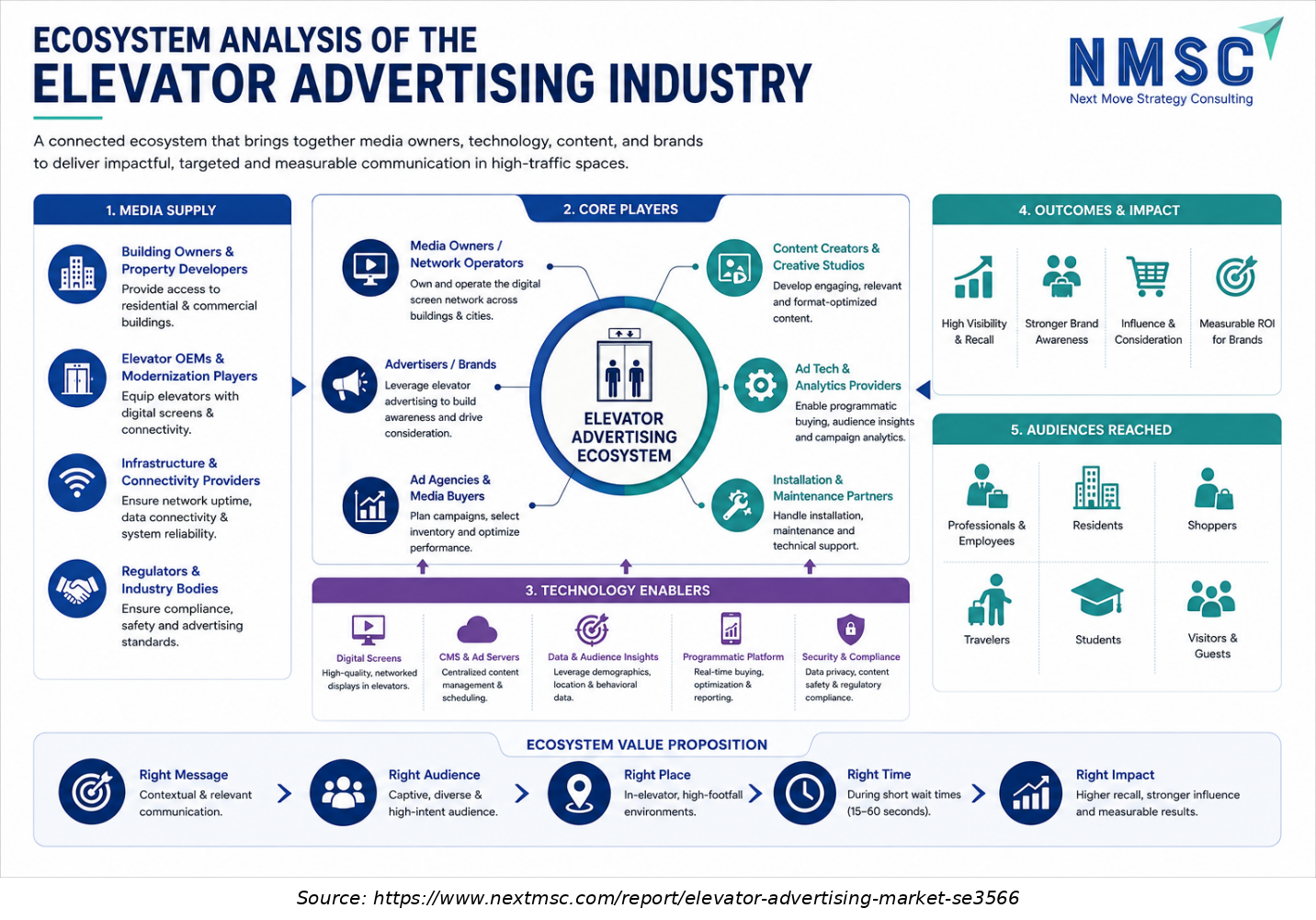
The above infographic maps the interconnected elevator advertising ecosystem, showing how property owners, elevator and technology providers, advertisers, agencies, content creators, and analytics partners work together. It highlights the technology infrastructure supporting digital screens, audience insights, and programmatic delivery, while connecting these participants to key audiences, measurable brand outcomes, and the ecosystem’s value proposition.

What Does the Elevator Advertising Market Encompass?

The elevator advertising market encompasses paid media formats deployed inside elevator cabins, on exterior elevator surfaces, and within dedicated elevator lobby zones to reach captive audiences during transit. Our assessment indicates that the scope spans digital screens, static print media, projection systems, and audio-only formats sold to advertisers across consumer products, retail, technology, healthcare, and financial services, among other industries, and installed across residential, office, hotel, retail, and healthcare properties worldwide. The category has evolved from static poster frames into a data-enabled digital media channel, driven by rising urban vertical density, smart-building adoption, and advertiser demand for hyper-local, high-frequency impression environments.

Building and elevator safety codes such as the U.S. ASME A17.1 Safety Code for Elevators and Escalators, together with municipal advertising and signage permitting rules, shape installation and content-display requirements for in-cabin media hardware. We observed that technology adoption is shifting toward networked digital displays and programmatic booking platforms that replace static posters with dynamic, impression-tracked content. Based on research conducted by NMSC, we found that this structural shift, combined with property owners’ growing appetite for ancillary revenue, is redefining how media operators price and sell elevator advertising inventory.

Key Emerging Trends

Based on research conducted by NMSC, we found that four structural trends are reshaping inventory design, sales models, and stakeholder engagement across the industry.

How Is Interactive Digital Screen Adoption Transforming In-Cabin Media?

Interactive digital screens with touch-enabled interfaces are replacing static non-interactive panels as media operators seek richer engagement metrics. We observed that several China-based operators have deployed touchscreen elevator panels supporting QR-code redemption and real-time weather or news content alongside advertising. Media operators are adopting these architectures to justify premium impression-based pricing, while property owners favor interactive formats that also serve building-wayfinding and tenant-communication functions.

Why Is Programmatic Booking Gaining Share in Elevator Media Buying?

Programmatic sale routes are gaining share as advertisers seek automated, data-driven placement across distributed elevator networks. Our findings suggest that demand-side platforms increasingly integrate elevator lobby and in-cabin screen inventory alongside traditional out-of-home formats, enabling advertisers to run cross-format campaigns from a single interface. Media operators such as Focus Media and JCDecaux are expanding programmatic-ready inventory, positioning this route as a premium, higher-margin channel within the broader booking structure.

How Is Retail Media Expansion Reshaping Elevator Advertising Demand?

Retail and shopping property owners are increasingly monetizing elevator lobby screens as an extension of in-store retail media networks. We observed that mall operators are bundling elevator lobby inventory with escalator and concourse media to offer advertisers building-wide reach packages. This trend is elevating demand for impression-based billing among retail and e-commerce advertisers, while media operators redesign lobby-screen networks to integrate with broader shopping-center retail media programs.

What Role Does Smart Building Integration Play in Elevator Media Innovation?

Smart building integration is emerging as a differentiator as elevator media platforms connect with building management and access-control systems. Our analysis shows that property developers in office and mixed-use developments are piloting elevator screens that combine tenant messaging, destination-dispatch data, and third-party advertising within a single interface. Executive Channel Network and Captivate are examples of operators positioning smart-building-integrated inventory as a premium format engineered for tenant-experience-focused office landlords.

Growth Drivers and Restraints

Growth Catalyst and Risk Assessment Matrix

What Is the Primary Growth Driver of the Elevator Advertising Market?

Rapid vertical urbanization is the primary driver of the market. The United Nations Department of Economic and Social Affairs projects continued growth in the share of the world population living in urban areas, sustaining demand for high-rise residential, office, and mixed-use construction that requires elevator infrastructure. We observed that this structural urban growth, reinforced by rising elevator installation counts in Asia-Pacific and Middle Eastern cities, continues to expand the addressable inventory base for in-cabin and lobby media across developed and emerging economies alike.

How Is Programmatic Technology Driving Elevator Advertising Market Growth?

Programmatic and data-driven ad-buying technology is accelerating market growth by making elevator inventory bookable alongside other out-of-home formats. Advertiser adoption of demand-side platforms that integrate elevator screen networks is expanding the addressable buyer base beyond traditional direct-sale relationships. Our assessment indicates that this technology shift, combined with impression-based measurement standards, is compressing sales cycles and broadening advertiser participation across digital display formats in North America, Europe, and Asia-Pacific.

What Is Restraining Elevator Advertising Market Expansion?

Advertising saturation and audience fatigue in dense urban cabins restrain premium pricing power across parts of the supply chain. Building-management associations in several North American and European cities have raised resident complaints regarding excessive in-cabin advertising density, prompting some property owners to cap screen counts. We found that smaller regional media operators face particular exposure, as limited property-portfolio scale reduces their ability to negotiate favorable ad-density terms compared with larger, multi-market operators.

Segmentation Analysis

Segment Sizing: By Format

Which Format Segment Dominates the Elevator Advertising Market?

Digital Display Media, encompassing non-interactive and interactive digital screens, led the market with USD 1.32 billion in 2025, supported by superior content flexibility and impression-tracking capability compared with static formats. We observed that Digital Display Media is also the fastest-growing format, expanding at a 10.7% CAGR from 2026 to 2035, as media operators retrofit elevator fleets with networked screens across office and residential properties requiring enhanced measurement standards.

Segment Sizing: By Placement

Which Placement Segment Leads Elevator Advertising Market Demand?

In-Cabin placements, spanning rear wall, side wall, interior door, ceiling, floor, and operating panel inventory, remained the leading placement segment at USD 1.75 billion in 2025, given their guaranteed dwell time during transit. Our findings suggest that Dedicated Elevator Lobby placements are the fastest-growing category, registering a 10.8% CAGR from 2026 to 2035, as retail and office property owners bundle lobby screens with broader building media packages to command impression-based pricing.

Segment Sizing: By Property Type

Which Property Type Segment Dominates the Elevator Advertising Market?

Office properties remained the leading property type at USD 830 million in 2025, supported by dense daily foot traffic and landlord appetite for tenant-amenity-linked advertising revenue. Our analysis shows that Retail and Shopping is the fastest-growing property type, expanding at a 10.2% CAGR from 2026 to 2035, as mall and shopping-center operators integrate elevator lobby screens into broader retail media network offerings.

Consumer Behaviour Analysis of the Elevator Advertising Industry

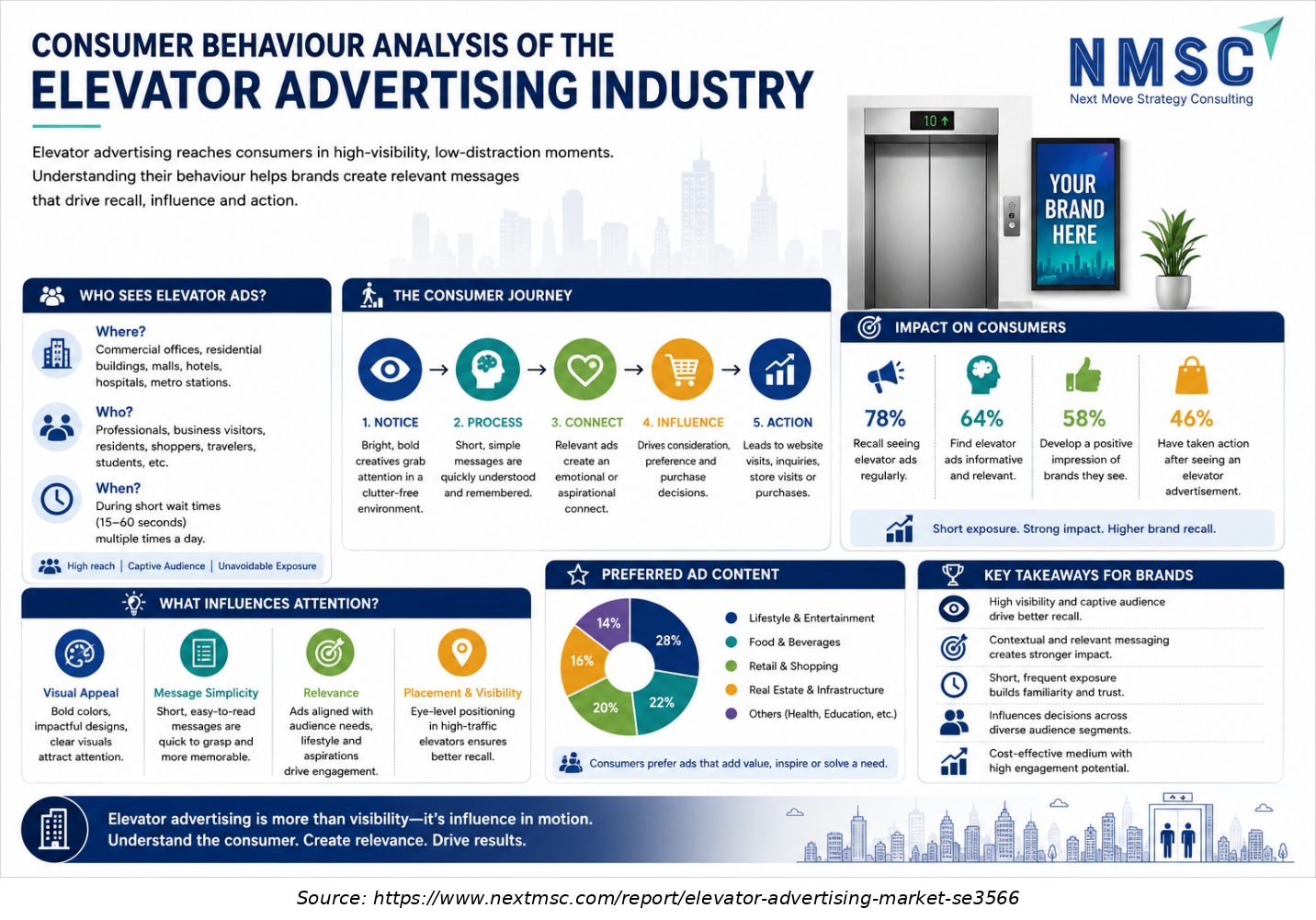
The above infographic provides a detailed consumer behavior analysis of the elevator advertising market, explaining how brands can capture attention during brief, high-traffic moments. It breaks down the audience demographics, the five-step psychological consumer journey from notice to action, and the specific elements that make ads effective. The diagram further highlights key metrics, preferred content categories among viewers, and actionable takeaways for brands, ultimately concluding that understanding consumer behavior is essential for creating relevant messages that drive recall and influence.

U.S.

Based on our estimates, the U.S. market was valued at approximately USD 620 million in 2025 and is projected to reach USD 1,190 million by 2035, growing at a 6.7% CAGR. Demand is anchored by a dense office and multifamily residential elevator base and advertiser appetite for programmatic out-of-home buying. Technology penetration favors digital display formats, and competitive intensity remains high among established national media operators.
Canada
The market in Canada reached roughly USD 140 million in 2025 and is forecast to hit USD 290 million by 2035 at a 7.5% CAGR. Demand structure mirrors U.S. office and residential elevator advertising patterns, while municipal signage bylaws shape content-display requirements. Technology penetration is rising as national landlords request digital screen retrofits, with competitive intensity moderate given reliance on cross-border media network partnerships.

UK

As per our estimate, the UK market stood at about USD 150 million in 2025, advancing toward USD 270 million by 2035 at a 6.1% CAGR. Demand is driven by a mature London and regional office property base navigating building-management advertising standards. Regulatory influence is moderate, technology penetration favors digital display adoption, and competitive intensity remains steady among domestic and pan-European media operators.
Germany
According to our analysis, Germany’s market was valued near USD 140 million in 2025 and is set to reach USD 255 million by 2035, expanding at a 6.2% CAGR. Demand structure benefits from a strong domestic office and mixed-use property base. Germany’s municipal signage regulations shape regulatory influence, while technology penetration favors interactive digital screens among leading regional operators.
France
Based on our estimates, France’s market reached approximately USD 110 million in 2025, projected to climb to USD 200 million by 2035 at a 6.2% CAGR. Demand is supported by France’s dense Paris office and residential property base, which shapes premium lobby-screen adoption. Regulatory influence from municipal advertising codes is notable, and competitive intensity remains high given the concentration of pan-European operators headquartered in the region.
China
The market in China stood at roughly USD 390 million in 2025 and is forecast to reach USD 1,080 million by 2035, registering a 10.7% CAGR. Demand is fueled by expanding high-rise residential and office construction and a dense base of domestic media operators. Regulatory influence is increasing gradually, technology penetration is accelerating through interactive screen rollouts, and competitive intensity remains elevated among numerous China-based operators.
India
As per our estimate, India’s market was valued at about USD 140 million in 2025, projected to reach USD 430 million by 2035 at an 11.9% CAGR, among the fastest of the covered countries. Demand structure reflects rapid urban high-rise construction and expanding organized property management for residential and office towers. Regulatory influence remains developing, while technology penetration is rising quickly as domestic operators scale digital screen deployment.
Japan
According to our analysis, Japan’s market reached close to USD 110 million in 2025 and is expected to hit USD 230 million by 2035, growing at an 8.5% CAGR. Demand is supported by Japan’s dense urban office and residential elevator base and precision-engineered digital display technology. Regulatory influence is well established, technology penetration is advanced, and competitive intensity remains high among long-standing domestic media operators.
South Korea
Based on our estimates, South Korea’s market stood at approximately USD 85 million in 2025, forecast to reach USD 210 million by 2035 at a 9.4% CAGR. Demand structure benefits from the country’s high apartment-tower density and advanced digital-media culture. Technology penetration is high, with domestic operators supplying interactive screen formats, and competitive intensity remains pronounced amid rapid content-innovation cycles.
Australia
The elevator advertising market in Australia reached about USD 60 million in 2025 and is projected to reach USD 135 million by 2035, expanding at an 8.4% CAGR. Demand is supported by a well-established office and residential property sector and growing landlord interest in ancillary revenue. Regulatory influence stems from state-level signage codes, while technology penetration favors digital display systems amid moderate competitive intensity.

UAE

UAE
As per our estimate, the UAE market was valued near USD 55 million in 2025, projected to reach USD 155 million by 2035 at a 10.9% CAGR. Demand structure is shaped by the UAE’s role as a regional commercial tower and hospitality development hub. Regulatory influence remains moderate, technology penetration is improving through digital display formats, and competitive intensity is rising as operators expand portfolios to serve Gulf markets, alongside broader growth in the UAE elevator installation base.
Saudi Arabia
According to our analysis, Saudi Arabia’s market reached roughly USD 60 million in 2025 and is expected to hit USD 170 million by 2035, growing at an 11.0% CAGR, the fastest among covered countries. Demand is driven by Vision 2030-linked urban development and rising commercial tower construction. Regulatory influence is developing, and technology penetration is advancing as domestic operators scale digital screen deployment across the growing Saudi Arabia elevator base.
South Africa
Based on our estimates, South Africa’s market stood at about USD 35 million in 2025, forecast to reach USD 78 million by 2035 at an 8.3% CAGR. Demand structure reflects a developing commercial property base serving regional Southern African markets, alongside a modest installed South Africa elevator fleet. Regulatory influence remains moderate, technology penetration is gradually improving, and competitive intensity is limited given reliance on regional media operators.
Brazil
The market in Brazil reached approximately USD 75 million in 2025 and is projected to reach USD 170 million by 2035, registering an 8.5% CAGR. Demand is underpinned by Brazil’s large domestic residential and office property base and expanding organized property management within the broader Brazil elevator installation market. Regulatory influence remains limited, and competitive intensity is moderate among regional operators.
Argentina
As per our estimate, Argentina’s market was valued near USD 30 million in 2025, projected to reach USD 68 million by 2035 at an 8.5% CAGR. Demand structure is supported by steady urban residential and commercial property consumption despite macroeconomic volatility affecting the wider Argentine elevator sector. Regulatory influence remains limited, and competitive intensity is centered on a small number of regional media operators.
Competitive Landscape
We observed that the elevator advertising market features a moderately consolidated competitive landscape, with global out-of-home specialists competing alongside regional Asian media groups on property coverage, technology, and pricing model innovation.
Key Takeaways
Dimension Description
Market Structure Moderately consolidated; the top companies profiled in this report collectively account for a majority of global elevator advertising market revenue, while numerous regional Asia-Pacific operators serve cost-sensitive standard placement demand.
Innovation Focus Interactive digital screen deployment, programmatic booking integration, and impression-based measurement standards dominate current innovation pipelines across leading operators.
M&A Activity Selective consolidation through portfolio and property-network acquisitions, exemplified by outdoor and transit media groups broadening in-building elevator and lobby screen capabilities.
Source: www.nextmsc.com
How Do Companies Compete in the Elevator Advertising Market?
Companies compete primarily on property-network scale, technology sophistication, and measurement credibility across the industry. Global players such as JCDecaux and Pattison Outdoor Advertising leverage broad multi-property portfolios to serve national and multinational advertisers, while regional Chinese operators compete on installation speed and cost efficiency for standard digital display formats supplied to smaller property owners and local advertisers.
Which Competitive Archetypes Dominate the Elevator Advertising Market?
Two archetypes dominate the market: diversified global out-of-home groups offering full-service property acquisition and programmatic sales support, and specialized regional media operators focused on high-volume, cost-competitive standard placements. oOh!media and Pattison Outdoor Advertising exemplify the diversified archetype through integrated property-network operations, while Focus Media and Chengdu Xinchao Media Group exemplify the regional cost-leadership archetype serving Asia-Pacific demand.
How Are Companies Differentiating Through Innovation in Elevator Advertising?
Innovation and differentiation strategy increasingly center on interactive screen engineering and programmatic-ready inventory. Vertical Impression and JCDecaux both invest in networked digital display platforms to secure impression-based measurement standards accepted by major advertisers. Our analysis shows that operators unable to demonstrate credible measurement and programmatic integration risk exclusion from advertiser request-for-proposal shortlists in North America and Europe.
What M&A and Expansion Activity Is Shaping the Elevator Advertising Market?
Mergers, acquisitions, and geographic expansion continue to consolidate media-network capabilities within the industry. Pattison Outdoor Advertising’s portfolio expansion into in-building media broadened its elevator and lobby screen footprint, while Focus Media’s continued property-network growth across China illustrates how diversified operators pursue geographic expansion and pricing leverage across office, residential, and retail end markets.
Key Market Players
Our assessment indicates that the following 20 companies are actively shaping property acquisition, technology deployment, and inventory expansion strategy within the global elevator advertising market.
Focus Media Information Technology Co., Ltd.
Chengdu Xinchao Media Group Co., Ltd.
Beijing Tikin Media Technology Co., Ltd.
Chicilon Digital Media
Eletromidia S.A.
Captivate, LLC
Billion Broadcaster (Abbie IT Mart Private Limited)
Gold Zone Media Co., Ltd.
Vertical Impression Inc.
JCDecaux SE
Pattison Outdoor Advertising LP
oOh!media Limited
PAMS LLC
Elevision Media LLC
LiftUp (Sunrise Retail Group)
Executive Channel Network Ltd.
City Media Shanghai Corp.
TOKYO, Inc.
MMM Group Berhad
Oneroad Advertising DMCC
Latest Developments
We observed that recent activity across the industry centers on network expansion, technology upgrades, and programmatic partnership announcements among leading operators.
Date Event
January 2026 Elevision launched new residential media circuits across Jumeirah, Bluewaters, Meydan, Discovery Gardens and Al Furjan. The rollout includes elevator and lobby screens equipped with real-time impression reporting, audience measurement and targeted campaign capabilities, expanding elevator-media inventory across Dubai's high-value residential communities.
October 2025 Elevision launched a residential media circuit covering 29 buildings with 93 elevator screens, generating a stated monthly reach of 12,495 and 10,933 daily impressions per campaign. The launch also introduced 21-inch portrait elevator screens designed for dynamic digital advertising content.
April 2025 Focus Media announced plans to acquire 100% of Xinchao Media for an estimated transaction value of RMB 8.3 billion (approximately USD 1.15–1.22 billion, depending on the exchange rate used). The acquisition would make Xinchao Media a wholly owned subsidiary of Focus Media and strengthen its community/elevator-media advertising footprint.
Source: www.nextmsc.com
Expert Insights
“Global brands leverage the unique advantages of elevator digital media to create more effective and impactful consumer outreach campaigns.”

What Does the Elevator Advertising Market Encompass?

The elevator advertising market encompasses paid media formats deployed inside elevator cabins, on exterior elevator surfaces, and within dedicated elevator lobby zones to reach captive audiences during transit. Our assessment indicates that the scope spans digital screens, static print media, projection systems, and audio-only formats sold to advertisers across consumer products, retail, technology, healthcare, and financial services, among other industries, and installed across residential, office, hotel, retail, and healthcare properties worldwide. The category has evolved from static poster frames into a data-enabled digital media channel, driven by rising urban vertical density, smart-building adoption, and advertiser demand for hyper-local, high-frequency impression environments.
Building and elevator safety codes such as the U.S. ASME A17.1 Safety Code for Elevators and Escalators, together with municipal advertising and signage permitting rules, shape installation and content-display requirements for in-cabin media hardware. We observed that technology adoption is shifting toward networked digital displays and programmatic booking platforms that replace static posters with dynamic, impression-tracked content. Based on research conducted by NMSC, we found that this structural shift, combined with property owners’ growing appetite for ancillary revenue, is redefining how media operators price and sell elevator advertising inventory.

Investment Opportunities

Where Are Capital Inflows Concentrating in the Elevator Advertising Market?

Capital inflows are concentrating in multi-property media network operators capable of scaling digital screen installations across office and residential portfolios. Investors are prioritizing operators with programmatic-ready infrastructure and diversified property-owner relationships that reduce single-contract concentration risk, particularly across Asia-Pacific and Middle Eastern growth markets.

How Significant Is Infrastructure Investment in Elevator Media Networks?

Infrastructure investment remains significant as operators upgrade static print installations to networked digital display hardware. Property owners and media operators are jointly funding screen retrofits to capture higher impression-based revenue, with infrastructure spending concentrated in newly constructed office, residential, and mixed-use towers across high-growth urban markets.

What ESG Considerations Shape Elevator Advertising Investment?

ESG considerations increasingly influence investment decisions as operators adopt energy-efficient digital display technology and reduce material waste associated with static print media. Property owners pursuing sustainability certifications favor media partners demonstrating lower-power screen hardware, positioning ESG performance as a growing factor in operator selection and long-term contract renewal.

Key Benefits for Stakeholders

How Does This Report Benefit Property and Media Industry Leaders?

Industry leaders gain access to validated segmentation, competitive benchmarking, and regional demand analysis that inform property-network expansion and pricing strategy. The report’s forecasts and segment-level data support informed decisions on which formats and placements to prioritize across office, residential, and retail property portfolios.

How Does This Report Benefit Investors and Financial Analysts?

Investors and financial analysts gain a data-grounded view of market size, growth trajectory, and competitive structure to support valuation and capital-allocation decisions. The report’s regional and segment forecasts help identify which geographies and formats offer the strongest growth-adjusted investment profiles within the industry.

How Does This Report Benefit Technology Vendors and Product Teams?

Technology vendors and product teams gain insight into format-level adoption trends, including the shift toward interactive digital screens and programmatic booking integration. This analysis supports product roadmap and go-to-market decisions for hardware and software vendors serving the elevator advertising industry.

Key Market Segments Evaluated

By Format

  • Digital Display Media
  • Static Print Media
  • Projection Media
  • Audio-Only Media
  • Other Elevator Media

By Placement

  • In-Cabin
  • Exterior Elevator Surface
  • Dedicated Elevator Lobby
  • Other Elevator Surface

By Property Type

  • Residential
  • Office
  • Hotel and Hospitality
  • Retail and Shopping
  • Healthcare
  • Education
  • Government and Institutional
  • Transport
  • Mixed-Use
  • Other Property

By Booking Route

  • Direct Sale
  • Programmatic Sale
  • Reseller Sale
  • Other Contracted Sale

By Billing Basis

  • Position-Based
  • Time-Based
  • Impression-Based
  • Spot-Based
  • Package-Based

By Advertiser Industry

  • Consumer Products
  • Retail and E-Commerce
  • Internet and Technology
  • Automotive
  • Healthcare and Pharmaceuticals
  • Real Estate and Home
  • Financial Services
  • Education
  • Media and Entertainment
  • Travel and Hospitality
  • Food and Beverage
  • Professional and Business Services
  • Government and Non-Profit
  • Other Advertiser Industries

Market Drivers & Dynamics

Interactive Dataset
Rapid vertical urbanization and high-rise construction driver +2.0% Global 2026-2035
Growth of programmatic and data-driven ad buying driver +1.7% North America, Europe, Asia-Pacific 2026-2035
Expansion of digital display media over static print driver +1.5% Global 2026-2035
Rising office and mixed-use development in Asia-Pacific driver +1.4% Asia-Pacific 2026-2035
Retail media network expansion into shared building spaces driver +1.0% Global 2026-2032
Growing property owner focus on ancillary revenue streams driver +0.8% Global 2026-2035
Ad fatigue and saturation in dense urban cabins restraint -1.0% North America, Europe 2026-2035
Competition from mobile and app-based hyper-local advertising restraint -0.9% Global 2026-2032
Building access and installation permitting constraints restraint -0.5% Europe 2028-2035
Source: Next Move Strategy Consulting

Growth Drivers

What Is the Primary Growth Driver of the Elevator Advertising Market?

Rapid vertical urbanization is the primary driver of the market. The United Nations Department of Economic and Social Affairs projects continued growth in the share of the world population living in urban areas, sustaining demand for high-rise residential, office, and mixed-use construction that requires elevator infrastructure. We observed that this structural urban growth, reinforced by rising elevator installation counts in Asia-Pacific and Middle Eastern cities, continues to expand the addressable inventory base for in-cabin and lobby media across developed and emerging economies alike.

How Is Programmatic Technology Driving Elevator Advertising Market Growth?

Programmatic and data-driven ad-buying technology is accelerating market growth by making elevator inventory bookable alongside other out-of-home formats. Advertiser adoption of demand-side platforms that integrate elevator screen networks is expanding the addressable buyer base beyond traditional direct-sale relationships. Our assessment indicates that this technology shift, combined with impression-based measurement standards, is compressing sales cycles and broadening advertiser participation across digital display formats in North America, Europe, and Asia-Pacific.

Growth Inhibitors

What Is Restraining Elevator Advertising Market Expansion?

Advertising saturation and audience fatigue in dense urban cabins restrain premium pricing power across parts of the supply chain. Building-management associations in several North American and European cities have raised resident complaints regarding excessive in-cabin advertising density, prompting some property owners to cap screen counts. We found that smaller regional media operators face particular exposure, as limited property-portfolio scale reduces their ability to negotiate favorable ad-density terms compared with larger, multi-market operators.

What Are the Growth Opportunities?

How Can Interactive Screen Formats Unlock Value for Retail Advertisers?

Interactive digital screens present a whitespace opportunity for retail and e-commerce advertisers seeking measurable, engagement-linked elevator inventory. Operators that commercialize touch-enabled or QR-linked screens stand to capture premium impression-based pricing as brands shift toward performance-measured out-of-home spending across dedicated elevator lobby and in-cabin placements.

Where Do Healthcare and Institutional Properties Create New Demand?

Healthcare and government and institutional properties represent an underpenetrated opportunity for compliant, low-disruption elevator media formats. Operators that develop content standards suited to hospitals and government buildings can secure long-term facility contracts, benefiting from recurring revenue tied to institutional property management agreements.

How Can Programmatic Booking Platforms Benefit Multi-Property Media Operators?

Programmatic booking integration creates an opportunity for multi-property media operators to access advertiser demand beyond direct sales relationships. Early movers that connect elevator inventory to demand-side platforms can differentiate with technology and internet advertisers pursuing automated, data-driven out-of-home campaign execution across their portfolios.

Segmentation Analysis

2025 (USD Billion)
2035 (USD Billion)
Digital Display Media 2025: $1.32 Billion | 2035: $3.56 Billion
Digital Disp
Static Print Media 2025: $0.95 Billion | 2035: $1.53 Billion
Static Print
Projection Media 2025: $0.32 Billion | 2035: $0.81 Billion
Projection M
Audio-Only Media 2025: $0.18 Billion | 2035: $0.34 Billion
Audio-Only M
Other Elevator Media 2025: $0.10 Billion | 2035: $0.18 Billion
Other Elevat
Digital Display Media $1.32 Billion $3.56 Billion 10.7%
Static Print Media $0.95 Billion $1.53 Billion 4.5%
Projection Media $0.32 Billion $0.81 Billion 9.8%
Audio-Only Media $0.18 Billion $0.34 Billion 6.0%
Other Elevator Media $0.10 Billion $0.18 Billion 6.5%

Which Format Segment Dominates the Elevator Advertising Market?

Digital Display Media, encompassing non-interactive and interactive digital screens, led the market with USD 1.32 billion in 2025, supported by superior content flexibility and impression-tracking capability compared with static formats. We observed that Digital Display Media is also the fastest-growing format, expanding at a 10.7% CAGR from 2026 to 2035, as media operators retrofit elevator fleets with networked screens across office and residential properties requiring enhanced measurement standards.

2025 (USD Billion)
2035 (USD Billion)
In-Cabin
Rear Wall
Side Wall
Interior Doo
Ceiling
Segment Item 2025 (USD Billion) 2035 (USD Billion) CAGR
In-Cabin $10.0 USD Billion $40.0 USD Billion 13.0%
Rear Wall $17.1 USD Billion $51.1 USD Billion 11.0%
Side Wall $24.2 USD Billion $62.2 USD Billion 25.0%
Interior Door $31.3 USD Billion $73.3 USD Billion 19.0%
Ceiling $38.4 USD Billion $84.4 USD Billion 16.0%

Segment-wise data is locked

Unlock complete segment-wise numbers for By Placement.

Unlock Full Data

Which Placement Segment Leads Elevator Advertising Market Demand?

In-Cabin placements, spanning rear wall, side wall, interior door, ceiling, floor, and operating panel inventory, remained the leading placement segment at USD 1.75 billion in 2025, given their guaranteed dwell time during transit. Our findings suggest that Dedicated Elevator Lobby placements are the fastest-growing category, registering a 10.8% CAGR from 2026 to 2035, as retail and office property owners bundle lobby screens with broader building media packages to command impression-based pricing.

2025 (USD Billion)
2035 (USD Billion)
Residential
Office
Hotel and Ho
Retail and S
Healthcare
Segment Item 2025 (USD Billion) 2035 (USD Billion) CAGR
Residential $10.0 USD Billion $40.0 USD Billion 22.0%
Office $17.1 USD Billion $51.1 USD Billion 8.0%
Hotel and Hospitality $24.2 USD Billion $62.2 USD Billion 26.0%
Retail and Shopping $31.3 USD Billion $73.3 USD Billion 24.0%
Healthcare $38.4 USD Billion $84.4 USD Billion 19.0%

Segment-wise data is locked

Unlock complete segment-wise numbers for By Property Type.

Unlock Full Data

Which Property Type Segment Dominates the Elevator Advertising Market?

Office properties remained the leading property type at USD 830 million in 2025, supported by dense daily foot traffic and landlord appetite for tenant-amenity-linked advertising revenue. Our analysis shows that Retail and Shopping is the fastest-growing property type, expanding at a 10.2% CAGR from 2026 to 2035, as mall and shopping-center operators integrate elevator lobby screens into broader retail media network offerings.

2025 (USD Billion)
2035 (USD Billion)
Direct Sale
Programmatic
Reseller Sal
Other Contra
Segment Item 2025 (USD Billion) 2035 (USD Billion) CAGR
Direct Sale $10.0 USD Billion $40.0 USD Billion 22.0%
Programmatic Sale $17.1 USD Billion $51.1 USD Billion 12.0%
Reseller Sale $24.2 USD Billion $62.2 USD Billion 18.0%
Other Contracted Sale $31.3 USD Billion $73.3 USD Billion 20.0%

Segment-wise data is locked

Unlock complete segment-wise numbers for By Booking Route.

Unlock Full Data
2025 (USD Billion)
2035 (USD Billion)
Position-Bas
Time-Based
Impression-B
Spot-Based
Package-Base
Segment Item 2025 (USD Billion) 2035 (USD Billion) CAGR
Position-Based $10.0 USD Billion $40.0 USD Billion 11.0%
Time-Based $17.1 USD Billion $51.1 USD Billion 17.0%
Impression-Based $24.2 USD Billion $62.2 USD Billion 27.0%
Spot-Based $31.3 USD Billion $73.3 USD Billion 25.0%
Package-Based $38.4 USD Billion $84.4 USD Billion 10.0%

Segment-wise data is locked

Unlock complete segment-wise numbers for By Billing Basis.

Unlock Full Data
2025 (USD Billion)
2035 (USD Billion)
Consumer Pro
Retail and E
Internet and
Automotive
Healthcare a
Segment Item 2025 (USD Billion) 2035 (USD Billion) CAGR
Consumer Products $10.0 USD Billion $40.0 USD Billion 9.0%
Retail and E-Commerce $17.1 USD Billion $51.1 USD Billion 11.0%
Internet and Technology $24.2 USD Billion $62.2 USD Billion 25.0%
Automotive $31.3 USD Billion $73.3 USD Billion 19.0%
Healthcare and Pharmaceuticals $38.4 USD Billion $84.4 USD Billion 24.0%

Segment-wise data is locked

Unlock complete segment-wise numbers for By Advertiser Industry.

Unlock Full Data

Regional Outlook

2025 (USD Billion)
2035 (USD Billion)
North Americ
Europe
Asia-Pacific
Middle East
Latin Americ
Region 2025 (USD Billion) 2035 (USD Billion) CAGR (%)
North America $10.0 USD Billion $40.0 USD Billion 9.0%
Europe $17.1 USD Billion $51.1 USD Billion 27.0%
Asia-Pacific $24.2 USD Billion $62.2 USD Billion 25.0%
Middle East & Africa $31.3 USD Billion $73.3 USD Billion 23.0%
Latin America $38.4 USD Billion $84.4 USD Billion 12.0%

Regional data is locked

Unlock complete regional numbers for this market.

Unlock Full Data

Competitive Landscape

Dimension Description
Market Structure Moderately consolidated; the top companies profiled in this report collectively account for a majority of global elevator advertising market revenue, while numerous regional Asia-Pacific operators serve cost-sensitive standard placement demand.
Innovation Focus Interactive digital screen deployment, programmatic booking integration, and impression-based measurement standards dominate current innovation pipelines across leading operators.
M&A Activity Selective consolidation through portfolio and property-network acquisitions, exemplified by outdoor and transit media groups broadening in-building elevator and lobby screen capabilities.

How Do Companies Compete in the Elevator Advertising Market?

Companies compete primarily on property-network scale, technology sophistication, and measurement credibility across the industry. Global players such as JCDecaux and Pattison Outdoor Advertising leverage broad multi-property portfolios to serve national and multinational advertisers, while regional Chinese operators compete on installation speed and cost efficiency for standard digital display formats supplied to smaller property owners and local advertisers.

Which Competitive Archetypes Dominate the Elevator Advertising Market?

Two archetypes dominate the market: diversified global out-of-home groups offering full-service property acquisition and programmatic sales support, and specialized regional media operators focused on high-volume, cost-competitive standard placements. oOh!media and Pattison Outdoor Advertising exemplify the diversified archetype through integrated property-network operations, while Focus Media and Chengdu Xinchao Media Group exemplify the regional cost-leadership archetype serving Asia-Pacific demand.

How Are Companies Differentiating Through Innovation in Elevator Advertising?

Innovation and differentiation strategy increasingly center on interactive screen engineering and programmatic-ready inventory. Vertical Impression and JCDecaux both invest in networked digital display platforms to secure impression-based measurement standards accepted by major advertisers. Our analysis shows that operators unable to demonstrate credible measurement and programmatic integration risk exclusion from advertiser request-for-proposal shortlists in North America and Europe.

What M&A and Expansion Activity Is Shaping the Elevator Advertising Market?

Mergers, acquisitions, and geographic expansion continue to consolidate media-network capabilities within the industry. Pattison Outdoor Advertising’s portfolio expansion into in-building media broadened its elevator and lobby screen footprint, while Focus Media’s continued property-network growth across China illustrates how diversified operators pursue geographic expansion and pricing leverage across office, residential, and retail end markets.

Competitive Dynamics and M&A Landscape

Recent strategic moves, partnerships, and acquisitions shaping the Elevator Advertising Market Global Industry Analysis and Forecast (2026-2035).

January 2026 Elevision Launch Elevision launched new residential media circuits across Jumeirah, Bluewaters, Meydan, Discovery Gardens and Al Furjan. The rollout includes elevator and lobby screens equipped with real-time impression reporting, audience measurement and targeted campaign capabilities, expanding elevator-media inventory across Dubai's high-value residential communities.
October 2025 Elevision Launch Elevision launched a residential media circuit covering 29 buildings with 93 elevator screens, generating a stated monthly reach of 12,495 and 10,933 daily impressions per campaign. The launch also introduced 21-inch portrait elevator screens designed for dynamic digital advertising content.
April 2025 Focus Media Acquisition Focus Media announced plans to acquire 100% of Xinchao Media for an estimated transaction value of RMB 8.3 billion (approximately USD 1.15–1.22 billion, depending on the exchange rate used). The acquisition would make Xinchao Media a wholly owned subsidiary of Focus Media and strengthen its community/elevator-media advertising footprint.

Key Market Players

Focus Media Information Technology Co., Ltd. Chengdu Xinchao Media Group Co., Ltd. Beijing Tikin Media Technology Co., Ltd. Chicilon Digital Media Eletromidia S.A. Captivate, LLC Billion Broadcaster (Abbie IT Mart Private Limited) Gold Zone Media Co., Ltd. Vertical Impression Inc. JCDecaux SE Pattison Outdoor Advertising LP oOh!media Limited PAMS LLC Elevision Media LLC LiftUp (Sunrise Retail Group) Executive Channel Network Ltd. City Media Shanghai Corp. TOKYO, Inc. MMM Group Berhad Oneroad Advertising DMCC

Conclusion & Recommendations

The long-term outlook remains positive, with the market projected to nearly double from USD 3.11 billion in 2026 to USD 6.42 billion by 2035 at an 8.4% CAGR. Sustained vertical urbanization, digital screen retrofits, and expanding programmatic adoption underpin this trajectory, positioning the industry for structural growth beyond the current forecast window as building stock continues to expand globally.

What Strategic Positioning Do We Recommend for Market Participants?

We recommend that media operators prioritize digital and interactive screen retrofits ahead of static print inventory to capture premium impression-based pricing. Property owners should pursue multi-format bundling across in-cabin and lobby placements, while advertisers are encouraged to adopt programmatic booking channels to access measurable, cross-property elevator inventory efficiently.

How Attractive Is the Elevator Advertising Market for Investment?

Investment attractiveness is favorable given the market’s 8.4% CAGR, moderately consolidated competitive structure, and rising advertiser demand for accountable out-of-home formats. Asia-Pacific and Middle East & Africa offer the strongest growth-adjusted returns, while North America and Europe provide stable, programmatic-driven cash flow for diversified operators.

What Market Shifts and Key Risks Should Stakeholders Monitor?

Stakeholders should monitor advertising-density saturation in mature urban cabins and competition from mobile and app-based hyper-local advertising formats. Building-permitting constraints in parts of Europe and potential resident pushback on advertising volume represent additional risks that could moderate near-term inventory expansion in specific markets.

What Are the Primary Growth Pathways Through 2035?

Primary growth pathways include interactive digital screen deployment, programmatic sale-route expansion, and deeper penetration of retail, healthcare, and mixed-use property types currently underrepresented relative to office and residential inventory. Operators that combine technology upgrades with diversified property-type coverage are best positioned to capture the market’s incremental USD 3.31 billion opportunity between 2026 and 2035.

Expert Insights

Melanie Lindquist

Asia-Pacific Communications Expert and OOH Advertising Advisor

"Global brands leverage the unique advantages of elevator digital media to create more effective and impactful consumer outreach campaigns."

Analyst Interpretation

Lindquist's comment underscores the growing integration of elevator digital media into broader omnichannel and OOH strategies. Her observation is particularly relevant as advertisers increasingly seek environments that combine contextual placement, visibility, and audience trust. Elevator advertising can complement online and conventional OOH campaigns by placing brand messages within consumers' everyday residential and workplace environments. This supports market growth as brands increasingly treat elevator screens as a strategic digital OOH inventory rather than a standalone niche advertising format.

Delivered Customizations

We have successfully delivered the following deep-dive customizations:

Client Request Customization Delivered Value Adds
Historical Market Revenue Analysis
  • Historical elevator advertising revenue analysis by format, placement, and property type, with billing-basis trends.
  • Identifies high-growth formats and property segments to prioritize for investment.
Company-Level Advertising Revenue Analysis
  • Company-level elevator advertising revenue benchmarking for leading media owners and network operators, split by format where disclosed.
  • Clarifies competitor scale and revenue mix to support positioning and M&A screening.
Company-Level Screen and Network Footprint Analysis
  • Company-level benchmarking of installed digital screens, elevator or building coverage, and impressions or ad-play volumes where publicly reported.
  • Highlights network scale differences and white-space for expansion or partnerships.
Property Type Inventory and Monetization Assessment
  • Mapping of ad inventory and monetization potential across residential, office, hotel, and mixed-use properties by placement (in-cabin, lobby, and waiting area).
  • Directs site acquisition and landlord partnership priorities toward the highest-yield property types.
Booking Route and Billing Model Benchmarking
  • Comparison of direct, agency, and programmatic booking routes against CPM, flat-rate, and cost-per-time billing, with pricing ranges from public rate cards.
  • Supports pricing strategy and sales channel optimization.
Advertiser Industry Demand Assessment
  • Analysis of elevator ad spend and campaign adoption by advertiser industry (e.g., FMCG, real estate, e-commerce, automotive, and financial services) across formats.
  • Pinpoints priority advertiser verticals for targeted sales and format development.

FAQs

About the Author

Mayurima Roy

Mayurima Roy

Mayurima Roy is Research Analyst at Next Move Strategy Consulting, where she has spent 4 years working across the firm's full industry coverage rather than a single fixed vertical. Her work centers on structured research, ongoing trend tracking, competitive assessment, and insight-led content development, translating complex market data into clear, decision-ready narratives that support informed client decision-making across diverse global industries, market sectors, and world regions every day.

About the Reviewer

Supradip Baul

Supradip Baul

Supradip Baul is an accomplished business consultant and strategist with over a decade of rich experience in market intelligence, strategy, technology, and business transformation. His work has included rigorous qualitative and quantitative analysis across multiple industries, helping clients shape investment decisions and long-term roadmaps. Earlier in his career, he was associated with Gartner, where he contributed to industry-leading reports and market share analyses. He has worked with leading global companies and holds an MBA with a dual specialization in Marketing and Finance.

Download Free Sample

Diana Trejo

DIANA TREJO

Assistant Manager

Sumitomo Corporation de Mexico, S.A. de C.V.

Recently, we purchased a report on the Mexico Data Center Market from Next Move Strategy Consulting. The service has been excellent, with support that is always timely and thoroughly professional. The information provided is interesting, highly useful, and delivered with clarity. I would highly recommend NextMSC for anyone seeking insightful and dependable analysis.

Kishu Kanda

KISHU KANDA

Strategy Analyst

Accenture

We purchased the AI Consumer Market Report from this company. Not only did they customize the report to meet our specific requirements, but they also showed great flexibility in accommodating our budget. The report we received fully met our expectations. Additionally, they provided prompt and thorough responses to both our pre-purchase and follow-up questions. We look forward to working with this company again in the future.

Henri Knyphausen

HENRI KNYPHAUSEN

Partner at Singulier [Ex-BCG]

Singulier

I recently engaged NEXTMSC.com for a commercial due diligence project within the intralogistics sector, and I am pleased to provide a reference based on my experience. In utilizing NEXTMSC.com's services, I found their report to offer valuable insights into market dynamics and key industry players. The initial report provided a solid foundation for our analysis. However, as we were investigating a smaller target in the market, and I had specific customization requests requiring additional research. These requests included detailed information on product portfolios of various players and sub-market sizes, both inclusive and exclusive of certain product categories. NEXTMSC.com demonstrated commendable responsiveness and agility in accommodating these customization requests. Within a timeframe of 1-2 weeks, they delivered a revised report that met our specific needs. Furthermore, they were receptive to my follow-up inquiries, ensuring clarity and understanding of the data provided. The final deliverable significantly contributed to our due diligence efforts. One of NEXTMSC.com's notable strengths lies in their qualitative research capabilities. However, for future engagements, I would recommend the inclusion of a quantified market model in Excel format. Such a model would offer the ability to conduct in-depth analyses and explore various market segments, including country-specific data and subcomponent breakdowns. Based on my positive experience, I would not hesitate to work with NEXTMSC.com again. Their responsiveness, willingness to accommodate customization requests, and commitment to delivering actionable insights make them a reliable partner for commercial research projects.

Mohit Agarwal

MOHIT AGARWAL

Chief Manager

DryChem India Pvt. Ltd.

Next Move Strategy Consulting is an amazing team of consultants. We required a market study report for our investors on top priority and the team went above and beyond our expectations to deliver the same with ample supporting data within a short time span enabling us to secure the investments and keep our project timeline maintained. Their professionalism, attention to detail, and timely delivery of actionable recommendations have left a lasting impression on our organization.

Nishant Awate

NISHANT AWATE

Business Development Global Sales

Zehnder Group Deutschland GmbH

Our experience working with Next Move Strategy Consulting was positive. The team was responsive, professional, and open to incorporating our specific requirements throughout the project. The India AHU market study was comprehensive and well structured, covering market value and volume forecasts, product and application segments, and key industry trends. The inclusion of both AHU and residential MVHR market insights made the study particularly relevant for our strategic market assessment. Overall, the report provides a solid foundation for evaluating market potential, identifying priority segments, and supporting business-development decisions in India.

Custom Market Research Services

We will customize the research for you if the listed report does not fully match your requirements.

Get 30% Free Customization

Select License

This website uses cookies to ensure you get the best experience on our website. Learn more

✖