Europe Room Air Conditioner Market By Product Type (Window AC, Portable AC, Single Split AC, Multi Split, & Others), By Speed Type (Fixed Speed & Inverter), By Cooling Capacity (≤ 1.0 Ton, >1.0 to ≤1.5 Ton, >1.5 to ≤2.0 Ton, & Others), By Efficiency Band (Entry, Standard, & Others), By Refrigerant (R22, R410A, R32, Hydrocarbon, & Others), By Function (Cooling Only, Heat Pump, Cooling with Electric Heat, & Others), By End-User (Residential & Commercial) – Analysis & Forecast, 2026-2035
Industry: Retail and Consumer | Latest Edition: September 10, 2026 | No of Pages: 939 | No. of Tables: 536 | No. of Figures: 518 | Format: PDF | Report Code: IC4868
Europe Room Air Conditioner Market Size & Forecast
|
Parameters |
Details |
|
Market Size in 2026 |
USD 15.29 Billion |
|
Revenue Forecast in 2035 |
USD 22.52 Billion |
|
Growth Rate |
CAGR of 4.40% from 2026 to 2035 |
|
Market Volume in 2026 |
16 Million Units |
|
Volume Forecast in 2035 |
27 Million Units |
|
Volume Growth Rate |
CAGR of 5.87% from 2026 to 2035 |
|
Analysis Period |
2025–2035 |
|
Base Year Considered |
2025 |
|
Forecast Period |
2026–2035 |
|
Market Size Estimation |
Billion (USD) |
|
Countries Covered |
9 |
|
Companies Profiled |
15 |
|
Market Share |
Available for 10 companies |
Industry Outlook
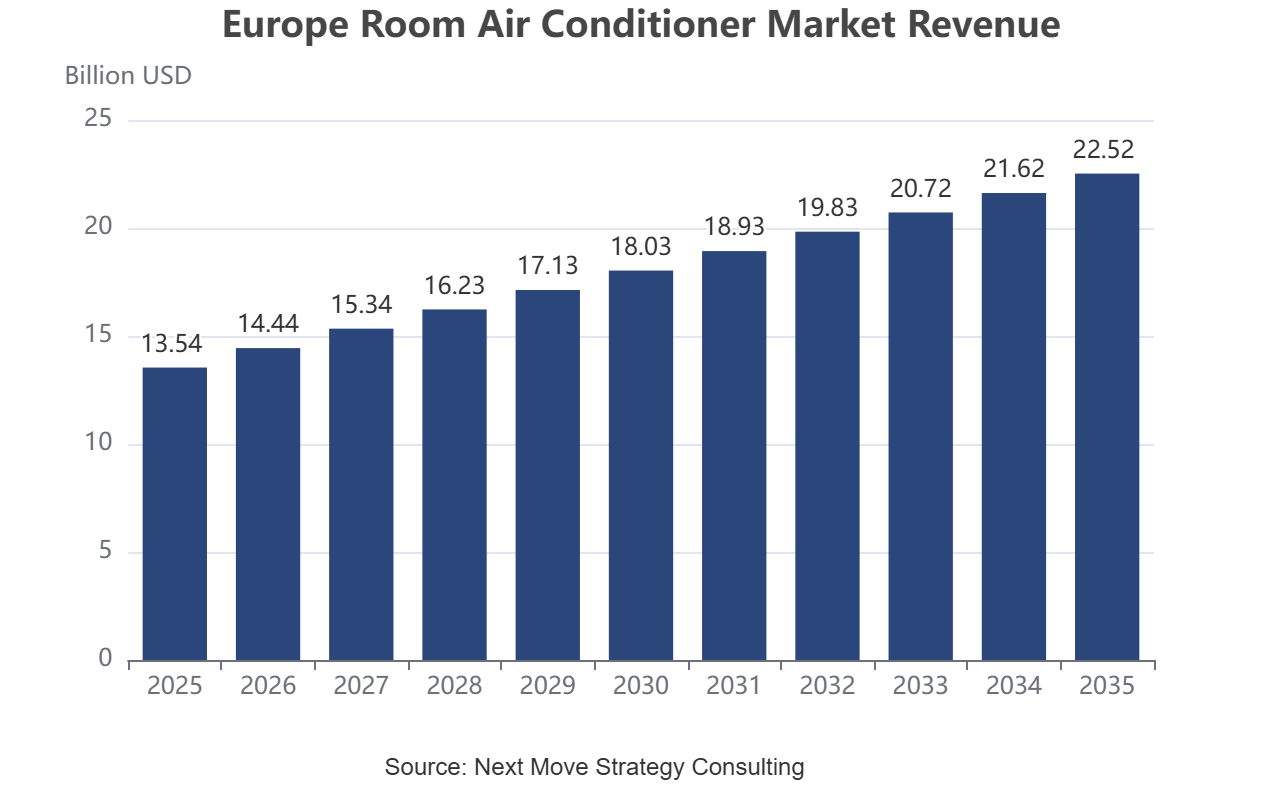
The Europe Room Air Conditioner Market size was valued at USD 13.54 billion in 2025, and is expected to be valued at USD 15.29 billion by the end of 2026. The industry is projected to grow, hitting USD 22.52 billion by 2035, with a CAGR of 4.40% between 2026 and 2035. In terms of volume, the market recorded 14 million units in 2025, with forecasts indicating growth to 16 million units by 2026 and further to 27 million units by 2035, reflecting a CAGR of 5.87% over the same period.
What are the Key Market Drivers, Breakthroughs, and Investment Opportunities that will Shape the Europe Room Air Conditioner Market in the Next Decade?
Growth Catalyst & Risk Assessment Matrix
|
DRIVERS / TRENDS / RESTRAINTS |
(+/–) % IMPACT ON CAGR FORECAST |
GEOGRAPHIC RELEVANCE |
IMPACT TIMELINE |
|
Rising temperatures and heatwaves increasing residential cooling demand |
+4.91% |
Southern Europe, Central Europe, emerging Northern Europe hotspots |
Short to Medium term (1–4 years) |
|
Strong energy-efficiency regulations supporting adoption of compliant RAC systems |
+3.62% |
EU-wide (Germany, France, Italy, Spain, Nordics) |
Medium to Long term (3–6 years) |
|
Increasing heatwave frequency driving shift toward residential room AC adoption |
+4.38% |
Spain, Italy, France, Germany, urban Europe |
Short to Medium term (1–4 years) |
|
Growing adoption of heat pump-based AC systems enabling hybrid heating-cooling demand |
+3.47% |
Northern & Western Europe (Germany, UK, Nordics, Netherlands) |
Medium to Long term (3–6 years) |
|
Strict environmental regulations increasing compliance and development costs |
-3.55% |
EU-wide (stronger impact in Western Europe manufacturing hubs) |
Short to Medium term (1–4 years) |
The Europe room air conditioner market is undergoing a structural transition driven by rising climate variability, accelerating heatwave frequency, and a growing policy-driven shift toward energy-efficient cooling technologies. Our analysis indicates that traditionally low RAC penetration in several European countries is steadily expanding as cooling requirements move from discretionary usage to essential indoor comfort needs, particularly in urban residential and rental housing segments. Increasing regulatory pressure from EU energy efficiency frameworks is actively reshaping product design and accelerating the adoption of inverter-based and low-emission systems. At the same time, the convergence of heating and cooling technologies through heat pump integration is redefining system preferences across households and small commercial applications. Industry trends indicate sustained long-term expansion supported by climate-driven demand, regulatory alignment, and continuous innovation in sustainable HVAC solutions.
Growth Drivers:
How are Rising Temperatures Due to Climate Change Accelerating the Europe Room Air Conditioner Market?
We found that rising temperatures driven by climate change are fundamentally reshaping cooling demand patterns across Europe and accelerating room air conditioner adoption. Historically, many European countries maintained a relatively low penetration of residential air conditioning due to moderate climate conditions. However, increasing frequency and intensity of summer heatwaves across Southern, Central, and even Northern Europe has significantly elevated the need for localised cooling solutions in residential and small commercial environments. We further observed that consumers are increasingly prioritizing indoor thermal comfort, particularly in urban apartments, rental housing, and older buildings lacking centralized HVAC systems. This shift is strengthening demand for compact, energy-efficient room air conditioners that can be installed without major structural modifications. Industry evidence suggests that cooling has transitioned from a discretionary requirement to a basic comfort necessity in several European markets, directly expanding the addressable base for RAC manufacturers and driving sustained long-term market expansion.
How is the Strong Regulatory Push for Energy-Efficient HVAC Systems Supporting the Europe Room Air Conditioner Market Adoption?
Based on our evaluation, we analysed that a strong regulatory framework across Europe is actively accelerating the adoption of energy-efficient room air conditioners. The European Union’s stringent energy efficiency directives and environmental sustainability targets are pushing manufacturers to develop high-efficiency, low-emission cooling systems that comply with evolving standards. These regulations are not only reshaping product design but also influencing consumer purchasing decisions by increasing awareness of lifecycle energy consumption and operational cost savings. Further, incentive programs and energy labelling systems are reinforcing demand for inverter-based and high-efficiency RAC units across both developed and emerging European economies. Our market analysis suggests that compliance-driven innovation has become a core competitive differentiator, compelling manufacturers to invest in advanced refrigerants, improved compressor technologies, and eco-friendly system designs. This regulatory environment is therefore strengthening structured Europe room air conditioner market growth while simultaneously raising the baseline for product performance and sustainability expectations.
How is Increasing Heatwave Frequency Driving Demand for Residential Cooling Solutions in Europe?
The increasing frequency of extreme heatwaves across Europe is directly driving structural demand growth for residential cooling systems, including room air conditioners, as countries such as Spain, Italy, France, and Germany have experienced prolonged high-temperature periods that place significant pressure on indoor living conditions, particularly in densely populated urban housing. We observed that consumers are increasingly adopting room AC units as immediate cooling solutions due to their affordability, ease of installation, and flexibility compared to centralized HVAC systems. This shift is particularly strong in rental and multi-family housing segments where permanent infrastructure modifications remain limited. Also, climate volatility has fundamentally altered consumer perception of cooling, positioning RAC systems as essential comfort appliances rather than seasonal luxury products. As heatwave intensity continues to rise, demand stability strengthens across both replacement and first-time installation segments.
Growth Inhibitor:
How are Strict Environmental Regulations Increasing Product Development and Compliance Costs in the Europe Room Air Conditioner Market?
Stringent environmental and energy efficiency regulations across Europe significantly increase product development complexity and compliance costs for room air conditioner manufacturers. The requirement to adhere to evolving eco-design standards, refrigerant restrictions, and energy performance benchmarks compels companies to continuously upgrade technologies and redesign product architectures. We noticed that compliance with low-global warming potential refrigerants and high-efficiency system mandates increases both R&D expenditure and production costs, particularly for global manufacturers operating across multiple regulatory jurisdictions. These cost pressures are further amplified by certification processes and energy labelling requirements that extend time-to-market cycles. While regulations strengthen long-term sustainability objectives, they also create short-term pricing constraints that limit affordability in cost-sensitive consumer segments, thereby moderating adoption speed in certain European markets.
Growth Opportunity:
How is the Growing Adoption of Heat Pump-Based Air Conditioning Systems Creating New Opportunities in the Europe Room Air Conditioner Market?
From our assessment, we noticed that the growing adoption of heat pump-based air conditioning systems is creating a significant structural opportunity within the European room air conditioner market. Heat pumps are increasingly positioned as dual-function systems capable of providing both heating and cooling, aligning strongly with Europe’s energy transition and decarbonization goals. Further, governments across the region are actively promoting heat pump deployment through subsidies, incentives, and policy support aimed at reducing reliance on fossil fuel-based heating systems. This transition is expanding the application scope of RAC-related technologies beyond traditional cooling into integrated climate control solutions. Industry analysis indicates that manufacturers investing in reversible heat pump technology, high-efficiency compressors, and smart energy management systems are gaining a competitive advantage in both residential and light commercial segments. Over the long term, this shift is expected to redefine product positioning, moving the market toward hybrid HVAC solutions that combine energy efficiency with year-round climate adaptability.
PESTEL Analysis of the Europe Room Air Conditioner Market
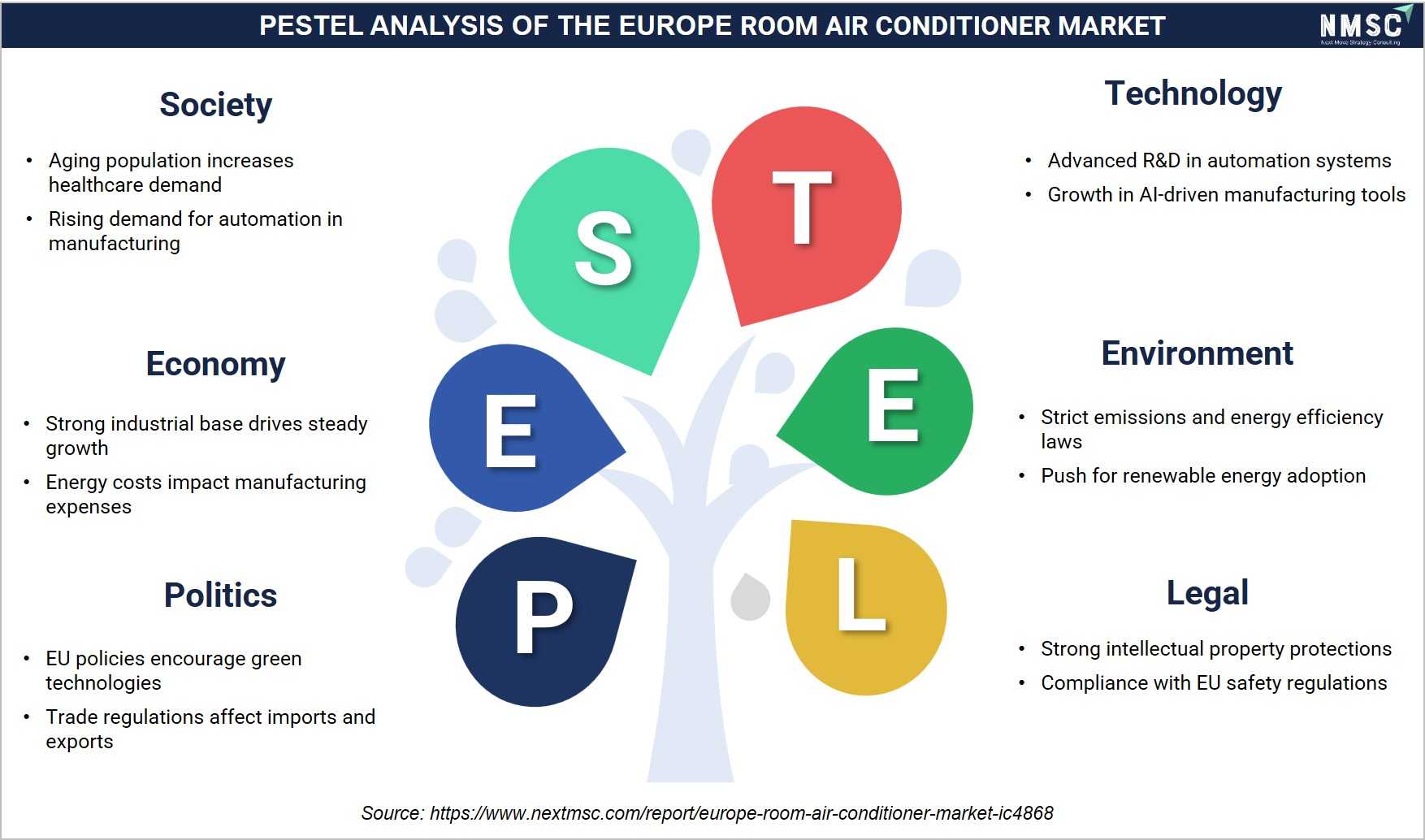
The infographic presents a PESTEL analysis of the Europe room air conditioner market, using a structured macro environmental framework to evaluate the key external forces shaping industry performance. It reflects strong subject matter expertise by linking political, economic, social, technological, environmental, and legal dimensions to real market conditions. The assessment captures how regulatory frameworks and environmental mandates align with evolving consumer cooling needs, while economic pressures and technology adoption continue to reshape market behaviour across the region. From a practical standpoint, it supports stakeholders in anticipating policy transitions, compliance requirements, and efficiency standards that define operational strategy in European markets.
Which Country is Dominating the Europe Room Air Conditioner Market?
Based on our assessment, we observed that Germany dominates the Europe room air conditioner market primarily due to its strong industrial base, high household purchasing power, and early adoption of advanced climate control technologies. Although Germany historically had lower air conditioner penetration compared to Southern Europe, the increasing frequency of summer heatwaves and prolonged warm seasons has significantly accelerated residential cooling demand. At the same time, high energy prices and strict environmental regulations have shaped consumer preference toward energy-efficient inverter systems and integrated HVAC solutions, particularly heat pump–based systems that serve both heating and cooling needs. This structural shift is reinforcing demand for technologically advanced, premium room air conditioning systems across urban households and commercial spaces.
Furthermore, Germany’s dominance is supported by its strong manufacturing ecosystem, well-established retail and distribution networks, and leadership in HVAC innovation across Europe. The country hosts several global HVAC and engineering players that continuously drive product development in efficiency, smart connectivity, and low-carbon cooling solutions. In addition, strong consumer awareness around sustainability and energy performance standards, such as EU Ecodesign requirements, has accelerated replacement cycles toward modern systems. The combination of regulatory leadership, innovation capability, and rising climate-driven cooling needs positions Germany as a central and influential market shaping the overall trajectory of the Europe Room Air Conditioner industry.
Which Country is Set to Witness the Fastest Growth?
Spain is set to witness the fastest growth in the Europe room air conditioner market through 2035 due to a structural shift in climate conditions, accelerating urban cooling demand, and a rapid transition from passive to mechanical cooling solutions. From our analysis, we found that rising summer temperatures and increasingly frequent heatwaves across major cities such as Madrid, Barcelona, Valencia, and Seville are making air conditioning a necessity rather than a discretionary purchase. This climatic pressure is further reinforced by high urban density, a growing rental housing stock, and modern apartment developments where split and portable room air conditioners are becoming the preferred choice due to ease of installation and adaptability in older building structures.
Additionally, Spain’s growth trajectory is also being shaped by strong macroeconomic and structural factors, including expanding tourism infrastructure, commercial construction, and rising consumer preference for energy-efficient inverter-based systems aligned with EU sustainability standards. At the same time, improving household affordability and increasing awareness of indoor thermal comfort are accelerating first-time adoption across urban and semi-urban regions. Market evidence indicates that the country is experiencing a broader cultural transition toward mechanical cooling adoption, moving away from traditional ventilation methods as heat intensity increases. This convergence of climate urgency, construction-led demand, and energy-efficient technology adoption positions Spain as the fastest-growing room air conditioner market in Europe over the forecast horizon.
How is the Europe Room Air Conditioner Market segmented in this report, and what are the key insights from the segmentation analysis?
By Speed Type Insights
How Are Efficiency Priorities Shaping Adoption of Fixed Speed and Inverter ACs in the Europe Room Air Conditioner Market?
Based on speed type, the Europe room air conditioner market is segmented into fixed speed and inverter.
Through our market assessment, we observed that fixed speed room air conditioners maintain steady relevance in price-sensitive segments and replacement-driven purchases, particularly where upfront affordability and straightforward maintenance remain decisive factors. These units remain common in secondary residences, rental accommodations, and intermittent-use environments where cooling demand is limited or seasonal in nature. At the same time, inverter-based systems are gaining stronger traction as consumers increasingly prioritize energy efficiency, reduced electricity consumption, and stable indoor temperature control under variable climatic conditions. This transition is reinforced by stringent energy efficiency regulations across Europe and rising focus on long-term operational cost optimization. Overall, both technologies coexist with distinct value positions, reflecting a gradual structural shift toward higher-efficiency cooling solutions within the regional market landscape.
By Efficiency Band Insights
How Do Efficiency Bands Shape Consumer and Regulatory Alignment in the Europe Room Air Conditioner Market?
Based on efficiency band, the Europe room air conditioner market is segmented into entry, standard, high, premium, and unrated.
Entry-level efficiency band room air conditioners maintain steady relevance in price-sensitive residential segments, particularly across rental housing and replacement-driven purchases, where affordability and low upfront cost dominate decision-making. This demand gradually transitions into standard efficiency systems, which remain widely adopted in mainstream households by balancing purchase cost with acceptable energy performance aligned to everyday cooling needs. As expectations shift toward lower operating expenses, high-efficiency units gain stronger momentum, supported by tightening European energy regulations and rising consumer preference for reduced electricity consumption. Building further on this efficiency-driven progression, premium band products are increasingly integrated into modern residential ecosystems, where advanced features, smart controls, and lifecycle savings justify higher investment. In contrast, unrated systems persist in fragmented retrofit and legacy installations, primarily driven by replacement requirements within older infrastructure and non-standardised purchasing environments.
Competitive Landscape
The Europe room air conditioner industry exhibits a moderately consolidated competitive structure, dominated by multinational HVAC and electronics manufacturers with strong regional subsidiaries and distribution networks across Western and Central Europe. NMSC analysis indicates that competition is increasingly shaped by stringent energy efficiency regulations, accelerated inverter adoption, and rising demand for low-noise, environmentally compliant cooling systems aligned with EU climate targets. Market dynamics also reflect a gradual shift toward smart HVAC integration, where digital control systems, IoT-enabled monitoring, and building energy management compatibility are becoming central differentiation levers. Supply chain localisation within Europe further strengthens service responsiveness and regulatory alignment, reinforcing long-term competitive positioning.
Strategic Developments:
-
December 2025 – Daikin Europe partnered with Copeland to expand compressor and HVAC system innovation in Europe. The collaboration strengthens residential heat pump and room cooling supply chains, addressing rising demand for electrified heating and cooling systems across EU housing stock.
-
November 2025 – Samsung Electronics GmbH completed its acquisition of FläktGroup, significantly expanding its European HVAC and air conditioning presence. The move enhances Samsung’s ability to supply energy-efficient cooling systems across residential, commercial, and smart building applications in Europe.
-
April 2026 – Daikin launched an online savings calculator specifically for the Central European market to promote air-to-air heat pumps as efficient primary heating. This strategy targets households facing high energy costs, positioning room air conditioners as year-round comfort solutions rather than seasonal cooling appliances.
-
March 2026 – Samsung introduced the Bespoke AI WindFree Pro in Milan, featuring Motion Wind technology and AI-driven energy modes. This strategic launch emphasizes decarbonization by utilizing AI to reduce energy consumption by up to 30%, aligning with the EU’s stringent energy efficiency targets for 2026.
-
March 2026 – At MCE 2026, Panasonic unveiled a comprehensive upgrade to its residential air conditioning range. Strategically, the new lineup integrates nanoe X technology and built-in Wi-Fi across all models, focusing on indoor air quality and smart home connectivity to meet rising European consumer health demands.
-
March 2025 – Daikin Airconditioning UK Ltd. highlighted advanced residential heat pump and room air conditioning solutions at ISH Frankfurt. The launch strengthens its leadership in low-carbon HVAC systems, targeting regulatory-driven demand across European residential retrofits and energy-efficient cooling adoption.
-
January 2025 – Daikin Europe N.V. introduced a CO&sub2; (R-744) VRV system across European markets, targeting decarbonised residential and light commercial cooling. The development aligns with EU F-gas regulations and strengthens Daikin’s leadership in low-global-warming-potential air conditioning technologies for Europe’s energy transition.
Key Players of the Europe Room Air Conditioner Market
-
Daikin Airconditioning UK Ltd.
-
Gree UK Limited
-
Midea Europe GmbH
-
Carrier GmbH & Co. KG
-
LG Electronics Deutschland GmbH
-
Panasonic Marketing Europe GmbH
-
Trane Deutschland GmbH
-
Hisense Gorenje Germany GmbH
-
Mitsubishi Electric Europe B.V.
-
Sharp Devices Europe GmbH
-
Hitachi Europe GmbH
-
Olimpia Splendid S.p.A.
-
Vaillant GmbH & Co. KG
The competitive intensity in the Europe room air conditioner market is defined by a technology-led race among established players such as Daikin Airconditioning UK Ltd., Carrier GmbH & Co. KG, and LG Electronics Deutschland GmbH, which continue to prioritise high-efficiency inverter systems, heat-pump-compatible air conditioning solutions, and advanced filtration technologies aligned with Europe’s decarbonisation agenda. At the same time, Panasonic Marketing Europe GmbH and Midea Europe GmbH are strengthening their foothold through expanded product portfolios and competitive pricing strategies, while Gree UK Limited continues to enhance market penetration via cost-efficient models and growing retail partnerships. Market evidence suggests that future competitive positioning increasingly depends on energy efficiency leadership, smart ecosystem integration, and regulatory-aligned product innovation across fragmented European demand centers.
SWOT Analysis of the Europe Room Air Conditioner Market
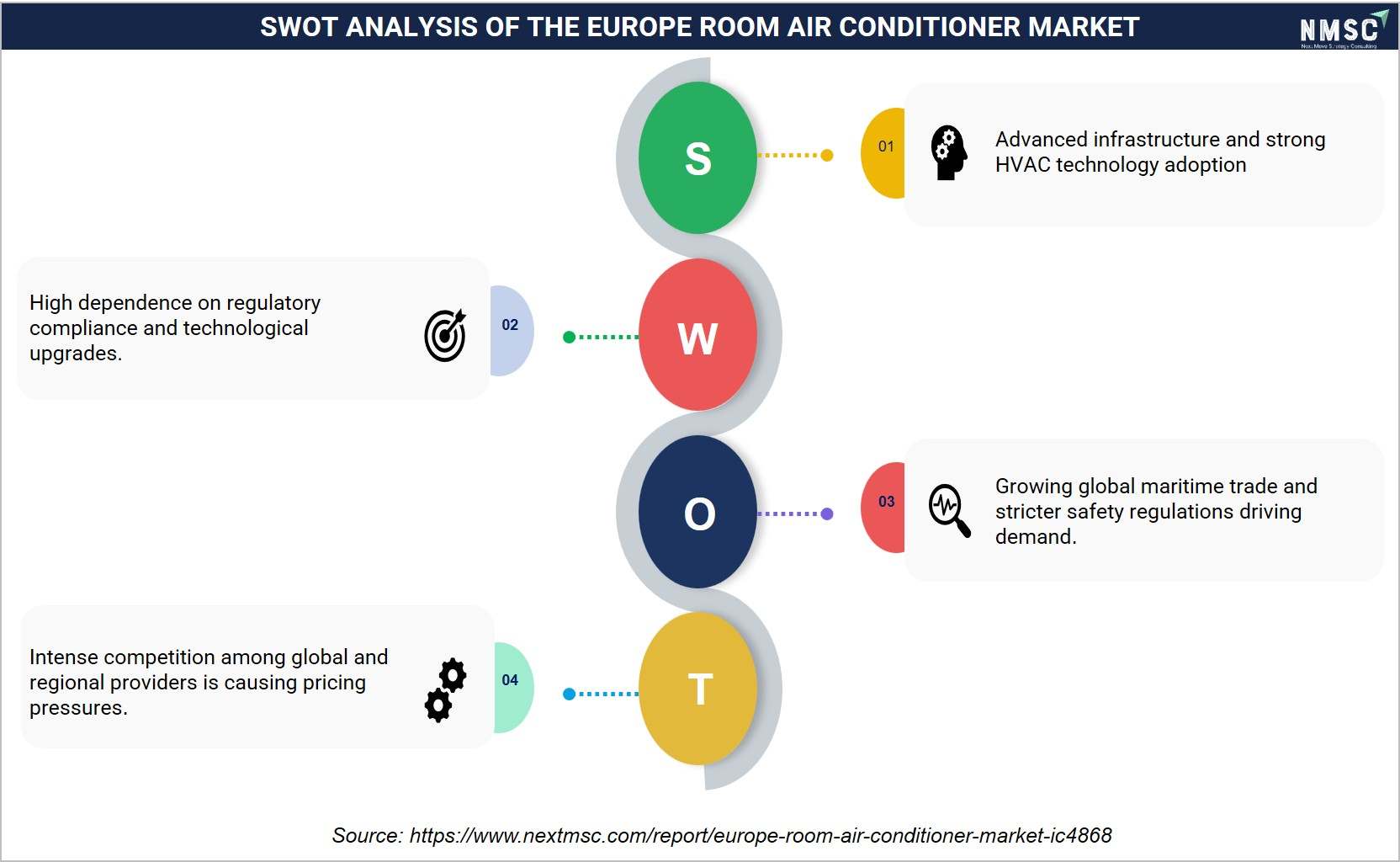
The infographic presents the SWOT analysis of the Europe room air conditioner market through a structured industry-grounded perspective. It highlights strengths such as advanced infrastructure and strong HVAC technology adoption, which together reinforce operational maturity across the region. At the same time, it identifies intense competition among global and regional players as a key weakness, creating sustained pricing pressure across the market. On the opportunity side, expanding global maritime trade alongside stricter safety regulations strengthens underlying demand conditions. However, the market also faces threats from increasing regulatory compliance requirements and the continuous pace of technological advancement needed to maintain competitiveness. This assessment reflects verified market dynamics and provides a structured foundation for strategic decision-making across European territories.
Europe Room Air Conditioner Market Key Segments
By Product Type
-
Window AC
-
Fixed Chassis
-
Through-the-Wall
-
-
Portable AC
-
Single Hose
-
Dual Hose
-
-
Single Split AC
-
Wall Mounted
-
Floor Standing
-
Ceiling Cassette
-
Ceiling Suspended
-
Ducted Single Zone
-
-
Multi Split AC
-
2 Indoor Units
-
3 Indoor Units
-
4+ Indoor Units
-
-
Packaged Room AC
-
Packaged Terminal AC
-
Vertical Packaged
-
Other Packaged
-
-
Other Room AC
By Speed Type
-
Fixed Speed
-
Inverter (Variable Speed)
By Cooling Capacity
-
≤ 1.0 Ton
-
>1.0 to ≤1.5 Ton
-
>1.5 to ≤2.0 Ton
-
>2.0 to ≤3.0 Ton
-
>3.0 Ton
By Efficiency Band
-
Entry
-
Standard
-
High
-
Premium
-
Unrated
By Refrigerant
-
R22
-
R410A
-
R32
-
Low-GWP HFO/HFC Blend
-
Hydrocarbon
-
Other Refrigerant
By Function
-
Cooling Only
-
Heat Pump
-
Cooling with Electric Heat
-
Other Function
By Distribution Channel
-
Retail (Brick and Mortar)
-
Multi-Brand Store
-
Brand Exclusive Store
-
Hypermarkets
-
-
Dealer Network
-
HVAC Dealers
-
Distributor & Wholesaler
-
-
Online
-
Marketplace
-
Brand Website
-
-
Project Sales
-
Real Estate Developer
-
Hospitality Chain
-
Institutional
-
OEM
-
By End-User
-
Residential
-
Commercial
-
Retail
-
Hospitality
-
Office
-
Healthcare
-
Education
-
Government/Public
-
Other Commercial
-
By Region
-
UK
-
Germany
-
France
-
Italy
-
Spain
-
Denmark
-
Netherlands
-
Finland
-
Sweden
Key Benefits for Stakeholders:
Next Move Strategy Consulting (NMSC) presents a comprehensive analysis of the Europe room air conditioner market trends, covering historical trends from 2020 through 2025 and offering detailed forecasts through 2035. Our study examines the market at regional and country levels, providing quantitative projections and insights into key growth drivers, challenges, and investment opportunities across all major room air conditioner segments.
In the Europe room air conditioner market, we found investors and customers derive distinct yet interlinked advantages in the industry. Investors gain stronger revenue visibility supported by replacement-driven demand cycles, energy efficiency upgrades, and regulatory alignment that reinforces stable product portfolios and aftermarket service expansion. Our assessment indicates that evolving efficiency standards and digital-enabled cooling solutions strengthen long-term capital confidence and margin predictability. Customers benefit from improved indoor comfort, reduced operational energy burden, and access to advanced low-noise systems integrated with smart controls. We also observed that structured regulatory frameworks enhance product reliability and safety assurance, while competitive innovation improves service quality and lifecycle value creation across residential applications.
|
Parameters |
Details |
|
Customization Scope |
Free customization (equivalent to up to 80 analyst-working hours) after purchase. |
|
Pricing and Purchase Options |
Avail customized purchase options to meet your exact research needs. |
|
Approach |
In-depth primary and secondary research; proprietary databases; rigorous quality control and validation measures. |
|
Analytical Tools |
Porter's Five Forces, SWOT, value chain, and Harvey ball analysis to assess competitive intensity, stakeholder roles, and relative impact of key factors. |
About the Author
 Ridip Gogoi
— Ridip Gogoi is a Research Associate at Next Move Strategy Consulting, where he supports cross-vertical market research and analysis across multiple industry sectors, with four years of experience. His work includes market analysis, data validation, secondary research, and insight development, helping structure evidence into clear findings for business and strategy decisions. He contributes to research quality checks and reporting, with a focus on consistency, source review, and clarity accuracy.
Ridip Gogoi
— Ridip Gogoi is a Research Associate at Next Move Strategy Consulting, where he supports cross-vertical market research and analysis across multiple industry sectors, with four years of experience. His work includes market analysis, data validation, secondary research, and insight development, helping structure evidence into clear findings for business and strategy decisions. He contributes to research quality checks and reporting, with a focus on consistency, source review, and clarity accuracy.
About the Reviewer
 Supradip Baul
— Supradip Baul is an accomplished business consultant and strategist with over a decade of rich experience in market intelligence, strategy, technology, and business transformation. His work has included rigorous qualitative and quantitative analysis across multiple industries, helping clients shape investment decisions and long-term roadmaps. Earlier in his career, he was associated with Gartner, where he contributed to industry-leading reports and market share analyses. He has worked with leading global companies and holds an MBA with a dual specialization in Marketing and Finance.
Supradip Baul
— Supradip Baul is an accomplished business consultant and strategist with over a decade of rich experience in market intelligence, strategy, technology, and business transformation. His work has included rigorous qualitative and quantitative analysis across multiple industries, helping clients shape investment decisions and long-term roadmaps. Earlier in his career, he was associated with Gartner, where he contributed to industry-leading reports and market share analyses. He has worked with leading global companies and holds an MBA with a dual specialization in Marketing and Finance.
At Next Move Strategy Consulting, we understand that insightful market research is the cornerstone of successful business decisions. That's why we employ a robust and multifaceted approach, combining various methodologies to deliver the most accurate and actionable data for our clients.

Research Landscape
We navigate the world of research with two primary approaches:
Qualitative Approach
Our qualitative research methodologies involve immersive techniques such as in-depth interviews, focus groups, and observational studies. By engaging directly with individuals and stakeholders, we uncover valuable insights that quantitative data alone may overlook.

Quantitative Research
In tandem with qualitative methodologies, NMSC leverages the power of Quantitative Research to provide a robust foundation of numerical insights. Through systematic data collection and analysis, we quantify patterns, preferences, and market trends, offering a comprehensive view of the business landscape.
Our quantitative research approach employs diverse tools, including surveys, experiments, and statistical modelling. These methodologies enable us to gather data from a large and representative sample, ensuring the statistical significance of our findings. By employing structured questionnaires and standardized data collection methods, we guarantee the reliability and validity of the information we present to our clients.
Quantitative research is particularly effective in measuring the prevalence of trends, assessing market size, and gauging the impact of various factors on consumer behavior. The numerical precision attained through this approach equips our clients with actionable insights, facilitating data-driven decision-making and strategy formulation.


Our Specialized Toolbox for Industry-Specific Market Research
We deploy a specialized arsenal of techniques tailored to meet your unique requirements. Here's a glimpse into our comprehensive toolbox:

Information Procurement
The stage entails acquiring market data or relevant information through various sources and methodologies.


Market Research Approach
We utilize both top-down and bottom-up approaches in market research analysis to achieve a comprehensive understanding of the market dynamics, leveraging the broad perspective of industry trends and macroeconomic factors alongside detailed insights from specific segments and individual companies.

Porters Five Forces Analysis
We conduct Porter's Five Forces analysis to evaluate the competitive landscape of an industry, providing us with insights into factors that affect profitability and strategic positioning.

SWOT Analysis

Forecasting
We utilize a forecasting model to predict future consumption by considering parameters like population, economics, regulations, market competition, drivers, constraints, technology, and pricing. We also employ statistical techniques such as multilinear regression, exponential smoothing, moving average, ARIMA, and Monte Carlo simulations for accurate predictions. In econometric forecasting, we analyzed short-term and long-term event impacts, attributing values based on regulatory frameworks, economic factors, and market events.





 Speak to Our Analyst