Europe Wireless Charging Market By Technology (Inductive, Magnetic Resonance, Radio Frequency, and Other Technologies), By Power Level (Low Power (≤ 15 W), Medium Power (>15 W to 60 W), High Power (>60 W to 500 W), and Ultra High Power (>500 W)), By Application (Consumer Electronics, Automotive, Healthcare, Industrial, Aerospace & Defense, and Other Applications), By Distribution Channel (Online, Offline Retail, OEM Supply, and Direct Enterprise) – Analysis & Forecast, 2025–2035
Industry: Semiconductor & Electronics | Latest Edition: August 7, 2026 | No of Pages: 335 | No. of Tables: 144 | No. of Figures: 139 | Format: PDF | Report Code: SE5609
Europe Wireless Charging Market Size & Forecast
|
Parameters |
Details |
|
Market Size in 2025 |
USD 8.49 Billion |
|
Market Size in 2026 |
USD 10.54 Billion |
|
Revenue Forecast in 2035 |
USD 73.52 Billion |
|
Growth Rate |
CAGR of 24.09% from 2026 to 2035 |
|
Analysis Period |
2025–2035 |
|
Base Year Considered |
2025 |
|
Forecast Period |
2026–2035 |
|
Market Size Estimation |
Billion (USD) |
|
Companies Profiled |
15 |
|
Market Share |
Available for 10 Companies |
Industry Outlook
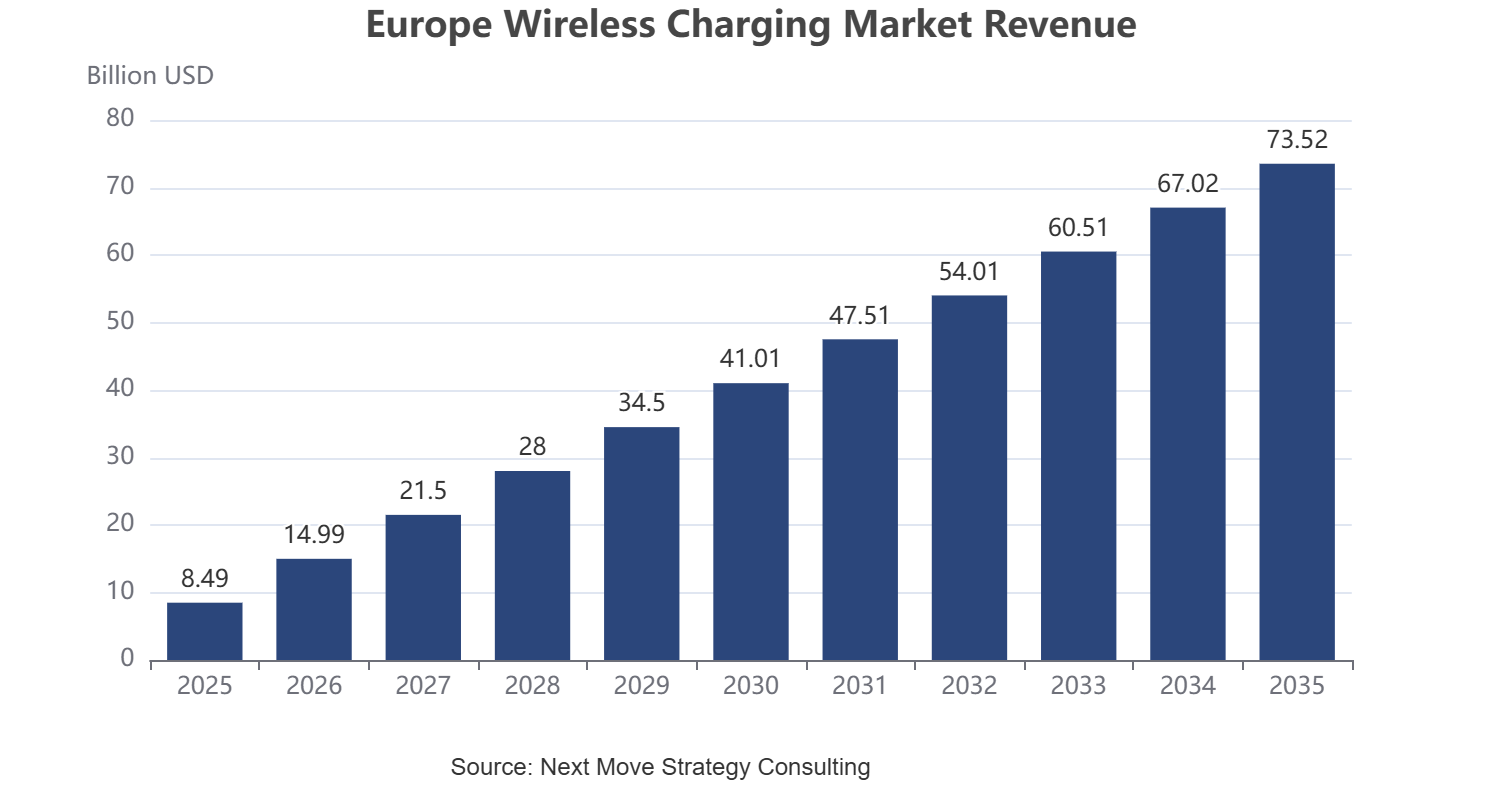
The Europe Wireless Charging Market size was valued at USD 8.49 billion in 2025 and reached USD 10.54 billion by 2026. The market is projected to expand substantially, reaching USD 73.52 billion by 2035, registering a CAGR of 24.09% from 2026 to 2035. This strong growth trajectory is propelled by aggressive EV electrification targets, expanding smart building deployments, and rising penetration of wireless charging across consumer electronics, automotive, healthcare, and industrial applications throughout Germany, the United Kingdom, France, and other major European economies.
What Are the Key Drivers, Restraints, and Opportunities Shaping the Europe Wireless Charging Market Through 2035?
Growth Catalyst & Risk Assessment Matrix
|
Drivers / Restraints / Opportunity |
(+/–) % Impact on CAGR Forecast |
Geographic Relevance |
Impact Timeline |
|
Aggressive EV electrification targets across European Union member states are driving demand for cable-free charging solutions in passenger and commercial vehicles |
+3.4% |
Europe |
Medium term (2–5 years) |
|
Growing deployment of smart buildings and connected infrastructure is supporting embedded charging systems across commercial and residential developments |
+2.6% |
Europe |
Short to medium term (1–4 years) |
|
Rising premiumization and expanding penetration of wireless-charging-enabled smartphones, wearables, and laptops is broadening consumer-side adoption |
+2.1% |
Europe |
Short to medium term (1–4 years) |
|
Lack of universal interoperability standards across charging technologies is limiting cross-platform adoption and increasing fragmentation risk |
–1.7% |
Europe |
Short to medium term (1–4 years) |
|
Integration of wireless charging into smart city and public mobility projects creates transformative long-term revenue generation potential |
+3.2% |
Europe |
Long term (5–10 years) |
Through our market assessment, we observed that the Europe Wireless Charging Market is advancing on the back of binding EU electrification targets, accelerating smart infrastructure rollouts, and rising consumer demand for premium cable-free devices. Regulatory momentum behind vehicle electrification and urban digitalization is reshaping competitive dynamics across the region. Meanwhile, the continued absence of universal interoperability standards remains a structural challenge, while smart city and public mobility integration represents a substantial long-term opportunity for technology providers and infrastructure operators across European markets.
Growth Driver:
How Are Aggressive EV Electrification Targets Driving Demand for Cable-Free Charging Solutions Across Europe?
Through our market assessment, we observed that aggressive EV electrification targets set by the European Union and individual member states are a primary catalyst accelerating wireless charging adoption. Binding emissions reduction commitments and combustion-engine phase-out timelines are pushing automotive OEMs toward integrated charging ecosystems, including stationary and dynamic wireless solutions. Expanding public and private investment in EV infrastructure, combined with consumer preference for convenience-oriented charging, is creating sustained demand for cable-free technologies across passenger vehicles, fleets, and shared mobility platforms throughout the region.
How Is the Growing Deployment of Smart Buildings and Connected Infrastructure Supporting Embedded Charging Systems?
Based on our market evaluation, we observed that the rapid expansion of smart buildings and connected infrastructure across Europe is significantly supporting embedded wireless charging deployment. Commercial developers and facility operators are increasingly specifying integrated charging surfaces within furniture, workstations, and public seating as standard amenities in modern offices, hospitality venues, and transit hubs. This shift toward intelligent, connected environments is establishing embedded charging as a baseline expectation, driving steady procurement of wireless charging modules across new construction and retrofit projects throughout the region.
How Is Rising Premiumization of Wireless-Charging-Enabled Devices Broadening Consumer Adoption in Europe?
Based on research conducted by NMSC, we found that rising premiumization across smartphones, wearables, and laptops is broadening consumer-side wireless charging adoption throughout Europe. Leading device manufacturers are embedding wireless charging as a standard feature across flagship and mid-range portfolios, while retailers are expanding shelf space for charging accessories. The growing installed base of compatible devices, combined with consumer preference for cable-free convenience, is sustaining demand for charging pads, stands, and embedded surfaces across residential and commercial settings across the region.
Growth Inhibitor:
How Is the Lack of Universal Interoperability Standards Acting as a Restraint on the Europe Wireless Charging Market?
The continued absence of universal interoperability standards across charging technologies is acting as a meaningful restraint on the Europe Wireless Charging Market. Competing inductive, magnetic resonance, and radio frequency protocols limit cross-device and cross-vendor compatibility, creating fragmentation that complicates procurement decisions for OEMs and infrastructure operators. Through our market analysis, we observed that this standardization gap is particularly pronounced in automotive and public infrastructure deployments, where inconsistent protocols across manufacturers raise integration costs and slow large-scale rollout across multiple European jurisdictions.
Growth Opportunity:
How Is the Integration of Wireless Charging Into Smart City and Public Mobility Projects Unlocking Long-Term Opportunities?
Through NMSC's assessment, we found that the integration of wireless charging into smart city and public mobility projects represents a transformative long-term opportunity for the Europe Wireless Charging Market. Municipal authorities across Germany, France, and the Nordics are piloting wireless charging infrastructure for electric buses, shared micromobility fleets, and public transit corridors. These initiatives, supported by EU urban innovation funding and public-private partnerships, are establishing the technical and regulatory groundwork necessary for large-scale wireless charging deployment across European cities over the coming decade.
Which Country is Dominating the Europe Wireless Charging Market?
Our comprehensive market assessment indicates that Germany holds the dominant share in the Europe Wireless Charging Market, supported by its strong consumer electronics sector, advanced automotive industry, and widespread adoption of wireless charging-enabled devices. The country benefits from significant investments in electric vehicles, smart mobility solutions, and advanced charging technologies, alongside a robust manufacturing ecosystem and high consumer purchasing power. Growing demand for smartphones, wearable devices, wireless accessories, and in-vehicle wireless charging systems, combined with increasing integration of wireless charging infrastructure across commercial and public spaces, reinforces Germany's position as the leading market for wireless charging in Europe.
Which Country is Set to Witness the Fastest Growth?
Based on our review of technology adoption trends and digital infrastructure development initiatives, Denmark is positioned to witness the fastest growth in the Europe Wireless Charging Market. Rising adoption of smart consumer devices, increasing investments in electric mobility infrastructure, and growing demand for convenient and cable-free charging solutions are driving market expansion. The country's strong focus on innovation, sustainability, and smart city development is accelerating the deployment of wireless charging technologies across residential, commercial, and transportation applications. Continued investments in advanced charging infrastructure and favorable technology adoption trends are expected to further strengthen Denmark's growth trajectory throughout the forecast period.
PESTEL Analysis of the Europe Wireless Charging Market
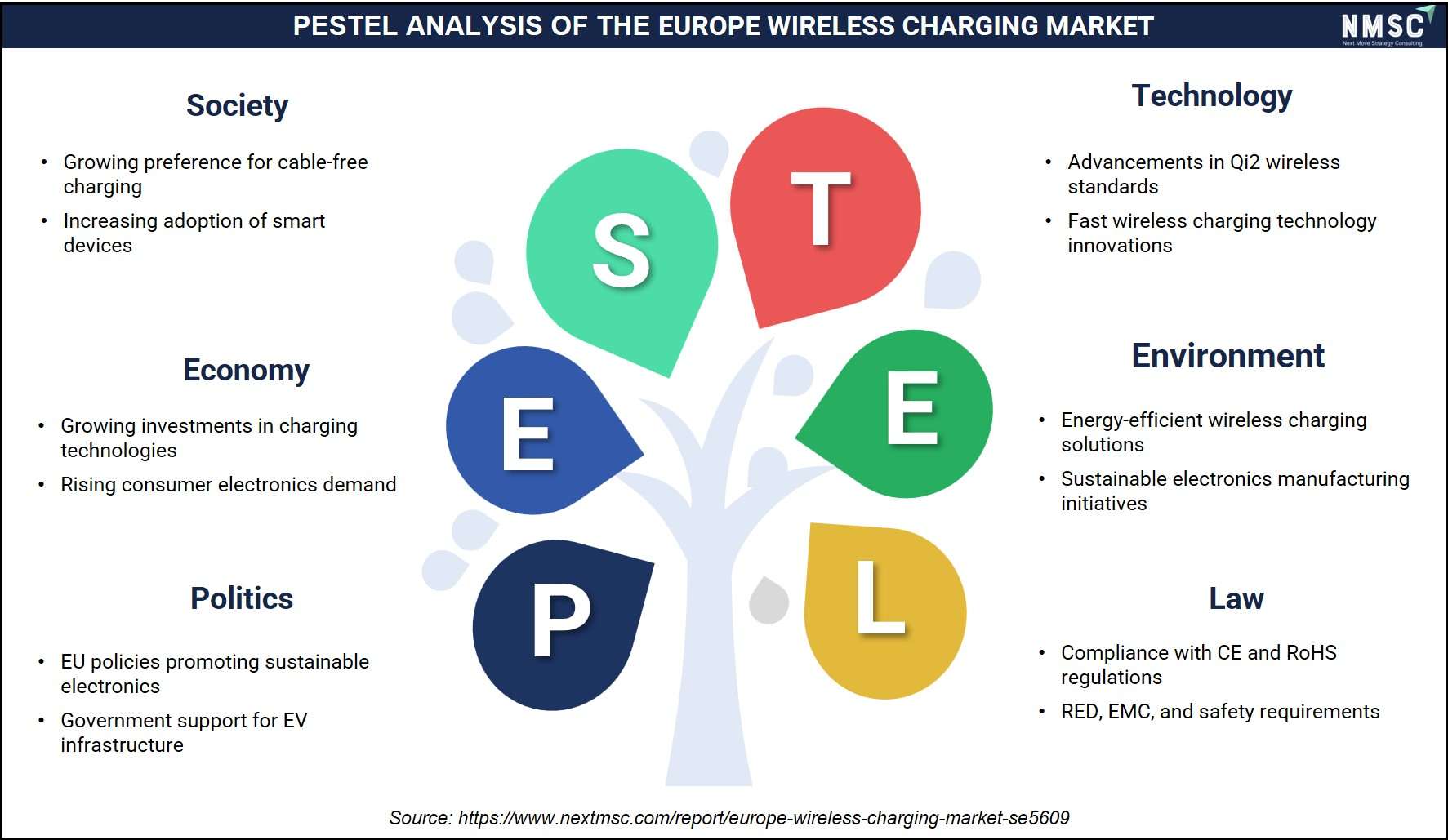
The Europe wireless charging market is influenced by a combination of regulatory, technological, economic, and sustainability factors. Strong EU policies promoting energy efficiency, standardized charging solutions, and electronic waste reduction are encouraging wider adoption of wireless charging technologies. Rapid advancements in Qi2 standards, increasing penetration of connected devices, and growing demand for convenient charging solutions further support market growth. Additionally, Europe's focus on sustainability, consumer safety, and innovation continues to create a favorable environment for the development and deployment of next-generation wireless charging systems across consumer, automotive, and industrial applications.
How Is the Europe Wireless Charging Market Segmented, and What Are the Key Insights from the Segmentation Analysis?
By Technology
How Is the Technology Segmentation Shaping Revenue Distribution in the Europe Wireless Charging Market?
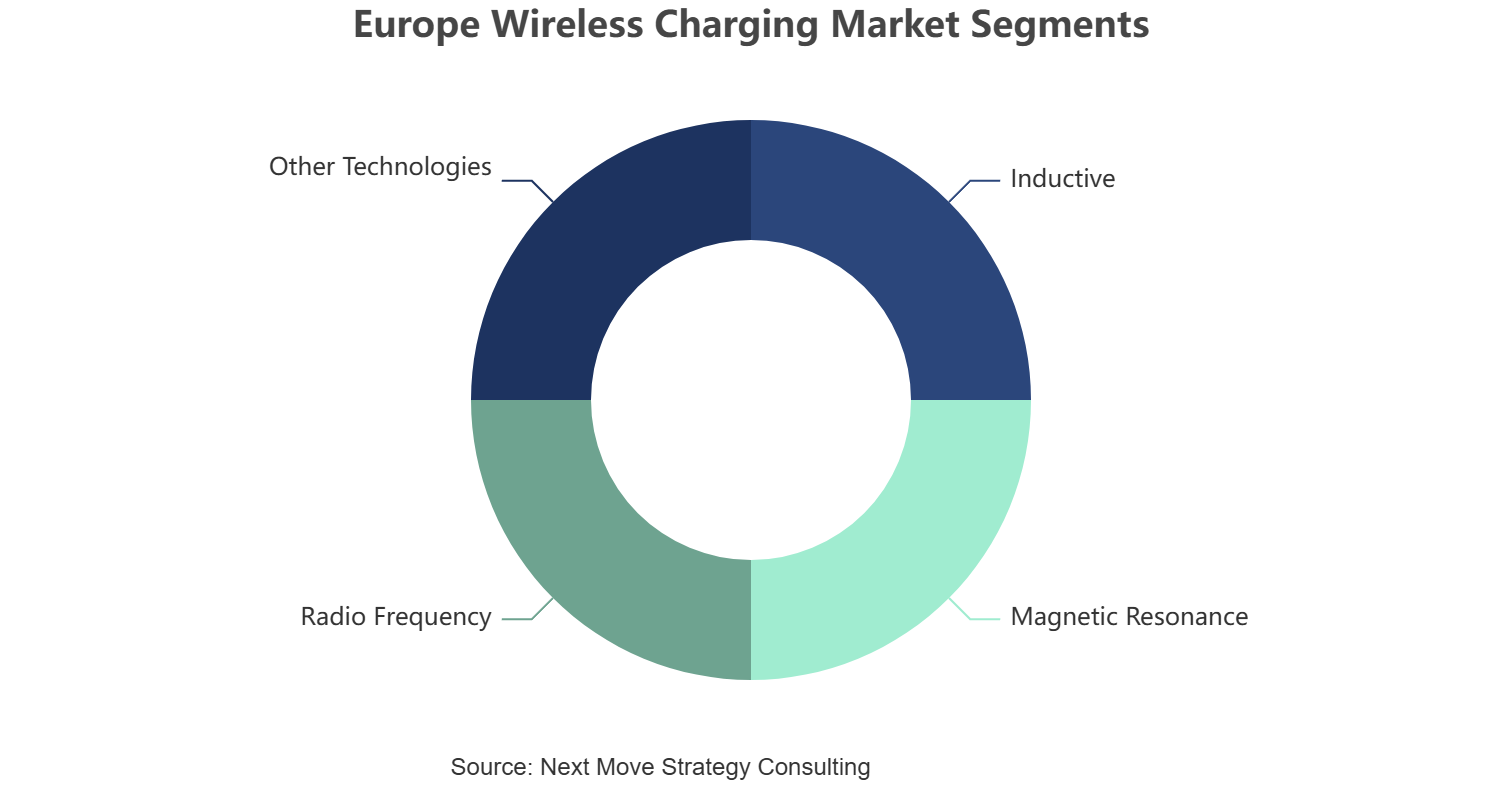
Based on technology, the Europe Wireless Charging Market is segmented into Inductive, Magnetic Resonance, Radio Frequency, and Other Technologies.
Based on our analysis, we observed that inductive charging technology holds the dominant revenue share across the Europe Wireless Charging Market, supported by its established compatibility with Qi-certified smartphones and widespread deployment across retail and hospitality environments. Magnetic resonance technology is gaining traction in automotive and industrial applications, where greater spatial tolerance and higher power transfer capabilities are required. Radio frequency-based solutions remain niche but are advancing within low-power IoT and wearable use cases across the region.
By Application
How Is the Application Segmentation Driving Demand Insights in the Europe Wireless Charging Market?
Based on application, the Europe Wireless Charging Market is segmented into Consumer Electronics, Automotive, Healthcare, Industrial, Aerospace & Defense, and Other Applications.
Based on our evaluation, we identified that consumer electronics remains the largest application segment, supported by widespread adoption of wireless-charging-enabled smartphones, tablets, wearables, and laptops across the region. The automotive segment is exhibiting the fastest growth, driven by EV electrification mandates and growing integration of in-vehicle and stationary charging systems. Healthcare and industrial applications are gaining momentum through expanding use of implantable devices, portable equipment, and automated guided vehicles requiring uninterrupted wireless power delivery.
Key Segments
By Technology
-
Inductive
-
Magnetic Resonance
-
Radio Frequency
-
Other Technologies
By Power Level
-
Low Power (≤ 15 W)
-
Medium Power (>15 W to 60 W)
-
High Power (>60 W to 500 W)
-
Ultra High Power (>500 W)
By Application
-
Consumer Electronics
-
Smartphones and Tablets
-
Wearable
-
Laptops and Notebooks
-
Other Consumer Devices
-
-
Automotive
-
In-Vehicle Chargers
-
Stationary EV Charging
-
Dynamic EV Charging
-
-
Healthcare
-
Implantable Devices
-
Portable Equipment
-
-
Industrial
-
AGVs & AMRs
-
Robots
-
Tools & Machinery
-
Other Industrial Uses
-
-
Aerospace & Defense
-
UAVs
-
Military Equipment
-
-
Other Applications
By Distribution Channel
-
Online
-
Offline Retail
-
OEM Supply
-
Direct Enterprise
Competitive Landscape
The Europe Wireless Charging Market is characterized by a dynamic and increasingly competitive landscape comprising global consumer electronics manufacturers, specialized wireless power technology developers, automotive charging system providers, and regional accessory brands. Market participants are differentiating through multi-device compatibility, power efficiency improvements, and strategic partnerships with device manufacturers and automotive OEMs. Intensifying competition is accelerating research and development investment across inductive, magnetic resonance, and radio frequency charging technologies, supporting continued performance gains, cost reductions, and broader deployment across consumer, automotive, and industrial applications throughout the region.
Strategic Developments:
-
March 2026 - Dutch wireless charging specialist Zens expanded its premium Qi2 and MagSafe-compatible charging portfolio across the Netherlands and European markets, targeting Apple and Samsung users with next-generation wireless charging solutions.
-
December 2025 - IKEA launched and expanded its Qi2-certified VÄSTMÄRKE wireless charging range in the UK, introducing low-cost magnetic chargers (as low as £7) designed for mass-market adoption. The rollout strengthens affordability-driven penetration of Qi2 wireless charging in the UK consumer electronics segment.
Key Players
-
Apple (UK) Limited
-
Samsung Electronics (UK) Limited
-
Google UK Limited
-
Ugreen Limited
-
ZAGG International UK Limited
-
Xiaomi Technology UK Limited
-
Huawei Technologies (UK) Co., Ltd.
-
Lenovo Technology (United Kingdom) Limited
-
Logitech UK Limited
-
Belkin Limited
-
OnePlus Finland Oy
-
Motorola Mobility LLC
-
Shenzhen Baseus Technology Co. Ltd.
-
Anker Innovations Deutschland GmbH
-
Wiferion GmbH
NMSC's analysis indicates that competitive dynamics in the Europe Wireless Charging Market are increasingly defined by technology leadership, standards compatibility, and ecosystem integration depth. Key companies including Apple (UK) Limited, Samsung Electronics (UK) Limited, Google UK Limited, Ugreen Limited, ZAGG International UK Limited, Xiaomi Technology UK Limited, Huawei Technologies (UK) Co., Ltd., Lenovo Technology (United Kingdom) Limited, Logitech UK Limited, Belkin Limited, OnePlus Finland Oy, Motorola Mobility LLC, Shenzhen Baseus Technology Co. Ltd., Anker Innovations Deutschland GmbH, and Wiferion GmbH are advancing market positions through product innovation and expanding distribution partnerships across European markets.
Supply Chain Structure of the Europe Wireless Charging Market
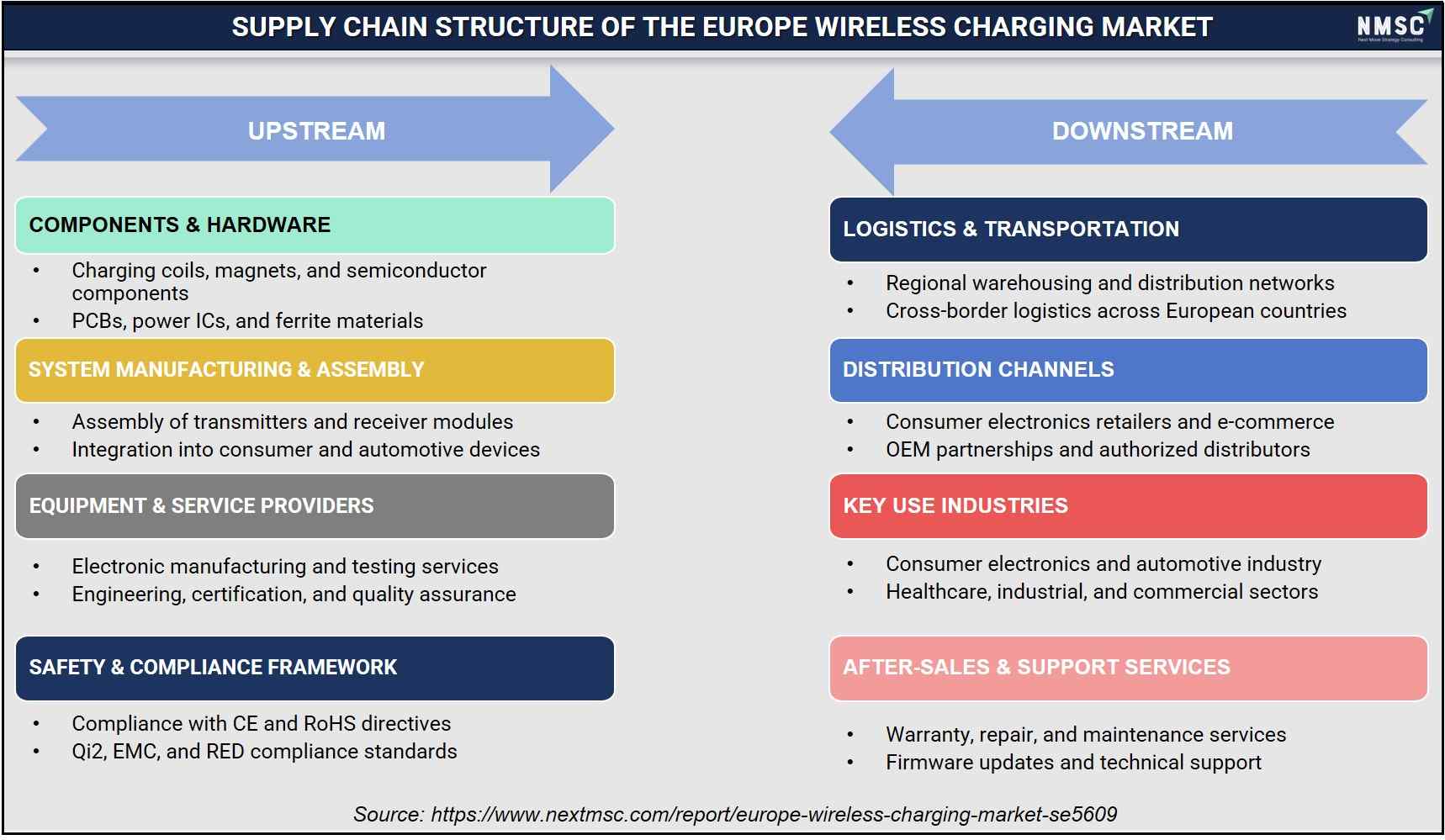
Europe's wireless charging market benefits from a sophisticated and highly integrated supply chain spanning component sourcing, system assembly, distribution, and after-sales support. The region's strong manufacturing capabilities, advanced logistics infrastructure, and established consumer electronics ecosystem facilitate efficient market operations. Compliance with CE, RoHS, RED, Qi2, and EMC standards ensures product quality, interoperability, and regulatory alignment. Growing demand across consumer electronics, automotive, healthcare, and industrial sectors continues to strengthen the supply chain and support the adoption of next-generation wireless charging technologies throughout Europe.
Key Benefits for Stakeholders
Next Move Strategy Consulting (NMSC) presents a comprehensive analysis of the Europe Wireless Charging Market, covering historical developments through 2025 and providing detailed forecasts through 2035. Our study evaluates market performance across key technology types, power levels, application segments, and distribution channels, delivering quantitative outlooks alongside qualitative insights into wireless power standards evolution, EV charging infrastructure development, and competitive dynamics shaping the long-term growth trajectory of the European wireless charging ecosystem across major regional economies.
Investors and strategic stakeholders gain actionable insights into technology investment priorities, regulatory developments, and market entry opportunities across the Europe Wireless Charging Market. Consumer electronics manufacturers, automotive OEMs, healthcare device developers, and industrial automation companies access detailed segmentation analysis spanning technology, power level, application, and distribution channel, supporting informed procurement, investment, and strategic partnership decisions across the rapidly expanding wireless charging value chain and its diverse downstream application markets throughout Europe.
|
Parameters |
Details |
|
Customization Scope |
Free customization (equivalent to up to 80 analyst-working hours) after purchase. |
|
Pricing and Purchase Options |
Avail customized purchase options to meet your exact research needs. |
|
Approach |
In-depth primary and secondary research; proprietary databases; rigorous quality control and validation measures. |
|
Analytical Tools |
Porter's Five Forces, SWOT, value chain, and Harvey ball analysis to assess competitive intensity, stakeholder roles, and relative impact of key factors. |
Conclusion
The Europe Wireless Charging Market is positioned for robust and sustained expansion over the 2025–2035 forecast period, supported by aggressive EV electrification targets, accelerating smart building deployments, and rising premiumization of consumer devices. While the lack of universal interoperability standards presents a near-term structural challenge, integration of wireless charging into smart city and public mobility projects represents a transformative long-term opportunity. The competitive landscape is evolving toward greater technology differentiation, standards consolidation, and strategic partnerships among global and regional players across Europe.
About the Author
 Mihul Sharma
— Mihul Sharma is Research Associate at Next Move Strategy Consulting, where he has covered technology, industrial, and healthcare markets for 3 years. His work applies structured business research, market analysis, and secondary-source review to assess market trends, competitive developments, and growth opportunities. He supports report development by fully synthesizing industry data, company information, and market signals into concise findings for strategy and investment-focused research teams.
Mihul Sharma
— Mihul Sharma is Research Associate at Next Move Strategy Consulting, where he has covered technology, industrial, and healthcare markets for 3 years. His work applies structured business research, market analysis, and secondary-source review to assess market trends, competitive developments, and growth opportunities. He supports report development by fully synthesizing industry data, company information, and market signals into concise findings for strategy and investment-focused research teams.
About the Reviewer
 Supradip Baul
— Supradip Baul is an accomplished business consultant and strategist with over a decade of rich experience in market intelligence, strategy, technology, and business transformation. His work has included rigorous qualitative and quantitative analysis across multiple industries, helping clients shape investment decisions and long-term roadmaps. Earlier in his career, he was associated with Gartner, where he contributed to industry-leading reports and market share analyses. He has worked with leading global companies and holds an MBA with a dual specialization in Marketing and Finance.
Supradip Baul
— Supradip Baul is an accomplished business consultant and strategist with over a decade of rich experience in market intelligence, strategy, technology, and business transformation. His work has included rigorous qualitative and quantitative analysis across multiple industries, helping clients shape investment decisions and long-term roadmaps. Earlier in his career, he was associated with Gartner, where he contributed to industry-leading reports and market share analyses. He has worked with leading global companies and holds an MBA with a dual specialization in Marketing and Finance.
At Next Move Strategy Consulting, we understand that insightful market research is the cornerstone of successful business decisions. That's why we employ a robust and multifaceted approach, combining various methodologies to deliver the most accurate and actionable data for our clients.

Research Landscape
We navigate the world of research with two primary approaches:
Qualitative Approach
Our qualitative research methodologies involve immersive techniques such as in-depth interviews, focus groups, and observational studies. By engaging directly with individuals and stakeholders, we uncover valuable insights that quantitative data alone may overlook.

Quantitative Research
In tandem with qualitative methodologies, NMSC leverages the power of Quantitative Research to provide a robust foundation of numerical insights. Through systematic data collection and analysis, we quantify patterns, preferences, and market trends, offering a comprehensive view of the business landscape.
Our quantitative research approach employs diverse tools, including surveys, experiments, and statistical modelling. These methodologies enable us to gather data from a large and representative sample, ensuring the statistical significance of our findings. By employing structured questionnaires and standardized data collection methods, we guarantee the reliability and validity of the information we present to our clients.
Quantitative research is particularly effective in measuring the prevalence of trends, assessing market size, and gauging the impact of various factors on consumer behavior. The numerical precision attained through this approach equips our clients with actionable insights, facilitating data-driven decision-making and strategy formulation.


Our Specialized Toolbox for Industry-Specific Market Research
We deploy a specialized arsenal of techniques tailored to meet your unique requirements. Here's a glimpse into our comprehensive toolbox:

Information Procurement
The stage entails acquiring market data or relevant information through various sources and methodologies.


Market Research Approach
We utilize both top-down and bottom-up approaches in market research analysis to achieve a comprehensive understanding of the market dynamics, leveraging the broad perspective of industry trends and macroeconomic factors alongside detailed insights from specific segments and individual companies.

Porters Five Forces Analysis
We conduct Porter's Five Forces analysis to evaluate the competitive landscape of an industry, providing us with insights into factors that affect profitability and strategic positioning.

SWOT Analysis

Forecasting
We utilize a forecasting model to predict future consumption by considering parameters like population, economics, regulations, market competition, drivers, constraints, technology, and pricing. We also employ statistical techniques such as multilinear regression, exponential smoothing, moving average, ARIMA, and Monte Carlo simulations for accurate predictions. In econometric forecasting, we analyzed short-term and long-term event impacts, attributing values based on regulatory frameworks, economic factors, and market events.





 Speak to Our Analyst