Eye Tracking Market by Component (Hardware, Software, and Services), by Tracking Technology (Optical Tracking, Eye-Attached Tracking, and Electrooculography (EOG)), and by Application (Healthcare & Assistive Technology, Consumer Research & Advertising, Automotive & Transportation, Consumer Electronics & Gaming, and Academic & Industrial Research) – Global Opportunity Analysis and Industry Forecast, 2024–2030
Industry: Semiconductor & Electronics | Latest Edition: July 30, 2026 | No of Pages: 405 | No. of Tables: 515 | No. of Figures: 511 | Format: PDF | Report Code: SE80
Market Definition
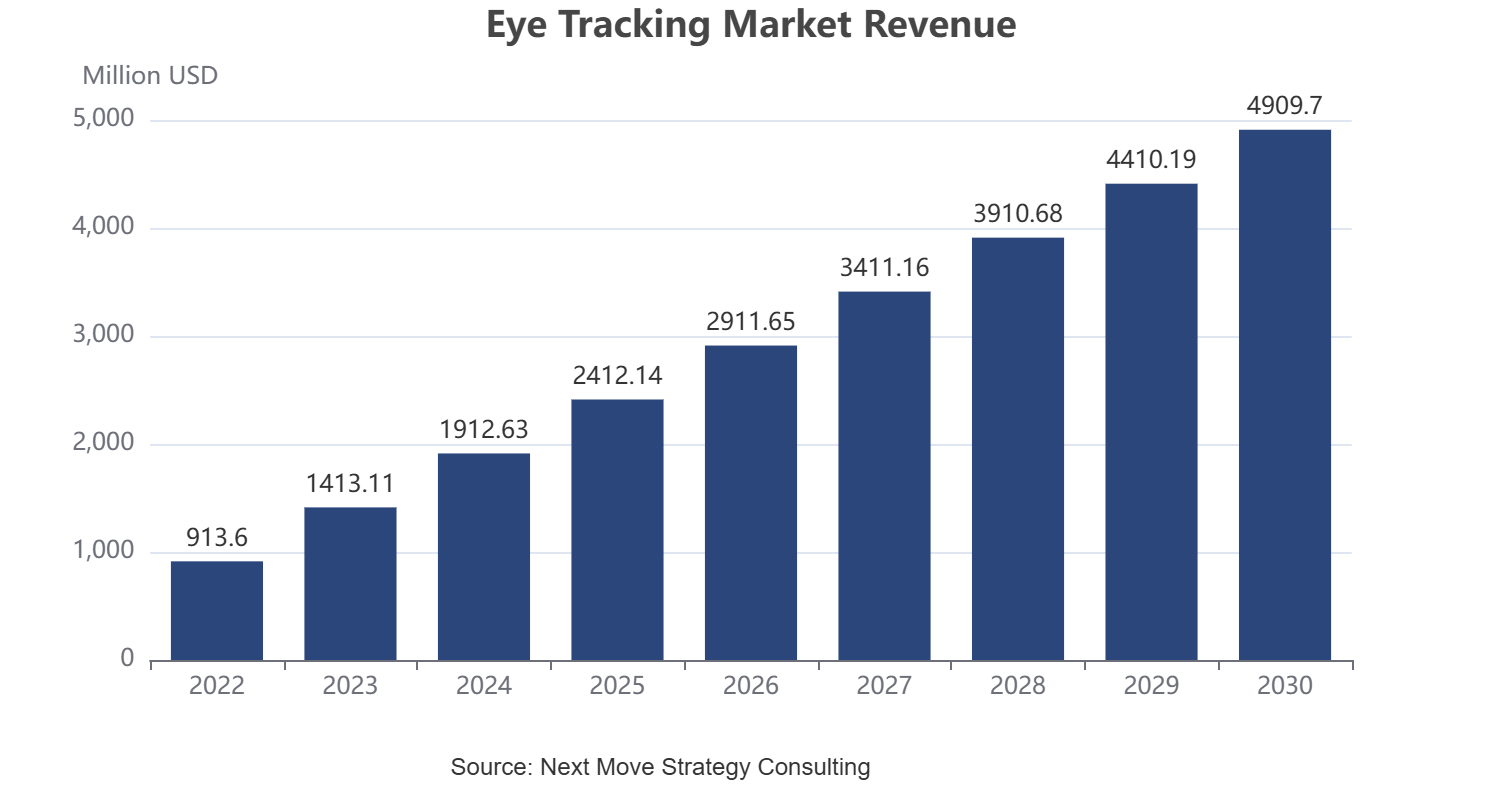
The global Eye Tracking Market size was valued at USD 913.6 million in 2023, and is predicted to reach USD 4909.7 million by 2030, with a CAGR of 26.0% from 2024 to 2030. Eye tracking, also known as gaze tracking is a sophisticated technology that measures and analyzes the movements, gaze direction, and fixation points of a person's eyes. This technology enables a comprehensive understanding of where a person's attention is directed and how their eyes move while observing their surroundings or engaging with visual stimuli. Researchers and professionals utilize this technology to glean insights into diverse aspects of human behavior, cognition, and visual perception.
The applications of eye tracking span across different fields, such as psychology, market research, user experience testing, and human-computer interaction. In psychology, it aids in comprehending how individuals process visual information, make decisions, and respond to stimuli. Market researchers employ it to evaluate consumer preferences, discerning which aspects of advertisements or products garner the most attention. In user experience and human-computer interaction, eye tracking furnishes valuable insights into how users interact with digital interfaces and websites, leading to design enhancements for improved usability.
By offering a meticulous and impartial analysis of visual attention, eye tracking stands as a pivotal tool for gaining profound insights into human visual behavior across various contexts. It has become an indispensable technology for researchers, designers, and professionals striving to refine their products, services, and user experiences.
Growing Advertisement and Consumer Research Boost the Market Growth
The retail industry, especially the fast-moving consumer goods (FMCG) sector, increasingly uses eye-tracking technology to boost sales revenue. Eye-tracking devices track where consumers look, and algorithms use this data to decipher consumer behavior in retail settings. This information reveals valuable insights, such as how long consumers look at products, which product placements lead to purchases, and which packaging designs effectively convey product information. Eye-tracking technology is also used in web marketing to analyze and evaluate ads in various formats, including print, signage, and digital.
In September 2023, Affectiva, a subsidiary of Smart Eye AB, introduced a new attention metric in its cloud-based Emotion AI offering. This new metric combines Smart Eye's precise eye tracking capabilities with Affectiva's Emotion AI to provide more nuanced insights into human behavior. This development can potentially revolutionize viewer attention measurement for brands, advertisers, entertainment companies, and market researchers. It will provide comprehensive and accurate data on human attention and emotions, which can be used to make advertising campaigns, content, and products more engaging and effective.
Rapid Integration of Eye Tracking in the Automotive Sector to Promote Safety & Comfort
The growing concern over rising traffic accidents drives the adoption of eye tracking technology in the automotive sector. This technology monitors driver gaze and assesses behavior to improve safety. It provides real-time insights into the driver's field of vision, leading to better driving experiences for increased comfort and safety. Eye tracking technology has significant potential in the automotive sector. It offers a live view of driver attention, identifies potentially distracting interface elements, and informs the redesign of principles for safer and more efficient vehicles than before.
In 2023, Tobii partnered with Automotive Motion Lab for a research initiative aimed at detecting driver drowsiness without the need for cameras, thus advancing the applications of eye tracking technology in the automotive industry. This breakthrough significantly enhances driver safety, and is relevant to the growing eye tracking market.
Emergence of New Eye Tracking Alternatives Hampers the Market Growth
The emergence of alternative technologies such as gesture recognition, unimodal methods, and multimodal activity recognition restrains the eye tracking market growth. Gesture recognition, for instance, deciphers human gestures through sophisticated algorithms, allowing for device control through simple movements. This technology identifies emotions conveyed through facial, hand, and body gestures. Particularly in sectors such as consumer electronics and gaming, where understanding user behavior is paramount, these alternative technologies offer insights that extend beyond the scope of eye tracking. This factor, in turn, restrains the market expansion.
Expansion of Eye Tracking Technology into New Applications Presents Growth Opportunities for the Industry
The rapid expansion of eye tracking technology across various applications, including augmented reality (AR), virtual reality (VR), lie-detection systems, and cognitive testing, presents substantial growth opportunities for the eye tracking market. In AR and VR, eye trackers not only enhance visual quality but also reduce eye strain, leading to a more immersive user experience. Additionally, they provide invaluable insights into user interactions with their surroundings. In AR, eye tracking enables interactions to respond to a user's gaze. In contrast, VR complements motion tracking for a comprehensive understanding of where users focus in 3D space. This technology benefits from natural stimuli and precise data collection, driving a dynamic field supported by startups and investments from industry giants, such as Apple, Google, Facebook, and Samsung.
In March 2022, Mojo Vision unveiled an advanced prototype of its AR smart contact lens, Mojo Lens, featuring new hardware elements and cutting-edge technologies, such as advanced display, communications, eye tracking technology, and an embedded power system. This innovation empowers users to access timely information quickly and discreetly without diverting their gaze to a screen.
Asia-Pacific Dominates the Eye Tracking Industry
In the Asia-Pacific region, the eye tracking market is driven by distinct factors. China's thriving gaming industry, with over 666 million gamers, fuels the integration of eye tracking for more immersive gameplay. India's rapid adoption of consumer electronics, supported by government initiatives such as 'Make in India' and 'Digital India,' propels the market. South Korea's gaming culture and advanced Driver Monitoring System (DMS) technology in automobiles are key drivers. In Japan, eye tracking is pivotal in medical research and cognitive studies. Australia's focus on elderly care with a rising prevalence of dementia accelerates the demand. Additionally, the military's adoption of eye tracking boosts the market. In Vietnam and the Philippines, the increasing use of eye tracking in healthcare, research, academia, and gaming drives the market growth.
North America to Witness a Substantial Growth in the Market
In North America, the U.S. dominates the eye tracking market, driven by its widespread use in the IT and healthcare sectors. Notably, Amazon's "Eye Gaze" feature for Alexa and Onyx Healthcare's telemedicine device with eye-tracking technology has revolutionized accessibility. The automotive industry's adoption of eye tracking, exemplified by Smart Eye's partnership with a global Tier 1 supplier, further propels the market growth.
In Canada, investments in smart and wearable technology, coupled with the demand for assistive communication devices, contribute to its position as the second-largest market in North America. Additionally, the growth of eye tracking in applications such as lie-detection systems, gaming, and cognitive testing along with its use in healthcare drive the market expansion. The presence of leading eye tracking software companies such as Expoze Io and iMotions amplifies the growth.
Mexico's eye tracking industry is rising, due to its increased adoption in gaming, AR, and VR applications. The retail sector's demand for eye-tracking technology further fuels the growth, as does its application in healthcare and research. Mexico's thriving vehicle modification also boosts the automotive market, and subsequently, the eye tracking market. For example, Smart Eye's AIS system, equipped with comprehensive driver monitoring features, exemplifies this growth.
Competitive Landscape
Various market players operating in the eye tracking industry include Tobii AB, Smart Eye AB, Lattice Semiconductor Corp., Ogilvy, Seeing Machines Ltd., AVSimulation, Lumen, Eyetech Digital Systems, Inc., EyeTracking, Gazepoint, Eyegaze, Eyeware Tech, SR Research Ltd., Pupil Labs, Irisbond Crowdbonding, S.L., and others. These market players are adopting strategies such as collaboration, product launches, and innovation across various regions to maintain their dominance in the global market.
For instance, In June 2026, Tobii AB introduced Distributed Online Projects in Tobii Pro Lab, allowing researchers to import and analyze webcam-based eye-tracking studies conducted remotely through Tobii Sticky. This enhancement significantly expands the scalability of online behavioral research by enabling researchers to collect and analyze eye-tracking data from geographically dispersed participants while maintaining seamless integration with Tobii's analytics platform.
Also, in October 2023, In January 2026, Pupil Labs partnered with NIL Technology (NILT) to integrate NILT's metaEy optical technology into its next-generation wearable eye-tracking platform. The collaboration aims to develop compact and lightweight eye-tracking solutions for augmented reality (AR), virtual reality (VR), and smart glasses, improving tracking accuracy while reducing device size and power consumption.
Moreover, In February 2026, Pupil Labs released Pupil Cloud v8.0, introducing advanced features such as Auto Image Mapper, Area of Interest (AOI) Labels, enhanced visualization tools, and workflow improvements. These upgrades simplify eye-tracking data analysis, improve collaboration among research teams, and enable faster interpretation of user attention and behavioral insights.
In August 2025, Irisbond Crowdbonding, S.L. launched Oskol 2, its first Speech Generating Device (SGD) for iPad powered by the Hiru eye tracker. The solution enables individuals with speech and motor impairments to communicate more naturally through eye gaze while benefiting from improved portability, accessibility, and seamless integration with Apple's ecosystem.
Furthermore, In 2026, Smart Eye AB expanded its automotive human insight portfolio by strengthening deployments of its AI-powered Driver Monitoring System (DMS) with global vehicle manufacturers. The company enhanced its in-cabin sensing capabilities to improve driver safety, monitor distraction and fatigue, and support compliance with evolving vehicle safety regulations worldwide.
Key Segments
By Component
-
Hardware
-
Remote Eye Trackers
-
Head-Mounted Eye Trackers
-
Embedded Modules
-
Accessories
-
-
Software
-
Capture & Calibration
-
Analytics & Visualization Platforms
-
SDKs & APIs
-
Cloud Platforms (SaaS)
-
-
Services
-
Integration & Installation
-
Managed Research
-
Support & Maintenance
-
By Tracking Technology
-
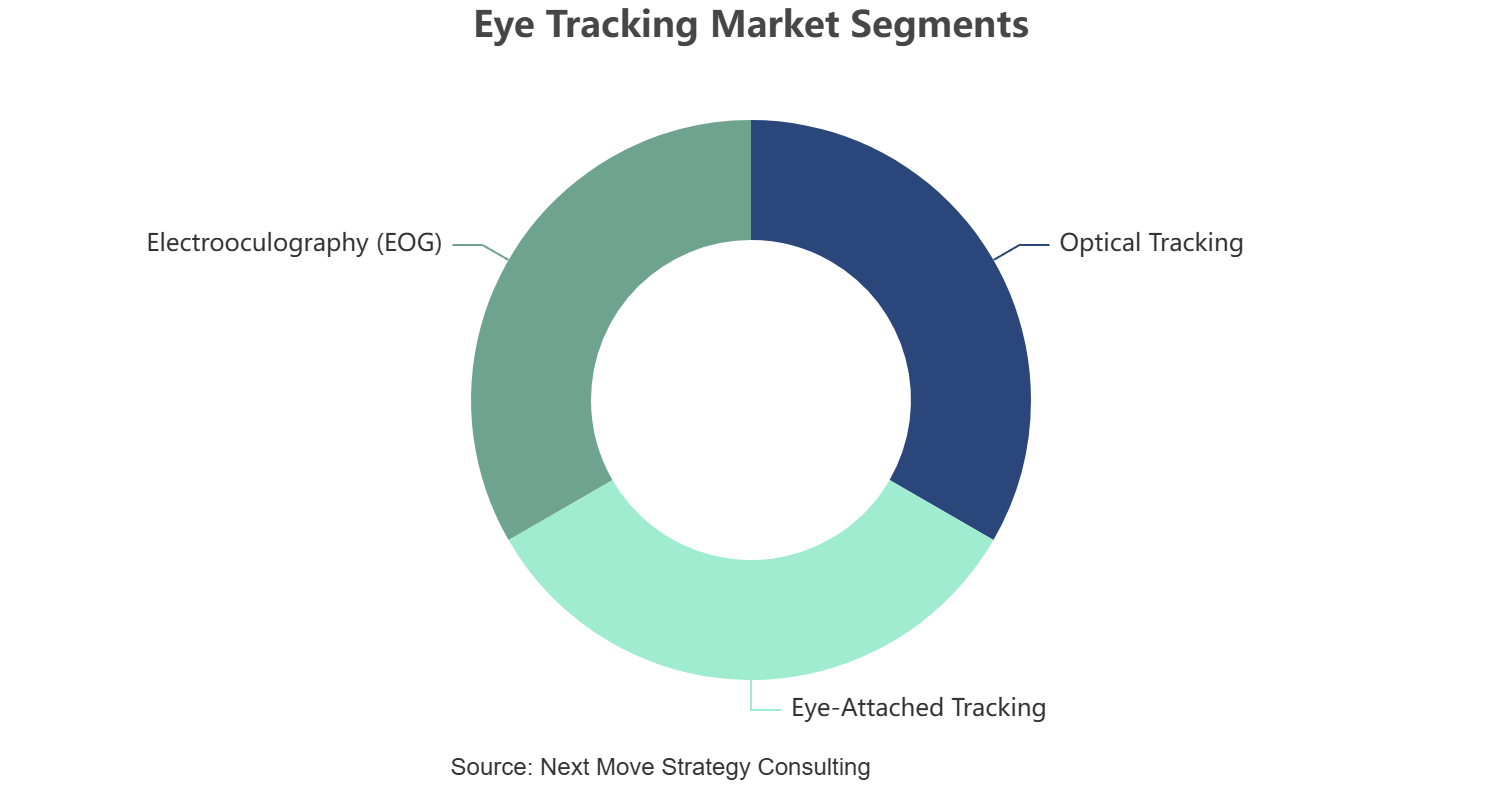
Optical Tracking
-
Eye-Attached Tracking
-
Electrooculography (EOG)
By Application
-
Healthcare & Assistive Technology
-
Assistive Communication Devices
-
Neurological Disorder Diagnostics & Research
-
Ophthalmology & Vision Science
-
-
Consumer Research & Advertising
-
Market Research
-
Usability & UX Testing
-
Advertisement & Packaging Testing
-
-
Automotive & Transportation
-
Driver Monitoring Systems
-
ADAS Integration
-
-
Consumer Electronics & Gaming
-
Virtual & Augmented Reality
-
Gaming & Computer Interfaces
-
-
Academic & Industrial Research
-
Psychology & Neuroscience Research
-
Human Factors Engineering
-
By Region
-
North America
-
U.S.
-
Canada
-
Mexico
-
-
Europe
-
U.K.
-
Germany
-
France
-
Italy
-
Spain
-
Sweden
-
Denmark
-
Finland
-
Netherlands
-
Rest of Europe
-
-
Asia Pacific
-
China
-
India
-
Japan
-
South Korea
-
Taiwan
-
Indonesia
-
Vietnam
-
Australia
-
Philippines
-
Malaysia
-
Rest of APAC
-
-
Middle East & Africa
-
Saudi Arabia
-
UAE
-
Egypt
-
Israel
-
Turkey
-
Nigeria
-
South Africa
-
Rest of MENA
-
-
Latin America
-
Brazil
-
Argentina
-
Chile
-
Colombia
-
Rest of LATAM
-
Key Players
-
Tobii AB
-
Smart Eye AB
-
Lattice Semiconductor Corp
-
Ogilvy
-
Seeing Machines Limited
-
AVSimulation
-
Lumen
-
Eyetech Digital Systems, Inc.
-
EyeTracking
-
Gazepoint
-
Eyegaze
-
Eyeware Tech
-
SR Research Ltd.
-
Pupil Labs
-
Irisbond Crowdbonding, S.L.
Report Scope and Segmentation:
|
Parameters |
Details |
|
Market Size in 2023 |
USD 913.6 Million |
|
Revenue Forecast in 2030 |
USD 4909.7 Million |
|
Growth Rate |
CAGR of 26.0% from 2024 to 2030 |
|
Analysis Period |
2023–2030 |
|
Base Year Considered |
2023 |
|
Forecast Period |
2024–2030 |
|
Market Size Estimation |
Million (USD) |
|
Growth Factors |
Growing advertisement and consumer research Rapid integration of eye tracking in the automotive sector to promote safety & comfort |
|
Countries Covered |
27 |
|
Companies Profiled |
15 |
|
Market Share |
Available for 10 companies |
|
Customization Scope |
Free customization (equivalent up to 80 working hours of analysts) after purchase. Addition or alteration to country, regional, and segment scope. |
|
Pricing and Purchase Options |
Avail customized purchase options to meet your exact research needs. |
About the Author
 Jayanta Das
— Jayanta Das is an industry analyst and writer with a keen focus on emerging technologies and sustainable business practices. With a background in engineering and market research, he brings analytical depth to topics like renewable energy, green manufacturing, and industrial transformation. Jayanta is passionate about translating complex data into actionable insights for businesses navigating the shift toward eco-conscious operations.
Jayanta Das
— Jayanta Das is an industry analyst and writer with a keen focus on emerging technologies and sustainable business practices. With a background in engineering and market research, he brings analytical depth to topics like renewable energy, green manufacturing, and industrial transformation. Jayanta is passionate about translating complex data into actionable insights for businesses navigating the shift toward eco-conscious operations.
About the Reviewer
 Supradip Baul
— Supradip Baul is an accomplished business consultant and strategist with over a decade of rich experience in market intelligence, strategy, technology and business transformation. His work has included rigorous qualitative and quantitative analysis across multiple industries, helping clients shape investment decisions and long-term roadmaps. Earlier in his career, he was associated with Gartner, where he contributed to industry-leading reports and market share analyses. He has worked with leading global companies and holds an MBA with a dual specialization in Marketing and Finance.
Supradip Baul
— Supradip Baul is an accomplished business consultant and strategist with over a decade of rich experience in market intelligence, strategy, technology and business transformation. His work has included rigorous qualitative and quantitative analysis across multiple industries, helping clients shape investment decisions and long-term roadmaps. Earlier in his career, he was associated with Gartner, where he contributed to industry-leading reports and market share analyses. He has worked with leading global companies and holds an MBA with a dual specialization in Marketing and Finance.
At Next Move Strategy Consulting, we understand that insightful market research is the cornerstone of successful business decisions. That's why we employ a robust and multifaceted approach, combining various methodologies to deliver the most accurate and actionable data for our clients.

Research Landscape
We navigate the world of research with two primary approaches:
Qualitative Approach
Our qualitative research methodologies involve immersive techniques such as in-depth interviews, focus groups, and observational studies. By engaging directly with individuals and stakeholders, we uncover valuable insights that quantitative data alone may overlook.

Quantitative Research
In tandem with qualitative methodologies, NMSC leverages the power of Quantitative Research to provide a robust foundation of numerical insights. Through systematic data collection and analysis, we quantify patterns, preferences, and market trends, offering a comprehensive view of the business landscape.
Our quantitative research approach employs diverse tools, including surveys, experiments, and statistical modelling. These methodologies enable us to gather data from a large and representative sample, ensuring the statistical significance of our findings. By employing structured questionnaires and standardized data collection methods, we guarantee the reliability and validity of the information we present to our clients.
Quantitative research is particularly effective in measuring the prevalence of trends, assessing market size, and gauging the impact of various factors on consumer behavior. The numerical precision attained through this approach equips our clients with actionable insights, facilitating data-driven decision-making and strategy formulation.


Our Specialized Toolbox for Industry-Specific Market Research
We deploy a specialized arsenal of techniques tailored to meet your unique requirements. Here's a glimpse into our comprehensive toolbox:

Information Procurement
The stage entails acquiring market data or relevant information through various sources and methodologies.


Market Research Approach
We utilize both top-down and bottom-up approaches in market research analysis to achieve a comprehensive understanding of the market dynamics, leveraging the broad perspective of industry trends and macroeconomic factors alongside detailed insights from specific segments and individual companies.

Porters Five Forces Analysis
We conduct Porter's Five Forces analysis to evaluate the competitive landscape of an industry, providing us with insights into factors that affect profitability and strategic positioning.

SWOT Analysis

Forecasting
We utilize a forecasting model to predict future consumption by considering parameters like population, economics, regulations, market competition, drivers, constraints, technology, and pricing. We also employ statistical techniques such as multilinear regression, exponential smoothing, moving average, ARIMA, and Monte Carlo simulations for accurate predictions. In econometric forecasting, we analyzed short-term and long-term event impacts, attributing values based on regulatory frameworks, economic factors, and market events.





 Speak to Our Analyst