Finland Drone Market By Component (Hardware, Software, and Services), By Platform Type (Multi-Rotor, Fixed-Wing, Hybrid VTOL, and Others), By Autonomy Level (Remotely Piloted, Assisted, Advanced, and Fully Autonomous), By Maximum Take-off Weight {Nano (<250 g), Micro (250 g–2 kg), Small (>2 kg–25 kg), and Others}, By End-User (Consumer Drone, Commercial & Industrial Drone, Government & Public Safety Drone, and Military Drone) – Analysis & Forecast, 2025–2035
Industry: Aerospace & Defense | Latest Edition: September 30, 2026 | No of Pages: 268 | No. of Tables: 140 | No. of Figures: 128 | Format: PDF | Report Code: AD3974
Finland Drone Market Size & Forecast
|
Parameters |
Details |
|
Market Size in 2025 |
USD 427.1 million |
|
Market Size in 2026 |
USD 497.8 million |
|
Revenue Forecast in 2035 |
USD 1,150.2 million |
|
Market Size Growth Rate |
CAGR of 9.75% from 2026 to 2035 |
|
Market Volume in 2025 |
9 thousand units |
|
Market Volume in 2026 |
11 thousand units |
|
Volume Forecast in 2035 |
35 thousand units |
|
Market Volume Growth Rate |
CAGR of 13.51% from 2026 to 2035 |
|
Analysis Period |
2025–2035 |
|
Base Year Considered |
2025 |
|
Forecast Period |
2026–2035 |
|
Market Size Estimation |
Million (USD) |
|
Companies Profiled |
15 |
|
Market Share |
Available for 10 companies |
Industry Outlook
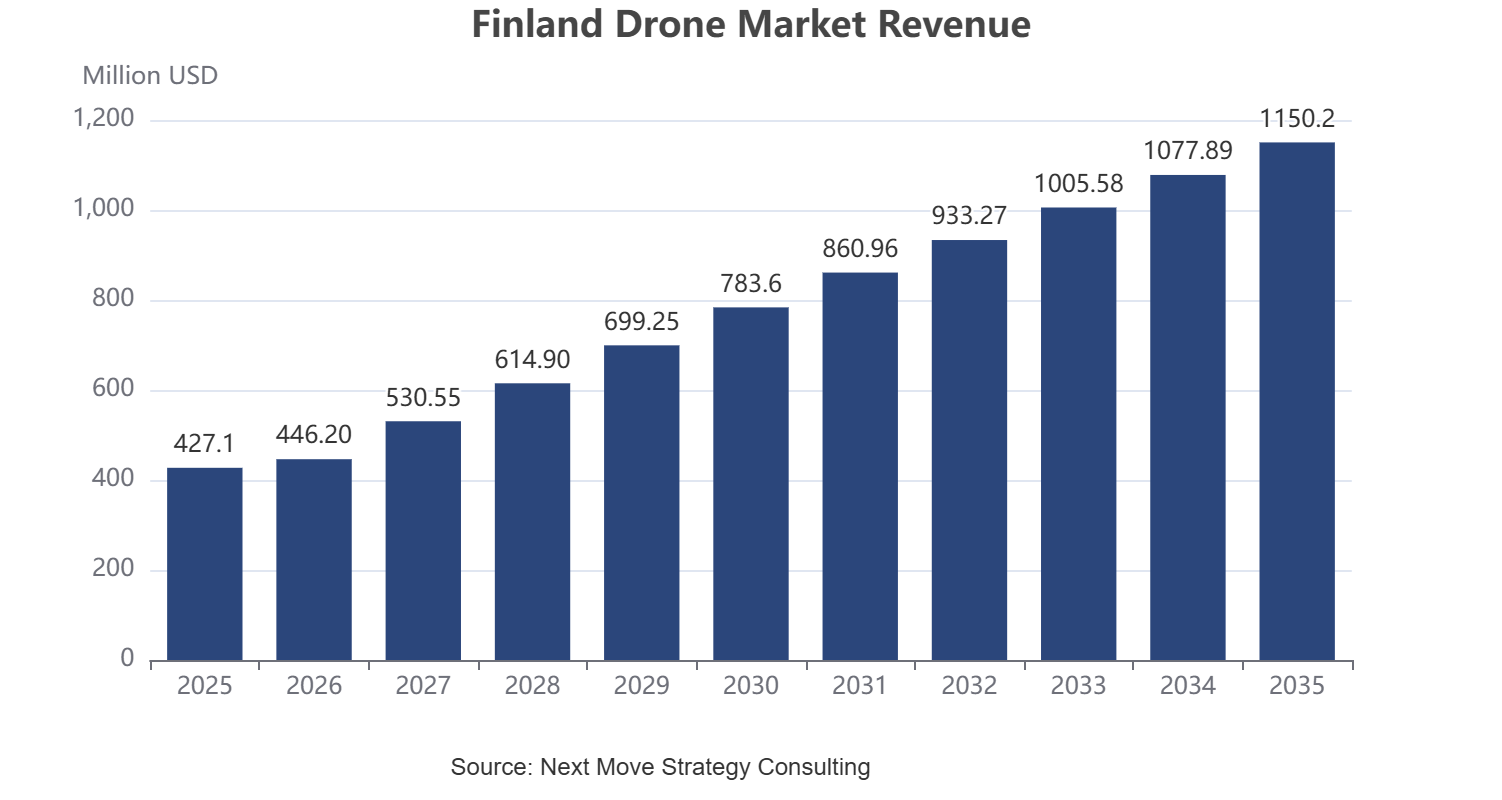
The Finland Drone Market was valued at USD 427.1 million and registered a deployment volume of 9 thousand units in 2025, reflecting the country's accelerating integration of unmanned aerial systems across defense, commercial, and public safety applications within one of Northern Europe's most strategically and operationally distinctive drone markets. The market is projected to reach USD 497.8 million and 11 thousand units by 2026, expanding to USD 1,150.2 million and 35 thousand units by 2035, at revenue and volume CAGRs of 9.75% and 13.51% respectively from 2026 to 2035, driven by NATO-linked defense procurement, EU regulatory enablement, and Arctic terrain commercial adoption.
What Are the Key Market Drivers, Restraints, and Opportunities Shaping the Finland Drone Market Through 2035?
|
Drivers / Trends / Restraints |
(+/-) % Impact on CAGR Forecast |
Geographic Relevance |
Impact Timeline |
|
Finland's NATO accession and heightened border security requirements along its 1,340 km frontier with Russia accelerating strategic military ISR, surveillance, and tactical drone procurement and deployment |
+3.1% |
Finnish–Russian border corridor, Lapland, Baltic Sea approaches |
Long term (4–7 years) |
|
Finland's vast boreal forest coverage, remote Arctic terrain, and dispersed rural infrastructure driving commercial UAS adoption for forestry monitoring, infrastructure inspection, and precision environmental surveying |
+2.4% |
Northern Finland, Lapland, and forested interior provinces |
Medium to Long term (3–6 years) |
|
EU U-Space regulatory framework implementation and Finnish TraFiCom BVLOS corridor authorization enabling scalable beyond-visual-line-of-sight commercial drone operations across Finland's urban and remote territories |
+1.8% |
Designated BVLOS test corridors and urban air mobility zones |
Medium term (2–5 years) |
|
Finland's extreme winter climate, sub-zero temperatures, and atmospheric icing conditions constraining drone operational endurance, battery discharge performance, and sensor calibration across commercial and military segments |
−2.0% |
Nationwide, with greatest operational impact in Lapland and Arctic regions |
Short to Medium term (1–4 years) |
|
Finland's advanced engineering ecosystem and cold-weather systems expertise creating globally differentiated export opportunity for Arctic-hardened, extreme-environment-rated unmanned systems and drone subsystems |
+1.5% |
International defense, oil and gas, and polar research export markets |
Medium to Long term (3–6 years) |
The Finland Drone Market is defined by a convergence of strategic defense imperatives, unique Arctic and boreal terrain operational requirements, and progressive EU regulatory enablement that collectively position the country as one of Northern Europe's most strategically important unmanned systems growth markets. Our analysis indicates that NATO-driven military procurement acceleration, commercial UAS adoption for remote terrain operations, and BVLOS regulatory corridor development represent the primary revenue and volume growth catalysts through 2035. Finland's harsh winter operating environment represents the most significant structural performance constraint, simultaneously creating a differentiated domestic engineering innovation opportunity within extreme-environment drone system development.
Growth Drivers:
How Is Finland's NATO Membership and Russian Border Security Imperative Accelerating Military Drone Procurement and Deployment in the Finland Drone Market?
Finland's NATO accession in April 2023 fundamentally repositioned the country's defense procurement strategy, with unmanned systems emerging as a high-priority capability investment category given the operational surveillance and force-multiplication requirements along Finland's 1,340-kilometer border with Russia. Our assessment indicates that procurement interest is concentrated in ISR-class drones, loitering munition systems, and tactical UAS platforms capable of extended endurance operations in Arctic environmental conditions. Patria ISP Oy and Saab Finland Oy are strategically positioned domestic defense contractors aligned to capture this accelerating defense procurement cycle, while NATO interoperability standards are driving platform compatibility investment across Finland's military drone acquisition programs throughout the forecast period.
How Is Finland's Remote Boreal and Arctic Terrain Driving Commercial Drone Adoption for Monitoring and Inspection Applications?
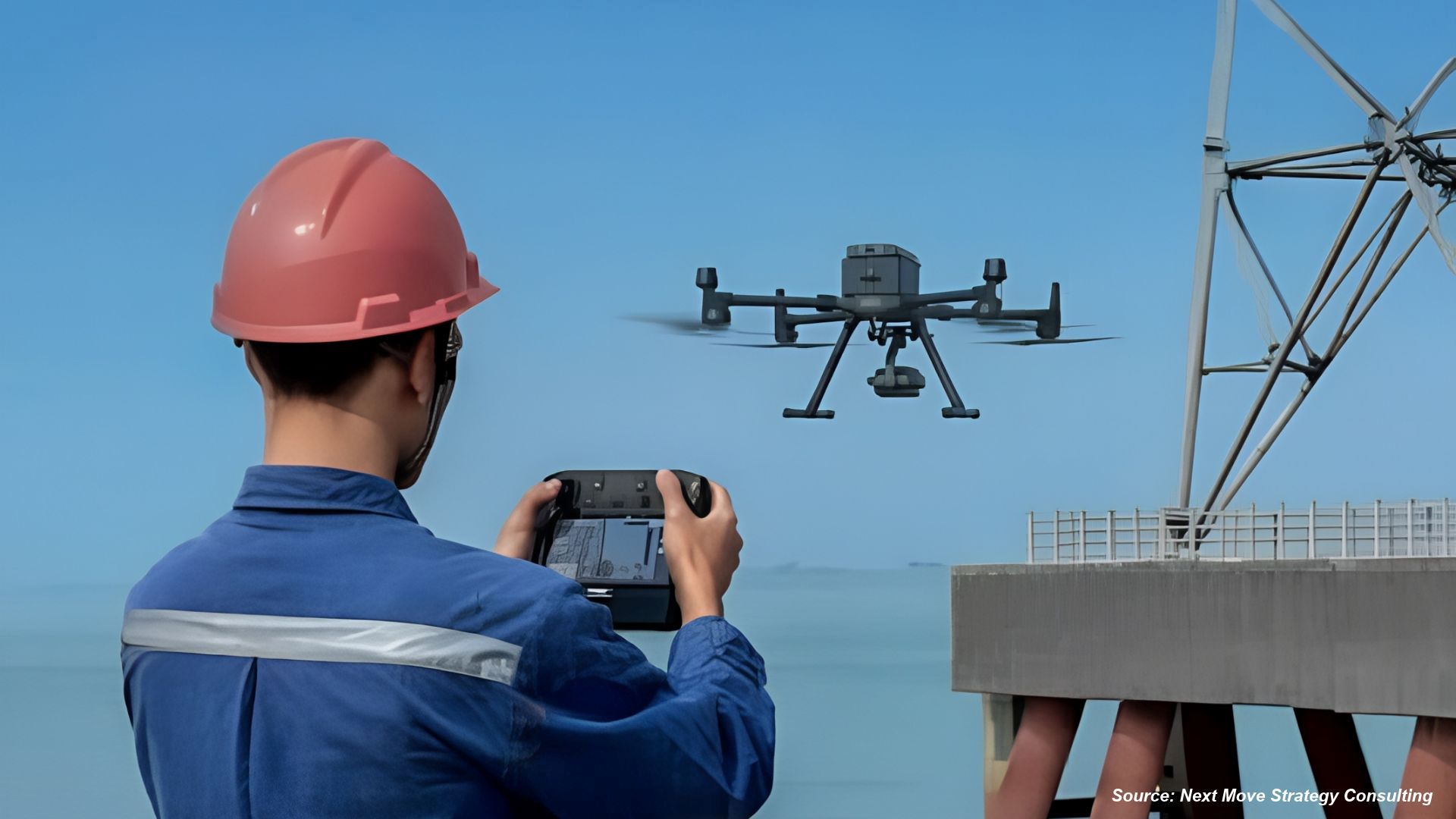
Finland's vast boreal forest coverage, accounting for over 75% of the country's land area, combined with remote Arctic terrain, scattered rural infrastructure, and limited road accessibility across northern provinces, creates a structurally compelling operational case for commercial drone deployment that substantially exceeds the business justification available in more densely networked European markets. Our analysis indicates that infrastructure inspection across power transmission lines, wind energy installations, and railway corridors represents the highest-volume near-term commercial drone application, complemented by growing adoption in forestry health monitoring, reindeer herding boundary surveillance, and precision environmental data collection. Summa Drones Oy and Avartek Drones Oy Ab are advancing Finland-specific commercial UAS service capabilities targeting these terrain-driven applications throughout the forecast period.
How Is EU U-Space Regulatory Enablement and Finnish TraFiCom BVLOS Authorization Unlocking Scalable Commercial Drone Operations in the Finland Drone Market?
The progressive implementation of the European Union's U-Space airspace management framework, combined with Finland's national aviation authority TraFiCom's development of approved BVLOS operational corridors, is systematically removing the regulatory constraints that have historically limited commercial drone deployment to line-of-sight operations and suppressed scalable logistics, inspection, and agricultural UAS application development. Our market assessment indicates that BVLOS authorization is the single most commercially consequential regulatory development for Finland's drone sector, enabling extended-range infrastructure inspection missions, rural logistics delivery feasibility, and large-scale environmental monitoring programs that are operationally and economically unviable under visual-line-of-sight restrictions. This regulatory progression is expected to drive a measurable step-change in commercial deployment volumes throughout the medium-term forecast period.
Growth Inhibitor:
How Is Finland's Extreme Winter Climate and Sub-Zero Operating Environment Constraining Drone Operational Performance and Deployment Frequency?
Finland's harsh winter operating environment, characterized by sub-zero temperatures reaching –40°C in northern Lapland, atmospheric icing conditions, reduced battery discharge performance, and limited daylight hours, represents the most significant technical and operational constraint on year-round commercial drone deployment frequency and mission endurance across the country's UAS sector. Our assessment indicates that lithium polymer battery capacity degradation at low temperatures constrains commercial drone flight times by up to 40% in winter conditions, while ice accretion on rotors and sensor apertures creates additional mission failure risk. These environmental constraints impose seasonal operational windows that suppress annual deployment volumes and increase per-mission costs for Finnish commercial drone operators throughout the forecast period.
Growth Opportunity:
How Is Finland's Arctic Engineering Expertise Creating a Globally Exportable Niche in Extreme-Environment Drone System Development?
Finland's concentration of cold-weather engineering talent, Arctic testing infrastructure, and operational experience with unmanned systems in extreme low-temperature environments is creating a globally distinctive competence that positions Finnish drone developers and subsystem manufacturers as preferred partners for international operators requiring Arctic-rated, winter-hardened platform solutions. Our analysis indicates that demand for extreme-environment-certified drones from oil and gas operators in Arctic exploration fields, polar scientific research institutions, Northern European defense forces, and Canadian and Alaskan commercial operators represents a meaningful addressable export market for Finnish UAS innovators. This Arctic systems differentiation capability creates an internationally competitive positioning advantage that extends well beyond Finland's domestic market scale throughout the forecast period.
How Is the Finland Drone Market Segmented in This Report, and What Are the Key Insights from the Segmentation Analysis?
By Component Insights
How Does Component Segmentation Reflect Technological Value Distribution Across the Finland Drone Market?
Based on component, the Finland Drone Market is segmented into hardware, software, and services.
The market comprises an integrated ecosystem of hardware, software, and service solutions that collectively support drone development, deployment, and lifecycle management. According to our analysis, we found that hardware components provide the structural, sensing, and communication capabilities required for diverse drone operations, while software platforms enhance autonomous flight, mission planning, data analytics, and fleet optimization. Complementing these technologies, service offerings support training, maintenance, operational assistance, and scalable deployment models, enabling organizations to improve efficiency and maximize long-term operational performance.
By End-User Insights
How Does End-User Segmentation Define Strategic Demand Across the Finland Drone Market?
Based on end-user, the Finland Drone Market is segmented into consumer drone, commercial and industrial drone, government and public safety drone, and military drone.
The market reflects diverse demand across consumer, commercial, government, and defense applications, with each end-user group adopting drones to address distinct operational objectives. According to our analysis, we found that commercial and industrial users deploy drones for surveying, inspection, environmental monitoring, logistics, and imaging applications, while government and public safety agencies utilize them for emergency response, security, and public service operations. Military and consumer segments continue to evolve through specialized mission requirements, technological advancements, and expanding application opportunities.
Pestel Analysis of the Finland Drone Market:
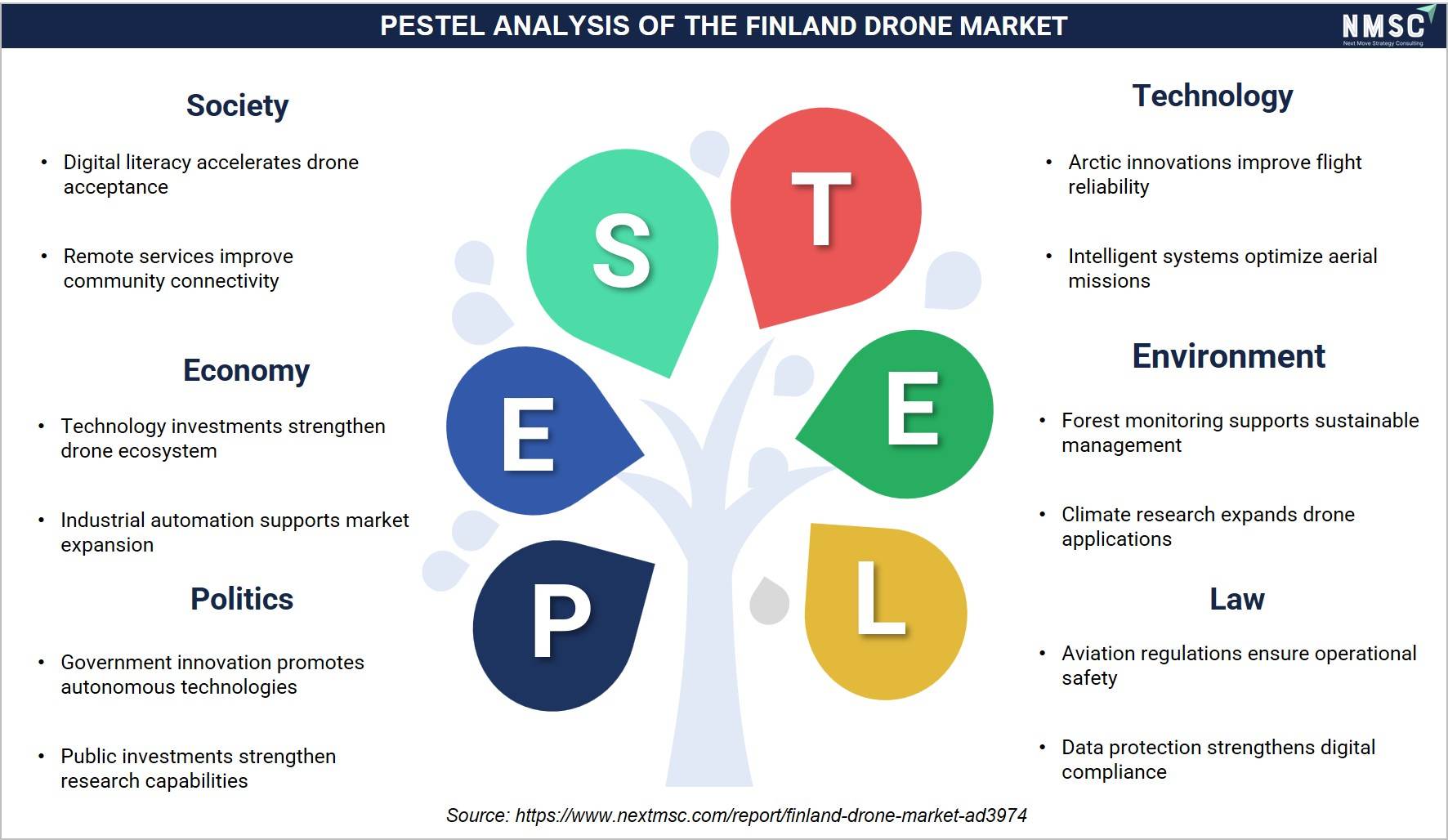
The above PESTEL analysis maps the key macro-environmental factors, such as political, economic, social, technological, environmental, and legal, shaping the Finland drone market. From our analysis, we observed that political stability and government-backed innovation programs support drone adoption, while economic factors influence R&D investments and operational costs. Social acceptance and technological advancements drive innovation, whereas environmental regulations promote sustainable operations and Arctic-specific considerations. Legal frameworks, including aviation laws and data privacy regulations, ensure compliance and safety, reflecting a comprehensive PESTEL landscape across the Finland drone market.
Key Segments
By Component
-
Hardware
-
Airframe
-
Avionics & Core Systems
-
Payloads & Sensors (Cameras, LiDAR, Multispectral, etc.)
-
Communication Systems (C2 Links)
-
-
Software
-
Flight Control & Autonomy
-
Data Processing & Analytics
-
Fleet Management
-
-
Services
-
Drone-as-a-Service (DaaS)
-
Training & Certification
-
Maintenance, Repair & Overhaul (MRO)
-
Data Processing Services
-
By Platform Type
-
Multi-Rotor
-
Fixed-Wing
-
Hybrid VTOL (Vertical Take-Off and Landing)
-
Single-Rotor (Helicopter)
-
Tethered UAV
-
Loitering Munition
-
MALE/HALE/UCAV
By Autonomy Level
-
Remotely Piloted
-
Assisted Autonomy
-
Advanced Autonomy
-
Fully Autonomous
By Maximum Takeoff Weight (MTOW)
-
Nano: < 250 g
-
Micro: 250 g – 2 kg
-
Small: > 2 kg – 25 kg
-
Medium: > 25 kg – 150 kg
-
Large: > 150 kg – 600 kg
-
Very Large/Tactical: > 600 kg
By Price/Performance Grade
-
Consumer Grade (< $1,000)
-
Prosumer Grade ($1,000 – $10,000)
-
Enterprise Grade ($10,000 – $100,000)
-
Military Grade (> $100,000)
By End-User
-
Consumer Drone
-
Commercial & Industrial Drone
-
Aerial Imaging & Cinematography
-
Surveying & Mapping (Geomatics)
-
Agricultural Applications (spraying, crop monitoring)
-
Infrastructure Inspection (energy, utilities, transport)
-
Logistics & Delivery (package transport)
-
Environmental & Scientific Monitoring
-
-
Government & Public Safety Drone
-
Emergency Response & Disaster Management
-
Law Enforcement & Security
-
Firefighting & Public Safety
-
Smart City Management
-
-
Military Drone
-
Intelligence, Surveillance & Reconnaissance (ISR)
-
Combat Operations
-
Electronic Warfare (EW)
-
Target Acquisition & Designation
-
Logistics & Resupply
-
Decoy & Countermeasure Systems
-
Competitive Landscape
The Finland Drone Market features a competitive landscape shaped by the simultaneous presence of globally dominant commercial UAS platform manufacturers, specialized European defense and professional systems integrators, and an emerging domestic Finnish unmanned systems sector anchored by defense industry incumbents and technology-driven startups with distinctive Arctic operational expertise. Competitive differentiation is driven by platform performance in extreme cold-weather conditions, regulatory compliance with EU and NATO standards, sensor payload integration capability, and the development of autonomous and BVLOS-certified operational platforms. Defense procurement relationships and NATO interoperability certification represent critical competitive access requirements in Finland's strategically expanding military drone segment throughout the forecast period.
Strategic Developments:
March 2025 – Patria Oyj highlighted its expanding drone capabilities, focusing on scalable production, agile product development, and integrated unmanned systems following its 2024 acquisition of Nordic Drones. The company expanded its portfolio with Patria SKY, Patria ONE, and Patria GEO platforms, targeting defence, surveillance, reconnaissance, and mission-support applications.
Key Players of the Finland Drone Market:
-
DJI GmbH
-
Skydio, Inc.
-
Parrot Drones S.A.S. and Parrot S.A.
-
Autel Robotics Europe GmbH
-
Wingtra AG
-
Freefly Systems Inc.
-
Quantum-Systems GmbH
-
Patria ISP Oy and Patria Oyj
-
Summa Drones Oy
-
Avartek Drones Oy Ab
-
Geoscan LLC
-
Saab Finland Oy and Saab AB
-
Company 13
-
Company 14
-
Company 15
Key players shaping the Finland Drone Market include DJI GmbH, Skydio, Inc., Parrot Drones S.A.S. and Parrot S.A., Autel Robotics Europe GmbH, Wingtra AG, Freefly Systems Inc., Quantum-Systems GmbH, Patria ISP Oy and Patria Oyj, Summa Drones Oy, and otherscollectively advancing through Arctic-hardened platform innovation, EU regulatory compliance investment, and defense system integration capabilities to capture Finland's expanding commercial, government, and military unmanned systems demand throughout the forecast period.
Porter's Five Forces Analysis of the Finland Drone Market:
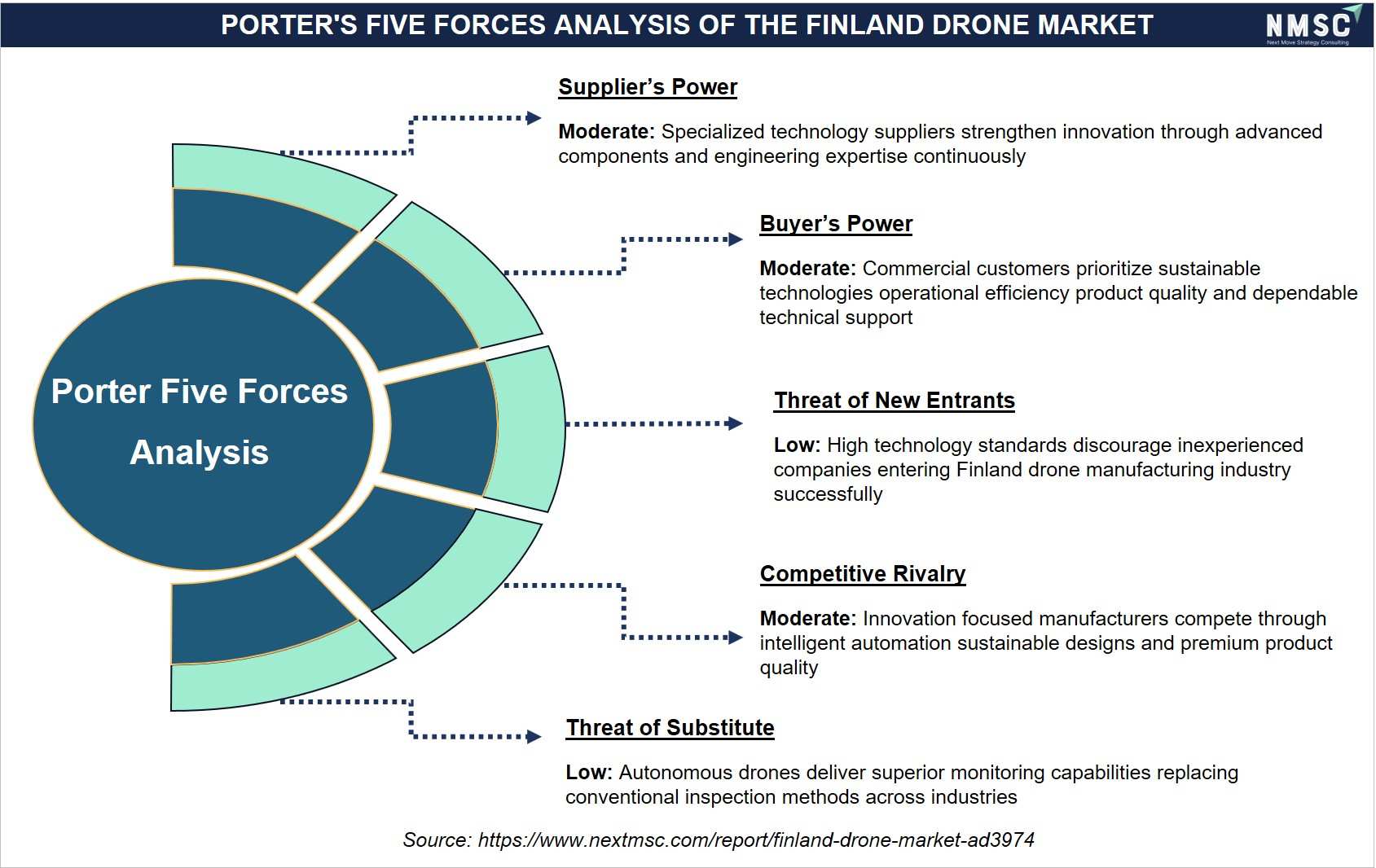
The above Porter's Five Forces analysis maps the key competitive forces, such as threat of new entrants, bargaining power of suppliers, bargaining power of buyers, threat of substitutes, and industry rivalry, shaping the Finland drone market. From our analysis, we observed that industry rivalry remains moderate with specialized Nordic applications, while the bargaining power of suppliers is influenced by advanced component dependencies. The threat of new entrants is limited by strict regulatory frameworks, whereas the bargaining power of buyers is growing with forestry, logistics, and infrastructure inspection applications driving market demand.
Key Benefits for Stakeholders
Next Move Strategy Consulting (NMSC) presents a comprehensive analysis of the Finland Drone Market covering the 2025–2035 period with detailed revenue and volume forecasts across all major segments, including component, platform type, autonomy level, maximum takeoff weight, price/performance grade, and end-user categories. The report identifies Finland-specific growth drivers, NATO defense procurement trajectories, and Arctic operational opportunity insights equipping stakeholders with the foundation for informed investment and market strategy decisions.
Investors, drone technology developers, and defense procurement specialists gain actionable intelligence on Finland's unique Arctic operational requirements, EU U-Space regulatory progression, and commercial UAS application scaling across boreal and remote terrain environments. Competitive landscape benchmarking, segment-level demand forecasts, and technology adoption trajectories support evidence-based portfolio strategy, product development prioritization, and partnership identification across Finland's rapidly evolving unmanned systems sector.
|
Parameters |
Details |
|
Customization Scope |
Free customization (equivalent to up to 80 analyst-working hours) after purchase. |
|
Pricing and Purchase Options |
Avail customized purchase options to meet your exact research needs. |
|
Approach |
In-depth primary and secondary research; proprietary databases; rigorous quality control and validation measures. |
|
Analytical Tools |
Porter's Five Forces, SWOT, value chain, and Harvey ball analysis to assess competitive intensity, stakeholder roles, and relative impact of key factors. |
Conclusion
The Finland Drone Market presents a strategically distinctive growth opportunity anchored by NATO-driven military procurement acceleration, Arctic terrain-induced commercial application necessity, and EU regulatory BVLOS enablement that collectively support a 9.75% revenue CAGR and 13.51% volume CAGR toward USD 1,150.2 million and 35 thousand units by 2035. Finland's extreme winter climate simultaneously constrains operational frequency and catalyzes globally exportable Arctic engineering differentiation. Competitive success will favor operators combining EU-compliant platform certification, Arctic performance validation, and defense interoperability credentials to capture Finland's expanding unmanned systems demand across commercial, government, and military end-user segments throughout the forecast period.
About the Author
 Mayurima Roy
— Mayurima Roy is Research Analyst at Next Move Strategy Consulting, where she has spent 4 years working across the firm's full industry coverage rather than a single fixed vertical. Her work centers on structured research, ongoing trend tracking, competitive assessment, and insight-led content development, translating complex market data into clear, decision-ready narratives that support informed client decision-making across diverse global industries, market sectors, and world regions every day.
Mayurima Roy
— Mayurima Roy is Research Analyst at Next Move Strategy Consulting, where she has spent 4 years working across the firm's full industry coverage rather than a single fixed vertical. Her work centers on structured research, ongoing trend tracking, competitive assessment, and insight-led content development, translating complex market data into clear, decision-ready narratives that support informed client decision-making across diverse global industries, market sectors, and world regions every day.
About the Reviewer
 Supradip Baul
— Supradip Baul is an accomplished business consultant and strategist with over a decade of rich experience in market intelligence, strategy, technology, and business transformation. His work has included rigorous qualitative and quantitative analysis across multiple industries, helping clients shape investment decisions and long-term roadmaps. Earlier in his career, he was associated with Gartner, where he contributed to industry-leading reports and market share analyses. He has worked with leading global companies and holds an MBA with a dual specialization in Marketing and Finance.
Supradip Baul
— Supradip Baul is an accomplished business consultant and strategist with over a decade of rich experience in market intelligence, strategy, technology, and business transformation. His work has included rigorous qualitative and quantitative analysis across multiple industries, helping clients shape investment decisions and long-term roadmaps. Earlier in his career, he was associated with Gartner, where he contributed to industry-leading reports and market share analyses. He has worked with leading global companies and holds an MBA with a dual specialization in Marketing and Finance.
At Next Move Strategy Consulting, we understand that insightful market research is the cornerstone of successful business decisions. That's why we employ a robust and multifaceted approach, combining various methodologies to deliver the most accurate and actionable data for our clients.

Research Landscape
We navigate the world of research with two primary approaches:
Qualitative Approach
Our qualitative research methodologies involve immersive techniques such as in-depth interviews, focus groups, and observational studies. By engaging directly with individuals and stakeholders, we uncover valuable insights that quantitative data alone may overlook.

Quantitative Research
In tandem with qualitative methodologies, NMSC leverages the power of Quantitative Research to provide a robust foundation of numerical insights. Through systematic data collection and analysis, we quantify patterns, preferences, and market trends, offering a comprehensive view of the business landscape.
Our quantitative research approach employs diverse tools, including surveys, experiments, and statistical modelling. These methodologies enable us to gather data from a large and representative sample, ensuring the statistical significance of our findings. By employing structured questionnaires and standardized data collection methods, we guarantee the reliability and validity of the information we present to our clients.
Quantitative research is particularly effective in measuring the prevalence of trends, assessing market size, and gauging the impact of various factors on consumer behavior. The numerical precision attained through this approach equips our clients with actionable insights, facilitating data-driven decision-making and strategy formulation.


Our Specialized Toolbox for Industry-Specific Market Research
We deploy a specialized arsenal of techniques tailored to meet your unique requirements. Here's a glimpse into our comprehensive toolbox:

Information Procurement
The stage entails acquiring market data or relevant information through various sources and methodologies.


Market Research Approach
We utilize both top-down and bottom-up approaches in market research analysis to achieve a comprehensive understanding of the market dynamics, leveraging the broad perspective of industry trends and macroeconomic factors alongside detailed insights from specific segments and individual companies.

Porters Five Forces Analysis
We conduct Porter's Five Forces analysis to evaluate the competitive landscape of an industry, providing us with insights into factors that affect profitability and strategic positioning.

SWOT Analysis

Forecasting
We utilize a forecasting model to predict future consumption by considering parameters like population, economics, regulations, market competition, drivers, constraints, technology, and pricing. We also employ statistical techniques such as multilinear regression, exponential smoothing, moving average, ARIMA, and Monte Carlo simulations for accurate predictions. In econometric forecasting, we analyzed short-term and long-term event impacts, attributing values based on regulatory frameworks, economic factors, and market events.





 Speak to Our Analyst