Combat Drone (UCAV) Market Global Industry Analysis and Forecast (2026–2035)

The global Combat Drone (UCAV) Market size was valued at USD 5.20 billion in 2025 and is estimated at USD 5.85 billion in 2026, forecast to reach USD 16.80 billion by 2035, expanding at a 12.4% CAGR between 2026 and 2035. North America leads with approximately 38% share, while Fixed-Wing MALE UCAV dominates all other platform types with approximately 38% share.

Download Free Sample PDF
Base Year (2025)
$5.20 Billion
Forecast (2035)
$16.80 Billion
CAGR (2026-2035)
12.4%
Top Region
North America

What Is the Combat Drone (UCAV) Market Size?

The global Combat Drone (UCAV) Market size was valued at USD 5.20 billion in 2025 and is estimated at USD 5.85 billion in 2026, forecast to reach USD 16.80 billion by 2035, expanding at a 12.4% CAGR between 2026 and 2035. North America leads with approximately 38% share, while Fixed-Wing MALE UCAV dominates all other platform types with approximately 38% share.
We observed that growth is broad-based across every segmentation axis, with loitering munition proliferation and loyal wingman autonomous collaborative programs driving the dominant structural shifts through 2035.

Combat Drone (UCAV) Market Global Industry Analysis and Forecast (2026–2035) Revenue Forecast

Values in USD Billion

2025 $5.20 Billion
2025
2026 $5.85 Billion
2026
2027 $6.58 Billion
2027
2028 $7.39 Billion
2028
2029 $8.31 Billion
2029
2030 $9.34 Billion
2030
2031 $10.50 Billion
2031
2032 $11.80 Billion
2032
2033 $13.26 Billion
2033
2034 $14.90 Billion
2034
2035 $16.80 Billion
2035

Key Takeaways

By Platform Type: Fixed-Wing MALE UCAV held the largest share of approximately 38% (USD 1.98 billion) in 2025; Loyal Wingman/Autonomous Collaborative Platforms is the fastest-growing sub-segment at 19.5% CAGR from 2026–2035.

By Autonomy Level: Remotely Piloted held the largest share of approximately 58% (USD 3.02 billion) in 2025; Fully Autonomous (AI-Enabled) is the fastest-growing sub-segment at 22.6% CAGR from 2026–2035.

By Application: Strike and Precision Attack held the largest share of approximately 40% (USD 2.08 billion) in 2025; Manned-Unmanned Teaming is the fastest-growing sub-segment at 19.3% CAGR from 2026–2035.

By End User: Air Force held the largest share of approximately 48% (USD 2.50 billion) in 2025; Navy is the fastest-growing sub-segment at 15.9% CAGR from 2026–2035.

By Range Category: Medium Range held the largest share of approximately 45% (USD 2.34 billion) in 2025; Long Range is the fastest-growing sub-segment at 16.0% CAGR from 2026–2035.

Dominant Region: North America dominated with approximately 38% revenue share (USD 1.98 billion) in 2025.

Fastest-Growing Region: Asia-Pacific is expected to register the highest CAGR of 15.5% during 2026–2035.

Dominant Country: U.S. led with approximately USD 1.72 billion in 2025.

Fastest-Growing Country: India is the fastest-growing country at approximately 16.4% CAGR from 2026–2035.

Market Opportunity: The Combat Drone (UCAV) Market is expected to create an absolute dollar opportunity of USD 10.95 billion between 2026 and 2035, presenting significant investment potential across the autonomous strike and loyal wingman platform value chain.
According to NMSC analysis, defense procurement agencies are increasingly favoring modular, software-defined UCAV architectures over single-purpose airframes, a shift that favors manufacturers with open mission-system integration over legacy fixed-configuration platforms as autonomous collaborative combat programs scale through 2035.

What Does the Combat Drone (UCAV) Market Encompass?
The Combat Drone (UCAV) Market encompasses unmanned combat aerial vehicles engineered to deliver precision strike, suppression of enemy air defense, and manned-unmanned teaming capability, distinct from the broader military drone market that includes unarmed reconnaissance-only platforms. We observed that the scope spans fixed-wing medium and high-altitude long-endurance strike platforms, loitering munitions, stealth low-observable airframes, and emerging loyal wingman autonomous collaborative platforms designed to operate alongside crewed fighters. The category has evolved from remotely piloted strike aircraft into increasingly autonomous, AI-enabled systems capable of swarm coordination and semi-independent target engagement.

Export control regimes such as the Missile Technology Control Regime and national arms export licensing frameworks continue to shape cross-border UCAV sales, while national defense modernization budgets increasingly prioritize indigenous production capability. We observed that technology adoption is shifting toward AI-enabled autonomy and swarm intelligence algorithms that allow multiple platforms to coordinate without continuous human control. NMSC's analysis indicates that this structural shift, combined with combat-proven export success from Turkish and Chinese manufacturers, is redefining procurement criteria across the Combat Drone (UCAV) Market.

Market Drivers & Dynamics

Interactive Dataset
Rising defense modernization budgets amid geopolitical tensions driver +2.9% Global 2026-2035
Combat-proven loitering munition demand from recent conflicts driver +2.4% Europe, Middle East & Africa 2026-2035
Expanding loyal wingman and manned-unmanned teaming programs driver +2.0% North America, Europe, Asia-Pacific 2026-2035
Growing indigenous production and technology transfer agreements driver +1.6% Asia-Pacific, Middle East & Africa 2026-2035
Rising AI-enabled autonomy and swarm coordination adoption driver +1.3% Global 2026-2033
Expanding export markets for combat-proven Turkish and Chinese platforms driver +1.1% Middle East & Africa, Latin America 2026-2035
Export control restrictions limiting cross-border technology transfer restraint -1.8% Global 2026-2035
Rapid proliferation of counter-drone systems reducing platform survivability restraint -1.2% Europe, North America 2026-2033
High development cost of stealth and autonomous airframes restraint -0.9% North America, Europe 2026-2032
Source: Next Move Strategy Consulting

Growth Drivers

What Is the Primary Growth Driver of the Combat Drone (UCAV) Market?

Rising defense modernization budgets amid geopolitical tensions are the primary driver of the market. U.S. Department of War budget disclosures continue to document sustained appropriations for unmanned strike aircraft procurement programs. We observed that this budget expansion, reinforced by combat-proven operational demand from recent regional conflicts, continues to anchor baseline demand for fixed-wing MALE and loitering munition platforms across allied and partner nation air forces.

How Is Loitering Munition Demand Driving Combat Drone (UCAV) Market Growth?

Combat-proven loitering munition demand is accelerating market growth as recent conflicts demonstrate the operational value of low-cost, precision-guided expendable strike platforms against integrated airdefensenetworks. Anduril Industries' Bolt-M loitering munition entered U.S. Marine Corps service under a $23.9 million contract for the Organic Precision Fires-Light program in 2026. NMSC's analysis indicates that this procurement trajectory, combined with rising European loitering munition orders, is compressing adoption timelines for man-portable and vehicle-launched strike systems.

Growth Inhibitors

What Is Restraining Combat Drone (UCAV) Market Expansion?

Export control restrictions limiting cross-border technology transfer restrain broader market participation among smaller defense industrial bases. Missile Technology Control Regime frameworks continue to constrain certain member states' UCAV export eligibility for higher-payload, longer-range platforms. We found that rapid proliferation of counter-drone systems particularly affects platform survivability calculations, prompting manufacturers to prioritize stealth and autonomous evasion capability over simpler, lower-cost airframe designs.

What Are the Growth Opportunities?

How Can Loyal Wingman Integration Unlock Value for Next-Generation Fighter Programs?

Loyal wingman integration presents a whitespace opportunity for manufacturers capable of pairing autonomous collaborative platforms with sixth-generation fighter programs such as the Global Combat Air Programme. Manufacturers that commercialize validated, combat-proven wingman candidates stand to capture premium contracts among air forces seeking cost-effective force multiplication alongside crewed fleets, particularly across NATO and allied Indo-Pacific procurement programs.

Where Does Indigenous Co-Production Create New Regional Market Access?

Indigenous co-production agreements represent an underpenetrated opportunity for manufacturers seeking sustained access to Middle Eastern and South Asian procurement budgets facing domestic content requirements. Vendors that establish validated local manufacturing partnerships can secure long-term supply agreements with defense ministries pursuing sovereign production capability alongside imported platform access.

How Can Swarm-Enabled Software Platforms Benefit Loitering Munition Manufacturers?

Rising demand for coordinated, multi-platform strike capability creates an opportunity for manufacturers offering open-architecture swarm intelligence software layered onto existing loitering munition hardware. Early movers that secure interoperable autonomy platforms can differentiate with defense ministries pursuing decentralized, resilient strike capability across contested electromagnetic environments. Manufacturers that license their coordination software across multiple partner airframes stand to capture recurring, platform-agnostic revenue streams.

Segmentation Analysis

2025 (USD Billion)
2035 (USD Billion)
Fixed-Wing MALE UCAV 2025: $1.98 Billion | 2035: $4.70 Billion
Fixed-Wing M
Loitering Munitions 2025: $1.25 Billion | 2035: $5.04 Billion
Loitering Mu
Fixed-Wing HALE UCAV 2025: $0.62 Billion | 2035: $1.68 Billion
Fixed-Wing H
Stealth/Low-Observable UCAV 2025: $0.52 Billion | 2035: $1.85 Billion
Stealth/Low-
Loyal Wingman/Autonomous Collaborative Platforms 2025: $0.42 Billion | 2035: $2.35 Billion
Loyal Wingma
Fixed-Wing Low-Altitude Tactical UCAV 2025: $0.26 Billion | 2035: $0.67 Billion
Fixed-Wing L
Rotary-Wing UCAV 2025: $0.15 Billion | 2035: $0.51 Billion
Rotary-Wing
Fixed-Wing MALE UCAV $1.98 Billion $4.70 Billion 8.6%
Loitering Munitions $1.25 Billion $5.04 Billion 15.2%
Fixed-Wing HALE UCAV $0.62 Billion $1.68 Billion 10.3%
Stealth/Low-Observable UCAV $0.52 Billion $1.85 Billion 13.6%
Loyal Wingman/Autonomous Collaborative Platforms $0.42 Billion $2.35 Billion 19.5%
Fixed-Wing Low-Altitude Tactical UCAV $0.26 Billion $0.67 Billion 9.6%
Rotary-Wing UCAV $0.15 Billion $0.51 Billion 13.1%

Which Platform Type Segment Dominates the Combat Drone (UCAV) Market?

Fixed-Wing MALE UCAV led the market with USD 1.98 billion in 2025, reflecting its established position as the primary strike platform across allied and export air forces given its balance of endurance, payload, and cost. We observed that Loyal Wingman/Autonomous Collaborative Platforms is the fastest-growing platform type, expanding at a 19.5% CAGR from 2026 to 2035, as air forces increasingly pursue manned-unmanned teaming programs pairing crewed fighters with autonomous, AI-enabled companion aircraft.

2025 (USD Billion)
2035 (USD Billion)
Remotely Pil
Semi-Autonom
Fully Autono
Segment Item 2025 (USD Billion) 2035 (USD Billion) CAGR
Remotely Piloted $10.0 USD Billion $40.0 USD Billion 24.0%
Semi-Autonomous $17.1 USD Billion $51.1 USD Billion 18.0%
Fully Autonomous (AI-Enabled) $24.2 USD Billion $62.2 USD Billion 20.0%

Segment-wise data is locked

Unlock complete segment-wise numbers for By Autonomy Level.

Unlock Full Data
2025 (USD Billion)
2035 (USD Billion)
Strike and P
Intelligence
Surveillance
and Reconnai
Suppression
Segment Item 2025 (USD Billion) 2035 (USD Billion) CAGR
Strike and Precision Attack $10.0 USD Billion $40.0 USD Billion 15.0%
Intelligence $17.1 USD Billion $51.1 USD Billion 21.0%
Surveillance $24.2 USD Billion $62.2 USD Billion 11.0%
and Reconnaissance-Strike $31.3 USD Billion $73.3 USD Billion 21.0%
Suppression of Enemy Air Defense $38.4 USD Billion $84.4 USD Billion 14.0%

Segment-wise data is locked

Unlock complete segment-wise numbers for By Application.

Unlock Full Data

Which Application Segment Leads Combat Drone (UCAV) Market Demand?

Strike and Precision Attack remained the leading application within the market, valued at USD 2.08 billion in 2025 as the core mission profile underpinning most fielded UCAV programs globally, ahead of unarmed intelligence, surveillance, and reconnaissance platforms performing adjacent non-strike roles. Our findings suggest that Manned-Unmanned Teaming is the fastest-growing application, registering a 19.3% CAGR from 2026 to 2035, as air forces including the UK-Italy-Japan Global Combat Air Programme increasingly evaluate combat-proven UCAVs as loyal wingman candidates for next-generation crewed-uncrewed fleet architectures.

2025 (USD Billion)
2035 (USD Billion)
Air Force
Army
Navy
Special Oper
Other End Us
Segment Item 2025 (USD Billion) 2035 (USD Billion) CAGR
Air Force $10.0 USD Billion $40.0 USD Billion 25.0%
Army $17.1 USD Billion $51.1 USD Billion 23.0%
Navy $24.2 USD Billion $62.2 USD Billion 9.0%
Special Operations Forces $31.3 USD Billion $73.3 USD Billion 23.0%
Other End Users $38.4 USD Billion $84.4 USD Billion 24.0%

Segment-wise data is locked

Unlock complete segment-wise numbers for By End User.

Unlock Full Data

Which End User Segment Dominates the Combat Drone (UCAV) Market?

Air Force remained the dominant end user within the market, valued at USD 2.50 billion in 2025 as the largest institutional operator of fixed-wing MALE and stealth UCAV platforms across allied and partner nation fleets. Our assessment indicates that Navy is the fastest-growing end user, expanding at a 15.9% CAGR from 2026 to 2035, as naval aviation programs increasingly field carrier-compatible and ship-launched unmanned strike and refueling platforms alongside crewed naval aircraft.

2025 (USD Billion)
2035 (USD Billion)
Short Range
Medium Range
Long Range (
Segment Item 2025 (USD Billion) 2035 (USD Billion) CAGR
Short Range (Up to 150 km) $10.0 USD Billion $40.0 USD Billion 17.0%
Medium Range (150-500 km) $17.1 USD Billion $51.1 USD Billion 11.0%
Long Range (Above 500 km) $24.2 USD Billion $62.2 USD Billion 9.0%

Segment-wise data is locked

Unlock complete segment-wise numbers for By Range Category.

Unlock Full Data

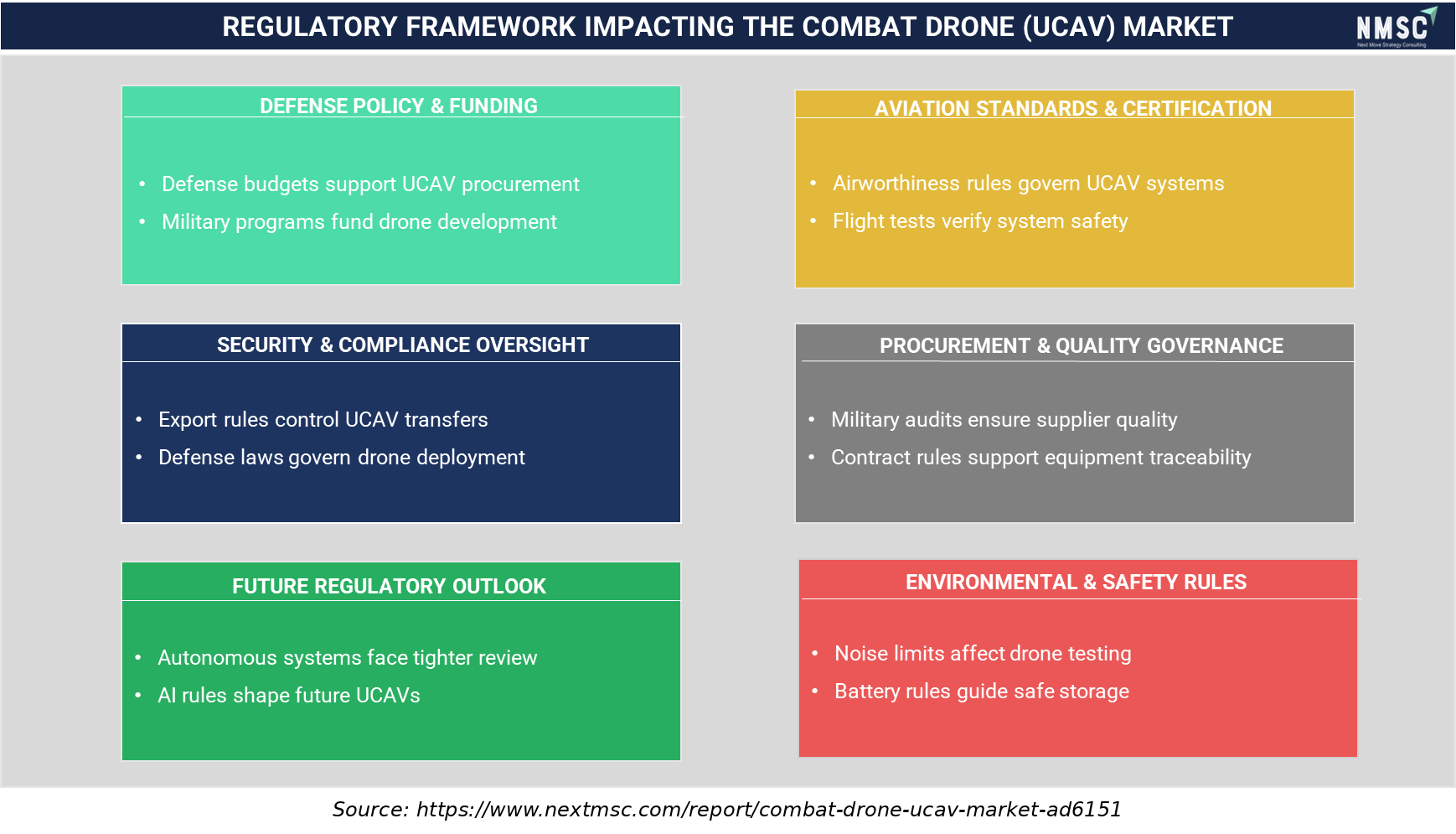
Regulatory Framework Impacting the Combat Drone (UCAV) Market

The combat drone market is influenced by defense procurement policies, aviation standards, export controls, and security requirements. Government funding supports UCAV development and acquisition, while airworthiness certification and flight testing establish operational standards. Procurement audits promote supplier quality and traceability, whereas environmental, battery, autonomy, and emerging AI regulations increasingly shape development, testing, deployment, and compliance requirements.

Growth Opportunities

Our analysis shows that three forward-looking opportunities stand out for stakeholders positioning within the Combat Drone (UCAV) Market over the 2026-2035 forecast period.

How Can Loyal Wingman Integration Unlock Value for Next-Generation Fighter Programs?

Loyal wingman integration presents a whitespace opportunity for manufacturers capable of pairing autonomous collaborative platforms with sixth-generation fighter programs such as the Global Combat Air Programme. Manufacturers that commercialize validated, combat-proven wingman candidates stand to capture premium contracts among air forces seeking cost-effective force multiplication alongside crewed fleets, particularly across NATO and allied Indo-Pacific procurement programs.

Where Does Indigenous Co-Production Create New Regional Market Access?

Indigenous co-production agreements represent an underpenetrated opportunity for manufacturers seeking sustained access to Middle Eastern and South Asian procurement budgets facing domestic content requirements. Vendors that establish validated local manufacturing partnerships can secure long-term supply agreements with defense ministries pursuing sovereign production capability alongside imported platform access.

How Can Swarm-Enabled Software Platforms Benefit Loitering Munition Manufacturers?

Rising demand for coordinated, multi-platform strike capability creates an opportunity for manufacturers offering open-architecture swarm intelligence software layered onto existing loitering munition hardware. Early movers that secure interoperable autonomy platforms can differentiate with defense ministries pursuing decentralized, resilient strike capability across contested electromagnetic environments. Manufacturers that license their coordination software across multiple partner airframes stand to capture recurring, platform-agnostic revenue streams.

Regional Outlook

2025 (USD Billion)
2035 (USD Billion)
North Americ
Asia-Pacific
Europe
Middle East
Latin Americ
Region 2025 (USD Billion) 2035 (USD Billion) CAGR (%)
North America $10.0 USD Billion $40.0 USD Billion 9.0%
Asia-Pacific $17.1 USD Billion $51.1 USD Billion 27.0%
Europe $24.2 USD Billion $62.2 USD Billion 25.0%
Middle East & Africa $31.3 USD Billion $73.3 USD Billion 23.0%
Latin America $38.4 USD Billion $84.4 USD Billion 12.0%

Regional data is locked

Unlock complete regional numbers for this market.

Unlock Full Data

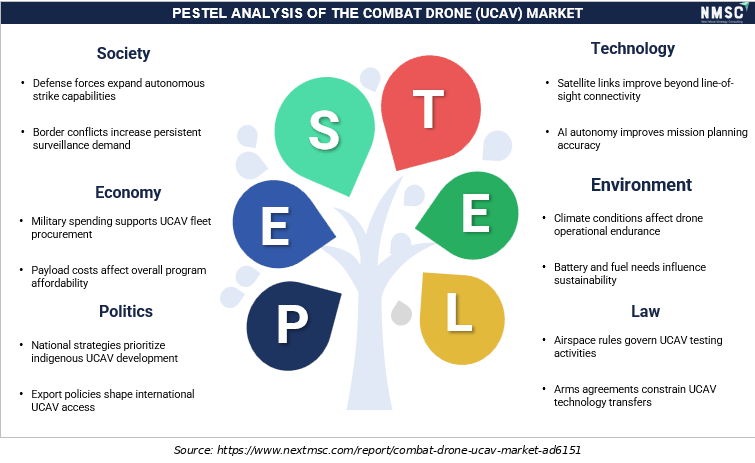
PESTEL Analysis of the Combat Drone (UCAV) Market

PESTEL Analysis of the Combat Drone (UCAV) Market

The combat drone market is shaped by political priorities, defense spending, economic conditions, societal considerations, technological advancements, environmental requirements, and evolving legislation. Government defense programs and geopolitical developments influence demand, while autonomous flight, AI, and advanced sensing support technological progress. Export controls, safety requirements, environmental considerations, and regulations significantly affect development, procurement, and deployment.

Competitive Landscape

We observed that the Combat Drone (UCAV) Market features a moderately consolidated competitive landscape, with diversified defense primes competing alongside specialized drone and autonomy manufacturers on combat-proven track record, export reach, and AI integration depth.
Dimension Description
Market Structure Moderately consolidated; the top companies profiled in this report collectively account for a majority of global Combat Drone (UCAV) Market revenue, while several specialized regional manufacturers serve export-oriented tactical and loitering munition demand.
Innovation Focus Loyal wingman autonomous collaborative platforms, swarm intelligence software, and combat-proven loitering munitions dominate current innovation pipelines across leading manufacturers.
M&A Activity Selective consolidation through strategic partnerships, exemplified by Baykar Defence's March 2025 partnership agreement with Leonardo S.p.A. to expand European market access for combat-proven UAV platforms.

How Do Companies Compete in the Combat Drone (UCAV) Market?

Companies compete primarily on combat-proven operational track record, export reach, and autonomy software depth across the industry. Diversified defense primes such as Northrop Grumman Corporation and Lockheed Martin Corporation leverage broad systems integration and stealth engineering expertise to serve allied air forces, while specialized manufacturers such as Baykar Defence and Anduril Industries, Inc. compete on rapid iteration, export flexibility, and open-architecture autonomy platforms.

Which Competitive Archetypes Dominate the Combat Drone (UCAV) Market?

Two archetypes dominate the market: established defense primes offering full-spectrum systems integration and lifecycle support, and specialized drone-native manufacturers focused on rapid, combat-validated platform iteration. General Atomics Aeronautical Systems, Inc. and Israel Aerospace Industries Ltd. exemplify the diversified archetype through decades of fielded strike platform experience, while Baykar Defence and Anduril Industries, Inc. exemplify the specialized archetype through export-driven, software-centric UCAV development.

How Are Companies Differentiating Through Innovation in Combat Drones?

Innovation and differentiation strategy increasingly center on autonomous collaborative platform readiness and combat-validated strike capability. Baykar's live-fire demonstration of a radar-guided air-to-air missile engagement from its Kizilelma UCAV and Anduril's Lattice-enabled multi-platform coordination both target credibility with defense procurement evaluators. Our analysis shows that manufacturers unable to demonstrate credible combat validation risk exclusion from allied nation qualification shortlists as procurement standards tighten.

What M&A and Expansion Activity Is Shaping the Combat Drone (UCAV) Market?

Strategic partnerships, industrial co-production agreements, and geographic expansion continue to reshape capability access within the industry. Baykar Defence's partnerships with Leonardo S.p.A. and Safran, alongside its co-production agreement with Saudi Arabian Military Industries, illustrate how manufacturers pursue geographic expansion and technology-sharing arrangements to serve rising allied and partner nation demand.

Key Market Players

Our assessment indicates that the following 20 companies are actively shaping platform innovation, autonomy software, and export strategy within the global Combat Drone (UCAV) Market.

General Atomics Aeronautical Systems, Inc. Northrop Grumman Corporation Boeing Company Lockheed Martin Corporation Israel Aerospace Industries Ltd. Elbit Systems Ltd. Baykar Defence Turkish Aerospace Industries, Inc. China Aerospace Science and Technology Corporation Aviation Industry Corporation of China Rostec State Corporation Anduril Industries, Inc. AeroVironment, Inc. STM (Savunma Teknolojileri Mühendislik ve Ticaret A.Ş.) Thales Group Leonardo S.p.A. Korea Aerospace Industries, Ltd. Hanwha Aerospace Co., Ltd. Helsing GmbH Shield AI, Inc.

Latest Developments

We found that recent contract awards and platform milestones within the Combat Drone (UCAV) Market are concentrated on combat validation, export expansion, and loyal wingman program integration, reflecting the industry's broader shift toward autonomous, combat-proven systems.

Date Event
July 2026 Baykar’s KIZILELMA unmanned fighter aircraft completed its first firing tests using its internal weapons bay in July 2026. Baykar also reported earlier autonomous close-formation flights and air-to-air testing, marking continued progression from flight-test development toward a more mature unmanned combat-aircraft capability.
July 2026 Helsing said in July 2026 that thousands of HX-2 AI-enabled strike drones had been handed over to the Ukrainian Armed Forces since the beginning of the year, highlighting the system's ability to operate despite electronic-warfare countermeasures.
June 2026 Anduril announced that its mission-autonomy technology had flown on the YFQ-44A and that the U.S. Air Force selected the company to advance mission autonomy for its Collaborative Combat Aircraft effort. The development combines autonomous flight with higher-level mission coordination for future uncrewed combat-aircraft operations.

Investment Opportunities

What Capital Inflows Are Targeting the Combat Drone (UCAV) Market?

Capital inflows into the market are increasingly directed toward autonomy software and combat-validated platform manufacturing capacity. Anduril Industries, Inc. reported approximately $2 billion in revenue in 2025 and continues to raise capital to fund its Arsenal-1 manufacturing campus, which will produce its Fury autonomous fighter jet and Barracuda missile airframes. We observed that investors favor manufacturers demonstrating validated combat performance, viewing operational track record as a proxy for long-term defense contract retention.

How Is Infrastructure Investment Supporting Combat Drone (UCAV) Deployment?

Infrastructure investment is expanding UCAV manufacturing and assembly capacity across North America, Europe, and the Middle East to serve rising allied and export demand. Our findings suggest that manufacturers are investing in co-production facilities, exemplified by Baykar's planned assembly plant in Pakistan and its existing Saudi Arabian co-production agreement, supporting nations that require domestic manufacturing content alongside imported platform access.

What ESG Considerations Are Shaping Combat Drone (UCAV) Investment Decisions?

Environmental, social, and governance considerations remain limited but increasingly relevant to investment decisions across the defense industry, spanning aerial UCAVs and adjacent ground-based autonomousdefenseplatforms, with autonomous weapons governance and human oversight requirements cited by organizations including the United Nations as key discussion points. We found that investors and defense ministries increasingly favor manufacturers with demonstrated human-in-the-loop safeguards, treating governance transparency as a proxy indicator alongside operational reliability in vendor selection.

Key Benefits for Stakeholders

How Does This Report Benefit Enterprise and Industry Leaders?

Enterprise and industry leaders gain access to validated segmentation, competitive benchmarking, and regional demand forecasts that support procurement and product-portfolio decisions across the Combat Drone (UCAV) industry. Our analysis shows that detailed platform type, application, and end user breakdowns help program managers align specifications with combat validation and autonomy requirements while identifying underserved segments for portfolio expansion.

How Does This Report Benefit Investors and Financial Analysts?

Investors and financial analysts benefit from consistent, single-point market size and CAGR estimates that support valuation and capital-allocation decisions across the Combat Drone (UCAV) Market supply chain. We observed that the report's regional and segment-level growth differentials help identify which manufacturers are best positioned to capture above-market growth in loyal wingman and Asia-Pacific categories through 2035.

How Does This Report Benefit Technology Vendors and Product Teams?

Technology vendors and product teams gain insight into emerging design requirements, including swarm intelligence coordination, autonomous collaborative platform integration, and combat validation standards, that are reshaping the industry. Our findings suggest that this analysis helps R&D teams prioritize development roadmaps around autonomy software and export-readiness increasingly required by allied nation qualification processes.

Key Market Segments Evaluated

By Platform Type

  • Fixed-Wing MALE UCAV
  • Loitering Munitions 
    • Man-Portable Loitering Munitions
    • Vehicle-Launched Loitering Munitions
    • Naval-Launched Loitering Munitions
  • Fixed-Wing HALE UCAV
  • Stealth/Low-Observable UCAV
  • Loyal Wingman/Autonomous Collaborative Platforms
  • Fixed-Wing Low-Altitude Tactical UCAV
  • Rotary-Wing UCAV

By Autonomy Level

  • Remotely Piloted
  • Semi-Autonomous
  • Fully Autonomous (AI-Enabled)

By Application

  • Strike and Precision Attack
  • Intelligence, Surveillance, and Reconnaissance-Strike
  • Suppression of Enemy Air Defense
  • Manned-Unmanned Teaming
  • Border and Homeland Security

By End User

  • Air Force
  • Army
  • Navy
  • Special Operations Forces
  • Other End Users

By Range Category

  • Short Range (Up to 150 km)
  • Medium Range (150-500 km)
  • Long Range (Above 500 km)

By Region

  • North America 
    • U.S.
    • Canada
    • Mexico
  • Europe 
    • UK
    • Germany
    • France
    • Italy
    • Spain
    • Sweden
    • Denmark
    • Finland
    • Netherlands
    • Rest of Europe
  • Asia-Pacific 
    • China
    • India
    • Japan
    • South Korea
    • Taiwan
    • Indonesia
    • Vietnam
    • Australia
    • Philippines
    • Malaysia
    • Rest of APAC
  • Middle East & Africa 
    • Saudi Arabia
    • UAE
    • Egypt
    • Israel
    • Turkey
    • Nigeria
    • South Africa
    • Rest of MEA
  • Latin America 
    • Brazil
    • Argentina
    • Chile
    • Colombia
    • Rest of LATAM

Conclusion & Recommendations

The long-term outlook for the market remains positive, with global revenue projected to more than triple from USD 5.20 billion in 2025 to USD 16.80 billion by 2035 at a 12.4% CAGR. We observed that sustained defense modernization spending, combat-proven loitering munition demand, and expanding loyal wingman program investment will continue underpinning demand across Air Force, Army, and Navy applications through the forecast period.

What Strategic Positioning Should Combat Drone (UCAV) Suppliers Pursue?

Suppliers should prioritize combat validation and autonomous collaborative platform readiness while pursuing industrial co-production partnerships to secure long-term export contracts. Our assessment indicates that manufacturers investing early in swarm intelligence software and loyal wingman integration will be best positioned to capture premium pricing within the Combat Drone (UCAV) Market.

How Attractive Is the Combat Drone (UCAV) Market for New Investment?

The Combat Drone (UCAV) industry presents an attractive investment case, supported by a USD 10.95 billion absolute dollar opportunity between 2026 and 2035 and above-average growth in Asia-Pacific and loyal wingman categories. We found that investment attractiveness is highest for manufacturers combining combat-validation credentials with scaled export and co-production capacity, positioning them to serve both allied nation and emerging market procurement programs simultaneously.

What Market Shifts and Key Risks Should Stakeholders Monitor?

Stakeholders should monitor export control restrictions, rapid counter-drone system proliferation, and high development costs of stealth and autonomous airframes as key risks to the Combat Drone (UCAV) Market. Our analysis shows that manufacturers unable to adapt platform survivability to evolving counter-drone defenses risk losing export contracts to competitors with certified, combat-validated evasion capability, particularly within contested Middle Eastern and European theaters.

What Are the Key Growth Pathways for the Combat Drone (UCAV) Market?

Key growth pathways include expanding loyal wingman autonomous collaborative platform portfolios, scaling combat-validated loitering munition production, and deepening penetration into naval and Asia-Pacific customer categories. NMSC's analysis indicates that manufacturers pursuing these pathways while maintaining cost competitiveness in core fixed-wing MALE categories will be best positioned to capture the Combat Drone (UCAV) Market's projected growth through 2035.

FAQs

About the Author

Mihul Sharma

Mihul Sharma

Mihul Sharma is Research Associate at Next Move Strategy Consulting, where he has covered technology, industrial, and healthcare markets for 3 years. His work applies structured business research, market analysis, and secondary-source review to assess market trends, competitive developments, and growth opportunities. He supports report development by fully synthesizing industry data, company information, and market signals into concise findings for strategy and investment-focused research teams.

About the Reviewer

Supradip Baul

Supradip Baul

Supradip Baul is an accomplished business consultant and strategist with over a decade of rich experience in market intelligence, strategy, technology, and business transformation. His work has included rigorous qualitative and quantitative analysis across multiple industries, helping clients shape investment decisions and long-term roadmaps. Earlier in his career, he was associated with Gartner, where he contributed to industry-leading reports and market share analyses. He has worked with leading global companies and holds an MBA with a dual specialization in Marketing and Finance.

Download Free Sample

Ross J Mckenzie

ROSS J MCKENZIE

Business Insight Manager

Staysure Group

“Next MSC have been incredibly helpful in providing detailed & robust information on our market, alongside quantifying growth by different segments. The process to procure was simple and easy, with sample reports and regular contact to ensure we had what we needed. Succinct detail on their sources & methodologies is also greatly received, allowing transparency in this respect helps build trust in the detail you pay for. Joseph in particular was fantastic, and helped ensure efficient provision of the insight pack – thank you NMSC!”.

Kevin Coker

KEVIN COKER

Founder, CEO and Board Diector

Proxima Clinical Research

I have been using Next MSC reports for product positioning in a new geography for a long time. They have by far the best reports I have found and the price is reasonable too!

Henri Knyphausen

HENRI KNYPHAUSEN

Partner at Singulier [Ex-BCG]

Singulier

I recently engaged NEXTMSC.com for a commercial due diligence project within the intralogistics sector, and I am pleased to provide a reference based on my experience. In utilizing NEXTMSC.com's services, I found their report to offer valuable insights into market dynamics and key industry players. The initial report provided a solid foundation for our analysis. However, as we were investigating a smaller target in the market, and I had specific customization requests requiring additional research. These requests included detailed information on product portfolios of various players and sub-market sizes, both inclusive and exclusive of certain product categories. NEXTMSC.com demonstrated commendable responsiveness and agility in accommodating these customization requests. Within a timeframe of 1-2 weeks, they delivered a revised report that met our specific needs. Furthermore, they were receptive to my follow-up inquiries, ensuring clarity and understanding of the data provided. The final deliverable significantly contributed to our due diligence efforts. One of NEXTMSC.com's notable strengths lies in their qualitative research capabilities. However, for future engagements, I would recommend the inclusion of a quantified market model in Excel format. Such a model would offer the ability to conduct in-depth analyses and explore various market segments, including country-specific data and subcomponent breakdowns. Based on my positive experience, I would not hesitate to work with NEXTMSC.com again. Their responsiveness, willingness to accommodate customization requests, and commitment to delivering actionable insights make them a reliable partner for commercial research projects.

Gaurav Jaiswal

GAURAV JAISWAL

Founder & CEO

Yano Charge Private Limited

The EV Charging market research report provided by the NextMSC was exceptionally detailed and insightful. It offered a comprehensive analysis that proved to be a game-changer for our strategic planning. Truly a testament to the NextMSC’s expertise and thoroughness in EV market landscape & analysis.

Robert Sean Trevino

ROBERT SEAN TREVINO

Sr. Director, Head of Strategic Insights & Analytics

Foundation Medicine

I realized that it was a reliable source of information. These days, there are many people who are looking for authentic data, and this is one of the only sources that can offer them with what they need;

Custom Market Research Services

We will customize the research for you if the listed report does not fully match your requirements.

Get 30% Free Customization

Select License

This website uses cookies to ensure you get the best experience on our website. Learn more

✖