MALE & HALE Drone Market Global Industry Analysis and Forecast (2026–2035)

The global MALE & HALE Drone Market size was valued at USD 9.60 billion in 2025 and is estimated at USD 10.90 billion in 2026, forecast to reach USD 33.80 billion by 2035, expanding at a 13.4% CAGR between 2026 and 2035. North America leads with approximately 34% share, while MALE UAV platforms dominate all other platform types with approximately 64% share.

Download Free Sample PDF
Base Year (2025)
$9.60 Billion
Forecast (2035)
$33.80 Billion
CAGR (2026-2035)
13.4%
Top Region
North America

What Is the MALE & HALE Drone Market Size?

The global MALE & HALE Drone Market size was valued at USD 9.60 billion in 2025 and is estimated at USD 10.90 billion in 2026 and is forecast to reach USD 33.80 billion by 2035, expanding at a 13.4% CAGR between 2026 and 2035. North America leads with approximately 34% share, while MALE UAV platforms dominate all other platform types with approximately 64% share.

We observed that the market's revenue base and growth are broad-based across every segmentation axis, with hybrid-electric propulsion adoption and Europe's Eurodrone-led ISR recapitalization driving the dominant structural shifts through 2035.

MALE & HALE Drone Market Global Industry Analysis and Forecast (2026–2035) Revenue Forecast

Values in USD Billion

2025 $9.60 Billion
2025
2026 $10.90 Billion
2026
2027 $12.36 Billion
2027
2028 $14.02 Billion
2028
2029 $15.90 Billion
2029
2030 $18.03 Billion
2030
2031 $20.44 Billion
2031
2032 $23.18 Billion
2032
2033 $26.29 Billion
2033
2034 $29.81 Billion
2034
2035 $33.80 Billion
2035

Key Takeaways

By Platform Type: MALE UAV held the largest share of approximately 64% (USD 6.14 Billion) in 2025; HALE UAV is the fastest-growing sub-segment at 14.3% CAGR from 2025–2035.

By Application: Intelligence, Surveillance and Reconnaissance held the largest share of approximately 46% (USD 4.42 Billion) in 2025; the Communications Relay and Others segment is the fastest-growing sub-segment at 15.1% CAGR from 2025–2035.

By End User: Air Force held the largest share of approximately 52% (USD 4.99 Billion) in 2025; the Homeland Security and Border Agencies segment is the fastest-growing sub-segment at 14.7% CAGR from 2025–2035.

By Propulsion Type: Turboprop Engine held the largest share of approximately 48% (USD 4.61 Billion) in 2025; Hybrid-Electric Propulsion is the fastest-growing sub-segment at 20.9% CAGR from 2026–2035.

By Payload Type: Electro-Optical and Infrared Sensor Payload held the largest share of approximately 38% (USD 3.65 Billion) in 2025; Communication Relay Payload is the fastest-growing sub-segment at 15.1% CAGR from 2025–2035.

Dominant Region: North America dominated with approximately 34% revenue share (USD 3.26 Billion) in 2025.

Fastest-Growing Region: Europe is the fastest-growing region, with a 15.0% CAGR during 2025–2035.

Dominant Country: U.S. led with approximately USD 2.71 Billion in 2025.

Fastest-Growing Country: India is the fastest-growing country in the report.

Market Opportunity: The MALE & HALE drone market presents an absolute dollar opportunity of USD 22.90 billion between 2026 and 2035, presenting significant investment potential across the ISR, maritime patrol, and strategic strike value chain.

According to NMSC analysis, defense ministries are increasingly consolidating MALE and HALE procurement around fewer, interoperable platform families with common ground control stations, a shift that favors diversified manufacturers with NATO-certifiable systems over single-program specialists as multi-domain integration requirements intensify through 2035.

What Does the MALE & HALE Drone Market Encompass?

The MALE & HALE drone market encompasses uncrewed aircraft systems engineered for medium-altitude long-endurance and high-altitude long-endurance missions, typically sustaining flight for 15 to 40 or more hours through turboprop, piston, turbofan, or hybrid-electric propulsion. Our assessment indicates that the scope spans intelligence, surveillance and reconnaissance platforms, armed strike-capable variants, and maritime patrol systems supplied to air forces, armies, navies, and homeland security agencies across defense and paramilitary end markets worldwide. The category has evolved from a niche reconnaissance capability into a central pillar of modern force structure, driven by rising defense budgets, contested-airspace requirements, and the sovereign-capability ambitions of NATO and allied nations.

Regulatory frameworks such as the U.S. Department of Defense's export and airworthiness policies and the European Union's non-segregated airspace integration requirements under EASA shape MALE and HALE certification pathways, while NATO Standardization Agreements increasingly influence interoperability requirements. We observed that technology adoption is shifting toward AI-assisted autonomy, hybrid-electric propulsion, and open mission-system architectures that reduce operator workload and extend on-station endurance. NMSC's analysis indicates that this structural shift, combined with rising demand for ITAR-free sovereign platforms such as the Eurodrone, is redefining procurement criteria across the MALE & HALE drone market.

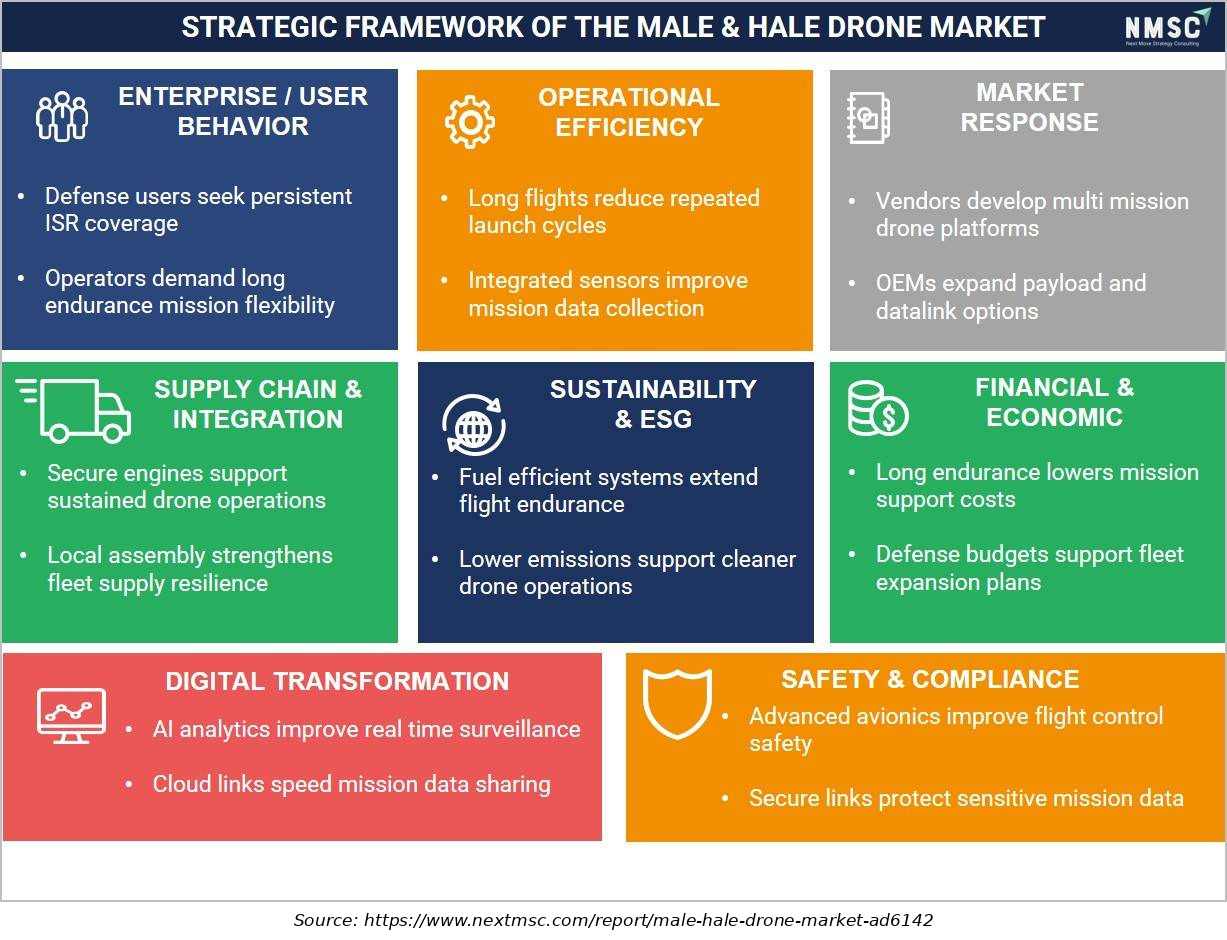
Strategic Framework of the MALE & HALE Drone Market

Strategic Framework of the MALE & HALE Drone Market
Through our market assessment, we observed that defense demand for persistent ISR coverage drives the MALE & HALE Drone Market. Integrated sensors improve mission data collection, while AI analytics accelerate real-time surveillance. Furthermore, fuel-efficient systems reduce emissions, whereas local assembly strengthens supply chain resilience. Concurrently, expanding defense budgets lower long-term support costs, while advanced avionics and secure links ensure flight safety across the MALE & HALE Drone Industry.

Market Drivers & Dynamics

Interactive Dataset
Rising defense budgets for ISR modernization driver +3.2% Global 2026–2035
Sovereign ITAR-free platform demand (Eurodrone) driver +2.4% Europe 2026–2032
Maritime domain awareness procurement driver +1.8% North America, Asia-Pacific 2026–2035
Long-range weapons integration on MALE platforms driver +1.5% North America, Middle East 2026–2033
Hybrid-electric propulsion adoption driver +1.1% Europe, North America 2028–2035
Indigenous HALE/MALE programs in Asia-Pacific driver +1.6% Asia-Pacific 2026–2035
Multi-year program delays and schedule slippage restraint −1.4% Europe 2026–2030
Airspace integration and certification complexity restraint −1.0% Global 2026–2032
Export-control and end-use restrictions restraint −0.9% Global 2026–2035
High unit and lifecycle sustainment costs restraint −0.7% Global 2026–2035
Source: Next Move Strategy Consulting

Growth Drivers

What Is the Primary Growth Driver for the MALE & HALE Drone Market?

Rising defense budgets allocated to intelligence, surveillance, and reconnaissance modernization represent the primary growth driver for the MALE & HALE drone market. The U.S. Department of Defense's published budget materials confirm sustained investment in remotely piloted aircraft procurement across the Air Force, Navy, and Special Operations Command portfolios. Our analysis shows that NATO member states are similarly increasing UAS allocations under collective defense-spending commitments, directly expanding addressable demand for MALE and HALE platforms across allied air forces through 2035.

How Is Sovereign Procurement Driving Market Growth?

Sovereign, ITAR-free procurement is driving structural growth as European nations seek platforms free of U.S. re-export restrictions. OCCAR's official confirmation of the Eurodrone program's Critical Design Review completion in October 2025 demonstrates concrete progress toward a four-nation, ITAR-free MALE capability. We found that this program alone, backed by a contract for 20 systems, totaling 60 aircraft, anchors a multi-billion-dollar demand pipeline for European industrial participants through the next decade.

Growth Inhibitors

What Is Restraining MALE & HALE Drone Market Growth?

Multi-year program delays and schedule slippage restrain near-term market growth, particularly for large multinational HALE programs. Publicly reported program milestones indicate the Eurodrone's entry into service has slipped beyond its original 2025 target toward the end of the decade, reflecting industrial coordination challenges among partner nations. We observed that such delays defer revenue recognition for airframe and systems suppliers, tempering the pace of near-term market expansion even as long-term demand fundamentals remain intact.

Segmentation Analysis

2025 (USD Billion)
2035 (USD Billion)
MALE UAV 2025: $6.14 Billion | 2035: $20.62 Billion
MALE UAV
HALE UAV 2025: $3.46 Billion | 2035: $13.18 Billion
HALE UAV
MALE UAV $6.14 Billion $20.62 Billion 12.9%
HALE UAV $3.46 Billion $13.18 Billion 14.3%

What Platform Type Dominates the MALE & HALE Drone Market?

The platform type axis divides the market into MALE and HALE UAV classes based on operating altitude and endurance profile. We found that MALE UAV platforms dominate with approximately 64% share in 2025, reflecting their lower unit cost, shorter production lead times, and broader export eligibility relative to strategic HALE assets. HALE UAV is the fastest-growing class at 14.3% CAGR from 2025–2035, propelled by Eurodrone deliveries, MQ-4C Triton follow-on orders, and rising maritime domain awareness requirements among Asia-Pacific and European navies.

2025 (USD Billion)
2035 (USD Billion)
Intelligence
Surveillance
Combat and S
Maritime Pat
Border and H
Segment Item 2025 (USD Billion) 2035 (USD Billion) CAGR
Intelligence $10.0 USD Billion $40.0 USD Billion 27.0%
Surveillance and Reconnaissance $17.1 USD Billion $51.1 USD Billion 9.0%
Combat and Strike Operations $24.2 USD Billion $62.2 USD Billion 19.0%
Maritime Patrol and Surveillance $31.3 USD Billion $73.3 USD Billion 17.0%
Border and Homeland Security $38.4 USD Billion $84.4 USD Billion 18.0%

Segment-wise data is locked

Unlock complete segment-wise numbers for By Application.

Unlock Full Data

Which Application Segment Leads the MALE & HALE Drone Market?

The application axis captures how MALE and HALE platforms are deployed operationally across defense missions. Our analysis shows that Intelligence, Surveillance and Reconnaissance leads with approximately 46% share in 2025, consistent with the platforms' original design intent as persistent overwatch assets for battlefield and border monitoring. The Communications Relay and Others segment is the fastest-growing application at 15.1% CAGR, driven by demand for stratospheric communications relay and disaster-response connectivity payloads that leverage HALE endurance beyond traditional ISR roles.

2025 (USD Billion)
2035 (USD Billion)
Air Force
Army
Navy and Mar
Homeland Sec
Segment Item 2025 (USD Billion) 2035 (USD Billion) CAGR
Air Force $10.0 USD Billion $40.0 USD Billion 24.0%
Army $17.1 USD Billion $51.1 USD Billion 22.0%
Navy and Maritime Forces $24.2 USD Billion $62.2 USD Billion 20.0%
Homeland Security and Border Agencies $31.3 USD Billion $73.3 USD Billion 22.0%

Segment-wise data is locked

Unlock complete segment-wise numbers for By End User.

Unlock Full Data

Which End User Segment Holds the Largest MALE & HALE Drone Market Share?

The end-user axis reflects the military branch operating MALE and HALE assets. We observed that the Air Force holds the largest share at approximately 52% in 2025, given air forces' historical ownership of high-altitude ISR and strike-capable fleets. The Homeland Security and Border Agencies segment is the fastest-growing end-user segment at 14.7% CAGR, reflecting rising border-security and coastal-surveillance investment and expanding coastal surveillance mandates among allied navies through 2035.

2025 (USD Billion)
2035 (USD Billion)
Turboprop En
Piston Engin
Turbofan and
Hybrid-Elect
Segment Item 2025 (USD Billion) 2035 (USD Billion) CAGR
Turboprop Engine $10.0 USD Billion $40.0 USD Billion 25.0%
Piston Engine $17.1 USD Billion $51.1 USD Billion 11.0%
Turbofan and Jet Engine $24.2 USD Billion $62.2 USD Billion 25.0%
Hybrid-Electric Propulsion $31.3 USD Billion $73.3 USD Billion 11.0%

Segment-wise data is locked

Unlock complete segment-wise numbers for By Propulsion Type.

Unlock Full Data
2025 (USD Billion)
2035 (USD Billion)
Electro-Opti
Synthetic Ap
SIGINT and E
Weapons and
Communicatio
Segment Item 2025 (USD Billion) 2035 (USD Billion) CAGR
Electro-Optical and Infrared Sensor Payload $10.0 USD Billion $40.0 USD Billion 14.0%
Synthetic Aperture Radar Payload $17.1 USD Billion $51.1 USD Billion 24.0%
SIGINT and ELINT Payload $24.2 USD Billion $62.2 USD Billion 22.0%
Weapons and Munitions Payload $31.3 USD Billion $73.3 USD Billion 12.0%
Communication Relay Payload $38.4 USD Billion $84.4 USD Billion 27.0%

Segment-wise data is locked

Unlock complete segment-wise numbers for By Payload Type.

Unlock Full Data

Growth Opportunities

Three forward-looking whitespace opportunities stand out for stakeholders positioning across the MALE & HALE drone value chain through 2035.

How Can Hybrid-Electric Retrofit Programs Unlock New Revenue?

Hybrid-electric propulsion retrofit kits for existing MALE fleets present a whitespace opportunity for propulsion and systems integrators. Airframe original equipment manufacturers and propulsion specialists stand to benefit as operators seek endurance and signature improvements without full platform replacement, extending the addressable market beyond new-build sales alone.

What Opportunity Does Maritime Patrol Configuration Present?

Maritime-configured HALE and MALE variants, such as SeaGuardian-class platforms, present a significant opportunity for sensor and radar payload suppliers. Navies pursuing persistent anti-submarine and exclusive economic zone monitoring capability are the primary beneficiaries, supporting sustained payload and ground-station revenue streams.

How Does Sovereign Manufacturing Localization Create Opportunity?

Sovereign manufacturing localization, including licensed production and technology-transfer partnerships, presents an opportunity for component and subsystem suppliers in Asia-Pacific and the Middle East. Local industrial partners and governments pursuing indigenous UAS capability are the primary beneficiaries, as offset agreements increasingly accompany large MALE and HALE procurement contracts.

Regional Outlook

2025 (USD Billion)
2035 (USD Billion)
North Americ
Europe
Asia-Pacific
Middle East
Latin Americ
Region 2025 (USD Billion) 2035 (USD Billion) CAGR (%)
North America $10.0 USD Billion $40.0 USD Billion 9.0%
Europe $17.1 USD Billion $51.1 USD Billion 27.0%
Asia-Pacific $24.2 USD Billion $62.2 USD Billion 25.0%
Middle East and Africa $31.3 USD Billion $73.3 USD Billion 23.0%
Latin America $38.4 USD Billion $84.4 USD Billion 12.0%

Regional data is locked

Unlock complete regional numbers for this market.

Unlock Full Data

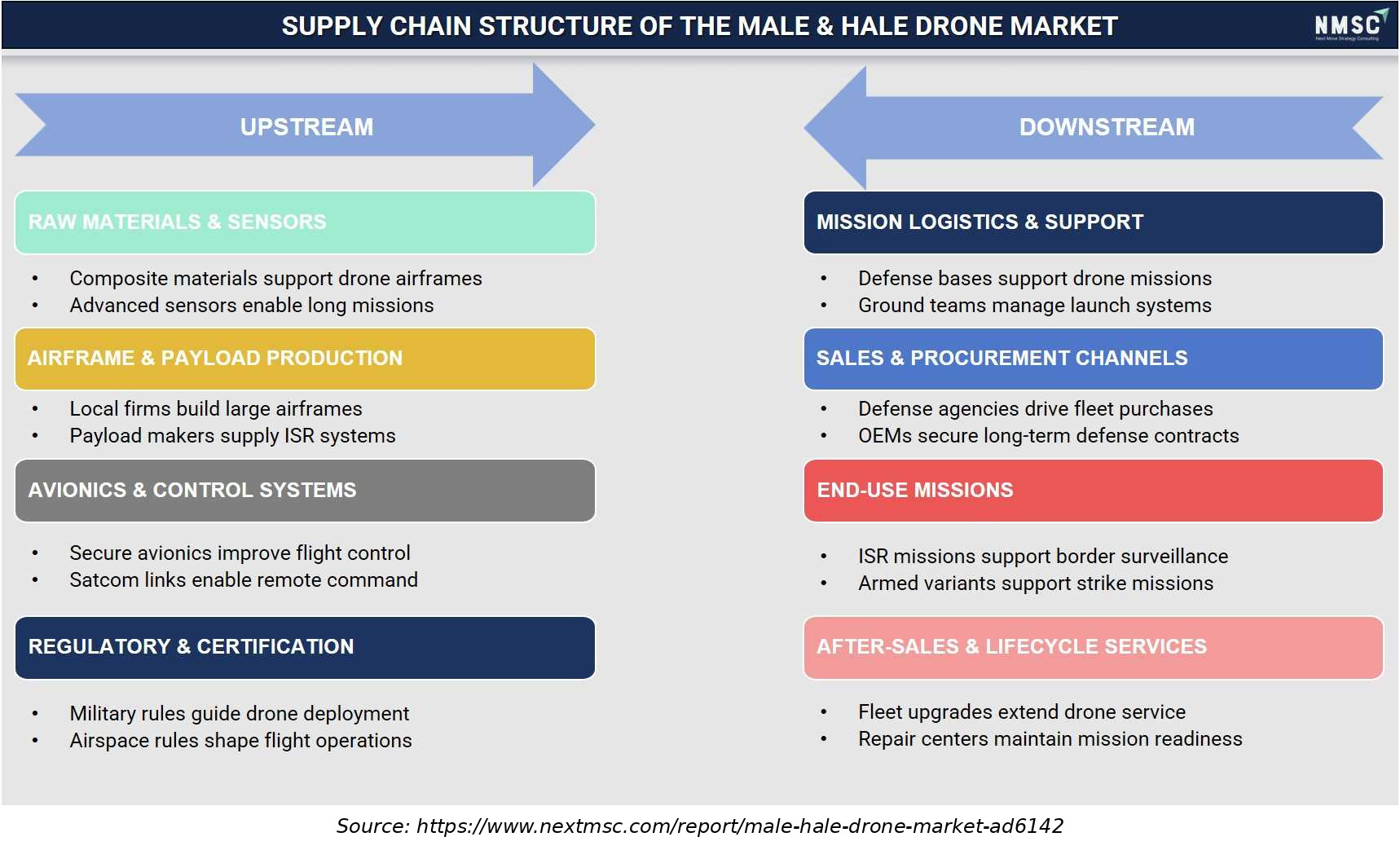
Supply Chain Structure of the MALE & HALE Drone Market

Supply Chain Structure of the MALE & HALE Drone Market
Based on our market evaluation, we noticed that the supply chain structure of the MALE & HALE Drone Market connects composite materials sourcing, airframe fabrication, payload integration, and avionics testing with defense base support. Downstream, procurement channels supply armed and ISR variants for border surveillance and strike missions. Ultimately, fleet upgrades and specialized repair centers maintain mission readiness and lifecycle performance across the MALE & HALE Drone Industry.

Competitive Landscape

We found that the MALE & HALE drone market is moderately consolidated, with a small number of established primes holding the majority of platform-level revenue alongside a growing set of regional challengers pursuing sovereign manufacturing capability.

Dimension Description
Market Structure Moderately consolidated; top five companies account for a majority of platform-level revenue, with regional challengers expanding share in Asia-Pacific and Europe
Innovation Focus Hybrid-electric propulsion, AI-assisted autonomy, long-range weapons integration, and open mission-system architectures
M&A Activity Limited large-scale M&A; growth is driven primarily by multinational program partnerships and licensed-production agreements rather than acquisitions

How Do Companies Compete in the MALE & HALE Drone Market?

Companies compete primarily on platform endurance, payload flexibility, and export eligibility rather than price alone, given the mission-critical nature of ISR and strike platforms. Our analysis shows that established U.S. and Israeli suppliers leverage combat-proven flight-hour records, while European and Asian challengers compete on sovereign-manufacturing and ITAR-free positioning to win nationally sensitive procurement programs.

Which Competitive Archetypes Dominate the MALE & HALE Drone Market?

Two archetypes dominate industry structure: combat-proven volume producers such as General Atomics and Baykar that compete on operational pedigree and export scale, and sovereign strategic-asset developers such as Northrop Grumman and the Eurodrone consortium that compete on strategic endurance capabilities and multinational program backing. We observed that this bifurcation shapes how customers select platforms based on mission criticality versus cost sensitivity.

What Innovation and Differentiation Strategies Are Companies Pursuing?

Companies are differentiating through hybrid-electric propulsion demonstrators, AI-enabled autonomous mission management, and modular payload architectures that support rapid mission reconfiguration. NMSC's analysis indicates that manufacturers investing early in open mission-system standards are best positioned to win multinational interoperability-driven procurement across NATO and allied markets.

How Active Is M&A in the MALE & HALE Drone Market?

M&A activity remains limited relative to program-partnership formation, reflecting the strategic sensitivity of defense-platform ownership. We found that growth is instead driven by consortium structures such as the Airbus-Dassault-Leonardo Eurodrone partnership and licensed-production agreements between established primes and emerging-market industrial partners seeking technology transfer.

Key Market Players

Based on verified official company disclosures and confirmed geographic presence, we identified the following ranked set of manufacturers active in the MALE & HALE drone market as of 2026.

General Atomics Aeronautical Systems, Inc. Northrop Grumman Corporation Baykar Technologies Turkish Aerospace Industries, Inc. Israel Aerospace Industries Ltd. Elbit Systems Ltd. China Aerospace Science and Technology Corporation Aviation Industry Corporation of China Leonardo S.p.A. Airbus Defence and Space GmbH Dassault Aviation SA Korea Aerospace Industries, Ltd. Hindustan Aeronautics Limited Denel SOC Ltd. JSC Kronshtadt Group

Latest Developments

We tracked the following verified, officially disclosed developments shaping platform delivery, program milestones, and capability expansion across the MALE & HALE drone market.

Date Event
July 2026 Northrop Grumman signed an MOU with Airbus Defence and Space to explore bringing MQ-4C Triton systems into NATO operations. The companies will develop a transatlantic solution with European industry, supporting expanded high-altitude, long-endurance ISR coverage and faster integration into NATO’s existing surveillance architecture.
June 2026 Airbus and Kawasaki Heavy Industries agreed to examine a Japanese anti-submarine warfare version of the U950 Eurodrone. Discussions cover configurations, Japanese sensors and effectors, industrial workshare, production and sustainment, potentially expanding the MALE platform into maritime patrol and anti-submarine missions.
June 2026 GA-ASI began adapting Block 30 Ground Control Stations to operate MQ-9B SkyGuardian and SeaGuardian aircraft. The upgrade allows existing MQ-9A operators to reuse established control equipment instead of purchasing entirely new systems, reducing infrastructure requirements and simplifying transition toward newer long-endurance platforms.
May 2026 Turkish Aerospace Industries and TEI signed an agreement covering 100 domestically produced PD170 turbodiesel engines for the Anka and Aksungur UAV programs. The agreement supports propulsion availability, localization and continued production of Turkey’s medium-altitude, long-endurance and high-payload unmanned aircraft platforms.
February 2026 Bayraktar AKINCI successfully conducted an air-to-air engagement using Roketsan’s EREN high-speed loitering munition, directly neutralizing an airborne target UAV. The trial expanded AKINCI’s demonstrated weapon integration and reinforced its ability to perform increasingly diverse combat missions from a high-altitude, long-endurance platform.

Expert Insights

Dr. Samir V. Kamat

Dr. Samir V. Kamat

Secretary, Department of Defence Research and Development & Chairman, DRDO | DRDO

"In case of short-range, MALE (medium-altitude, long-endurance) and HALE (high-altitude, long-endurance) UAVs (>100 kg), the design capability is limited to DRDO and HAL (Hindustan Aeronautics Limited). In that, there are challenges such as availability of suitable propulsion systems and optimum configuration customized to the propulsion systems. DRDO is also working on the design and development of MALE and HALE UAVs and weaponisation of UAVs. The technology readiness level is currently five and will be improved to seven in a time frame of five years for the MALE and HALE UAV class."

Analyst Interpretation

Kamat’s statement highlights the technological and development challenges influencing the MALE and HALE drone market, particularly the availability of suitable propulsion systems and the need to optimize UAV configurations around propulsion technologies. His reference to advancing MALE and HALE systems from Technology Readiness Level 5 to Level 7 within five years also indicates continued development efforts toward higher technology maturity. These factors influence the evolution of long-endurance UAV platforms, with propulsion efficiency, system integration, and technology readiness remaining important considerations for future MALE and HALE deployments.

Investment Opportunities

Where Are Capital Inflows Concentrating in the MALE & HALE Drone Market?

Capital inflows are concentrating in propulsion technology, autonomy software, and payload-integration suppliers that support existing platform families rather than entirely new airframe development. We observed that this pattern reduces investment risk while capturing rising defense-modernization budgets confirmed across NATO member states' published spending commitments, positioning subsystem suppliers as an attractive entry point for investors.

How Significant Is Infrastructure Investment in This Market?

Ground control station networks, satellite communication links, and maintenance depots represent significant infrastructure investment requirements accompanying MALE and HALE fleet expansion. Our findings suggest that nations pursuing new platform acquisitions, including Eurodrone partner states, are simultaneously investing in airspace-integration infrastructure to enable non-segregated flight operations, creating parallel opportunity for infrastructure and systems-integration providers.

What ESG Considerations Are Shaping Investment Decisions?

Environmental, social, and governance considerations are increasingly shaping investment decisions through hybrid-electric propulsion programs that reduce fuel consumption and emissions relative to legacy turboprop platforms. We observed that governance considerations around export-control compliance and end-use monitoring are equally material, given the dual-use and strike-capable nature of many MALE platforms, requiring investors to evaluate compliance frameworks alongside financial performance.

Key Benefits for Stakeholders

How Does This Report Benefit Defense Industry Leaders?

Defense industry leaders gain a structured view of segment-level revenue distribution, competitive positioning, and regional demand drivers to inform platform-development and export-strategy decisions. Our analysis, data, and forecasts through 2035 provide a benchmark for prioritizing propulsion and payload investment against verified program milestones such as the Eurodrone's Critical Design Review completion and MQ-9B's expanding mission set.

How Does This Report Benefit Investors and Financial Analysts?

Investors and financial analysts gain quantified segment- and region-level growth trajectories, including the USD 22.90 Billion absolute dollar opportunity identified between 2026 and 2035, to support capital-allocation decisions across the MALE & HALE drone value chain. Our strategic insights identify which platform archetypes and geographies offer the strongest risk-adjusted growth profiles through the forecast period.

How Does This Report Benefit Technology Vendors and Product Teams?

Technology vendors and product teams supplying propulsion, payload, and autonomy subsystems gain visibility into which platform segments and applications are expanding fastest, enabling more targeted product-roadmap prioritization. Our segmentation analysis and regional outlook clarify where hybrid-electric propulsion, SAR payloads, and maritime-patrol configurations offer the greatest near-term commercial opportunity.

Key Market Segments Evaluated

By Platform Type

  • MALE UAV
  • HALE UAV

By Propulsion Type

  • Turboprop Engine
  • Piston Engine
  • Turbofan and Jet Engine
  • Hybrid-Electric Propulsion

By Application

  • Intelligence, Surveillance and Reconnaissance
  • Combat and Strike Operations
  • Maritime Patrol and Surveillance
  • Border and Homeland Security
  • Communications Relay and Others

By Payload Type

  • Electro-Optical and Infrared Sensor Payload
  • Synthetic Aperture Radar Payload
  • SIGINT and ELINT Payload
  • Weapons and Munitions Payload
  • Communication Relay Payload

By End User

  • Air Force
  • Army
  • Navy and Maritime Forces
  • Homeland Security and Border Agencies

By Region

  • North America 
    • U.S.
    • Canada
    • Mexico.
  • Europe 
    • UK
    • Germany
    • France
    • Italy
    • Spain
    • Sweden
    • Denmark
    • Finland
    • Netherlands
    • Rest of Europe.
  • Asia-Pacific 
    • China
    • India
    • Japan
    • South Korea
    • Taiwan
    • Indonesia
    • Vietnam
    • Australia
    • Philippines
    • Malaysia
    • Rest of APAC.
  • Middle East and Africa 
    • Saudi Arabia
    • UAE
    • Egypt
    • Israel
    • Turkey
    • Nigeria
    • South Africa
    • Rest of MEA.
  • Latin America 
    • Brazil
    • Argentina
    • Chile
    • Colombia
    • Rest of LATAM.

Conclusion & Recommendations

The long-term outlook for the MALE & HALE drone market remains firmly positive, supported by sustained defense-modernization spending and the maturation of sovereign programs such as the Eurodrone. We found that the market's expansion from USD 10.90 Billion in 2026 to USD 33.80 Billion by 2035 reflects durable structural demand rather than cyclical procurement, positioning the category for continued growth beyond the current forecast window.

What Strategic Positioning Should Stakeholders Pursue?

Stakeholders should pursue strategic positioning around interoperable, multi-mission platform families rather than single-application systems. Our assessment indicates that manufacturers combining ISR, maritime patrol, and strike capability within common airframe families, following the MQ-9B model, are best positioned to capture cross-branch procurement budgets across allied defense ministries through 2035.

How Attractive Is the MALE & HALE Drone Market for New Investment?

The MALE & HALE drone market presents an attractive investment case, supported by a USD 22.90 Billion absolute dollar opportunity between 2026 and 2035 and above-average growth in Europe and hybrid-electric propulsion categories. We found that investment attractiveness is highest for suppliers combining sovereign-manufacturing credentials with export-scale production capacity.

What Market Shifts and Key Risks Should Stakeholders Monitor?

Stakeholders should monitor multinational program-governance disputes, export-control policy shifts, and airspace-integration certification timelines as key risks to the MALE & HALE drone market. Our analysis shows that suppliers unable to navigate multi-nation program coordination, as illustrated by reported Eurodrone partner tensions in 2026, risk schedule and revenue disruption despite strong underlying demand.

What Are the Key Growth Pathways for the MALE & HALE Drone Market?

Key growth pathways include expanding maritime-patrol platform variants, scaling hybrid-electric propulsion capability, and deepening sovereign co-production partnerships in Asia-Pacific and the Middle East. NMSC's analysis indicates that suppliers pursuing these pathways while maintaining export competitiveness in standard MALE categories will be best positioned to capture the market's projected growth through 2035.

FAQs

About the Author

Saista Faiyaz

Saista Faiyaz

Saista Faiyaz is Research Associate at Next Move Strategy Consulting, where she has covered consumer markets and healthcare technologies for 3 years. Her work includes primary interview review, secondary-source validation, market sizing, and structured analysis of company and industry data. She supports research by comparing evidence across sources, organizing findings into market narratives, and documenting assumptions used in analysis. Her scope includes cross-market benchmarking, and reports.

About the Reviewer

Supradip Baul

Supradip Baul

Supradip Baul is an accomplished business consultant and strategist with over a decade of rich experience in market intelligence, strategy, technology, and business transformation. His work has included rigorous qualitative and quantitative analysis across multiple industries, helping clients shape investment decisions and long-term roadmaps. Earlier in his career, he was associated with Gartner, where he contributed to industry-leading reports and market share analyses. He has worked with leading global companies and holds an MBA with a dual specialization in Marketing and Finance.

Download Free Sample

Melanie Samko

MELANIE SAMKO

Director of Marketing

TOSOH BIOSCIENCE, INC.

The information provided by NMSC is incredibly valuable, thank you so much for such a excellent work. I really appreciate it. I will make sure to reference all of it, in my summary document.

Kishu Kanda

KISHU KANDA

Strategy Analyst

Accenture

We purchased the AI Consumer Market Report from this company. Not only did they customize the report to meet our specific requirements, but they also showed great flexibility in accommodating our budget. The report we received fully met our expectations. Additionally, they provided prompt and thorough responses to both our pre-purchase and follow-up questions. We look forward to working with this company again in the future.

Gaurav Jaiswal

GAURAV JAISWAL

Founder & CEO

Yano Charge Private Limited

The EV Charging market research report provided by the NextMSC was exceptionally detailed and insightful. It offered a comprehensive analysis that proved to be a game-changer for our strategic planning. Truly a testament to the NextMSC’s expertise and thoroughness in EV market landscape & analysis.

Robert Sean Trevino

ROBERT SEAN TREVINO

Sr. Director, Head of Strategic Insights & Analytics

Foundation Medicine

I realized that it was a reliable source of information. These days, there are many people who are looking for authentic data, and this is one of the only sources that can offer them with what they need;

Amos Chang

AMOS CHANG

Strategy Consultant

Kardex Group

I have bought the intralogistics market reports from NMSC two times so far. Joseph and his team are always very helpful and flexible in responding to any customization requirements on the report. Their expertise in market reports really helps us steer the day-to-day business. I will definitely recommend and come back myself whenever there is a need.

Custom Market Research Services

We will customize the research for you if the listed report does not fully match your requirements.

Get 30% Free Customization

Select License

This website uses cookies to ensure you get the best experience on our website. Learn more

✖