Hybrid VTOL Drone Market Global Industry Analysis and Forecast (2026-2035)

Hybrid VTOL Drone Market size was USD 2.35 billion in 2025, projected to reach USD 10.19 billion by 2035, growing at a CAGR of 15.8% from 2026 to 2035. Key drivers include rising defense ISR modernization budgets, evolving BVLOS regulatory frameworks, and growth in drone-based last-mile logistics, with North America leading the market.

Download Free Sample PDF
Base Year (2025)
$2.35 Billion
Forecast (2035)
$10.19 Billion
CAGR (2026-2035)
15.8%
Top Region
North America

What Is the Hybrid VTOL Drone Market Size?

The global hybrid VTOL drone market size was valued at USD 2.35 billion in 2025 and is estimated at USD 2.72 billion in 2026, forecast to reach USD 10.19 billion by 2035, expanding at a 15.8% CAGR between 2026 and 2035. North America leads with approximately 34% share, while tilt-rotor platforms dominate all other platform types with approximately 38% share.

We observed that growth is broad-based across every segmentation axis, with logistics-driven last-mile delivery and hydrogen fuel cell hybrid propulsion adoption driving the dominant structural shifts through 2035.

Hybrid VTOL Drone Market Global Industry Analysis and Forecast (2026-2035) Revenue Forecast

Values in USD Billion

2025 $2.35 Billion
2025
2026 $2.72 Billion
2026
2027 $3.15 Billion
2027
2028 $3.65 Billion
2028
2029 $4.22 Billion
2029
2030 $4.89 Billion
2030
2031 $5.66 Billion
2031
2032 $6.56 Billion
2032
2033 $7.60 Billion
2033
2034 $8.80 Billion
2034
2035 $10.19 Billion
2035

Key Takeaways

By Platform Type: Tilt-Rotor held the largest share of approximately 38% (USD 0.89 billion) in 2025; Ducted Fan platforms are the fastest-growing sub-segment at an 18.4% CAGR from 2026–2035.

By Propulsion Type: Hybrid-Electric (Combustion-Electric) held the largest share of approximately 61% (USD 1.43 billion) in 2025; Hydrogen Fuel Cell Hybrid is the fastest-growing sub-segment at a 24.5% CAGR from 2026–2035.

By Payload Capacity: 5 to 25 kg held the largest share of approximately 41% (USD 0.96 billion) in 2025; Above 150 kg is the fastest-growing sub-segment at a 20.1% CAGR from 2026–2035.

By Range: 100 to 300 km held the largest share of approximately 46% (USD 1.08 billion) in 2025; Above 300 km is the fastest-growing sub-segment at a 19.8% CAGR from 2026–2035.

By Application: Defense and ISR held the largest share of approximately 30% (USD 0.71 billion) in 2025; Logistics and Last-Mile Delivery is the fastest-growing sub-segment at a 19.4% CAGR from 2026–2035.

By End Use: Military and Defense held the largest share of approximately 37% (USD 0.87 billion) in 2025; Agriculture is the fastest-growing sub-segment at a 19.6% CAGR from 2026–2035.

Dominant Region: North America dominated with approximately 34% revenue share (USD 0.80 billion) in 2025.

Fastest-Growing Region: Asia-Pacific is expected to register the highest CAGR of 18.7% during 2026–2035.

Dominant Country: U.S. led with approximately USD 0.62 billion in 2025.

Fastest-Growing Country: India is the fastest-growing country at approximately 23.1% CAGR from 2026–2035.

What Does the Hybrid VTOL Drone Market Encompass?

The hybrid VTOL drone market encompasses unmanned aerial platforms that combine vertical take-off and landing capability with fixed-wing or hybrid-electric cruise propulsion, eliminating runway dependence while extending flight endurance beyond conventional multirotor designs. Our assessment indicates that the scope spans tilt-rotor, tilt-wing, ducted fan, and vectored-thrust fixed-wing hybrid architectures supplied to military, government, and commercial operators across defense, logistics, agriculture, infrastructure, and emergency response end markets. The category has evolved from experimental long-endurance prototypes into a commercially deployed unmanned aerial vehicle class, driven by beyond-visual-line-of-sight regulatory approvals and rising demand for runway-independent, long-range aerial operations worldwide.
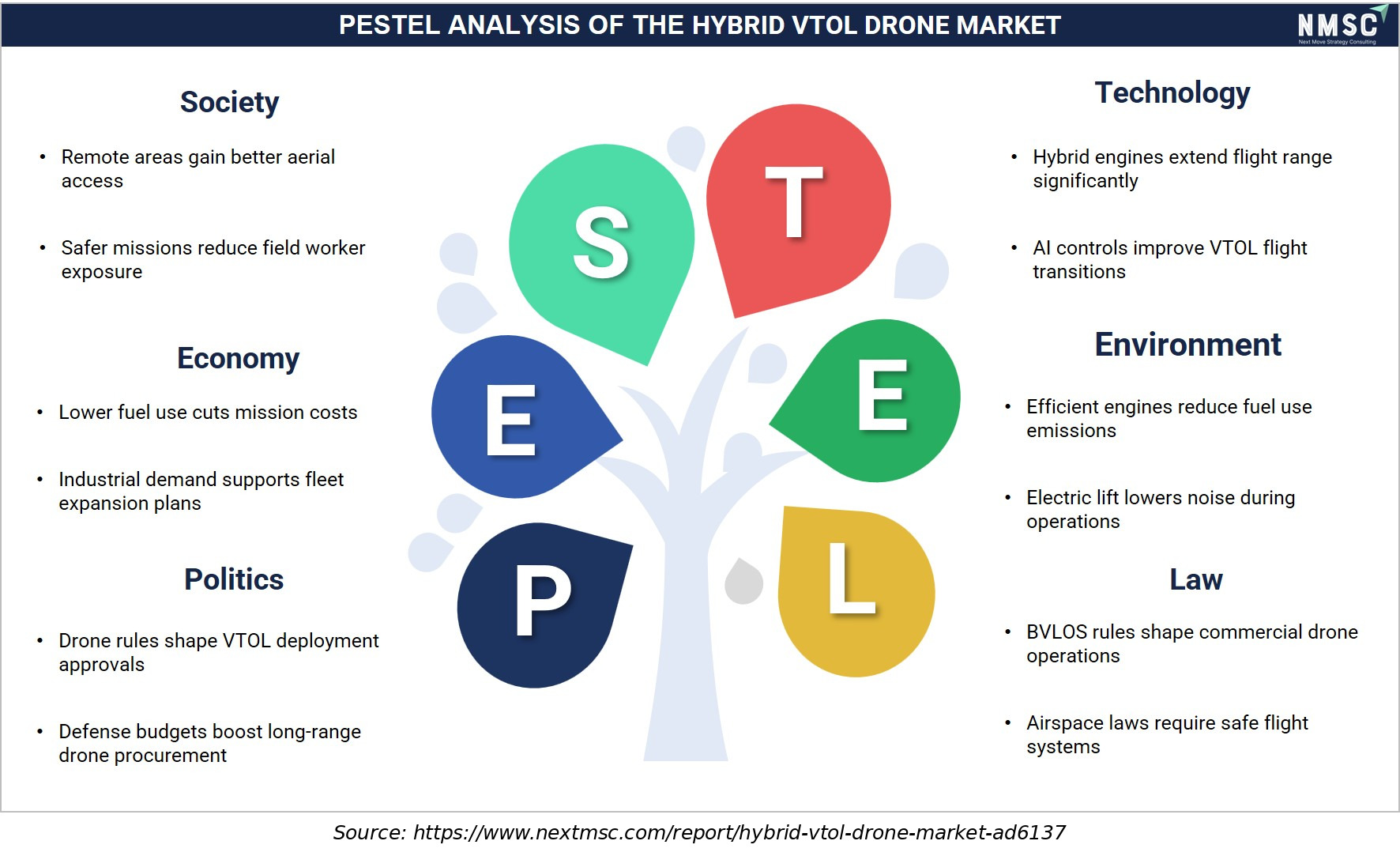
Regulatory frameworks such as the U.S. Federal Aviation Administration's evolving beyond-visual-line-of-sight rulemaking and the European Union Aviation Safety Agency's U-space regulation shape certification and airspace-integration requirements for hybrid VTOL platforms, while national defense procurement standards increasingly influence propulsion and payload design. We observed that technology adoption is shifting toward hybrid-electric and hydrogen fuel cell propulsion architectures that extend endurance beyond battery-only limits. Next Move Strategy Consulting's analysis indicates that this structural shift, combined with rising defense ISR modernization budgets, is redefining sourcing criteria across the hybrid VTOL drone market.

Market Drivers & Dynamics

Interactive Dataset
Rising defense ISR modernization budgets driver +2.4% Global 2026–2035
Evolution of BVLOS regulatory frameworks driver +2.0% North America, Europe 2026–2035
Growth of drone-based last-mile logistics networks driver +1.9% Global 2026–2033
Advances in hybrid-electric propulsion energy density driver +1.7% Global 2026–2035
Increasing precision-agriculture adoption driver +1.5% Asia-Pacific, North America 2026–2035
Rising infrastructure and utility inspection demand driver +1.3% Global 2026–2032
High unit and maintenance costs versus pure-electric drones restraint −1.1% Global 2026–2035
Airspace integration and certification complexity restraint −0.9% North America, Europe 2026–2032
Supply-chain dependency on specialized propulsion components restraint −0.6% Global 2028–2035
Source: Next Move Strategy Consulting

Growth Drivers

What Is the Primary Growth Driver of the Hybrid VTOL Drone Market?

Rising defense intelligence, surveillance, and reconnaissance modernization budgets are the primary driver of the market. The U.S. Department of Defense continues to prioritize long-endurance unmanned platforms within its modernization programs, sustaining institutional demand for military drone procurement across allied nations. We observed that this procurement momentum, reinforced by homeland-security and border-surveillance requirements, continues to anchor baseline consumption of tilt-rotor and vectored-thrust fixed-wing hybrid platforms across developed and emerging economies alike.

How Is BVLOS Regulation Driving Hybrid VTOL Drone Market Growth?

Expanding beyond-visual-line-of-sight regulatory frameworks are accelerating market growth toward long-range hybrid VTOL deployment. The Federal Aviation Administration's evolving BVLOS rulemaking and the European Union Aviation Safety Agency's U-space framework are enabling operators to specify extended-range hybrid-electric platforms for previously unauthorized missions. Our assessment indicates that this regulatory pressure, combined with rising logistics and infrastructure-inspection demand, is compressing adoption timelines for hybrid VTOL architectures across North America and Europe.

Growth Inhibitors

What Is Restraining Hybrid VTOL Drone Market Expansion?

High unit costs and specialized maintenance requirements relative to pure-electric multirotor drones restrain broader adoption across cost-sensitive commercial segments. Certification and airspace-integration requirements extend procurement cycles for new unmanned platforms. We found that smaller commercial operators face particular exposure, as limited fleet scale reduces their ability to absorb hybrid-electric powertrain maintenance costs compared with larger, vertically integrated defense and logistics operators.

What Are the Growth Opportunities?

How Do Heavy-Cargo Hybrid VTOL Platforms Unlock Middle-Mile Logistics Value?

Heavy-cargo hybrid VTOL platforms present a whitespace opportunity for logistics operators seeking runway-independent middle-mile transport across underserved regions. Manufacturers that commercialize higher-payload tilt-rotor and vectored-thrust designs target recurring fleet contracts as BVLOS authorizations expand, particularly among commercial enterprise and government logistics operators seeking differentiated, long-range cargo delivery capacity.

Where Does Hydrogen Fuel Cell Hybrid Propulsion Create New Endurance Demand?

Hydrogen fuel cell hybrid propulsion represents an underpenetrated opportunity for manufacturers targeting multi-hour endurance missions beyond the reach of combustion-electric systems. Suppliers that develop validated, high-cycle hydrogen hybrid platforms can secure long-term procurement contracts with defense and infrastructure-inspection end users, benefiting from recurring replacement-cycle revenue tied to extended-endurance mission requirements.

How Do Defense ISR Modernization Programs Benefit Hybrid VTOL Manufacturers?

Defense ISR modernization programs create an opportunity for manufacturers offering certified, long-endurance hybrid VTOL platforms for border-surveillance and tactical-support missions. Early movers that secure defense-grade type certification for hybrid VTOL platforms differentiate with military and homeland-security end users pursuing multi-year fleet modernization commitments across their procurement portfolios.

Segmentation Analysis

2025 (USD Billion)
2035 (USD Billion)
Tilt-Rotor 2025: $0.89 Billion | 2035: $3.58 Billion
Tilt-Rotor
Tilt-Wing 2025: $0.47 Billion | 2035: $2.24 Billion
Tilt-Wing
Ducted Fan 2025: $0.41 Billion | 2035: $2.21 Billion
Ducted Fan
Vectored-Thrust Fixed-Wing Hybrid 2025: $0.58 Billion | 2035: $2.16 Billion
Vectored-Thr
Tilt-Rotor $0.89 Billion $3.58 Billion 14.9%
Tilt-Wing $0.47 Billion $2.24 Billion 16.9%
Ducted Fan $0.41 Billion $2.21 Billion 18.4%
Vectored-Thrust Fixed-Wing Hybrid $0.58 Billion $2.16 Billion 14.1%

Which Platform Type Segment Dominates the Hybrid VTOL Drone Market?

Tilt-Rotor platforms, which combine multirotor hover stability with fixed-wing cruise efficiency through rotating nacelles, led the market with USD 0.89 billion in 2025, supported by proven commercial deployment in logistics and mapping missions. We observed that Ducted Fan platforms are the fastest-growing platform type, expanding at an 18.4% CAGR from 2026 to 2035, as compact, propeller-shrouded designs gain traction across confined-space infrastructure inspection and urban surveillance applications requiring enhanced safety clearance.

2025 (USD Billion)
2035 (USD Billion)
Hybrid-Elect
All-Electric
Hydrogen Fue
Segment Item 2025 (USD Billion) 2035 (USD Billion) CAGR
Hybrid-Electric (Combustion-Electric) $10.0 USD Billion $40.0 USD Billion 12.0%
All-Electric Hybrid-Configuration $17.1 USD Billion $51.1 USD Billion 18.0%
Hydrogen Fuel Cell Hybrid $24.2 USD Billion $62.2 USD Billion 20.0%

Segment-wise data is locked

Unlock complete segment-wise numbers for By Propulsion Type.

Unlock Full Data
2025 (USD Billion)
2035 (USD Billion)
Up to 5 kg
5 to 25 kg
25 to 150 kg
Above 150 kg
Segment Item 2025 (USD Billion) 2035 (USD Billion) CAGR
Up to 5 kg $10.0 USD Billion $40.0 USD Billion 20.0%
5 to 25 kg $17.1 USD Billion $51.1 USD Billion 22.0%
25 to 150 kg $24.2 USD Billion $62.2 USD Billion 16.0%
Above 150 kg $31.3 USD Billion $73.3 USD Billion 22.0%

Segment-wise data is locked

Unlock complete segment-wise numbers for By Payload Capacity.

Unlock Full Data
2025 (USD Billion)
2035 (USD Billion)
Up to 100 km
100 to 300 k
Above 300 km
Segment Item 2025 (USD Billion) 2035 (USD Billion) CAGR
Up to 100 km $10.0 USD Billion $40.0 USD Billion 19.0%
100 to 300 km $17.1 USD Billion $51.1 USD Billion 9.0%
Above 300 km $24.2 USD Billion $62.2 USD Billion 19.0%

Segment-wise data is locked

Unlock complete segment-wise numbers for By Range.

Unlock Full Data
2025 (USD Billion)
2035 (USD Billion)
Defense and
Logistics an
Agriculture
Infrastructu
Mapping
Segment Item 2025 (USD Billion) 2035 (USD Billion) CAGR
Defense and ISR $10.0 USD Billion $40.0 USD Billion 18.0%
Logistics and Last-Mile Delivery $17.1 USD Billion $51.1 USD Billion 16.0%
Agriculture and Precision Farming $24.2 USD Billion $62.2 USD Billion 22.0%
Infrastructure Inspection and Utility Monitoring $31.3 USD Billion $73.3 USD Billion 12.0%
Mapping $38.4 USD Billion $84.4 USD Billion 19.0%

Segment-wise data is locked

Unlock complete segment-wise numbers for By Application.

Unlock Full Data

Which Application Segment Leads Hybrid VTOL Drone Market Demand?

Defense and ISR remained the leading application within the market, valued at USD 0.71 billion in 2025 on sustained long-endurance reconnaissance and border-surveillance procurement. Our findings suggest that Logistics and Last-Mile Delivery is the fastest-growing application, registering a 19.4% CAGR from 2026 to 2035, as parcel and medical-supply operators increasingly specify hybrid VTOL platforms over conventional multirotor systems to extend delivery range beyond battery-limited networks.

2025 (USD Billion)
2035 (USD Billion)
Military and
Commercial E
Government a
Agriculture
Segment Item 2025 (USD Billion) 2035 (USD Billion) CAGR
Military and Defense $10.0 USD Billion $40.0 USD Billion 15.0%
Commercial Enterprises $17.1 USD Billion $51.1 USD Billion 13.0%
Government and Homeland Security $24.2 USD Billion $62.2 USD Billion 23.0%
Agriculture $31.3 USD Billion $73.3 USD Billion 9.0%

Segment-wise data is locked

Unlock complete segment-wise numbers for By End Use.

Unlock Full Data

Which End Use Segment Is Most Widely Served in the Hybrid VTOL Drone Market?

Military and Defense remained the dominant end use across the market, reaching USD 0.87 billion in 2025 due to sustained ISR modernization and border-security procurement programs. Based on research conducted by Next Move Strategy Consulting, we found that Agriculture represents the fastest-growing end use category at a 19.6% CAGR from 2026 to 2035, reflecting operators' efforts to replace short-endurance multirotor sprayers with longer-range hybrid VTOL platforms across large-acreage precision-farming operations.

2025 (USD Billion)
2035 (USD Billion)
Airframe and
Propulsion a
Flight Contr
Payload and
Ground Contr
Segment Item 2025 (USD Billion) 2035 (USD Billion) CAGR
Airframe and Structures $10.0 USD Billion $40.0 USD Billion 13.0%
Propulsion and Powertrain Systems $17.1 USD Billion $51.1 USD Billion 19.0%
Flight Control and Avionics $24.2 USD Billion $62.2 USD Billion 13.0%
Payload and Sensor Systems $31.3 USD Billion $73.3 USD Billion 11.0%
Ground Control Stations and Software $38.4 USD Billion $84.4 USD Billion 12.0%

Segment-wise data is locked

Unlock complete segment-wise numbers for By Component.

Unlock Full Data
2025 (USD Billion)
2035 (USD Billion)
Remotely Pil
Semi-Autonom
Fully Autono
Segment Item 2025 (USD Billion) 2035 (USD Billion) CAGR
Remotely Piloted $10.0 USD Billion $40.0 USD Billion 10.0%
Semi-Autonomous $17.1 USD Billion $51.1 USD Billion 12.0%
Fully Autonomous $24.2 USD Billion $62.2 USD Billion 10.0%

Segment-wise data is locked

Unlock complete segment-wise numbers for By Operation Mode.

Unlock Full Data

Growth Opportunities

Our analysis shows that three forward-looking opportunities stand out for stakeholders positioning within the hybrid VTOL drone market over the 2026–2035 forecast period.

How Do Heavy-Cargo Hybrid VTOL Platforms Unlock Middle-Mile Logistics Value?

Heavy-cargo hybrid VTOL platforms present a whitespace opportunity for logistics operators seeking runway-independent middle-mile transport across underserved regions. Manufacturers that commercialize higher-payload tilt-rotor and vectored-thrust designs target recurring fleet contracts as BVLOS authorizations expand, particularly among commercial enterprise and government logistics operators seeking differentiated, long-range cargo delivery capacity.

Where Does Hydrogen Fuel Cell Hybrid Propulsion Create New Endurance Demand?

Hydrogen fuel cell hybrid propulsion represents an underpenetrated opportunity for manufacturers targeting multi-hour endurance missions beyond the reach of combustion-electric systems. Suppliers that develop validated, high-cycle hydrogen hybrid platforms can secure long-term procurement contracts with defense and infrastructure-inspection end users, benefiting from recurring replacement-cycle revenue tied to extended-endurance mission requirements.

How Do Defense ISR Modernization Programs Benefit Hybrid VTOL Manufacturers?

Defense ISR modernization programs create an opportunity for manufacturers offering certified, long-endurance hybrid VTOL platforms for border-surveillance and tactical-support missions. Early movers that secure defense-grade type certification for hybrid VTOL platforms differentiate with military and homeland-security end users pursuing multi-year fleet modernization commitments across their procurement portfolios.

Regional Outlook

2025 (USD Billion)
2035 (USD Billion)
North Americ
Europe
Asia-Pacific
Middle East
Latin Americ
Region 2025 (USD Billion) 2035 (USD Billion) CAGR (%)
North America $10.0 USD Billion $40.0 USD Billion 9.0%
Europe $17.1 USD Billion $51.1 USD Billion 27.0%
Asia-Pacific $24.2 USD Billion $62.2 USD Billion 25.0%
Middle East & Africa $31.3 USD Billion $73.3 USD Billion 23.0%
Latin America $38.4 USD Billion $84.4 USD Billion 12.0%

Regional data is locked

Unlock complete regional numbers for this market.

Unlock Full Data

Ecosystem Analysis

Other

  • airframe manufacturers
  • hybrid powertrain suppliers
  • flight control developers
  • payload integrators
  • Universities and research labs
  • testing centers
  • aviation regulators

Competitive Landscape

We observed that the hybrid VTOL drone market features a moderately fragmented competitive landscape, with global defense and aerospace primes competing alongside specialized hybrid-propulsion startups on endurance, payload, and certification credentials.

Dimension Description
Market Structure Moderately fragmented; established defense and aerospace primes profiled in this report account for a significant share of global hybrid VTOL drone market revenue, while numerous specialized hybrid-propulsion startups serve niche commercial and inspection applications.
Innovation Focus Hybrid-electric and hydrogen fuel cell propulsion architectures, BVLOS-certified autonomous flight software, and heavy-cargo payload systems dominate current innovation pipelines across leading manufacturers.
M&A Activity Selective consolidation through platform and distribution acquisitions, exemplified by XTI Aerospace, Inc.'s acquisition of Drone Nerds to expand its U.S. enterprise, government, and defense drone distribution capabilities.

How Do Companies Compete in the Hybrid VTOL Drone Market?

Companies compete primarily on endurance credentials, payload flexibility, and certification pathways across the industry. Global defense primes such as Elbit Systems Ltd. and Israel Aerospace Industries Ltd. leverage broad ISR platform portfolios to serve multinational defense operators, while specialized hybrid-propulsion manufacturers compete on rapid product iteration and niche mission customization for infrastructure-inspection and logistics customers.

Which Competitive Archetypes Dominate the Hybrid VTOL Drone Market?

Two archetypes dominate the market: diversified aerospace and defense groups offering full-service ISR and logistics platforms, and specialized hybrid-propulsion manufacturers focused on long-endurance commercial applications. Lockheed Martin Corporation and Textron Inc. exemplify the diversified archetype through integrated defense-to-commercial manufacturing, while Quaternium Technologies S.L. and Xer Technologies AG exemplify the specialized hybrid-propulsion archetype serving industrial inspection and fixed-wing long-endurance surveillance demand.

How Are Companies Differentiating Through Innovation in Hybrid VTOL Drones?

Innovation and differentiation strategies increasingly center on hybrid-electric endurance engineering and autonomous BVLOS flight software. Wingcopter GmbH's tilt-rotor 198 platform and XTI Aerospace, Inc.'s TriFan 600 program both target extended-range commercial and defense missions through proprietary propulsion and flight-control integration. Our analysis shows that manufacturers unable to demonstrate credible BVLOS certification pathways risk exclusion from defense and logistics operator procurement shortlists in North America and Europe.

What M&A and Expansion Activity Is Shaping the Hybrid VTOL Drone Market?

Mergers, acquisitions, and geographic expansion continue to consolidate hybrid VTOL capabilities within the industry. XTI Aerospace, Inc.'s acquisition of Drone Nerds, paired with a strategic investment from Unusual Machines, broadened its commercial distribution and accelerated TriFan 600 development, while Wingcopter GmbH's new financing round illustrates how specialized manufacturers pursue geographic expansion toward type certification across the U.S., Brazil, and Japan.

Key Market Players

Our assessment indicates that the following 20 companies are actively shaping product innovation, capacity expansion, and certification strategy within the global hybrid VTOL drone market.

AeroVironment, Inc. Elbit Systems Ltd. Lockheed Martin Corporation Textron Inc. Israel Aerospace Industries Ltd. Wingcopter GmbH XTI Aerospace, Inc. Quantum-Systems GmbH Autel Robotics Co., Ltd. Skyfront Corporation Quaternium Technologies S.L. Xer Technologies AG ideaForge Technology Limited Threod Systems OÜ Aerovel Corporation Malloy Aeronautics Ltd. Griff Aviation AS Censys Technologies Corporation Swoop Aero Pty Ltd PteroDynamics Inc.

Latest Developments

We found that recent product launches within the hybrid VTOL drone market are concentrated on extended-endurance propulsion and BVLOS-certified logistics deployment, reflecting the industry's broader commercialization transition.

Date Event
May 2026 Skyfront won a U.S. Army contract covering Perimeter 8 flight operations, command-and-control integration, soldier training, and sustainment. The first phase included a three-week Colorado deployment. The award validates hybrid gas-electric VTOL endurance for persistent surveillance and communications-relay missions, strengthening military adoption of long-endurance hybrid drone architectures.
May 2026 Xer Technologies launched the X8 PRO, its new production hybrid-electric UAS, replacing the X8. The platform offers up to 10 kg payload, three-hour endurance, and a 50+ km mission radius, with rapid vehicle deployment. Its NATO-compliant, modular architecture expands hybrid VTOL applications across ISR, SIGINT, counter-UAV, maritime, and mine-detection missions.
May 2026 PteroDynamics was awarded a Royal Australian Navy contract to supply P4 Transwing VTOL UAS, along with training and support, for autonomous maritime distributed logistics. The agreement includes an option for larger P5 Transwing systems beginning in 2027.
May 2026 PteroDynamics partnered with Cobra AERO to integrate a series-hybrid-electric propulsion system into its P5 Transwing UAS. The collaboration targets extended-endurance VTOL logistics and defense missions, strengthening demand for hybrid-electric VTOL architectures.

Investment Opportunities

What Capital Inflows Are Targeting the Hybrid VTOL Drone Market?

Capital inflows into the hybrid VTOL drone market are increasingly directed toward hybrid-electric powertrain development and BVLOS certification programs. Strategic investors and defense-adjacent acquirers continue to fund manufacturer scale-up, as seen in Unusual Machines' investment in XTI Aerospace, Inc. We observed that investors favor manufacturers demonstrating validated endurance and certification credentials, viewing regulatory alignment as a proxy for long-term contract retention with defense and logistics operators.

How Is Infrastructure Investment Supporting Hybrid VTOL Drone Manufacturing?

Infrastructure investment is expanding assembly and flight-testing capacity across North America, Europe, and Asia-Pacific to serve rising defense and commercial demand. Our findings suggest that manufacturers are investing in automated propulsion-integration lines to improve consistency across payload capacities ranging from below 5 kg to above 150 kg, supporting the precision required for defense-grade and heavy-cargo hybrid VTOL platforms.

What ESG Considerations Are Shaping Hybrid VTOL Drone Investment Decisions?

Environmental, social, and governance considerations are increasingly relevant to investment decisions across the industry, with reduced-emission hybrid-electric and hydrogen fuel cell propulsion viewed as key differentiators against helicopter and manned-aircraft alternatives. Investors increasingly assess propulsion efficiency, emissions performance, safety, and airspace-integration compliance when evaluating unmanned aviation platforms. We found that investors increasingly favor manufacturers with validated propulsion-emissions data, treating it as a governance indicator alongside safety and airspace-integration compliance.

Key Benefits for Stakeholders

How Does This Report Benefit Enterprise and Industry Leaders?

Enterprise and industry leaders gain access to validated segmentation, competitive benchmarking, and regional demand forecasts that support sourcing and platform-portfolio decisions across the hybrid VTOL drone industry. Our analysis shows that detailed platform-type, payload-capacity, and range breakdowns help procurement teams align specifications with mission and regulatory requirements while identifying underserved application segments for portfolio expansion.

How Does This Report Benefit Investors and Financial Analysts?

Investors and financial analysts benefit from consistent, single-point market size and CAGR estimates that support valuation and capital-allocation decisions across the hybrid VTOL drone market supply chain. We observed that the report's regional and segment-level growth differentials help identify which manufacturers and propulsion suppliers are best positioned to capture above-market growth in logistics and hydrogen hybrid categories through 2035.

How Does This Report Benefit Technology Vendors and Product Teams?

Technology vendors and product teams gain insight into emerging design requirements, including hybrid-electric propulsion, autonomous BVLOS flight software, and heavy-cargo payload engineering, that are reshaping the industry. Our findings suggest that this analysis helps R&D teams prioritize development roadmaps around endurance and certification requirements increasingly required by defense and logistics operator procurement processes.

Key Market Segments Evaluated

By Platform Type

  • Tilt-Rotor
  • Tilt-Wing
  • Ducted Fan
  • Vectored-Thrust Fixed-Wing Hybrid

By Propulsion Type

  • Hybrid-Electric (Combustion-Electric)
  • All-Electric Hybrid-Configuration
  • Hydrogen Fuel Cell Hybrid

By Component

  • Airframe and Structures
  • Propulsion and Powertrain Systems
  • Flight Control and Avionics
  • Payload and Sensor Systems
  • Ground Control Stations and Software

By Payload Capacity

  • Up to 5 kg
  • 5 to 25 kg
  • 25 to 150 kg
  • Above 150 kg

By Range

  • Up to 100 km
  • 100 to 300 km
  • Above 300 km

By Operation Mode

  • Remotely Piloted
  • Semi-Autonomous
  • Fully Autonomous

By Application

  • Defense and ISR
  • Logistics and Last-Mile Delivery
  • Agriculture and Precision Farming
  • Infrastructure Inspection and Utility Monitoring
  • Mapping, Surveying and Geospatial Data Collection
  • Emergency Response and Disaster Management
  • Other Applications

By End Use

  • Military and Defense
  • Commercial Enterprises
  • Government and Homeland Security
  • Agriculture

By Region

  • North America 
    • U.S.
    • Canada
    • Mexico.
  • Europe 
    • UK
    • Germany
    • France
    • Italy
    • Spain
    • Sweden
    • Denmark
    • Finland
    • Netherlands
    • Rest of Europe.
  • Asia-Pacific 
    • China
    • India
    • Japan
    • South Korea
    • Taiwan
    • Indonesia
    • Vietnam
    • Australia
    • Philippines
    • Malaysia
    • Rest of APAC.
  • Middle East & Africa 
    • Saudi Arabia
    • UAE
    • Egypt
    • Israel
    • Turkey
    • Nigeria
    • South Africa
    • Rest of MEA.
  • Latin America 
    • Brazil
    • Argentina
    • Chile
    • Colombia
    • Rest of LATAM.

Conclusion & Recommendations

The long-term outlook for the hybrid VTOL drone market remains strongly positive, supported by evolving BVLOS regulatory frameworks and sustained defense ISR modernization spending through 2035. We observed that logistics and agriculture end uses are projected to narrow the revenue gap with defense applications as commercial certification pathways mature, broadening the market's addressable base beyond its current defense-weighted composition.

What Strategic Positioning Should Hybrid VTOL Drone Manufacturers Pursue?

Manufacturers should pursue dual-use platform strategies that qualify for both defense procurement and commercial certification to maximize addressable revenue. Our assessment indicates that manufacturers investing early in hybrid-electric and hydrogen fuel cell propulsion capability, alongside BVLOS-certified autonomous flight software, will be best positioned to capture premium pricing within the hybrid VTOL drone market.

How Attractive Is the Hybrid VTOL Drone Market for New Investment?

The hybrid VTOL drone industry presents an attractive investment case, supported by a USD 7.47 billion absolute dollar opportunity between 2026 and 2035 and above-average growth in Asia-Pacific and logistics product categories. We found that investment attractiveness is highest for manufacturers combining certification credentials with scaled propulsion manufacturing capacity, positioning them to serve both defense and commercial operator segments simultaneously.

What Market Shifts and Key Risks Should Stakeholders Monitor?

Stakeholders should monitor certification-timeline uncertainty, tightening airspace-integration requirements, and competitive pressure from pure-electric multirotor alternatives as key risks to the hybrid VTOL drone market. Our analysis shows that manufacturers unable to adapt to evolving BVLOS specifications risk losing procurement opportunities to competitors with certified, longer-endurance platforms, particularly within North America's increasingly regulated airspace environment.

What Are the Key Growth Pathways for the Hybrid VTOL Drone Market?

Key growth pathways include expanding heavy-cargo logistics portfolios, scaling hydrogen fuel cell propulsion capacity, and deepening penetration into precision-agriculture and infrastructure-inspection channels. Next Move Strategy Consulting's analysis indicates that manufacturers pursuing these pathways while maintaining defense-grade certification credentials will be best positioned to capture the hybrid VTOL drone market's projected growth through 2035.

FAQs

About the Author

Saista Faiyaz

Saista Faiyaz

Saista Faiyaz is Research Associate at Next Move Strategy Consulting, where she has covered consumer markets and healthcare technologies for 3 years. Her work includes primary interview review, secondary-source validation, market sizing, and structured analysis of company and industry data. She supports research by comparing evidence across sources, organizing findings into market narratives, and documenting assumptions used in analysis. Her scope includes cross-market benchmarking, and reports.

About the Reviewer

Supradip Baul

Supradip Baul

Supradip Baul is an accomplished business consultant and strategist with over a decade of rich experience in market intelligence, strategy, technology, and business transformation. His work has included rigorous qualitative and quantitative analysis across multiple industries, helping clients shape investment decisions and long-term roadmaps. Earlier in his career, he was associated with Gartner, where he contributed to industry-leading reports and market share analyses. He has worked with leading global companies and holds an MBA with a dual specialization in Marketing and Finance.

Download Free Sample

Rishabh Jogani

RISHABH JOGANI

Strategy Analyst

Accenture Japan

We are incredibly impressed with the market report on the real estate market in India provided by Next Move Strategy Consulting. The report was thorough, insightful, and well-structured, offering deep analysis and actionable recommendations. It not only captured the current trends and dynamics but also provided a forward-looking perspective that has been invaluable for our strategic planning. Their team demonstrated exceptional professionalism, attention to detail, and a profound understanding of the industry. The data-driven insights and clarity of presentation exceeded our expectations, making complex market trends easy to understand. We highly recommend Next Move Strategy Consulting to anyone looking for reliable and comprehensive market research services. Their expertise has given us the confidence to navigate the complexities of the Indian real estate market with clarity and foresight.

Diana Trejo

DIANA TREJO

Assistant Manager

Sumitomo Corporation de Mexico, S.A. de C.V.

Recently, we purchased a report on the Mexico Data Center Market from Next Move Strategy Consulting. The service has been excellent, with support that is always timely and thoroughly professional. The information provided is interesting, highly useful, and delivered with clarity. I would highly recommend NextMSC for anyone seeking insightful and dependable analysis.

Mohit Agarwal

MOHIT AGARWAL

Chief Manager

DryChem India Pvt. Ltd.

Next Move Strategy Consulting is an amazing team of consultants. We required a market study report for our investors on top priority and the team went above and beyond our expectations to deliver the same with ample supporting data within a short time span enabling us to secure the investments and keep our project timeline maintained. Their professionalism, attention to detail, and timely delivery of actionable recommendations have left a lasting impression on our organization.

Robert Sean Trevino

ROBERT SEAN TREVINO

Sr. Director, Head of Strategic Insights & Analytics

Foundation Medicine

I realized that it was a reliable source of information. These days, there are many people who are looking for authentic data, and this is one of the only sources that can offer them with what they need;

Kishu Kanda

KISHU KANDA

Strategy Analyst

Accenture

We purchased the AI Consumer Market Report from this company. Not only did they customize the report to meet our specific requirements, but they also showed great flexibility in accommodating our budget. The report we received fully met our expectations. Additionally, they provided prompt and thorough responses to both our pre-purchase and follow-up questions. We look forward to working with this company again in the future.

Custom Market Research Services

We will customize the research for you if the listed report does not fully match your requirements.

Get 30% Free Customization

Select License

This website uses cookies to ensure you get the best experience on our website. Learn more

✖