France Drone Market By Component (Hardware, Software, and Services), By Platform Type (Multi-Rotor, Fixed-Wing, Hybrid VTOL, and Others), By Autonomy Level (Remotely Piloted, Assisted, Advanced, and Fully Autonomous), By Maximum Take-off Weight {Nano (<250 g), Micro (250 g–2 kg), Small (>2 kg–25 kg), and Others}, By End-User (Consumer Drone, Commercial & Industrial Drone, Government & Public Safety Drone, and Military Drone) – Analysis & Forecast, 2025–2035
Industry: Aerospace & Defense | Latest Edition: September 30, 2026 | No of Pages: 265 | No. of Tables: 140 | No. of Figures: 128 | Format: PDF | Report Code: AD3979
France Drone Market Size & Forecast
|
Parameters |
Details |
|
Market Size in 2025 |
USD 1.44 billion |
|
Market Size in 2026 |
USD 1.65 billion |
|
Revenue Forecast in 2035 |
USD 3.26 billion |
|
Market Size Growth Rate |
CAGR of 7.87% from 2026 to 2035 |
|
Market Volume in 2025 |
47 thousand units |
|
Market Volume in 2026 |
56 thousand units |
|
Volume Forecast in 2035 |
150 thousand units |
|
Market Volume Growth Rate |
CAGR of 11.56% from 2026 to 2035 |
|
Analysis Period |
2025–2035 |
|
Base Year Considered |
2025 |
|
Forecast Period |
2026–2035 |
|
Market Size Estimation |
Billion (USD) |
|
Companies Profiled |
15 |
|
Market Share |
Available for 10 companies |
Industry Outlook
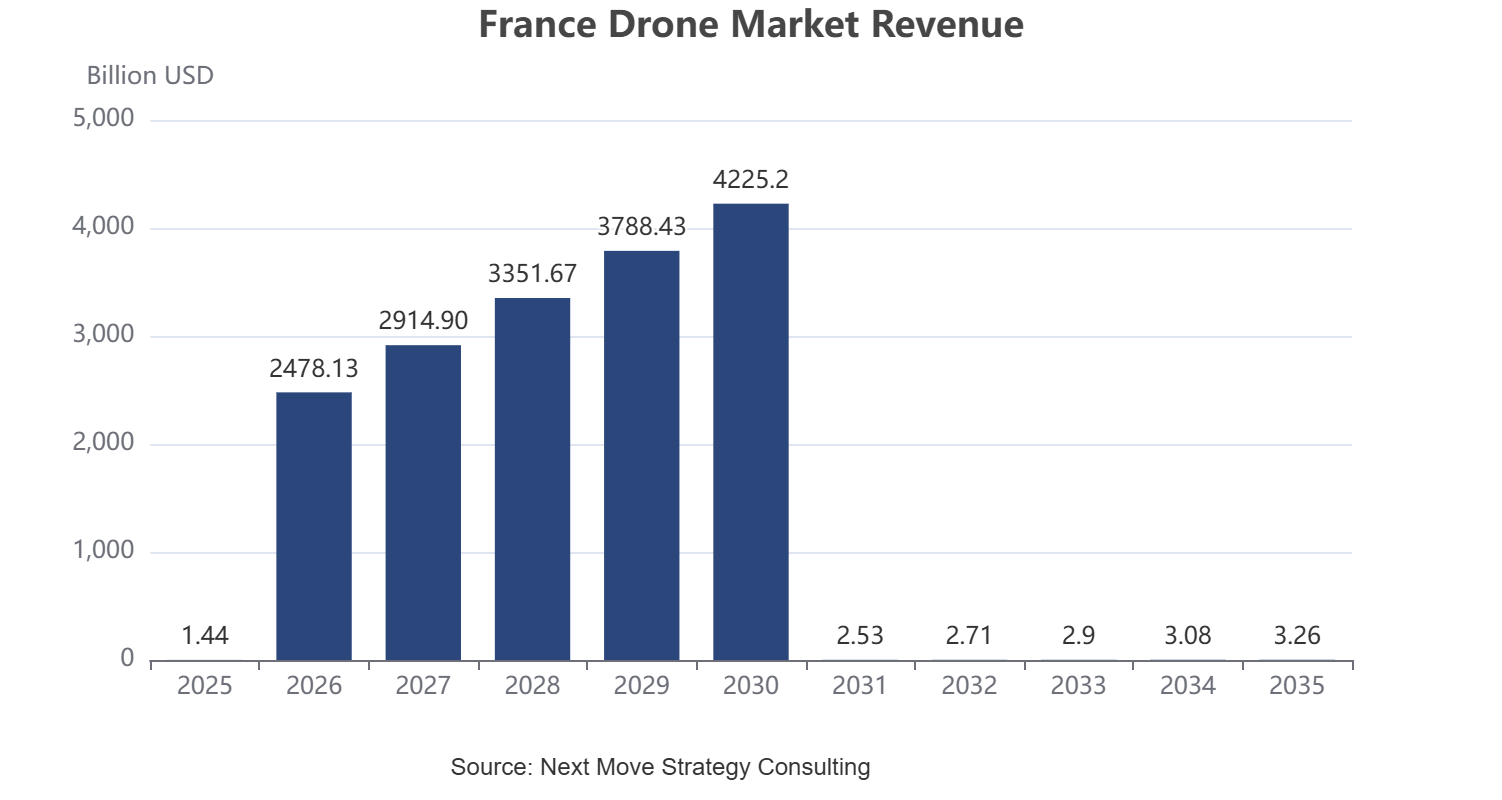
The France Drone Market was valued at USD 1.44 billion in 2025 and is estimated to reach USD 1.65 billion in 2026. Revenue is projected to grow to USD 3.26 billion by 2035, registering a CAGR of 7.87% during 2026–2035. In volume terms, the market stood at 47 thousand units in 2025, estimated at 56 thousand units in 2026, and is forecast to expand to 150 thousand units by 2035, reflecting a volume CAGR of 11.56%, driven by accelerating adoption across commercial, government, and military end-use applications nationwide.
What Are the Key Market Drivers, Restraints, and Opportunities Shaping the France Drone Market through 2035?
Growth Catalyst & Risk Assessment Matrix
|
Drivers / Trends / Restraints |
(+/–) % Impact on CAGR Forecast |
Geographic Relevance |
Impact Timeline |
|
Mature DGAC-led regulatory framework providing structured UAV operational categories and predictable BVLOS authorization pathways for commercial operators |
+1.9% |
France-wide, concentrated in commercial and agricultural regions |
Medium to long term (3–6 years) |
|
Broad industrial demand from energy, aerospace, agriculture, and smart city sectors driving enterprise-grade drone platform adoption |
+1.7% |
Industrial and agricultural regions (Occitanie, Nouvelle-Aquitaine, Île-de-France) |
Medium to long term (3–6 years) |
|
Active defense procurement under the Loi de Programmation Militaire and European MALE drone co-development programs driving military UAV demand |
+1.6% |
National defense procurement, operational deployments across France and overseas territories |
Medium to long term (4–7 years) |
|
Expanding AI-enabled autonomy, DaaS business models, and data analytics platforms creating new commercial value layers |
+1.3% |
Urban and semi-urban France, expanding to rural enterprise users |
Long term (5–8 years) |
|
Airspace congestion in metropolitan regions, high enterprise system costs, and BVLOS approval timelines constraining commercial volume scaling |
–1.2% |
Urban centers, high-density airspace zones (Paris, Lyon, Marseille) |
Short to medium term (1–4 years) |
France's drone market is underpinned by a strong national industrial base, a well-developed regulatory framework for unmanned aviation, and a strategically active defense posture that consistently prioritizes uncrewed aerial systems procurement. From our analysis, the market reflects a mature commercial drone ecosystem with growing enterprise-grade adoption, alongside an expanding government and military demand layer shaped by France's operational commitments and European defense cooperation programs. Structural growth drivers across agriculture, infrastructure inspection, public safety, and sovereign defense continue to reinforce the market's positive trajectory through the forecast period to 2035.
Growth Drivers:
How Is France's Structured UAV Regulatory Framework Enabling Sustained Commercial Drone Market Growth?
France's Direction Générale de l'Aviation Civile has established one of Europe's most structured UAV regulatory environments, implementing tiered operational categories that provide predictable compliance pathways for commercial operators seeking to expand BVLOS and automated flight operations. Through NMSC's assessment, this regulatory maturity is actively reducing entry barriers for drone service operators in sectors including precision agriculture, utility inspection, and emergency response. Ongoing alignment with EASA's evolving U-Space framework is expected to further expand airspace access for commercial operators, supporting accelerated deployment across France's urban and peri-urban operational corridors.
How Is France's Industrially Diverse Economy Creating Structural Demand for Enterprise-Grade Drone Solutions?
France's broad industrial landscape, spanning aerospace manufacturing, energy infrastructure, agricultural production, and smart city development, is creating sustained structural demand for enterprise-grade drone platforms capable of delivering precision inspection, geospatial mapping, and environmental monitoring functions. We observed that French utilities, rail operators, and agricultural cooperatives are progressively integrating fixed-wing and hybrid VTOL drones into operational workflows, driven by measurable cost reductions in manual inspection and crop monitoring activities. This industrial demand is reinforcing a sustained shift toward higher-value, performance-grade unmanned aerial systems within France's commercial and industrial end-user segment.
How Are France's Defense Procurement Programs and European Military Cooperation Driving Military Drone Demand?
France maintains one of Europe's most operationally active defense postures, with sustained procurement commitments for ISR-capable drones, tactical unmanned systems, and loitering munitions through the Loi de Programmation Militaire framework. Through our industry assessment, France's defense drone requirements are further reinforced by its commitments within NATO structures and its participation in European MALE drone co-development programs, including the Eurodrone initiative. These defense imperatives are creating consistent high-value procurement demand for military-grade unmanned platforms and supporting a specialized domestic industrial base centered around established aerospace and defense manufacturers.
Growth Inhibitor:
How Do Airspace Management Complexity, High System Costs, and Public Acceptance Concerns Restrain Drone Market Growth in France?
Despite a supportive regulatory framework, France's commercial drone market faces meaningful constraints from airspace management complexity in densely populated metropolitan regions, ongoing public acceptance concerns related to surveillance and privacy, and the high acquisition and operational costs associated with enterprise and military-grade systems. From our assessment, fragmented interoperability between drone hardware, UTM platforms, and fleet management software continues to slow the seamless scaling of multi-drone commercial operations. These structural limitations, alongside constrained BVLOS authorization timelines in high-density airspace, moderate the pace of volume growth within France's broader drone market.
Growth Opportunity:
How Does France's Aerospace Research Ecosystem and Startup Landscape Create Future Drone Market Opportunities?
France's national industrial and research ecosystem, anchored by ONERA, aerospace clusters in Toulouse and Bordeaux, and a growing base of UAV-focused startups, is well positioned to capitalize on accelerating demand for AI-enabled autonomous drone capabilities across commercial and defense applications. Growing interest in urban air mobility, precision agriculture, and drone-based emergency response is creating new market entry and expansion opportunities for software platform providers, data analytics firms, and DaaS operators. Our assessment identifies autonomous data collection, AI-driven mission planning, and defense co-development programs as high-potential opportunity areas within France's drone market through 2035.
Regulatory Framework Impacting the France Drone Market
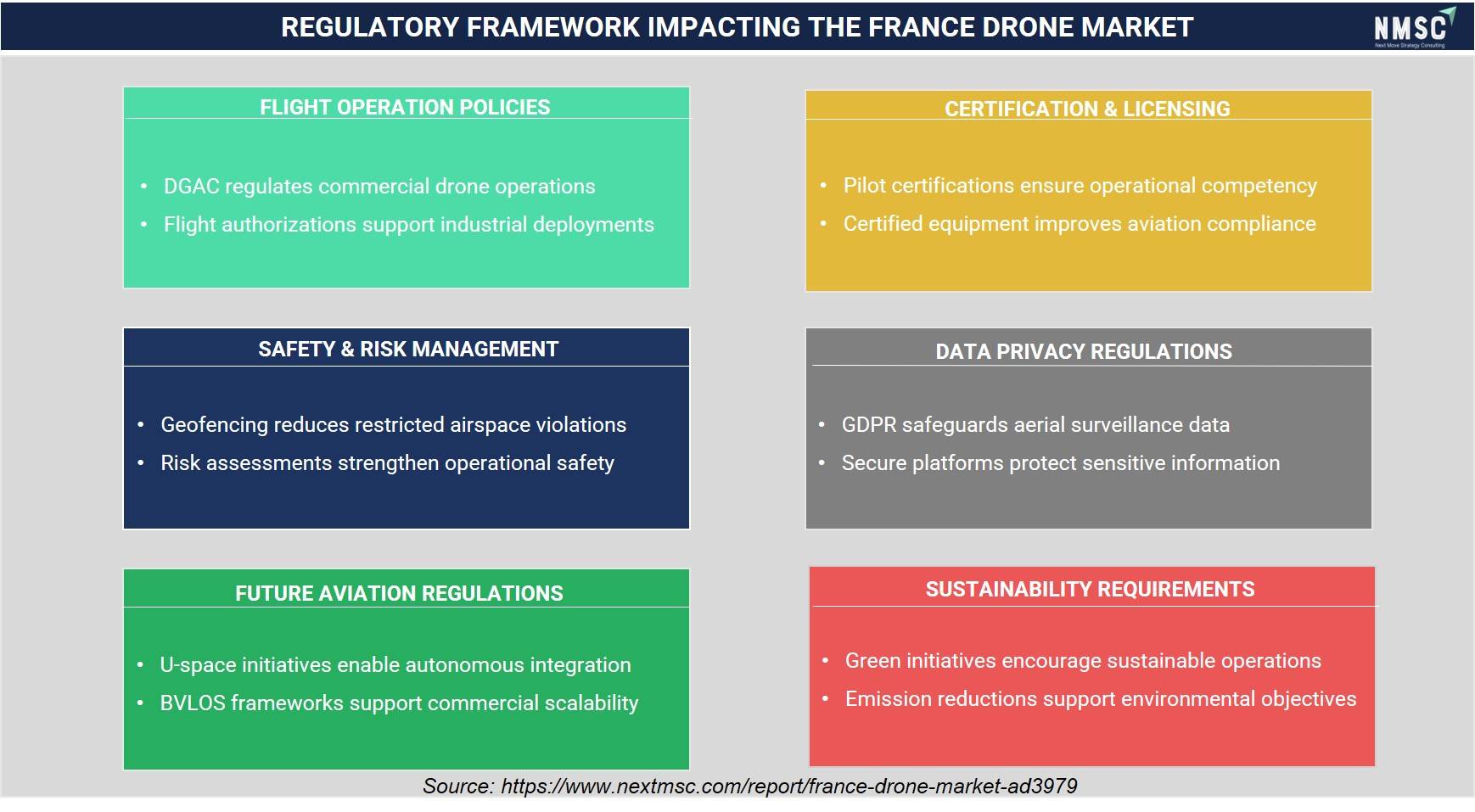
The above regulatory framework analysis maps the key regulatory components, such as flight operation policies, safety and risk management, future aviation regulations, certification and licensing, data privacy regulations, and sustainability requirements, shaping the France drone market. From our analysis, we observed that DGAC regulates commercial operations and flight authorizations support industrial deployments, while geofencing reduces restricted airspace violations and risk assessments strengthen operational safety. U-space initiatives enable autonomous integration, and BVLOS frameworks support commercial scalability. Pilot certifications ensure operational competency, while GDPR safeguards aerial surveillance data and green initiatives encourage sustainable operations.
How Is the France Drone Market Segmented in This Report, and What Are the Key Insights from the Segmentation Analysis?
By Maximum Take-off Weight Insights
How Does Maximum Take-off Weight (MTOW) Segmentation Reflect Operational Requirements Across the France Drone Market?
Based on maximum take-off weight (MTOW), the France Drone Market is segmented into nano (<250 g), micro (250 g–2 kg), small (>2 kg–25 kg), medium (>25 kg–150 kg), large (>150 kg–600 kg), and very large/tactical (>600 kg) drone categories.
The market comprises a broad range of drone weight classes designed to address diverse operational requirements across consumer, commercial, government, and defense applications. According to our analysis, we found that nano and micro drones support recreational, imaging, and localized inspection activities, while small and medium platforms enable surveying, agriculture, infrastructure inspection, and industrial operations requiring greater payload capacity and endurance. Large and very large/tactical systems are utilized for complex missions involving long-range surveillance, logistics, public safety, and specialized defense applications requiring enhanced operational capability.
By Platform Type Insights
How Does Platform Type Segmentation Reflect Operational Diversity Across the France Drone Market?
Based on platform type, the France Drone Market is segmented into multi-rotor, fixed-wing, hybrid VTOL, single-rotor, tethered UAV, loitering munition, and MALE/HALE/UCAV platforms.
The market encompasses a diverse portfolio of drone platforms designed to address varying operational requirements across commercial, government, and defense applications. According to our analysis, we found that multi-rotor, fixed-wing, and hybrid VTOL platforms support applications such as aerial imaging, surveying, infrastructure inspection, agriculture, and environmental monitoring by offering different combinations of maneuverability, endurance, and range. Meanwhile, single-rotor helicopters, tethered UAVs, loitering munitions, and MALE/HALE/UCAV platforms serve specialized missions requiring persistent surveillance, tactical capabilities, extended flight endurance, and enhanced mission flexibility.
Supply Chain Structure of the France Drone Market
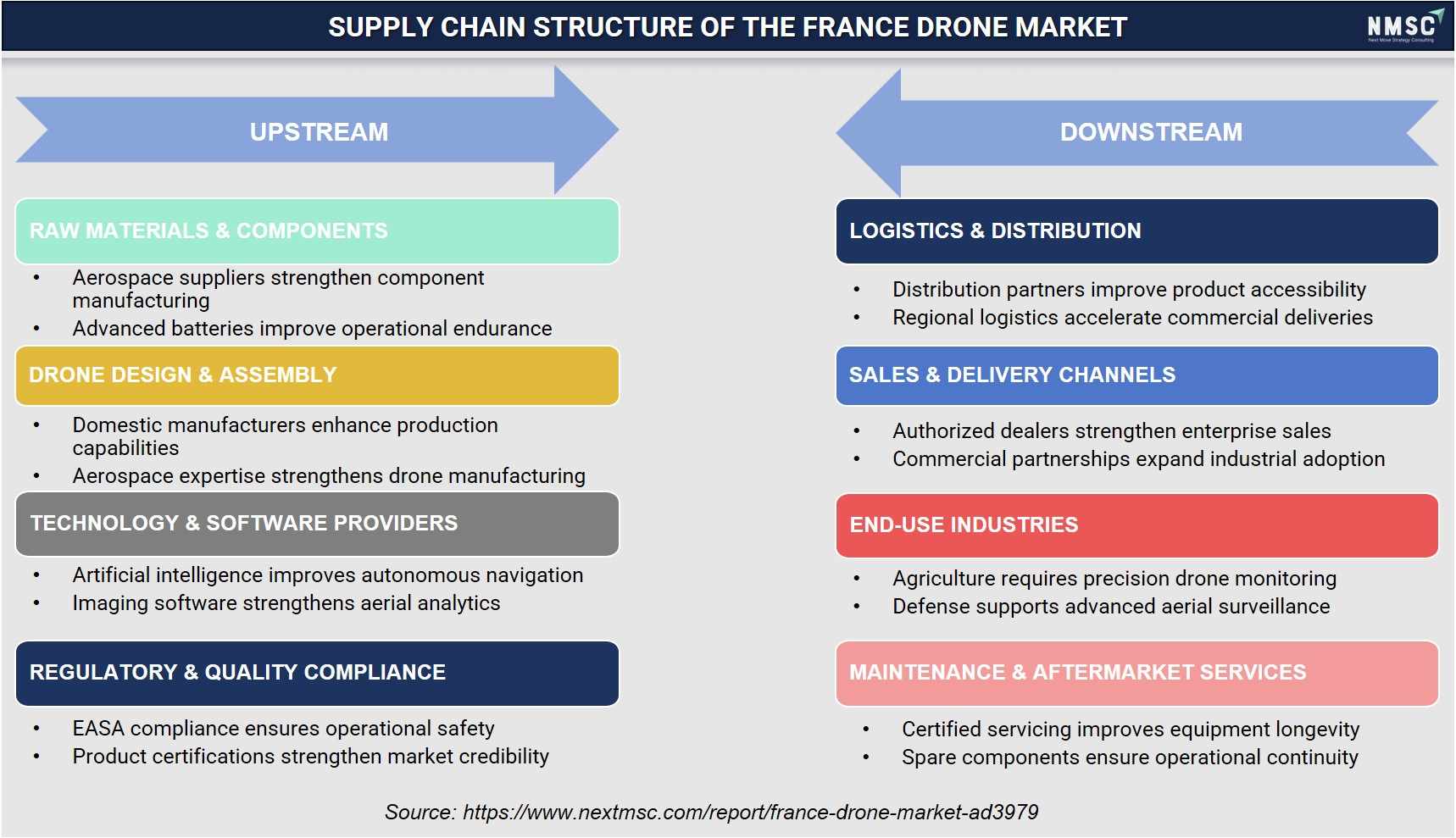
The above supply chain analysis maps the key operational stages, such as upstream and downstream, shaping the France drone market. From our analysis, we observed that upstream activities include aerospace suppliers, advanced batteries, domestic manufacturers, artificial intelligence, imaging software, and EASA compliance, while downstream activities encompass distribution partners, authorized dealers, commercial partnerships, agriculture and defense end-users, and certified servicing, reflecting a well-integrated supply chain across the market.
Key Segments
By Component
-
Hardware
-
Airframe
-
Avionics & Core Systems
-
Payloads & Sensors (Cameras, LiDAR, Multispectral, etc.)
-
Communication Systems (C2 Links)
-
-
Software
-
Flight Control & Autonomy
-
Data Processing & Analytics
-
Fleet Management
-
-
Services
-
Drone-as-a-Service (DaaS)
-
Training & Certification
-
Maintenance, Repair & Overhaul (MRO)
-
Data Processing Services
-
By Platform Type
-
Multi-Rotor
-
Fixed-Wing
-
Hybrid VTOL (Vertical Take-Off and Landing)
-
Single-Rotor (Helicopter)
-
Tethered UAV
-
Loitering Munition
-
MALE/HALE/UCAV
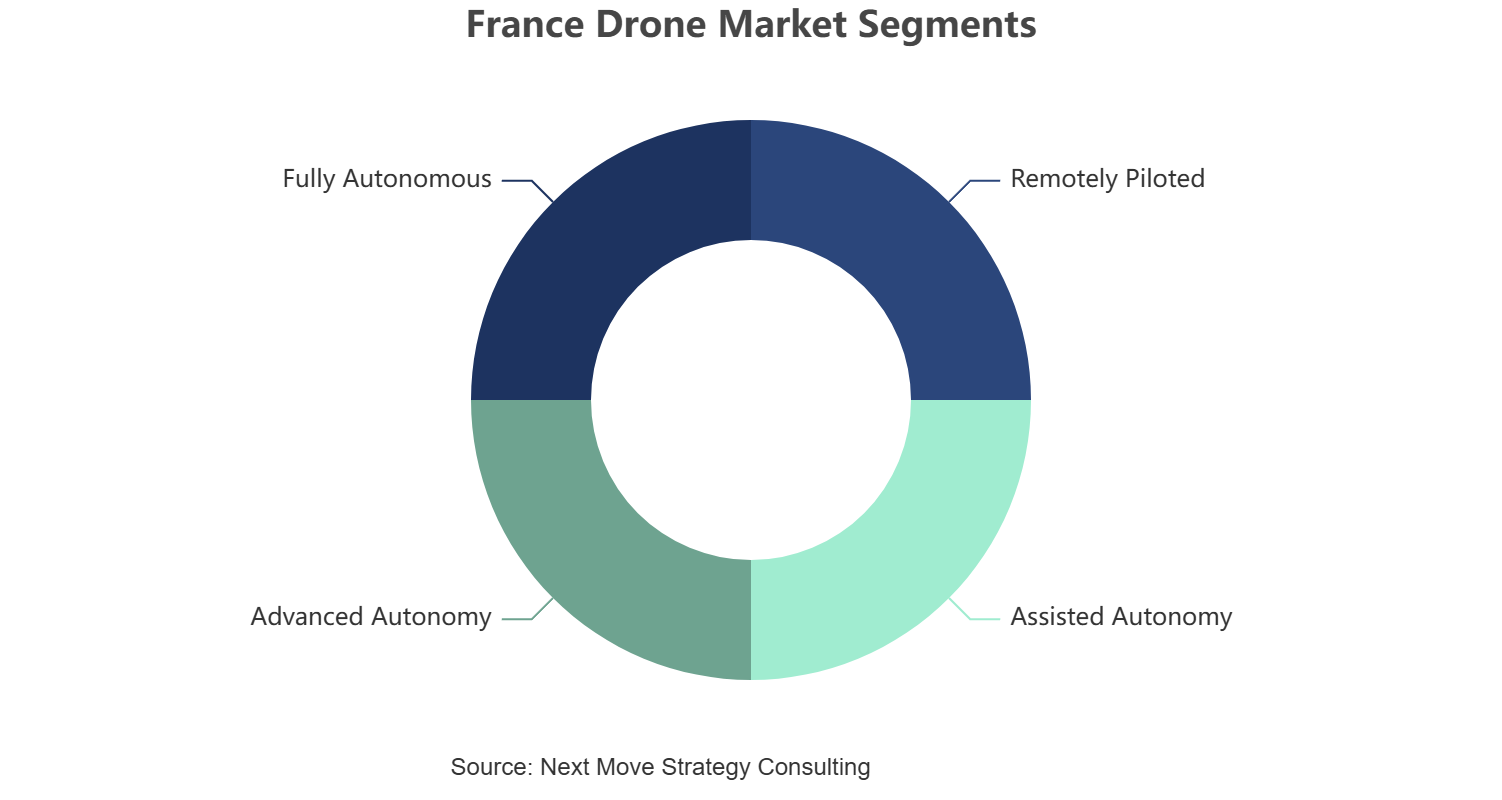
By Autonomy Level
-
Remotely Piloted
-
Assisted Autonomy
-
Advanced Autonomy
-
Fully Autonomous
By Maximum Takeoff Weight (MTOW)
-
Nano: < 250 g
-
Micro: 250 g – 2 kg
-
Small: > 2 kg – 25 kg
-
Medium: > 25 kg – 150 kg
-
Large: > 150 kg – 600 kg
-
Very Large/Tactical: > 600 kg
By Price/Performance Grade
-
Consumer Grade (< $1,000)
-
Prosumer Grade ($1,000 – $10,000)
-
Enterprise Grade ($10,000 – $100,000)
-
Military Grade (> $100,000)
By End-User
-
Consumer Drone
-
Commercial & Industrial Drone
-
Aerial Imaging & Cinematography
-
Surveying & Mapping (Geomatics)
-
Agricultural Applications (spraying, crop monitoring)
-
Infrastructure Inspection (energy, utilities, transport)
-
Logistics & Delivery (package transport)
-
Environmental & Scientific Monitoring
-
-
Government & Public Safety Drone
-
Emergency Response & Disaster Management
-
Law Enforcement & Security
-
Firefighting & Public Safety
-
Smart City Management
-
-
Military Drone
-
Intelligence, Surveillance & Reconnaissance (ISR)
-
Combat Operations
-
Electronic Warfare (EW)
-
Target Acquisition & Designation
-
Logistics & Resupply
-
Decoy & Countermeasure Systems
-
Competitive Landscape
The competitive landscape of the France Drone Market is characterized by a blend of globally recognized drone OEMs, specialist European defense system integrators, enterprise-focused software and data analytics providers, and a growing base of French UAV startups operating across hardware, software, and service delivery verticals. Competitive dynamics in France are increasingly shaped by regulatory compliance expertise, payload specialization, after-sales service network strength, and the ability to deliver integrated end-to-end drone solutions that meet enterprise and government procurement standards. Our assessment indicates that Drone-as-a-Service and data-analytics-led business models are becoming key competitive differentiators within France's evolving drone market.
Strategic Developments:
February 2026 – TEKEVER, S.A. unveiled its new Cahors industrial site in France to expand production of its AR3 and AR5 autonomous drones. Backed an approximately USD 114 million investment plan, the facility will strengthen France's drone manufacturing capacity, support 100 skilled jobs, and enhance European defense and sovereign UAV capabilities.
Key Players of the France Drone Market:
-
Parrot Drones S.A.S.
-
Delair S.A.S.
-
DJI GmbH
-
Kratos Defense & Security Solutions, Inc.
-
Tekever, S.A.
-
Flyability SA
-
Autel Robotics Europe GmbH
-
Wingtra AG
-
AgEagle Aerial Systems Inc.
-
Airbus Defence and Space S.A.S.
-
Drone Volt S.A.
-
Freefly Systems Inc.
-
AeroVironment, Inc.
-
Guangzhou EHang Intelligent Technology Co., Ltd.
-
Quantum-Systems GmbH
Key players operating in the France Drone Market include Parrot Drones S.A.S., Delair S.A.S., DJI GmbH, Kratos Defense & Security Solutions Inc., Tekever S.A., Flyability SA, Autel Robotics Europe GmbH, Wingtra AG, AgEagle Aerial Systems Inc., Freefly Systems Inc., and others. These players compete through platform innovation, payload capability expansion, regulatory certification investment, and service contract differentiation across France's commercial, government, and defense customer base.
Key Benefits for Stakeholders
Next Move Strategy Consulting (NMSC) presents a detailed assessment of the France Drone Market, encompassing revenue and volume forecasts from 2025 through 2035. The study provides structured insights across six segmentation dimensions, including component, platform type, autonomy level, maximum takeoff weight, price/performance grade, and end-user, equipping manufacturers, investors, and policymakers with quantitative and qualitative intelligence for informed strategic planning.
Stakeholders across the drone value chain, including hardware manufacturers, software developers, defense contractors, and service operators, gain clarity on France-specific demand patterns, regulatory dynamics, and competitive positioning through NMSC's comprehensive analysis. The report supports strategic decisions related to market entry, product development prioritization, partnership formation, and portfolio investment across France's growing commercial, government, and military unmanned systems market.
|
Parameters |
Details |
|
Customization Scope |
Free customization (equivalent to up to 80 analyst-working hours) after purchase. |
|
Pricing and Purchase Options |
Avail customized purchase options to meet your exact research needs. |
|
Approach |
In-depth primary and secondary research; proprietary databases; rigorous quality control and validation measures. |
|
Analytical Tools |
Porter’s Five Forces, SWOT, value chain, and Harvey ball analysis to assess competitive intensity, stakeholder roles, and relative impact of key factors. |
Conclusion
The France Drone Market is positioned for consistent growth through the forecast period, underpinned by a mature regulatory environment, structurally diverse commercial demand, and sustained defense procurement under national and European defense frameworks. Revenue is projected to advance from USD 1.65 billion in 2026 to USD 3.26 billion by 2035 at a CAGR of 7.87%, while volume is forecast to reach 150 thousand units at a CAGR of 11.56%. Competitive intensity among global OEMs, French domestic players, and specialist service providers will continue to shape differentiation across the market through 2035.
About the Author
 Mayurima Roy
— Mayurima Roy is Research Analyst at Next Move Strategy Consulting, where she has spent 4 years working across the firm's full industry coverage rather than a single fixed vertical. Her work centers on structured research, ongoing trend tracking, competitive assessment, and insight-led content development, translating complex market data into clear, decision-ready narratives that support informed client decision-making across diverse global industries, market sectors, and world regions every day.
Mayurima Roy
— Mayurima Roy is Research Analyst at Next Move Strategy Consulting, where she has spent 4 years working across the firm's full industry coverage rather than a single fixed vertical. Her work centers on structured research, ongoing trend tracking, competitive assessment, and insight-led content development, translating complex market data into clear, decision-ready narratives that support informed client decision-making across diverse global industries, market sectors, and world regions every day.
About the Reviewer
 Supradip Baul
— Supradip Baul is an accomplished business consultant and strategist with over a decade of rich experience in market intelligence, strategy, technology, and business transformation. His work has included rigorous qualitative and quantitative analysis across multiple industries, helping clients shape investment decisions and long-term roadmaps. Earlier in his career, he was associated with Gartner, where he contributed to industry-leading reports and market share analyses. He has worked with leading global companies and holds an MBA with a dual specialization in Marketing and Finance.
Supradip Baul
— Supradip Baul is an accomplished business consultant and strategist with over a decade of rich experience in market intelligence, strategy, technology, and business transformation. His work has included rigorous qualitative and quantitative analysis across multiple industries, helping clients shape investment decisions and long-term roadmaps. Earlier in his career, he was associated with Gartner, where he contributed to industry-leading reports and market share analyses. He has worked with leading global companies and holds an MBA with a dual specialization in Marketing and Finance.
At Next Move Strategy Consulting, we understand that insightful market research is the cornerstone of successful business decisions. That's why we employ a robust and multifaceted approach, combining various methodologies to deliver the most accurate and actionable data for our clients.

Research Landscape
We navigate the world of research with two primary approaches:
Qualitative Approach
Our qualitative research methodologies involve immersive techniques such as in-depth interviews, focus groups, and observational studies. By engaging directly with individuals and stakeholders, we uncover valuable insights that quantitative data alone may overlook.

Quantitative Research
In tandem with qualitative methodologies, NMSC leverages the power of Quantitative Research to provide a robust foundation of numerical insights. Through systematic data collection and analysis, we quantify patterns, preferences, and market trends, offering a comprehensive view of the business landscape.
Our quantitative research approach employs diverse tools, including surveys, experiments, and statistical modelling. These methodologies enable us to gather data from a large and representative sample, ensuring the statistical significance of our findings. By employing structured questionnaires and standardized data collection methods, we guarantee the reliability and validity of the information we present to our clients.
Quantitative research is particularly effective in measuring the prevalence of trends, assessing market size, and gauging the impact of various factors on consumer behavior. The numerical precision attained through this approach equips our clients with actionable insights, facilitating data-driven decision-making and strategy formulation.


Our Specialized Toolbox for Industry-Specific Market Research
We deploy a specialized arsenal of techniques tailored to meet your unique requirements. Here's a glimpse into our comprehensive toolbox:

Information Procurement
The stage entails acquiring market data or relevant information through various sources and methodologies.


Market Research Approach
We utilize both top-down and bottom-up approaches in market research analysis to achieve a comprehensive understanding of the market dynamics, leveraging the broad perspective of industry trends and macroeconomic factors alongside detailed insights from specific segments and individual companies.

Porters Five Forces Analysis
We conduct Porter's Five Forces analysis to evaluate the competitive landscape of an industry, providing us with insights into factors that affect profitability and strategic positioning.

SWOT Analysis

Forecasting
We utilize a forecasting model to predict future consumption by considering parameters like population, economics, regulations, market competition, drivers, constraints, technology, and pricing. We also employ statistical techniques such as multilinear regression, exponential smoothing, moving average, ARIMA, and Monte Carlo simulations for accurate predictions. In econometric forecasting, we analyzed short-term and long-term event impacts, attributing values based on regulatory frameworks, economic factors, and market events.





 Speak to Our Analyst