Function Accelerator Cards Market

Function accelerator cards market was USD 3.20 billion in 2025, projected to reach USD 27.07 billion by 2035 at a 24.2% CAGR from 2026 to 2035, per this report.

Download Free Sample PDF
Base Year (2025)
$3.20 Billion
Forecast (2035)
$27.07 Billion
CAGR (2026-2035)
24.2%
Top Region
North America

What Is the Function Accelerator Cards Market Size?

The global function accelerator cards market size was valued at USD 3.20 billion in 2025 and is estimated at USD 3.85 billion in 2026, forecast to reach USD 27.07 billion by 2035, expanding at a 24.2% CAGR between 2026 and 2035. North America leads with approximately 48% share, while GPU-Based Accelerator Cards dominate all other product types with approximately 26% share.

We observed that growth is broad-based across every segmentation axis, with PCIe Gen5 interfaces and AI inference acceleration driving the dominant structural shifts through 2035.

Function Accelerator Cards Market Revenue Forecast

Values in USD Billion

2025 $3.20 Billion
2025
2026 $3.97 Billion
2026
2027 $4.94 Billion
2027
2028 $6.13 Billion
2028
2029 $7.61 Billion
2029
2030 $9.46 Billion
2030
2031 $11.75 Billion
2031
2032 $14.59 Billion
2032
2033 $18.12 Billion
2033
2034 $22.50 Billion
2034
2035 $27.07 Billion
2035

Key Takeaways

By Product Type: GPU-Based Accelerator Cards held the largest share of approximately 26% (USD 0.83 billion) in 2025; the segment also registers the fastest CAGR at 29.0% from 2026–2035.

By Function Type: AI Inference Acceleration held the largest share of approximately 28% (USD 0.90 billion) in 2025, and is also the fastest-growing sub-segment at 28.1% CAGR from 2026–2035.

By Interface: PCIe Gen4 held the largest share of approximately 46% (USD 1.47 billion) in 2025; PCIe Gen5 is the fastest-growing sub-segment at 29.9% CAGR from 2026–2035.

By Deployment: Data Center held the largest share of approximately 58% (USD 1.86 billion) in 2025; Edge Computing is the fastest-growing sub-segment at 26.4% CAGR from 2026–2035.

By End-Use Industry: Cloud Service Providers held the largest share of approximately 34% (USD 1.09 billion) in 2025; Automotive is the fastest-growing sub-segment at 27.3% CAGR from 2026–2035.

Dominant Region: North America dominated with approximately 48% revenue share (USD 1.54 billion) in 2025.

Fastest-Growing Region: Asia-Pacific is expected to register the highest CAGR of 27.8% during 2026–2035.

Dominant Country: U.S. led with approximately USD 1.31 billion in 2025.

Fastest-Growing Country: India is the fastest-growing country at approximately 30.0% CAGR from 2026–2035.

Market Opportunity: The function accelerator cards market is expected to create an absolute dollar opportunity of USD 23.22 billion between 2026 and 2035, presenting significant investment potential across the AI inference and cloud data center infrastructure value chain.

According to Next Move Strategy Consulting analysis, hyperscale cloud providers are increasingly consolidating accelerator card procurement with vendors capable of supplying integrated networking, security, and inference offload on a single card, a shift that favors diversified semiconductor vendors over single-function card specialists as AI infrastructure buildouts accelerate through 2035.

What Does the Function Accelerator Cards Market Encompass?

The function accelerator cards market encompasses PCIe-based hardware cards that offload specific compute functions, including networking, cryptography, artificial intelligence inference, storage compression, and video transcoding, from general-purpose server processors. Our assessment indicates that the scope spans FPGA-based, ASIC-based, GPU-based, and multiprocessor-based card architectures deployed across data center, edge computing, and telecommunications infrastructure environments serving cloud service providers, telecommunications operators, and enterprise data centers. The category has evolved from single-function network interface offload cards into programmable, multi-function platforms capable of simultaneously accelerating networking, security, and AI inference workloads within hyperscale data centers.
Semiconductor vendors continue to expand custom silicon partnerships with hyperscale cloud providers to address unprecedented memory, connectivity, and compute demands driven by agentic AI inference workloads. We observed that technology adoption is shifting toward PCIe Gen5-compatible cards and Open Compute Project form factors that improve interoperability across hyperscale data center fleets. Next Move Strategy Consulting's analysis indicates that this structural shift, combined with accelerating investment in AI-optimized data center infrastructure, is redefining vendor selection criteria across the market.

SUPPLY CHAIN STRUCTURE OF THE FUNCTION ACCELERATOR CARDS MARKET

SUPPLY CHAIN STRUCTURE OF THE FUNCTION ACCELERATOR CARDS MARKET
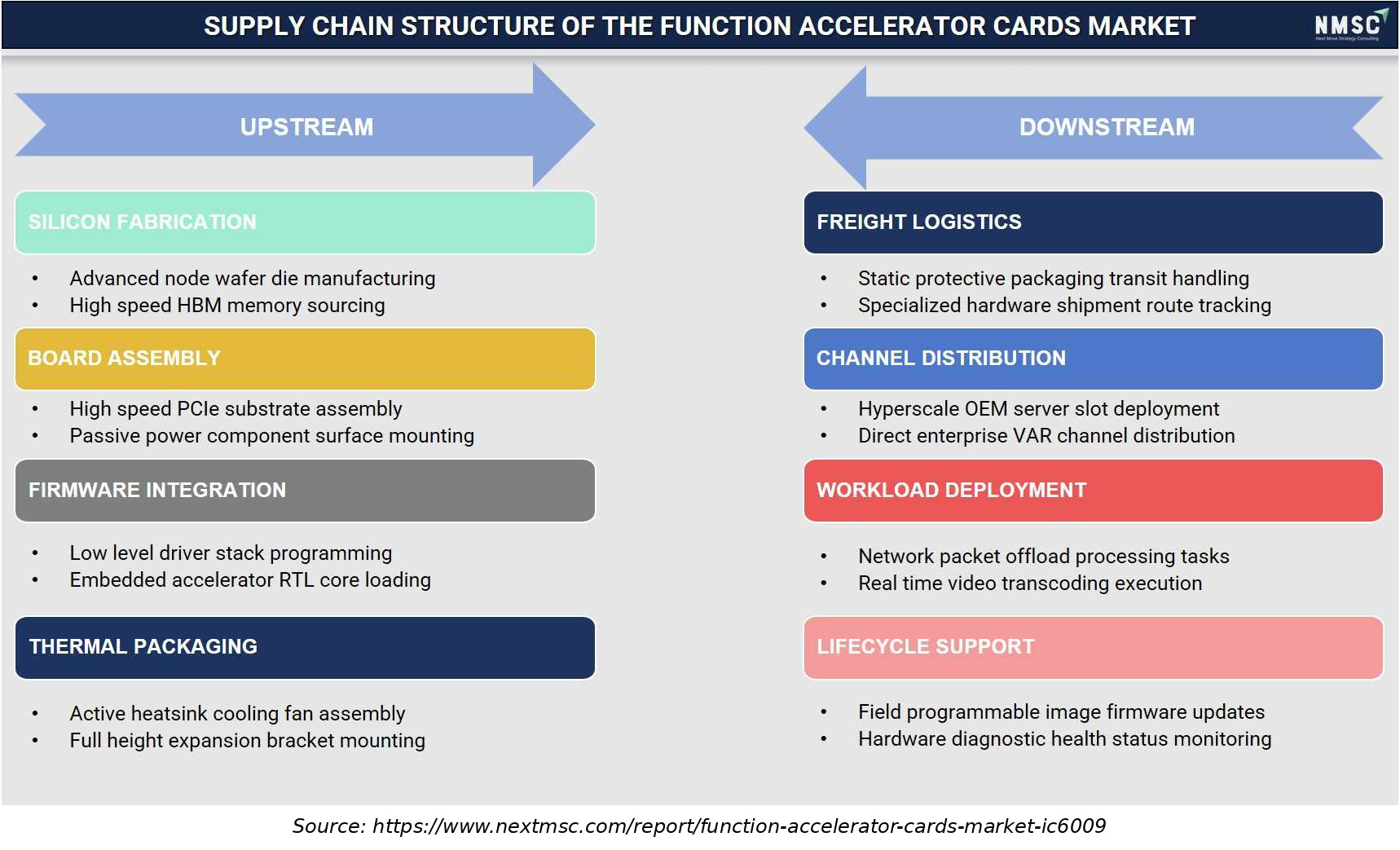
The supply chain structure of the Function Accelerator Cards Market covers upstream activities including silicon fabrication, board assembly, firmware integration, and thermal packaging, followed by downstream activities such as freight logistics, channel distribution, workload deployment, and lifecycle support. This structure highlights the flow of accelerator hardware from semiconductor manufacturing and component integration to enterprise deployment, workload execution, maintenance, and long-term technical support.

Market Drivers & Dynamics

Interactive Dataset
Accelerating hyperscale AI infrastructure buildout driver +3.8% Global 2026-2035
Rising agentic AI inference memory and bandwidth demand driver +2.9% North America, Asia-Pacific 2026-2035
PCIe Gen5 and Open Compute Project standardization driver +1.8% Global 2026-2032
Custom silicon partnerships between semiconductor vendors and hyperscalers driver +2.2% Global 2026-2035
Expanding telecommunications network function virtualization investment driver +1.4% Global 2026-2033
Regional semiconductor manufacturing investment incentives driver +1.1% Asia-Pacific, North America 2026-2033
High card design and qualification costs limiting new entrants restraint -1.6% Global 2026-2032
Component and advanced packaging supply chain constraints restraint -1.3% Global 2026-2030
Rapid architecture obsolescence shortening card replacement cycles restraint -1.0% Global 2026-2033
Export control restrictions on advanced accelerator technology restraint -0.8% Asia-Pacific 2026-2035
Source: Next Move Strategy Consulting

Growth Drivers

What Is the Primary Growth Driver of the Function Accelerator Cards Market?

Accelerating hyperscale AI infrastructure buildout is the primary driver of the market. Hyperscale cloud providers continue to undertake what industry participants describe as among the largest infrastructure buildouts in history, driving sustained demand for accelerator cards spanning compute, memory, and connectivity functions. We observed that this infrastructure investment, reinforced by rising agentic AI inference workload demands, continues to anchor baseline demand for GPU-based and custom ASIC accelerator cards across cloud service provider data centers.

How Is Agentic AI Inference Driving Market Growth?

Rising agentic AI inference memory and bandwidth demand is accelerating market growth as larger models and longer context windows expose the limits of traditional server-attached architectures. Marvell Technology's expanded AI memory infrastructure portfolio, announced in August 2026, illustrates how semiconductor vendors are addressing token efficiency and infrastructure utilization challenges. Our assessment indicates that this demand shift, combined with custom silicon partnerships, is compressing development timelines for next-generation accelerator cards across hyperscale datacenter deployments.

Growth Inhibitors

What Is Restraining Function Accelerator Cards Market Expansion?

High card design and qualification costs restrain new entrant participation, as competitive accelerator card development requires substantial investment in advanced packaging and silicon design. Component and advanced packaging supply chain constraints further limit production scaling for emerging vendors. We found that smaller semiconductor vendors face particular exposure, as limited capital resources reduce their ability to match the qualification cycles and hyperscaler design partnerships that established vendors have secured.

What Are the Growth Opportunities?

How Can Vendors Capture the Agentic AI Memory Opportunity?

Hyperscale cloud providers scaling agentic AI inference present a whitespace opportunity for vendors offering validated, high-bandwidth memory expansion cards. Suppliers that commercialize rack-scale CXL memory pooling architectures stand to capture recurring infrastructure contracts as hyperscalers prioritize memory-compute disaggregation to improve token efficiency at scale.

Where Does Automotive Edge Inference Create Whitespace?

Connected and autonomous vehicle platforms integrating edge inference represent an underpenetrated opportunity for vendors offering automotive-qualified accelerator cards. Vendors that achieve automotive-grade reliability certification can secure long-term original equipment manufacturer contracts, benefiting from recurring platform revenue as vehicle electronics architectures increasingly centralize compute around dedicated accelerator hardware.

How Can Regional Manufacturers Benefit from Semiconductor Investment Incentives?

Regional semiconductor manufacturing investment incentives represent a fast-growing opportunity for vendors expanding development and production capacity outside traditional hubs. Firms that establish regional design centers, following patterns such as Marvell's expanded Bangalore facility, can access government-backed incentives while building talent pipelines to serve expanding local hyperscale infrastructure demand.

Segmentation Analysis

2025 (USD Billion)
2035 (USD Billion)
FPGA-Based Cards 2025: $1.34 Billion | 2035: $9.20 Billion
FPGA-Based C
ASIC-Based Cards 2025: $0.77 Billion | 2035: $5.96 Billion
ASIC-Based C
GPU-Based Accelerator Cards 2025: $0.83 Billion | 2035: $10.29 Billion
GPU-Based Ac
Multiprocessor-Based Cards 2025: $0.26 Billion | 2035: $1.62 Billion
Multiprocess
FPGA-Based Cards $1.34 Billion $9.20 Billion 21.5%
ASIC-Based Cards $0.77 Billion $5.96 Billion 23.1%
GPU-Based Accelerator Cards $0.83 Billion $10.29 Billion 29.0%
Multiprocessor-Based Cards $0.26 Billion $1.62 Billion 20.8%

Which Product Type Segment Dominates the Function Accelerator Cards Market?

GPU-Based Accelerator Cards led the market with USD 0.83 billion in 2025, supported by hyperscale cloud providers prioritizing programmable, high-throughput inference acceleration. We observed that GPU-Based Accelerator Cards are also the fastest-growing product type, expanding at a 29.0% CAGR from 2026 to 2035, as agentic AI inference workloads increasingly favor architectures optimized for large model memory bandwidth and parallel compute throughput.

2025 (USD Billion)
2035 (USD Billion)
Network Func
Cryptographi
AI Inference
Storage and
Video Transc
Segment Item 2025 (USD Billion) 2035 (USD Billion) CAGR
Network Function Acceleration $10.0 USD Billion $40.0 USD Billion 8.0%
Cryptographic Acceleration $17.1 USD Billion $51.1 USD Billion 26.0%
AI Inference Acceleration $24.2 USD Billion $62.2 USD Billion 20.0%
Storage and Compression Acceleration $31.3 USD Billion $73.3 USD Billion 10.0%
Video Transcoding Acceleration $38.4 USD Billion $84.4 USD Billion 21.0%

Segment-wise data is locked

Unlock complete segment-wise numbers for By Function Type.

Unlock Full Data

Which Function Type Segment Leads Function Accelerator Cards Market Demand?

Network Function Acceleration remained the leading function type within the market, valued at USD 0.96 billion in 2025 on sustained network interface offload demand across cloud and telecommunications infrastructure. Our findings suggest that AI Inference Acceleration is the fastest-growing function type, registering a 28.1% CAGR from 2026 to 2035, as agentic AI workloads increasingly require dedicated inference offload capacity beyond general-purpose compute.

2025 (USD Billion)
2035 (USD Billion)
PCIe Gen4
PCIe Gen5
OCP Form Fac
Other Interf
Segment Item 2025 (USD Billion) 2035 (USD Billion) CAGR
PCIe Gen4 $10.0 USD Billion $40.0 USD Billion 15.0%
PCIe Gen5 $17.1 USD Billion $51.1 USD Billion 13.0%
OCP Form Factor $24.2 USD Billion $62.2 USD Billion 19.0%
Other Interfaces $31.3 USD Billion $73.3 USD Billion 9.0%

Segment-wise data is locked

Unlock complete segment-wise numbers for By Interface.

Unlock Full Data
2025 (USD Billion)
2035 (USD Billion)
Data Center
Edge Computi
Telecommunic
Segment Item 2025 (USD Billion) 2035 (USD Billion) CAGR
Data Center $10.0 USD Billion $40.0 USD Billion 10.0%
Edge Computing $17.1 USD Billion $51.1 USD Billion 24.0%
Telecommunications Infrastructure $24.2 USD Billion $62.2 USD Billion 26.0%

Segment-wise data is locked

Unlock complete segment-wise numbers for By Deployment.

Unlock Full Data
2025 (USD Billion)
2035 (USD Billion)
Cloud Servic
Telecommunic
BFSI
Government a
Healthcare
Segment Item 2025 (USD Billion) 2035 (USD Billion) CAGR
Cloud Service Providers $10.0 USD Billion $40.0 USD Billion 20.0%
Telecommunications $17.1 USD Billion $51.1 USD Billion 18.0%
BFSI $24.2 USD Billion $62.2 USD Billion 12.0%
Government and Defense $31.3 USD Billion $73.3 USD Billion 22.0%
Healthcare $38.4 USD Billion $84.4 USD Billion 25.0%

Segment-wise data is locked

Unlock complete segment-wise numbers for By End-Use Industry.

Unlock Full Data

Which End-Use Industry Segment Leads the Function Accelerator Cards Market?

Cloud Service Providers remained the leading end-use industry within the market, valued at USD 1.09 billion in 2025 on sustained hyperscale AI infrastructure investment. Our analysis shows that Automotive is the fastest-growing end-use industry, registering a 27.3% CAGR from 2026 to 2035, as connected and autonomous vehicle platforms increasingly integrate dedicated accelerator cards for edge inference and sensor fusion workloads.

2025 (USD Billion)
2035 (USD Billion)
North Americ
Canada
Mexico
Europe: UK
Germany
Segment Item 2025 (USD Billion) 2035 (USD Billion) CAGR
North America: U.S. $10.0 USD Billion $40.0 USD Billion 10.0%
Canada $17.1 USD Billion $51.1 USD Billion 8.0%
Mexico $24.2 USD Billion $62.2 USD Billion 18.0%
Europe: UK $31.3 USD Billion $73.3 USD Billion 8.0%
Germany $38.4 USD Billion $84.4 USD Billion 15.0%

Segment-wise data is locked

Unlock complete segment-wise numbers for By Region.

Unlock Full Data

Growth Opportunities

Our analysis shows that three forward-looking opportunities stand out for stakeholders positioning within the function accelerator cards market over the 2026-2035 forecast period.

How Can Vendors Capture the Agentic AI Memory Opportunity?

Hyperscale cloud providers scaling agentic AI inference present a whitespace opportunity for vendors offering validated, high-bandwidth memory expansion cards. Suppliers that commercialize rack-scale CXL memory pooling architectures stand to capture recurring infrastructure contracts as hyperscalers prioritize memory-compute disaggregation to improve token efficiency at scale.

Where Does Automotive Edge Inference Create Whitespace?

Connected and autonomous vehicle platforms integrating edge inference represent an underpenetrated opportunity for vendors offering automotive-qualified accelerator cards. Vendors that achieve automotive-grade reliability certification can secure long-term original equipment manufacturer contracts, benefiting from recurring platform revenue as vehicle electronics architectures increasingly centralize compute around dedicated accelerator hardware.

How Can Regional Manufacturers Benefit from Semiconductor Investment Incentives?

Regional semiconductor manufacturing investment incentives represent a fast-growing opportunity for vendors expanding development and production capacity outside traditional hubs. Firms that establish regional design centers, following patterns such as Marvell's expanded Bangalore facility, can access government-backed incentives while building talent pipelines to serve expanding local hyperscale infrastructure demand.

PORTER'S FIVE FORCES ANALYSIS OF THE FUNCTION ACCELERATOR CARDS MARKET

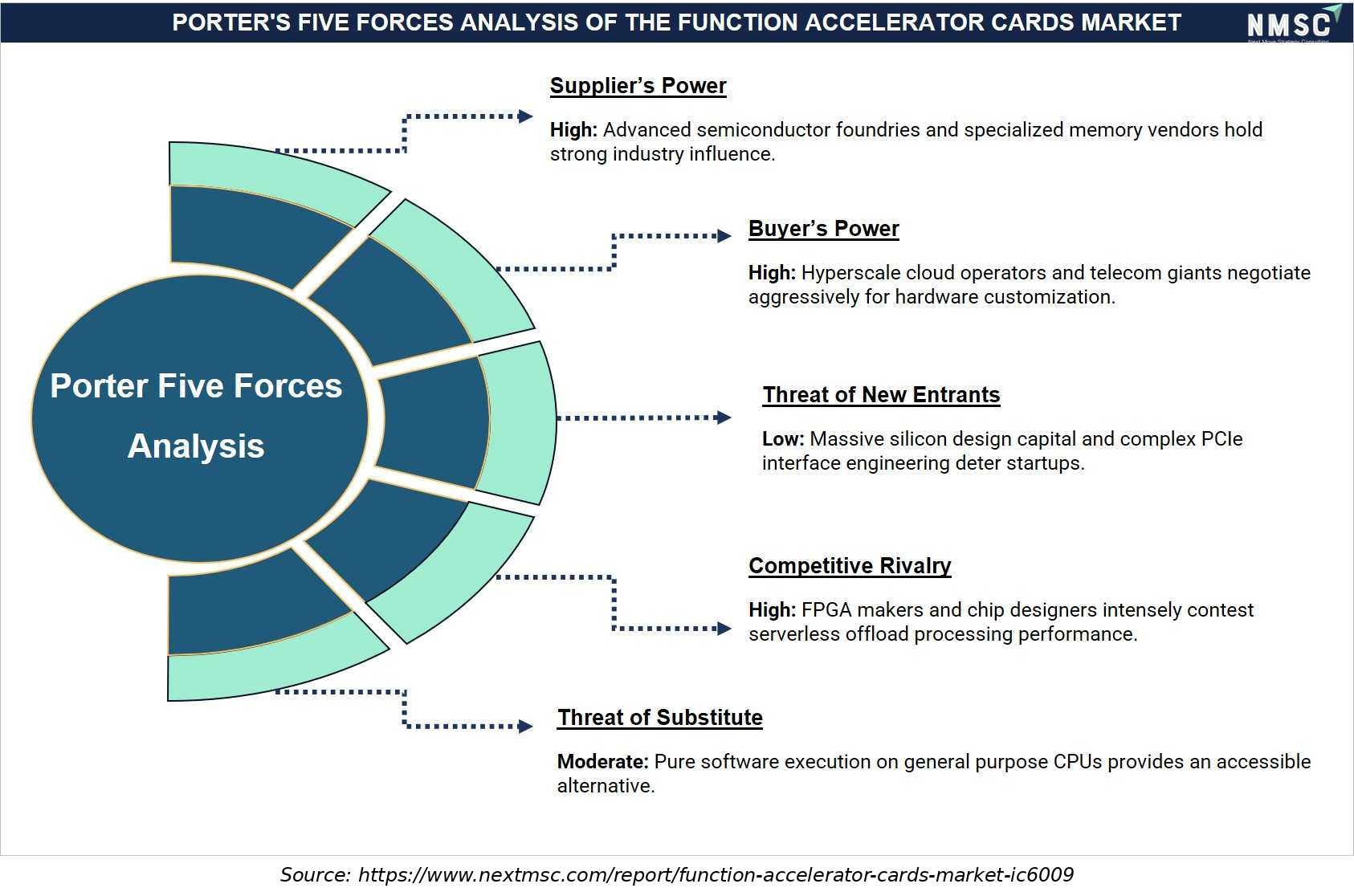
The Porter’s Five Forces Analysis of the Function Accelerator Cards Market evaluates the competitive environment through supplier power, buyer power, threat of new entrants, threat of substitutes, and competitive rivalry. The framework highlights the key market forces influencing pricing, competition, technology adoption, barriers to entry, and strategic positioning of market participants.

Regional Outlook

2025 (USD Billion)
2035 (USD Billion)
North Americ
Europe
Asia-Pacific
Middle East
Latin Americ
Region 2025 (USD Billion) 2035 (USD Billion) CAGR (%)
North America $10.0 USD Billion $40.0 USD Billion 9.0%
Europe $17.1 USD Billion $51.1 USD Billion 27.0%
Asia-Pacific $24.2 USD Billion $62.2 USD Billion 25.0%
Middle East & Africa $31.3 USD Billion $73.3 USD Billion 23.0%
Latin America $38.4 USD Billion $84.4 USD Billion 12.0%

Regional data is locked

Unlock complete regional numbers for this market.

Unlock Full Data

Competitive Landscape

We observed that the market features a moderately consolidated competitive landscape, with diversified semiconductor leaders competing alongside specialized FPGA and networking card vendors.

Dimension Description
Market Structure Moderately consolidated; a small group of diversified semiconductor vendors profiled in this report account for a majority of global function accelerator cards market revenue, alongside specialized FPGA and SmartNIC card manufacturers.
Innovation Focus AI memory infrastructure, PCIe Gen5 connectivity, and custom silicon partnerships with hyperscale cloud providers dominate current innovation pipelines across leading vendors.
M&A Activity Selective consolidation and expanded custom silicon partnerships continue to broaden vendors' compute, memory, and connectivity capabilities beyond single-function accelerator cards.

How Do Companies Compete in the Function Accelerator Cards Market?

Companies compete primarily on performance density, custom silicon partnership depth, and interface standardization across the industry. Diversified semiconductor vendors such as Marvell Technology and AMD leverage established hyperscaler relationships to secure custom card design wins, while specialized FPGA vendors including Achronix and Napatech compete on programmability and rapid deployment for networking and security acceleration use cases.

Which Competitive Archetypes Dominate the Function Accelerator Cards Market?

Two archetypes dominate the market: diversified semiconductor vendors offering custom silicon and integrated compute, memory, and connectivity portfolios, and specialized FPGA and networking card manufacturers focused on programmable acceleration. Marvell Technology and AMD exemplify the diversified archetype through comprehensive AI infrastructure portfolios, while Achronix and Silicom exemplify the specialized archetype serving networking and security-focused customers.

How Are Companies Differentiating Through Innovation in Function Accelerator Cards?

Innovation and differentiation strategy increasingly center on AI memory infrastructure and custom silicon co-design with hyperscale cloud providers. Marvell Technology's expanded AI memory infrastructure portfolio, spanning rack-scale CXL memory expansion and pod-level optical shared memory, exemplifies how vendors are addressing memory-compute disaggregation challenges. Our analysis shows that vendors unable to demonstrate validated hyperscaler design wins risk exclusion from major cloud infrastructure procurement cycles.

What M&A and Expansion Activity Is Shaping the Function Accelerator Cards Market?

Strategic investment and facility expansion continue to consolidate design and manufacturing capabilities within the industry. Marvell's announced USD 250 million investment to expand its Bangalore, India facility illustrates how vendors are broadening regional development capacity to support next-generation AI accelerator technology, strengthening competitive positioning against vendors concentrated in traditional semiconductor hubs.

Key Market Players

Our assessment indicates that the following 20 companies are actively shaping product innovation, custom silicon partnerships, and geographic expansion strategy within the global function accelerator cards market.

Advanced Micro Devices, Inc. Intel Corporation NVIDIA Corporation Broadcom Inc. Marvell Technology, Inc. Silicom Ltd. Napatech A/S Achronix Semiconductor Corporation Molex, LLC Corigine, Inc. Kalray S.A. Cisco Systems, Inc. Lattice Semiconductor Corporation Microchip Technology Incorporated ADLINK Technology Inc. Advantech Co., Ltd. Fujitsu Limited International Business Machines Corporation Hewlett Packard Enterprise Company Dell Technologies Inc.

Latest Developments

We found that recent product and investment activity within the function accelerator cards market is concentrated on AI memory infrastructure and regional capacity expansion, reflecting the industry's broader convergence with hyperscale AI infrastructure buildouts.

Date Event
May 2026 Napatech received its first material production order for a next-generation platform from an AI inference-system provider. The initial order covers 1,000 units and has a multi-million-dollar value. The customer's AI platform uses Napatech programmable SmartNIC technology for high-throughput, low-latency connectivity across distributed AI workloads.
September 2025 Napatech unveiled the F3070X, a 400G DPU combining an Altera Agilex FPGA with an Intel Xeon D processor. The hardware-programmable platform targets AI, cloud, storage and cybersecurity workloads, enabling data movement, networking and other compute-intensive functions to be accelerated directly on the card.

Expert Insights

Cristiano Amon

President and CEO | Qualcomm

"We are incredibly excited help build the advanced AI data center infrastructure required to launch reliable and cost-effective next-generation hybrid AI services in the Kingdom and globally using our industry-leading CPU and AI solutions."

Analyst Interpretation

Cristiano Amon's statement highlights the growing emphasis on cost-efficient, heterogeneous AI infrastructure, where CPUs and AI accelerators work together to support increasingly demanding workloads. The expansion of AI data centers is driving demand for specialized compute infrastructure, including accelerator cards designed for AI inference and other high-performance workloads. Qualcomm's entry into AI data-center infrastructure also reflects the broadening competitive landscape as semiconductor companies expand beyond traditional CPU markets into specialized acceleration and heterogeneous computing.

Investment Opportunities

What Capital Inflows Are Targeting the Function Accelerator Cards Market?

Capital inflows into the market are increasingly directed toward AI memory infrastructure development and regional design center expansion. Marvell Technology's expanded AI memory portfolio and its USD 250 million Bangalore facility investment illustrate sustained capital commitment to next-generation accelerator development. We observed that investors favor vendors demonstrating validated hyperscaler design wins, viewing custom silicon partnership depth as a proxy for long-term revenue retention.

How Is Infrastructure Investment Supporting Function Accelerator Cards Deployment?

Infrastructure investment is expanding semiconductor design and packaging capacity across North America and Asia-Pacific to serve rising hyperscale and enterprise demand. Our findings suggest that vendors are investing in advanced packaging and PCIe Gen5-compatible manufacturing capacity to improve consistency across data center, edge, and telecommunications deployment formats, supporting the scale required for large hyperscaler customers.

What ESG Considerations Are Shaping Function Accelerator Cards Investment Decisions?

Environmental, social, and governance considerations are increasingly relevant to investment decisions, with data center energy efficiency and regional talent development as emerging criteria. Marvell's Bangalore facility expansion exemplifies growing vendor attention to regional workforce development alongside infrastructure investment. We found that investors increasingly favor vendors demonstrating energy-efficient accelerator architectures, treating power efficiency per compute unit as a governance-relevant performance indicator.

Key Benefits for Stakeholders

How Does This Report Benefit Enterprise and Industry Leaders?

Enterprise and industry leaders gain access to validated segmentation, competitive benchmarking, and regional demand forecasts that support vendor selection and infrastructure-planning decisions across the function accelerator cards industry. Our analysis shows that detailed product type, function type, and interface breakdowns help procurement teams align specifications with AI infrastructure requirements while identifying underserved end-use industries for platform expansion.

How Does This Report Benefit Investors and Financial Analysts?

Investors and financial analysts benefit from consistent, single-point market size and CAGR estimates that support valuation and capital-allocation decisions across the function accelerator cards supply chain. We observed that the report's regional and segment-level growth differentials help identify which vendors are best positioned to capture above-market growth in Asia-Pacific and AI inference categories through 2035.

How Does This Report Benefit Technology Vendors and Product Teams?

Technology vendors and product teams gain insight into emerging design requirements, including PCIe Gen5 interfaces, Open Compute Project form factors, and disaggregated memory architecture, that are reshaping the industry. Our findings suggest that this analysis helps research and development teams prioritize roadmaps around systems-level design capability increasingly required by hyperscale cloud provider procurement processes.

Key Market Segments Evaluated

By Product Type

  • FPGA-Based Cards
  • ASIC-Based Cards
  • GPU-Based Accelerator Cards
  • Multiprocessor-Based Cards

By Function Type

  • Network Function Acceleration
  • Cryptographic Acceleration
  • AI Inference Acceleration
  • Storage and Compression Acceleration
  • Video Transcoding Acceleration

By Interface

  • PCIe Gen4
  • PCIe Gen5
  • OCP Form Factor
  • Other Interfaces

By Deployment

  • Data Center
  • Edge Computing
  • Telecommunications Infrastructure

By End-Use Industry

  • Cloud Service Providers
  • Telecommunications
  • BFSI
  • Government and Defense
  • Healthcare
  • Automotive
  • Others

By Region

  • North America 
    • U.S.
    • Canada
    • Mexico
  • Europe 
    • UK
    • Germany
    • France
    • Italy
    • Spain
    • Sweden
    • Denmark
    • Finland
    • Netherlands
    • Rest of Europe
  • Asia-Pacific 
    • China
    • India
    • Japan
    • South Korea
    • Taiwan
    • Indonesia
    • Vietnam
    • Australia
    • Philippines
    • Malaysia
    • Rest of APAC
  • Middle East & Africa 
    • Saudi Arabia
    • UAE
    • Egypt
    • Israel
    • Turkey
    • Nigeria
    • South Africa
    • Rest of MEA
  • Latin America 
    • Brazil
    • Argentina
    • Chile
    • Colombia
    • Rest of LATAM

Conclusion & Recommendations

The long-term outlook for the market remains positive, with global revenue projected to expand more than eightfold from USD 3.20 billion in 2025 to USD 27.07 billion by 2035 at a 24.2% CAGR. We observed that sustained hyperscale AI infrastructure investment, agentic AI inference demand, and custom silicon innovation will continue underpinning demand across cloud service provider, telecommunications, and automotive applications through the forecast period.

What Strategic Positioning Should Function Accelerator Cards Suppliers Pursue?

Suppliers should prioritize systems-level design capability and custom silicon partnership depth to secure long-term hyperscaler contracts. Our assessment indicates that vendors investing early in disaggregated memory architecture and PCIe Gen5 connectivity will be best positioned to capture premium pricing within the function accelerator cards market.

How Attractive Is the Function Accelerator Cards Market for New Investment?
The function accelerator cards industry presents an attractive investment case, supported by a USD 23.22 billion absolute dollar opportunity between 2026 and 2035 and above-average growth in Asia-Pacific and AI inference categories. We found that investment attractiveness is highest for vendors combining validated hyperscaler design wins with scaled regional manufacturing capacity, positioning them to serve both cloud service provider and telecommunications customer segments simultaneously.

What Market Shifts and Key Risks Should Stakeholders Monitor?

Stakeholders should monitor component and advanced packaging supply chain constraints, rapid architecture obsolescence, and export control restrictions on advanced accelerator technology as key risks to the function accelerator cards market. Our analysis shows that vendors unable to secure resilient component supply risk losing hyperscaler share to competitors with more diversified manufacturing and packaging relationships, particularly within the fast-scaling Asia-Pacific region.

What Are the Key Growth Pathways for the Function Accelerator Cards Market?

Key growth pathways include expanding AI memory infrastructure portfolios, scaling regional design and manufacturing capacity, and deepening penetration into automotive and edge computing channels. Next Move Strategy Consulting's analysis indicates that suppliers pursuing these pathways while maintaining cost competitiveness in standard network function acceleration categories will be best positioned to capture the function accelerator cards market's projected growth through 2035.

FAQs

About the Author

Liza Phukan

Liza Phukan

Liza Phukan is Research Associate at Next Move Strategy Consulting, where she has covered emerging industries and market research across sectors for 3.5 years. Her work includes analyzing industry developments, validating market data, and developing structured business content from research findings. She uses secondary research and data-validation practices to turn complex market information into clear decision-useful market analysis for business audiences and support report development and B2B.

About the Reviewer

Supradip Baul

Supradip Baul

Supradip Baul is an accomplished business consultant and strategist with over a decade of rich experience in market intelligence, strategy, technology, and business transformation. His work has included rigorous qualitative and quantitative analysis across multiple industries, helping clients shape investment decisions and long-term roadmaps. Earlier in his career, he was associated with Gartner, where he contributed to industry-leading reports and market share analyses. He has worked with leading global companies and holds an MBA with a dual specialization in Marketing and Finance.

Download Free Sample

Nishant Awate

NISHANT AWATE

Business Development Global Sales

Zehnder Group Deutschland GmbH

Our experience working with Next Move Strategy Consulting was positive. The team was responsive, professional, and open to incorporating our specific requirements throughout the project. The India AHU market study was comprehensive and well structured, covering market value and volume forecasts, product and application segments, and key industry trends. The inclusion of both AHU and residential MVHR market insights made the study particularly relevant for our strategic market assessment. Overall, the report provides a solid foundation for evaluating market potential, identifying priority segments, and supporting business-development decisions in India.

Diana Trejo

DIANA TREJO

Assistant Manager

Sumitomo Corporation de Mexico, S.A. de C.V.

Recently, we purchased a report on the Mexico Data Center Market from Next Move Strategy Consulting. The service has been excellent, with support that is always timely and thoroughly professional. The information provided is interesting, highly useful, and delivered with clarity. I would highly recommend NextMSC for anyone seeking insightful and dependable analysis.

Rishabh Jogani

RISHABH JOGANI

Strategy Analyst

Accenture Japan

We are incredibly impressed with the market report on the real estate market in India provided by Next Move Strategy Consulting. The report was thorough, insightful, and well-structured, offering deep analysis and actionable recommendations. It not only captured the current trends and dynamics but also provided a forward-looking perspective that has been invaluable for our strategic planning. Their team demonstrated exceptional professionalism, attention to detail, and a profound understanding of the industry. The data-driven insights and clarity of presentation exceeded our expectations, making complex market trends easy to understand. We highly recommend Next Move Strategy Consulting to anyone looking for reliable and comprehensive market research services. Their expertise has given us the confidence to navigate the complexities of the Indian real estate market with clarity and foresight.

Pratyush Kumar Das

PRATYUSH KUMAR DAS

Assistant Manager

Polycab India Limited

We would like to express our appreciation for the data and insights provided by nextmsc. We are very pleased with the quality and depth of the information, which has proven to be highly valuable and beneficial for our business decision-making.

Semih Kavaklioglu

SEMIH KAVAKLIOGLU

Co-Founder & Sales Manager

Decortie

I work a lot in the marketing industry and I know that research is an essential part of any campaign. I have used Market research reports for my own products and I found them to be very informative and well-researched. The team here produces insightful reports for a good price

Custom Market Research Services

We will customize the research for you if the listed report does not fully match your requirements.

Get 30% Free Customization

Select License

This website uses cookies to ensure you get the best experience on our website. Learn more

✖