Germany Air Compressor Market Size, Share, Trends and Growth Analysis, By Technology Type (Reciprocating (Piston), Screw, Scroll, Centrifugal, Axial, and Others), By Drive-Power Source, By Lubrication Type (Oil-free & oil-injected), By Power Rating, By Discharge Pressure, By Mobility, By Speed Control, By End-Use Industry (Manufacturing, Oil & Gas, Energy & Power, Transportation & Automotive, Pharma & Food, and Others) – Opportunity Analysis and Forecast, 2026-2035
Industry: Construction & Manufacturing | Latest Edition: July 13, 2026 | No of Pages: 196 | No. of Tables: 156 | No. of Figures: 101 | Format: PDF | Report Code: CM2169
What Is the Germany Air Compressor Market Size?
The Germany Air Compressor Market size was valued at USD 1.13 Billion in 2025 and is estimated at USD 1.30 Billion in 2026, forecast to reach USD 1.85 Billion by 2035, expanding at a 4.0% CAGR between 2026 and 2035. Screw compressors dominate with approximately 58% share under technology type, while Manufacturing leads end-use demand. In volume terms, the market stood at 63 thousand units in 2025 and is estimated at 74 thousand units in 2026, before reaching 131 thousand units by 2035, registering a volume CAGR of 6.51% during the forecast period.
We observed that growth is broad-based across every segmentation axis, with oil-free and variable-speed drive (VSD) architectures driving the dominant structural shifts through 2035.
|
Key Takeaways |
|
By Technology Type: Screw held the largest share of approximately 58% (USD 649.1 Million) in 2025; Scroll is the fastest-growing sub-segment at 6.0% CAGR from 2026-2035. |
|
By Drive-Power Source: Electric-Driven (Oil-Injected) held the largest share of approximately 57% (USD 637.3 Million) in 2025; Electric-Driven (Oil-Free) is the fastest-growing sub-segment at 4.4% CAGR from 2026-2035. |
|
By Lubrication Type: Oil-Injected held the largest share of approximately 64.7% (USD 729.08 million) in 2025, while Oil-Free is projected to be the fastest-growing sub-segment at a 4.35% CAGR from 2026 to 2035. |
|
By Power Rating: 0-100 kW held the largest share of approximately 41% (USD 466.2 Million) in 2025; 501 kW & Above is the fastest-growing sub-segment at 4.6% CAGR from 2026-2035. |
|
By Discharge Pressure: Medium-Pressure (4–16 bar) accounted for the largest share of approximately 62.1% (USD 699.99 million) in 2025, while High-Pressure (>16 bar) is projected to witness the fastest growth, registering a 4.44% CAGR during the forecast period (2026–2035). |
|
By Mobility: Stationary held the largest share of approximately 87% (USD 985.0 Million) in 2025; Portable is the fastest-growing sub-segment at 4.2% CAGR from 2026-2035. |
|
By Speed Control: Variable-Speed (VSD) held the largest share of approximately 58% (USD 655.3 Million) in 2025 and is also the fastest-growing sub-segment at 4.3% CAGR from 2026-2035. |
|
By End-Use Industry: Manufacturing held the largest share of approximately 33% (USD 373.0 Million) in 2025; Energy & Power is the fastest-growing sub-segment at 5.9% CAGR from 2026-2035. |
Between 2026 and 2035, the Germany Air Compressor Market is set to generate an absolute dollar opportunity of USD 553.1 Million, positioning oil-free and variable-speed compressor platforms as a compelling area for capital allocation.
According to Next Move Strategy Consulting analysis, sustained investment in energy-efficient VSD screw compressors is reshaping procurement criteria for manufacturing and energy end users, as lifecycle energy-cost savings increasingly determine vendor selection across Germany's industrial base.
What does the Germany Air Compressor Market Encompass?
The Germany Air Compressor Market, also referred to as the Germany Industrial Air Compressor Market, is an integral part of the broader compressed air systems and industrial pneumatic systems market landscape, encompassing reciprocating, screw, scroll, centrifugal, and axial air compression technology supplied across manufacturing, oil and gas, energy and power, transportation, pharma and food, and construction end markets. Our assessment indicates that the scope spans stationary and portable industrial air compressors, electric and engine-driven platforms, and oil-free and oil-injected lubrication systems supplied to industrial buyers, OEMs, and rental fleets throughout Germany's manufacturing corridors.
Germany's Ecodesign Directive-aligned energy efficiency requirements and the Federal Immission Control Act shape compressor motor and leakage standards, while decarbonization targets under Germany's Climate Action Law increasingly influence oil-free and variable-speed adoption. We observed that technology adoption is shifting toward VSD screw and oil-free scroll platforms that cut compressed-air energy costs. Next Move Strategy Consulting's analysis indicates that this structural shift, combined with Industry 4.0 connectivity demands, is redefining sourcing criteria across the Germany Air Compressor Market.
|
Parameters |
Details |
|
Market Size in 2025 |
USD 1.13 Billion |
|
Market Size in 2026 |
USD 1.30 Billion |
|
Revenue Forecast in 2035 |
USD 1.85 Billion |
|
Growth Rate |
CAGR of 4.0% from 2026 to 2035 |
|
Analysis Period |
2025-2035 |
|
Base Year Considered |
2025 |
|
Market Volume in 2025 |
63 thousand units |
|
Market Volume in 2026 |
74 thousand units |
|
Volume Forecast in 2035 |
131 thousand units |
|
Volume Growth Rate |
CAGR of 6.51% from 2026 to 2035 |
|
Forecast Period |
2026-2035 |
|
Market Size Estimation |
USD Billion |
|
Companies Profiled |
15 |
|
Market Share |
Available for Top 10 Companies |
Key Emerging Trends in the Germany Air Compressor Market
Based on research conducted by Next Move Strategy Consulting, we found that four structural trends are reshaping product development, sourcing, and stakeholder engagement across the Germany Air Compressor Market.
How Is Variable-Speed Drive Technology Transforming Energy Efficiency?
Variable-speed drive (VSD) screw and centrifugal compressors are replacing fixed-speed units to cut electricity consumption at partial-load operation. We observed that Kaeser Kompressoren's SFC series VSD screw compressors reduce specific energy demand across variable manufacturing loads. Industrial buyers are adopting VSD platforms to satisfy corporate decarbonization targets, while OEMs retool product lines to widen VSD availability across the 0-300 kW power range.
Why Is Oil-Free Compression Gaining Adoption in Pharma and Food Applications?
Oil-free scroll and screw compressors are gaining share as pharmaceutical and food processing buyers respond to stricter contamination-control standards. Our findings suggest that ISO 8573-1 Class 0 certified oil-free air increasingly becomes a specification requirement for food-grade and sterile manufacturing lines. Manufacturers such as Atlas Copco and Aerzener Maschinenfabrik are expanding oil-free portfolios, positioning these formats as a premium category within the segmentation structure.
How Is Industry 4.0 Connectivity Reshaping Compressor Monitoring?
Digitally connected compressors with remote monitoring and predictive maintenance capability are becoming standard across German manufacturing plants. We observed that IoT-enabled control platforms allow plant operators to track energy consumption and schedule maintenance proactively, reducing unplanned downtime. This trend is elevating demand for centrifugal and screw compressors bundled with digital service contracts among manufacturing and energy end users.
What Role Does Decarbonization Policy Play in Compressor Innovation?
Germany's climate action targets are pushing compressor manufacturers toward heat-recovery integration and refrigerant-free cooling designs. Our analysis shows that BAUER Kompressoren and Mehrer Compression are piloting heat-recovery systems that redirect compression heat into facility hot-water loops, cutting net energy costs. This direction reflects a circular-energy response to rising industrial electricity prices and emissions-reporting obligations.
Supply Chain Structure of the Germany Air Compressor Market
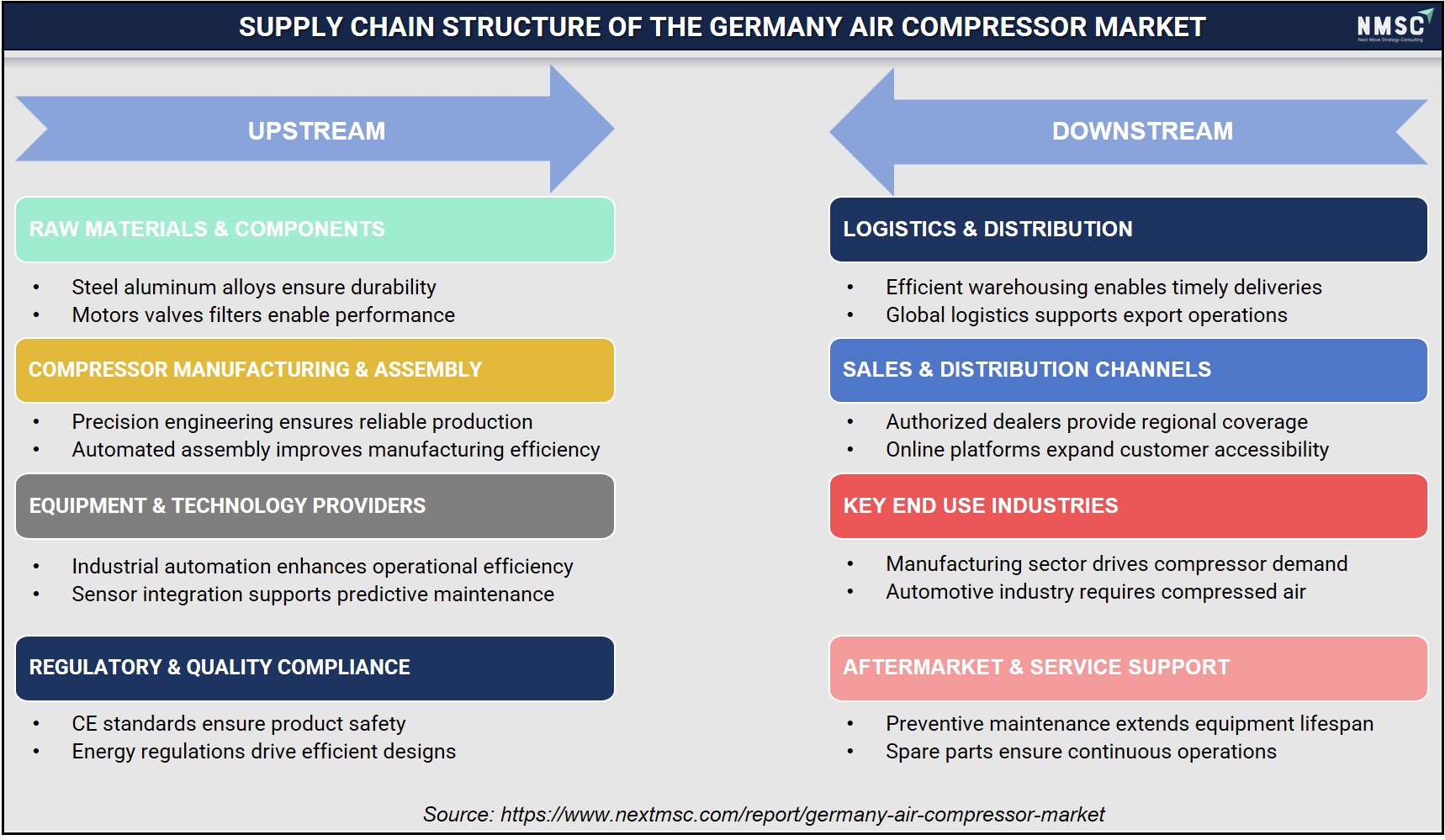
The supply chain structure of the Germany Air Compressor Market spans raw material sourcing, component manufacturing, equipment integration, distribution, and aftermarket services. Our assessment indicates that upstream activities focus on high-quality steel, aluminum alloys, motors, valves, and filtration systems that ensure compressor durability and performance. Precision manufacturing and automation support efficient assembly, while strict regulatory compliance maintains product quality. Downstream operations include logistics, authorized distribution networks, industrial end users, and comprehensive maintenance services that ensure reliable equipment performance, operational continuity, and long-term customer satisfaction.
Growth Drivers and Restraints
Growth Catalyst and Risk Assessment Matrix
|
Factors |
(+/-) % Impact on CAGR |
Impact Timeline |
|
Rising demand for energy-efficient VSD compressors |
+1.6% |
2026-2035 |
|
Industry 4.0 and digital monitoring adoption |
+1.2% |
2026-2035 |
|
Oil-free compression demand in pharma and food |
+1.0% |
2026-2035 |
|
Manufacturing sector capacity expansion |
+0.9% |
2026-2035 |
|
Decarbonization and heat-recovery integration |
+0.7% |
2026-2032 |
|
Renewable energy and hydrogen infrastructure investment |
+0.6% |
2028-2035 |
|
Electricity price volatility |
-0.9% |
2026-2035 |
|
High upfront cost of oil-free and VSD systems |
-0.6% |
2026-2032 |
|
Slower industrial output growth in mature sectors |
-0.5% |
2026-2035 |
What Is the Primary Growth Driver of the Germany Air Compressor Market?
Rising demand for energy-efficient variable-speed compressors is the primary driver of the Germany Air Compressor Market. Germany's Federal Ministry for Economic Affairs and Climate Action continues to promote industrial energy-efficiency programs, sustaining demand for VSD screw and centrifugal platforms. We observed that this policy-reinforced shift continues to anchor baseline replacement demand across manufacturing and energy end users alike.
How Is Industry 4.0 Adoption Driving Market Growth?
Digital monitoring and predictive maintenance integration are accelerating Germany Air Compressor Market growth toward connected compressor platforms within the wider Industrial Pneumatic Systems Market. The German Federal Statistical Office reports continued industrial digitalization investment across manufacturing sectors, supporting demand for IoT-enabled screw and centrifugal units. Our assessment indicates that this digitalization trend, combined with energy-cost transparency requirements, is compressing adoption timelines for smart compressor controls.
What Is Restraining Germany Air Compressor Market Expansion?
Elevated and volatile industrial electricity prices restrain capital investment decisions across the Market supply chain. Germany's Federal Network Agency tracks recurring industrial electricity price fluctuations that delay compressor fleet upgrades among cost-sensitive manufacturers. We found that smaller manufacturing operators face particular exposure, as limited capital reserves reduce their ability to invest in higher-cost oil-free and VSD systems compared with larger industrial groups.
Production Analysis of Air Compressors in Germany
|
Compressor Type |
January |
February |
March |
April |
Total |
|
Oscillating Positive Displacement Compressors |
19158 |
25285 |
31903 |
24292 |
100638 |
|
Rotary Positive Displacement Compressors |
98372 |
95.70 |
114.646 |
97006 |
195588.35 |
Germany's air compressor industry is supported by a strong domestic manufacturing base, with production concentrated in oscillating positive displacement compressors and rotary positive displacement compressors serving manufacturing, automotive, energy, food processing, and other industrial applications. The production data presented above reflects monthly manufacturing output during 2026 and highlights the country's continued emphasis on supplying high-performance compressed-air equipment for both domestic consumption and export markets. Rotary positive displacement compressors account for a substantial share of production, reflecting their widespread adoption across industrial operations due to their high efficiency, reliability, and continuous-duty capabilities. Ongoing investments in advanced manufacturing technologies and energy-efficient compressor systems continue strengthening Germany's position as one of Europe's leading producers of industrial air compressors.
Segmentation Analysis
Which Technology Type Segment Dominates the Germany Air Compressor industry?
|
Segment |
2025 (USD Million) |
2035 (USD Million) |
CAGR% (2026-2035) |
|
Reciprocating (Piston) |
229.5 |
313.8 |
2.1% |
|
Screw |
649.1 |
1,083.2 |
4.2% |
|
Scroll |
53.3 |
105.8 |
6.0% |
|
Centrifugal |
171.0 |
310.1 |
5.1% |
|
Axial |
13.6 |
20.0 |
2.9% |
|
Others |
10.1 |
16.1 |
3.7% |
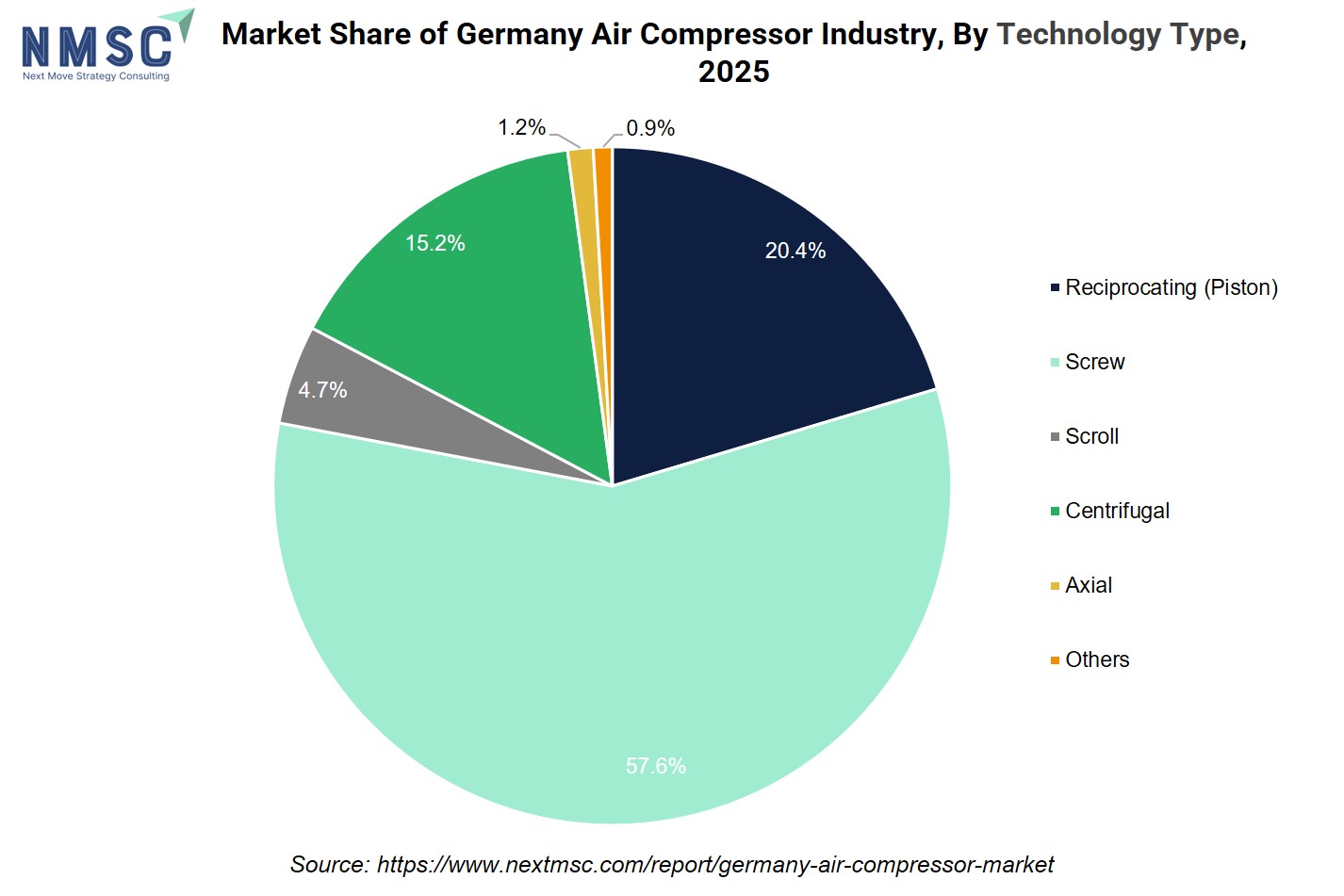
Rotary screw compressors led the Germany Air Compressor Market with USD 649.1 Million in 2025, underscoring the scale of the Germany Rotary Screw Air Compressor Market within the broader compressed air equipment market, supported by their balance of energy efficiency, reliability, and suitability across manufacturing and energy applications. We observed that Scroll compressors are the fastest-growing technology type, expanding at a 6.0% CAGR from 2026 to 2035, as oil-free air compressors gain traction across pharma and food applications requiring contamination-free compressed air.
Which Drive-Power Source Segment Leads the Germany Air Compressor Industry?
|
Segment |
2025 (USD Million) |
2035 (USD Million) |
CAGR% (2026-2035) |
|
Electric-Driven (Oil-Free) |
358.4 |
611.5 |
4.4% |
|
Electric-Driven (Oil-Injected) |
637.3 |
1,033.5 |
3.9% |
|
Engine-Driven (Oil-Free) |
39.3 |
61.7 |
3.6% |
|
Engine-Driven (Oil-Injected) |
91.8 |
142.2 |
3.4% |
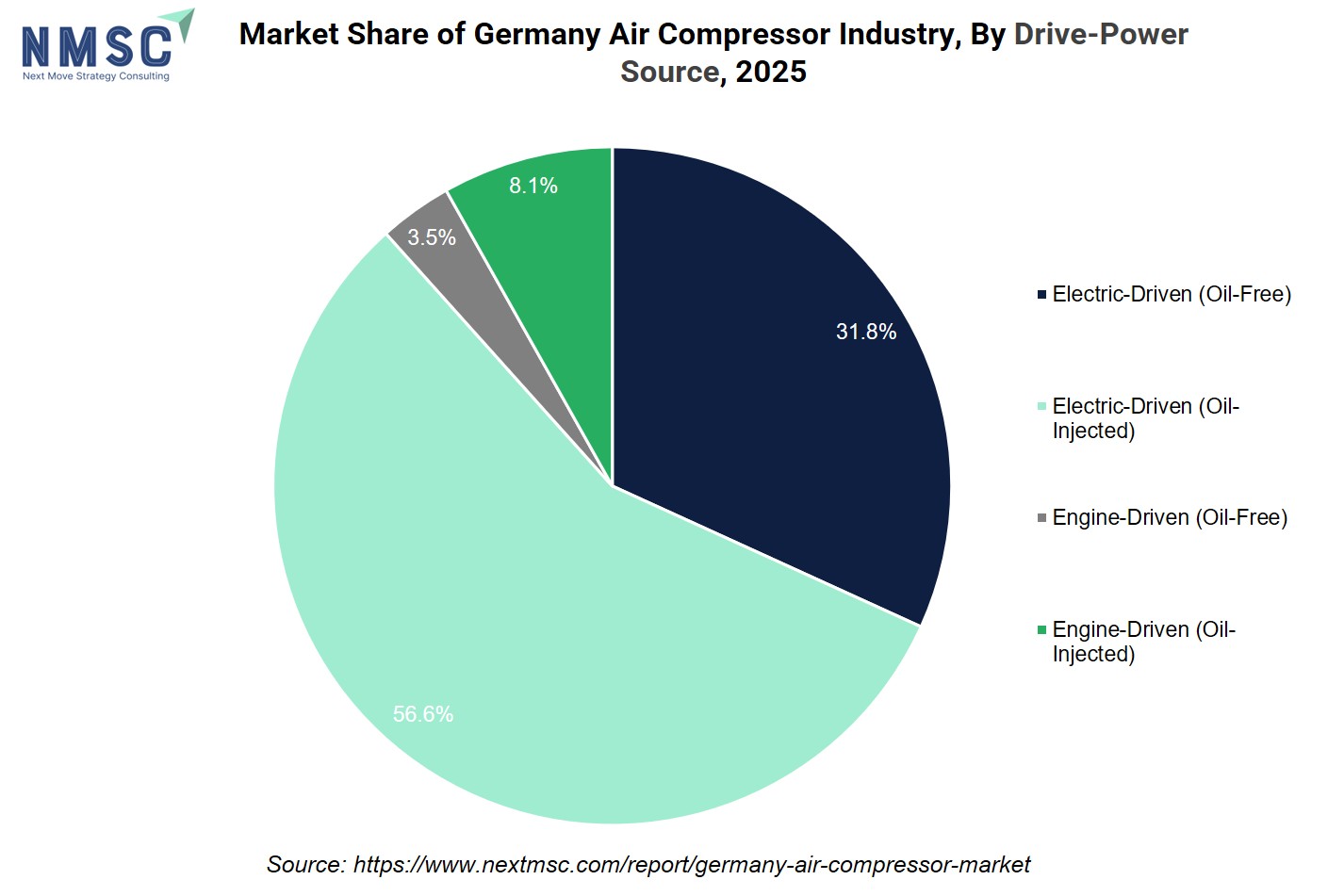
Electric-Driven (Oil-Injected) compressors remained the leading drive-power source within the Germany Air Compressor Market, valued at USD 637.3 Million in 2025 on sustained manufacturing and construction demand. Our findings suggest that Electric-Driven (Oil-Free) is the fastest-growing category, registering a 4.4% CAGR from 2026 to 2035, as pharma, food, and energy end users increasingly specify oil-free electric platforms to meet air-purity and emissions standards.
Which End-Use Industry Segment Leads Germany Air Compressor Market Demand?
|
Segment |
2025 (USD Million) |
2035 (USD Million) |
CAGR% (2026-2035) |
|
Manufacturing |
373.0 |
631.9 |
4.4% |
|
Oil & Gas |
115.5 |
211.5 |
5.2% |
|
Energy & Power |
108.0 |
211.4 |
5.9% |
|
Transportation & Automotive |
188.4 |
296.4 |
3.6% |
|
Pharma & Food |
132.6 |
203.0 |
3.3% |
|
Construction & Mining |
125.1 |
176.2 |
2.4% |
|
Others |
84.2 |
118.3 |
2.4% |
Manufacturing remained the leading end-use industry within the Germany Air Compressor Market, valued at USD 373.0 Million in 2025 on sustained factory automation and production-line compressed-air demand. Based on research conducted by Next Move Strategy Consulting, we found that Energy & Power is the fastest-growing end-use industry, registering a 5.9% CAGR from 2026 to 2035, as renewable energy and grid-infrastructure projects increasingly specify centrifugal and screw compressors for auxiliary process applications.
Growth Opportunities
Our analysis shows that three forward-looking opportunities stand out for stakeholders positioning within the Germany Air Compressor industry over the 2026-2035 forecast period.
How Are Heat-Recovery Systems Creating Opportunities for Energy-Intensive Manufacturers?
Heat-recovery-integrated compressors present a whitespace opportunity for energy-intensive manufacturing plants seeking to offset rising electricity costs. Suppliers that commercialize heat-recovery-ready screw and centrifugal platforms stand to capture recurring retrofit revenue as manufacturers pursue facility-level decarbonization targets, particularly within chemical processing and heavy manufacturing segments seeking measurable energy-cost reductions.
Why Are Oil-Free Systems Emerging as a Growth Opportunity for Pharma and Food Buyers?
Pharmaceutical and food processing facilities represent an underpenetrated opportunity for oil-free scroll and screw compressors engineered to contamination-control standards. Manufacturers that develop validated, ISO 8573-1 Class 0 certified platforms can secure long-term procurement contracts with pharma and food end users, benefiting from recurring replacement-cycle revenue tied to regulatory compliance programs.
How Are Digital Service Contracts Unlocking Opportunities for Compressor OEMs?
Manufacturing buyers seeking predictive maintenance capability create an opportunity for OEMs offering IoT-enabled compressor monitoring bundled with service contracts. Early movers that deploy connected-compressor platforms can differentiate with manufacturing and energy end users pursuing uptime guarantees and lower total cost of ownership across their industrial air systems.
Consumer Behavior Analysis of the Germany Air Compressor Industry
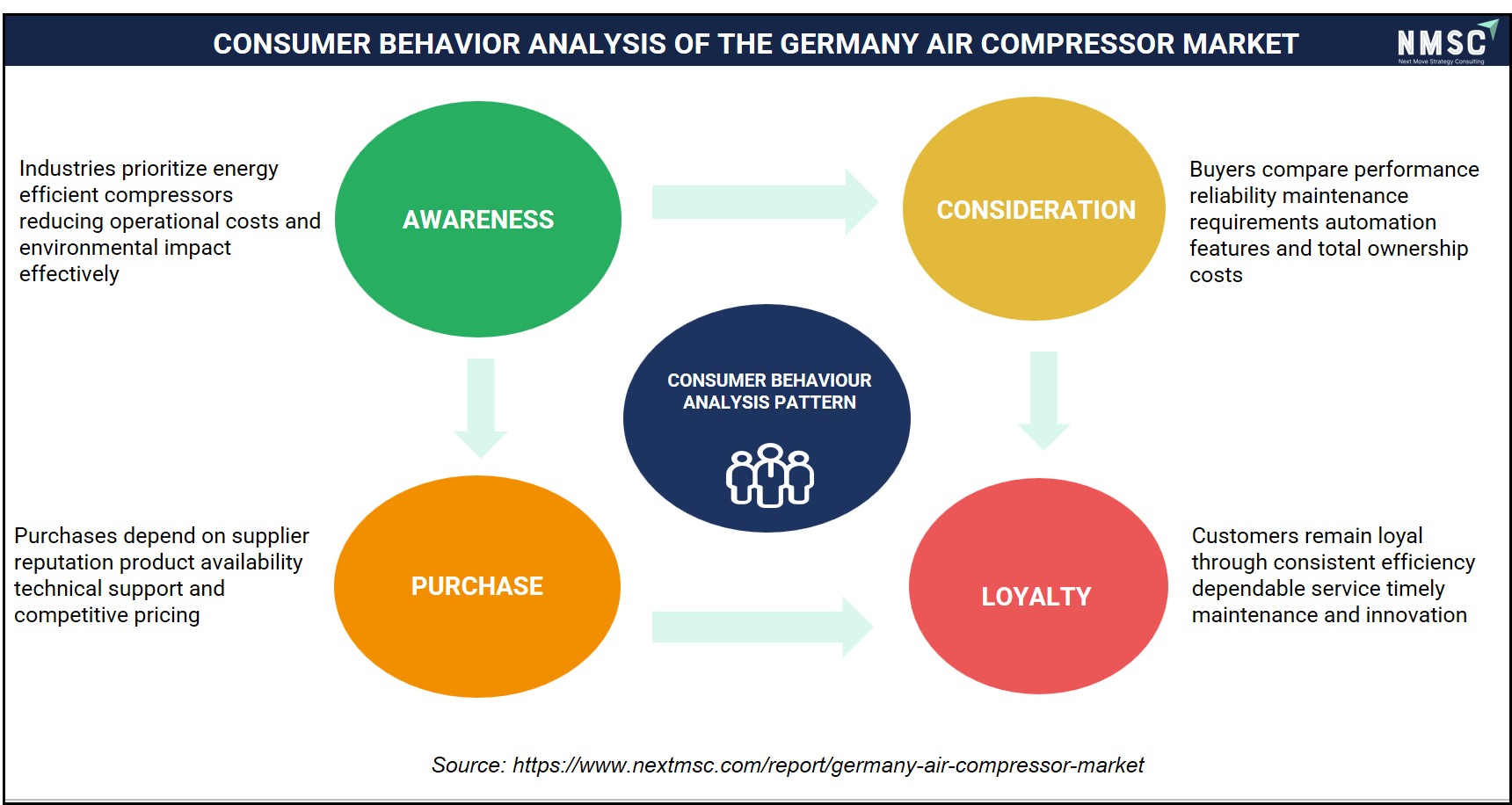
The consumer behavior analysis evaluates purchasing patterns among industrial air compressor buyers in Germany. Our assessment indicates that customers initially prioritize energy efficiency, operational reliability, and environmental performance when identifying suitable compressor solutions. During evaluation, buyers compare lifecycle costs, maintenance requirements, automation capabilities, and system performance before selecting suppliers. Purchasing decisions emphasize reputable manufacturers, technical support, product availability, and competitive pricing. Long-term loyalty is driven by dependable equipment performance, preventive maintenance services, timely spare parts availability, continuous technological innovation, and strong after-sales support that maximize operational efficiency.
Competitive Landscape
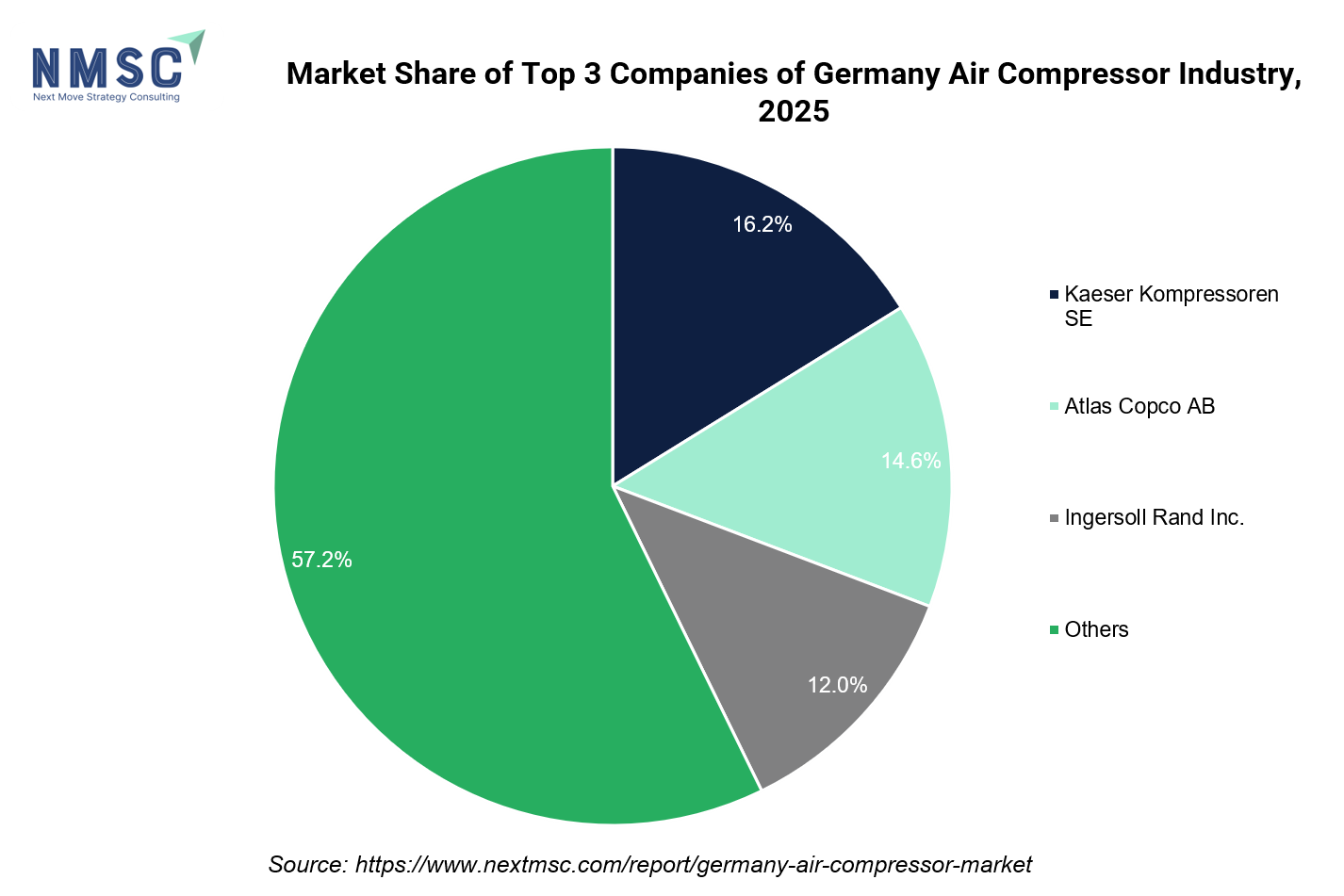
We observed that the Germany Air Compressor Market features a moderately consolidated competitive landscape, with global compressed air systems specialists competing alongside domestic German engineering firms on efficiency, reliability, and service quality.
|
Key Takeaways |
Details |
|
Market Structure |
Moderately consolidated; the top companies profiled in this report collectively account for a majority of Germany Air Compressor Market revenue, while several specialized domestic manufacturers serve niche oil-free and engine-driven segments. |
|
Innovation Focus |
Variable-speed drive integration, oil-free compression technology, and IoT-enabled digital monitoring dominate current innovation pipelines across leading suppliers. |
|
M&A Activity |
Selective consolidation and capacity expansion, exemplified by Ingersoll Rand's continued bolt-on acquisitions of specialty compressed air technology providers to broaden its industrial pneumatic systems portfolio. |
How Do Companies Compete in the Germany Air Compressor Market?
Companies compete primarily on energy efficiency, product reliability, and after-sales service network depth across the Germany Air Compressor Market. Global players such as Atlas Copco and Ingersoll Rand leverage broad technology portfolios spanning screw, centrifugal, and oil-free platforms to serve multinational manufacturing customers, while domestic specialists such as Kaeser Kompressoren and BOGE Kompressoren compete on precision engineering and localized service coverage across Germany's industrial base.
Which Competitive Archetypes Dominate the Germany Air Compressor Market?
Two archetypes dominate the Germany Air Compressor Market: diversified global compressed air systems groups offering full-range technology and digital service support, and specialized domestic manufacturers focused on precision-engineered screw and reciprocating compressors. Kaeser Kompressoren and Atlas Copco exemplify the diversified archetype through integrated hardware-and-software offerings, while BAUER Kompressoren and Mehrer Compression exemplify the specialist archetype serving niche high-pressure and process-gas applications.
How Are Companies Differentiating Through Innovation in Air Compressors?
Innovation and differentiation strategy increasingly center on variable-speed drive integration and oil-free compression validation. Kaeser Kompressoren's SFC VSD platform and Aerzener Maschinenfabrik's oil-free screw blowers both target energy-cost reduction and contamination-free air delivery. Our analysis shows that suppliers unable to demonstrate credible energy-efficiency gains risk exclusion from manufacturing buyer request-for-proposal shortlists across Germany's industrial sector.
What M&A and Expansion Activity Is Shaping the Germany Air Compressor Market?
Mergers, acquisitions, and capacity expansion continue to consolidate compressed air systems capabilities within the Germany Air Compressor Market. Ingersoll Rand's continued acquisition of specialty compression technology providers broadens its industrial pneumatic systems portfolio, while Atlas Copco's ongoing investment in domestic manufacturing capacity illustrates how diversified groups pursue geographic expansion and service-network depth across Germany's manufacturing and energy end markets.
Key Market Players
Our assessment indicates that the following 15 companies represent the validated competitive set actively shaping product innovation, capacity expansion, and service strategy within the Germany Air Compressor Market.
-
Kaeser Kompressoren SE
-
Ingersoll Rand Inc.
-
BOGE KOMPRESSOREN Otto Boge GmbH & Co. KG
-
Aerzener Maschinenfabrik GmbH
-
BAUER KOMPRESSOREN GmbH
-
ALMiG Kompressoren GmbH
-
RENNER GmbH Kompressoren
-
Ing. Enea Mattei S.p.A.
-
J.P. Sauer & Sohn Maschinenbau GmbH
-
ELGi Equipments Limited
-
Gebr. Becker GmbH
-
Mehrer Compression GmbH
-
HERTZ KOMPRESSOREN GmbH
-
Durr Technik GmbH & Co. KG
Latest Developments
We found that recent product launches within the Germany Air Compressor Market are concentrated on energy-efficient and oil-free compressed air systems, reflecting the industry's broader decarbonization transition.
|
Date |
Key Development |
|
March 2026 |
Aerzener Maschinenfabrik announced the premiere of its next-generation, energy-efficient "Delta Hybrid" screw blowers and "Aerzen Turbo" blowers, designed to reduce energy demand by up to 37%. |
|
February 2026 |
The Atlas Copco Group acquired the German filter distributor Zind Verfahrenstechnik GmbH & Co. KG, strengthening its process filtration solutions and presence in the German market |
|
January 2026 |
RENNER strengthened its position in the Germany air compressor market with the launch of the RSF-PRO direct-drive screw compressor series, offering higher energy efficiency and supporting growing industrial demand for cost-effective compressed-air solutions. |
|
February 2025 |
ELGi Equipments unveiled its patented "STABILISOR" technology, which utilizes a "Recirculate and Recover" principle to align compressor capacity with dynamic plant demand, achieving up to 15% in energy savings. |
|
January 2025 |
Atlas Copco strengthened its presence in the Germany air compressor market through the acquisition of Dr. Weigel Anlagenbau GmbH, expanding its compressed-air solutions and service capabilities in the country. |
|
January 2025 |
The FuelEU Maritime Regulation entered into force across the European Union, establishing mandatory greenhouse gas intensity reduction requirements for marine fuels beginning with a 2% reduction target and creating a long-term framework for maritime decarbonization. |
Investment Opportunities
What Capital Inflows Are Targeting the Germany Air Compressor Market?
Capital inflows into the Germany Air Compressor Market are increasingly directed toward VSD and oil-free manufacturing capacity upgrades. Strategic acquirers continue to fund bolt-on acquisitions of specialty compression technology providers, as seen in Ingersoll Rand's ongoing portfolio expansion. We observed that investors favor suppliers demonstrating validated energy-efficiency credentials, viewing this as a proxy for long-term contract retention with manufacturing customers.
How Is Infrastructure Investment Supporting Air Compressor Manufacturing?
Infrastructure investment is expanding production capacity for screw and centrifugal compressor lines across Germany's manufacturing centers to serve rising domestic industrial demand. Our findings suggest that manufacturers are investing in automated assembly and testing facilities to improve quality consistency for energy-efficient product ranges, supporting the precision required for oil-free and VSD compressor formats.
What ESG Considerations Are Shaping Air Compressor Investment Decisions?
Environmental, social, and governance considerations are central to investment decisions across the Germany Air Compressor Market, with energy-efficiency performance and reduced carbon-intensive operation as key criteria. Germany's Federal Ministry for Economic Affairs and Climate Action's industrial decarbonization guidance continues to inform manufacturer sustainability disclosures. We found that investors increasingly favor manufacturers demonstrating measurable energy-cost reduction, treating it as a governance indicator alongside safety and labor compliance.
Key Benefits for Stakeholders
How Does This Report Benefit Enterprise and Industry Leaders?
Enterprise and industry leaders gain access to validated segmentation, competitive benchmarking, and demand forecasts that support sourcing and product-portfolio decisions across the Germany Air Compressor Market. Our analysis shows that detailed technology-type, power-rating, and end-use breakdowns help procurement teams align specifications with energy-efficiency and regulatory requirements while identifying underserved application segments for portfolio expansion.
How Does This Report Benefit Investors and Financial Analysts?
Investors and financial analysts benefit from consistent, single-point market size and CAGR estimates that support valuation and capital-allocation decisions across the Germany Air Compressor Market supply chain. We observed that the report's segment-level growth differentials help identify which manufacturers are best positioned to capture above-market growth in oil-free and VSD compressor categories through 2035.
How Does This Report Benefit Technology Vendors and Product Teams?
Technology vendors and product teams gain insight into emerging design requirements, including variable-speed drive integration, oil-free compression, and IoT-enabled monitoring, that are reshaping the Germany Air Compressor Market. Our findings suggest that this analysis helps R&D teams prioritize development roadmaps around energy-efficiency certification and digital service capability increasingly required by manufacturing buyer procurement processes.
Key Market Segments
By Technology Type
-
Reciprocating (Piston)
-
Screw
-
Scroll
-
Centrifugal
-
Axial
- Others
By Drive-Power Source
-
Electric-Driven (Oil-Free)
-
Reciprocating (Piston)
-
Screw
-
Scroll
-
Centrifugal
-
Axial
-
-
Electric-Driven (Oil-Injected)
-
Reciprocating (Piston)
-
Screw
-
Centrifugal
-
-
Engine-Driven (Oil-Free)
-
Reciprocating (Piston)
-
Screw
-
-
Engine-Driven (Oil-Injected)
-
Reciprocating (Piston)
-
Screw
-
-
Others
By Lubrication Type
-
Oil-Free
-
Reciprocating (Piston)
-
Screw
-
Scroll
-
Centrifugal
-
Axial
-
-
Oil-Injected
-
Reciprocating (Piston)
-
Screw
-
Centrifugal
-
-
Others
By Power Rating
-
0-100 kW
-
Low-Pressure (≤ 4 bar)
-
Screw
-
Others
-
-
Medium-Pressure (4–16 bar)
-
Reciprocating (Piston)
-
Screw
-
Scroll
-
Others
-
-
High-Pressure (> 16 bar)
-
Reciprocating (Piston)
-
Screw
-
Others
-
-
-
101-300 kW
-
Low-Pressure (≤ 4 bar)
-
Screw
-
Others
-
-
Medium-Pressure (4–16 bar)
-
Reciprocating (Piston)
-
Screw
-
Centrifugal
-
Others
-
-
High-Pressure (> 16 bar)
-
Reciprocating (Piston)
-
Screw
-
Others
-
-
-
301-500 kW
-
Low-Pressure (≤ 4 bar)
-
Screw
-
Centrifugal
-
Others
-
-
Medium-Pressure (4–16 bar)
-
Reciprocating (Piston)
-
Screw
-
Centrifugal
-
Others
-
-
High-Pressure (> 16 bar)
-
Reciprocating (Piston)
-
Screw
-
Others
-
-
-
501 kW & Above
-
Low-Pressure (≤ 4 bar)
-
Screw
-
Centrifugal
-
Axial
-
Others
-
-
Medium-Pressure (4–16 bar)
-
Screw
-
Centrifugal
-
Others
-
-
High-Pressure (> 16 bar)
-
Reciprocating (Piston)
-
Others
-
-
By Discharge Pressure
-
Low-Pressure (≤ 4 bar)
-
Screw
-
Centrifugal
-
Axial
-
Others
-
-
Medium-Pressure (4–16 bar)
-
Reciprocating (Piston)
-
Screw
-
Scroll
-
Centrifugal
-
Others
-
-
High-Pressure (> 16 bar)
-
Reciprocating (Piston)
-
Screw
-
Others
-
By Mobility
-
Stationary
-
Reciprocating (Piston)
-
Screw
-
Scroll
-
Centrifugal
-
Axial
-
Others
-
-
Portable
-
Reciprocating (Piston)
-
Screw
-
By Speed Control
-
Fixed-Speed
-
Reciprocating (Piston)
-
Screw
-
Scroll
-
Centrifugal
-
Axial
-
Others
-
-
Variable-Speed (VSD)
-
Reciprocating (Piston)
-
Screw
-
Scroll
-
Centrifugal
-
By End-Use Industry
-
Manufacturing
-
Reciprocating (Piston)
-
Screw
-
Scroll
-
Centrifugal
-
Others
-
-
Oil & Gas
-
Reciprocating (Piston)
-
Screw
-
Scroll
-
Centrifugal
-
Axial
-
Others
-
-
Energy & Power
-
Reciprocating (Piston)
-
Screw
-
Centrifugal
-
Axial
-
Others
-
-
Transportation & Automotive
-
Reciprocating (Piston)
-
Screw
-
Scroll
-
Centrifugal
-
Others
-
-
Pharma & Food
-
Reciprocating (Piston)
-
Screw
-
Scroll
-
Centrifugal
-
Others
-
-
Construction & Mining
-
Reciprocating (Piston)
-
Screw
-
Centrifugal
-
Others
-
-
Others
-
Reciprocating (Piston)
-
Screw
-
Scroll
-
Centrifugal
-
Others
-
Conclusion and Recommendations
What Is the Long-Term Outlook for the Germany Air Compressor Market?
The long-term outlook for the Germany Air Compressor Market remains positive, with revenue projected to grow from USD 1.13 billion in 2025 to USD 1.85 billion by 2035 at a 4.0% CAGR. We observed that sustained energy-efficiency adoption, digitalization, and decarbonization policy will continue underpinning demand across manufacturing, energy, and pharma applications through the forecast period.
What Strategic Positioning Should Air Compressor Suppliers Pursue?
Suppliers should prioritize VSD and oil-free product platforms while pursuing energy-efficiency certification to secure long-term manufacturing customer contracts. Our assessment indicates that manufacturers investing early in digital monitoring capability and heat-recovery integration will be best positioned to capture premium pricing within the Germany Air Compressor Market.
How Attractive Is the Germany Air Compressor Market for New Investment?
The Germany Air Compressor Market presents an attractive investment case, supported by a USD 553.1 million absolute dollar opportunity between 2026 and 2035 and above-average growth in oil-free and variable-speed product categories. We found that investment attractiveness is highest for manufacturers combining energy-efficiency credentials with scaled service networks, positioning them to serve both cost-sensitive and premium industrial segments simultaneously.
What Market Shifts and Key Risks Should Stakeholders Monitor?
Stakeholders should monitor industrial electricity price volatility, high upfront costs of oil-free and VSD systems, and slower industrial output growth in mature manufacturing regions as key risks to the Germany Air Compressor Market. Our analysis shows that suppliers unable to demonstrate measurable energy-efficiency gains risk losing share to competitors with certified low-energy platforms, particularly within Germany's increasingly regulated industrial environment.
What Are the Key Growth Pathways for the Germany Air Compressor Market?
Key growth pathways include expanding oil-free and VSD product portfolios, scaling heat-recovery integration capability, and deepening penetration into pharma and energy end-use channels. Next Move Strategy Consulting's analysis indicates that suppliers pursuing these pathways while maintaining cost competitiveness in standard compressor categories will be best positioned to capture the Germany Air Compressor Market's projected growth through 2035.


About the Author
 Saista Faiyaz
— Saista Faiyaz is Research Associate at Next Move Strategy Consulting, where she has covered consumer markets and healthcare technologies for 3 years. Her work includes primary interview review, secondary-source validation, market sizing, and structured analysis of company and industry data. She supports research by comparing evidence across sources, organizing findings into market narratives, and documenting assumptions used in analysis. Her scope includes cross-market benchmarking, and reports.
Saista Faiyaz
— Saista Faiyaz is Research Associate at Next Move Strategy Consulting, where she has covered consumer markets and healthcare technologies for 3 years. Her work includes primary interview review, secondary-source validation, market sizing, and structured analysis of company and industry data. She supports research by comparing evidence across sources, organizing findings into market narratives, and documenting assumptions used in analysis. Her scope includes cross-market benchmarking, and reports.
About the Reviewer
 Supradip Baul
— Supradip Baul is an accomplished business consultant and strategist with over a decade of rich experience in market intelligence, strategy, technology, and business transformation. His work has included rigorous qualitative and quantitative analysis across multiple industries, helping clients shape investment decisions and long-term roadmaps. Earlier in his career, he was associated with Gartner, where he contributed to industry-leading reports and market share analyses. He has worked with leading global companies and holds an MBA with a dual specialization in Marketing and Finance.
Supradip Baul
— Supradip Baul is an accomplished business consultant and strategist with over a decade of rich experience in market intelligence, strategy, technology, and business transformation. His work has included rigorous qualitative and quantitative analysis across multiple industries, helping clients shape investment decisions and long-term roadmaps. Earlier in his career, he was associated with Gartner, where he contributed to industry-leading reports and market share analyses. He has worked with leading global companies and holds an MBA with a dual specialization in Marketing and Finance.
At Next Move Strategy Consulting, we understand that insightful market research is the cornerstone of successful business decisions. That's why we employ a robust and multifaceted approach, combining various methodologies to deliver the most accurate and actionable data for our clients.

Research Landscape
We navigate the world of research with two primary approaches:
Qualitative Approach
Our qualitative research methodologies involve immersive techniques such as in-depth interviews, focus groups, and observational studies. By engaging directly with individuals and stakeholders, we uncover valuable insights that quantitative data alone may overlook.

Quantitative Research
In tandem with qualitative methodologies, NMSC leverages the power of Quantitative Research to provide a robust foundation of numerical insights. Through systematic data collection and analysis, we quantify patterns, preferences, and market trends, offering a comprehensive view of the business landscape.
Our quantitative research approach employs diverse tools, including surveys, experiments, and statistical modelling. These methodologies enable us to gather data from a large and representative sample, ensuring the statistical significance of our findings. By employing structured questionnaires and standardized data collection methods, we guarantee the reliability and validity of the information we present to our clients.
Quantitative research is particularly effective in measuring the prevalence of trends, assessing market size, and gauging the impact of various factors on consumer behavior. The numerical precision attained through this approach equips our clients with actionable insights, facilitating data-driven decision-making and strategy formulation.


Our Specialized Toolbox for Industry-Specific Market Research
We deploy a specialized arsenal of techniques tailored to meet your unique requirements. Here's a glimpse into our comprehensive toolbox:

Information Procurement
The stage entails acquiring market data or relevant information through various sources and methodologies.


Market Research Approach
We utilize both top-down and bottom-up approaches in market research analysis to achieve a comprehensive understanding of the market dynamics, leveraging the broad perspective of industry trends and macroeconomic factors alongside detailed insights from specific segments and individual companies.

Porters Five Forces Analysis
We conduct Porter's Five Forces analysis to evaluate the competitive landscape of an industry, providing us with insights into factors that affect profitability and strategic positioning.

SWOT Analysis

Forecasting
We utilize a forecasting model to predict future consumption by considering parameters like population, economics, regulations, market competition, drivers, constraints, technology, and pricing. We also employ statistical techniques such as multilinear regression, exponential smoothing, moving average, ARIMA, and Monte Carlo simulations for accurate predictions. In econometric forecasting, we analyzed short-term and long-term event impacts, attributing values based on regulatory frameworks, economic factors, and market events.





 Speak to Our Analyst