India ATV and UTV Market Size, Share, Trends and Growth Analysis, By Vehicle Type (All-Terrain Vehicles and Utility Task Vehicles / Side-by-Sides), By Propulsion Type, By Power Output, By Drivetrain, By Autonomy Level, By Primary Application, By End-User Segment (Individual Consumers, Commercial Enterprises, and Others), By Price Tier (Economy (USD 20K), — Industry Report and Forecast, 2026–2035
Industry: Automotive & Transportation | Latest Edition: September 30, 2026 | No of Pages: 160 | No. of Tables: 52 | No. of Figures: 44 | Format: PDF | Report Code: AT786
What Is the India ATV and UTV Market Size?
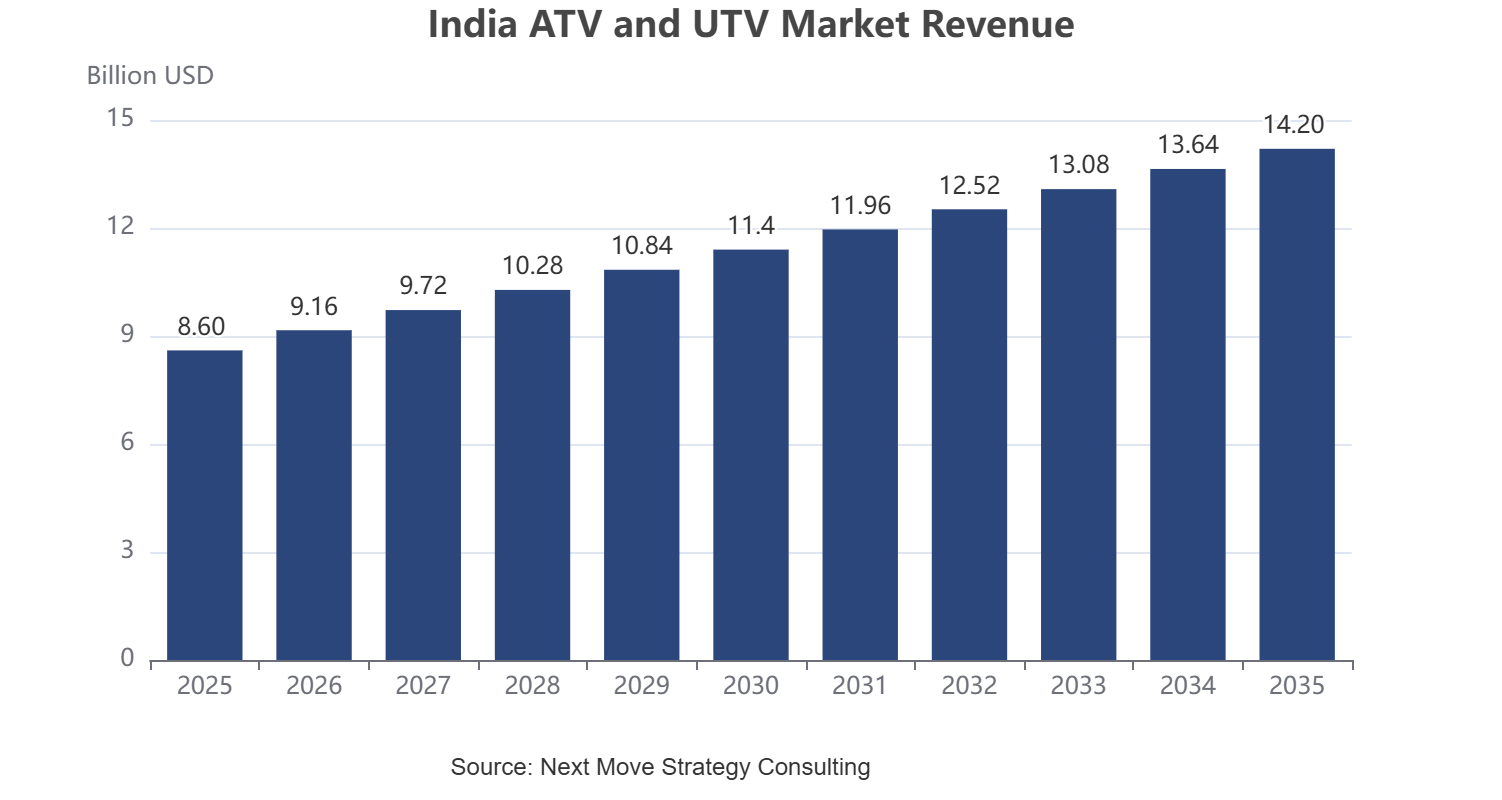
The India ATV and UTV market size was valued at USD 8.60 Billion in 2025 and is estimated at USD 9.05 Billion in 2026, forecast to reach USD 14.20 Billion by 2035, expanding at a 5.1% CAGR between 2026 and 2035. Utility Task Vehicles dominate all other vehicle types with approximately 62% share. We observed that growth is broadening across premium price tiers and government-linked applications, with defense procurement and rental fleet expansion driving the fastest structural gains through 2035.
|
Key Takeaways |
|
By Vehicle Type: Utility Task Vehicles / Side-by-Sides held the largest share of approximately 62% (USD 5.33 Billion) in 2025; Utility Task Vehicles / Side-by-Sides is also the fastest-growing sub-segment at 5.9% CAGR from 2026–2035. |
|
By Propulsion Type: Internal-Combustion Engine held the largest share of approximately 82% (USD 7.05 Billion) in 2025; Electrified is the fastest-growing sub-segment at approximately 14.5% CAGR from 2026–2035. |
|
By Power Output: Medium Power Output held the largest share of approximately 46% (USD 3.96 Billion) in 2025; High Power Output is the fastest-growing sub-segment at approximately 7.8% CAGR from 2026–2035. |
|
By Drivetrain: 4-Wheel Drive held the largest share of approximately 71% (USD 6.11 Billion) in 2025; 2-Wheel Drive is the fastest-growing sub-segment at approximately 6.5% CAGR from 2026–2035. |
|
By Autonomy Level: Conventional held the largest share of approximately 94% (USD 8.08 Billion) in 2025; Semi-Autonomous is the fastest-growing sub-segment at approximately 22.0% CAGR from 2026–2035. |
|
By Primary Application: Recreation & Tourism held the largest share of approximately 34% (USD 2.92 Billion) in 2025; Government, Law-Enforcement & Defense is the fastest-growing sub-segment at 7.6% CAGR from 2026–2035. |
|
By End-User Segment: Individual Consumers held the largest share of approximately 52% (USD 4.47 Billion) in 2025; Rental Fleets & Tour Operators is the fastest-growing sub-segment at approximately 9.2% CAGR from 2026–2035. |
|
By Price Tier: Mid-Range held the largest share of approximately 48% (USD 4.13 Billion) in 2025; Premium is the fastest-growing sub-segment at 8.1% CAGR from 2026–2035. |
Market Opportunity: The India ATV and UTV market is expected to create an absolute dollar opportunity of USD 5.15 Billion between 2026 and 2035, presenting significant investment potential across Utility Task Vehicle production capacity, electrified propulsion development, and government and defense procurement channels.
According to Next Move Strategy Consulting analysis, domestic manufacturers are increasingly positioning mid-range Utility Task Vehicles for agricultural and rental fleet use alongside recreational demand, a shift that favors diversified product portfolios over single-application vehicle lines as commercial procurement standards mature through 2035.
What Does the India ATV and UTV Market Encompass?
The India ATV and UTV market encompasses all-terrain vehicles and utility task vehicles, also known as side-by-sides, used across recreation, agriculture, construction, government, and turf-management applications. Our assessment indicates that the scope spans internal-combustion and electrified propulsion systems, low to high power output classes, two-wheel and four-wheel drivetrains, and conventional through semi-autonomous control systems. The category has evolved from predominantly recreational off-road vehicles into multi-purpose utility platforms increasingly deployed for agricultural fieldwork, industrial site operations, and government and law-enforcement applications across varied terrain.
Regulatory frameworks such as the Central Motor Vehicles Rules governing off-road vehicle homologation and state-level agricultural equipment subsidy programs shape adoption and pricing standards across the industry. We observed that technology adoption is shifting toward electrified propulsion and semi-autonomous safety features for commercial and government fleets. Next Move Strategy Consulting's analysis indicates that this structural shift, combined with rising interest in electric ATV and UTV platforms, is redefining propulsion and application standards across the India ATV and UTV market.
|
Parameter |
Details |
|
Market Size in 2025 |
USD 8.60 Billion |
|
Market Size in 2026 |
USD 9.05 Billion |
|
Revenue Forecast in 2035 |
USD 14.20 Billion |
|
Growth Rate |
CAGR of 5.1% from 2026 to 2035 |
|
Analysis Period |
2025–2035 |
|
Base Year Considered |
2025 |
|
Forecast Period |
2026–2035 |
|
Market Size Estimation |
Revenue (USD Billion) |
|
Companies Profiled |
12 |
|
Market Share |
Available for Top 10 Companies |
Key Emerging Trends
Based on research conducted by Next Move Strategy Consulting, we found that four structural trends are reshaping product development, sourcing, and stakeholder engagement across the industry.
How Is Electrified Propulsion Transforming Vehicle Design?
Battery-electric propulsion systems are emerging as manufacturers respond to rising demand for lower-emission off-road vehicles across recreational and commercial applications. We observed that Polaris Inc.'s expanded electric side-by-side lineup, broadened in 2025, targets both recreational and utility buyers seeking quieter, emission-free operation. Manufacturers are retooling production lines to accommodate battery-pack integration, while dealers redesign showroom offerings around electrified model tiers.
Why Is Utility Task Vehicle Adoption Gaining Ground Over Traditional ATVs?
Utility task vehicles are gaining share as buyers increasingly prioritize side-by-side seating, cargo capacity, and multi-passenger configurations over single-rider ATV formats. Our findings suggest that CFMOTO's expanded utility task vehicle range, scaled through 2025, increasingly targets agricultural and light-industrial buyers seeking versatile field vehicles. Manufacturers such as Kawasaki are expanding utility-focused product lines, positioning the format as the higher-growth category within the broader vehicle-type segmentation.
How Is Domestic Manufacturing Capacity Reshaping Supply Chain Strategy?
Rising domestic manufacturing investment is pushing Indian producers toward localized component sourcing that reduces dependency on imported drivetrain and chassis parts. We observed that Powerland Agro Tractor Vehicles' expanded domestic production capacity, updated in 2025, increasingly targets agricultural and turf-management buyers within India. This trend is elevating demand for locally manufactured mid-range vehicles among cost-conscious commercial buyers, while import-focused dealers adapt distribution strategies.
What Role Does Government and Defense Procurement Play in Market Expansion?
Rising government, law-enforcement, and defense procurement of rugged utility vehicles is emerging as a differentiator amid expanding border-patrol and disaster-response fleet modernization programs. Our analysis shows that manufacturers are positioning electric ATV and UTV platforms for silent-operation government applications requiring low acoustic signatures. Nebula Automotive's expanded government-fleet product line, introduced in 2025, exemplifies this direction with ruggedized specifications tailored for institutional procurement.
Consumer Behavior Analysis of the India ATV and UTV Market
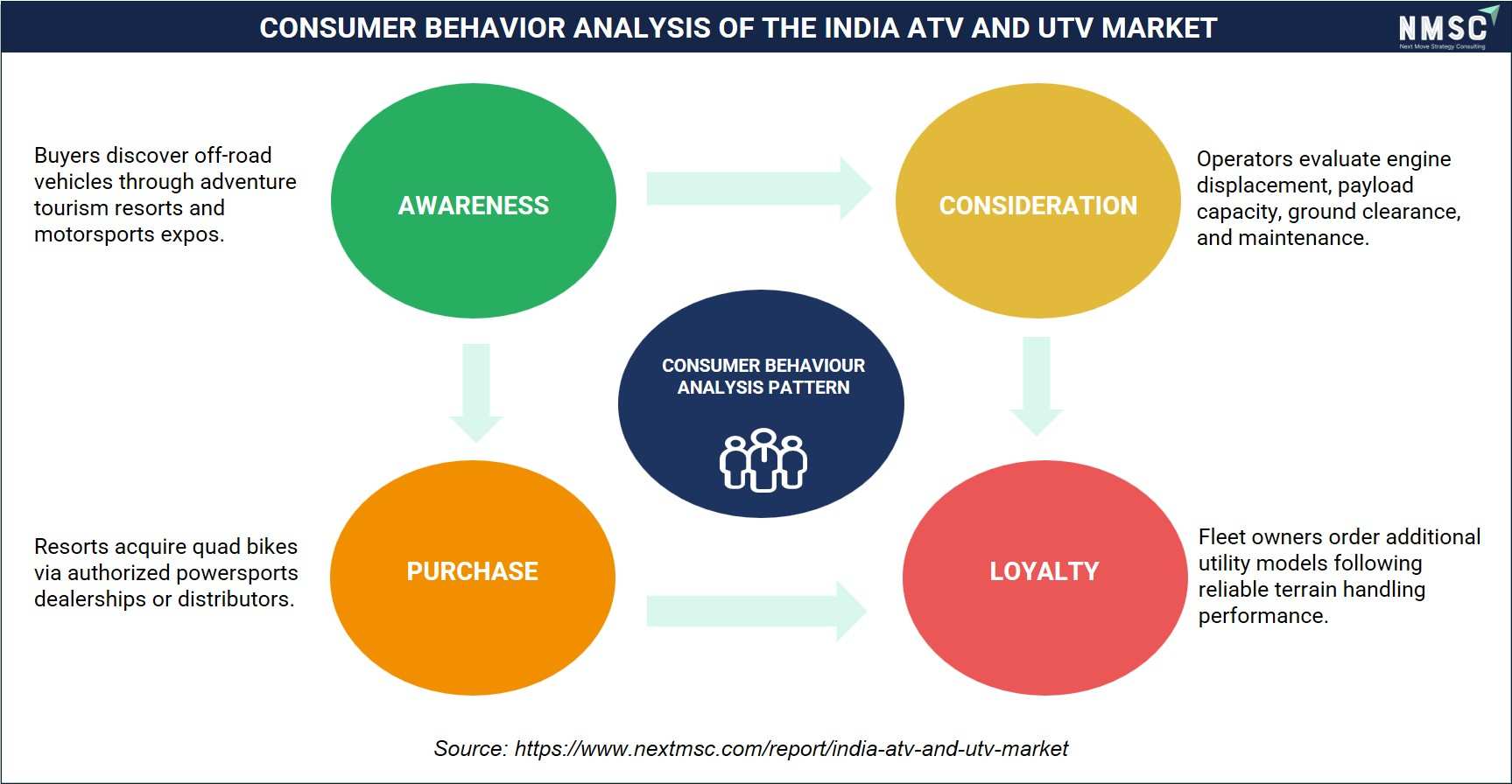
In our observation, the consumer buying journey in the India ATV and UTV Market begins as prospective buyers discover off-road vehicles through adventure tourism resorts and motorsports expos. Consequently, operators evaluate engine displacement, payload capacity, ground clearance, and maintenance during consideration. Quad bikes are purchased via authorized dealerships or distributors, while long-term fleet loyalty is driven by reliable terrain handling performance in demanding operations.
Growth Drivers & Restraints
Growth Catalyst & Risk Assessment Matrix
|
Factors |
Type |
(+/-) % Impact on CAGR |
Geographic Relevance |
Impact Timeline |
|
Rising agricultural mechanization adoption |
Driver |
+1.3% |
India |
2026–2035 |
|
Growth in recreational off-road tourism demand |
Driver |
+1.1% |
India |
2026–2033 |
|
Expanding government and defense fleet modernization |
Driver |
+0.9% |
India |
2027–2035 |
|
Rising domestic manufacturing capacity investment |
Driver |
+0.7% |
India |
2026–2032 |
|
Growth of electrified propulsion adoption |
Driver |
+0.5% |
India |
2026–2031 |
|
High import duties on completed vehicle units |
Restraint |
-0.6% |
India |
2026–2030 |
|
Limited dedicated off-road recreational infrastructure |
Restraint |
-0.4% |
India |
2026–2029 |
|
Regulatory uncertainty in off-road vehicle homologation |
Restraint |
-0.3% |
India |
2026–2028 |
What Is the Primary Growth Driver of the India ATV and UTV Market?
Rising agricultural mechanization adoption represents the primary growth driver, as utility task vehicles increasingly replace traditional manual and animal-drawn implements for field transport and light farming tasks. Data from India's Ministry of Agriculture and Farmers Welfare indicates sustained growth in mechanization-linked equipment adoption across rural districts through 2025. This expanding adoption is prompting manufacturers to scale mid-range utility vehicle production to meet rising farmer demand.
How Is Recreational Off-Road Tourism Driving the Market Growth?
Growing recreational off-road tourism demand is driving market growth, as adventure-tourism operators and individual buyers seek all-terrain vehicles for desert, hill, and forest-trail experiences. Ministry of Tourism data confirms sustained growth in adventure-tourism visitor volumes across key Indian destinations through 2025. Manufacturers are responding by expanding recreational-grade ATV production to meet rising rental fleet and individual consumer demand.
What Is Restraining the India ATV and UTV Market Growth?
High import duties on completed vehicle units restrain market growth by elevating retail prices for imported premium ATV and UTV models relative to domestically produced alternatives. Ministry of Commerce and Industry trade-tariff data confirms sustained import-duty structures on completed off-road vehicle units through 2025. These conditions are prompting international manufacturers to explore local assembly partnerships to reduce landed-cost pressure on premium product tiers.
Segmentation Analysis
Segment Sizing: By Vehicle Type
|
Segment |
2025 (USD Billion) |
2035 (USD Billion) |
CAGR% (2026–2035) |
|
Utility Task Vehicles / Side-by-Sides |
5.33 |
8.95 |
5.9% |
|
All-Terrain Vehicles |
3.27 |
5.25 |
5.4% |
|
Total |
8.60 |
14.20 |
5.1% |
Which Vehicle Type Dominates the India ATV and UTV Market?
Vehicle type segmentation divides the market into utility task vehicles, also known as side-by-sides, and all-terrain vehicles. Utility task vehicles hold the dominant position, supported by multi-passenger seating and cargo capacity that suit agricultural, construction, and commercial applications beyond recreational use alone. Utility task vehicles are also the fastest-growing category, driven by rising commercial and government fleet adoption that favors side-by-side configurations over single-rider ATV formats.
Segment Sizing: By Primary Application
|
Segment |
2025 (USD Billion) |
2035 (USD Billion) |
CAGR% (2026–2035) |
|
Recreation & Tourism |
2.92 |
4.69 |
5.4% |
|
Agriculture & Forestry |
2.06 |
3.41 |
5.7% |
|
Construction & Industrial |
1.72 |
2.98 |
6.3% |
|
Government, Law-Enforcement & Defense |
1.03 |
1.99 |
7.6% |
|
Turf & Grounds Management |
0.86 |
1.14 |
3.1% |
|
Total |
8.60 |
14.20 |
5.1% |
Which Primary Application Leads India ATV and UTV Demand?
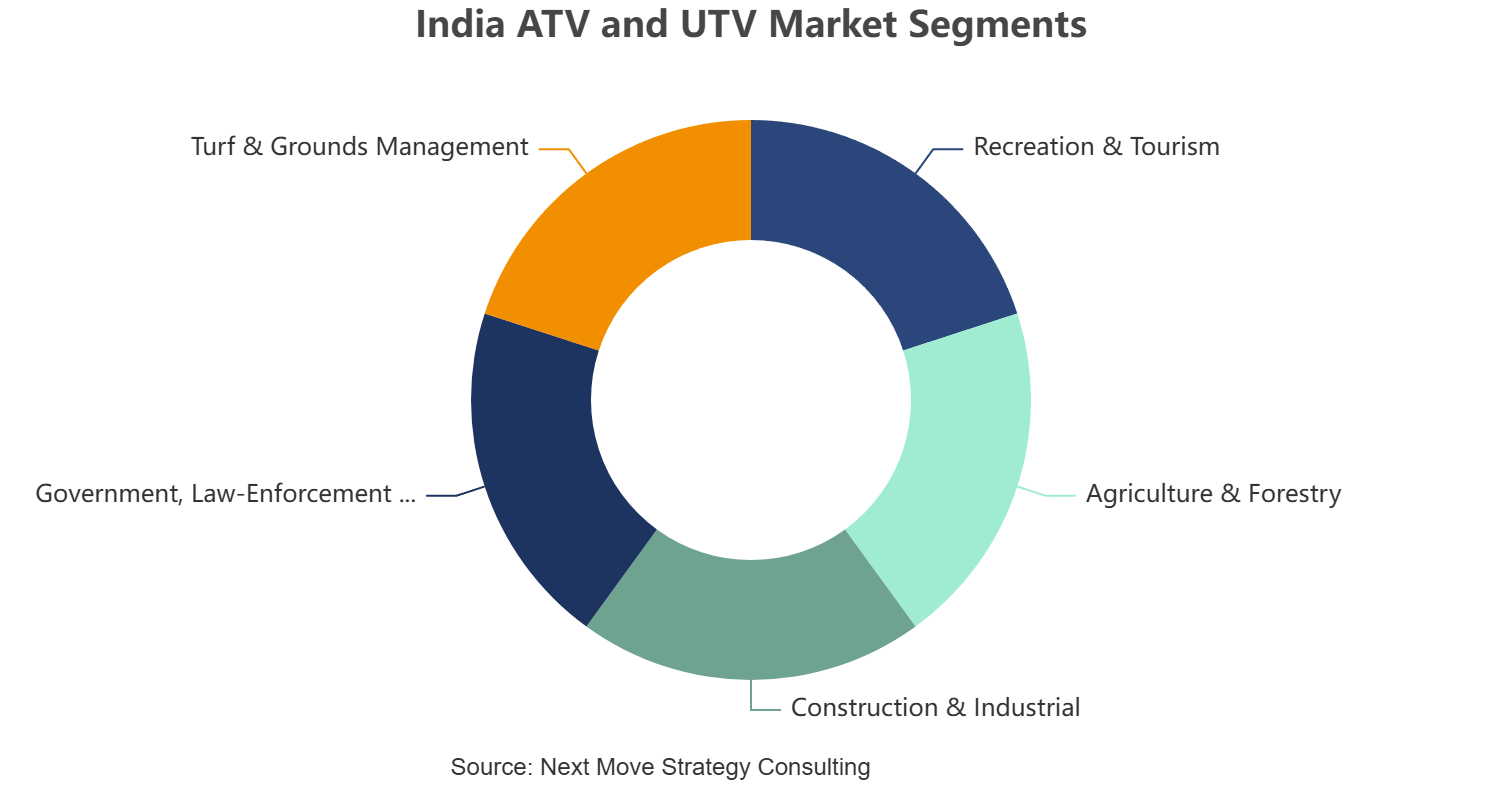
Primary application segmentation spans recreation and tourism, agriculture and forestry, construction and industrial, government, law-enforcement and defense, and turf and grounds management. Recreation and tourism dominates the segment, reflecting sustained individual consumer and rental fleet demand for off-road adventure experiences. Government, law-enforcement and defense is the fastest-growing application, driven by expanding border-patrol and disaster-response fleet modernization programs across state and central procurement channels.
Segment Sizing: By Price Tier
|
Segment |
2025 (USD Billion) |
2035 (USD Billion) |
CAGR% (2026–2035) |
|
Mid-Range ($10K–$20K) |
4.13 |
6.67 |
5.5% |
|
Economy (<$10K) |
2.92 |
4.40 |
4.6% |
|
Premium (>$20K) |
1.55 |
3.12 |
8.1% |
|
Total |
8.60 |
14.20 |
5.1% |
Which Price Tier Leads the India ATV and UTV Market?
Price tier segmentation covers economy, mid-range, and premium vehicles. Mid-range vehicles dominate the segment, reflecting balanced affordability and feature sets that suit both individual consumers and commercial buyers. Premium vehicles represent the fastest-growing price tier, supported by rising demand for high-power, four-wheel-drive utility task vehicles among affluent recreational buyers and commercial fleets seeking advanced feature sets.
Growth Opportunities
Beyond current demand drivers, three forward-looking whitespace opportunities are positioned to reshape competitive positioning through 2035.
How Can Manufacturers Capture Government Fleet Modernization Demand?
Manufacturers can capture rising government and defense procurement by developing ruggedized, low-acoustic-signature utility vehicles suited for border-patrol and disaster-response applications. Government, law-enforcement and defense application participants stand to benefit most, as institutional contracts offer multi-year volume commitments that reduce dependency on cyclical recreational retail demand.
What Opportunity Exists in Electrified Agricultural Utility Vehicles?
Expanding electrified utility task vehicles tailored for agricultural fieldwork presents a scalable growth mechanism as farmers seek lower operating costs than fuel-powered alternatives. Domestic manufacturers with established agricultural distribution networks benefit directly, converting rising mechanization demand into recurring electrified-vehicle replacement cycles.
How Can Rental Fleet Expansion Unlock Tourism-Linked Demand?
Expanding rental fleet partnerships with adventure-tourism operators creates a durable opportunity to capture recreational demand without requiring individual consumer ownership. Rental fleet and tour operator participants benefit most, as tourism-linked rental agreements generate recurring utilization revenue exceeding typical individual-consumer purchase cycles.
Supply Chain Structure of the India ATV and UTV Market
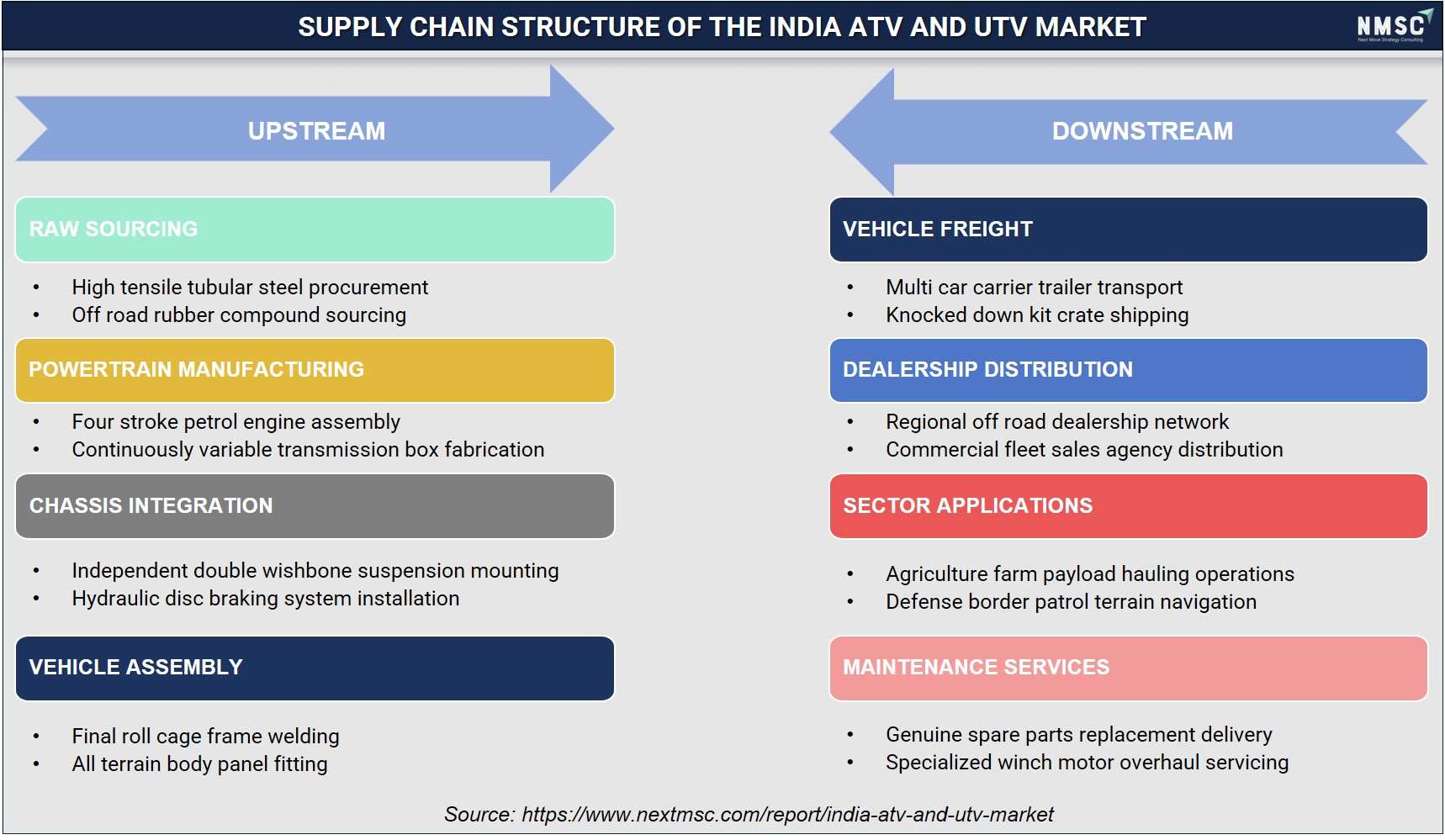
Based on research conducted by NMSC, we found that the supply chain structure of the India ATV and UTV Market links tubular steel procurement, engine assembly, suspension mounting, and final roll cage welding with multi-car carrier transport. Downstream, local dealership networks distribute vehicles for agricultural hauling and defense border patrol. Ultimately, genuine spare parts replacement delivery and specialized winch motor overhaul servicing sustain post-sale operational reliability.
Competitive Landscape
We observed that the competitive landscape is moderately fragmented, with global powersports manufacturers and domestic Indian producers together accounting for the largest share of vehicle supply.
|
Dimension |
Assessment |
|
Market Structure |
Moderately fragmented, led by global powersports manufacturers and domestic Indian producers. |
|
Innovation Focus |
Electrified propulsion, semi-autonomous safety features, and ruggedized government-fleet specifications. |
|
M&A Activity |
Selective distribution partnerships between international manufacturers and domestic dealers. |
How Do Companies Compete in the India ATV and UTV Market?
Companies compete primarily on vehicle durability, application versatility, and after-sales service network reach rather than on price alone. Domestic manufacturing capability and agricultural distribution reach are key differentiators for Indian producers, while global manufacturers compete on brand recognition and premium feature sets. Industry participants are increasingly investing in localized service infrastructure to strengthen customer retention across rural and semi-urban markets.
Which Competitive Archetypes Dominate the India ATV and UTV Market?
Two archetypes dominate the industry: global powersports manufacturers offering premium recreational and utility vehicle lines, and domestic Indian producers focused on cost-competitive agricultural and commercial utility vehicles. The global archetype benefits from established brand recognition and premium feature differentiation, while domestic producers differentiate through localized pricing and agricultural distribution reach. This dual structure explains why market share remains distributed across both international brands and domestic manufacturers.
What Innovation and Differentiation Strategies Are Companies Pursuing?
Companies are pursuing electrified propulsion development, semi-autonomous safety features, and ruggedized government-fleet specifications as core differentiation strategies. Polaris Inc.'s expanded electric side-by-side lineup, scaled through 2025, illustrates a strategy of positioning early for rising demand across recreational and commercial buyers seeking lower-emission alternatives. Manufacturers across the industry are prioritizing localized service networks to strengthen customer confidence in rural and semi-urban markets.
What M&A Activity Is Shaping the Competitive Landscape?
M&A activity centers on selective distribution partnerships between international manufacturers and domestic dealers seeking to expand retail and service reach across India. Kawasaki Heavy Industries' continued dealer-network expansion through recent distribution partnerships reflects this collaborative pattern. Market distribution expansion and localized service-network broadening remain the primary competitive levers across the current partnership cycle, ahead of traditional acquisition-based consolidation.
Key Market Players
We found that the competitive set below reflects the validated group of companies most active in shaping the India ATV and UTV market supply as of 2026.
-
Kawasaki Heavy Industries, Ltd.
-
Powerland Agro Tractor Vehicles Private Limited
-
A-THON
-
Nebula Automotive Private Limited
-
Farmland Industries India Private Limited
-
Vintage Vision Private Limited
-
HUSE Mobility
-
ATV Bike India
-
The ATV Outlet
-
Powersport India
Latest Developments
Our analysis shows that recent company activity reflects continued product-line expansion and distribution-network development across the manufacturer base.
|
Date |
Event |
|
June 2026 |
India Kawasaki Motors launched the TERYX4 H2 in India, introducing the world's first supercharged four-seat side-by-side vehicle to the Indian market. The launch expands Kawasaki's premium UTV portfolio with a high-performance recreational and utility model specifically commercialized for Indian customers. |
|
June 2026 |
India Kawasaki Motors introduced the RIDGE CREW side-by-side vehicle in India. Designed for up to six occupants, it combines high-performance engineering with utility capability for agriculture, industrial operations, resorts and recreational applications, marking Kawasaki's expansion of India's side-by-side vehicle portfolio. |
|
June 2026 |
India Kawasaki Motors launched the MULE PRO-FXT 1000 LE in India. Featuring a convertible three-to-six-passenger Trans Cab configuration, the utility vehicle targets agriculture, industrial users, resorts and commercial operations requiring versatile off-road transportation solutions. |
|
June 2026 |
India Kawasaki Motors introduced the TERYX KRX 1000 in India as part of its expanded side-by-side lineup. The vehicle is engineered for extreme off-road capability and strengthens Kawasaki's presence in India's premium recreational utility vehicle segment through an official domestic product introduction. |
Investment Opportunities
What Capital Inflows Are Shaping the India ATV and UTV Market?
Capital inflows are concentrating on domestic manufacturing-capacity expansion and electrified propulsion development. Strategic investors and domestic manufacturers are directing sustained capital toward localized production facilities and battery-integration capability. This inflow pattern is enabling producers to accelerate capacity pipelines while diversifying revenue between agricultural, recreational, and government-fleet income streams through 2035.
How Is Infrastructure Investment Supporting Market Expansion?
Infrastructure investment in rural road connectivity and off-road recreational tourism facilities is directly supporting India ATV and UTV market expansion. Government-backed rural infrastructure programs are expanding accessibility for agricultural utility vehicle deployment across previously underserved districts. This infrastructure buildout is reinforcing demand for durable, all-terrain-capable vehicles across newly connected rural and semi-urban markets.
What ESG Considerations Are Influencing Investment Decisions?
Environmental, Social, and Governance considerations are increasingly shaping investment decisions, with investors favoring manufacturers demonstrating verified emissions-reduction commitments through electrified product lines. Third-party emissions certification and battery-recycling program commitments are gaining preference among institutional investors evaluating long-term vehicle-manufacturing assets. This ESG-linked capital allocation is reinforcing demand for electrified propulsion across commercial and government fleet procurement.
Key Benefits for Stakeholders
How Does This Report Benefit Industry Leaders?
Industry leaders gain a validated view of segment-level revenue distribution, competitive positioning, and market growth trajectories that inform manufacturing and distribution investment decisions. The report's segmentation and market analysis clarify where demand is concentrating, enabling manufacturing executives to prioritize capital allocation toward the highest-growth vehicle types and applications through 2035.
How Does This Report Benefit Investors and Financial Analysts?
Investors and financial analysts gain access to consistent market-sizing figures, CAGR forecasts, and competitive-landscape assessment that support valuation and portfolio-allocation decisions across vehicle-manufacturing assets. The report's segment-level breakdowns provide a defensible basis for evaluating growth-adjusted investment opportunities across the India ATV and UTV value chain through the 2026–2035 forecast period.
How Does This Report Benefit Technology and Product Vendors?
Technology and product vendors supplying battery systems, drivetrain components, and safety technology gain insight into which vehicle types and applications are expanding fastest. This analysis helps vendors prioritize product roadmaps toward the highest-growth integration points, including electrified propulsion and semi-autonomous safety systems favored by the dominant segments identified in this report.
Key Market Segments
By Vehicle Type
-
All-Terrain Vehicles (ATVs)
-
Utility Task Vehicles / Side-by-Sides (UTVs / SxS)
By Propulsion Type
-
Internal-Combustion Engine (ICE)
-
2-Stroke Gasoline
-
4-Stroke Gasoline
-
Diesel
-
-
Electrified
-
Battery Electric Vehicle (BEV)
-
Hybrid Electric Vehicle (HEV)
-
Fuel-Cell Electric Vehicle (FCEV)
-
By Power Output
-
Low (<400 cc or <20 kW)
-
Medium (400–800 cc or 20–40 kW)
-
High (>800 cc or >40 kW)
By Drivetrain
-
2-Wheel Drive
-
4-Wheel Drive
By Autonomy Level
-
Conventional
-
Semi-Autonomous
-
Fully Autonomous
By Primary Application
-
Recreation & Tourism
-
Agriculture & Forestry
-
Construction & Industrial
-
Government, Law-Enforcement & Defense
-
Turf & Grounds Management
By End-User Segment
-
Individual Consumers
-
Commercial Enterprises
-
Government Agencies
-
Rental Fleets & Tour Operators
By Price Tier
-
Economy (<$10K)
-
Mid-Range ($10K–$20K)
-
Premium (>$20K)
Conclusion & Recommendations
What Is the Long-Term Outlook for the India ATV and UTV Market?
The long-term outlook remains positive, with the market expanding from USD 9.05 Billion in 2026 to USD 14.20 Billion by 2035 at a 5.1% CAGR. Sustained agricultural mechanization adoption, expanding government fleet modernization, and rising recreational off-road tourism demand collectively support continued growth across the fastest-expanding applications and price tiers through the full forecast period.
What Strategic Positioning Should Manufacturers Pursue?
Manufacturers should prioritize electrified propulsion development, ruggedized government-fleet specifications, and domestic manufacturing-capacity expansion to strengthen competitive positioning. Global powersports manufacturers are advised to expand localized production, while domestic Indian producers should scale premium-tier product offerings to capture recurring demand across both established and emerging commercial customer segments.
How Attractive Is the India ATV and UTV Market for Investment?
The market presents solid investment attractiveness, supported by an absolute dollar opportunity of USD 5.15 Billion between 2026 and 2035. Government, law-enforcement and defense applications offer the highest growth-adjusted returns given their 7.6% segment CAGR, while established recreation and agriculture applications provide stable, lower-volatility exposure to vehicle-manufacturing assets.
What Market Shifts and Key Risks Should Stakeholders Monitor?
Stakeholders should monitor high import duties on completed vehicle units, limited dedicated off-road recreational infrastructure, and regulatory uncertainty in off-road vehicle homologation standards. Additionally, rising demand for electrified propulsion requires continuous battery-technology investment, as manufacturers unable to adapt product lines risk losing share to more electrification-forward competitors.
What Are the Key Growth Pathways Through 2035?
Key growth pathways include expanding government and defense fleet partnerships, scaling electrified agricultural utility vehicles, and deepening rental fleet relationships with adventure-tourism operators across emerging markets. Manufacturers pursuing coordinated expansion across these three pathways, supported by continued domestic manufacturing investment, are best positioned to capture disproportionate share of the USD 5.15 Billion incremental opportunity through 2035.
About the Author
 Saista Faiyaz
— Saista Faiyaz is Research Associate at Next Move Strategy Consulting, where she has covered consumer markets and healthcare technologies for 3 years. Her work includes primary interview review, secondary-source validation, market sizing, and structured analysis of company and industry data. She supports research by comparing evidence across sources, organizing findings into market narratives, and documenting assumptions used in analysis. Her scope includes cross-market benchmarking, and reports.
Saista Faiyaz
— Saista Faiyaz is Research Associate at Next Move Strategy Consulting, where she has covered consumer markets and healthcare technologies for 3 years. Her work includes primary interview review, secondary-source validation, market sizing, and structured analysis of company and industry data. She supports research by comparing evidence across sources, organizing findings into market narratives, and documenting assumptions used in analysis. Her scope includes cross-market benchmarking, and reports.
About the Reviewer
 Supradip Baul
— Supradip Baul is an accomplished business consultant and strategist with over a decade of rich experience in market intelligence, strategy, technology, and business transformation. His work has included rigorous qualitative and quantitative analysis across multiple industries, helping clients shape investment decisions and long-term roadmaps. Earlier in his career, he was associated with Gartner, where he contributed to industry-leading reports and market share analyses. He has worked with leading global companies and holds an MBA with a dual specialization in Marketing and Finance.
Supradip Baul
— Supradip Baul is an accomplished business consultant and strategist with over a decade of rich experience in market intelligence, strategy, technology, and business transformation. His work has included rigorous qualitative and quantitative analysis across multiple industries, helping clients shape investment decisions and long-term roadmaps. Earlier in his career, he was associated with Gartner, where he contributed to industry-leading reports and market share analyses. He has worked with leading global companies and holds an MBA with a dual specialization in Marketing and Finance.
At Next Move Strategy Consulting, we understand that insightful market research is the cornerstone of successful business decisions. That's why we employ a robust and multifaceted approach, combining various methodologies to deliver the most accurate and actionable data for our clients.

Research Landscape
We navigate the world of research with two primary approaches:
Qualitative Approach
Our qualitative research methodologies involve immersive techniques such as in-depth interviews, focus groups, and observational studies. By engaging directly with individuals and stakeholders, we uncover valuable insights that quantitative data alone may overlook.

Quantitative Research
In tandem with qualitative methodologies, NMSC leverages the power of Quantitative Research to provide a robust foundation of numerical insights. Through systematic data collection and analysis, we quantify patterns, preferences, and market trends, offering a comprehensive view of the business landscape.
Our quantitative research approach employs diverse tools, including surveys, experiments, and statistical modelling. These methodologies enable us to gather data from a large and representative sample, ensuring the statistical significance of our findings. By employing structured questionnaires and standardized data collection methods, we guarantee the reliability and validity of the information we present to our clients.
Quantitative research is particularly effective in measuring the prevalence of trends, assessing market size, and gauging the impact of various factors on consumer behavior. The numerical precision attained through this approach equips our clients with actionable insights, facilitating data-driven decision-making and strategy formulation.


Our Specialized Toolbox for Industry-Specific Market Research
We deploy a specialized arsenal of techniques tailored to meet your unique requirements. Here's a glimpse into our comprehensive toolbox:

Information Procurement
The stage entails acquiring market data or relevant information through various sources and methodologies.


Market Research Approach
We utilize both top-down and bottom-up approaches in market research analysis to achieve a comprehensive understanding of the market dynamics, leveraging the broad perspective of industry trends and macroeconomic factors alongside detailed insights from specific segments and individual companies.

Porters Five Forces Analysis
We conduct Porter's Five Forces analysis to evaluate the competitive landscape of an industry, providing us with insights into factors that affect profitability and strategic positioning.

SWOT Analysis

Forecasting
We utilize a forecasting model to predict future consumption by considering parameters like population, economics, regulations, market competition, drivers, constraints, technology, and pricing. We also employ statistical techniques such as multilinear regression, exponential smoothing, moving average, ARIMA, and Monte Carlo simulations for accurate predictions. In econometric forecasting, we analyzed short-term and long-term event impacts, attributing values based on regulatory frameworks, economic factors, and market events.





 Speak to Our Analyst