
Lab Grown Meat Market Size, Share, Trends and Growth Analysis, By Product Type (Finished Products, Ingredient Products), By Species (Chicken, Beef, Pork, Seafood, Duck), By Product Architecture (Whole Cut, Ground, Formed, Hybrid), By Buyer Type (Consumer, Foodservice, Retailer, Manufacturer), By Sales Channel (Direct B2B, Retail, Foodservice, D2C, Distributor), and Region — Global Industry Report and Forecast, 2026–2035
Industry: Retail and Consumer | Publishing Date: July 30, 2026 | Last Updated: September 3, 2026 | No of Pages: N/A | No. of Tables: N/A | No. of Figures: N/A | Format: PDF | Report Code: RC5484
What Is the Lab Grown Meat Market Size?
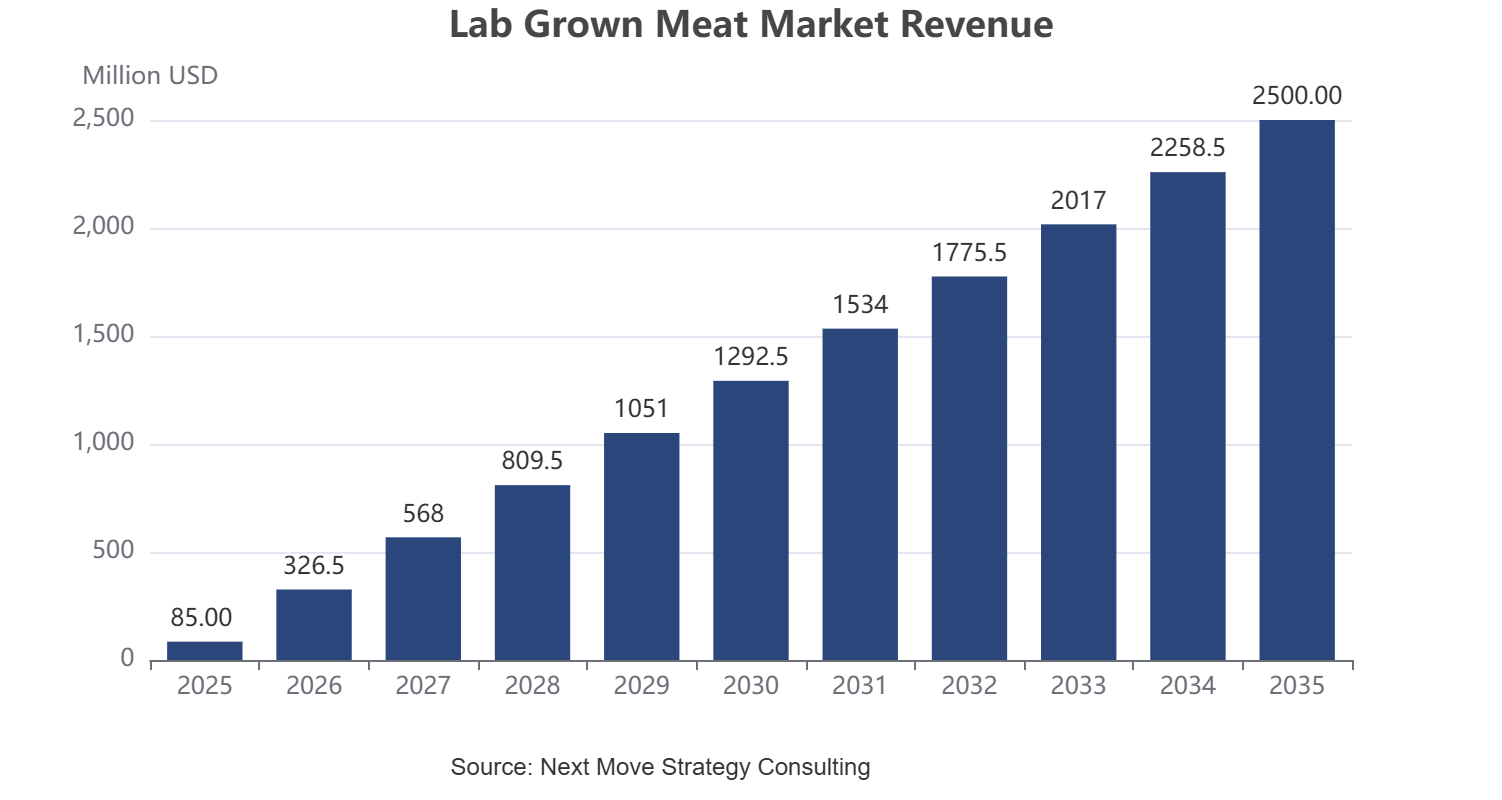
The global lab grown meat market size was valued at USD 85.00 million in 2025 and is estimated at USD 123.30 million in 2026, forecast to reach USD 2,500.00 million by 2035, expanding at a 39.8% CAGR between 2026 and 2035. North America leads with approximately 38% share, while Finished Products dominates all other product types with approximately 62% share.
We observed that growth is broad-based across every segmentation axis, with cultivated fat ingredients and first-ever retail sales driving the most pronounced structural shifts through 2035.
|
Key Takeaways |
|
By Product Type: Finished Products held the largest share of approximately 62% (USD 52.70 million) in 2025; Ingredient Products is the fastest-growing sub-segment at 41.3% CAGR from 2026–2035. |
|
By Species: Chicken held the largest share of approximately 42% (USD 35.70 million) in 2025; Seafood is the fastest-growing sub-segment at 45.2% CAGR from 2026–2035. |
|
By Product Architecture: Ground held the largest share of approximately 35% (USD 29.75 million) in 2025; Whole Cut is the fastest-growing sub-segment at 47.2% CAGR from 2026–2035. |
|
By Buyer Type: Foodservice Operator held the largest share of approximately 38% (USD 32.30 million) in 2025; Pet Food Maker is the fastest-growing sub-segment at 47.5% CAGR from 2026–2035. |
|
By Sales Channel: Direct B2B held the largest share of approximately 45% (USD 38.25 million) in 2025; Retail is the fastest-growing sub-segment at 47.2% CAGR from 2026–2035. |
|
Dominant Region: North America dominated with approximately 38% revenue share (USD 32.30 million) in 2025. |
|
Fastest-Growing Region: Asia-Pacific is expected to register the highest CAGR of 41.7% during 2026–2035. |
|
Dominant Country: The U.S. led with approximately USD 29.07 million in 2025. |
|
Fastest-Growing Country: India is the fastest-growing country at approximately 46.6% CAGR from 2026–2035. |
Market Opportunity: The lab grown meat market is expected to create an absolute dollar opportunity of USD 2,376.70 million between 2026 and 2035, presenting significant investment potential across cultivated fat ingredients, retail-ready formed products, and pet food applications.
According to Next Move Strategy Consulting analysis, companies pursuing capital-light, B2B ingredient supply models are reaching commercial milestones faster than direct-to-consumer whole-cut developers, a divergence that is reshaping investor preference across the sector's next funding cycle through 2035.
What Does the Lab Grown Meat Market Encompass?
The lab grown meat market encompasses finished products and ingredient products manufactured from animal cells cultivated outside a living animal, spanning chicken, beef, pork, seafood, duck, and other species across whole cut, ground, formed, and hybrid product architectures. We observed that the scope spans consumers, foodservice operators, retailers, food manufacturers, and pet food makers sourcing through direct B2B, retail, foodservice, direct-to-consumer, distributor, and licensing sales channels. The category has evolved from a laboratory research concept into a commercially regulated food category as national food safety authorities complete formal approval pathways.
Regulatory frameworks such as the U.S. Food and Drug Administration and Department of Agriculture joint approval process and the Singapore Food Agency's novel food framework shape which products reach market and in which jurisdictions. Our assessment indicates that technology adoption is shifting toward capital-light, B2B ingredient supply models following cultivated fat and cultivated chicken approvals. Next Move Strategy Consulting's analysis indicates that this structural shift, combined with the sector's first-ever retail sale in late 2025, is redefining commercialization strategy across the lab grown meat market.
|
Parameter |
Details |
|
Market Size in 2025 |
USD 85.00 Million |
|
Market Size in 2026 |
USD 123.30 Million |
|
Revenue Forecast in 2035 |
USD 2,500.00 Million |
|
Growth Rate |
CAGR of 39.8% from 2026 to 2035 |
|
Analysis Period |
2025–2035 |
|
Base Year Considered |
2025 |
|
Forecast Period |
2026–2035 |
|
Market Size Estimation |
USD Million |
|
Companies Profiled |
20 |
|
Countries Covered |
33 |
|
Market Share |
Available for Top 10 Companies |
Key Emerging Trends in the Lab Grown Meat Market
Based on research conducted by Next Move Strategy Consulting, we found that four structural trends are reshaping product commercialization, regulatory strategy, and stakeholder engagement across the industry.
How Is the World's First Cultivated Meat Retail Sale Reshaping Commercialization Strategy?
The world's first retail sale of cultivated meat is reshaping how companies approach commercialization timelines. We observed that Mission Barns, Inc. sold Italian-style cultivated pork meatballs at Berkeley Bowl in California on November 1, 2025, marking the first time cultivated meat had ever been sold at retail worldwide. This milestone, following the company's March 2025 FDA clearance and July 2025 USDA grant of inspection, is prompting other developers to prioritize limited retail pilots over large-scale production buildout.
Why Is Capital-Light B2B Ingredient Supply Gaining Investor Favor?
Capital-light, B2B ingredient supply models are gaining investor favor as funding for the broader cultivated meat sector has declined sharply since 2021. Our findings suggest that Mission Barns' proprietary bioreactor platform and low-inclusion cultivated fat ingredient strategy have positioned the company as a de-risked, scalable entry point for consumer packaged goods partners, a model increasingly cited by industry participants as preferable to capital-intensive whole-cut production facilities.
How Is Pet Food Emerging as a Faster Regulatory Pathway?
Pet food is emerging as a faster regulatory pathway for cultivated meat commercialization given simpler approval requirements than human food. We observed that Meatly Ltd. secured UK regulatory clearance for cultivated chicken pet food in July 2024 and launched a limited-edition product at Pets at Home in February 2025, while Friends & Family Pet Food Company secured Singapore approval for cultivated poultry pet food in June 2025. This pathway is enabling faster revenue generation than human food approval routes.
What Role Does Regulatory Approval Momentum Play in Restoring Investor Confidence?
Regulatory approval momentum is playing a growing role in restoring investor confidence following a multi-year funding decline. Based on research conducted by Next Move Strategy Consulting, we found that Gourmey, rebranded as Parima, became the first European company to secure approval for human consumption of cultivated meat in October 2025, following approvals for Wildtype's cultivated salmon and Believer Meats' cultivated chicken earlier the same year. Industry participants describe this approval cluster as the most active period since 2023.
Pestel Analysis Of The Lab-grown Meat Market
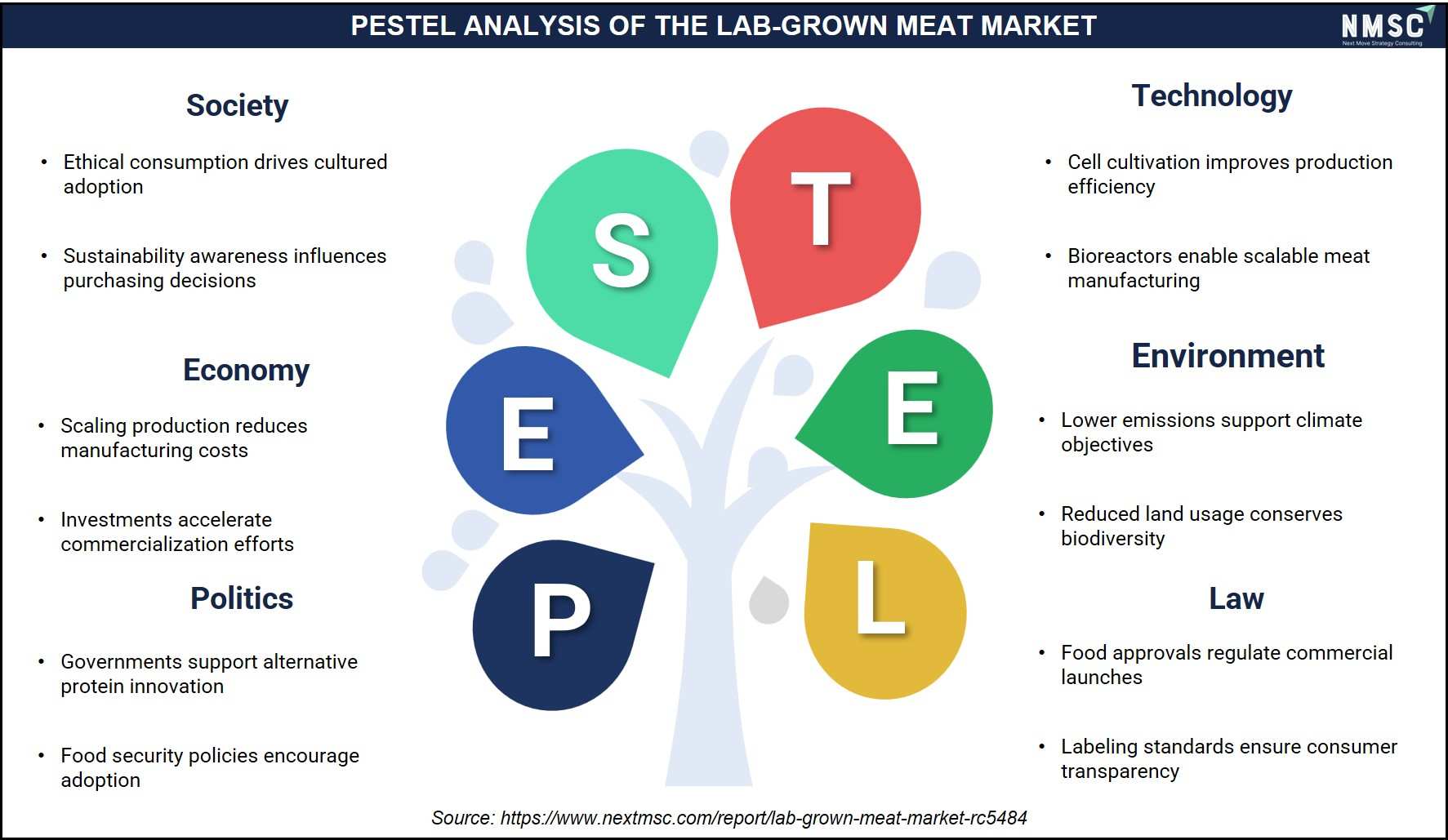
This infographic illustrates a PESTEL analysis of the lab-grown meat market by Next Move Strategy Consulting, breaking down key growth drivers across six core dimensions. Political support and food security policies foster adoption, while economic investments and manufacturing scale help reduce costs. Social acceptance rises through ethical and sustainable choices, powered by technological innovations in cell cultivation and bioreactor scalability. Environmentally, cultivated meat reduces emissions and conserves land, while legal frameworks establish necessary food safety approvals and consumer labeling standards.
Growth Drivers and Restraints
Growth Catalyst and Risk Assessment Matrix
|
Factors |
Type |
(+/−) % Impact on CAGR |
Geographic Relevance |
Impact Timeline |
|
Accelerating regulatory approvals across multiple jurisdictions |
Driver |
+11.5% |
Global |
2026–2032 |
|
World's first cultivated meat retail sale validating commercial viability |
Driver |
+7.2% |
North America |
2026–2030 |
|
Pet food approval pathway enabling faster commercialization |
Driver |
+5.8% |
Europe, Asia-Pacific |
2026–2032 |
|
Capital-light B2B ingredient supply models attracting renewed investment |
Driver |
+6.1% |
Global |
2026–2035 |
|
Singapore and Australia regulatory leadership expanding approved species |
Driver |
+4.4% |
Asia-Pacific |
2026–2035 |
|
Foodservice partnership pilots building consumer familiarity |
Driver |
+3.0% |
Global |
2026–2030 |
|
Sharp decline in sector-wide venture funding since 2021 |
Restraint |
−5.6% |
Global |
2026–2030 |
|
U.S. state-level bans restricting cultivated meat sales |
Restraint |
−3.2% |
North America |
2026–2032 |
|
High per-unit production costs relative to conventional meat |
Restraint |
−2.4% |
Global |
2026–2032 |
What Is the Primary Growth Driver of the Lab Grown Meat Market?
Accelerating regulatory approvals across multiple jurisdictions remain the primary driver of the market. The U.S. Food and Drug Administration issued a 'no questions' letter to Mission Barns, Inc. for its cultivated pork fat in March 2025, followed by a USDA grant of inspection for the company's San Francisco facility in July 2025. We observed that this dual-agency approval pathway is enabling sequential product launches that were not commercially possible before 2025.
How Is the First Cultivated Meat Retail Sale Driving Market Growth?
The world's first cultivated meat retail sale is driving growth by demonstrating consumer-facing commercial viability beyond restaurant pilots. Mission Barns, Inc. confirmed that its Italian-style cultivated pork meatballs sold at Berkeley Bowl on November 1, 2025, priced at USD 13.99, represented the first-ever retail sale of cultivated meat globally. Our assessment indicates that this milestone is accelerating retailer interest in stocking cultivated meat products across additional Bay Area locations through the company's Sprouts Farmers Market partnership.
What Is Restraining Lab Grown Meat Market Expansion?
A sharp decline in sector-wide venture funding restrains broader market expansion. Industry-derived estimates indicate that cultivated meat funding fell from a 2021 peak to approximately USD 137 million in 2024, then to just USD 35 million in the first quarter of 2025, most of which came from a single funding round. We found that U.S. state-level bans on cultivated meat sales further compound this restraint, creating regulatory fragmentation that complicates national commercialization strategies.
Segmentation Analysis
Segment Sizing: By Product Type
|
Segment |
2025 (USD) |
2035 (USD) |
CAGR% (2026–2035) |
|
Finished Products |
USD 52.7 Million |
USD 1450 Million |
38.7% |
|
Ingredient Products |
USD 32.3 Million |
USD 1050 Million |
41.3% |
|
Total |
USD 85 Million |
USD 2500 Million |
39.8% |
Which Product Type Segment Dominates the Lab Grown Meat Market?
Finished Products led the market with USD 52.70 million in 2025, supported by growing foodservice partnerships and the sector's first retail sale in November 2025. We observed that Ingredient Products is the fastest-growing product type, expanding at a 41.3% CAGR from 2026 to 2035, as capital-light, B2B cultivated fat and cultivated meat ingredient supply models attract renewed investor interest following the broader sector's multi-year funding decline.
Segment Sizing: By Species
|
Segment |
2025 (USD) |
2035 (USD) |
CAGR% (2026–2035) |
|
Chicken |
USD 35.7 Million |
USD 875 Million |
36.9% |
|
Beef |
USD 15.3 Million |
USD 500 Million |
41.4% |
|
Pork |
USD 12.75 Million |
USD 400 Million |
40.7% |
|
Seafood |
USD 10.2 Million |
USD 425 Million |
45.2% |
|
Duck |
USD 4.25 Million |
USD 150 Million |
42.6% |
|
Other Species |
USD 6.8 Million |
USD 150 Million |
35.3% |
|
Total |
USD 85 Million |
USD 2500 Million |
39.8% |
Which Species Segment Leads Market Demand?
Chicken remained the leading species, valued at USD 35.70 million in 2025, reflecting its status as the first approved species in the United States and Singapore. Our findings suggest that Seafood is the fastest-growing species, registering a 45.2% CAGR from 2026 to 2035, driven by Wildtype's 2025 cultivated salmon approval and growing developer interest in species with fewer established regulatory precedents but strong consumer sustainability appeal.
Segment Sizing: By Sales Channel
|
Segment |
2025 (USD) |
2035 (USD) |
CAGR% (2026–2035) |
|
Direct B2B |
USD 38.25 Million |
USD 950 Million |
37.1% |
|
Retail |
USD 12.75 Million |
USD 600 Million |
47.2% |
|
Foodservice |
USD 21.25 Million |
USD 550 Million |
37.7% |
|
D2C |
USD 4.25 Million |
USD 175 Million |
45.0% |
|
Distributor |
USD 5.1 Million |
USD 150 Million |
39.7% |
|
Licensing |
USD 3.4 Million |
USD 75 Million |
35.3% |
|
Total |
USD 85 Million |
USD 2500 Million |
39.8% |
Which Sales Channel Segment Dominates the Lab Grown Meat Market?
Direct B2B remained the leading sales channel, reaching USD 38.25 million in 2025, as ingredient suppliers prioritize capital-light supply agreements with foodservice and consumer packaged goods partners. Based on research conducted by Next Move Strategy Consulting, we found that Retail is the fastest-growing sales channel, expanding at a 47.2% CAGR from 2026 to 2035, following Mission Barns' first-ever cultivated meat retail sale at Berkeley Bowl in November 2025.
Growth Opportunities
Our analysis shows that three forward-looking opportunities stand out for stakeholders positioning within the lab grown meat market over the 2026–2035 forecast period.
How Can Cultivated Fat Ingredients Unlock Value for Food Manufacturers?
Cultivated fat ingredients present a whitespace opportunity for suppliers serving food manufacturers seeking flavor and richness enhancement without full-scale cultivated meat production. Companies that scale low-inclusion cultivated fat supply, following Mission Barns' proprietary bioreactor model, stand to capture recurring ingredient contracts as consumer packaged goods partners seek de-risked entry points into cultivated protein.
Where Does Pet Food Approval Create New Demand?
Pet food regulatory pathways create a significant opportunity for developers seeking faster routes to market than human food approval. Suppliers that scale cultivated chicken pet food production, following Meatly's UK retail launch and Friends & Family's Singapore approval, can capture recurring contracts with pet food manufacturers seeking sustainable ingredient differentiation ahead of broader category maturity.
How Can Retail Expansion Benefit Early-Mover Cultivated Meat Brands?
Retail channel expansion creates an opportunity for early-mover brands that have completed the full regulatory approval pathway. Companies that scale limited retail pilots into broader grocery distribution, following Mission Barns' November 2025 retail debut, can secure first-mover brand recognition among consumers before additional competitors complete equivalent regulatory clearances.
Regulatory Framework Impacting The Lab-grown Meat Market
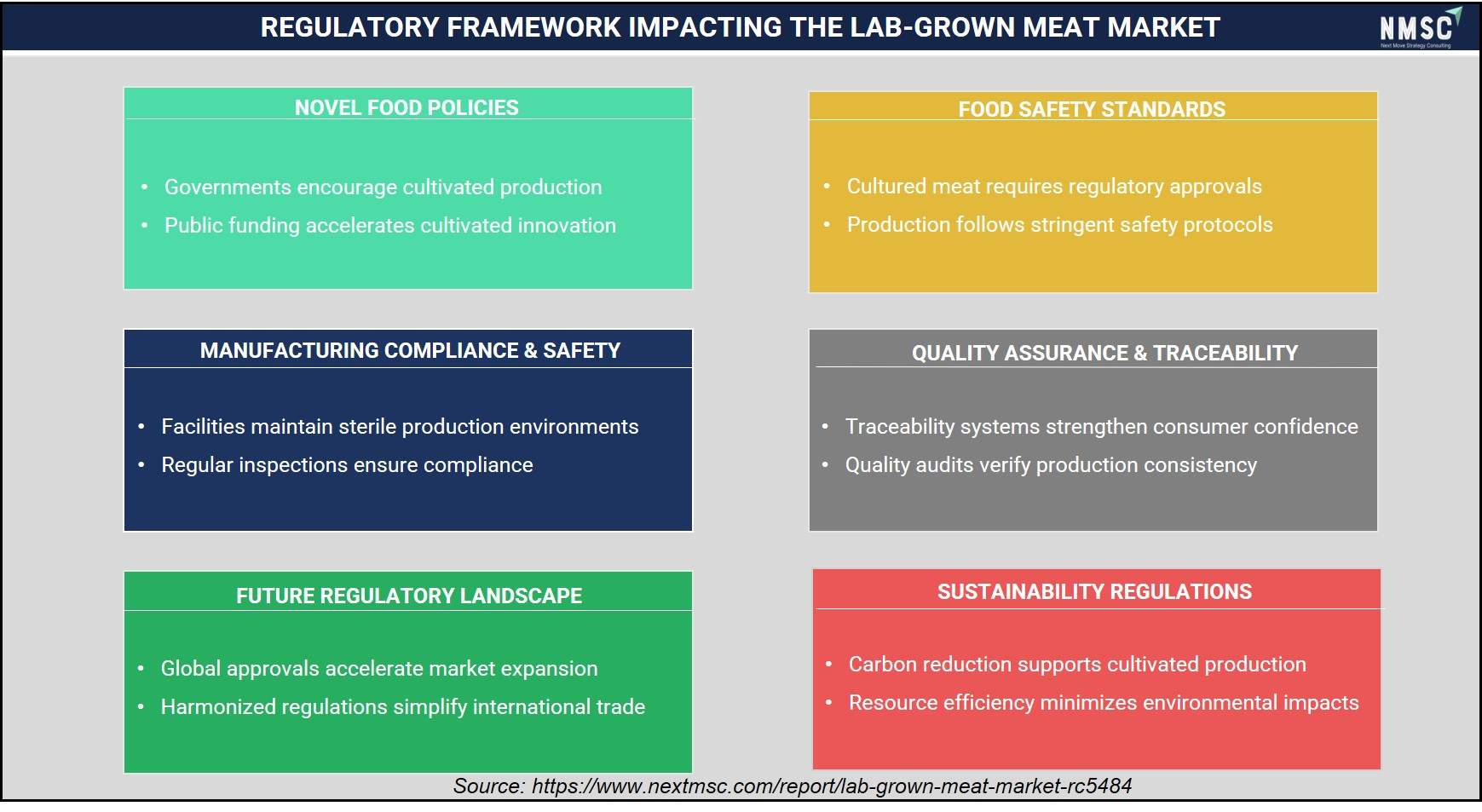
This infographic outlines the regulatory framework impacting the lab-grown meat market by Next Move Strategy Consulting across six key areas. Novel food policies drive innovation through public funding, while strict food safety standards and manufacturing compliance ensure sterile environments and regulatory approvals. Quality assurance and traceability build consumer confidence through audits and tracking. Looking forward, the future regulatory landscape relies on global approvals and harmonized trade regulations, alongside sustainability regulations that promote resource efficiency and carbon reduction.
Regional Outlook
Geographic Performance Snapshot
|
Region |
2025 (USD) |
2035 (USD) |
CAGR% (2026–2035) |
Key Driver |
|
North America |
USD 32.3 Million |
USD 825 Million |
37.5% |
World's first cultivated meat retail sale and dual-agency US approval pathway |
|
Europe |
USD 17 Million |
USD 500 Million |
39.7% |
UK pet food approval and first European human consumption clearance |
|
Asia-Pacific |
USD 25.5 Million |
USD 850 Million |
41.7% |
Singapore and Australia regulatory leadership across multiple species |
|
Middle East & Africa |
USD 5.1 Million |
USD 175 Million |
42.1% |
Israel's regulatory clearance and growing regional food-tech investment |
|
Latin America |
USD 5.1 Million |
USD 150 Million |
39.7% |
Expanding foodservice pilot partnerships and consumer awareness |
|
Total |
USD 85 Million |
USD 2500 Million |
39.8% |
— |
North America Lab Grown Meat Market Outlook
North America is the dominant region in the lab grown meat market, anchored by Mission Barns' world-first cultivated meat retail sale in November 2025. We observed that the U.S. dual-agency FDA and USDA approval pathway, completed by UPSIDE Foods, Eat Just, and Mission Barns, has established the most mature regulatory precedent globally. Technology adoption favors capital-light B2B ingredient models, though state-level bans continue to create regulatory fragmentation across the region.
Europe Lab Grown Meat Market Outlook
Europe's market reflects a bifurcated regulatory landscape shaped by faster pet food approvals alongside slower human food clearance. Our findings suggest that Meatly's July 2024 UK pet food approval and Gourmey's October 2025 human consumption clearance, achieved through Singapore rather than EU authorities, illustrate how European companies are pursuing approval in more favorable jurisdictions first. Technology adoption favors cultivated chicken formats, and competitive intensity remains moderate among a small number of specialized developers.
Asia-Pacific Lab Grown Meat Market Outlook
Asia-Pacific is the fastest-growing region, anchored by Singapore's position as the world's first cultivated meat regulatory authority and Australia's June 2025 approval of Vow's cultivated quail. We found that regional regulators continue to expand approved species and companies, with additional dossiers under review from multiple developers. Technology adoption is advancing quickly across cultivated poultry and seafood formats, and regulatory frameworks remain the most accommodating globally.
Middle East & Africa Lab Grown Meat Market Outlook
The Middle East & Africa market is expanding as Israel's regulatory clearance for Aleph Farms' cultivated beef establishes a regional precedent. Our analysis shows that growing food-tech investment across the Gulf region is attracting developer interest in cultivated protein as a food security strategy. Regulatory frameworks remain developing outside Israel, and technology adoption is gradually advancing as regional distributors explore partnerships with established developers.
Latin America Lab Grown Meat Market Outlook
Latin America's market is supported by expanding foodservice pilot partnerships and growing consumer awareness in Brazil and Argentina. We observed that regulatory frameworks remain less developed than in North America, Europe, or Asia-Pacific, though national food safety agencies have begun preliminary engagement with developers. Technology adoption remains in early stages, with competitive intensity limited to a small number of international developers exploring regional distribution partnerships.
U.S. Lab Grown Meat Market
Based on our estimates, the U.S. market was valued at approximately USD 29.07 million in 2025 and is projected to reach USD 717.75 million by 2035, growing at a 37.0% CAGR. Demand is anchored by the world's first cultivated meat retail sale and the country's mature dual-agency FDA and USDA approval pathway. Technology penetration favors capital-light B2B ingredient supply, and competitive intensity is high among UPSIDE Foods, Eat Just, Mission Barns, Wildtype, and Believer Meats, though state-level bans continue to restrict sales in several states.
Canada Lab Grown Meat Market
The market in Canada reached roughly USD 2.26 million in 2025 and is forecast to hit USD 70.12 million by 2035 at a 40.5% CAGR. Demand structure mirrors early U.S. foodservice pilot activity, supported by Health Canada's ongoing novel food evaluation framework. Technology penetration is rising as developers explore cross-border partnerships, with competitive intensity moderate given reliance on U.S.-based product development and regulatory precedent.
UK Lab Grown Meat Market
As per our estimate, the UK market stood at about USD 5.10 million in 2025, advancing toward USD 135.00 million by 2035 at a 38.1% CAGR. Demand is driven by Meatly's July 2024 pet food approval and February 2025 retail launch at Pets at Home. Regulatory influence remains significant under the UK's dedicated regulatory sandbox for cultivated meat, technology penetration favors cultivated chicken pet food, and competitive intensity remains moderate among domestic developers.
Germany Lab Grown Meat Market
According to our analysis, Germany's market was valued near USD 4.08 million in 2025 and is set to reach USD 115.00 million by 2035, expanding at a 39.0% CAGR. Demand structure reflects early-stage consumer interest amid the European Union's still-pending regulatory decision on cultivated meat. Regulatory influence remains uncertain, with several European countries pursuing pre-emptive bans, while technology penetration favors foodservice pilot partnerships ahead of formal EU approval.
France Lab Grown Meat Market
Based on our estimates, France's market reached approximately USD 3.40 million in 2025, projected to climb to USD 100.00 million by 2035 at a 39.7% CAGR. Demand is supported by Gourmey, rebranded as Parima, securing the first European human consumption approval for cultivated meat in October 2025, achieved through Singapore rather than domestic authorities. Regulatory influence from pending EU novel food review is notable, and competitive intensity remains moderate given the concentration of domestic cultivated duck and poultry developers.
China Lab Grown Meat Market
The market in China stood at roughly USD 7.14 million in 2025 and is forecast to reach USD 221.00 million by 2035, registering a 40.5% CAGR. Demand is fueled by growing domestic biotechnology investment and CellX's development activity within the country's cultivated meat sector. Regulatory influence is increasing gradually as national food safety authorities evaluate novel food frameworks, technology penetration is advancing across cultivated pork given the country's scale of pork consumption, and competitive intensity remains moderate.
India Lab Grown Meat Market
As per our estimate, India's market was valued at about USD 3.57 million in 2025, projected to reach USD 161.50 million by 2035 at a 46.6% CAGR, the fastest among all covered countries. Demand structure reflects rapidly expanding domestic food-tech investment and growing interest in alternative protein research institutions. Regulatory influence remains developing under national food safety authority guidelines, while technology penetration is rising quickly as international developers explore partnerships with domestic research institutions.
Japan Lab Grown Meat Market
According to our analysis, Japan's market reached close to USD 5.10 million in 2025 and is expected to hit USD 144.50 million by 2035, growing at a 39.1% CAGR. Demand is supported by Japan's strong domestic food technology research base and growing government interest in food security applications. Regulatory influence remains under active development, technology penetration is advancing across cultivated seafood given the country's seafood consumption patterns, and competitive intensity remains moderate among domestic and international developers.
South Korea Lab Grown Meat Market
Based on our estimates, South Korea's market stood at approximately USD 4.08 million in 2025, forecast to reach USD 127.50 million by 2035 at a 40.7% CAGR. Demand structure benefits from the country's advanced biotechnology base and growing government support for alternative protein research. Technology penetration is rising as domestic developers pursue regulatory dossiers, and competitive intensity remains moderate amid growing international developer interest in market entry.
Australia Lab Grown Meat Market
The market in Australia reached about USD 5.61 million in 2025 and is projected to reach USD 170.00 million by 2035, expanding at a 40.2% CAGR. Demand is supported by Food Standards Australia New Zealand's June 2025 approval of Vow's cultivated quail, following the company's earlier Singapore launch. Regulatory influence stems from the joint Australia-New Zealand food standards framework, while technology penetration favors cultivated quail and premium species amid growing competitive intensity.
UAE Lab Grown Meat Market
As per our estimate, the UAE market was valued near USD 1.73 million in 2025, projected to reach USD 57.75 million by 2035 at a 41.7% CAGR. Demand structure is shaped by national food security strategy and growing regional food-tech investment interest. Regulatory influence remains developing, technology penetration is improving through foodservice pilot partnerships, and competitive intensity is rising as international developers explore Gulf market entry.
Saudi Arabia Lab Grown Meat Market
According to our analysis, Saudi Arabia's market reached roughly USD 1.53 million in 2025 and is expected to hit USD 56.00 million by 2035, growing at a 43.1% CAGR, the fastest in the Middle East & Africa region. Demand is driven by national food security programs tied to economic diversification goals. Regulatory influence is developing under national food safety authority guidelines, and technology penetration is advancing as international developers scale regional partnership discussions.
South Africa Lab Grown Meat Market
Based on our estimates, South Africa's market stood at about USD 0.71 million in 2025, forecast to reach USD 22.75 million by 2035 at a 41.0% CAGR. Demand structure reflects an early-stage market addressing growing regional interest in alternative protein sources. Regulatory influence remains limited, technology penetration is modest, and competitive intensity is minimal given reliance on international developers for eventual market entry.
Brazil Lab Grown Meat Market
The market in Brazil reached approximately USD 2.81 million in 2025 and is projected to reach USD 79.50 million by 2035, registering a 39.1% CAGR. Demand is underpinned by Brazil's large conventional meat industry and growing interest in alternative protein diversification. Regulatory influence stems from national food safety agency engagement, technology penetration favors early foodservice pilot partnerships, and competitive intensity remains limited among regional distributors.
Argentina Lab Grown Meat Market
As per our estimate, Argentina's market was valued near USD 1.02 million in 2025, projected to reach USD 31.50 million by 2035 at a 40.5% CAGR. Demand structure is supported by early-stage consumer interest despite macroeconomic volatility. Regulatory influence remains limited, technology penetration is modest, and competitive intensity is centered on a small number of international developers exploring regional partnerships.
Competitive Landscape
We observed that the competitive landscape remains fragmented among early-stage developers, with differentiation increasingly determined by regulatory approval sequencing rather than production scale alone.
|
Category |
Assessment |
|
Market Structure |
Fragmented; a small number of regulatory-cleared developers, including UPSIDE Foods, Eat Just, Mission Barns, and Believer Meats, hold first-mover advantage over a broader base of pre-commercial companies |
|
Innovation Focus |
Capital-light B2B ingredient supply, cultivated fat platforms, proprietary bioreactor design, and pet food formulations offering faster regulatory pathways |
|
M&A Activity |
Limited direct M&A activity; competitive dynamics instead centered on sequential regulatory approvals and strategic foodservice and retail partnerships |
How Do Companies Compete in the Lab Grown Meat Market?
Companies compete primarily on regulatory approval sequencing, production cost efficiency, and the ability to secure foodservice or retail partnerships ahead of competitors. We found that being first to achieve a specific regulatory milestone, such as Mission Barns' first-ever retail sale, confers significant brand recognition advantages. Pricing strategies remain closely tied to bioreactor production costs, pushing developers toward capital-light ingredient models to reach commercial viability faster than whole-cut production.
Which Competitive Archetypes Dominate the Lab Grown Meat Market?
Two archetypes dominate the lab grown meat market: capital-light ingredient and fat developers that compete on proprietary bioreactor efficiency and B2B partnership breadth, and whole-cut and formed-product developers that compete on consumer-facing brand development and direct retail or foodservice access. Our analysis shows that differentiation increasingly centers on regulatory approval sequencing across jurisdictions, positioning companies with multiple approvals to capture disproportionate investor and media attention.
How Are Companies Differentiating Through Innovation?
Leading developers are differentiating through proprietary bioreactor technology, low-cost culture media formulations, and species selection strategies that avoid regulatory bottlenecks. During our market evaluation, we noticed that several developers are simultaneously pursuing pet food and human food regulatory pathways in parallel, positioning themselves to generate revenue from faster-approving pet food applications while human food dossiers remain under review.
What M&A and Geographic Expansion Activity Is Reshaping the Market?
Geographic expansion through multi-jurisdiction regulatory filings is reshaping competitive positioning across the industry. We observed that Gourmey, rebranded as Parima, pursued Singapore approval rather than waiting for the European Union's pending novel food decision, while Vow expanded from its initial Singapore approval to Australia and New Zealand in June 2025. This pattern of pursuing the most accommodating regulatory jurisdiction first, rather than home-market approval, has become a defining competitive strategy across the sector.
Key Market Players
Our assessment indicates that the following companies represent the leading developers shaping competitive dynamics across the lab grown meat market.
-
Eat Just, Inc.
-
Mission Barns, Inc.
-
Wildtype, Inc.
-
Meatly Ltd.
-
Vow
-
Aleph Farms Ltd.
-
Mosa Meat B.V.
-
BlueNalu, Inc.
-
Believer Meats
-
SuperMeat
-
Gourmey
-
Meatable B.V.
-
Forsea Foods
-
Avant Meats
-
Finless Foods, Inc.
-
Fork & Good, Inc.
-
Higher Steaks Ltd.
-
Clever Carnivore, Inc.
-
CellX
Latest Developments
We found that recent regulatory approvals, retail launches, and product milestones underscore the pace of change across the lab grown meat industry.
|
Date |
Event |
|
May 2024 |
GOOD Meat announced the "world's first" retail launch of cell-based chicken. The company partnered with Huber's Butchery in Singapore to sell "GOOD Meat 3," a new formulation utilizing 3% cultivated chicken combined with plant proteins, which allowed them to lower production costs and offer the product in the retail freezer section. |
Expert Insights

“The goal is not to replace meat but to diversify choices and provide a unique value proposition to a very well-defined segment of the market.”
— Didier Toubia, Co-founder and CEO, Aleph Farms
Statement made during a September 2025 interview with Just Food, discussing Aleph Farms' strategic positioning ahead of its planned commercial rollout in European markets (including Switzerland and the UK) and its first product, the Petit Steak.
Market Interpretation
The comment highlights a strategic pivot in the messaging of the cultivated meat sector. Rather than framing lab-grown meat as an immediate total replacement for conventional agriculture which has met with consumer pushback and immense scaling hurdles industry leaders like Toubia are positioning it as an additive category. By focusing on providing an alternative choice with a distinct value proposition (such as specific health, nutritional, or environmental benefits), cultivated meat companies are targeting well-defined demographics, like flexitarians and younger consumers, to build steady market adoption and long-term profitability.
Investment Opportunities
Where Are Capital Inflows Concentrated in the Lab Grown Meat Market?
Capital inflows are concentrated in companies with completed or near-complete regulatory approvals. We observed that Aleph Farms secured a USD 29 million raise in the first quarter of 2025, representing the majority of total sector funding during that period. This pattern reflects investor preference for companies that have de-risked regulatory uncertainty over earlier-stage developers still navigating approval processes.
How Is Infrastructure Investment Expanding Production Capacity?
Infrastructure investment is expanding production capacity as regulatory-cleared companies scale from pilot to commercial volumes. We found that Mission Barns unveiled a new headquarters and cultivated fat production facility in San Francisco ahead of securing USDA inspection approval in July 2025. This pattern of building capacity in advance of final regulatory clearance reflects growing developer confidence in eventual approval outcomes.
What ESG Considerations Are Shaping Lab Grown Meat Investment?
Environmental, social, and governance considerations remain central to the lab grown meat investment thesis, with developers positioning cultivated protein as a climate and food security solution. Our findings suggest that companies emphasizing reduced land use and animal welfare benefits continue to attract mission-aligned investors even as broader sector funding has declined, though ESG framing alone has not offset the sharp overall reduction in available capital since 2021.
Key Benefits for Stakeholders
How Does This Report Benefit Enterprise and Industry Leaders?
Enterprise and industry leaders gain a structured view of segment-level demand across product type, species, product architecture, buyer type, and sales channel, supported by Next Move Strategy Consulting's forecasts through 2035. Our analysis shows that this data enables commercialization planning decisions, helping developers prioritize investment in the fastest-growing segments, including ingredient products and retail channel expansion.
How Does This Report Benefit Investors and Financial Analysts?
Investors and financial analysts benefit from validated market sizing, regional growth differentials, and competitive landscape analysis that inform capital allocation decisions. We found that the report's country-level revenue breakdowns and CAGR projections support comparative evaluation of expansion opportunities across North America, Europe, Asia-Pacific, the Middle East & Africa, and Latin America, strengthening due diligence on cultivated meat-related investment targets.
How Does This Report Benefit Technology Vendors and Product Teams?
Technology vendors and product teams gain insight into emerging trends, including capital-light B2B ingredient models, pet food regulatory pathways, and first-mover retail commercialization strategy. Our assessment indicates that this analysis helps product teams prioritize research and development roadmaps toward the species and product architectures showing the strongest forecast growth, improving alignment between innovation investment and evolving regulatory realities.
Key Market Segments
By Product Type
-
Finished Products
-
Retail Packs
-
Foodservice Menu Items
-
Pet Food
-
Other Finished Products
-
-
Ingredient Products
-
Cultivated Meat Ingredient
-
Cultivated Fat Ingredient
-
Other Ingredient Products
-
By Species
-
Chicken
-
Beef
-
Pork
-
Seafood
-
Duck
-
Other Species
By Product Architecture
-
Whole Cut
-
Ground
-
Formed
-
Hybrid
-
Other
By Buyer Type
-
Consumer
-
Foodservice Operator
-
Retailer
-
Food Manufacturer
-
Pet Food Maker
By Sales Channel
-
Direct B2B
-
Retail
-
Foodservice
-
D2C
-
Distributor
-
Licensing
By Region
-
North America: U.S., Canada, Mexico
-
Europe: UK, Germany, France, Italy, Spain, Sweden, Denmark, Finland, Netherlands, Rest of Europe
-
Asia-Pacific: China, India, Japan, South Korea, Taiwan, Indonesia, Vietnam, Australia, Philippines, Malaysia, Rest of APAC
-
Middle East & Africa: Saudi Arabia, UAE, Egypt, Israel, Turkey, Nigeria, South Africa, Rest of MEA
-
Latin America: Brazil, Argentina, Chile, Colombia, Rest of LATAM
Conclusion and Recommendations
What Is the Long-Term Outlook for the Lab Grown Meat Market?
The long-term outlook remains strongly positive, with the market projected to expand from USD 123.30 million in 2026 to USD 2,500.00 million by 2035 at a 39.8% CAGR. Our assessment indicates that this growth will be increasingly concentrated among regulatory-cleared developers as additional species and jurisdictions complete approval pathways through 2035.
What Strategic Positioning Should Developers Pursue?
Developers should pursue capital-light, B2B ingredient positioning while pursuing parallel regulatory pathways across multiple jurisdictions. We found that companies combining pet food and human food approval strategies, following Meatly's and Mission Barns' models, are best positioned to generate revenue while broader human food regulatory review continues in less accommodating markets such as the European Union.
How Attractive Is the Market for New Investment?
The market presents high long-term investment attractiveness given its 39.8% forecast CAGR, though near-term investment activity remains constrained by the sector's sharp funding decline since 2021. Our findings suggest that investors focusing on regulatory-cleared companies with demonstrated commercial traction, rather than pre-approval developers, stand to benefit from more favorable risk-adjusted returns through 2035.
What Are the Key Market Shifts and Risks?
Key shifts include the transition from restaurant pilots toward retail commercialization and the emergence of pet food as a faster regulatory pathway. We observed that principal risks include continued U.S. state-level bans, persistently low venture funding relative to 2021 peaks, and high per-unit production costs, all of which could slow the pace of the industry's commercial scale-up if unresolved.
What Are the Primary Growth Pathways Through 2035?
Primary growth pathways include scaling capital-light cultivated fat and meat ingredient supply, expanding pet food commercialization, and converting the sector's first retail sale into broader grocery distribution. Based on research conducted by Next Move Strategy Consulting, we found that developers combining these three pathways with multi-jurisdiction regulatory strategy are best positioned to capture the USD 2,376.70 million absolute dollar opportunity created between 2026 and 2035.
About the Author
 Liza Phukan
— Liza Phukan is Research Associate at Next Move Strategy Consulting, where she has covered emerging industries and market research across sectors for 3.5 years. Her work includes analyzing industry developments, validating market data, and developing structured business content from research findings. She uses secondary research and data-validation practices to turn complex market information into clear decision-useful market analysis for business audiences and support report development and B2B.
Liza Phukan
— Liza Phukan is Research Associate at Next Move Strategy Consulting, where she has covered emerging industries and market research across sectors for 3.5 years. Her work includes analyzing industry developments, validating market data, and developing structured business content from research findings. She uses secondary research and data-validation practices to turn complex market information into clear decision-useful market analysis for business audiences and support report development and B2B.
About the Reviewer
 Supradip Baul
— Supradip Baul is an accomplished business consultant and strategist with over a decade of rich experience in market intelligence, strategy, technology, and business transformation. His work has included rigorous qualitative and quantitative analysis across multiple industries, helping clients shape investment decisions and long-term roadmaps. Earlier in his career, he was associated with Gartner, where he contributed to industry-leading reports and market share analyses. He has worked with leading global companies and holds an MBA with a dual specialization in Marketing and Finance.
Supradip Baul
— Supradip Baul is an accomplished business consultant and strategist with over a decade of rich experience in market intelligence, strategy, technology, and business transformation. His work has included rigorous qualitative and quantitative analysis across multiple industries, helping clients shape investment decisions and long-term roadmaps. Earlier in his career, he was associated with Gartner, where he contributed to industry-leading reports and market share analyses. He has worked with leading global companies and holds an MBA with a dual specialization in Marketing and Finance.
At Next Move Strategy Consulting, we understand that insightful market research is the cornerstone of successful business decisions. That's why we employ a robust and multifaceted approach, combining various methodologies to deliver the most accurate and actionable data for our clients.

Research Landscape
We navigate the world of research with two primary approaches:
Qualitative Approach
Our qualitative research methodologies involve immersive techniques such as in-depth interviews, focus groups, and observational studies. By engaging directly with individuals and stakeholders, we uncover valuable insights that quantitative data alone may overlook.

Quantitative Research
In tandem with qualitative methodologies, NMSC leverages the power of Quantitative Research to provide a robust foundation of numerical insights. Through systematic data collection and analysis, we quantify patterns, preferences, and market trends, offering a comprehensive view of the business landscape.
Our quantitative research approach employs diverse tools, including surveys, experiments, and statistical modelling. These methodologies enable us to gather data from a large and representative sample, ensuring the statistical significance of our findings. By employing structured questionnaires and standardized data collection methods, we guarantee the reliability and validity of the information we present to our clients.
Quantitative research is particularly effective in measuring the prevalence of trends, assessing market size, and gauging the impact of various factors on consumer behavior. The numerical precision attained through this approach equips our clients with actionable insights, facilitating data-driven decision-making and strategy formulation.


Our Specialized Toolbox for Industry-Specific Market Research
We deploy a specialized arsenal of techniques tailored to meet your unique requirements. Here's a glimpse into our comprehensive toolbox:

Information Procurement
The stage entails acquiring market data or relevant information through various sources and methodologies.


Market Research Approach
We utilize both top-down and bottom-up approaches in market research analysis to achieve a comprehensive understanding of the market dynamics, leveraging the broad perspective of industry trends and macroeconomic factors alongside detailed insights from specific segments and individual companies.

Porters Five Forces Analysis
We conduct Porter's Five Forces analysis to evaluate the competitive landscape of an industry, providing us with insights into factors that affect profitability and strategic positioning.

SWOT Analysis

Forecasting
We utilize a forecasting model to predict future consumption by considering parameters like population, economics, regulations, market competition, drivers, constraints, technology, and pricing. We also employ statistical techniques such as multilinear regression, exponential smoothing, moving average, ARIMA, and Monte Carlo simulations for accurate predictions. In econometric forecasting, we analyzed short-term and long-term event impacts, attributing values based on regulatory frameworks, economic factors, and market events.





 Speak to Our Analyst