Liquid Handling System Market by Product (Pipettes, Liquid Handling Workstations, Dispensers, Microplate Reagent Dispensers, Microplate Washers, Burettes, Accessories, Consumables, Software, Services, and Other Products), by Application (Drug Discovery, Genomics, Clinical Diagnostics, Proteomics, Cell and Gene Therapy, Food Testing, Environmental Testing, Forensic Testing, Academic Research, and Other Applications), and Others – Global Opportunity Analysis and Industry Forecast, 2025–2030
Liquid Handling System Market Overview
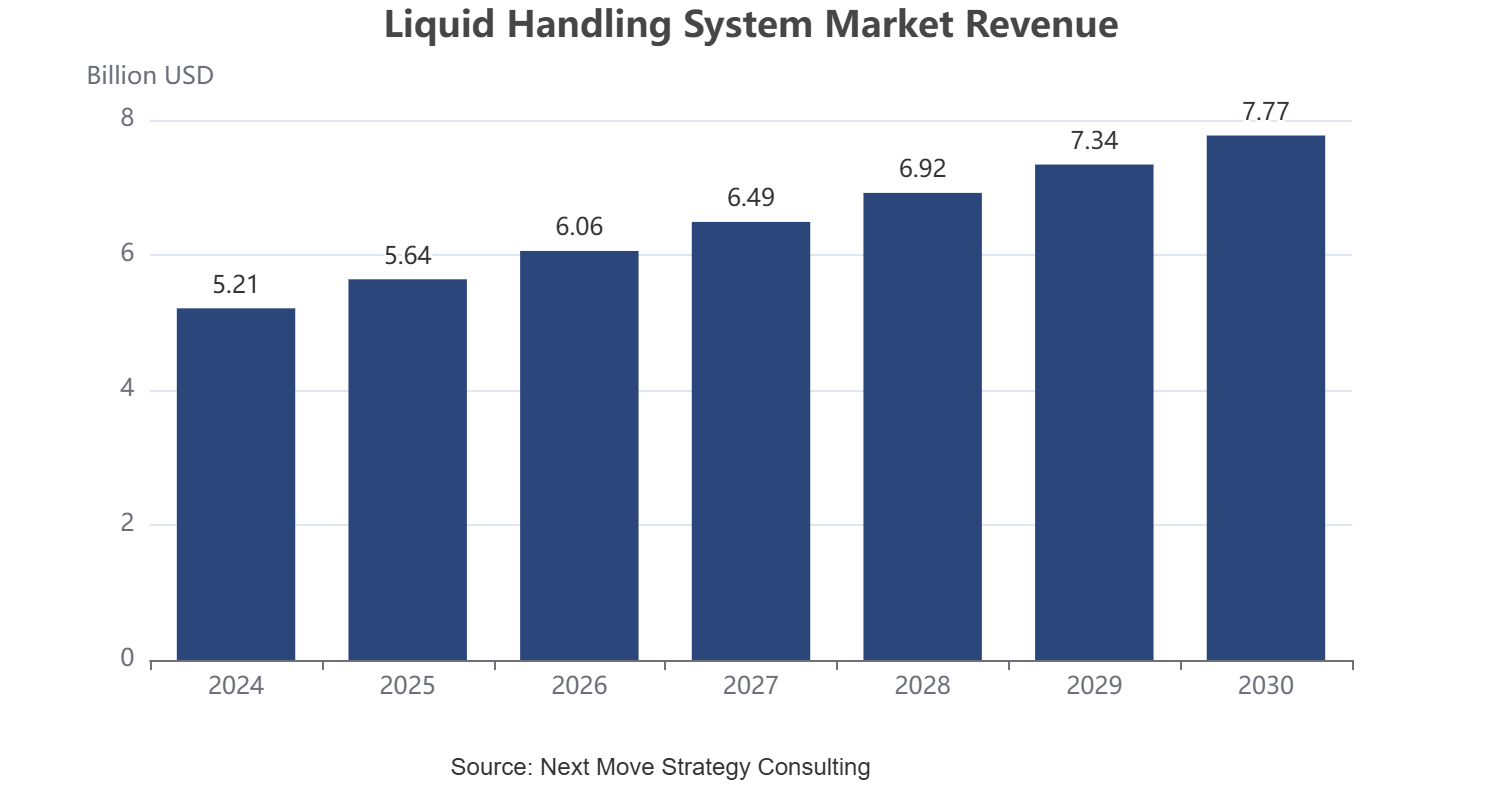
The global Liquid Handling System Market size was valued at USD 5.21 billion in 2024 and is predicted to reach USD 5.57 billion by the end of 2025. The industry is predicted to reach USD 7.77 billion by 2030 with a CAGR of 6.9% from 2025 to 2030.
The liquid handling system market is evolving rapidly as automation, precision, and scalability become central to life sciences and diagnostic workflows. Government-funded research programs, rising public healthcare investments, and a growing need for accuracy in complex bioassays are accelerating the adoption of automated systems across laboratories worldwide. While high capital costs remain a challenge, particularly for budget-constrained institutions, the integration of AI-driven technologies is opening new opportunities for scalable and intelligent liquid handling solutions. As key players focus on developing systems that meet the demands of genomics, proteomics, and personalized medicine, the market continues to expand across research, clinical, and industrial domains.
Surge in Government-Funded Research Initiatives Drives Market Growth
One of the key driving forces for the market is the rising scale and frequency of government-backed research and academic projects. Public agencies are increasingly investing in life sciences, particularly genomics, proteomics, and infectious disease studies, all of which require precise liquid handling. For instance, the Indian Council of Medical Research (ICMR) and National Institutes of Health (NIH) in the U.S. fund numerous laboratory programs that utilize automated liquid handling systems for viral RNA extraction, PCR prep, and serological assays. The Department of Biotechnology (DBT) in India, under its Biotech Labs Program, has also supplied robotic pipetting systems to national research labs to accelerate sample processing efficiency. These government efforts significantly expand the addressable market size for liquid handling technologies.
Rising Public Healthcare Investment in Diagnostics Drives Market Expansion
The COVID-19 pandemic revealed critical gaps in diagnostic preparedness and spurred record-level government spending in laboratory infrastructure worldwide. Agencies such as the Centers for Disease Control and Prevention (CDC) and the World Health Organization (WHO) have supported the installation of automated liquid handling systems in regional virology and epidemiology labs. The CDC’s Advanced Molecular Detection (AMD) program, for example, funds automation tools that improve testing throughput and accuracy. These programs are boosting the market growth potential by embedding liquid handling technology deeper into national diagnostic frameworks, especially in low- and middle-income countries.
Growing Accuracy Needs in High-Precision Bioassays Fuel Market Trends
Government-affiliated institutes conducting clinical trials and molecular biology research demand exact reproducibility, especially in assays like qPCR, ELISA, and next-generation sequencing. Automated liquid handling systems are indispensable in these settings. For instance, the Indian Institute of Science (IISc) and various CSIR labs have procured automated pipetting stations for use in advanced bioassay research under government-funded programs. These platforms reduce human error, increase process speed, and ensure consistency, key metrics for research repeatability and validation. This push towards automation is directly tied to government-supported lab modernization drives, creating sustained demand across the global industry.
High Capital Investment Hinders Liquid Handling System Market Demand
Despite their operational advantages, advanced liquid handling systems come with high upfront costs. These include installation, calibration, user training, and recurring maintenance. Public hospitals and academic labs with limited budgets often delay or restrict such purchases, impacting wider adoption. Even though government subsidies exist in some regions, the capital expenditure remains a barrier to entry, especially for Tier 2 and Tier 3 institutions.
Introduction of AI-Enabled Automation Modular Liquid Handling System Creates Opportunity for Market Growth
The shift toward personalized medicine is fueling demand for advanced liquid handling systems, with AI integration emerging as a key enabler. Precision healthcare initiatives such as the U.S. Precision Medicine Initiative and India’s Genome India Project depend on high-throughput genomic and biomarker analysis, requiring reliable and automated liquid handling solutions. The incorporation of AI enhances system efficiency through real-time decision-making, error reduction, and workflow optimization. As healthcare providers and research institutions adopt AI-powered platforms to support tailored diagnostics and treatments, vendors in the market have a growing opportunity to deliver intelligent, scalable solutions aligned with the future of precision medicine.
A notable example is the 2023 launch of Opentrons' Flex System, an AI-compatible, modular liquid handling platform designed to streamline workflows in genomics and diagnostics labs. As healthcare providers and research institutions adopt AI-powered platforms to support tailored diagnostics and treatments, vendors in the market have a growing opportunity to deliver intelligent, scalable solutions aligned with the future of precision medicine.
Market Segmentation and Scope of Study
The liquid handling system market report is segmented on the basis of product, application, end user, and channel. On the basis of product, the market is divided into pipettes, liquid handling workstations, dispensers, microplate reagent dispensers, microplate washers, burettes, accessories, consumables, software, services, and other products. Pipettes are further categorized into manual pipettes and electronic pipettes. Dispensers are further segmented into bottle-top dispensers and reagent dispensers. Burettes are divided into manual burettes and electronic burettes.
Accessories are further segmented into heads and modules, stackers and hotels, tip loaders, grippers and carriers, and other accessories. Consumables are categorized into tips, tip racks and cartridges, reservoirs and troughs, tubes and plates, seals and caps, and other consumables. Software is segmented into control software, workflow software, data software, and LIMS connectivity software. Services are further divided into installation and validation, training, maintenance and calibration, integration and custom automation, and other services.
On the basis of application, the market is segmented into drug discovery, genomics, clinical diagnostics, proteomics, cell and gene therapy, food testing, environmental testing, forensic testing, academic research, and other applications. On the basis of end user, the market is divided into pharma and biopharma companies, biotechnology companies, CRO and CDMO organizations, academic and government institutes, clinical laboratories, food laboratories, environmental laboratories, forensic laboratories, industrial QC laboratories, and other end users.
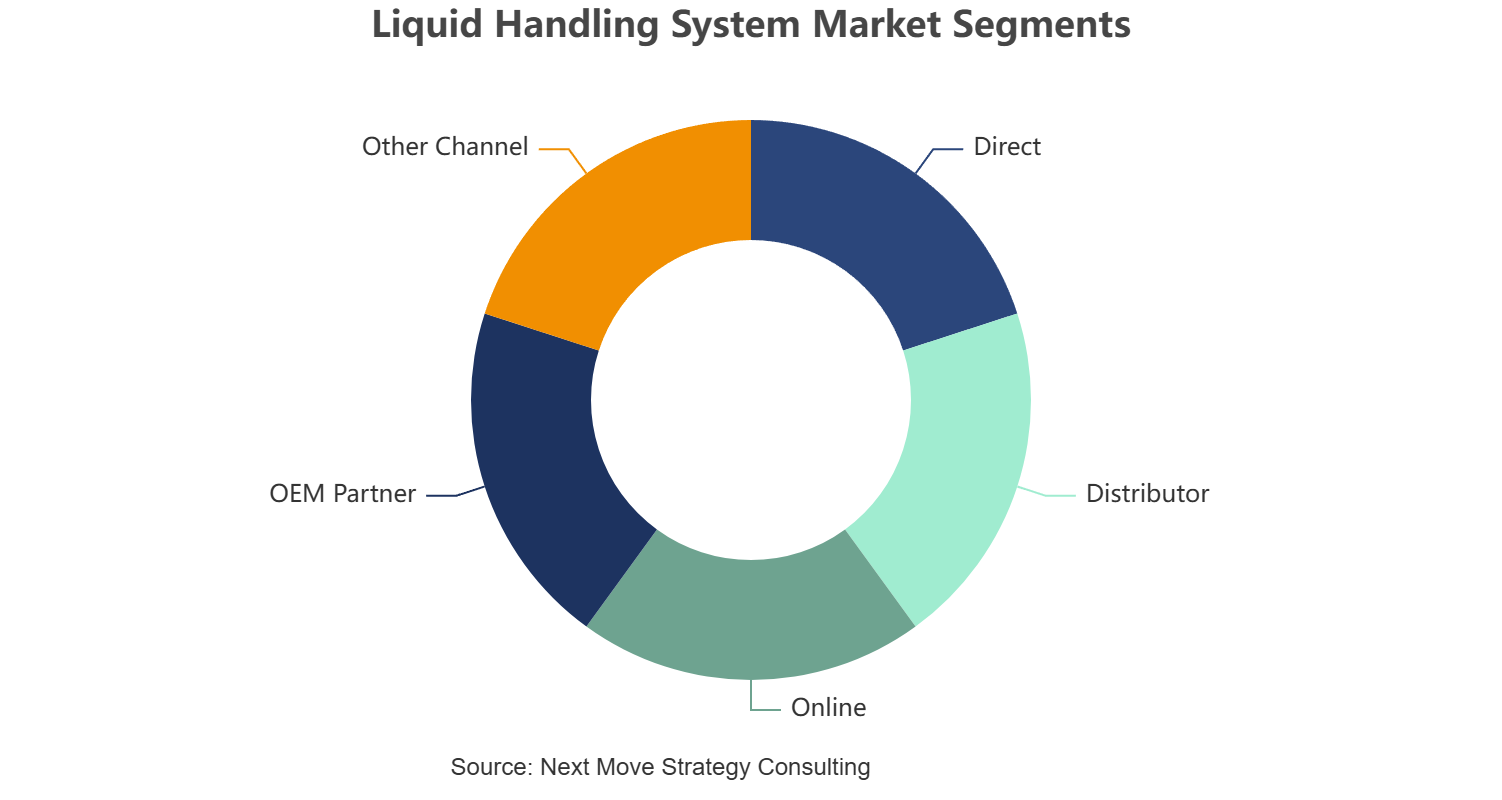
On the basis of channel, the market is segmented into direct sales, distributors, online channels, OEM partners, and other channels. Regional breakdown and analysis of each of the aforesaid segments includes North America, Europe, Asia-Pacific, and RoW.
Geographical Analysis
North America holds a significant share in the global liquid handling system market, underpinned by advanced healthcare infrastructure, high R&D investment, and strong adoption of precision medicine. The U.S. continues to lead due to initiatives like the Precision Medicine Initiative and growing demand for automated sample preparation in genomic research. A notable development includes Revvity’s launch of the Fontus Automated Liquid Handling Workstation in July 2023, tailored to streamline NGS and biomarker workflows. As the demand for high-throughput and error-free liquid dispensing rises, North America is expected to maintain its leadership in terms of market size and technological advancement. The integration of AI and robotics is further expanding growth potential, reinforcing the region’s dominant industry growth.
Europe is experiencing steady growth in the market, supported by a strong biotechnology base, increased R&D funding, and rising demand for laboratory automation. Countries like Germany, the U.K., and France are prioritizing high-precision tools for diagnostics and drug development, especially in the wake of increased attention on pandemic preparedness and personalized medicine programs. The European market is also witnessing notable product advancements. In late 2023, SPT Labtech introduced the Firefly, a compact all-in-one liquid handler optimized for next-generation sequencing (NGS) workflows, specifically catering to mid-sized labs. This innovation supports Europe’s trend toward efficient, space-saving solutions in genomics. The region's emphasis on quality control, compliance with regulatory standards, and sustainable lab practices continues to shape market trends, contributing significantly to the overall industry size in Europe.
The Asia-Pacific liquid handling system market is undergoing rapid expansion, fueled by government-backed genomics programs, a rising biotechnology sector, and the widespread push for lab automation across clinical and research domains. Major economies such as China, India, Japan, and South Korea are investing in precision medicine infrastructure. India’s Genome India Project, for example, is driving demand for scalable and automated liquid handling systems for large-scale genetic sequencing. In early 2025, DISPENDIX unveiled the I.DOT LT at SLAS 2025, bringing enhanced dispensing accuracy to emerging markets across Asia-Pacific. The region's growing pool of skilled researchers and the increasing establishment of biopharmaceutical R&D centers are improving the market share. As cost-effective automation gains traction, Asia-Pacific is set to be a major contributor to future market growth potential.
The Rest of the World (RoW) segment, encompassing Latin America, the Middle East, and Africa, is gradually unlocking new opportunities for liquid handling system manufacturers. Growth in this region is supported by expanding life sciences education, increased diagnostics demand, and rising collaborations with global research organizations. Though still in the early stages compared to developed markets, countries such as Brazil, South Africa, and the UAE are investing in laboratory modernization and clinical trial capabilities. In mid-2023, Revvity launched the Fontus Automated Liquid Handling Workstation, tailored for flexible deployment in both developed and emerging labs, a move that aligns with the growing need for adaptable and scalable systems across RoW. As infrastructure improves and global companies increase their footprint in these regions, the industry size in RoW is expected to grow steadily, driven by both public health initiatives and academic research investments.
Strategic Trends in the Liquid Handling System Market
Key players in the global liquid handling system industry are pursuing a mix of strategic partnerships, technological innovation, and geographic expansion to strengthen their market share and address evolving laboratory demands. Companies such as Thermo Fisher Scientific Inc., Beckman Coulter Life Sciences, Tecan Group AG, Eppendorf SE, Hamilton Company, Agilent Technologies, Inc., Revvity, Inc., Mettler-Toledo International Inc., Sartorius AG, Corning Incorporated, INTEGRA Biosciences AG, Gilson, Inc., BRAND GMBH + CO KG, SPT Labtech Ltd., Opentrons Labworks, Inc., Analytik Jena GmbH+Co. KG, FORMULATRIX, Inc., Hudson Robotics, Inc., Bio-Rad Laboratories, Inc., and Nichiryo Co., Ltd. are heavily investing in automation, artificial intelligence (AI), and cloud-based solutions to enhance system performance and user experience.
In March 2026, Thermo Fisher Scientific Inc. launched the Thermo Scientific Fluid Ease Pro ClipTip Electronic Pipette, featuring a high-resolution touchscreen, intelligent power management, and advanced programming capabilities designed to improve reproducibility, ergonomic handling, and workflow efficiency across laboratory applications. The launch further strengthened the company’s position in the automated liquid handling and laboratory workflow solutions market.
However, the growth potential remains substantial. The rising focus on personalized medicine, increased clinical diagnostics automation, and expanding applications in drug discovery are opening new avenues. Strategic collaborations with academic and research institutions, united with demand for low-volume, precision-based systems, position the industry for long-term growth. These market trends signal that a vendor capable of offering scalable, AI-driven, and user-friendly systems will lead the future trajectory of the industry globally.
Key Benefits
-
The report provides quantitative analysis and estimations of the liquid handling system market from 2025 to 2030, which assists in identifying the prevailing industry opportunities.
-
The study comprises a deep-dive analysis of the current and future liquid handling system market trends to depict prevalent investment pockets in the Liquid Handling System market.
-
Information related to key drivers, restraints, and opportunities and their impact on the liquid handling system trend is provided in the report.
-
Competitive analysis of the key players, along with their market share is provided in the report.
-
SWOT analysis and Porters Five Forces model is elaborated in the study.
-
Value chain analysis in the market study provides a clear picture of roles of stakeholders.
Liquid Handling System Market Key Segments
By Product
-
Pipettes
-
Manual Pipettes
-
Electronic Pipettes
-
-
Liquid Handling Workstations
-
Dispensers
-
Bottle-top Dispensers
-
Reagent Dispensers
-
-
Microplate Reagent Dispensers
-
Microplate Washers
-
Burettes
-
Manual Burettes
-
Electronic Burettes
-
-
Accessories
-
Heads and Modules
-
Stackers and Hotels
-
Tip Loaders
-
Grippers and Carriers
-
Other Accessories
-
-
Consumables
-
Tips
-
Tip Racks and Cartridges
-
Reservoirs and Troughs
-
Tubes and Plates
-
Seals and Caps
-
Other Consumables
-
-
Software
-
Control Software
-
Workflow Software
-
Data Software
-
LIMS Connectivity
-
-
Services
-
Installation and Validation
-
Training
-
Maintenance and Calibration
-
Integration and Custom Automation
-
Other Services
-
-
Other Products
By Application
-
Drug Discovery
-
Genomics
-
Clinical Diagnostics
-
Proteomics
-
Cell and Gene Therapy
-
Food Testing
-
Environmental Testing
-
Forensic Testing
-
Academic Research
-
Other Applications
By End User
-
Pharma and Biopharma
-
Biotech
-
CRO and CDMO
-
Academic and Government
-
Clinical Labs
-
Food Labs
-
Environmental Labs
-
Forensic Labs
-
Industrial QC
-
Other Endusers
By Channel
-
Direct
-
Distributor
-
Online
-
OEM Partner
-
Other Channel
By Region
-
North America
-
The U.S.
-
Canada
-
Mexico
-
-
Europe
-
The UK
-
Germany
-
France
-
Italy
-
Spain
-
Denmark
-
Netherlands
-
Finland
-
Sweden
-
Norway
-
Russia
-
Rest of Europe
-
-
Asia-Pacific
-
China
-
Japan
-
India
-
South Korea
-
Australia
-
Indonesia
-
Singapore
-
Taiwan
-
Thailand
-
Rest of Asia-Pacific
-
-
RoW
-
Latin America
-
Middle East
-
Africa
-
Key Players
-
Thermo Fisher Scientific Inc.
-
Beckman Coulter Life Sciences
-
Tecan Group AG
-
Eppendorf SE
-
Hamilton Company
-
Agilent Technologies, Inc.
-
Revvity, Inc.
-
Mettler-Toledo International Inc.
-
Sartorius AG
-
Corning Incorporated
-
INTEGRA Biosciences AG
-
Gilson, Inc.
-
BRAND GMBH + CO KG
-
SPT Labtech Ltd.
-
Opentrons Labworks, Inc.
-
Analytik Jena GmbH+Co. KG
-
FORMULATRIX, Inc.
-
Hudson Robotics, Inc.
-
Bio-Rad Laboratories, Inc.
-
Nichiryo Co., Ltd.
Report Scope and Segmentation
|
Parameters |
Details |
|
Market Size in 2024 |
USD 5.21 Billion |
|
Revenue Forecast in 2030 |
USD 7.77 Billion |
|
Growth Rate |
CAGR of 6.9% from 2025 to 2030 |
|
Analysis Period |
2024–2030 |
|
Base Year Considered |
2024 |
|
Forecast Period |
2025–2030 |
|
Market Size Estimation |
Billion (USD) |
|
Growth Factors |
|
|
Countries Covered |
28 |
|
Companies Profiled |
15 |
|
Market Share |
Available for 10 companies |
|
Customization Scope |
Free customization (equivalent to up to 80 working hours of analysts) after purchase. Addition or alteration to country, regional, and segment scope. |
|
Pricing and Purchase Options |
Avail customized purchase options to meet your exact research needs. |
About the Author
 Jayanta Das is a senior research analyst delivering high-impact market intelligence across global markets. He leads comprehensive studies covering market assessment, forecasting, competitive evaluation, regulatory review, and trend analysis. Known for his structured and methodical approach, Jayanta excels at converting complex datasets into clear, decision-ready insights for leadership teams. His work supports strategic planning through credible sourcing, analytical precision, strong validation frameworks, and well-structured, business-focused reporting that enables confident decision-making.
About the Reviewer
 Supradip Baul is an accomplished business consultant and strategist with over a decade of rich experience in market intelligence, strategy, technology, and business transformation. His work has included rigorous qualitative and quantitative analysis across multiple industries, helping clients shape investment decisions and long-term roadmaps. Earlier in his career, he was associated with Gartner, where he contributed to industry-leading reports and market share analyses. He has worked with leading global companies and holds an MBA with a dual specialization in Marketing and Finance.
At Next Move Strategy Consulting, we understand that insightful market research is the cornerstone of successful business decisions. That's why we employ a robust and multifaceted approach, combining various methodologies to deliver the most accurate and actionable data for our clients.

Research Landscape
We navigate the world of research with two primary approaches:
Qualitative Approach
Our qualitative research methodologies involve immersive techniques such as in-depth interviews, focus groups, and observational studies. By engaging directly with individuals and stakeholders, we uncover valuable insights that quantitative data alone may overlook.

Quantitative Research
In tandem with qualitative methodologies, NMSC leverages the power of Quantitative Research to provide a robust foundation of numerical insights. Through systematic data collection and analysis, we quantify patterns, preferences, and market trends, offering a comprehensive view of the business landscape.
Our quantitative research approach employs diverse tools, including surveys, experiments, and statistical modelling. These methodologies enable us to gather data from a large and representative sample, ensuring the statistical significance of our findings. By employing structured questionnaires and standardized data collection methods, we guarantee the reliability and validity of the information we present to our clients.
Quantitative research is particularly effective in measuring the prevalence of trends, assessing market size, and gauging the impact of various factors on consumer behavior. The numerical precision attained through this approach equips our clients with actionable insights, facilitating data-driven decision-making and strategy formulation.


Our Specialized Toolbox for Industry-Specific Market Research
We deploy a specialized arsenal of techniques tailored to meet your unique requirements. Here's a glimpse into our comprehensive toolbox:

Information Procurement
The stage entails acquiring market data or relevant information through various sources and methodologies.


Market Research Approach
We utilize both top-down and bottom-up approaches in market research analysis to achieve a comprehensive understanding of the market dynamics, leveraging the broad perspective of industry trends and macroeconomic factors alongside detailed insights from specific segments and individual companies.

Porters Five Forces Analysis
We conduct Porter's Five Forces analysis to evaluate the competitive landscape of an industry, providing us with insights into factors that affect profitability and strategic positioning.

SWOT Analysis

Forecasting
We utilize a forecasting model to predict future consumption by considering parameters like population, economics, regulations, market competition, drivers, constraints, technology, and pricing. We also employ statistical techniques such as multilinear regression, exponential smoothing, moving average, ARIMA, and Monte Carlo simulations for accurate predictions. In econometric forecasting, we analyzed short-term and long-term event impacts, attributing values based on regulatory frameworks, economic factors, and market events.





 Speak to Our Analyst