Location-Based Services Market Global Industry Analysis and Forecast (2026-2035)

Location-Based Services Market size was USD 71.06 Billion in 2025, projected to reach USD 330.42 Billion by 2035, growing at a CAGR of 14.6% from 2026 to 2035. Key drivers include rapid smartphone proliferation, expanding enterprise demand for real-time location intelligence, and the mass adoption of IoT-connected devices, with North America leading the market.

Download Free Sample PDF
Base Year (2025)
$71.06 Billion
Forecast (2035)
$330.42 Billion
CAGR (2026-2035)
14.6%
Top Region
North America

What Is the Location-Based Services Market Size?

The Location-Based Services Market size was valued at USD 71.06 Billion in 2025 and is estimated at USD 97.00 Billion in 2026, forecast to reach USD 330.42 Billion by 2035, expanding at a 14.6% CAGR between 2026 and 2035. North America leads with approximately 38% share, while Mapping Services dominates all service types with approximately 22% share in 2025 revenue.

We observed that growth momentum is sharpest in Location Intelligence and Location Tracking segments, as enterprises shift from basic map display toward real-time operational insights, indoor positioning, and AI-driven spatial analytics through 2035.

Location-Based Services Market Global Industry Analysis and Forecast (2026-2035) Revenue Forecast

Values in USD Billion

2025 $71.06 Billion
2025
2026 $97.00 Billion
2026
2027 $111.16 Billion
2027
2028 $127.39 Billion
2028
2029 $145.99 Billion
2029
2030 $167.31 Billion
2030
2031 $191.73 Billion
2031
2032 $219.72 Billion
2032
2033 $251.80 Billion
2033
2034 $288.57 Billion
2034
2035 $330.42 Billion
2035

Key Takeaways

By Service Type: Mapping Services held the largest share of approximately 22% (USD 15.63 Billion) in 2025; Location Intelligence Services is the fastest-growing sub-segment at 17.17% CAGR from 2026–2035.

By Component: Software held the largest share of approximately 52% (USD 36.95 Billion) in 2025; Data is the fastest-growing sub-segment at 18.61% CAGR from 2026–2035.

By Location Environment: Outdoor held the largest share of approximately 48% (USD 34.11 Billion) in 2025; Indoor is the fastest-growing sub-segment at 17.64% CAGR from 2026–2035.

By Technology: GNSS held the largest share of approximately 28% (USD 19.90 Billion) in 2025; UWB is the fastest-growing sub-segment at 22.57% CAGR from 2026–2035.

By Revenue Model: Subscription held the largest share of approximately 34% (USD 24.16 Billion) in 2025; Advertising is the fastest-growing sub-segment at 18.10% CAGR from 2026–2035.

By Distribution Channel: Direct Sales held the largest share of approximately 62% (USD 44.06 Billion) in 2025; Indirect Sales is the fastest-growing sub-segment at 15.87% CAGR from 2026–2035.

By End User: Transportation and Logistics held the largest share of approximately 18% (USD 12.79 Billion) in 2025; Agriculture is the fastest-growing sub-segment at 18.31% CAGR from 2026–2035.

Dominant Region: North America dominated with approximately 38% revenue share (USD 27.00 Billion) in 2025.

Fastest-Growing Region: Asia-Pacific is expected to register the highest CAGR of 16.80% during 2026–2035.

Dominant Country: The U.S. led with approximately USD 22.00 Billion in 2025.

Fastest-Growing Country: India is expected to register the highest CAGR of approximately 21.5% during 2026–2035.

Market Opportunity: The Location-Based Services market is expected to create an absolute dollar opportunity of USD 233.42 Billion between 2026 and 2035, presenting significant investment potential across indoor positioning infrastructure, AI-driven location intelligence platforms, and precision agriculture applications.

According to NMSC analysis, the convergence of 5G densification and ultra-wideband chip integration is compressing location accuracy from meters to centimeters indoors, a shift that is unlocking entirely new revenue streams in healthcare asset tracking, warehouse automation, and retail proximity marketing that were previously impractical at scale.

Ecosystem Analysis of the Location-Based Services Industry

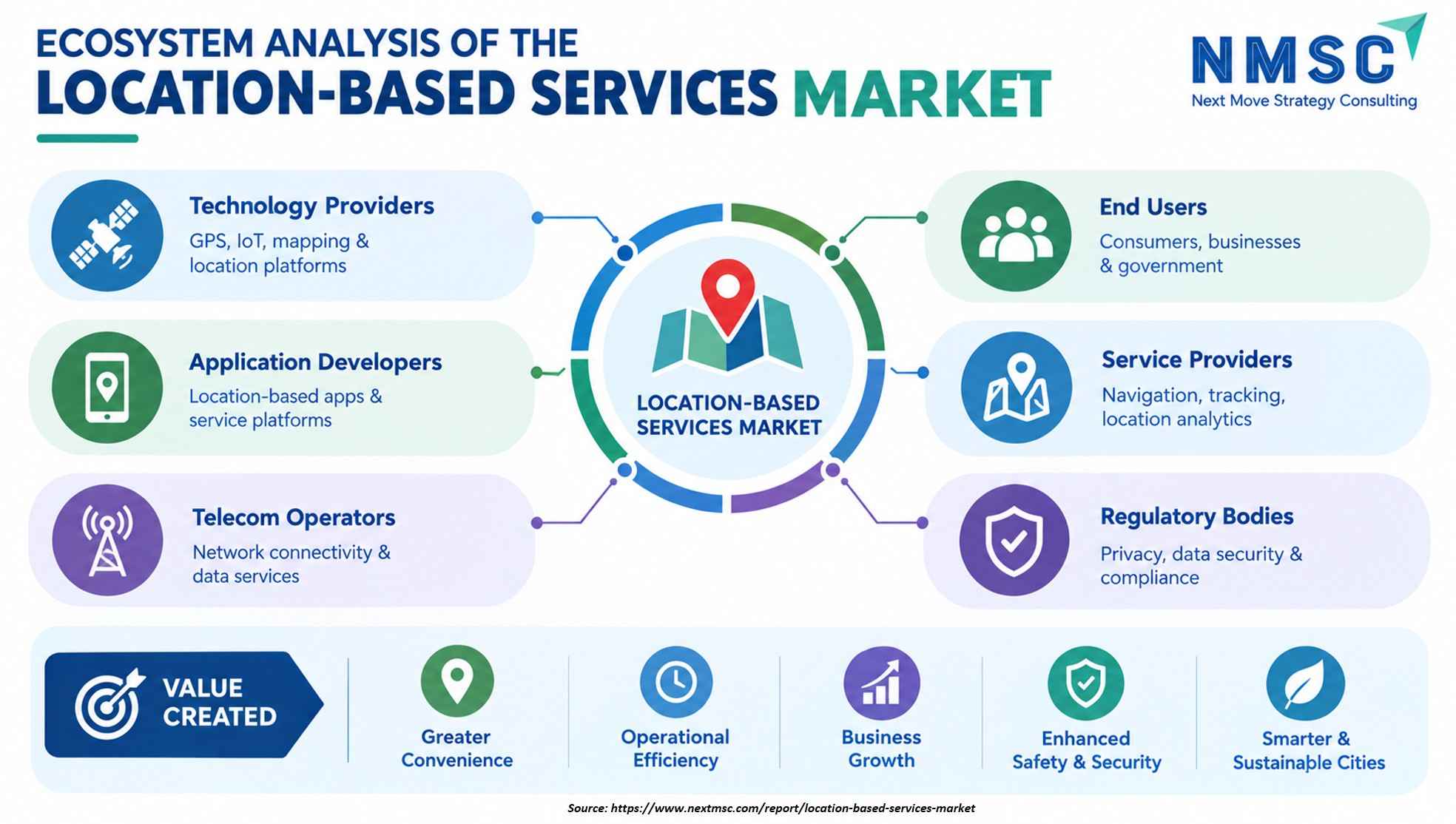
The above infographic presents the ecosystem of the Location-Based Services Market by connecting technology providers, application developers, telecom operators, service providers, end users, and regulatory bodies. It illustrates how location technologies, connectivity, applications, and data-driven services interact to deliver greater convenience, operational efficiency, business growth, enhanced safety, and smarter, more sustainable cities .

What Does the Location-Based Services Market Encompass?

The Location-Based Services Market covers software platforms, data products, and professional services that use real-time and historical geographic position information to deliver mapping, navigation, tracking, intelligence, and advertising applications. Our assessment indicates that the scope spans consumer-facing and enterprise-grade deployments across outdoor GNSS-reliant and indoor positioning and navigation environments, serving end users from transportation fleets and healthcare networks to retail chains and government agencies worldwide.
Regulatory frameworks including the European Union's ePrivacy Directive, the U.S. Federal Communications Commission E-911 location accuracy mandates, and emerging national data-sovereignty rules directly shape data collection and cross-border data transfer practices. We observed that technology adoption is accelerating for ultra-wideband, 5G-based positioning, and sensor fusion architectures that combine GNSS, Wi-Fi, Bluetooth, and inertial data to deliver sub-meter accuracy indoors. NMSC's analysis indicates that these advances are redefining the market from a commercial vehicle telematics -adjacent utility into a foundational enterprise intelligence layer across industries.

Market Drivers & Dynamics

Interactive Dataset
Rapid smartphone proliferation expanding consumer LBS demand driver +3.4% Global 2026-2035
Enterprise adoption of real-time location intelligence platforms driver +2.8% North America, Europe 2026-2035
5G network rollout enabling higher-accuracy cellular positioning driver +2.1% Asia-Pacific, North America 2026-2032
Ultra-wideband chipset integration in consumer and enterprise devices driver +1.6% Global 2026-2032
Growth of precision agriculture and autonomous vehicle LBS demand driver +1.2% Asia-Pacific, North America 2028-2035
IoT device expansion creating new location data endpoints driver +0.9% Global 2026-2035
Data privacy regulations restricting location data collection and use restraint -1.8% Europe, North America 2026-2033
GNSS signal vulnerability in urban canyons and indoor environments restraint -0.9% Global 2026-2031
High cost of indoor positioning infrastructure deployment restraint -0.6% Global 2026-2032
Source: Next Move Strategy Consulting

Growth Drivers

What Is the Primary Growth Driver of the Location-Based Services Market?

Rapid smartphone proliferation driving consumer demand for location-enabled applications is the primary driver of the market. The GSMA's 2025 State of Mobile Internet Connectivity report states that 4.4 billion people using their own smartphone to access mobile internet at the end of 2024, equal to 54% of the global population , providing an enormous installed base for mapping, navigation, and location-based advertising services. We observed that this pervasive device penetration creates self-reinforcing demand as more users generate location data that in turn improves service quality and commercial targeting capability.

How Is Enterprise Location Intelligence Demand Driving Market Growth?

Rising enterprise adoption of real-time location intelligence platforms is accelerating growth as organizations integrate spatial data into logistics, retail, and facility management operations. We found that Trimble Inc. continued to expand its positioning and spatial data platform across construction, agriculture, and transportation enterprise segments through 2025. Our assessment indicates that this enterprise demand shift is elevating average revenue per customer and extending contract duration compared with legacy transactional API usage models.

Growth Inhibitors

What Is Restraining Location-Based Services Market Expansion?

Data privacy regulations restricting location data collection and cross-border transfer are the primary restraint on market growth. The EU General Data Protection Regulation and the California Consumer Privacy Act both impose consent requirements and data minimization obligations on location data processing that limit the breadth of consumer tracking available to advertising and analytics platforms. We found that compliance costs and consent rate limitations are particularly constraining the Location Advertising Services segment's revenue growth potential in regulated markets.

What Are the Growth Opportunities?

How Can Indoor Positioning Infrastructure Investment Capture Healthcare and Retail Demand?

Rising demand for sub-meter indoor location accuracy in hospitals and large retail stores creates a mechanism for infrastructure vendors to deploy UWB and Bluetooth beacon networks under multi-year managed service contracts. Vendors with certified healthcare- grade deployment capability stand to benefit most within the Healthcare end-user segment, the fastest-growing industry vertical at 17.47% CAGR from 2026 to 2035.

What Opportunity Does Precision Agriculture Represent for Location Platform Providers?

Expanding precision agriculture adoption in Asia-Pacific and Latin America creates a mechanism for GNSS and sensor fusion platform providers to supply field-level positioning and variable-rate application systems under subscription models. Providers with multi-constellation GNSS coverage and local agronomic support capability stand to benefit most, capturing the a griculture end-user segment's 18.31% CAGR through 2035.

How Can Location Advertising Platforms Capture Valuefrom Privacy-Safe Identity Solutions?

Growing advertiser demand for privacy-compliant location targeting creates a mechanism for platforms to develop consent-based, aggregated movement intelligence products that comply with GDPR and CCPA while preserving audience addressability. Platforms investing in on-device processing and differential privacy techniques stand to benefit most within the Advertising revenue model segment, which is expanding at 18.10% CAGR from 2026 to 2035.

Segmentation Analysis

2025 (USD Billion)
2035 (USD Billion)
Mapping Services 2025: $15.63 Billion | 2035: $62.78 Billion
Mapping Serv
Navigation Services 2025: $14.21 Billion | 2035: $56.17 Billion
Navigation S
Location Tracking Services 2025: $13.50 Billion | 2035: $69.39 Billion
Location Tra
Location Intelligence Services 2025: $12.79 Billion | 2035: $72.69 Billion
Location Int
Location Advertising Services 2025: $10.66 Billion | 2035: $52.87 Billion
Location Adv
Others 2025: $4.26 Billion | 2035: $16.52 Billion
Others
Mapping Services $15.63 Billion $62.78 Billion 12.74%
Navigation Services $14.21 Billion $56.17 Billion 12.54%
Location Tracking Services $13.50 Billion $69.39 Billion 15.87%
Location Intelligence Services $12.79 Billion $72.69 Billion 17.17%
Location Advertising Services $10.66 Billion $52.87 Billion 15.41%
Others $4.26 Billion $16.52 Billion 12.29%

Which Service Type Dominates the Location-Based Services Market?

Mapping Services led the market with USD 15.63 Billion in 2025, reflecting the foundational role of digital map platforms in consumer and enterprise location applications. Location Intelligence Services is the fastest-growing service type, expanding at a 17.17% CAGR from 2026 to 2035. This reflects enterprise demand for AI-driven spatial analytics that converts raw location data into actionable operational and strategic insights, a higher-value use case than basic map display or turn-by-turn navigation.

2025 (USD Billion)
2035 (USD Billion)
Software
Data
Services
Segment Item 2025 (USD Billion) 2035 (USD Billion) CAGR
Software $10.0 USD Billion $40.0 USD Billion 25.0%
Data $17.1 USD Billion $51.1 USD Billion 11.0%
Services $24.2 USD Billion $62.2 USD Billion 25.0%

Segment-wise data is locked

Unlock complete segment-wise numbers for By Component.

Unlock Full Data
2025 (USD Billion)
2035 (USD Billion)
Indoor
Outdoor
Indoor and O
Segment Item 2025 (USD Billion) 2035 (USD Billion) CAGR
Indoor $10.0 USD Billion $40.0 USD Billion 27.0%
Outdoor $17.1 USD Billion $51.1 USD Billion 9.0%
Indoor and Outdoor $24.2 USD Billion $62.2 USD Billion 19.0%

Segment-wise data is locked

Unlock complete segment-wise numbers for By Location Environment.

Unlock Full Data
2025 (USD Billion)
2035 (USD Billion)
GNSS
Cellular
Wi-Fi
Bluetooth
UWB
Segment Item 2025 (USD Billion) 2035 (USD Billion) CAGR
GNSS $10.0 USD Billion $40.0 USD Billion 14.0%
Cellular $17.1 USD Billion $51.1 USD Billion 24.0%
Wi-Fi $24.2 USD Billion $62.2 USD Billion 22.0%
Bluetooth $31.3 USD Billion $73.3 USD Billion 12.0%
UWB $38.4 USD Billion $84.4 USD Billion 27.0%

Segment-wise data is locked

Unlock complete segment-wise numbers for By Technology.

Unlock Full Data
2025 (USD Billion)
2035 (USD Billion)
Subscription
Usage-Based
Licensing
Advertising
Professional
Segment Item 2025 (USD Billion) 2035 (USD Billion) CAGR
Subscription $10.0 USD Billion $40.0 USD Billion 24.0%
Usage-Based $17.1 USD Billion $51.1 USD Billion 22.0%
Licensing $24.2 USD Billion $62.2 USD Billion 20.0%
Advertising $31.3 USD Billion $73.3 USD Billion 22.0%
Professional Services $38.4 USD Billion $84.4 USD Billion 13.0%

Segment-wise data is locked

Unlock complete segment-wise numbers for By Revenue Model.

Unlock Full Data
2025 (USD Billion)
2035 (USD Billion)
Direct Sales
Indirect Sal
Segment Item 2025 (USD Billion) 2035 (USD Billion) CAGR
Direct Sales $10.0 USD Billion $40.0 USD Billion 23.0%
Indirect Sales $17.1 USD Billion $51.1 USD Billion 9.0%

Segment-wise data is locked

Unlock complete segment-wise numbers for By Distribution Channel.

Unlock Full Data
2025 (USD Billion)
2035 (USD Billion)
Transportati
Automotive
Retail
Healthcare
Manufacturin
Segment Item 2025 (USD Billion) 2035 (USD Billion) CAGR
Transportation and Logistics $10.0 USD Billion $40.0 USD Billion 21.0%
Automotive $17.1 USD Billion $51.1 USD Billion 23.0%
Retail $24.2 USD Billion $62.2 USD Billion 25.0%
Healthcare $31.3 USD Billion $73.3 USD Billion 15.0%
Manufacturing $38.4 USD Billion $84.4 USD Billion 16.0%

Segment-wise data is locked

Unlock complete segment-wise numbers for By End User.

Unlock Full Data

Which End User Segment Leads the Location-Based Services Market?

Transportation and Logistics led end-user demand with USD 12.79 Billion in 2025, driven by fleet route optimization, last-mile delivery tracking, and multimodal logistics visibility platforms. Agriculture is the fastest-growing end-user segment at 18.31% CAGR from 2026 to 2035, as precision farming platforms integrate GNSS, sensor fusion, and spatial analytics to optimize field operations. This growth reflects expanding automotive OEM telematics and agri -tech investment in emerging economies alongside established North American and European markets.

2025 (USD Billion)
2035 (USD Billion)
North Americ
Canada
Mexico
Europe: UK
Germany
Segment Item 2025 (USD Billion) 2035 (USD Billion) CAGR
North America: U.S. $10.0 USD Billion $40.0 USD Billion 9.0%
Canada $17.1 USD Billion $51.1 USD Billion 23.0%
Mexico $24.2 USD Billion $62.2 USD Billion 9.0%
Europe: UK $31.3 USD Billion $73.3 USD Billion 23.0%
Germany $38.4 USD Billion $84.4 USD Billion 8.0%

Segment-wise data is locked

Unlock complete segment-wise numbers for By Region.

Unlock Full Data

Which Region Leads the Location-Based Services Market?

North America led the market with USD 27.00 Billion in 2025, reflecting the region's high smartphone penetration, mature enterprise software adoption, and the concentration of platform providers including Google, Apple, and HERE. Asia-Pacific is the fastest-growing region, registering a 16.80% CAGR from 2026 to 2035, driven by rapid 5G rollout, surging e-commerce and logistics demand, and growing government investment in smart city and digital infrastructure programs across China, India, and Southeast Asia.

Growth Opportunities

We found that three forward-looking whitespace opportunities stand out for stakeholders positioning within the Location-Based Services market over the 2026–2035 forecast period.

How Can Indoor Positioning Infrastructure Investment Capture Healthcare and Retail Demand?

Rising demand for sub-meter indoor location accuracy in hospitals and large retail stores creates a mechanism for infrastructure vendors to deploy UWB and Bluetooth beacon networks under multi-year managed service contracts. Vendors with certified healthcare- grade deployment capability stand to benefit most within the Healthcare end-user segment, the fastest-growing industry vertical at 17.47% CAGR from 2026 to 2035.

What Opportunity Does Precision Agriculture Represent for Location Platform Providers?

Expanding precision agriculture adoption in Asia-Pacific and Latin America creates a mechanism for GNSS and sensor fusion platform providers to supply field-level positioning and variable-rate application systems under subscription models. Providers with multi-constellation GNSS coverage and local agronomic support capability stand to benefit most, capturing the a griculture end-user segment's 18.31% CAGR through 2035.

How Can Location Advertising Platforms Capture Valuefrom Privacy-Safe Identity Solutions?

Growing advertiser demand for privacy-compliant location targeting creates a mechanism for platforms to develop consent-based, aggregated movement intelligence products that comply with GDPR and CCPA while preserving audience addressability. Platforms investing in on-device processing and differential privacy techniques stand to benefit most within the Advertising revenue model segment, which is expanding at 18.10% CAGR from 2026 to 2035.

Regional Outlook

2025 (USD Billion)
2035 (USD Billion)
North Americ
Asia-Pacific
Europe
Latin Americ
Middle East
Region 2025 (USD Billion) 2035 (USD Billion) CAGR (%)
North America $10.0 USD Billion $40.0 USD Billion 9.0%
Asia-Pacific $17.1 USD Billion $51.1 USD Billion 27.0%
Europe $24.2 USD Billion $62.2 USD Billion 25.0%
Latin America $31.3 USD Billion $73.3 USD Billion 23.0%
Middle East & Africa $38.4 USD Billion $84.4 USD Billion 12.0%

Regional data is locked

Unlock complete regional numbers for this market.

Unlock Full Data

Supply Chain Analysis of the Location-Based Services Industry

Supply Chain Analysis of the Location-Based Services Industry
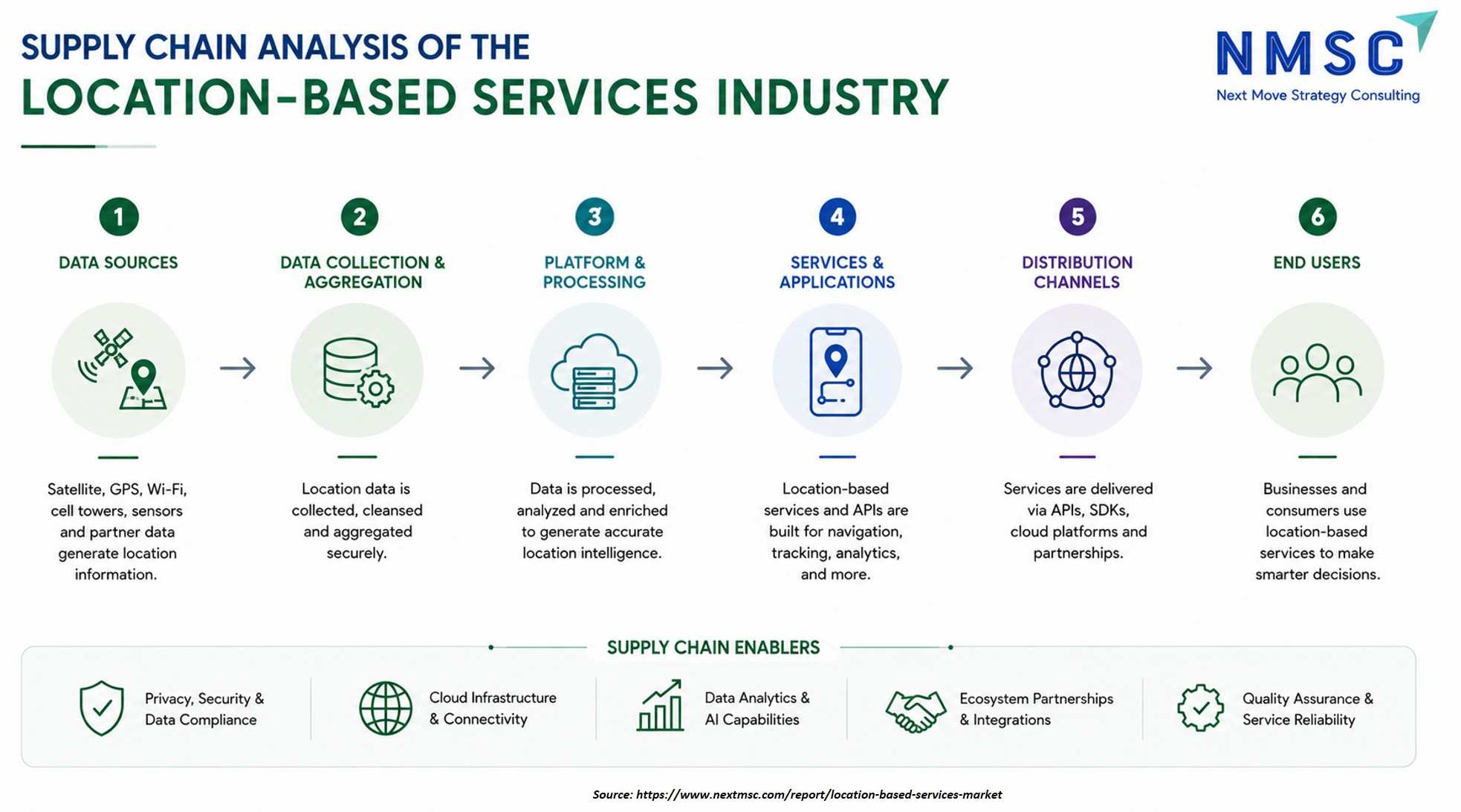
The above infographic provides a detailed supply chain analysis of the Location-Based Services Market , outlining a six-step flow from data sources to end users. It traces the process from satellite and GPS data collection through platform processing to the delivery of services via APIs and SDKs. The analysis further highlights crucial supply chain enablers, such as privacy compliance, cloud infrastructure, and AI capabilities, that support the ecosystem. Ultimately, it illustrates how this interconnected chain empowers businesses and consumers to make smarter decisions using accurate location intelligence .

Competitive Landscape

During our market evaluation, we noticed that the Location-Based Services market features a polarized competitive landscape, with global hyperscaler platform owners and specialised geospatial software vendors competing on data depth, accuracy infrastructure, and developer ecosystem breadth across theindustry. Key Takeaways

Dimension Description
Market Structure Moderately concentrated at the platform layer, with Google, Apple, HERE, and Esri controlling the dominant mapping and analytics platforms; highly fragmented at the application and integration layer across hundreds of vertical-specific LBS solution providers.
Innovation Focus Ultra-wideband indoor positioning, AI-powered spatial analytics, 5G-native positioning APIs, privacy-preserving location intelligence, and autonomous vehicle HD mapping dominate current innovation investment.
M&A Activity Continued strategic acquisition of geospatial data assets and AI analytics firms, exemplified by Trimble's ongoing portfolio expansion and Qualcomm's technology licensing and partnership activity in automotive and IoT positioning.

How Do Companies Compete in the Location-Based Services Market?

Companies compete on four primary dimensions across the industry: mapping data quality and coverage depth, positioning technology accuracy, developer platform ecosystem breadth, and enterprise analytics capability. Google and Apple leverage dominant consumer device ecosystems and global mapping investment to sustain platform incumbency, while HERE and TomTom compete on automotive-grade HD mapping and enterprise data licensing, and Esri competes on professional GIS software depth for government and infrastructure customers.

Which Competitive Archetypes Dominate the Location-Based Services Industry?

Three archetypes define the competitive landscape. First, consumer platform hyperscalers , Google and Apple , compete through device integration and advertising revenue models. Second, professional mapping and enterprise geospatial vendors , HERE, TomTom, Esri, and Trimble , compete through data licensing and SaaS subscription models targeting enterprise and automotive customers. Third, hardware-integrated positioning specialists , Qualcomm, Garmin, and Zebra Technologies , compete through chipset-level accuracy and sector-specific hardware-software bundling.

How Are Companies Differentiating Through Innovation in Location-Based Services?

Innovation increasingly centers on AI-powered spatial prediction, privacy-first location data architecture, and sub-meter indoor accuracy. Mapbox has differentiated through an open- source , developer-first platform with customizable map rendering, while Qualcomm has integrated UWB positioning technology directly into Snapdragon chipsets. Our analysis shows that companies failing to demonstrate either centimeter -accurate indoor positioning or GDPR-compliant data processing are losing enterprise procurement bids to more specialized competitors.

What M&A and Expansion Activity Is Shaping the Location-Based Services Market?

Acquisition activity is concentrated on geospatial data assets, AI analytics capability, and vertical-specific LBS application businesses. Trimble Inc. has sustained a multi-year acquisition strategy targeting precision positioning and spatial software firms across agriculture, construction, and transportation. Microsoft Corporation has deepened its Azure Maps platform through internal investment and API partnerships rather than large-scale acquisitions, while Oracle has expanded its spatial analytics capability through its cloud platform integration strategy.

Key Market Players

Our assessment indicates that the following 20 companies are actively shaping platform development, positioning technology innovation, and enterprise adoption within the global Location-Based Services market.

HERE Global B.V. Google LLC Apple Inc. TomTom N.V. Microsoft Corporation Environmental Systems Research Institute, Inc. Baidu, Inc. Mapbox , Inc. Garmin Ltd. Trimble Inc. NavInfo Co., Ltd. C.E. Info Systems Limited Qualcomm Incorporated Zebra Technologies Corporation Cisco Systems, Inc. Oracle Corporation Samsung Electronics Co., Ltd. Telefonaktiebolaget LM Ericsson International Business Machines Corporation NTT DOCOMO, INC.

Latest Developments

We found that recent product launches and platform expansions within the Location-Based Services industry reflect accelerating investment in AI-enhanced mapping, indoor positioning, and enterprise spatial analytics.

Date Event
September 2026 Mapbox introduced a location infrastructure platform for AI applications, including a public-preview Places API covering more than 250 million global points of interest, an agentic mapping engine, Traffic 2.0, natural-language search, and agent tools for maps and navigation.
September 2026 TomTom expanded its partnership with citiEU to support location analytics, traffic intelligence, and mobility solutions across Europe and the Middle East.
July 2026 HERE Technologies partnered with Cariqa to connect EV navigation with charging discovery, pricing, and payment through HERE WeGo .
April 2026 HERE Technologies and Baidu Maps signed an MoU to co-develop global navigation and intelligent-driving map solutions for automakers. The planned collaboration combines HERE’s AI-powered live map and location services with Baidu Maps navigation and R&D capabilities for ADAS, Intelligent Speed Assistance, automated driving, and predictive signal timing.
March 2026 Mapbox was selected by DennoKotsu to modernize the mapping layer of its cloud-based taxi dispatch system, used by approximately 600 operators and 23,000 taxis across Japan.

Expert Insights

Nick Patrick

Nick Patrick

Co-founder and CEO | Radar

"Location-based marketing and messaging is a really powerful tool to drive higher engagement on push notifications, more personalized messaging, foot traffic and ultimately revenue ."

Analyst Interpretation

We observed that this perspective directly supports the increasing integration of location intelligence into customer engagement, marketing, and digital commerce applications. NMSC’s analysis indicates that the evolution of location-based services from basic navigation and tracking capabilities toward real-time personalization is expanding the commercial value of geolocation across retail, financial services, transportation, and mobile applications. The ability to connect a user’s physical location with contextual offers, notifications, and digital experiences is strengthening demand for geofencing, location tracking, mapping APIs, and real-time location intelligence solutions, while increasing the strategic importance of accurate and privacy-aware location data .

Investment Opportunities

What Capital Inflows Are Supporting the Location-Based Services Market?

Venture capital and corporate investment into LBS platform, indoor positioning, and spatial AI startups continued at elevated levels through 2025, with Mapbox , Overture Maps Foundation, and precision agriculture LBS companies attracting notable funding rounds. We observed that enterprise software investors are increasingly treating location intelligence as a core data infrastructure category alongside business intelligence and customer data platforms, driving both private equity and public market capital toward scaled LBS platform operators.

How Is Infrastructure Investment Shaping Location-Based Services Demand?

5G network infrastructure investment by mobile operators across North America, Europe, and Asia-Pacific is directly expanding LBS market opportunity by enabling more accurate cellular positioning without dedicated GNSS hardware. Government smart city programs in the UAE, Saudi Arabia, South Korea, and Singapore are additionally funding location data infrastructure that creates sustained public-sector procurement demand for LBS platform providers with certified spatial data governance capability.

What ESG Considerations Are Influencing Location-Based Services Investment Decisions?

Environmental, social, and governance factors are influencing LBS investment through two primary channels. On the environmental side, route optimization and logistics efficiency applications powered by LBS platforms are increasingly marketed as measurable carbon reduction tools, attracting sustainability-linked procurement from corporate fleet operators. On the governance side, GDPR compliance and data minimization standards are becoming investor due diligence criteria for LBS companies seeking institutional capital in European markets.

Key Benefits for Stakeholders

How Does This Report Benefit Enterprise Technology Leaders?

Enterprise technology leaders gain validated market sizing, segmentation benchmarks across seven axes, and technology adoption analysis that support LBS platform selection and integration roadmap decisions. The report's regional growth data and competitive landscape analysis help CIOs and digital transformation leaders prioritize location intelligence investments against documented market demand trends through 2035.

How Does This Report Benefit Investors and Financial Analysts?

Investors and financial analysts gain a fundamentals-supported 14.6% CAGR projection, segment-level growth trajectories, and competitive positioning analysis that support due diligence on LBS platform vendors. The report's country-level revenue estimates and key driver matrix help analysts identify which geographies and service types offer the strongest risk-adjusted growth exposure within the broader enterprise software and geospatial data investment universe.

How Does This Report Benefit Technology Vendors and Product Teams?

Technology vendors and product teams gain visibility into the fastest-growing sub-segments , Location Intelligence Services (17.17% CAGR), UWB technology (22.57% CAGR), Agriculture end user (18.31% CAGR), and Indoor environment (17.64% CAGR) , enabling product roadmap and go-to-market prioritization aligned with documented enterprise buyer demand shifts through 2035.

Key Market Segments Evaluated

By Service Type

  • Mapping Services
  • Navigation Services
  • Location Tracking Services
  • Location Intelligence Services
  • Location Advertising Services
  • Others

By Component

  • Software
  • Data
  • Services

By Location Environment

  • Indoor
  • Outdoor
  • Indoor and Outdoor

By Technology

  • GNSS
  • Cellular
  • Wi-Fi
  • Bluetooth
  • UWB
  • Sensor Fusion
  • Others

By Revenue Model

  • Subscription
  • Usage-Based
  • Licensing
  • Advertising
  • Professional Services

By Distribution Channel

  • Direct Sales
  • Indirect Sales

By End User

  • Transportation and Logistics
  • Automotive
  • Retail
  • Healthcare
  • Manufacturing
  • Government and Public Safety
  • Telecommunications and Technology
  • Hospitality and Travel
  • Energy and Utilities
  • Construction and Real Estate
  • Agriculture
  • Media and Entertainment
  • Other

By Region

  • North America 
    • U.S.
    • Canada
    • Mexico
  • Europe 
    • UK
    • Germany
    • France
    • Italy
    • Spain
    • Sweden
    • Denmark
    • Finland
    • Netherlands
    • Rest of Europe
  • Asia-Pacific 
    • China
    • India
    • Japan
    • South Korea
    • Taiwan
    • Indonesia
    • Vietnam
    • Australia
    • Philippines
    • Malaysia
    • Rest of APAC
  • Middle East & Africa 
    • Saudi Arabia
    • UAE
    • Egypt
    • Israel
    • Turkey
    • Nigeria
    • South Africa

    • Rest of MEA
  • Latin America 
    • Brazil
    • Argentina
    • Chile
    • Colombia
    • Rest of LATAM

Conclusion & Recommendations

The Location-Based Services market is positioned for strong, sustained growth through 2035 at a 14.6% CAGR, driven by enterprise platform adoption, 5G infrastructure expansion, and UWB-enabled indoor positioning maturity. We expect Location Intelligence Services and Agriculture applications to gain the most structural share, while Mapping and Navigation Services retain large absolute revenue bases supporting platform infrastructure investment.

What Strategic Positioning Should Vendors Pursue?

Vendors should prioritize AI-driven spatial analytics capability, GDPR-compliant data architecture, and indoor positioning accuracy to align with enterprise buyer evaluation criteria. Our assessment indicates that vendors combining platform API breadth with sector-specific vertical solutions , particularly in healthcare, logistics, and precision agriculture , are best positioned to capture the highest-CAGR segments through 2035.

How Attractive Is the Location-Based Services Market for Investment?

The market presents a highly attractive investment case. A validated USD 233.42 Billion absolute dollar opportunity between 2026 and 2035, a 14.6% CAGR, and diversified demand across seven end-user verticals and five regions provide multiple growth vectors that reduce concentration risk compared with single-vertical software investment categories. Asia-Pacific's 16.80% regional CAGR provides additional upside exposure for investors with emerging-market technology allocation mandates.

What Market Shifts and Key Risks Should Stakeholders Monitor?

Stakeholders should monitor escalating data privacy regulation as the primary structural risk. GDPR enforcement actions, California CPPA rulings, and proposed federal privacy legislation in the U.S. could materially constrain the location advertising sub-segment and increase compliance costs for data-intensive analytics platforms. GNSS signal vulnerability in dense urban environments and the capital intensity of indoor positioning infrastructure deployment are secondary risk factors affecting near-term margin profiles.

What Are the Key Growth Pathways Through 2035?

Key growth pathways include scaling Location Intelligence Services across enterprise verticals, deploying UWB indoor positioning infrastructure in healthcare and retail, capturing precision agriculture LBS demand in Asia-Pacific and Latin America, and developing privacy-safe location advertising platforms. NMSC's analysis indicates that providers pursuing these pathways while maintaining strong data governance credentials are best positioned to capture a disproportionate share of the market's projected USD 330.42 billion 2035 revenue base.

Delivered Customizations

We have successfully delivered the following deep-dive customizations:

Client Request Customization Delivered Value Adds
Historical Market Growth Analysis
  • Historical revenue analysis of location-based services across service types, revenue models, and regions.
  • Identifies high-growth service categories and monetization models for investment prioritization.
Company-Level Service Revenue Benchmarking
  • Company-level LBS revenue and active-user or API-transaction benchmarking, using disclosed filings and investor reports.
  • Highlights provider scale and share differences to sharpen competitive positioning.
Market Opportunity Sizing (TAM / SAM / VAM)
  • TAM, SAM, and VAM sizing of location-based services by end user, location environment, and region.
  • Prioritizes addressable segments and regions for entry and expansion decisions.
Positioning Technology Adoption Assessment
  • Adoption mapping of GPS/GNSS, Wi-Fi, Bluetooth beacons, UWB, cellular, and 5G positioning by service type and location environment.
  • Guides technology investment and partnerships for indoor versus outdoor use cases.
Monetization and Pricing Model Benchmarking
  • Benchmarking of subscription, licensing, pay-per-use, advertising, and API pricing models across leading LBS providers and distribution channels.
  • Supports pricing strategy and revenue-model optimization by customer type.
End-User Use Case Demand Analysis
  • Demand assessment of LBS applications across end users such as automotive, retail, logistics, BFSI, healthcare, and government, using public sector and company data.
  • Pinpoints priority verticals and use cases for customer targeting and product development.

FAQs

About the Author

Mayurima Roy

Mayurima Roy

Mayurima Roy is Research Analyst at Next Move Strategy Consulting, where she has spent 4 years working across the firm's full industry coverage rather than a single fixed vertical. Her work centers on structured research, ongoing trend tracking, competitive assessment, and insight-led content development, translating complex market data into clear, decision-ready narratives that support informed client decision-making across diverse global industries, market sectors, and world regions every day.

About the Reviewer

Supradip Baul

Supradip Baul

Supradip Baul is an accomplished business consultant and strategist with over a decade of rich experience in market intelligence, strategy, technology, and business transformation. His work has included rigorous qualitative and quantitative analysis across multiple industries, helping clients shape investment decisions and long-term roadmaps. Earlier in his career, he was associated with Gartner, where he contributed to industry-leading reports and market share analyses. He has worked with leading global companies and holds an MBA with a dual specialization in Marketing and Finance.

Download Free Sample

Gaurav Jaiswal

GAURAV JAISWAL

Founder & CEO

Yano Charge Private Limited

The EV Charging market research report provided by the NextMSC was exceptionally detailed and insightful. It offered a comprehensive analysis that proved to be a game-changer for our strategic planning. Truly a testament to the NextMSC’s expertise and thoroughness in EV market landscape & analysis.

Gustaf Hummel Burstrom

GUSTAF HUMMEL BURSTROM

Founder

Revline Tools AB

Joseph and the team at Next Move Strategy Consulting have been excellent to work with, in supplying us with relevant market data and forecasts for our specific category. We had some special requirements and they were able to do a custom package to suit our needs. We would definitely recommend them to any other company needing market data and forecasts

Kevin Coker

KEVIN COKER

Founder, CEO and Board Diector

Proxima Clinical Research

I have been using Next MSC reports for product positioning in a new geography for a long time. They have by far the best reports I have found and the price is reasonable too!

Kishu Kanda

KISHU KANDA

Strategy Analyst

Accenture

We purchased the AI Consumer Market Report from this company. Not only did they customize the report to meet our specific requirements, but they also showed great flexibility in accommodating our budget. The report we received fully met our expectations. Additionally, they provided prompt and thorough responses to both our pre-purchase and follow-up questions. We look forward to working with this company again in the future.

Rishabh Jogani

RISHABH JOGANI

Strategy Analyst

Accenture Japan

We are incredibly impressed with the market report on the real estate market in India provided by Next Move Strategy Consulting. The report was thorough, insightful, and well-structured, offering deep analysis and actionable recommendations. It not only captured the current trends and dynamics but also provided a forward-looking perspective that has been invaluable for our strategic planning. Their team demonstrated exceptional professionalism, attention to detail, and a profound understanding of the industry. The data-driven insights and clarity of presentation exceeded our expectations, making complex market trends easy to understand. We highly recommend Next Move Strategy Consulting to anyone looking for reliable and comprehensive market research services. Their expertise has given us the confidence to navigate the complexities of the Indian real estate market with clarity and foresight.

Custom Market Research Services

We will customize the research for you if the listed report does not fully match your requirements.

Get 30% Free Customization

Select License

This website uses cookies to ensure you get the best experience on our website. Learn more

✖