Loitering Munition Drone Market Global Industry Analysis and Forecast (2026–2035)

The global Loitering Munition Drone Market size was valued at USD 2.92 billion in 2025 and is estimated at USD 3.35 billion in 2026, forecast to reach USD 12.54 billion by 2035, expanding at a 15.8% CAGR between 2026 and 2035. North America leads with approximately 34% share, while Man-Portable/Tube-Launched systems dominate all other platform types with approximately 44% share.

Download Free Sample PDF
Base Year (2025)
$2.92 Billion
Forecast (2035)
$12.54 Billion
CAGR (2026-2035)
15.8%
Top Region
North America

What Is the Loitering Munition Drone Market Size?

The global loitering munition drone market size was valued at USD 2.92 billion in 2025 and is estimated at USD 3.35 billion in 2026, forecast to reach USD 12.54 billion by 2035, expanding at a 15.8% CAGR between 2026 and 2035. North America leads with approximately 34% share, while man-portable and tube-launched systems dominate all other platform types with approximately 44% share.

We observed that growth is broad-based across every segmentation axis, with vehicle-launched platforms and long-range anti-armor variants driving the dominant structural shifts through 2035.

Loitering Munition Drone Market Global Industry Analysis and Forecast (2026–2035) Revenue Forecast

Values in USD Billion

2025 $2.92 Billion
2025
2026 $3.35 Billion
2026
2027 $3.88 Billion
2027
2028 $4.49 Billion
2028
2029 $5.20 Billion
2029
2030 $6.02 Billion
2030
2031 $6.98 Billion
2031
2032 $8.08 Billion
2032
2033 $9.35 Billion
2033
2034 $10.83 Billion
2034
2035 $12.54 Billion
2035

Key Takeaways

By Platform Type: Man-Portable/Tube-Launched held the largest share of approximately 44% (USD 1.29 billion) in 2025; Vehicle-Launched is the fastest-growing sub-segment at 17.2% CAGR from 2025–2035.

By Range: Short Range (Below 50 km) held the largest share of approximately 51% (USD 1.49 billion) in 2025; Long Range (Above 300 km) is the fastest-growing sub-segment at 19.9% CAGR from 2025–2035.

By Payload Type: High-Explosive Fragmentation Warhead held the largest share of approximately 46% (USD 1.34 billion) in 2025; Non-Kinetic/ISR Payload is the fastest-growing sub-segment at 18.6% CAGR from 2025–2035.

By Guidance System: Electro-Optical/Infrared Guided held the largest share of approximately 41% (USD 1.20 billion) in 2025; AI-Enabled Autonomous Guided is the fastest-growing sub-segment at 21.6% CAGR from 2026–2035.

By End Use: Army held the largest share of approximately 57% (USD 1.66 billion) in 2025; Navy is the fastest-growing sub-segment at 20.1% CAGR from 2026–2035.

Dominant Region: North America dominated with approximately 34% revenue share (USD 0.99 billion) in 2025.

Fastest-Growing Region: Asia-Pacific is projected to register the highest CAGR of 18.1% during 2025–2035.

Dominant Country: U.S. led with approximately USD 0.77 billion in 2025.

Fastest-Growing Country: India is the fastest-growing country at approximately 24.0% CAGR from 2025–2035.

China Market Growth: China is projected to expand at approximately 20.4% CAGR from 2025–2035.

What Does the Loitering Munition Drone Market Encompass?

The loitering munition drone market encompasses expendable and recoverable unmanned aerial systems engineered to loiter over a target area before executing a terminal, precision strike or delivering an intelligence, surveillance, and reconnaissance payload. Our assessment indicates that the scope spans man-portable, vehicle-launched, ship-launched, and rail or canister-launched architectures supplied to army, navy, and air force branches across short, medium, and long-range mission profiles. The category has evolved from a niche special-operations tool into a mainstream infantry and combined-arms asset within the broader military drone market, driven by sustained conflict demand, shrinking sensor and battery costs, and the fielding of dismounted precision-strike programs across allied forces.
Regulatory frameworks such as the U.S. International Traffic in Arms Regulations administered by the U.S. Department of State and the Wassenaar Arrangement's dual-use export control lists shape end-use certification and foreign military sales approval for loitering munition transfers, while NATO STANAG interoperability standards increasingly influence guidance-link and munition-safety design. We observed that technology adoption is shifting toward AI-assisted terminal guidance and man-in-the-loop override architectures that preserve human accountability while improving strike precision. Next Move Strategy Consulting's analysis indicates that this structural shift, combined with expanding air-launched and vehicle-launched integration, is redefining acquisition criteria across the loitering munition drone market.

Porter's Five Forces Analysis of the Loitering Munition Drone Industry

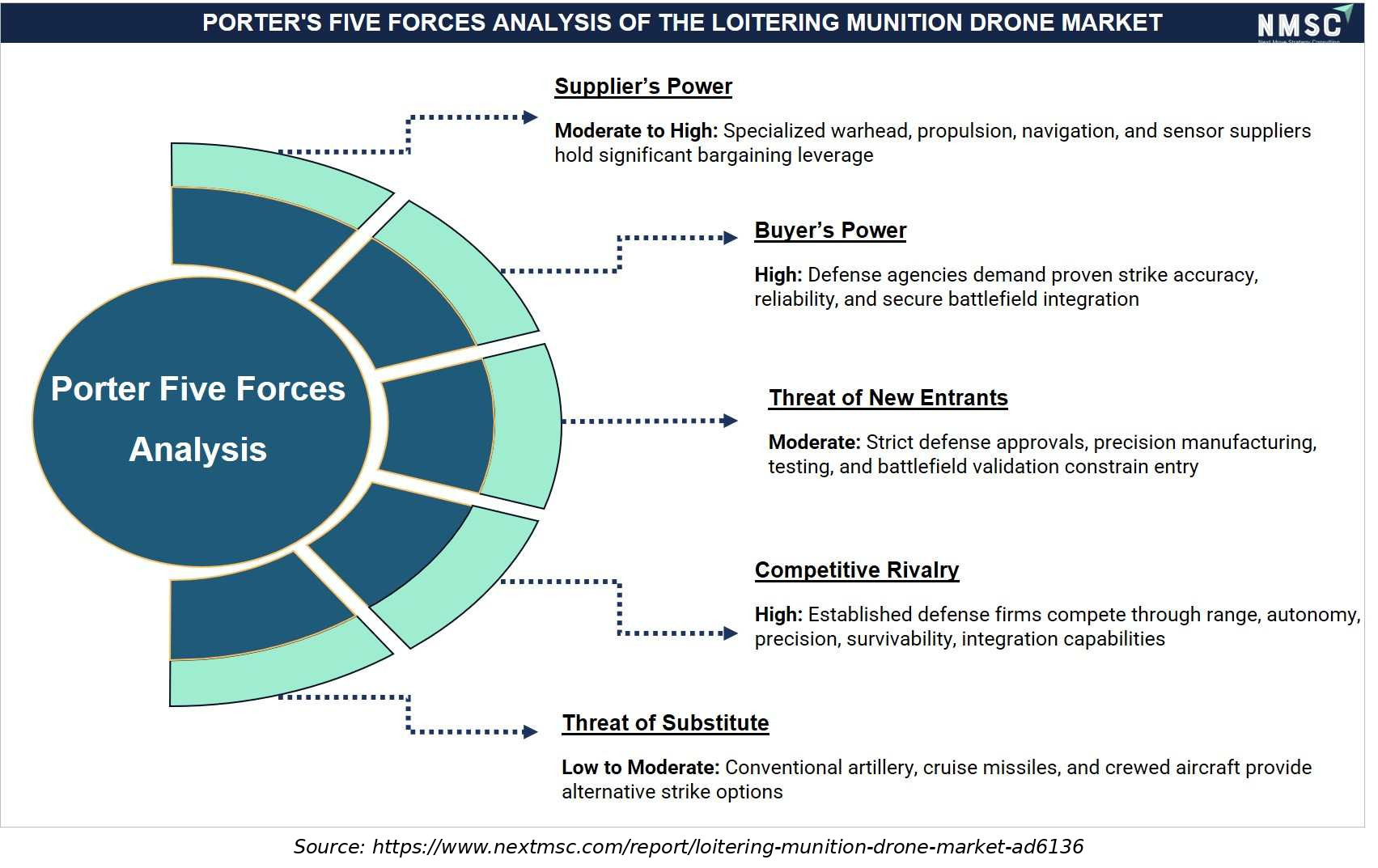
Our analysis shows that competitive rivalry within the Loitering Munition Drone Industry is high as established defense firms compete through range, autonomy, and precision. Furthermore, specialized warhead suppliers and defense agencies exert considerable bargaining power. Concurrently, rigorous battlefield testing and strict defense approvals create moderate entry barriers, while conventional artillery and cruise missiles represent a low-to-moderate threat of substitutes across the global Loitering Munition Drone Industry.

Market Drivers & Dynamics

Interactive Dataset
Sustained conflict-driven battlefield demand driver +3.2% Europe, Middle East & Africa 2026-2035
U.S. Army LASSO and Lethal Unmanned Systems procurement expansion driver +2.6% North America 2026-2031
Rising global defense budgets and precision-strike modernization driver +2.1% Global 2026-2035
Indigenous loitering munition programs across Asia-Pacific driver +1.9% Asia-Pacific 2026-2035
AI-assisted terminal guidance and miniaturized autonomy advances driver +1.6% Global 2026-2035
Expanding foreign military sales and NATO interoperability standards driver +1.2% Europe, North America 2026-2033
Export control and end-use certification restrictions restraint -1.4% Global 2026-2035
Proliferation of counter-UAS and electronic warfare defenses restraint -1.1% Europe, Middle East & Africa 2026-2035
Ethical and regulatory scrutiny of autonomous lethal targeting restraint -0.7% North America, Europe 2028-2035
Source: Next Move Strategy Consulting

Growth Drivers

What Is the Primary Growth Driver of the Loitering Munition Drone Market?

Sustained conflict-driven battlefield demand is the primary driver of the market. The U.S. Army's fiscal 2026-2031 planning allocates close to USD 1.2 billion for its Low-Altitude Stalking and Strike Ordnance program alone, layered atop an existing USD 990 million indefinite-delivery contract for lethal unmanned systems. We observed that this procurement trajectory, reinforced by continuing combat employment across active theaters, anchors baseline demand for man-portable and vehicle-launched loitering munitions across allied defense establishments.

How Is AI-Enabled Autonomy Driving Loitering Munition Market Growth?

Advances in AI-assisted terminal guidance and miniaturized autonomy are accelerating market growth toward higher-value, longer-range systems. The U.S. Defense Advanced Research Projects Agency continues to fund autonomy and swarming research applicable to expendable strike platforms. Our assessment indicates that this technology push, combined with combat feedback loops from ongoing conflicts, is compressing development timelines for next-generation guidance packages across both man-portable and air-launched loitering munition categories.

Growth Inhibitors

What Is Restraining Loitering Munition Drone Market Expansion?

Export control and end-use certification requirements administered under the U.S. International Traffic in Arms Regulations and the multilateral Wassenaar Arrangement restrain the pace of cross-border loitering munition transfers. The U.S. Department of State tracks foreign military sales case processing timelines that can delay allied deliveries by months to years. We found that smaller regional developers face particular exposure, as limited government-to-government sales infrastructure reduces their ability to compete for time-sensitive foreign military sales awards against larger, established primes.

Segmentation Analysis

2025 (USD Billion)
2035 (USD Billion)
Man-Portable/Tube-Launched 2025: $1.29 Billion | 2035: $4.77 Billion
Man-Portable
Vehicle-Launched 2025: $0.82 Billion | 2035: $4.01 Billion
Vehicle-Laun
Ship-Launched 2025: $0.47 Billion | 2035: $2.13 Billion
Ship-Launche
Rail and Canister-Launched 2025: $0.34 Billion | 2035: $1.63 Billion
Rail and Can
Man-Portable/Tube-Launched $1.29 Billion $4.77 Billion 14.0%
Vehicle-Launched $0.82 Billion $4.01 Billion 17.2%
Ship-Launched $0.47 Billion $2.13 Billion 16.3%
Rail and Canister-Launched $0.34 Billion $1.63 Billion 17.0%

What Is Driving Platform Type Segmentation in the Loitering Munition Drone Market?

Platform type divides the market into man-portable, vehicle-launched, ship-launched, and rail or canister-launched architectures, each aligned to a distinct value-chain point of sale and end-user branch. Our analysis shows that man-portable and tube-launched systems dominate with approximately 44% share, reflecting sustained infantry-level procurement across allied armies. Vehicle-launched platforms are the fastest-growing sub-segment at 17.2% CAGR, driven by helicopter and ground-vehicle integration programs that extend standoff range without adding new dismounted-soldier load.

2025 (USD Billion)
2035 (USD Billion)
Short Range
Medium Range
Long Range (
Segment Item 2025 (USD Billion) 2035 (USD Billion) CAGR
Short Range (Below 50 km) $10.0 USD Billion $40.0 USD Billion 25.0%
Medium Range (50-300 km) $17.1 USD Billion $51.1 USD Billion 11.0%
Long Range (Above 300 km) $24.2 USD Billion $62.2 USD Billion 25.0%

Segment-wise data is locked

Unlock complete segment-wise numbers for By Range.

Unlock Full Data

How Does Range Segmentation Shape Loitering Munition Procurement?

Range segmentation separates short, medium, and long-range loitering munitions based on operational reach and launch-platform pairing. We observed that short-range systems below 50 kilometers retain the largest share at approximately 51%, reflecting dismounted infantry and squad-level demand. Long-range systems above 300 kilometers are the fastest-growing sub-segment at 19.9% CAGR, as armies increasingly specify deep-strike loitering munitions capable of engaging high-value targets well beyond the forward line of troops.

2025 (USD Billion)
2035 (USD Billion)
High-Explosi
Anti-Armor W
Thermobaric
Non-Kinetic/
Segment Item 2025 (USD Billion) 2035 (USD Billion) CAGR
High-Explosive Fragmentation Warhead $10.0 USD Billion $40.0 USD Billion 27.0%
Anti-Armor Warhead $17.1 USD Billion $51.1 USD Billion 9.0%
Thermobaric Warhead $24.2 USD Billion $62.2 USD Billion 19.0%
Non-Kinetic/ISR Payload $31.3 USD Billion $73.3 USD Billion 17.0%

Segment-wise data is locked

Unlock complete segment-wise numbers for By Payload Type.

Unlock Full Data

Which Payload Type Leads the Loitering Munition Drone Market?

Payload type segmentation covers high-explosive fragmentation, anti-armor, thermobaric, and non-kinetic or ISR payload configurations. Our findings suggest that high-explosive fragmentation warheads lead with approximately 46% share, reflecting broad utility against personnel and light infrastructure targets. Non-kinetic and ISR payloads are the fastest-growing sub-segment at 18.6% CAGR, as electronic warfare and reconnaissance-configured variants gain adoption for battlefield awareness missions that do not require a kinetic effect.

2025 (USD Billion)
2035 (USD Billion)
Electro-Opti
GPS/INS Guid
Man-in-the-L
AI-Enabled A
Segment Item 2025 (USD Billion) 2035 (USD Billion) CAGR
Electro-Optical/Infrared Guided $10.0 USD Billion $40.0 USD Billion 14.0%
GPS/INS Guided $17.1 USD Billion $51.1 USD Billion 24.0%
Man-in-the-Loop Guided $24.2 USD Billion $62.2 USD Billion 22.0%
AI-Enabled Autonomous Guided $31.3 USD Billion $73.3 USD Billion 12.0%

Segment-wise data is locked

Unlock complete segment-wise numbers for By Guidance System.

Unlock Full Data
2025 (USD Billion)
2035 (USD Billion)
Army
Navy
Air Force
Homeland Sec
Segment Item 2025 (USD Billion) 2035 (USD Billion) CAGR
Army $10.0 USD Billion $40.0 USD Billion 24.0%
Navy $17.1 USD Billion $51.1 USD Billion 22.0%
Air Force $24.2 USD Billion $62.2 USD Billion 20.0%
Homeland Security $31.3 USD Billion $73.3 USD Billion 22.0%

Segment-wise data is locked

Unlock complete segment-wise numbers for By End Use.

Unlock Full Data
2025 (USD Billion)
2035 (USD Billion)
North Americ
Canada
Mexico.
Europe: UK
Germany
Segment Item 2025 (USD Billion) 2035 (USD Billion) CAGR
North America: U.S. $10.0 USD Billion $40.0 USD Billion 23.0%
Canada $17.1 USD Billion $51.1 USD Billion 9.0%
Mexico. $24.2 USD Billion $62.2 USD Billion 19.0%
Europe: UK $31.3 USD Billion $73.3 USD Billion 13.0%
Germany $38.4 USD Billion $84.4 USD Billion 10.0%

Segment-wise data is locked

Unlock complete segment-wise numbers for By Region.

Unlock Full Data

Growth Opportunities

Beyond the core drivers reshaping demand, three forward-looking opportunities stand out for stakeholders positioning across the loitering munition drone value chain.

How Can Modular Payload Architectures Unlock New Revenue Streams?

Modular payload bays that swap between kinetic warheads, electronic warfare modules, and ISR sensors let a single airframe serve multiple mission profiles. This mechanism benefits vehicle-launched and long-range platform manufacturers, which can amortize airframe development costs across army, navy, and air force customers seeking budget flexibility without maintaining separate platform families for each mission type.

What Opportunity Does Naval Integration Present for Loitering Munitions?

Shipborne vertical-launch and deck-launched loitering munition integration is opening a distinct naval procurement channel beyond land-force programs. Navies pursuing distributed lethality concepts benefit from compact, canister-launched systems that supplement missile inventories, creating a mechanism for ship-launched platform suppliers to diversify beyond traditional army-centric sales cycles and access recurring fleet-wide sustainment contracts.

How Does Allied Co-Production Expand Market Access?

Licensed co-production and technology-transfer agreements with allied nations are easing export-control friction while building local industrial capacity. This mechanism benefits established primes and mid-tier developers alike, as co-production structures satisfy offset requirements and accelerate foreign military sales approval, giving suppliers a durable channel into markets that would otherwise face lengthy end-use certification review.

Regional Outlook

2025 (USD Billion)
2035 (USD Billion)
North Americ
Europe
Asia-Pacific
Middle East
Latin Americ
Region 2025 (USD Billion) 2035 (USD Billion) CAGR (%)
North America $10.0 USD Billion $40.0 USD Billion 9.0%
Europe $17.1 USD Billion $51.1 USD Billion 27.0%
Asia-Pacific $24.2 USD Billion $62.2 USD Billion 25.0%
Middle East & Africa $31.3 USD Billion $73.3 USD Billion 23.0%
Latin America $38.4 USD Billion $84.4 USD Billion 12.0%

Regional data is locked

Unlock complete regional numbers for this market.

Unlock Full Data

Regulatory Framework Impacting the Loitering Munition Drone Industry

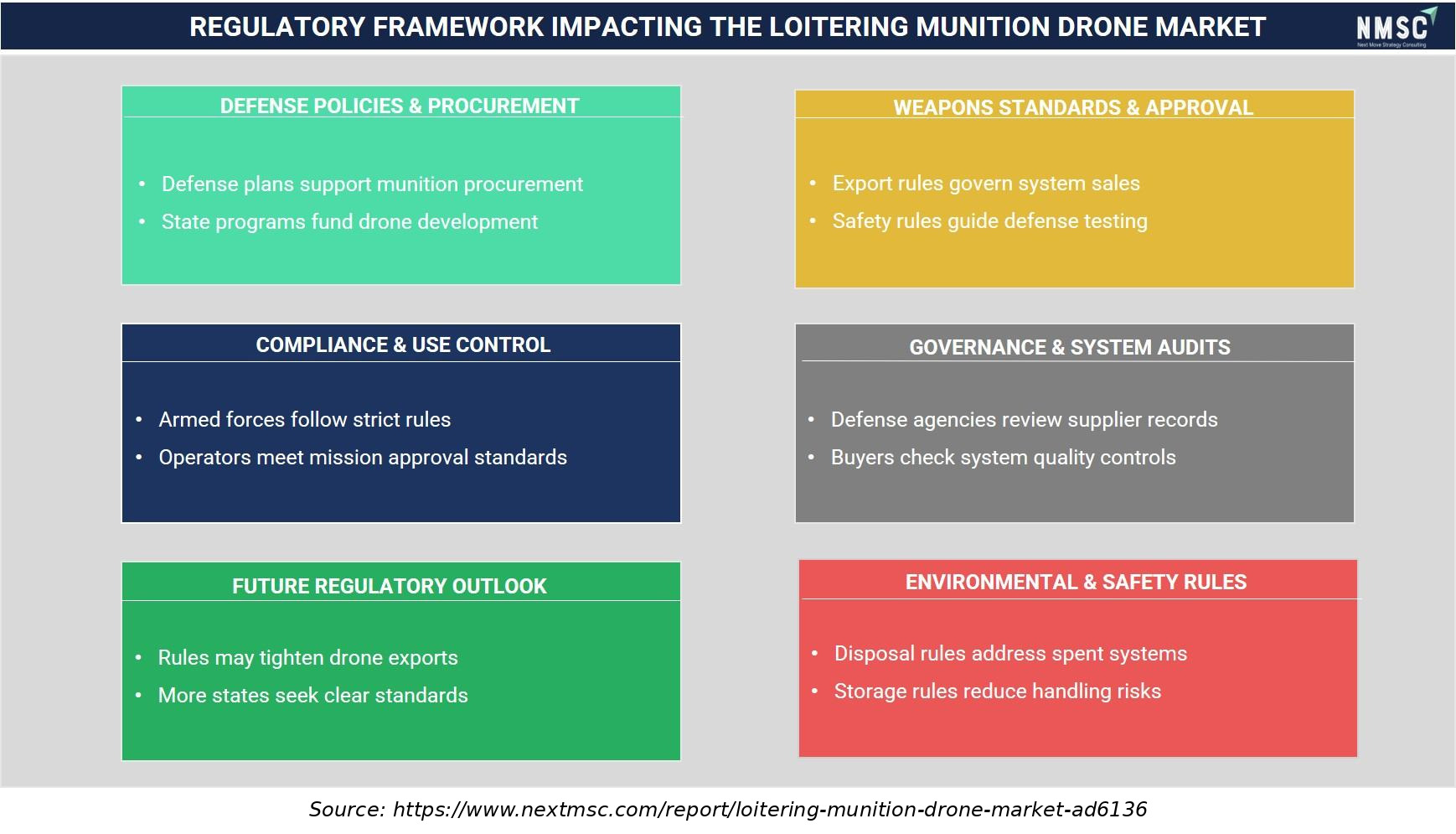
From our research, we found that defense procurement policies and funded state programs drive technological expansion in the Loitering Munition Drone Market. Furthermore, strict export regulations and safety guidelines govern weapons testing and system sales. Concurrently, armed forces enforce rigorous operational controls, while defense agency audits, disposal mandates, and secure storage rules reduce operational hazards, shaping future compliance standards across the global Loitering Munition Drone Industry.

Competitive Landscape

We observed that the competitive landscape spans combat-proven mid-size specialists and diversified aerospace and defense primes, each pursuing distinct paths to scale amid surging global demand.

Dimension Description
Dimension Assessment
Market Structure Moderately fragmented, with a combat-proven specialist tier competing alongside diversified defense primes entering through platform integration
Innovation Focus AI-assisted terminal guidance, modular payload architectures, and helicopter or ground-vehicle launched effects integration
M&A Activity Selective acquisitions of tube-launched and air-launched effects developers by larger primes to close platform-portfolio gaps

How Do Companies Compete in the Loitering Munition Drone Market?

Companies compete primarily on combat-validated reliability, production scale, and speed of delivery against urgent military requirements. Our findings suggest that suppliers with established indefinite-delivery contract vehicles, such as AeroVironment's multi-year U.S. Army agreements, hold a durable advantage in recurring procurement cycles. Newer entrants compete on software-defined autonomy and manufacturing agility, often securing prototype awards before scaling toward production-rate contracts.

Which Competitive Archetypes Dominate the Loitering Munition Drone Market?

Two archetypes dominate: specialist loitering munition developers with deep platform-specific expertise, and diversified aerospace and defense primes that integrate loitering effects into broader combat-system portfolios. We observed that specialists differentiate through combat pedigree and rapid iteration, while primes differentiate through systems integration, sustainment networks, and the ability to bundle loitering munitions within larger platform and software ecosystems across the wider defense industry.

What Innovation and Differentiation Strategies Shape the Market?

Innovation strategy centers on modular payload swapping, AI-assisted guidance resilient to jamming, and cross-platform launch integration spanning ground vehicles, rotary-wing aircraft, and naval vessels. Our analysis shows that manufacturers investing in open-architecture autonomy software gain flexibility to update targeting algorithms without redesigning airframes, a differentiation strategy increasingly demanded by defense customers seeking rapid technology refresh cycles.

How Active Is M&A Activity Across the Loitering Munition Drone Market?

M&A activity remains selective but strategically significant, with larger primes acquiring specialized air-launched effects and tube-launched developers to close capability gaps quickly. We found that this consolidation trend, combined with expanding foreign military sales and geographic footprint expansion into allied co-production arrangements, is reshaping competitive positioning as established players seek to defend share against agile, venture-backed entrants.

Key Market Players

Our assessment indicates that the following companies represent the leading, verified participants shaping the global loitering munition drone Industry based on market-specific revenue, production scale, and validated program activity.

AeroVironment, Inc. Elbit Systems Ltd. Israel Aerospace Industries Ltd. UVision Air Ltd. STM Savunma Teknolojileri Mühendislik A.Ş. Aselsan A.Ş. Rafael Advanced Defense Systems Ltd. Anduril Industries, Inc. RTX Corporation Leonardo S.p.A. Rheinmetall AG QinetiQ Group plc Teledyne Technologies Incorporated WB Group (Grupa WB S.A.) Turkish Aerospace Industries, Inc. Northrop Grumman Corporation L3Harris Technologies, Inc. ST Engineering Ltd. Textron Inc. (parent of Textron Systems) Kongsberg Gruppen ASA

Latest Developments

We observed a wave of program awards and platform integrations across 2025 and 2026 that illustrate accelerating institutional demand for loitering munition systems.

Date Event
June 2026 Elbit Systems and Diehl Defence signed a strategic partnership to jointly offer the SkyStriker loitering munition to Germany’s Bundeswehr. If selected, the companies will produce and support the system, which provides autonomous long-range precision strike capability with over 200-kilometer range and multiple launch options.
May 2026 AeroVironment received a U.S. Army prototype agreement for the Switchblade 400 under the Low-Altitude Stalking and Strike Ordnance program. The system is intended to support rapidly deployable precision strike, featuring a man-portable design, modular architecture and AI-enabled targeting for tactical operations.
April 2026 Rheinmetall received a major Bundeswehr framework contract for large quantities of its FV-014 loitering munition. The framework is worth billions of euros, with an initial call-off of approximately USD 300 million and optional procurement of a five-figure number of autonomous reconnaissance and strike drones.
February 2026 AeroVironment received a USD 186 million U.S. Army delivery order for Switchblade 600 Block 2 and Switchblade 300 Block 20 EFP loitering munition systems. It represents the Army’s first procurement of AV’s upgraded Switchblade family under the existing USD 990 million Lethal Unmanned Systems contract.
December 2025 Teledyne FLIR Defense secured a USD 42.5 million U.S. Marine Corps contract for more than 600 Rogue 1 reusable loitering munition systems, alongside ground control stations and training kits. Fielding is planned for Marine Corps units under the Organic Precision Fires-Light program beginning in summer 2026.

Investment Opportunities

How Are Capital Inflows Shaping the Loitering Munition Drone Market?

Capital inflows into loitering munition developers have accelerated as venture and private-equity investors target defense technology alongside traditional government funding. Our findings suggest that publicly disclosed multi-year indefinite-delivery contract vehicles, including AeroVironment's USD 990 million U.S. Army agreement, provide revenue visibility that continues to attract growth-stage capital into the sector.

What Infrastructure Investment Is Supporting Market Expansion?

Manufacturers are expanding production infrastructure to meet surging order backlogs, including new assembly and integration capacity in California and expanded manufacturing footprints announced by emerging entrants. We observed that this infrastructure build-out is a leading indicator of sustained demand, as suppliers rarely commit capital to new facilities without multi-year order visibility from defense customers.

What ESG Considerations Apply to Loitering Munition Investment?

Environmental, social, and governance considerations for loitering munition investment center on governance controls around lethal autonomy, export compliance, and end-use monitoring rather than traditional environmental metrics. Our assessment indicates that institutional investors increasingly require documented human-oversight safeguards and export-control compliance programs as a precondition for defense-sector capital allocation in this category.

Key Benefits for Stakeholders

How Does This Report Benefit Defense Industry Leaders?

Defense industry leaders gain a validated view of platform-type, range, and payload segmentation alongside country-level demand signals, supporting capital allocation and product-roadmap decisions. The report's forecasts and competitive benchmarking help program executives prioritize investment across the highest-growth vehicle-launched and long-range sub-segments identified through 2035.

How Does This Report Benefit Investors and Financial Analysts?

Investors and financial analysts benefit from consistent, cross-validated market-size and CAGR figures spanning the base year through the forecast horizon, supporting due diligence on public and private loitering munition developers. The report's regional and segment-level data help analysts assess revenue durability against disclosed government procurement pipelines.

How Does This Report Benefit Technology Vendors and Product Teams?

Technology vendors and product teams supplying guidance, propulsion, and payload subsystems gain visibility into which platform types and payload categories are growing fastest, informing where to prioritize engineering resources. The report's competitive landscape analysis further clarifies which integration partnerships offer the most durable long-term revenue channels.

Key Market Segments Evaluated

By Platform Type

  • Man-Portable/Tube-Launched
  • Vehicle-Launched
  • Ship-Launched
  • Rail and Canister-Launched

By Range

  • Short Range (Below 50 km)
  • Medium Range (50-300 km)
  • Long Range (Above 300 km)

By Payload Type

  • High-Explosive Fragmentation Warhead
  • Anti-Armor Warhead
  • Thermobaric Warhead
  • Non-Kinetic/ISR Payload

By Guidance System

  • Electro-Optical/Infrared Guided
  • GPS/INS Guided
  • Man-in-the-Loop Guided
  • AI-Enabled Autonomous Guided

By End Use

  • Army
  • Navy
  • Air Force
  • Homeland Security

By Region

  • North America: U.S.
  • Canada
  • Mexico.
  • Europe: UK
  • Germany
  • France
  • Italy
  • Spain
  • Sweden
  • Denmark
  • Finland
  • Netherlands
  • Rest of Europe.
  • Asia-Pacific: China
  • India
  • Japan
  • South Korea
  • Taiwan
  • Indonesia
  • Vietnam
  • Australia
  • Philippines
  • Malaysia
  • Rest of APAC.
  • Middle East & Africa: Saudi Arabia
  • UAE
  • Egypt
  • Israel
  • Turkey
  • Nigeria
  • South Africa
  • Rest of MEA.
  • Latin America: Brazil
  • Argentina
  • Chile
  • Colombia
  • Rest of LATAM.

Conclusion & Recommendations

The long-term outlook remains strongly positive, with the market projected to grow from USD 3.35 billion in 2026 to USD 12.54 billion by 2035 at a 15.8% CAGR. We observed that sustained conflict-driven demand, expanding indigenous programs, and deepening platform integration across air, land, and sea launch modes together support a durable, multi-decade growth trajectory for the category.

What Strategic Positioning Should Suppliers Pursue?

Suppliers should prioritize modular, multi-mission payload architectures and diversified launch-platform integration to capture demand across army, navy, and air force customers simultaneously. Our findings suggest that companies combining combat-validated reliability with scalable production capacity are best positioned to win recurring, multi-year procurement vehicles rather than one-off prototype awards.

How Attractive Is the Market for New Investment?

Investment attractiveness remains high given visible multi-year government procurement pipelines and expanding foreign military sales activity. We found that the sector's revenue visibility, anchored by disclosed indefinite-delivery contract vehicles, continues to draw growth-stage capital alongside traditional defense-sector investors seeking exposure to precision-strike modernization budgets.

What Market Shifts and Key Risks Should Stakeholders Monitor?

Stakeholders should monitor tightening export-control enforcement, the proliferation of counter-loitering-munition defenses, and evolving regulatory scrutiny of autonomous lethal targeting. Our assessment indicates that these factors could compress growth in specific corridors even as aggregate global demand continues to expand, making geographic and end-user diversification an important risk-mitigation strategy.

What Are the Primary Growth Pathways Through 2035?

Primary growth pathways include vehicle-launched and long-range platform expansion, naval integration, and allied co-production arrangements that ease export-control friction. We observed that companies pursuing these pathways simultaneously, rather than relying on a single launch-platform category, are best positioned to sustain above-market growth rates through the 2026-2035 forecast period.

FAQs

About the Author

Saista Faiyaz

Saista Faiyaz

Saista Faiyaz is Research Associate at Next Move Strategy Consulting, where she has covered consumer markets and healthcare technologies for 3 years. Her work includes primary interview review, secondary-source validation, market sizing, and structured analysis of company and industry data. She supports research by comparing evidence across sources, organizing findings into market narratives, and documenting assumptions used in analysis. Her scope includes cross-market benchmarking, and reports.

About the Reviewer

Supradip Baul

Supradip Baul

Supradip Baul is an accomplished business consultant and strategist with over a decade of rich experience in market intelligence, strategy, technology, and business transformation. His work has included rigorous qualitative and quantitative analysis across multiple industries, helping clients shape investment decisions and long-term roadmaps. Earlier in his career, he was associated with Gartner, where he contributed to industry-leading reports and market share analyses. He has worked with leading global companies and holds an MBA with a dual specialization in Marketing and Finance.

Download Free Sample

Gaurav Jaiswal

GAURAV JAISWAL

Founder & CEO

Yano Charge Private Limited

The EV Charging market research report provided by the NextMSC was exceptionally detailed and insightful. It offered a comprehensive analysis that proved to be a game-changer for our strategic planning. Truly a testament to the NextMSC’s expertise and thoroughness in EV market landscape & analysis.

Rishabh Jogani

RISHABH JOGANI

Strategy Analyst

Accenture Japan

We are incredibly impressed with the market report on the real estate market in India provided by Next Move Strategy Consulting. The report was thorough, insightful, and well-structured, offering deep analysis and actionable recommendations. It not only captured the current trends and dynamics but also provided a forward-looking perspective that has been invaluable for our strategic planning. Their team demonstrated exceptional professionalism, attention to detail, and a profound understanding of the industry. The data-driven insights and clarity of presentation exceeded our expectations, making complex market trends easy to understand. We highly recommend Next Move Strategy Consulting to anyone looking for reliable and comprehensive market research services. Their expertise has given us the confidence to navigate the complexities of the Indian real estate market with clarity and foresight.

Ross J Mckenzie

ROSS J MCKENZIE

Business Insight Manager

Staysure Group

“Next MSC have been incredibly helpful in providing detailed & robust information on our market, alongside quantifying growth by different segments. The process to procure was simple and easy, with sample reports and regular contact to ensure we had what we needed. Succinct detail on their sources & methodologies is also greatly received, allowing transparency in this respect helps build trust in the detail you pay for. Joseph in particular was fantastic, and helped ensure efficient provision of the insight pack – thank you NMSC!”.

Kishu Kanda

KISHU KANDA

Strategy Analyst

Accenture

We purchased the AI Consumer Market Report from this company. Not only did they customize the report to meet our specific requirements, but they also showed great flexibility in accommodating our budget. The report we received fully met our expectations. Additionally, they provided prompt and thorough responses to both our pre-purchase and follow-up questions. We look forward to working with this company again in the future.

Pratyush Kumar Das

PRATYUSH KUMAR DAS

Assistant Manager

Polycab India Limited

We would like to express our appreciation for the data and insights provided by nextmsc. We are very pleased with the quality and depth of the information, which has proven to be highly valuable and beneficial for our business decision-making.

Custom Market Research Services

We will customize the research for you if the listed report does not fully match your requirements.

Get 30% Free Customization

Select License

This website uses cookies to ensure you get the best experience on our website. Learn more

✖