Metalized Flexible Packaging Market Size, Share, Growth & Forecast by Material Type (Plastic Films: PET/MET PET, BOPP/MET BOPP, PA/Nylon, PE, CPP, PVC; Paper & Paperboard; Aluminum Foil Laminates; Other Substrates), Packaging Type (Pouches: Stand-up, Pillow, Gusseted, Spouted, Retort; Rollstock; Bags & Sacks; Sachets & Stick Packs; Lidding), Barrier Class, Metallization Process, Film Structure, Recyclability, Sales Channel, and End-Use Industry — Global Analysis 2025–2035
Industry: Materials and Chemical | Publishing Date: June 19, 2026 | Last Updated: October 5, 2026 | No of Pages: N/A | No. of Tables: N/A | No. of Figures: N/A | Format: PDF | Report Code: MC3852
What Is the Metalized Flexible Packaging Market Size?
The global Metalized Flexible Packaging Market was valued at USD 15.31 billion in 2025 and is expected to reach USD 16 billion in 2026. Driven by persistent demand for barrier-enhanced, shelf-stable packaging across food, pharmaceutical, and personal care industries, the market is projected to reach USD 23.88 billion by 2035, advancing at a CAGR of 4.55% from 2026 to 2035. Key growth drivers include the expansion of processed and convenience food consumption worldwide, rising pharmaceutical blister and sachet packaging volumes, accelerating adoption of recyclable mono-material metalized films in response to Extended Producer Responsibility (EPR) regulations, and capital investment in new vacuum metallization capacity across Asia-Pacific.
|
Parameters |
Details |
|
Market Size in 2025 |
USD 15.31 Billion |
|
Market Size in 2026 |
USD 16.00 Billion |
|
Revenue Forecast in 2035 |
USD 23.88 Billion |
|
Growth Rate |
CAGR of 4.55% from 2026 to 2035 |
|
Analysis Period |
2025–2035 |
|
Base Year Considered |
2025 |
|
Forecast Period |
2026–2035 |
|
Market Size Estimation |
Billion USD |
|
Companies Profiled |
20 |
|
Countries Covered |
33 |
|
Market Share |
Top 10 |
Metalized Flexible Packaging Market Overview
What Is the Metalized Flexible Packaging Market?
Metalized flexible packaging refers to flexible substrates plastic films, paper, paperboard, or foil laminates coated with a thin metallic layer, typically aluminum, through vacuum metallization, foil lamination, or sputter deposition. The resulting material delivers superior barrier performance against oxygen, moisture, light, and odors, extending product shelf life without the weight and rigidity of rigid metal containers. The Metalized Flexible Packaging Market spans pouches, rollstock, sachets, lidding films, labels, tubes, and preformed containers serving food, pharmaceutical, personal care, tobacco, and industrial end-markets globally.
How Has the Metalized Flexible Packaging Market Evolved?
The Metalized Flexible Packaging Market has evolved through three distinct phases. The first phase centered on foil-laminated pouches and sachets for snack foods and tobacco, establishing foundational supply chains. The second phase introduced vacuum-metallized PET and BOPP films as cost-effective alternatives to full-foil laminates, enabling lighter-weight, higher-throughput packaging formats. NMSC's analysis indicates that the current phase is defined by the emergence of recyclable mono-material metalized films, co-extruded barrier structures, and digitally printed metallic substrates, driven by circular economy mandates and brand differentiation requirements across fast-moving consumer goods and pharmaceutical markets.
How Do Regulations Influence the Metalized Flexible Packaging Market?
Regulatory frameworks are reshaping the structural composition of the Metalized Flexible Packaging Market. The European Union's Packaging and Packaging Waste Regulation (PPWR) requires all packaging to be recyclable by 2030, compelling converters and brand owners to accelerate development of mono-material metalized structures. EPR schemes in the UK, France, and Germany assign financial responsibility for end-of-life packaging to producers, incentivizing light-weighting and recyclable design. The U.S. Food and Drug Administration (FDA) governs food contact materials including metalized films through 21 CFR 174–178. India's Plastic Waste Management Rules 2022 are similarly reshaping material selection across the fast-growing South Asian market.
How Is Technology Adoption Expanding Across the Metalized Flexible Packaging Market?
Technology adoption across the Metalized Flexible Packaging Market is accelerating along two parallel axes. On the materials side, optical density control in vacuum metallization, atomic layer deposition for ultra-thin barrier coatings, and hybrid sputter-vacuum processes are enabling thinner metallic layers with maintained or improved barrier performance. On the printing and converting side, digital inkjet printing directly onto metalized substrates is enabling short-run personalization and regional brand differentiation. Our assessment indicates that high-barrier co-extruded mono-material films incorporating EVOH or PVDC layers are emerging as technically viable substitutes for mixed-material laminates in high-barrier applications, supporting the recyclability transition.
|
Key Takeaway |
|
By material type, Plastic Films dominated the Metalized Flexible Packaging Market, accounting for approximately USD 9.8 billion in 2025. Within plastic films, Polyester Film (PET/MET PET) holds the largest sub-segment share due to its exceptional barrier properties, heat resistance, and widespread adoption in snack, coffee, and pharmaceutical packaging. |
|
Biaxially Oriented Polypropylene (BOPP/MET BOPP) is the fastest-growing plastic film sub-segment in the Metalized Flexible Packaging Market, driven by rising demand for lightweight snack and confectionery wrappers and its cost advantage over PET in high-volume applications. |
|
By packaging type, Pouches represent the leading format in the Metalized Flexible Packaging Market with an estimated market value of USD 5.5 billion in 2025, underpinned by surging retail demand for stand-up pouches (SUPs) across snack, pet food, and ready-to-eat meal categories. |
|
Sachets and Stick Packs are among the fastest-growing packaging types in the Metalized Flexible Packaging Market, expanding rapidly across emerging markets driven by unit-dose pharmaceutical packaging and single-serve beverage and personal care formats. |
|
By barrier class, High Barrier metalized structures command the dominant position in the Metalized Flexible Packaging Market, representing approximately 55% of total revenue in 2025, reflecting brand owner requirements for extended shelf life and active preservation across premium food and pharmaceutical segments. |
|
Medium Barrier solutions are witnessing the fastest volumetric growth in the Metalized Flexible Packaging Market, particularly in bakery, snack, and personal care categories where partial barrier performance is sufficient and cost-efficiency is the primary purchase criterion. |
|
By metallization process, Vacuum Metallization is the dominant process in the Metalized Flexible Packaging Market, applied across the widest range of plastic film substrates due to its speed, scalability, and cost-effectiveness for flexible packaging converter operations globally. |
|
Recyclable Mono-material Metallized Films and Recyclable Laminate Solutions represent the fastest-growing recyclability classes in the Metalized Flexible Packaging Market, propelled by EPR legislation across Europe, the UK, and increasingly across Asia-Pacific markets through the forecast period. |
|
By end-use industry, Food and Beverage is the dominant vertical in the Metalized Flexible Packaging Market, accounting for approximately USD 10.1 billion in 2025, with Snacks and Confectionery being the single largest sub-category reflecting the global expansion of packaged food retail. |
|
Pharmaceuticals and Healthcare is the fastest-growing end-use industry in the Metalized Flexible Packaging Market at an estimated CAGR of 6.6% from 2026 to 2035, driven by unit-dose blister packaging growth, cold chain sachets for biologics, and expanding OTC medication formats across emerging markets. |
|
North America held the largest regional share of the Metalized Flexible Packaging Market at USD 4.8 billion in 2025, projected to reach USD 7.0 billion by 2035 at a CAGR of 3.8%, supported by large-scale snack, pet food, and pharmaceutical packaging consumption across the U.S. and Canada. |
|
Asia-Pacific is the fastest-growing major region in the Metalized Flexible Packaging Market at a CAGR of 5.4% from 2026 to 2035, advancing from USD 4.3 billion in 2025 to USD 7.3 billion by 2035, driven by urbanization, processed food retail expansion, and new metallization capacity investments in China, India, and Southeast Asia. |
|
China is the single largest country market within Asia-Pacific in the Metalized Flexible Packaging Market, valued at approximately USD 1.8 billion in 2025, anchored by a large domestic flexible packaging manufacturing base and strong export orientation to global consumer goods brands. |
|
India is the fastest-growing national market in the Metalized Flexible Packaging Market at a CAGR of 9.2% from 2026 to 2035, propelled by organized retail expansion, rising disposable incomes, and escalating demand for unit-dose pharmaceutical and FMCG sachets across Tier 2 and Tier 3 cities. |
Key Emerging Trends in the Metalized Flexible Packaging Market
How Are Recyclable Mono-Material Metalized Films Reshaping the Metalized Flexible Packaging Market?
Recyclable mono-material metalized flexible packaging is the most consequential technology trend in the Metalized Flexible Packaging Market. Converter companies have commercialized metallized all-PE and all-PP laminates that maintain sufficient oxygen and moisture barrier performance while meeting single-stream recycling requirements. NMSC's analysis indicates that corporate sustainability commitments from leading food brands are driving this transition. Regulatory pressure from the EU PPWR and the UK Plastic Packaging Tax with a recycled content threshold is forcing accelerated adoption across the premium snack and confectionery segment throughout the forecast period to 2035.
How Is Digital Printing on Metalized Substrates Transforming the Metalized Flexible Packaging Market?
Digital inkjet and digital offset printing technologies are enabling short-run, variable-data printing directly onto metalized flexible substrates without the lead times and plate costs associated with gravure or flexographic printing. From our research, we found that digital printing platforms are gaining adoption among mid-market converters seeking to serve brand owners with regional SKU proliferation. This capability is particularly valuable in the personal care, premium confectionery, and seasonal packaging segments, where rapid design refresh cycles require printing agility. Digital printing on metalized substrates reduces time-to-market from weeks to days, creating competitive differentiation for converters that invest in these platforms.
What Role Is Active and Intelligent Packaging Playing in the Evolution of the Metalized Flexible Packaging Market?
Active and intelligent packaging integration with metalized flexible substrates represents an emerging growth vector in the Metalized Flexible Packaging Market. Oxygen scavengers, moisture absorbers, and antimicrobial agents can be incorporated within or alongside the metallic layer to extend product freshness beyond passive barrier capabilities. Based on NMSC's research, we found that Near-Field Communication (NFC) tags and printed electronics are increasingly being laminated into metalized films for pharmaceutical track-and-trace, anti-counterfeiting, and consumer engagement applications. The European Commission's Food Safety from Farm to Fork strategy is driving interest in smart metalized packaging solutions for supply chain transparency across cold chain food and pharmaceutical applications.
How Is the Expansion of E-Commerce Logistics Influencing the Metalized Flexible Packaging Market Demand?
E-commerce fulfillment is creating new demand parameters for metalized flexible packaging, particularly for food delivery, pharmaceutical direct-to-consumer shipments, and beauty product subscriptions. Through our market assessment, we observed that packages transiting e-commerce logistics networks are subjected to mechanical stresses, temperature fluctuations, and extended transit times that require higher barrier performance than traditional retail shelf packaging. Metalized pouches and insulated mailers with metalized film liners are increasingly specified by meal kit delivery services, pharmaceutical e-tailers, and premium food brands. The continued global expansion of major e-commerce platforms is structurally expanding the addressable market for high-performance metalized flexible packaging solutions across the forecast period.
Ecosystem Analysis of the Metalized Flexible Packaging Market
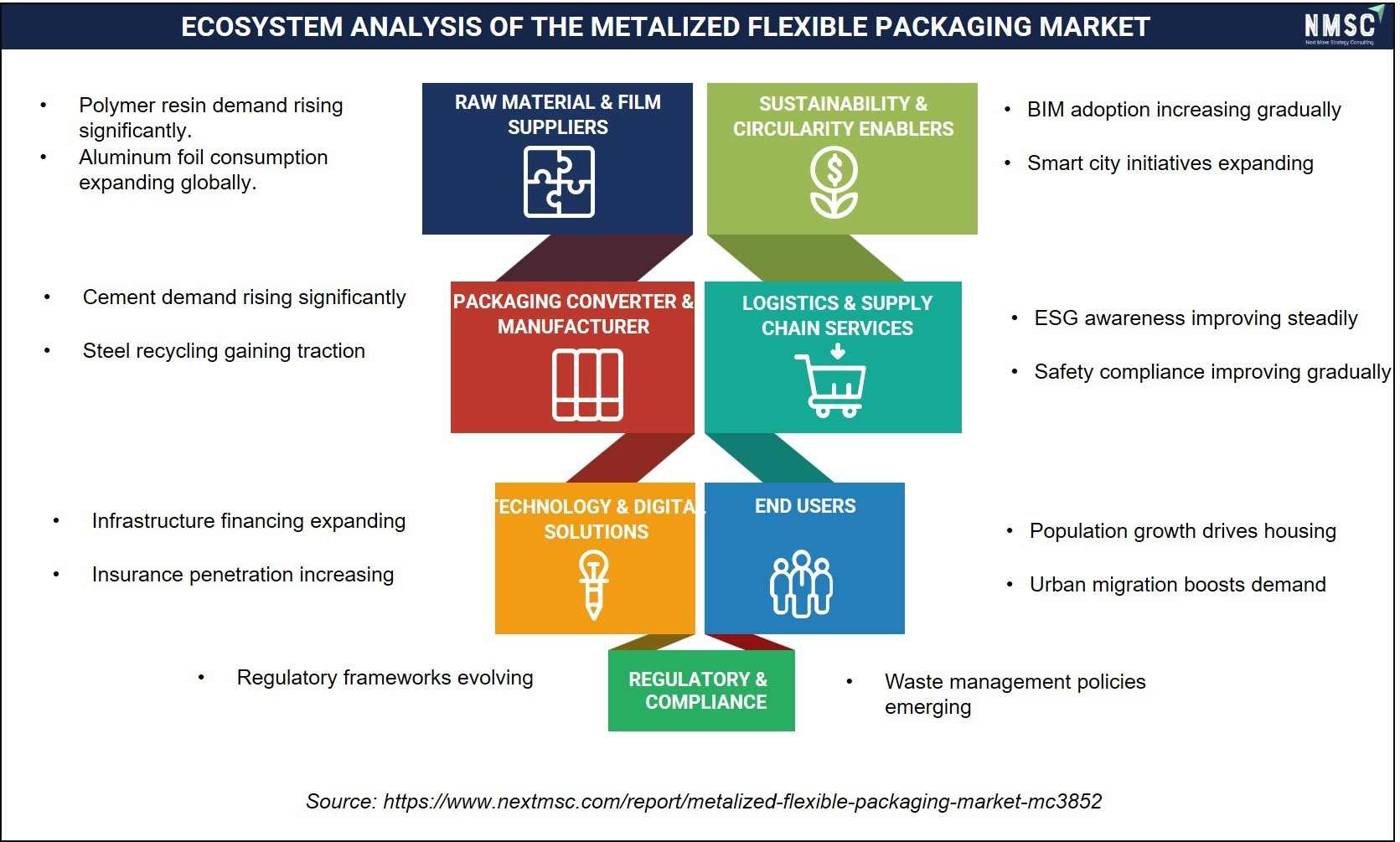
The Metalized Flexible Packaging Market ecosystem comprises interconnected stakeholders that collectively drive innovation, production, distribution, and regulatory compliance. Raw material suppliers provide films, foils, and coatings, while packaging converters manufacture finished packaging solutions. Sustainability enablers support circular economy initiatives, and logistics providers ensure efficient supply chain operations. Technology solution providers enhance manufacturing capabilities, while end users from food, pharmaceutical, and personal care industries generate demand. Regulatory bodies establish standards governing safety, sustainability, recyclability, and environmental compliance across the industry.
What Are the Key Market Drivers, Breakthroughs, and Investment Opportunities that Will Shape the Metalized Flexible Packaging Market in the Next Decade?
|
Drivers / Trends / Restraints |
(+/-) % Impact on CAGR Forecast |
Geographic Relevance |
Impact Timeline |
|
Processed and Convenience Food Demand Growth |
+1.2% |
Global (led by APAC, MEA, LATAM) |
2025–2035 |
|
Pharmaceutical Packaging Volume Expansion |
+0.9% |
Global, especially APAC and Europe |
2025–2032 |
|
EPR-Driven Recyclable Mono-Material Film Adoption |
+0.7% |
Europe, UK, North America |
2025–2030 |
|
Vacuum Metallization Capacity Expansion in Asia |
+0.5% |
China, India, Southeast Asia |
2025–2030 |
|
Premium Personal Care and Cosmetics Packaging Demand |
+0.4% |
North America, Europe, APAC |
2026–2035 |
|
Raw Material Volatility (Aluminum, PET, PP Resin) |
-0.8% |
Global |
Ongoing |
|
Regulatory Restrictions on Non-Recyclable Mixed Laminates |
-0.5% |
Europe, UK, Australia |
2025–2030 |
|
Shift from Flexible to Rigid or Semi-Rigid Formats |
-0.3% |
North America, Europe |
Ongoing |
|
E-Commerce Packaging Demand Growth |
+0.4% |
Global |
2025–2035 |
|
Sustainable Biobased Metalized Substrate Development |
+0.3% |
Europe, North America |
2027–2035 |
What Are the Growth Drivers of the Metalized Flexible Packaging Market?
How Is Global Processed and Convenience Food Demand Driving the Metalized Flexible Packaging Market?
Accelerating global consumption of packaged snacks, ready-to-eat meals, confectionery, and shelf-stable beverages is the primary secular growth driver for the Metalized Flexible Packaging Market. The United Nations Food and Agriculture Organization (FAO) reports that global food loss reduction targets are accelerating the adoption of high-barrier packaging solutions that extend shelf life and reduce spoilage across supply chains. Our analysis shows that urbanization rates exceeding 55% globally and the rapid expansion of organized retail in Asia-Pacific, Latin America, and the Middle East are generating sustained volume demand for metalized pouches, wrappers, and rollstock. Packaged food brands increasingly specify metallized barrier films to differentiate products on shelf through visual metallic aesthetics combined with functional protection.
How Is Pharmaceutical Packaging Expansion Fueling Metalized Flexible Packaging Market Growth?
The pharmaceutical and healthcare sector represents the highest-growth end-use vertical in the Metalized Flexible Packaging Market at an estimated CAGR of 6.6% from 2026 to 2035. The U.S. Pharmacopeia (USP) and European Medicines Agency (EMA) set stringent barrier and stability requirements for primary packaging materials, consistently favoring high-barrier metalized laminates for blister packs, sachets, and cold-form foil applications. Based on our market evaluation, we noticed that aging populations across Europe, North America, and East Asia are driving unit-dose packaging volumes. Generic drug expansion in India, Brazil, and Southeast Asia is creating additional demand for cost-effective metalized foil laminate sachets and stick packs for oral solid dosage forms.
How Are Sustainability Mandates Creating New Investment Opportunities in the Metalized Flexible Packaging Market?
EPR legislation, plastic packaging taxes, and corporate sustainability commitments are simultaneously creating disruption and investment opportunity within the Metalized Flexible Packaging Market. The European Commission's PPWR mandates that all packaging placed on the EU market be recyclable by 2030, requiring the replacement of non-recyclable mixed laminates with mono-material or easily separable structures. Our findings suggest that this transition is attracting capital investment in new vacuum metallization lines capable of processing thinner, mono-material substrates. The UK's Plastic Packaging Tax, levied at GBP 210.82 per tonne on packaging with less than 30% recycled content, is compelling brand owners to reformulate their flexible packaging specifications toward recyclable metallic films.
What Are the Growth Inhibitors of the Metalized Flexible Packaging Market?
How Does Raw Material Price Volatility Constrain the Metalized Flexible Packaging Market?
Raw material cost volatility represents the most immediate and recurring constraint on the Metalized Flexible Packaging Market. Aluminum prices, governed by global commodity markets and energy costs for primary smelting, directly impact the economics of both foil-laminated and vacuum-metallized structures. PET and PP resin prices, closely correlated with crude oil and naphtha feedstock costs, create margin compression for converter operations during periods of petrochemical price inflation. The U.S. Energy Information Administration (EIA) documents that energy price volatility has repeatedly caused significant swings in polymer production costs. These input cost dynamics create pressure on converter profitability and can delay capital investment decisions for new metallization capacity installations.
How Do Restrictions on Non-Recyclable Mixed Laminates Inhibit Near-Term Growth in the Metalized Flexible Packaging Market?
Regulatory restrictions targeting non-recyclable multi-material laminates pose a near-to-medium-term structural headwind for conventional metalized flexible packaging formats that rely on incompatible material combinations. The EU's classification of mixed-material laminates as non-recyclable under the PPWR threatens the continued marketability of conventional PET/aluminum/PE structures across European retail channels after 2030. Through our analysis, we observed that this regulatory uncertainty is causing some brand owners to prematurely accelerate format transitions, compressing demand for existing metalized laminate structures before technically and commercially viable recyclable alternatives achieve full-scale commercial deployment. This transition creates a disruption risk for converters with high exposure to non-recyclable mixed laminate production.
What Are the Growth Opportunities in the Metalized Flexible Packaging Market?
How Does the Growth of Pharmaceutical Direct-to-Consumer and Cold Chain Packaging Create Opportunity in the Metalized Flexible Packaging Market?
The global expansion of direct-to-consumer pharmaceutical dispensing, specialty drug distribution, and biologics cold chain logistics is creating structurally growing demand for high-barrier metalized flexible packaging solutions. The U.S. Department of Health and Human Services reports that specialty drug spending has been growing at double-digit rates, creating volume demand for cold-form foil blisters, multi-layer sachets, and insulated metalized mailers. Based on NMSC's research, we found that biosimilar market expansion in the EU, U.S., and emerging markets is generating additional demand for high-barrier primary packaging to protect temperature-sensitive proteins and peptides. Converters with pharmaceutical-grade cleanroom metallization facilities and regulatory compliance capabilities are positioned to capture this premium growth segment.
How Is Pet Food Premiumization Driving Structural Demand Growth in the Metalized Flexible Packaging Market?
The global pet food premiumization trend represents a structurally significant demand opportunity for metalized flexible packaging, particularly high-barrier stand-up pouches and retort pouches for wet pet food formats. The American Pet Products Association (APPA) reports that U.S. pet industry expenditures exceeded USD 147 billion in 2023, with premium wet pet food representing one of the fastest-growing product categories. Our assessment indicates that the shift from can-based to pouch-based wet pet food packaging, driven by retailer shelf efficiency, consumer convenience, and product freshness benefits is creating sustained volume demand for retort-capable, high-barrier metalized laminates. This trend is similarly observable in European and Japanese premium pet food markets.
How Does the Expansion of Emerging Market Organized Retail Create Structural Growth in the Metalized Flexible Packaging Market Opportunity?
Organized retail expansion across India, Southeast Asia, Africa, and Latin America is creating new consumer market access for packaged goods in metalized flexible packaging, particularly unit-dose sachets, single-serve pouches, and affordable multipack formats. The World Trade Organization (WTO) and UN Conference on Trade and Development (UNCTAD) have documented the structural shift from unorganized to organized retail in developing economies, which systematically drives demand for branded, shelf-stable packaged food, personal care, and home care products. From our research, we found that this retail modernization creates durable, long-cycle demand for metalized flexible packaging as brand owners introduce modern packaging formats to new consumer segments for the first time, generating volume at scale that compensates for lower per-unit values in price-sensitive markets.
Regulatory Framework Impacting The Metalized Flexible Packaging Market
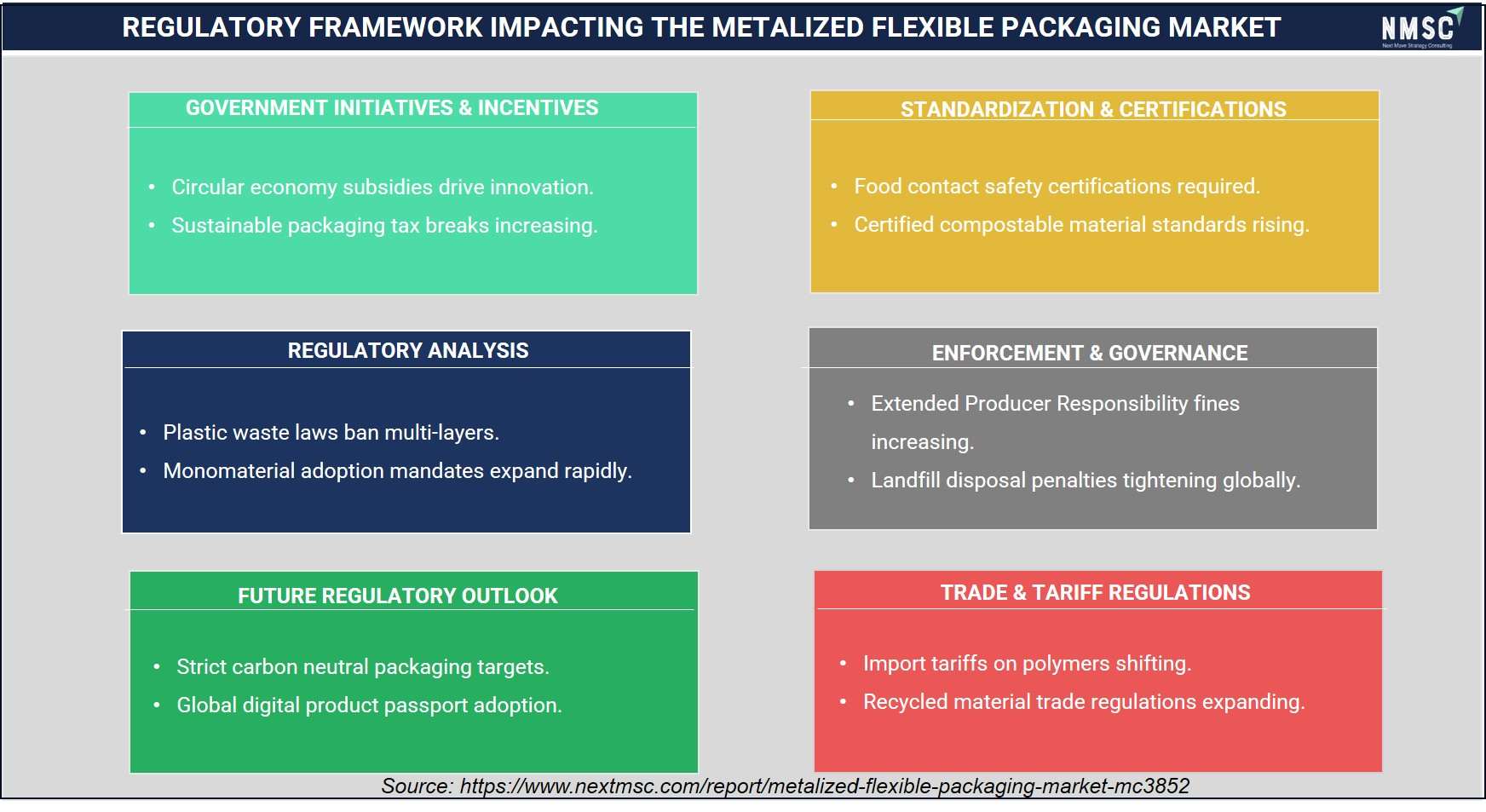
The Metalized Flexible Packaging Market is significantly influenced by evolving regulatory frameworks focused on packaging safety, environmental sustainability, waste reduction, and recyclability. Regulations such as Extended Producer Responsibility (EPR) mandates, packaging waste directives, food-contact material standards, and circular economy policies are driving manufacturers toward sustainable packaging solutions. These frameworks impact material selection, product design, recycling infrastructure investments, and compliance requirements, shaping innovation strategies and long-term market growth across global and regional packaging industries.
How Is the Metalized Flexible Packaging Market Segmented in This Report, and What Are the Key Insights from the Segmentation Analysis?
Which Material Type Segments Contribute Most to the Metalized Flexible Packaging Market Revenue?
|
Material Type Segment |
2025 (USD Bn) |
2035 (USD Bn) |
CAGR (%) |
|
Plastic Films |
9.8 |
15.1 |
4.4% |
|
Polyester Film (PET/MET PET) |
4.6 |
6.9 |
4.6% |
|
BOPP/MET BOPP |
2.8 |
4.6 |
5.7% |
|
Polyamide Film (PA/Nylon) |
0.7 |
1.1 |
5.2% |
|
Polyethylene (PE, incl. LDPE, LLDPE) |
0.9 |
1.3 |
4.2% |
|
Cast Polypropylene (CPP) |
0.5 |
0.7 |
3.8% |
|
PVC Film |
0.2 |
0.3 |
4.6% |
|
Other Plastic Films |
0.2 |
0.3 |
4.6% |
|
Paper and Paperboard |
1.7 |
2.6 |
4.8% |
|
Aluminum Foil Based Laminates |
3.1 |
4.8 |
5.0% |
|
Other Substrates |
0.71 |
1.38 |
6.9% |
Based on our analysis of flexible packaging converter operations and brand owner material specifications, we observed that the Metalized Flexible Packaging Market is segmented by material type into Plastic Films, Paper and Paperboard, Aluminum Foil Based Laminates, and Other Substrates. Plastic Films dominate overwhelmingly, led by PET/MET PET, which is the single largest sub-segment due to its superior thermal stability, optical clarity, and excellent oxygen and moisture barrier properties ideal for snack, coffee, pharmaceutical, and cosmetic applications. BOPP/MET BOPP is the fastest-growing plastic film sub-segment, driven by its cost advantage and light weight for high-volume confectionery and snack wrappers. Aluminum Foil Based Laminates hold the second-largest material segment share due to their unmatched barrier performance for pharmaceutical blisters, retort pouches, and premium food applications where hermeticity is non-negotiable.
How Does Packaging Format Drive Revenue Distribution Across the Metalized Flexible Packaging Market?
|
Packaging Type Segment |
2025 (USD Bn) |
2035 (USD Bn) |
CAGR (%) |
|
Pouches |
5.5 |
8.6 |
5.1% |
|
Stand-up Pouches (SUP) |
2.5 |
4.1 |
5.7% |
|
Pillow Pouches |
1.3 |
2.0 |
4.9% |
|
Gusseted Pouches |
0.6 |
1.0 |
5.8% |
|
Spouted Pouches |
0.4 |
0.7 |
6.4% |
|
Retort Pouches |
0.6 |
0.8 |
3.2% |
|
Rollstock and Films |
3.6 |
5.4 |
4.6% |
|
Bags and Sacks |
1.3 |
2.0 |
4.9% |
|
Sachets and Stick Packs |
1.7 |
2.9 |
6.1% |
|
Lidding and Peel Films |
1.1 |
1.7 |
5.0% |
|
Labels and Wrappers |
1.0 |
1.5 |
4.6% |
|
Tubes and Cartridges |
0.5 |
0.7 |
3.8% |
|
Preformed Containers and Trays |
0.4 |
0.7 |
6.4% |
|
Other Formats |
0.21 |
0.38 |
6.1% |
Through NMSC's assessment, we found that the Metalized Flexible Packaging Market is segmented by packaging type into Pouches, Rollstock and Films, Bags and Sacks, Sachets and Stick Packs, Lidding and Peel Films, Labels and Wrappers, Tubes and Cartridges, Preformed Containers and Trays, and Other Formats. Pouches are the dominant packaging format, led by Stand-up Pouches (SUPs), which represent the single largest format by revenue due to their combination of retail shelf impact, consumer convenience, and resealing capability across snack, pet food, coffee, and baby food categories. Sachets and Stick Packs are among the fastest-growing formats, driven by unit-dose pharmaceutical packaging and affordable single-serve formats across personal care and food applications in emerging markets. Spouted Pouches are also witnessing rapid growth in liquid food, baby food, and beverage categories globally.
How Does Barrier Class Segmentation Reveal Performance and Pricing Differentiation in the Metalized Flexible Packaging Market?
|
Barrier Class Segment |
2025 (USD Bn) |
2035 (USD Bn) |
CAGR (%) |
|
High Barrier |
8.4 |
13.1 |
4.5% |
|
Medium Barrier |
4.9 |
7.7 |
4.6% |
|
Low Barrier |
2.01 |
3.08 |
4.4% |
Our assessment indicates that the Metalized Flexible Packaging Market is segmented by barrier class into High Barrier, Medium Barrier, and Low Barrier structures, reflecting the wide range of product protection requirements across end-use industries. High Barrier structures dominate the market, representing approximately 55% of total revenue in 2025, driven by the demanding oxygen and moisture transmission rate (OTR/WVTR) specifications of pharmaceutical blisters, coffee packaging, retort pouches, and premium snack formats where shelf life extension directly impacts brand value and product safety. Medium Barrier solutions are growing at a slightly faster rate, finding application in bakery, dry snack, and personal care packaging where partial barrier performance is sufficient and cost-efficiency is the competitive priority. Low Barrier metalized films serve label, decorative wrapper, and overwrap applications where metallization is primarily used for visual aesthetics.
How Do Different Metallization Processes Compete for Share in the Metalized Flexible Packaging Market?
|
Metallization Process Segment |
2025 (USD Bn) |
2035 (USD Bn) |
CAGR (%) |
|
Vacuum Metallization |
9.3 |
14.5 |
4.5% |
|
Foil Lamination |
4.4 |
6.8 |
4.4% |
|
Sputter Metallized |
1.0 |
1.7 |
5.4% |
|
Metallized Coating |
0.4 |
0.58 |
3.8% |
|
Other Physical Methods |
0.21 |
0.3 |
3.6% |
Based on our market evaluation, we noticed that the Metalized Flexible Packaging Market is segmented by metallization process into Vacuum Metallization, Foil Lamination, Sputter Metallization, Metallized Coating, and Other Physical Methods. Vacuum Metallization dominates with approximately 61% of market revenue in 2025, favored for its high throughput, cost-effectiveness, and compatibility across a wide range of plastic film substrates including PET, BOPP, CPP, and PE. Foil Lamination holds the second-largest share, essential for pharmaceutical cold-form blisters and retort pouches requiring absolute hermeticity. Sputter Metallization is the fastest-growing process, gaining adoption for ultra-thin, ultra-high-barrier coatings on specialty substrates for electronics packaging and premium consumer applications, though its higher capital and operating cost limits mainstream flexible packaging penetration.
What Structural Configurations Are Defining Product Performance in the Metalized Flexible Packaging Market?
|
Film Structure Segment |
2025 (USD Bn) |
2035 (USD Bn) |
CAGR (%) |
|
Monolayer Metallized Films |
3.4 |
5.0 |
3.9% |
|
Multilayer Laminate Films |
9.81 |
15.08 |
4.4% |
|
Co-extruded Mono Material Films |
1.7 |
3.3 |
6.9% |
|
Other Constructions |
0.4 |
0.5 |
2.3% |
Our analysis shows that the Metalized Flexible Packaging Market is segmented by film structure into Monolayer Metallized Films, Multilayer Laminate Films, Co-extruded Mono Material Films, and Other Constructions. Multilayer Laminate Films constitute the dominant structural category, accounting for approximately 64% of market revenue in 2025, reflecting the widespread use of multi-material combinations including PET/met-PET/PE, OPP/met-OPP/PE, and foil-based laminates across food, pharmaceutical, and personal care packaging. Co-extruded Mono Material Films are the fastest-growing structural category at an estimated CAGR of 7.6% from 2026 to 2035, as converters invest in all-PE and all-PP co-extrusion lines to produce recyclable structures that can replace conventional multi-material laminates while maintaining acceptable barrier performance for snack, confectionery, and personal care applications.
How Is the Recyclability Segment Driving Structural Change in the Metalized Flexible Packaging Market?
|
Recyclability Segment |
2025 (USD Bn) |
2035 (USD Bn) |
CAGR (%) |
|
Recyclable Mono-material Metallized Films |
2.0 |
4.6 |
8.7% |
|
Recyclable Laminate Solutions |
1.3 |
2.7 |
7.6% |
|
Non-recyclable Mixed Laminates |
11.11 |
13.88 |
2.3% |
|
Biobased and Compostable Metallized Substrates |
0.3 |
1.2 |
14.9% |
|
Other Sustainability Classes |
0.6 |
1.5 |
9.6% |
NMSC's analysis indicates that the Metalized Flexible Packaging Market is segmented by recyclability into Recyclable Mono-material Metallized Films, Recyclable Laminate Solutions, Non-recyclable Mixed Laminates, Biobased and Industrially Compostable Metallized Substrates, and Other Sustainability Classes. Non-recyclable Mixed Laminates currently dominate by revenue volume in 2025 due to the established commercial scale of conventional PET/Al/PE and OPP/Al/PE structures, but their share is projected to decline materially through 2035 as EPR-driven reformulation accelerates. Recyclable Mono-material Metallized Films and Recyclable Laminate Solutions are growing at high single-to-double-digit CAGRs. Biobased and Industrially Compostable Metallized Substrates represent the fastest-growing nascent category, driven by brand commitments to biobased content in premium organic food and cosmetic packaging segments.
How Do Sales Channel Structures Shape Go-to-Market Strategy in the Metalized Flexible Packaging Market?
|
Sales Channel Segment |
2025 (USD Bn) |
2035 (USD Bn) |
CAGR (%) |
|
Direct to Brand Owner |
8.91 |
13.68 |
4.4% |
|
Distributor and Reseller |
3.3 |
5.0 |
4.2% |
|
Co-packer and Contract Packer |
2.0 |
3.2 |
4.8% |
|
Online and E-commerce Suppliers |
0.7 |
1.3 |
6.4% |
|
Other Channels |
0.4 |
0.7 |
5.8% |
From our assessment, we noticed that the Metalized Flexible Packaging Market is segmented by sales channel into Direct to Brand Owner, Distributor and Reseller, Co-packer and Contract Packer, Online and E-commerce Suppliers, and Other Channels. Direct to Brand Owner is the dominant sales channel, representing approximately 57% of market revenue in 2025, reflecting the strategic purchasing relationships between large multinational consumer goods companies and Tier 1 flexible packaging converters under long-term supply agreements. Co-packers and Contract Packers represent a structurally important channel for mid-market brand owners that outsource their packaging and filling operations. Online and E-commerce Suppliers are the fastest-growing channel, primarily serving small and emerging brands procuring short-run metalized flexible packaging through digital platforms.
Which End-Use Industries Generate the Greatest Revenue in the Metalized Flexible Packaging Market?
|
End-Use Industry Segment |
2025 (USD Bn) |
2035 (USD Bn) |
CAGR (%) |
|
Food and Beverage |
10.21 |
14.98 |
3.9% |
|
Snacks and Confectionery |
3.4 |
5.2 |
4.8% |
|
Bakery and Cereals |
1.5 |
2.2 |
4.3% |
|
Ready-to-Eat / Processed Food |
1.7 |
2.7 |
5.3% |
|
Frozen Food |
0.9 |
1.2 |
3.2% |
|
Coffee and Tea |
1.3 |
2.0 |
4.9% |
|
Dairy Products |
0.6 |
0.9 |
4.6% |
|
Pet Food |
0.6 |
1.0 |
5.8% |
|
Pharmaceuticals and Healthcare |
2.0 |
3.8 |
6.6% |
|
Personal Care and Cosmetics |
1.3 |
2.0 |
4.9% |
|
Home Care and Household Products |
0.7 |
1.1 |
4.6% |
|
Tobacco and Nicotine Products |
0.4 |
0.5 |
2.3% |
|
Industrial and Technical Goods |
0.3 |
0.5 |
5.2% |
|
Electronics and Electrical Components |
0.2 |
0.4 |
7.2% |
|
Agriculture and Seeds |
0.1 |
0.2 |
7.2% |
|
Other Industries |
0.1 |
0.4 |
14.9% |
Based on our analysis of end-use consumption and supply chain data, we observed that the Metalized Flexible Packaging Market is segmented by end-use industry into Food and Beverage, Pharmaceuticals and Healthcare, Personal Care and Cosmetics, Home Care and Household Products, Tobacco and Nicotine Products, Industrial and Technical Goods, Electronics and Electrical Components, Agriculture and Seeds, and Other Industries. Food and Beverage is the dominant vertical, accounting for approximately 66% of total market revenue in 2025, led by Snacks and Confectionery representing the single largest food sub-category due to widespread use of metallized BOPP and PET films in high-speed form-fill-seal snack packaging worldwide. Pharmaceuticals and Healthcare is the fastest-growing end-use industry at an estimated CAGR of 6.7%, driven by blister packaging expansion, unit-dose sachet adoption, and cold chain biologics packaging requirements across global pharmaceutical markets.
Regional Outlook
Geographic Performance Snapshot
|
Region |
2025 (USD Bn) |
2035 (USD Bn) |
CAGR (%) |
Key Driver |
|
North America |
4.8 |
7.0 |
3.8% |
Snack, pet food, and pharma packaging demand |
|
Europe |
4.0 |
5.7 |
3.6% |
EPR regulation driving recyclable film transition |
|
Asia-Pacific |
4.3 |
7.3 |
5.4% |
Urbanization, food retail expansion, new capacity |
|
Middle East & Africa |
1.21 |
2.1 |
5.7% |
Food security packaging, organized retail growth |
|
Latin America |
1.0 |
1.78 |
5.9% |
FMCG and pharma packaging growth in emerging markets |
North America Metalized Flexible Packaging Market
North America is the largest regional market for metalized flexible packaging, accounting for USD 4.8 billion in 2025 and projected to reach USD 7.0 billion by 2035 at a CAGR of 3.8%. The region benefits from a highly developed food and beverage industry, one of the world's highest pet food consumption rates, and a large pharmaceutical packaging supply chain. Regulatory maturity under FDA 21 CFR requirements and increasing EPR program development at the state level are driving investment in recyclable mono-material metalized films. The U.S. dominates regional demand, with Canada representing a stable and growing secondary market for processed food and pharmaceutical packaging applications across North America.
U.S. Metalized Flexible Packaging Market
Based on our engagements with flexible packaging converter operations and brand owner procurement teams, the United States is the single largest national market for metalized flexible packaging globally, valued at approximately USD 4.1 billion in 2025. The U.S. snack food industry drives demand for metallized BOPP and PET films across high-speed form-fill-seal packaging lines. The FDA's 21 CFR framework governs food contact materials, and growing state-level EPR legislation across California, New York, and Oregon is compelling U.S. brand owners to reformulate packaging specifications toward recyclable metallic films. The U.S. pharmaceutical sector generates structurally growing demand for high-barrier foil blister and cold-form packaging across prescription and OTC drug formats.
Canada Metalized Flexible Packaging Market
Through our analysis, Canada represents approximately 14% of North American Metalized Flexible Packaging Market revenue in 2025, anchored by a well-developed food processing sector and a growing pharmaceutical packaging market. Canada's federal Single-Use Plastics Prohibition Regulations and provincial extended producer responsibility programs are driving adoption of recyclable flexible packaging formats among Canadian brand owners. The snack food, confectionery, and coffee segments are primary consumers of metalized flexible packaging. Canadian pharmaceutical packaging demand is growing with the expansion of generic drug manufacturing. Bilingual labeling requirements create demand for variable digital printing on metalized substrates for regional SKU management across Canadian retail markets.
Mexico Metalized Flexible Packaging Market
From our assessment, Mexico is the fastest-growing market within North America in the Metalized Flexible Packaging Market, driven by a large and growing snack food industry, rapid organized retail expansion, and nearshoring of food and pharmaceutical manufacturing operations. Mexico's Norma Oficial Mexicana (NOM) standards govern packaging safety for food contact applications. The country's Ley General para la Prevencion y Gestion Integral de los Residuos is driving initial EPR framework development. Leading flexible packaging converter operations maintain significant Mexican manufacturing footprints. Mexico's proximity to the U.S. makes it a cost-competitive production base for metalized packaging serving North American brand owners.
Europe Metalized Flexible Packaging Market
Europe is the second-largest region in the Metalized Flexible Packaging Market, contributing USD 4.0 billion in 2025 and projected to reach USD 5.7 billion by 2035 at a CAGR of 3.6%. Europe is the global epicenter of regulatory-driven packaging transformation, with the EU PPWR, EPR frameworks, and the Single-Use Plastics Directive reshaping material specifications across all flexible packaging segments. European converters and brand owners are investing heavily in recyclable mono-material metallized film technology to comply with 2030 recyclability mandates. Germany, the UK, France, and Italy collectively account for over 60% of European Metalized Flexible Packaging Market revenue.
U.K. Metalized Flexible Packaging Market
Based on our engagements with UK flexible packaging industry stakeholders, the United Kingdom is the largest individual national market within Europe for metalized flexible packaging, driven by one of Europe's highest per-capita snack food consumption rates and a large pharmaceutical packaging sector. The UK Plastic Packaging Tax, administered by HMRC at GBP 210.82 per tonne, is compelling UK brand owners to reformulate packaging with higher recycled content or transition to recyclable formats. The UK's OPRL (On-Pack Recycling Label) scheme is supporting recyclable flexible packaging adoption among UK retailers and brand owners. Post-Brexit, UK REACH chemical regulations govern packaging additive compliance independently of EU REACH.
Germany Metalized Flexible Packaging Market
Through our analysis, Germany represents the second-largest European market for metalized flexible packaging, supported by a world-class food processing industry, a large pharmaceutical sector, and one of Europe's most stringent EPR packaging systems operated by Duales System Deutschland (DSD). German brand owners and retailers are major volume purchasers of metalized flexible packaging for snack, coffee, confectionery, and dairy applications. The German Packaging Act (Verpackungsgesetz) mandates high recycling quotas and supports investment in recyclable flexible film formats. Germany's Fraunhofer Institute and Packaging Valley cluster are active centers of innovation in sustainable flexible packaging materials.
France Metalized Flexible Packaging Market
From our assessment, France is the third-largest European market for metalized flexible packaging, characterized by a sophisticated food industry, strong regulatory action on packaging sustainability, and a large personal care sector. France's Loi AGEC (Anti-Waste for a Circular Economy) has established some of Europe's most ambitious packaging waste reduction targets, with an information obligation on the recyclability of packaging placed on French consumers since January 2022. CITEO, France's EPR organization, certifies recyclable packaging formats through its Triman labeling scheme. French brand owners in the food, confectionery, and cosmetic sectors are active adopters of recyclable mono-material metalized packaging alternatives.
Italy Metalized Flexible Packaging Market
Based on our evaluation, Italy is a significant European market for metalized flexible packaging, driven by a large food processing sector encompassing coffee, pasta, snacks, and confectionery, and a growing pharmaceutical packaging industry. Italy's CONAI (Consorzio Nazionale Imballaggi) EPR scheme requires producers to contribute to packaging waste recovery costs, incentivizing investment in recyclable packaging formats. The Italian food sector's strong preference for premium packaging aesthetics drives demand for high-quality metallized films delivering visual brilliance alongside functional barrier performance across retail food categories in Italy and for Italian export markets globally.
Spain Metalized Flexible Packaging Market
Based on our evaluation, Spain demonstrates sustained growth in the Metalized Flexible Packaging Market, supported by a large food and beverage industry including olive oil, fresh produce, seafood, and snack food segments. Spain's ECOEMBES EPR system manages flexible packaging waste collection and recycling. The Spanish government's Ley de Residuos y Suelos Contaminados (Law 7/2022) aligns Spain with EU PPWR requirements for recyclable packaging by 2030. Spanish flexible packaging converters serve both domestic brand owners and the broader European private label market. Growing e-commerce food delivery and ready-to-eat meal services in Spanish urban markets are driving incremental demand for metalized pouch formats.
Sweden Metalized Flexible Packaging Market
Through our analysis, Sweden is an advanced and mature market for metalized flexible packaging within the Nordic region, characterized by high sustainability standards, strong EPR system performance, and active retailer engagement in packaging reformulation. Swedish retailers are active drivers of recyclable packaging specifications among their private label supplier bases. Swedish pharmaceutical companies are structurally stable consumers of high-barrier foil laminate packaging for prescription and OTC medications across Scandinavian distribution networks. Sweden's Naturvårdsverket (Swedish Environmental Protection Agency) oversees EPR regulations that apply directly to flexible packaging producers operating in the Swedish market.
Denmark Metalized Flexible Packaging Market
From our assessment, Denmark maintains a high standard of flexible packaging sustainability performance, driven by an advanced EPR framework under the Danish Environmental Protection Agency (Miljøstyrelsen) and a culture of consumer recycling. Danish food companies are significant consumers of metalized flexible packaging for processed meat, cheese, and dairy product categories. Denmark's ambition to be a leader in the circular economy for packaging, articulated in its National Strategy for Plastics, is encouraging early adoption of mono-material metalized film alternatives among Danish food processors and packaging converters operating in the region.
Finland Metalized Flexible Packaging Market
Based on our engagements, Finland represents a stable Nordic market for metalized flexible packaging, supported by a modern food processing sector, a well-organized EPR packaging system managed by Rinki EPR, and strong retailer sustainability commitments. Finnish food companies in the processed meat and dairy sectors are consumers of metalized flexible packaging. Finland's strategic location as a Northern European logistics hub supports flexible packaging converter operations serving the broader Scandinavian and Baltic regional market. The Finnish government's circular economy programs are actively encouraging packaging recyclability innovation.
Netherlands Metalized Flexible Packaging Market
Through our analysis, the Netherlands is a critical logistics and trading hub for the European Metalized Flexible Packaging Market, hosting major consumer goods company European headquarters. The Netherlands' Afvalfonds Verpakkingen EPR system has driven high flexible packaging recycling rates relative to the European average. Dutch retailers are active drivers of sustainable packaging specifications. The Netherlands' port infrastructure, particularly the Port of Rotterdam, makes it the primary import point for Asian-manufactured metalized flexible packaging films entering the European market, giving it outsized commercial importance in the regional supply chain.
Rest of Europe Metalized Flexible Packaging Market
From our assessment, the Rest of Europe, encompassing Poland, Belgium, Switzerland, Austria, Portugal, Czech Republic, Hungary, Romania, and other European markets, collectively represents a growing segment. Poland is the most significant emerging European market, with a large and growing food processing sector and rapidly expanding EPR packaging obligations under the Polish Act on Packaging and Packaging Waste. Switzerland maintains high packaging sustainability standards under the Swiss Packaging Ordinance. Central and Eastern European markets are experiencing the fastest regional volume growth as organized retail penetration and packaged food consumption increase steadily.
Asia-Pacific Metalized Flexible Packaging Market
Asia-Pacific is the fastest-growing major region in the Metalized Flexible Packaging Market, advancing from USD 4.3 billion in 2025 to USD 7.3 billion by 2035 at a CAGR of 5.4%. The region's growth is propelled by rapid urbanization, organized retail expansion, increasing processed food and pharmaceutical consumption, and significant new vacuum metallization capacity investment in China, India, and Southeast Asia. Regulatory frameworks governing packaging safety and waste management are at varying stages of development across the region. APAC is the world's largest manufacturing hub for metalized flexible packaging films, with China alone accounting for the largest share of global vacuum metallization capacity.
China Metalized Flexible Packaging Market
Based on our engagements with the flexible packaging supply chain, China is the largest national market for metalized flexible packaging in Asia-Pacific, valued at approximately USD 1.8 billion in 2025, and the world's largest producer of vacuum-metallized films. China's massive domestic food processing industry — including snack, instant noodle, beverage, and confectionery sectors — drives enormous volume demand for metalized BOPP and PET packaging films. China's mandatory GB standards for food contact materials govern packaging safety. The Ministry of Ecology and Environment's producer responsibility policies are beginning to drive recyclable packaging development among Chinese brand owners and converters for the domestic market.
India Metalized Flexible Packaging Market
Through our analysis, India is the fastest-growing national market in the Metalized Flexible Packaging Market globally, advancing at an estimated CAGR of 9.2% from 2026 to 2035, valued at approximately USD 1.0 billion in 2025. India's organized retail and FMCG sector expansion is driving demand for metalized flexible packaging across snack, biscuit, spice, tea, and personal care categories. The Plastic Waste Management Rules 2022 are driving initial steps toward recyclable flexible packaging in India. Major FMCG companies including Hindustan Unilever, ITC, Nestlé India, and Britannia Industries are dominant purchasers of metalized flexible packaging films from Indian converter operations.
Japan Metalized Flexible Packaging Market
Based on our evaluation, Japan is the third-largest Asia-Pacific market for metalized flexible packaging, supported by a mature food processing sector, a well-established convenience store retail channel, and a large pharmaceutical and nutraceutical packaging market. Japan's Act on Promotion of Resource Circulation for Plastics, enacted in 2022, is driving industry investment in recyclable and compostable flexible packaging alternatives. Japanese converters including Toray Industries, Toyobo, and Dai Nippon Printing are globally significant manufacturers of metalized films. Japan's high food quality standards and premium consumer preferences drive demand for high-barrier metalized packaging in ambient, chilled, and frozen food applications.
South Korea Metalized Flexible Packaging Market
Based on our engagements, South Korea demonstrates strong performance in the Metalized Flexible Packaging Market, driven by a large and innovative food processing sector, a globally recognized personal care and beauty industry, and a mature pharmaceutical packaging market. Korea's Act on the Promotion of Saving and Recycling of Resources imposes eco-design requirements on packaging. Korean conglomerates in the food, snack, and personal care sectors are major flexible packaging consumers. South Korea's advanced materials science capabilities support local converter innovation in high-barrier metalized film structures for functional food and pharmaceutical applications.
Taiwan Metalized Flexible Packaging Market
Through our analysis, Taiwan's Metalized Flexible Packaging Market is concentrated in the electronics, food, and pharmaceutical sectors, with the electronics segment driving demand for metalized films used in component moisture-barrier packaging and static shielding applications. Taiwan's Resource Recycling Act governs packaging waste responsibilities. Taiwanese flexible packaging converters supply both the domestic market and export markets across Southeast Asia and Japan. The food sector, particularly convenience store food service, snack, and confectionery segments, drives domestic consumer demand for metalized flexible packaging across Taiwan's highly urbanized retail market.
Indonesia Metalized Flexible Packaging Market
From our assessment, Indonesia is among the most rapidly growing Metalized Flexible Packaging Markets in Southeast Asia, valued at approximately USD 0.6 billion in 2025, driven by a large population of over 270 million consumers, accelerating organized retail penetration, and growing instant noodle, snack, and personal care FMCG industries. The Government Regulation on Plastic Waste Management is establishing EPR frameworks for Indonesian packaging producers. Major FMCG players are significant consumers of metalized flexible packaging. Indonesian flexible packaging converter capacity is expanding with investments from domestic and international groups seeking to serve growing local food and personal care brand demand.
Vietnam Metalized Flexible Packaging Market
Based on our engagements, Vietnam is an emerging and high-growth market for metalized flexible packaging in Southeast Asia, supported by rapid food processing sector expansion, growing domestic consumer goods consumption, and significant export-oriented flexible packaging manufacturing. Vietnam's Law on Environmental Protection 2020 is establishing EPR obligations for packaging producers. Vietnamese converter operations, many serving global FMCG brands through contract manufacturing, are investing in new vacuum metallization capacity. The snack, instant noodle, confectionery, and personal care categories are primary domestic demand drivers for metalized flexible packaging in Vietnam.
Australia Metalized Flexible Packaging Market
Through our analysis, Australia is the most mature Metalized Flexible Packaging Market in Oceania, valued at approximately USD 0.4 billion in 2025, with strong adoption across snack food, confectionery, pharmaceutical, and pet food categories. The Australian Packaging Covenant Organisation (APCO) has established national packaging targets including requirements that 100% of packaging be reusable, recyclable, or compostable. These targets are driving Australian brand owners to invest in recyclable mono-material metalized packaging alternatives. Major FMCG companies are significant metalized flexible packaging consumers across the Australian retail market.
Philippines Metalized Flexible Packaging Market
Based on our evaluation, the Philippines represents a developing but rapidly growing Metalized Flexible Packaging Market, driven by a large population of over 110 million consumers, a dynamic FMCG sector, and significant sachet economy dynamics in personal care and food categories. The Philippines' Republic Act 9003 (Ecological Solid Waste Management Act) is being supplemented by Extended Producer Responsibility legislation to address the country's plastic waste challenge. The sachet format, driven by affordable unit-dose consumption among lower-income consumer segments, represents a structurally significant driver of metalized flexible packaging volume across the Philippine market.
Malaysia Metalized Flexible Packaging Market
Based on our engagements, Malaysia is a mid-tier and growing Metalized Flexible Packaging Market within Southeast Asia, characterized by a well-developed food processing sector, a growing pharmaceutical manufacturing industry, and Kuala Lumpur's emergence as a regional FMCG hub. Malaysia's National Solid Waste Management Policy is developing EPR frameworks that will drive packaging recyclability investment. Malaysian brand owners in snack, dairy, and beverage products are significant consumers of metalized flexible packaging. Malaysia's halal food manufacturing sector creates demand for certified food-safe metalized packaging materials across export and domestic markets.
Rest of Asia-Pacific Metalized Flexible Packaging Market
From our assessment, the Rest of Asia-Pacific, comprising Thailand, Bangladesh, Sri Lanka, Pakistan, Myanmar, Cambodia, New Zealand, and smaller Pacific markets, collectively represents a growing segment of the regional Metalized Flexible Packaging Market. Thailand is the most significant individual market within this group, driven by a large food export-oriented processing sector and growing domestic consumer goods market. Bangladesh's expanding garment and food processing sectors generate demand for metalized flexible packaging for product protection. New Zealand maintains high packaging sustainability standards aligned with Australian APCO targets. Pakistan's large food processing and FMCG sector generates substantial demand for affordable metalized flexible packaging films.
Middle East and Africa Metalized Flexible Packaging Market
The Middle East and Africa is the third-fastest-growing region in the Metalized Flexible Packaging Market, advancing from USD 1.2 billion in 2025 to USD 2.1 billion by 2035 at a CAGR of 5.7%. The region's growth is driven by food security-oriented packaging demand, organized retail expansion across GCC and South Africa, growing pharmaceutical consumption, and FMCG brand investment in shelf-stable packaging formats for consumers across a wide range of climate and logistics conditions. Saudi Arabia, UAE, South Africa, Nigeria, Turkey, and Egypt collectively represent the majority of regional market revenue.
Saudi Arabia Metalized Flexible Packaging Market
Based on our engagements, Saudi Arabia is the largest Metalized Flexible Packaging Market in the Middle East and Africa region, valued at approximately USD 0.7 billion in 2025, supported by Vision 2030's food security and retail modernization goals. Saudi Arabia's Standards, Metrology and Quality Organization (SASO) governs packaging material standards for food contact applications. The expansion of organized modern trade is driving demand for branded packaged foods in metalized flexible packaging formats. Saudi pharmaceutical manufacturing expansion under Vision 2030 is creating incremental demand for high-barrier foil blister and sachet packaging from domestic and regional pharmaceutical producers.
UAE Metalized Flexible Packaging Market
Through our analysis, UAE is the second-largest Metalized Flexible Packaging Market in the MEA region, driven by Dubai and Abu Dhabi's roles as regional food trade, retail, and re-export hubs. The UAE's National Food Security Strategy and its robust food re-export sector create demand for high-barrier metalized packaging to protect products during extended regional distribution. UAE's Emirates Authority for Standardization and Metrology (ESMA) sets packaging safety standards. The personal care and cosmetics sector, reflecting UAE's high consumer spending power, is a structurally important end-user of premium metalized films for beauty and luxury product packaging.
Egypt Metalized Flexible Packaging Market
Based on our evaluation, Egypt represents the largest Metalized Flexible Packaging Market in North Africa, valued at approximately USD 0.3 billion in 2025, driven by a large food processing sector serving a population of over 100 million consumers, a growing pharmaceutical sector, and expanding organized retail. Egypt's General Organization for Export and Import Control (GOEIC) governs packaging standards for food products. The Egyptian food industry in confectionery, snack foods, and bakery products drives the largest share of domestic flexible packaging demand. Egypt's growing generic pharmaceutical manufacturing sector creates incremental demand for metalized foil laminate packaging for blister and sachet applications.
Israel Metalized Flexible Packaging Market
Based on our engagements, Israel is an advanced Metalized Flexible Packaging Market within the MEA region, characterized by a highly innovative food technology sector, a sophisticated pharmaceutical packaging industry, and rigorous food safety standards enforced by the Israeli Ministry of Health. The Israeli food processing sector, with export-oriented operations in dairy, snack, confectionery, and specialty food categories, is a demanding consumer of high-quality metalized flexible packaging materials. Israel's Standards Institute (SII) sets packaging material standards. Israeli converter operations supply both domestic and export markets, with metalized films used extensively in premium food, nutraceutical, and pharmaceutical packaging categories.
Turkey Metalized Flexible Packaging Market
Through our analysis, Turkey is among the largest Metalized Flexible Packaging Markets in the MEA and broader Eurasian region, valued at approximately USD 0.4 billion in 2025, supported by a large food processing sector including confectionery, biscuits, snacks, and dried nuts, as well as a growing pharmaceutical packaging industry. Turkey's packaging regulatory framework is managed by the Ministry of Environment and Urbanization. Turkish flexible packaging converters include internationally competitive operations serving both domestic and export markets, producing metalized BOPP and PET films. The Turkish food industry's high export orientation generates demand for globally compliant metalized flexible packaging formats.
Nigeria Metalized Flexible Packaging Market
From our assessment, Nigeria represents the largest Metalized Flexible Packaging Market in Sub-Saharan Africa, driven by a population exceeding 220 million consumers, a large and growing formal food processing sector, and significant FMCG brand operations across the country. Nigeria's Standards Organisation of Nigeria (SON) regulates packaging material standards. The sachet economy in Nigeria, encompassing water, tomato paste, spices, condiments, and personal care products, generates structurally large demand for low-to-medium-cost metalized flexible packaging films. Pharmaceutical packaging demand is growing with Nigeria's generic drug manufacturing sector and healthcare infrastructure investment.
South Africa Metalized Flexible Packaging Market
Based on our engagements, South Africa is the most mature Metalized Flexible Packaging Market in Sub-Saharan Africa, valued at approximately USD 0.3 billion in 2025, supported by Johannesburg's role as the continent's largest consumer goods manufacturing and retail hub. South Africa's Extended Producer Responsibility regulations effective from 2021 under the National Environmental Management Waste Act are compelling flexible packaging producers to invest in recyclable material innovation. Major South African FMCG companies in snack, dairy, and processed food applications are significant consumers of metalized flexible packaging across the South African retail market.
Rest of MEA Metalized Flexible Packaging Market
Through our analysis, the Rest of MEA, encompassing Kuwait, Qatar, Bahrain, Oman, Jordan, Morocco, Kenya, Ghana, Ethiopia, and other markets, collectively represents a growing segment of the regional Metalized Flexible Packaging Market. GCC markets outside Saudi Arabia and UAE benefit from high consumer spending power and modern retail infrastructure that drives demand for premium packaged goods in metalized flexible formats. Kenya and Ghana are the fastest-growing Sub-Saharan African markets, driven by rapid urbanization, organized retail expansion, and FMCG brand investment. Morocco serves as a North African manufacturing and food processing hub supplying European and regional markets.
Latin America Metalized Flexible Packaging Market
Latin America is the fastest-growing region in the Metalized Flexible Packaging Market at a CAGR of 5.9% from 2026 to 2035, advancing from USD 1.0 billion in 2025 to USD 1.78 billion by 2035. Brazil and Mexico collectively account for approximately 75% of regional market revenue. Growing organized retail penetration, rapid FMCG brand expansion, pharmaceutical packaging volume growth, and expanding e-commerce food and personal care delivery services are the primary growth drivers. Regulatory frameworks for packaging EPR are at early-to-intermediate stages of development in most Latin American markets, with Brazil's SINIR system representing the most advanced EPR framework in the region.
Brazil Metalized Flexible Packaging Market
Based on our engagements, Brazil is the largest Metalized Flexible Packaging Market in Latin America, valued at approximately USD 0.8 billion in 2025, supported by the world's eighth-largest food processing sector and a rapidly growing pharmaceutical market. Brazil's National Policy on Solid Waste (Lei 12.305/2010) and the evolving SINIR packaging EPR system are driving investment in recyclable flexible packaging innovation. Major FMCG companies operating in Brazil generate large-volume demand for metalized flexible packaging. Brazilian converters operate significant packaging production capacity serving domestic and regional export markets across Latin America.
Argentina Metalized Flexible Packaging Market
Through our analysis, Argentina represents the second-largest Metalized Flexible Packaging Market in Latin America, valued at approximately USD 0.3 billion in 2025. Argentina's food processing sector, encompassing confectionery, snack foods, and dairy products, is the primary driver of domestic metalized flexible packaging demand. Argentina's Law 27.279 on Post-Consumer Plastics and provincial EPR initiatives are establishing packaging sustainability obligations for Argentine brand owners and converters. Economic volatility has periodically constrained capital investment in new converter capacity, though consumption demand for metalized flexible packaging remains structurally driven by FMCG sector activity across urban markets.
Chile Metalized Flexible Packaging Market
Based on our evaluation, Chile is a stable and growing Metalized Flexible Packaging Market within Latin America, characterized by a high per-capita food processing sector, strong organized retail penetration, and a proactive packaging sustainability regulatory environment. Chile's Law 20.920 (Framework for Waste Management and Extended Responsibility of the Producer) creates EPR obligations for packaging producers. Chilean food companies in snack, confectionery, and premium food export applications are consumers of metalized flexible packaging. Chile's high export orientation in food creates demand for globally compliant high-barrier metalized packaging meeting international food safety standards.
Colombia Metalized Flexible Packaging Market
Based on our engagements, Colombia is among the fastest-growing Metalized Flexible Packaging Markets in Latin America, driven by Bogotá's emergence as a regional food processing and FMCG distribution hub, a growing pharmaceutical sector, and expanding domestic consumer goods consumption. Colombia's Resolución 1407 of 2018 established EPR obligations for packaging producers. Major FMCG companies operating in Colombia including confectionery and snack food leaders are significant domestic consumers of metalized flexible packaging for confectionery, snack, and beverage applications across the Colombian consumer market.
Rest of LATAM Metalized Flexible Packaging Market
From our assessment, the Rest of Latin America, including Peru, Ecuador, Uruguay, Bolivia, Paraguay, Costa Rica, Panama, Venezuela, and Caribbean nations, collectively represents a growing component of the Metalized Flexible Packaging Market. Peru and Ecuador are experiencing early-stage organized retail expansion that is driving initial demand for branded packaged goods in metalized flexible packaging formats. Uruguay maintains a notably advanced packaging sustainability regulatory framework in the Southern Cone region. Costa Rica serves as a Central American food processing and logistics hub. Panama's role as a trade logistics gateway creates demand for transit-protective high-barrier metalized packaging for perishable food and pharmaceutical shipments.
Competitive Landscape
Competitive Dynamics and M&A Landscape
|
Key Takeaways |
Details |
|
Market Structure |
The Metalized Flexible Packaging Market features competition among large integrated flexible packaging converters, specialized metallized film producers, foil laminate manufacturers, and regional packaging converters, each competing on material innovation, converter service breadth, barrier performance certifications, and sustainability credentials. |
|
Innovation Focus |
Innovation centers on recyclable mono-material metalized film development, ultra-thin high-barrier sputter and vacuum metallization processes, digitally printable metalized substrates, and active and intelligent packaging integration for pharmaceutical track-and-trace and consumer engagement applications. |
|
M&A Activity |
The market has seen consolidation activity among global flexible packaging converters pursuing scale, geographic expansion, and capabilities in recyclable packaging. Strategic acquisitions of regional converters and specialty metallized film producers have been the primary M&A modality across the forecast period. |
How Do Companies Compete in the Metalized Flexible Packaging Market?
The Metalized Flexible Packaging Market is characterized by competition across multiple dimensions including barrier performance capabilities, substrate breadth, converter service offerings, sustainability credentials, and geographic footprint. Leading global converters compete on the basis of integrated vacuum metallization and lamination assets, proprietary barrier coating technologies, and deep application engineering support for complex packaging formats. Mid-tier regional converters compete primarily on price, delivery lead time, and flexibility for shorter production runs. Our analysis shows that increasing differentiation is now centered on recyclability certifications, mono-material film capabilities, and the ability to offer digital printing on metalized substrates as brand owners reformulate packaging specifications toward sustainable options under EPR mandates.
Which Kind of Companies Dominate the Metalized Flexible Packaging Market?
Three distinct categories of companies dominate the Metalized Flexible Packaging Market. First, large global integrated flexible packaging converters leverage broad converter assets, global manufacturing footprints, and multi-substrate capabilities to serve multinational consumer goods and pharmaceutical brand owners. Second, specialized metalized film and foil laminate manufacturers focus on upstream film production and supply converters and brand owners with metalized substrate rolls. Third, regional packaging converters with local metallization or lamination capabilities serve domestic FMCG, pharmaceutical, and personal care brand owners with market-specific product knowledge and competitive lead times across their respective geographic markets.
Sustainability-Led Differentiation and Open Collaboration Drive Market Success in the Metalized Flexible Packaging Market
Innovation in the Metalized Flexible Packaging Market is increasingly centered on sustainability-driven material science, digital manufacturing integration, and regulatory compliance capabilities. Companies investing in recyclable mono-material metallized film technology, atomic layer deposition for ultra-thin barrier coatings, and digital inkjet printing on metalized substrates are securing competitive advantage with leading FMCG and pharmaceutical brand owners. NMSC's analysis indicates that open collaboration models between resin suppliers, film producers, converters, and brand owners through initiatives like CEFLEX and RecyClass in Europe are driving accelerated commercialization of recyclable flexible packaging innovations that were previously blocked by IP fragmentation across the value chain.
Market Players to Opt for Merger and Acquisition Strategies to Expand Their Presence in the Metalized Flexible Packaging Market
Mergers and acquisitions are reshaping the competitive structure of the Metalized Flexible Packaging Market, with large global converters acquiring regional specialists and sustainability-focused material innovators to augment their capabilities. The structural pressure of EU PPWR compliance, EPR cost internalization, and the capital intensity of transitioning to recyclable mono-material metallized film production is accelerating consolidation among smaller converter operations that lack the R&D and capital investment capacity to independently navigate the transition. Private equity investment in specialized flexible packaging converter groups is also shaping the competitive landscape, particularly in the fast-growing Asia-Pacific region where domestic converters are being professionalized and scaled through consolidation platforms.
Who Are the Key Market Players in the Metalized Flexible Packaging Market?
-
Amcor plc
-
Sealed Air Corporation
-
Berry Global Group, Inc.
-
Uflex Limited
-
Cosmo Films Limited
-
Constantia Flexibles International GmbH
-
Mondi Group plc
-
Huhtamaki Oyj
-
Jindal Films Americas LLC
-
Polyplex Corporation Limited
-
Dunmore Corporation
-
Toray Plastics (America), Inc.
-
Klockner Pentaplast Group
-
Taghleef Industries LLC
-
CCL Industries Inc.
-
Printpack Inc.
-
ProAmpac Holdings LLC
-
Bryce Corporation
-
Sonoco Products Company
-
Multifilm Packaging Corporation
What Are the Latest Developments in the Metalized Flexible Packaging Industry?
|
Date |
Event |
|
March 2026 |
Amcor expanded its Lugo di Vicenza, Italy facility with a new production line dedicated to high-barrier recycle-ready flexible films used across food, healthcare, and consumer packaging applications. |
|
February 2025 |
Amcor launched Recycle-Ready High Shield Medical Laminates, designed as a sustainable alternative to traditional aluminum laminate packaging while maintaining high barrier performance. |
What Are the Investment Opportunities in the Metalized Flexible Packaging Market?
Capital Inflows and Infrastructure Investment
Capital investment in the Metalized Flexible Packaging Market is concentrated in three areas: new vacuum metallization capacity in Asia-Pacific, recyclable mono-material film production technology in Europe and North America, and digital printing integration within flexible packaging converter facilities globally. Our assessment indicates that Asia-Pacific particularly India, Vietnam, and Indonesia is attracting significant converter capital investment as domestic and multinational FMCG brands seek local supply chain resilience. The U.S. Department of Commerce's Manufacturing USA institute programs are supporting domestic flexible packaging material innovation investments aligned with supply chain reshoring objectives, contributing to sustained throughput expansion across the global value chain.
ESG Considerations
ESG considerations are structurally reshaping investment decisions across the Metalized Flexible Packaging Market. The European Union's Corporate Sustainability Reporting Directive (CSRD) requires large companies to report on packaging sustainability performance, creating investment pressure to reduce non-recyclable packaging volumes. Our findings suggest that brand owners with science-based targets under the Science Based Targets initiative (SBTi) are setting internal corporate mandates for recyclable packaging transitions that create sustained multi-year demand for recyclable metalized film suppliers. Packaging carbon footprint reduction, quantified through Life Cycle Assessment (LCA) methodologies endorsed by ISO 14040/14044 standards, is increasingly used by brand owners to justify premium pricing for lightweight and recyclable metalized packaging alternatives.
Private Equity and Venture Capital Activity
Private equity activity in the Metalized Flexible Packaging Market has been focused on consolidating regional converter operations, scaling specialty metalized film producers, and building platform companies with multi-market flexible packaging capabilities. Through our market assessment, we observed that PE-backed roll-up strategies in the flexible packaging sector have been particularly active in the U.S., UK, and Australian markets, where fragmented mid-tier converter bases offer acquisition-led consolidation opportunities. Venture capital investment has been directed toward startups developing next-generation barrier coating technologies, biodegradable metalized substrate materials, and digital printing platforms for flexible packaging. ESG-focused institutional investors are increasingly drawn to environmentally compliant flexible packaging converter businesses.
Key Benefits for Stakeholders
For Flexible Packaging Converters, Metallized Film Producers, and Packaging Manufacturers
Industry participants gain comprehensive insights into the Metalized Flexible Packaging Market, including market sizing, growth forecasts, material trends, packaging format analysis, and end-use demand across food, pharmaceutical, personal care, and industrial applications. The report enables manufacturers to identify high-growth product categories, evaluate regional expansion opportunities, optimize production capacity planning, and benchmark their competitive positioning against leading global and regional market participants. Detailed technology and sustainability assessments further support investment decisions related to recyclable structures, mono-material packaging solutions, and advanced metallization technologies.
For Brand Owners, Procurement Managers, and End-Use Industries
Brand owners and packaging procurement teams benefit from a structured evaluation of metalized flexible packaging solutions across multiple applications and performance requirements. The report provides insights into barrier properties, shelf-life enhancement capabilities, sustainability trends, and supplier landscapes, enabling informed sourcing decisions and packaging portfolio optimization. Analysis of regulatory developments and Extended Producer Responsibility (EPR) frameworks supports long-term packaging transition strategies while ensuring compliance with evolving environmental standards and recyclability requirements.
For Investors, Private Equity Firms, and Financial Analysts
Investors and financial institutions gain access to detailed market forecasts, segment-level growth analysis, competitive benchmarking, and investment opportunity assessments across the Metalized Flexible Packaging Market. Revenue projections through 2035, combined with regional growth trends and end-user demand analysis, provide a robust framework for evaluating acquisition targets, assessing market attractiveness, and identifying emerging growth areas. Company profiling and strategic development tracking further support due diligence activities and investment decision-making within the global packaging industry.
For Raw Material Suppliers, Equipment Manufacturers, and Technology Providers
Suppliers of metallized films, aluminum foils, specialty resins, adhesives, coatings, and packaging machinery can leverage this report to understand evolving demand patterns and technological requirements across the value chain. The analysis highlights emerging opportunities associated with sustainable materials, high-barrier packaging innovations, lightweight structures, and advanced manufacturing technologies. Market intelligence on customer requirements and regional demand trends helps suppliers align product development strategies and strengthen their competitive positioning within the flexible packaging ecosystem.
For Government Agencies, Regulatory Bodies, and Industry Associations
Government organizations, policymakers, and industry associations gain valuable insights into the economic and environmental implications of metalized flexible packaging adoption across major industries. The report examines the impact of packaging regulations, circular economy initiatives, recycling mandates, and sustainability policies on market development. Regional and country-level analysis provides evidence-based perspectives that support policy formulation, industry development programs, waste management planning, and the advancement of sustainable packaging practices worldwide.
For Consulting Firms and Strategic Advisors
Consulting organizations and industry advisors can utilize this report as a validated reference framework for market entry assessments, competitive strategy development, sustainability consulting, packaging transformation initiatives, and technology evaluation projects. Comprehensive coverage of market dynamics, regulatory developments, innovation trends, and competitive landscapes enables consultants to provide data-driven recommendations to clients operating throughout the metalized flexible packaging value chain.
Key Market Segments
By Material Type
-
Plastic Films
-
Polyester Film (PET/MET PET)
-
Biaxially Oriented Polypropylene (BOPP/MET BOPP)
-
Polyamide Film (PA/Nylon)
-
Polyethylene (PE, including LDPE, LLDPE)
-
Cast Polypropylene (CPP)
-
Polyvinyl Chloride (PVC) Film
-
Other Plastic Films
-
-
Paper and Paperboard
-
Coated Metalized Paper
-
Metalized Paperboard Laminates
-
-
Aluminum Foil Based Laminates
-
Single-face Foil Laminate
-
Multi-ply Foil Laminate
-
Foil Core Laminate
-
-
Other Substrates
By Packaging Type
-
Pouches
-
Stand-up Pouches (SUP)
-
Pillow Pouches
-
Gusseted Pouches
-
Spouted Pouches
-
Retort Pouches
-
-
Rollstock and Films
-
Rollstock for Form Fill Seal
-
Laminated Film Rolls
-
-
Bags and Sacks
-
Sachets and Stick Packs
-
Lidding and Peel Films
-
Labels and Wrappers
-
Tubes and Cartridges
-
Preformed Containers and Trays
-
Other Formats
By Barrier Class
-
High Barrier
-
Medium Barrier
-
Low Barrier
By Metallization Process
-
Vacuum Metallization
-
Foil Lamination
-
Sputter Metallized
-
Metallized Coating
-
Other Physical Methods
By Film Structure
-
Monolayer Metallized Films
-
Multilayer Laminate Films
-
Co-extruded Mono Material Films
-
Other Constructions
By Recyclability
-
Recyclable Mono-material Metallized Films
-
Recyclable Laminate Solutions
-
Non-recyclable Mixed Laminates
-
Biobased and Industrially Compostable Metallized Substrates
-
Other Sustainability Classes
By Sales Channel
-
Direct to Brand Owner
-
Distributor and Reseller
-
Co-packer and Contract Packer
-
Online and E-commerce Suppliers
-
Other Channels
By End-Use Industry
-
Food and Beverage
-
Snacks and Confectionery
-
Bakery and Cereals
-
Ready-to-Eat Meals and Processed Food
-
Frozen Food
-
Coffee and Tea
-
Dairy Products
-
Pet Food
-
-
Pharmaceuticals and Healthcare
-
Personal Care and Cosmetics
-
Home Care and Household Products
-
Tobacco and Nicotine Products
-
Industrial and Technical Goods
-
Electronics and Electrical Components
-
Agriculture and Seeds
-
Other Industries
By Region
-
North America: U.S., Canada, and Mexico.
-
Europe: UK, Germany, France, Italy, Spain, Sweden, Denmark, Finland, the Netherlands, and the rest of Europe.
-
Asia Pacific: China, India, Japan, South Korea, Taiwan, Indonesia, Vietnam, Australia, Philippines, Malaysia and the rest of APAC.
-
Middle East & Africa (MEA): Saudi Arabia, UAE, Egypt, Israel, Turkey, Nigeria, South Africa, and the rest of MEA.
-
Latin America: Brazil, Argentina, Chile, Colombia, and the rest of LATAM.
Conclusion and Recommendations
Long-Term Outlook
The Metalized Flexible Packaging Market is entering a decade of structurally supported growth combined with significant material and regulatory transformation. The market is forecast to grow from USD 16.00 billion in 2026 to USD 23.88 billion by 2035 at a CAGR of 4.55%, driven by processed food volume expansion, pharmaceutical packaging growth, and sustained demand for barrier-enhanced flexible formats across global consumer markets. This growth occurs against a backdrop of accelerating regulatory pressure on non-recyclable packaging materials that will fundamentally reshape the material composition of the market through the forecast period, with recyclable mono-material metallized structures projected to gain significant market share from conventional mixed-material laminates by 2035.
Strategic Positioning Recommendations
Flexible packaging converters should prioritize investment in recyclable mono-material metallized film production capabilities to maintain market access in European and UK markets subject to EPR mandates, while simultaneously scaling conventional metallized film capacity in Asia-Pacific to capture volume-driven demand growth across emerging consumer markets. Vacuum metallization equipment operators should evaluate sputter metallization technology investments for high-barrier specialty applications in pharmaceutical and electronics packaging where performance premium justifies higher capital costs. Brand owners should establish cross-functional packaging reformulation programs with defined 2027 and 2030 compliance milestones for recyclable packaging format adoption in regulated markets, to avoid supply disruption and regulatory cost risk from last-minute format transitions.
Investment Attractiveness
The Metalized Flexible Packaging Market represents a commercially attractive investment environment given its essential role in global food and pharmaceutical supply chains, relatively stable demand growth across economic cycles, and the structural capital requirement of the recyclable packaging transition. Our assessment indicates that the highest-conviction investment themes include recyclable mono-material metallized film technology (estimated CAGR exceeding 9%), pharmaceutical flexible packaging (6.7% CAGR), and Asia-Pacific emerging market converter capacity (6.1% regional CAGR). ESG-aligned investors should note the alignment between recyclable flexible packaging investment and circular economy objectives that increasingly govern institutional investor mandates globally.
Market Shifts and Key Risks
The most significant market shift underway is the regulatory-mandated transition from non-recyclable mixed-material metalized laminates toward recyclable mono-material structures, driven primarily by EU PPWR and analogous legislation across more than 40 markets globally. This shift benefits converters with early mono-material metallized film capabilities at the expense of operators with high fixed exposure to conventional mixed-laminate production assets. Key risks for the Metalized Flexible Packaging Market include raw material price volatility creating margin compression, the pace of technically viable recyclable alternative commercialization falling behind regulatory compliance timelines, and macroeconomic demand slowdown in key end-use consumer markets reducing packaging volume growth rates below forecast assumptions.
Growth Pathways
Organizations seeking to maximize value from the Metalized Flexible Packaging Market should pursue a three-horizon strategy. In the near term (2025-2027), prioritize customer engagement on recyclable packaging reformulation and secure long-term supply agreements for mono-material metallized film substrates ahead of the anticipated supply scarcity as EU PPWR compliance timelines approach. In the mid-term (2027-2031), invest in digital printing on metalized substrates and expand pharmaceutical-grade metallized packaging capabilities to serve the fastest-growing end-use vertical. In the long term (2031-2035), position for biobased and compostable metalized substrate volume growth as cost curves for these materials improve and consumer demand for post-plastic packaging alternatives continues to expand globally.


About the Author
 Tushmi Dutta
— Tushmi Dutta is a focused researcher specializing in detailed analysis and insight-driven research across diverse business landscapes. She supports strategic initiatives through structured data interpretation, thorough validation, and clear communication of findings that aid informed decision-making. With a strong interest in writing, she enjoys presenting research insights in an engaging and accessible manner. Beyond work, she enjoys traveling, reading, painting, and continuously learning new skills that contribute to her creative and professional growth.
Tushmi Dutta
— Tushmi Dutta is a focused researcher specializing in detailed analysis and insight-driven research across diverse business landscapes. She supports strategic initiatives through structured data interpretation, thorough validation, and clear communication of findings that aid informed decision-making. With a strong interest in writing, she enjoys presenting research insights in an engaging and accessible manner. Beyond work, she enjoys traveling, reading, painting, and continuously learning new skills that contribute to her creative and professional growth.
About the Reviewer
 Supradip Baul
— Supradip Baul is an accomplished business consultant and strategist with over a decade of rich experience in market intelligence, strategy, technology, and business transformation. His work has included rigorous qualitative and quantitative analysis across multiple industries, helping clients shape investment decisions and long-term roadmaps. Earlier in his career, he was associated with Gartner, where he contributed to industry-leading reports and market share analyses. He has worked with leading global companies and holds an MBA with a dual specialization in Marketing and Finance.
Supradip Baul
— Supradip Baul is an accomplished business consultant and strategist with over a decade of rich experience in market intelligence, strategy, technology, and business transformation. His work has included rigorous qualitative and quantitative analysis across multiple industries, helping clients shape investment decisions and long-term roadmaps. Earlier in his career, he was associated with Gartner, where he contributed to industry-leading reports and market share analyses. He has worked with leading global companies and holds an MBA with a dual specialization in Marketing and Finance.
At Next Move Strategy Consulting, we understand that insightful market research is the cornerstone of successful business decisions. That's why we employ a robust and multifaceted approach, combining various methodologies to deliver the most accurate and actionable data for our clients.

Research Landscape
We navigate the world of research with two primary approaches:
Qualitative Approach
Our qualitative research methodologies involve immersive techniques such as in-depth interviews, focus groups, and observational studies. By engaging directly with individuals and stakeholders, we uncover valuable insights that quantitative data alone may overlook.

Quantitative Research
In tandem with qualitative methodologies, NMSC leverages the power of Quantitative Research to provide a robust foundation of numerical insights. Through systematic data collection and analysis, we quantify patterns, preferences, and market trends, offering a comprehensive view of the business landscape.
Our quantitative research approach employs diverse tools, including surveys, experiments, and statistical modelling. These methodologies enable us to gather data from a large and representative sample, ensuring the statistical significance of our findings. By employing structured questionnaires and standardized data collection methods, we guarantee the reliability and validity of the information we present to our clients.
Quantitative research is particularly effective in measuring the prevalence of trends, assessing market size, and gauging the impact of various factors on consumer behavior. The numerical precision attained through this approach equips our clients with actionable insights, facilitating data-driven decision-making and strategy formulation.


Our Specialized Toolbox for Industry-Specific Market Research
We deploy a specialized arsenal of techniques tailored to meet your unique requirements. Here's a glimpse into our comprehensive toolbox:

Information Procurement
The stage entails acquiring market data or relevant information through various sources and methodologies.


Market Research Approach
We utilize both top-down and bottom-up approaches in market research analysis to achieve a comprehensive understanding of the market dynamics, leveraging the broad perspective of industry trends and macroeconomic factors alongside detailed insights from specific segments and individual companies.

Porters Five Forces Analysis
We conduct Porter's Five Forces analysis to evaluate the competitive landscape of an industry, providing us with insights into factors that affect profitability and strategic positioning.

SWOT Analysis

Forecasting
We utilize a forecasting model to predict future consumption by considering parameters like population, economics, regulations, market competition, drivers, constraints, technology, and pricing. We also employ statistical techniques such as multilinear regression, exponential smoothing, moving average, ARIMA, and Monte Carlo simulations for accurate predictions. In econometric forecasting, we analyzed short-term and long-term event impacts, attributing values based on regulatory frameworks, economic factors, and market events.





 Speak to Our Analyst