Military Transmit and Receive Module Market Size, Share, Growth & Forecast by Type (GaN, GaAs, Others), Platform (Airborne, Land, Naval, Spaceborne), Frequency (Single-Band: HF/VHF/UHF, L-Band, S-Band, X-Band 4–8 GHz, X-Band 8–12 GHz, Ku/K/Ka; Multi-Band), Communication Medium (Optical, Radio Frequency, Hybrid), and Application (Radar Systems, Electronic Warfare, Communications Systems, Other Applications) — Global Analysis 2025–2035
Industry: Aerospace & Defense | Publishing Date: July 8, 2026 | Last Updated: July 8, 2026 | No of Pages: N/A | No. of Tables: N/A | No. of Figures: N/A | Format: PDF | Report Code: AD2868
What Is the Military Transmit and Receive Module Market Size?
The global Military Transmit and Receive Module Market was valued at USD 7.7 billion in 2025 and is projected to reach USD 8.3 billion in 2026. Sustained defense modernization programs, accelerating electronic warfare investments, and expanding radar-based situational awareness across airborne and naval platforms are expected to propel the market to USD 16.35 billion by 2035, advancing at a CAGR of 7.82% from 2026 to 2035. Key growth drivers include the proliferation of active electronically scanned array (AESA) radar systems, rising demand for Gallium Nitride-based transmit and receive modules in next-generation defense platforms, growing adoption of multi-band communication architectures, and escalating defense budgets across NATO and Indo-Pacific nations.
|
Parameters |
Details |
|
Market Size in 2025 |
USD 7.7 Billion |
|
Market Size in 2026 |
USD 8.3 Billion |
|
Revenue Forecast in 2035 |
USD 16.35 Billion |
|
Growth Rate |
CAGR of 7.82% from 2026 to 2035 |
|
Analysis Period |
2025–2035 |
|
Base Year Considered |
2025 |
|
Forecast Period |
2026–2035 |
|
Market Size Estimation |
USD Billion |
|
Companies Profiled |
20 |
|
Countries Covered |
33 |
|
Market Share |
Top 10 |
Military Transmit and Receive Module Market Overview
What Is the Military Transmit and Receive Module Market?
The Military Transmit and Receive Module Market encompasses the global ecosystem for semiconductor-based modules that simultaneously transmit and receive radio frequency signals in defense applications. These modules, commonly referred to as T/R modules, are core components within phased-array radar systems, electronic warfare suites, and tactical communications platforms. NMSC's analysis indicates that T/R modules integrate power amplifiers, low-noise amplifiers, phase shifters, attenuators, and switching circuits within a compact housing, enabling beamforming, signal processing, and frequency agility critical to modern defense operations across airborne, land, naval, and spaceborne domains.
How Has the Military Transmit and Receive Module Market Evolved?
The Military Transmit and Receive Module Market has undergone transformative generational shifts driven by semiconductor technology advancement. Early T/R modules relied on Gallium Arsenide (GaAs) technology, which offered adequate gain and noise performance for legacy radar systems. Based on research conducted by NMSC, we found that the current phase is defined by the transition to Gallium Nitride (GaN) technology, which delivers superior power density, efficiency, and thermal performance, enabling significant reductions in module size and weight while increasing radar detection range. This transition is reshaping procurement programs at major defense agencies worldwide, including the U.S. Department of Defense and NATO member nations.
How Do Regulations Influence the Military Transmit and Receive Module Market?
Regulatory and export control frameworks critically shape the Military Transmit and Receive Module Market. The International Traffic in Arms Regulations (ITAR) administered by the U.S. Department of State and the Export Administration Regulations (EAR) by the Bureau of Industry and Security govern the export of advanced GaN and GaAs T/R module technology. NATO interoperability standards and national defense acquisition frameworks further define procurement specifications. Countries such as India operate under the Defence Acquisition Procedure which mandates indigenous content requirements, directly influencing T/R module sourcing and local manufacturing partnerships across the defense electronics supply chain.
How Is Technology Adoption Expanding Across the Military Transmit and Receive Module Market?
Technology adoption across the Military Transmit and Receive Module Market is accelerating as defense agencies worldwide prioritize AESA radar modernization and electronic warfare capability upgrades. Our findings suggest that GaN-based T/R modules are rapidly displacing GaAs counterparts across high-power radar applications due to their superior wideband performance. Multi-function radar and electronic warfare systems that demand simultaneous multi-band operation are emerging as a defining architectural requirement, driving investments in multi-band and software-defined T/R module platforms. Spaceborne adoption represents the fastest-growing frontier as satellite-based radar and communications constellations proliferate globally.
|
Key Takeaways |
|
Gallium Nitride (GaN) held the largest share of the Military Transmit and Receive Module Market at USD 4.2 billion in 2025, driven by its superior power density, thermal management advantages, and wide bandwidth performance that make it the preferred semiconductor material for next-generation AESA radar and EW systems globally. |
|
GaN is also the fastest-growing type segment with a projected CAGR of 9.3% from 2026 to 2035, as major defense procurement programs in the U.S., Europe, and Asia-Pacific transition to GaN-based architectures for airborne fighter radar, shipborne surveillance, and ground-based air defense platforms. |
|
The Airborne platform segment dominated the Military Transmit and Receive Module Market at USD 2.8 billion in 2025, reflecting sustained procurement of AESA radar systems for fifth-generation fighter aircraft, maritime patrol aircraft, and airborne early warning and control systems across major air forces worldwide. |
|
The Spaceborne segment is the fastest-growing platform at a CAGR of 7.0% from 2026 to 2035, driven by proliferating Low Earth Orbit (LEO) satellite constellations equipped with synthetic aperture radar (SAR) and satellite communications payloads requiring compact, high-efficiency T/R modules. |
|
Ku/K/Ka-band (12–40 GHz) led frequency-based revenue generation at USD 1.3 billion in 2025, driven by growing satellite communications and spaceborne radar applications where high-frequency operation enables compact antenna apertures and high-resolution imaging capabilities critical to modern ISR missions. |
|
Ku/K/Ka-band (12–40 GHz) is also the fastest-growing frequency segment at a CAGR of 9.8% from 2026 to 2035, reflecting the accelerating deployment of military SATCOM and proliferating LEO surveillance satellite constellations demanding millimeter-wave T/R module technology. |
|
Radio Frequency dominated the Military Transmit and Receive Module Market at USD 5.8 billion in 2025, as the foundational communication medium for radar, electronic warfare, and tactical communications systems across all military platform domains globally. |
|
Optical communication medium is the fastest-growing sub-segment at a CAGR of 10.6% from 2026 to 2035, driven by free-space optical communications and laser radar (LiDAR) integration into military platforms that require high-data-rate secure communications immune to RF jamming. |
|
Radar Systems represented the largest application segment at USD 3.2 billion in 2025, underpinned by massive defense procurement of AESA radar platforms for fighter aircraft, naval vessels, ground-based air defense systems, and airborne early warning programs across NATO and allied nations. |
|
Electronic Warfare is the fastest-growing application at a CAGR of 7.9% from 2026 to 2035, driven by escalating investments in jamming, electronic countermeasures, and signals intelligence platforms as electromagnetic spectrum competition intensifies in modern conflict environments. |
|
North America held the largest regional share of the Military Transmit and Receive Module Market at USD 3.1 billion in 2025, driven by the U.S. Department of Defense's sustained investment in radar modernization, AESA technology leadership, and electronic warfare capability enhancement programs across all military services. |
|
Asia-Pacific is the fastest-growing major region at a CAGR of 8.3% from 2026 to 2035, fueled by rising defense budgets across China, India, Japan, and South Korea, each of which is investing in indigenous radar development, AESA fighter aircraft programs, and maritime surveillance capability enhancement. |
|
The United States is the single largest country market in the Military Transmit and Receive Module Market, accounting for the majority of North American revenue at over USD 2.5 billion in 2025, anchored by DoD AESA radar upgrade programs, F-35 and Next Generation Air Dominance production, and EW platform procurement. |
|
India is the fastest-growing national market in the Military Transmit and Receive Module Market, driven by its Atmanirbhar Bharat defense indigenization program, indigenous AESA radar development under DRDO, and rapid procurement of advanced radar systems for its expanding fleet of fighter aircraft and naval vessels. |
Ecosystem Analysis of the Military Transmit and Receive Module Market
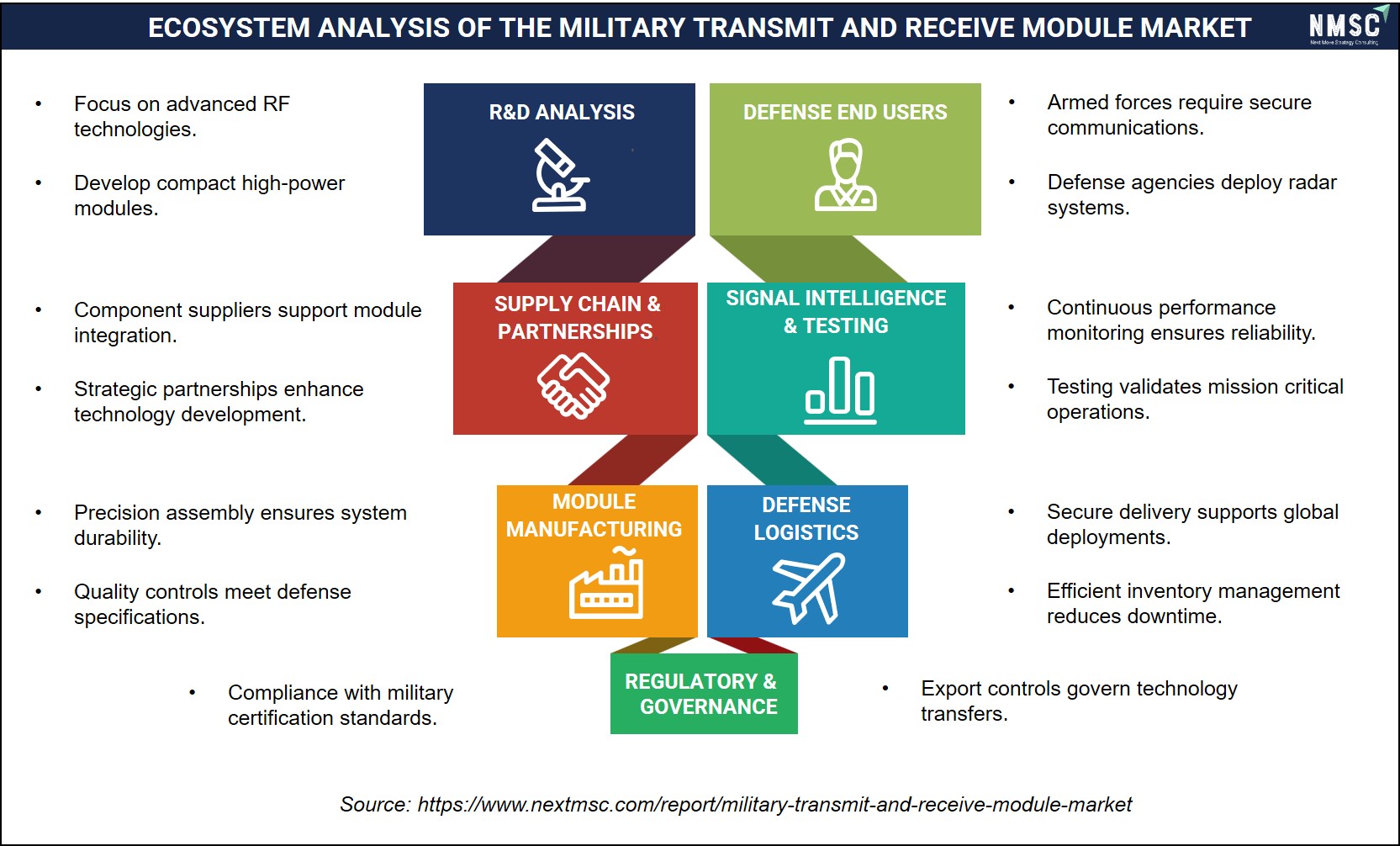
The above framework presents an ecosystem analysis of the Military Transmit and Receive Module Market across R&D, manufacturing, supply chain, signal intelligence, regulatory governance, and defense end-user segments. We observed that defense end users drive demand for advanced module performance and reliability, while R&D and testing focus on signal intelligence and module capabilities. Supply chain partnerships enable manufacturing and logistics, ensuring timely delivery to defense operations. Regulatory governance enforces compliance with defense standards, security protocols, and export controls, collectively fostering innovation and operational readiness in this critical security market.
Key Emerging Trends in the Military Transmit and Receive Module Market
How Is GaN Semiconductor Technology Redefining Performance Standards in the Military Transmit and Receive Module Market?
The industry transition from GaAs to GaN-based T/R modules represents the most consequential technology shift in the Military Transmit and Receive Module Market. GaN-on-SiC substrates deliver power density exceeding 10 W/mm, enabling higher transmit power within a smaller module footprint. Through our market assessment, we observed that AESA radar programs, including the AN/APG-83 SABR upgrade for F-16 aircraft and the AN/APG-79(v)4 for F/A-18 Super Hornets, have standardized on GaN T/R modules, demonstrating operational validation of this technology transition across frontline U.S. military platforms. Adoption is accelerating across NATO member air forces pursuing radar modernization.
How Is Multi-Function RF Technology Reshaping the Military Transmit and Receive Module Market?
Multi-function RF (MFRF) architectures that integrate radar, electronic warfare, and communications functions within a single aperture and shared T/R module array represent a rapidly emerging trend in the Military Transmit and Receive Module Market. From our research, we found that the U.S. Air Force's Multi-Function RF System (MFRFS) program exemplifies this convergence, aiming to reduce platform size, weight, and power (SWaP) requirements while delivering concurrent radar and EW capability through a unified hardware architecture. This trend is compelling T/R module vendors to develop wideband modules supporting simultaneous multi-mode operation across frequency bands from UHF to Ka-band.
How Is Software-Defined Architecture Transforming the Military Transmit and Receive Module Market?
Software-defined and reconfigurable T/R module architectures are gaining significant traction within the Military Transmit and Receive Module Market as defense agencies prioritize systems capable of adapting mission parameters dynamically without hardware replacement. NMSC's analysis indicates that the U.S. Department of Defense's Software-Defined Radio initiative and Joint Tactical Radio System (JTRS) programs established the framework for software-reconfigurable waveform capability. Modern T/R modules incorporating digital beamforming and direct digital synthesis are enabling real-time frequency agility and waveform adaptation that provides significant operational advantages in contested electromagnetic environments against sophisticated adversaries.
How Is the Proliferation of LEO Military Satellite Constellations Driving Demand in the Military Transmit and Receive Module Market?
The rapid deployment of Low Earth Orbit (LEO) military satellite constellations for surveillance, communications, and signals intelligence is creating a structurally new and fast-growing demand category within the Military Transmit and Receive Module Market. Based on our market evaluation, we noticed that the U.S. Space Force's proliferated LEO architecture program and satellite ground station modernization are generating sustained procurement of compact, power-efficient T/R modules optimized for Ka-band and Ku-band satellite communications links. Countries including China and Japan are also pursuing military LEO satellite programs that incorporate phased-array T/R module payloads for high-throughput secure data transmission.
What Are the Key Market Drivers, Breakthroughs, and Investment Opportunities That Will Shape the Military Transmit and Receive Module Industry in the Next Decade?
|
Drivers / Trends / Restraints |
(+/-) % Impact on CAGR Forecast |
Geographic Relevance |
Impact Timeline |
|
Rising Defense Budgets and AESA Radar Modernization |
+2.1% |
North America, Europe, Asia-Pacific |
2025–2035 |
|
GaN T/R Module Adoption for Next-Gen Platforms |
+1.8% |
Global |
2025–2030 |
|
Electronic Warfare Capability Investment Surge |
+1.5% |
North America, Europe |
2025–2035 |
|
LEO Military Satellite Proliferation |
+1.2% |
North America, Asia-Pacific |
2026–2035 |
|
Multi-Function RF Architecture Transition |
+1.0% |
North America, Europe |
2025–2030 |
|
SWaP Optimization Demand in Airborne Platforms |
+0.8% |
Global |
2025–2035 |
|
ITAR/EAR Export Control Restrictions |
-0.9% |
MEA, APAC (non-allied) |
Ongoing |
|
High Manufacturing Cost of GaN Modules |
-0.7% |
Global |
2025–2028 |
|
Supply Chain Concentration Risk for Compound Semiconductors |
-0.5% |
Global |
Ongoing |
What Are the Growth Drivers of the Military Transmit and Receive Module Market?
How Are Rising Defense Budgets and AESA Radar Programs Fueling Military Transmit and Receive Module Market Growth?
Escalating global defense budgets constitute the most powerful structural growth driver for the Military Transmit and Receive Module Market. NATO member nations have collectively committed to defense spending targets of at least 2% of GDP, with the U.S. Department of Defense's fiscal year 2025 budget allocating over USD 145 billion to research, development, test, and evaluation programs that include advanced radar and EW systems. NMSC's analysis indicates that AESA radar programs for fifth-generation fighter aircraft, ground-based air defense systems, and naval surface combatants represent the most concentrated procurement demand for GaN-based T/R modules across the global defense market.
How Does the Transition to GaN Technology Drive Demand in the Military Transmit and Receive Module Market?
The industry-wide transition from GaAs to GaN-based T/R modules is both a technology trend and a demand multiplier for the Military Transmit and Receive Module Market. GaN-on-SiC T/R modules deliver power density advantages of five to ten times over GaAs equivalents at X-band and Ku-band frequencies, enabling radar systems to achieve longer detection ranges with reduced thermal management requirements. Based on our market evaluation, we noticed that the U.S. Defense Advanced Research Projects Agency (DARPA) and the Office of Naval Research have co-funded multiple GaN power amplifier programs specifically targeting naval shipborne radar modernization, providing direct government investment evidence of GaN T/R module strategic importance.
How Is Electronic Warfare Investment Intensity Creating Sustained Demand in the Military Transmit and Receive Module Market?
Electronic warfare capability investment has become a top-tier defense priority across NATO and Indo-Pacific nations, directly driving demand for advanced T/R modules optimized for EW applications within the Military Transmit and Receive Module Market. EW systems require T/R modules with ultra-wide instantaneous bandwidth, fast switching speeds, and high dynamic range to detect, classify, and counter adversary radar and communication signals. Through NMSC's assessment, we found that the U.S. Navy's Next Generation Jammer program, the Air Force Research Laboratory's Advanced Battle Management System, and the Army's Multi-Function Electronic Warfare program collectively represent billions in EW T/R module procurement value through 2035.
What Are the Growth Inhibitors of the Military Transmit and Receive Module Market?
How Do ITAR and Export Control Restrictions Constrain Military Transmit and Receive Module Market Expansion?
International Traffic in Arms Regulations (ITAR) and Export Administration Regulations (EAR) administered by the U.S. Department of State and Bureau of Industry and Security represent the most significant structural constraint on the Military Transmit and Receive Module Market's global expansion. Advanced GaN T/R module technology is classified under USML Category XI (Military Electronics), requiring individual export licenses for each recipient country and end-user. From our assessment, we observed that these restrictions limit market access for U.S.-origin T/R module technology across numerous potential growth markets in the Middle East, Southeast Asia, and beyond, creating supply fragmentation and incentivizing local indigenous development programs in countries seeking technology autonomy.
How Do High GaN Module Manufacturing Costs Restrain Adoption in the Military Transmit and Receive Module Market?
The high manufacturing cost of GaN-based T/R modules relative to legacy GaAs and silicon-based alternatives represents a meaningful near-term restraint on rapid adoption across cost-sensitive defense procurement programs within the Military Transmit and Receive Module Market. GaN-on-SiC wafer processing requires specialized epitaxial growth equipment and clean room infrastructure with limited commercial foundry capacity. Our assessment indicates that the U.S. Department of Defense's Trusted Foundry program identifies GaN wafer supply as a strategic semiconductor risk, reflecting the constrained manufacturing base for defense-grade GaN substrates and its implications for T/R module production cost and volume scalability.
What Are the Growth Opportunities in the Military Transmit and Receive Module Market?
How Does the Multi-Domain Operations Doctrine Create Structural Opportunity in the Military Transmit and Receive Module Market?
The U.S. Department of Defense's Multi-Domain Operations (MDO) doctrine, which mandates integrated joint force operations across land, sea, air, space, and cyberspace simultaneously, creates a structural multi-year demand driver for advanced T/R modules across all platform domains in the Military Transmit and Receive Module Market. MDO-compliant systems require interoperable radar, EW, and communications modules capable of joint data link connectivity, shared spectrum awareness, and real-time sensor fusion. NMSC's analysis indicates that this doctrine shift is compelling T/R module vendors to develop open architecture, standards-compliant hardware platforms aligned with the DoD's Modular Open Systems Approach (MOSA) framework, creating significant product refresh and upgrade opportunity.
How Does the Indigenization Wave in Emerging Defense Markets Create Opportunity in the Military Transmit and Receive Module Market?
India's Atmanirbhar Bharat defense production initiative, South Korea's domestic defense industry development strategy, and Japan's revised defense export policy under its Three Principles framework are collectively creating significant manufacturing and technology partnership opportunities in the Military Transmit and Receive Module Market. India's Defence Research and Development Organisation (DRDO) has developed indigenous GaN MMIC technology for AESA radar applications in the Tejas Mk2 fighter program. Our findings suggest that international T/R module vendors pursuing technology transfer and joint venture partnerships with indigenous defense manufacturers in these countries can access substantial long-term procurement value while navigating local content requirements.
How Does the Integration of AI-Enabled Signal Processing Create New Value in the Military Transmit and Receive Module Market?
The integration of artificial intelligence and machine learning algorithms into radar signal processing and electronic warfare systems is creating a new dimension of differentiation opportunity for advanced T/R module architectures within the Military Transmit and Receive Module Market. AI-enabled adaptive beamforming, cognitive radar waveform selection, and machine learning-based target classification require T/R modules with higher bandwidth, faster switching speeds, and digital beamforming capability. Through our market assessment, we observed that DARPA's Radio Frequency Machine Learning Systems (RFMLS) program is funding research into AI-native T/R module architectures that can dynamically adapt to electromagnetic spectrum conditions, establishing the technology foundation for next-generation cognitive EW systems.
How Is the Military Transmit and Receive Module Market Segmented in This Report, and What Are the Key Insights from the Segmentation Analysis?
Which Semiconductor Material Is Driving Technology Leadership in the Military Transmit and Receive Module Market?
|
Type Segment |
2025 (USD Bn) |
2035 (USD Bn) |
CAGR (%) |
|
Gallium Nitride (GaN) |
4.20 |
10.20 |
9.3% |
|
Gallium Arsenide (GaAs) |
2.80 |
4.80 |
5.5% |
|
Others |
0.70 |
1.35 |
6.8% |
Through our market assessment, we observed that the Military Transmit and Receive Module Market is divided by semiconductor material into Gallium Nitride (GaN), Gallium Arsenide (GaAs), and Others. GaN is the dominant and fastest-growing type at USD 4.2 billion in 2025, advancing at a CAGR of 9.3% through 2035 due to its superior power density, high voltage operation, and thermal efficiency for AESA radar applications. GaAs maintains relevance in legacy radar platforms and low-noise amplifier applications where its mature processing technology provides cost advantages. The Others category encompasses emerging materials such as InP and silicon-based T/R modules serving niche low-power communications and millimeter-wave applications.
How Do Different Military Platforms Shape Demand Across the Military Transmit and Receive Module Market?
|
Platform Segment |
2025 (USD Bn) |
2035 (USD Bn) |
CAGR (%) |
|
Airborne |
2.80 |
6.10 |
8.1% |
|
Land |
2.20 |
4.70 |
7.9% |
|
Naval |
1.50 |
3.20 |
7.8% |
|
Spaceborne |
1.20 |
2.35 |
7.0% |
NMSC's analysis indicates that the Military Transmit and Receive Module Market is segmented by platform into Airborne, Land, Naval, and Spaceborne categories, each representing distinct operational requirements and procurement dynamics. Airborne is the dominant platform at USD 2.8 billion in 2025, driven by AESA radar retrofits on F-16, F/A-18, and Eurofighter platforms and new production on F-35 aircraft across allied air forces. Land-based systems including ground-based air defense radars and vehicle-mounted EW systems constitute the second-largest segment. Naval T/R modules serve shipborne phased-array radar and EW systems for surface combatants. The Spaceborne segment, while smallest in 2025, is gaining momentum from proliferating military LEO satellite programs.
How Does Frequency Band Selection Define Capability Requirements in the Military Transmit and Receive Module Market?
|
Frequency Segment |
2025 (USD Bn) |
2035 (USD Bn) |
CAGR (%) |
|
Single-Band: HF/VHF/UHF (>1 GHz) |
0.60 |
1.00 |
5.2% |
|
Single-Band: L-Band (1–2 GHz) |
0.80 |
1.50 |
6.5% |
|
Single-Band: S-Band (2–4 GHz) |
1.00 |
2.00 |
7.2% |
|
Single-Band: X-Band (4–8 GHz) |
0.90 |
1.90 |
7.8% |
|
Single-Band: X-Band (8–12 GHz) |
1.20 |
2.80 |
8.8% |
|
Single-Band: Ku/K/Ka (12–40 GHz) |
1.30 |
3.30 |
9.8% |
|
Multi-Band |
1.90 |
3.85 |
7.3% |
Based on our analysis of defense radar and EW procurement programs, the Military Transmit and Receive Module Market is segmented by frequency into Single-Band categories spanning HF/VHF/UHF through Ku/K/Ka-band, and Multi-Band configurations. X-Band (8–12 GHz) and Ku/K/Ka-band (12–40 GHz) single-band segments together represent over USD 2.5 billion in 2025, driven by AESA radar and military SATCOM applications respectively. Multi-Band T/R modules at USD 1.9 billion represent the fastest-growing category alongside Ku/K/Ka as defense systems increasingly demand simultaneous multi-frequency operation. Ku/K/Ka-band is the highest-growth single-band segment at 9.8% CAGR, driven by military satellite communication terminal proliferation and spaceborne ISR payload demand.
How Does Communication Medium Architecture Shape the Military Transmit and Receive Module Market?
|
Communication Medium |
2025 (USD Bn) |
2035 (USD Bn) |
CAGR (%) |
|
Optical |
0.80 |
2.20 |
10.6% |
|
Radio Frequency |
5.80 |
11.20 |
6.8% |
|
Hybrid |
1.10 |
2.95 |
10.4% |
Our findings suggest that the Military Transmit and Receive Module Market is segmented by communication medium into Optical, Radio Frequency, and Hybrid architectures. Radio Frequency dominates at USD 5.8 billion in 2025 as the foundational transmission medium for radar, EW, and tactical communications applications across all military domains. Optical communication, which utilizes free-space optical links and fiber-fed module arrays, is the fastest-growing medium at a CAGR of 10.6%, driven by its immunity to RF jamming and its high-bandwidth capability for inter-platform data links. Hybrid systems that combine RF and optical transmission are the second-fastest-growing medium at 10.4% CAGR, offering operational flexibility across contested electromagnetic environments.
Which Applications Are Generating the Highest T/R Module Demand in the Military Transmit and Receive Module Market?
|
Application Segment |
2025 (USD Bn) |
2035 (USD Bn) |
CAGR (%) |
|
Radar Systems |
3.20 |
6.80 |
7.8% |
|
Electronic Warfare |
2.10 |
4.50 |
7.9% |
|
Communications Systems |
1.80 |
3.80 |
7.8% |
|
Other Applications |
0.60 |
1.25 |
7.6% |
From our assessment of global defense procurement programs, the Military Transmit and Receive Module Market is segmented by application into Radar Systems, Electronic Warfare, Communications Systems, and Other Applications. Radar Systems is the largest application at USD 3.2 billion in 2025, underpinned by global AESA radar program procurement for airborne, land-based, and naval platforms across NATO and allied nations. Electronic Warfare is the fastest-growing application at 7.9% CAGR, reflecting escalating defense investment in jamming and counter-measure capabilities. Communications Systems, including military SATCOM and tactical data link terminals, represent a structurally important and growing demand segment at USD 1.8 billion in 2025. Other Applications encompass emerging directed-energy weapon targeting systems.
Regional Outlook
Geographic Performance Snapshot
|
Region |
2025 (USD Bn) |
2035 (USD Bn) |
CAGR (%) |
Key Driver |
|
North America |
3.10 |
6.30 |
7.4% |
DoD AESA radar modernization, EW investment |
|
Europe |
1.80 |
3.70 |
7.5% |
NATO spending commitments, FCAS, Eurofighter upgrades |
|
Asia-Pacific |
1.90 |
4.20 |
8.3% |
Rising defense budgets, AESA development in India/Japan |
|
Middle East & Africa |
0.50 |
1.15 |
8.7% |
Saudi Vision 2030 defense, Israeli EW leadership |
|
Latin America |
0.40 |
1.00 |
9.6% |
Brazil defense modernization, regional border radar programs |
North America Military Transmit and Receive Module Market
North America is the largest revenue region in the Military Transmit and Receive Module Market, contributing USD 3.1 billion in 2025 and forecast to reach USD 6.3 billion by 2035 at a CAGR of 7.4%. The region benefits from the world's largest defence electronics industrial base, anchored by RTX Corporation, Northrop Grumman, L3Harris Technologies, and Qorvo developing advanced GaN T/R modules for DoD programs. U.S. defence budget allocations to radar and EW modernization programs, including the Next Generation Air Dominance (NGAD) program and B-21 bomber radar systems, represent the most concentrated T/R module procurement demand globally through 2035.
United States Military Transmit and Receive Module Market
Based on our engagements with defense industry stakeholders, the United States represents over USD 2.5 billion of the North American Military Transmit and Receive Module Market in 2025, driven by unprecedented DoD investment in AESA radar modernization, electronic warfare capability enhancement, and next-generation fighter aircraft production programs. The U.S. Air Force's F-35A fleet equipped with AN/APG-81 GaN-based AESA radar, the Navy's AN/APG-79 system, and the Army's Integrated Battle Command System constitute the primary T/R module demand drivers. ITAR regulations administered by the State Department define global market access for U.S.-origin T/R module technology.
Canada Military Transmit and Receive Module Market
Through our analysis, Canada is an active participant in the Military Transmit and Receive Module Market, investing in modern fighter capability through its F-35 acquisition program, which incorporates GaN-based AESA radar T/R modules. The Canadian government's Strong Secure Engaged defence policy framework allocates sustained capital to air and maritime surveillance radar systems, including long-range coastal surveillance installations across Arctic and Atlantic regions. Canadian defence procurement operates within the NORAD interoperability framework, ensuring technology alignment with U.S. T/R module standards and supply chain integration with North American defence electronics manufacturers.
Mexico Military Transmit and Receive Module Market
From our assessment, Mexico represents an emerging participant in the Military Transmit and Receive Module Market, with defence modernization efforts focused on border surveillance radar systems and coastal patrol capabilities. The Mexican Armed Forces operate legacy radar infrastructure for air traffic monitoring and anti-narcotics operations, with selective procurement of modern radar platforms requiring updated T/R module technology. Mexico's defence procurement regulatory framework and budget constraints limit near-term adoption of advanced GaN-based T/R modules, but regional border security imperatives and U.S. security cooperation programs provide incremental demand exposure.
Europe Military Transmit and Receive Module Market
Europe is the second-largest region in the Military Transmit and Receive Module Market, contributing USD 1.8 billion in 2025 and forecast to reach USD 3.7 billion by 2035 at a CAGR of 7.5%. NATO member nations' commitment to the 2% GDP defence spending target, ratified at successive summits, is driving simultaneous radar modernization across major European air forces, navies, and ground-based air defence commands. The European Future Combat Air System (FCAS) program, co-led by France, Germany, and Spain, represents a multi-decade T/R module procurement program of strategic significance that will define European radar architecture choices through 2050.
United Kingdom Military Transmit and Receive Module Market
Based on our engagements, the United Kingdom is the largest European Military Transmit and Receive Module Market, driven by its sophisticated defence electronics industrial base and sustained investment in radar and EW capability. The UK's Future Combat Air System (FCAS) Tempest program and its participation in the Eurofighter Typhoon AESA radar upgrade are primary GaN T/R module demand drivers. BAE Systems and Leonardo UK maintain significant T/R module engineering capability, while the MOD's Defence and Security Industrial Strategy provides regulatory framework for domestic procurement preference. UK defence exports under UKTI Defence and Security Organisation further support module vendor revenue.
Germany Military Transmit and Receive Module Market
Through our analysis, Germany is a strategically important Military Transmit and Receive Module Market, driven by its commitment to NATO's 2% GDP defence spending target and its leadership in the European FCAS (Future Combat Air System) program alongside France and Spain. HENSOLDT AG, headquartered in Germany, is a leading European T/R module manufacturer developing KIRAS-family GaN AESA radar modules for Eurofighter and ground-based air defence applications. Germany's Federal Office of Bundeswehr Equipment, Information Technology and In-Service Support (BAAINBw) governs defence procurement that directly influences T/R module sourcing requirements across radar and EW platforms.
France Military Transmit and Receive Module Market
According to our evaluation, France is a major Military Transmit and Receive Module Market driven by Thales S.A.'s leading position in European radar and EW development and the French government's sustained defence investment under the Loi de Programmation Militaire. Thales develops GaN T/R modules for the Rafale AESA radar (RBE2-AA) and naval surveillance systems, including the Sea Fire 500 for FDI frigates. France's Direction Générale de l'Armement (DGA) defines procurement standards for T/R module performance and national security classification requirements, supporting domestic technology preference aligned with France's strategic autonomy defence posture.
Italy Military Transmit and Receive Module Market
From our assessment, Italy represents a meaningful Military Transmit and Receive Module Market, anchored by Leonardo S.p.A.'s comprehensive radar and EW product portfolio and Italy's participation in NATO and the Eurofighter Typhoon consortium. Leonardo develops T/R modules for its AESA Pulse Doppler radar products, including the CAPTOR-E for Eurofighter and shipborne surveillance radars for the Italian Navy. The Italian defence procurement agency SEGREDIFESA governs radar and EW system acquisitions, and Italy's defence industrial policy prioritizes domestic content in Leonardo-led programs that incorporate T/R module manufacturing within the national defence supply chain.
Spain Military Transmit and Receive Module Market
Based on our engagements, Spain is an active participant in the Military Transmit and Receive Module Market as a partner nation in both the Eurofighter program and the New Generation Fighter (FCAS NGF) under AIRBUS Defence. Indra Sistemas develops radar and EW systems incorporating T/R modules for its AESA-based Firemaster and MARS family air surveillance radars deployed by the Spanish Air and Space Force. Spain's defence procurement directorate (DGAM) coordinates acquisition programs aligned with NATO interoperability standards, and Spain's growing defence export activity creates supplementary demand for T/R module-equipped radar platforms across Latin American customer nations.
Sweden Military Transmit and Receive Module Market
Through our analysis, Sweden represents a technologically advanced Military Transmit and Receive Module Market, home to Saab AB, which develops world-class AESA radar technology including the PS-05/A Mk4 active array for the Gripen E/F fighter and the GlobalEye airborne surveillance system. Saab's T/R module capability leverages Swedish expertise in GaN MMIC design for airborne radar applications, supported by the Swedish Defence Materiel Administration (FMV). Sweden's NATO membership formalizes interoperability requirements and may accelerate defence procurement programs incorporating AESA radar with advanced GaN T/R module technology in the forecast period.
Denmark Military Transmit and Receive Module Market
From our assessment, Denmark's Military Transmit and Receive Module Market is shaped by its F-35A procurement program, which incorporates AN/APG-81 GaN-based AESA radar T/R modules from Northrop Grumman. Denmark's defence budget growth aligns with NATO spending commitments, supporting sustained investment in radar surveillance, maritime patrol, and EW platforms for the Royal Danish Air Force and Navy. The Danish Defence Acquisition and Logistics Organisation (DALO) manages procurement processes, and Denmark's maritime geographic position drives demand for naval surveillance radar systems incorporating advanced T/R module arrays.
Finland Military Transmit and Receive Module Market
Based on our engagements, Finland is a growing Military Transmit and Receive Module Market following its NATO membership, which is expanding defence interoperability requirements and driving procurement of NATO-standard radar and EW platforms incorporating modern T/R module technology. Finland's HX fighter program, selecting the F-35A introduces GaN AESA T/R module technology into the Finnish Air Force inventory. The Finnish Defence Forces Logistics Command governs defence procurement aligned with NATO standards, and Finland's border defence requirements drive investment in ground-based surveillance radar systems requiring advanced T/R module architectures.
Netherlands Military Transmit and Receive Module Market
Through our analysis, the Netherlands is an established participant in the Military Transmit and Receive Module Market, operating F-35A aircraft with AN/APG-81 GaN AESA radar and hosting Thales Nederland, which develops advanced T/R module-equipped phased array radar systems for naval vessels. Thales Nederland's SMART-L EWC long-range radar and APAR medium-range active phased array radar for the Royal Netherlands Navy's De Zeven Provinciën-class frigates represent significant installed T/R module platforms. The Netherlands Defence Materiel Organisation coordinates procurement activities aligned with NATO interoperability and Dutch defence industrial participation frameworks.
Rest of Europe Military Transmit and Receive Module Market
According to our evaluation, the Rest of Europe segment encompasses Poland, Norway, Greece, Belgium, Portugal, Romania, and other NATO member states that are increasing defence budgets in response to evolving security environments. Poland's substantial defence spending increase, targeting 4% of GDP, is driving procurement of AESA radar-equipped platforms including F-35 aircraft and Patriot air defence systems that incorporate advanced T/R module arrays. Norway's F-35 fleet and maritime patrol aircraft programs contribute to T/R module demand. The European Defence Fund is also financing collaborative T/R module technology development across multiple EU member states.
Asia-Pacific Military Transmit and Receive Module Market
Asia-Pacific is the fastest-growing major region in the Military Transmit and Receive Module Market at a CAGR of 8.3% from 2026 to 2035, contributing USD 1.9 billion in 2025 and forecast to reach USD 4.2 billion by 2035. The region's growth is fuelled by China's comprehensive PLA modernisation, India's Atmanirbhar Bharat defence indigenisation, Japan's expanding defence budget toward 2% of GDP, and South Korea's KF-21 Boramae fighter AESA radar program. Regional geopolitical tensions across the Taiwan Strait, Korean Peninsula, and South China Sea are accelerating T/R module procurement timelines across multiple nations simultaneously.
China Military Transmit and Receive Module Market
Based on our engagements, China is the largest military radar and EW market in Asia and a major domestic Military Transmit and Receive Module Market, driven by the People's Liberation Army's comprehensive modernization program. China has developed indigenous GaN T/R module technology for its J-20 AESA radar, KJ-500 airborne early warning platform, and Type 346 phased array naval radar. The PLA's equipment procurement is governed by the Central Military Commission and the Strategic Support Force, with domestic industry including CASC, CETC, and CSSC supplying T/R modules under China's military-civil fusion policy that integrates commercial GaN research for defence applications.
India Military Transmit and Receive Module Market
Through our analysis, India is the fastest-growing national Military Transmit and Receive Module Market, driven by its Atmanirbhar Bharat defence indigenisation program and rapidly expanding defence budget exceeding USD 75 billion annually. DRDO's Centre for Airborne Systems has developed indigenous GaN T/R modules for the Uttam AESA radar integrated into the Tejas Mk2 fighter program. Bharat Electronics Limited (BEL) manufactures T/R modules domestically, supported by the Ministry of Defence's positive indigenisation list that mandates domestic sourcing. India's procurement of Rafale-M aircraft with AESA radar further validates its ascending position in the global T/R module demand landscape.
Japan Military Transmit and Receive Module Market
From our assessment, Japan is a technologically advanced Military Transmit and Receive Module Market, home to Mitsubishi Electric Corporation which produces GaN T/R modules for Japan's indigenous AESA radar programs, including the J/APG-2 for the F-2 fighter and the AESA radar for the F-X next-generation fighter. Japan's Acquisition, Technology & Logistics Agency (ATLA) governs defence procurement with an emphasis on domestic production and technology independence. Japan's significant defence budget expansion, targeting 2% of GDP by 2027, is generating sustained demand for advanced T/R module-equipped radar and EW systems across Japan Air Self-Defense Force, Ground, and Maritime Self-Defense Force platforms.
South Korea Military Transmit and Receive Module Market
Based on our engagements, South Korea is an emerging Military Transmit and Receive Module Market characterised by strong indigenous development capability and growing export ambition. The Defense Acquisition Program Administration (DAPA) manages radar and EW procurement, with Korean domestic programs including the KF-21 Boramae fighter AESA radar and Korean Air and Missile Defense systems requiring advanced T/R module technology. Hanwha Systems is developing indigenous AESA radar T/R modules for the KF-21 program, representing significant investment in domestic GaN capability. South Korea's expanding defence export portfolio, including FA-50 aircraft with radar upgrades, creates additional T/R module market value.
Taiwan Military Transmit and Receive Module Market
Through our analysis, Taiwan is a strategically significant Military Transmit and Receive Module Market driven by its unique security environment and substantial defence investment. CSIST (Chungshan Institute of Science and Technology) develops indigenous radar and EW systems for the Republic of China Air Force and Navy, incorporating T/R module technology for airborne and naval surveillance applications. Taiwan's F-16V upgrade program with AN/APG-83 SABR AESA radar introduces GaN T/R modules at scale. The Ministry of
Indonesia Military Transmit and Receive Module Market
According to our evaluation, Indonesia represents a developing Military Transmit and Receive Module Market, with defence modernization driven by the Ministry of Defence's Minimum Essential Force procurement strategy and growing security requirements across its vast maritime territory. Indonesia's F-15EX acquisition program and potential procurement of Rafale fighters with AESA radar create future T/R module demand. Ground-based air defence radar upgrades and coastal surveillance systems incorporating modern phased-array radar are primary near-term market drivers. Indonesia's defence procurement frameworks include offset and technology transfer requirements that influence T/R module vendor engagement strategies.
Vietnam Military Transmit and Receive Module Market
From our assessment, Vietnam is a developing participant in the Military Transmit and Receive Module Market, investing in coastal surveillance radar and air defence capability enhancement. Vietnam People's Air Force procurement of Sukhoi Su-30MK2V aircraft with legacy radar systems creates potential for radar modernization programs. Vietnam's Ministry of National Defence procurement policies prioritize cost-effective capability enhancement, limiting near-term adoption of premium GaN T/R module platforms. However, Vietnam's maritime territorial interests and growing defence budget create structural demand for modern surveillance radar systems incorporating advanced T/R module technology over the forecast period.
Australia Military Transmit and Receive Module Market
Based on our engagements, Australia is a mature and technologically sophisticated Military Transmit and Receive Module Market within the Asia-Pacific region. Australia operates F-35A aircraft with AN/APG-81 GaN AESA radar and is investing in the AIR 6500 advanced joint battle management system incorporating advanced radar sensing. The Australian Signals Directorate and Defence Science and Technology Group participate in allied research programs developing next-generation radar T/R module architectures under AUKUS technology sharing agreements. Australia's Defence Strategic Review drives investment in maritime surveillance and air combat capability, sustaining demand for advanced T/R module-equipped platforms through 2035.
Philippines Military Transmit and Receive Module Market
Through our analysis, the Philippines represents an emerging Military Transmit and Receive Module Market, driven by the Armed Forces of the Philippines' modernization program under the Revised AFP Modernization Act. The Philippines is investing in coastal surveillance radar networks, maritime patrol aircraft, and air defence systems that create incremental demand for T/R module-equipped radar platforms. U.S. security cooperation programs and the Enhanced Defence Cooperation Agreement provide channels for defence equipment transfers, and procurement frameworks are aligned with U.S. interoperability standards. Near-term T/R module demand is primarily generated through radar system procurement rather than module-level procurement.
Malaysia Military Transmit and Receive Module Market
According to our evaluation, Malaysia represents a developing Military Transmit and Receive Module Market, with defence procurement governed by the Ministry of Defence's military procurement regulations and guided by Malaysia's defence white paper. Malaysia's Royal Malaysian Air Force operates Sukhoi Su-30MKM fighters with phased array radar systems. Malaysia's maritime security requirements across its EEZ create demand for coastal and offshore patrol vessel radar platforms incorporating T/R module technology. The defence procurement framework incorporates offset and industrial participation requirements that influence engagement models for international T/R module technology vendors exploring Malaysian market opportunities.
Rest of APAC Military Transmit and Receive Module Market
Our analysis shows that the Rest of APAC segment within the Military Transmit and Receive Module Market encompasses Pakistan, Bangladesh, Thailand, New Zealand, and other nations increasing defence budgets in response to evolving regional security dynamics. Pakistan's defence programs include JF-17 Thunder Block III upgrades with KLJ-7A AESA radar incorporating Chinese-origin T/R modules, representing a significant domestic radar upgrade program. Thailand and New Zealand operate defence radar systems requiring periodic modernization. The rest of APAC collectively represents incremental but growing demand for T/R module technology, with procurement channelled through major platform programs rather than direct module-level acquisition.
Middle East and Africa Military Transmit and Receive Module Market
The Middle East and Africa (MEA) region contributes USD 0.5 billion to the Military Transmit and Receive Module Market in 2025, forecast to reach USD 1.15 billion by 2035 at a CAGR of 8.7%. The Gulf Cooperation Council nations, particularly Saudi Arabia and the UAE, are the primary demand drivers, investing heavily in AESA radar-equipped combat aircraft, advanced air defence systems, and maritime surveillance platforms. Israel represents the region's most technologically advanced T/R module developer and user, with indigenous GaN capability at ELTA Systems. African nations contribute incremental demand through ground-based surveillance radar procurement.
Saudi Arabia Military Transmit and Receive Module Market
Based on our engagements, Saudi Arabia is the largest Military Transmit and Receive Module Market in the Middle East, driven by Vision 2030 defence industry development programs and massive defence budget allocations. Saudi Arabia's procurement of F-15SA aircraft with AESA radar upgrades and its advanced air defence systems, including THAAD and Patriot PAC-3 incorporate advanced T/R module technology from U.S. suppliers under FMS frameworks. The General Authority for Military Industries (GAMI) is developing indigenous defence manufacturing capability, including radar electronics, under the Vision 2030 military localization strategy that aims to achieve 50% domestic defence production by 2030.
UAE Military Transmit and Receive Module Market
Through our analysis, the United Arab Emirates represents the most commercially mature Military Transmit and Receive Module Market in the MEA region, supported by its sophisticated defence procurement apparatus and strategic partnership with the U.S. and European defence industries. The UAE operates F-35A aircraft (pending delivery) and advanced air defence systems incorporating GaN T/R module technology. EDGE Group, the UAE's defence technology conglomerate, is developing indigenous radar and EW capabilities as part of the UAE's defence industry diversification strategy. The Ministry of Defence's procurement policy prioritizes technology transfer and local content requirements from international T/R module suppliers.
Egypt Military Transmit and Receive Module Market
From our assessment, Egypt is an emerging Military Transmit and Receive Module Market with growing defence procurement driven by security requirements across its borders and in the maritime domain. Egypt operates Rafale fighters with RBE2-AA AESA radar T/R modules under its French defence procurement program. Egypt's Military Production Ministry oversees domestic defence manufacturing, with selected electronics production partnerships. Egyptian defence procurement through U.S. Foreign Military Sales and French government-to-government agreements generates T/R module demand through platform acquisition. Egypt's significant defence budget and geographic strategic position support continued investment in modern radar and EW platforms.
Israel Military Transmit and Receive Module Market
Based on our engagements, Israel is the most technologically advanced Military Transmit and Receive Module Market in the MEA region, with ELTA Systems (a division of Israel Aerospace Industries) representing a world-class AESA radar and T/R module manufacturer. ELTA's EL/M-2052 AESA fighter radar, EL/M-2084 MMR multi-mission radar, and Iron Dome radar systems incorporate indigenously developed GaN T/R modules. The Israel Ministry of Defence's SIBAT defence export directorate supports significant technology export that extends T/R module market value beyond domestic procurement. Elbit Systems also develops EW T/R module technology for advanced electronic warfare applications.
Turkey Military Transmit and Receive Module Market
Through our analysis, Turkey is an increasingly self-reliant Military Transmit and Receive Module Market with significant domestic development ambitions. ASELSAN, Turkey's leading defence electronics company, is developing indigenous AESA radar T/R modules for the GÖKHAN airborne radar and HAVELSAN-led military communication system programs. Turkey's defence procurement is administered by the Presidency of Defence Industries (SSB), which enforces domestic content requirements that drive ASELSAN's T/R module investment. Turkey's strategic defence export program for TUSAŞ-developed KAAN fighter aircraft creates future demand for domestically produced AESA radar T/R modules as the program matures toward production qualification.
Nigeria Military Transmit and Receive Module Market
According to our evaluation, Nigeria represents a developing Military Transmit and Receive Module Market within Sub-Saharan Africa, with defence procurement driven by internal security requirements and regional peacekeeping operations. Nigeria's Air Force operates fixed-wing and rotary-wing platforms for ISR and ground support missions, with radar capability investment focused on coastal and border surveillance systems. Nigeria's defence budget constraints limit near-term adoption of advanced GaN T/R module platforms, but peacekeeping mission requirements and regional security cooperation programs through the African Union create incremental demand for modern radar surveillance systems over the forecast period.
South Africa Military Transmit and Receive Module Market
From our assessment, South Africa is the most established Military Transmit and Receive Module Market in Sub-Saharan Africa, with indigenous defence electronics capability developed through Reutech Radar Systems and Denel Electronics. South Africa's defence procurement is managed by Armscor under the South African National Defence Force's capability development framework. Reutech develops radar systems including the RSR-Series battlefield radar incorporating T/R module technology for southern African and continental export markets. South Africa's historical defence electronics export program and regional security commitments provide structural demand for radar and EW systems incorporating advanced T/R module architectures over the forecast horizon.
Rest of MEA Military Transmit and Receive Module Market
Our analysis shows that the Rest of MEA segment within the Military Transmit and Receive Module Market encompasses Kuwait, Qatar, Bahrain, Oman, Jordan, Morocco, Kenya, Ethiopia, and other nations with growing defence procurement driven by regional security dynamics. Gulf Cooperation Council nations are collectively investing in advanced air defence systems, AESA-equipped combat aircraft, and maritime surveillance radar platforms that incorporate premium T/R module technology. Qatar's F-35 and Rafale acquisitions, Kuwait's F-18 programs, and Bahrain's F-16V procurement are primary GaN T/R module demand contributors in the GCC. East African nations generate baseline radar demand through ground surveillance system procurement.
Latin America Military Transmit and Receive Module Market
Latin America contributes USD 0.4 billion to the Military Transmit and Receive Module Market in 2025, forecast to reach USD 1.0 billion by 2035 at a CAGR of 9.6%, the highest regional growth rate globally. Brazil's Gripen E AESA radar program and Chile's F-16 modernization are the primary T/R module demand drivers. Regional defence procurement is constrained by budget cycles but supported by U.S. security cooperation programs through the SOUTHCOM framework. Persistent sovereignty surveillance requirements across vast maritime territories and land borders create structural demand for radar systems incorporating modern T/R module technology across the forecast period.
Brazil Military Transmit and Receive Module Market
Based on our engagements, Brazil is the largest Military Transmit and Receive Module Market in Latin America, anchored by its significant defence budget, its participation in the F-39E Gripen E program with AESA radar, and the Brazilian Air Force's ongoing defence modernization. The Gripen E, equipped with Saab's active AESA radar, incorporates T/R module technology that establishes GaN capability within the Brazilian Air Force. Brazil's SISFRON border surveillance system and SIVAM airspace monitoring program generate ground-based and airborne radar demand. Brazil's defence procurement is governed by the Ministry of Defence and the Army, Navy, and Air Force commands under the National Defence Strategy.
Argentina Military Transmit and Receive Module Market
Through our analysis, Argentina represents a developing Military Transmit and Receive Module Market with defence procurement constrained by macroeconomic pressures but driven by sovereign air and maritime surveillance requirements. Argentina's Air Force modernization includes evaluation of fourth-generation fighter replacement programs that would introduce AESA radar T/R module technology into the Argentine inventory. Ground-based air defence radar systems along Argentina's extensive coastline and southern territories create incremental T/R module demand. Argentina's defence procurement framework administered by the Ministry of National Defence prioritizes cost-effective capability solutions aligned with South American regional security commitments and OAS frameworks.
Chile Military Transmit and Receive Module Market
From our assessment, Chile is the most technologically sophisticated Military Transmit and Receive Module Market in South America, operating F-16 Block 52+ fighters and investing in modern ground-based air defence radar systems. Chile's F-16 fleet is a candidate for AESA radar upgrade programs incorporating modern T/R module technology through U.S. FMS channels. Chile's Directorate of National Mobilization and the Chilean Air Force Materiel Command govern defence procurement aligned with NATO interoperability standards. Chile's stable defence procurement environment and strategic partnership with the U.S. provide a reliable framework for advanced T/R module technology introduction over the forecast period.
Colombia Military Transmit and Receive Module Market
Based on our engagements, Colombia represents a growing Military Transmit and Receive Module Market driven by security operations against non-state actors and its procurement of Kfir C10 fighters with radar modernization requirements. Colombia's Air Force is evaluating modern fighter replacement platforms that would introduce AESA radar capability, while existing radar infrastructure for air traffic and border surveillance creates platform upgrade demand. Colombia's defence procurement through the Ministry of Defence and the Fuerzas Militares framework includes U.S. security cooperation that provides access to modern radar technology incorporating advanced T/R module architectures. Regional security cooperation programs with the U.S. Southern Command further shape Colombia's technology access pathways.
Rest of LATAM Military Transmit and Receive Module Market
Our analysis shows that the Rest of LATAM segment within the Military Transmit and Receive Module Market encompasses Peru, Ecuador, Venezuela, Paraguay, Uruguay, Central American nations, and Caribbean states, where defence procurement is primarily driven by sovereign surveillance requirements and internal security operations. Peru's Air Force operates Mirage 2000 fighters with legacy radar systems that represent potential modernization opportunities incorporating updated T/R module technology. Ecuador's border defence and maritime surveillance radar investments create incremental T/R module demand. Across the broader Rest of LATAM segment, defence procurement budgets are constrained, limiting near-term adoption of advanced GaN T/R module platforms beyond established allied procurement frameworks.
PESTEL Analysis of the Military Transmit and Receive Module Market
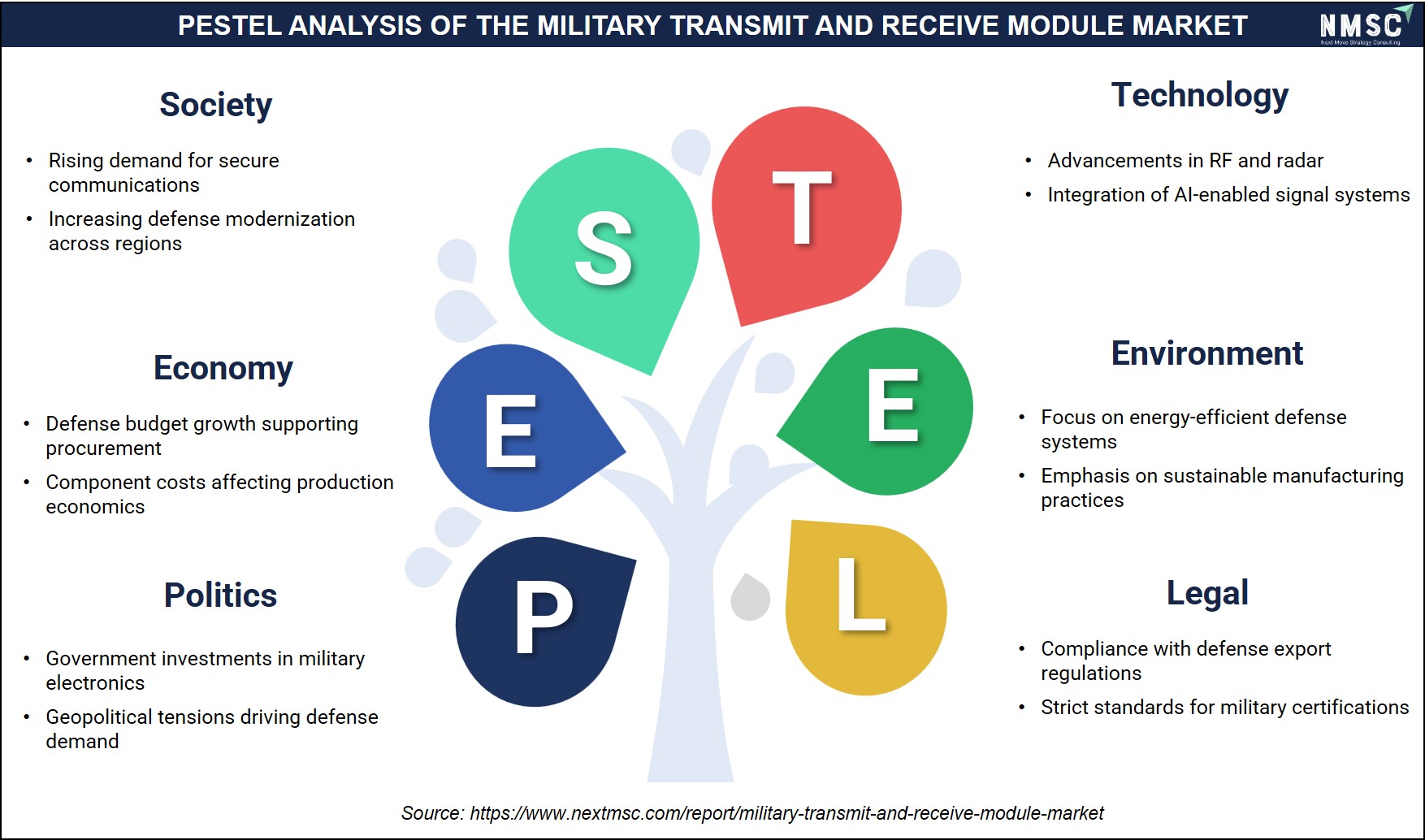
The above infographic presents a structured PESTEL analysis of the Military Transmit and Receive Module Market, illustrating the key external factors influencing industry growth and strategic decision-making. It highlights how political priorities, economic conditions, societal requirements, technological advancements, environmental considerations, and legal frameworks collectively shape market dynamics, innovation trends, procurement strategies, and the long-term development of advanced military radar and electronic warfare systems.
Competitive Landscape
Competitive Dynamics and M&A Landscape
|
Key Takeaways |
Details |
|
Market Structure |
Oligopolistic at the prime integration tier with RTX, Northrop Grumman, Thales, BAE Systems, and Leonardo dominating AESA radar and EW system prime contracts. An active merchant T/R module supplier tier includes Qorvo, MACOM, Analog Devices, Mercury Systems, and CAES Systems supplying GaN MMIC and packaged module components to prime integrators globally. |
|
Innovation Focus |
GaN-on-SiC T/R module power density improvement, wide-instantaneous-bandwidth EW module development, software-defined radar beamforming, compact SWaP-optimized UAV T/R modules, space-qualified T/R module qualification for LEO satellite payloads, and AI-native cognitive radar waveform integration. |
|
M&A Activity |
Mercury Systems' acquisitions of API Technologies and Germane Systems expanded its embedded processing and EW T/R module portfolio. L3Harris's merger with Harris Corporation consolidated radar and EW T/R module capability. Qorvo's acquisition of Custom MMIC strengthened its GaN power amplifier portfolio for defence radar and EW applications. European consolidation including Thales's continued integration of acquired radar businesses reinforces the pan-European T/R module supply chain. |
How Do Companies Compete in the Military Transmit and Receive Module Market?
The Military Transmit and Receive Module Market is characterised by multi-dimensional competition across technology leadership, long-term programme relationships, and national industrial policy alignment. NMSC's analysis indicates that design win execution for AESA radar platform programmes is the primary competitive battleground, as T/R module selection for major fighter aircraft, naval combat systems, and ground-based air defence programmes creates production revenue commitments spanning 20 or more years per platform. Prime integrators compete on system-level radar performance metrics including sensitivity, range, angular resolution, and electronic protection capability, while merchant module suppliers compete on GaN power efficiency, insertion loss, phase shift accuracy, and thermal management solutions.
Which Kind of Companies Dominate the Military Transmit and Receive Module Market?
The Military Transmit and Receive Module Market is dominated by two distinct company archetypes. Prime defence systems integrators, led by RTX Corporation, Northrop Grumman, Thales S.A., BAE Systems, and Leonardo, develop complete AESA radar and EW system solutions incorporating proprietary or merchant T/R module arrays designed to customer platform specifications. These primes leverage decades of radar engineering expertise, government programme relationships, and security clearance infrastructure as barriers to competitive displacement. A complementary tier of specialist T/R module and GaN MMIC suppliers, including Qorvo, MACOM, Analog Devices, Mercury Systems, and CAES Systems, provides enabling semiconductor and sub-module technology to both primes and government development programmes.
AI-Native Differentiation and Open Standards Drive Market Success in the Military Transmit and Receive Module Market
Leading Military Transmit and Receive Module Market vendors are increasingly differentiating through AI-enabled adaptive beamforming, cognitive EW waveform generation capability, and adherence to open architecture standards frameworks mandated by the DoD's Modular Open Systems Approach (MOSA). Our findings suggest that T/R module vendors that participate in JEDEC, MIL-PRF-38534, and VITA 65 OpenVPX standards bodies achieve faster qualification cycles and broader platform adoption than proprietary architecture vendors. Software-defined capability that allows T/R module performance parameters to be updated through firmware without hardware replacement is becoming a procurement differentiator across DoD and NATO allied procurement programmes.
Market Players to Opt for Merger and Acquisition Strategies to Expand Their Presence in the Military Transmit and Receive Module Market
Strategic M&A activity in the Military Transmit and Receive Module Market is driven by the need to acquire GaN MMIC design IP, secure access to trusted foundry relationships, expand frequency coverage across radar and EW applications, and achieve geographic market access in non-U.S. allied defence markets. Based on our market evaluation, we noticed that Mercury Systems' acquisition strategy of integrating mission-critical processing with T/R module packaging creates a vertically differentiated electronic warfare sub-system offering. Future consolidation is most likely to involve CAES Systems, MACOM, or Qorvo being acquired by or forming alliances with prime integrators seeking to deepen vertical control over GaN T/R module supply chains critical to their radar programme cost structures.
Who Are the Key Market Players in the Military Transmit and Receive Module Market?
-
RTX Corporation
-
Northrop Grumman Corporation
-
Thales S.A.
-
BAE Systems plc
-
Leonardo S.p.A.
-
Saab AB
-
HENSOLDT AG
-
Elbit Systems Ltd.
-
Israel Aerospace Industries Ltd.
-
ASELSAN Elektronik Sanayi ve Ticaret Anonim Şirketi
-
Bharat Electronics Limited
-
L3Harris Technologies, Inc.
-
Mercury Systems, Inc.
-
CAES Systems LLC
-
Qorvo, Inc.
-
MACOM Technology Solutions Holdings, Inc.
-
Analog Devices, Inc.
-
Teledyne Technologies Incorporated
-
Rohde & Schwarz GmbH & Co. KG
-
Mitsubishi Electric Corporation
What Are the Latest Developments in the Military Transmit and Receive Module Market?
|
Date |
Event |
|
March 2026 |
HENSOLDT signed a long-term semiconductor agreement with United Monolithic Semiconductors (UMS) to strengthen radar production capacity. The partnership supports the supply of GaN-based components used in AESA radar transmit/receive modules and enhances supply-chain resilience for next-generation defense radar systems. |
What Are the Investment Opportunities in the Military Transmit and Receive Module Market?
Capital Inflows and Strategic Defence Investment
The Military Transmit and Receive Module Market is attracting substantial capital inflows from both government defence investment programmes and strategic defence industry capital allocation. The U.S. DoD's Joint Chiefs of Staff identified advanced radar and EW technology as modernisation priorities in the 2024 National Defence Strategy, directing substantial research and development funding to GaN T/R module programmes. Our assessment indicates that DARPA's Electronics Resurgence Initiative and its RF-centric programmes, including JUMP 2.0, are channelling hundreds of millions in federal research funding into compound semiconductor and GaN T/R module technology, creating near-term IP development that transitions into production programmes through 2030 and beyond.
Infrastructure Investment in Trusted Foundry Capacity
Investment in domestic GaN-on-SiC wafer fabrication capacity for defence-grade T/R modules represents a critical infrastructure priority within the Military Transmit and Receive Module Market. The U.S. CHIPS and Science Act, administered by the Department of Commerce, includes provisions for advanced packaging and compound semiconductor manufacturing that benefit GaN T/R module supply chain resilience. From our research, we found that Wolfspeed's investment in its Mohawk Valley GaN-on-SiC fabrication facility in New York, supported by DoD foundry agreements, directly addresses the trusted manufacturing gap for defence-grade GaN T/R module substrates, representing a strategic infrastructure investment that underpins the U.S. T/R module industry's long-term production security.
ESG Considerations in Defence Electronics
Environmental, social, and governance considerations within the Military Transmit and Receive Module Market are primarily expressed through energy efficiency imperatives in defence system design. GaN T/R modules' superior power-added efficiency reduces radar system energy consumption and thermal management requirements, directly supporting military platform power budget optimisation and reducing the logistical fuel burden associated with forward-deployed radar systems. The DoD's Operational Energy Strategy, which targets reduction of fuel consumption in operational platforms, creates policy alignment with GaN T/R module adoption that reduces platform-level power consumption relative to equivalent GaAs T/R module radar systems, providing an ESG-aligned investment narrative alongside the operational capability advantages.
Digital Transformation and Software-Defined Capability
The integration of digital beamforming, direct digital synthesis, and AI-enabled waveform management into T/R module array architectures represents the digital transformation frontier of the Military Transmit and Receive Module Market. Investment in software-defined T/R module platforms that support firmware-level capability upgrades is aligned with the DoD's digital engineering transformation framework articulated in the 2022 Digital Engineering Strategy. NMSC's analysis indicates that digital T/R module architectures that support open-architecture software integration reduce the cost of radar system capability upgrades over the platform lifecycle, creating compelling total-cost-of-ownership arguments for procurement authorities managing long-duration platform sustainment programmes through 2035 and beyond.
Private Equity and Strategic M&A Activity
Strategic investment interest in the Military Transmit and Receive Module Market is concentrated around GaN MMIC design IP, trusted foundry relationships, and EW-specific T/R module capability. Our assessment indicates that mid-market T/R module specialists with established DoD programme relationships and GaN design track records represent attractive acquisition targets for defence prime contractors seeking to vertically integrate compound semiconductor capability. The Carlyle Group's historical investment in Vectrus and CAES Systems demonstrates private equity appetite for defence electronics businesses with long-term DoD programme revenue visibility. Future PE investment themes include EW T/R module software integration businesses, GaN wafer processing capability, and multi-function T/R module platform developers aligned with the DoD's MOSA framework.
Key Benefits for Stakeholders
For Defence Prime Contractors and System Integrators
Defence prime contractors and system integrators gain access to a comprehensive and vendor-neutral assessment of the Military Transmit and Receive Module Market, including detailed segmentation across type, platform, frequency band, communication medium, and application categories. Competitive landscape analysis provides insights into GaN-based T/R module vendor strategies, AESA radar design win trends, and electronic warfare module differentiation, enabling informed sub-system sourcing decisions and long-term supply chain planning. Segment-level forecasts and regional demand assessments support programme proposal development and investment prioritisation over the forecast period.
For Investors and Financial Analysts
Investors and financial analysts access a structured and data-rich evaluation of the Military Transmit and Receive Module Market's growth trajectory, competitive dynamics, and segment-level revenue opportunities through 2035. CAGR analysis, company benchmarking, and tracking of technology developments provide an early-indicator framework for identifying design win momentum, semiconductor technology transitions, and merger and acquisition opportunities across the defence electronics value chain. These insights support portfolio construction, valuation modelling, and long-term investment thesis development.
For T/R Module Vendors and Semiconductor Companies
T/R module manufacturers and semiconductor companies gain actionable intelligence on white-space opportunities across high-growth frequency bands, emerging platform categories, and strategically important geographic markets. Segmentation analysis highlights the fastest-growing procurement areas across radar, electronic warfare, and communication applications, enabling suppliers to optimize product roadmaps and prioritize programme engagement activities. Regional outlook sections further provide visibility into allied nation procurement cycles, local content requirements, and technology transfer frameworks that influence international expansion strategies.
For Government Agencies and Defence Procurement Authorities
Government agencies and defence procurement authorities gain a structured understanding of how defence industrial policies, export control regulations, and semiconductor investment initiatives are influencing the evolution of the Military Transmit and Receive Module Market. Country-level analysis provides evidence-based insights into the impact of procurement strategies, indigenous capability development programs, and international cooperation frameworks on domestic industry competitiveness, supply chain resilience, and technological self-reliance. These findings support informed policymaking and long-term defence modernization planning.
Key Market Segments
By Type
-
Gallium Nitride (GaN)
-
Gallium Arsenide (GaAs)
-
Others
By Platform
-
Airborne
-
Land
-
Naval
-
Spaceborne
By Frequency
-
Single-Band
-
HF/VHF/UHF (> 1 GHz)
-
L-Band (1–2 GHz)
-
S-Band (2–4 GHz)
-
X-Band (4–8 GHz)
-
X-Band (8–12 GHz)
-
Ku/K/Ka (12–40 GHz)
-
-
Multi-Band
By Communication Medium
-
Optical
-
Radio Frequency
-
Hybrid
By Application
-
Radar Systems
-
Electronic Warfare
-
Communications Systems
-
Other Applications
By Region
-
North America: U.S., Canada, and Mexico
-
Europe: UK, Germany, France, Italy, Spain, Sweden, Denmark, Finland, the Netherlands, and the rest of Europe
-
Asia-Pacific: China, India, Japan, South Korea, Taiwan, Indonesia, Vietnam,
-
Middle East & Africa (MEA): Saudi Arabia, UAE, Egypt, Israel, Turkey, Nigeria, South Africa, and the rest of MEA
-
Latin America: Brazil, Argentina, Chile, Colombia, and the rest of LATAM
Conclusion and Recommendations
Long-Term Outlook
The Military Transmit and Receive Module Market is entering a decade of structurally robust growth, advancing from USD 8.3 billion in 2026 to USD 16.35 billion by 2035 at a CAGR of 7.82%. This growth reflects both expanding platform programme volumes and a meaningful increase in average T/R module content value per radar system, as GaN-based architectures, digital beamforming integration, and multi-function RF capabilities command premium pricing relative to legacy GaAs and narrowband module predecessors. NMSC's analysis indicates that the convergence of AESA radar modernisation across five global domain categories, airborne, naval, land, spaceborne, and EW, provides a more balanced and durable demand structure than the historically airborne-concentrated radar market of prior decades.
Strategic Positioning Recommendations
T/R module vendors should prioritise GaN-on-SiC design and qualification capability as the single most critical technology investment, as all major radar and EW platform programmes are standardising on GaN architectures for new production. Vendors without spaceborne-qualified T/R module product lines should treat this as a high-priority gap, given the concentration of emerging procurement value in proliferated LEO military satellite programmes. Alignment with the DoD's Modular Open Systems Approach framework and European OCCAR procurement standards is a prerequisite for programme qualification across the largest T/R module demand markets globally through 2035.
Investment Attractiveness
The Military Transmit and Receive Module Market represents a compelling investment environment underpinned by durable secular demand drivers, long production programme commitments of 20 or more years, and a once-in-generation semiconductor transition from GaAs to GaN that creates design win displacement opportunities for technology leaders. Our assessment indicates that the highest-conviction investment themes include GaN T/R module adoption for AESA fighter radar (dominant segment, 9.3% CAGR), electronic warfare module investment (7.9% CAGR), Ka-band spaceborne T/R modules (fastest-frequency growth at 9.8% CAGR), and Asia-Pacific defence indigenisation partnerships (8.3% regional CAGR). Listed companies including Qorvo and Analog Devices provide semiconductor-level exposure to these themes.
Market Shifts and Key Risks
The most significant market shift underway is the transition from single-band to multi-function, software-defined T/R module architectures that simultaneously serve radar, EW, and communications applications within a single module array. This shift compresses the number of separate T/R module types required per platform while increasing the unit value and software complexity of each module deployed. Key risks for the Military Transmit and Receive Module Market include export control escalation affecting GaN T/R module supply to allied partners, supply chain concentration risk for GaN-on-SiC substrates, and programme delays in major AESA radar modernisation initiatives that compress near-term revenue recognition. Geopolitical tensions in Taiwan, where no major military T/R module production is concentrated, represent a lower direct risk than in adjacent semiconductor markets.
Growth Pathways
Organisations seeking to maximise value from the Military Transmit and Receive Module Market should pursue a three-horizon strategy. In the near term from 2025 to 2027, prioritise GaN T/R module qualification for the highest-volume AESA fighter and naval radar programmes, ITAR-compliant international business development in allied European and Indo-Pacific markets, and multi-band module development aligned with emerging MFRF programme specifications. In the mid-term from 2027 to 2031, invest in spaceborne T/R module qualification for military LEO satellite payloads, AI-enabled adaptive beamforming module capability, and digital T/R module platforms supporting open-architecture radar systems. In the long term from 2031 to 2035, position for cognitive EW T/R module architectures that embed AI inference acceleration directly within the module processing chain as the highest-value next frontier of T/R module system differentiation.
Key Risks
The primary risks that could constrain the Military Transmit and Receive Module Market growth trajectory include cyclical defence budget pressure if geopolitical de-escalation reduces near-term procurement urgency, ITAR restriction tightening that limits allied nation market access for U.S.-origin GaN T/R technology, disruption to GaN-on-SiC substrate supply from the limited number of qualified commercial and trusted foundry sources, and programme delays in major AESA radar platforms that defer production-rate ramp in key T/R module procurement programmes. Vendors and investors should monitor DoD FYDP budget cycles, U.S.-China export control policy evolution, and GaN foundry capacity expansion timelines as the primary leading indicators of Military Transmit and Receive Module Market risk.
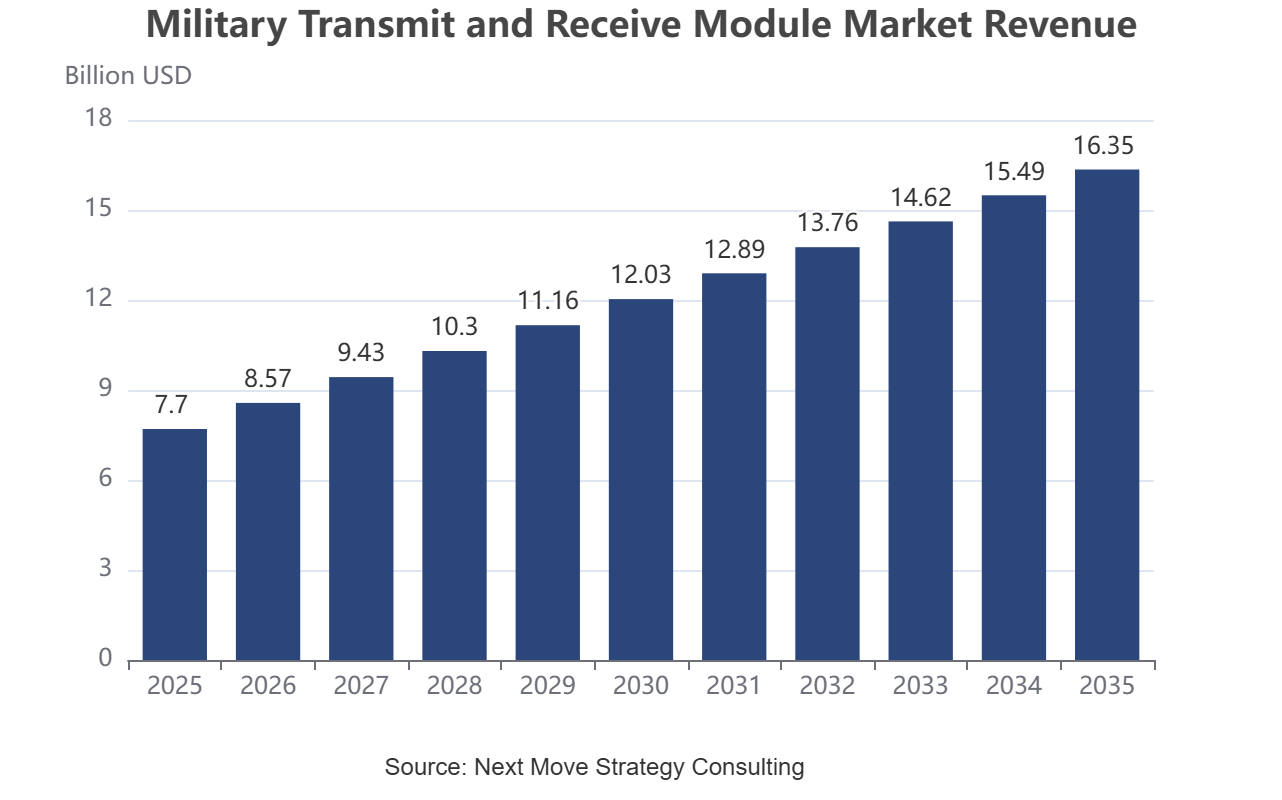
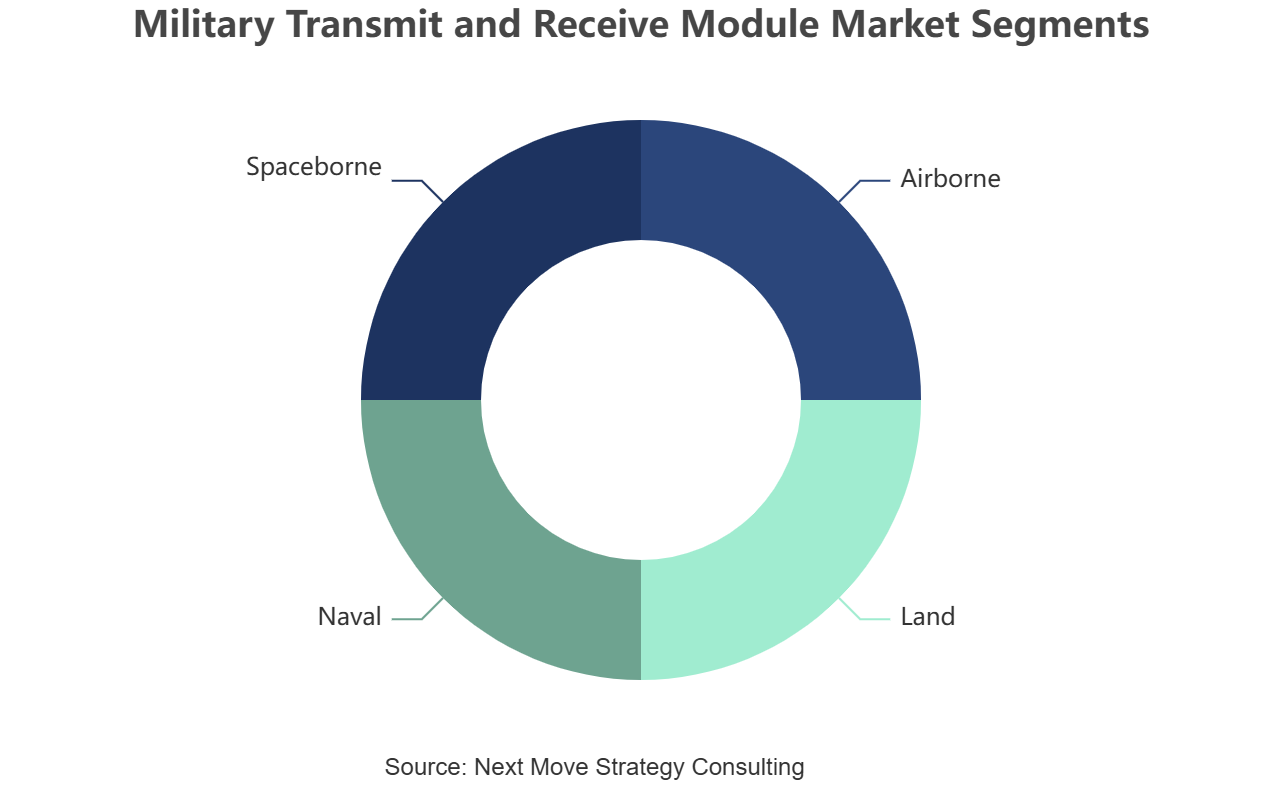
About the Author
 Mayurima Roy
— Mayurima Roy is Research Analyst at Next Move Strategy Consulting, where she has spent 4 years working across the firm's full industry coverage rather than a single fixed vertical. Her work centers on structured research, ongoing trend tracking, competitive assessment, and insight-led content development, translating complex market data into clear, decision-ready narratives that support informed client decision-making across diverse global industries, market sectors, and world regions every day.
Mayurima Roy
— Mayurima Roy is Research Analyst at Next Move Strategy Consulting, where she has spent 4 years working across the firm's full industry coverage rather than a single fixed vertical. Her work centers on structured research, ongoing trend tracking, competitive assessment, and insight-led content development, translating complex market data into clear, decision-ready narratives that support informed client decision-making across diverse global industries, market sectors, and world regions every day.
About the Reviewer
 Supradip Baul
— Supradip Baul is an accomplished business consultant and strategist with over a decade of rich experience in market intelligence, strategy, technology, and business transformation. His work has included rigorous qualitative and quantitative analysis across multiple industries, helping clients shape investment decisions and long-term roadmaps. Earlier in his career, he was associated with Gartner, where he contributed to industry-leading reports and market share analyses. He has worked with leading global companies and holds an MBA with a dual specialization in Marketing and Finance.
Supradip Baul
— Supradip Baul is an accomplished business consultant and strategist with over a decade of rich experience in market intelligence, strategy, technology, and business transformation. His work has included rigorous qualitative and quantitative analysis across multiple industries, helping clients shape investment decisions and long-term roadmaps. Earlier in his career, he was associated with Gartner, where he contributed to industry-leading reports and market share analyses. He has worked with leading global companies and holds an MBA with a dual specialization in Marketing and Finance.
At Next Move Strategy Consulting, we understand that insightful market research is the cornerstone of successful business decisions. That's why we employ a robust and multifaceted approach, combining various methodologies to deliver the most accurate and actionable data for our clients.

Research Landscape
We navigate the world of research with two primary approaches:
Qualitative Approach
Our qualitative research methodologies involve immersive techniques such as in-depth interviews, focus groups, and observational studies. By engaging directly with individuals and stakeholders, we uncover valuable insights that quantitative data alone may overlook.

Quantitative Research
In tandem with qualitative methodologies, NMSC leverages the power of Quantitative Research to provide a robust foundation of numerical insights. Through systematic data collection and analysis, we quantify patterns, preferences, and market trends, offering a comprehensive view of the business landscape.
Our quantitative research approach employs diverse tools, including surveys, experiments, and statistical modelling. These methodologies enable us to gather data from a large and representative sample, ensuring the statistical significance of our findings. By employing structured questionnaires and standardized data collection methods, we guarantee the reliability and validity of the information we present to our clients.
Quantitative research is particularly effective in measuring the prevalence of trends, assessing market size, and gauging the impact of various factors on consumer behavior. The numerical precision attained through this approach equips our clients with actionable insights, facilitating data-driven decision-making and strategy formulation.


Our Specialized Toolbox for Industry-Specific Market Research
We deploy a specialized arsenal of techniques tailored to meet your unique requirements. Here's a glimpse into our comprehensive toolbox:

Information Procurement
The stage entails acquiring market data or relevant information through various sources and methodologies.


Market Research Approach
We utilize both top-down and bottom-up approaches in market research analysis to achieve a comprehensive understanding of the market dynamics, leveraging the broad perspective of industry trends and macroeconomic factors alongside detailed insights from specific segments and individual companies.

Porters Five Forces Analysis
We conduct Porter's Five Forces analysis to evaluate the competitive landscape of an industry, providing us with insights into factors that affect profitability and strategic positioning.

SWOT Analysis

Forecasting
We utilize a forecasting model to predict future consumption by considering parameters like population, economics, regulations, market competition, drivers, constraints, technology, and pricing. We also employ statistical techniques such as multilinear regression, exponential smoothing, moving average, ARIMA, and Monte Carlo simulations for accurate predictions. In econometric forecasting, we analyzed short-term and long-term event impacts, attributing values based on regulatory frameworks, economic factors, and market events.





 Speak to Our Analyst