Smart Weapon Market Global Industry Analysis and Forecast (2026–2035)

Smart Weapon Market size was USD 30.06 Billion in 2025, projected to reach USD 59.61 Billion by 2035, growing at a CAGR of 6.78% from 2026 to 2035. Key drivers include accelerating defense modernization budgets across NATO and Indo-Pacific nations, rising demand for precision strike capabilities to minimize collateral damage, and rapid integration of artificial intelligence into autonomous guidance systems, with North America leading the global market.

Download Free Sample PDF
Base Year (2025)
$33.01 Billion
Forecast (2035)
$59.61 Billion
CAGR (2026-2035)
6.8%
Top Region
North America

What Is the Smart Weapon Market Size?

The global Smart Weapon Market reached USD 30.06 Billion in 2025 and is estimated at USD 33.01 Billion in 2026, forecast to reach USD 59.61 Billion by 2035 at a CAGR of 6.78% between 2026 and 2035. North America leads with approximately 40% revenue share in 2025, while Guided Missiles is the dominant product type, holding approximately 48% of global revenue.

Based on research conducted by NMSC, we found that sustained escalation in geopolitical tensions across Eastern Europe, the Indo-Pacific, and the Middle East is translating directly into accelerated procurement of precision guided munitions, loitering munitions, and AI-integrated targeting systems, embedding the Smart Weapon Market within the highest-priority spending categories of national defense budgets across the largest defense-spending nations.

Smart Weapon Market Global Industry Analysis and Forecast (2026–2035) Revenue Forecast

Values in USD Billion

2025 $30.06 Billion
2025
2026 $33.01 Billion
2026
2027 $35.25 Billion
2027
2028 $37.64 Billion
2028
2029 $40.19 Billion
2029
2030 $42.91 Billion
2030
2031 $45.82 Billion
2031
2032 $48.93 Billion
2032
2033 $52.25 Billion
2033
2034 $55.79 Billion
2034
2035 $59.61 Billion
2035

Key Takeaways

By Product Type: Guided Missiles held the largest share, expanding from USD 14.43 Billion in 2025 to USD 27.10 Billion by 2035; Loitering Munitions is the fastest-growing sub-segment at 9.50% CAGR from 2026–2035.

By Guidance Technology: GPS and Inertial Navigation Guidance held the largest share, expanding from USD 10.52 Billion in 2025 to USD 19.08 Billion by 2035; AI-Based Autonomous Guidance is the fastest-growing sub-segment at 15.55% CAGR from 2026–2035.

By Platform: Airborne held the largest share, expanding from USD 15.63 Billion in 2025 to USD 30.21 Billion by 2035; Land-Based is the fastest-growing platform at 8.01% CAGR from 2026–2035.

By End User: Air Force held the largest share, expanding from USD 13.83 Billion in 2025 to USD 26.10 Billion by 2035; Army is the fastest-growing end user at 8.48% CAGR from 2026–2035.

Dominant Region: North America dominated with approximately 40% revenue share in 2025, anchored by U.S. Department of Defense procurement programs.

Fastest-Growing Region: Latin America is expected to register the highest CAGR of 12.10% during 2026–2035, driven by defense modernization programs in Brazil and regional security investment.

Dominant Country: The U.S. led the market with an estimated USD 11.22 Billion in 2025, underpinned by the world's largest defense procurement budget.

Fastest-Growing Country: India is the fastest-growing major country, projected to expand from approximately USD 1.81 Billion in 2025 at a CAGR of 8.82%, driven by indigenous defense production and modernization spending.

The Smart Weapon Market presents an absolute investment opportunity of approximately USD 26.60 Billion between 2026 and 2035, calculated as the difference between the 2035 forecast of USD 59.61 Billion and the 2026 base of USD 33.01 Billion, positioning loitering munitions systems and AI-enabled guidance platforms as the highest-growth categories for defense technology investors.

According to NMSC analysis, the convergence of AI-based autonomous guidance, multi-domain targeting data networks, and miniaturized precision propulsion systems is enabling the development of a new generation of cost-effective smart weapons that expand the addressable procurement base beyond traditional tier-one defense budgets to include mid-size military forces seeking affordable precision capability.

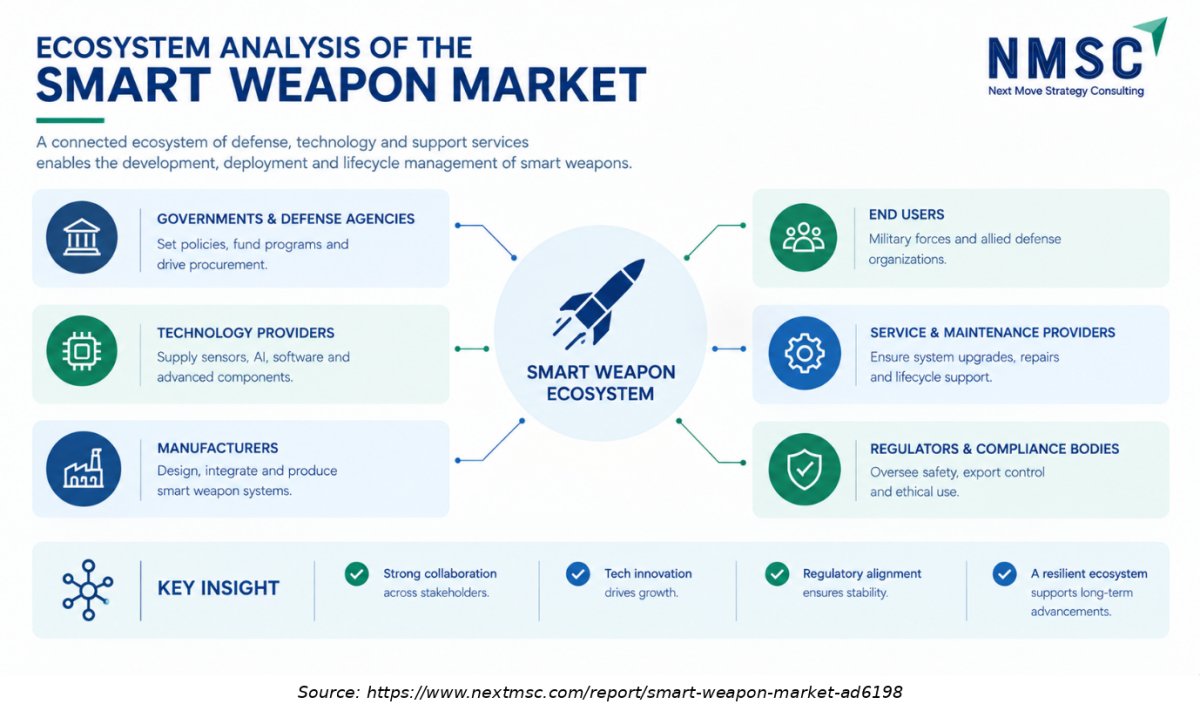
Ecosystem Analysis of the Smart Weapon Industry

The above infographic presents an ecosystem analysis of the Smart Weapon Market, mapping its interconnected structure with authoritative clarity. It identifies six key stakeholders spanning government agencies, technology providers, manufacturers, end users, maintenance services, and regulatory bodies. The analysis demonstrates that strong collaboration, technological innovation, and regulatory alignment collectively create a resilient ecosystem supporting long-term industry advancements.

What does the Smart Weapon Market Encompass?

The Smart Weapon Market covers guided missiles, precision-guided munitions, loitering munitions, smart torpedoes, and guided rockets designed to deliver precision effects against designated targets with reduced collateral damage, using onboard and externally-provided guidance systems. The market encompasses all associated guidance technologies, seeker heads, navigation systems, propulsion units, warhead integration, and software-enabled targeting and terminal phase control systems manufactured and procured by national defense establishments. Growing investment in AI in military anddefense is expanding the capability envelope of smart weapons toward autonomous target identification and dynamic re-targeting during flight, fundamentally changing the operating parameters of precision strike systems.

Market Drivers & Dynamics

Interactive Dataset
Defense budget escalation across NATO members following Article 3 capability commitments driver +2.4% North America, Europe 2026–2035
Indo-Pacific military modernization and multi-domain precision strike competition driver +2.1% Asia-Pacific 2026–2035
AI and autonomous guidance technology integration expanding weapon capability and unit volume driver +1.6% Global 2026–2032
Loitering munition program proliferation across mid-tier armed forces in new geographies driver +1.2% MEA, Latin America, Asia-Pacific 2026–2031
Hypersonic weapon program investment creating new long-range precision strike segment driver +0.9% North America, Asia-Pacific, Europe 2026–2033
Export control restrictions under MTCR and Wassenaar Arrangement limiting market access restraint −1.4% Global 2026–2035
Long production cycle times and supply chain concentration creating delivery risk restraint −0.9% North America, Europe 2026–2032
Budget sequestration and continuing resolution uncertainty in U.S. defense procurement restraint −0.7% North America 2026–2030
International humanitarian law compliance requirements increasing development cost and timeline restraint −0.5% Europe 2026–2033
Source: Next Move Strategy Consulting

Growth Drivers

What Is the Primary Growth Driver in the Smart Weapon Market?

Defense budget escalation, particularly across NATO member states committed to achieving and sustaining 5% of GDP defense spending floors, is the primary structural driver of the Smart Weapon Industry through 2035. The NATO Secretary General has publicly confirmed sustained member-state investment commitments following 2024 summit declarations, providing multi-year procurement visibility that defense contractors require to justify production line expansion and R&D investment. Defensecybersecurity investment is also driving integration of secure data link and cyber-resilient guidance systems into precision weapon programs, increasing per-unit value and total program cost across the NATO procurement base.

How Is Indo-Pacific Modernization Driving the Smart Weapon Market?

The competitive military balance in the Indo-Pacific is driving simultaneous precision strike capability investment across China, India, Japan, South Korea, Australia, and Taiwan, creating multiple parallel procurement programs that expand total market volume without the sequencing delays that characterize single-nation procurement cycles. Our findings suggest that India's Defense Acquisition Procedure and Japan's revised National Defense Strategy have both specifically mandated precision strike capability expansion, with India allocating increasing capital to indigenous guided missile and loitering munition development programs that are growing domestic production capacity alongside import volumes.

Growth Inhibitors

What Is Restraining the Smart Weapon Market?

Export control restrictions imposed by the Missile Technology Control Regime limit the transfer of complete precision-guided missile systems and enabling guidance technologies to non-member states, constraining market penetration in strategically important but MTCR-restricted buyer countries. We found that these restrictions are creating bifurcated market development dynamics: MTCR-member nations and their treaty partners access the full global product portfolio, while non-member nations develop domestic alternatives or accept more limited capability configurations. This bifurcation is suppressing total market growth below the level that underlying demand would otherwise support, particularly in South and Southeast Asian defense markets.

What Are the Growth Opportunities?

Can Software-Defined Guidance Upgrades Unlock Retrofit Revenue Across Aging Munition Inventories?

Nations maintaining large inventories of legacy dumb bombs and unguided rockets face significant procurement cost barriers to transitioning to all-new precision weapon systems, creating a large addressable retrofit market for bolt-on guidance kits and software-upgradeable seeker packages. This opportunity primarily benefits the Precision Guided Munitions product type and the GPS and Inertial Navigation Guidance technology segments, as low-cost wing kit and guidance package providers can capture inventory retrofit contracts at per-unit costs far below new-build smart weapon procurement.


Does Loitering Munition Proliferation to Mid-Tier Defense Forces Represent a Structural Volume Opportunity?

Mid-tier armed forces across Latin America, Southeast Asia, and sub-Saharan Africa are evaluating affordable loitering munition systems to acquire precision strike capability without the procurement cost of conventional guided missile inventories. This opportunity benefits the Loitering Munitions product type and the Land-Based platform segment, as vehicle-launched and man-portable loitering systems offer deployment flexibility at unit costs that fall within mid-tier procurement budgets and below the MTCR payload-threshold that would require technology transfer approval for larger guided missile systems.

Can AI-Enabled Multi-Mode Seekers Create a New Premium Segment in Adverse Environment Targeting?

The GPS-jamming and spoofing environment that has emerged as a standard feature of contested airspace is creating structured demand for AI-enabled multi-mode seekers that combine GPS, inertial, radar, infrared imaging, and terrain-matching navigation into a single terminal guidance system resilient to electronic attack. This opportunity benefits the AI-Based Autonomous Guidance technology segment and Airborne and Land-Based platform segments, with premium pricing supported by the operational necessity of maintaining precision capability in GPS-denied conditions across the highest-priority procurement programs of NATO and Indo-Pacific defense establishments.

What Is the Primary Growth Driver in the Smart Weapon Market?

Defense budget escalation, particularly across NATO member states committed to achieving and sustaining 5% of GDP defense spending floors, is the primary structural driver of the Smart Weapon Industry through 2035. The NATO Secretary General has publicly confirmed sustained member-state investment commitments following 2024 summit declarations, providing multi-year procurement visibility that defense contractors require to justify production line expansion and R&D investment. Defensecybersecurity investment is also driving integration of secure data link and cyber-resilient guidance systems into precision weapon programs, increasing per-unit value and total program cost across the NATO procurement base.

How Is Indo-Pacific Modernization Driving the Smart Weapon Market?

The competitive military balance in the Indo-Pacific is driving simultaneous precision strike capability investment across China, India, Japan, South Korea, Australia, and Taiwan, creating multiple parallel procurement programs that expand total market volume without the sequencing delays that characterize single-nation procurement cycles. Our findings suggest that India's Defense Acquisition Procedure and Japan's revised National Defense Strategy have both specifically mandated precision strike capability expansion, with India allocating increasing capital to indigenous guided missile and loitering munition development programs that are growing domestic production capacity alongside import volumes.

What Is Restraining the Smart Weapon Market?

Export control restrictions imposed by the Missile Technology Control Regime limit the transfer of complete precision-guided missile systems and enabling guidance technologies to non-member states, constraining market penetration in strategically important but MTCR-restricted buyer countries. We found that these restrictions are creating bifurcated market development dynamics: MTCR-member nations and their treaty partners access the full global product portfolio, while non-member nations develop domestic alternatives or accept more limited capability configurations. This bifurcation is suppressing total market growth below the level that underlying demand would otherwise support, particularly in South and Southeast Asian defense markets.

Segmentation Analysis

2025 (USD Billion)
2035 (USD Billion)
Guided Missiles 2025: $14.43 Billion | 2035: $27.10 Billion
Guided Missi
Precision Guided Munitions 2025: $9.02 Billion | 2035: $17.88 Billion
Precision Gu
Loitering Munitions 2025: $3.61 Billion | 2035: $8.94 Billion
Loitering Mu
Smart Torpedoes 2025: $1.80 Billion | 2035: $3.58 Billion
Smart Torped
Guided Rockets 2025: $1.20 Billion | 2035: $2.11 Billion
Guided Rocke
Guided Missiles $14.43 Billion $27.10 Billion 6.50%
Precision Guided Munitions $9.02 Billion $17.88 Billion 7.09%
Loitering Munitions $3.61 Billion $8.94 Billion 9.50%
Smart Torpedoes $1.80 Billion $3.58 Billion 7.12%
Guided Rockets $1.20 Billion $2.11 Billion 5.80%

Which Product Type Segment Dominates the Market?

Guided Missiles dominate the Smart Weapon Market at USD 14.43 Billion in 2025, reflecting the large installed inventories and continuous replacement procurement programs maintained by air forces, navies, and land-based air defense systems globally. Loitering Munitions is the fastest-growing product type at 9.50% CAGR during 2025–2035, expanding from USD 3.61 Billion in 2025 to USD 8.94 Billion by 2035 as combat-proven effectiveness and comparatively low unit costs drive adoption among both traditional defense establishments and emerging mid-tier armed forces. The growing use of military robots as launch and recovery platforms for loitering munitions is further expanding the addressable deployment context beyond conventional vehicle and aircraft platforms.

2025 (USD Billion)
2035 (USD Billion)
GPS and Iner
Laser Guidan
Infrared Ima
Radar Guidan
Electro-Opti
Segment Item 2025 (USD Billion) 2035 (USD Billion) CAGR
GPS and Inertial Navigation Guidance $10.0 USD Billion $40.0 USD Billion 25.0%
Laser Guidance $17.1 USD Billion $51.1 USD Billion 11.0%
Infrared Imaging Guidance $24.2 USD Billion $62.2 USD Billion 25.0%
Radar Guidance $31.3 USD Billion $73.3 USD Billion 11.0%
Electro-Optical Guidance $38.4 USD Billion $84.4 USD Billion 16.0%

Segment-wise data is locked

Unlock complete segment-wise numbers for By Guidance Technology.

Unlock Full Data

Which Guidance Technology Leads and Which Is Fastest-Growing?

GPS and Inertial Navigation Guidance lead at USD 10.52 Billion in 2025, reflecting its pervasive integration across all major precision-guided munition families as the foundational midcourse navigation layer. AI-Based Autonomous Guidance is the fastest-growing technology at 15.55% CAGR during 2025–2035, expanding from USD 0.90 Billion in 2025 to USD 3.82 Billion by 2035, as autonomous terminal homing capability transitions from development programs to production-standard system increments. Advanced radar seekers integrated with AI-based signal processing are enabling all-weather precision terminal guidance independent of GPS availability, addressing the GPS-jamming vulnerability that has become a defining operational challenge across all precision weapon programs.

2025 (USD Billion)
2035 (USD Billion)
Airborne
Fixed-Wing A
Rotary-Wing
Unmanned Aer
Naval
Segment Item 2025 (USD Billion) 2035 (USD Billion) CAGR
Airborne $10.0 USD Billion $40.0 USD Billion 27.0%
Fixed-Wing Aircraft $17.1 USD Billion $51.1 USD Billion 9.0%
Rotary-Wing Aircraft $24.2 USD Billion $62.2 USD Billion 19.0%
Unmanned Aerial Vehicles $31.3 USD Billion $73.3 USD Billion 17.0%
Naval $38.4 USD Billion $84.4 USD Billion 18.0%

Segment-wise data is locked

Unlock complete segment-wise numbers for By Platform.

Unlock Full Data

Which Platform Segment Leads and Which Is Fastest-Growing?

Airborne platforms dominate the Smart Weapon Market at USD 15.63 Billion in 2025, driven by the large inventory of air-launched precision-guided munitions, air-to-air missiles, and cruise missiles delivered from both manned and unmanned fixed-wing aircraft. Land-Based is the fastest-growing platform at 8.01% CAGR, as ground forces integrate precision-guided rockets, anti-tank guided missiles, and loitering munitions into combined-arms doctrine at accelerating rates. The expansion of autonomous UGV platforms as launch vehicles for smart weapons is contributing to land-based segment growth beyond traditional self-propelled and towed artillery applications.

2025 (USD Billion)
2035 (USD Billion)
Air Force
Navy
Army
Special Oper
Segment Item 2025 (USD Billion) 2035 (USD Billion) CAGR
Air Force $10.0 USD Billion $40.0 USD Billion 14.0%
Navy $17.1 USD Billion $51.1 USD Billion 24.0%
Army $24.2 USD Billion $62.2 USD Billion 22.0%
Special Operations Forces $31.3 USD Billion $73.3 USD Billion 12.0%

Segment-wise data is locked

Unlock complete segment-wise numbers for By End User.

Unlock Full Data
2025 (USD Billion)
2035 (USD Billion)
North Americ
Canada
Mexico
Europe: UK
Germany
Segment Item 2025 (USD Billion) 2035 (USD Billion) CAGR
North America: U.S. $10.0 USD Billion $40.0 USD Billion 24.0%
Canada $17.1 USD Billion $51.1 USD Billion 22.0%
Mexico $24.2 USD Billion $62.2 USD Billion 20.0%
Europe: UK $31.3 USD Billion $73.3 USD Billion 22.0%
Germany $38.4 USD Billion $84.4 USD Billion 13.0%

Segment-wise data is locked

Unlock complete segment-wise numbers for By Region.

Unlock Full Data

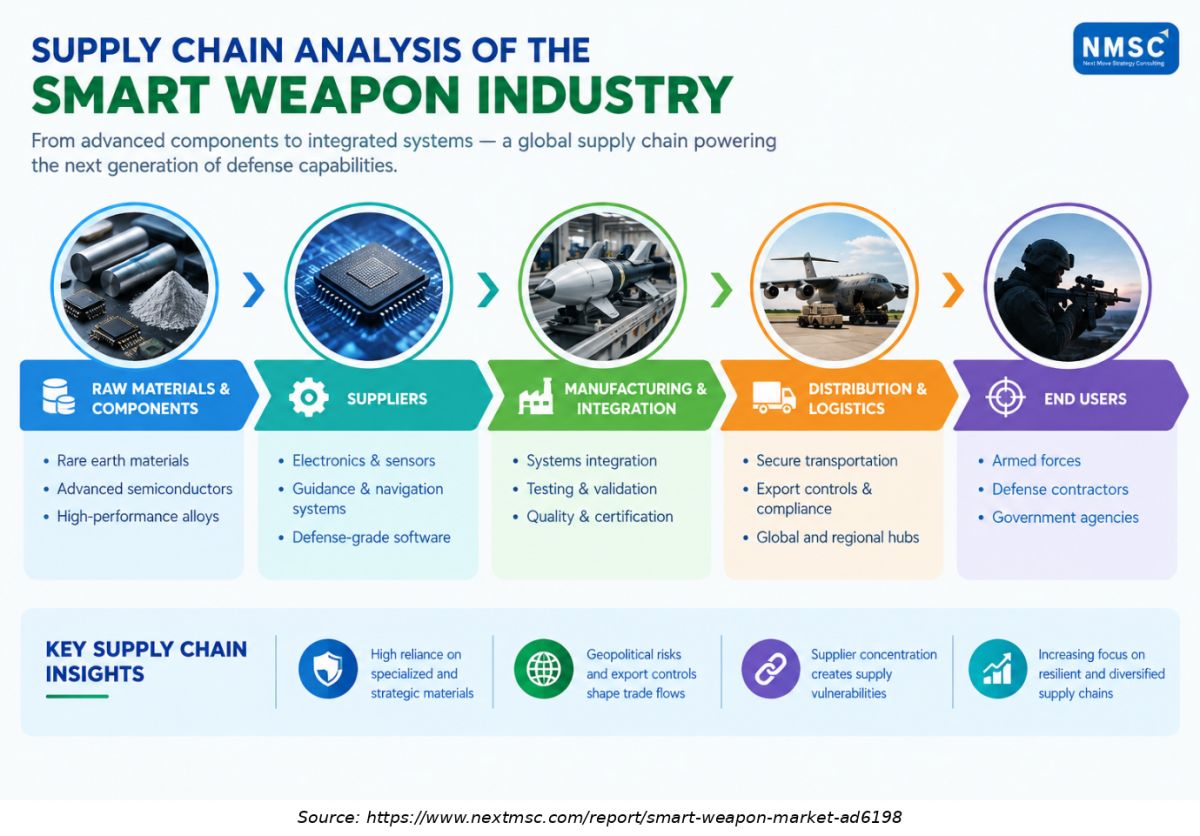
Supply Chain Analysis of the Smart Weapon Industry

Supply Chain Analysis of the Smart Weapon Industry
The above infographic outlines the supply chain analysis of the smart weapon industry, tracing its progression with authoritative clarity. It maps five critical stages from raw materials and specialized suppliers to manufacturing, secure logistics, and end users. Key insights emphasize that high reliance on strategic materials, geopolitical risks, and supplier concentration drive an increasing focus on resilient and diversified supply chains.

Growth Opportunities

Our analysis shows that three forward-looking whitespace opportunities are positioned to generate disproportionate Smart Weapon Market revenue growth for vendors who act ahead of the procurement cycle maturation in each category.

Can Software-Defined Guidance Upgrades Unlock Retrofit Revenue Across Aging Munition Inventories?

Nations maintaining large inventories of legacy dumb bombs and unguided rockets face significant procurement cost barriers to transitioning to all-new precision weapon systems, creating a large addressable retrofit market for bolt-on guidance kits and software-upgradeable seeker packages. This opportunity primarily benefits the Precision Guided Munitions product type and the GPS and Inertial Navigation Guidance technology segments, as low-cost wing kit and guidance package providers can capture inventory retrofit contracts at per-unit costs far below new-build smart weapon procurement.

Does Loitering Munition Proliferation to Mid-Tier Defense Forces Represent a Structural Volume Opportunity?

Mid-tier armed forces across Latin America, Southeast Asia, and sub-Saharan Africa are evaluating affordable loitering munition systems to acquire precision strike capability without the procurement cost of conventional guided missile inventories. This opportunity benefits the Loitering Munitions product type and the Land-Based platform segment, as vehicle-launched and man-portable loitering systems offer deployment flexibility at unit costs that fall within mid-tier procurement budgets and below the MTCR payload-threshold that would require technology transfer approval for larger guided missile systems.

Can AI-Enabled Multi-Mode Seekers Create a New Premium Segment in Adverse Environment Targeting?

The GPS-jamming and spoofing environment that has emerged as a standard feature of contested airspace is creating structured demand for AI-enabled multi-mode seekers that combine GPS, inertial, radar, infrared imaging, and terrain-matching navigation into a single terminal guidance system resilient to electronic attack. This opportunity benefits the AI-Based Autonomous Guidance technology segment and Airborne and Land-Based platform segments, with premium pricing supported by the operational necessity of maintaining precision capability in GPS-denied conditions across the highest-priority procurement programs of NATO and Indo-Pacific defense establishments.

Regional Outlook

2025 (USD Billion)
2035 (USD Billion)
North Americ
Asia-Pacific
Europe
Middle East
Latin Americ
Region 2025 (USD Billion) 2035 (USD Billion) CAGR (%)
North America $10.0 USD Billion $40.0 USD Billion 9.0%
Asia-Pacific $17.1 USD Billion $51.1 USD Billion 27.0%
Europe $24.2 USD Billion $62.2 USD Billion 25.0%
Middle East & Africa $31.3 USD Billion $73.3 USD Billion 23.0%
Latin America $38.4 USD Billion $84.4 USD Billion 12.0%

Regional data is locked

Unlock complete regional numbers for this market.

Unlock Full Data

Competitive Landscape

Our assessment indicates that the Smart Weapon Market industry is dominated by a concentrated group of tier-one defense prime contractors in North America and Europe, alongside a second tier of national champions in Israel, South Korea, and increasingly India and Turkey, competing on technology differentiation, production volume, and bilateral government-to-government relationship depth.

Dimension Description
Market Structure Highly concentrated at the top, with the five largest vendors accounting for the majority of global market value; national champion competition is intensifying in Asia-Pacific, the Middle East, and Turkey as domestic procurement priorities reduce import dependency
Innovation Focus AI-integrated autonomous guidance, multi-mode seeker development for GPS-denied environments, hypersonic propulsion and airframe systems, and cost-optimized loitering munition architectures for mass procurement
M&A Activity Selective vertical integration in guidance electronics and propulsion; partnership-based program teaming rather than large-scale consolidation; growing co-production agreements between U.S. primes and allied nation industrial partners

How Do Companies Compete in the Smart Weapon Market?

Companies compete primarily on proximity to government procurement decision-making through established prime contractor relationships, technology differentiation in guidance and propulsion systems, and production volume capability that can fulfill large-scale replenishment contracts within defense cycle timelines. We found that military computer hardware and embedded software capability for mission processing and guidance computing is becoming an increasing differentiator, as vendors who own the computing and signal processing stack can integrate AI autonomy features at lower incremental cost than those dependent on third-party electronics.

Which Competitive Archetypes Dominate the Smart Weapon Market?

Diversified defense prime contractors, RTX Corporation, Lockheed Martin, The Boeing Company, and Northrop Grumman, dominate through complete weapon system integration capability, established multi-decade production programs, and government-to-government sales infrastructure that smaller competitors cannot replicate. European consortium and national champion vendors, MBDA, BAE Systems, Thales Group S.A., and Saab AB, compete through EU-origin and NATO-interoperable system advantages that U.S. exporters cannot always access in politically sensitive procurement decisions. Israeli national champions, Rafael Advanced Defense Systems, Elbit Systems, and IAI, dominate the loitering munition and anti-tank guided missile categories through combat-proven system advantages.

What Innovation Strategies Are Vendors Pursuing in the Smart Weapon Market?

Leading vendors are investing in multi-mode seeker development that combines radar, infrared imaging, and GPS/INS navigation into a single terminal guidance package resistant to GPS jamming and electro-optical countermeasures. We observed that Lockheed Martin's JATM (AIM-260) and RTX's AIM-120D3 AMRAAM programs both reflect sustained investment in AI-assisted target discrimination capability within existing missile airframe families. Loitering munition vendors are differentiating through swarm coordination software, man-in-the-loop data link resilience, and reduced radar cross-section airframe designs that improve survivability in contested air defense environments.

What M&A and Partnership Activity Is Shaping the Smart Weapon Market?

Our findings suggest that the competitive landscape is evolving through co-production agreements and offset-driven industrial partnerships between tier-one primes and allied nation defense industrial bases, rather than large-scale M&A consolidation. Lockheed Martin's Javelin co-production program in Poland and RTX Corporation's Stinger manufacturing partnership with Germany exemplify how allied nation industrial participation is being structured to satisfy local content requirements within major smart weapon procurement contracts. These partnerships create long-term competitive moats by embedding primes within sovereign industrial ecosystems that are difficult for competitors to displace.

Key Market Players

We observed that the following 20 companies represent the validated global leadership set across smart weapon system design, development, production, and program management, ranked by estimated market-specific revenue and production capability as of 2026.

RTX Corporation Lockheed Martin Corporation The Boeing Company Northrop Grumman Corporation BAE Systems plc MBDA S.A.S. Thales Group S.A. General Dynamics Corporation L3Harris Technologies, Inc. Elbit Systems Ltd. Rafael Advanced Defense Systems Ltd. Israel Aerospace Industries Ltd. Saab AB Kongsberg Gruppen ASA Leonardo S.p.A. DIEHL Defence GmbH & Co. KG Hanwha Aerospace Co., Ltd. ASELSAN A.Ş. China Aerospace Science and Industry Corporation Bharat Dynamics Limited

Latest Developments

During our market evaluation, we noticed that 2024–2025 Smart Weapon Market activity reflects an accelerating convergence of AI-enabled autonomy, hypersonic propulsion development, and allied co-production programs designed to scale precision weapon production capacity across multiple national industrial bases simultaneously.

Date Event
September 2026 Raytheon was awarded a five-year contract with two option years valued at up to USD 20.7 billion to accelerate AMRAAM production. The agreement supports annual production of at least 1,900 missiles, expanding the supply of advanced, guided beyond-visual-range air-to-air weapons.
July 2026 Lockheed Martin secured a seven-year contract modification worth up to USD 53.86 billion, bringing total multiyear PAC-3 MSE contract value to USD 58.62 billion. The program is intended to support a threefold production-capacity increase by 2030.
February 2026 The U.S. Navy approved Raytheon’s StormBreaker smart weapon for operational use on the F/A-18E/F Super Hornet. The weapon is designed to engage moving and stationary targets in adverse weather and is also being integrated with the F-35 family.
September 2025 Raytheon completed testing of a ground-launched variant of the StormBreaker smart weapon, designing, developing, and testing the prototype in 50 days.

Expert Insights

Sam Deneke

Sam Deneke

president of Air & Space Defense Systems | Raytheon

"Recent global conflicts have highlighted the need for a smart, ground-launched, precision strike weapon that can perform in GPS-contested areas."

Analyst Interpretation

The statement highlights how changing battlefield conditions are influencing the development of smart weapons. GPS disruption and electronic warfare are increasing the importance of resilient guidance, adaptable targeting, and precision engagement technologies. This trend is supporting investment in multi-mode seekers, alternative navigation capabilities, network-enabled weapons, and modular smart munitions that can operate across more demanding environments.

Investment Opportunities

Where Are Capital Inflows Concentrating in the Smart Weapon Market?

Capital inflows are concentrating in autonomous guidance system development, hypersonic propulsion technology, and loitering munition production scale-up, as evidenced by RTX Corporation's multi-billion-dollar hypersonic program investment disclosure and L3Harris Technologies' expanded guidance electronics manufacturing capacity announced through 2025. Defense-focused venture capital and dual-use technology funds are additionally directing capital toward AI-native guidance software and edge computing hardware that can be integrated across multiple smart weapon platform categories, creating cross-program revenue opportunities that are scaling program-specific investment.

How Is Infrastructure Investment Shaping Smart Weapon Market Production Capacity?

Infrastructure investment is shifting toward expanding production line capacity for high-demand precision munition categories, as existing facilities are operating at sustained maximum throughput. Lockheed Martin's expansion of Hellfire and JASSM production facilities and RTX Corporation's Tucson missile production campus investment reflect the manufacturing capacity gap between current production rates and DoD-requested replenishment volumes. The development of AI-enabled counter-drone systems as complementary precision engagement platforms is also attracting infrastructure investment, as the counter-UAS mission is creating new addressable production programs adjacent to the established guided missile sector.

What ESG Considerations Are Influencing Smart Weapon Market Investment Decisions?

Environmental, Social, and Governance frameworks applied to defense sector investment center on compliance with international humanitarian law, specifically International Humanitarian Law precision and proportionality standards that smart weapon systems are designed to support, alongside responsible supply chain management for energetic materials and reduced environmental impact from demilitarization of end-of-life munition inventories. We found that institutional investors applying ESG screens to defense portfolios are increasingly treating precision weapon capability as an ESG-positive attribute relative to unguided munition alternatives, given the demonstrated reduction in civilian infrastructure impact associated with precision-guided engagement.

Key Benefits for Stakeholders

How Does This Report Benefit Defense Industry Leaders?

Defense prime contractors and tier-two subsystem manufacturers gain segment-level revenue forecasts and CAGR benchmarks across product type, guidance technology, platform, and end-user axes, enabling technology investment and production capacity decisions grounded in the consistent 2025–2035 figures used throughout this analysis. Our competitive landscape findings and regional defense budget analysis provide market-entry and capture strategy evidence for vendors evaluating new national procurement programs or industrial co-production opportunities across the 38 covered countries.

How Does This Report Benefit Defense Sector Investors and Financial Analysts?

Investors and financial analysts gain a reconciled market-sizing model, competitive position assessment, and named-company development tracking that supports defense sector equity valuation and capital allocation decisions. The Growth Catalyst & Risk Assessment Matrix quantifies specific driver and restraint impacts on CAGR, enabling scenario analysis for defense procurement budget risk assessment across the NATO, Indo-Pacific, and Middle East & Africa defense spending environments that collectively account for the majority of Smart Weapon Market revenue.

How Does This Report Benefit Technology Vendors and Guidance System Developers?

Technology vendors and guidance system developers gain visibility into which technology segments, notably AI-Based Autonomous Guidance at 15.55% CAGR, are growing fastest relative to established guidance technology categories, informing R&D investment and partnership prioritization. The segmentation analysis across end-user and platform axes provides actionable intelligence on which armed service procurement cycles and platform integration programs offer the most accessible near-term engagement opportunities for subsystem and component providers targeting the Smart Weapon Market.

Key Market Segments Evaluated

By Product Type

  • Guided Missiles 
    • Air-to-Air Missiles
    • Air-to-Surface Missiles
    • Surface-to-Air Missiles
    • Anti-Ship Missiles
    • Anti-Tank Guided Missiles
    • Ballistic Missiles
  • Precision Guided Munitions 
    • Laser-Guided Bombs
    • GPS-Guided Bombs
    • Glide Bombs
    • Guided Artillery Shells
  • Loitering Munitions 
    • Man-Portable Loitering Munitions
    • Tactical Loitering Munitions
    • Long-Range Loitering Munitions
  • Smart Torpedoes 
    • Lightweight Torpedoes
    • Heavyweight Torpedoes
  • Guided Rockets 
    • Air-to-Ground Guided Rockets
    • Surface-to-Surface Guided Rockets

By Guidance Technology

  • GPS and Inertial Navigation Guidance
  • Laser Guidance
  • Infrared Imaging Guidance
  • Radar Guidance
  • Electro-Optical Guidance
  • AI-Based Autonomous Guidance
  • Semi-Active Homing

By Platform

  • Airborne 
    • Fixed-Wing Aircraft
    • Rotary-Wing Aircraft
    • Unmanned Aerial Vehicles
  • Naval 
    • Surface Ships
    • Submarines
  • Land-Based 
    • Ground Combat Vehicles
    • Towed and Self-Propelled Artillery
    • Man-Portable Systems

By End User

  • Air Force
  • Navy
  • Army
  • Special Operations Forces

By Region

  • North America 
    • U.S.
    • Canada
    • Mexico
  • Europe 
    • UK
    • Germany
    • France
    • Italy
    • Spain
    • Sweden
    • Denmark
    • Finland
    • Netherlands
    • Rest of Europe
  • Asia-Pacific 
    • China
    • India
    • Japan
    • South Korea
    • Taiwan
    • Indonesia
    • Vietnam
    • Australia
    • Philippines
    • Malaysia
    • Rest of APAC
  • Middle East & Africa 
    • Saudi Arabia
    • UAE
    • Egypt
    • Israel
    • Turkey
    • Nigeria
    • South Africa
    • Rest of MEA
  • Latin America 
    • Brazil
    • Argentina
    • Chile
    • Colombia
    • Rest of LATAM

Conclusion & Recommendations

The long-term outlook for the Smart Weapon Market is structurally positive, with revenue expanding from USD 33.01 Billion in 2026 to USD 59.61 Billion by 2035 at a 6.78% CAGR, underpinned by multi-year defense budget commitments across NATO, Indo-Pacific, and Middle East defense establishments and the maturation of AI-based guidance and loitering munition technologies from development programs into production-standard procurement categories. We observed that this growth trajectory is driven by durable geopolitical and doctrinal factors rather than a cyclical replacement wave, supporting sustained capital investment commitment across the forecast horizon.

What Strategic Positioning Recommendations Does NMSC Offer?

Vendors should prioritize AI-enabled guidance technology development and loitering munition program investment to capture the two fastest-growing sub-segments, while maintaining production volume credibility in established guided missile and precision guided munition categories where procurement volume and contract value remain highest in absolute terms. Companies without autonomous guidance capability should pursue technology partnership or acquisition strategies, as AI integration is transitioning from a program differentiator to a procurement requirement across the highest-value Smart Weapon Market programs through 2030.

How Attractive Is the Smart Weapon Market for Investment?

Investment attractiveness is high across the Smart Weapon Market, with the USD 26.60 Billion absolute growth opportunity between 2026 and 2035 and visible multi-year procurement commitments from the world's largest defense budgets providing revenue predictability uncommon in other technology sectors. Asia-Pacific at 8.04% CAGR and Latin America at 12.10% CAGR offer the highest relative growth rates, while North America provides the largest absolute revenue base with the most mature procurement structure and the deepest relationship infrastructure for vendors already established within DoD acquisition programs.

What Are the Key Market Shifts and Risks in the Smart Weapon Market?

Key market shifts include the transition from single-mode to multi-mode seeker architectures, the proliferation of loitering munitions from tier-one to mid-tier armed forces, and the emergence of hypersonic weapons as a distinct high-value product segment. Primary risks include U.S. defense budget continuing resolution cycles that delay contract award timelines, export control restrictions that limit international program participation, and supply chain concentration in specialized materials, including energetic compounds, high-temperature propulsion alloys, and guidance electronics, that creates production bottleneck exposure during surge demand periods.

What Are the Primary Growth Pathways for the Smart Weapon Market Through 2035?

Primary growth pathways include AI-enabled autonomous guidance program investment, mass-producible loitering munition architecture development for mid-tier market penetration, and allied co-production industrial partnership expansion that simultaneously satisfies local content procurement requirements and scales production beyond U.S. domestic capacity constraints. Our analysis shows that vendors combining all three pathways are best positioned to capture a disproportionate share of the USD 26.60 billion absolute growth opportunity between 2026 and 2035, particularly in Asia-Pacific and Europe, where procurement acceleration is proceeding ahead of previously established defense plan timelines.

FAQs

About the Author

Mayurima Roy

Mayurima Roy

Mayurima Roy is Research Analyst at Next Move Strategy Consulting, where she has spent 4 years working across the firm's full industry coverage rather than a single fixed vertical. Her work centers on structured research, ongoing trend tracking, competitive assessment, and insight-led content development, translating complex market data into clear, decision-ready narratives that support informed client decision-making across diverse global industries, market sectors, and world regions every day.

About the Reviewer

Supradip Baul

Supradip Baul

Supradip Baul is an accomplished business consultant and strategist with over a decade of rich experience in market intelligence, strategy, technology, and business transformation. His work has included rigorous qualitative and quantitative analysis across multiple industries, helping clients shape investment decisions and long-term roadmaps. Earlier in his career, he was associated with Gartner, where he contributed to industry-leading reports and market share analyses. He has worked with leading global companies and holds an MBA with a dual specialization in Marketing and Finance.

Download Free Sample

Mohit Agarwal

MOHIT AGARWAL

Chief Manager

DryChem India Pvt. Ltd.

Next Move Strategy Consulting is an amazing team of consultants. We required a market study report for our investors on top priority and the team went above and beyond our expectations to deliver the same with ample supporting data within a short time span enabling us to secure the investments and keep our project timeline maintained. Their professionalism, attention to detail, and timely delivery of actionable recommendations have left a lasting impression on our organization.

Rishabh Jogani

RISHABH JOGANI

Strategy Analyst

Accenture Japan

We are incredibly impressed with the market report on the real estate market in India provided by Next Move Strategy Consulting. The report was thorough, insightful, and well-structured, offering deep analysis and actionable recommendations. It not only captured the current trends and dynamics but also provided a forward-looking perspective that has been invaluable for our strategic planning. Their team demonstrated exceptional professionalism, attention to detail, and a profound understanding of the industry. The data-driven insights and clarity of presentation exceeded our expectations, making complex market trends easy to understand. We highly recommend Next Move Strategy Consulting to anyone looking for reliable and comprehensive market research services. Their expertise has given us the confidence to navigate the complexities of the Indian real estate market with clarity and foresight.

Kishu Kanda

KISHU KANDA

Strategy Analyst

Accenture

We purchased the AI Consumer Market Report from this company. Not only did they customize the report to meet our specific requirements, but they also showed great flexibility in accommodating our budget. The report we received fully met our expectations. Additionally, they provided prompt and thorough responses to both our pre-purchase and follow-up questions. We look forward to working with this company again in the future.

Gustaf Hummel Burstrom

GUSTAF HUMMEL BURSTROM

Founder

Revline Tools AB

Joseph and the team at Next Move Strategy Consulting have been excellent to work with, in supplying us with relevant market data and forecasts for our specific category. We had some special requirements and they were able to do a custom package to suit our needs. We would definitely recommend them to any other company needing market data and forecasts

Amos Chang

AMOS CHANG

Strategy Consultant

Kardex Group

I have bought the intralogistics market reports from NMSC two times so far. Joseph and his team are always very helpful and flexible in responding to any customization requirements on the report. Their expertise in market reports really helps us steer the day-to-day business. I will definitely recommend and come back myself whenever there is a need.

Custom Market Research Services

We will customize the research for you if the listed report does not fully match your requirements.

Get 30% Free Customization

Select License

This website uses cookies to ensure you get the best experience on our website. Learn more

✖