Modular Data Centre Market By Offering (Solutions and Services), By Power Capacity (Nano (<10 kW), Micro (10–50 kW), Small (50–250 kW), Medium (250 kW–1 MW), Large (1–5 MW), and Hyperscale (>5 MW)), By Rack Density (Standard Density (<10 kW/rack), Medium Density (10–30 kW/rack), and High Density (>30 kW/rack)), By Form Factor (ISO Containers, Skid-Mounted Systems, and Others), By Deployment Type (Indoor and Outdoor), and Others – Global Analysis & Forecast, 2025–2035
Industry: ICT & Media | Publishing Date: September 12, 2026 | Last Updated: October 16, 2026 | No of Pages: N/A | No. of Tables: N/A | No. of Figures: N/A | Format: PDF | Report Code: IC4271
Industry Outlook
The global Modular Data Centre Market size was valued at USD 44.15 billion in 2025, and is expected to be valued at USD 52.15 billion by the end of 2026. The industry is projected to grow, hitting USD 233.62 billion by 2035, with a CAGR of 18.13% between 2026 and 2035.
Modular Data Centre Market Size & Forecast
|
Parameters |
Details |
|
Market Size in 2026 |
USD 52.15 Billion |
|
Revenue Forecast in 2035 |
USD 233.62 Billion |
|
Growth Rate |
CAGR of 18.13% from 2026 to 2035 |
|
Analysis Period |
2025–2035 |
|
Base Year Considered |
2025 |
|
Forecast Period |
2026–2035 |
|
Market Size Estimation |
Billion (USD) |
|
Companies Profiled |
20 |
|
Countries Covered |
33 |
|
Market Share |
Available for 10 companies |
Based on NMSC’s primary research, the global modular data centre market is witnessing steady and accelerating growth, driven by rising cloud adoption, edge computing requirements, and increasing demand for rapid, scalable digital infrastructure. Modular data centre solutions are increasingly deployed to reduce construction timelines, optimise capital expenditure, and support flexible capacity expansion across enterprise, telecom, and cloud environments. Our field assessments and in-depth discussions with data centre operators and infrastructure teams indicate that integrated power-cooling modules, standardised designs, and factory-built architectures significantly improve deployment predictability and operational reliability. While core infrastructure hardware continues to account for the majority of spending, software layers, particularly monitoring, energy management, and automation platforms, are emerging as critical enablers of efficiency and uptime.
Moreover, through our evaluation of prefabricated data center solutions deployments across North America, Europe, and Asia-Pacific, we observed that adoption in the modular data centre market is shaped by power availability, latency requirements, regulatory constraints, and sustainability targets. North America benefits from strong cloud and colocation demand supported by mature digital infrastructure, while Europe places greater emphasis on energy efficiency, regulatory compliance, and carbon reduction mandates.
Asia-Pacific leads in volume-driven deployments, underpinned by rapid digitalisation, 5G rollout, and government-backed data infrastructure programs, with emerging markets such as India increasingly adopting modular data centres to support edge use cases and capacity-constrained urban environments. Key market participants, including Schneider Electric, Vertiv, Huawei, and Dell Technologies, compete through integrated solutions, faster deployment cycles, and end-to-end service capabilities. Moreover, recent developments in containerised designs, liquid cooling integration, and modular expansion models reflect continued innovation, while flexible commercial structures and service-led offerings are lowering adoption barriers and supporting long-term operational confidence among data centre operators.
What Are the Key Trends in the Modular Data Centre Industry?
How Are Edge Computing and Latency-Sensitive Workloads Influencing Modular Data Centre Design?
From our evaluation of distributed and edge-focused deployments within the modular data centre market, we found that latency-sensitive workloads are significantly influencing both modular data centre form factors and site selection strategies. In response, telecom operators and enterprises supporting content delivery, industrial IoT, and regional data processing are increasingly deploying compact modular units in urban, industrial, and semi-rural locations where traditional data centre development is often impractical. However, our discussions with operations teams indicate that while modular architectures enable rapid physical deployment, maintaining consistent performance across geographically dispersed sites introduces additional operational complexity. Consequently, edge deployments have shown higher-than-anticipated costs related to remote monitoring, enhanced security requirements, and maintenance logistics, which are shaping more cautious long-term scalability and cost assumptions.
How Are Integrated Power and Cooling Innovations Improving Efficiency and Reliability?
Based on our assessment of scalable data center architecture installations, we observed that integrated power and cooling systems materially improved commissioning consistency and early-stage reliability. Pre-engineered UPS, power distribution, and cooling modules reduced on-site integration risk and shortened acceptance testing cycles within the modular data centre market. However, our analysis of post-deployment performance indicated that efficiency gains varied significantly by workload density and local climate conditions. In several deployments, we observed that over-provisioned cooling capacity during initial phases, leading to suboptimal energy utilisation until utilisation levels increased. These findings highlight that while integrated designs improve predictability, efficiency outcomes still depend heavily on realistic load planning rather than theoretical design ratings.
How Are Software, Monitoring, And Automation Becoming Strategic Enablers?
Within the modular data centre market, our evaluation of operational environments shows that software and automation capabilities increasingly differentiate modular data centre solutions beyond core infrastructure quality. Operators relied on monitoring platforms and automation tools to manage distributed assets, detect early-stage faults, and optimise energy usage across sites. Our assessment of operational data showed that facilities with real-time visibility into power and thermal metrics achieved faster incident response and lower unplanned downtime. At the same time, we also observed that fragmented software ecosystems and limited interoperability between vendor platforms constrained full value realisation, particularly in multi-vendor deployments where manual intervention remained necessary despite automation claims.
Ecosystem Analysis of Modular Data Centre Market
From our market assessment, we observed that the modular data centre market ecosystem is shaped by close interaction between government initiatives, technology development, supply partners, and end users, supported by standardisation and regulatory frameworks. Innovation in power, cooling, and prefabrication is enabled by coordinated R&D, reliable supplier networks, and factory-based manufacturing, while efficient distribution and logistics ensure rapid deployment at scale.
Further, data collection, monitoring, and governance play a critical role in optimising performance, ensuring compliance, and managing lifecycle outcomes. Together, these interconnected elements create a structured, execution-driven ecosystem that supports scalable, resilient, and compliant modular data centre deployments across global markets.
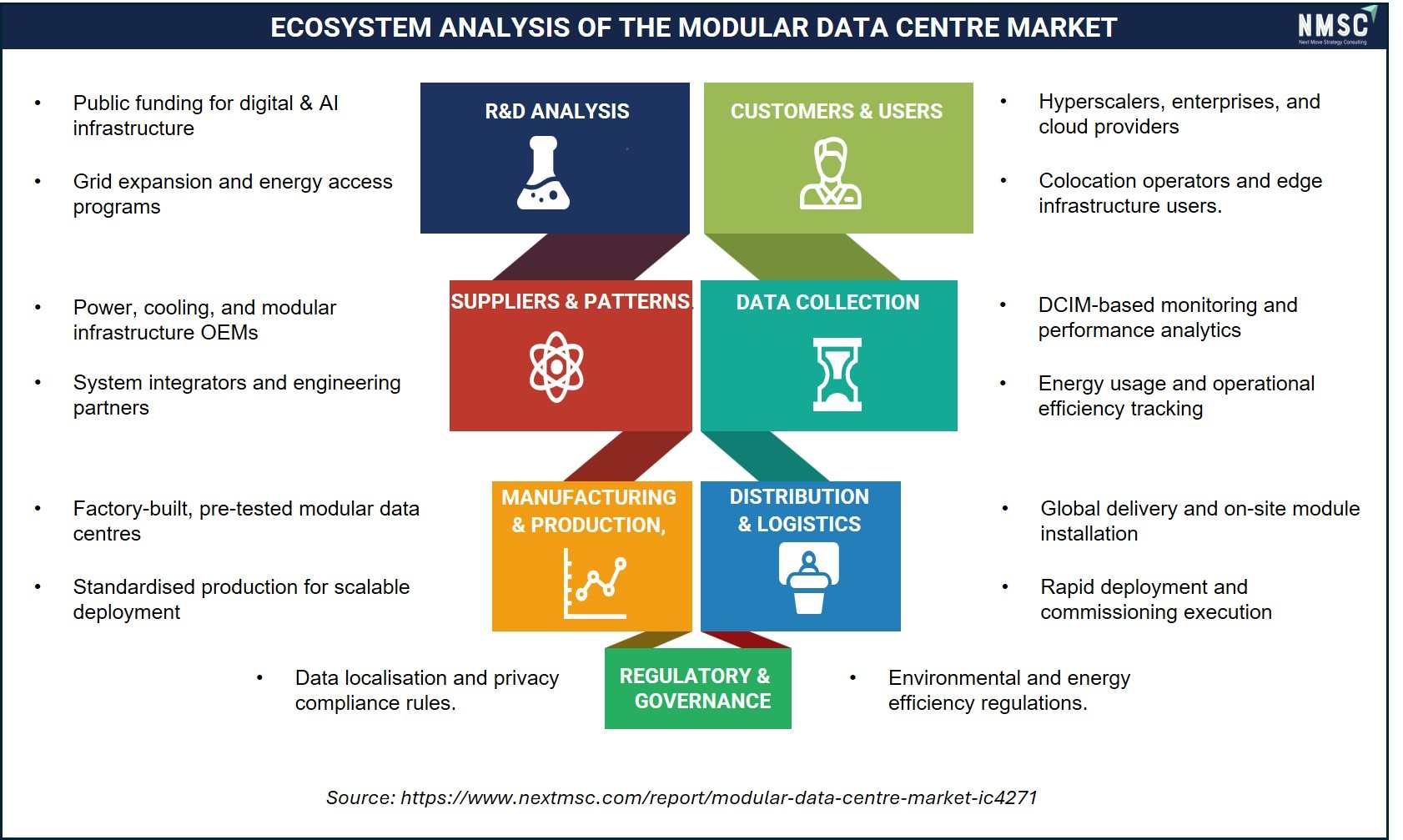
This infographic illustrates the modular data centre market ecosystem, showing how government initiatives, standardisation, R&D activities, supplier networks, manufacturing, and distribution processes interact across the value chain. Also, data collection, regulatory oversight, and governance frameworks further support performance optimisation, compliance, and lifecycle management. Together, these interconnected elements enable scalable, efficient, and rapid modular data centre deployment across diverse global markets.
What Are the Key Market Drivers, Breakthroughs, And Investment Opportunities That Will Shape the Modular Data Centre Industry in the Next Decade?
Growth Catalyst & Risk Assessment Matrix
|
Drivers/Trends/Restraints |
(+/–) % Impact On CAGR Forecast |
Geographic Relevance |
Impact Timeline |
|
Rising cloud adoption and data-intensive workloads driving demand for rapid, scalable data centre capacity (hyperscale, enterprise, colocation) |
+1.0% |
North America & Asia-Pacific core; steady uptake in Europe |
Short to medium term (1–3 years) |
|
Expansion of edge computing and latency-sensitive applications accelerating modular and distributed data centre deployments |
+0.8% |
Global; strongest in USA, China, Japan, South Korea, India |
Medium term (2–4 years) |
|
Increasing preference for prefabricated and modular designs to reduce construction timelines and deployment risk |
+0.9% |
Global, led by North America & Europe |
Short to medium term (1–3 years) |
|
Growing integration of software-driven monitoring, automation, and energy management to improve uptime and operational efficiency |
+0.7% |
Global; highest adoption in developed data centre markets |
Medium term (2–4 years) |
|
Power availability constraints, grid interconnection delays, and high upfront infrastructure costs limiting deployment pace |
–0.6% |
Global; pronounced impact in Europe and emerging APAC markets |
Medium term (2–4 years) |
Based on NMSC’s evaluation of global digital infrastructure deployments, we observed that the modular data centre market is experiencing steady expansion as traditional data centre delivery models become increasingly misaligned with fluctuating demand patterns. Across our engagements with colocation operators and infrastructure developers, prolonged construction timelines, early-stage overcapacity, and capital lock-in consistently emerged as structural limitations of conventional data centre builds. Consequently, modular data centres are increasingly being positioned not merely as a faster construction alternative, but as a strategic tool for managing deployment risk and aligning capital investment more closely with actual capacity utilisation.
We found that modular deployments allowed organisations to more closely align infrastructure spending with actual workload ramp-up, with operators adopting phased capacity additions reporting improved financial planning flexibility and lower exposure to stranded assets during early utilisation periods. However, these benefits are not uniform across deployments, as in several cases we evaluated, grid interconnection delays, site-readiness gaps, and permitting constraints eroded the headline speed advantages of modular designs, compelling operators to hold partially idle infrastructure. These findings underscore that while modularity reduces capital and deployment risk, it does not fully eliminate execution risks tied to local power availability and regulatory conditions.
Growth Drivers:
How Are Faster Deployment and Scalability Reshaping Adoption of Modular Data Centres?
Based on our engagements with data centre planners, alongside infrastructure strategy leaders at colocation providers and enterprise operators, we found that speed of deployment and the ability to scale capacity in stages are the main reasons organisations adopt modular data centres. As cloud services, edge computing, and digital transformation projects move faster, operators need data centre capacity that can be brought online quickly without locking into large, long-term capacity commitments upfront.
Our evaluation of deployment outcomes indicates that modular data centres deliver the strongest economic and operational value in environments where speed-to-market and phased scalability are critical. Operators use modular architectures to bring initial capacity online quickly while retaining the flexibility to expand incrementally as demand materialises. In contrast, projects prioritising single-phase, large-scale deployments experience slower time-to-revenue and underutilised capacity, even when modular systems are deployed. This divergence underscores that modular data centres function most effectively as enablers of rapid deployment and scalable growth, rather than as direct substitutes for conventional build strategies across all deployment contexts.
How Is the Shift Toward Opex-Led and As-A-Service Deployment Models Influencing Modular Data Centre Market Demand?
Based on our assessment of infrastructure financing and operating strategies, we observed that the shift toward OpEx-led and as-a-service deployment models is materially reshaping demand within the modular data centre market. Buyers increasingly favour consumption-based and service-oriented models to avoid large upfront capital commitments while supporting distributed cloud, edge, and latency-sensitive workloads across secondary markets, industrial zones, and dense urban environments.
Our evaluation of operational performance across distributed modular deployments indicates that this shift is driven not only by financial flexibility but also by the operational complexity of managing geographically dispersed sites. We also observed that remote monitoring, security enforcement, and maintenance logistics introduce higher recurring operational overheads over time, prompting buyers to favour service-based accountability over asset ownership. As a result, buyers increasingly assess modular data centre offerings on the strength of integrated service management, performance guarantees, and lifecycle accountability, including uptime commitments, maintenance responsibility, and defined performance SLAs reinforcing the transition toward OpEx-aligned and as-a-service deployment structures.
Growth Inhibitor:
How Are Power Constraints and Infrastructure Economics Limiting Modular Data Centre Market Growth?
Based on our assessment of modular data centre deployment activity across the modular data centre market, we found that power availability and infrastructure economics remain the most persistent constraints on market growth. Interviews with operators and developers highlight grid access delays, escalating connection costs, and uncertainty around long-term power availability as decisive bottlenecks, particularly in Europe and emerging Asia-Pacific markets.
Our analysis of delayed and restructured projects shows that while modular designs reduce construction and integration risk, they do not fundamentally alter dependence on external power infrastructure. In several cases, modular capacity was technically ready months before power connections were secured, undermining time-to-market assumptions. Additionally, higher per-megawatt costs relative to large hyperscale builds have constrained adoption among cost-sensitive buyers. Taken together, these dynamics underscore that modular data centres shift risk profiles but do not eliminate the capital and power-related constraints inherent to data infrastructure development.
Growth Opportunity:
How Are Lifecycle-Oriented Commercial Models Creating New Opportunities in the Modular Data Centre Market?
From our evaluation of procurement structures and operating models, we identified lifecycle-oriented commercial offerings, spanning deployment, expansion, and ongoing operations, as a key growth opportunity within the modular data centre market. Buyers increasingly valued vendors capable of delivering integrated design, deployment, operations, and upgrade support rather than standalone infrastructure modules. Our review of active deployments further showed that staged investments, service-backed contracts, and modular expansion options improved cost predictability and reduced upfront financial exposure, particularly for enterprises with evolving digital strategies.
These models lowered barriers for organisations that previously deferred modular adoption due to capital intensity and operational risk. However, we also observed that outcomes varied significantly by vendor execution quality. In practice, operators gravitated toward partners with proven local service capabilities, transparent lifecycle cost structures, and demonstrable post-deployment support. This reinforced that while commercial flexibility accelerates adoption, operational credibility ultimately determines long-term success.
Regulatory Framework Impacting the Modular Data Centre Industry
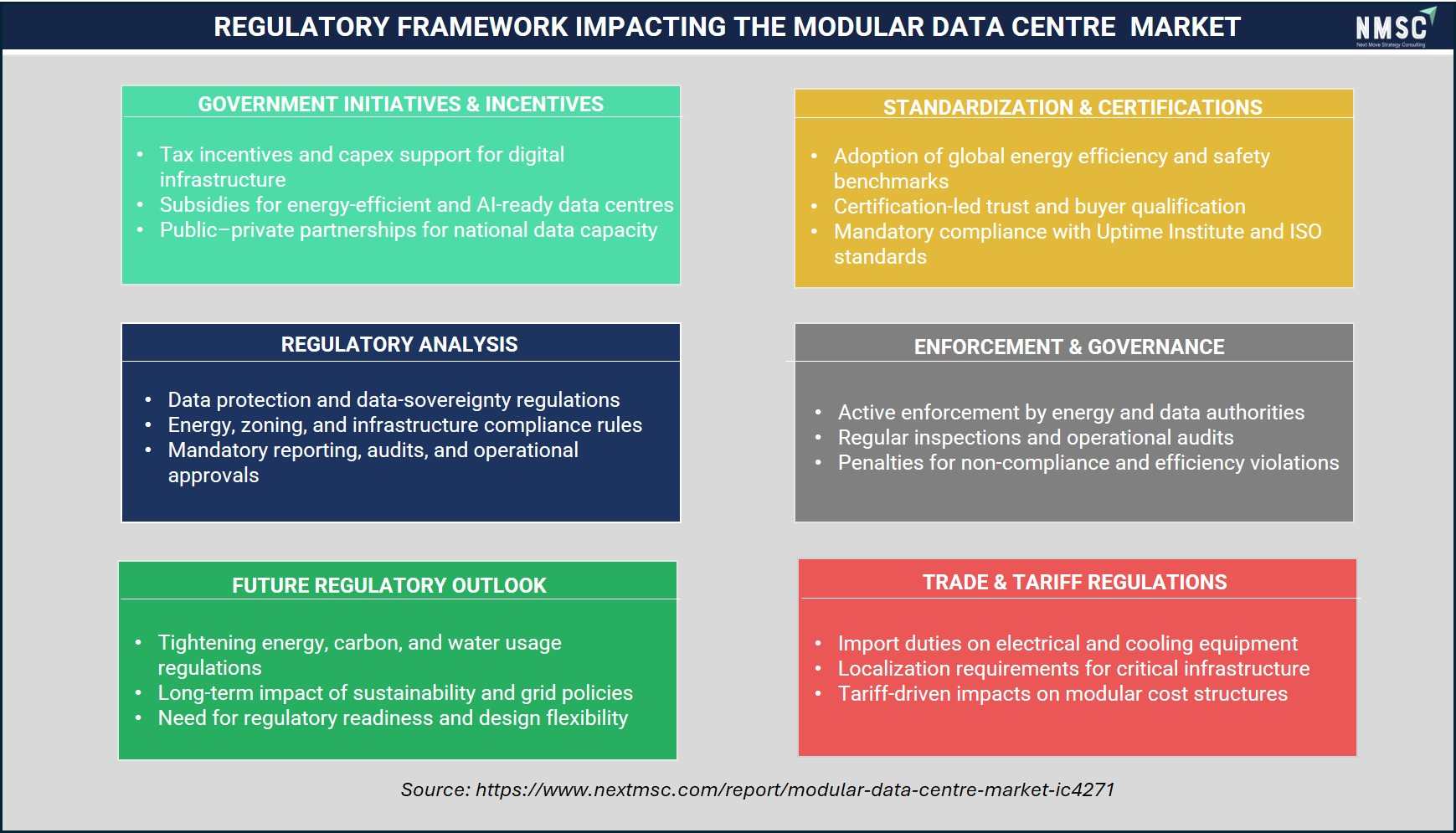
The regulatory framework impacting the modular data centre market is shaped by a combination of government incentives, standardisation requirements, and enforcement mechanisms that influence deployment feasibility and operating models. Policy support through tax incentives, subsidies, and public–private partnerships encourages investment in energy-efficient and AI-ready infrastructure, while mandatory certifications and compliance with global standards strengthen buyer confidence and market credibility. At the same time, data protection, energy, and zoning regulations, alongside active enforcement and audit regimes, raise compliance expectations and operational discipline.
How Is the Modular Data Centre Industry Segmented in This Report, And What Are the Key Insights from the Segmentation Analysis?
Market Highlights & Strategic Insights – Modular Data Centre Market:
|
Segments |
Key Takeaways |
|
Offering Type |
Integrated Systems dominated in 2025, driven by turnkey deployment demand and faster time-to-market advantages. Subsystem Hardware maintained a strong share due to upgrades in power and cooling infrastructure, while Services and Software are expanding as operators prioritise lifecycle management and automation. |
|
Form Factor |
Prefabricated Building modules led to large-scale deployments due to structural durability and campus integration advantages. Containerised systems gained traction in edge and remote environments, while modular pods and rack-level solutions supported phased expansion strategies. |
|
Power Capacity |
Medium (250 kW–1 MW) systems held the largest share, balancing scalability and deployment flexibility. Large (1–5 MW) modules followed, driven by cloud expansion, while hyperscale builds are accelerating under AI and high-performance compute demand. |
|
Rack Density |
Medium-density (10–30 kW/rack) deployments dominated due to enterprise and colocation workloads. High-density (>30 kW/rack) segments are expanding rapidly with AI-driven infrastructure requirements, while standard density remains relevant for legacy and distributed workloads. |
|
End User |
Cloud Service Providers and Colocation operators led adoption, supported by multi-region capacity expansion strategies. Enterprises followed with modernization initiatives, while telecom providers leveraged modular builds for edge and 5G integration. |
|
Distribution Channel |
Direct Sales and System Integrator/EPC partnerships dominated large-scale deployments. Channel partners and resellers supported enterprise and edge projects, while operators expanded DCaaS and managed infrastructure models. |
By Offering Type Insights
How Are Integrated Systems and Services Driving the Modular Data Centre Market?
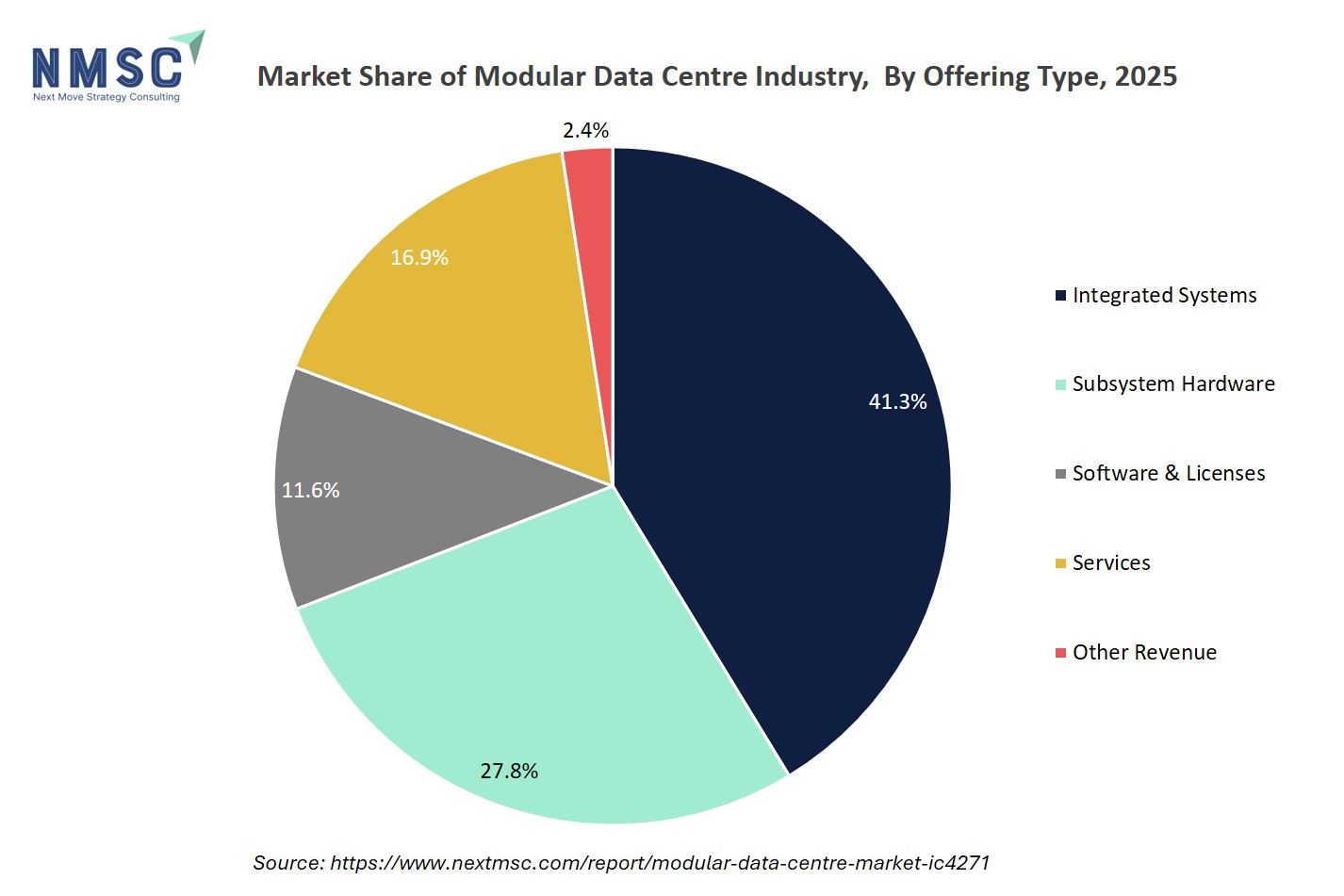
Based on our deployment-level analysis, we observed that the modular data centre market is segmented into integrated systems, subsystem hardware, software & licenses, services, and other revenue streams.
From our evaluation of procurement frameworks and EPC-driven expansion strategies, Integrated Systems are driving dominant revenue momentum due to compressed deployment cycles, standardized engineering, and predictable capex structures. For example, Enterprises and hyperscale operators increasingly prioritize turnkey modular builds to accelerate capacity rollouts while maintaining operational consistency across multiple sites. In parallel, Services are expanding steadily as operators seek lifecycle management, remote monitoring, and DCaaS models to enhance uptime and optimize total cost of ownership. Overall, this integrated delivery model is strengthening vendor competitiveness and supporting durable revenue growth across the modular ecosystem.
By Form Factor Insights
How Is Deployment Design Influencing Adoption Patterns in the Modular Data Centre Market?
Based on our infrastructure assessments, we identified that the modular data centre market is segmented into containerised, prefabricated building, skid-mounted, rack-level, and modular pod configurations.
From our review of hyperscale campus expansion and edge computing deployments, Prefabricated Building modules are leading large-scale adoption due to structural durability, rapid assembly timelines, and seamless integration into existing data centre campuses. Meanwhile, containerised systems are gaining traction across remote industrial sites and edge networks where mobility and rapid commissioning are critical. Also, modular pods and rack-level solutions further enable phased capacity expansion within constrained facilities. Together, these adaptable form factors are accelerating digital infrastructure scaling while improving deployment efficiency and capital allocation discipline.
By Power Capacity Insights
How Is Capacity Scaling Shaping Investment Strategy in the Modular Data Centre Market?
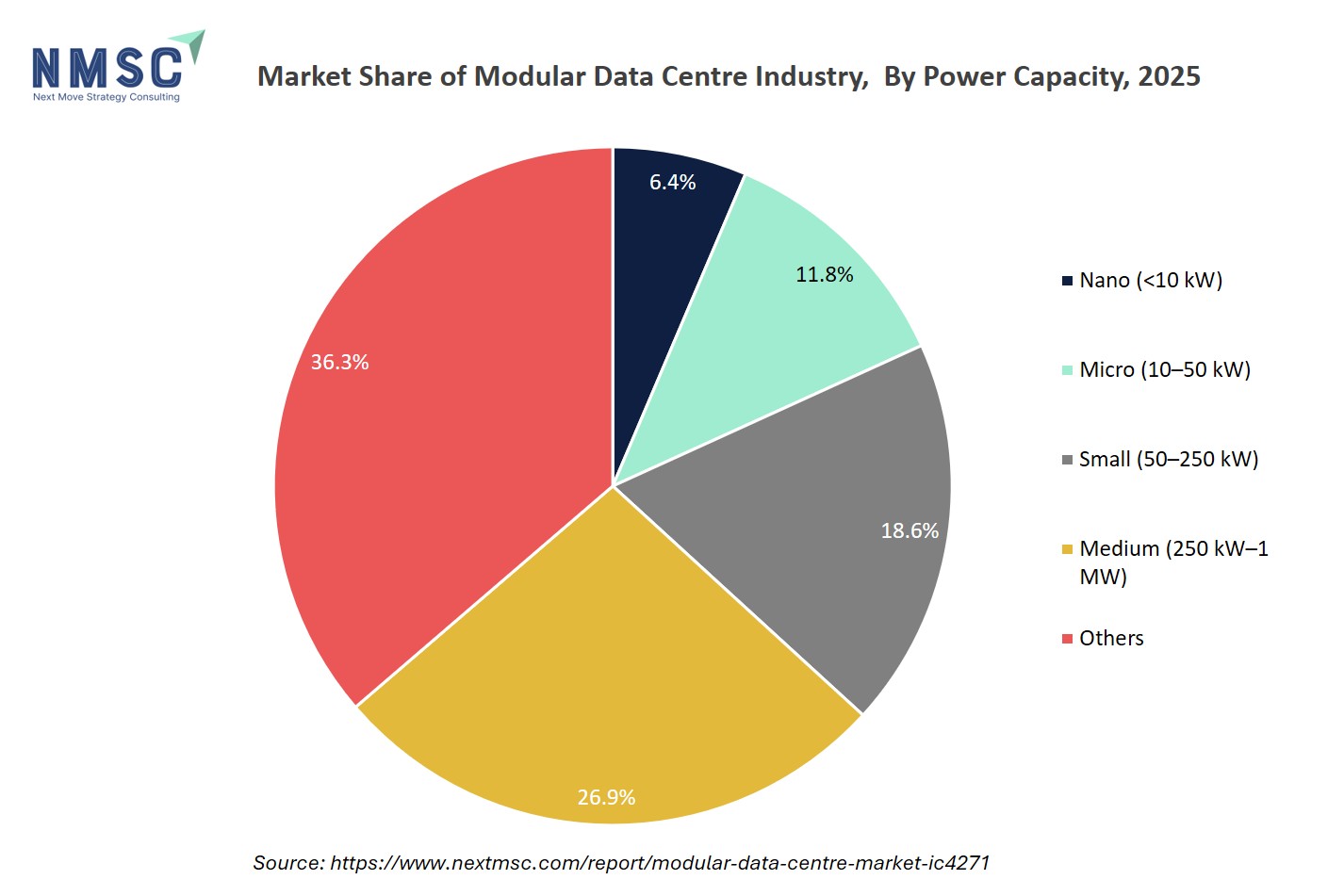
Through our analysis of installed modular capacity, we observed that the modular data centre market is segmented into Nano (<10 kW), Micro (10–50 kW), Small (50–250 kW), Medium (250 kW–1 MW), Large (1–5 MW), and Hyperscale (>5 MW) categories. These tiers align with edge deployments, enterprise modernization, and hyperscale cloud expansion strategies.
From our engagement with power infrastructure planners and cloud operators, medium and large capacity modules are driving the strongest investment momentum, as organizations scale infrastructure to support AI workloads, high-density compute, and latency-sensitive applications. Moreover, hyperscale modular deployments are expanding rapidly, enabling faster regional capacity additions without prolonged construction cycles. This scalable capacity architecture enhances flexibility, improves energy optimization, and strengthens infrastructure resilience. As digital demand accelerates, modular power scaling is reinforcing long-term investment confidence across the data centre landscape.
By End User Insights
Which End Users Are Accelerating Adoption in the Modular Data Centre Market?
Based on our demand-side evaluation, the modular data centre market is segmented into enterprise, cloud service providers, colocation providers, telecommunications providers, government & defence, industrial & energy, and other users.
From our evaluation of hyperscale procurement programs and enterprise digital transformation initiatives, cloud service providers and colocation operators are leading adoption due to aggressive multi-region capacity expansion and the need for rapid deployment flexibility. Also, enterprises are modernising legacy facilities through modular builds to enhance scalability and operational efficiency. Meanwhile, telecommunications providers are leveraging modular solutions to support edge computing and 5G network densification, while government and industrial sectors prioritise resilient and secure infrastructure. Overall, this diversified demand structure is sustaining steady growth momentum and reinforcing modular data centres as foundational digital infrastructure assets.
Regional Outlook:
Geographic Performance Snapshot:
|
Geography |
Key Takeaways |
|
North America |
Within the modular data centre market, growth is driven by sustained hyperscale cloud and colocation expansion, with modular data centres primarily adopted for incremental capacity additions to accelerate deployment timelines and manage capital exposure. Regional growth is shaped by power availability constraints and grid congestion in major data centre hubs, which increasingly influence site selection and rollout sequencing. |
|
Europe |
Modular data centre growth is driven by regulatory compliance requirements, energy efficiency priorities, and sustainability mandates, particularly in capacity-constrained urban markets. Adoption is strongest in phased expansion and retrofit scenarios, with growth paced by permitting complexity, grid access conditions, and regional energy cost dynamics. |
|
Asia Pacific |
Rapid digitalisation, hyperscale cloud expansion, and government-backed data infrastructure initiatives underpin the fastest regional growth in modular data centre adoption. Demand is reinforced by the need for faster capacity rollout and scalability, with outcomes shaped by country-level power infrastructure readiness, regulatory consistency, and local supply chain maturity. |
|
Latin America |
Growth is driven by expanding cloud availability zones, enterprise digital transformation, and rising demand for edge and disaster recovery infrastructure. Modular data centres are adopted to overcome infrastructure gaps and accelerate deployment, while market expansion remains influenced by power reliability, economic volatility, and project-specific investment appetite. |
|
Middle East & Africa |
Modular data centre growth is driven by sovereign digitalisation programs, government-led cloud initiatives, and mission-critical infrastructure requirements across energy, transport, and public sectors. Adoption is reinforced by deployment speed and scalability in infrastructure-constrained environments, with growth shaped by grid capacity, local service ecosystem depth, and regulatory clarity. |
The modular data centre market is geographically studied across North America, Europe, Asia Pacific, and the rest of the world, and each region is further studied across countries.
The regional outlook reflects how the steady expansion of global data centre capacity across regions is directly shaping demand for modular data centre solutions as operators seek faster, scalable, and more capital-efficient capacity additions.
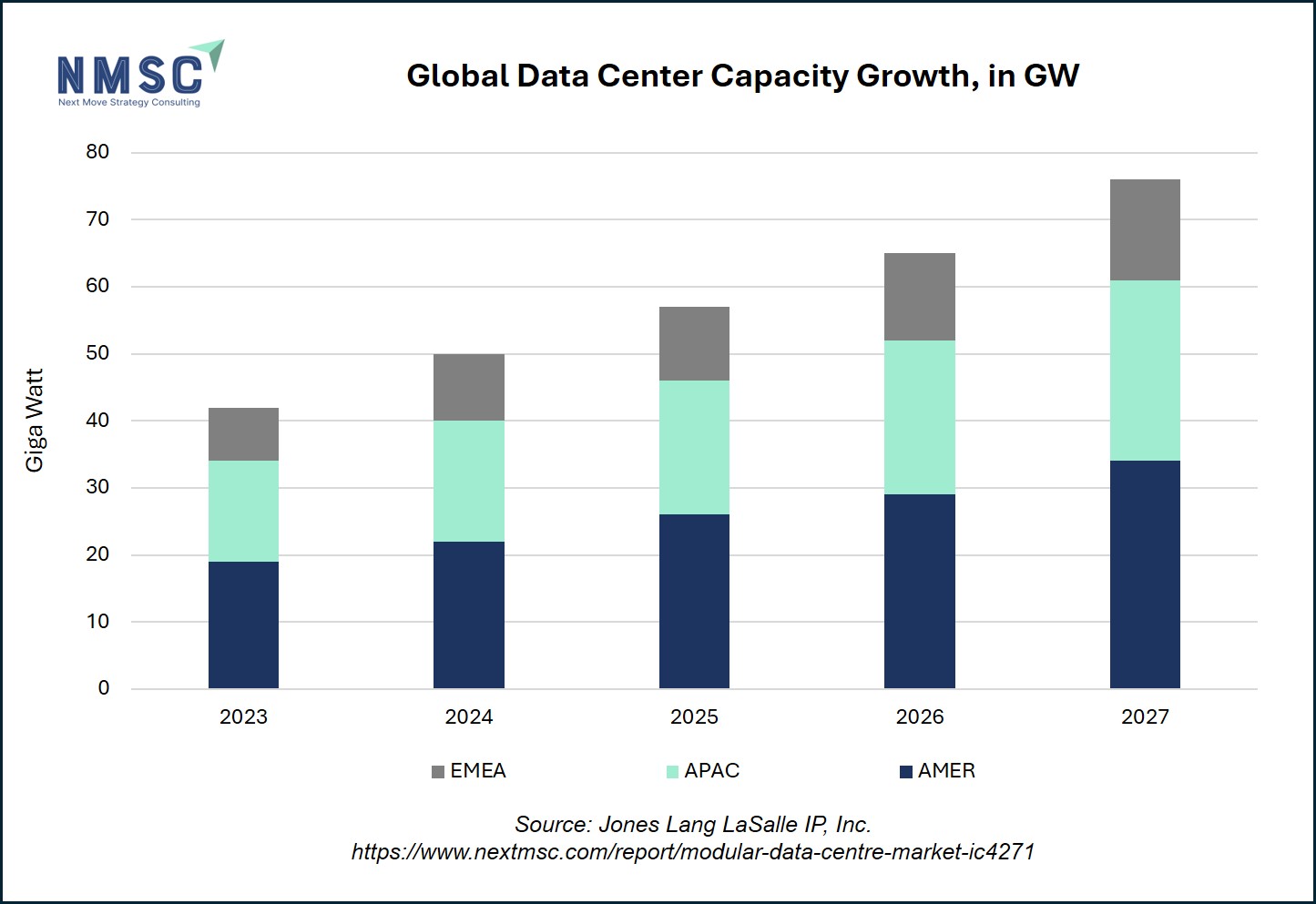
The infographic depicts the growth of global data centre capacity across regions, which serves as a foundational demand indicator for the modular data centre market. As capacity requirements increase, data centre operators, cloud providers, and colocation players are increasingly turning to modular architectures to deploy new capacity quickly, manage phased expansion, and align capital investment with utilization. Regions showing stronger capacity additions are therefore expected to account for a disproportionate share of modular data centre deployments, particularly in edge, hyperscale, and high-density environments, reinforcing modular solutions as a key enabler of scalable global data centre growth.
Modular Data Centre Market in North America
North America represents a mature and execution-focused modular data centre market, supported by strong cloud penetration, advanced digital infrastructure, and a dense colocation ecosystem. Our insights derived from regional capacity planning activity indicate that modular deployments in the region are primarily used to accelerate incremental capacity additions, support phased expansion strategies, and reduce construction timelines in capacity-constrained markets.
Further, adoption is strongest among hyperscale cloud providers and large colocation operators, while enterprises increasingly deploy prefabricated solutions to improve deployment predictability. Buyer preferences reflect a strong emphasis on integrated power and cooling architectures, standardised designs, and lifecycle service assurance. Energy efficiency, resilience, and long-term operational performance continue to influence solution selection. Modular data centres are positioned as a complementary deployment model rather than a replacement for traditional builds, supporting controlled scale and operational flexibility across North America.
Modular Data Centre Market in the United States
The United States remains the largest modular data centre market globally, driven by sustained hyperscale expansion, enterprise digital transformation, and colocation growth. Through interviews with hyperscale infrastructure teams and colocation development managers, we noticed that modular data centres are widely adopted to support campus densification, near-term capacity bridging, and rapid deployment in high-demand markets.
Moreover, as operators seek to minimise deployment risk while accelerating timelines, deployment patterns show a strong preference for factory-tested, standardised modular architectures that simplify on-site integration and reduce commissioning uncertainty. This preference is reinforced by the availability of experienced system integrators and service providers, which supports smoother implementation and more reliable long-term operations. Consequently, buyers increasingly prioritise scalable power configurations, integrated monitoring platforms, and service-backed delivery models that enable controlled expansion and operational visibility. At the same time, energy efficiency requirements and uptime expectations continue to shape procurement decisions, reinforcing demand for modular solutions that balance deployment speed with reliability and operational transparency across a wide range of use cases.
Modular Data Centre Market in Canada
Based on our regional assessment, we found that Canada demonstrates steady and structurally resilient adoption within the modular data centre market, supported by high digital readiness and expanding regional data centre footprints. Insights drawn from procurement evaluations indicate that demand is concentrated across enterprise environments, manufacturing-adjacent facilities, and secondary markets where reliability and resilience are critical.
Modular solutions are increasingly favoured for their ability to minimise on-site construction complexity and enable reliable deployment in cold-climate environments. As a result, buyers consistently prioritise robust power backup systems, integrated cooling solutions, and extended service lifecycles to ensure uninterrupted operations. Geographic dispersion and harsh climatic conditions further strengthen the preference for prefabricated designs, as they offer more predictable performance across distributed locations. While overall deployment scale remains moderate compared with the United States, modular data centre installations in Canada are defined by a strong emphasis on durability, operational continuity, and long-term system reliability.
Modular Data Centre Market in Europe
Europe exhibits regulation-driven and efficiency-focused adoption within the modular data centre market, shaped by stringent environmental standards and ongoing infrastructure modernisation initiatives. Our review of procurement and deployment assessment shows that modular data centres are increasingly adopted to support retrofit projects, address urban capacity constraints, and ensure compliance with evolving building, energy, and sustainability regulations across European markets. Further, energy efficiency, sustainability alignment, and certification requirements play a central role in purchasing decisions. Adoption dynamics vary by country, reflecting differences in regulatory complexity, power availability, and market maturity. Operators favour scalable, interoperable modular architectures that enable phased expansion while maintaining regulatory compliance. As a result, modular data centres are positioned as a practical pathway to modernise infrastructure, minimise disruption, and improve operational efficiency across diverse European markets.
Modular Data Centre Market in the United Kingdom
The UK modular data centre market is shaped by dense urban infrastructure, strong colocation activity, and rising demand for edge capacity, all of which place pressure on operators to deploy scalable infrastructure within constrained environments. Accordingly, our evaluation of operator-led procurement activity indicates that modular deployments are increasingly used to enable retrofit expansion and accelerate delivery timelines while minimising on-site disruption. Consequently, buyer preferences have shifted toward turnkey, factory-integrated solutions that offer embedded monitoring and robust lifecycle support. Also, stringent planning regulations and limited site availability reinforce demand for modular architectures that reduce operational impact. As procurement priorities evolve, operators increasingly favour vendors offering transparent compliance processes, clear service accountability, and long-term operational support, supporting continued adoption of modular data centres across the UK.
Modular Data Centre Market in Germany
Germany’s modular data centre market reflects an engineering-led and compliance-oriented adoption profile, where technical precision and regulatory alignment strongly shape deployment decisions. Our review of procurement processes shows that demand is driven mainly by enterprise and colocation operators seeking certified designs, high availability, and long-term operational assurance. As a result, prefabricated indoor modules with advanced cooling systems, built-in redundancy, and integrated monitoring capabilities are increasingly favoured. These preferences are reinforced by procurement frameworks that emphasise rigorous technical validation, comprehensive documentation, and system longevity, alongside strict energy-efficiency and sustainability requirements.
Moreover, close collaboration between operators, technology providers, and system integrators supports the rollout of technically sophisticated modular solutions. Compared with other European markets, Germany demonstrates a higher tolerance for extended procurement cycles in exchange for reliability, performance consistency, and long-term lifecycle value.
Modular Data Centre Market in France
France continues to see steady adoption of modular data centres, underpinned by ongoing infrastructure modernisation efforts and stringent regulatory compliance requirements. Our assessment shows that modular solutions are increasingly used to enable phased capacity expansion while limiting operational disruption during modernisation initiatives. Buyer priorities are therefore closely aligned with energy efficiency, security, and data transparency. At the same time, regulatory emphasis on environmental protection and infrastructure resilience further reinforces demand for integrated modular architectures. Vendor selection is strongly influenced by local system integration capabilities and proven compliance expertise. Overall, adoption remains measured, with operators placing greater weight on reliability and system interoperability rather than deployment speed alone, positioning modular data centres as a structured and compliant approach to infrastructure expansion across France.
Modular Data Centre Market in Italy
Italy’s modular data centre market shows a pattern of selective adoption, shaped by a strong emphasis on retrofit modernisation and the need for infrastructure flexibility. Our assessment of project approval activity indicates that modular data centres are increasingly used to modernise legacy sites and enable distributed capacity expansion without requiring extensive site reconstruction. Buyer priorities focus on adaptable form factors, efficient cooling solutions, and cost-conscious scalability. Deployment strategies are further influenced by fragmented infrastructure layouts and regional diversity, while government initiatives promoting digital and industrial modernisation provide additional momentum. Compared with northern European markets, adoption remains more measured; however, it continues to expand as operators seek faster, lower-disruption alternatives to traditional builds, positioning modular data centres as a practical pathway for incremental capacity upgrades across Italy’s evolving digital infrastructure landscape.
Modular Data Centre Market in Spain
Spain is experiencing an accelerating adoption of modular data centres, supported by growth in digital services, logistics infrastructure, and regional data hubs. Based on our evaluation of operator-led procurement, we observed that modular deployments are increasingly specified to enable rapid capacity delivery and improved energy performance. Buyer priorities centre on cost efficiency, simplified installation, and predictable operational outcomes. Compact modular designs are favoured across urban and regional markets where space constraints remain a key consideration. Also, energy efficiency and operational cost management strongly influence solution selection. Vendors offering scalable architectures and transparent performance metrics achieve stronger market acceptance. As a result, modular data centres continue to gain traction as operators balance expansion requirements with cost control and deployment efficiency.
Modular Data Centre Market in the Nordics
The Nordic region, comprising Sweden, Norway, Finland, and Denmark, represents one of the most advanced and quality-driven modular data centre markets globally. Based on our interviews with data centre operators, we found that adoption is underpinned by high digital maturity, stringent sustainability mandates, and broad access to renewable energy sources. Operators consistently prioritise energy-efficient designs, low-PUE performance, and long-term operational resilience. Also, prefabricated and modular solutions optimised for cold-climate conditions are widely deployed. Buyer preferences strongly favour integrated power and cooling architectures, system interoperability, and comprehensive lifecycle support. Further, environmental compliance and infrastructure reliability play a central role in procurement decisions, supporting high-value, long-duration modular deployments across Nordic data centre ecosystems.
Modular Data Centre Market in the Asia-Pacific
Asia-Pacific represents the fastest-growing and most diverse modular data centre market globally, driven by rapid digitalisation, expanding cloud adoption, and government-led digital infrastructure programmes. Based on our ongoing regional deployment engagements and market monitoring, modular data centres are increasingly adopted to accelerate capacity rollouts and manage fluctuating demand across both mature and emerging markets. However, deployment characteristics vary widely by country, reflecting differences in regulatory frameworks, power infrastructure readiness, and supply chain maturity. In response, operators favour flexible modular architectures that enable localisation and phased expansion. Consequently, vendors that can adapt designs to country-specific requirements and on-ground deployment conditions achieve stronger scalability, reinforcing Asia-Pacific’s position as a high-growth region defined by highly differentiated execution dynamics.
Modular Data Centre Market in China
China represents a scale-driven modular data centre market, supported by strong domestic manufacturing capabilities and rapid infrastructure expansion. Based on our interactions with local data centre operators and modular OEMs, modular deployments are widely adopted across hyperscale, enterprise, and edge environments to meet fast-growing capacity requirements. A mature domestic OEM ecosystem enables competitive pricing, faster delivery cycles, and standardised designs aligned with national infrastructure priorities.
Accordingly, buyer priorities centre on scalability, deployment speed, and compatibility with domestic technology platforms. Effective market participation therefore, depends on localised production, integration with indigenous software and management ecosystems, and strict adherence to national standards. As a result, modular data centres play a central role in China’s data infrastructure expansion, supporting both large-scale capacity growth and distributed deployment models.
Modular Data Centre Market in Japan
Japan exhibits a precision-focused and reliability-driven modular data centre market, shaped by stringent national safety and building standards. Based on our assessment, we found that adoption is defined by strict safety compliance, acute space constraints, and exceptionally high expectations for uptime and operational continuity. In response, operators favour indoor prefabricated modules engineered for seismic resilience and long-term reliability, reflecting local risk profiles and regulatory conditions.
Procurement decisions, further, consistently prioritise system quality, redundancy, and lifecycle service assurance over deployment speed. Modular solutions are therefore selectively deployed to optimise space utilisation and support enterprise and edge workloads within tightly controlled facilities. Vendor reputation, technical credibility, and proven long-term support capabilities play a decisive role, positioning modular data centres as a controlled and dependable infrastructure option within Japan’s highly regulated data centre environment.
Modular Data Centre Market in India
India is emerging as a high-growth modular data centre market, driven by accelerating cloud adoption, data localisation mandates, and rapid expansion of digital services. Based on our interviews from hyperscale cloud deployment teams, we observed that modular data centres are increasingly deployed to accelerate metro capacity development while supporting edge expansion beyond primary hubs. Buyers prioritise scalable and cost-efficient designs, with procurement decisions closely linked to the availability of strong local integration and execution capabilities.
Also, adoption patterns vary significantly across cities, shaped by differences in power infrastructure readiness, skilled workforce availability, and site development timelines. Vendors offering flexible deployment models combined with robust local execution and commissioning support achieve faster market traction. As a result, modular data centres are becoming a critical enabler of rapid infrastructure expansion in India, allowing operators to balance capital efficiency with rising operational complexity across an evolving data centre landscape.
Modular Data Centre Market in South Korea
South Korea represents an advanced adopter of modular data centres, characterised by high digital readiness and rapid technology uptake. Based on our assessments with data centre engineering teams, we found that demand is primarily driven by AI, analytics, and telecom workloads requiring high-density and highly efficient infrastructure. Modular solutions integrated with advanced cooling and monitoring systems are widely preferred, particularly for performance-sensitive deployments.
Our interactions with domestic system integrators further highlights that South Korea’s strong local technology ecosystem supports the rapid adoption of sophisticated modular architectures. Buyers consistently prioritise performance consistency, automation, and system interoperability when evaluating modular options. Modular data centres are increasingly deployed as part of integrated digital infrastructure strategies supporting both enterprise and edge applications, with vendor capability to deliver high-performance, scalable modular designs emerging as a key competitive differentiator in the South Korean market.
Modular Data Centre Market in Taiwan
Taiwan demonstrates targeted and early-stage adoption of modular data centres, supported by its strong electronics and semiconductor manufacturing base. Based on our engagements with semiconductor manufacturers and enterprise data centre operators, we observed that modular deployments are concentrated in high-reliability environments requiring predictable performance and strong system interoperability. Buyers favour modular solutions that integrate seamlessly with existing IT, control, and monitoring platforms. Further, local service providers and authorised maintenance partners play a significant role in procurement decisions, driven by requirements for responsive service support and spare parts availability. Modular data centres therefore support controlled and precision-led capacity expansion within Taiwan’s highly reliability-focused digital infrastructure ecosystem.
Modular Data Centre Market in Indonesia
Indonesia represents an emerging modular data centre market, where adoption is influenced by rising urban density, rapid growth in e-commerce activity, and gradual improvements in core digital infrastructure. We observed that deployment remains concentrated in major metropolitan areas, where space efficiency and shorter delivery timelines are critical decision factors. Accordingly, operators show a preference for containerised and compact modular formats that address site constraints while minimising civil construction requirements.
However, execution outcomes are closely linked to power stability and system integration readiness, which continue to distinguish successful projects from delayed or scaled-back deployments. In this environment, vendors capable of providing end-to-end deployment, commissioning, and operational support achieve stronger adoption outcomes. As a result, modular data centres are increasingly positioned as a practical pathway for incremental capacity expansion within Indonesia’s developing data centre ecosystem.
Modular Data Centre Market in Australia
Australia’s modular data centre market is defined by relatively high capital investment per deployment, underscoring a sector-wide focus on resilience and long-term operational reliability. Based on our regional assessment of deployment economics, we found that modular solutions are frequently adopted to extend capacity into regional locations and address supply gaps where conventional construction timelines and costs are less viable. Accordingly, procurement decisions place greater emphasis on service continuity and fault tolerance than on rapid deployment, driving demand for prefabricated indoor modules equipped with integrated power backup and energy-efficient cooling systems.
The country’s geographic dispersion across major population and industrial centres further heightens the importance of predictable operations and consistent performance. As a result, vendors with local inventory access, proven integration capabilities, and comprehensive long-term service support are best positioned, reinforcing the role of modular data centres in enabling scalable and resilient digital infrastructure across Australia’s concentrated data centre landscape.
Modular Data Centre Market in Latin America
The modular data centre market in Latin America is characterised by measured and selective adoption, with deployment activity largely concentrated in larger economies and strategically important logistics hubs. Evaluation from our regional assessments and infrastructure sponsors, modular solutions are primarily utilised to meet immediate capacity needs and to compress infrastructure delivery timelines. Across the region, procurement strategies are heavily shaped by cost sensitivity, financing considerations, and reliance on imported systems, all of which influence vendor choice and design decisions. Therefore, phased deployment approaches and flexible modular architectures are better suited to navigating macroeconomic volatility than large, fixed-capacity developments.
Project performance is further dependent on the availability of local system integration and ongoing service support, particularly in markets with fragmented infrastructure environments. As a result, modular data centres are increasingly adopted as a lower-risk, incremental pathway for digital infrastructure expansion rather than as a vehicle for large-scale, upfront transformation.
Modular Data Centre Market in the Middle East & Africa
The Middle East & Africa region exhibits differentiated adoption patterns for modular data centres. Based on our assessment from data centre operators and infrastructure sponsors, demand in the Middle East is driven by large-scale digital transformation initiatives, sovereign cloud programmes, and smart infrastructure development. Buyers favour highly resilient, turnkey modular solutions with integrated power and cooling systems designed for mission-critical workloads.
In Africa, we found that adoption remains at an early stage, with deployments focused on edge, telecom, and mission-critical use cases. Infrastructure availability, power stability, and service ecosystem maturity continue to influence deployment outcomes. Vendors combining modular design capability with strong local execution and lifecycle support are best positioned to capture long-term growth across the region.
Competitive Landscape
Competitive Dynamics & M&A Landscape:
|
Key Takeaways |
|
The global modular data centre market is shaped by a mix of large, diversified infrastructure and IT incumbents, such as Huawei Technologies Co., Ltd., Schneider Electric SE, Vertiv Holdings Co, Eaton Corporation plc, Johnson Controls International plc, ABB Ltd, Dell Technologies Inc., Hewlett Packard Enterprise Company, Delta Electronics, Inc., Mitsubishi Electric Corporation, nVent Electric plc, ZTE Corporation, Rittal GmbH & Co. KG, STULZ GmbH, Legrand SA, M.C. Dean, Inc., Cadolto Datacenter GmbH, BladeRoom Group Limited, Cannon Technologies Ltd, Beijing Haiwu Technology Co., LTD. and emerging modular-native players such as datapod.ai. Large incumbents leverage integrated portfolios across power, cooling, IT infrastructure, and global service networks, while specialists differentiate through prefabrication expertise, deployment speed, and modular engineering depth. |
|
From our assessment of vendor strategies, competition increasingly centres on end-to-end modular platforms rather than standalone infrastructure components. Vendors are prioritising tightly integrated power-cooling architectures, embedded monitoring and management software, standardised module designs, and repeatable deployment frameworks that scale across multi-site environments. Interoperability with enterprise IT stacks, lifecycle service capability, and the ability to support phased expansion have emerged as critical differentiators, particularly for colocation operators, cloud providers, and enterprises managing distributed capacity growth. |
|
Recent partnership, acquisition, and capability-building activity in the modular data centre market reflects a clear shift toward strengthening software, controls, energy management, and systems-integration depth, rather than expanding hardware breadth alone. Companies are increasingly targeting digital power management, thermal optimisation, prefabrication engineering, and service delivery capabilities to improve deployment predictability and long-term operating performance. This strategic focus supports recurring service revenues, strengthens customer retention, and enhances competitive positioning as modular data centres become a core component of global digital infrastructure strategies. |
Which Companies Dominate the Modular Data Centre Industry and How Do They Compete?
Based on our market analysis, the modular data centre industry is led by large, diversified infrastructure and IT incumbents alongside a smaller group of modular-focused specialists. Companies such as Schneider Electric, Vertiv Group Corp, ABB, Eaton, Hewlett Packard Enterprise, Dell Inc., and Huawei Digital Power Technologies consistently dominate large-scale and mission-critical deployments where reliability, global service coverage, and lifecycle assurance are key decision factors. From our analysis of recent deployments, we found that these vendors are frequently selected for enterprise, colocation, and hyperscale environments requiring tight integration across power, cooling, IT infrastructure, and management software. Competition at this tier is driven primarily by platform breadth, execution capability, and long-term operational performance rather than unit-level pricing.
Market Dominated by Modular Data Centre Giants and Specialists
Alongside global incumbents, the competitive landscape is shaped by modular- and component-focused specialists such as Rittal, STULZ GmbH, Delta Electronics, BladeRoom Group, KSTAR, and emerging players including datapod.ai. From our assessment, we found that these companies gain traction by focusing on prefabrication engineering, high-efficiency cooling, containerised designs, and faster deployment models. BladeRoom is frequently referenced for scalable prefabricated halls, while STULZ and Rittal are preferred where thermal efficiency and enclosure engineering are critical. In practice, incumbents set architectural standards and service expectations, while specialists accelerate adoption through targeted, modular-first solutions across the modular data centre market.
Innovation and Adaptability Drive Market Success
Innovation in the modular data centre market increasingly centres on platform integration rather than standalone modules. Our assessments of hyperscale and colocation indicate an intensifying focus on pre-integrated power and cooling architectures, embedded monitoring, DCIM integration, and repeatable deployment frameworks that scale across multiple sites. Vendors investing in standardised module designs, energy optimisation software, and interoperable control layers are better positioned to support distributed and edge-heavy deployments. Feedback from operators and integrators highlights that suppliers offering consistent performance, predictable commissioning, and strong lifecycle services achieve higher customer retention. Competitive differentiation is therefore increasingly linked to software maturity, system interoperability, and the ability to manage modular assets across geographically dispersed portfolios.
Market Players to Opt for Merger & Acquisition Strategies to Expand Their Presence
From our evaluation of strategic transactions and capability-driven acquisitions, M&A are playing an increasingly central role in competitive expansion across the market. In early 2025, Vertiv Group Corp advanced its infrastructure portfolio through targeted acquisitions aimed at strengthening rack, enclosure, and liquid cooling capabilities, reinforcing its position in high-density and AI-ready modular deployments. Simultaneously, Schneider Electric expanded its thermal and digital power management capabilities through strategic investments and acquisitions aligned with next-generation data centre architectures, supporting modular and prefabricated system integration.
Viewed alongside broader industry activity, these transactions reflect a clear strategic shift toward acquiring enabling technologies, execution depth, and platform control rather than pursuing scale-driven consolidation alone. Overall, recent M&A activity underscores a sustained focus on integrated power-cooling platforms, software-enabled management, and repeatable deployment models as key levers of competitiveness in an increasingly distributed and modular global data centre landscape.
SWOT Analysis:

The SWOT infographic highlights how the modular data centre market is defined by fast deployment and scalable, prefabricated designs that enable predictable capacity expansion as a core strength. At the same time, dependence on power availability and limited software interoperability remain key constraints on operational efficiency. Growing adoption of cloud, AI, edge computing, and DCaaS presents strong opportunities for modular, service-led deployments, while grid constraints, regulatory delays, and intensifying price competition continue to pose execution and margin risks across the market.
List of Key Modular Data Centre Companies
-
Huawei Technologies Co., Ltd.
-
Schneider Electric SE
-
Vertiv Holdings Co
-
Eaton Corporation plc
-
Johnson Controls International plc
-
ABB Ltd
-
Dell Technologies Inc.
-
Hewlett Packard Enterprise Company
-
Delta Electronics, Inc.
-
Mitsubishi Electric Corporation
-
nVent Electric plc
-
ZTE Corporation
-
Rittal GmbH & Co. KG
-
STULZ GmbH
-
Legrand SA
-
M.C. Dean, Inc.
-
Cadolto Datacenter GmbH
-
BladeRoom Group Limited
-
Cannon Technologies Ltd
-
Beijing Haiwu Technology Co., LTD.
What Are the Latest Key Industry Developments?
-
August 2025 - Vertiv completed the acquisition of Great Lakes Data Racks & Cabinets, significantly strengthening its portfolio of high-density racks, enclosures, and prefabricated infrastructure solutions. This development enhanced Vertiv’s capabilities in modular and AI-ready data centre deployments, enabling faster rollout of edge and hyperscale infrastructure optimized for high-performance computing and liquid-cooled environments.
-
June 2025 - Hewlett Packard Enterprise (HPE) expanded its AI Factory and modular infrastructure portfolio during HPE Discover 2025, introducing advanced liquid-cooled modular data centre stacks designed for AI-intensive workloads. These solutions reinforce HPE’s focus on standardized, repeatable, and prefabricated architectures that accelerate enterprise and cloud deployment cycles while supporting high-density GPU clusters.
Expert Insights:
 “The introduction of 800 VDC architectures is a transformative advancement for data center innovation that will enable new possibilities in AI computing.”
JP Buzzell, Vice President and Data Center Chief Architect, Eaton
What Are the Key Factors Influencing Investment Analysis & Opportunities in the Modular Data Centre Industry?
Investment analysis in the modular data centre market has increasingly shifted toward platform-driven, execution-oriented, and service-led business models, rather than suppliers offering standalone prefabricated units or isolated infrastructure components. Based on our review of recent strategic investments and acquisition activity, we found that investors are favouring companies that demonstrate repeatable modular architectures, integrated power and cooling platforms, and embedded software capabilities that support multi-site scalability. Vendors generating recurring revenues through lifecycle services, monitoring platforms, energy optimisation, and long-term operations contracts consistently attract stronger valuation multiples than hardware-centric providers.
We also observed growing investment concentration within the modular data centre market around AI-ready power infrastructure, liquid and hybrid cooling technologies, and standardised prefabrication frameworks that reduce deployment risk and commissioning timelines. Strategic investments increasingly outweigh purely financial participation, as hyperscalers, colocation operators, and infrastructure OEMs seek tighter control over supply chains, execution quality, and platform interoperability. For investors, the most compelling opportunities lie in modular data centre players that combine technical differentiation with proven delivery capability, predictable deployment economics, and extensible platform roadmaps aligned with distributed, edge, and AI-driven infrastructure growth.
Key Benefits for Stakeholders:
Next Move Strategy Consulting (NMSC) presents a comprehensive analysis of the modular data centre market, covering historical developments from 2020 to 2025 and providing forward-looking forecasts through 2035. The study evaluates the market at global, regional, and country levels, delivering quantitative outlooks alongside qualitative insights into key growth drivers, adoption barriers, technology shifts, and investment trends across all major Modular Data Centre segments.
From our analysis, the modular data centre industry delivers tangible value across a diverse stakeholder ecosystem. Investors benefit from predictable returns supported by long-term infrastructure demand, recurring revenues from lifecycle services, and growing adoption of platform-based modular deployments. Enterprises, cloud service providers, and colocation operators gain faster time-to-capacity, improved capital efficiency, and enhanced operational resilience through prefabricated, scalable data centre architectures.
Further, we also observed that system integrators, infrastructure OEMs, and technology partners benefit from repeatable deployment frameworks, extended service contracts, and opportunities to embed software, energy management, and monitoring solutions across distributed sites. By aligning modular infrastructure innovation with reliability, efficiency, and scalability requirements, the modular data centre market creates sustained value across the data centre value chain while supporting long-term digital infrastructure expansion and operational modernisation.
|
Parameters |
Details |
|
Customization Scope |
Free customization (equivalent to up to 80 analyst-working hours) after purchase. Addition or alteration to country, regional & segment scope. |
|
Pricing and Purchase Options |
Avail customized purchase options to meet your exact research needs. |
|
Approach |
In-depth primary and secondary research; proprietary databases; rigorous quality control and validation measures. |
|
Analytical Tools |
Porter's Five Forces, SWOT, value chain, and Harvey ball analysis to assess competitive intensity, stakeholder roles, and relative impact of key factors. |
Modular Data Centre Market Key Segments
By Offering
-
Solutions
-
Integrated Systems
-
Containerized Systems
-
Prefabricated Buildings
-
Micro Data Centres
-
AI Optimized Pods
-
Other Integrated Systems
-
-
Prefabricated Modules
-
IT Module
-
Power Module
-
Cooling Module
-
Control & Management Module
-
Other Modules
-
-
-
Services
-
Design and Consulting
-
Deployment and Integration
-
Support and Maintenance
-
Managed Services
-
By Power Capacity
-
Nano (<10 kW)
-
Micro (10–50 kW)
-
Small (50–250 kW)
-
Medium (250 kW–1 MW)
-
Large (1–5 MW)
-
Hyperscale (>5 MW)
By Rack Density
-
Standard Density (<10 kW/rack)
-
Medium Density (10–30 kW/rack)
-
High Density (>30 kW/rack)
By Form Factor
-
ISO Containers
-
20 Feet Containers
-
40 Feet Containers
-
Custom
-
-
Skid-Mounted Systems
-
Rack-Based Systems
-
Other Form Factor
By Deployment Type
-
Indoor
-
Outdoor
By Sales Channel
-
Direct Sales
-
Enterprise
-
Government
-
Hyperscale
-
-
Indirect Sales
-
System Integrators
-
Value Added Resellers
-
Distributors
-
OEM Partnerships
-
-
Other Sales Channel
By Application
-
Capacity Expansion
-
Edge Computing
-
Telecom Edge
-
Enterprise Edge
-
Industrial Edge
-
-
Disaster Recovery
-
HPC and AI
-
Colocation Infrastructure
-
Other Application
By End-User Vertical
-
Telecom Service Providers
-
Cloud Service Providers
-
Enterprises
-
BFSI
-
Government & Public Sector
-
Healthcare and Life Sciences
-
Manufacturing & Industrial
-
Retail & E-commerce
-
Energy & Utilities
-
Education & Research
-
Media and Entertainment
-
Other Enterprise Verticals
-
-
Other Verticals
Geographical Breakdown
-
North America: U.S., Canada, and Mexico.
-
Europe: UK, Germany, France, Italy, Spain, Sweden, Denmark, Finland, the Netherlands, and the Rest of Europe.
-
Asia Pacific: China, India, Japan, South Korea, Taiwan, Indonesia, Vietnam, Australia, Philippines, Malaysia and the rest of APAC.
-
Middle East & Africa (MEA): Saudi Arabia, UAE, Egypt, Israel, Turkey, Nigeria, South Africa, and the rest of MEA.
-
Latin America: Brazil, Argentina, Chile, Colombia, and the rest of LATAM.
Conclusion & Recommendations
This report equips stakeholders, industry participants, investors, and consultants with actionable intelligence to capitalize on the structural transformation underway in the modular data centre market. By combining rigorous data-driven analysis with proven strategic frameworks, NMSC’s modular data centre market Report serves as a critical decision-support resource for navigating a rapidly evolving automation landscape.
The modular data centre market is positioned for sustained expansion, supported by accelerating digitalisation, rapid AI workload growth, and increasing pressure on operators to deploy capacity faster while managing capital efficiency and execution risk. Key strategic insights highlight the rising importance of integrated power and cooling platforms, software-enabled monitoring and control, and repeatable prefabricated architectures, as these capabilities improve deployment predictability, operational reliability, and long-term total cost of ownership. Vendors that prioritise standardised modular designs, AI-ready infrastructure, and strong lifecycle service models consistently achieve higher customer retention and recurring revenue streams.
For executives and investors, value creation increasingly depends on targeting high-growth use cases such as AI training and inference, edge computing, and colocation expansion, while continuing investment in platform interoperability, energy efficiency, and execution capability. Expanding presence in high-growth regions, particularly Asia-Pacific and emerging digital hubs, unlocks new demand pools. Scalability, uptime assurance, and demonstrable operational performance further strengthen vendor credibility, supporting durable value creation across the global modular data centre ecosystem.


About the Author
 Saista Faiyaz
— Saista Faiyaz is Research Associate at Next Move Strategy Consulting, where she has covered consumer markets and healthcare technologies for 3 years. Her work includes primary interview review, secondary-source validation, market sizing, and structured analysis of company and industry data. She supports research by comparing evidence across sources, organizing findings into market narratives, and documenting assumptions used in analysis. Her scope includes cross-market benchmarking, and reports.
Saista Faiyaz
— Saista Faiyaz is Research Associate at Next Move Strategy Consulting, where she has covered consumer markets and healthcare technologies for 3 years. Her work includes primary interview review, secondary-source validation, market sizing, and structured analysis of company and industry data. She supports research by comparing evidence across sources, organizing findings into market narratives, and documenting assumptions used in analysis. Her scope includes cross-market benchmarking, and reports.
About the Reviewer
 Supradip Baul
— Supradip Baul is an accomplished business consultant and strategist with over a decade of rich experience in market intelligence, strategy, technology, and business transformation. His work has included rigorous qualitative and quantitative analysis across multiple industries, helping clients shape investment decisions and long-term roadmaps. Earlier in his career, he was associated with Gartner, where he contributed to industry-leading reports and market share analyses. He has worked with leading global companies and holds an MBA with a dual specialization in Marketing and Finance.
Supradip Baul
— Supradip Baul is an accomplished business consultant and strategist with over a decade of rich experience in market intelligence, strategy, technology, and business transformation. His work has included rigorous qualitative and quantitative analysis across multiple industries, helping clients shape investment decisions and long-term roadmaps. Earlier in his career, he was associated with Gartner, where he contributed to industry-leading reports and market share analyses. He has worked with leading global companies and holds an MBA with a dual specialization in Marketing and Finance.
At Next Move Strategy Consulting, we understand that insightful market research is the cornerstone of successful business decisions. That's why we employ a robust and multifaceted approach, combining various methodologies to deliver the most accurate and actionable data for our clients.

Research Landscape
We navigate the world of research with two primary approaches:
Qualitative Approach
Our qualitative research methodologies involve immersive techniques such as in-depth interviews, focus groups, and observational studies. By engaging directly with individuals and stakeholders, we uncover valuable insights that quantitative data alone may overlook.

Quantitative Research
In tandem with qualitative methodologies, NMSC leverages the power of Quantitative Research to provide a robust foundation of numerical insights. Through systematic data collection and analysis, we quantify patterns, preferences, and market trends, offering a comprehensive view of the business landscape.
Our quantitative research approach employs diverse tools, including surveys, experiments, and statistical modelling. These methodologies enable us to gather data from a large and representative sample, ensuring the statistical significance of our findings. By employing structured questionnaires and standardized data collection methods, we guarantee the reliability and validity of the information we present to our clients.
Quantitative research is particularly effective in measuring the prevalence of trends, assessing market size, and gauging the impact of various factors on consumer behavior. The numerical precision attained through this approach equips our clients with actionable insights, facilitating data-driven decision-making and strategy formulation.


Our Specialized Toolbox for Industry-Specific Market Research
We deploy a specialized arsenal of techniques tailored to meet your unique requirements. Here's a glimpse into our comprehensive toolbox:

Information Procurement
The stage entails acquiring market data or relevant information through various sources and methodologies.


Market Research Approach
We utilize both top-down and bottom-up approaches in market research analysis to achieve a comprehensive understanding of the market dynamics, leveraging the broad perspective of industry trends and macroeconomic factors alongside detailed insights from specific segments and individual companies.

Porters Five Forces Analysis
We conduct Porter's Five Forces analysis to evaluate the competitive landscape of an industry, providing us with insights into factors that affect profitability and strategic positioning.

SWOT Analysis

Forecasting
We utilize a forecasting model to predict future consumption by considering parameters like population, economics, regulations, market competition, drivers, constraints, technology, and pricing. We also employ statistical techniques such as multilinear regression, exponential smoothing, moving average, ARIMA, and Monte Carlo simulations for accurate predictions. In econometric forecasting, we analyzed short-term and long-term event impacts, attributing values based on regulatory frameworks, economic factors, and market events.





 Speak to Our Analyst