Netherlands Mobile Payment Market By Payment Channel (Contactless Card-based, QR Code-based, Account-to-Account Transfers, and Carrier Billing), By Platform Type (Web-Embedded and Native App), By Transaction Use Case (Peer-to-Peer, Point-of-Sale, Bill and Recurring Payments, and Others), By Payment Location (Remote Payment and Proximity Payment), and By Customer Type (Retail Consumers, Small and Medium Enterprises, and Others) – Opportunity Analysis and Industry Forecast, 2025–2035.
Industry: ICT & Media | Latest Edition: September 30, 2026 | No of Pages: 132 | No. of Tables: 33 | No. of Figures: 28 | Format: PDF | Report Code: IC2480
What Is the Netherlands Mobile Payment Market Size?
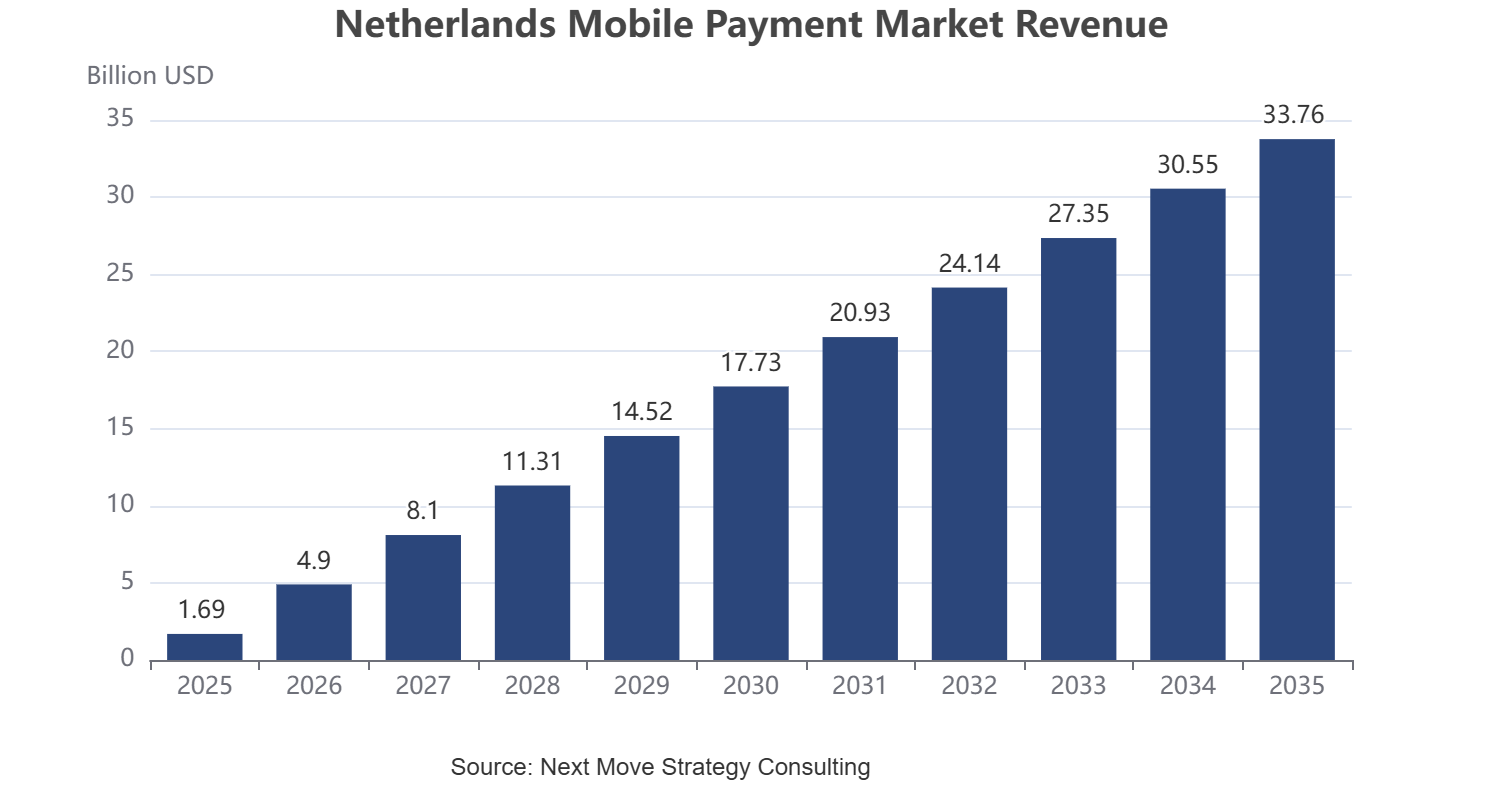
The Netherlands mobile payment market size was valued at USD 1.69 billion in 2025 and is estimated at USD 2.80 billion in 2026, forecast to reach USD 33.76 billion by 2035, expanding at a 31.87% CAGR between 2026 and 2035. Account-to-Account Transfers dominate the market by payment channel, anchored by the iDEAL network.
|
Key Takeaways |
|
By Payment Channel: Account-to-Account Transfers (A2A) is the dominant segment, while Contactless Card-based (NFC, MST) is the fastest-growing segment. |
|
By Platform Type: Native App is the dominant segment, while Web-Embedded is the fastest-growing segment. |
|
By Transaction Use-Case: Point-of-Sale (P2M) is the dominant segment, while Peer-to-Peer (P2P) is the fastest-growing segment. |
|
By Payment Location: Remote Payment is the dominant segment, while Proximity Payment is the fastest-growing segment. |
|
By Customer Type: Retail Consumers is the dominant segment, while Small and Medium Enterprises is the fastest-growing segment. |
Market Opportunity: The Netherlands mobile payment market is expected to create an absolute dollar opportunity of USD 30.96 billion between 2026 and 2035, presenting significant investment potential across account-to-account infrastructure, embedded checkout technology, and merchant acceptance solutions.
According to NMSC's analysis, the phased migration of iDEAL toward the pan-European Wero scheme between 2026 and 2027 is expected to be a defining structural catalyst for the Netherlands mobile payment market, reshaping merchant integration timelines and consumer checkout behavior through 2035.
What does the Netherlands Mobile Payment Market Encompass?
The Netherlands mobile payment market encompasses smartphone- and smartwatch-initiated transactions conducted through contactless cards, QR codes, account-to-account transfers, and carrier billing, spanning native banking applications and web-embedded checkout flows. We observed that the market has evolved from a card-substitution channel into core transaction infrastructure for retail, small and medium enterprises, large enterprises, and government and public-sector remittance. Growth in merchant acceptance is closely tied to the broader Payment Gateway Market, which enables the underlying checkout and acquiring rails that mobile payment volumes flow through across Dutch retail and e-commerce channels.
De Nederlandsche Bank (DNB) oversees the iDEAL and Wero payment systems and sets availability requirements for contactless and chip-and-pin infrastructure, while the Dutch Payments Association coordinates industry migration to the European Payments Initiative's Wero scheme. Our assessment indicates that the incoming Payment Services Regulation and third Payment Services Directive, expected to enter into force following the March 2026 trilogue agreement, will extend open banking access and reshape payment initiation services. Technology adoption continues to accelerate as Dutch banks embed instant SEPA transfers, biometric authentication, and open banking APIs directly into native mobile banking applications.
|
Parameters |
Details |
|
Market Size in 2025 |
USD 1.69 Billion |
|
Market Size in 2026 |
USD 2.80 Billion |
|
Revenue Forecast in 2035 |
USD 33.76 Billion |
|
Growth Rate |
CAGR of 31.87% from 2026 to 2035 |
|
Analysis Period |
2025–2035 |
|
Base Year Considered |
2025 |
|
Forecast Period |
2026–2035 |
|
Market Size Estimation |
USD Billion |
|
Companies Profiled |
15 |
|
Market Share |
Available for Top 10 Companies |
Key Emerging Trends
Based on research conducted by NMSC, we found that four structural trends are reshaping payment infrastructure, consumer checkout behavior, and merchant strategy across the Netherlands mobile payment market.
How Is the iDEAL-to-Wero Migration Transforming Checkout Infrastructure?
The Netherlands is transitioning its dominant account-to-account scheme, iDEAL, into Wero, the pan-European payment solution developed by the European Payments Initiative. We observed that co-branded "iDEAL | Wero" checkout logos began appearing in early 2026, with merchant migration scheduled from the fourth quarter of 2026 and full transition targeted by the end of 2027. EPI Company SE, ABN AMRO Bank N.V., ING Bank N.V., and Coöperatieve Rabobank U.A. are jointly coordinating the rollout to preserve transaction continuity for consumers and merchants.
Why Is Contactless Smartphone and Smartwatch Payment Displacing Debit Cards?
Proximity payments initiated by smartphone or smartwatch are steadily displacing traditional debit card insertion at the point of sale. According to DNB and the Dutch Payments Association, the share of contactless point-of-sale payments made via smartphone or smartwatch rose from 21% in 2022 to 29% in 2023, coming largely at the expense of card-based transactions. NMSC's analysis indicates that Apple Inc. and bank-issued wallet integrations from ABN AMRO Bank N.V. and ING Bank N.V. continue to accelerate this shift across Dutch retail.
How Is Open Banking Reshaping Business and SME Payment Flows?
Open banking APIs are increasingly used by Dutch small and medium enterprises for invoice reconciliation, bulk payments, and automated onboarding. Our findings suggest that providers such as Mollie B.V., Buckaroo B.V., and PAY. Development B.V. are embedding account-to-account initiation directly into merchant checkout and accounting workflows. This trend is reinforced by adjacent growth in the Mobile Commerce Market, as SMEs increasingly sell through mobile-first storefronts that require integrated, low-friction payment initiation.
What Role Does Embedded Finance and Flexible Checkout Play in Market Growth?
Embedded finance is expanding rapidly as banking-as-a-service platforms and flexible payment options integrate directly into merchant and neobank applications. We observed that bunq B.V. opened its banking-as-a-service platform to businesses across the European Union in June 2026, while equensWorldline NV signed a framework agreement with Klarna Bank AB (publ) in May 2026 to embed flexible payment options across its merchant acquiring network, illustrating how flexible checkout is becoming a standard mobile payment feature.
Strategic Framework of the Netherlands Mobile Payment Market
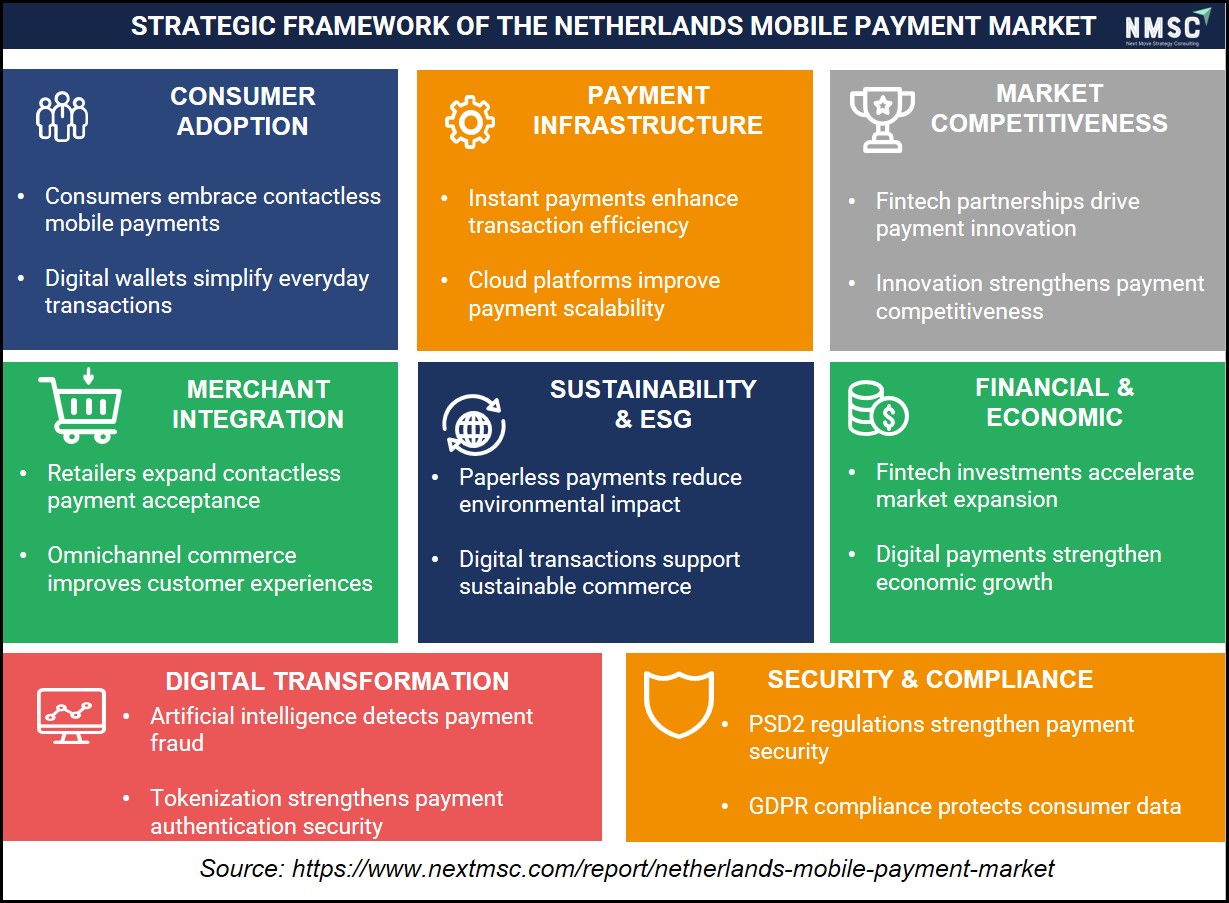
Our findings suggest that the Netherlands Mobile Payment Market is driven by strong consumer adoption, advanced instant payment infrastructure, expanding merchant integration, and continuous fintech innovation. Digital transformation initiatives, sustainability objectives, supportive investment activity, and robust PSD2 and GDPR compliance collectively strengthen payment security, operational efficiency, and long-term market competitiveness.
Growth Drivers and Restraints
Growth Catalyst and Risk Assessment Matrix
|
Factors |
Type |
(+/-) % Impact on CAGR |
Geographic Relevance |
Impact Timeline |
|
Rapid adoption of instant account-to-account payments through the iDEAL and Wero infrastructure |
Driver |
+2.3% |
Netherlands (nationwide) |
2026–2032 |
|
Shift toward contactless smartphone and smartwatch payments displacing debit card insertion at point of sale |
Driver |
+1.9% |
Netherlands (nationwide; strongest in urban retail) |
2026–2031 |
|
Regulatory support from PSD3, PSR, and open banking mandates enabling new payment initiation services |
Driver |
+1.6% |
Netherlands and broader EU |
2026–2035 |
|
Expansion of embedded finance, banking-as-a-service, and flexible checkout integration among merchants |
Driver |
+1.4% |
Netherlands (nationwide) |
2026–2030 |
|
Growth of SME digital invoicing and instant business-to-business settlement via open banking APIs |
Driver |
+1.1% |
Netherlands (SME segment) |
2026–2033 |
|
Elevated card-not-present fraud and phishing risk denting consumer trust in remote payments |
Restraint |
−1.2% |
Netherlands (nationwide) |
2026–2029 |
|
Merchant migration costs and integration complexity during the phased iDEAL-to-Wero transition |
Restraint |
−0.9% |
Netherlands (nationwide) |
2026–2028 |
|
Limited consumer willingness to pay for premium open banking services, constraining monetization |
Restraint |
−0.7% |
Netherlands (nationwide) |
2026–2030 |
What Is the Primary Growth Driver of the Netherlands Mobile Payment Market?
The migration of the Netherlands' dominant account-to-account rail, iDEAL, into the pan-European Wero scheme is the primary growth driver of the Netherlands mobile payment market. We observed that ABN AMRO Bank N.V., ING Bank N.V., and Coöperatieve Rabobank U.A. are jointly steering the rollout, with co-branded checkout logos introduced between January and March 2026. This transition is extending instant, IBAN-based payment capability across e-commerce, point-of-sale, and future recurring-payment use cases nationwide.
How Is Regulatory Modernization Driving Netherlands Mobile Payment Market Growth?
Regulatory modernization under the incoming Payment Services Regulation and third Payment Services Directive is accelerating market growth by mandating consistent third-party provider access and consumer data dashboards. The European Parliament, Council, and European Commission concluded trilogue negotiations on the legislative texts in March 2026, with entry into force expected in early 2027. NMSC's analysis indicates that this framework is encouraging PayPal (Europe) S.à r.l. et Cie, S.C.A., Stripe Payments Europe, Limited, and domestic providers to expand payment initiation offerings ahead of formal implementation.
What Is Restraining Netherlands Mobile Payment Market Expansion?
Rising card-not-present fraud and phishing activity continue to restrain market expansion by undermining consumer confidence in remote mobile transactions. DNB carried out an exploratory examination of payment institutions in early 2026, finding that all seven institutions reviewed had implemented fraud-prevention measures in response to growing threats. Providers are increasingly turning to specialized risk-transfer tools, including offerings tracked under the Cybersecurity Insurance Market, to manage residual exposure while strengthening authentication controls across mobile banking applications.
Segmentation Analysis
By Payment Channel Insights
How Is the Netherlands Mobile Payment Market Segmented by Payment Channel?
Based on Payment Channel, the Netherlands mobile payment market is segmented into Contactless Card-based (NFC, MST), QR Code-based, Account-to-Account Transfers (A2A), and Carrier Billing.
Account-to-Account Transfers represent the dominant sub-segment, underpinned by the entrenched position of iDEAL in Dutch e-commerce checkout and its ongoing migration to Wero. Contactless Card-based payments are the fastest-growing sub-segment, as smartphone and smartwatch tap-to-pay adoption continues to displace physical card insertion at the point of sale. QR Code-based and Carrier Billing remain comparatively niche, supporting specific merchant and telecom-billing use cases across the Dutch retail landscape.
By Transaction Use-Case Insights
How Is the Netherlands Mobile Payment Market Segmented by Transaction Use-Case?
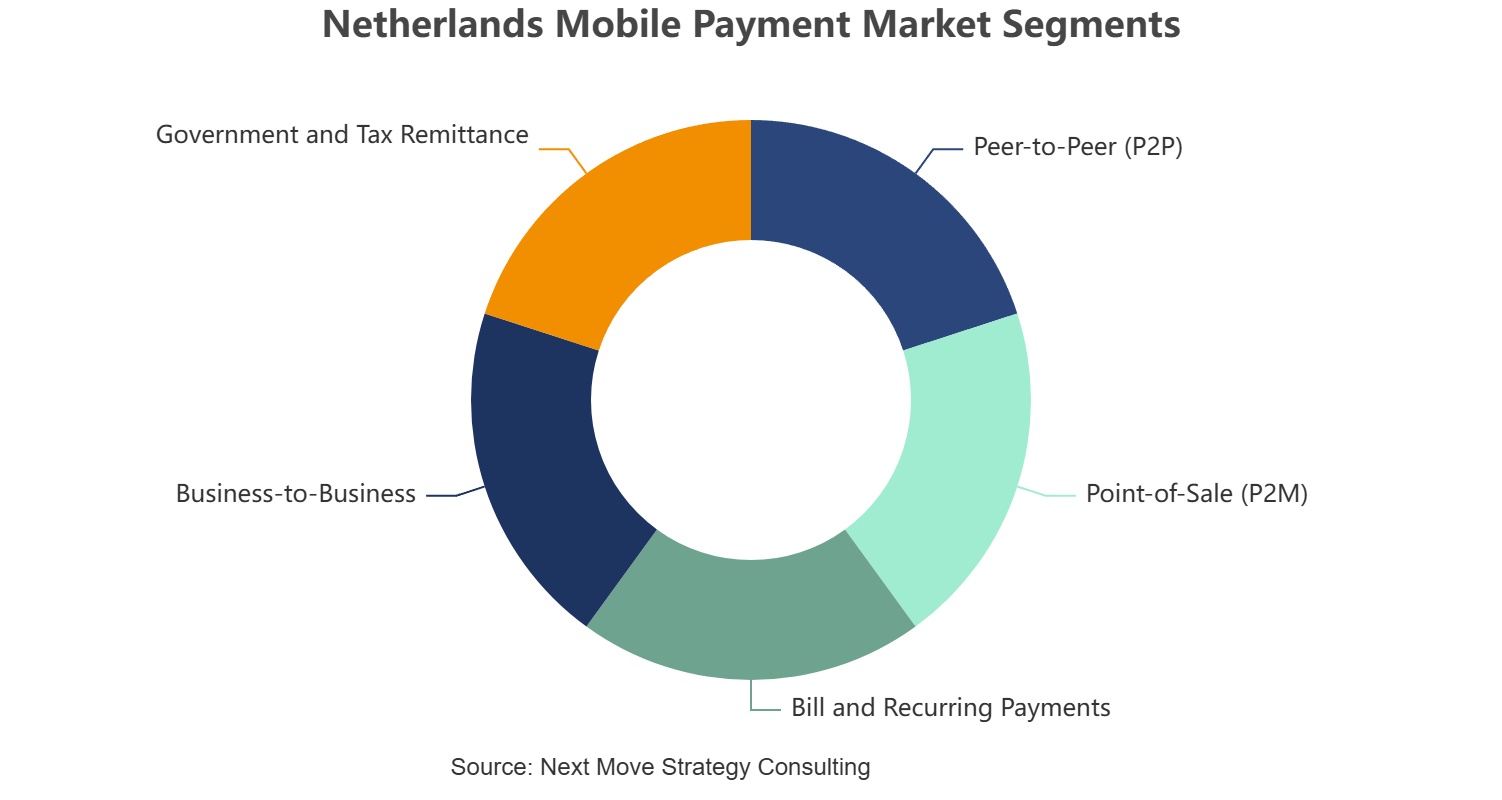
Based on Transaction Use-Case, the Netherlands mobile payment market is segmented into Peer-to-Peer (P2P), Point-of-Sale (P2M), Bill and Recurring Payments, Business-to-Business, and Government and Tax Remittance.
Point-of-Sale transactions dominate the market as contactless in-store payments and account-to-account checkout jointly account for the largest share of transaction value across Dutch retail and hospitality. Peer-to-Peer payments are the fastest-growing use-case, driven by widespread adoption of bank-linked social payment tools such as Tikkie. Bill and recurring payments are also gaining traction alongside adjacent growth in the Netherlands Buy Now Pay Later (BNPL) Market, as flexible installment options increasingly route through mobile-linked recurring payment mandates.
Growth Opportunities
Our analysis shows that three forward-looking opportunities stand out for stakeholders operating in the Netherlands mobile payment market over the 2026–2035 forecast period.
How Can Wero Migration Tooling Unlock New Growth Opportunities?
Payment service providers that build merchant-facing migration tooling for the iDEAL-to-Wero transition can capture significant integration revenue between 2026 and 2028. Buckaroo B.V. and PAY. Development B.V. are well positioned to benefit as merchants require rebranded checkout flows, reconciliation continuity, and phased cut-over support during the multi-year migration window.
Where Does SME Embedded Finance Create New Demand?
Small and medium enterprises present a substantial opportunity as embedded finance and open banking APIs simplify invoicing, bulk payment, and onboarding workflows. Mollie B.V. and CM.com N.V. can capture higher-value SME relationships by bundling instant account-to-account collection with existing point-of-sale and online checkout tools, extending their footprint within the broader Netherlands Digital Marketplace Market as more Dutch SMEs sell through third-party online marketplaces.
How Can Cross-Border Wallet Interoperability Benefit Market Participants?
Providers that enable interoperable acceptance across Wero, Apple Pay, and card-based wallets can benefit from rising cross-border commerce between the Netherlands and neighboring EU markets. Apple Inc. and equensWorldline NV are positioned to capture this opportunity by extending unified acceptance infrastructure that reduces integration complexity for merchants serving both domestic and pan-European mobile payment customers.
Porter's Five Forces Analysis of the Netherlands Mobile Payment Market
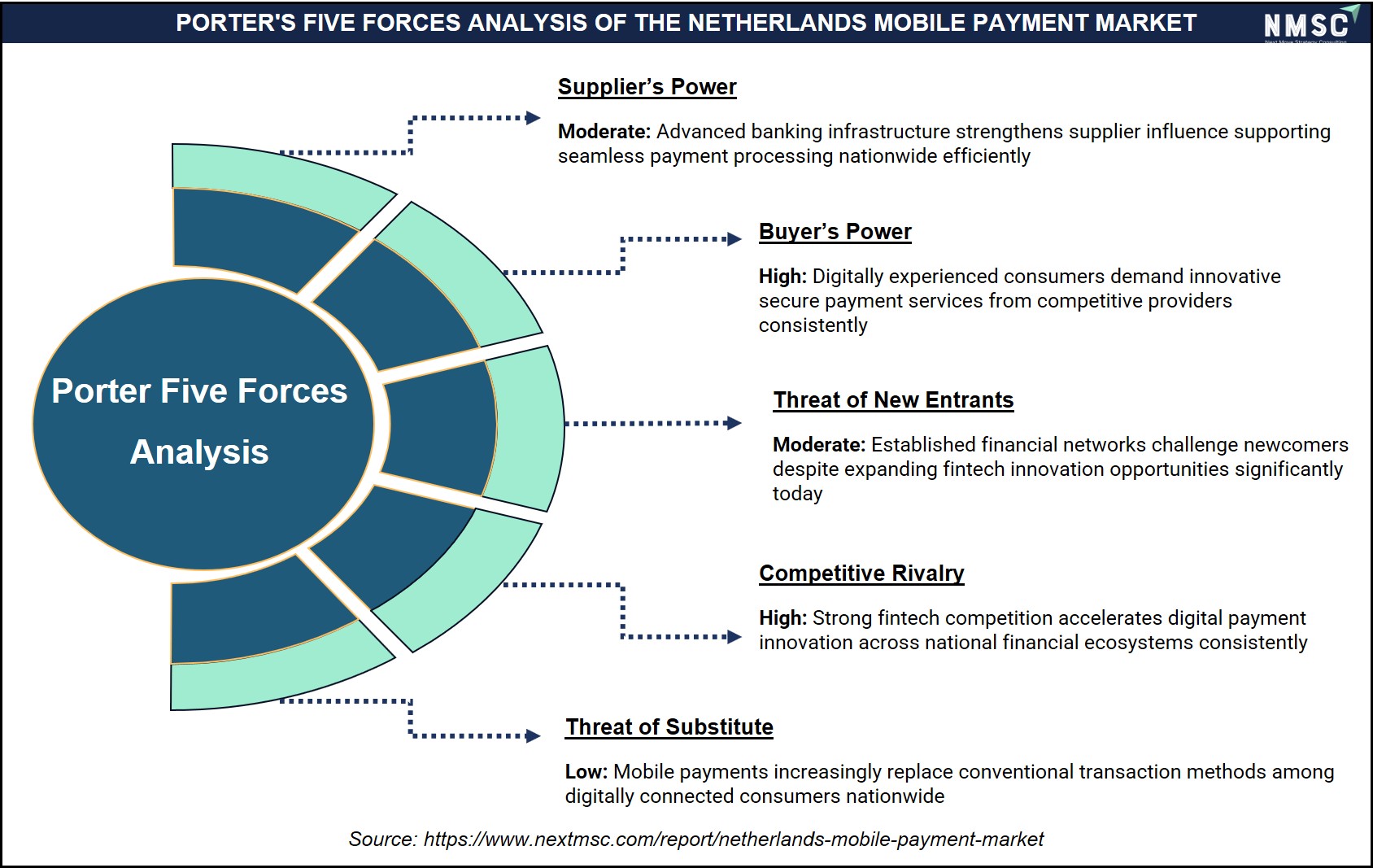
Our analysis indicates that competitive rivalry is high due to the presence of established banks, digital wallet providers, and fintech companies competing through innovation and value-added services. The threat of new entrants is moderate because regulatory compliance and infrastructure investment create entry barriers despite ongoing fintech innovation. The bargaining power of buyers is high as consumers and merchants can easily switch between payment platforms offering comparable services. The bargaining power of suppliers is moderate, supported by technology providers, banking infrastructure, and payment networks. The threat of substitutes is moderate, as conventional banking channels and payment cards remain available while mobile payments continue to gain wider acceptance.
Competitive Landscape
We observed that the Netherlands mobile payment market features a highly competitive landscape, with domestic banks, global payment processors, and specialized fintech providers competing alongside the emerging pan-European Wero scheme.
|
Key Takeaways |
Dimension |
|
Dimension |
Description |
|
Market Structure |
Highly competitive with domestic universal banks, global payment processors, and specialized fintech providers. ABN AMRO Bank N.V., ING Bank N.V., and Coöperatieve Rabobank U.A. anchor account-to-account infrastructure, while Adyen N.V. and Mollie B.V. lead merchant-facing processing. |
|
Innovation Focus |
Instant account-to-account payments, embedded finance, open banking APIs, biometric authentication, and Wero-ready checkout integration dominate current product development strategies. |
|
M&A Activity |
Strategic partnerships and platform integrations, including Adyen's agreement to acquire Talon.One and equensWorldline's framework agreement with Klarna, continue to shape competitive positioning across merchant acquiring networks. |
How Do Companies Compete in the Netherlands Mobile Payment Market?
Companies compete primarily through transaction speed, merchant integration breadth, and checkout reliability. Domestic banks including ABN AMRO Bank N.V., ING Bank N.V., and Coöperatieve Rabobank U.A. leverage entrenched iDEAL relationships and nationwide account penetration, while global processors such as Adyen N.V., PayPal (Europe) S.à r.l. et Cie, S.C.A., and Stripe Payments Europe, Limited compete on merchant-facing platform breadth and cross-border acceptance capability.
Which Competitive Archetypes Dominate the Netherlands Mobile Payment Market?
Two primary competitive archetypes characterize the market. The first comprises domestic account-to-account infrastructure providers, including EPI Company SE, ABN AMRO Bank N.V., ING Bank N.V., and Coöperatieve Rabobank U.A., which anchor the iDEAL-to-Wero transition. The second includes merchant-facing payment technology specialists such as Adyen N.V., Mollie B.V., Buckaroo B.V., and CM.com N.V., which focus on checkout integration, reconciliation, and value-added merchant services.
How Are Companies Differentiating Through Innovation in Netherlands Mobile Payment?
Innovation strategies increasingly center on instant payment rails, embedded finance, and biometric checkout authentication. bunq B.V. differentiates through its banking-as-a-service platform launched on its own Dutch banking licence, while Apple Inc. continues to expand device-native biometric authentication. These efforts parallel broader momentum in the Biometric System Market, as providers seek to reduce fraud while streamlining proximity and remote checkout experiences.
What M&A and Expansion Activity Is Shaping the Netherlands Mobile Payment Market?
Strategic partnerships and platform expansion continue to shape competition across the market. Adyen N.V. agreed to acquire Talon.One in 2026 to extend real-time merchant loyalty capability, while equensWorldline NV signed a framework agreement with Klarna Bank AB (publ) to embed flexible payment options across its acquiring network. These moves reflect a broader trend of processors deepening merchant platform capability ahead of the Wero transition.
Key players
Our assessment indicates that the following 15 companies are actively shaping infrastructure migration, merchant integration, and competitive dynamics within the Netherlands mobile payment market.
-
EPI Company SE
-
Adyen N.V.
-
Mollie B.V.
-
ABN AMRO Bank N.V.
-
ING Bank N.V.
-
Coöperatieve Rabobank U.A.
-
PayPal (Europe) S.à r.l. et Cie, S.C.A.
-
Buckaroo B.V.
-
equensWorldline NV
-
bunq B.V.
-
Klarna Bank AB (publ)
-
CM.com N.V.
-
PAY. Development B.V.
-
Apple Inc. (mobile wallet enablement)
Investment Opportunities
What Capital Inflows Are Targeting the Netherlands Mobile Payment Market?
Capital inflows into the Netherlands mobile payment market are increasingly directed toward Wero migration tooling, embedded finance platforms, and instant payment infrastructure. We found that DNB reported outstanding fintech loans in the Netherlands more than doubled from €1.8 billion in 2021 to €4.4 billion by the end of 2024, signaling growing capital commitment to non-bank digital finance providers operating within the mobile payment ecosystem.
How Is Infrastructure Investment Supporting the Netherlands Mobile Payment Market?
Infrastructure investment is expanding instant payment clearing capacity, merchant acquiring networks, and open banking API coverage. Our findings suggest that equensWorldline NV continues to operate core clearing and settlement infrastructure for Dutch banks, while the Dutch Payments Association's openFinance initiative, developed with the Berlin Group, is broadening standardized API coverage across payment service providers through 2026.
What ESG Considerations Are Shaping Investment Decisions in the Netherlands Mobile Payment Market?
Environmental, social, and governance considerations increasingly influence investment decisions, with financial inclusion, data privacy, and transparent fraud-prevention practices emerging as key priorities. We found that DNB's continued oversight of over-75 consumers' payment behavior and broader accessibility commitments under the European Accessibility Act are pushing providers to ensure mobile payment tools remain inclusive across age groups and digital literacy levels.
Key Benefits for Stakeholders
How Does This Report Benefit Enterprise and Industry Leaders?
Enterprise and industry leaders gain access to validated segmentation, competitive benchmarking, and regulatory-transition analysis that support strategic planning and product roadmapping across the Netherlands mobile payment market. Our analysis shows that detailed assessment of payment channels, transaction use-cases, and customer types helps companies identify high-growth opportunities and align product development with the ongoing Wero migration.
How Does This Report Benefit Investors and Financial Analysts?
Investors and financial analysts benefit from consistent market size estimates, growth forecasts, and competitive assessments that support investment evaluation across the Netherlands mobile payment market. We observed that the report's detailed analysis of account-to-account infrastructure, embedded finance, and merchant acquiring segments enables stakeholders to identify companies and categories with the strongest long-term growth potential through 2035.
How Does This Report Benefit Technology Vendors and Product Teams?
Technology vendors and product development teams gain insights into emerging priorities, including biometric authentication, open banking API integration, and Wero-ready checkout design. Our findings suggest that this analysis helps research and development teams prioritize product roadmaps and align mobile payment offerings with evolving regulatory requirements and consumer expectations.
Key Market Segments
By Payment Channel
-
Contactless Card-based (NFC, MST)
-
QR Code-based
-
Account-to-Account Transfers (A2A)
-
Carrier Billing
By Platform Types
-
Web-Embedded
-
Native App
By Transaction Use-Case
-
Peer-to-Peer (P2P)
-
Point-of-Sale (P2M)
-
Bill and Recurring Payments
-
Business-to-Business
-
Government and Tax Remittance
By Payment Location
-
Remote Payment
-
Proximity Payment
By Customer Type
-
Retail Consumers
-
Small and Medium Enterprises (SMEs)
-
Large Enterprises
-
Government and Public Sector
Conclusion and Recommendations
What Is the Long-Term Outlook for the Netherlands Mobile Payment Market?
The long-term outlook for the Netherlands mobile payment market remains strongly positive, supported by the structural iDEAL-to-Wero migration, rising contactless proximity adoption, and expanding open banking use-cases. We observed that continued regulatory support under PSD3 and PSR will reinforce instant, IBAN-based payment infrastructure as the default checkout experience across retail, SME, and government use-cases through 2035.
What Strategic Positioning Should Mobile Payment Companies Pursue?
Providers should prioritize investment in Wero-ready checkout integration, embedded finance tooling, and biometric fraud-prevention capability while strengthening merchant onboarding support. Our assessment indicates that companies combining reliable account-to-account infrastructure with flexible, embedded checkout experiences will be best positioned to retain merchant relationships throughout the multi-year Wero transition.
How Attractive Is the Netherlands Mobile Payment Market for New Investment?
The Netherlands mobile payment market presents an attractive investment opportunity, supported by rising fintech lending volumes, expanding embedded finance adoption, and a regulator-backed migration to pan-European payment infrastructure. We found that investment potential is particularly strong for companies focused on merchant migration tooling, SME embedded finance, and cross-border wallet interoperability.
What Market Shifts and Key Risks Should Stakeholders Monitor?
Stakeholders should closely monitor the pace of merchant migration from iDEAL to Wero, evolving card-not-present fraud patterns, and the phased entry into force of PSD3 and PSR. Our analysis shows that companies unable to complete timely Wero integration or address consumer fraud concerns may face competitive pressure as the migration deadline approaches through 2027 and beyond.
What Are the Key Growth Pathways for the Netherlands Mobile Payment Market?
Key growth pathways include accelerating Wero merchant onboarding, deepening SME embedded finance adoption, and strengthening biometric and open banking-based fraud prevention. NMSC's analysis indicates that companies successfully combining instant payment infrastructure with merchant-facing platform breadth, and that stay attentive to broader regional dynamics reflected in the Europe Mobile Payment Market, will be best positioned to capture the Netherlands mobile payment market's projected growth through 2035.
About the Author
 Saista Faiyaz
— Saista Faiyaz is Research Associate at Next Move Strategy Consulting, where she has covered consumer markets and healthcare technologies for 3 years. Her work includes primary interview review, secondary-source validation, market sizing, and structured analysis of company and industry data. She supports research by comparing evidence across sources, organizing findings into market narratives, and documenting assumptions used in analysis. Her scope includes cross-market benchmarking, and reports.
Saista Faiyaz
— Saista Faiyaz is Research Associate at Next Move Strategy Consulting, where she has covered consumer markets and healthcare technologies for 3 years. Her work includes primary interview review, secondary-source validation, market sizing, and structured analysis of company and industry data. She supports research by comparing evidence across sources, organizing findings into market narratives, and documenting assumptions used in analysis. Her scope includes cross-market benchmarking, and reports.
About the Reviewer
 Supradip Baul
— Supradip Baul is an accomplished business consultant and strategist with over a decade of rich experience in market intelligence, strategy, technology, and business transformation. His work has included rigorous qualitative and quantitative analysis across multiple industries, helping clients shape investment decisions and long-term roadmaps. Earlier in his career, he was associated with Gartner, where he contributed to industry-leading reports and market share analyses. He has worked with leading global companies and holds an MBA with a dual specialization in Marketing and Finance.
Supradip Baul
— Supradip Baul is an accomplished business consultant and strategist with over a decade of rich experience in market intelligence, strategy, technology, and business transformation. His work has included rigorous qualitative and quantitative analysis across multiple industries, helping clients shape investment decisions and long-term roadmaps. Earlier in his career, he was associated with Gartner, where he contributed to industry-leading reports and market share analyses. He has worked with leading global companies and holds an MBA with a dual specialization in Marketing and Finance.
At Next Move Strategy Consulting, we understand that insightful market research is the cornerstone of successful business decisions. That's why we employ a robust and multifaceted approach, combining various methodologies to deliver the most accurate and actionable data for our clients.

Research Landscape
We navigate the world of research with two primary approaches:
Qualitative Approach
Our qualitative research methodologies involve immersive techniques such as in-depth interviews, focus groups, and observational studies. By engaging directly with individuals and stakeholders, we uncover valuable insights that quantitative data alone may overlook.

Quantitative Research
In tandem with qualitative methodologies, NMSC leverages the power of Quantitative Research to provide a robust foundation of numerical insights. Through systematic data collection and analysis, we quantify patterns, preferences, and market trends, offering a comprehensive view of the business landscape.
Our quantitative research approach employs diverse tools, including surveys, experiments, and statistical modelling. These methodologies enable us to gather data from a large and representative sample, ensuring the statistical significance of our findings. By employing structured questionnaires and standardized data collection methods, we guarantee the reliability and validity of the information we present to our clients.
Quantitative research is particularly effective in measuring the prevalence of trends, assessing market size, and gauging the impact of various factors on consumer behavior. The numerical precision attained through this approach equips our clients with actionable insights, facilitating data-driven decision-making and strategy formulation.


Our Specialized Toolbox for Industry-Specific Market Research
We deploy a specialized arsenal of techniques tailored to meet your unique requirements. Here's a glimpse into our comprehensive toolbox:

Information Procurement
The stage entails acquiring market data or relevant information through various sources and methodologies.


Market Research Approach
We utilize both top-down and bottom-up approaches in market research analysis to achieve a comprehensive understanding of the market dynamics, leveraging the broad perspective of industry trends and macroeconomic factors alongside detailed insights from specific segments and individual companies.

Porters Five Forces Analysis
We conduct Porter's Five Forces analysis to evaluate the competitive landscape of an industry, providing us with insights into factors that affect profitability and strategic positioning.

SWOT Analysis

Forecasting
We utilize a forecasting model to predict future consumption by considering parameters like population, economics, regulations, market competition, drivers, constraints, technology, and pricing. We also employ statistical techniques such as multilinear regression, exponential smoothing, moving average, ARIMA, and Monte Carlo simulations for accurate predictions. In econometric forecasting, we analyzed short-term and long-term event impacts, attributing values based on regulatory frameworks, economic factors, and market events.





 Speak to Our Analyst