Organic Laundry Detergent Market Global Industry Analysis and Forecast (2026-2035)

Organic Laundry Detergent Market size was USD 13.56 Billion in 2025, projected to reach USD 25.75 Billion by 2035, growing at a CAGR of 6.6% from 2026 to 2035. Key drivers include rising demand for plant-based and environmentally positioned laundry products, product-format innovation, and expanding retail and e-commerce distribution, with North America leading the global market.

Download Free Sample PDF
Base Year (2025)
$13.56 Billion
Forecast (2035)
$25.75 Billion
CAGR (2026-2035)
6.6%
Top Region
North America

What Is the Organic Laundry Detergent Market Size?

The global Organic Laundry Detergent Market reached USD 13.56 Billion in 2025 and is estimated at USD 14.46 Billion in 2026, projected to reach USD 25.75 Billion by 2035 at a CAGR of 6.6% from 2026 to 2035. North America leads with approximately 37% revenue share in 2025, while Liquid Detergent dominates the product-form segment at approximately 45% share.

We observed that the Organic Laundry Detergent Market is benefiting from a structural consumer shift toward transparent, certified-clean household products that extends well beyond premium demographics into mainstream retail channels, creating durable revenue growth independent of short-term commodity price cycles.
By Product Form: Liquid Detergent held the largest share, growing from USD 6.05 Billion in 2025 to USD 10.56 Billion by 2035; Laundry Pods and Capsules is the fastest-growing sub-segment at 8.31% CAGR from 2026–2035.

By Distribution Channel: Supermarkets and Hypermarkets held the largest share, growing from USD 5.97 Billion in 2025 to USD 10.56 Billion by 2035; E-Commerce and Direct-to-Consumer is the fastest-growing channel at 9.00% CAGR from 2026–2035.

By End User: Household held the largest share, growing from USD 10.95 Billion in 2025 to USD 20.60 Billion by 2035; Commercial and Institutional Laundry is the fastest-growing segment at 7.04% CAGR from 2026–2035.

Dominant Region: North America dominated with approximately 37% revenue share in 2025, valued at USD 5.07 Billion.

Fastest-Growing Region: Asia-Pacific is expected to register the highest CAGR of 7.16% during 2026–2035.

Dominant Country: The U.S. led the market in 2025, anchored by the world's largest certified-organic household product consumer base and an advanced e-commerce direct-to-consumer organic brand ecosystem.

Fastest-Growing Country: India is the fastest-growing country, driven by expanding urban middle-class eco-awareness, growing e-commerce access to organic household products, and the government's organic certification framework expansion.

The market presents an absolute investment opportunity of approximately USD 11.29 Billion between 2026 and 2035, calculated as the difference between the 2035 forecast of USD 25.75 Billion and the 2026 estimate of USD 14.46 Billion, positioning E-Commerce and Direct-to-Consumer and Laundry Pods and Capsules among the higher-growth segments identified in the NMSC forecast for organic FMCG manufacturers and sustainability-focused consumer brands investors.

According to NMSC analysis, differentiation in the Organic Laundry Detergent Market is increasingly influenced by the transparency and substantiation of product claims. Organic certification, ingredient disclosure, and independently verified safety or environmental attributes can help distinguish qualifying products from those relying primarily on general natural or eco-friendly positioning.

Organic Laundry Detergent Market Global Industry Analysis and Forecast (2026-2035) Revenue Forecast
Values in USD Billion

2025 $13.56 Billion
2025
2026 $14.45 Billion
2026
2027 $15.41 Billion
2027
2028 $16.43 Billion
2028
2029 $17.51 Billion
2029
2030 $18.67 Billion
2030
2031 $19.90 Billion
2031
2032 $21.21 Billion
2032
2033 $22.61 Billion
2033
2034 $24.10 Billion
2034
2035 $25.75 Billion
2035

What Does the Organic Laundry Detergent Market Encompass?

The Organic Laundry Detergent Market covers laundry detergents marketed as organic and formulated with organic, naturally derived, or qualifying plant-based ingredients according to applicable market-specific requirements. The market includes major product formats such as liquid detergents, laundry pods and capsules, powder detergents, and concentrated or refill formats, distributed through retail, specialty, e-commerce, and direct-to-consumer channels for household and commercial laundry applications. Plant-based, biobased, natural, biodegradable, and environmentally positioned products are treated as distinct product attributes and are included only where they satisfy the report's defined organic-market inclusion criteria.
In the European Union, REACH establishes requirements and restrictions for specified chemical substances and uses, while detergent-specific requirements are governed by EU detergents and surfactants legislation. Regulation (EU) 2026/405 on detergents and surfactants entered into force on March 22, 2026, and will generally apply from September 23, 2029, replacing Regulation (EC) No 648/2004. The framework addresses requirements relating to product information, ingredient disclosure, biodegradability, labeling, and other aspects of detergent products.

Market Drivers & Dynamics

Interactive Dataset
Rising consumer demand for plant-based, naturally derived, and environmentally positioned household cleaning products driver +1.8% North America, Europe, Australia 2026–2035
Expansion of e-commerce and direct-to-consumer channels enabling niche brand discovery driver +1.2% Global 2026–2034
Tightening EU and national chemical safety regulations restricting synthetic surfactants driver +1.0% Europe, UK, North America 2026–2033
Growing organic personal care and clean household product cross-purchase behavior driver +0.7% North America, Europe 2026–2035
Rising pet-ownership increasing demand for hypoallergenic certified-organic fabric care driver +0.4% North America, Europe, Latin America 2026–2032
Premium price positioning limiting adoption among price-sensitive consumer segments restraint −1.0% Latin America, MEA, Southeast Asia 2026–2035
Private-label organic detergents compressing branded margins at mass-retail channels restraint −0.5% Global 2026–2033
Ingredient supply chain constraints for certified-organic surfactants and botanical extracts restraint −0.4% Global 2026–2031
Consumer skepticism over 'organic' label claims without third-party certification restraint −0.3% Europe, North America 2026–2031
Source: Next Move Strategy Consulting

Growth Drivers

What Is the Primary Growth Driver in the Organic Laundry Detergent Market?

The primary growth driver is the structural consumer transition toward plant based, chemical free household cleaning products, anchored by rising awareness of synthetic surfactant exposure risks, growing parental concern for infant and child skin sensitivity, and the mainstreaming of organic purchasing behaviour from food into household care categories. The USDA National Organic Program's data shows that organic product consumption patterns consistently expand from food into adjacent household categories as consumers develop organic purchasing habits a cross-category halo effect that has materially accelerated household product organic adoption beyond what standalone detergent marketing investment would have achieved.

How Is E-Commerce Expansion Driving Organic Laundry Detergent Market Growth?

Our findings suggest that e-commerce is structurally expanding the Organic Laundry Detergent Market by enabling brands with premium price positioning and complex certification messaging to reach targeted consumers outside the physical retail shelf environment where organic products historically received limited space allocation relative to conventional FMCG brands. The e-commerce and direct-to-consumer channel at 9.00% CAGR are growing at 36% faster than the overall market, compressing traditional market development timelines and enabling challenger organic brands to achieve national distribution economics that previously required multiyear brick and mortar shelf placement investment.

Growth Inhibitors

What Is Restraining the Organic Laundry Detergent Market?

The primary restraint is the premium price positioning of certified-organic laundry detergents relative to conventional alternatives, which limits adoption among price sensitive consumer segments that represent the majority of household detergent purchase volume globally Industry derived estimates indicate that organic laundry detergents carry a 25% to 40% price premium over conventional leading brands at equivalent supermarket price points brands at equivalent supermarket price points, a premium that requires sustained consumer education investment and regulatory pressure on conventional ingredients to narrow. In Latin America, the Middle East, and Southeast Asia, this price gap effectively confines organic laundry detergent demand to high-income urban households, capping penetration rates at low single digits of the overall detergent market in those regions.

What Are the Growth Opportunities?

Can Laundry Strips and Subscription-Format Organic Detergents Create a Dominant DTC Revenue Model?

Brands that commercialize certified-organic laundry strip and dissolvable sheet formats through subscription-first direct-to-consumer platforms can generate recurring customer lifetime revenue at customer acquisition costs that outperform conventional FMCG retail, primarily benefiting the Concentrated and Refill Formats product-form segment and the E-Commerce and Direct-to-Consumer channel, where format innovation and subscription lock-in structurally differentiate from mass-retail competitors that cannot replicate the subscription economics and packaging elimination impact that drives organic consumer trial conversion.

Does Asia-Pacific's Rising Eco-Aware Middle Class Represent a Greenfield Organic Laundry Market?

The urban middle-class expansion in China, India, South Korea, and Australia combined with the rapid growth of e-commerce platforms including Tmall, Flipkart, and Coupang is creating a greenfield organic laundry detergent market where brand awareness and certification education investment made today will establish durable category leadership before conventional FMCG players allocate equivalent organic formulation resources. Asia-Pacific's 7.16% CAGR represents the fastest regional growth in the organic laundry detergent market globally, and first mover certified brands can capture specification preferences before the competitive intensity of European and North American organic laundry markets replicates in the region.

Can Certified-Organic Detergents for Commercial and Institutional Laundry Establish a Recurring B2B Revenue Channel?

Manufacturers that develop commercial scale certified organic detergent formulations designed for industrial dosing systems, high temperature institutional laundry, and healthcare compliant linen management can access the Commercial and Institutional Laundry end user segment at 7.04% CAGR with multiyear procurement contract structures that generate predictable revenue independent of consumer retail promotional cycles, primarily benefiting hotel chains, hospital networks, and commercial linen services committing to sustainability certified supply chains as a differentiation and procurement compliance requirement.

Segmentation Analysis

2025 (USD Billion)
2035 (USD Billion)
Liquid Detergent 2025: $6.05 Billion | 2035: $10.56 Billion
Liquid Deter
Laundry Pods and Capsules 2025: $3.66 Billion | 2035: $8.14 Billion
Laundry Pods
Powder Detergent 2025: $2.44 Billion | 2035: $4.13 Billion
Powder Deter
Concentrated and Refill Formats 2025: $1.41 Billion | 2035: $2.92 Billion
Concentrated
Liquid Detergent $6.05 Billion $10.56 Billion 5.71%
Laundry Pods and Capsules $3.66 Billion $8.14 Billion 8.31%
Powder Detergent $2.44 Billion $4.13 Billion 5.38%
Concentrated and Refill Formats $1.41 Billion $2.92 Billion 7.58%

Segment Sizing: By Product Form

2025 (USD Billion)
2035 (USD Billion)
Supermarkets
Conventional
Organic-focu
E-Commerce a
Brand-owned
Segment Item 2025 (USD Billion) 2035 (USD Billion) CAGR
Supermarkets and Hypermarkets $10.0 USD Billion $40.0 USD Billion 25.0%
Conventional supermarket natural-products aisle $17.1 USD Billion $51.1 USD Billion 19.0%
Organic-focus hypermarket placement $24.2 USD Billion $62.2 USD Billion 25.0%
E-Commerce and Direct-to-Consumer $31.3 USD Billion $73.3 USD Billion 19.0%
Brand-owned DTC subscription platforms $38.4 USD Billion $84.4 USD Billion 20.0%

Segment-wise data is locked

Unlock complete segment-wise numbers for By Distribution Channel.

Unlock Full Data
2025 (USD Billion)
2035 (USD Billion)
Household
Infant and s
General fami
Commercial a
Hotel and ho
Segment Item 2025 (USD Billion) 2035 (USD Billion) CAGR
Household $10.0 USD Billion $40.0 USD Billion 26.0%
Infant and sensitive skin household laundry $17.1 USD Billion $51.1 USD Billion 16.0%
General family household laundry $24.2 USD Billion $62.2 USD Billion 18.0%
Commercial and Institutional Laundry $31.3 USD Billion $73.3 USD Billion 8.0%
Hotel and hospitality linen services $38.4 USD Billion $84.4 USD Billion 23.0%

Segment-wise data is locked

Unlock complete segment-wise numbers for By End User.

Unlock Full Data

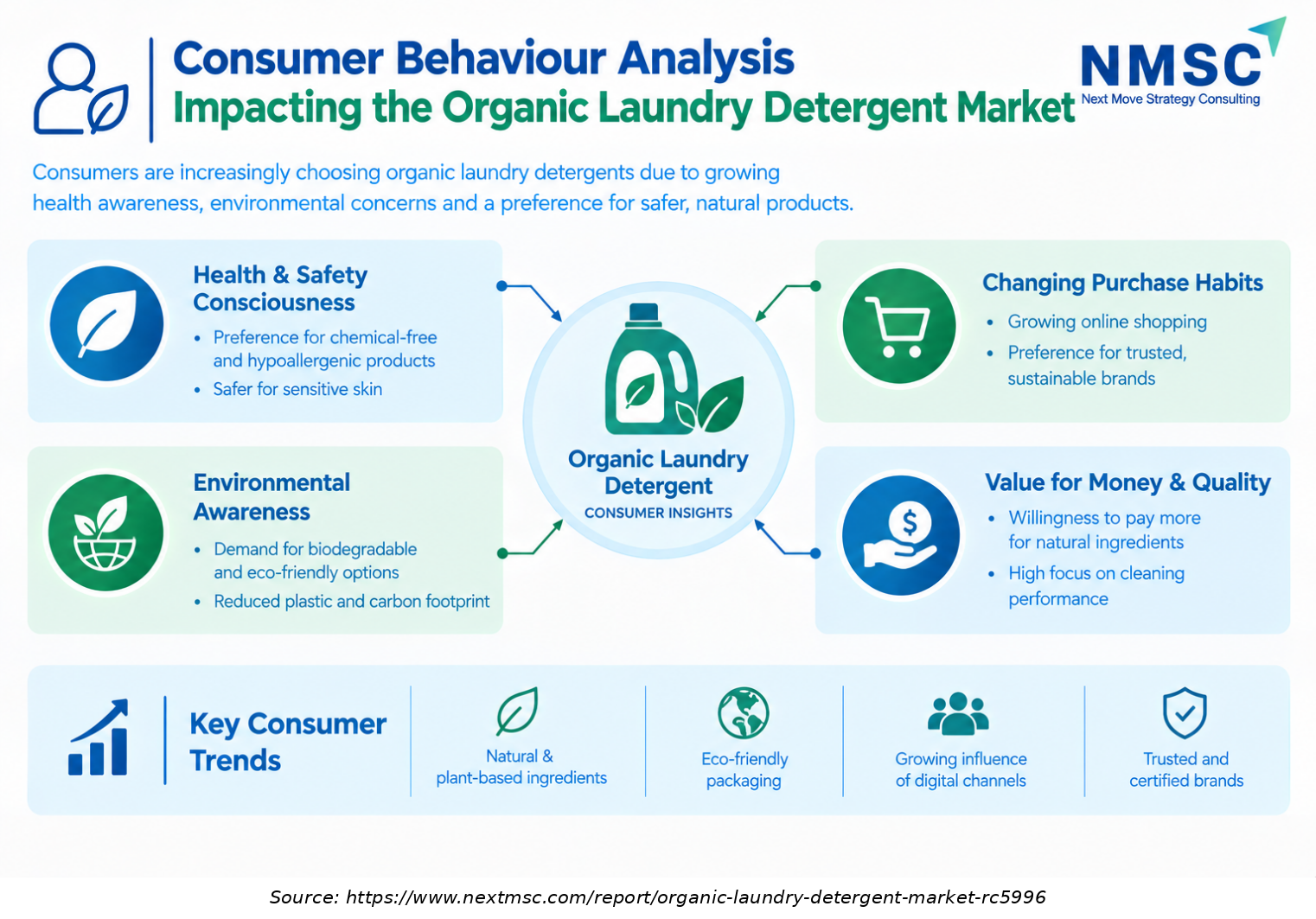
Consumer Behaviour Analysis Impacting the Organic Laundry Detergent Market
Consumer Behaviour Analysis Impacting the Organic Laundry Detergent Market

The Consumer Behaviour Analysis infographic for the Organic Laundry Detergent Market highlights key purchasing factors such as preference for plant-based ingredients, eco-friendly formulations, skin safety, fragrance, cleaning performance, packaging sustainability, price sensitivity, and brand transparency. It shows how changing consumer preferences are influencing product adoption and market demand.

Growth Opportunities

Our analysis shows that three distinct whitespace opportunities offer the highest-conviction forward returns for organic laundry detergent manufacturers, investors, and retail partners through 2035.

Can Laundry Strips and Subscription-Format Organic Detergents Create a Dominant DTC Revenue Model?

Brands that commercialize certified-organic laundry strip and dissolvable sheet formats through subscription-first direct-to-consumer platforms can generate recurring customer lifetime revenue at customer acquisition costs that outperform conventional FMCG retail, primarily benefiting the Concentrated and Refill Formats product-form segment and the E-Commerce and Direct-to-Consumer channel, where format innovation and subscription lock-in structurally differentiate from mass-retail competitors that cannot replicate the subscription economics and packaging elimination impact that drives organic consumer trial conversion.

Does Asia-Pacific's Rising Eco-Aware Middle Class Represent a Greenfield Organic Laundry Market?

The urban middle-class expansion in China, India, South Korea, and Australia combined with the rapid growth of e-commerce platforms including Tmall, Flipkart, and Coupang is creating a greenfield organic laundry detergent market where brand awareness and certification education investment made today will establish durable category leadership before conventional FMCG players allocate equivalent organic formulation resources. Asia-Pacific's 7.16% CAGR represents the fastest regional growth in the organic laundry detergent market globally, and first mover certified brands can capture specification preferences before the competitive intensity of European and North American organic laundry markets replicates in the region.

Can Certified-Organic Detergents for Commercial and Institutional Laundry Establish a Recurring B2B Revenue Channel?

Manufacturers that develop commercial scale certified organic detergent formulations designed for industrial dosing systems, high temperature institutional laundry, and healthcare compliant linen management can access the Commercial and Institutional Laundry end user segment at 7.04% CAGR with multiyear procurement contract structures that generate predictable revenue independent of consumer retail promotional cycles, primarily benefiting hotel chains, hospital networks, and commercial linen services committing to sustainability certified supply chains as a differentiation and procurement compliance requirement.

Regional Outlook

2025 (USD Billion)
2035 (USD Billion)
North Americ
Europe
Asia-Pacific
Middle East
Latin Americ
Region 2025 (USD Billion) 2035 (USD Billion) CAGR (%)
North America $10.0 USD Billion $40.0 USD Billion 9.0%
Europe $17.1 USD Billion $51.1 USD Billion 27.0%
Asia-Pacific $24.2 USD Billion $62.2 USD Billion 25.0%
Middle East & Africa $31.3 USD Billion $73.3 USD Billion 23.0%
Latin America $38.4 USD Billion $84.4 USD Billion 12.0%

Regional data is locked

Unlock complete regional numbers for this market.

Unlock Full Data

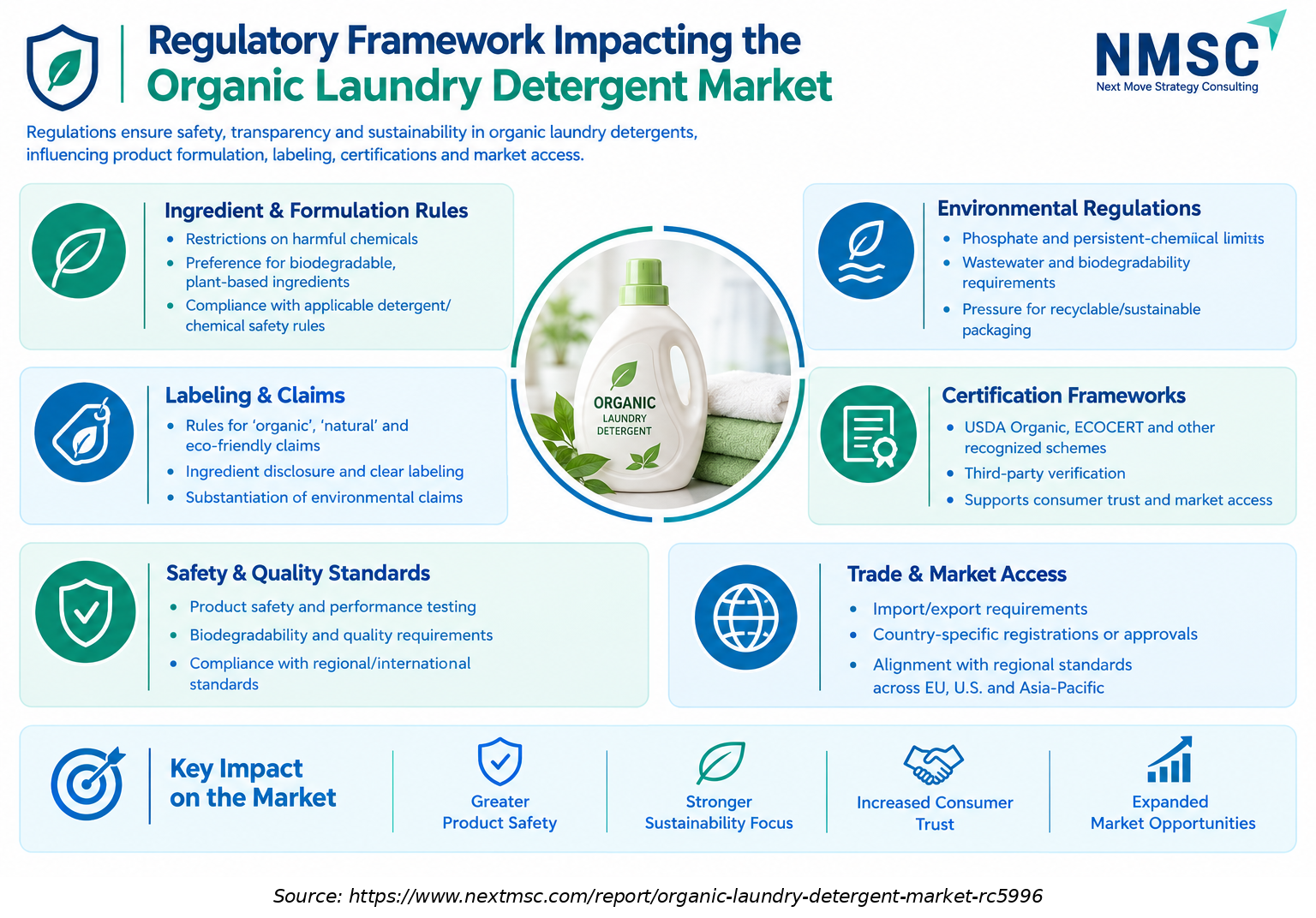
Regulatory Framework Impacting the Organic Laundry Detergent Market

The Regulatory Framework infographic for the Organic Laundry Detergent Market highlights key requirements related to ingredient safety, chemical use, labelling, environmental claims, biodegradability, packaging, and wastewater impact. It shows how regulatory standards influence product formulation, certification, packaging, and market adoption

The Regulatory Framework infographic for the Organic Laundry Detergent Market highlights key requirements related to ingredient safety, chemical use, labelling, environmental claims, biodegradability, packaging, and wastewater impact. It shows how regulatory standards influence product formulation, certification, packaging, and market adoption

Competitive Landscape

Our assessment indicates that the Organic Laundry Detergent Market operates as a moderately fragmented global industry where certified-organic challenger brands built on e-commerce and sustainability credentials compete alongside FMCG conglomerates' organic sub-brands, creating a distinctly dual-archetype competitive environment that rewards both scale and brand authenticity simultaneously.

Dimension Description
Market Structure The competitive landscape includes established consumer-goods companies, sustainability-oriented laundry brands, specialist natural-product manufacturers, and private-label participants
Innovation Focus Concentrated refill formats, plant-derived enzyme-based stain removal, certified-compostable pod packaging, zero-waste subscription models, laundry strips and dissolvable sheets, and USDA Organic and ECOCERT-certified surfactant platforms
M&A Activity Unilever's acquisition of Seventh Generation and SC Johnson's acquisition of Method and Ecover illustrate how established consumer-goods companies have incorporated sustainability-oriented home-care brands into broader portfolios.

How Do Companies Compete in the Organic Laundry Detergent Industry?

Companies compete primarily on certification credibility the depth and verifiability of organic ingredient sourcing and third-party certification formulation performance at lower wash temperatures, packaging sustainability innovation, and e-commerce subscription economics that generate recurring consumer lifetime value. We found that brands holding multiple concurrent certifications USDA Organic plus EWG Verified plus EPA Safer Choice, for example command measurably higher consumer trust scores and conversion rates versus single-certification competitors at equivalent price points, making certification portfolio depth a direct competitive and commercial differentiator.

Which Competitive Archetypes Dominate the Organic Laundry Detergent Market?

Certified-organic challenger brands Seventh Generation, Puracy, Tru Earth, and Attitude dominate through ingredient transparency, multi-channel direct-to-consumer subscription platforms, and clean-origin brand narratives that FMCG giants' organic sub-brands structurally cannot replicate without full brand separation from parent company conventional product associations. FMCG conglomerate organic platforms Ecover and Method under Unilever PLC, Tide purclean under Procter & Gamble compete through retailer distribution scale, mass-market pricing, and manufacturing cost efficiency that challenger brands cannot match, creating two distinct competitive tiers with limited direct head-to-head substitution risk at the premium consumer segment.

What Innovation and Differentiation Strategies Are Companies Pursuing?

NMSC's analysis indicates that the leading organic laundry brands are pursuing three primary innovation directions: concentrated and zero-waste formats strips, dissolvable sheets, concentrated pods that eliminate packaging plastic and reduce carbon footprint per wash; cold-water enzyme technology that enables certified-organic formulations to match conventional detergent stain removal performance at 30°C or below; and carbon-neutral and regenerative organic sourcing commitments for botanical and plant-derived surfactant ingredients that provide a verifiable environmental impact narrative beyond the product itself.

Competitive Dynamics and M&A Landscape

Recent strategic moves, partnerships, and acquisitions shaping the Organic Laundry Detergent Market Global Industry Analysis and Forecast (2026-2035).

February 2026 Tru Earth Product Launch Tru Earth announced its first in-store Costco Canada presence, making its laundry detergent sheets available at 14 Costco warehouses across British Columbia
March 2025 Dropps Product Launch Dropps launched its 4-in-1 Plus Oxi Biobased Power Laundry Detergent Pods at select Target stores, Target.com, and Dropps.com

Key Market Players

Based on research conducted by NMSC, the following 20 companies represent the validated set of leading participants in the global Organic Laundry Detergent Market, ranked by market-specific revenue, organic product certification scale, and geographic market presence as of 2026.

Unilever PLC Seventh Generation Inc. Procter & Gamble Co. Henkel AG & Co. KGaA The Honest Company Inc. Church & Dwight Co., Inc. SC Johnson & Son, Inc. Werner & Mertz GmbH Sonett GmbH Puracy LLC Attitude Living Inc. Tru Earth Inc. Ecostore International Ltd. Grab Green Home LLC Better Life Co. Charlie's Soap Inc. AspenClean Products Inc. Biokleen Inc. Dropps Inc. RSPO Member: DeutschKlein GmbH

Expert Insights

Naveed Khan

Consumer Analyst | GlobalData

"“Eco-friendly detergent formulations with ingredients such as plant extracts, essential oils, enzymes, and natural preservatives are becoming increasingly popular. These ingredients are perceived by consumers to have low to no environmental impact, throughout the product lifecycle from production till disposal.”"

Analyst Interpretation

The statement reflects the growing importance of natural and bio-based ingredients in laundry detergent formulation. Increasing consumer attention to ingredient origin and environmental characteristics is supporting interest in plant-derived surfactants, enzymes, essential oils, and biodegradable ingredients. This trend is relevant to organic laundry detergents, where formulation transparency, natural inputs, and environmental considerations can influence consumer adoption and product differentiation

Investment Opportunities

Where Are Capital Inflows Concentrating in the Organic Laundry Detergent Market?

Capital is concentrating in organic certified-surfactant supply chain infrastructure, e-commerce subscription platform development, and zero-waste format manufacturing capacity the three capability investments that simultaneously address the certification credibility, recurring revenue, and sustainability differentiation requirements of the highest-growth organic laundry consumer segments. Venture and strategic capital are specifically targeting brands with EWG Verified or ECOCERT COSMOS Organic status, subscription customer retention rates above 60%, and concentrated or zero-plastic packaging formats that align with the biodegradable plastic and sustainable packaging investment themes attracting ESG-focused portfolio capital.

How Is Retail and E-Commerce Infrastructure Investment Creating Long-Term Market Access?

Infrastructure investment in last-mile e-commerce logistics in Asia-Pacific and Latin America is directly expanding the addressable retail reach for premium organic laundry brands that cannot sustain the promotional investment required for conventional FMCG supermarket shelf placement in markets where mass-retail organic category development is nascent. Our assessment indicates that brands investing in localized e-commerce certification communication, regional distribution partnerships, and market-specific fragrance-free or botanical-scented formulations ahead of physical retail expansion are capturing first-mover organic brand preference in markets where conventional FMCG players have not yet committed equivalent organic category investment.

What ESG Considerations Are Influencing Organic Laundry Detergent Investment Decisions?

ESG considerations center on certified-organic ingredient sourcing with verified supply chain traceability, packaging recyclability and refill ability commitments reducing single-use plastic per wash, cold-water formulation performance that reduces household energy consumption per laundry cycle, and carbon neutral or Scope 3 emissions transparency for botanical and plant-derived surfactant supply chains. Investors are increasingly evaluating organic laundry brands on USDA Organic or COSMOS Organic certification maintenance, EWG ingredient safety scoring, and B-Corp certification status as proxy indicators of durable ESG performance that aligns with the organic personal care ingredients sector's ESG investment criteria.

Key Benefits for Stakeholders

How Does This Report Benefit Organic FMCG Industry Leaders?

Organic FMCG industry leaders gain segment-level revenue forecasts and CAGR benchmarks across product form, distribution channel, and end-user dimensions enabling product portfolio investment, certification roadmap planning, and channel expansion strategy grounded in the 2025–2035 figures used consistently throughout this analysis. The competitive landscape and certification differentiation sections provide specific intelligence on how rival brands are building certification depth, subscription economics, and zero-waste format positioning that inform strategic product development and consumer marketing investment allocation across the organic laundry category.

How Does This Report Benefit Investors and Financial Analysts?

Investors and financial analysts gain a reconciled market-sizing framework USD 13.56 Billion in 2025 to USD 25.75 Billion by 2035 at 6.6% CAGR alongside quantified driver and restraint impacts, named company M&A pattern analysis, and 38 country demand projections that support organic consumer brand valuation, acquisition target screening, and portfolio company growth trajectory modelling at a granularity unavailable from aggregate household care sector data. The USD 11.29 Billion absolute opportunity figure between 2026 and 2035 provides direct scenario-analysis inputs for organic FMCG investment thesis construction

How Does This Report Benefit Brand Developers and Retail Partners?

Brand developers and retail category managers gain direct intelligence on the fastest-growing product form Laundry Pods and Capsules at 8.31% CAGR fastest-growing distribution channel E-Commerce and Direct-to-Consumer at 9.00% CAGR and fastest-growing end-user Commercial and Institutional Laundry at 7.04% CAGR alongside the specific certification, formulation, and packaging innovation directions attracting market share gains in the organic laundry category that is outpacing conventional detergent growth in North America and Europe.

Key Market Segments Evaluated

By Product Form

  • Liquid Detergent
  • Laundry Pods and Capsules
  • Powder Detergent
  • Concentrated and Refill Formats

By Distribution Channel

  • Supermarkets and Hypermarkets
  • Conventional supermarket natural-products aisle
  • Organic-focus hypermarket placement
  • E-Commerce and Direct-to-Consumer
  • Brand-owned DTC subscription platforms
  • Amazon
  • Tmall
  • Flipkart marketplace organic category
  • Specialty and Natural Stores
  • Natural and health food retailers
  • Zero-waste and refill specialty stores
  • Pharmacy and Drug Stores
  • Health-focus pharmacy organic care sections

By End User

  • Household
  • Infant and sensitive skin household laundry
  • General family household laundry
  • Commercial and Institutional Laundry
  • Hotel and hospitality linen services
  • Healthcare and long-term care facility laundry
  • Commercial laundromat and dry-clean adjacent services

Conclusion & Recommendations

The long-term outlook is structurally positive, with the market expanding from USD 14.46 Billion in 2026 to USD 25.75 Billion by 2035 at a 6.6% CAGR. We observed that this growth is driven by the mainstreaming of certified-organic purchasing behaviour across household care categories, intensifying chemical safety regulation that raises the cost structure of conventional synthetic formulations, and the structural advantage of e-commerce channels for organic brand discovery and subscription revenue generation. Regulatory and consumer credibility pressures will sustain premium pricing durability through the forecast period.

What Strategic Positioning Do We Recommend?

Our assessment indicates that organic laundry detergent brands should strengthen product-claim substantiation, invest in appropriate certification or third-party verification, expand e-commerce distribution, and develop concentrated or reduced-packaging formats through 2030. Brands targeting Asia-Pacific should invest in localized certification communication, region-specific fragrance profile development, and e-commerce platform partnerships with Tmall, Coupang, and Flipkart ahead of the competitive intensity maturation that will occur as European and North American organic brands increase Asia-Pacific distribution investment.

How Attractive Is the Organic Laundry Detergent Market for Investment?

Investment attractiveness is high for the organic laundry sub-segments with above-market CAGR profiles: Laundry Pods and Capsules at 8.31% CAGR, E-Commerce and Direct-to-Consumer at 9.00% CAGR, and Commercial and Institutional Laundry at 7.04% CAGR all outperform the overall 6.6% market CAGR by meaningful margins. The USD 11.29 Billion absolute opportunity between 2026 and 2035, combined with the structural consumer loyalty advantages of certified-organic brands versus conventional FMCG competitors, creates a risk-adjusted return profile favourable to growth equity and strategic acquirer investment.

What Are the Key Market Shifts and Risks?

Key risks include FMCG conglomerates accelerating organic sub-brand investment to compete directly with challenger brands, private-label organic detergent proliferation compressing branded premiums at mass retailers, and the potential for regulatory green claims scrutiny to expose certification gaps in brands using 'organic' positioning without USDA or ECOCERT verification. Our analysis shows that brands that delay third-party certification investment beyond 2027 will face increasing regulatory and retail partner scrutiny as green claims verification requirements tighten in the EU and the U.S.

What Are the Primary Growth Pathways Through 2035?

Primary growth pathways include certified-organic laundry strip and subscription platform commercialization, Asia-Pacific organic e-commerce market entry ahead of competitive intensity maturation, and commercial-institutional laundry procurement channel development with multi-year sustainability-certified contract structures. We found that companies combining verifiable multi-certification organic credentials with zero-waste format innovation, e-commerce subscription economics, and Asia-Pacific distribution infrastructure are best positioned to capture the USD 11.29 Billion absolute opportunity the Organic Laundry Detergent Market presents between 2026 and 2035.
FAQs

About the Author

Mayurima Roy

Mayurima Roy

Mayurima Roy is Research Analyst at Next Move Strategy Consulting, where she has spent 4 years working across the firm's full industry coverage rather than a single fixed vertical. Her work centers on structured research, ongoing trend tracking, competitive assessment, and insight-led content development, translating complex market data into clear, decision-ready narratives that support informed client decision-making across diverse global industries, market sectors, and world regions every day.

About the Reviewer

Debashree Dey

Debashree Dey

Debashree Dey is Assistant Manager at Next Move Strategy Consulting, where she supports cross-vertical market content and communications across diverse industries for 6 years. Her professional background includes senior content writing, communications, and published manuscript authorship, with experience developing audience-focused business narratives and maintaining clear, consistent messaging. Her role supports research-led content development and editorial quality across NextMSC publications.

Download Free Sample

Pratyush Kumar Das

PRATYUSH KUMAR DAS

Assistant Manager

Polycab India Limited

We would like to express our appreciation for the data and insights provided by nextmsc. We are very pleased with the quality and depth of the information, which has proven to be highly valuable and beneficial for our business decision-making.

Rishabh Jogani

RISHABH JOGANI

Strategy Analyst

Accenture Japan

We are incredibly impressed with the market report on the real estate market in India provided by Next Move Strategy Consulting. The report was thorough, insightful, and well-structured, offering deep analysis and actionable recommendations. It not only captured the current trends and dynamics but also provided a forward-looking perspective that has been invaluable for our strategic planning. Their team demonstrated exceptional professionalism, attention to detail, and a profound understanding of the industry. The data-driven insights and clarity of presentation exceeded our expectations, making complex market trends easy to understand. We highly recommend Next Move Strategy Consulting to anyone looking for reliable and comprehensive market research services. Their expertise has given us the confidence to navigate the complexities of the Indian real estate market with clarity and foresight.

Kishu Kanda

KISHU KANDA

Strategy Analyst

Accenture

We purchased the AI Consumer Market Report from this company. Not only did they customize the report to meet our specific requirements, but they also showed great flexibility in accommodating our budget. The report we received fully met our expectations. Additionally, they provided prompt and thorough responses to both our pre-purchase and follow-up questions. We look forward to working with this company again in the future.

Nishant Awate

NISHANT AWATE

Business Development Global Sales

Zehnder Group Deutschland GmbH

Our experience working with Next Move Strategy Consulting was positive. The team was responsive, professional, and open to incorporating our specific requirements throughout the project. The India AHU market study was comprehensive and well structured, covering market value and volume forecasts, product and application segments, and key industry trends. The inclusion of both AHU and residential MVHR market insights made the study particularly relevant for our strategic market assessment. Overall, the report provides a solid foundation for evaluating market potential, identifying priority segments, and supporting business-development decisions in India.

Diana Trejo

DIANA TREJO

Assistant Manager

Sumitomo Corporation de Mexico, S.A. de C.V.

Recently, we purchased a report on the Mexico Data Center Market from Next Move Strategy Consulting. The service has been excellent, with support that is always timely and thoroughly professional. The information provided is interesting, highly useful, and delivered with clarity. I would highly recommend NextMSC for anyone seeking insightful and dependable analysis.

Custom Market Research Services

We will customize the research for you if the listed report does not fully match your requirements.

Get 30% Free Customization

Select License

This website uses cookies to ensure you get the best experience on our website. Learn more

✖