Philippines Warehouse Robotics Market By Type [Automated Guided Vehicles (AGVs) (Laser Guidance, Magnetic Guidance, Optical Tape Guidance, Vision Guidance, and Others), Autonomous Mobile Robots (AMRs) (Tow Vehicle, Tug Vehicle, Unit Load Vehicle), Articulated Robots, Collaborative Robots (Cobots), Scara and Cylindrical Robots, and Others], By Offering (Hardware, Software, and Service), By Payload Capacity, By Application, and By End User – Opportunity Analysis and Industry Forecast, 2025–2035
Industry: ICT & Media | Latest Edition: September 30, 2026 | No of Pages: 226 | No. of Tables: 108 | No. of Figures: 98 | Format: PDF | Report Code: IC5076
Philippines Warehouse Robotics Market Size & Forecast 2025–2035
|
Parameters |
Details |
|
Market Size in 2025 |
USD 44.58 Million |
|
Market Size in 2026 |
USD 77.34 Million |
|
Revenue Forecast in 2035 |
USD 771.41 Million |
|
Growth Rate |
CAGR of 29.12% from 2026 to 2035 |
|
Market Volume in 2025 |
4 Thousand Units |
|
Market Volume in 2026 |
6 Thousand Units |
|
Volume Forecast in 2035 |
69 Thousand Units |
|
Growth Rate (Volume) |
CAGR of 30.12% from 2026 to 2035 |
|
Analysis Period |
2025–2035 |
|
Base Year Considered |
2025 |
|
Forecast Period |
2026–2035 |
|
Market Size Estimation |
Million (USD) |
|
Companies Profiled |
10 |
|
Market Share |
Available for 10 Companies |
Industry Outlook
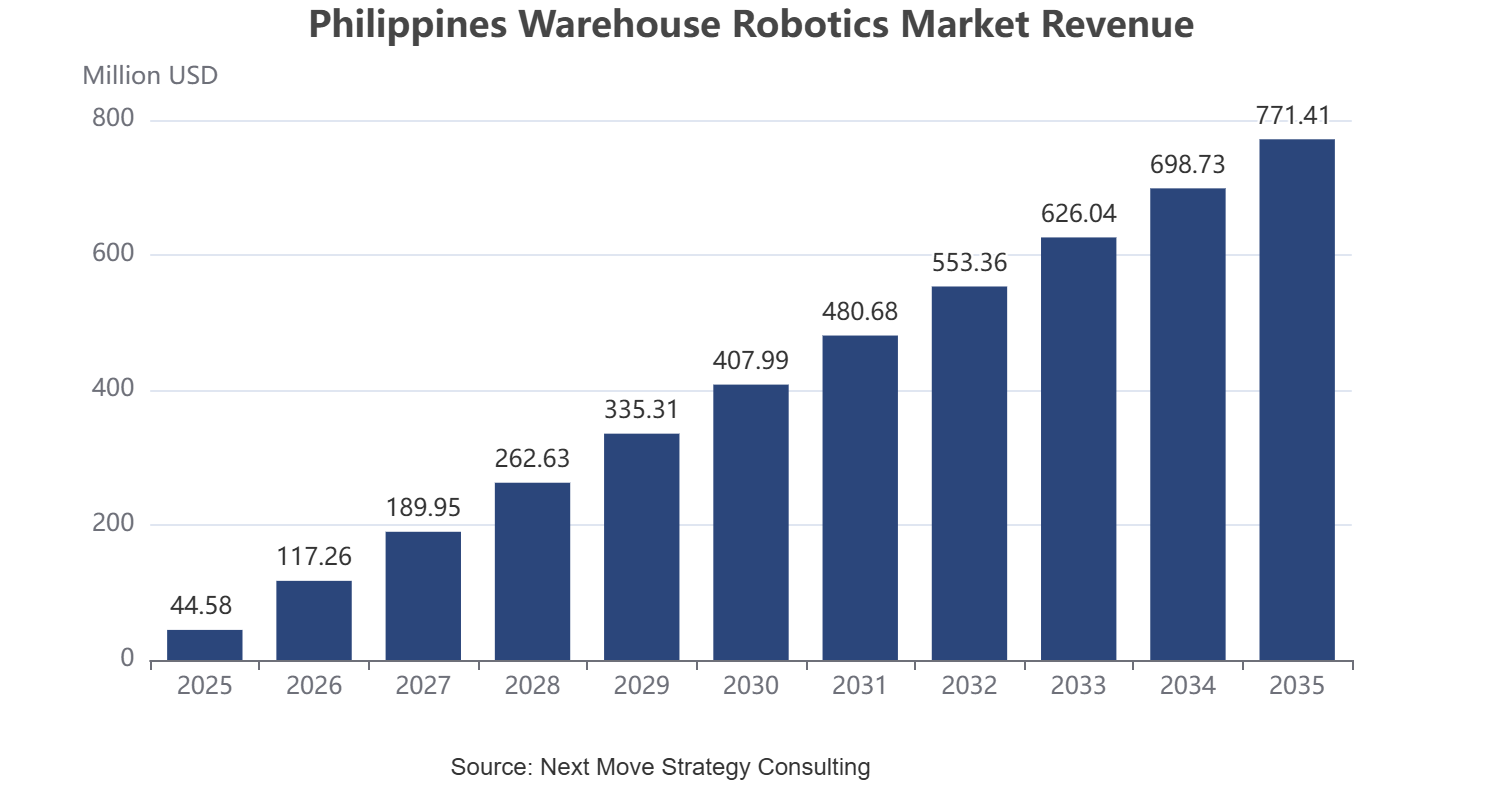
The Philippines Warehouse Robotics Market was valued at USD 44.58 million in 2025 and reached USD 77.34 million in 2026. Looking ahead, the market is projected to experience substantial growth, reaching USD 771.41 million by 2035, registering a CAGR of 29.12% from 2026 to 2035. In terms of volume, the market recorded 4 thousand units in 2025, with forecasts indicating growth to 6 thousand units by 2026 and further to 69 thousand units by 2035, reflecting a CAGR of 30.12% over the same period.
What Are the Key Market Drivers, Restraints, and Opportunities Shaping the Philippines Warehouse Robotics Market Through 2035?
|
Drivers / Restraints / Opportunities |
(+/–) % Impact on CAGR Forecast |
Geographic Relevance |
Impact Timeline |
|
Rapid expansion of Philippine e-commerce and digital retail sectors is driving significant demand for warehouse automation and robotics solutions across fulfillment centers and distribution hubs nationwide. |
+3.2% |
Philippines; urban centers (Metro Manila, Cebu, Davao) |
Short to medium term (1–5 years) |
|
Government-led industrial modernization and Industry 4.0 initiatives are accelerating investments in advanced robotics, automation systems, and smart logistics infrastructure across the Philippine warehousing sector. |
+2.8% |
Philippines; CALABARZON, Metro Manila |
Medium to long term (3–8 years) |
|
Rising labor cost pressures and workforce productivity challenges are compelling manufacturers and logistics operators to adopt warehouse robotics, reducing dependency on manual labor while improving efficiency. |
+2.4% |
Philippines-wide |
Short to medium term (1–5 years) |
|
High capital expenditure requirements and limited technical expertise create adoption barriers among small and medium-sized enterprises, constraining market penetration despite compelling long-term automation benefits. |
–1.5% |
Philippines; SME industry clusters |
Short to medium term (1–5 years) |
|
Growth of cold-chain logistics, pharmaceutical distribution networks, and semiconductor manufacturing is generating significant opportunities for advanced warehouse robotics deployment across Philippine special economic zones. |
+1.8% |
National; special economic zones |
Long term (4–10 years) |
Through our market assessment, we observed that the Philippines Warehouse Robotics Market is experiencing accelerated growth driven by surging e-commerce activities, government-backed industrial modernization programs, and rising labor productivity demands. The rapid development of digital commerce platforms and modern logistics infrastructure is reshaping warehousing operations across the Philippines. While high capital costs remain a notable adoption barrier, increasing investments in smart logistics hubs, pharmaceutical cold-chain networks, and semiconductor assembly facilities are generating significant opportunities for advanced robotics deployment throughout the forecast period.
Growth Drivers:
How Is the Rapid Expansion of E-commerce and Digital Retail Driving Demand for Warehouse Robotics in the Philippines?
Through our market assessment, we observed that the rapid proliferation of e-commerce platforms and digital retail activity in the Philippines is a primary driver of warehouse robotics adoption. Rising consumer demand for faster deliveries, same-day fulfillment, and efficient order processing is compelling logistics operators and distribution centers to invest in automated robotics solutions. Warehouse robots improve throughput, reduce error rates, and enable scalable fulfillment operations, making automation a strategic priority for Philippine e-commerce and retail logistics companies expanding their warehouse networks.
How Are Government Industrial Modernization Initiatives and Industry 4.0 Policies Accelerating Warehouse Robotics Adoption in the Philippines?
Based on our market evaluation, the Philippine government's industrial modernization agenda and digital transformation policies, including initiatives aligned with Industry 4.0, are actively promoting automation and smart manufacturing investments. Government programs supporting logistics infrastructure development, special economic zones, and export-oriented industries are creating favorable conditions for warehouse robotics adoption. Financial incentives, technology transfer partnerships, and regulatory frameworks encouraging advanced manufacturing practices are further accelerating robotic automation deployment across Philippine warehousing and distribution operations.
How Are Rising Labor Cost Pressures and Workforce Productivity Challenges Driving Warehouse Robotics Investments Across the Philippines?
Based on research conducted by NMSC, increasing labor costs, workforce availability constraints, and growing demands for operational efficiency are compelling Philippine warehouse and logistics operators to adopt robotics solutions. Automated guided vehicles (AGVs), autonomous mobile robots (AMRs), and robotic picking systems help reduce reliance on manual labor while enhancing accuracy, consistency, and throughput. By deploying robotics automation, companies can achieve continuous operations, minimize human error, and optimize warehouse productivity, delivering long-term cost savings and operational resilience across their supply chain networks.
Growth Inhibitor:
How Do High Capital Expenditure Requirements and Limited Technical Expertise Restrain Market Growth in the Philippines?
High initial capital investment requirements present a significant constraint for the Philippines Warehouse Robotics Market. Through our market analysis, we observed that deploying robotic hardware, automation software, and supporting logistics infrastructure demands substantial upfront expenditure that many small and medium-sized enterprises struggle to justify. Additionally, limited availability of skilled technical personnel for system integration, maintenance, and operation further complicates adoption. These combined challenges reduce the pace of robotics deployment across the Philippine warehousing sector, despite the compelling long-term operational and cost benefits that automation technologies deliver.
Growth Opportunity:
How Are Cold-Chain Logistics, Pharmaceutical Distribution, and Semiconductor Manufacturing Creating New Growth Opportunities for Warehouse Robotics in the Philippines?
Through NMSC's assessment, we found that the expansion of cold-chain logistics networks, pharmaceutical distribution infrastructure, and semiconductor manufacturing facilities across the Philippines is creating compelling new opportunities for advanced warehouse robotics deployment. These sectors demand high-precision, compliant, and efficient handling of temperature-sensitive goods, pharmaceutical products, and precision electronics components, making robotics automation a critical operational necessity. Investment in robotics-enabled warehousing within special economic zones and export processing facilities is expected to accelerate significantly throughout the forecast period, unlocking substantial market growth.
Consumer Behavior Analysis Of The Philippines Warehouse Robotics Market
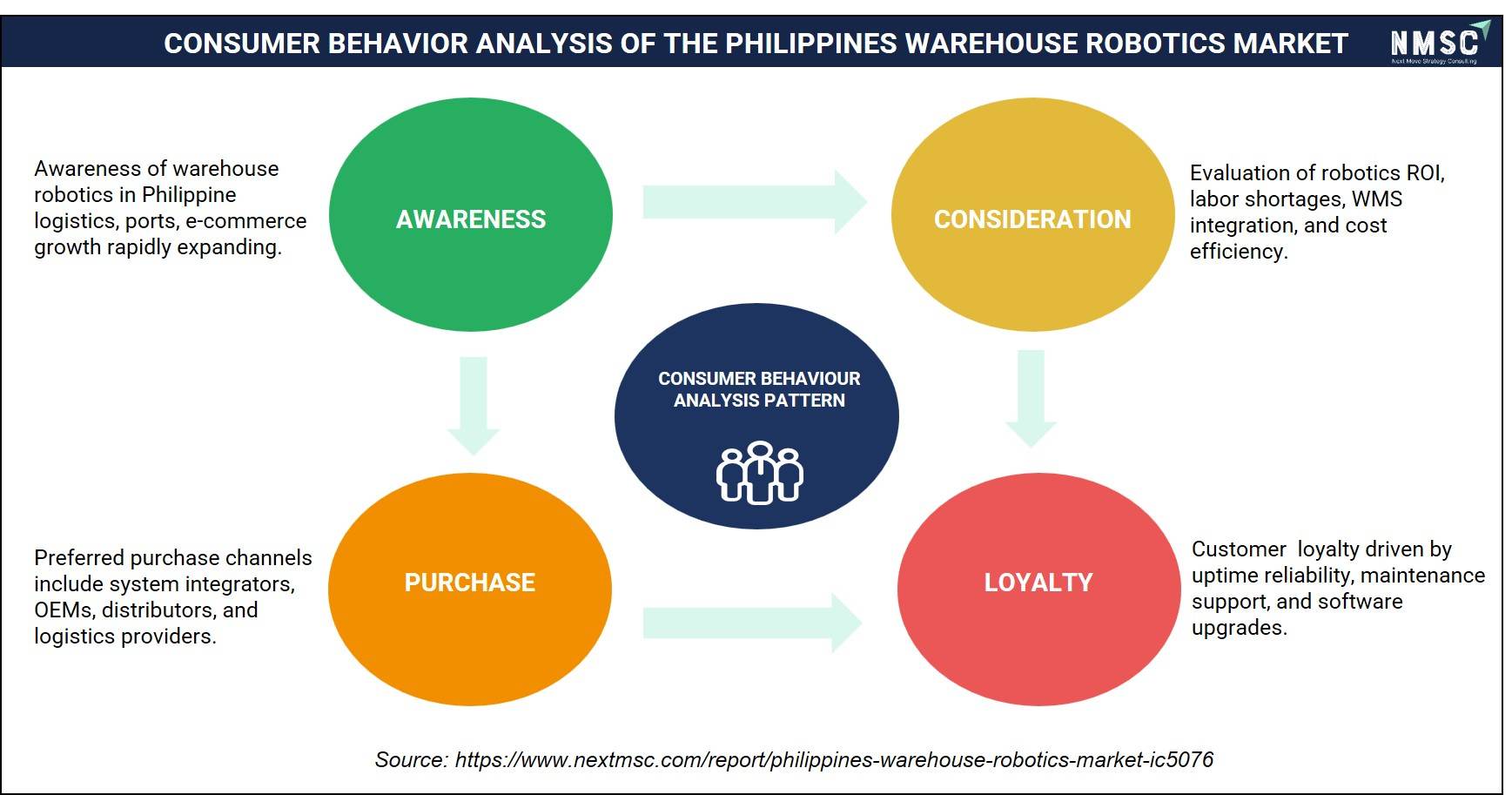
Consumer behavior in the Philippines Warehouse Robotics Market is shaped by growing awareness of warehouse automation, expanding e-commerce, and logistics modernization. Purchasing decisions are primarily influenced by return on investment, labor shortages, system integration, and operational efficiency. Buyers typically procure solutions through OEMs, distributors, and system integrators, while long-term customer loyalty depends on system reliability, responsive maintenance support, and continuous software upgrades.
How Is the Philippines Warehouse Robotics Market Segmented, and Which Segments Are Expected to Drive Future Growth?
By Types
How Is the Philippines Warehouse Robotics Market Segmented by Robot Type, and Which Type Is Expected to Lead Market Adoption?
The Philippines Warehouse Robotics Market is segmented by type into Automated Guided Vehicles (AGVs), Autonomous Mobile Robots (AMRs), Articulated Robots, Collaborative Robots (Cobot), Scara Robots and Cylindrical Robot, and Others.
Based on our analysis, Autonomous Mobile Robots (AMRs) are expected to dominate the Philippine warehouse robotics landscape due to their flexibility, ease of deployment, and ability to navigate dynamic environments without fixed infrastructure requirements. Automated Guided Vehicles (AGVs) also command significant market share, particularly in manufacturing and large-scale distribution facilities. The growing adoption of collaborative robots (cobots) is gaining momentum in smaller warehouses and food processing operations, driven by their safety features and adaptability to varied operational workflows across the Philippines.
By End User
How Does the End User Segmentation Define Growth Priorities and Market Opportunities in the Philippines Warehouse Robotics Market?
The Philippines Warehouse Robotics Market is segmented by end user into E-commerce, Automotive, Food & Beverages, Pharmaceutical, Chemical and Materials, Semiconductor and Electronics, and Others.
Based on our market findings, the e-commerce sector is anticipated to represent the largest end user segment, driven by the explosive growth of online retail platforms and rising fulfillment demands across the Philippines. The pharmaceutical and semiconductor and electronics sectors are also emerging as high-growth end users, given their need for precision handling and regulatory compliance. The food and beverages segment is witnessing increased robotics adoption driven by stringent hygiene requirements and rising demand for automated packaging and sorting solutions across the country.
Competitive Landscape
The Philippines Warehouse Robotics Market is characterized by a competitive landscape featuring a mix of global automation technology leaders and regional distribution specialists. Market participants are actively pursuing partnerships with local logistics operators, expanding service capabilities, and tailoring robotic solutions to meet the specific operational demands of Philippine warehousing environments. Companies are focusing on product innovation, after-sales support infrastructure, and integration services to differentiate their offerings. The competitive intensity is expected to increase as market awareness grows and demand for sophisticated automation solutions accelerates across the forecast period.
Key Players
-
Daifuku Co., Ltd.
-
SSI SCHAEFER Systems Philippines Inc.
-
ABB Inc.
-
FANUC Philippines Corporation
-
OMRON Mechatronics of the Philippines Corporation
-
Yaskawa Philippines, Inc.
-
John Bean Technologies (Philippines) Inc.
-
Teradyne Philippines Ltd.
The Philippines Warehouse Robotics Market features leading global players including Daifuku Co., Ltd., Dematic S.E.A. Pte. Ltd., SSI SCHAEFER Systems Philippines Inc., and Honeywell International Philippines, Inc., alongside technology specialists such as ABB Inc., FANUC Philippines Corporation, and OMRON Mechatronics of the Philippines Corporation. Companies including Yaskawa Philippines, Inc., John Bean Technologies (Philippines) Inc., and Teradyne Philippines Ltd. further strengthen the competitive ecosystem. These players collectively drive innovation, expand local service networks, and develop customized automation solutions tailored to the Philippine warehouse and logistics sector.
Key Segments
By Types
-
Automated Guided Vehicles (AGVs)
-
Laser Guidance
-
Magnetic Guidance
-
Optical Tape Guidance
-
Vision Guidance
-
Others
-
-
Autonomous Mobile Robots (AMRs)
-
Tow Vehicle
-
Tug Vehicle
-
Unit Load Vehicle
-
Pallet Truck
-
Forklift Vehicle
-
Other Type
-
-
Articulated Robots
-
Collaborative Robots (Cobot)
-
Scara Robots and Cylindrical Robot
-
Others
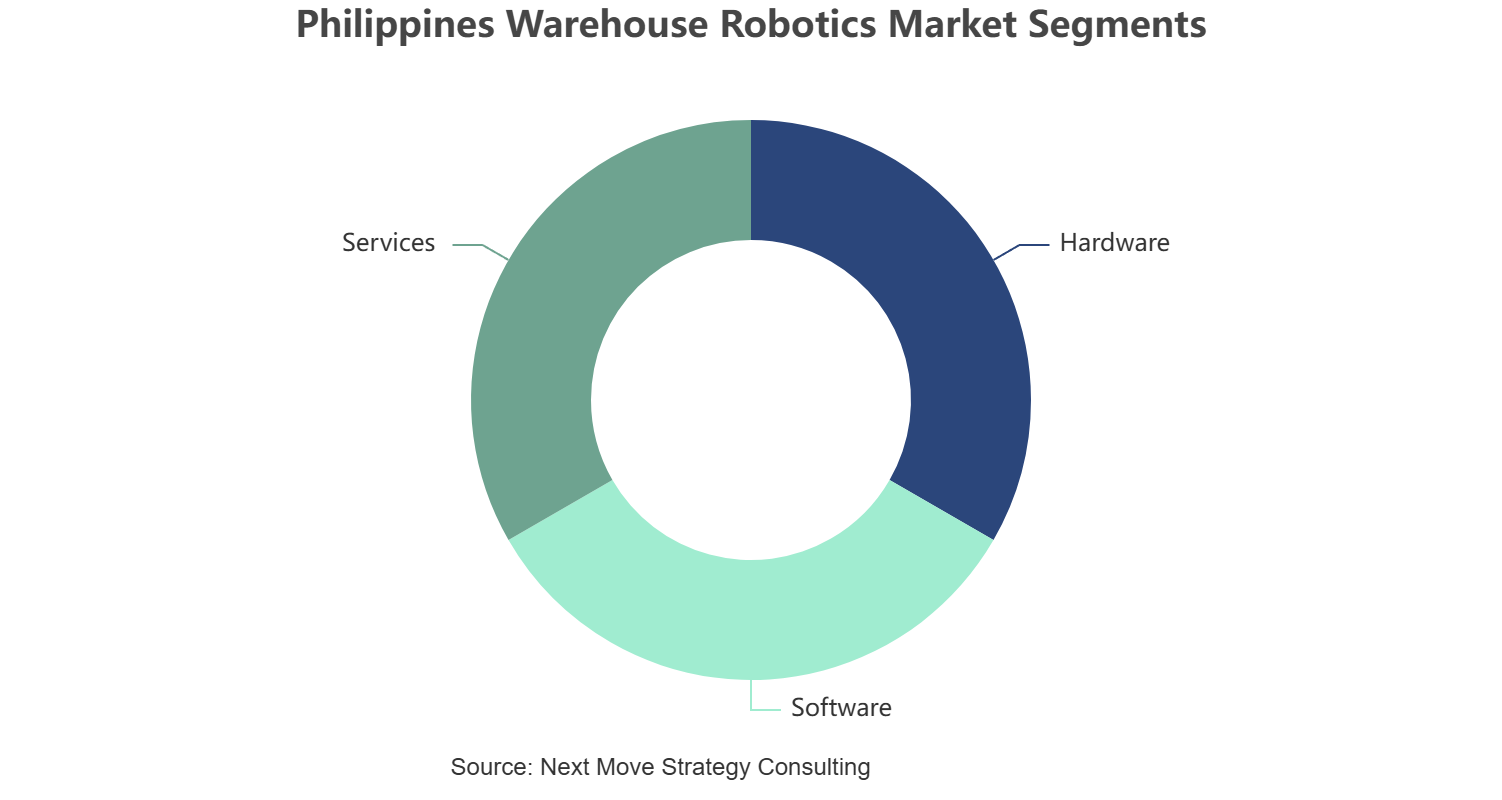
By Offerings
-
Hardware
-
Software
-
Warehouse Management System (WMS)
-
Warehouse Execution System (WES)
-
Warehouse Control System (WCS)
-
-
Services
By Payload Capacity
-
≤ 100 KG
-
101–200 KG
-
201–500 KG
-
501–1000 KG
-
1001–2000 KG
-
2001–5000 KG
-
More than 5000 KG
By Application
-
Palletizing and Depalletizing
-
Sorting and Packaging
-
Picking and Placing
-
Transportation
By End User
-
E-commerce
-
Automotive
-
Food & Beverages
-
Pharmaceutical
-
Chemical and Materials
-
Semiconductor and Electronics
-
Others
Strategic Framework Of The Philippines Warehouse Robotics Market
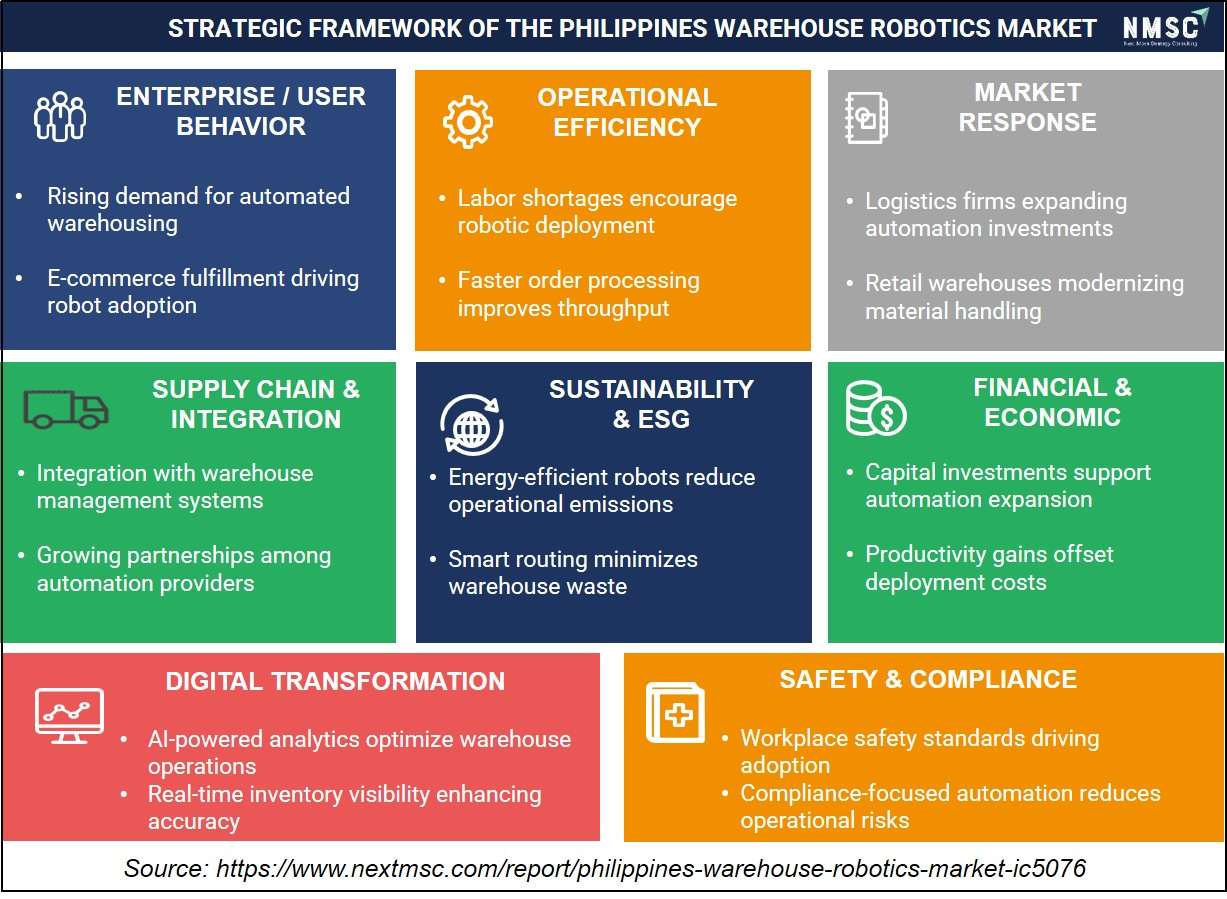
The strategic framework of the Philippines Warehouse Robotics Market highlights the key factors driving market growth, including rising demand for warehouse automation, labor shortages, and expanding e-commerce activities. Increasing investments in digital transformation, warehouse management system integration, and AI-powered analytics are enhancing operational efficiency and inventory visibility. Sustainability initiatives, workplace safety compliance, and strong capital investments are further accelerating warehouse robotics adoption while improving productivity and supporting long-term market expansion.
Key Benefits for Stakeholders
Through our comprehensive assessment of the Philippines Warehouse Robotics Market, stakeholders including logistics operators, warehouse managers, technology investors, and supply chain strategists can gain actionable intelligence for informed decision-making. The report provides detailed market sizing, revenue forecasts, competitive landscape analysis, and segmentation insights spanning the 2025–2035 forecast period. Understanding market dynamics, technological advancements, and regulatory developments enables organizations to identify investment opportunities, optimize operational strategies, and build competitive advantages in the rapidly evolving Philippine warehouse automation landscape.
Government agencies, financial institutions, and industry associations can leverage the report's insights to formulate supportive policies, allocate funding resources, and develop industry frameworks that foster warehouse robotics adoption across the Philippines. Equipment manufacturers and technology providers can utilize segmentation analysis and competitive insights to refine product portfolios, develop market entry strategies, and strengthen partnerships with local logistics operators. The report serves as a comprehensive reference for all stakeholders seeking to capitalize on the sustained growth trajectory of the Philippine warehouse robotics industry.
|
Parameters |
Details |
|
Customization Scope |
Free customization (equivalent to up to 80 analyst-working hours) after purchase. |
|
Pricing and Purchase Options |
Avail customized purchase options to meet your exact research needs. |
|
Approach |
In-depth primary and secondary research; proprietary databases; rigorous quality control and validation measures. |
|
Analytical Tools |
Porter's Five Forces, SWOT, value chain, and Harvey ball analysis to assess competitive intensity, stakeholder roles, and relative impact of key factors. |
Conclusion
The Philippines Warehouse Robotics Market presents a highly promising growth trajectory, supported by the rapid expansion of e-commerce, government-backed industrial modernization initiatives, and rising labor productivity pressures driving automation investments across the country. With market revenues projected to grow from USD 44.58 million in 2025 to USD 771.41 million by 2035, the market offers substantial opportunities for robotics vendors, logistics operators, and investors. Competitive dynamics are expected to intensify as global and regional players expand their local presence, delivering innovative automation solutions that transform Philippine warehousing and supply chain operations through 2035.
About the Author
 Liza Phukan
— Liza Phukan is Research Associate at Next Move Strategy Consulting, where she has covered emerging industries and market research across sectors for 3.5 years. Her work includes analyzing industry developments, validating market data, and developing structured business content from research findings. She uses secondary research and data-validation practices to turn complex market information into clear decision-useful market analysis for business audiences and support report development and B2B.
Liza Phukan
— Liza Phukan is Research Associate at Next Move Strategy Consulting, where she has covered emerging industries and market research across sectors for 3.5 years. Her work includes analyzing industry developments, validating market data, and developing structured business content from research findings. She uses secondary research and data-validation practices to turn complex market information into clear decision-useful market analysis for business audiences and support report development and B2B.
About the Reviewer
 Supradip Baul
— Supradip Baul is an accomplished business consultant and strategist with over a decade of rich experience in market intelligence, strategy, technology, and business transformation. His work has included rigorous qualitative and quantitative analysis across multiple industries, helping clients shape investment decisions and long-term roadmaps. Earlier in his career, he was associated with Gartner, where he contributed to industry-leading reports and market share analyses. He has worked with leading global companies and holds an MBA with a dual specialization in Marketing and Finance.
Supradip Baul
— Supradip Baul is an accomplished business consultant and strategist with over a decade of rich experience in market intelligence, strategy, technology, and business transformation. His work has included rigorous qualitative and quantitative analysis across multiple industries, helping clients shape investment decisions and long-term roadmaps. Earlier in his career, he was associated with Gartner, where he contributed to industry-leading reports and market share analyses. He has worked with leading global companies and holds an MBA with a dual specialization in Marketing and Finance.
At Next Move Strategy Consulting, we understand that insightful market research is the cornerstone of successful business decisions. That's why we employ a robust and multifaceted approach, combining various methodologies to deliver the most accurate and actionable data for our clients.

Research Landscape
We navigate the world of research with two primary approaches:
Qualitative Approach
Our qualitative research methodologies involve immersive techniques such as in-depth interviews, focus groups, and observational studies. By engaging directly with individuals and stakeholders, we uncover valuable insights that quantitative data alone may overlook.

Quantitative Research
In tandem with qualitative methodologies, NMSC leverages the power of Quantitative Research to provide a robust foundation of numerical insights. Through systematic data collection and analysis, we quantify patterns, preferences, and market trends, offering a comprehensive view of the business landscape.
Our quantitative research approach employs diverse tools, including surveys, experiments, and statistical modelling. These methodologies enable us to gather data from a large and representative sample, ensuring the statistical significance of our findings. By employing structured questionnaires and standardized data collection methods, we guarantee the reliability and validity of the information we present to our clients.
Quantitative research is particularly effective in measuring the prevalence of trends, assessing market size, and gauging the impact of various factors on consumer behavior. The numerical precision attained through this approach equips our clients with actionable insights, facilitating data-driven decision-making and strategy formulation.


Our Specialized Toolbox for Industry-Specific Market Research
We deploy a specialized arsenal of techniques tailored to meet your unique requirements. Here's a glimpse into our comprehensive toolbox:

Information Procurement
The stage entails acquiring market data or relevant information through various sources and methodologies.


Market Research Approach
We utilize both top-down and bottom-up approaches in market research analysis to achieve a comprehensive understanding of the market dynamics, leveraging the broad perspective of industry trends and macroeconomic factors alongside detailed insights from specific segments and individual companies.

Porters Five Forces Analysis
We conduct Porter's Five Forces analysis to evaluate the competitive landscape of an industry, providing us with insights into factors that affect profitability and strategic positioning.

SWOT Analysis

Forecasting
We utilize a forecasting model to predict future consumption by considering parameters like population, economics, regulations, market competition, drivers, constraints, technology, and pricing. We also employ statistical techniques such as multilinear regression, exponential smoothing, moving average, ARIMA, and Monte Carlo simulations for accurate predictions. In econometric forecasting, we analyzed short-term and long-term event impacts, attributing values based on regulatory frameworks, economic factors, and market events.





 Speak to Our Analyst