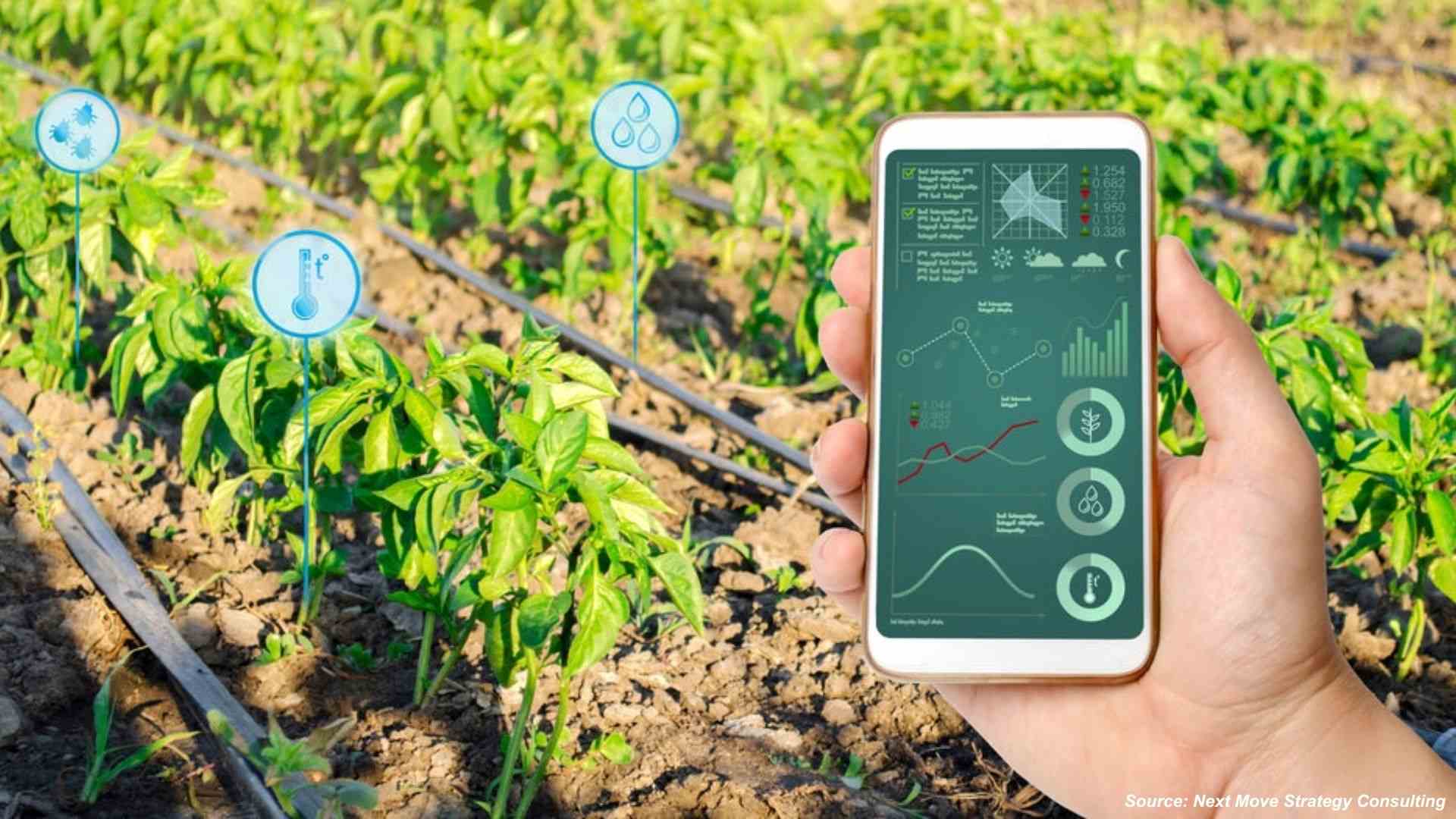
Post-Harvest Preservation Technologies Market By Post-Harvest Treatment Technologies {Chemical Treatments (Edible Coatings, Wax Coatings, and Others), Non-Chemical Treatments (UV-C, Ozone, Irradiation, and Others)}, By Packaging Technologies (Modified Atmosphere Packaging, Vacuum Packaging, and Others), By Farm Scale (Smallholder Farms, Medium Farms, Large Commercial Farms), and By End User (Farmers & Growers, Agricultural Cooperatives, and Others) – Global Analysis & Forecast, 2025–2035
Industry: Agriculture | Publishing Date: October 17, 2026 | Last Updated: October 17, 2026 | No of Pages: N/A | No. of Tables: N/A | No. of Figures: N/A | Format: PDF | Report Code: AG4510
Industry Outlook
The global Post-Harvest Preservation Technologies Market size was valued at USD 7.48 billion in 2025, and is expected to be valued at USD 8.18 billion by the end of 2026. The industry is projected to grow, hitting USD 18.24 billion by 2035, with a CAGR of 9.3% between 2026 and 2035.
Post-Harvest Preservation Technologies Market Size & Forecast
|
Parameters |
Details |
|
Market Size in 2026 |
USD 8.18 Billion |
|
Revenue Forecast in 2035 |
USD 18.24 Billion |
|
Growth Rate |
CAGR of 9.3% from 2026 to 2035 |
|
Analysis Period |
2025–2035 |
|
Base Year Considered |
2025 |
|
Forecast Period |
2026–2035 |
|
Market Size Estimation |
Billion (USD) |
|
Companies Profiled |
20 |
|
Countries Covered |
33 |
|
Market Share |
Available for 10 companies |
Based on NMSC’s primary research, we found that the post-harvest preservation technologies market demonstrates steady expansion, driven by increasing pressure to reduce post-harvest crop losses, rising global demand for high-quality agricultural produce, and rapid advancements in sorting, grading, and storage technologies. AI-enabled optical sorting systems, automated grading platforms, and controlled atmosphere storage solutions are increasingly deployed to improve crop quality consistency, extend shelf life, and optimize post-harvest handling operations. Our field assessments and interviews with agricultural processors and produce exporters indicate that precision detection technologies, digital storage monitoring, and automated processing lines significantly enhance preservation efficiency and processing throughput. Equipment platforms continue to dominate market revenue, while digital monitoring systems and integrated processing solutions are emerging as key strategic enablers across modern agricultural facilities. Asia-Pacific leads adoption due to large agricultural production volumes and expanding agricultural infrastructure modernization programs.
Moreover, through our evaluation of processing facilities and agricultural supply chain infrastructure across North America, Europe, and Asia-Pacific, we observed that technology adoption is strongly influenced by export quality standards, supply chain modernization initiatives, and the need for efficient crop handling systems. North America benefits from advanced agricultural processing infrastructure and strong adoption of optical sorting technologies, while Europe emphasizes precision grading, sustainability standards, and automated packhouse operations. Emerging agricultural economies in Asia-Pacific and Latin America show increasing adoption as producers strengthen post-harvest handling capabilities to support global fresh produce trade. Key post-harvest preservation technologies market participants, including TOMRA Systems ASA, Bühler AG, SATAKE CORPORATION, Aweta, and PETKUS Technologie GmbH, compete through advanced optical sorting technologies, automated grading systems, and integrated crop processing solutions, while increasing investment in digital monitoring platforms and intelligent detection systems continues strengthening technological innovation across global agricultural preservation infrastructure.
What Are the Key Trends in the Post-Harvest Preservation Technologies Market?
How Are AI-Driven Optical and Hyperspectral Sorting Systems Transforming Crop Quality Management?
Based on our analysis of modern agricultural processing facilities, we observed that AI-driven optical and hyperspectral sorting systems are transforming crop quality management across post-harvest operations in the post-harvest preservation technologies market. AI-enabled sorting platforms significantly improve defect detection and grading precision compared with traditional optical systems. Our review of processing line performance data further shows that hyperspectral imaging technologies detect internal crop defects, contaminants, and quality variations that remain invisible to conventional inspection methods. Processors deploying AI-assisted sorting technologies achieve higher grading consistency and stronger export compliance. Consequently, these systems increasingly strengthen quality assurance capabilities across modern agricultural processing infrastructure.
How Are Smart Cold Chain and Digital Storage Systems Strengthening the Post-Harvest Preservation Technologies Market?
Through our evaluation of cold storage modernization programs and agricultural infrastructure upgrades, we identified that smart cold chain and digital storage systems are strengthening post-harvest preservation capabilities across global agricultural supply chains in the post-harvest preservation technologies market. Sensor-enabled monitoring platforms continuously track temperature stability, humidity levels, and atmospheric composition to maintain optimal crop storage conditions. Further, digital monitoring systems allow operators to respond quickly to environmental fluctuations, thereby preventing spoilage and maintaining crop freshness during extended storage periods. From our review of integrated storage infrastructure projects, we also found that automated climate control systems improve operational efficiency while extending product shelf life. As a result, smart storage technologies increasingly support reliable preservation across modern food distribution networks.
How Is Packhouse Automation Reshaping Fruit and Vegetable Processing Operations?
From our assessment of automation initiatives across large fruit and vegetable packing facilities, we observed that packhouse automation is significantly reshaping post-harvest processing operations in the post-harvest preservation technologies market. Automated grading lines, robotic handling systems, and intelligent packing technologies improve throughput while maintaining consistent quality classification. Our evaluation of operational performance across export-oriented packing houses further revealed that automated handling systems reduce crop damage during sorting and packing processes while improving overall productivity. From our analysis, we also identified that packhouse automation enables processors to manage increasing crop volumes demanded by global retail and export markets. Consequently, automated processing lines continue strengthening efficiency, scalability, and reliability across modern agricultural packing infrastructure.
Ecosystem Analysis of the Post-Harvest Preservation Technologies Market
The image illustrates the key components and workflow of the post-harvest preservation technologies market ecosystem, highlighting their interconnections and operational roles.
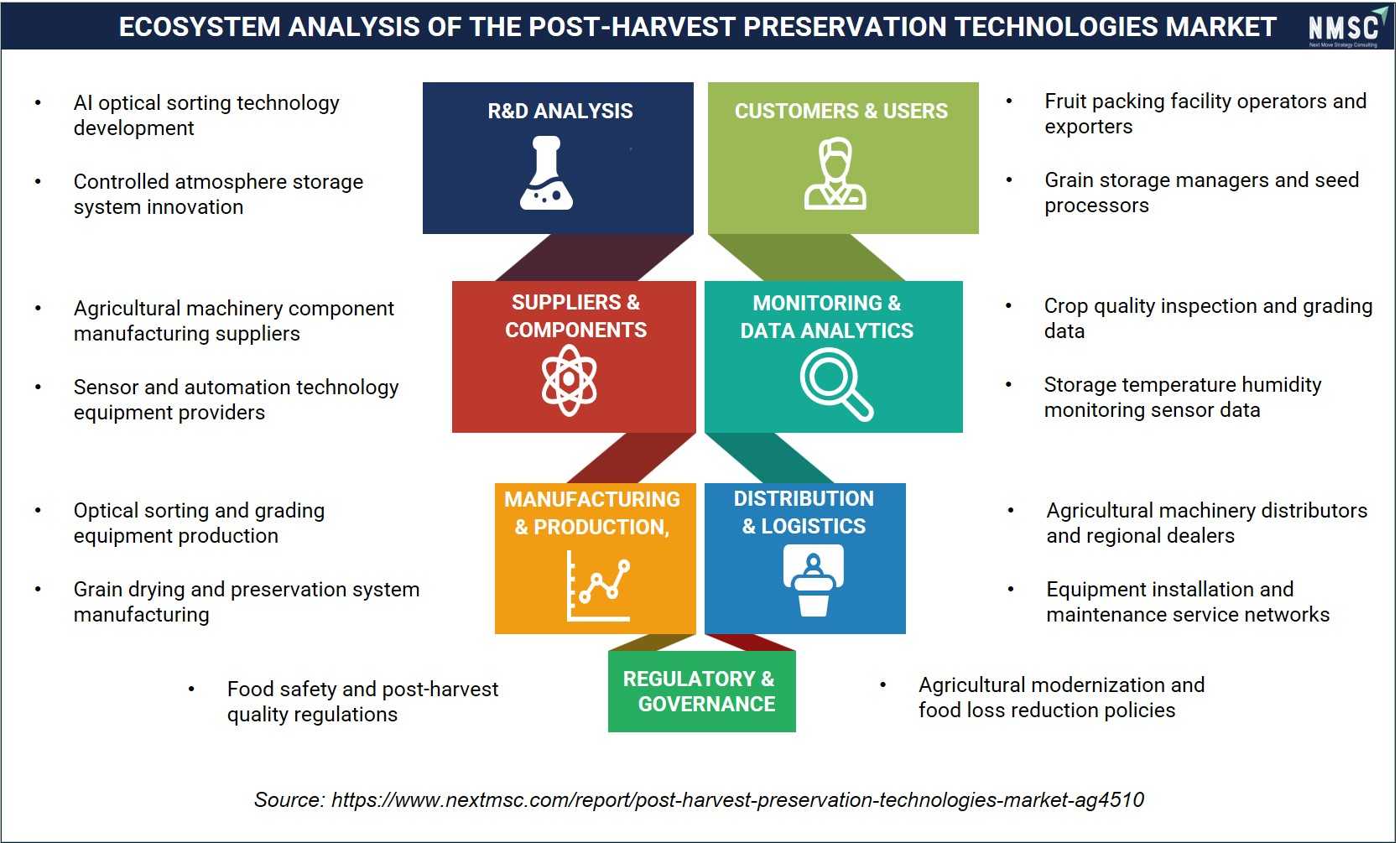
Based on our ecosystem analysis, we noticed that the post-harvest preservation technologies market functions through an integrated value chain connecting R&D institutions, technology suppliers, equipment manufacturers, distributors, and agricultural users. Innovation in sorting, storage, and monitoring technologies supports equipment production, while distribution networks and regulatory frameworks enable efficient deployment across modern agricultural supply chains.
What Are the Key Market Drivers, Breakthroughs, and Investment Opportunities that will Shape the Post-Harvest Preservation Technologies Industry in the Next Decade?
Growth Catalyst & Risk Assessment Matrix
|
DRIVERS / TRENDS / RESTRAINTS |
(+/–) % IMPACT ON CAGR FORECAST |
GEOGRAPHIC RELEVANCE |
IMPACT TIMELINE |
|
Rising food quality standards and export compliance requirements driving adoption of advanced preservation technologies |
+1.1% |
North America; Europe; Asia Pacific export markets; global trade hubs |
Short to medium term (1–3 years) |
|
Increasing post-harvest crop losses driving demand for sorting, grading, and storage solutions |
+1.0% |
Asia Pacific, Latin America, and Africa with growing adoption in North America & Europe |
Short to medium term (1–3 years) |
|
Expansion of global fresh produce trade requiring improved post-harvest handling and preservation systems |
+0.9% |
Latin America, Asia Pacific, and Europe export markets |
Medium term (2–4 years) |
|
Modernization of agricultural supply chains improving adoption of structured post-harvest infrastructure |
+0.8% |
Europe, North America, and Asia Pacific; emerging in Latin America |
Medium term (2–4 years) |
|
High capital investment requirements and technical integration complexity limiting adoption among small-scale processors |
-0.6% |
Global, particularly in developing agricultural regions in Asia and Africa |
Medium term (2–4 years) |
Based on our evaluation of global agricultural processing technologies, we observed that the post-harvest preservation technologies market demonstrates steady expansion driven by increasing pressure to reduce crop losses and improve food supply chain efficiency. Post-harvest technologies are increasingly deployed as a strategic solution to maintain crop quality, extend shelf life, and support large-scale agricultural distribution networks. Moreover, advancements in AI-enabled optical sorting, automated grading systems, and smart storage monitoring platforms further expand the capabilities of modern processing facilities, enabling more precise crop inspection and consistent quality control. However, our assessment also indicated that high capital investment requirements and infrastructure limitations constrain adoption among small-scale agricultural operators. At the same time, growing investments in cold-chain infrastructure, integrated processing systems, and digital storage technologies create new opportunities for scalable post-harvest modernization across global agricultural supply chains.
Growth Drivers:
How Are Rising Food Quality Standards and Export Compliance Requirements Driving Adoption of Post-Harvest Preservation Technologies?
Through our interactions with produce exporters and fruit packing operators, we observed that rising food quality standards and stricter export compliance requirements significantly accelerate the adoption ofpost-harvest storage solutions . Respondents consistently highlighted that global retailers and food import regulators require uniform grading accuracy, contaminant detection, and traceable quality control across fresh produce shipments. Industry analysis indicates that automated grading platforms, optical sorting systems, and controlled storage technologies enable processors to meet these evolving compliance benchmarks while maintaining consistent product quality. Furthermore, as agricultural supply chains expand across international markets, processors increasingly prioritize technologies that protect product integrity during long distribution cycles. Industry analysis indicate that preservation systems supporting precise grading, defect detection, and quality monitoring strengthen export competitiveness while improving buyer confidence in global produce markets.
How Is Rising Post-Harvest Crop Loss Accelerating Adoption of Preservation Technologies?
Based on our interactions with agricultural processors, and fruit packing facility managers, we observed that rising post-harvest crop losses increasingly accelerate the adoption of preservation technologies across modern agricultural supply chains within the post-harvest preservation technologies market. Respondents consistently reported that quality deterioration during storage and transportation reduces marketable yield and directly impacts profitability. Industry analysis indicates that technologies such as optical sorting systems, controlled atmosphere storage, and automated grading platforms help processors detect defects earlier, stabilize product quality, and minimize spoilage during handling and distribution. Furthermore, as agricultural production volumes expand and supply chains extend across longer distribution routes, operators increasingly prioritize solutions that preserve crop integrity beyond the harvesting stage. Industry evaluation indicates that advanced preservation technologies enable producers and distributors to maintain consistent quality standards while improving storage efficiency and overall product recovery. Consequently, the growing focus on reducing post-harvest losses continues to strengthen long-term adoption of modern crop preservation systems.
Growth Inhibitor:
How are High Capital Costs and Technical Integration Complexity Limiting Adoption of Post-Harvest Preservation Technologies?
From our interactions with grain storage operators, and equipment distributors, we observed that high capital costs and technical integration complexity act as key constraints affecting adoption of advancedgrain preservation technologies . Respondents highlighted that systems such as optical sorting equipment, automated grading lines, and controlled atmosphere storage require substantial upfront investment, specialized infrastructure, and trained personnel for installation and operation. Industry analysis indicates that many small and mid-scale agricultural processors face financial and operational barriers when transitioning from conventional crop handling methods to automated preservation systems. In addition, integrating modern preservation technologies with existing packing houses and storage facilities requires facility modifications and system customization. Operational analysis suggests that these integration challenges extend deployment timelines and increase project complexity. As a result, high investment requirements and technical integration barriers continue to limit the pace of adoption of advanced post-harvest preservation technologies across many agricultural operations.
Growth Opportunity:
How Is the Expansion of Global Fresh Produce Trade Creating Opportunities for Post-Harvest Preservation Technologies?
In our evaluation of export-oriented agricultural supply chains, we identified that the expansion of global fresh produce trade creates strong opportunities for the post-harvest preservation technologies market. Produce exporters and food distribution companies increasingly require advanced sorting, grading, and packaging solutions to maintain crop quality during long-distance transportation. Industry trends indicate that technologies capable of preserving visual quality, freshness, and shelf life play a central role in supporting cross-border agricultural trade. In addition, growing demand for year-round fruit and vegetable availability across global retail networks continues to strengthen investment in modern post-harvest handling infrastructure. Market indicators show that processors increasingly deploy advanced preservation technologies to support large export volumes while maintaining product consistency across international supply chains. Consequently, expanding global agricultural trade continues reinforcing long-term demand for advanced crop preservation systems.
Price Point Analysis of the Post-Harvest Preservation Technologies Market
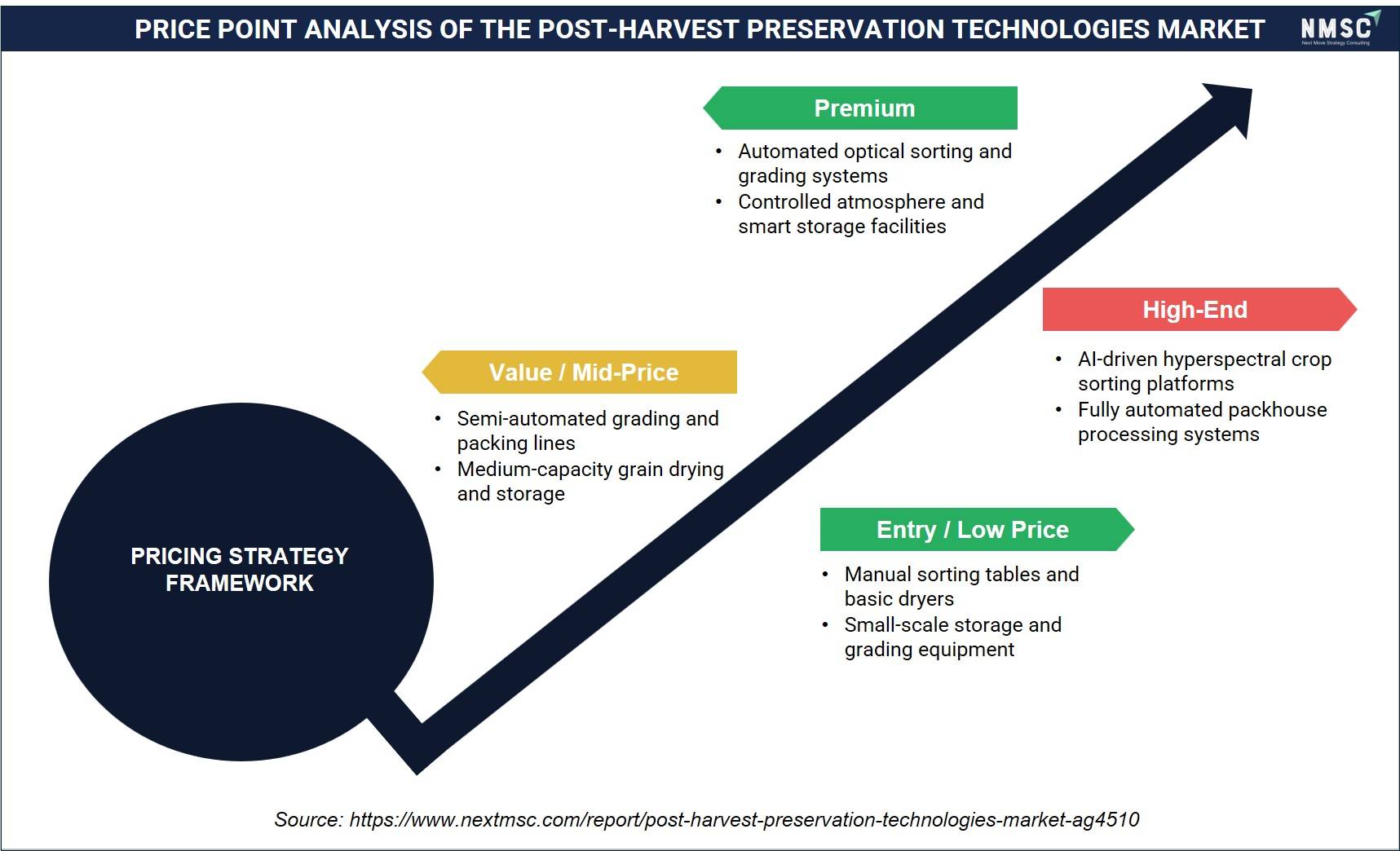
Based on our analysis, we identified that the post-harvest preservation technologies market follows a tiered pricing structure linked to automation and processing capability. Entry-level solutions support basic crop handling, while mid-range systems introduce semi-automated grading and storage technologies. Meanwhile, premium and high-end solutions deploy automated optical sorting and AI-driven processing platforms that improve crop quality and operational efficiency.
How Is the Post-Harvest Preservation Technologies Market Segmented in This Report, And What are the Key Insights From the Segmentation Analysis?
Market Highlights & Strategic Insights – Post-Harvest Preservation Technologies Market:
|
Segments |
Key Takeaways |
|
Post-Harvest Treatment Technologies |
Chemical treatments dominated the post-harvest preservation technologies market due to widespread use in fungal control and shelf-life extension. Edible coatings, fungicides, and sanitizers remain widely adopted. Non-chemical treatments such as UV-C, ozone, and irradiation systems are gaining traction due to increasing demand for residue-free preservation technologies. |
|
Drying & Moisture Control Technologies |
Mechanical dryers held the largest share due to their extensive use in grain and cereal drying. Solar dryers are gaining popularity among smallholder farms due to low operating costs. Advanced technologies such as heat pump and microwave dryers are gradually expanding in commercial processing operations. |
|
Post-Harvest Handling Equipment |
Sorting and grading equipment dominated due to rising demand for quality control and automation. Optical sorting technologies are increasingly adopted to detect defects and ensure product uniformity. Cleaning and washing systems remain essential across fresh produce supply chains. |
|
Cold Chain & Storage Technologies |
Cold storage systems led the post-harvest preservation technologies market as they play a critical role in maintaining freshness during storage and transport. Atmospheric Controlled Storage Systems is gaining traction for high-value produce. Bulk storage solutions such as grain silos and hermetic storage are widely used for cereals and grains. |
|
Packaging Technologies |
Modified atmosphere packaging dominated due to its ability to slow respiration and extend shelf life. Vacuum packaging remains widely used in processed foods. Smart and active packaging solutions are gaining traction for improved product monitoring and spoilage control. |
|
Monitoring & Quality Control Technologies |
Environmental monitoring systems held a significant share due to increasing cold chain monitoring requirements. IoT sensors and data loggers are gaining traction for real-time monitoring. Traceability systems such as RFID and barcode technologies support supply chain transparency. |
|
Crop Type |
Fruits and vegetables dominated due to their high perishability and reliance on preservation technologies. Cereals and grains also hold a significant share due to large-scale storage requirements. Other crops including pulses, nuts, and spices maintain steady demand for preservation solutions. |
|
Farm Scale |
Large commercial farms dominated due to higher adoption of advanced preservation and cold storage technologies. Medium-sized farms follow with increasing investment in storage and drying systems. Smallholder farms are gradually adopting affordable preservation solutions such as solar dryers and hermetic storage. |
|
End User |
Farmers and growers dominated as primary users of preservation technologies. Food processing companies and cold storage operators are major adopters for maintaining product quality. Logistics providers and retail chains increasingly use monitoring and packaging solutions to reduce food waste. |
By Post-Harvest Treatment Technologies Insights
Which Treatment Technologies Drive Growth in the Post-Harvest Preservation Technologies Market?
Based on our analysis of post-harvest preservation practices across agricultural supply chains, we found that the post-harvest preservation technologies market is segmented into chemical treatments and non-chemical treatments.
From our evaluation of commercial post-harvest operations, we found that chemical treatments account for a significant share, driven by their widespread use in controlling fungal infections, microbial contamination, and sprouting during storage and transportation. Edible coatings, fungicides, and sanitizers remain widely adopted for maintaining freshness and extending shelf life of fruits and vegetables. Non-chemical treatments follow, supported by increasing demand for residue-free preservation technologies such as UV-C treatment, ozone treatment, and irradiation systems. Meanwhile, emerging solutions including plasma and pulsed light technologies gain traction as producers increasingly prioritize sustainable and chemical-free post-harvest preservation methods.
By Cold Chain & Storage Technologies Insights
How Do Cold Chain Technologies Influence the Post-Harvest Preservation Technologies Market?
Based on our assessment of agricultural storage infrastructure and supply chain operations, we noticed that the post-harvest preservation technologies market is segmented into cold storage systems, Atmospheric Controlled Storage Systems, bulk storage systems, and transport systems.
From our evaluation of post-harvest supply chains, we found that cold storage systems account for a significant share, driven by their essential role in maintaining freshness and slowing spoilage of perishable commodities such as fruits, vegetables, and flowers. Refrigerated storage and pre-cooling systems are widely used to extend shelf life during storage and distribution. Atmospheric Controlled Storage Systems follows, supported by its ability to regulate oxygen and carbon dioxide levels to delay ripening in high-value produce. Meanwhile, bulk storage solutions such as grain silos and hermetic storage gain steady adoption for cereals and grains requiring long-term moisture-controlled preservation.

By Packaging Technologies Insights
Which Packaging Technologies Support Post-Harvest Product Preservation?
In on our analysis of post-harvest packaging solutions and supply chain requirements, we noticed that the post-harvest preservation technologies market is segmented into modified atmosphere packaging, vacuum packaging, active packaging, smart packaging, barrier films, breathable packaging, and others.
From our evaluation of agricultural packaging applications, we found that modified atmosphere packaging accounts for a significant share, supported by its ability to control gas composition and slow respiration in fresh produce during storage and transport. Vacuum packaging follows, driven by its widespread use in extending shelf life of processed agricultural products and packaged foods. Our assessment further indicates that active and smart packaging technologies gain traction, particularly ethylene-absorbing and moisture-control packaging used to monitor ripening and maintain freshness. Meanwhile, barrier films and breathable packaging continue supporting product protection and airflow management across fresh produce supply chains.

Regional Outlook:
Geographic Performance Snapshot:
|
Geography |
Key Takeaways |
|
North America |
North America represents a technologically mature in the post-harvest preservation technologies market, supported by advanced cold chain infrastructure, high mechanization in agriculture, and strong adoption of controlled atmosphere storage, refrigeration, and packaging technologies to maintain produce quality during long distribution cycles. |
|
Europe |
Europe shows strong adoption driven by strict food safety regulations, sustainability initiatives, and policies targeting food waste reduction. The region widely deploys refrigerated logistics, modified atmosphere packaging, and smart storage systems across fresh produce and horticulture supply chains. |
|
Asia Pacific |
Asia Pacific is a rapidly developing market due to high agricultural production volumes and significant post-harvest losses. Governments and agribusiness stakeholders increasingly invest in cold storage infrastructure, supply chain modernization, and preservation technologies to improve food security and export competitiveness. |
|
Latin America |
Latin America demonstrates growing adoption as major fruit and vegetable exporting countries strengthen post-harvest handling and cold chain systems. Export-oriented agriculture and increasing international quality standards encourage the use of preservation technologies. |
|
Middle East & Africa |
The Middle East & Africa region is gradually adopting post-harvest preservation solutions as countries invest in food security, cold chain development, and agricultural infrastructure to reduce losses in fruits, vegetables, and perishable commodities. |
The Post-Harvest Preservation Technologies Market is geographically studied across North America, Europe, Asia Pacific, Latin America and Middle East & Africa and each region is further studied across countries.
Post-Harvest Preservation Technologies Market in North America
Through our engagements with fresh produce exporters and agricultural technology providers, we observed that the post-harvest preservation technologies market in North America continues to strengthen its adoption of advancedagricultural storage technologies . The market benefits from highly organized agricultural supply chains and well-established cold-chain logistics that support long-distance distribution of fruits, vegetables, and horticultural products. Industry analysis indicates that large commercial farms increasingly integrate rapid pre-cooling systems, controlled atmosphere storage, and automated sorting technologies to maintain product quality after harvest. At the same time, food retailers and produce distributors prioritize longer shelf life and consistent grading standards, encouraging wider deployment of smart storage monitoring and precision humidity management systems. Consequently, ongoing investments in post-harvest infrastructure and digital monitoring platforms continue to advance preservation efficiency across North American agricultural logistics.
Post-Harvest Preservation Technologies Market in the United States
The United States represents the largest adoption base for post-harvest preservation technologies in North America, driven by the scale of its fresh produce, horticulture, and specialty crop industries. Industry analysis indicate that high-value crops such as berries, leafy vegetables, and cut flowers require sophisticated cooling, modified atmosphere storage, and real-time condition monitoring to maintain quality during long supply chains. Our field research indicates that large produce distributors and cold-storage operators increasingly deploy automated sorting, optical grading, and sensor-enabled storage environments to reduce spoilage and maintain export standards. Procurement trends further suggest growing integration of smart packaging and traceability technologies to meet retailer transparency requirements. As a result, technology vendors continue expanding digital storage monitoring platforms and precision preservation systems, strengthening the country’s leadership in advanced post-harvest management.
Post-Harvest Preservation Technologies Market in Canada
Canada’s post-harvest preservation technologies market landscape develops steadily as climate-sensitive crop storage and export logistics drive demand for reliable preservation systems. From our evaluation of agricultural storage deployments, we observed that controlled-temperature warehouses, refrigerated transportation, and long-duration storage facilities remain central to maintaining quality across apples, potatoes, and greenhouse produce. Furthermore, through our interactions with growers and agricultural cooperatives, we identified that controlled atmosphere storage and advanced ventilation systems are increasingly prioritized to extend product shelf life during winter distribution cycles. In addition, rising export volumes and strict quality certification requirements encourage investment in automated grading, packaging, and storage monitoring technologies. Compared with the United States, Canadian facilities typically emphasize durability, energy efficiency, and integrated environmental controls, which strengthens long-term equipment utilization and supports continued modernization of post-harvest infrastructure across the country..
Post-Harvest Preservation Technologies Market in Europe
The post-harvest preservation technologies market in Europe maintains a highly structured and quality-focused environment, supported by stringent food safety regulations and strong agricultural export networks. Based on our assessment of regional supply chain practices, we found that fruit and vegetable producers increasingly rely on controlled atmosphere storage, advanced refrigeration systems, and precision humidity management to maintain product integrity during cross-border distribution. Moreover, through our evaluation of cooperative operations, we observed that large produce cooperatives and food logistics operators continue upgrading packing houses with automated grading and sorting technologies to meet strict retailer quality standards. Northern and Western European countries emphasize energy-efficient cold storage and digital monitoring systems, while Southern Europe focuses on rapid cooling and packing solutions for export-oriented horticulture. Consequently, these developments collectively strengthen the role of advanced preservation infrastructure across Europe’s integrated agricultural supply chains.
Post-Harvest Preservation Technologies Market in the United Kingdom
The United Kingdom demonstrates strong momentum in post-harvest preservation technologies, driven by the country’s advanced retail food supply chains and high import–export activity in fresh produce. Our analysis indicate that distributors and horticulture producers increasingly deploy pre-cooling systems, automated grading equipment, and humidity-controlled storage to maintain product freshness across extended transport cycles. Our observations from industry engagements indicate that supermarket quality specifications and traceability standards encourage investment in smart packaging and environmental monitoring systems. Additionally, growing consumer preference for premium-quality fruits, vegetables, and flowers further strengthens demand for precision preservation technologies. Consequently, technology providers continue expanding integrated cooling, monitoring, and storage solutions to support the country’s high-throughput fresh produce distribution networks.
Post-Harvest Preservation Technologies Market in Germany
The post-harvest preservation technologies market in Germany reflects the country’s engineering-driven agricultural technology ecosystem and efficiency-oriented produce supply chains. Through on our evaluation of processing and storage facilities, we found that fruit and vegetable cooperatives widely deploy automated grading lines, optical sorting technologies, and controlled atmosphere storage to maintain consistent product quality across domestic distribution and export markets. Moreover, strong adoption of energy-efficient refrigeration infrastructure and advanced ventilation systems within modern storage facilities. In addition, our interactions with produce distributors indicate that agricultural cooperatives prioritize certified, long-lifecycle preservation equipment capable of maintaining stable storage conditions over extended periods. Consequently, Germany continues advancing innovation in storage automation, quality monitoring, and sustainable cooling solutions across its fresh produce handling networks.
Post-Harvest Preservation Technologies Market in France
France exhibits steady expansion in post-harvest preservation technologies, supported by the country’s strong fruit, vegetable, and specialty crop sectors. Based on our assessment of horticultural supply chain infrastructure, we found that growing investment in temperature-controlled logistics hubs, rapid cooling facilities, and advanced packaging systems plays a critical role in maintaining freshness during national and export distribution. Furthermore, through our interactions with producers and food logistics operators, we observed increasing adoption of automated sorting, grading, and humidity control technologies to meet strict retail quality benchmarks. In addition, national initiatives focused on reducing food waste encourage deployment of smart storage monitoring and shelf-life extension technologies. Consequently, these developments strengthen operational efficiency across France’s horticultural supply chains and continue advancing the modernization of post-harvest management practices.
Post-Harvest Preservation Technologies Market in Italy
Italy’s post-harvest preservation technologies market evolves primarily through export-driven horticulture and modernization of produce handling infrastructure. In our evaluation of major fruit-producing regions, we observed increasing investment in pre-cooling tunnels, controlled atmosphere storage, and automated packaging systems to support international shipments of grapes, citrus, and stone fruits. Moreover, through our interactions with producer cooperatives and exporters, we identified that stakeholders prioritize technologies capable of preserving visual quality, firmness, and shelf life during long-distance transport. Additionally, government-backed agricultural modernization programs continue supporting the adoption of energy-efficient refrigeration and digital storage monitoring solutions. Consequently, these developments reinforce the importance of integrated preservation systems within Italy’s globally connected horticulture sector.
Post-Harvest Preservation Technologies Market in Spain
Spain’s position as one of Europe’s largest fruit and vegetable exporters strongly shapes adoption of post-harvest preservation technologies across the country’s agricultural logistics systems. From on our analysis of export-oriented supply chains, we found that exporters and large agricultural cooperatives actively deploy rapid hydro-cooling facilities, advanced cold storage infrastructure, and automated grading technologies to maintain export-grade quality for citrus, berries, and greenhouse produce. Furthermore, growing demand for integrated storage monitoring platforms capable of controlling temperature, humidity, and atmospheric composition within large packing facilities. In addition, through our evaluation of procurement trends, we identified that continuous export activity and year-round horticultural production encourage ongoing upgrades to preservation infrastructure. Consequently, Spain remains a key regional hub for advanced packing-house technologies and large-scale cold storage deployment.
Post-Harvest Preservation Technologies Market in the Nordics
Cold-climate agricultural logistics across Sweden, Finland, and Norway shape a quality-focused adoption environment for post-harvest preservation technologies. Through on our assessment of regional storage and distribution practices, we found that producers and food distribution networks rely heavily on controlled atmosphere storage, advanced refrigeration, and humidity-controlled facilities to maintain crop quality during extended storage periods. Furthermore, the region’s highly digitized agricultural systems support integration of sensor-based monitoring platforms that track temperature stability and atmospheric composition in real time. In addition, our evaluation indicates that strict environmental standards encourage the use of energy-efficient cooling technologies and optimized storage ventilation systems. Consequently, preservation solutions combining operational reliability, sustainability performance, and precise environmental control continue gaining strong traction across Nordic fresh produce handling and export supply chains.
Post-Harvest Preservation Technologies Market in Asia-Pacific
The post-harvest preservation technologies market in Asia-Pacific reflects one of the most rapidly evolving agricultural technology landscapes globally, supported by large production volumes and expanding fresh food distribution networks. In our analysis of regional agricultural supply chains, we observed that rising urban consumption, export-oriented horticulture, and government-backed cold-chain development programs accelerate deployment of pre-cooling facilities, temperature-controlled storage, and advanced packaging technologies. Moreover, China, Japan, and India anchor regional adoption through large fruit and vegetable supply chains, while Southeast Asian economies increasingly strengthen post-harvest infrastructure to reduce spoilage and improve export competitiveness. Additionally, our interactions with industry stakeholders indicate strong investment in automated sorting, digital storage monitoring, and integrated cold logistics hubs. Consequently, these developments continue expanding preservation technology deployment across Asia-Pacific agricultural distribution systems.
Post-Harvest Preservation Technologies Market in China
China represents the largest-scale deployment environment for post-harvest preservation technologies within Asia-Pacific, driven by extensive fruit, vegetable, and horticulture production. Based on our evaluation of procurement and infrastructure expansion trends, we found that agricultural cooperatives and produce distribution networks increasingly invest in large cold-storage complexes, hydro-cooling systems, and automated grading technologies to maintain product quality during long distribution cycles. Furthermore, we observed that government-led agricultural modernization programs strengthen the expansion of regional cold-chain infrastructure and temperature-controlled logistics hubs. In addition, our analysis of operational practices indicates growing adoption of automated sorting lines and controlled atmosphere storage for export-grade produce. Consequently, preservation technologies continue expanding rapidly across China’s large-scale agricultural supply chains and food distribution networks.
Post-Harvest Preservation Technologies Market in Japan
From our field interactions with agricultural cooperatives and produce distribution operators, we observed that the post-harvest preservation technologies market share in Japan demonstrates a precision-driven adoption profile for post-harvest preservation technologies. The country’s premium fruit and vegetable markets place strong emphasis on visual quality, freshness, and shelf-life stability. Technical evaluation indicates widespread use of rapid pre-cooling systems, controlled atmosphere storage, and advanced grading technologies designed to preserve delicate produce during extended distribution. In addition, retailers and food distribution companies increasingly prioritize traceable storage conditions and consistent temperature management across logistics networks. These operational priorities encourage continuous investment in sensor-enabled storage monitoring and high-reliability cooling systems, reinforcing Japan’s leadership in precision-focused post-harvest management infrastructure.
Post-Harvest Preservation Technologies Market in India
India represents a rapidly evolving landscape for post-harvest preservation technologies, driven by the country’s large agricultural output and increasing efforts to reduce post-harvest losses. Infrastructure assessment indicates that fruit, vegetable, and horticulture supply chains increasingly integrate cold storage facilities, pre-cooling systems, and improved packaging solutions to maintain product quality during transport and storage. Further, government-backed cold-chain development programs and agricultural modernization initiatives accelerate deployment of temperature-controlled logistics and grading infrastructure. From our engagements with agricultural cooperatives and cold-chain operators, we identified that agricultural cooperatives and produce exporters increasingly prioritize modern storage monitoring systems and automated sorting technologies to improve shelf life and market value. These developments steadily strengthen the role of advanced preservation systems across India’s expanding fresh produce distribution networks.
Post-Harvest Preservation Technologies Market in South Korea
South Korea maintains a technologically advanced environment for post-harvest preservation technologies, supported by highly organized agricultural distribution networks and strong cold-chain infrastructure. Based on our assessment of distribution and storage practices, we found that fruit and vegetable producers deploy rapid pre-cooling systems, controlled atmosphere storage, and automated grading technologies to maintain consistent quality throughout the distribution process. Moreover, the country’s sophisticated food retail ecosystem increases demand for precise temperature control and shelf-life optimization across logistics channels. In addition, our analysis indicates that agricultural cooperatives and produce distributors are integrating sensor-enabled storage monitoring platforms to manage humidity levels and atmospheric stability during storage. Consequently, this combination of digital monitoring and advanced cooling infrastructure strengthens preservation efficiency across South Korea’s modern agricultural supply chains.
Post-Harvest Preservation Technologies Market in Taiwan
The post-harvest preservation technologies market demand in Taiwan benefits from the island’s export-oriented agricultural sector and well-developed food logistics infrastructure. Based on our assessment of export packing and storage operations, we found that high-value fruit producers and export packing houses increasingly deploy automated grading systems, humidity-controlled storage environments, and temperature-managed logistics facilities to maintain consistent product quality for international markets. Moreover, reliable environmental control and grading accuracy remain central purchasing considerations for agricultural exporters. In addition, our analysis indicates that advanced processing facilities are adopting digital monitoring platforms capable of tracking temperature and atmospheric conditions across large preservation facilities. Consequently, these investments reinforce Taiwan’s ability to maintain premium produce quality while supporting its export-driven agricultural economy.
Post-Harvest Preservation Technologies Market in Indonesia
Indonesia’s adoption of post-harvest preservation technologies continues to accelerate as agricultural supply chains modernize alongside growing urban food demand. Through our evaluation of agricultural logistics development, we observed rising investment in cold storage infrastructure, pre-cooling facilities, and improved packaging technologies to reduce spoilage in fruits, vegetables, and fisheries products. Furthermore, large agricultural producers and food distribution networks increasingly deploy temperature-controlled storage and rapid cooling systems to support longer distribution routes between production regions and urban markets. In addition, our interactions with industry stakeholders indicate that government food security initiatives and infrastructure development programs continue encouraging upgrades to post-harvest handling systems. Consequently, preservation technologies steadily expand across Indonesia’s developing agricultural logistics and distribution networks.
Post-Harvest Preservation Technologies Market in Australia
Australia demonstrates a quality-driven adoption profile for the post-harvest preservation technologies market, reflecting its strong agricultural export sector and geographically dispersed production regions. From our analysis of export-oriented supply chains, we found that fruit growers, horticulture exporters, and food logistics operators increasingly invest in advanced cold storage, controlled atmosphere facilities, and automated sorting systems to maintain product integrity during long-distance transportation. Moreover, high export standards and strict quality certification requirements encourage deployment of humidity-controlled storage and smart monitoring platforms. Additionally, our evaluation indicates that agricultural enterprises are integrating digital environmental monitoring technologies to ensure stable storage conditions across extended logistics cycles. Consequently, these developments continue strengthening Australia’s advanced preservation infrastructure supporting its global agricultural trade.
Post-Harvest Preservation Technologies Market in Latin America
From our engagements with fruit exporters and cold-chain logistics operators, we observed that Latin America continues strengthening its adoption of post-harvest preservation technologies, particularly across major agricultural exporting economies such as Brazil, Chile, and Mexico. Export-oriented horticulture and fresh produce supply chains increasingly rely on rapid pre-cooling, controlled atmosphere storage, and automated grading systems to maintain quality during long international shipping cycles. Infrastructure assessment further indicates growing investment in temperature-controlled storage facilities and modern packing houses supporting large fruit export industries including berries, grapes, and citrus. At the same time, global retailer quality standards and international trade requirements continue encouraging adoption of advanced preservation and monitoring technologies. These developments steadily expand the role of modern post-harvest management systems across Latin America’s export-driven agricultural logistics networks
Post-Harvest Preservation Technologies Market in the Middle East & Africa
From our interactions with agricultural distributors and food logistics providers, we identified a distinctly varied adoption landscape for the post-harvest preservation technologies market expansion across the Middle East and Africa. Gulf economies demonstrate strong investment in advanced cold-chain infrastructure, controlled storage facilities, and automated produce handling systems to support food security initiatives and large food import volumes. Meanwhile, infrastructure development programs and agricultural modernization efforts across parts of Africa increasingly encourage deployment of cold storage units, improved packaging solutions, and temperature-controlled transportation. Industry indicators further show rising emphasis on reducing post-harvest losses in fruits, vegetables, and staple crops across regional agricultural supply chains. As a result, preservation technologies continue gaining importance as governments and food distribution networks strengthen agricultural logistics and food security frameworks across the region.
Competitive Landscape
Competitive Dynamics & M&A Landscape:
|
Key Takeaways |
|
The post-harvest preservation technologies market features a mix of global agricultural technology providers and specialized equipment manufacturers focused on crop handling, sorting, and storage systems. Major companies such as TOMRA Systems ASA, Bühler AG, Grain & Protein Technologies, SATAKE CORPORATION, and Key Technology lead through advanced sorting, grading, and processing technologies. Meanwhile, specialized players including PETKUS Technologie GmbH, Aweta, Tong Engineering Ltd, and Akyurek Technology strengthen competition through crop-specific preservation solutions. |
|
Industry insights indicate that companies increasingly focus on automation, optical sorting accuracy, and integrated processing solutions to reduce crop losses and improve grading consistency across agricultural supply chains. In addition, digital monitoring systems, energy-efficient drying technologies, and modular storage infrastructure are becoming central to product innovation as agricultural producers modernize post-harvest operations. |
|
Strategic expansion across emerging agricultural markets also shapes competitive dynamics. Companies continue strengthening regional distribution networks, local equipment partnerships, and integrated processing platforms to support growing demand for efficient post-harvest handling and crop preservation solutions across global agricultural supply chains. |
Which Companies Dominate the Post-Harvest Preservation Technologies Industry and How Do They Compete?
Based on our analysis of agricultural processing installations and equipment deployments, we observed that the post-harvest preservation technologies market is led by established crop processing and sorting technology providers alongside specialized post-harvest equipment manufacturers. Companies such as TOMRA Systems ASA, Bühler AG, Grain & Protein Technologies, SATAKE CORPORATION, and Key Technology consistently support large grain processing facilities, seed conditioning plants, and fresh produce packing operations. From our evaluation of plant automation requirements, we identified that these companies gain preference in installations where grading accuracy, high processing throughput, and equipment reliability are critical operational priorities. Furthermore, system integrators and processing operators increasingly select vendors capable of integrating optical sorting, grading, and processing systems across complete post-harvest handling lines, thereby strengthening competitive positioning across large agricultural processing infrastructures.
Market Dominated by Post-Harvest Preservation Technologies Giants and Specialists
From our engagements with fruit packing facilities and seed conditioning operators, we observed that the competitive landscape is also shaped by specialized post-harvest equipment manufacturers including PETKUS Technologie GmbH, Aweta, Tong Engineering Ltd, Akyurek Technology, Alvan Blanch, and Westrup A/S. These companies increasingly supply crop-specific preservation systems such as seed cleaning equipment, vegetable handling lines, grain drying technologies, and precision grading platforms. In addition, operators frequently prioritize modular equipment that can be integrated within existing packing houses and grain processing facilities with minimal infrastructure disruption. Consequently, while large technology providers establish performance benchmarks in automated optical sorting and processing automation, specialized equipment manufacturers strengthen market competition by delivering application-focused preservation technologies tailored to specific crop handling requirements.
Innovation and Adaptability Drive Market Success
In our assessment of technology deployments across grain processing plants, fruit packing facilities, and seed conditioning operations, we identified that innovation and processing efficiency remain central determinants of competitive advantage in the post-harvest preservation technologies market growth. Leading companies continue advancing optical sorting accuracy, sensor-based grading technologies, and automated seed processing platforms to improve crop quality consistency and reduce post-harvest losses. Furthermore, technical evaluation indicates growing integration of AI-enabled detection systems, digital monitoring platforms, and energy-efficient grain drying technologies within modern agricultural processing infrastructure. From our review of equipment upgrade projects, we also observed that processors increasingly prioritize systems capable of maintaining high throughput while minimizing crop damage and preserving visual quality standards. These technological advancements reflect strong engineering capabilities in optical detection, processing automation, and integrated post-harvest handling systems, thereby enabling vendors to support increasingly sophisticated agricultural supply chains.
Market Players to Opt for Merger & Acquisition Strategies to Expand Their Presence
From our evaluation of strategic partnerships and corporate expansion activities across agricultural technology suppliers, we noticed that mergers, acquisitions, and technology collaborations increasingly shape competitive expansion strategies in the post-harvest preservation technologies market. Leading equipment providers actively pursue targeted acquisitions and partnerships with companies specializing in optical inspection technologies, automation software platforms, and digital monitoring systems. Moreover, vendors increasingly prioritize technologies that enhance sorting precision, processing efficiency, and integrated equipment control across complete post-harvest handling operations. From our review of industry consolidation patterns, we determined that these strategic initiatives enable companies to broaden solution portfolios, strengthen service networks, and expand distribution capabilities across emerging agricultural markets. As a result, consolidation activities continue strengthening equipment interoperability, accelerating technological innovation, and reinforcing long-term competitive positioning across global agricultural processing infrastructure.
SWOT Analysis of the Post-Harvest Preservation Technologies Market:
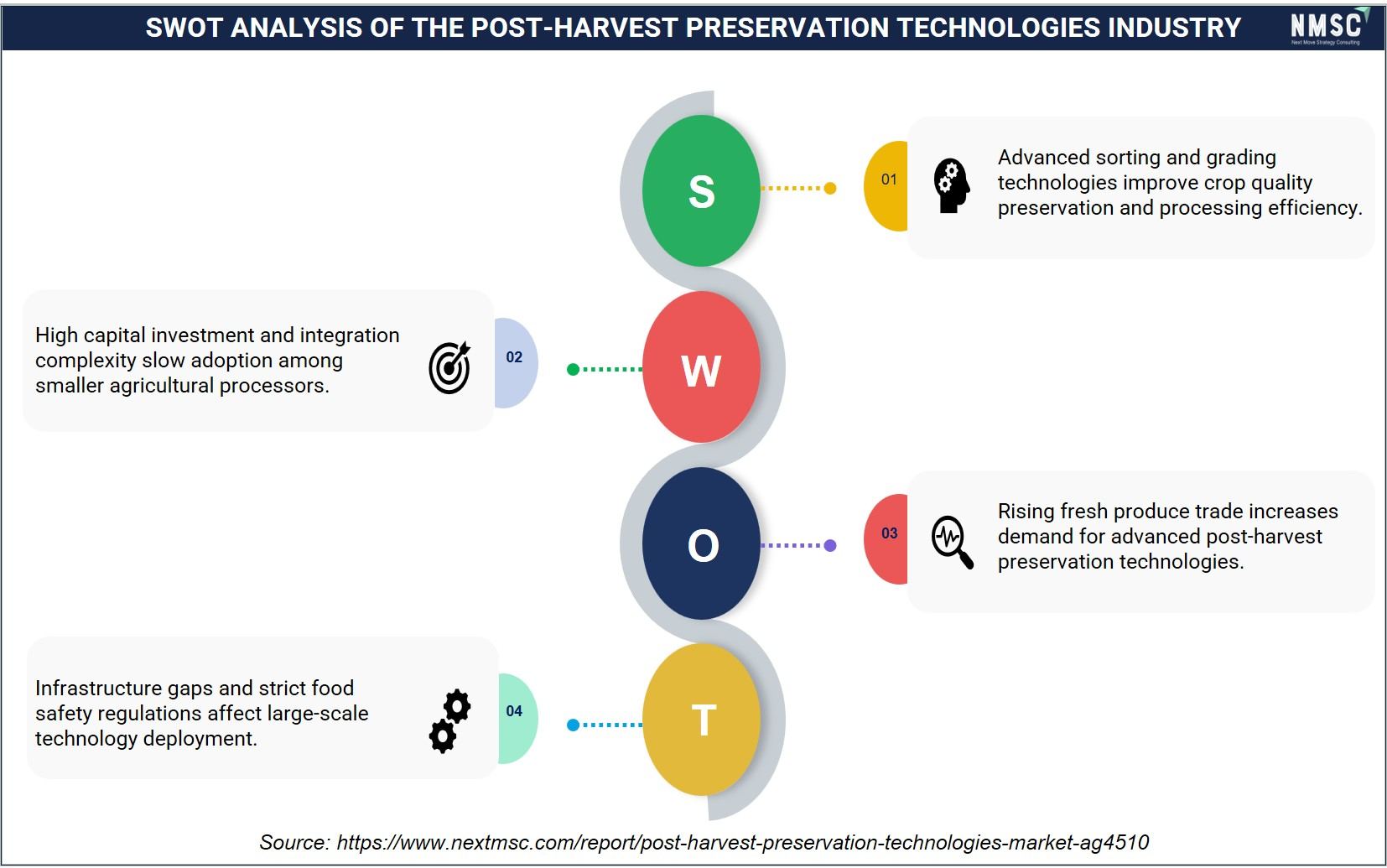
Based on our analysis, we noticed that the post-harvest preservation technologies market demonstrates strong potential as advanced sorting and grading technologies improve crop quality and processing efficiency. However, high capital investment and integration complexity influence adoption among smaller processors. At the same time, rising global fresh produce trade strengthens demand for modern preservation systems, while infrastructure gaps and strict food safety regulations continue shaping large-scale technology deployment across agricultural supply chains.
List of Key Post-Harvest Preservation Technologies Companies
-
TOMRA Systems ASA
-
Bühler AG
-
Grain & Protein Technologies
-
Agrosaw
-
Tong Engineering Ltd
-
SATAKE CORPORATION
-
PETKUS Technologie GmbH
-
Westrup A/S
-
Key Technology (Duravant)
-
Aweta
-
Ellips B.V.
-
Zhengzhou First Industry Co.
-
Sickle Innovations Private Limited
-
SK Agro
-
Akyurek Technology
-
Alvan Blanch
-
ArrowCorp
-
Oliver Manufacturing CO, Inc.
-
SYNMEC International Trading Ltd
-
StaxxLogix (Bench Industries Inc.)
What Are The Latest Key Industry Developments?
-
March, 2026 - Key Technology, part of the Duravant family, introduced the COMPASS Optical Sorter for leafy greens. This launch includes an advanced vision system that eliminates foreign material and defects while maintaining the structural integrity of fragile produce during high-speed processing.
-
June 2025 - SATAKE CORPORATION expanded its international footprint by delivering its newest high-capacity rice milling facility in Australia. This development follows the launch of the Pellet Sorter II in June 2025, which utilizes dual-sided sensors for precision sorting in grain and pellet production.
-
September 2025 - Duravant (parent company of Key Technology) launched Duravant India, establishing two operational hubs in Thane and Vadodara. This move provides localized engineering and technical support for the Indian agricultural market's shift toward automated food sorting and handling.
What Are The Key Factors Influencing Investment Analysis & Opportunities In The Post-Harvest Preservation Technologies Market?
Investment activity in the post-harvest preservation technologies market increasingly reflects the growing importance of efficient agricultural supply chains and food loss reduction initiatives. In our evaluation of equipment deployments, technology partnerships, and agricultural infrastructure programs, we observed that investors and strategic stakeholders prioritize companies offering advanced optical sorting systems, automated grading technologies, energy-efficient drying solutions, and integrated storage monitoring platforms. These technologies directly address critical industry challenges such as post-harvest losses, inconsistent crop quality, and inefficiencies in large-scale agricultural processing facilities. As a result, companies demonstrating proven processing efficiency, strong engineering capabilities, and scalable equipment platforms consistently attract strategic investments across global agricultural markets.
We also identified growing investment concentration around AI-enabled sorting systems, digital storage monitoring technologies, and integrated post-harvest automation platforms designed to improve grading accuracy and extend crop shelf life. Through our interactions with agricultural processors, and food supply chain operators, we confirmed that investors increasingly favour technology providers capable of integrating sorting, drying, storage, and handling systems within complete post-harvest processing lines. Moreover, strategic investments from agricultural equipment manufacturers and food processing companies increasingly outweigh purely financial funding, as industry participants seek to strengthen technology capabilities and expand global distribution networks. Consequently, investment opportunities continue to emerge in companies combining technological innovation, reliable processing performance, and scalable post-harvest infrastructure solutions.
Key Benefits for Stakeholders:
Next Move Strategy Consulting (NMSC) presents a comprehensive analysis of the market, covering historical developments from 2020 to 2025 and providing forward-looking forecasts through 2035. The study evaluates the post-harvest preservation technologies market trends at global, regional, and country levels, delivering quantitative outlooks alongside qualitative insights into key growth drivers, operational challenges, technology evolution, and investment dynamics across major post-harvest processing segments.
In our observation, the post-harvest preservation technologies industry delivers measurable value across a diverse agricultural stakeholder ecosystem. Investors benefit from growing demand for advanced crop handling, sorting, drying, and storage systems driven by rising food security concerns and the need to reduce post-harvest losses. Agricultural producers and food processors gain improved crop quality, extended shelf life, and reduced spoilage through the deployment of optical sorting systems, automated grading technologies, and controlled storage environments.
Meanwhile, equipment manufacturers, technology providers, and agricultural infrastructure developers benefit from long-term equipment installations, service contracts, and modernization projects across grain processing plants, fruit packing facilities, and cold storage infrastructure. By aligning technological innovation with efficient crop preservation and supply chain reliability, the post-harvest preservation technologies market continues to create sustained value across global agricultural production and food distribution systems.
|
Parameters |
Details |
|
Customization Scope |
Free customization (equivalent to up to 80 analyst-working hours) after purchase. Addition or alteration to country, regional & segment scope. |
|
Pricing and Purchase Options |
Avail customized purchase options to meet your exact research needs. |
|
Approach |
In-depth primary and secondary research; proprietary databases; rigorous quality control and validation measures. |
|
Analytical Tools |
Porter's Five Forces, SWOT, value chain, and Harvey ball analysis to assess competitive intensity, stakeholder roles, and relative impact of key factors. |
Key Market Segments
By Post-Harvest Treatment Technologies
-
Chemical Treatments
-
Edible Coatings
-
Wax Coatings
-
Fungicides
-
Synthetic Fungicides
-
Biological Fungicides
-
-
Sanitizers And Disinfectants
-
Sprout Inhibitors
-
Anti-Microbial Preservatives
-
Others
-
-
Non-Chemical Treatments
-
UV-C Treatment
-
Irradiation Systems
-
Ozone Treatment
-
Plasma Treatment
-
Pulsed Light Treatment
-
Others
-
By Drying & Moisture Control Technologies
-
Mechanical Dryers
-
Solar Dryers
-
Heat Pump Dryers
-
Microwave Dryers
-
Fluidized Bed Dryers
-
Dehumidification Systems
By Post-Harvest Handling Equipment
-
Cleaning Equipment
-
Washing Systems
-
Sorting Equipment
-
Optical Sorting
-
Mechanical Sorting
-
-
Grading Equipment
-
Conveyors And Elevators
By Cold Chain & Storage Technologies
-
Cold Storage Systems
-
Refrigerated Storage
-
Cold Rooms
-
Pre-Cooling Systems
-
Hydro-Cooling Systems
-
Vacuum Cooling Systems
-
-
Atmospheric Controlled Storage Systems
-
Controlled Atmosphere Storage
-
Modified Atmosphere (MA) Storage
-
Hypobaric Storage
-
-
Bulk Storage Systems
-
Grain Silos
-
Hermetic Storage
-
Hermetic Bags
-
Hermetic Silos
-
-
Bulk Storage Bins
-
-
Transport Systems
-
Refrigerated Trucks
-
Refrigerated Containers
-
Insulated Containers
-
Portable Cooling Units
-
Temperature-Controlled Pallets
-
In-Transit Monitoring Devices
-
By Packaging Technologies
-
Modified Atmosphere Packaging
-
Vacuum Packaging
-
Active Packaging
-
Smart Packaging
-
Ethylene Absorbing Packaging
-
Moisture Control Packaging
-
-
Barrier Films
-
Breathable Packaging
-
Others
By Monitoring & Quality Control Technologies
-
Environmental Monitoring
-
Temperature Monitoring Systems
-
Humidity Monitoring Systems
-
Gas Monitoring Systems
-
IoT Sensors
-
Data Loggers
-
-
Quality Inspection
-
Optical Inspection Systems
-
Spectroscopy Inspection Systems
-
Ripeness Sensors
-
Damage Detection Systems
-
-
Traceability Systems
-
RFID Systems
-
Barcode Systems
-
Blockchain Traceability
-
Inventory Tracking Systems
-
By Crop Type
-
Fruits
-
Vegetables
-
Cereals & Grains
-
Pulses & Legumes
-
Oilseeds
-
Nuts
-
Spices
-
Plantation Crops
-
Flowers & Ornamentals
-
Others
By Farm Scale
-
Smallholder Farms
-
Medium-Sized Farms
-
Large Commercial Farms
By End User
-
Farmers And Growers
-
Agricultural Cooperatives
-
Food Processing Companies
-
Cold Storage Operators
-
Logistics Providers
-
Retail Chains & Supermarkets
-
Agricultural Exporters
-
Others
Geographical Breakdown
-
North America: U.S., Canada, and Mexico.
-
Europe: UK, Germany, France, Italy, Spain, Sweden, Denmark, Finland, the Netherlands, and the Rest of Europe.
-
Asia Pacific: China, India, Japan, South Korea, Taiwan, Indonesia, Vietnam, Australia, Philippines, Malaysia and the rest of APAC.
-
Middle East & Africa (MEA): Saudi Arabia, UAE, Egypt, Israel, Turkey, Nigeria, South Africa, and the rest of MEA.
-
Latin America: Brazil, Argentina, Chile, Colombia, and the rest of LATAM.
Conclusion & Recommendations
This report equips stakeholders, industry participants, investors, and consultants with actionable intelligence to capitalize on the structural transformation underway in the market. By combining rigorous data-driven analysis with established agricultural technology frameworks, NMSC’s Post-Harvest Preservation Technologies Market Report serves as a critical decision-support resource for navigating the rapidly evolving landscape of crop preservation and agricultural processing. The market continues to demonstrate sustained expansion, supported by rising global food demand, increasing emphasis on reducing post-harvest losses, and growing investments in modern agricultural infrastructure. Key strategic insights highlight the expanding role of optical sorting systems, automated grading technologies, controlled storage environments, and energy-efficient drying solutions, as these technologies strengthen crop quality preservation, processing efficiency, and supply chain reliability across agricultural markets. Equipment providers that prioritize precision sorting technologies, modular processing systems, and integrated storage monitoring platforms consistently strengthen customer adoption and long-term equipment utilization.
For executives and investors, capturing value increasingly requires focusing on high-growth applications such as grain processing, fresh produce grading, seed conditioning, and export-oriented horticulture logistics, while continuing investments in processing automation, digital monitoring technologies, and energy-efficient storage infrastructure. Expanding presence in high-growth agricultural regions, particularly Asia-Pacific, Latin America, and emerging African agricultural markets, unlocks new demand pools for advanced preservation technologies. Furthermore, reliable processing performance, scalable equipment platforms, and measurable reductions in post-harvest losses strengthen vendor credibility and accelerate adoption, thereby creating durable value across the global agricultural preservation ecosystem.


About the Author
 Saista Faiyaz
— Saista Faiyaz is Research Associate at Next Move Strategy Consulting, where she has covered consumer markets and healthcare technologies for 3 years. Her work includes primary interview review, secondary-source validation, market sizing, and structured analysis of company and industry data. She supports research by comparing evidence across sources, organizing findings into market narratives, and documenting assumptions used in analysis. Her scope includes cross-market benchmarking, and reports.
Saista Faiyaz
— Saista Faiyaz is Research Associate at Next Move Strategy Consulting, where she has covered consumer markets and healthcare technologies for 3 years. Her work includes primary interview review, secondary-source validation, market sizing, and structured analysis of company and industry data. She supports research by comparing evidence across sources, organizing findings into market narratives, and documenting assumptions used in analysis. Her scope includes cross-market benchmarking, and reports.
About the Reviewer
 Supradip Baul
— Supradip Baul is an accomplished business consultant and strategist with over a decade of rich experience in market intelligence, strategy, technology, and business transformation. His work has included rigorous qualitative and quantitative analysis across multiple industries, helping clients shape investment decisions and long-term roadmaps. Earlier in his career, he was associated with Gartner, where he contributed to industry-leading reports and market share analyses. He has worked with leading global companies and holds an MBA with a dual specialization in Marketing and Finance.
Supradip Baul
— Supradip Baul is an accomplished business consultant and strategist with over a decade of rich experience in market intelligence, strategy, technology, and business transformation. His work has included rigorous qualitative and quantitative analysis across multiple industries, helping clients shape investment decisions and long-term roadmaps. Earlier in his career, he was associated with Gartner, where he contributed to industry-leading reports and market share analyses. He has worked with leading global companies and holds an MBA with a dual specialization in Marketing and Finance.
At Next Move Strategy Consulting, we understand that insightful market research is the cornerstone of successful business decisions. That's why we employ a robust and multifaceted approach, combining various methodologies to deliver the most accurate and actionable data for our clients.

Research Landscape
We navigate the world of research with two primary approaches:
Qualitative Approach
Our qualitative research methodologies involve immersive techniques such as in-depth interviews, focus groups, and observational studies. By engaging directly with individuals and stakeholders, we uncover valuable insights that quantitative data alone may overlook.

Quantitative Research
In tandem with qualitative methodologies, NMSC leverages the power of Quantitative Research to provide a robust foundation of numerical insights. Through systematic data collection and analysis, we quantify patterns, preferences, and market trends, offering a comprehensive view of the business landscape.
Our quantitative research approach employs diverse tools, including surveys, experiments, and statistical modelling. These methodologies enable us to gather data from a large and representative sample, ensuring the statistical significance of our findings. By employing structured questionnaires and standardized data collection methods, we guarantee the reliability and validity of the information we present to our clients.
Quantitative research is particularly effective in measuring the prevalence of trends, assessing market size, and gauging the impact of various factors on consumer behavior. The numerical precision attained through this approach equips our clients with actionable insights, facilitating data-driven decision-making and strategy formulation.


Our Specialized Toolbox for Industry-Specific Market Research
We deploy a specialized arsenal of techniques tailored to meet your unique requirements. Here's a glimpse into our comprehensive toolbox:

Information Procurement
The stage entails acquiring market data or relevant information through various sources and methodologies.


Market Research Approach
We utilize both top-down and bottom-up approaches in market research analysis to achieve a comprehensive understanding of the market dynamics, leveraging the broad perspective of industry trends and macroeconomic factors alongside detailed insights from specific segments and individual companies.

Porters Five Forces Analysis
We conduct Porter's Five Forces analysis to evaluate the competitive landscape of an industry, providing us with insights into factors that affect profitability and strategic positioning.

SWOT Analysis

Forecasting
We utilize a forecasting model to predict future consumption by considering parameters like population, economics, regulations, market competition, drivers, constraints, technology, and pricing. We also employ statistical techniques such as multilinear regression, exponential smoothing, moving average, ARIMA, and Monte Carlo simulations for accurate predictions. In econometric forecasting, we analyzed short-term and long-term event impacts, attributing values based on regulatory frameworks, economic factors, and market events.





 Speak to Our Analyst