Printing Toner Market Size, Share, Growth & Forecast by Product Type (Cartridge Toner: OEM, Compatible; Bulk Toner; Specialty Toner: MICR, Security, Magnetic), Manufacturing Technology (Conventional Toner, Chemical Toner), Resin Type (Polyester, Styrene Acrylic, Hybrid Resin), Colour Type (Monochrome Toner, Colour Toner, Specialty Colour Toner), Printer Type (Laser Printers, Copiers, Production Printing Systems), Distribution Channel, Commercial Model, and End User — Global Analysis 2025–2035
Industry: Materials and Chemical | Publishing Date: July 7, 2026 | Last Updated: September 30, 2026 | No of Pages: N/A | No. of Tables: N/A | No. of Figures: N/A | Format: PDF | Report Code: MC4996
What Is the Printing Toner Market Size?
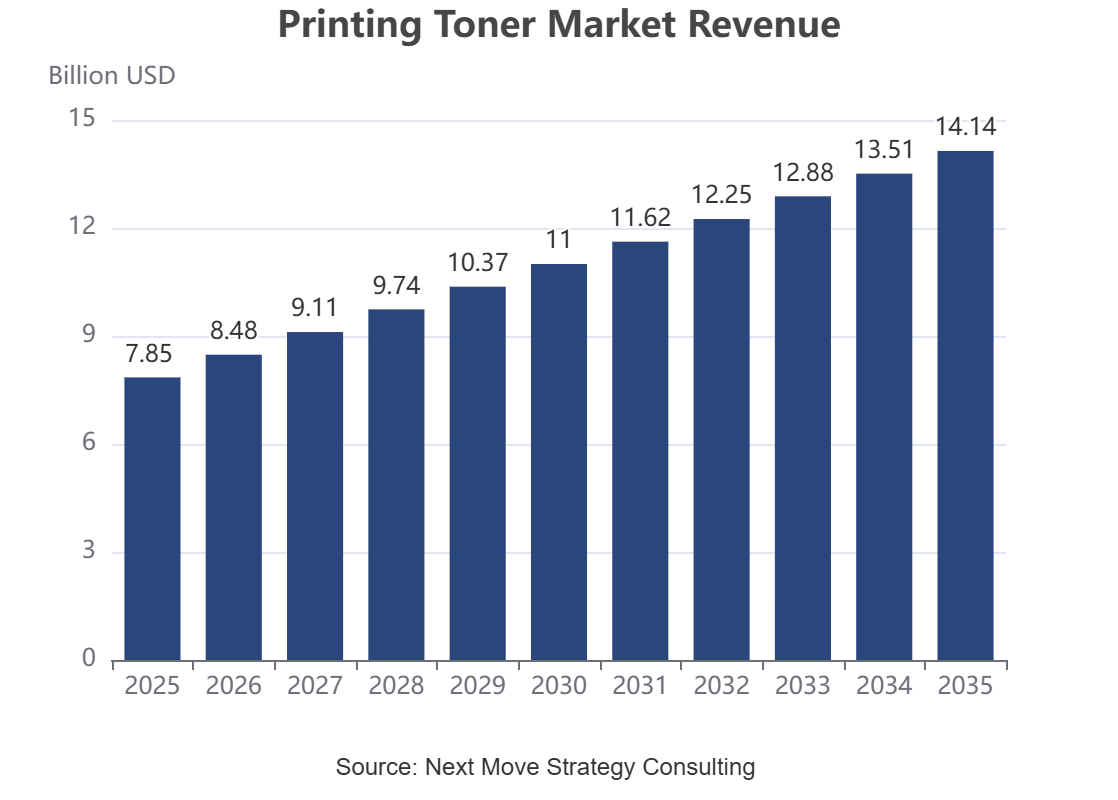
The global Printing Toner Market was valued at USD 7.85 billion in 2025 and is projected to reach USD 8.33 billion in 2026. Supported by sustained office and commercial print volumes, expanding managed print services adoption, continued demand for compatible and remanufactured cartridges, and growth in production print and specialty toner applications, the market is forecast to reach USD 14.14 billion by 2035, registering a CAGR of 6.06% from 2026 to 2035. Cartridge toner retains revenue dominance, while specialty toner and chemical manufacturing technologies are emerging as the fastest-growing categories within the broader Printing Toner Market report scope.
|
Parameters |
Details |
|
Market Size in 2025 |
USD 7.85 Billion |
|
Market Size in 2026 |
USD 8.33 Billion |
|
Revenue Forecast in 2035 |
USD 14.14 Billion |
|
Growth Rate |
CAGR of 6.06% from 2026 to 2035 |
|
Analysis Period |
2025–2035 |
|
Base Year Considered |
2025 |
|
Forecast Period |
2026–2035 |
|
Market Size Estimation |
USD Billion |
|
Companies Profiled |
20 |
|
Countries Covered |
33 |
|
Market Share |
Top 10 |
Printing Toner Market Overview
What Is the Scope of the Printing Toner Market Report?
The Printing Toner Market report covers powder and liquid imaging consumables used in laser printers, copiers, and production printing systems, spanning OEM cartridges, compatible and remanufactured alternatives, bulk refill formats, and specialty formulations including MICR, security, and magnetic toners. NMSC's analysis indicates that the market scope extends across conventional and chemically produced toner manufacturing technologies, multiple resin chemistries, monochrome and colour formulations, and distribution through direct enterprise contracts, managed print services, and indirect retail and e-commerce channels serving residential, commercial, and government end users globally.
How Has the Printing Toner Market Evolved Structurally?
The Printing Toner Market has evolved through three distinct structural phases. The first phase centred on pulverized, conventional toner formulations optimized for monochrome office printing. The second phase introduced chemically produced emulsion aggregation and suspension polymerization toners, enabling finer particle control and improved colour reproduction. Through NMSC's assessment, we found that the current phase is defined by the parallel growth of compatible and remanufactured cartridge alternatives, managed print services consumable contracts, and specialty toner formulations serving security printing, industrial labelling, and production print applications beyond traditional office environments.
How Is the Regulatory Environment Shaping the Printing Toner Market?
Regulatory frameworks are increasingly influencing toner formulation and disposal practices within the Printing Toner Market. The U.S. Environmental Protection Agency's guidelines on electronic waste and printer consumables recycling shape cartridge collection and remanufacturing program design. The European Union's Waste Electrical and Electronic Equipment Directive imposes producer responsibility obligations on toner cartridge manufacturers operating within the EU. These frameworks are compelling manufacturers to invest in take-back programs, recycled content disclosure, and low-emission toner formulations to satisfy both regulatory compliance and growing institutional buyer sustainability procurement requirements.
How Is Technology Adoption Reshaping the Printing Toner Market?
Technology adoption across the Printing Toner Market is advancing through chemically produced toner formulations that enable finer particle size distribution, lower fusing temperatures, and improved print quality relative to conventional pulverized toner. Based on NMSC's research, we found that emulsion aggregation toner technology is gaining adoption among production print and high-volume copier applications due to its consistent particle uniformity. Managed print services providers are increasingly integrating predictive consumable replenishment technology, using printer usage data to optimize toner delivery schedules and reduce both downtime and excess inventory across enterprise printing fleets.
|
Key Takeaways |
|
Cartridge Toner holds the largest share of the Printing Toner Market at USD 5.65 billion in 2025, reflecting its position as the standard consumable format for laser printers, copiers, and multifunction devices across virtually all end-use environments. |
|
Specialty Toner is the fastest-growing product type at a CAGR of 10.61% from 2026 to 2035, advancing from USD 0.63 billion in 2025 to USD 1.56 billion by 2035, driven by demand for MICR, security, and metallic toner formulations. |
|
Conventional Toner remains the dominant manufacturing technology at USD 4.87 billion in 2025, supported by its cost efficiency and broad compatibility with the installed base of laser printers and copiers worldwide. |
|
Chemical Toner is the fastest-growing manufacturing technology at a CAGR of 10.54% from 2026 to 2035, reaching USD 7.35 billion by 2035, as emulsion aggregation and suspension polymerization processes gain adoption in premium and production print applications. |
|
Monochrome Toner leads the colour type segment at USD 4.24 billion in 2025, anchored by Black Toner's continued dominance across high-volume text-based office and document printing applications. |
|
Specialty Colour Toner is the fastest-growing colour category at a CAGR of 11.67% from 2026 to 2035, supported by White, Clear, and Metallic Toner adoption in packaging, label, and decorative print applications. |
|
Laser Printers represent the dominant printer type at USD 4.08 billion in 2025, with Multifunction Printers as the leading sub-segment given their widespread deployment across small offices and enterprise environments alike. |
|
Production Printing Systems are the fastest-growing printer type at a CAGR of 11.15% from 2026 to 2035, reaching USD 3.25 billion by 2035, as commercial print providers expand high-volume digital production capacity. |
|
Indirect Sales is the dominant distribution channel at USD 4.87 billion in 2025, reflecting the continued role of distributors, office equipment dealers, and retail channels in reaching small and medium-sized toner buyers. |
|
E-Commerce Platforms are the fastest-growing indirect sales channel at a CAGR of 12.68% from 2026 to 2035, as both residential and small business buyers increasingly purchase toner cartridges through online marketplaces. |
|
North America leads the Printing Toner Market at USD 2.36 billion in 2025, forecast to reach USD 3.68 billion by 2035 at a CAGR of 5.07%, supported by a large installed printer base and high managed print services penetration. |
|
Asia-Pacific is the fastest-growing major region, advancing from USD 2.28 billion in 2025 to USD 5.09 billion by 2035 at a CAGR of 9.35%, propelled by expanding office infrastructure and commercial print demand across China and India. |
|
The United States is the leading individual country market, accounting for the substantial majority of North American revenue in 2025, supported by extensive enterprise printer fleets and mature managed print services adoption. |
|
The Philippines and Malaysia are among the fastest-growing national markets at a CAGR approaching 13% from 2026 to 2035, supported by expanding commercial office infrastructure and rising organized retail printer sales. |
Key Emerging Trends in the Printing Toner Market
How Is Managed Print Services Adoption Reshaping Consumable Procurement in the Printing Toner Market?
Managed print services adoption is fundamentally transforming how enterprises procure toner, shifting purchasing decisions away from transactional cartridge buying toward consolidated cost-per-page contracts. NMSC's analysis indicates that large enterprises increasingly outsource toner replenishment, device monitoring, and supply forecasting to managed print services providers, reducing internal procurement overhead. HP Inc.'s Managed Print Services portfolio exemplifies this shift, bundling toner supply with predictive analytics that anticipate replenishment needs before cartridges are depleted, reducing both downtime and excess consumable inventory for enterprise customers.
How Is the Compatible and Remanufactured Cartridge Segment Expanding Within the Printing Toner Market?
Compatible and remanufactured toner cartridges are capturing a growing share of replacement demand as cost-conscious buyers and sustainability-focused organizations seek lower-priced alternatives to OEM consumables. Through our market assessment, we observed that remanufacturing specialists, including Clover Imaging Group, are expanding collection and refurbishment capacity to meet this demand. The U.S. Environmental Protection Agency's electronics recycling guidance has further legitimised remanufactured cartridges as an environmentally preferable procurement option, supporting institutional buyer adoption across government and educational end-user segments.
How Is Specialty Toner Demand Growing Beyond Traditional Office Printing Applications?
Specialty toner formulations, including MICR, security, and metallic toners, are experiencing demand growth driven by applications extending well beyond conventional office printing. Our findings suggest that financial institutions continue to rely on MICR toner for check printing compliance with American Bankers Association magnetic ink character recognition standards, while security toner adoption is expanding among government and document-issuing organizations requiring tamper-evident printing. Metallic and white toner formulations are gaining traction in packaging and commercial print applications seeking differentiated visual finishes unavailable through standard colour toner.
How Is Production Print Expansion Driving Bulk Toner Demand in the Printing Toner Market?
Commercial print providers are expanding high-volume digital production printing capacity, driving structural demand growth for bulk toner formats, including production print toner and refill systems designed for continuous high-throughput operation. NMSC's analysis indicates that production printing systems require toner formulations engineered for consistent performance across extended print runs, distinct from cartridge-based formats designed for intermittent office use. This shift is reinforcing demand for bulk toner bottles and bags supplied directly to commercial print operations, light production environments, and high-volume production systems serving transactional and commercial print markets.
What Are the Key Market Drivers, Breakthroughs, and Investment Opportunities that Will Shape the Printing Toner Market in the Next Decade?
|
Drivers / Trends / Restraints |
(+/-) % Impact on CAGR Forecast |
Geographic Relevance |
Impact Timeline |
|
Managed Print Services Contract Expansion |
+1.4% |
North America, Europe, APAC |
2025–2032 |
|
Compatible and Remanufactured Cartridge Growth |
+1.1% |
Global |
2025–2035 |
|
Production Print and Commercial Print Expansion |
+1.3% |
North America, Europe, APAC |
< 2026–2035 |
|
Office Infrastructure Growth in Emerging Markets |
+1.2% |
Asia-Pacific, MEA, LATAM |
2026–2035 |
|
Specialty Toner Application Diversification |
+0.8% |
North America, Europe |
2026–2035 |
|
Digital Document Workflow Substitution |
-1.0% |
North America, Europe |
Ongoing |
|
OEM Cartridge Price Erosion from Compatibles |
-0.7% |
Global |
Ongoing |
|
Raw Material and Resin Price Volatility |
-0.5% |
All regions |
Ongoing |
|
E-Commerce Distribution Channel Expansion |
+0.9% |
Global |
2025–2032 |
|
Sustainability and Recycled Content Regulation |
+0.6% |
Europe, North America |
2025–2035 |
What Are the Growth Drivers of the Printing Toner Market?
How Is Sustained Office and Commercial Print Volume Driving the Printing Toner Market?
Despite ongoing digitalization trends, office and commercial print volumes remain a foundational demand driver for the Printing Toner Market. The U.S. Census Bureau's data on office equipment and supplies wholesale trade continues to reflect sustained transactional activity in printer consumables, indicating durable underlying print demand. Government agencies, financial institutions, healthcare organizations, and educational institutions maintain substantial document-intensive workflows requiring continuous toner replenishment, reinforcing baseline market growth, market size, and revenue stability even as some print volume migrates toward digital-first processes in select use cases.
How Is Managed Print Services Adoption Accelerating Printing Toner Market Growth and Demand?
The expansion of managed print services contracts is accelerating Printing Toner Market growth and demand by consolidating fragmented enterprise printer fleets under centralized consumable management agreements. Our findings suggest that the U.S. General Services Administration's federal strategic sourcing initiatives for office equipment and supplies have promoted consolidated managed print services procurement across federal agencies, creating a structured demand channel. This trend is increasing the proportion of Printing Toner Market revenue flowing through predictable, contract-based replenishment cycles rather than ad hoc transactional purchasing, supporting more stable long-term demand trends.
How Is Expanding Office Infrastructure in Emerging Markets Creating New Printing Toner Market Demand?
The continued build-out of office infrastructure, organized retail, and commercial enterprise facilities across Asia-Pacific, the Middle East, and Latin America is generating new addressable Printing Toner Market demand. Through NMSC's assessment, we found that India's Department for Promotion of Industry and Internal Trade has documented sustained investment inflows into commercial real estate and office infrastructure, directly supporting growth in laser printer and copier installations. As organized enterprise environments expand across these regions, toner consumption is rising in step with growing installed printer and copier device populations.
What Are the Growth Inhibitors of the Printing Toner Market?
How Does Digital Document Workflow Substitution Constrain Printing Toner Market Expansion?
The ongoing substitution of paper-based document workflows with digital alternatives represents a structural constraint on Printing Toner Market expansion, particularly across mature markets in North America and Europe. Enterprise digital transformation initiatives, electronic signature adoption, and cloud-based document management systems are reducing per-employee print volumes in office environments. Our assessment indicates that this substitution effect is most pronounced in administrative and internal communication printing, while transactional, compliance, and customer-facing print applications remain comparatively resilient, moderating but not eliminating the overall constraint on toner consumption growth.
How Does OEM Cartridge Price Erosion from Compatible Alternatives Limit Printing Toner Market Revenue Growth?
Price competition from compatible and remanufactured cartridge alternatives is exerting sustained downward pressure on OEM toner cartridge pricing, limiting overall Printing Toner Market revenue growth despite stable or growing unit volumes. Our market evaluation indicates that compatible cartridge manufacturers can offer functionally equivalent print yield at meaningfully lower price points, compelling OEM vendors to defend market share through bundled service offerings, warranty assurances, and managed print services contracts rather than competing purely on a per-cartridge price basis within increasingly price-sensitive enterprise and consumer purchasing decisions.
What Are the Growth Opportunities in the Printing Toner Market?
How Does Specialty Toner Diversification Create a High-Margin Opportunity in the Printing Toner Market?
Specialty toner formulations, including MICR, security, magnetic, and metallic variants represent a high-margin opportunity within the Printing Toner Market, as these applications command premium pricing relative to standard monochrome and colour toner. Our analysis shows that financial institutions' continued reliance on MICR toner for check processing compliance and government agencies' growing adoption of security toner for tamper-evident document printing are reinforcing demand for these specialized formulations. Vendors investing in specialty toner chemistry and application-specific certification are positioned to capture disproportionate margins relative to commodity cartridge segments.
How Does Managed Print Services Expansion in Emerging Markets Represent a Strategic Printing Toner Market Opportunity?
The expansion of managed print services models into emerging markets across Asia-Pacific, the Middle East, and Latin America represents a strategic growth opportunity for Printing Toner Market participants. Our market evaluation indicates that as organized enterprise sectors mature in these regions, large local and multinational businesses are increasingly receptive to consolidated cost-per-page contracts that bundle hardware, toner supply, and maintenance services. Vendors establishing managed print services capabilities ahead of broader market maturation are positioned to capture long-term, contract-based revenue streams as these markets continue their commercial infrastructure development.
How Does E-Commerce Distribution Expansion Create New Printing Toner Market Reach Opportunities?
The continued growth of e-commerce distribution channels presents a meaningful opportunity for Printing Toner Market participants to reach residential, small office, and small business buyers who increasingly prefer online purchasing over traditional retail or distributor channels. NMSC's analysis indicates that e-commerce platforms allow both OEM and compatible cartridge manufacturers to reach price-sensitive buyers directly, bypassing traditional distribution markups. Vendors optimizing digital catalogue presence, cartridge compatibility search tools, and direct-to-consumer fulfilment capabilities are capturing disproportionate growth within this rapidly expanding distribution channel.
How Is the Printing Toner Market Segmented in This Report, and What Are the Key Insights from the Segmentation Analysis?
How Do Cartridge, Bulk, and Specialty Toner Compare in Driving Revenue Across the Printing Toner Market?
|
Product Type Segment |
2025 (USD Bn) |
2035 (USD Bn) |
CAGR (%) |
|
Cartridge Toner |
5.652 |
9.332 |
5.73% |
|
Bulk Toner |
1.570 |
3.252 |
8.43% |
|
Specialty Toner |
0.628 |
1.556 |
10.61% |
Based on our analysis of consumable procurement patterns, we observed that the Printing Toner Market is segmented by product type into Cartridge Toner, Bulk Toner, and Specialty Toner. Cartridge Toner dominates at USD 5.65 billion in 2025, reflecting its position as the standard format across laser printers, copiers, and multifunction devices in nearly all end-use environments. Specialty Toner is the fastest-growing category at a CAGR of 10.61%, supported by MICR, security, and metallic toner applications. Bulk Toner is expanding steadily as production print and high-volume copier operations adopt refill bottles and bag formats over individual cartridges.
How Do Conventional and Chemical Toner Production Methods Compare Across the Printing Toner Market?
|
Manufacturing Technology Segment |
2025 (USD Bn) |
2035 (USD Bn) |
CAGR (%) |
|
Conventional Toner |
4.867 |
6.787 |
3.76% |
|
Chemical Toner |
2.983 |
7.353 |
10.54% |
In our assessment of toner production methods, we found that the Printing Toner Market is segmented by manufacturing technology into Conventional Toner and Chemical Toner. Conventional, pulverized toner remains dominant at USD 4.87 billion in 2025, reflecting its established cost efficiency and broad compatibility with the global installed printer base. Chemical Toner, encompassing emulsion aggregation and suspension polymerization processes, is growing substantially faster at a CAGR of 10.54%, as these technologies enable finer particle uniformity and lower fusing temperatures increasingly demanded in premium and production print applications.
How Do Polyester, Styrene Acrylic, and Hybrid Resins Compare in Toner Formulation?
|
Resin Type Segment |
2025 (USD Bn) |
2035 (USD Bn) |
CAGR (%) |
|
Polyester Toner |
3.454 |
6.787 |
7.79% |
|
Styrene Acrylic Toner |
2.591 |
3.959 |
4.82% |
|
Hybrid Resin Toner |
1.334 |
2.687 |
8.09% |
|
Other Resin Toner |
0.471 |
0.707 |
4.62% |
Based on our evaluation of toner chemistry, we found that the Printing Toner Market is segmented by resin type into Polyester Toner, Styrene Acrylic Toner, Hybrid Resin Toner, and Other Resin Toner. Polyester Toner leads at USD 3.45 billion in 2025, valued for its low-temperature fusing properties and compatibility with energy-efficient printer designs. Hybrid Resin Toner is the fastest-growing resin category at a CAGR of 8.09%, as manufacturers combine polyester and styrene acrylic properties to optimize both print quality and production cost efficiency across diverse printer platforms.
How Do Monochrome, Colour, and Specialty Colour Toners Compare Across the Printing Toner Market?
|
Colour Type Segment |
2025 (USD Bn) |
2035 (USD Bn) |
CAGR (%) |
|
Monochrome Toner |
4.239 |
6.222 |
4.36% |
|
Colour Toner |
2.983 |
6.222 |
8.51% |
|
Specialty Colour Toner |
0.628 |
1.696 |
11.67% |
Our findings suggest that Monochrome Toner, led entirely by Black Toner, remains the largest colour category at USD 4.24 billion in 2025, sustained by high-volume text and document printing across office, government, and educational environments. Colour Toner is growing significantly faster at a CAGR of 8.51%, as colour printing adoption expands across marketing, retail, and presentation materials. Specialty Colour Toner is the fastest-growing category overall at 11.67% CAGR, propelled by White, Clear, and Metallic Toner adoption in packaging and decorative commercial print applications.
How Do Laser Printers, Copiers, and Production Systems Compare in Toner Consumption?
|
Printer Type Segment |
2025 (USD Bn) |
2035 (USD Bn) |
CAGR (%) |
|
Laser Printers |
4.082 |
6.504 |
5.31% |
|
Copiers |
2.041 |
3.394 |
5.81% |
|
Production Printing Systems |
1.256 |
3.252 |
11.15% |
|
Specialty Printing Systems |
0.471 |
0.990 |
8.60% |
Based on our analysis of device-level consumption patterns, we found that Laser Printers account for the largest share of Printing Toner Market demand at USD 4.08 billion in 2025, led by Multifunction Printers given their pervasive deployment across small offices and large enterprises alike. Production Printing Systems are the fastest-growing printer type at a CAGR of 11.15%, reaching USD 3.25 billion by 2035, as commercial print providers scale high-volume digital production capacity to meet growing transactional and marketing print demand.
How Do Direct and Indirect Sales Channels Compare in Printing Toner Market Revenue Distribution?
|
Distribution Channel Segment |
2025 (USD Bn) |
2035 (USD Bn) |
CAGR (%) |
|
Direct Sales |
2.983 |
6.222 |
8.51% |
|
Indirect Sales |
4.867 |
7.918 |
5.56% |
Through our market assessment, we observed that the Printing Toner Market is segmented by distribution channel into Direct Sales and Indirect Sales. Indirect Sales remains the larger channel at USD 4.87 billion in 2025, reflecting the continued importance of distributors, office equipment dealers, and retail outlets in reaching small and medium-sized toner buyers. Direct Sales is growing faster at a CAGR of 8.51%, supported by expanding enterprise contracts and managed print services agreements that bypass traditional distribution intermediaries in favor of direct vendor relationships with large institutional buyers.
How Do OEM, Compatible, Remanufactured, and Service-Based Commercial Models Compare?
|
Commercial Model Segment |
2025 (USD Bn) |
2035 (USD Bn) |
CAGR (%) |
|
OEM Consumables |
3.611 |
5.090 |
3.89% |
|
Compatible Consumables |
1.648 |
3.394 |
8.36% |
|
Remanufactured Consumables |
1.099 |
2.121 |
7.58% |
|
Managed Print Services Consumables |
0.942 |
2.262 |
10.22% |
|
Cost Per Page Contracts |
0.550 |
1.273 |
9.77% |
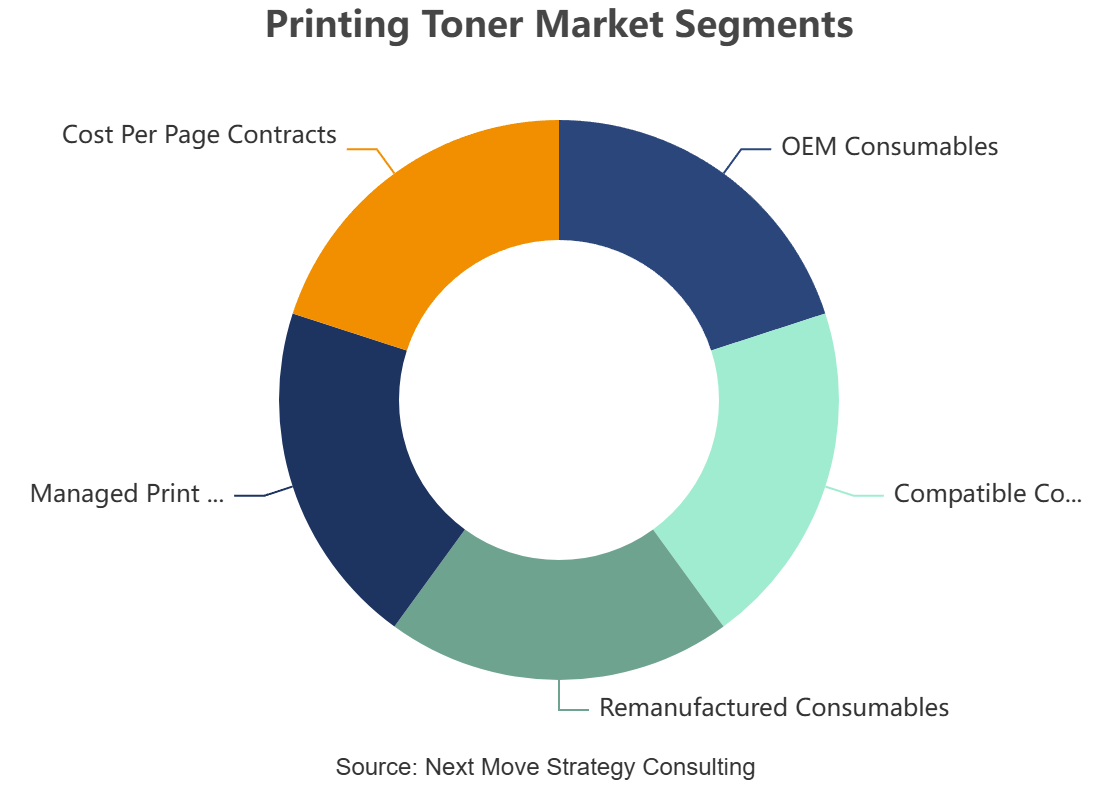
NMSC's analysis indicates that the Printing Toner Market is segmented by commercial model into OEM Consumables, Compatible Consumables, Remanufactured Consumables, Managed Print Services Consumables, and Cost Per Page Contracts. OEM Consumables remain dominant at USD 3.61 billion in 2025, though growing the slowest among all commercial models at 3.89% CAGR as buyers increasingly shift toward lower-cost alternatives. Managed Print Services Consumables are the fastest-growing commercial model at a CAGR of 10.22%, reflecting the broader structural shift toward consolidated, contract-based consumable procurement across enterprise buyers.
Which End User Categories Are Driving Demand Across the Printing Toner Market?
|
End User Segment |
2025 (USD Bn) |
2035 (USD Bn) |
CAGR (%) |
|
Residential Users |
0.706 |
0.848 |
2.06% |
|
Small and Home Offices |
0.785 |
1.131 |
4.14% |
|
Small and Medium Enterprises |
1.334 |
2.404 |
6.76% |
|
Large Enterprises |
1.570 |
2.687 |
6.15% |
|
Commercial Print Providers |
1.020 |
2.121 |
8.47% |
|
Government Organizations |
0.706 |
1.131 |
5.38% |
|
Educational Institutions |
0.549 |
0.990 |
6.77% |
|
Healthcare Organizations |
0.393 |
0.848 |
8.92% |
|
Financial Institutions |
0.393 |
0.848 |
8.92% |
|
Industrial and Manufacturing Organizations |
0.235 |
0.566 |
10.26% |
|
Other Commercial Organizations |
0.159 |
0.566 |
15.15% |
Based on our analysis of buyer-level demand patterns, we found that the Printing Toner Market is segmented by end user into eleven categories spanning residential through industrial buyers. Large Enterprises lead at USD 1.57 billion in 2025, supported by extensive printer fleets and managed print services contract penetration. Other Commercial Organizations is the fastest-growing end-user category at a CAGR of 15.15%, while Industrial and Manufacturing Organizations follow at 10.26%, both reflecting toner adoption expanding into labelling, documentation, and specialty printing applications beyond traditional office and institutional end users.
Price Point Analysis of the Printing Toner Market
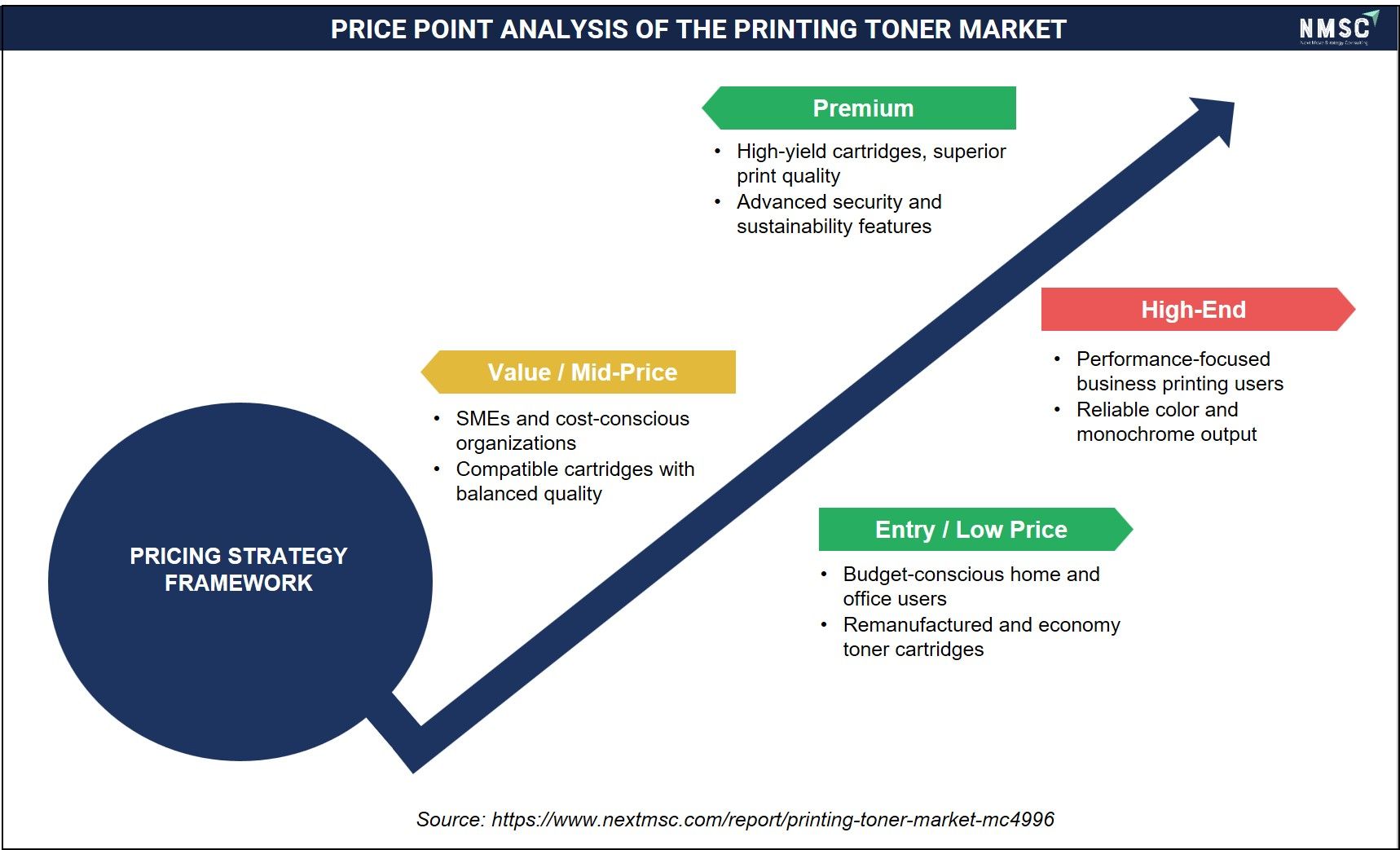
The above infographic presents a price point analysis of the Printing Toner Market, outlining a tiered pricing strategy that spans entry-level economy options to high-end performance solutions. Budget and value segments cater to cost-conscious users and SMEs with remanufactured and compatible cartridges, while premium and high-end tiers target businesses seeking superior print quality, advanced security, and sustainability features. Looking ahead, we observed that this diversified pricing approach effectively addresses varying consumer needs and printing requirements across the market.
Regional Outlook
Geographic Performance Snapshot
|
Region |
2025 (USD Bn) |
2035 (USD Bn) |
CAGR (%) |
Key Driver |
|
North America |
2.355 |
3.676 |
5.07% |
Large installed printer base, managed print services penetration |
|
Asia-Pacific |
2.276 |
5.090 |
9.35% |
Office infrastructure expansion, China and India growth |
|
Europe |
2.119 |
3.252 |
4.87% |
< WEEE compliance, mature enterprise print environments |
|
Latin America |
0.551 |
0.991 |
6.74% |
Brazil commercial print growth, organized retail expansion |
|
Middle East & Africa |
0.549 |
1.131 |
8.36% |
GCC office infrastructure, South Africa enterprise adoption |
North America Printing Toner Market
North America leads the Printing Toner Market at USD 2.36 billion in 2025, forecast to reach USD 3.68 billion by 2035 at a CAGR of 5.07%. The region's dominance reflects a large installed base of laser printers and copiers, high managed print services penetration, and the headquarters presence of HP Inc. and Xerox Holdings Corporation. The U.S. Environmental Protection Agency's electronics recycling guidelines continue to shape cartridge collection and remanufacturing program design, while enterprise demand for consolidated cost-per-page contracts remains strong across the region's mature commercial print environment.
U.S. Printing Toner Market
Based on our engagements, the United States represents the substantial majority of North American Printing Toner Market revenue in 2025, anchored by the headquarters presence of HP Inc., Xerox Holdings Corporation, and Static Control Components, Inc. The U.S. General Services Administration's federal strategic sourcing programs for office equipment and supplies have promoted consolidated managed print services procurement across federal agencies. The Environmental Protection Agency's electronics stewardship guidelines continue to shape cartridge recycling and remanufacturing program standards across the U.S. commercial printing ecosystem.
Canada Printing Toner Market
Through our analysis, Canada is a steadily growing Printing Toner Market within North America, supported by enterprise and government printing demand across major urban centers. Innovation, Science and Economic Development Canada's digital adoption programs have supported continued enterprise office technology investment, including printer fleet modernization. Canadian government procurement standards increasingly favor remanufactured and recycled-content toner consumables, supporting demand for environmentally certified products among federal and provincial government printing operations.
Mexico Printing Toner Market
From our assessment, Mexico represents a growing Printing Toner Market within North America, driven by expanding commercial office infrastructure and organized retail printer sales. Mexico's Secretaria de Economia has supported broader digital and commercial infrastructure investment relevant to office equipment demand. Mexican enterprises are increasingly adopting managed print services arrangements as multinational companies operating in the country extend their global consumable procurement standards to their Mexican operations and facilities.
Europe Printing Toner Market
Europe is the third-largest region in the Printing Toner Market at USD 2.12 billion in 2025, forecast to reach USD 3.25 billion by 2035 at a CAGR of 4.87%. The region's growth is shaped by the European Union's Waste Electrical and Electronic Equipment Directive, which imposes producer responsibility obligations on toner cartridge manufacturers. Konica Minolta, Inc. and FUJIFILM Business Innovation Corp.'s strong European enterprise customer base, combined with growing institutional demand for recycled-content consumables, continues to support steady regional Printing Toner Market expansion.
U.K. Printing Toner Market
Based on our engagements, the United Kingdom is one of Europe's largest individual Printing Toner Markets, supported by a substantial enterprise and government office printing base. The UK's Environment Agency enforces WEEE-aligned electronics producer responsibility regulations applicable to toner cartridge manufacturers operating domestically. UK government procurement frameworks increasingly favour remanufactured and recycled-content toner products, thereby supporting sustained demand for environmentally certified consumables across public-sector printing operations.
Germany Printing Toner Market
According to our evaluation, Germany is the leading European Printing Toner Market, supported by its large industrial and enterprise base and stringent environmental compliance standards. The German Federal Environment Agency enforces detailed WEEE implementation requirements governing toner cartridge collection and recycling. Germany's substantial manufacturing and industrial sectors drive additional demand for speciality toner in labelling and documentation applications beyond standard office printing requirements.
France Printing Toner Market
Through our analysis, France represents a significant European Printing Toner Market, supported by extensive government and enterprise office printing infrastructure. France's Agence de la Transition Ecologique oversees extended producer responsibility frameworks applicable to toner cartridge waste management. French enterprises and government agencies are increasingly adopting managed print services contracts as part of broader digital and sustainability-aligned procurement modernization initiatives across the public and private sectors.
Italy Printing Toner Market
From our assessment, Italy is a growing European Printing Toner Market, with demand concentrated among small and medium enterprises, government agencies, and educational institutions. Italy's Ministry of Environment and Energy Security enforces WEEE-aligned producer responsibility standards for toner cartridge manufacturers. Italian organizations are gradually increasing adoption of compatible and remanufactured cartridges as cost-conscious procurement practices extend across both private enterprise and public sector printing operations.
Spain Printing Toner Market
Based on our evaluation, Spain demonstrates steady Printing Toner Market growth, supported by enterprise and government office printing demand across the country's major commercial centers. Spain's Ministry for Ecological Transition enforces electronics waste management regulations applicable to toner cartridge producers. Spanish organizations are increasingly adopting managed print services and cost-per-page contracts as enterprises seek to consolidate and reduce the administrative overhead associated with traditional toner procurement processes.
Sweden Printing Toner Market
Based on our engagements, Sweden represents a mature Printing Toner Market within the Nordic region, supported by high enterprise digitalization alongside continued reliance on print for compliance and transactional documentation. Sweden's Environmental Protection Agency enforces stringent electronics waste and producer responsibility standards. Swedish enterprises and government agencies demonstrate a strong preference for recycled-content and remanufactured toner products aligned with the country's broader environmental sustainability policy framework.
Denmark Printing Toner Market
Through our analysis, Denmark is a mature digital economy with stable Printing Toner Market demand, particularly among government, healthcare, and educational institutions. The Danish Environmental Protection Agency enforces WEEE-aligned producer responsibility requirements for toner cartridge manufacturers. Danish organizations maintain a strong institutional commitment to recycled and remanufactured consumable procurement, supporting consistent demand for environmentally certified toner products across the public sector printing ecosystem.
Finland Printing Toner Market
From our assessment, Finland represents a niche but stable Printing Toner Market, supported by strong digital infrastructure alongside continued reliance on print for regulatory and transactional documentation. Finland's Ministry of the Environment enforces electronics waste management standards applicable to toner cartridge producers. Finnish enterprises and government agencies continue to invest in managed print services arrangements as part of broader office technology modernization and consumable cost optimization initiatives.
Netherlands Printing Toner Market
According to our evaluation, the Netherlands is a significant European Printing Toner Market hub, benefiting from its role as a regional logistics and distribution center for office equipment and consumables. The Dutch Ministry of Infrastructure and Water Management enforces WEEE-aligned electronics producer responsibility regulations. Dutch enterprises and distributors serve as an important regional gateway for toner cartridge distribution across neighbouring European markets, supporting the country's continued commercial significance.
Rest of Europe Printing Toner Market
The Rest of Europe, comprising Poland, Belgium, Switzerland, Austria, Portugal, and other nations, collectively represents a meaningful and growing segment of the European Printing Toner Market. Poland's expanding enterprise and government office sector and Switzerland's concentration of multinational corporate headquarters are notable contributors to regional demand. Belgium, hosting key EU regulatory institutions, remains an active policy environment shaping WEEE compliance standards, influencing toner manufacturer practices across the broader European market.
Asia-Pacific Printing Toner Market
Asia-Pacific is the fastest-growing major region in the Printing Toner Market, advancing from USD 2.28 billion in 2025 to USD 5.09 billion by 2035 at a CAGR of 9.35%. China's large-scale office infrastructure expansion, India's rapidly growing enterprise sector, and the regional manufacturing presence of Ninestar Corporation and Hubei Dinglong Co., Ltd. are primary growth drivers. Government-led digital and commercial infrastructure investment programs across the region are supporting continued growth in installed printer and copier device populations, driving toner consumption.
China Printing Toner Market
Based on our engagements, China is the largest Printing Toner Market in Asia-Pacific, driven by its vast enterprise and government office sector and significant domestic toner manufacturing capacity. China hosts Ninestar Corporation and Hubei Dinglong Co., Ltd., both globally significant toner and cartridge component manufacturers. China's Ministry of Ecology and Environment enforces electronics waste management regulations applicable to toner cartridge producers and remanufacturers operating within the domestic market.
India Printing Toner Market
Through our analysis, India is among the fastest-growing national Printing Toner Markets in Asia-Pacific, supported by rapid enterprise sector expansion and growing organized office infrastructure. India's Department for Promotion of Industry and Internal Trade has documented sustained investment inflows into commercial real estate and office infrastructure. Indian Toners & Developers Ltd., headquartered domestically, represents a significant local manufacturing presence supporting the country's growing toner consumption across the enterprise and government sectors.
Japan Printing Toner Market
According to our evaluation, Japan represents a mature and technologically advanced Printing Toner Market, anchored by the headquarters presence of Canon Inc., Ricoh Company, Ltd., Konica Minolta, Inc., Kyocera Document Solutions Inc., Seiko Epson Corporation, and FUJIFILM Business Innovation Corp. Japan's Ministry of Economy, Trade and Industry enforces electronics recycling and resource efficiency standards applicable to toner cartridge manufacturers. Japan's dense concentration of global toner technology leaders supports continued innovation in chemical toner production processes.
South Korea Printing Toner Market
From our assessment, South Korea demonstrates steady Printing Toner Market growth, supported by advanced digital infrastructure and a substantial enterprise office printing sector. South Korea's Ministry of Environment enforces extended producer responsibility regulations applicable to toner cartridge waste management. South Korean enterprises maintain strong adoption of managed print services arrangements as part of broader office technology and sustainability-aligned procurement modernisation initiatives.
Taiwan Printing Toner Market
Based on our engagements, Taiwan represents a growing Printing Toner Market, supported by a technology-oriented enterprise sector and significant electronics manufacturing presence. Taiwan's Environmental Protection Administration enforces electronics waste management standards applicable to toner cartridge producers and importers. Taiwanese enterprises demonstrate growing interest in compatible and remanufactured cartridge alternatives as cost-conscious procurement practices extend across the island's competitive business environment.
Indonesia Printing Toner Market
Through our analysis, Indonesia is an emerging Printing Toner Market, supported by expanding organized enterprise and government office infrastructure. Indonesia's Ministry of Environment and Forestry has introduced electronics waste management regulations relevant to toner cartridge disposal and recycling practices. Indonesian enterprises are gradually adopting managed print services arrangements as multinational companies operating in the country extend global consumable procurement standards to their domestic operations.
Vietnam Printing Toner Market
From our assessment, Vietnam represents a developing but promising Printing Toner Market, supported by rapid enterprise sector growth and increasing foreign direct investment in office and manufacturing infrastructure. Vietnam's Ministry of Natural Resources and Environment has introduced extended producer responsibility regulations applicable to electronics and consumer waste management. Vietnamese enterprises are increasingly adopting organized office printing infrastructure as the country's commercial sector continues its rapid modernization.
Australia Printing Toner Market
According to our evaluation, Australia is a mature Printing Toner Market, supported by a concentrated and technologically advanced enterprise and government sector. The Australian Government's National Television and Computer Recycling Scheme has been extended to cover broader electronics categories relevant to toner cartridge recycling. Australian enterprises demonstrate strong adoption of managed print services and remanufactured cartridge options as sustainability-aligned procurement practices continue expanding across the public and private sectors.
Philippines Printing Toner Market
Based on our engagements, the Philippines represents one of the fastest-growing Printing Toner Markets in Asia-Pacific, supported by expanding business process outsourcing infrastructure and growing organized office sector development. The Philippine Department of Environment and Natural Resources enforces electronics waste management regulations applicable to toner cartridge disposal. Philippine enterprises are increasingly adopting organized office printing infrastructure as the country's commercial services sector continues its rapid expansion.
Malaysia Printing Toner Market
Through our analysis, Malaysia is a growing Printing Toner Market, supported by an expanding enterprise sector and government-backed digital economy initiatives. The Malaysia Department of Environment enforces electronics waste management standards applicable to toner cartridge producers and distributors. Malaysian enterprises are increasingly adopting compatible and remanufactured cartridge alternatives as cost-conscious procurement practices extend across the country's diverse commercial and government office environments.
Rest of Asia-Pacific Printing Toner Market
The Rest of Asia-Pacific, comprising Thailand, Singapore, Bangladesh, New Zealand, and smaller markets, collectively represents a growing segment of the regional Printing Toner Market. Singapore functions as a regional distribution hub for several toner manufacturers serving Southeast Asian enterprise customers. Thailand's expanding organized office sector and New Zealand's mature enterprise printing infrastructure further contribute to this segment's steady contribution to the broader Asia-Pacific Printing Toner Market.
Middle East and Africa Printing Toner Market
The Middle East and Africa Printing Toner Market is advancing from USD 0.55 billion in 2025 to USD 1.13 billion by 2035 at a CAGR of 8.36%, supported by GCC office infrastructure expansion under national economic diversification programs, South Africa's mature enterprise printing sector, and growing organized commercial activity across Nigeria and Egypt. Government-led economic diversification initiatives across Saudi Arabia and the UAE are supporting broader commercial real estate and office infrastructure investment relevant to toner consumption growth.
Saudi Arabia Printing Toner Market
Based on our engagements, Saudi Arabia is the largest Printing Toner Market in the Middle East and Africa region, driven by Vision 2030's commercial and office infrastructure diversification objectives. The Saudi General Authority for Statistics has documented continued expansion in office and commercial real estate construction, supporting enterprise printer fleet growth. Saudi enterprises are increasingly adopting managed print services arrangements as government and private sector digital transformation programs continue expanding across the Kingdom.
UAE Printing Toner Market
Through our analysis, the UAE represents a significant Printing Toner Market within MEA, supported by Dubai and Abu Dhabi's sophisticated enterprise and government office sectors. The UAE Ministry of Climate Change and Environment has introduced electronics waste management guidelines relevant to toner cartridge recycling practices. UAE enterprises, particularly in financial services and government administration, are notable adopters of managed print services given the market's concentration of multinational corporate regional headquarters.
Egypt Printing Toner Market
From our assessment, Egypt is an emerging Printing Toner Market, supported by a large population base and growing organized enterprise and government office sector presence. Egypt's Ministry of Environment has introduced electronics waste management regulations relevant to toner cartridge disposal and recycling. Egyptian enterprises are gradually adopting organized office printing infrastructure as Cairo and other major urban centers continue their commercial sector modernization and formalization.
Israel Printing Toner Market
According to our evaluation, Israel represents a technology-advanced Printing Toner Market, supported by a sophisticated enterprise sector and high digital infrastructure maturity. Israel's Ministry of Environmental Protection enforces extended producer responsibility regulations applicable to electronics and consumer waste management. Israeli enterprises benefit from strong domestic technology sector presence, supporting efficient adoption of managed print services and modern office printing infrastructure across the country's commercial environment.
Turkey Printing Toner Market
Based on our engagements, Turkey is a significant Printing Toner Market within MEA, supported by a large and dynamic enterprise sector spanning financial services, manufacturing, and government administration. Turkey's Ministry of Environment, Urbanization and Climate Change enforces electronics waste management regulations applicable to toner cartridge producers. Turkish enterprises are increasingly adopting compatible and remanufactured cartridge alternatives as cost-conscious procurement practices extend across the country's competitive commercial landscape.
Nigeria Printing Toner Market
Through our analysis, Nigeria is Sub-Saharan Africa's largest Printing Toner Market opportunity, supported by a large population base and growing organized enterprise presence in Lagos and other major cities. Nigeria's Federal Ministry of Environment has introduced electronics waste management regulations relevant to toner cartridge disposal practices. Nigerian enterprises are gradually adopting organized office printing infrastructure as the country's formal commercial and government sector continues its expansion.
South Africa Printing Toner Market
From our assessment, South Africa is the most mature Printing Toner Market in Sub-Saharan Africa, supported by a sophisticated enterprise sector with established office printing infrastructure. South Africa's Department of Forestry, Fisheries and the Environment enforces extended producer responsibility regulations applicable to electronics and toner cartridge waste management. South African enterprises are notable adopters of managed print services and remanufactured cartridge options across the country's relatively advanced commercial printing ecosystem.
Rest of MEA Printing Toner Market
The Rest of MEA, encompassing Kuwait, Qatar, Bahrain, Oman, Jordan, Morocco, Kenya, Ghana, and other nations, collectively represents a growing segment of the regional Printing Toner Market. Gulf state markets outside Saudi Arabia and the UAE are investing in commercial office infrastructure aligned with broader economic diversification programs. Kenya's expanding formal enterprise sector and Morocco's growing organized commercial presence are notable contributors to this segment's gradual Printing Toner Market development.
Latin America Printing Toner Market
Latin America is a growing region in the Printing Toner Market, advancing from USD 0.55 billion in 2025 to USD 0.99 billion by 2035 at a CAGR of 6.74%. Brazil accounts for the largest share of regional revenue, supported by its substantial enterprise and government office printing sector. Regional commercial real estate expansion and increasing organized retail penetration across Argentina, Chile, and Colombia are contributing to steady Printing Toner Market expansion throughout the forecast period.
Brazil Printing Toner Market
Based on our engagements, Brazil is the largest Printing Toner Market in Latin America, supported by a large and well-established enterprise and government office printing sector. Brazil's Ministry of Environment and Climate Change enforces electronics waste management regulations applicable to toner cartridge producers and importers. Brazilian enterprises are increasingly adopting managed print services arrangements as multinational companies operating in the country extend global consumables procurement standards to their domestic operations.
Argentina Printing Toner Market
Through our analysis, Argentina is the second-largest Printing Toner Market in Latin America, supported by a sophisticated enterprise sector despite ongoing macroeconomic volatility. Argentina's Secretariat of Environment and Sustainable Development has introduced electronics waste management guidelines applicable to toner cartridge disposal. Argentine enterprises are gradually adopting compatible and remanufactured cartridge alternatives as cost-conscious procurement practices extend across the country's commercial and government office environments.
Chile Printing Toner Market
From our assessment, Chile represents a stable and growing Printing Toner Market, supported by one of Latin America's most developed enterprise sectors. Chile's Ministry of Environment enforces extended producer responsibility regulations applicable to electronics and toner cartridge waste management. Chilean enterprises are notable adopters of managed print services, leveraging the country's relatively advanced digital infrastructure and enterprise software and office technology maturity.
Colombia Printing Toner Market
According to our evaluation, Colombia is a growing Printing Toner Market, supported by an expanding organized enterprise sector and increasing urban commercial sophistication. Colombia's Ministry of Environment and Sustainable Development has introduced electronics waste management regulations applicable to toner cartridge producers. Colombian enterprises are gradually adopting organized office printing infrastructure as larger commercial operations continue to expand across the country's major urban centers.
Rest of LATAM Printing Toner Market
The Rest of Latin America, comprising Peru, Ecuador, Uruguay, Costa Rica, Panama, and other nations, collectively represents a smaller but growing component of the regional Printing Toner Market. Peru's expanding organized enterprise sector and Uruguay's relatively advanced digital infrastructure are notable contributors. Central American markets are gradually adopting modern office printing infrastructure as formal enterprise and government sectors continue to develop across the region.
Competitive Landscape
Competitive Dynamics and M&A Landscape
|
Key Takeaways |
Details |
|
Market Structure |
The Printing Toner Market features a moderately consolidated competitive structure spanning original equipment manufacturers including HP Inc., Canon Inc., Ricoh Company, Ltd., Brother Industries, Ltd., and component manufacturers including Ninestar Corporation, Hubei Dinglong Co., Ltd., and Mitsubishi Chemical Group Corporation, and compatible and remanufactured cartridge specialists including Clover Imaging Group, LLC and CET Group Co., Ltd. Competition centers on print quality consistency, yield performance, environmental compliance, and managed print services capability. |
|
Innovation Focus |
Innovation within the Printing Toner Market centers on chemically produced toner formulations enabling lower fusing temperatures and improved colour reproduction, recycled content integration to satisfy WEEE and EPA-aligned sustainability requirements, and specialty formulations including security and metallic toners serving differentiated application needs. Vendors are increasingly investing in predictive consumable replenishment technology integrated within managed print services platforms. |
|
M&A Activity |
M&A activity within the Printing Toner Market reflects continued consolidation among compatible and remanufactured cartridge specialists seeking expanded collection and refurbishment capacity. Clover Imaging Group, LLC has historically pursued acquisitions to expand its remanufacturing footprint, while toner powder manufacturers including Hubei Dinglong Co., Ltd. continue strengthening vertical integration with cartridge component producers to secure supply chain control across the value chain. |
How Do Companies Compete in the Printing Toner Market?
Competition in the Printing Toner Market operates across three primary dimensions. Original equipment manufacturers compete on print quality consistency, device compatibility, and bundled managed print services offerings that lock in long-term consumable revenue. Compatible and remanufactured cartridge specialists compete on price and environmental credentials, targeting cost-conscious and sustainability-focused institutional buyers. Toner powder and resin manufacturers compete on chemical formulation innovation and supply reliability, serving as critical upstream suppliers to both OEM and compatible cartridge producers across the global toner industry value chain.
Which Kind of Companies Dominate the Printing Toner Market?
The Printing Toner Market is currently dominated by two company archetypes. First, large original equipment manufacturers, including HP Inc., Canon Inc., and Ricoh Company, Ltd. leverage established device installed bases and managed print services relationships to retain dominant market share among enterprise and government buyers. Second, compatible and remanufactured cartridge specialists, including Clover Imaging Group, LLC and Ninestar Corporation, are capturing disproportionate growth among price-sensitive small business and residential buyers through expanding e-commerce distribution and improving product quality consistency.
AI-Native Differentiation and Open Standards Drive Market Success in the Printing Toner Market
NMSC's analysis indicates that vendors achieving the strongest competitive positioning within the Printing Toner Market increasingly combine predictive analytics-driven replenishment platforms with broad device compatibility across multiple printer brands. This approach allows managed print services providers to differentiate on operational intelligence while minimizing the integration friction associated with single-vendor proprietary ecosystems. Vendors successfully balancing data-driven consumable forecasting with cross-platform compatibility are demonstrating measurably stronger enterprise customer retention relative to closed, single-brand competitors within the market.
Market Players to Opt for Merger and Acquisition Strategies to Expand Their Presence in the Printing Toner Market
Our assessment indicates that M&A activity within the Printing Toner Market is expected to continue as compatible and remanufactured cartridge specialists seek to expand collection, refurbishment, and distribution capacity. Larger toner powder and component manufacturers possess the balance sheet capacity to pursue strategic acquisitions of regional remanufacturing specialists, while OEM vendors may continue pursuing complementary acquisitions in managed print services and predictive analytics capabilities to strengthen recurring consumable revenue streams across their enterprise customer base.
Who Are the Key Market Players in the Printing Toner Market?
-
HP Inc.
-
Canon Inc.
-
Ricoh Company, Ltd.
-
Brother Industries, Ltd.
-
Konica Minolta, Inc.
-
Xerox Holdings Corporation
-
FUJIFILM Business Innovation Corp.
-
Kyocera Document Solutions Inc.
-
Seiko Epson Corporation
-
Sharp Corporation
-
Ninestar Corporation
-
Hubei Dinglong Co., Ltd.
-
Kao Corporation
-
Tomoegawa Corporation
-
Mitsubishi Chemical Group Corporation
-
Sanyo Chemical Industries, Ltd.
-
Clover Imaging Group, LLC
-
CET Group Co., Ltd.
-
Static Control Components, Inc.
-
Indian Toners & Developers Ltd.
What Are the Latest Developments in the Toner Industry?
|
Date |
Event |
|
December 2025 |
Fujifilm Europe announced its gold toner for its Revoria SC285S and Revoria EC2100S models. |
|
October 2025 |
FUJIFILM announced new Silver and White specialty toners for its REVORIA PRESS EC2100S and SC285S platforms. These additions complement existing Pink, Clear, and Textured Clear toners, enabling higher-value applications such as metallic effects, premium packaging, and specialty graphics. |
Expert Insights

"We said in launching these 5UPER COLOUR devices that our vision was to make speciality toners, and 5-colour printing, accessible to a larger market than ever before. The huge success of the devices in Europe in their first year shows that this vision is being realised, and through continual innovation, we’re excited to help customers keep expanding the possibilities of what they can do."
- Mark Lawn, Head of POD Solutions, Fujifilm EMEA
Statement made during Fujifilm’s announcement regarding the availability of Gold Toner for its Revoria 5UPER COLOUR presses.
Market Interpretation
The comment underscores the Printing Toner Market’s ongoing evolution toward specialty toner applications and value-added digital printing. As commercial print providers seek differentiation and higher-margin services, demand for metallic, white, clear, fluorescent, and other specialty toners is expanding beyond conventional CMYK printing. This trend is driving investment in advanced toner technologies and production printing systems, creating new growth opportunities for toner manufacturers serving packaging, branding, personalization, and premium print applications.
Consumer Behaviour Analysis of the Printing Toner Market
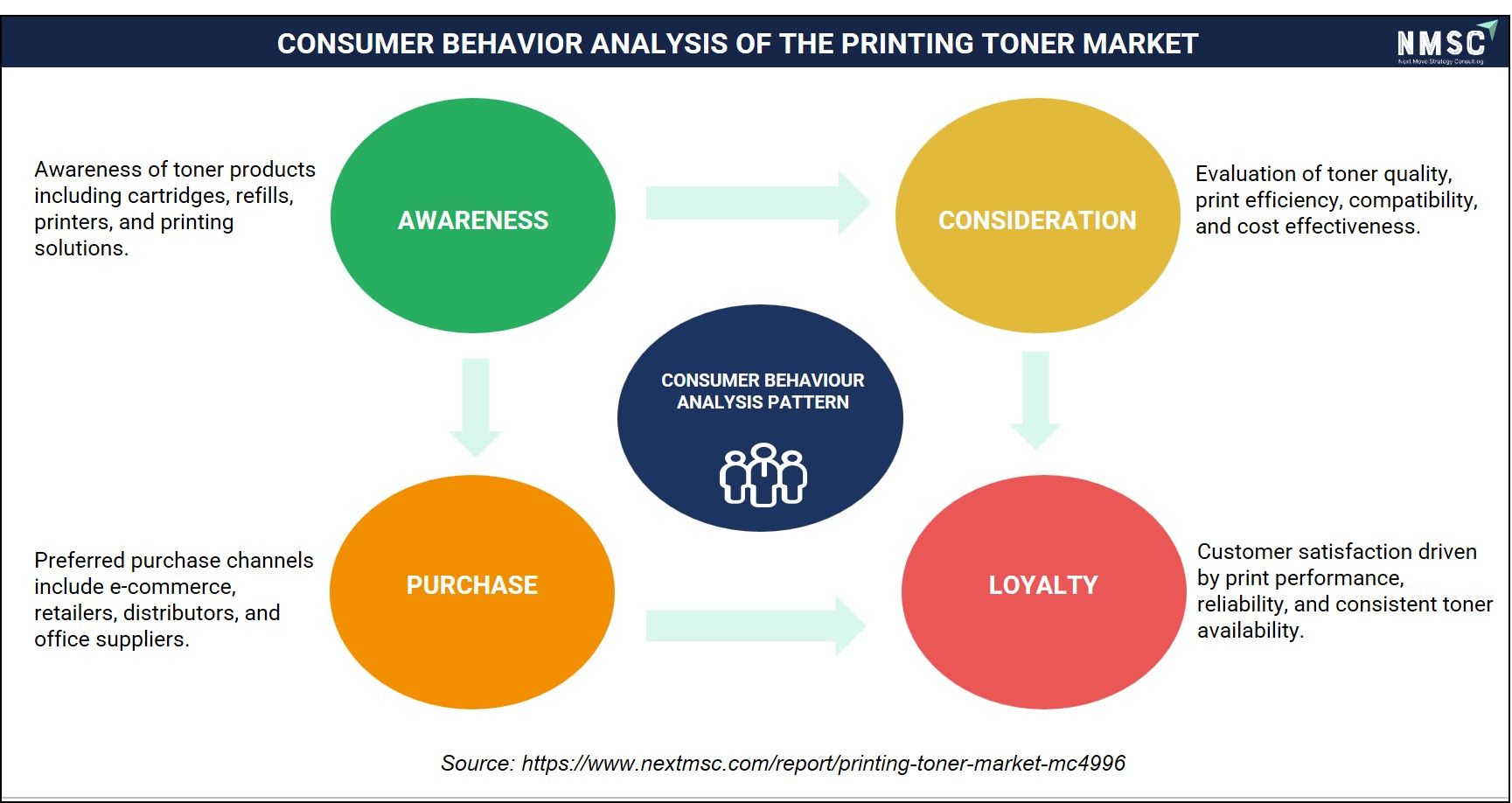
The above infographic presents a consumer behaviour analysis of the Printing Toner Market, mapping the journey from awareness to purchase. Awareness is driven by exposure to cartridges, refills, printers, and printing solutions, leading consumers to evaluate quality, compatibility, and cost before making purchasing decisions through e-commerce, retailers, distributors, and office suppliers. Looking ahead, we observed that these behavioural patterns collectively shape brand preferences and purchasing decisions across the market.
What Are the Investment Opportunities in the Printing Toner Market?
Capital Inflows and Venture Activity
The Printing Toner Market continues to attract corporate capital investment directed toward remanufacturing capacity expansion and recycled material processing infrastructure. Clover Imaging Group, LLC has continued investing in expanded refurbishment facility capacity to meet institutional demand for environmentally certified consumables. Our findings suggest that continued enterprise sustainability procurement commitments are translating into sustained capital allocation toward remanufacturing and recycled content production capabilities across the global toner supply chain.
Infrastructure Investment
Toner powder production and cartridge assembly infrastructure investment continue across major manufacturing hubs in the Asia-Pacific, supporting both OEM and compatible cartridge supply chains. Continued capacity expansion by toner powder manufacturers, including Hubei Dinglong Co., Ltd. supports the scalability requirements of global compatible cartridge demand. The U.S. Environmental Protection Agency's electronics stewardship infrastructure guidance continues to inform collection and recycling facility design standards relevant to toner cartridge remanufacturing operations.
ESG and Sustainability Considerations
Environmental and social governance considerations are increasingly central to Printing Toner Market investment decisions, as cartridge recycling and recycled content integration directly address regulatory compliance and corporate sustainability reporting requirements. The European Union's Waste Electrical and Electronic Equipment Directive and the U.S. Environmental Protection Agency's Sustainable Materials Management Program both create policy alignment between toner cartridge circularity investment and broader corporate environmental disclosure obligations for manufacturers and institutional buyers alike.
Digital Transformation Enablement
Toner consumables remain integral to enterprise digital transformation programs that paradoxically continue to rely on print for compliance, transactional, and customer-facing documentation even as internal workflows digitize. Managed print services platforms increasingly integrate toner replenishment within broader enterprise document workflow management systems, positioning consumable supply as a component of comprehensive digital transformation rather than a standalone procurement category, supporting durable multi-year Printing Toner Market investment relevance.
Private Equity and Strategic M&A Activity
Private equity and strategic corporate investment activity within the Printing Toner Market is expected to continue as remanufacturing specialists and toner component manufacturers seek to expand capacity and geographic reach. Established OEM vendors possess the balance sheet capacity to pursue strategic acquisitions in managed print services and predictive analytics capabilities, while financial sponsors may continue pursuing consolidation of regional remanufacturing and compatible cartridge production specialists across fragmented geographic markets.
Key Benefits for Stakeholders
For Enterprise and Government Procurement Teams
Enterprise and government procurement teams gain access to a comprehensive and vendor-neutral assessment of the Printing Toner Market, including quantitative market sizing and forecasts across product type, commercial model, end-user, and distribution channel segments. The analysis provides procurement decision-makers with detailed insights into pricing trends, supplier positioning, managed print services adoption, and regional demand dynamics, enabling more effective consumable sourcing strategies, contract negotiations, vendor evaluation, and long-term budget planning for printing infrastructure.
For Toner and Cartridge Manufacturers
Toner and cartridge manufacturers benefit from in-depth competitive benchmarking across OEM, compatible, remanufactured, and specialty toner categories, supported by detailed segment-level demand analysis and regional growth assessments. The study highlights evolving customer preferences, technological developments in toner formulations, and distribution channel shifts, helping manufacturers optimize R&D investments, production capacity planning, product portfolio expansion, and market-entry strategies across both mature and emerging markets.
For Investors and Financial Analysts
Investors and financial analysts gain access to a structured, data-driven evaluation of the Printing Toner Market’s growth outlook, competitive landscape, and revenue opportunities through 2035. Detailed CAGR forecasts across segments, regions, and end-user categories help support investment screening, valuation modelling, and portfolio allocation decisions. The analysis also identifies emerging growth themes such as specialty toner products, sustainability-focused consumables, managed print services integration, and high-growth regional markets.
For Managed Print Services Providers
Managed print services providers receive actionable intelligence on market demand patterns, customer procurement behaviour, and competitive positioning across commercial, government, educational, and industrial end-user segments. The report identifies underserved customer categories, evolving print management requirements, and regional growth opportunities, enabling providers to refine service offerings, strengthen contract acquisition strategies, and optimize consumables management programs.
For Compatible and Remanufactured Cartridge Specialists
Compatible and remanufactured cartridge manufacturers gain insights into the impact of sustainability initiatives, circular economy practices, institutional procurement policies, and e-commerce expansion on toner consumption patterns. The analysis helps stakeholders evaluate future demand potential, identify favourable geographic markets, and develop effective channel expansion, production planning, and sustainability-focused market positioning strategies.
For Government and Regulatory Bodies
Government agencies and regulatory organizations gain access to evidence-based analysis of how environmental regulations, e-waste management policies, circular economy initiatives, and sustainable procurement frameworks are influencing the Printing Toner Market. Country- and region-level insights provide policymakers with a clear understanding of industry compliance trends, recycling adoption patterns, and the broader implications of regulations such as the EU WEEE Directive and sustainable materials management guidelines on market development.
Key Market Segments
By Product Type
-
Cartridge Toner
-
OEM Toner Cartridges
-
Standard Yield
-
High Yield
-
Extra High Yield
-
-
Compatible Toner Cartridges
-
New Compatible Toner Cartridges
-
Remanufactured Toner Cartridges
-
-
-
Bulk Toner
-
Refill Toner Bottles
-
Refill Toner Bags
-
Production Print Toner
-
-
Specialty Toner
-
MICR Toner
-
Security Toner
-
Magnetic Toner
-
Fluorescent Toner
-
White Toner
-
Clear Toner
-
Metallic Toner
-
Other Specialty Toner
-
By Manufacturing Technology
-
Conventional Toner
-
Pulverized Toner
-
-
Chemical Toner
-
Emulsion Aggregation Toner
-
Suspension Polymerization Toner
-
By Resin Type
-
Polyester Toner
-
Styrene Acrylic Toner
-
Hybrid Resin Toner
-
Other Resin Toner
By Colour Type
-
Monochrome Toner
-
Black Toner
-
-
colour Toner
-
Cyan Toner
-
Magenta Toner
-
Yellow Toner
-
Process Black Toner
-
-
Specialty colour Toner
-
White Toner
-
Clear Toner
-
Metallic Toner
-
Fluorescent Toner
-
By Printer Type
-
Laser Printers
-
Personal Laser Printers
-
Workgroup Laser Printers
-
Multifunction Printers
-
-
Copiers
-
Analog Copiers
-
Digital Copiers
-
-
Production Printing Systems
-
Light Production Systems
-
Mid-Volume Production Systems
-
High-Volume Production Systems
-
-
Specialty Printing Systems
By Distribution Channel
-
Direct Sales
-
Enterprise Contracts
-
Managed Print Services Contracts
-
Direct Online Sales
-
-
Indirect Sales
-
Distributors and Wholesalers
-
Office Equipment Dealers
-
IT Resellers
-
Office Supply Retailers
-
E-Commerce Platforms
-
By Commercial Model
-
OEM Consumables
-
Compatible Consumables
-
Remanufactured Consumables
-
Managed Print Services Consumables
-
Cost Per Page Contracts
By End User
-
Residential Users
-
Small and Home Offices
-
Small and Medium Enterprises
-
Large Enterprises
-
Commercial Print Providers
-
Government Organizations
-
Educational Institutions
-
Healthcare Organizations
-
Financial Institutions
-
Industrial and Manufacturing Organizations
-
Other Commercial Organizations
Conclusion and Recommendations
Long-Term Outlook for the Printing Toner Market
The Printing Toner Market is positioned for steady, sustained growth through 2035, advancing from USD 7.85 billion in 2025 to USD 14.14 billion by 2035 at a CAGR of 6.06%. This trajectory reflects the structural resilience of print-dependent compliance, transactional, and commercial documentation workflows even as broader digitalization trends continue. NMSC's long-term assessment indicates that specialty toner formulations, managed print services consumables, and Asia-Pacific regional demand will continue outpacing the broader market's overall growth rate through the remainder of the forecast period.
Strategic Positioning Recommendations
Manufacturers should prioritize recycled content integration and verified sustainability credentials to satisfy tightening WEEE and EPA-aligned procurement requirements among enterprise and government buyers. Vendors should also strengthen managed print services capabilities and predictive replenishment analytics to capture the structural shift toward consolidated, contract-based consumable procurement. Strategic positioning around specialty toner chemistry, particularly MICR, security, and metallic formulations, will likely yield superior margin performance relative to commodity cartridge segments facing sustained price competition.
Investment Attractiveness of the Printing Toner Market
The Printing Toner Market presents a moderate but durable investment thesis combining stable secular demand with several above-average growth sub-segment opportunities. NMSC's assessment identifies the highest-conviction investment themes as Specialty Toner growth at 10.61% CAGR, Chemical Toner manufacturing technology expansion at 10.54% CAGR, Production Printing Systems growth at 11.15% CAGR, and Asia-Pacific regional expansion at 9.35% CAGR. Vendors achieving demonstrated sustainability credentials and managed print services capability represent the most attractive investment opportunities within this maturing market.
Key Market Shifts Reshaping the Printing Toner Market
The most significant market shift underway is the transition from transactional, per-cartridge toner purchasing toward consolidated managed print services and cost-per-page contracts that bundle consumable supply with predictive replenishment and device monitoring. This shift is fundamentally altering vendor competitive positioning, moving emphasis away from per-unit pricing alone toward demonstrated service reliability and total cost of ownership. A parallel shift toward e-commerce distribution is expanding direct buyer access for both OEM and compatible cartridge manufacturers.
Key Risks for the Printing Toner Market
The primary risks facing the Printing Toner Market include continued digital document workflow substitution, reducing baseline print volumes in mature markets, sustained price erosion from compatible and remanufactured alternatives compressing OEM revenue margins, and evolving electronics waste regulations under frameworks including the EU WEEE Directive, potentially increasing compliance costs for manufacturers operating across multiple jurisdictions. Raw material and resin price volatility also represents an ongoing margin pressure factor across the toner production value chain.
Growth Pathways for Stakeholders
Stakeholders maximizing value from the Printing Toner Market should pursue a phased approach. In the near term, manufacturers should prioritize recycled content integration and sustainability certification to meet tightening institutional procurement standards. In the mid-term, vendors should expand managed print services and specialty toner capabilities to capture above-average growth sub-segments. In the long term, organizations should pursue Asia-Pacific manufacturing and distribution expansion to capture the region's structurally faster office infrastructure growth relative to mature North American and European markets.
About the Author
 Debashree Dey
— Debashree Dey is Assistant Manager at Next Move Strategy Consulting, where she supports cross-vertical market content and communications across diverse industries for 6 years. Her professional background includes senior content writing, communications, and published manuscript authorship, with experience developing audience-focused business narratives and maintaining clear, consistent messaging. Her role supports research-led content development and editorial quality across NextMSC publications.
Debashree Dey
— Debashree Dey is Assistant Manager at Next Move Strategy Consulting, where she supports cross-vertical market content and communications across diverse industries for 6 years. Her professional background includes senior content writing, communications, and published manuscript authorship, with experience developing audience-focused business narratives and maintaining clear, consistent messaging. Her role supports research-led content development and editorial quality across NextMSC publications.
About the Reviewer
 Sanyukta Deb
— Sanyukta Deb is Digital Marketing Team Lead at Next Move Strategy Consulting, where she has led content strategy and technical SEO for the firm's B2B market research publications for over 2 years. Her editorial process translates NextMSC's primary and secondary research — spanning technology, industrial, and consumer sectors — into commercial narratives, backed by search-intent, keyword, and competitive analysis. She brings 5 years of overall experience in digital marketing and content strategy.
Sanyukta Deb
— Sanyukta Deb is Digital Marketing Team Lead at Next Move Strategy Consulting, where she has led content strategy and technical SEO for the firm's B2B market research publications for over 2 years. Her editorial process translates NextMSC's primary and secondary research — spanning technology, industrial, and consumer sectors — into commercial narratives, backed by search-intent, keyword, and competitive analysis. She brings 5 years of overall experience in digital marketing and content strategy.
At Next Move Strategy Consulting, we understand that insightful market research is the cornerstone of successful business decisions. That's why we employ a robust and multifaceted approach, combining various methodologies to deliver the most accurate and actionable data for our clients.

Research Landscape
We navigate the world of research with two primary approaches:
Qualitative Approach
Our qualitative research methodologies involve immersive techniques such as in-depth interviews, focus groups, and observational studies. By engaging directly with individuals and stakeholders, we uncover valuable insights that quantitative data alone may overlook.

Quantitative Research
In tandem with qualitative methodologies, NMSC leverages the power of Quantitative Research to provide a robust foundation of numerical insights. Through systematic data collection and analysis, we quantify patterns, preferences, and market trends, offering a comprehensive view of the business landscape.
Our quantitative research approach employs diverse tools, including surveys, experiments, and statistical modelling. These methodologies enable us to gather data from a large and representative sample, ensuring the statistical significance of our findings. By employing structured questionnaires and standardized data collection methods, we guarantee the reliability and validity of the information we present to our clients.
Quantitative research is particularly effective in measuring the prevalence of trends, assessing market size, and gauging the impact of various factors on consumer behavior. The numerical precision attained through this approach equips our clients with actionable insights, facilitating data-driven decision-making and strategy formulation.


Our Specialized Toolbox for Industry-Specific Market Research
We deploy a specialized arsenal of techniques tailored to meet your unique requirements. Here's a glimpse into our comprehensive toolbox:

Information Procurement
The stage entails acquiring market data or relevant information through various sources and methodologies.


Market Research Approach
We utilize both top-down and bottom-up approaches in market research analysis to achieve a comprehensive understanding of the market dynamics, leveraging the broad perspective of industry trends and macroeconomic factors alongside detailed insights from specific segments and individual companies.

Porters Five Forces Analysis
We conduct Porter's Five Forces analysis to evaluate the competitive landscape of an industry, providing us with insights into factors that affect profitability and strategic positioning.

SWOT Analysis

Forecasting
We utilize a forecasting model to predict future consumption by considering parameters like population, economics, regulations, market competition, drivers, constraints, technology, and pricing. We also employ statistical techniques such as multilinear regression, exponential smoothing, moving average, ARIMA, and Monte Carlo simulations for accurate predictions. In econometric forecasting, we analyzed short-term and long-term event impacts, attributing values based on regulatory frameworks, economic factors, and market events.





 Speak to Our Analyst