Poly Mailer Market Size, Share, Trends and Growth Analysis, By Product Type (Flat Poly Mailers, Bubble Poly Mailers, Expansion Poly Mailers, Insulated Poly Mailers, Specialty Poly Mailers), By Material (Virgin PE, Recycled PE, Compostable Polymers), By Closure Type (Permanent Peel-and-Seal, Dual Adhesive Return Seal, Heat Seal, Resealable Closure), By Thickness, By Size, By Print Type, By Sales Channel, By End User, and Region – Global Industry Report and Forecast, 2026–2035
Industry: Materials and Chemical | Publishing Date: July 10, 2026 | Last Updated: September 30, 2026 | No of Pages: N/A | No. of Tables: N/A | No. of Figures: N/A | Format: PDF | Report Code: MC5087
What Is the Poly Mailer Market Size?
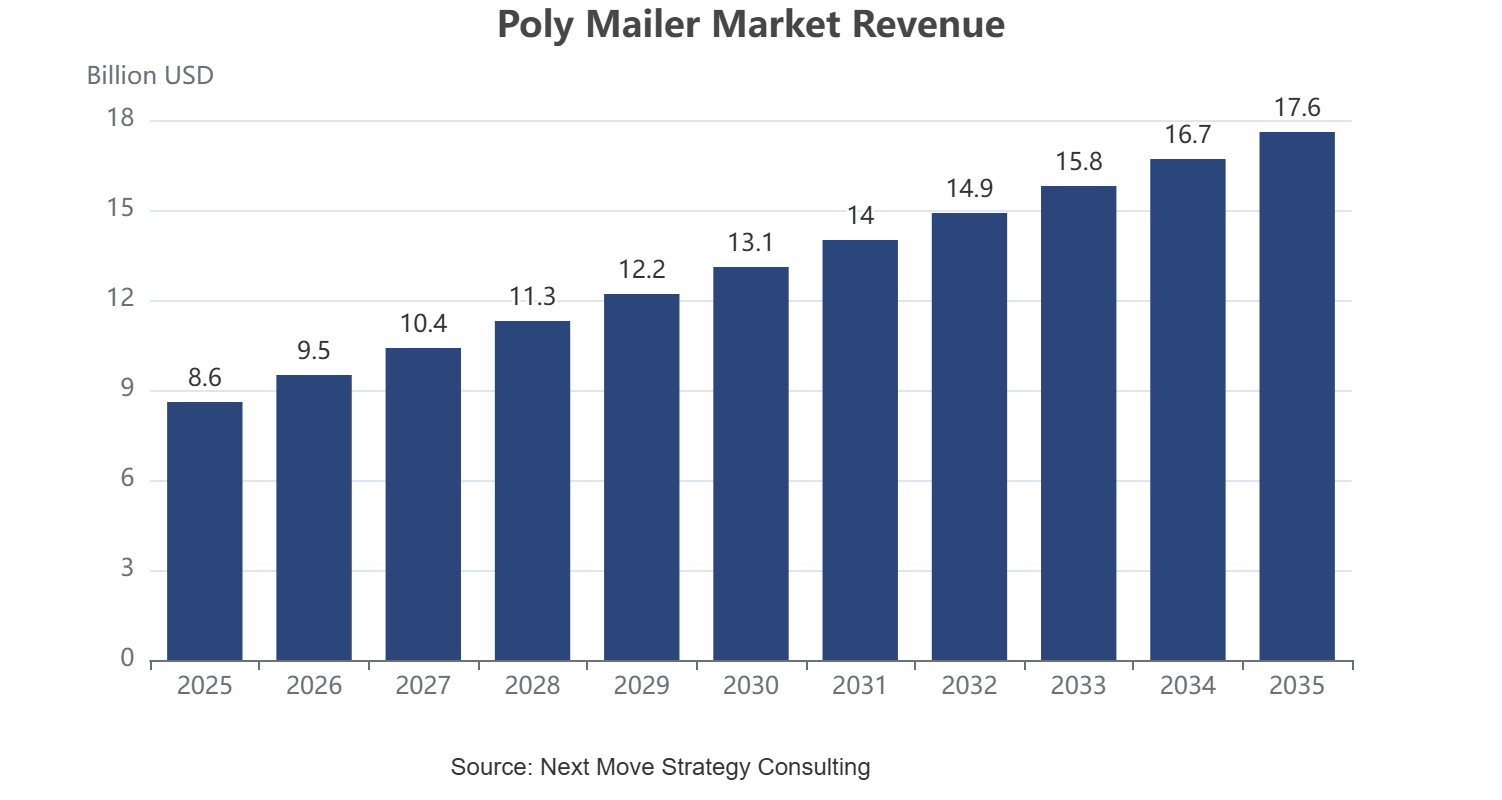
The global Poly Mailer Industry size was valued at USD 8.6 Billion in 2025 and is estimated at USD 9.2 Billion in 2026, forecast to reach USD 17.6 Billion by 2035, expanding at a 7.5% CAGR between 2026 and 2035. North America leads with approximately 36% share, while under product type, Flat Poly Mailers dominate with approximately 48% share.
We observed that recycled-content adoption and e-commerce return logistics are the two structural forces reshaping material and closure specification across the Poly Mailer Market through 2035.
Key Takeaways
Our assessment indicates that the following data points summarize the core structural signals shaping the Poly Mailer Market through the forecast period.
|
Key Takeaways |
|
By Product Type: Flat Poly Mailers held the largest share of approximately 48% (USD 4.13 Billion) in 2025; Insulated Poly Mailers is the fastest-growing sub-segment at 12.4% CAGR from 2026–2035. |
|
By Material: Virgin PE held the largest share of approximately 58% (USD 4.99 Billion) in 2025; Recycled PE is the fastest-growing sub-segment at 11.2% CAGR from 2026–2035. |
|
By Closure Type: Permanent Peel-and-Seal held the largest share of approximately 54% (USD 4.64 Billion) in 2025; Dual Adhesive Return Seal is the fastest-growing sub-segment at 11.3% CAGR from 2026–2035. |
|
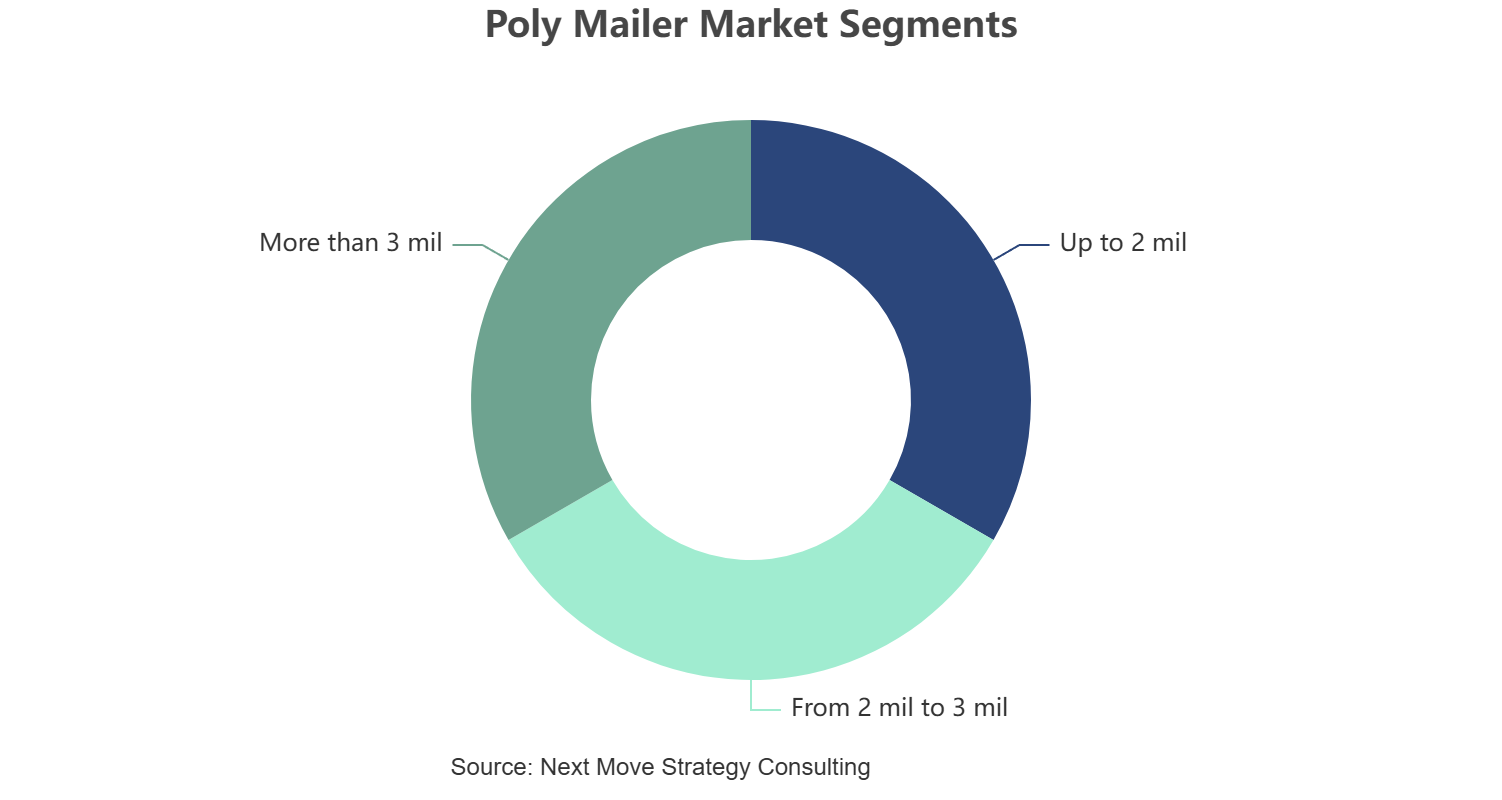
By Thickness: 2 mil to 3 mil held the largest share of approximately 50% (USD 4.30 Billion) in 2025; More than 3 mil is the fastest-growing sub-segment at 11.5% CAGR from 2026–2035. |
|
By Size: 8 x 12 to 12 x 15.5 Inches held the largest share of approximately 40% (USD 3.44 Billion) in 2025; Larger than 19 x 24 Inches is the fastest-growing sub-segment at 12.6% CAGR from 2026–2035. |
|
By Print Type: Plain held the largest share of approximately 50% (USD 4.30 Billion) in 2025; Custom Printed is the fastest-growing sub-segment at 11.8% CAGR from 2026–2035. |
|
By Sales Channel: Direct Sales held the largest share of approximately 44% (USD 3.78 Billion) in 2025; Online Sales is the fastest-growing sub-segment at 13.7% CAGR from 2026–2035. |
|
By End User: E-Commerce held the largest share of approximately 38% (USD 3.27 Billion) in 2025; Healthcare is the fastest-growing sub-segment at 15.6% CAGR from 2026–2035. |
|
Dominant Region: North America dominated with approximately 36% revenue share (USD 3.1 Billion) in 2025. |
|
Fastest-Growing Region: Asia-Pacific is expected to register the highest CAGR of 11.2% during 2026–2035. |
|
Dominant Country: U.S. led with approximately USD 1.98 Billion in 2025. |
|
Fastest-Growing Country: India is the fastest-growing country at approximately 15.1% CAGR from 2026–2035. |
Between 2026 and 2035, the Poly Mailer Industry is set to generate an absolute dollar opportunity of USD 8.4 Billion, positioning recycled-content and insulated mailer formats as a compelling area for capital allocation.
According to NMSC analysis, sustained investment in recycled polyethylene sourcing and dual adhesive return-seal closures is reshaping procurement criteria for e-commerce and logistics brands, as reverse logistics requirements increasingly determine mailer specification across apparel and footwear categories.
What Does the Poly Mailer Market Encompass?
The Poly Mailer Market encompasses flexible polyethylene shipping envelopes used to protect, contain, and transport goods across e-commerce, courier, logistics, apparel, and healthcare distribution channels. NMSC's analysis indicates that the scope spans virgin and recycled polyethylene constructions, compostable polymer alternatives, and closure formats ranging from permanent peel-and-seal to dual adhesive return seals supplied to brand owners, packaging distributors, and fulfillment operators worldwide.
Regulatory frameworks such as California's SB 343 truth-in-labeling law and various U.S. state Extended Producer Responsibility statutes are accelerating recycled-content mandates for flexible plastic packaging, while the U.S. Food and Drug Administration's food-contact substance notifications govern material safety for select applications. We observed that technology adoption is shifting toward recycled polyethylene sourcing and curbside-recyclable mono-material construction. NMSC's analysis indicates that this structural shift, combined with rising reverse logistics demands, is redefining sourcing criteria across the Poly Mailer Market.
|
Parameter |
Details |
|
Market Size in 2025 |
USD 8.6 Billion |
|
Market Size in 2026 |
USD 9.2 Billion |
|
Revenue Forecast in 2035 |
USD 17.6 Billion |
|
Growth Rate |
CAGR of 7.5% from 2026 to 2035 |
|
Analysis Period |
2025–2035 |
|
Base Year Considered |
2025 |
|
Forecast Period |
2026–2035 |
|
Market Size Estimation |
Revenue (USD Billion) |
|
Companies Profiled |
15 |
|
Countries Covered |
33 |
|
Market Share |
Available for Top 10 Companies |
Key Emerging Trends
Our findings suggest that the Poly Mailer Industry is being reshaped by parallel forces in material recycling, closure engineering, e-commerce logistics, and cold-chain demand, summarized across the following four trends.
How Is Recycled Polyethylene Content Reshaping Poly Mailer Specification?
We found that brand owners are steadily raising post-consumer recycled polyethylene content targets to meet corporate packaging commitments and state-level recycled-content mandates such as California's SB 343. Amazon and Walmart have both published supplier scorecards that reward recycled-content poly mailer adoption. This shift is prompting converters to secure long-term recycled resin supply contracts, altering procurement economics across e-commerce and apparel fulfillment.
Why Is Dual Adhesive Return Seal Adoption Accelerating?
We observed that dual adhesive return seal closures are gaining share as retailers expand no-box-required return programs that require a resealable outer envelope. Pregis LLC markets dual adhesive return-seal mailers across its e-commerce fulfillment product line. This trend is closely tied to rising apparel and footwear return rates, which require packaging that survives multiple shipping cycles without failure.
How Is Insulated Poly Mailer Demand Expanding Beyond Cold Chain Food?
During our market evaluation, we noticed that insulated poly mailers are expanding beyond fresh food delivery into direct-to-patient pharmaceutical and cosmetics shipping, where temperature-sensitive products require protection during last-mile transit. Sealed Air Corporation supplies insulated mailer solutions to healthcare and specialty food shippers. This diversification is broadening insulated format demand beyond its traditional meal-kit customer base.
What Role Does Automation Play in Poly Mailer Fulfillment Integration?
Our analysis shows that automated bagging and sealing equipment is being integrated directly into e-commerce fulfillment lines to reduce labor cost and improve packaging consistency at scale. Pregis LLC's EverTec automated mailer system is designed for direct integration with warehouse fulfillment operations. This automation trend is concentrated among high-volume e-commerce and third-party logistics operators seeking throughput efficiency.
Growth Drivers & Restraints
|
Factors |
(+/−) % Impact on CAGR |
Geographic Relevance |
Impact Timeline |
|
Sustained growth in global e-commerce parcel volume |
+1.6% |
Global |
2026–2035 |
|
Expansion of apparel and footwear reverse logistics programs |
+1.0% |
North America, Europe |
2026–2035 |
|
Retailer adoption of recycled-content packaging mandates |
+0.8% |
North America, Europe |
2026–2035 |
|
Growth in direct-to-patient healthcare and cold-chain shipping |
+0.6% |
Global |
2026–2035 |
|
Lightweight format substitution for corrugated boxes |
+0.5% |
Global |
2026–2035 |
|
Extended Producer Responsibility compliance costs |
−0.7% |
North America, Europe |
2026–2035 |
|
Resin price volatility tied to crude oil feedstock |
−0.6% |
Global |
2026–2035 |
|
Single-use plastics restrictions in select jurisdictions |
−0.5% |
Europe, Asia-Pacific |
2026–2035 |
|
Competition from paper and molded fiber mailer alternatives |
−0.4% |
North America, Europe |
2026–2035 |
What Is the Primary Growth Driver of the Poly Mailer Market?
We found that sustained growth in global e-commerce parcel volume remains the primary growth driver, as poly mailers offer lightweight, water-resistant protection that lowers per-shipment freight cost relative to corrugated boxes. The U.S. Census Bureau reports that e-commerce retail sales have continued rising as a share of total retail spending, supporting sustained poly mailer demand across apparel, footwear, and general merchandise shipping.
How Is Reverse Logistics Growth Driving the Market Expansion?
Our analysis shows that expanding apparel and footwear return programs are increasing demand for resealable and dual adhesive return-seal poly mailers engineered to survive multiple shipping cycles. The Federal Trade Commission's guidance on e-commerce returns has drawn attention to rising return volumes, reinforcing sustained investment in durable, reusable mailer closure formats across retail fulfillment operations.
What Is Restraining Poly Mailer Market Expansion?
We observed that Extended Producer Responsibility compliance costs and single-use plastics restrictions are the primary restraints, as brand owners face rising per-unit packaging fees in states including California, Colorado, and Oregon. The California Department of Resources Recycling and Recovery confirms per-unit producer fee obligations under SB 54, adding direct cost pressure to flexible plastic mailer formats specifically.
Segmentation Analysis
Segment Sizing: By Product Type
|
Segment |
2025 (USD) |
2035 (USD) |
CAGR% (2026–2035) |
|
Flat Poly Mailers |
USD 4.13 Billion |
USD 7.74 Billion |
7.2% |
|
Bubble Poly Mailers |
USD 1.89 Billion |
USD 3.70 Billion |
7.7% |
|
Expansion Poly Mailers |
USD 1.03 Billion |
USD 2.29 Billion |
9.2% |
|
Insulated Poly Mailers |
USD 0.86 Billion |
USD 2.46 Billion |
12.4% |
|
Specialty Poly Mailers |
USD 0.69 Billion |
USD 1.41 Billion |
8.3% |
|
Total |
USD 8.60 Billion |
USD 17.60 Billion |
— |
Which Product Type Leads the Poly Mailer Industry?
We found that Flat Poly Mailers led the Poly Mailer Market with approximately 48% share in 2025, supported by their low cost and versatility across apparel and general merchandise shipping. Insulated Poly Mailers are the fastest-growing sub-segment at a 12.4% CAGR from 2026 to 2035, driven by expanding cold-chain food delivery and direct-to-patient healthcare shipping requirements.
Segment Sizing: By Material
|
Segment |
2025 (USD) |
2035 (USD) |
CAGR% (2026–2035) |
|
Virgin PE |
USD 4.99 Billion |
USD 8.45 Billion |
6.0% |
|
Recycled PE |
USD 2.58 Billion |
USD 6.69 Billion |
11.2% |
|
Compostable Polymers |
USD 0.69 Billion |
USD 1.76 Billion |
11.0% |
|
Other Polymer Materials |
USD 0.34 Billion |
USD 0.70 Billion |
8.3% |
|
Total |
USD 8.60 Billion |
USD 17.60 Billion |
— |
Which Material Leads the Poly Mailer Industry?
Our analysis shows that Virgin PE led the Poly Mailer Market with approximately 58% share in 2025, given its established supply chain and consistent film performance. Recycled PE is the fastest-growing material at an 11.2% CAGR from 2026 to 2035, propelled by retailer recycled-content mandates and corporate plastic-reduction commitments across e-commerce brand owners.
Segment Sizing: By End User
|
Segment |
2025 (USD) |
2035 (USD) |
CAGR% (2026–2035) |
|
E-Commerce |
USD 3.27 Billion |
USD 6.34 Billion |
7.6% |
|
Courier |
USD 1.03 Billion |
USD 2.11 Billion |
8.3% |
|
Logistics |
USD 0.86 Billion |
USD 1.76 Billion |
8.3% |
|
Apparel |
USD 1.20 Billion |
USD 2.29 Billion |
7.4% |
|
Footwear |
USD 0.52 Billion |
USD 1.06 Billion |
8.3% |
|
Healthcare |
USD 0.43 Billion |
USD 1.58 Billion |
15.6% |
|
Electronics |
USD 0.43 Billion |
USD 0.88 Billion |
8.3% |
|
Books |
USD 0.26 Billion |
USD 0.44 Billion |
6.1% |
|
Stationery |
USD 0.17 Billion |
USD 0.26 Billion |
4.9% |
|
Cosmetics |
USD 0.17 Billion |
USD 0.35 Billion |
8.3% |
|
Personal Care |
USD 0.13 Billion |
USD 0.26 Billion |
8.3% |
|
Industrial |
USD 0.09 Billion |
USD 0.18 Billion |
8.3% |
|
Other End Users |
USD 0.04 Billion |
USD 0.09 Billion |
8.3% |
|
Total |
USD 8.60 Billion |
USD 17.60 Billion |
— |
Which End User Segment Leads the Poly Mailer Industry?
We observed that E-Commerce remains the dominant end user with approximately 38% share in 2025, reflecting poly mailers' entrenched role in online retail fulfillment. Healthcare is the fastest-growing end user at a 15.6% CAGR from 2026 to 2035, supported by rising direct-to-patient pharmaceutical and diagnostic shipping volumes.
Growth Opportunities
Our assessment indicates that three forward-looking whitespace opportunities stand out for stakeholders positioning within the Poly Mailer Market through 2035.
How Can Recycled Polyethylene Capacity Expansion Create Value?
Converters securing long-term recycled polyethylene feedstock supply stand to capture retailer-driven substitution demand from e-commerce and apparel brand owners seeking verified recycled content, positioning early movers ahead of tightening state-level packaging regulations.
What Opportunity Exists in Dual Adhesive Return-Seal Innovation?
Suppliers that engineer durable, multi-cycle dual adhesive return-seal closures can capture growing demand from apparel and footwear retailers expanding no-box-required return programs, a segment outpacing average category growth.
How Can Healthcare-Grade Insulated Mailer Specialization Drive Margin Growth?
Converters building dedicated insulated mailer production lines for direct-to-patient pharmaceutical and diagnostic shipping can capture premium margins in the fastest-growing end-use segment, benefiting specialized players positioned in temperature-controlled packaging niches.
Regional Outlook
|
Region |
2025 (USD) |
2035 (USD) |
CAGR% (2026–2035) |
Key Driver |
|
North America |
USD 3.10 Billion |
USD 5.46 Billion |
6.5% |
E-commerce parcel volume and retail return-program expansion |
|
Europe |
USD 2.06 Billion |
USD 3.70 Billion |
6.7% |
Extended Producer Responsibility and single-use plastics regulation compliance |
|
Asia-Pacific |
USD 2.24 Billion |
USD 5.81 Billion |
11.2% |
Rapid growth in cross-border e-commerce and organized retail |
|
Middle East & Africa |
USD 0.60 Billion |
USD 1.41 Billion |
9.9% |
Rising e-commerce penetration and modern retail expansion |
|
Latin America |
USD 0.60 Billion |
USD 1.23 Billion |
8.3% |
Growth in regional e-commerce fulfillment infrastructure |
|
Total |
USD 8.60 Billion |
USD 17.61 Billion |
— |
— |
North America Poly Mailer Industry Outlook
We observed that North America is a mature market anchored by extensive e-commerce fulfillment infrastructure, valued at approximately USD 3.10 Billion in 2025. Recycled-content adoption and expanding apparel return programs are driving continued technology adoption toward recycled polyethylene and dual adhesive return-seal formats. Strategic outlook favors converters investing in certified recycled-resin supply chains over the forecast period.
Europe Poly Mailer Industry Outlook
Our analysis shows that Europe's market, valued at approximately USD 2.06 Billion in 2025, is shaped heavily by Extended Producer Responsibility statutes and national single-use plastics restrictions. Technology adoption favors mono-material recyclable mailers that meet curbside recyclability thresholds. Strategic outlook points toward continued share migration from virgin polyethylene toward recycled and compostable alternatives.
Asia-Pacific Poly Mailer Industry Outlook
We found that Asia-Pacific, valued at approximately USD 2.24 Billion in 2025, is the fastest-growing region at an 11.2% CAGR, driven by rapid cross-border e-commerce expansion and organized retail growth. Regulatory influence remains less restrictive than in Europe, though several markets are introducing extended producer responsibility frameworks. Strategic outlook favors converters expanding regional production capacity to serve rising demand.
Middle East & Africa Poly Mailer Industry Outlook
Our assessment indicates that Middle East & Africa, valued at approximately USD 0.60 Billion in 2025, is an emerging market supported by rising e-commerce penetration and modern retail expansion. Regulatory frameworks remain comparatively nascent, and technology adoption is concentrated among multinational e-commerce and logistics operators. Strategic outlook favors gradual capacity investment aligned with digital retail growth.
Latin America Poly Mailer Industry Outlook
We observed that Latin America, valued at approximately USD 0.60 Billion in 2025, is supported by growing regional e-commerce fulfillment infrastructure and expanding courier network coverage. Regulatory influence is increasing gradually as Brazil and Chile introduce extended producer responsibility frameworks. Strategic outlook favors converters serving fast-growing regional e-commerce fulfillment operators.
U.S. Poly Mailer Industry
Based on our engagements, the U.S. Poly Mailer Market was valued at approximately USD 1.98 Billion in 2025 and is projected to reach USD 3.38 Billion by 2035, expanding at a 6.1% CAGR from 2026 to 2035. Demand is led by e-commerce and apparel return logistics, with mature recycling infrastructure and strong competitive intensity among national converters.
Canada Poly Mailer Industry
Through our analysis, the Canada Poly Mailer Market was valued at approximately USD 0.68 Billion in 2025 and is projected to reach USD 1.23 Billion by 2035, expanding at a 6.8% CAGR from 2026 to 2035. Demand structure mirrors U.S. patterns at smaller scale, supported by federal plastics-reduction regulation and steady technology adoption among regional converters.
UK Poly Mailer Industry
From our assessment, the UK Poly Mailer Market was valued at approximately USD 0.44 Billion in 2025 and is projected to reach USD 0.78 Billion by 2035, expanding at a 6.6% CAGR from 2026 to 2035. Regulatory influence from the UK Plastic Packaging Tax is accelerating recycled-content adoption, with moderate competitive intensity among domestic and European converters.
Germany Poly Mailer Industry
According to evaluation, the Germany Poly Mailer Market was valued at approximately USD 0.41 Billion in 2025 and is projected to reach USD 0.71 Billion by 2035, expanding at a 6.3% CAGR from 2026 to 2035. Strict Packaging Act compliance and advanced recycling infrastructure support high recycled-content penetration, with strong competitive intensity among established converters.
France Poly Mailer Industry
Based on our engagements, the France Poly Mailer Market was valued at approximately USD 0.31 Billion in 2025 and is projected to reach USD 0.52 Billion by 2035, expanding at a 5.9% CAGR from 2026 to 2035. The AGEC anti-waste law is driving single-use plastics substitution, with steady technology adoption toward recycled and mono-material mailer alternatives.
China Poly Mailer Market
Through our analysis, the China Poly Mailer Market was valued at approximately USD 0.78 Billion in 2025 and is projected to reach USD 1.86 Billion by 2035, expanding at a 10.1% CAGR from 2026 to 2035. Rapid cross-border e-commerce expansion and rising organized retail support strong demand, with increasing competitive intensity among domestic converters.
India Poly Mailer Industry
From our assessment, the India Poly Mailer Market was valued at approximately USD 0.36 Billion in 2025 and is projected to reach USD 1.28 Billion by 2035, expanding at a 15.1% CAGR from 2026 to 2035. Expanding e-commerce and organized retail distribution are driving rapid adoption, with regulatory influence from the Plastic Waste Management Rules shaping material choices.
Japan Poly Mailer Industry
According to evaluation, the Japan Poly Mailer Market was valued at approximately USD 0.31 Billion in 2025 and is projected to reach USD 0.58 Billion by 2035, expanding at a 7.2% CAGR from 2026 to 2035. Mature but stable demand is supported by high packaging quality standards and gradual adoption of recyclable mono-material mailer formats.
South Korea Poly Mailer Industry
Based on our engagements, the South Korea Poly Mailer Market was valued at approximately USD 0.24 Billion in 2025 and is projected to reach USD 0.52 Billion by 2035, expanding at a 9.0% CAGR from 2026 to 2035. Strong regulatory emphasis on extended producer responsibility is driving recycled-content adoption, with high competitive intensity among domestic converters.
Australia Poly Mailer Industry
Through our analysis, the Australia Poly Mailer Market was valued at approximately USD 0.18 Billion in 2025 and is projected to reach USD 0.41 Billion by 2035, expanding at a 9.6% CAGR from 2026 to 2035. Rising e-commerce parcel volumes and national packaging targets under the National Plastics Plan are shaping steady technology adoption.
UAE Poly Mailer Industry
From our assessment, the UAE Poly Mailer Market was valued at approximately USD 0.14 Billion in 2025 and is projected to reach USD 0.30 Billion by 2035, expanding at a 8.8% CAGR from 2026 to 2035. Expanding e-commerce penetration and modern retail growth support demand, with regulatory influence emerging through Dubai's single-use plastics restrictions.
Saudi Arabia Poly Mailer Industry
According to evaluation, the Saudi Arabia Poly Mailer Market was valued at approximately USD 0.12 Billion in 2025 and is projected to reach USD 0.28 Billion by 2035, expanding at a 9.9% CAGR from 2026 to 2035. Growing e-commerce and organized retail penetration under Vision 2030 initiatives is supporting demand, with moderate technology adoption among regional converters.
South Africa Poly Mailer Industry
Based on our engagements, the South Africa Poly Mailer Market was valued at approximately USD 0.10 Billion in 2025 and is projected to reach USD 0.21 Billion by 2035, expanding at a 8.6% CAGR from 2026 to 2035. Demand is supported by expanding e-commerce and modern trade retail formats, with regulatory influence from extended producer responsibility regulations gradually increasing.
Brazil Poly Mailer Industry
Through our analysis, the Brazil Poly Mailer Market was valued at approximately USD 0.27 Billion in 2025 and is projected to reach USD 0.54 Billion by 2035, expanding at a 8.0% CAGR from 2026 to 2035. Expanding e-commerce fulfillment infrastructure supports demand, with regulatory influence increasing under the national solid waste policy framework.
Argentina Poly Mailer Industry
From our assessment, the Argentina Poly Mailer Market was valued at approximately USD 0.09 Billion in 2025 and is projected to reach USD 0.17 Billion by 2035, expanding at a 7.3% CAGR from 2026 to 2035. Demand is supported by growing regional e-commerce penetration, with moderate technology adoption and competitive intensity concentrated among regional converters.
Consumer Behavior Analysis of the Poly Mailer Market
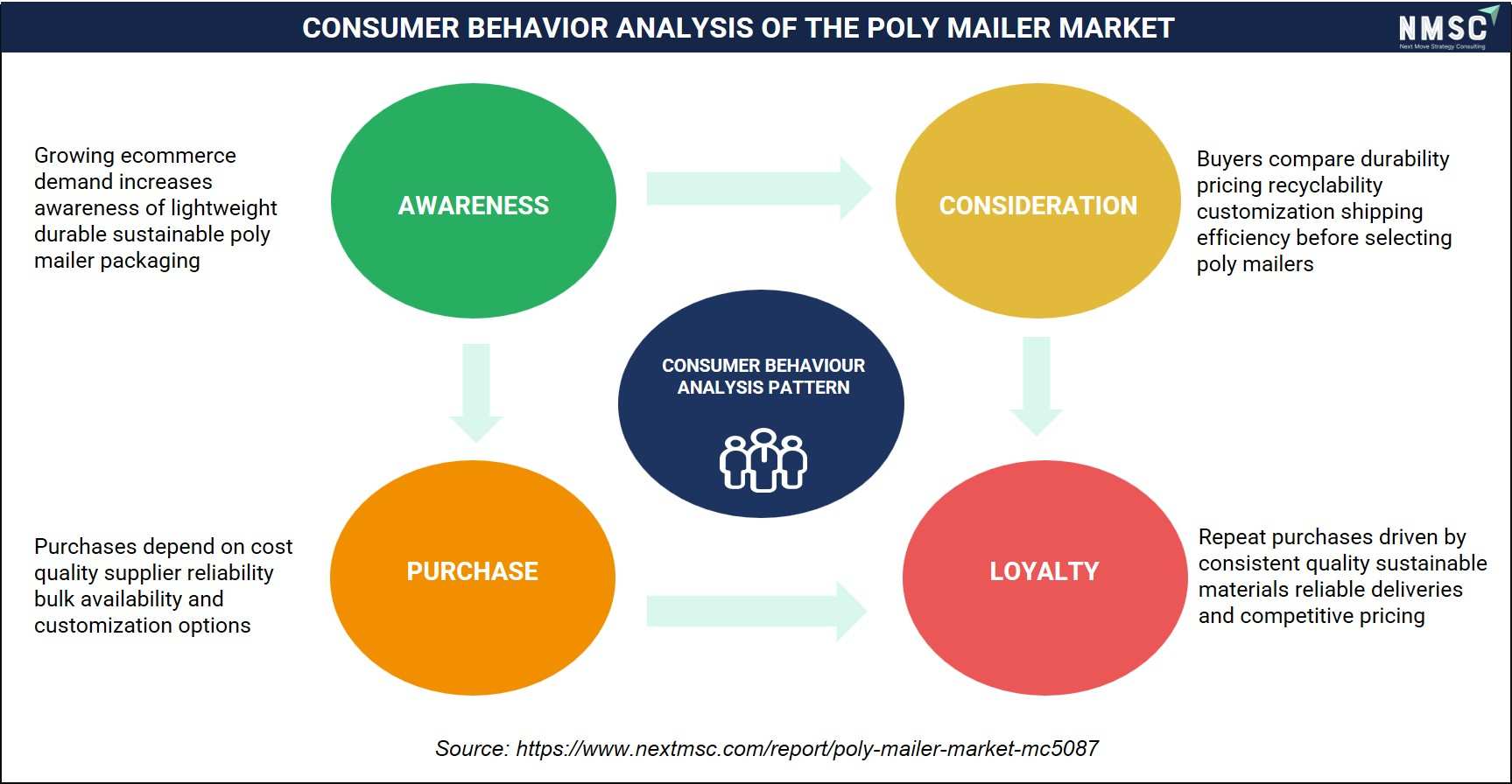
Consumer purchasing behavior in the poly mailer market is driven by the growing demand for lightweight, durable, and sustainable packaging solutions, particularly in e-commerce and logistics. Buyers evaluate product strength, recyclability, customization, and cost-effectiveness before purchase, while consistent quality, reliable supply, and eco-friendly materials foster long-term customer loyalty and repeat procurement.
Competitive Landscape
We observed that the Poly Mailer Market remains moderately fragmented, with global packaging majors competing alongside specialized regional converters across material and closure-format niches.
|
Dimension |
Summary |
|
Market Structure |
Moderately fragmented, with the top ten companies holding available market share data while numerous regional converters serve localized demand. |
|
Innovation Focus |
Recycled-content material substitution, dual adhesive return-seal engineering, and automated fulfillment integration dominate innovation investment. |
|
M&A Activity |
Consolidation is concentrated among mid-size converters seeking recycled-resin supply security and expanded regional production footprint. |
How Do Companies Compete in the Poly Mailer Market?
We found that companies compete primarily on material innovation, recycled-content sourcing capability, and closure engineering rather than price alone. Converters with established recycled polyethylene supply chains increasingly win private-label contracts that require verifiable sustainability documentation from major e-commerce and retail customers.
Which Competitive Archetypes Dominate the Market?
Our analysis shows that two archetypes dominate: large diversified packaging majors leveraging scale and integrated resin supply, and specialized regional converters differentiated by closure or application-specific expertise such as insulated or healthcare mailers. Both archetypes compete for recycled-content certification credibility as a primary differentiation theme.
What Innovation and Differentiation Strategies Are Companies Pursuing?
We observed that companies are differentiating through recycled-content formulation, dual adhesive return-seal engineering, and automated bagging equipment that integrates directly with fulfillment lines. Several converters are also investing in curbside-recyclable mono-material construction to meet retailer sustainability scorecards.
What M&A Activity Is Shaping the Competitive Landscape?
Our findings suggest that M&A activity is concentrated among mid-size converters seeking to expand regional production footprint and secure recycled-resin feedstock access. Amcor plc's completed combination with Berry Global illustrates continued consolidation among flexible packaging producers pursuing scale and integrated resin sourcing capability.
Key Market Players
Our assessment indicates that the following companies represent the validated set of 15 key players shaping competitive dynamics across the Poly Mailer Market.
-
ProAmpac LLC
-
Sealed Air Corporation
-
Pregis LLC
-
Novolex Holdings, LLC
-
Coveris Management GmbH
-
Intertape Polymer Group Inc.
-
Poly Pak Industries, Inc.
-
International Plastics Inc.
-
Polybags Ltd.
-
Polycell International Corp.
-
EcoEnclose LLC
-
Beta Package Products Co., Ltd.
-
Flexopack S.A.
-
Shenzhen Stars Packing Products Co., Ltd.
Latest Developments
We found that the following developments reflect the most recent verifiable capacity, sustainability, and corporate activity across leading Poly Mailer Market participants.
|
Date |
Event |
|
March 2026 |
ProAmpac completed the acquisition of PAC Worldwide, significantly expanding its e-commerce packaging portfolio, including poly mailers, paper mailers, protective mailers and packaging automation solutions. |
|
September 2025 |
Sealed Air launched the AUTOBAG® 850HB Hybrid Bagging Machine, designed to run both paper and poly mailers on the same automated packaging system for fulfillment operations. |
Investment Opportunities
What Capital Inflows Are Targeting the Poly Mailer Market?
We found that strategic capital continues flowing toward converters with established recycled-resin supply chains and automated fulfillment integration capability, reflecting investor confidence in sustainability-aligned e-commerce packaging assets. Amcor plc's completed transaction with Berry Global illustrates continued strategic capital consolidation within flexible packaging.
What Infrastructure Investment Is Shaping the Market?
Our analysis shows that infrastructure investment is concentrated in recycled polyethylene production capacity, automated bagging equipment, and regional converting expansion to reduce freight cost and lead-time exposure. These investments position converters to meet tightening recycled-content mandates while serving growing e-commerce and healthcare mailer demand.
What ESG Considerations Are Shaping Poly Mailer Investment Decisions?
We observed that Environmental, Social, and Governance considerations are increasingly central to capital allocation decisions, with investors favoring converters that can document verifiable recycled content and renewable-energy-matched production. Pregis LLC's 2040 net-zero pledge and wind-power-matched mailer production reflect this growing ESG-linked investment discipline.
Key Benefits for Stakeholders
How Does This Report Benefit Industry Leaders?
Our analysis provides industry leaders with granular segmentation, regional forecasts, and competitive benchmarking data needed to prioritize material investment and capacity expansion decisions. The report's driver, restraint, and opportunity analysis supports strategic planning aligned with regulatory and retailer sustainability requirements shaping the Poly Mailer Market.
How Does This Report Benefit Investors and Financial Analysts?
We provide investors and financial analysts with reconciled market sizing, CAGR data, and competitive landscape insights that support valuation and capital allocation decisions across the flexible packaging sector. The report's regional and segment-level forecasts help identify which sub-segments offer the strongest growth-adjusted investment opportunity through 2035.
How Does This Report Benefit Technology Vendors and Product Teams?
Our findings equip technology vendors and product teams with insight into emerging material, closure, and automation trends shaping converter purchasing decisions. This supports go-to-market prioritization for equipment, resin, and software vendors serving mailer production and fulfillment integration across the Poly Mailer Market.
Key Market Segments
By Product Type
-
Flat Poly Mailers
-
Bubble Poly Mailers
-
Expansion Poly Mailers
-
Insulated Poly Mailers
-
Specialty Poly Mailers
-
Security Poly Mailers
-
Anti-Static Poly Mailers
-
Temperature-Controlled Poly Mailers
-
Other Specialty Poly Mailers
-
By Material
-
Virgin PE
-
LDPE
-
LLDPE
-
HDPE
-
-
Recycled PE
-
Less than 30 Percent Recycled Content
-
30 Percent to 60 Percent Recycled Content
-
More than 60 Percent Recycled Content
-
-
Compostable Polymers
-
Other Polymer Materials
By Closure Type
-
Permanent Peel-and-Seal
-
Dual Adhesive Return Seal
-
Heat Seal
-
Resealable Closure
-
Other Closure Types
By Thickness
-
Up to 2 mil
-
From 2 mil to 3 mil
-
More than 3 mil
By Size
-
Up to 8 x 12 Inches
-
More than 8 x 12 Inches to 12 x 15.5 Inches
-
More than 12 x 15.5 Inches to 19 x 24 Inches
-
Larger than 19 x 24 Inches
By Print Type
-
Plain
-
Stock Printed
-
Custom Printed
By Sales Channel
-
Direct Sales
-
Packaging Distributors
-
Online Sales
-
Retail Stores
By End User
-
E-Commerce
-
Courier
-
Logistics
-
Apparel
-
Footwear
-
Healthcare
-
Electronics
-
Books
-
Stationery
-
Cosmetics
-
Personal Care
-
Industrial
-
Other End Users
By Region
-
North America: U.S., Canada, Mexico.
-
Europe: UK, Germany, France, Italy, Spain, Sweden, Denmark, Finland, Netherlands, Rest of Europe.
-
Asia-Pacific: China, India, Japan, South Korea, Taiwan, Indonesia, Vietnam, Australia, Philippines, Malaysia, Rest of APAC.
-
Middle East & Africa: Saudi Arabia, UAE, Egypt, Israel, Turkey, Nigeria, South Africa, Rest of MEA.
-
Latin America: Brazil, Argentina, Chile, Colombia, Rest of LATAM.
Supply Chain Structure of the Poly Mailer Market
The poly mailer market is supported by an integrated supply chain encompassing polyethylene resin procurement, film extrusion, printing, customization, logistics, and distribution. Quality assurance and regulatory compliance ensure product reliability, while expanding e-commerce channels drive demand. Increasing adoption of recycled materials and sustainable manufacturing practices is strengthening supply chain resilience and supporting circular economy initiatives.
Conclusion & Recommendations
What Is the Long-Term Outlook for the Poly Mailer Market?
We found that the long-term outlook remains positive, with the market projected to grow from USD 9.2 Billion in 2026 to USD 17.6 Billion by 2035 at a 7.5% CAGR, supported by sustained e-commerce, apparel return logistics, and healthcare shipping demand. Structural material substitution toward recycled polyethylene is expected to continue reshaping competitive positioning through the forecast period.
What Strategic Positioning Should Poly Mailer Suppliers Pursue?
Our assessment indicates that suppliers should prioritize recycled-content certification, dual adhesive return-seal engineering, and automated fulfillment integration to align with tightening Extended Producer Responsibility requirements. Converters that secure verifiable recycled-resin supply chains are best positioned to win long-term private-label contracts across major e-commerce customers.
How Attractive Is the Poly Mailer Market for Investment?
We observed that the market's 7.5% CAGR and USD 8.4 Billion absolute dollar opportunity between 2026 and 2035 make it an attractive investment target, particularly in recycled PE, insulated mailer, and healthcare packaging segments where structural growth outpaces the broader market average.
What Market Shifts and Key Risks Should Stakeholders Monitor?
Our findings suggest that stakeholders should monitor accelerating single-use plastics restrictions, resin price volatility, and competition from paper and molded fiber mailer alternatives as key risks. Regulatory divergence across U.S. states and international jurisdictions adds further complexity to long-term material sourcing strategy.
What Are the Key Growth Pathways for the Poly Mailer Market?
We found that the clearest growth pathways lie in recycled polyethylene substitution, healthcare packaging specialization, dual adhesive return-seal innovation, and automated fulfillment integration. Converters and brand owners that align investment across these four pathways are best positioned to capture disproportionate share of forecast market growth.
About the Author
 Mihul Sharma
— Mihul Sharma is Research Associate at Next Move Strategy Consulting, where he has covered technology, industrial, and healthcare markets for 3 years. His work applies structured business research, market analysis, and secondary-source review to assess market trends, competitive developments, and growth opportunities. He supports report development by fully synthesizing industry data, company information, and market signals into concise findings for strategy and investment-focused research teams.
Mihul Sharma
— Mihul Sharma is Research Associate at Next Move Strategy Consulting, where he has covered technology, industrial, and healthcare markets for 3 years. His work applies structured business research, market analysis, and secondary-source review to assess market trends, competitive developments, and growth opportunities. He supports report development by fully synthesizing industry data, company information, and market signals into concise findings for strategy and investment-focused research teams.
About the Reviewer
 Supradip Baul
— Supradip Baul is an accomplished business consultant and strategist with over a decade of rich experience in market intelligence, strategy, technology, and business transformation. His work has included rigorous qualitative and quantitative analysis across multiple industries, helping clients shape investment decisions and long-term roadmaps. Earlier in his career, he was associated with Gartner, where he contributed to industry-leading reports and market share analyses. He has worked with leading global companies and holds an MBA with a dual specialization in Marketing and Finance.
Supradip Baul
— Supradip Baul is an accomplished business consultant and strategist with over a decade of rich experience in market intelligence, strategy, technology, and business transformation. His work has included rigorous qualitative and quantitative analysis across multiple industries, helping clients shape investment decisions and long-term roadmaps. Earlier in his career, he was associated with Gartner, where he contributed to industry-leading reports and market share analyses. He has worked with leading global companies and holds an MBA with a dual specialization in Marketing and Finance.
At Next Move Strategy Consulting, we understand that insightful market research is the cornerstone of successful business decisions. That's why we employ a robust and multifaceted approach, combining various methodologies to deliver the most accurate and actionable data for our clients.

Research Landscape
We navigate the world of research with two primary approaches:
Qualitative Approach
Our qualitative research methodologies involve immersive techniques such as in-depth interviews, focus groups, and observational studies. By engaging directly with individuals and stakeholders, we uncover valuable insights that quantitative data alone may overlook.

Quantitative Research
In tandem with qualitative methodologies, NMSC leverages the power of Quantitative Research to provide a robust foundation of numerical insights. Through systematic data collection and analysis, we quantify patterns, preferences, and market trends, offering a comprehensive view of the business landscape.
Our quantitative research approach employs diverse tools, including surveys, experiments, and statistical modelling. These methodologies enable us to gather data from a large and representative sample, ensuring the statistical significance of our findings. By employing structured questionnaires and standardized data collection methods, we guarantee the reliability and validity of the information we present to our clients.
Quantitative research is particularly effective in measuring the prevalence of trends, assessing market size, and gauging the impact of various factors on consumer behavior. The numerical precision attained through this approach equips our clients with actionable insights, facilitating data-driven decision-making and strategy formulation.


Our Specialized Toolbox for Industry-Specific Market Research
We deploy a specialized arsenal of techniques tailored to meet your unique requirements. Here's a glimpse into our comprehensive toolbox:

Information Procurement
The stage entails acquiring market data or relevant information through various sources and methodologies.


Market Research Approach
We utilize both top-down and bottom-up approaches in market research analysis to achieve a comprehensive understanding of the market dynamics, leveraging the broad perspective of industry trends and macroeconomic factors alongside detailed insights from specific segments and individual companies.

Porters Five Forces Analysis
We conduct Porter's Five Forces analysis to evaluate the competitive landscape of an industry, providing us with insights into factors that affect profitability and strategic positioning.

SWOT Analysis

Forecasting
We utilize a forecasting model to predict future consumption by considering parameters like population, economics, regulations, market competition, drivers, constraints, technology, and pricing. We also employ statistical techniques such as multilinear regression, exponential smoothing, moving average, ARIMA, and Monte Carlo simulations for accurate predictions. In econometric forecasting, we analyzed short-term and long-term event impacts, attributing values based on regulatory frameworks, economic factors, and market events.





 Speak to Our Analyst