Railway Traction Motor Market Size, Share, Growth & Forecast By Rolling Stock Application (Locomotives, Commuter and Regional Train, High-Speed Trains, Urban Rail, Other Rail Vehicle), By Motor Type (DC Motors, AC Induction Motors, PMSM, Other), By Motor Architecture (Radial Flux, Axial Flux, Other), By Mounting Type (Axle Hung, Nose Suspended, Frame Mounted, Other), By Power Rating, By Cooling Method, By Traction Voltage Class, and By Commercial Channel - Global Analysis 2025–2035
Industry: Automotive & Transportation | Latest Edition: September 30, 2026 | No of Pages: 567 | No. of Tables: 752 | No. of Figures: 743 | Format: PDF | Report Code: AT66
What Is the Railway Traction Motor Market Size?
The global Railway Traction Motor Market was valued at USD 11.30 billion in 2025 and is expected to reach USD 13.17 billion in 2026. Accelerating electrification of railway networks worldwide, sustained urban rail infrastructure investment, and the large-scale replacement of legacy DC motors with high-efficiency AC induction and permanent magnet synchronous motors are projected to propel the market to USD 30.84 billion by 2035, advancing at a CAGR of 9.91% from 2026 to 2035. Key growth catalysts include government-backed high-speed rail expansion programs, proliferating metro and light rail transit systems in emerging economies, fleet modernization mandates targeting improved energy efficiency, and the phaseout of diesel traction units in favour of fully electric rolling stock across major rail corridors globally. In volume terms, the market was estimated at 517 thousand units in 2025 and is projected to increase from 628 thousand units in 2026 to 1665 thousand units by 2035, registering a CAGR of 11.4% during the forecast period.
|
Parameters |
Details |
|
Market Size in 2025 |
USD 11.30 Billion |
|
Market Size in 2026 |
USD 13.17 Billion |
|
Revenue Forecast in 2035 |
USD 30.84 Billion |
|
Growth Rate |
CAGR of 9.91% from 2026 to 2035 |
|
Market Volume in 2026 |
628 Thousand Units |
|
Volume Forecast in 2035 |
1665 Thousand Units |
|
Growth Rate |
CAGR of 11.4% from 2026 to 2035 |
|
Analysis Period |
2025–2035 |
|
Base Year Considered |
2025 |
|
Forecast Period |
2026–2035 |
|
Market Size Estimation |
USD Billion |
|
Companies Profiled |
20 |
|
Countries Covered |
33 |
|
Market Share |
Top 10 |
Railway Traction Motor Market Overview
What Is the Railway Traction Motor Market?
The Railway Traction Motor Market encompasses the global commercial ecosystem for electric motors that convert electrical energy into mechanical torque to propel railway vehicles across all rolling stock categories. Traction motors are the core propulsion component in electric locomotives, electric multiple units, metro trains, light rail vehicles, high-speed trains, and battery-electric rolling stock. NMSC's analysis indicates that railway traction motors are specified by power output, operating voltage class, motor technology type, mounting configuration, and cooling method, with product selection driven by the tractive effort requirements, speed profile, and duty cycle of each rolling stock application and rail network standard.
How Has the Railway Traction Motor Market Evolved?
The Railway Traction Motor Market has undergone three fundamental technology generations. The first was defined by DC series-wound motors, which dominated railway propulsion through the 1970s due to their simple speed control and high starting torque. Based on research conducted by NMSC, we found that the second generation introduced AC induction motors with variable frequency drives, dramatically reducing maintenance requirements and enabling regenerative braking energy capture. The current third generation is characterized by permanent magnet synchronous motors, axial flux architectures, and frame-mounted configurations delivering efficiency exceeding 96% and substantially reduced lifecycle costs relative to legacy DC traction systems.
How Do Regulations Influence the Railway Traction Motor Market?
Regulatory frameworks governing energy efficiency, interoperability, and safety profoundly shape the Railway Traction Motor Market. The European Union's Technical Specifications for Interoperability mandate motor performance and electromagnetic compatibility standards for cross-border rolling stock operations. IEC 60349 and IEC 60034 define test methods and performance classifications for rail traction motors globally. Through our market assessment, we observed that India's Ministry of Railways electrification mandates, China National Railway Group procurement standards, and the European Commission's Green Deal rail investment directives create structured regulatory demand for high-efficiency traction motor procurement across new fleet delivery programs globally.
How Is Technology Adoption Expanding Across the Railway Traction Motor Market?
Technology adoption across the Railway Traction Motor Market is accelerating as rail operators and rolling stock OEMs converge on permanent magnet synchronous motors and advanced AC induction platforms as the preferred architecture for new fleet deliveries. Our findings suggest that PMSM traction motors, leveraging high-energy rare earth permanent magnets, achieve superior torque density and efficiency advantages that are driving dominant design-in momentum across high-speed train, metro, and light rail platforms globally. Frame-mounted motor configurations, which decouple the motor from the wheel axle to reduce unsprung mass, represent the frontier of traction motor integration for premium rolling stock applications demanding high operational speeds.
Ecosystem Analysis of the Railway Traction Motor Market
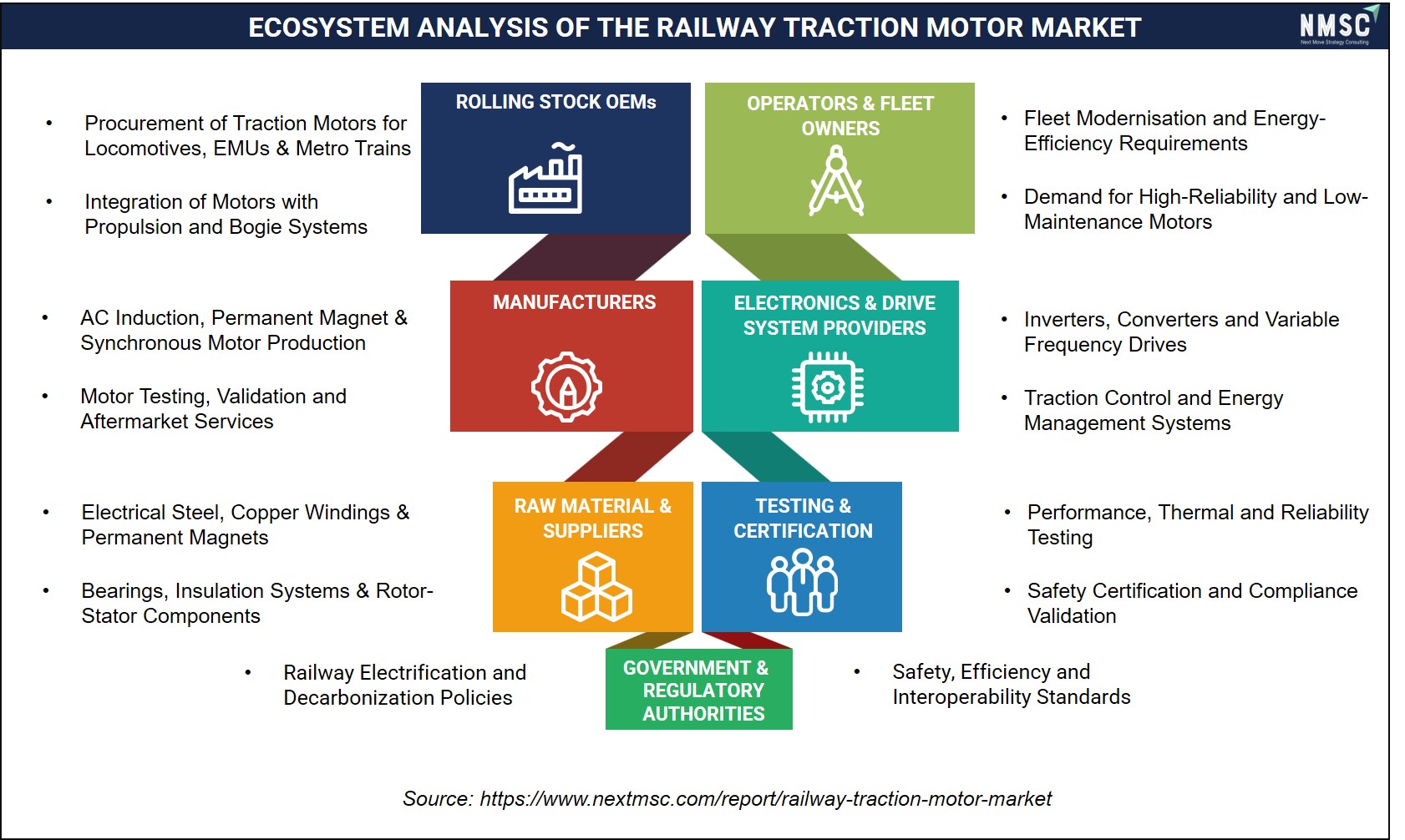
Based on NMSC's analysis, we found that the Railway Traction Motor Market is supported by a connected ecosystem of component suppliers, traction motor manufacturers, power electronics providers, rolling stock OEMs, railway operators, and regulatory authorities. Raw material suppliers enable motor production, while drive system providers enhance efficiency and performance. OEMs integrate traction motors into locomotives, metro trains, and high-speed rail systems, while operators drive demand through fleet modernisation initiatives. Regulatory frameworks focused on electrification, safety, and sustainability further accelerate technology adoption, fostering innovation and long-term market growth across the railway sector.
|
Key Takeaways |
|
By Rolling Stock Application, High-Speed Trains held the largest revenue share of the Railway Traction Motor Market at USD 3.42 billion in 2025 (30.3% share), driven by China's expansive high-speed rail network, European intercity HSR programs, and Japan's Shinkansen fleet, all demanding high-power distributed traction and power car motor systems delivering superior speed and energy performance. |
|
Urban Rail is the fastest-growing Rolling Stock Application segment at a CAGR of 11.35% from 2026 to 2035, reaching USD 7.89 billion by 2035, propelled by metro and light rail vehicle network expansions across Asia, the Middle East, and Latin America, each requiring compact, high-cycle-duty traction motors for intensive stop-and-start urban transit operations. |
|
By Motor Type, AC Induction Motors (Asynchronous) dominated the Railway Traction Motor Market at USD 3.80 billion in 2025 (33.7% share), reflecting their established position as the primary propulsion technology across the global installed rolling stock fleet, supported by mature supply chains, long operational track records, and broad compatibility with existing drive systems. |
|
Permanent Magnet Synchronous Motors (PMSM) are the fastest-growing Motor Type at a CAGR of 13.01% from 2026 to 2035, expanding to USD 11.33 billion by 2035, as railway operators mandate superior energy efficiency, reduced motor weight, and higher power density for new high-speed train, metro, and premium passenger rolling stock procurement programs globally. |
|
By Motor Architecture, Other Architecture held the largest revenue share at USD 4.95 billion in 2025 (43.8%), representing the substantial installed base of conventional induction and wound-field motor designs across mature railway fleets, while Radial Flux architecture is the fastest-growing segment at a CAGR of 12.77%, driven by advanced PMSM and AC induction motor deployments in new rolling stock. |
|
By Mounting Type, Frame Mounted configuration leads the Railway Traction Motor Market as both the dominant segment at USD 3.67 billion in 2025 (32.5% share) and the fastest-growing at a CAGR of 12.92%, as premium rolling stock OEMs adopt frame-mounted configurations to reduce unsprung mass, improve track-friendliness, and enable higher operating speeds in new high-speed and urban rail fleets. |
|
By Power Rating, High Power (800–1500 kW) motors dominate the Railway Traction Motor Market at USD 5.88 billion in 2025 (52.0% share), serving electric locomotive, intercity EMU, and regional train platforms, while Very High Power (greater than 1500 kW) is the fastest-growing segment at a CAGR of 12.75%, driven by high-speed train propulsion and heavy freight locomotive upgrade programs. |
|
By Cooling Method, Air-Cooled motors hold the largest share at USD 5.18 billion in 2025 (45.9%), valued for their mechanical simplicity and suitability for medium-power railway applications, while Liquid-Cooled motors are the fastest-growing at a CAGR of 11.96%, as high-power PMSM and AC induction applications in high-speed trains and heavy freight locomotives increasingly require advanced thermal management. |
|
By Traction Voltage Class, High Voltage (greater than 3 kV) systems dominate at USD 7.14 billion in 2025 (63.2% share) and are also the fastest-growing at a CAGR of 10.87%, reflecting the global prevalence of 25 kV AC electrification in high-speed, mainline passenger, and heavy freight railway systems across China, India, Europe, and Japan. |
|
By Commercial Channel, OEM supply leads the Railway Traction Motor Market at USD 8.81 billion in 2025 (78.0% share) and a CAGR of 10.30%, reflecting the primacy of new rolling stock delivery programs as the largest demand driver, while the Aftermarket segment at USD 2.49 billion sustains replacement motor and refurbishment demand across the growing global installed fleet. |
|
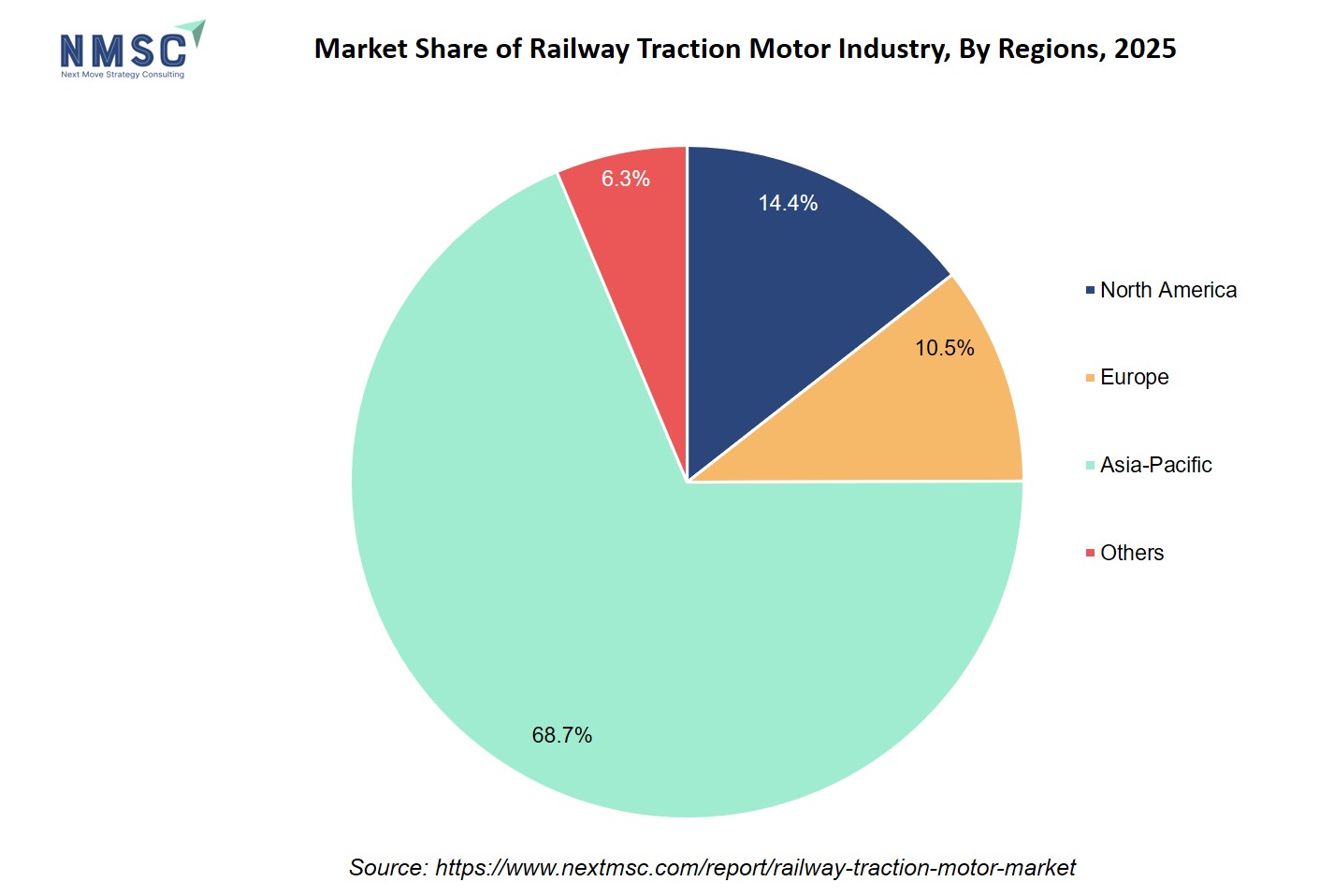
Asia-Pacific is the dominant region in the Railway Traction Motor Market at USD 7.76 billion in 2025 (68.7% share), driven by China's world-leading high-speed rail network, India's comprehensive railway electrification program, and extensive metro and urban rail buildout across South, East, and Southeast Asia supporting sustained traction motor procurement growth through 2035. |
|
Middle East and Africa is the fastest-growing region in the Railway Traction Motor Market at a CAGR of 15.03% from 2026 to 2035, reaching USD 2.00 billion by 2035, driven by GCC metro network expansion, Vision 2030 transport infrastructure investment in Saudi Arabia, urban rail projects in Egypt and Turkey, and increasing Sub-Saharan African rail modernization programs. |
|
China is the dominant country in the Railway Traction Motor Market at USD 5.08 billion in 2025, representing 65.4% of Asia-Pacific revenue and 44.9% of global market value, anchored by CRRC Corporation's high-speed rolling stock manufacturing, ongoing high-speed rail network expansion, and subway system buildout across dozens of Chinese cities at various stages of development. |
|
Rest of MEA is the fastest-growing country-level segment in the Railway Traction Motor Market at a CAGR of 16.56% from 2026 to 2035, followed by Saudi Arabia at 16.07% and Turkey at 15.51%, reflecting the accelerating public transit infrastructure investment wave transforming urban mobility across the broader Middle East, North Africa, and sub-Saharan Africa during the forecast period. |
Key Emerging Trends in the Railway Traction Motor Market
How Is the Structural Shift from DC to AC Traction Technology Reshaping the Railway Traction Motor Market?
The transition from legacy DC traction motors to AC induction and PMSM platforms is the single most consequential technology shift in the Railway Traction Motor Market. Through our market assessment, we observed that AC-based traction systems offer 30-40% lower lifecycle maintenance costs compared to DC motors by eliminating brushes and commutators that require regular replacement. Indian Railways' comprehensive electrification program and European Union-funded rolling stock procurement have standardized on AC traction as the baseline motor specification, accelerating DC motor phaseout across ageing fleet replacement programs. This transition is restructuring supplier ecosystems, compelling traditional DC motor manufacturers to invest in AC and PMSM platform development or risk market displacement.
How Are Permanent Magnet Synchronous Motors Driving Energy Efficiency Gains in the Railway Traction Motor Market?
Permanent magnet synchronous motors are emerging as the dominant next-generation traction technology across premium rolling stock platforms in the Railway Traction Motor Market. NMSC's analysis indicates that PMSM traction motors achieve energy efficiency levels exceeding 96%, compared to 91-93% for AC induction motors, enabling rail operators to reduce traction energy consumption by 8-15% per vehicle across full lifecycle operation. Siemens Mobility's SIMOTICS DP series and Alstom's ONIX traction motor families demonstrate commercial PMSM deployment across high-speed train and metro applications, driving a structural shift in procurement specifications toward permanent magnet platforms in new rolling stock tenders across Europe, Asia, and North America.
How Is Urban Rail Expansion Creating New Demand Frontiers in the Railway Traction Motor Market?
Rapid urbanization and metropolitan mobility investment are creating structural growth demand in the Railway Traction Motor Market through sustained metro, light rail, and tram network expansion globally. According to the International Association of Public Transport (UITP), metro systems were operating across 247 networks in 202 cities worldwide as of 2023, with more than 1 billion people having access to metro services. The organization further reported that 13 new urban agglomerations introduced metro systems between 2021 and 2023, highlighting the continued expansion of urban rail infrastructure and supporting long-term demand for railway traction motors and propulsion systems. Each new metro vehicle typically requires four to six traction motors per trainset, making urban rail fleet delivery programs a high-volume demand channel for motor manufacturers with competitive urban rail motor platforms across compact, high-cycle-duty specifications.
How Is Digitalization and Predictive Maintenance Transforming the Railway Traction Motor Market?
Integration of condition monitoring systems, IoT sensor arrays, and AI-driven predictive maintenance algorithms into railway traction motor systems is transforming operational economics across the Railway Traction Motor Market. Our assessment indicates that embedded vibration, temperature, and current signature sensors in modern traction motor packages enable rail operators to predict bearing failure, insulation degradation, and rotor winding faults with lead times of 30-90 days, substantially reducing unplanned maintenance events. Wabtec Corporation's iLOCOMOTIVE platform and ABB's digital traction analytics systems represent the commercial vanguard of condition-based maintenance technology integration, enhancing fleet availability while reducing total cost of ownership for railway traction motor-equipped rolling stock.
What Are the Key Market Drivers, Breakthroughs, and Investment Opportunities That Will Shape the Railway Traction Motor Market Industry in the Next Decade?
|
Drivers / Trends / Restraints |
(+/-) % Impact on CAGR Forecast |
Geographic Relevance |
Impact Timeline |
|
Global Railway Electrification Mandates |
+2.1% |
Global (led by APAC, Europe) |
2025–2035 |
|
Urban Metro and LRT Network Expansion |
+1.8% |
APAC, MEA, Latin America |
2025–2035 |
|
PMSM Traction Technology Adoption |
+1.4% |
Global |
2026–2035 |
|
High-Speed Rail Infrastructure Investment |
+1.2% |
China, Europe, Middle East |
2025–2035 |
|
Battery-Electric and Hydrogen Rolling Stock |
+0.9% |
Europe, North America |
2027–2035 |
|
Fleet Modernization and DC Motor Replacement |
+0.8% |
Global |
2025–2030 |
|
Rare Earth Material Supply Constraints |
-0.7% |
Global |
Ongoing |
|
Long Product Qualification Lead Times |
-0.5% |
Global |
Ongoing |
|
Fiscal Constraints on Public Rail Investment |
-0.4% |
Emerging Markets |
Cyclical |
|
Supply Chain Disruptions in Motor Components |
-0.3% |
Global |
Episodic |
What Are the Growth Drivers of the Railway Traction Motor Market?
How Do National Railway Electrification Programs Drive Railway Traction Motor Market Growth?
Government-mandated railway electrification programs represent the strongest structural demand driver for the Railway Traction Motor Market globally. India's Ministry of Railways achieved 100% electrification of its broad-gauge network and continues procuring electric locomotives and EMUs requiring traction motors for fleet expansion. From our research, we found that China National Railway Group operates over 40,000 km of high-speed railway, with ongoing expansion adding trainsets requiring advanced PMSM traction systems annually. The European Commission's Sustainable and Smart Mobility Strategy targets a doubling of high-speed rail traffic by 2030, directly generating traction motor procurement demand across new rolling stock delivery programs in EU member states. These programs collectively represent the largest demand vector for Railway motor manufacturing globally.
How Does Urban Rail Infrastructure Investment Sustain Long-Term Railway Traction Motor Market Demand?
Accelerating investment in urban metro, light rail, monorail, and rapid transit infrastructure across Asia, the Middle East, Latin America, and other developing regions is creating a durable long-term demand base for the Railway Traction Motor Market. Through NMSC's assessment, we found that ongoing network expansion, new rail corridor development, and fleet modernisation programs are driving sustained procurement of rolling stock equipped with advanced traction motor and propulsion systems. Large-scale investments in urban mobility solutions are encouraging transit authorities to expand rail capacity, improve operational efficiency, and reduce transportation-related emissions. Furthermore, the continued development of metro networks, suburban rail systems, and integrated public transportation infrastructure is supporting demand for high-performance traction motors that enhance reliability, energy efficiency, and lifecycle performance across modern rail fleets.
How Does Rolling Stock Fleet Modernisation Create Replacement Demand in the Railway Traction Motor Market?
The large installed base of legacy diesel and early-generation DC electric rolling stock reaching end-of-life across North America, Europe, and parts of Asia creates substantial and predictable replacement demand for the Railway Traction Motor Market. Based on our market evaluation, we noticed that the U.S. Federal Railroad Administration fleet data indicates a significant portion of commuter locomotive fleets in service are over 25 years old, creating structural refurbishment and replacement procurement demand. European rail operators including DB Fernverkehr, SNCF, and Network Rail are executing multi-year rolling stock renewal programs specifying high-efficiency AC induction and PMSM traction motors, consistent with railway electric propulsion systems modernisation objectives across the continent.
What Are the Growth Inhibitors of the Railway Traction Motor Market?
How Do Rare Earth Material Supply Dependencies Constrain PMSM Adoption in the Railway Traction Motor Market?
The growing preference for PMSM in Railway Traction Motor applications creates supply chain vulnerability around rare earth materials, specifically neodymium and dysprosium used in high-energy permanent magnets. From our assessment, we observed that the U.S. Department of Energy's Critical Materials Assessment identifies rare earth elements as high-criticality materials for electric drive motors, with China controlling over 60% of global rare earth production. This concentration creates pricing volatility and potential supply disruption risk for PMSM traction motor manufacturers, which could constrain adoption or incentivize alternative motor architectures such as reluctance motors that eliminate rare earth magnet dependence in cost-sensitive rolling stock traction motor procurement programs.
How Do Lengthy Product Qualification and Certification Timelines Inhibit Railway Traction Motor Market Growth?
Railway traction motors must undergo extensive qualification procedures before deployment, including type testing against IEC 60349 performance standards, electromagnetic compatibility assessments, and in-service trial requirements imposed by rail operators. NMSC's analysis indicates that the full qualification cycle for a new railway traction motor platform from design freeze through type approval and operator acceptance can span four to seven years, creating substantial development cost burden and delayed revenue realization. This extended qualification timeline limits market responsiveness to emerging technology opportunities and creates high barriers to entry that concentrate the Railway Traction Motor Market among a small number of established, certified motor manufacturers globally.
What Are the Growth Opportunities in the Railway Traction Motor Market?
How Do Battery-Electric and Hydrogen Multiple Units Create New Traction Motor Market Opportunities?
The commercial development of battery-electric multiple units and hydrogen fuel cell trains creates a structurally new segment within the Railway Traction Motor Market, requiring specialized motor configurations compatible with variable voltage outputs from battery and fuel cell power systems. Our analysis shows that the UK Department for Transport's net-zero railway strategy specifically targets hydrogen and battery traction for non-electrified rural lines, creating new procurement for traction motor manufacturers qualifying products for novel drive systems. The U.S. Federal Railroad Administration's research programs on battery-electric locomotives also represent structured government-backed demand for advanced railway electric propulsion systems compatible with next-generation energy storage traction platforms.
How Does Expanding Metro and Urban Rail in Emerging Economies Represent a Railway Traction Motor Market Growth Opportunity?
Rapid expansion of formal public transit systems in Southeast Asia, South Asia, the Middle East, and Latin America represents the highest-growth geographic opportunity in the Railway Traction Motor Market over the 2025–2035 period. Through our market assessment, we observed that According to the Ministry of Housing & Urban Affairs (MoHUA), India's metro rail network, including Regional Rapid Transit System (RRTS) corridors, reached approximately 1,096 km of operational length across 26 cities by the end of 2025, highlighting the rapid expansion of urban rail infrastructure and supporting long-term demand for railway traction motors, propulsion systems, and rolling stock equipment. Indonesia, Vietnam, Egypt, Turkey, and Colombia are executing metro and light rail projects creating multi-year traction motor supply contracts for qualified suppliers with competitive urban rail platform offerings.
How Does the Aftermarket Refurbishment and Motor Rewinding Segment Represent an Underexplored Opportunity in the Railway Traction Motor Market?
The global installed base of railway traction motors creates substantial and recurring aftermarket opportunity for motor refurbishment, rewinding, and performance upgrade services within the Railway Traction Motor Market. Based on NMSC's research, we found that rail operators with large AC induction motor fleets face recurring refurbishment cycles averaging every 10–15 years per motor, creating predictable volume demand for rewinding services, bearing replacement, insulation upgrading, and electronic drive system retrofits. PowerRail, Medha Servo Drives, and specialized refurbishment divisions within CG Power and Toshiba Corporation are active in this segment, providing replacement motor supply and rewinding services that extend operational life of ageing traction motors for railway fleets across North America, Europe, and Asia.
Porter’s Five Forces Analysis of the Railway Traction Motor Market
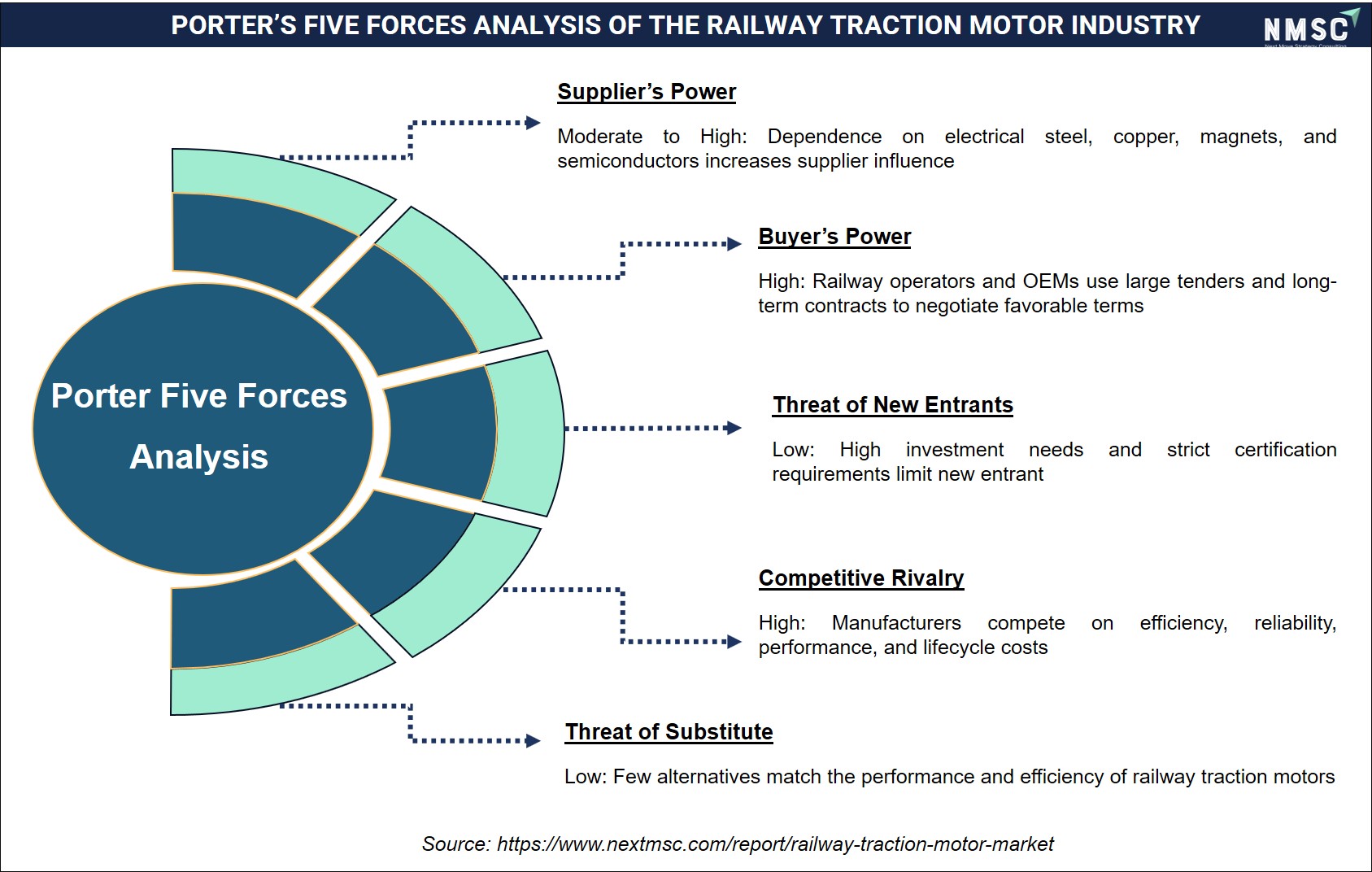
The railway traction motor market value chain begins with suppliers of electrical steel, copper, permanent magnets, bearings, and semiconductor components that are essential for motor production. We observed that these inputs are transformed through specialized manufacturing and assembly processes supported by advanced testing and automation technologies. Regulatory compliance and certification frameworks ensure safety, reliability, and interoperability across railway networks. Further downstream, traction motors are supplied to rolling stock OEMs and railway operators through long-term procurement programs and infrastructure projects. Lifecycle services, including maintenance, refurbishment, and retrofitting, further enhance asset performance and operational efficiency. This integrated supply chain directly influences product quality, technology adoption, cost competitiveness, and long-term market growth.
How Is the Railway Traction Motor Market Segmented in This Report, and What Are the Key Insights from the Segmentation Analysis?
Which Rolling Stock Application Segment Generates the Highest Railway Traction Motor Market Revenue?
|
Rolling Stock Application |
2025 (USD Bn) |
2035 (USD Bn) |
CAGR (%) |
|
Locomotives |
1.98 |
5.11 |
9.33% |
|
Commuter and Regional Train |
2.62 |
7.05 |
9.78% |
|
High-Speed Trains |
3.42 |
9.23 |
9.77% |
|
Urban Rail |
2.53 |
7.89 |
11.35% |
|
Other Rail Vehicle |
0.75 |
1.55 |
6.92% |
The Railway Traction Motor Market is segmented by rolling stock application into Locomotives, Commuter and Regional Trains, High-Speed Trains, Urban Rail, and Other Rail Vehicles. High-Speed Trains is the largest revenue segment at USD 3.42 billion in 2025, driven by China's expansive HSR network, European intercity programs, and Japan's Shinkansen fleet demanding high-power distributed traction and power car motor systems. Urban Rail is the fastest-growing application at a CAGR of 11.35%, as metro, LRV, and tram deployments in emerging economies generate high-volume demand for compact, high-cycle-duty traction motors. Within Locomotives, freight locomotive applications dominate volume while passenger locomotives transition to PMSM. Commuter and Regional Trains, encompassing EMUs, DMUs, dual-mode units, and battery-electric multiple units, show accelerating growth as European and North American operators deploy non-diesel alternatives on rural non-electrified lines.
How Does Motor Type Segmentation Reveal the Technology Transition Underway in the Railway Traction Motor Market?
|
Motor Type |
2025 (USD Bn) |
2035 (USD Bn) |
CAGR (%) |
|
DC Motors |
0.94 |
1.58 |
4.69% |
|
AC Induction Motors (Asynchronous) |
3.80 |
10.13 |
9.64% |
|
Permanent Magnet Synchronous Motors (PMSM) |
3.13 |
11.33 |
13.01% |
|
Wound Field Synchronous Motor |
0.87 |
2.01 |
8.12% |
|
Reluctance Motor |
0.95 |
2.74 |
10.57% |
|
Other Motor Type |
1.62 |
3.04 |
5.84% |
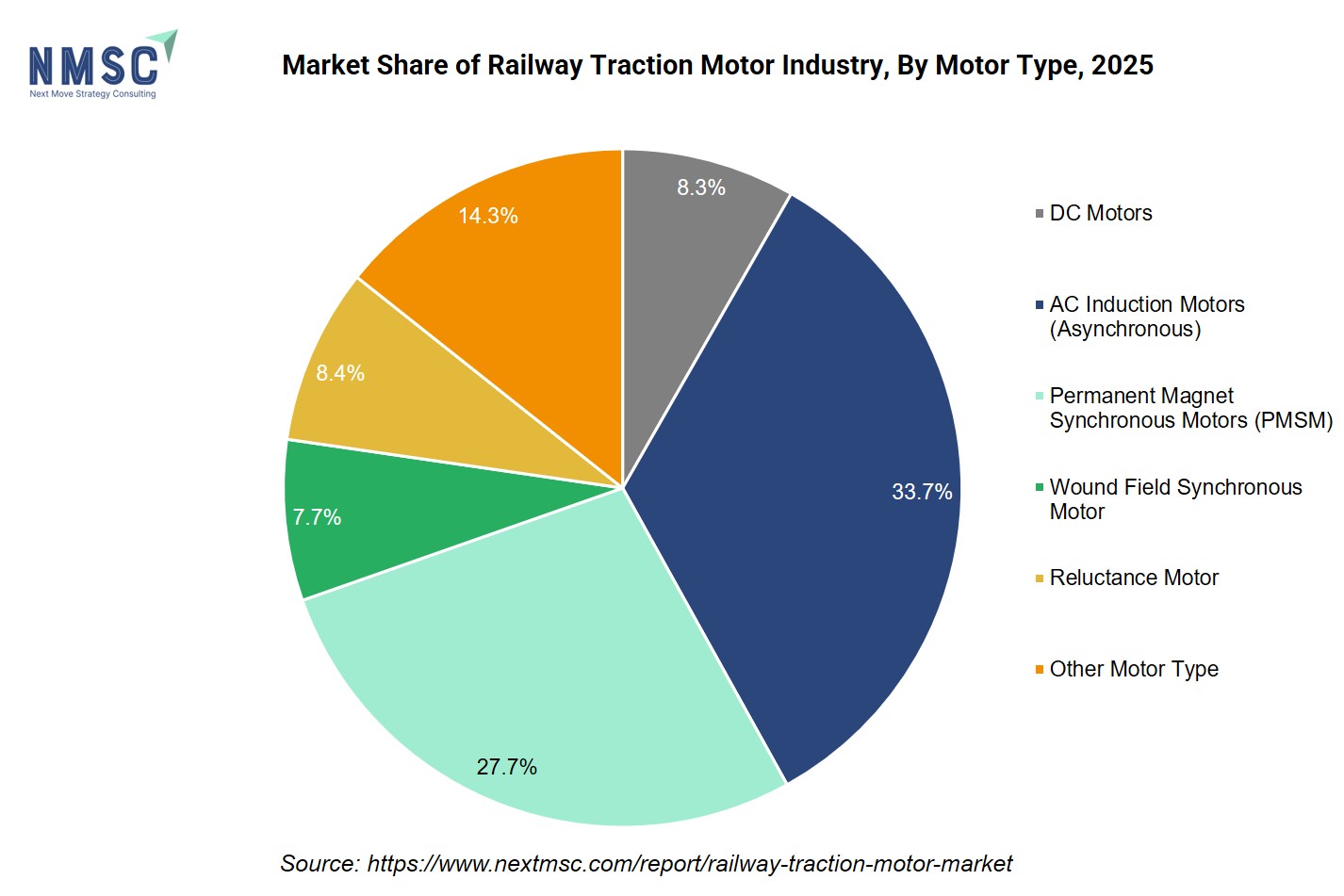
The Railway Traction Motor Market encompasses DC Motors, AC Induction Motors, Permanent Magnet Synchronous Motors (PMSM), Wound Field Synchronous Motors, Reluctance Motors, and Other Motor Types, each serving distinct performance and cost requirements. AC Induction Motors dominate at USD 3.80 billion in 2025, reflecting their established position across the global fleet, while PMSM is the fastest-growing motor type at a CAGR of 13.01% due to superior power density and efficiency in high-speed and urban rail applications, with Interior Permanent Magnet architectures growing faster than Surface Permanent Magnet variants. DC Motors are in structural decline at 4.69% CAGR, representing legacy fleet maintenance. Reluctance Motors, including Synchronous and Switched variants, are gaining traction as rare-earth-free alternatives at 10.57% CAGR, appealing to cost-sensitive operators seeking to mitigate rare earth supply risk in Railway motor manufacturing.
How Is Motor Architecture Evolution Shaping the Next Generation of Railway Traction Systems?
|
Motor Architecture |
2025 (USD Bn) |
2035 (USD Bn) |
CAGR (%) |
|
Radial Flux |
2.93 |
10.39 |
12.77% |
|
Axial Flux |
3.42 |
10.61 |
11.33% |
|
Other Architecture |
4.95 |
9.84 |
6.44% |
The Railway Traction Motor Market is segmented by motor architecture into Radial Flux, Axial Flux, and Other Architecture configurations. Other Architecture holds the largest current share at USD 4.95 billion in 2025, representing the substantial installed base of conventional induction and wound-field motor designs across mature railway fleets globally. Radial Flux motors, where electromagnetic flux flows perpendicular to the shaft, are the fastest-growing architecture at a CAGR of 12.77%, driven by PMSM and advanced AC induction motor deployments in new rolling stock across high-speed and urban rail programs. Axial Flux motors, with flux parallel to the shaft enabling shorter axial length and higher torque-to-weight ratios, are growing at 11.33% CAGR and attracting increasing interest for compact wheel-hub and underfloor motor applications in tram and light rail vehicles, where packaging constraints demand innovative motor geometries.
Which Mounting Type Is Transforming Rolling Stock Traction System Performance in the Railway Traction Motor Market?
|
Mounting Type |
2025 (USD Bn) |
2035 (USD Bn) |
CAGR (%) |
|
Axle Hung |
2.84 |
6.55 |
8.03% |
|
Nose Suspended |
2.64 |
5.45 |
6.85% |
|
Frame Mounted |
3.67 |
13.19 |
12.92% |
|
Other Mounting |
2.14 |
5.66 |
9.56% |
The Railway Traction Motor Market is categorized by mounting configuration into Axle Hung, Nose Suspended, Frame Mounted, and Other Mounting types. Frame Mounted configurations represent both the dominant segment at USD 3.67 billion in 2025 and the fastest-growing at a CAGR of 12.92%, as premium rolling stock OEMs adopt frame-mounting to decouple motor weight from the wheel axle, reducing unsprung mass and enabling higher-speed operation. Axle Hung configurations remain common in freight and lower-speed passenger applications at USD 2.84 billion, valued for mechanical simplicity and lower cost. Nose Suspended configurations serve medium-speed passenger and urban rail fleets as an intermediate mounting architecture. Other mounting types encompass bogie-integrated and underfloor motor arrangements gaining traction in low-floor light rail vehicles requiring compliance with accessibility standards and reduced floor-height specifications.
How Does Power Rating Segmentation Define the Commercial Structure of the Railway Traction Motor Market?
|
Power Rating |
2025 (USD Bn) |
2035 (USD Bn) |
CAGR (%) |
|
Low Power (< 300 kW) |
0.53 |
1.35 |
9.18% |
|
Medium Power (300–800 kW) |
2.27 |
6.63 |
10.65% |
|
High Power (800–1500 kW) |
5.88 |
13.57 |
8.09% |
|
Very High Power (> 1500 kW) |
2.63 |
9.29 |
12.75% |
The Railway Traction Motor Market is segmented by power output into Low Power (less than 300 kW), Medium Power (300–800 kW), High Power (800–1500 kW), and Very High Power (greater than 1500 kW) categories. High Power motors dominate at USD 5.88 billion in 2025 and 52.0% share, representing the standard power range for electric and diesel-electric locomotives, intercity EMUs, and regional trains. Very High-Power motors are the fastest-growing segment at a CAGR of 12.75%, driven by demand for high-speed train propulsion systems and heavy freight locomotive upgrades requiring maximum tractive effort at sustained high speeds. Medium Power motors serve commuter rail and urban rail applications, growing at 10.65% CAGR as metro and LRT fleet expansion accelerates. Low Power motors serve tram, shunting locomotive, and compact EMU applications where lightweight and compact motor designs are prioritized over maximum tractive effort.
How Is Cooling Technology Innovation Creating Competitive Differentiation in the Railway Traction Motor Market?
|
Cooling Method |
2025 (USD Bn) |
2035 (USD Bn) |
CAGR (%) |
|
Air-Cooled |
5.18 |
12.31 |
8.38% |
|
Liquid-Cooled |
4.55 |
14.97 |
11.96% |
|
Hybrid Cooling |
1.57 |
3.56 |
7.93% |
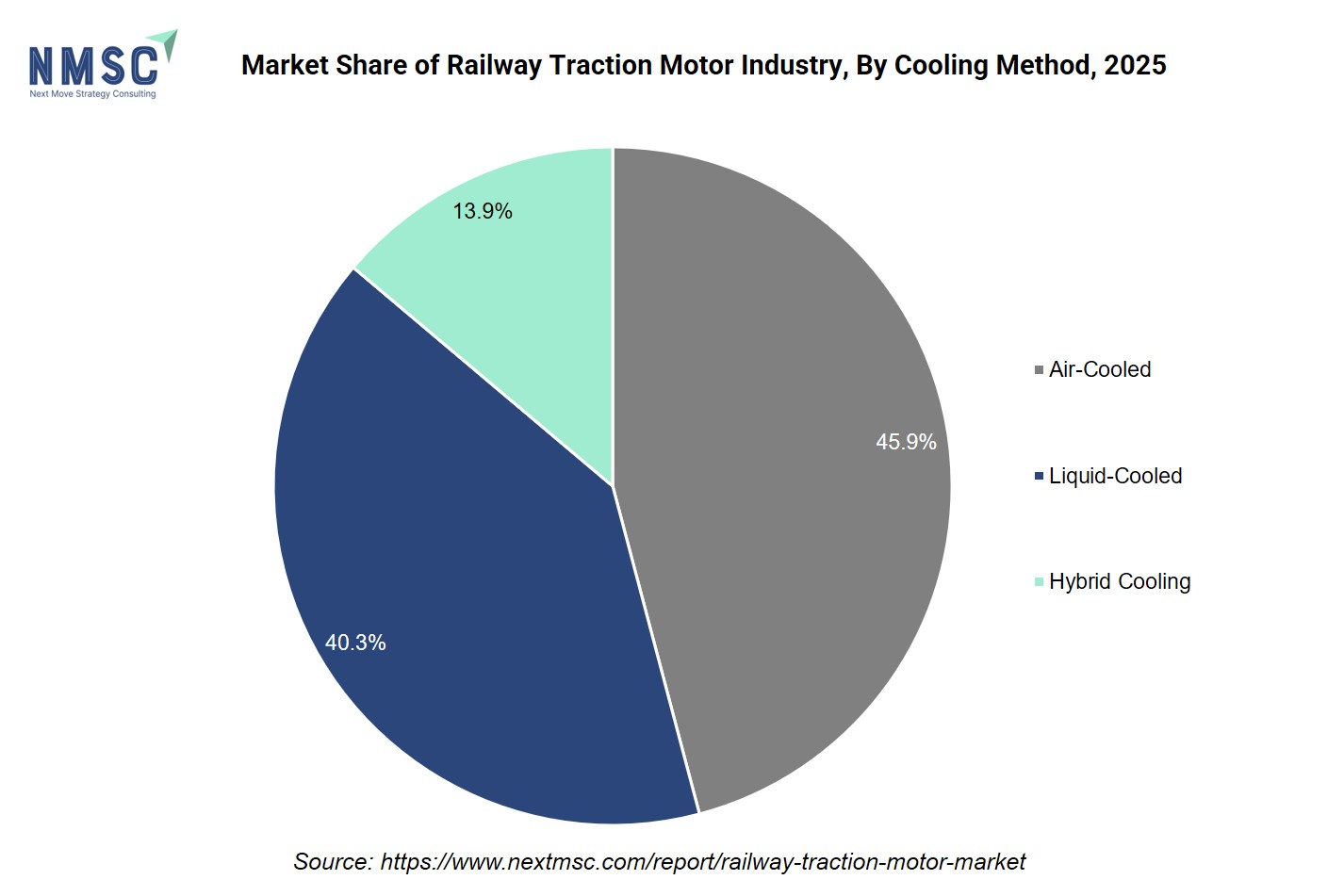
The Railway Traction Motor Market is segmented by cooling method into Air-Cooled, Liquid-Cooled, and Hybrid Cooling configurations. Air-Cooled motors represent the dominant installed base at USD 5.18 billion in 2025, valued for mechanical simplicity, lower maintenance requirements, and suitability for medium-power applications in standard ambient conditions. Liquid-Cooled motors are the fastest-growing segment at a CAGR of 11.96%, as high-power PMSM and AC induction applications in high-speed trains and heavy freight locomotives increasingly require forced liquid cooling to sustain continuous high-power operation without thermal derating. Within liquid cooling, Water-Glycol cooling systems are more prevalent in new rolling stock designs, while Oil-Cooled configurations find application in gear-integrated motor packages. Hybrid Cooling systems combining air and liquid cooling elements provide thermal management flexibility for variable-duty applications such as commuter and regional rail platforms.
How Does Traction Voltage Class Segmentation Reflect the Global Railway Electrification Landscape?
|
Traction Voltage Class |
2025 (USD Bn) |
2035 (USD Bn) |
CAGR (%) |
|
Low Voltage (< 750 V) |
0.88 |
2.47 |
10.26% |
|
Medium Voltage (750 V – 3 kV) |
3.28 |
7.10 |
7.37% |
|
High Voltage (> 3 kV) |
7.14 |
21.27 |
10.87% |
The Railway Traction Motor Market is categorized by traction voltage class into Low Voltage (less than 750 V), Medium Voltage (750 V to 3 kV), and High Voltage (greater than 3 kV) systems. High Voltage motors dominate at USD 7.14 billion in 2025 and 63.2% share, and are also the fastest-growing at a CAGR of 10.87%, reflecting the global prevalence of 25 kV AC electrification in high-speed, mainline passenger, and heavy freight railway systems across China, India, Europe, and Japan. Medium Voltage systems, including 1.5 kV DC and 3 kV DC standards used in legacy European and Asian urban rail, represent the mature middle segment at USD 3.28 billion. Low Voltage systems (less than 750 V) serve metro, tram, and light rail applications using 750 V DC third-rail or overhead systems, growing at 10.26% CAGR as metro network expansion accelerates in emerging economies deploying standard sub-750 V urban rail electrification.
How Do OEM and Aftermarket Channel Dynamics Influence Revenue Distribution in the Railway Traction Motor Market?
|
Commercial Channel |
2025 (USD Bn) |
2035 (USD Bn) |
CAGR (%) |
|
OEM |
8.81 |
24.91 |
10.30% |
|
Aftermarket |
2.49 |
5.93 |
8.43% |
The Railway Traction Motor Market is segmented by commercial channel into OEM supply for new rolling stock deliveries and Aftermarket supply encompassing Replacement Motors and Refurbishment and Rewinding services. OEM channels dominate at USD 8.81 billion in 2025 and 78.0% revenue share, reflecting the primacy of new rolling stock delivery programs as the largest demand driver globally. OEM demand is growing at 10.30% CAGR, driven by high-speed rail fleet deliveries, metro system expansion, and ongoing electrification programs. The Aftermarket segment at USD 2.49 billion in 2025 encompasses direct Replacement Motor supply for mid-life fleet components and Refurbishment and Rewinding services addressing operators seeking cost-effective life extension of repairable traction motor assets. Rail vehicle traction systems aftermarket specialists, including PowerRail and Medha Servo Drives, serve both sub-segments with growing commercial focus.
Regional Outlook
Geographic Performance Snapshot
|
Region |
2025 (USD Bn) |
2035 (USD Bn) |
CAGR (%) |
Key Driver |
|
North America |
1.63 |
5.53 |
12.30% |
Freight electrification, transit fleet renewal |
|
Europe |
1.19 |
3.44 |
10.56% |
Green Deal rail investment, HSR interoperability |
|
Asia-Pacific |
7.76 |
19.21 |
8.84% |
China HSR, India electrification, urban rail |
|
Middle East & Africa |
0.46 |
2.00 |
15.03% |
GCC metro expansion, Vision 2030 programs |
|
Latin America |
0.26 |
0.66 |
9.19% |
Urban transit expansion, freight modernization |
North America Railway Traction Motor Market
North America is the second-largest regional Railway Traction Motor Market contributor after Asia-Pacific, valued at USD 1.63 billion in 2025 and forecast to reach USD 5.53 billion by 2035 at a CAGR of 12.30%. The region's strong growth outlook is driven by large-scale freight locomotive electrification initiatives, urban transit fleet modernisation, and the Biden-era Bipartisan Infrastructure Law allocating billions to passenger and freight rail, which is stimulating new rolling stock procurement. NMSC's analysis indicates that the North American Railway Traction Motor Market is characterised by a mature but rapidly modernising demand base, with both OEM and aftermarket channels growing on the back of fleet replacement and electrification investment programs.
U.S. Railway Traction Motor Market
Based on our engagements with North American rail stakeholders, the United States is the dominant Railway Traction Motor Market in the region at USD 1.39 billion in 2025, reflecting extensive freight railroad electrification feasibility studies, commuter rail fleet modernization, and Amtrak's capital program under the Bipartisan Infrastructure Law. The U.S. Federal Railroad Administration provides regulatory oversight of traction system safety standards under Title 49 CFR, establishing compliance requirements relevant to traction motor procurement specifications. The Department of Transportation's FY2025 capital grants for transit agencies under the Federal Transit Administration are stimulating urban rail fleet renewal, driving OEM procurement for advanced traction motor platforms across Class 8 metro and LRV categories.
Canada Railway Traction Motor Market
Through our analysis, Canada is the fastest-growing North American Railway Traction Motor Market at a CAGR of 15.51%, driven by major urban transit investments in Toronto, Montreal, and Vancouver, government-backed electrification of regional commuter rail, and fleet renewals across GO Transit and Exo networks. Transport Canada's National Trade Corridors Fund and the Investing in Canada Infrastructure Program are supporting rail modernization programs that specify high-efficiency electric traction systems. Canada's clean energy policy framework under the Canadian Net-Zero Emissions Accountability Act creates additional regulatory momentum for electrified rolling stock procurement that directly benefits the Railway Traction Motor Market.
Mexico Railway Traction Motor Market
From our assessment, Mexico represents an emerging Railway Traction Motor Market at USD 0.06 billion in 2025, supported by the Mexico City Metro network expansion, the Maya Train tourism rail project, and growing urban transit investment across Guadalajara and Monterrey. Mexico's Secretaría de Infraestructura, Comunicaciones y Transportes oversees national rail infrastructure investment, with urban metro fleet procurement creating demand for traction motors compliant with IEC and NOM standards. Mexico's proximity to North American supply chains provides logistical advantages for traction motor sourcing, though the market remains early-stage relative to Canadian and U.S. procurement volumes and technological requirements.
Europe Railway Traction Motor Market
Europe is a mature and innovation-intensive Railway Traction Motor Market, valued at USD 1.19 billion in 2025 and forecast to reach USD 3.44 billion by 2035 at a CAGR of 10.56%. The region's growth is anchored by the European Green Deal's commitment to doubling high-speed rail ridership by 2030, trans-European transport network corridor investments, and national fleet renewal programs across Germany, France, Italy, and Spain. Our analysis shows that European rail operators lead global adoption of PMSM and advanced AC induction traction technologies, creating a demanding specification environment that drives technology innovation across the Railway motor manufacturing supply chain globally.
UK Railway Traction Motor Market
Based on our engagements, the United Kingdom maintains a significant Railway Traction Motor Market position at USD 0.08 billion in 2025, underpinned by Network Rail's rolling stock renewal programs, Transport for London's Crossrail and Underground fleet investments, and the government's Integrated Rail Plan for the North and Midlands allocating multi-billion-pound funding for electrification and fleet renewal. The Office of Rail and Road regulate technical standards for traction systems, including electromagnetic compatibility and safety requirements relevant to railway electric propulsion systems. The UK's net-zero by 2050 transport commitment is driving accelerated retirement of diesel multiple units in favor of electrified and battery-electric alternatives across regional rail networks.
Germany Railway Traction Motor Market
Through our analysis, Germany is the largest national Railway Traction Motor Market in Europe at USD 0.29 billion in 2025, driven by Deutsche Bahn's multi-year fleet modernization program, regional Länder-funded rolling stock renewal, and Siemens Mobility's and Alstom's Germany-based traction systems development activities. The Eisenbahn-Bundesamt regulatory framework establishes type approval standards for traction motor systems across the German rail network. Germany's Deutschlandtakt national rail timetabling initiative is stimulating substantial new rolling stock procurement to enable clock-face scheduling across intercity and regional routes, generating structured OEM demand for high-efficiency traction motor platforms.
France Railway Traction Motor Market
From our assessment, France is the second-largest European Railway Traction Motor Market at USD 0.26 billion in 2025, supported by SNCF Voyageurs' TGV fleet renewal, the Grand Paris Express metro project, and RFI's regional tram and light rail investments. The Autorité de régulation des transports (ART) oversees rail market access and technical standards. France's 2035 Rail Investment Program allocates substantial capital to fleet renewal across high-speed, intercity, and regional categories, creating multi-year traction motor procurement visibility for qualified suppliers with PMSM and advanced AC induction platform offerings compatible with French rolling stock technical specifications and SNCF's lifecycle cost requirements.
Italy Railway Traction Motor Market
According to our evaluation, Italy demonstrates strong growth in the Railway Traction Motor Market at a CAGR of 11.24%, driven by Ferrovie dello Stato Italiane's fleet renewal programs, Trenitalia's ETR high-speed train procurements, and metropolitan city investments in metro and tram systems in Milan, Rome, Naples, and Turin. Italy's Ministero delle Infrastrutture e dei Trasporti oversees rail infrastructure and rolling stock procurement policy under the PNRR national recovery plan, which earmarks significant investment for railway modernisation. PMSM traction systems are gaining specification momentum across new Italian rolling stock tenders, aligning with EU rail energy efficiency and decarbonization directives.
Spain Railway Traction Motor Market
Based on our engagements, Spain is an active Railway Traction Motor Market at USD 0.08 billion in 2025, growing at a CAGR of 11.05%, driven by Renfe's fleet renewal across the high-speed AVE network, regional commuter rail modernisation under Cercanías, and metro system expansions in Madrid and Barcelona. Adif's high-speed network expansion program requires new rolling stock deliveries with advanced traction motor platforms meeting EU TSI standards. Spain's National Transport, Mobility and Urban Agenda 2030 commit to substantial rail investment that supports sustained traction motor procurement demand across OEM and aftermarket channels over the forecast period.
Denmark Railway Traction Motor Market
Through our analysis, Denmark is a modest but technically demanding Railway Traction Motor Market at USD 0.02 billion in 2025, reflecting DSB's fleet modernization program, the Copenhagen Metro expansion, and regional light rail investments. The Danish Transport Authority regulates rolling stock type approvals under EU TSI frameworks. Denmark's green transport agenda and the government's Climate Action Plan prioritize electrification of remaining diesel rail lines, creating incremental traction motor procurement as new electric and battery-electric rolling stock enters service. The Copenhagen Metro's continued line extensions generate recurring traction motor supply requirements for urban rail vehicle deliveries from qualified European rolling stock OEMs.
Netherlands Railway Traction Motor Market
From our assessment, the Netherlands presents a well-established Railway Traction Motor Market at USD 0.04 billion in 2025, growing at 10.61% CAGR, driven by NS (Nederlandse Spoorwegen) fleet renewal, ProRail's electrification of remaining non-electrified lines, and the Amsterdam, Rotterdam, and Utrecht metro and tram network investments. The Inspectorate for the Living Environment and Transport regulates rail technical standards under EU TSI frameworks. The Netherlands' ambition to achieve a fully electric passenger rail network by 2040 under its National Integrated Infrastructure and Transport Plan creates structural procurement demand for high-efficiency traction motors across both OEM and refurbishment service channels.
Finland Railway Traction Motor Market
According to our evaluation, Finland occupies a distinctive position in the European Railway Traction Motor Market at USD 0.02 billion in 2025, reflecting VR Group's fleet modernization, the Helsinki Metro expansion, and the Tampere tram network commissioning. The Finnish Transport Infrastructure Agency oversees rail technical specifications and rolling stock approvals. Finland's sub-arctic operating environment imposes stringent motor thermal performance requirements, including cold temperature starting capability and resistance to frost-related ingress, creating specialized technical demand for traction motors qualified for extreme cold-weather railway operations that represent a niche competency for qualified motor suppliers.
Sweden Railway Traction Motor Market
Based on our engagements, Sweden is a technically progressive Railway Traction Motor Market at USD 0.05 billion in 2025, growing at 10.39% CAGR, underpinned by SJ AB and regional operator fleet renewal, the Stockholm metro Blue Line extension, and national investment in high-speed rail under Sweden's National Transport Plan 2022–2033. Transportstyrelsen regulates rail vehicle type approval under EU TSI standards. Sweden's electrified rail network covering approximately 77% of track provides a mature demand base for traction motor refurbishment and replacement, while new high-speed rail planning and urban transit expansion create OEM procurement pipeline for next-generation traction motor platforms.
Rest of Europe Railway Traction Motor Market
Through our analysis, the Rest of Europe Railway Traction Motor Market at USD 0.22 billion in 2025, growing at 12.08% CAGR, encompasses Poland, Czech Republic, Austria, Switzerland, Belgium, and Southeastern European markets with active rolling stock procurement. Poland's CPK high-speed rail program and extensive regional rail modernization, funded through EU cohesion funds, are generating the largest procurement volumes within the Rest of Europe segment. The Czech Republic's SŽDC-backed fleet renewal, Austria's ÖBB new EMU procurements, and Switzerland's SBB fleet upgrades collectively represent a well-funded demand base for advanced Railway Traction Motor platforms across the Central and Eastern European geography.
Asia-Pacific Railway Traction Motor Market
Asia-Pacific is the dominant Railway Traction Motor Market region, valued at USD 7.76 billion in 2025 and forecast to reach USD 19.21 billion by 2035 at a CAGR of 8.84%. The region accounts for 68.7% of global market revenue in 2025, anchored by China's world-leading high-speed rail network, India's comprehensive railway electrification program, and extensive metro and urban rail buildout across South, East, and Southeast Asia. NMSC's analysis indicates that APAC's Railway Traction Motor Market combines the highest absolute procurement volumes with significant technology diversity, from cutting-edge PMSM high-speed train motors in China and Japan to medium-power AC induction motors for India's large-scale electric locomotive fleet expansion programs.
China Railway Traction Motor Market
Based on our engagements in the China Railway Traction Motor Market, China dominates the global market at USD 5.08 billion in 2025, representing 65.4% of APAC and 44.9% of global revenue. CRRC Corporation's vertically integrated rolling stock manufacturing drives massive traction motor demand through ongoing HSR network expansion, metro buildout in dozens of cities, and freight locomotive fleet renewal under China Railway Group's procurement programs. China's Ministry of Transport 14th Five-Year Plan targets over 50,000 km of HSR by 2035, creating unprecedented sustained demand for advanced PMSM and AC induction traction motor platforms in rail vehicle traction systems procurement programs across the forecast period.
Japan Railway Traction Motor Market
Through our analysis, Japan occupies a unique position in the Asia-Pacific Railway Traction Motor Market at USD 0.71 billion in 2025, as the home of Shinkansen high-speed railway technology and advanced motor manufacturers including Hitachi, Toshiba, Toyo Denki, and Fuji Electric. Japan's Ministry of Land, Infrastructure, Transport and Tourism regulates rolling stock technical standards, with Japan's Class C Shinkansen vehicles requiring the most demanding PMSM specifications in the world. Ongoing Shinkansen network expansion including the Hokkaido Shinkansen extension and urban railway network modernization programs across the JR operators create structured traction motor procurement for domestic suppliers with long-established type approvals.
India Railway Traction Motor Market
From our assessment, India is the second-largest Asia-Pacific Railway Traction Motor Market at USD 1.20 billion in 2025, driven by Indian Railways' world-record electrification completion, ongoing WAP and WAG series electric locomotive fleet expansion, and metro network buildout under the Smart Cities Mission and AMRUT programs. The Ministry of Railways and RDSO (Research Designs and Standards Organisation) define technical specifications for traction motors deployed across Indian Railways fleet, with BHEL and Medha Servo Drives serving as key domestic suppliers. India's Vande Bharat Express trainset production program is creating additional PMSM traction motor demand as semi-high-speed rail services expand nationally.
South Korea Railway Traction Motor Market
Based on our market evaluation, South Korea is an established Railway Traction Motor Market at USD 0.12 billion in 2025, characterized by Hyundai Rotem's domestic rolling stock manufacturing, Seoul Metropolitan Subway and regional rail fleet modernization, and the KTX high-speed rail network serving as a technology showcase for Korean traction motor manufacturers. Hyosung Heavy Industries and the domestic supply chain supporting Hyundai Rotem provide locally manufactured traction motors for Korean railway procurement. Korea's Ministry of Land, Infrastructure and Transport oversees rail safety and technical standards, with progressive electrification and urban rail expansion in Busan, Incheon, and Daegu contributing to steady Railway Traction Motor Market demand.
Vietnam Railway Traction Motor Market
According to our evaluation, Vietnam is an emerging Railway Traction Motor Market at USD 0.03 billion in 2025, growing at 8.52% CAGR, driven by the Hanoi Metro Line 2 and 3 construction, Ho Chi Minh City Metro Line 1 commissioning, and the Ministry of Transport's urban rail expansion masterplan for both metropolitan areas. The Socialist Republic of Vietnam's transport electrification policy supports metro and light rail over road-based transit for major urban corridors. International rolling stock OEMs supplying Vietnam's metro projects, including Hitachi, Alstom, and CRRC, are creating traction motor procurement opportunities for qualified suppliers meeting Vietnamese rolling stock acceptance standards.
Philippines Railway Traction Motor Market
Through our analysis, the Philippines Railway Traction Motor Market at USD 0.02 billion in 2025 is developing alongside ongoing Metro Manila rail network expansion, including the North-South Commuter Railway and Metro Manila Subway projects under the Department of Transportation's Build, Build, Build infrastructure program. The Philippine National Railways modernisation and new rolling stock procurements for elevated and subway lines are creating structured traction motor demand. International OEM partnerships with Japanese and European rolling stock manufacturers are introducing advanced AC induction and PMSM traction technologies into the Philippine market, establishing technical baselines for future fleet procurement standards.
Malaysia Railway Traction Motor Market
From our assessment, Malaysia represents a developing Railway Traction Motor Market at USD 0.01 billion in 2025, supported by Prasarana Malaysia's Klang Valley MRT and LRT network expansion programs, the KL-Singapore High Speed Rail planning, and the Malaysia Rail Link Sdn Bhd infrastructure investments. The Land Public Transport Authority (APAD) regulates urban rail technical standards. Japanese and Chinese rolling stock OEMs are the primary suppliers for Malaysian rail projects, channelling traction motor procurement through their established supply chains. Malaysia's 12th Malaysia Plan infrastructure commitments include further urban rail expansion that will progressively grow Railway Traction Motor Market volumes across the forecast period.
Australia Railway Traction Motor Market
Based on our engagements, Australia is a mature Railway Traction Motor Market at USD 0.21 billion in 2025, underpinned by Sydney Trains, Metro Trains Melbourne, and Brisbane's CrossRiver Rail project fleet procurement programs. The Department of Infrastructure, Transport, Regional Development, Communications and the Arts oversees rail policy and investment frameworks supporting fleet electrification and renewal. Australia's significant mining and resources sector is a specialized demand segment for diesel-electric locomotive traction motors in heavy haul freight operations. New metro rolling stock procurement for Sydney Metro Northwest and Melbourne Metro Tunnel projects specifies advanced traction motor platforms from European and Asian rolling stock OEMs qualified for Australian climate and operational requirements.
Indonesia Railway Traction Motor Market
Through our analysis, Indonesia is a growing Railway Traction Motor Market at USD 0.11 billion in 2025, driven by the MRT Jakarta Phase 2 construction, the LRT Jabodebek network, and the Jakarta-Bandung High-Speed Rail line commissioning, representing Indonesia's first high-speed rail project. The Ministry of Transportation oversees rolling stock technical standards and import licensing for railway systems. PT KAI's commuter rail fleet renewal programs and new EMU procurements for Jabodetabek urban rail services create recurring demand for traction motors from qualified international suppliers. Indonesia's ambitious rail expansion agenda under the National Medium-Term Development Plan targets further metro and intercity rail development through 2035.
Taiwan Railway Traction Motor Market
According to our evaluation, Taiwan is an established Railway Traction Motor Market at USD 0.07 billion in 2025, underpinned by Taiwan Railways Administration's EMU fleet renewal, the Taiwan High Speed Rail system's operational fleet maintenance, and Taipei and Kaohsiung metro network rolling stock programs. The Ministry of Transportation and Communications oversees rolling stock procurement and technical approval standards. Taiwan's dense and highly utilized urban and intercity rail network creates consistent traction motor aftermarket demand alongside periodic new rolling stock procurement cycles, with European and Japanese traction motor suppliers historically dominating qualified vendor lists for THSR and TRA fleet programs.
Rest of Asia-Pacific Railway Traction Motor Market
Our analysis shows that the Rest of Asia-Pacific Railway Traction Motor Market at USD 0.20 billion in 2025 includes Singapore, Thailand, Pakistan, Bangladesh, Sri Lanka, and other developing rail markets. Singapore's Land Transport Authority continues expanding the MRT network, requiring new rolling stock traction motor procurement for Circle Line and Thomson-East Coast Line extensions. Thailand's Red Line and Yellow Line commuter rail projects and Bangkok metro expansion are creating new traction motor demand. Bangladesh's Dhaka Mass Rapid Transit project is a significant emerging procurement program representing growing Railway Traction Motor Market opportunity in South Asian urban transit.
Middle East and Africa (MEA) Railway Traction Motor Market
The Middle East and Africa is the fastest-growing Railway Traction Motor Market region at a CAGR of 15.03%, valued at USD 0.46 billion in 2025 and forecast to reach USD 2.00 billion by 2035. Growth is concentrated in GCC countries, Turkey, and North Africa, where major metro and rail infrastructure programs are transforming urban mobility. NMSC's analysis indicates that MEA's Railway Traction Motor Market is transitioning from a nascent to an emerging growth phase, with Saudi Arabia's Vision 2030 transport investments, Egypt's Greater Cairo Metro expansion, Turkey's high-speed rail and urban transit programs, and South Africa's Passenger Rail Agency fleet modernisation driving multi-year traction motor procurement.
Saudi Arabia Railway Traction Motor Market
Based on our engagements, Saudi Arabia is the most strategically active MEA Railway Traction Motor Market, growing at 16.07% CAGR from USD 0.04 billion in 2025. Vision 2030 transport investment programs include the Riyadh Metro full system operation, the Haramain High Speed Rail, and the Saudi Land Bridge freight rail project. The Saudi Railway Organization (SAR) and Public Transport Authority oversee rolling stock procurement and technical standards. Planned metro extensions in Riyadh and new metro systems in Jeddah and Neom are creating structured traction motor procurement demand for qualified rolling stock OEMs with established GCC supply chain presence and regional service network capabilities.
UAE Railway Traction Motor Market
Through our analysis, the UAE Railway Traction Motor Market is growing at 13.81% CAGR from USD 0.02 billion in 2025, driven by Dubai Metro's Route 2020 extension operation, Abu Dhabi metro planning, and the Etihad Rail national freight and passenger network construction program. The Roads and Transport Authority (RTA) Dubai administers technical standards for Dubai Metro rolling stock procurement. The UAE's National Railway Program under Etihad Rail represents the largest single rolling stock procurement pipeline in the country, specifying electric traction systems for new passenger and freight locomotives that create significant railway electric propulsion systems procurement volume over the forecast period.
Egypt Railway Traction Motor Market
From our assessment, Egypt is the second-largest MEA Railway Traction Motor Market at USD 0.11 billion in 2025, growing at 14.75% CAGR, driven by the Greater Cairo Metro Lines 3, 4, and 6 construction and operation, the High-Speed Rail network under development between Cairo, Alexandria, and Aswan, and Egyptian National Railways fleet modernisation programs. The Egyptian Ministry of Transport oversees rail procurement under Egyptian railway technical standards. International rolling stock OEMs including Alstom, Talgo, and Stadler are supplying EMUs for Egyptian high-speed rail, generating traction motor procurement that is expected to grow substantially as the ambitious multi-line high-speed network progresses toward commissioning.
Israel Railway Traction Motor Market
According to our evaluation, Israel represents a technically sophisticated but relatively small Railway Traction Motor Market at USD 0.01 billion in 2025, growing at 15.00% CAGR, driven by Israel Railways' fleet expansion program, Jerusalem Light Rail extensions, and Tel Aviv metro planning. The Ministry of Transport and Road Safety oversees rail investment and technical standards. Israel Railways' procurement of new electric multiple units and suburban rolling stock specifies modern AC induction and PMSM traction motor platforms consistent with European standards. Israel's growing urban transit investment, particularly the Red Line metro tender, represents the largest near-term Railway Traction Motor Market procurement opportunity in the country.
Turkey Railway Traction Motor Market
Based on our engagements, Turkey is the largest MEA Railway Traction Motor Market at USD 0.12 billion in 2025, growing at 15.51% CAGR, driven by TCDD's high-speed rail network expansion, metro and tram systems in Istanbul, Ankara, Izmir, and Bursa, and Turkey's domestic rolling stock manufacturing industry involving CAF, Alstom, and Türasas partnerships. The Ministry of Transport and Infrastructure oversees railway electrification and rolling stock technical specifications. Turkey's ambitious Ulaşım Ana Planı targets HSR network expansion beyond 10,000 km by 2035, creating substantial multi-year Railway Traction Motor procurement demand across OEM supply contracts for new train deliveries from both domestic and international manufacturers.
Nigeria Railway Traction Motor Market
Through our analysis, Nigeria is an emerging Railway Traction Motor Market at USD 0.02 billion in 2025, growing at 14.60% CAGR, driven by the Abuja Light Rail system, the Lagos Red and Blue Line metro projects, and the Nigerian railway standard gauge modernisation programs under the Federal Ministry of Transportation. Chinese rolling stock OEMs including CRRC and CCECC are primary suppliers for Nigerian rail projects under China-Nigeria bilateral infrastructure agreements, channelling traction motor procurement through their supply chains. Nigeria's large urban population and significant urban mobility deficit represent a substantial long-term Railway Traction Motor Market development opportunity as formal transit infrastructure investment matures.
South Africa Railway Traction Motor Market
From our assessment, South Africa is the most commercially mature Sub-Saharan Railway Traction Motor Market at USD 0.08 billion in 2025, driven by Passenger Rail Agency of South Africa (PRASA) fleet renewal, the Gautrain regional rail operation, and the national freight rail network operated by Transnet Freight Rail requiring traction motor maintenance and replacement. The Department of Transport oversees rail policy under South Africa's National Transport Masterplan. PRASA's New Generation Rolling Stock (NGRS) procurement program represents the largest rolling stock fleet renewal in Sub-Saharan Africa, specifying modern traction motor platforms for electric multiple unit deliveries from Gibela Rail Transport Consortium manufacturing in South Africa.
Rest of MEA Railway Traction Motor Market
Our analysis shows that the Rest of MEA Railway Traction Motor Market was valued at USD 0.05 billion in 2025, growing at the fastest CAGR of 16.56%, encompassing Kuwait, Qatar, Bahrain, Oman, Morocco, Kenya, and Ethiopia. Qatar's Doha Metro expansion, Kuwait's Intercity Rail Network project, and Morocco's Al Boraq high-speed rail extension and urban tram networks generate traction motor procurement through European rolling stock OEM supply chains. Kenya's Standard Gauge Railway and Ethiopia's Addis Ababa Light Rail represent East African early-stage procurements establishing the foundation for growing Railway Traction Motor Market presence across the continent's emerging formal transit infrastructure.
Latin America Railway Traction Motor Market
Latin America is the smallest regional Railway Traction Motor Market at USD 0.26 billion in 2025, forecast to reach USD 0.66 billion by 2035 at a CAGR of 9.19%. Brazil and Argentina together represent approximately 70% of regional revenue, with Mexico contributing through its urban transit programs. NMSC's analysis indicates that Latin America's railway market growth is primarily driven by urban transit expansion in São Paulo, Buenos Aires, Santiago, and Bogotá, complemented by freight rail network modernisation in Brazil's agricultural commodity corridors. The region presents a developing but commercially meaningful opportunity for Railway Traction Motor suppliers as urban mobility investment accelerates under sustainability-aligned infrastructure programs.
Brazil Railway Traction Motor Market
Based on our engagements, Brazil is the largest Latin American Railway Traction Motor Market at USD 0.14 billion in 2025, growing at 10.00% CAGR, driven by São Paulo Metro fleet expansion, the CPTM commuter rail network renewal, and significant freight rail investment by Vale, Rumo, and VLI in locomotive fleet modernisation. ANTT (Agência Nacional de Transportes Terrestres) regulates railway technical standards and concession agreements. Brazil's Federal Government investment programs under the Novo PAC include metro and urban rail components that generate rolling stock procurement. BNDES financing for rail infrastructure supports fleet modernisation initiatives that create traction motor demand for both OEM and aftermarket channels.
Argentina Railway Traction Motor Market
Through our analysis, Argentina represents a developing Railway Traction Motor Market at USD 0.04 billion in 2025, growing at 6.40% CAGR, characterised by ongoing Buenos Aires Subte network fleet renewal, Trenes Argentinos intercity rail rolling stock investments, and freight locomotive procurement under government-backed modernization programs. The Secretaría de Transporte oversees railway policy and rolling stock technical standards. Macroeconomic volatility and foreign exchange constraints periodically constrain capital equipment import procurement, but government priority infrastructure spending and IDB-backed transport investment programs provide recurring Railway Traction Motor demand across urban transit fleet renewal and intercity passenger service modernisation initiatives.
Chile Railway Traction Motor Market
From our assessment, Chile demonstrates strong Railway Traction Motor Market growth at 9.64% CAGR from USD 0.02 billion in 2025, driven by Metro de Santiago network expansion, the EFE commuter and regional rail network electrification program, and new urban transit initiatives in Valparaíso, Concepción, and Temuco. Chile's Ministerio de Transportes y Telecomunicaciones oversees rail investment policy, with Metro de Santiago's procurement of new rolling stock specifying modern electric traction motor platforms. Chile's Mining sector diesel-electric locomotive fleet also generates traction motor maintenance and replacement demand, creating an aftermarket opportunity alongside OEM procurement from new metro fleet deliveries.
Colombia Railway Traction Motor Market
According to our evaluation, Colombia is an emerging Railway Traction Motor Market at USD 0.02 billion in 2025, growing at 10.18% CAGR, driven by Bogotá's Metro Line 1 construction and Line 2 planning, the Medellín Metro and light rail network expansion, and Colombia's Invías-backed freight rail modernisation programs. Colombia's Ministerio de Transporte oversees rail infrastructure investment and technical standards. The Bogotá First Line Metro project, representing the country's largest single transport infrastructure investment, includes extensive rolling stock procurement specifying modern PMSM traction motor platforms, establishing a technology benchmark for Colombia's advancing urban transit system modernisation objectives.
Rest of Latin America Railway Traction Motor Market
Our analysis shows that the Rest of Latin America Railway Traction Motor Market was USD 0.04 billion in 2025, growing at 8.15% CAGR, and encompasses Peru, Ecuador, Venezuela, Central America, and the Caribbean, where urban transit and freight rail investments represent early-stage opportunities. Peru's Lima Metro Line 2 construction and Ecuador's Quito Trolleybus and Metro system create structured but modest traction motor procurement. Panama's Metro Lines 1 and 2 represent additional small-scale urban rail procurement opportunities. Across the Rest of LATAM segment, international rolling stock OEM partnerships with Alstom, Siemens, and CAF channel traction motor procurement through established supply chains serving individual national project procurements.
Supply Chain Structure of the Railway Traction Motor Market
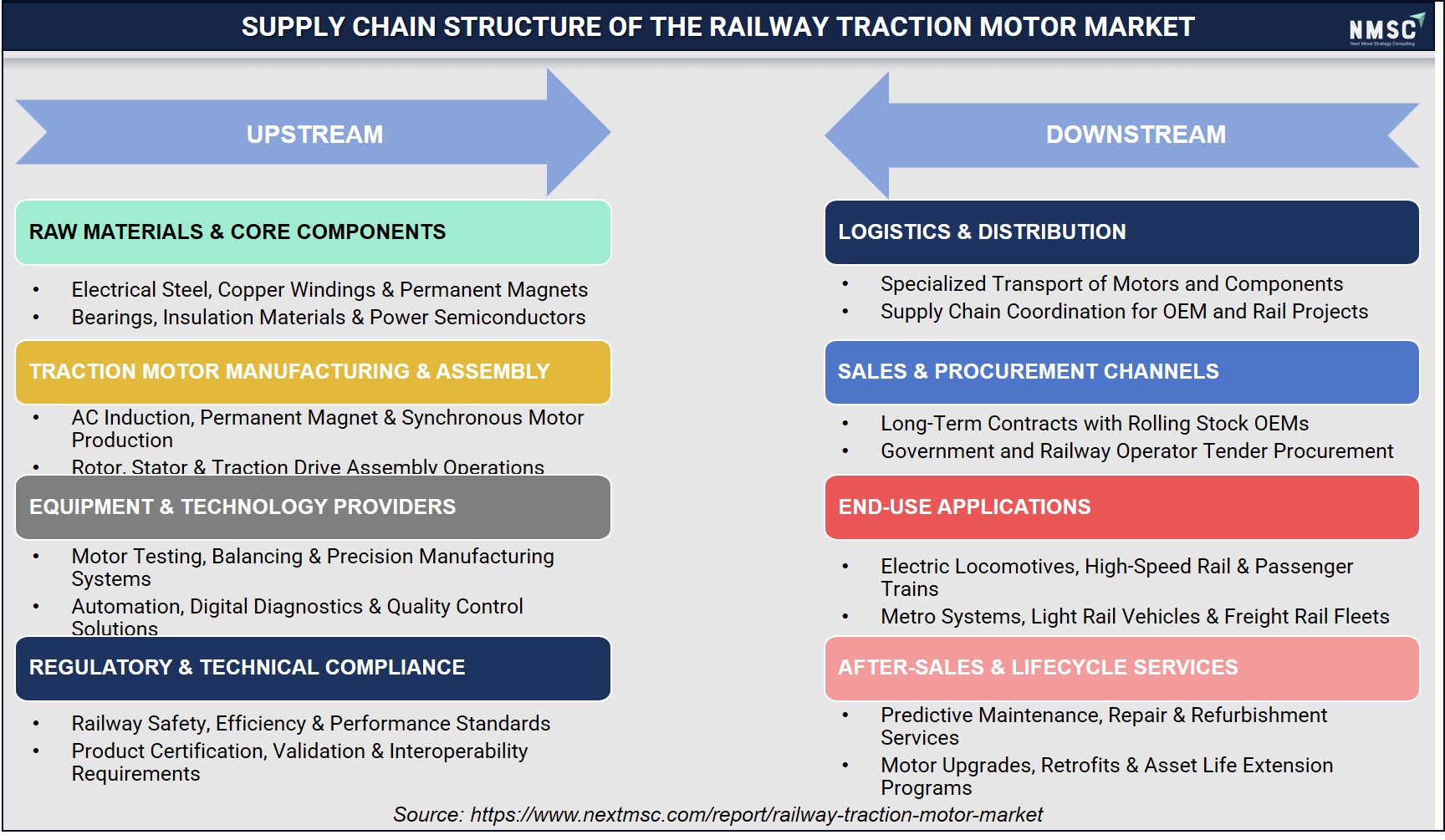
NMSC assessment indicates that the railway traction motor market demonstrates a highly specialized competitive structure supported by growing rail electrification, fleet modernisation, and sustainable transportation initiatives. Supplier influence is reinforced by the critical nature of specialized materials and components, while large railway operators and rolling stock manufacturers maintain significant purchasing power through long-term procurement programs. Strong technical requirements, certification procedures, and capital-intensive manufacturing limit new market entrants, whereas the absence of viable substitutes sustains the strategic importance of traction motors within modern rail networks. These dynamics continue to drive innovation, operational efficiency, and competitive differentiation across the industry.
Competitive Landscape
Competitive Dynamics and M&A Landscape
|
Key Takeaways |
Details |
|
Market Structure |
Consolidated at the premium rolling stock tier with a small number of global OEMs, Siemens Mobility, Alstom, Hitachi, Wabtec, and ABB, commanding advanced traction motor platforms. Regional specialists including BHEL, Medha Servo Drives, Hyosung, and Xi'an Simo Motor serve domestic markets. CRRC-affiliated motor suppliers dominate China through captive supply chain integration with the world's largest rolling stock OEM. |
|
Innovation Focus |
PMSM technology advancement, axial flux motor architecture development for urban rail, digital condition monitoring system integration, rare-earth-free synchronous reluctance motor alternatives, liquid cooling systems for high-power HSR applications, and frame-mounted motor configurations for premium rolling stock platforms requiring minimum unsprung mass. |
|
M&A Activity |
Wabtec Corporation's acquisition of GE Transportation in 2019 strengthened its North American traction motor aftermarket position. Alstom's integration of Bombardier Transportation in 2021 created a combined traction systems portfolio spanning multiple rail vehicle platforms. Chinese consolidation under CRRC's state-backed supply chain strategy has concentrated domestic traction motor capability. ABB's rail traction systems portfolio reinforces its railway electric propulsion systems competitive positioning globally. |
For the latest market share analysis and in-depth report on Railway Traction Motor Industry insights, you can buy our latest report: Access the Report
How Do Companies Compete in the Railway Traction Motor Market?
The Railway Traction Motor Market is characterised by multi-dimensional competition across technology generation leadership, rolling stock platform compatibility breadth, after-sales service capability, and regulatory certification depth across multiple national rail networks. NMSC's analysis indicates that PMSM platform design win execution for high-speed train and premium metro programs is the current primary competitive battleground, as rolling stock OEM qualification cycles lock in motor supplier relationships for multi-year production programs defining revenue trajectories through the early 2030s. System integrators including Siemens Mobility and Alstom compete by offering complete traction system packages, motor, drive, and control, reducing integration complexity for rolling stock OEM customers and creating captive aftermarket service revenue streams.
Pricing strategies reflect dual pressures: technology premium positioning for advanced PMSM and frame-mounted systems in high-speed and premium metro applications, and aggressive cost competition in standardised AC induction motor segments serving freight and regional rail procurement. Geographic expansion strategies are increasingly focused on MEA and Southeast Asia, where urban rail investment is accelerating fastest. Companies with local manufacturing, joint venture partnerships, and government-registered vendor status gain structural procurement advantages in markets like India, China, and Saudi Arabia where domestic industry participation requirements influence supplier selection in public rail tenders.
Which Kind of Companies Dominate the Railway Traction Motor Market?
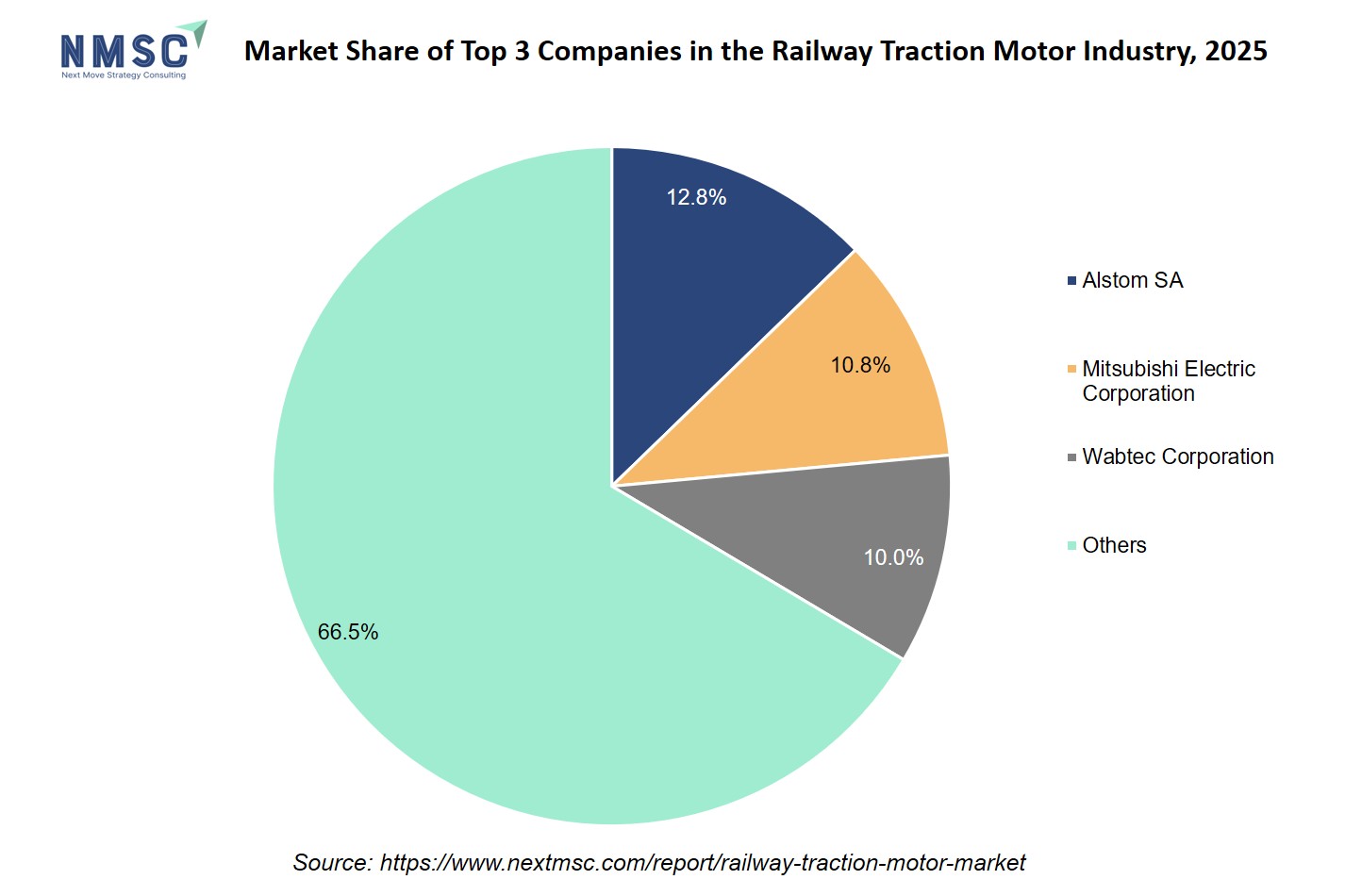
The Railway Traction Motor Market is characterized by the presence of three distinct categories of competitors. The first comprises global propulsion and traction system providers such as Siemens Mobility, Alstom, Hitachi Rail, ABB, Wabtec Corporation, and Mitsubishi Electric Corporation, which offer integrated traction motors, propulsion systems, and drive technologies supported by extensive global certifications and long-standing relationships with rolling stock manufacturers. The second group consists of regional manufacturers, including Bharat Heavy Electricals Limited, CG Power and Industrial Solutions, Hyosung Heavy Industries, Škoda Transportation, and Traktionssysteme Austria, which leverage strong domestic market presence, regional certifications, and cost-effective product offerings. The third category includes specialized traction motor manufacturers such as Toyo Denki Seizo, Fuji Electric, Xi'an Simo Motor, and Nidec Corporation, which focus on niche motor technologies, customized applications, or specific geographic markets, enabling them to establish strong competitive positions through technical specialization and focused expertise.
AI-Native Differentiation and Open Standards Drive Market Success in the Railway Traction Motor Market
Leading Railway Traction Motor Market vendors are differentiating through integrated digital intelligence capabilities, embedding IoT sensors, condition monitoring firmware, and predictive maintenance data interfaces directly within traction motor assemblies. Our findings suggest that interoperability with open railway data standards including IEC 61375 Train Communication Network and ERA's EULYNX data model is becoming a qualification prerequisite for rolling stock OEM design wins at European rail operators standardizing on digital train control architectures. Companies that combine advanced motor technology with turnkey digital monitoring platforms are capturing premium specification positions and higher-margin aftermarket service contracts relative to product-only motor suppliers.
Market Players to Opt for Merger and Acquisition Strategies to Expand Their Presence in the Railway Traction Motor Market
Strategic M&A activity in the Railway Traction Motor Market is driven by the need to acquire PMSM platform IP, expand geographic certifications, and access aftermarket service networks across growing non-home-region markets. Based on our market evaluation, we noticed that the integration of Bombardier Transportation into Alstom created the second-largest traction systems portfolio globally and exemplifies the scale logic driving consolidation. Future M&A activity is most likely to involve European motor specialists acquiring PMSM technology IP, North American rail suppliers seeking to expand urban transit traction capabilities, and Asian manufacturers pursuing international certification acquisition to support rolling stock traction motor export market ambitions.
Who Are the Key Market Players in the Railway Traction Motor Market?
-
Alstom SA
-
Mitsubishi Electric Corporation
-
Toshiba Corporation
-
Hitachi Ltd.
-
Fuji Electric Co., Ltd.
-
VEM Group
-
Hyosung Heavy Industries
-
Siemens Mobility
-
Bharat Heavy Electricals Limited
-
CG Power & Industrial Solutions Ltd.
-
Xi'an Simo Motor Co., Ltd.
-
Traktionssysteme Austria GmbH
-
Škoda Transportation
-
Medha Servo Drives Pvt. Ltd.
-
Saini Electrical Engineering Pvt. Ltd.
-
Toyo Denki Seizo K.K.
-
PowerRail
What Are the Latest Developments in the Railway Traction Motor Market Industry?
|
Date |
Event |
|
January 2026 |
Bharat Heavy Electricals Limited (BHEL) commenced supply of IGBT-based underslung traction system for the Vande Bharat Sleeper Train project. The propulsion package includes advanced traction motors and converters developed for semi-high-speed railway applications up to 160 kmph |
|
December 2024 |
Siemens Mobility partnered with CAF to supply advanced propulsion systems, including traction motors, converters, and brake resistors for new Metro de Madrid train fleets. The collaboration strengthens Siemens’ position in high-efficiency rail propulsion technologies |
|
June 2024 |
Siemens Mobility expanded its Cornellà manufacturing facility in Spain by adding a new gearbox production line and converter cabinet competence center. The site is a major supplier of traction motors, converters, and traction components used in railway vehicles globally |
Expert Insights
 “Vectron Dual Mode is today the most reliable and cost-effective solution for railway operators that intend to step away from pure diesel traction. This locomotive, fitted with ERTMS, can operate in an agile way on both electrified and non-electrified infrastructure without compromise on speed and haulage capacity. We are proud to add this offer in addition to our existing Electric Vectron portfolio.”
— Fabien Rochefort, CEO of Akiem
Statement made following Akiem’s order for 50 Vectron Dual Mode locomotives.
Market Interpretation
The comment underscores the accelerating shift within the railway industry toward electrified and low-emission propulsion solutions. As rail operators seek to reduce fuel consumption, lower emissions, and improve operational flexibility across partially electrified networks, demand for advanced traction motors and integrated propulsion systems is increasing. The adoption of dual-mode locomotives is driving investment in high-efficiency traction motor technologies, power electronics, and hybrid propulsion architectures, supporting long-term growth opportunities across the Railway Traction Motor Market.
What Are the Investment Opportunities in the Railway Traction Motor Market?
Capital Inflows and Venture Activity
The Railway Traction Motor Market continues to attract strategic capital from both infrastructure investors and industrial conglomerates, driven by the convergence of railway electrification mandates and clean transportation policy frameworks. BHEL's ongoing capital allocation to traction motor production capacity expansion in India, Siemens Mobility's PMSM R&D investment programs, and Alstom's traction systems manufacturing investment across its global facility network reflect the large-OEM capital flow pattern dominating the market. Niche capital also flows into motor technology startups developing axial flux railway traction architectures and rare-earth-free reluctance motor alternatives, supported by clean transportation R&D grant programs under the European Horizon program and U.S. Department of Transportation research initiatives.
Infrastructure Investment
Large-scale investment in railway infrastructure, network modernisation, electrification projects, and urban transit development remains a key growth catalyst for the Railway Traction Motor Market. Through NMSC's assessment, we found that sustained public and private sector funding for metro rail systems, high-speed rail corridors, regional transit networks, and railway electrification initiatives is creating long-term demand for advanced traction motors and propulsion equipment. As governments and rail operators focus on expanding network capacity, improving energy efficiency, and reducing carbon emissions, procurement of modern rolling stock equipped with high-performance traction systems continues to increase. The strongest investment momentum is evident in urban rail and high-speed rail segments, where large-scale fleet expansion and modernisation programs are driving substantial demand for next-generation traction motor technologies.
ESG Considerations
Environmental, social, and governance considerations are increasingly central to Railway Traction Motor Market investment thesis frameworks. Electric traction motors enable dramatically lower lifecycle carbon emissions per passenger-kilometer compared to diesel traction, with rail operators publishing energy efficiency improvement targets that directly mandate traction motor technology upgrades. The U.S. Department of Energy's Vehicle Technologies Office rail traction electrification research programs and the European Commission's Shift2Rail Joint Undertaking research initiatives provide policy-backed ESG investment context supporting capital allocation toward high-efficiency railway traction motor technology development, manufacturing, and deployment programs aligned with national and regional net-zero transportation commitments.
Digital Transformation Enablement
Railway traction motors are foundational enablers of digital railway programs, as condition-based maintenance, energy optimisation, and real-time fleet management platforms all require embedded intelligence within traction motor systems. From our research, we found that the International Union of Railways' Digital Transformation Strategy explicitly identifies traction system digitalization as a core operational technology investment area for rail operators seeking to improve fleet availability and reduce maintenance costs. Motor manufacturers that embed condition monitoring capability, interoperable data interfaces, and predictive analytics connectivity directly within traction motor assemblies are capturing premium specification positions in new rolling stock tenders and accessing high-margin long-term service agreement revenue streams.
Private Equity and Strategic M&A Activity
Strategic M&A interest in the Railway Traction Motor Market is driven by technology scarcity in advanced PMSM platform IP, the defensible revenue characteristics of certified aftermarket service businesses, and the long-duration demand outlook created by national rail electrification commitments. Our assessment indicates that mid-market railway traction motor specialists with proven type approvals across multiple rail networks and established aftermarket service operations represent attractive acquisition targets for industrial conglomerates seeking to expand their rolling stock systems portfolio. Rail vehicle traction systems specialists with growing MEA and Southeast Asian customer relationships are positioned as particularly attractive targets given the high-growth trajectory of Railway Traction Motor Market demand in these emerging geographies.
Key Benefits for Stakeholders
For Rolling Stock OEMs and Traction System Engineers
Rolling stock OEMs and traction system engineers gain access to a comprehensive, vendor-neutral assessment of the Railway Traction Motor Market, including quantitative sizing across all rolling stock applications, motor types, architecture, mounting, power rating, cooling, voltage class, and commercial channel segments. Our competitive landscape analysis provides engineering teams with intelligence on motor supplier PMSM platform roadmaps, qualification certification timelines, and regional service network capabilities, enabling informed supplier selection and program risk management for new rolling stock development programs. The regional analysis provides geographic demand prioritisation context for supply chain investment and customer development strategy decisions across all major rail markets.
For Rail Operators and Transit Authorities
Rail operators and transit authorities access structured intelligence on the Railway Traction Motor Market's technology transition dynamics, including quantitative evidence for PMSM efficiency advantage business cases, aftermarket motor refurbishment market sizing, and regional benchmark data for traction motor lifecycle cost assessment. NMSC's analysis enables procurement and fleet management teams to benchmark their traction motor replacement and refurbishment program investment timing against industry adoption trends. The segmentation analysis by cooling method, power rating, and voltage class provides direct relevance to technical specification development for rolling stock tender documents and fleet maintenance program optimization initiatives.
For Investors and Financial Analysts
Investors and financial analysts access a structured, data-rich assessment of the Railway Traction Motor Market's growth trajectory, competitive dynamics, and segment-level revenue forecasts through 2035. The CAGR analysis by segment, region, and technology type enables precision valuation modelling and portfolio construction for listed rail systems companies including ABB, Siemens Mobility, Hitachi, and Wabtec Corporation. The latest developments tracking section provides an early-signal framework for identifying technology transition momentum, rolling stock procurement program awards, and emerging competitive threats within the global railway traction motor supply chain and rolling stock traction motor manufacturing landscape.
For Government Bodies and Transport Authorities
Government agencies and transport policy bodies gain a structured analysis of how national railway electrification mandates, rolling stock procurement programs, and clean transportation investment frameworks are shaping the competitive structure of the Railway Traction Motor Market. Country-level insights provide policymakers with evidence-based perspectives on how technology regulation, domestic content requirements, and infrastructure investment choices affect railway electric propulsion systems industry development and fleet energy efficiency outcomes. The MEA and Latin America regional analysis provides directly relevant context for emerging economy transport ministers designing public rail investment programs and domestic industry participation frameworks for rolling stock procurement tenders.
Key Market Segments
By Rolling Stock Application
-
Locomotives
-
Freight Locomotive
-
Passenger Locomotive
-
Shunting Locomotive
-
Work Locomotive
-
-
Commuter and Regional Train
-
Electric Multiple Unit
-
Diesel Multiple Unit
-
Dual Mode Multiple Unit
-
Battery Electric Multiple Unit
-
-
High-Speed Trains
-
Distributed Traction
-
Power Car
-
-
Urban Rail
-
Metro Trains
-
Light Rail Vehicles (LRV)
-
Trams
-
-
Other Rail Vehicle
By Motor Type
-
DC Motors
-
AC Induction Motors (Asynchronous)
-
Permanent Magnet Synchronous Motors (PMSM)
-
Interior Permanent Magnet
-
Surface Permanent Magnet
-
-
Wound Field Synchronous Motor
-
Reluctance Motor
-
Synchronous Reluctance
-
Switched Reluctance
-
-
Other Motor Type
By Motor Architecture
-
Radial Flux
-
Axial Flux
-
Other Architecture
By Mounting Type
-
Axle Hung
-
Nose Suspended
-
Frame Mounted
-
Other Mounting
By Power Rating
-
Low Power (< 300 kW)
-
Medium Power (300–800 kW)
-
High Power (800–1500 kW)
-
Very High Power (> 1500 kW)
By Cooling Method
-
Air-Cooled
-
Liquid-Cooled
-
Water Glycol
-
Oil Cooled
-
-
Hybrid Cooling
By Traction Voltage Class
-
Low Voltage (< 750 V)
-
Medium Voltage (750 V – 3 kV)
-
High Voltage (> 3 kV)
By Commercial Channel
-
OEM
-
Aftermarket
-
Replacement Motors
-
Refurbishment and Rewinding
-
By Region
-
North America: U.S., Canada, and Mexico
-
Europe: UK, Germany, France, Italy, Spain, Sweden, Denmark, Finland, the Netherlands, and the rest of Europe
-
Asia Pacific: China, India, Japan, South Korea, Taiwan, Indonesia, Vietnam, Australia, Philippines, Malaysia, and the rest of APAC
-
Middle East & Africa (MEA): Saudi Arabia, UAE, Egypt, Israel, Turkey, Nigeria, South Africa, and the rest of MEA
-
Latin America: Brazil, Argentina, Chile, Colombia, and the rest of LATAM
Conclusion and Recommendations
Long-Term Outlook
The Railway Traction Motor Market is entering a decade of structurally robust growth, driven by the convergence of national railway electrification mandates, urban rail infrastructure investment acceleration, PMSM technology maturation, and the emergence of battery-electric and hydrogen traction platforms. The market is forecast to grow from USD 13.17 billion in 2026 to USD 30.84 billion by 2035 at a CAGR of 9.91%. This growth reflects not only expanding rolling stock procurement volumes but a meaningful increase in average traction motor content value per vehicle, as PMSM and advanced cooling architectures command premium pricing relative to legacy AC induction and DC predecessor platforms across major rolling stock categories.
Strategic Positioning Recommendations
Railway Traction Motor suppliers should prioritize PMSM platform design win execution as the single most critical near-term competitive initiative, as rolling stock OEM qualification cycles for high-speed train and urban rail programs are actively selecting motor suppliers for multi-year production commitments. Frame-mounted configuration development, while requiring longer qualification lead times, represents a structurally important capability gap as premium rolling stock specifications increasingly mandate minimum unsprung mass. Suppliers without liquid-cooled PMSM portfolio offerings and IEC 60349-certified product lines should treat these as priority investment areas given the increasing proportion of premium rolling stock tenders specifying these capabilities.
Investment Attractiveness
The Railway Traction Motor Market represents a compelling investment environment underpinned by durable secular demand drivers, structurally increasing motor content value per vehicle, and long-duration demand visibility created by national rail electrification program commitments. Our assessment indicates that the highest-conviction investment themes include PMSM traction technology adoption (13.01% segment CAGR), MEA urban rail expansion (15.03% regional CAGR), Frame Mounted configuration growth (12.92% CAGR), and Very High-Power motor demand for high-speed rail programs (12.75% CAGR). The global Railway Traction Motor Market's combination of infrastructure policy support, clean transportation alignment, and technology transition dynamics creates a differentiated and defensible growth profile through 2035.
Market Shifts and Key Risks
The most significant structural market shift underway is the progressive displacement of AC induction motor revenue by PMSM across new premium rolling stock platforms, requiring motor suppliers to invest substantially in permanent magnet supply chain qualification and motor design IP. Key risks include rare earth material price volatility and supply concentration constraining PMSM adoption economics, extended rolling stock qualification cycles delaying revenue realization on new motor platform investments, geopolitical disruption to global supply chains for motor components including rare earth magnets and high-grade electrical steels, and fiscal constraints on public rail investment programs in emerging markets where urban rail expansion represents the largest forecast growth opportunity in the Railway Traction Motor Market.
Growth Pathways
Organizations seeking to maximize value from the Railway Traction Motor Market should pursue a three-horizon strategy. In the near term from 2025 to 2027, prioritize PMSM platform qualification execution, liquid cooling capability development, and urban rail motor specification engagement across MEA and Southeast Asian metro project tenders. In the mid-term from 2027 to 2031, invest in axial flux architecture development for compact urban rail applications, digital condition monitoring integration for aftermarket service contract access, and battery-electric multiple unit traction motor qualification programs. In the long term from 2031 to 2035, position for rare-earth-free reluctance motor advancement and hydrogen-compatible traction system architectures as the frontier of Railway Traction Motor innovation and the highest-value competitive differentiation dimensions.
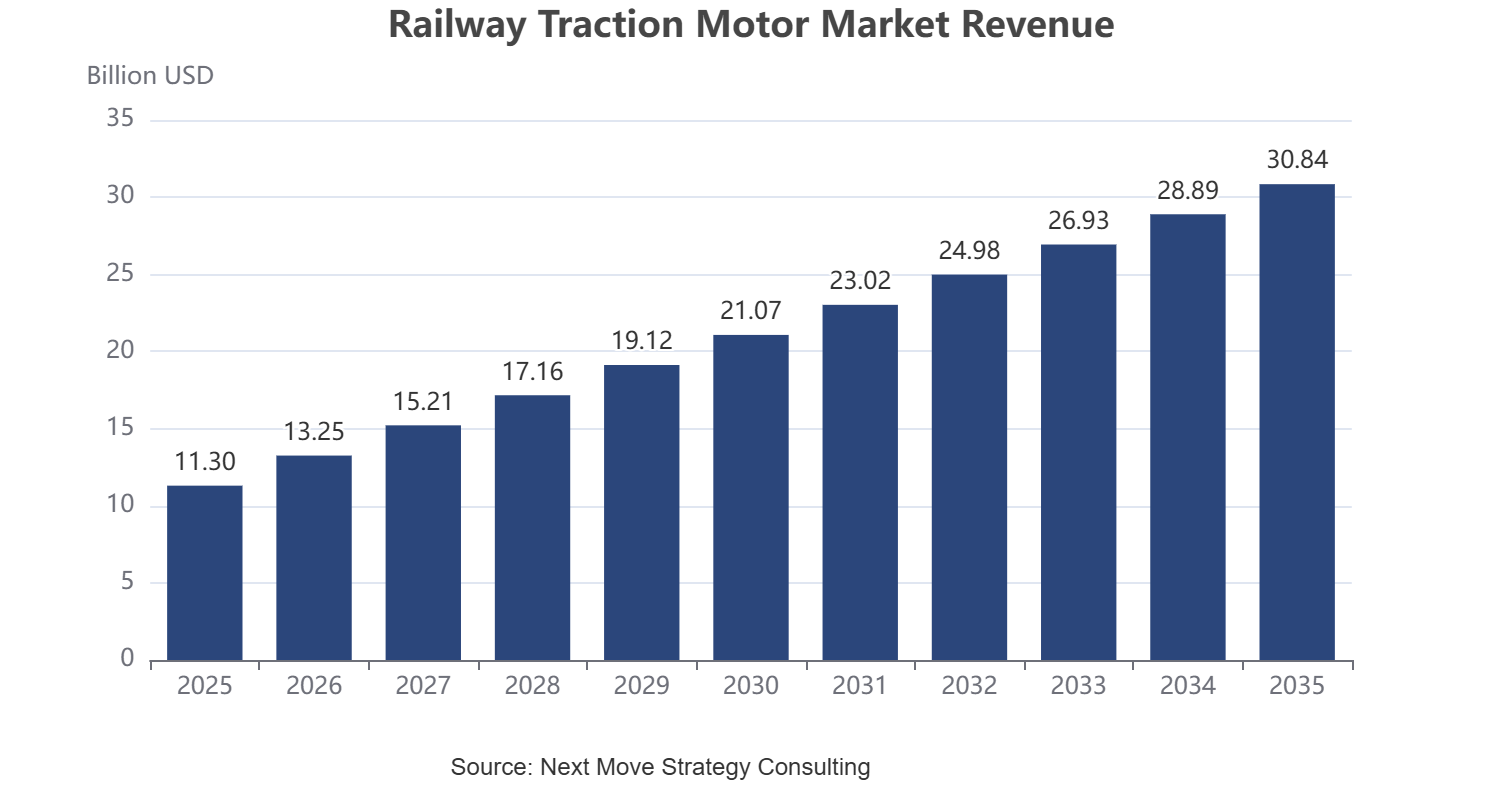
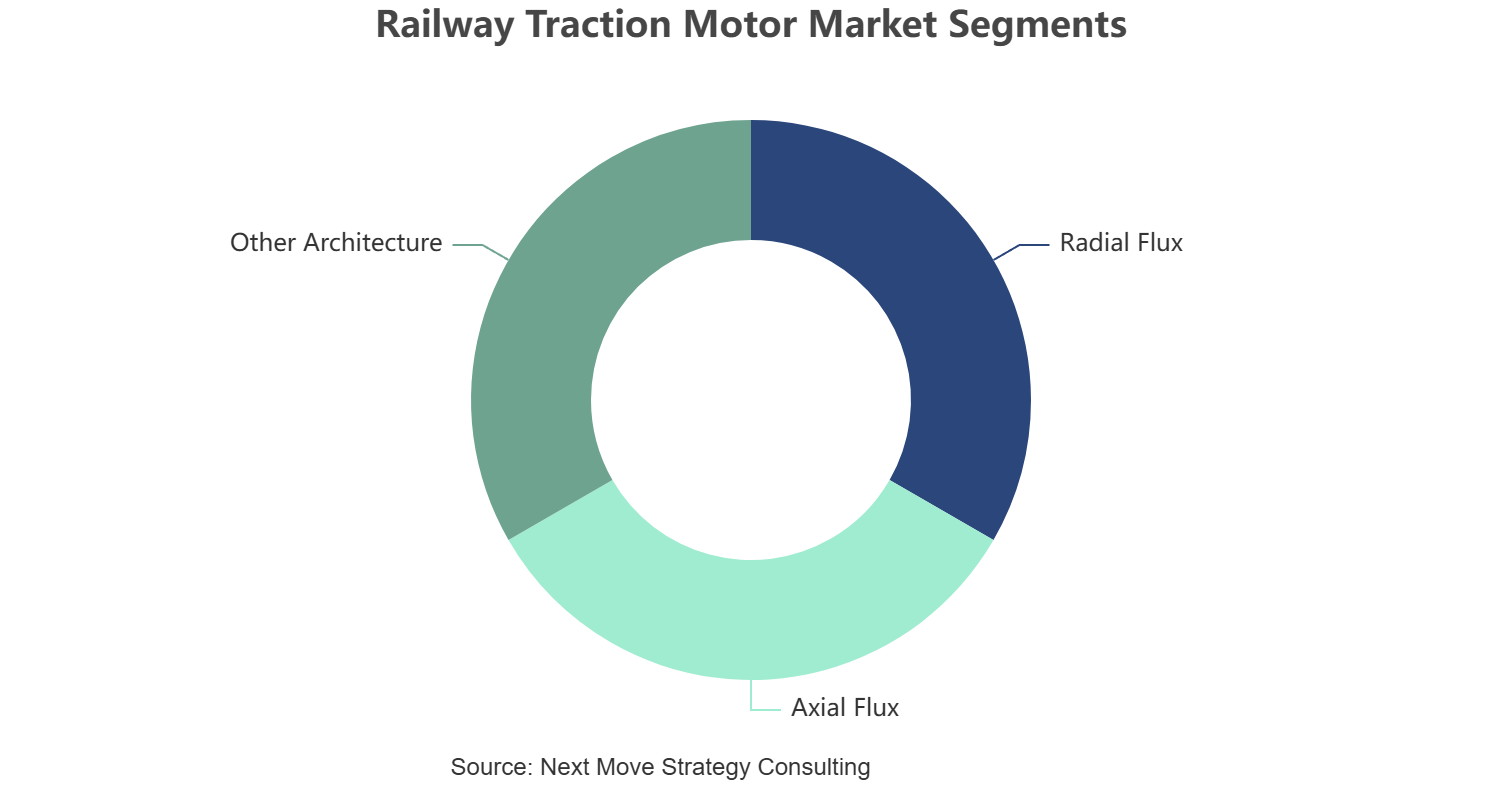
About the Author
 Mayurima Roy
— Mayurima Roy is Research Analyst at Next Move Strategy Consulting, where she has spent 4 years working across the firm's full industry coverage rather than a single fixed vertical. Her work centers on structured research, ongoing trend tracking, competitive assessment, and insight-led content development, translating complex market data into clear, decision-ready narratives that support informed client decision-making across diverse global industries, market sectors, and world regions every day.
Mayurima Roy
— Mayurima Roy is Research Analyst at Next Move Strategy Consulting, where she has spent 4 years working across the firm's full industry coverage rather than a single fixed vertical. Her work centers on structured research, ongoing trend tracking, competitive assessment, and insight-led content development, translating complex market data into clear, decision-ready narratives that support informed client decision-making across diverse global industries, market sectors, and world regions every day.
About the Reviewer
 Supradip Baul
— Supradip Baul is an accomplished business consultant and strategist with over a decade of rich experience in market intelligence, strategy, technology, and business transformation. His work has included rigorous qualitative and quantitative analysis across multiple industries, helping clients shape investment decisions and long-term roadmaps. Earlier in his career, he was associated with Gartner, where he contributed to industry-leading reports and market share analyses. He has worked with leading global companies and holds an MBA with a dual specialization in Marketing and Finance.
Supradip Baul
— Supradip Baul is an accomplished business consultant and strategist with over a decade of rich experience in market intelligence, strategy, technology, and business transformation. His work has included rigorous qualitative and quantitative analysis across multiple industries, helping clients shape investment decisions and long-term roadmaps. Earlier in his career, he was associated with Gartner, where he contributed to industry-leading reports and market share analyses. He has worked with leading global companies and holds an MBA with a dual specialization in Marketing and Finance.
At Next Move Strategy Consulting, we understand that insightful market research is the cornerstone of successful business decisions. That's why we employ a robust and multifaceted approach, combining various methodologies to deliver the most accurate and actionable data for our clients.

Research Landscape
We navigate the world of research with two primary approaches:
Qualitative Approach
Our qualitative research methodologies involve immersive techniques such as in-depth interviews, focus groups, and observational studies. By engaging directly with individuals and stakeholders, we uncover valuable insights that quantitative data alone may overlook.

Quantitative Research
In tandem with qualitative methodologies, NMSC leverages the power of Quantitative Research to provide a robust foundation of numerical insights. Through systematic data collection and analysis, we quantify patterns, preferences, and market trends, offering a comprehensive view of the business landscape.
Our quantitative research approach employs diverse tools, including surveys, experiments, and statistical modelling. These methodologies enable us to gather data from a large and representative sample, ensuring the statistical significance of our findings. By employing structured questionnaires and standardized data collection methods, we guarantee the reliability and validity of the information we present to our clients.
Quantitative research is particularly effective in measuring the prevalence of trends, assessing market size, and gauging the impact of various factors on consumer behavior. The numerical precision attained through this approach equips our clients with actionable insights, facilitating data-driven decision-making and strategy formulation.


Our Specialized Toolbox for Industry-Specific Market Research
We deploy a specialized arsenal of techniques tailored to meet your unique requirements. Here's a glimpse into our comprehensive toolbox:

Information Procurement
The stage entails acquiring market data or relevant information through various sources and methodologies.


Market Research Approach
We utilize both top-down and bottom-up approaches in market research analysis to achieve a comprehensive understanding of the market dynamics, leveraging the broad perspective of industry trends and macroeconomic factors alongside detailed insights from specific segments and individual companies.

Porters Five Forces Analysis
We conduct Porter's Five Forces analysis to evaluate the competitive landscape of an industry, providing us with insights into factors that affect profitability and strategic positioning.

SWOT Analysis

Forecasting
We utilize a forecasting model to predict future consumption by considering parameters like population, economics, regulations, market competition, drivers, constraints, technology, and pricing. We also employ statistical techniques such as multilinear regression, exponential smoothing, moving average, ARIMA, and Monte Carlo simulations for accurate predictions. In econometric forecasting, we analyzed short-term and long-term event impacts, attributing values based on regulatory frameworks, economic factors, and market events.





 Speak to Our Analyst