Robot Preventive Maintenance Market Size, Share & Trends & Growth Analysis, By Maintenance Type (Scheduled Maintenance, Condition Based Maintenance, and Predictive Maintenance), By Robot Type (Industrial Robots, Collaborative Robots, and Mobile Robots), By Provider Type, By Revenue Model, By End Use Industry and Region — Global Industry Report, Competitive Landscape, Emerging Trends, Opportunities, Market Dynamics & Forecast, 2026–2035
Industry: ICT & Media | Latest Edition: September 30, 2026 | No of Pages: 501 | No. of Tables: 617 | No. of Figures: 611 | Format: PDF | Report Code: IC458
What Is the Robot Preventive Maintenance Market Size?
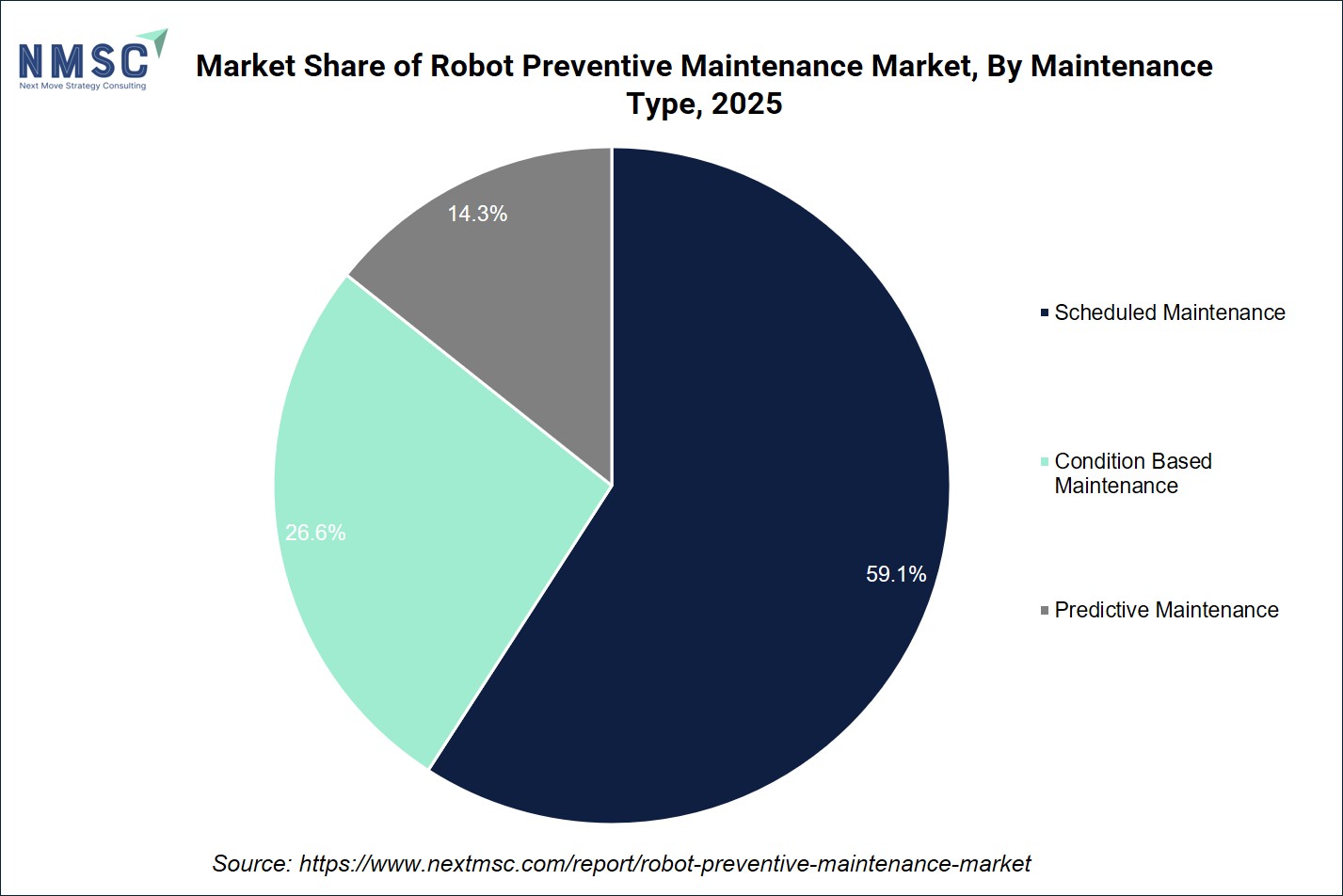
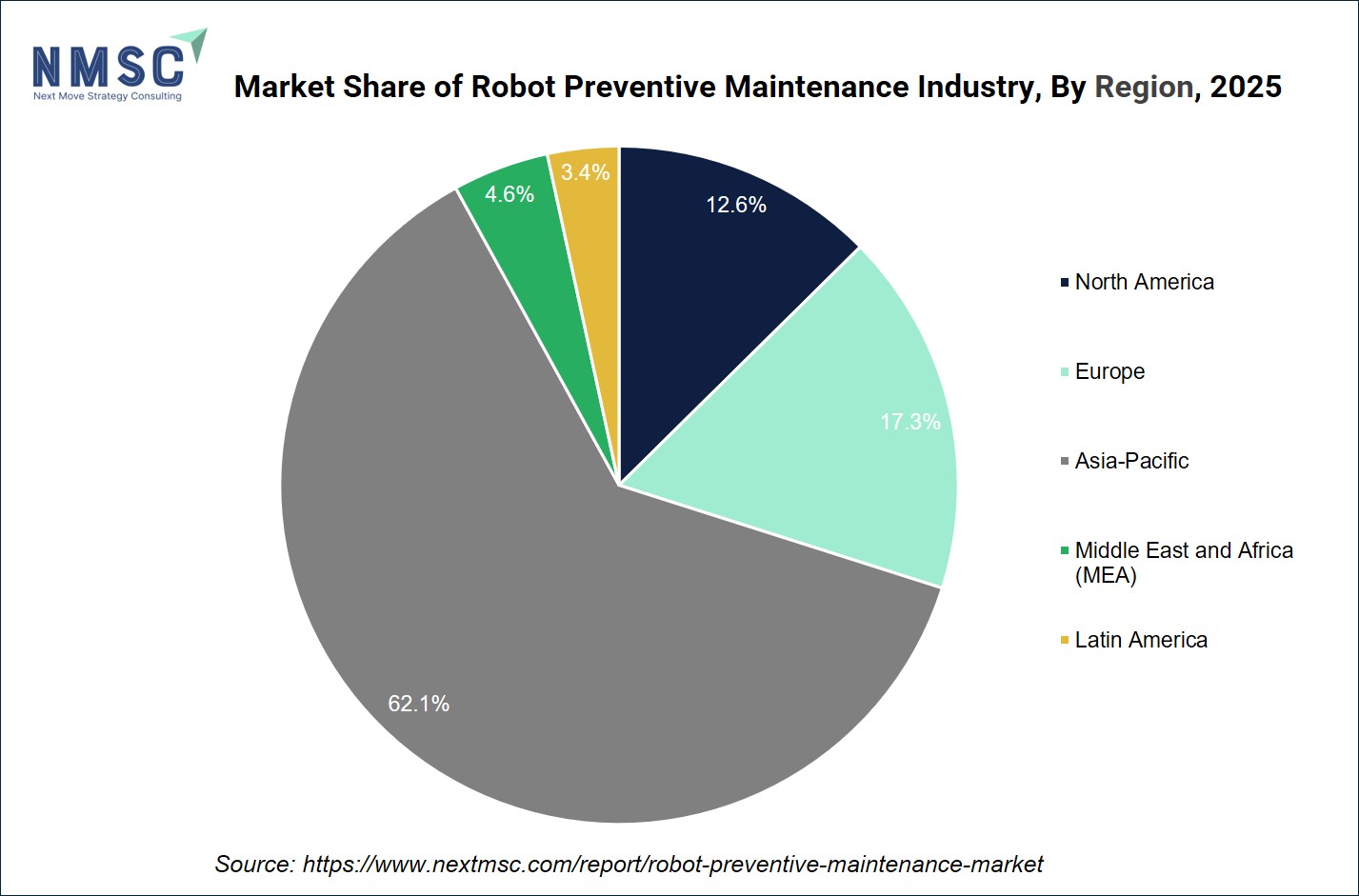
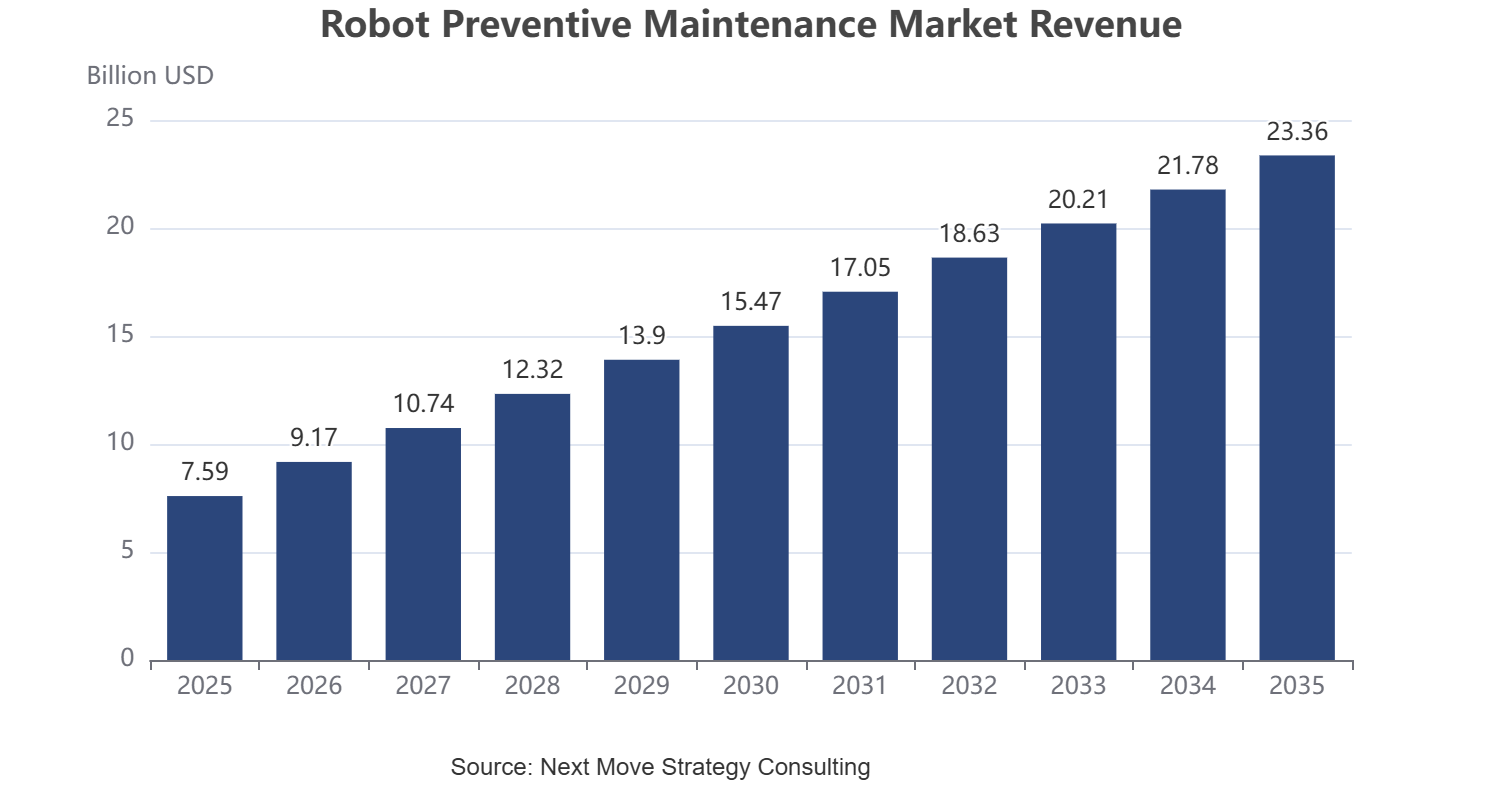
The global Robot Preventive Maintenance Market size was valued at USD 7.59 billion in 2025 and is estimated at USD 9.36 billion in 2026, forecast to reach USD 23.36 billion by 2035, at a 10.69% CAGR from 2026 to 2035. Asia-Pacific leads with approximately 62% share, while scheduled maintenance dominates all other maintenance types with approximately 59% share.
We observed that growth is accelerating fastest in predictive maintenance and mobile robot deployments, reflecting rising digital twin adoption and expanding autonomous mobile robot fleets across manufacturing, logistics, and warehousing operations worldwide.
|
Key Takeaways |
|
By Maintenance Type: Scheduled Maintenance held the largest share of approximately 59% (USD 4.49 Billion) in 2025; Predictive Maintenance is the fastest-growing sub-segment at 13.70% CAGR from 2026-2035. |
|
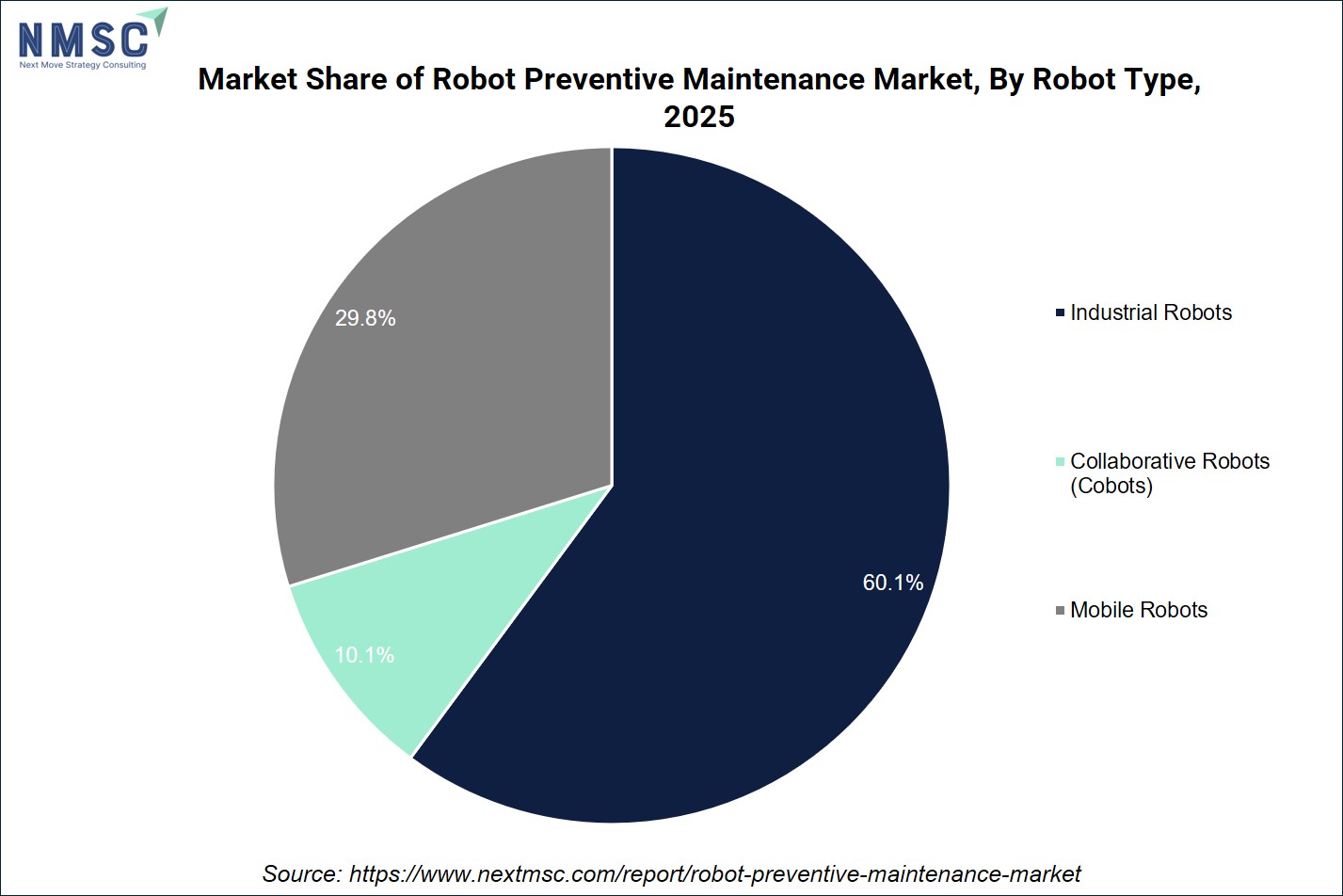
By Robot Type: Industrial Robots held the largest share of approximately 60% (USD 4.56 Billion) in 2025; Mobile Robots is the fastest-growing sub-segment at 14.28% CAGR from 2026-2035. |
|
By Provider Type: OEM Service held the largest share of approximately 34% (USD 2.60 Billion) in 2025; Software Vendor is the fastest-growing sub-segment at 14.28% CAGR from 2026-2035. |
|
Dominant Region: Asia-Pacific dominated with approximately 62% revenue share (USD 4.71 Billion) in 2025. |
|
Fastest-Growing Region: Asia-Pacific is expected to register the highest CAGR of 11.78% during 2026-2035. |
|
Dominant Country: China led with approximately USD 2.55 Billion in 2025. |
|
Fastest-Growing Country: India is the fastest-growing country at approximately 17.2% CAGR from 2026-2035. |
Market Opportunity: The robot preventive maintenance market is expected to create an absolute dollar opportunity of USD 14.00 billion between 2026 and 2035, presenting significant investment potential across predictive maintenance platforms, mobile robot fleets, and Asia-Pacific service expansion.
According to NMSC analysis, OEM service providers are increasingly bundling condition monitoring sensors and predictive analytics software with equipment sales, a shift that favors vendors with integrated digital twin capabilities as manufacturers prioritize unplanned downtime reduction across industrial and logistics operations through 2035.
What Does the Robot Preventive Maintenance Market Encompass?
The robot preventive maintenance market encompasses scheduled, condition based, and predictive maintenance services and software delivered across industrial, collaborative, and mobile robot fleets. Our assessment indicates that the scope spans inspection, lubrication, and calibration services, sensor-based condition monitoring, and digital twin-enabled failure forecasting supplied by OEMs, authorized partners, independent service providers, and software vendors to automotive, electronics, food and beverage, healthcare, and logistics end users. The category has evolved from manual, calendar-based servicing into data-driven, software-enabled maintenance programs as robot installed bases have expanded.
Regulatory frameworks such as ISO 10218 robot safety standards and regional workplace safety regulations shape maintenance protocols and service documentation requirements. We observed that technology adoption is shifting toward IoT-enabled sensor monitoring and cloud-based analytics platforms, complementing broader industrial automation modernization. NMSC's analysis indicates that this structural shift is redefining service delivery models across the robot preventive maintenance market as vendors transition from reactive repair toward subscription-based monitoring.
|
Field |
Details |
|
Market Size in 2025 |
USD 7.59 Billion |
|
Market Size in 2026 |
USD 9.36 Billion |
|
Revenue Forecast in 2035 |
USD 23.36 Billion |
|
Growth Rate |
CAGR of 10.69% from 2026 to 2035 |
|
Analysis Period |
2025–2035 |
|
Base Year Considered |
2025 |
|
Forecast Period |
2026–2035 |
|
Market Size Estimation |
USD Billion |
|
Companies Profiled |
10 |
|
Countries Covered |
33 |
|
Market Share |
Available for Top 10 Companies |
Key Emerging Trends
We found that four structural trends are reshaping service delivery, technology adoption, and stakeholder engagement across the robot preventive maintenance industry.
How Is Digital Twin Simulation Transforming Predictive Maintenance?
Digital twin simulation is increasingly deployed to model robot component wear and forecast remaining useful life before failures occur. We observed that FANUC Corporation offers cloud-connected robot condition monitoring integrated with its ZDT zero downtime platform, enabling manufacturers to schedule interventions based on simulated degradation patterns. This trend is elevating demand for software-driven maintenance contracts among automotive and electronics manufacturers seeking to minimize unplanned line stoppages.
Why Are Sensor-Based Condition Monitoring Programs Expanding?
Manufacturers are increasingly embedding vibration, thermal, and acoustic sensors directly into robotic joints and drive systems to enable continuous condition tracking. Our findings suggest that Siemens AG has expanded its Senseye predictive maintenance software to cover robotic assets alongside conventional industrial machinery, broadening condition-based coverage. This trend is reshaping stakeholder expectations toward real-time visibility over robot health rather than periodic manual inspection.
How Is Collaborative Robot Growth Elevating Maintenance Demand?
Rapid deployment of collaborative robots across small and mid-size manufacturers is increasing demand for simplified, remote-diagnosable maintenance programs suited to non-specialist operators. We observed that Rockwell Automation INC has integrated remote monitoring capabilities into its FactoryTalk platform to support cobot fleets deployed outside traditional automation-heavy facilities. This trend is elevating adoption of subscription-based monitoring among first-time robot buyers.
How Is Mobile Robot Fleet Expansion Reshaping Service Models?
Growing deployment of automated guided vehicles and autonomous mobile robots across warehousing and logistics is driving demand for fleet-wide preventive maintenance software rather than unit-by-unit servicing. Based on research conducted by NMSC, we found that mobile robot vendors increasingly bundle battery health analytics and predictive component replacement scheduling within fleet management software. This trend is reshaping maintenance contracts toward fleet-level subscription models among logistics operators.
Growth Drivers & Restraints
Growth Catalyst & Risk Assessment Matrix
|
Factors |
Type |
(+/-) % Impact on CAGR |
Geographic Relevance |
Impact Timeline |
|
Rising industrial robot installed base requiring servicing |
Driver |
+2.1% |
Asia-Pacific, North America |
2026-2035 |
|
Growing adoption of predictive maintenance software |
Driver |
+1.7% |
Global |
2026-2035 |
|
Expanding collaborative robot deployment among SMEs |
Driver |
+1.3% |
North America, Europe |
2026-2033 |
|
Rising labor cost pressure favoring automated diagnostics |
Driver |
+1.0% |
Europe, North America |
2026-2035 |
|
Growing mobile robot fleets in logistics and warehousing |
Driver |
+0.9% |
Asia-Pacific, North America |
2026-2035 |
|
Increasing OEM bundling of condition monitoring sensors |
Driver |
+0.7% |
Global |
2026-2032 |
|
High upfront cost of sensor retrofitting on legacy robots |
Restraint |
-1.0% |
Global |
2026-2032 |
|
Shortage of skilled robot maintenance technicians |
Restraint |
-0.7% |
North America, Europe |
2026-2033 |
|
Limited predictive maintenance awareness among small manufacturers |
Restraint |
-0.5% |
Latin America, MEA |
2026-2032 |
What Is the Primary Growth Driver of the Robot Preventive Maintenance Market?
The rising installed base of industrial robots requiring ongoing servicing is the primary driver of the market. We observed that the International Federation of Robotics reported continued year-over-year growth in global industrial robot installations through 2025, illustrating an expanding addressable base for scheduled and condition-based maintenance services. This installed-base growth continues to anchor baseline service demand across automotive, electronics, and metals manufacturing operations.
How Is Predictive Software Adoption Driving Robot Preventive Maintenance Market Growth?
Growing enterprise adoption of predictive maintenance software is accelerating market growth as manufacturers seek to reduce unplanned downtime costs. Our assessment indicates that Siemens AG's official disclosures describe expanding customer deployment of its Senseye predictive analytics platform across manufacturing clients through 2025 and 2026. This adoption pattern is compressing the timeline for predictive maintenance uptake among mid-size manufacturers previously reliant on scheduled servicing alone.
What Is Restraining Robot Preventive Maintenance Market Expansion?
High upfront costs of retrofitting legacy robots with condition-monitoring sensors restrain broader adoption across the industry, as many manufacturers operate aging robot fleets not originally designed for sensor integration. A shortage of skilled robot maintenance technicians further restricts service capacity expansion, since diagnosing complex robotic subsystems requires specialized training. We found that smaller manufacturers face particular exposure to these constraints given limited capital budgets relative to larger automotive and electronics producers.
ECOSYSTEM ANALYSIS OF THE ROBOT PREVENTIVE MAINTENANCE MARKET
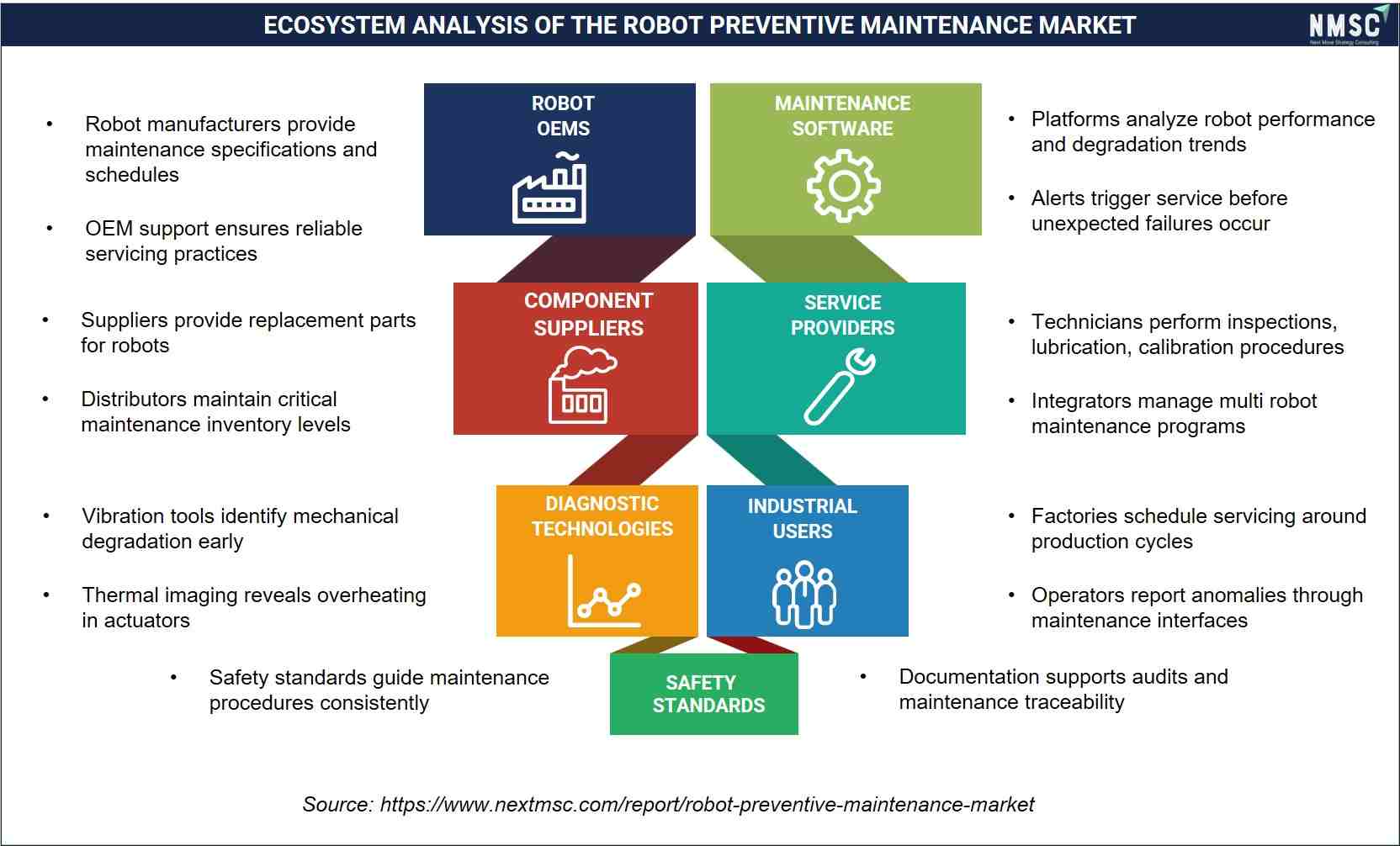
The ecosystem comprises robot OEMs, maintenance software providers, component suppliers, service providers, diagnostic technology companies, and industrial users. These stakeholders collaborate across robot maintenance, condition monitoring, diagnostics, and lifecycle management. Safety standards provide the regulatory foundation supporting reliable maintenance practices. The ecosystem enables industrial users to improve robot uptime, detect potential failures, optimize maintenance schedules, and extend equipment lifecycles through integrated technologies and specialized services.
Segmentation Analysis
Segment Sizing: By Maintenance Type
|
Segment |
2025 (USD) |
2035 (USD) |
CAGR% (2026-2035) |
|
Scheduled Maintenance |
USD 4.49 Billion |
USD 12.95 Billion |
9.96% |
|
Condition Based Maintenance |
USD 2.02 Billion |
USD 6.03 Billion |
10.41% |
|
Predictive Maintenance |
USD 1.09 Billion |
USD 4.39 Billion |
13.70% |
|
Total |
USD 7.59 Billion |
USD 23.36 Billion |
10.69% |
Which Maintenance Type Dominates the Robot Preventive Maintenance Market?
Scheduled Maintenance led the robot preventive maintenance market with USD 4.49 billion in 2025, supported by established calendar-based servicing practices across automotive and metals manufacturing facilities. We observed that Predictive Maintenance is the fastest-growing maintenance type, expanding at a 13.70% CAGR from 2026 to 2035, as manufacturers increasingly deploy digital twin simulation and failure forecasting software to reduce unplanned downtime beyond what scheduled servicing alone can address.
Segment Sizing: By Robot Type
|
Segment |
2025 (USD) |
2035 (USD) |
CAGR% (2026-2035) |
|
Industrial Robots |
USD 4.56 Billion |
USD 11.00 Billion |
7.98% |
|
Collaborative Robots (Cobots) |
USD 0.76 Billion |
USD 2.73 Billion |
12.35% |
|
Mobile Robots |
USD 2.26 Billion |
USD 9.64 Billion |
14.28% |
|
Total |
USD 7.59 Billion |
USD 23.36 Billion |
10.69% |
Which Robot Type Leads Robot Preventive Maintenance Demand?
Industrial Robots remained the leading robot type, valued at USD 4.56 billion in 2025 on the segment's large installed base across automotive body shops and electronics assembly lines. Our findings suggest that Mobile Robots is the fastest-growing robot type, registering a 14.28% CAGR from 2026 to 2035, as expanding automated guided vehicle and autonomous mobile robot fleets in logistics and warehousing require fleet-wide predictive servicing programs.
Segment Sizing: By Provider Type
|
Segment |
2025 (USD) |
2035 (USD) |
CAGR% (2026-2035) |
|
OEM Service |
USD 2.60 Billion |
USD 8.34 Billion |
11.13% |
|
Authorized Partner |
USD 1.94 Billion |
USD 5.36 Billion |
9.46% |
|
Independent Service Provider |
USD 1.55 Billion |
USD 3.33 Billion |
6.69% |
|
Software Vendor |
USD 1.49 Billion |
USD 6.34 Billion |
14.28% |
|
Total |
USD 7.59 Billion |
USD 23.36 Billion |
10.69% |
Which Provider Type Leads the Robot Preventive Maintenance Market?
OEM Service led the market, valued at USD 2.60 billion in 2025, reflecting manufacturer preference for original equipment vendors possessing proprietary diagnostic and calibration expertise. Our analysis shows that Software Vendor is the fastest-growing provider type, registering a 14.28% CAGR from 2026 to 2035, as manufacturers increasingly license standalone monitoring platforms and analytics licenses independent of hardware service contracts.
Growth Opportunities
Our analysis shows that three forward-looking opportunities stand out for stakeholders positioning within the robot preventive maintenance market over the 2026-2035 forecast period.
How Can Retrofit Sensor Kits Unlock Value for Independent Service Providers?
Affordable retrofit sensor kits for legacy industrial robots present a whitespace opportunity for independent service providers addressing manufacturers unwilling to replace aging fleets. Providers that commercialize plug-in vibration and thermal sensor packages stand to capture recurring monitoring subscription revenue from small and mid-size manufacturers.
Where Does Mobile Robot Fleet Analytics Create New Demand?
Fleet-wide predictive analytics for automated guided vehicles and autonomous mobile robots represents an underpenetrated opportunity for software vendors serving logistics and warehousing operators. Vendors that integrate battery health monitoring, component wear forecasting, and real-time diagnostics can enable proactive maintenance, reduce unexpected equipment failures, and improve fleet availability. This creates opportunities to capture recurring software and monitoring revenue from e-commerce fulfillment centers and other high-throughput warehouse operation.
How Can Asia-Pacific Service Network Expansion Benefit OEMs?
Expansion of authorized service networks across Asia-Pacific manufacturing hubs creates an opportunity for OEMs and authorized partners serving the region's rapidly growing robot installed base. Early movers that establish localized service centers in China, India, and Southeast Asia can differentiate on response time, capturing recurring service contract revenue tied to the region's above-market growth through 2035.
STRATEGIC FRAMEWORK OF THE ROBOT PREVENTIVE MAINTENANCE MARKET
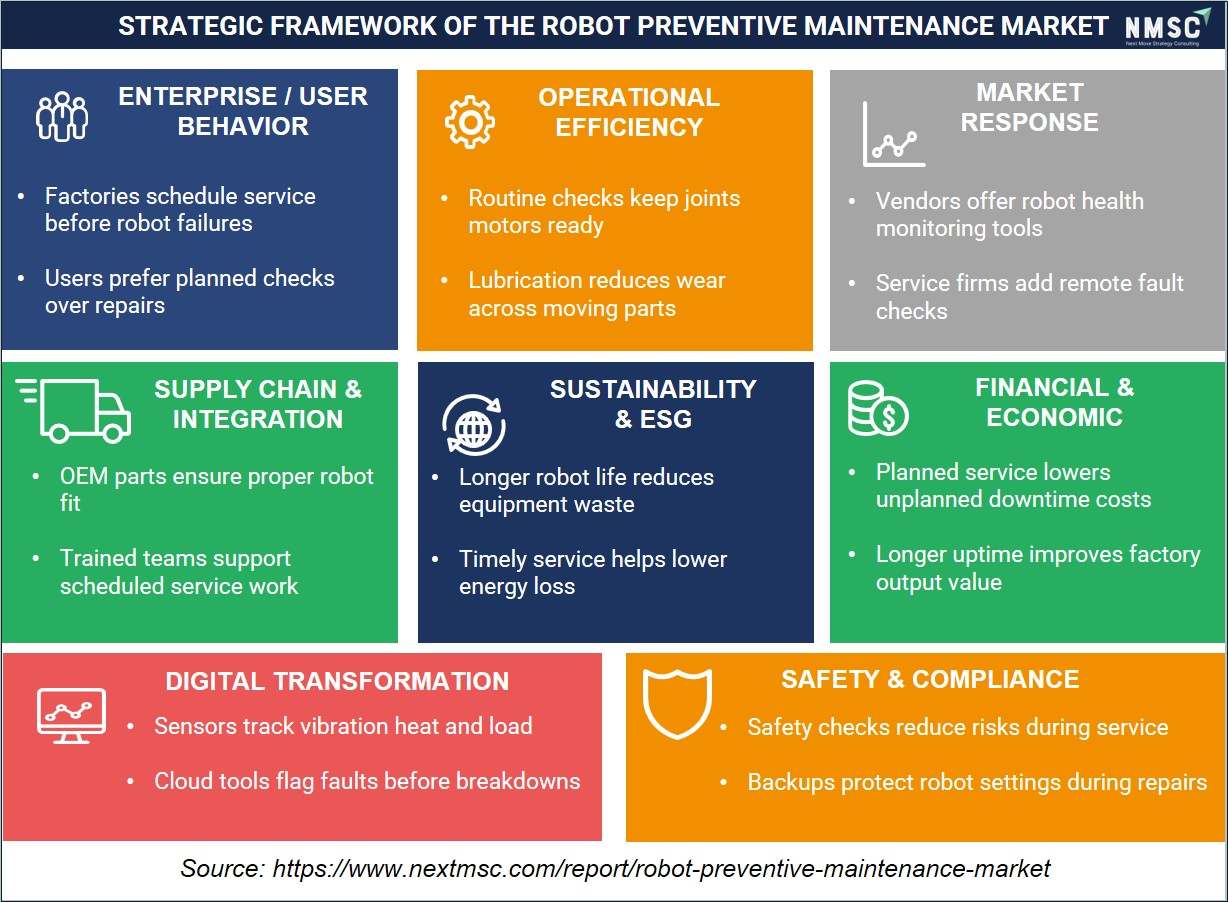
The strategic framework highlights how enterprise behavior, operational efficiency, market response, supply chain integration, sustainability, financial performance, digital transformation, and safety compliance shape the robot preventive maintenance market. Planned servicing, lubrication, diagnostics, and health monitoring help reduce failures and downtime, while OEM components and trained service teams support reliable maintenance. Digital technologies enable condition monitoring and early fault detection, while timely servicing extends robot lifecycles, improves productivity, reduces waste, and strengthens workplace safety.
Regional Outlook
Geographic Performance Snapshot
|
Region |
2025 (USD) |
2035 (USD) |
CAGR% (2026-2035) |
Key Driver |
|
North America |
USD 0.96 Billion |
USD 2.21 Billion |
7.52% |
Established automotive and electronics manufacturing base |
|
Europe |
USD 1.31 Billion |
USD 3.55 Billion |
9.23% |
Strong industrial automation and cobot adoption |
|
Asia-Pacific |
USD 4.71 Billion |
USD 16.01 Billion |
11.78% |
Rapid expansion of industrial and mobile robot installed base |
|
Middle East and Africa (MEA) |
USD 0.35 Billion |
USD 1.04 Billion |
10.28% |
Growing manufacturing diversification and logistics investment |
|
Latin America |
USD 0.26 Billion |
USD 0.56 Billion |
6.92% |
Expanding automotive assembly automation |
|
Total |
USD 7.59 Billion |
USD 23.36 Billion |
10.69% |
|
North America Robot Preventive Maintenance Market
Based on our estimates, the North America robot preventive maintenance market was valued at approximately USD 0.96 billion in 2025 and is projected to reach USD 2.21 billion by 2035, registering a 7.52% CAGR from 2026 to 2035. The region benefits from a mature industrial robot installed base concentrated in automotive and electronics manufacturing, supported by established OEM service networks. Regulatory workplace safety standards shape maintenance documentation requirements, while technology adoption favors predictive software integration among large manufacturers pursuing downtime reduction strategies through 2035.
Europe Robot Preventive Maintenance Market
The market in Europe was valued at approximately USD 1.31 billion in 2025 and is forecast to reach USD 3.55 billion by 2035, registering a 9.23% CAGR from 2026 to 2035. Strong industrial automation penetration across Germany and adjacent manufacturing hubs supports steady scheduled and condition-based maintenance demand. EU workplace machinery safety regulations shape service protocols, while collaborative robot adoption among small manufacturers is elevating demand for simplified remote-diagnosable maintenance programs across the region through 2035.
Asia-Pacific Robot Preventive Maintenance Market
As per our estimate, Asia-Pacific was valued at approximately USD 4.71 billion in 2025 and is projected to reach USD 16.01 billion by 2035, registering an 11.78% CAGR from 2026 to 2035, the fastest among all regions. Rapid expansion of industrial and mobile robot installations across China, Japan, and South Korea drives baseline service demand, while government manufacturing modernization programs support automation adoption. Expanding electronics and logistics sectors are accelerating predictive maintenance software uptake across the region through 2035.
Middle East and Africa Robot Preventive Maintenance Market
According to our analysis, Middle East and Africa was valued at approximately USD 0.35 billion in 2025 and is forecast to reach USD 1.04 billion by 2035, registering a 10.28% CAGR from 2026 to 2035. Growing manufacturing diversification initiatives across Gulf Cooperation Council economies support gradual industrial robot deployment and associated service demand. Limited domestic technician availability shapes reliance on authorized OEM partners, while logistics sector investment is elevating mobile robot maintenance requirements across the region through 2035.
Latin America Robot Preventive Maintenance Market
Based on our estimates, Latin America was valued at approximately USD 0.26 billion in 2025 and is projected to reach USD 0.56 billion by 2035, registering a 6.92% CAGR from 2026 to 2035. Automotive assembly automation across Brazil and Argentina anchors baseline scheduled maintenance demand, supported by established OEM service presence. Budget constraints among smaller manufacturers moderate predictive software adoption, while regulatory workplace safety standards continue shaping maintenance documentation practices across the region through 2035.
U.S. Robot Preventive Maintenance Market
The market in the U.S. was valued at approximately USD 0.78 billion in 2025 and is projected to reach USD 1.77 billion by 2035, registering an 8.6% CAGR from 2026 to 2035. Demand structure is anchored by automotive and electronics manufacturers with mature robot fleets, supporting high adoption of predictive maintenance software. Strong OSHA workplace safety enforcement and robust OEM service networks sustain competitive intensity among established providers pursuing digital service differentiation through 2035.
Canada Robot Preventive Maintenance Market
As per our estimate, Canada was valued at approximately USD 0.18 billion in 2025 and is forecast to reach USD 0.44 billion by 2035, registering a 9.9% CAGR from 2026 to 2035. Demand structure centers on automotive assembly and food processing automation, with moderate technology penetration reflecting a smaller manufacturing base than the U.S. Regulatory alignment with North American safety standards and growing authorized partner presence support steady strategic outlook across the forecast period.
UK Robot Preventive Maintenance Market
Based on our estimates, the UK was valued at approximately USD 0.30 billion in 2025 and is projected to reach USD 0.80 billion by 2035, registering a 10.3% CAGR from 2026 to 2035. Demand structure reflects expanding collaborative robot adoption among small manufacturers, supported by government automation incentive programs. Post-Brexit regulatory alignment with UK-specific machinery safety standards shapes service documentation, while competitive intensity remains moderate among independent service providers through 2035.
Germany Robot Preventive Maintenance Market
According to our analysis, Germany was valued at approximately USD 0.38 billion in 2025 and is forecast to reach USD 1.02 billion by 2035, registering a 10.4% CAGR from 2026 to 2035. Demand structure benefits from Europe's largest industrial robot installed base concentrated in automotive manufacturing, driving high technology penetration for predictive maintenance software. Strict EU machinery safety regulation and strong OEM competitive intensity sustain a favorable strategic outlook through 2035.
France Robot Preventive Maintenance Market
The market in France was valued at approximately USD 0.22 billion in 2025 and is projected to reach USD 0.58 billion by 2035, registering a 10.1% CAGR from 2026 to 2035. Demand structure reflects growing automotive and aerospace manufacturing automation, with moderate technology penetration relative to Germany. National industrial modernization incentives and EU regulatory alignment support gradual predictive maintenance adoption among mid-size manufacturers through the forecast period.
China Robot Preventive Maintenance Market
Based on our estimates, China was valued at approximately USD 2.55 billion in 2025 and is projected to reach USD 8.10 billion by 2035, registering a 13.7% CAGR from 2026 to 2035, the largest country market globally. Demand structure is driven by the world's largest industrial robot installed base, supported by government manufacturing modernization programs. High technology penetration and intense competitive rivalry among domestic and international OEMs sustain a strong strategic outlook through 2035.
India Robot Preventive Maintenance Market
As per our estimate, India was valued at approximately USD 0.68 billion in 2025 and is forecast to reach USD 2.85 billion by 2035, registering a 17.2% CAGR from 2026 to 2035, the fastest among all covered countries. Demand structure reflects rapidly expanding electronics and automotive manufacturing automation, with rising technology penetration from a smaller installed base. Government production-linked incentive programs and growing authorized partner networks support an accelerating strategic outlook through 2035.
Japan Robot Preventive Maintenance Market
According to our analysis, Japan was valued at approximately USD 0.62 billion in 2025 and is projected to reach USD 1.55 billion by 2035, registering a 10.7% CAGR from 2026 to 2035. Demand structure benefits from a mature, high-density industrial robot installed base concentrated in automotive and electronics manufacturing, supporting strong technology penetration for condition-based monitoring. Established domestic OEM competitive intensity and consistent regulatory standards sustain a stable strategic outlook through 2035.
South Korea Robot Preventive Maintenance Market
The market in South Korea was valued at approximately USD 0.42 billion in 2025 and is forecast to reach USD 1.10 billion by 2035, registering an 11.3% CAGR from 2026 to 2035. Demand structure reflects high robot density across electronics and automotive manufacturing, driving strong predictive maintenance software adoption. Government smart factory initiatives and intense competitive rivalry among domestic and international vendors support a favorable strategic outlook through 2035.
Australia Robot Preventive Maintenance Market
Based on our estimates, Australia was valued at approximately USD 0.21 billion in 2025 and is projected to reach USD 0.52 billion by 2035, registering a 10.6% CAGR from 2026 to 2035. Demand structure centers on food and beverage and logistics automation, with moderate technology penetration reflecting a smaller manufacturing base. Regulatory alignment with international machinery safety standards and growing mobile robot deployment support steady strategic outlook through the forecast period.
UAE Robot Preventive Maintenance Market
As per our estimate, the UAE was valued at approximately USD 0.09 billion in 2025 and is forecast to reach USD 0.28 billion by 2035, registering a 13.4% CAGR from 2026 to 2035. Demand structure reflects growing logistics and warehousing automation tied to regional trade hub expansion, with rising mobile robot deployment. Government economic diversification programs and expanding authorized OEM partner presence support an accelerating strategic outlook through 2035.
Saudi Arabia Robot Preventive Maintenance Market
According to our analysis, Saudi Arabia was valued at approximately USD 0.11 billion in 2025 and is projected to reach USD 0.32 billion by 2035, registering a 12.6% CAGR from 2026 to 2035. Demand structure benefits from Vision 2030 manufacturing diversification initiatives, driving gradual industrial robot adoption in automotive and metals sectors. Moderate technology penetration and growing OEM service network investment support a positive strategic outlook through 2035.
South Africa Robot Preventive Maintenance Market
The market in South Africa was valued at approximately USD 0.05 billion in 2025 and is forecast to reach USD 0.12 billion by 2035, registering a 10.2% CAGR from 2026 to 2035. Demand structure centers on automotive assembly automation, with limited technology penetration reflecting a smaller industrial robot installed base than Gulf economies. Regulatory alignment with international safety standards and gradual independent service provider expansion support steady strategic outlook through the forecast period.
Brazil Robot Preventive Maintenance Market
Based on our estimates, Brazil was valued at approximately USD 0.13 billion in 2025 and is projected to reach USD 0.29 billion by 2035, registering a 9.3% CAGR from 2026 to 2035. Demand structure reflects the region's largest automotive assembly automation base, supporting established OEM service presence. Moderate technology penetration and regulatory alignment with national workplace safety standards sustain a steady strategic outlook through the forecast period.
Argentina Robot Preventive Maintenance Market
As per our estimate, Argentina was valued at approximately USD 0.05 billion in 2025 and is forecast to reach USD 0.10 billion by 2035, registering an 8.0% CAGR from 2026 to 2035. Demand structure centers on automotive component manufacturing automation, with limited technology penetration reflecting a smaller industrial base. Gradual independent service provider expansion and regulatory alignment with regional safety standards support a modest strategic outlook through 2035.
PAIN POINT ANALYSIS OF THE ROBOT PREVENTIVE MAINTENANCE MARKET
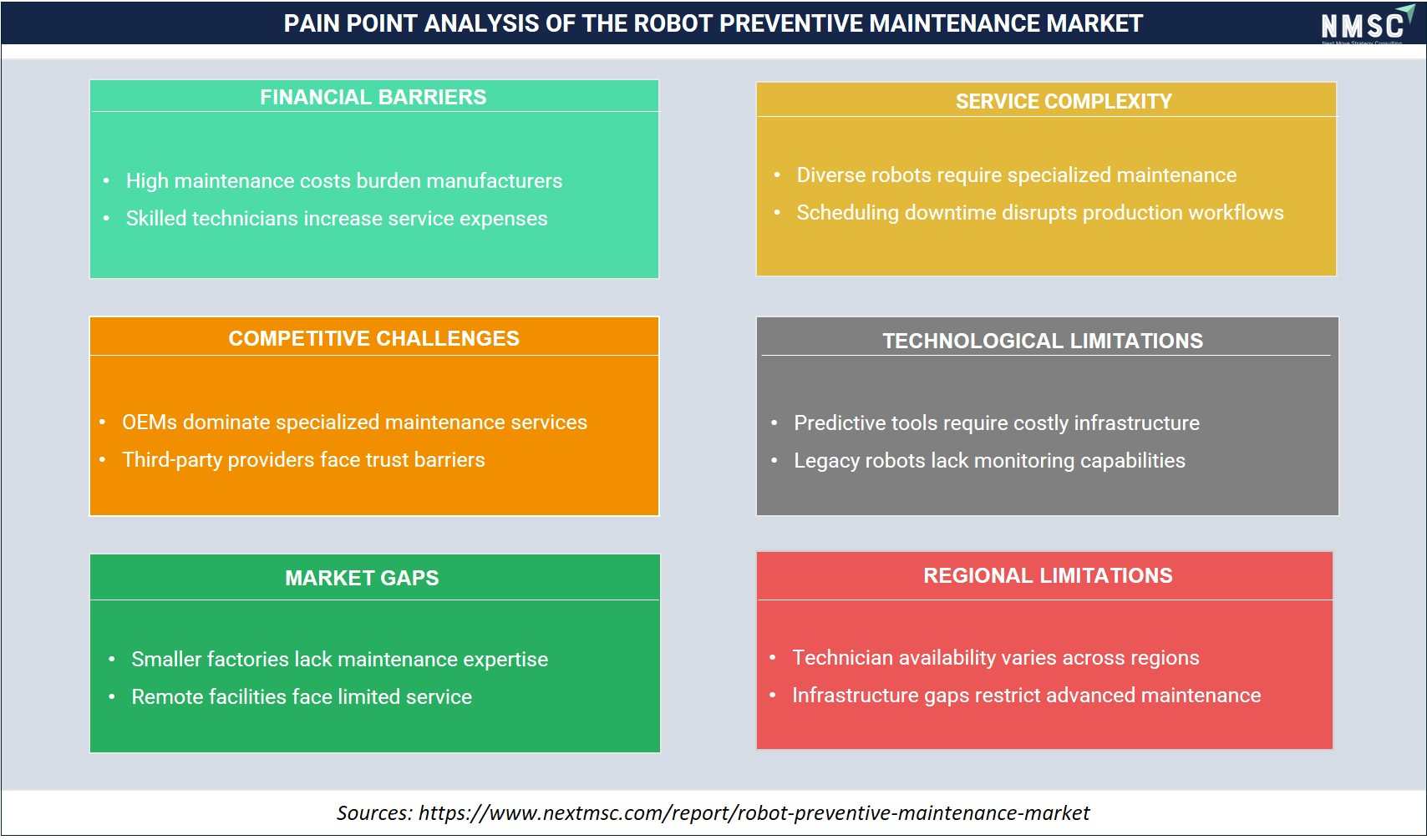
The robot preventive maintenance market faces financial, service, technological, competitive, and regional challenges. High maintenance costs and shortages of skilled technicians increase service expenses, while diverse robot systems require specialized expertise and scheduled downtime can disrupt production. Legacy robots often lack advanced monitoring capabilities, limiting predictive maintenance adoption. Smaller and remote facilities may also face gaps in maintenance expertise, infrastructure, and technician availability, creating service-access barriers
Competitive Landscape
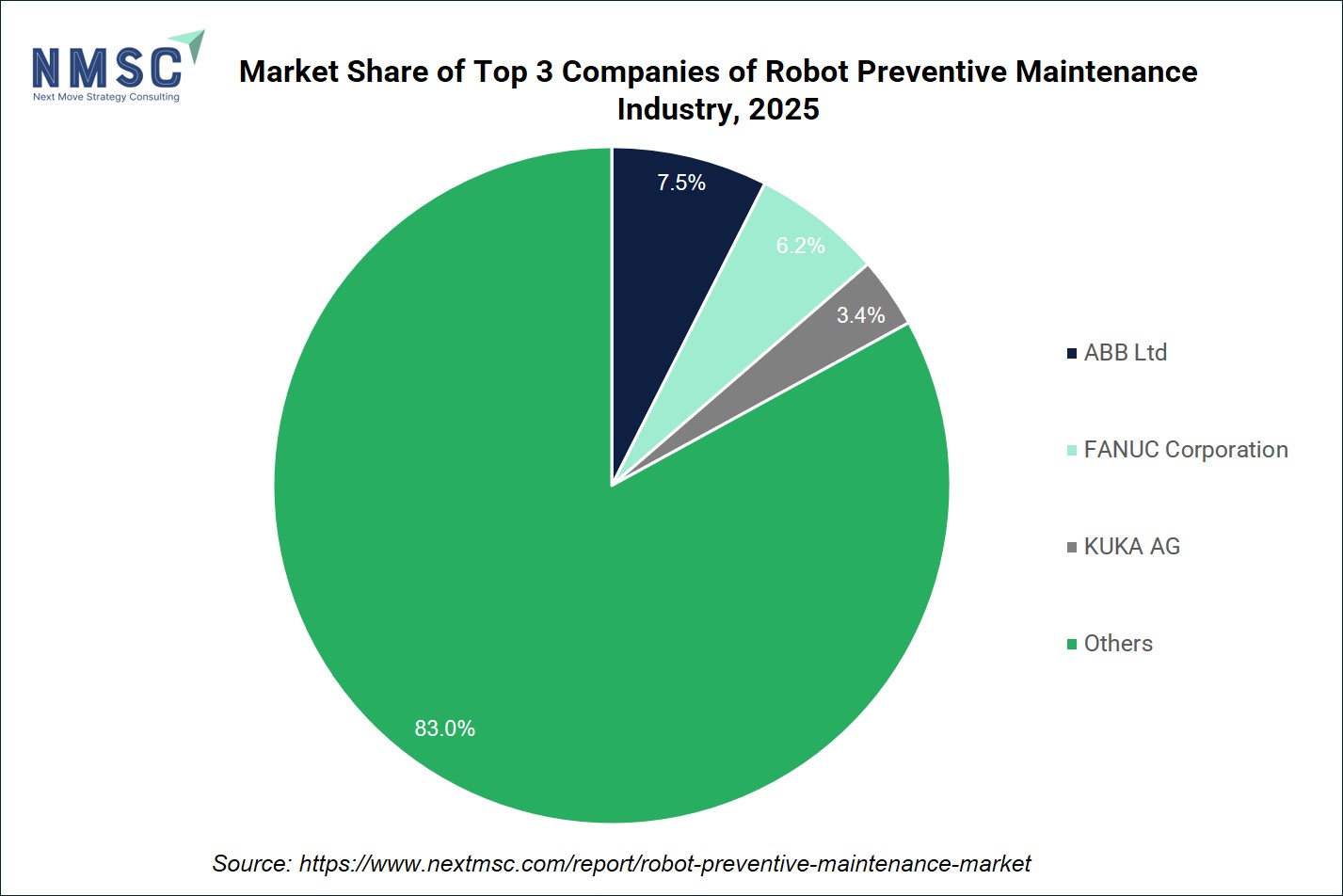
We observed that the robot preventive maintenance market features a moderately consolidated competitive structure dominated by established industrial robot OEMs expanding into software-enabled service offerings.
|
Field |
Details |
|
Market Structure |
Moderately consolidated, led by OEM service providers with expanding independent and software vendor participation |
|
Innovation Focus |
Predictive analytics, digital twin simulation, and cloud-connected condition monitoring platforms |
|
M&A Activity |
Selective acquisitions of software analytics firms by established robot OEMs to expand predictive maintenance capabilities |
How Do Companies Compete in the Robot Preventive Maintenance Market?
Companies compete primarily on service network coverage, response time, and the sophistication of predictive analytics software bundled with maintenance contracts. Our assessment indicates that OEMs leverage proprietary diagnostic data from robot control systems to differentiate service quality, while independent providers compete on cost and flexible contract terms. This dynamic sustains pricing differentiation between OEM-bundled service contracts and standalone transactional servicing across the industry.
Which Competitive Archetypes Dominate the Robot Preventive Maintenance Industry?
Original equipment manufacturers with integrated software platforms dominate the robot preventive maintenance industry, reflecting proprietary access to robot performance data unavailable to third-party providers. We observed that authorized partners compete on regional service density, while software vendors differentiate through platform interoperability across multiple robot brands. These archetypes collectively define the industry's segmentation between hardware-tied and vendor-agnostic maintenance offerings.
What Innovation and Differentiation Strategies Are Companies Pursuing?
Companies are pursuing innovation strategies centered on cloud-connected sensor integration, machine learning-based failure prediction, and remote diagnostic capabilities. Our findings suggest that leading vendors are investing in digital twin simulation environments to model component degradation ahead of physical failure. This innovation focus is reshaping competitive differentiation from network coverage toward data analytics sophistication across the industry.
What M&A Activity Is Shaping the Competitive Landscape?
M&A activity within the robot preventive maintenance market centers on established robot OEMs acquiring specialized software analytics firms to accelerate predictive maintenance capability development. We observed that this consolidation trend enables faster integration of machine learning-based diagnostics into existing service portfolios compared to internal development. Geographic expansion through authorized partner network agreements further supports competitive positioning across underpenetrated Asia-Pacific and Latin American markets.
Key Market Players
We observed that the following companies represent the leading validated participants shaping the competitive structure of the robot preventive maintenance market.
-
FANUC Corporation
-
KUKA AG
-
Rockwell Automation INC
-
Siemens AG
-
Yaskawa Electric Corporation
-
Stäubli International AG
-
Mitsubishi Electric Corporation
-
Kawasaki Heavy Industries
-
DENSO Corporation
Latest Developments
We observed that recent company activity reflects an industry-wide shift toward software-enabled and cloud-connected preventive maintenance offerings.
|
Date |
Event |
|
April 2026 |
Rockwell highlighted an AI-enabled maintenance approach combining FactoryTalk Analytics GuardianAI, LogixAI, VisionAI, and FactoryTalk Remote Access. These capabilities support condition-based monitoring, anomaly detection, AI-powered visual inspection, predictive maintenance, and secure remote troubleshooting, helping manufacturers reduce unplanned downtime and improve machine-service efficiency. |
|
February 2026 |
Mitsubishi Electric announced that several MELFA Smart Plus intelligence and AI functions became standard with software version E4 for applicable MELFA controllers. The predictive-maintenance capability remains supported through iQ Care MELFA Support, while robot-health tracking and related intelligent functions strengthen maintenance-oriented automation. |
|
December 2025 |
FANUC introduced its new R-2000/E robot series with battery-less encoders, eliminating battery replacement, while also removing grease and cable-change requirements. The design supports remote maintenance and is scheduled for mass production from March 2026, reducing routine maintenance tasks and lifecycle service requirements. |
|
November 2025 |
Siemens expanded its service portfolio with Circular Repair Services for automation products, offering Advanced and Premium repair levels. Services restore equipment performance, apply preventive measures and software updates, replace components likely to fail, and extend useful product life while improving availability and lifecycle-cost predictability. |
|
April 2025 |
KUKA launched iiQKA.OS2, a scalable robot operating system with a virtual robot controller, simulation, engineering, and diagnostic capabilities. The system can identify errors at an early stage through virtual tests and engineering functions, helping reduce operational risks and supporting more efficient commissioning and system management. |
Expert Insights
 “Robotic inspection offers maximum value when the resulting data is readily available and actionable to those who need it most: the maintenance and reliability teams responsible for asset management and critical infrastructure.”
— Péter Fankhauser, Co-Founder & CEO, ANYbotics
Statement made: The statement was made in connection with ANYbotics’ 2025 launch of Data Navigator, which is designed to make inspection data collected by ANYmal robots accessible for asset-health analysis and maintenance decision-making. The platform supports the identification of potential asset issues and enables maintenance teams to act on inspection data.
Market Interpretation:
The insight highlights the growing shift toward data-driven preventive and predictive maintenance in industrial robotics. Robotic inspection systems can continuously collect asset-condition data, while analytics platforms convert this information into actionable maintenance insights. This trend is increasing demand for robotic inspection, condition monitoring, asset-performance management, predictive analytics, and integrated maintenance solutions, particularly in critical and asset-intensive industrial environments.
Investment Opportunities
Where Are Capital Inflows Concentrating in the Robot Preventive Maintenance Market?
Capital inflows are increasingly concentrating in predictive analytics software developers and sensor technology providers serving robotic maintenance applications. We observed that established robot OEMs continue directing internal investment toward cloud platform development, while independent software vendors attract growth capital to expand condition monitoring capabilities across mobile and collaborative robot segments through 2035.
How Is Infrastructure Investment Supporting Market Expansion?
Infrastructure investment in regional service centers and authorized partner networks is expanding across Asia-Pacific manufacturing hubs to support the region's rapidly growing robot installed base. Our findings suggest that OEMs are prioritizing localized parts inventory and technician training facilities in China and India to reduce service response times, supporting sustained infrastructure-driven market expansion through the forecast period.
What ESG Considerations Are Shaping Investment Decisions?
Environmental, Social, and Governance considerations are shaping investment decisions as preventive maintenance programs directly extend robot operational lifespan, reducing equipment replacement frequency and associated resource consumption. We observed that maintenance providers increasingly highlight downtime reduction and energy efficiency benefits in corporate sustainability disclosures, aligning service contract value propositions with manufacturer ESG reporting requirements through 2035.
Key Benefits for Stakeholders
How Does This Report Benefit Enterprise and Industry Leaders?
Enterprise and industry leaders benefit from the report's segmented analysis of maintenance types, robot types, and provider models, enabling informed sourcing decisions for internal maintenance program design. Our analysis shows that the report's regional and country-level data supports facility-level planning for manufacturers scaling robot deployments across Asia-Pacific and North American operations through 2035.
How Does This Report Benefit Investors and Financial Analysts?
Investors and financial analysts benefit from the report's revenue forecasts, CAGR analysis, and growth catalyst matrix, supporting evaluation of capital allocation across service provider and software vendor segments. We observed that the report's competitive landscape and latest developments sections provide context for assessing M&A activity and strategic positioning among leading market participants through 2035.
How Does This Report Benefit Technology Vendors and Product Teams?
Technology vendors and product teams benefit from the report's segmentation by revenue model and provider type, informing subscription platform and analytics licensing strategy decisions. Our findings suggest that the report's regional outlook and growth opportunity analysis support prioritization of market entry sequencing for predictive maintenance software targeting underpenetrated geographies through the forecast period.
Key Market Segments
By Maintenance Type
-
Scheduled Maintenance
-
Inspection
-
Cleaning
-
Lubrication
-
Calibration
-
Planned Replacement
-
-
Condition Based Maintenance
-
Sensor Monitoring
-
Oil Analysis
-
Acoustic Testing
-
Thermal Testing
-
-
Predictive Maintenance
-
Failure Forecasting
-
Remaining Life Modeling
-
Digital Twin Simulation
-
By Robot Type
-
Industrial Robots
-
Articulated Robots
-
SCARA Robots
-
Cartesian and Gantry Robots
-
Delta and Parallel Robots
-
Cylindrical Robots
-
Other Industrial Robots
-
-
Collaborative Robots (Cobots)
-
Mobile Robots
-
Automated Guided Vehicles
-
Autonomous Mobile Robots
-
By Provider Type
-
OEM Service
-
Authorized Partner
-
Independent Service Provider
-
Software Vendor
By Revenue Model
-
Service Contract
-
Annual Plan
-
Multi Year Plan
-
Labor Retainer
-
-
Transactional Revenue
-
One Off Visit
-
Parts Sale
-
-
Subscription
-
Monitoring Platforms
-
Analytics Licenses
-
By End Use Industry
-
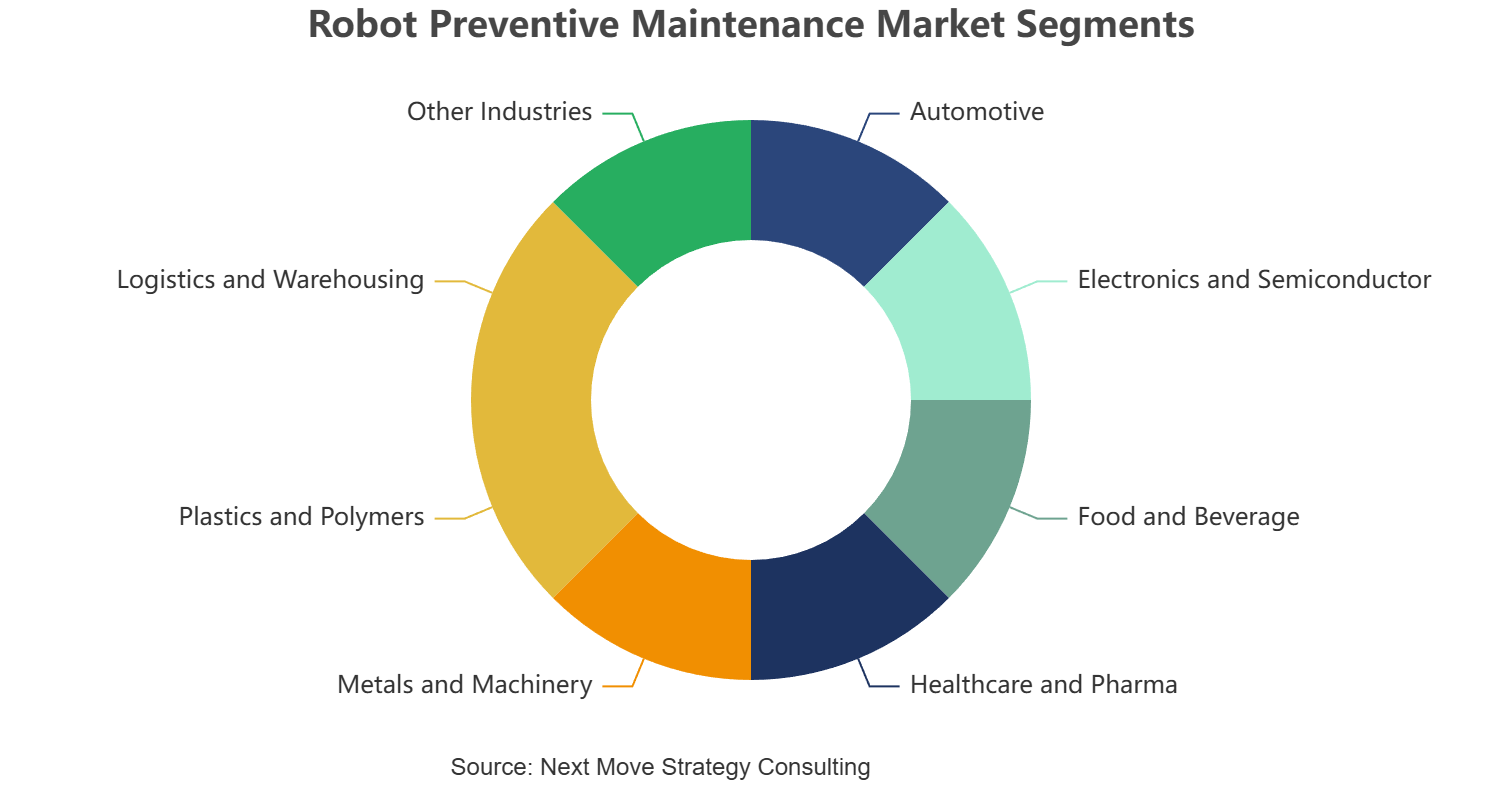
Automotive
-
Electronics and Semiconductor
-
Food and Beverage
-
Healthcare and Pharma
-
Metals and Machinery
-
Plastics and Polymers
-
Logistics and Warehousing
-
Other Industries
By Region
-
North America: U.S., Canada, Mexico
-
Europe: UK, Germany, France, Italy, Spain, Sweden, Denmark, Finland, Netherlands, Rest of Europe
-
Asia-Pacific: China, India, Japan, South Korea, Taiwan, Indonesia, Vietnam, Australia, Philippines, Malaysia, Rest of APAC
-
Middle East & Africa: Saudi Arabia, UAE, Egypt, Israel, Turkey, Nigeria, South Africa, Rest of MEA
-
Latin America: Brazil, Argentina, Chile, Colombia, Rest of LATAM
Conclusion & Recommendations
What Is the Long-Term Outlook for the Robot Preventive Maintenance Market?
The long-term outlook remains strongly positive, with the market projected to expand from USD 9.36 billion in 2026 to USD 23.36 billion by 2035 at a 10.69% CAGR. Our analysis shows that sustained growth in global robot installations, combined with accelerating predictive software adoption, supports durable demand across scheduled, condition-based, and predictive maintenance categories through the forecast period.
What Strategic Positioning Should Companies Pursue?
Companies should pursue strategic positioning around integrated hardware-software service bundles, combining proprietary diagnostic data access with cloud-based predictive analytics platforms. We observed that vendors investing in digital twin simulation capabilities are best positioned to capture premium predictive maintenance contracts, while independent providers should differentiate on multi-brand interoperability and flexible transactional pricing.
How Attractive Is the Market for Investment?
The market presents strong investment attractiveness given its double-digit CAGR and expanding addressable base tied to global robot installations. Our findings suggest that predictive maintenance software and Asia-Pacific service infrastructure represent the most attractive sub-segments, reflecting 13.70% and 11.78% respective CAGRs that outpace the broader market average through 2035.
What Market Shifts and Key Risks Should Stakeholders Monitor?
Stakeholders should monitor the shift from hardware-tied service contracts toward vendor-agnostic software platforms, which could erode OEM service margins over time. Key risks include high sensor retrofitting costs limiting legacy fleet coverage and a persistent shortage of skilled maintenance technicians constraining service capacity expansion across North American and European markets.
What Growth Pathways Offer the Strongest Returns?
Growth pathways centered on mobile robot fleet analytics, Asia-Pacific service network expansion, and retrofit sensor commercialization offer the strongest returns given their above-market CAGRs. We found that companies prioritizing these three pathways alongside core OEM service contracts are best positioned to capture disproportionate share of the USD 14.00 billion incremental opportunity created between 2026 and 2035.
About the Author
 Liza Phukan
— Liza Phukan is Research Associate at Next Move Strategy Consulting, where she has covered emerging industries and market research across sectors for 3.5 years. Her work includes analyzing industry developments, validating market data, and developing structured business content from research findings. She uses secondary research and data-validation practices to turn complex market information into clear decision-useful market analysis for business audiences and support report development and B2B.
Liza Phukan
— Liza Phukan is Research Associate at Next Move Strategy Consulting, where she has covered emerging industries and market research across sectors for 3.5 years. Her work includes analyzing industry developments, validating market data, and developing structured business content from research findings. She uses secondary research and data-validation practices to turn complex market information into clear decision-useful market analysis for business audiences and support report development and B2B.
About the Reviewer
 Supradip Baul
— Supradip Baul is an accomplished business consultant and strategist with over a decade of rich experience in market intelligence, strategy, technology, and business transformation. His work has included rigorous qualitative and quantitative analysis across multiple industries, helping clients shape investment decisions and long-term roadmaps. Earlier in his career, he was associated with Gartner, where he contributed to industry-leading reports and market share analyses. He has worked with leading global companies and holds an MBA with a dual specialization in Marketing and Finance.
Supradip Baul
— Supradip Baul is an accomplished business consultant and strategist with over a decade of rich experience in market intelligence, strategy, technology, and business transformation. His work has included rigorous qualitative and quantitative analysis across multiple industries, helping clients shape investment decisions and long-term roadmaps. Earlier in his career, he was associated with Gartner, where he contributed to industry-leading reports and market share analyses. He has worked with leading global companies and holds an MBA with a dual specialization in Marketing and Finance.
At Next Move Strategy Consulting, we understand that insightful market research is the cornerstone of successful business decisions. That's why we employ a robust and multifaceted approach, combining various methodologies to deliver the most accurate and actionable data for our clients.

Research Landscape
We navigate the world of research with two primary approaches:
Qualitative Approach
Our qualitative research methodologies involve immersive techniques such as in-depth interviews, focus groups, and observational studies. By engaging directly with individuals and stakeholders, we uncover valuable insights that quantitative data alone may overlook.

Quantitative Research
In tandem with qualitative methodologies, NMSC leverages the power of Quantitative Research to provide a robust foundation of numerical insights. Through systematic data collection and analysis, we quantify patterns, preferences, and market trends, offering a comprehensive view of the business landscape.
Our quantitative research approach employs diverse tools, including surveys, experiments, and statistical modelling. These methodologies enable us to gather data from a large and representative sample, ensuring the statistical significance of our findings. By employing structured questionnaires and standardized data collection methods, we guarantee the reliability and validity of the information we present to our clients.
Quantitative research is particularly effective in measuring the prevalence of trends, assessing market size, and gauging the impact of various factors on consumer behavior. The numerical precision attained through this approach equips our clients with actionable insights, facilitating data-driven decision-making and strategy formulation.


Our Specialized Toolbox for Industry-Specific Market Research
We deploy a specialized arsenal of techniques tailored to meet your unique requirements. Here's a glimpse into our comprehensive toolbox:

Information Procurement
The stage entails acquiring market data or relevant information through various sources and methodologies.


Market Research Approach
We utilize both top-down and bottom-up approaches in market research analysis to achieve a comprehensive understanding of the market dynamics, leveraging the broad perspective of industry trends and macroeconomic factors alongside detailed insights from specific segments and individual companies.

Porters Five Forces Analysis
We conduct Porter's Five Forces analysis to evaluate the competitive landscape of an industry, providing us with insights into factors that affect profitability and strategic positioning.

SWOT Analysis

Forecasting
We utilize a forecasting model to predict future consumption by considering parameters like population, economics, regulations, market competition, drivers, constraints, technology, and pricing. We also employ statistical techniques such as multilinear regression, exponential smoothing, moving average, ARIMA, and Monte Carlo simulations for accurate predictions. In econometric forecasting, we analyzed short-term and long-term event impacts, attributing values based on regulatory frameworks, economic factors, and market events.





 Speak to Our Analyst