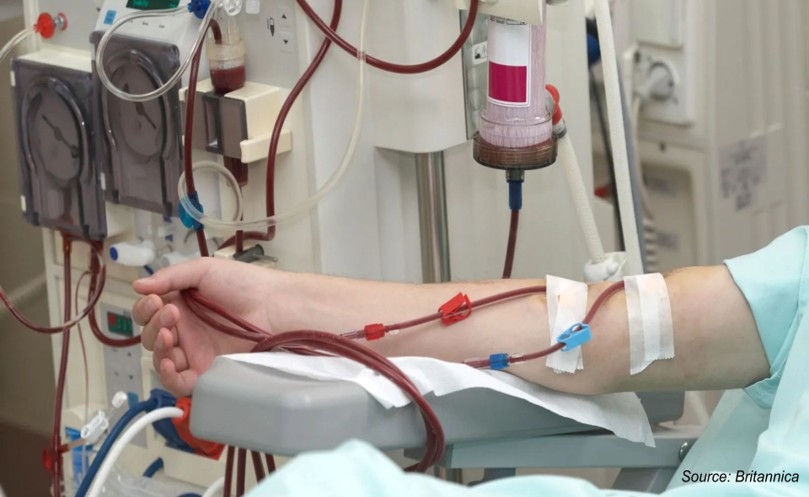
South Korea Dialysis Market By Modality [Hemodialysis {Hemodialysis Machines (In-center HD, Home HD), Water Treatment Systems (Central water-disinfection units, Point-of-use/portable systems), and Others}, Peritoneal Dialysis (PD Cyclers, Ancillary PD Equipment, and Others)], By End-User (Hospitals, Dialysis Centers, Homecare, and Ambulatory Surgical Centers) – Opportunity Analysis and Industry Forecast, 2025–2030
Industry: Healthcare | Lastest Edition: February 26, 2026 | No of Pages: 128 | No. of Tables: 95 | No. of Figures: 48 | Format: PDF | Report Code : HC1272
Industry Outlook
The South Korea Dialysis Market size was valued at USD 453.4 million in 2024 and is expected to reach USD 533.9 million by 2025. Looking ahead, the market is projected to expand significantly, reaching USD 873.6 million by 2030 at a CAGR of 10.35% from 2025 to 2030.
The market is experiencing steady growth, driven by the rising prevalence of chronic kidney disease (CKD), diabetes, and hypertension, alongside an aging population and increasing lifestyle-related health risks. Innovations in hemodialysis and peritoneal dialysis technologies are enhancing treatment effectiveness, patient comfort, and overall outcomes. The expansion of home-based dialysis therapies, supported by telehealth monitoring, is improving accessibility and convenience for patients. Additionally, government-backed healthcare initiatives and public programs are facilitating broader adoption of dialysis services. Collectively, these factors are accelerating market growth while promoting more efficient, patient-centric, and technologically advanced renal care across South Korea.
Technological Advancements in Automated and Connected Dialysis Systems Boost South Korea Dialysis Market Demand
South Korea is witnessing increased adoption of automated dialysis machines and connected systems equipped with AI-assisted monitoring. These technologies improve treatment accuracy, enhance patient safety, and optimize therapy schedules. Integration with digital platforms allows clinicians to manage patients remotely and detect early complications. Continuous innovation in wearable and portable dialysis devices is further boosting market demand, making treatment more accessible and patient-friendly.
Rising Adoption of Home-Based Dialysis Accelerates South Korea Dialysis Market Growth
In South Korea, home-based dialysis therapies are gaining momentum, particularly among elderly and urban populations. Telehealth-enabled monitoring allows healthcare providers to supervise treatments remotely, adjust schedules, and intervene promptly in case of complications. Government-backed reimbursement programs and awareness campaigns are encouraging patients to adopt home-based care, reducing hospital visits and enhancing convenience. This shift toward patient-centered care is significantly driving market growth, expanding the reach of dialysis services across the country.
Shortage of Skilled Healthcare Professionals Slows Adoption
A major challenge in South Korea’s dialysis market is the limited availability of trained nephrologists, dialysis nurses, and technicians, particularly in semi-urban and rural regions. Advanced dialysis technologies, including home-based and automated systems, require skilled personnel to operate and monitor treatments safely. The shortage of qualified staff can delay adoption of modern equipment, reduce treatment efficiency, and create regional disparities in access. Hospitals and clinics may struggle to scale services despite growing demand, which constrains overall market growth.
Expansion of Portable, Wearable, and Private Clinic Solutions Provides South Korea Dialysis Market Opportunities
The dialysis market in South Korea has significant opportunities arising from the development of portable and wearable dialysis devices, which allow patients to manage treatments with greater independence. Simultaneously, the growth of private dialysis centers and specialty renal care clinics enhances access to advanced therapies, particularly in urban regions. Collaborations between medical device companies and healthcare providers facilitate the introduction of AI-assisted and connected systems, improving treatment efficiency and patient convenience. These innovations support patient-centred care, reduce hospital dependency, and create new revenue streams for providers, offering substantial potential for South Korea dialysis market expansion in the country’s technologically advanced dialysis sector.
Competitive Landscape
The market players operating in the South Korea dialysis industry include Fresenius Medical Care AG & Co. KGaA, Baxter International Inc., B. Braun, Asahi Kasei Corporation, Becton, Dickinson and Company, Toray Medical Co., Ltd., Terumo Corporation, JMS Co. Ltd., W. L. Gore & Associates, Inc., Teleflex Incorporated, Quanta Dialysis Technologies Ltd, Vantive Health LLC, and Medionics International Inc.
South Korea Dialysis Market Key Segments
By Modality
-
Hemodialysis (HD)
-
Hemodialysis Machines
-
In-center HD
-
Home HD
-
-
Water Treatment Systems
-
Central water-disinfection units
-
Point-of-use/portable systems
-
-
Ancillary/Other HD Equipment
-
UF/ultrafiltration pumps
-
Dialysis chairs/beds
-
Disinfection/sterilization units
-
Monitoring & data-capture hardware
-
-
HD Consumables & Supplies
-
Dialyzers
-
Bloodlines & Tubing Sets
-
Dialysis Fluids / Concentrates
-
Vascular Access Products
-
Other HD Consumables & Accessories
-
-
HD Aftermarket Services
-
Repair & Maintenance
-
Installation & Commissioning
-
Training & Technical Support
-
-
-
Peritoneal Dialysis (PD)
-
PD Cyclers / Automated PD Machines
-
Ancillary PD Equipment
-
PD Consumables & Supplies
-
PD Dialysis Solutions
-
PD Catheters & Access Systems
-
Transfer Sets & Tubing
-
Other PD Supplies / Accessories
-
-
PD Aftermarket Services
-
Repair & Maintenance (Cyclers & Heaters)
-
Installation & Commissioning
-
Training & Technical Support
-
-
By End-User
-
Hospitals
-
Dialysis Centers
-
Homecare
-
Ambulatory Surgical Centers
Key Players
-
B Braun
-
Asahi Kasei Corporation
-
Becton, Dickinson and Company
-
Toray Medical Co,.Ltd.
-
Terumo Corporation
-
JMS Co. Ltd.
-
W. L. Gore & Associates, Inc.
-
Teleflex Incorporated
-
Quanta Dialysis Technologies Ltd
-
Vantive Health LLC
-
Medionics International Inc.
Report Scope and Segmentation
|
Parameters |
Details |
|
Market Size in 2025 |
USD 533.9 Million |
|
Revenue Forecast in 2030 |
USD 873.6 Million |
|
Growth Rate |
CAGR of 10.3% from 2025 to 2030 |
|
Analysis Period |
2024–2030 |
|
Base Year Considered |
2024 |
|
Forecast Period |
2025–2030 |
|
Market Size Estimation |
Million (USD) |
|
Growth Factors |
|
|
Companies Profiled |
13 |
|
Market Share |
Available for 10 companies |
|
Customization Scope |
Free customization (equivalent up to 80 working hours of analysts) after purchase. Addition or alteration to country, regional, and segment scope. |
|
Pricing and Purchase Options |
Avail customized purchase options to meet your exact research needs. |


About the Author
 Mayurima Roy is a research analyst delivering data-driven insights that support strategic planning and market understanding. She combines analytical rigor with strong content development skills, translating complex information into clear, actionable narratives for diverse audiences. Her work includes structured research, trend tracking, competitive assessment, and insight-led content creation that supports informed decision-making. Curious and detail-oriented by nature, she continually deepens her understanding of evolving markets while pursuing creative interests such as crafting and video creation.
About the Reviewer
 Supradip Baul is an accomplished business consultant and strategist with over a decade of rich experience in market intelligence, strategy, technology, and business transformation. His work has included rigorous qualitative and quantitative analysis across multiple industries, helping clients shape investment decisions and long-term roadmaps. Earlier in his career, he was associated with Gartner, where he contributed to industry-leading reports and market share analyses. He has worked with leading global companies and holds an MBA with a dual specialization in Marketing and Finance.
At Next Move Strategy Consulting, we understand that insightful market research is the cornerstone of successful business decisions. That's why we employ a robust and multifaceted approach, combining various methodologies to deliver the most accurate and actionable data for our clients.

Research Landscape
We navigate the world of research with two primary approaches:
Qualitative Approach
Our qualitative research methodologies involve immersive techniques such as in-depth interviews, focus groups, and observational studies. By engaging directly with individuals and stakeholders, we uncover valuable insights that quantitative data alone may overlook.

Quantitative Research
In tandem with qualitative methodologies, NMSC leverages the power of Quantitative Research to provide a robust foundation of numerical insights. Through systematic data collection and analysis, we quantify patterns, preferences, and market trends, offering a comprehensive view of the business landscape.
Our quantitative research approach employs diverse tools, including surveys, experiments, and statistical modelling. These methodologies enable us to gather data from a large and representative sample, ensuring the statistical significance of our findings. By employing structured questionnaires and standardized data collection methods, we guarantee the reliability and validity of the information we present to our clients.
Quantitative research is particularly effective in measuring the prevalence of trends, assessing market size, and gauging the impact of various factors on consumer behavior. The numerical precision attained through this approach equips our clients with actionable insights, facilitating data-driven decision-making and strategy formulation.


Our Specialized Toolbox for Industry-Specific Market Research
We deploy a specialized arsenal of techniques tailored to meet your unique requirements. Here's a glimpse into our comprehensive toolbox:

Information Procurement
The stage entails acquiring market data or relevant information through various sources and methodologies.


Market Research Approach
We utilize both top-down and bottom-up approaches in market research analysis to achieve a comprehensive understanding of the market dynamics, leveraging the broad perspective of industry trends and macroeconomic factors alongside detailed insights from specific segments and individual companies.

Porters Five Forces Analysis
We conduct Porter's Five Forces analysis to evaluate the competitive landscape of an industry, providing us with insights into factors that affect profitability and strategic positioning.

SWOT Analysis

Forecasting
We utilize a forecasting model to predict future consumption by considering parameters like population, economics, regulations, market competition, drivers, constraints, technology, and pricing. We also employ statistical techniques such as multilinear regression, exponential smoothing, moving average, ARIMA, and Monte Carlo simulations for accurate predictions. In econometric forecasting, we analyzed short-term and long-term event impacts, attributing values based on regulatory frameworks, economic factors, and market events.





 Speak to Our Analyst