South Korea Room Air Conditioner Market By Product Type (Window AC, Portable AC, Single Split AC, Multi Split, & Others), By Speed Type (Fixed Speed & Inverter), By Cooling Capacity (≤ 1.0 Ton, >1.0 to ≤1.5 Ton, >1.5 to ≤2.0 Ton, & Others), By Efficiency Band (Entry, Standard, & Others), By Refrigerant (R22, R410A, R32, Hydrocarbon, & Others), By Function (Cooling Only, Heat Pump, Cooling with Electric Heat, & Others), By End-User (Residential & Commercial) – Analysis & Forecast, 2026-2035
Industry: Retail and Consumer | Latest Edition: September 10, 2026 | No of Pages: 306 | No. of Tables: 172 | No. of Figures: 156 | Format: PDF | Report Code: RC4806
South Korea Room Air Conditioner Market Size & Forecast
|
Parameters |
Details |
|
Market Size in 2026 |
USD 1.93 Billion |
|
Revenue Forecast in 2035 |
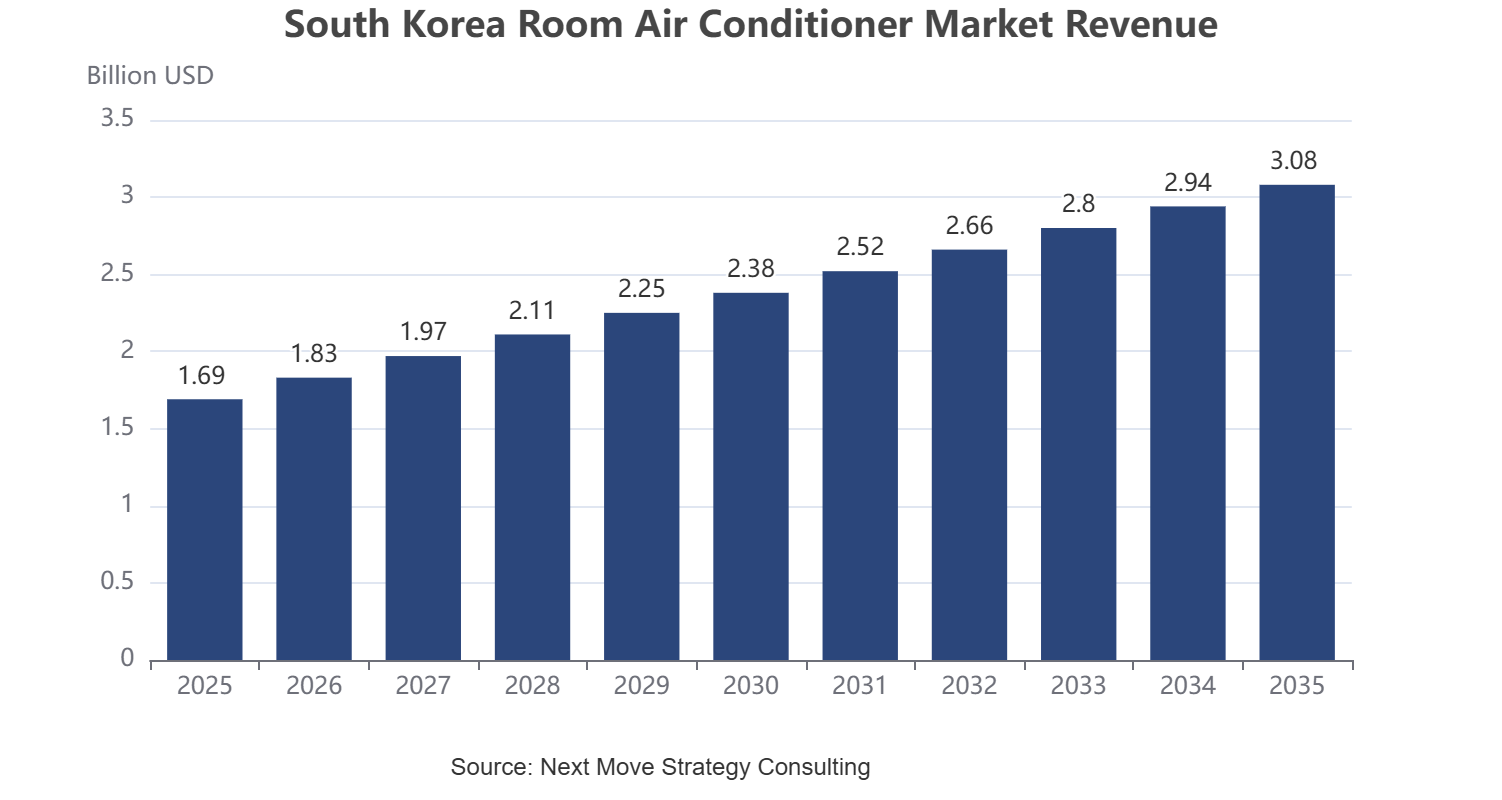
USD 3.08 Billion |
|
Growth Rate |
CAGR of 5.35% from 2026 to 2035 |
|
Market Volume in 2026 |
1773 Thousand Units |
|
Volume Forecast in 2035 |
3052 Thousand Units |
|
Volume Growth Rate |
CAGR of 6.22% from 2026 to 2035 |
|
Analysis Period |
2025–2035 |
|
Base Year Considered |
2025 |
|
Forecast Period |
2026–2035 |
|
Market Size Estimation |
Billion (USD) |
|
Companies Profiled |
15 |
|
Market Share |
Available for 10 companies |
Industry Outlook
The South Korea Room Air Conditioner Market size was valued at USD 1.69 billion in 2025 and is expected to reach USD 1.93 billion by the end of 2026. Looking ahead, the industry is projected to expand significantly, reaching USD 3.08 billion by 2035, registering a CAGR of 5.35% from 2026 to 2035. In terms of volume, the market recorded 1518 thousand units in 2025, with forecasts indicating growth to 1773 thousand units by 2026 and further to 3052 thousand units by 2035, reflecting a CAGR of 6.22% over the same period.
Ecosystem Analysis of the South Korea Room Air Conditioner Market
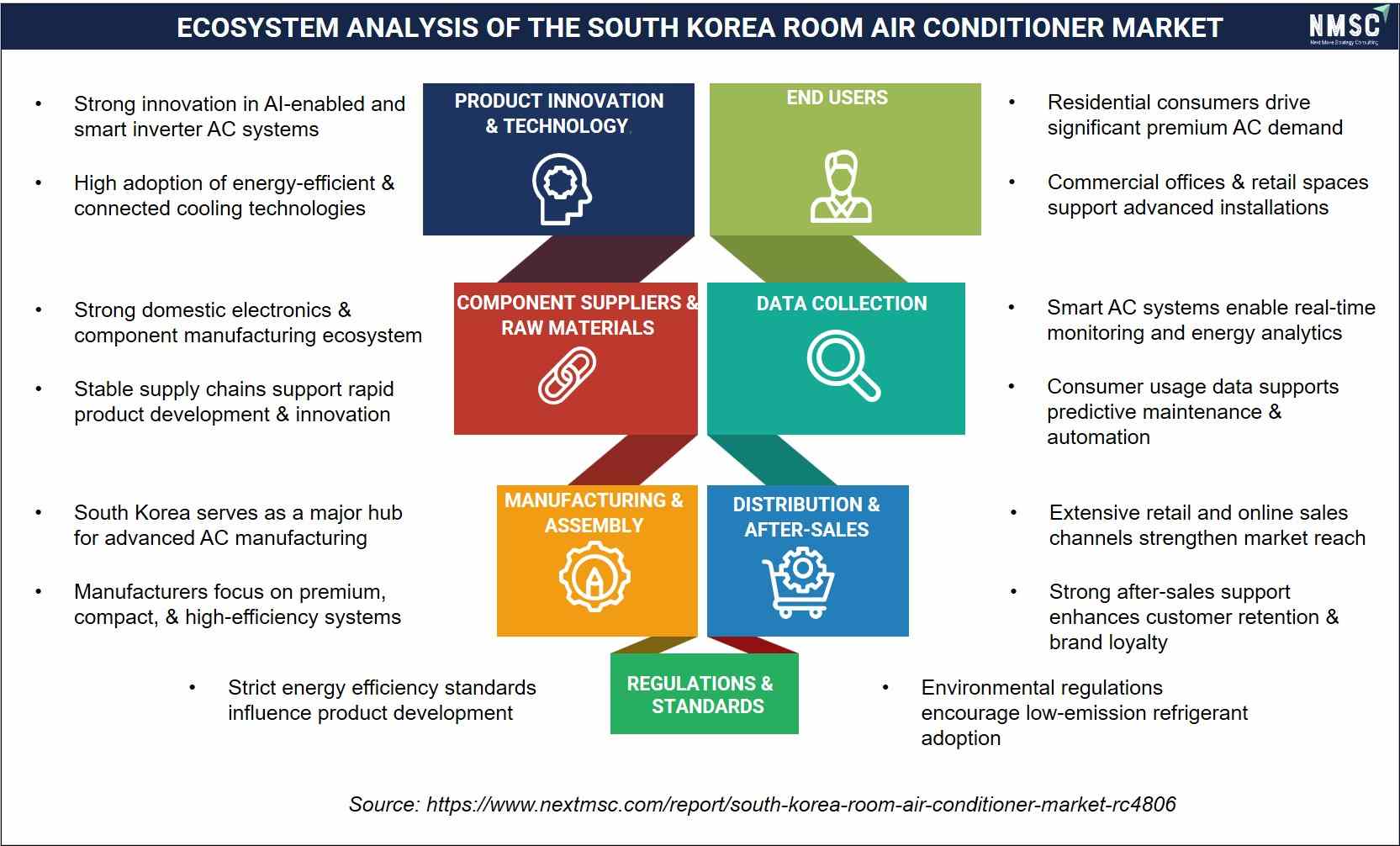
This infographic depicts the ecosystem analysis of the South Korea room air conditioner market by illustrating the interconnected stages that influence industry growth, innovation, and market competitiveness. It highlights the role of advanced product technology, domestic component suppliers, manufacturing capabilities, distribution networks, regulatory standards, and evolving end-user demand in shaping the market landscape. The framework reflects South Korea’s strong focus on AI-enabled and energy-efficient cooling systems, smart home integration, and premium product development. It also demonstrates how data-driven services and robust after-sales networks support long-term market expansion and consumer engagement. Overall, we observed a technologically advanced and highly competitive market environment supporting sustained industry development.
What are the Key Market Drivers, Breakthroughs, and Investment Opportunities that will Shape the South Korea Room Air Conditioner Market in the Next Decade?
Growth Catalyst & Risk Assessment Matrix
|
DRIVERS / TRENDS / RESTRAINTS |
(+/-) % IMPACT ON CAGR FORECAST |
GEOGRAPHIC RELEVANCE |
IMPACT TIMELINE |
|
High smart appliance adoption accelerating demand for connected and AI-enabled cooling systems |
+4.24% |
Nationwide South Korea (strongest in Seoul Metropolitan Area) |
Medium to Long term (3–7 years) |
|
Strong consumer purchasing power supporting premium AC segment expansion |
+3.81% |
Urban high-income residential markets (Seoul, Busan, Incheon) |
Medium term (2–5 years) |
|
Urban living standards increasing demand for advanced climate control and energy-efficient systems |
+3.46% |
High-density metropolitan regions nationwide |
Medium to Long term (3–6 years) |
|
Expansion of premium and smart AC solutions driving innovation-led replacement demand |
+3.92% |
Premium residential and commercial infrastructure across South Korea |
Medium to Long term (3–7 years) |
|
Mature market conditions limiting large-scale first-time installation growth |
-4.07% |
Nationwide South Korea, especially saturated urban residential markets |
Long term (5–10 years) |
The South Korea room air conditioner market represents a highly advanced and technology-oriented ecosystem, supported by widespread smart appliance adoption, strong consumer purchasing power, and continuous demand for premium cooling solutions. South Korean consumers place significant emphasis on intelligent home technologies, energy-efficient appliances, and high-performance indoor climate management systems, which continues to strengthen demand for advanced room air conditioners across residential and commercial environments. From our analysis, we found that urban centers maintain high installation density due to compact apartment-based housing structures and elevated expectations for indoor comfort and air quality. The market is also strongly influenced by replacement-driven demand, as consumers regularly upgrade to newer systems with enhanced efficiency, AI-based controls, and integrated smart home compatibility. However, high penetration rates and mature market conditions continue to limit large-scale incremental expansion. Despite this structural maturity, ongoing innovation in premium and smart cooling technologies continues to support stable value-driven growth across the South Korean market.
Growth Drivers:
How is Smart Appliance Adoption Supporting the South Korea Room Air Conditioner Market?
High adoption of smart home appliances remains one of the most influential growth drivers shaping demand across the room air conditioner market. Our assessment indicates that South Korean households demonstrate a strong preference for connected home ecosystems where air conditioners function as integrated components of broader intelligent living environments. Consumers increasingly prioritize systems equipped with Wi-Fi connectivity, AI-enabled climate management, voice-control integration, and real-time energy monitoring capabilities. This high level of digital readiness significantly accelerates the adoption of technologically advanced cooling systems compared to conventional models. In addition, compatibility with smart home platforms enhances convenience, operational efficiency, and personalised climate control, reinforcing consumer preference for premium smart AC products. Manufacturers continuously introduce advanced models with automated optimization and predictive operational features to align with evolving consumer expectations. This strong technology-oriented consumer environment continues to reinforce demand for intelligent cooling systems across South Korea.
How is Strong Consumer Purchasing Power Driving Premium Segment Growth in South Korea?
Strong consumer purchasing power across South Korea is significantly supporting growth in the premium room air conditioner segment, as consumers increasingly prioritize product quality, advanced technological functionality, and long-term operational efficiency over basic affordability when selecting cooling systems. This enables stronger adoption of premium inverter-based air conditioners equipped with intelligent controls, advanced filtration systems, and enhanced energy optimization features. Urban households are also more willing to invest in aesthetically designed and multifunctional cooling systems that complement modern residential environments. In addition, rising expectations regarding indoor air quality, humidity management, and personalised climate control are strengthening demand for high-end models with integrated purification and adaptive cooling capabilities. This premium-oriented purchasing behaviour continues to support higher-value market growth across the South Korean cooling industry.
How are Urban Living Standards Influencing Cooling Demand in South Korea?
NMSC assessment indicates that urban living standards and evolving residential expectations are steadily influencing product demand patterns across the South Korea room air conditioner market. We observed that consumers increasingly expect precise indoor climate regulation, low-noise operation, and advanced comfort management systems as standard household infrastructure. High-density apartment living in metropolitan areas such as Seoul intensifies the importance of efficient cooling systems capable of maintaining stable indoor conditions during warmer periods. Consumers are also placing stronger emphasis on energy optimization and intelligent automation to improve overall living efficiency. In commercial environments, modern offices and retail spaces require sophisticated HVAC systems to maintain employee comfort and customer experience standards. These evolving lifestyle and infrastructure expectations continue to reinforce stable replacement-driven demand for advanced cooling systems across South Korea.
Growth Inhibitor:
How do Mature Market Conditions Limit Growth in the South Korea Room Air Conditioner Market?
Mature market conditions remain a key structural restraint limiting rapid expansion in the South Korea room air conditioner market. Air conditioner penetration across urban residential and commercial environments is already extremely high, leaving limited room for substantial first-time installation growth. As a result, market demand is increasingly concentrated in replacement cycles and premium product upgrades rather than large-scale new adoption. This mature environment reduces opportunities for volume-driven expansion, particularly within metropolitan regions where cooling system penetration is already well established. In addition, intense competition among established manufacturers shifts market focus toward technological differentiation and premiumization strategies rather than aggressive unit growth. While replacement demand provides long-term market stability, overall expansion remains structurally moderated by saturation conditions.
Growth Opportunity:
How is the Expansion of Premium and Smart AC Solutions Creating Opportunities in South Korea?
The continued expansion of premium and smart air conditioning solutions is creating strong value-driven opportunities across the South Korea room air conditioner market. Consumers increasingly prefer high-performance cooling systems that combine intelligent automation, energy optimisation, and advanced comfort management within integrated smart home ecosystems. Manufacturers are rapidly expanding portfolios featuring AI-based climate adaptation, occupancy sensing, predictive maintenance, and real-time energy monitoring capabilities to address evolving consumer expectations. In addition, demand for ultra-efficient inverter systems and multifunctional units with integrated air purification is strengthening across premium residential segments. Commercial adoption of smart HVAC technologies is also increasing as businesses focus on operational efficiency and automated climate management. From our research, we found that this continued transition toward intelligent and premium cooling technologies is sustaining innovation-led growth opportunities across the South Korean market.
How is the South Korea Room Air Conditioner Industry segmented in this report, and what are the key insights from the segmentation analysis?
By Product Type Insights
How are Product Preferences Influencing Demand Structure in the South Korea Room Air Conditioner Market?
Based on product type, the South Korea room air conditioner market is segmented into window AC, portable AC, single split AC, multi split AC, packaged room AC, and other room AC.
Through our market assessment, we observed that window AC systems continue to maintain limited but stable demand in South Korea, primarily across older residential buildings and cost-sensitive replacement purchases where compact installation and lower upfront cost remain relevant considerations. Portable AC units are also witnessing steady adoption among apartment residents and temporary users seeking flexible cooling solutions suited to compact urban living environments. Single split AC systems hold strong market relevance as consumers increasingly prioritize energy efficiency, quieter operation, and smart-home-compatible cooling solutions within modern residential developments. This transition is further encouraging the adoption of multi split AC systems in premium apartments and compact commercial environments, where zoning flexibility and optimised space utilisation enhance operational efficiency. On the other hand, packaged room AC systems continue serving hospitality and light commercial applications requiring centralised room cooling performance, while other room AC categories remain concentrated in specialised retrofit and customised infrastructure requirements across the market.
By End-User Insights
How are Residential and Commercial Applications Shaping Demand in the South Korea Room Air Conditioner Market?
Based on end-user, the South Korea room air conditioner market is segmented into residential and commercial.
Residential applications continue to represent a major source of demand in the South Korea room air conditioner market, supported by high urban population density, widespread apartment-based living, and strong consumer preference for technologically advanced indoor comfort solutions. Demand is further reinforced by rapid replacement cycles and growing adoption of energy-efficient and smart-connected cooling systems across modern households. Commercial applications are also witnessing steady expansion through investments in retail infrastructure, office spaces, hospitality facilities, healthcare environments, and mixed-use developments requiring reliable indoor climate management. The increasing emphasis on operational efficiency and occupant comfort within commercial buildings further strengthens cooling system adoption across the segment. Our assessment indicates that both end-user categories are increasingly influenced by smart-building integration and energy optimization priorities, reflecting South Korea’s broader transition toward digitally connected and performance-driven cooling infrastructure.
Competitive Landscape
The South Korea room air conditioner industry reflects a highly technology-centric and innovation-intensive competitive structure, where product differentiation is closely tied to smart functionality, design integration, and energy optimisation capabilities. Based on our analysis at NMSC, we noticed that consumer purchasing behaviour is strongly influenced by digitally connected lifestyles, high smart home penetration, and elevated expectations around appliance automation and indoor comfort precision. The market also demonstrates strong replacement-driven characteristics, with households frequently upgrading to newer inverter systems offering AI-enabled climate control, advanced air purification, and lower electricity consumption. In addition, compact urban housing formats and extensive high-rise residential development continue to support demand for space-efficient and aesthetically integrated cooling systems.
Strategic Developments:
-
February 2026 – Samsung launched its flagship 2026 residential AC lineup in Seoul, embedding upgraded Bixby natural language processing. Strategically, the units feature AI Direct and Indirect airflow modes utilizing built-in motion radar sensors to detect occupant locations. This deep-learning AI system optimizes compressor fluctuations based on behavioural history, boosting energy efficiency by up to 58% and cooling speeds by 19%.
Key Players of the South Korea Room Air Conditioner Market
-
Daikin Airconditioning Korea Co., Ltd.
-
Midea Korea Co., Ltd.
-
Panasonic Korea Co., Ltd.
-
Trane Korea Co., Ltd.
-
Mitsubishi Electric Korea Co., Ltd.
-
Carrier Airconditioning Korea Co., Ltd.
-
Kiturami Co., Ltd.
-
Shinil Industrial Co., Ltd.
-
TCL Korea Co., Ltd.
-
Paseco Co., Ltd.
-
Daewoo Electronics Co., Ltd.
-
Fujitsu General Korea Co., Ltd.
-
Winia Co., Ltd.
Competition in South Korea is largely shaped by domestic electronics leaders with deep technological ecosystems and strong consumer brand loyalty. LG Electronics Inc. and Samsung Electronics Co., Ltd. dominate much of the premium residential segment through AI-driven cooling systems, connected smart home integration, and advanced inverter technologies tailored to digitally sophisticated consumers. Meanwhile, Daikin Airconditioning Korea Co., Ltd., Carrier Airconditioning Korea Co., Ltd., and Trane Korea Co., Ltd. maintain competitive positioning in high-performance and commercial-oriented HVAC applications where engineering reliability and system efficiency remain key procurement priorities. At the same time, Mitsubishi Electric Korea Co., Ltd. and Panasonic Korea Co., Ltd. continue to compete through precision cooling technologies and premium residential solutions, while Midea Korea Co., Ltd. focuses on expanding its value-oriented presence through competitively positioned inverter offerings. Overall, we observed that competitive intensity in South Korea is increasingly driven by software-enabled HVAC intelligence, ecosystem connectivity, and premiumisation of residential cooling experiences.
Porter’s Five Forces Analysis of the South Korea Room Air Conditioner Market
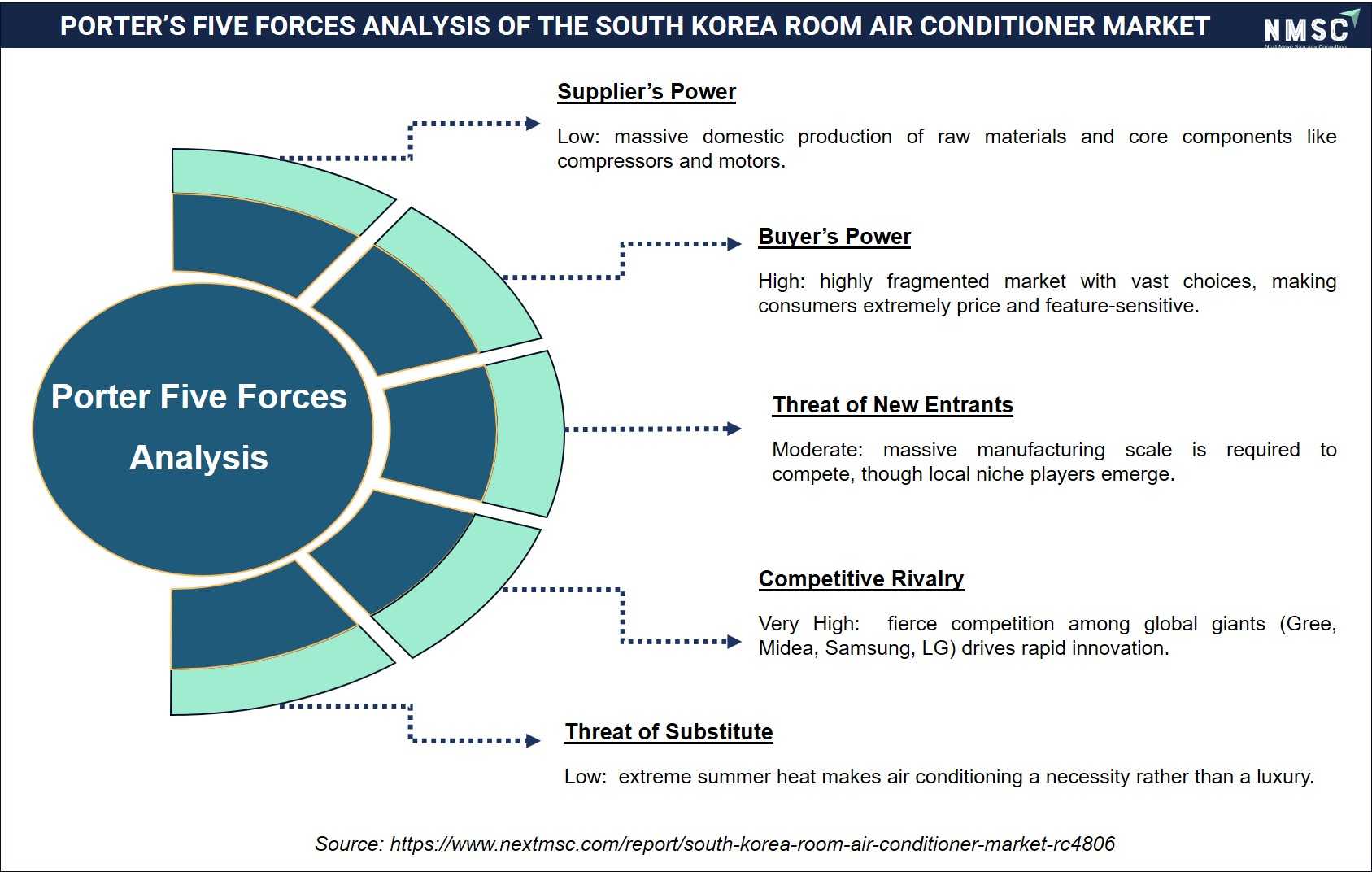
The infographic presents Porter’s Five Forces analysis of the South Korea room air conditioner market, examining the competitive forces influencing profitability and long-term market positioning. Industry analysis suggests that competitive rivalry remains highly intense, led by major domestic manufacturers such as Samsung Electronics and LG Electronics alongside established international brands competing across technology, efficiency, and premium product positioning. Buyer influence remains strong due to high consumer awareness of advanced technologies and growing preference for smart, connected, and energy-efficient cooling systems. Supplier power is relatively moderate, supported by South Korea’s localised and technologically advanced supply ecosystem. The threat of substitutes, including fans and traditional floor heating systems, remains comparatively limited within the broader cooling segment. Overall, the framework provides a structured perspective on the innovation-driven and premium-oriented dynamics shaping South Korea’s room air conditioner market.
South Korea Room Air Conditioner Market Key Segments
By Product Type
-
Window AC
-
Fixed Chassis
-
Through-the-Wall
-
-
Portable AC
-
Single Hose
-
Dual Hose
-
-
Single Split AC
-
Wall Mounted
-
Floor Standing
-
Ceiling Cassette
-
Ceiling Suspended
-
Ducted Single Zone
-
-
Multi Split AC
-
2 Indoor Units
-
3 Indoor Units
-
4+ Indoor Units
-
-
Packaged Room AC
-
Packaged Terminal AC
-
Vertical Packaged
-
Other Packaged
-
-
Other Room AC
By Speed Type
-
Fixed Speed
-
Inverter (Variable Speed)
By Cooling Capacity
-
≤ 1.0 Ton
-
>1.0 to ≤1.5 Ton
-
>1.5 to ≤2.0 Ton
-
>2.0 to ≤3.0 Ton
-
>3.0 Ton
By Efficiency Band
-
Entry
-
Standard
-
High
-
Premium
-
Unrated
By Refrigerant
-
R22
-
R410A
-
R32
-
Low-GWP HFO/HFC Blend
-
Hydrocarbon
-
Other refrigerant
By Function
-
Cooling Only
-
Heat Pump
-
Cooling with Electric Heat
-
Other Function
By Distribution Channel
-
Retail (Brick and Mortar)
-
Multi-Brand Store
-
Brand Exclusive Store
-
Hypermarkets
-
-
Dealer Network
-
HVAC Dealers
-
Distributor & Wholesaler
-
-
Online
-
Marketplace
-
Brand website
-
-
Project Sales
-
Real Estate Developer
-
Hospitality Chain
-
Institutional
-
OEM
-
By End-User
-
Residential
-
Commercial
-
Retail
-
Hospitality
-
Office
-
Healthcare
-
Education
-
Government/Public
-
Other Commercial
-
Key Benefits for Stakeholders:
Next Move Strategy Consulting (NMSC) presents a comprehensive analysis of the South Korea room air conditioner market trends, covering historical trends from 2020 through 2025 and offering detailed forecasts through 2035.
Our study examines the market at regional and country levels, providing quantitative projections and insights into key growth drivers, challenges, and investment opportunities across all major room air conditioner segments.
The South Korea room air conditioner market operates within a highly digitalized consumer environment where purchasing decisions are strongly influenced by smart home integration, premium appliance preferences, and advanced energy management expectations. Demand is largely driven by replacement and technology-upgrade cycles, with households increasingly favouring AI-enabled cooling systems equipped with intelligent climate automation, air purification, and connected ecosystem compatibility. Further, market competition is centred on innovation intensity, product sophistication, and design efficiency, particularly within urban apartment-based living environments where space optimisation and quiet operation remain important considerations. Consumers also demonstrate strong awareness of electricity efficiency and long-term appliance performance, accelerating the adoption of advanced inverter technologies across premium and mid-range segments. In parallel, the country’s mature electronics manufacturing ecosystem continues to support rapid product innovation and reinforce a technologically advanced residential cooling market landscape.
|
Parameters |
Details |
|
Customization Scope |
Free customization (equivalent to up to 80 analyst-working hours) after purchase. |
|
Pricing and Purchase Options |
Avail customized purchase options to meet your exact research needs. |
|
Approach |
In-depth primary and secondary research; proprietary databases; rigorous quality control and validation measures. |
|
Analytical Tools |
Porter's Five Forces, SWOT, value chain, and Harvey ball analysis to assess competitive intensity, stakeholder roles, and relative impact of key factors. |
About the Author
 Mayurima Roy
— Mayurima Roy is Research Analyst at Next Move Strategy Consulting, where she has spent 4 years working across the firm's full industry coverage rather than a single fixed vertical. Her work centers on structured research, ongoing trend tracking, competitive assessment, and insight-led content development, translating complex market data into clear, decision-ready narratives that support informed client decision-making across diverse global industries, market sectors, and world regions every day.
Mayurima Roy
— Mayurima Roy is Research Analyst at Next Move Strategy Consulting, where she has spent 4 years working across the firm's full industry coverage rather than a single fixed vertical. Her work centers on structured research, ongoing trend tracking, competitive assessment, and insight-led content development, translating complex market data into clear, decision-ready narratives that support informed client decision-making across diverse global industries, market sectors, and world regions every day.
About the Reviewer
 Supradip Baul
— Supradip Baul is an accomplished business consultant and strategist with over a decade of rich experience in market intelligence, strategy, technology, and business transformation. His work has included rigorous qualitative and quantitative analysis across multiple industries, helping clients shape investment decisions and long-term roadmaps. Earlier in his career, he was associated with Gartner, where he contributed to industry-leading reports and market share analyses. He has worked with leading global companies and holds an MBA with a dual specialization in Marketing and Finance.
Supradip Baul
— Supradip Baul is an accomplished business consultant and strategist with over a decade of rich experience in market intelligence, strategy, technology, and business transformation. His work has included rigorous qualitative and quantitative analysis across multiple industries, helping clients shape investment decisions and long-term roadmaps. Earlier in his career, he was associated with Gartner, where he contributed to industry-leading reports and market share analyses. He has worked with leading global companies and holds an MBA with a dual specialization in Marketing and Finance.
At Next Move Strategy Consulting, we understand that insightful market research is the cornerstone of successful business decisions. That's why we employ a robust and multifaceted approach, combining various methodologies to deliver the most accurate and actionable data for our clients.

Research Landscape
We navigate the world of research with two primary approaches:
Qualitative Approach
Our qualitative research methodologies involve immersive techniques such as in-depth interviews, focus groups, and observational studies. By engaging directly with individuals and stakeholders, we uncover valuable insights that quantitative data alone may overlook.

Quantitative Research
In tandem with qualitative methodologies, NMSC leverages the power of Quantitative Research to provide a robust foundation of numerical insights. Through systematic data collection and analysis, we quantify patterns, preferences, and market trends, offering a comprehensive view of the business landscape.
Our quantitative research approach employs diverse tools, including surveys, experiments, and statistical modelling. These methodologies enable us to gather data from a large and representative sample, ensuring the statistical significance of our findings. By employing structured questionnaires and standardized data collection methods, we guarantee the reliability and validity of the information we present to our clients.
Quantitative research is particularly effective in measuring the prevalence of trends, assessing market size, and gauging the impact of various factors on consumer behavior. The numerical precision attained through this approach equips our clients with actionable insights, facilitating data-driven decision-making and strategy formulation.


Our Specialized Toolbox for Industry-Specific Market Research
We deploy a specialized arsenal of techniques tailored to meet your unique requirements. Here's a glimpse into our comprehensive toolbox:

Information Procurement
The stage entails acquiring market data or relevant information through various sources and methodologies.


Market Research Approach
We utilize both top-down and bottom-up approaches in market research analysis to achieve a comprehensive understanding of the market dynamics, leveraging the broad perspective of industry trends and macroeconomic factors alongside detailed insights from specific segments and individual companies.

Porters Five Forces Analysis
We conduct Porter's Five Forces analysis to evaluate the competitive landscape of an industry, providing us with insights into factors that affect profitability and strategic positioning.

SWOT Analysis

Forecasting
We utilize a forecasting model to predict future consumption by considering parameters like population, economics, regulations, market competition, drivers, constraints, technology, and pricing. We also employ statistical techniques such as multilinear regression, exponential smoothing, moving average, ARIMA, and Monte Carlo simulations for accurate predictions. In econometric forecasting, we analyzed short-term and long-term event impacts, attributing values based on regulatory frameworks, economic factors, and market events.





 Speak to Our Analyst