The Spain Expense Management Software Market By Product Type (Travel & Expense, Corporate & Virtual Card, and Finance & ERP Embedded Modules), By Revenue Stream (Software, Professional Services, and Card & Payment), By Deployment Model (Cloud, On-premises, and Hybrid), By Functional Modules (Expense Capture & OCR, Policy Controls, Reconciliation, Analytics & Fraud Detection, & Others), By Pricing Model, By Enterprise Size, and By Industry Vertical – Opportunity Analysis & Forecast, 2026-2035
Industry: ICT & Media | Latest Edition: September 30, 2026 | No of Pages: 173 | No. of Tables: 62 | No. of Figures: 55 | Format: PDF | Report Code: IC4839
Spain Expense Management Software Market Size & Forecast
|
Parameters |
Details |
|
Market Size in 2026 |
USD 190.8 Million |
|
Revenue Forecast in 2035 |
USD 570.5 Million |
|
Growth Rate |
CAGR of 12.94% from 2026 to 2035 |
|
Analysis Period |
2025–2035 |
|
Base Year Considered |
2025 |
|
Forecast Period |
2026–2035 |
|
Market Size Estimation |
Million (USD) |
|
Companies Profiled |
15 |
|
Market Share |
Available for 10 companies |
Industry Outlook
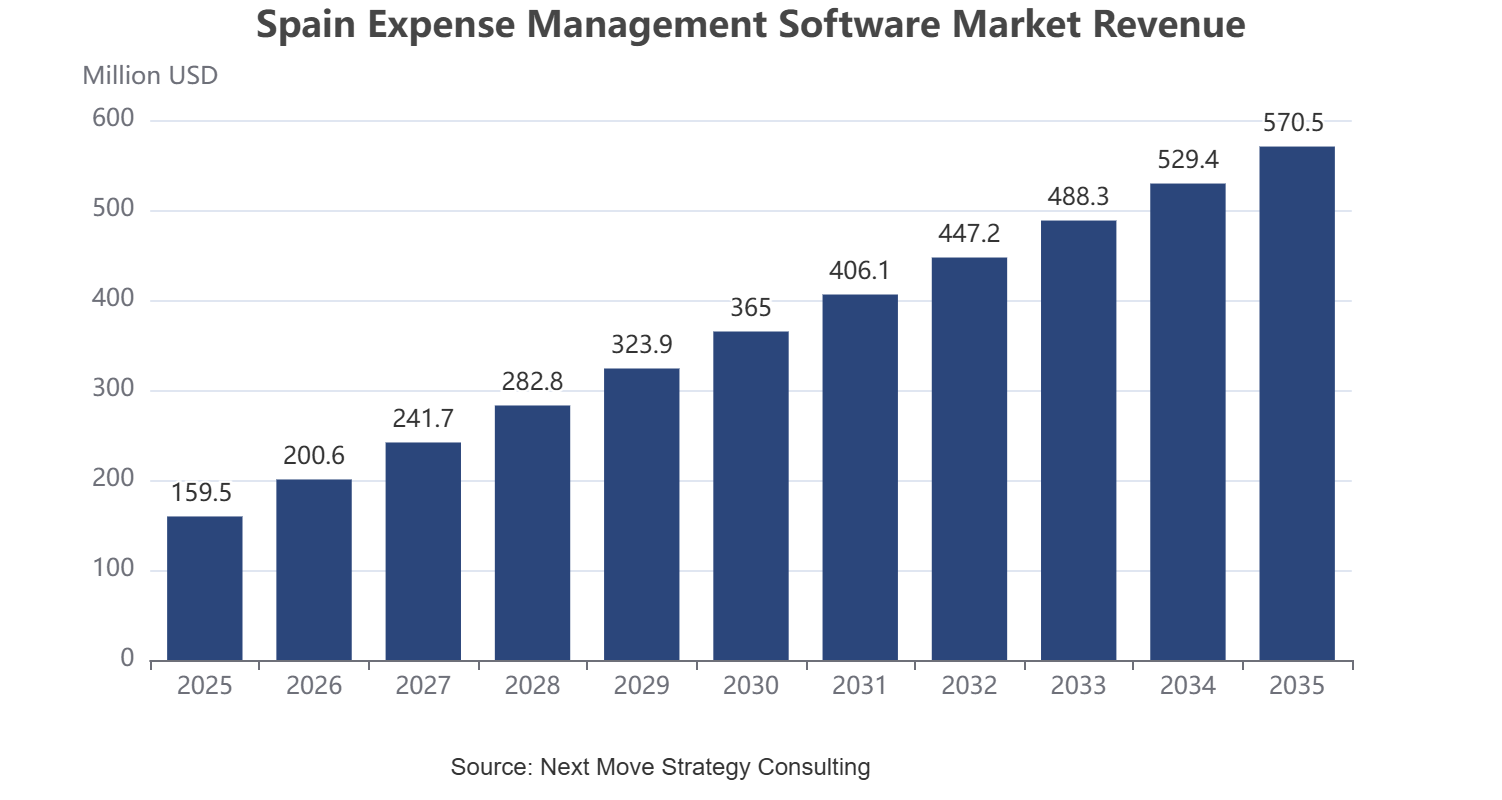
The Spain Expense Management Software Market size was valued at USD 159.5 million in 2025 and is expected to reach USD 190.8 million by 2026. Looking ahead, the industry is projected to expand significantly, reaching USD 570.5 million by 2035, registering a CAGR of 12.94% from 2026 to 2035.
What are the Key Market Drivers, Breakthroughs, and Investment Opportunities that will Shape the Spain Expense Management Software in the Next Decade?
Growth Catalyst & Risk Assessment Matrix
|
DRIVERS / TRENDS / RESTRAINTS |
(+/-) % IMPACT ON CAGR FORECAST |
GEOGRAPHIC RELEVANCE |
IMPACT TIMELINE |
|
Digital transformation across services and retail accelerates expense automation adoption |
+3.73% |
Madrid, Catalonia, Valencia, Andalusia |
Medium to Long term (3–6 years) |
|
Cloud acceptance among SMEs expands demand for SaaS-based reimbursement automation |
+3.11% |
Catalonia, the Basque Country, Galicia, Madrid |
Medium term (2–5 years) |
|
The rising need for financial visibility strengthens demand for centralized spend governance tools |
+2.87% |
Madrid, Valencia, Andalusia, Navarre |
Medium to Long term (3–6 years) |
|
Uneven digital maturity, slow workflow standardization, and advanced platform deployment |
-3.27% |
Extremadura, Castilla-La Mancha, Murcia |
Short to Medium term (1–4 years) |
|
Bundled expense, travel, and procurement workflows create integrated automation opportunities |
+3.02% |
Spain |
Medium to Long term (3–6 years) |
Through our market assessment, we observed that companies are adopting expense management platforms to automate reimbursement approvals, reduce manual errors, improve audit readiness, and centralize employee spending oversight across travel, procurement, and day-to-day operational expenses. The Spain expense management software market is progressing steadily as service-sector and retail organizations modernize financial workflows, improve reimbursement visibility, and strengthen cost governance across increasingly digital operating environments. The software is being used for receipt digitization, travel claim processing, policy enforcement, mileage tracking, and integration with accounting systems. As digital finance capabilities expand across Spain, the market is expected to benefit from broader cloud adoption, greater workflow automation, and stronger demand for integrated spend management tools.
Growth Drivers:
How Is Digital Transformation Across Services and Retail Accelerating the Spanish Expense Management Software Market?
Digital transformation across services and retail is directly supporting the adoption of the Spain expense management software market. From our research, we found that organizations in hospitality, retail, consulting, and business services are increasingly shifting away from manual reimbursement tracking toward cloud-based systems that improve process efficiency and financial transparency. These sectors typically manage frequent employee expenses, customer-facing travel, and multi-branch operations, all of which create a strong need for automated policy control and centralized reporting. Expense management platforms help businesses reduce paperwork, accelerate approvals, and improve visibility into discretionary spending. Retailers and service providers are also integrating expense tools with accounting and ERP systems to improve coordination between finance and operations. As these industries continue prioritizing digital workflow modernization, demand for scalable expense software is expected to rise steadily across Spain's commercial ecosystem.
How Is Cloud Acceptance Among SMEs Expanding Demand for Automated Reimbursements?
Through our market assessment, we observed that smaller businesses are increasingly willing to move from spreadsheet-based processes to SaaS platforms that offer low-friction deployment, predictable pricing, and simpler daily use. Cloud acceptance among SMEs is becoming a major growth engine for the Spain expense management software market. SMEs value solutions that reduce reimbursement delays, minimize administrative effort, and provide mobile-friendly submission and approval workflows without requiring large IT investments. This shift is especially important for companies with lean finance teams that need quick implementation and immediate operational gains. Cloud-based expense tools also enable smaller firms to improve visibility into employee spending while maintaining policy control and documentation quality. As more Spanish SMEs become comfortable with cloud financial applications, the addressable market for automated expense reimbursements is expected to expand meaningfully.
How Is the Need for Financial Visibility Supporting Broader Market Growth in Spain?
The rising need for financial visibility is creating another important layer of demand in Spain expense management software market. Based on our market evaluation, we noticed that organizations are placing greater emphasis on real-time spend tracking, centralized approval control, and accurate reporting to support budget discipline and operational oversight. Expense management platforms allow finance teams to monitor claims more effectively, identify policy breaches, and reduce leakage across departments and business units. These capabilities are particularly valuable in organizations with multiple cost centers, high employee travel activity, or decentralized purchasing patterns. Businesses are also using reporting tools to improve forecasting accuracy and strengthen internal accountability. As finance leaders continue prioritizing data-driven control and greater transparency, expense management software is becoming an increasingly strategic tool for operational governance and long-term cost optimization.
Growth Inhibitor:
How Is Uneven Digital Maturity Slowing Standardization in the Spain Expense Management Software Market?
Uneven digital maturity across Spanish businesses remains a major restraint on standardization and faster market penetration. In our observation, many organizations still operate with varying levels of finance digitization, which makes it difficult to implement consistent expense workflows across different departments or business units. While larger enterprises are ready for integrated automation, smaller or less mature firms continue relying on manual processes, legacy systems, or fragmented accounting tools. This creates implementation friction for vendors, especially when software must be tailored to diverse operational readiness levels. In addition, limited process standardization delays ROI realization and reduces buyer confidence in more advanced platforms. As a result, vendors must balance sophistication with simplicity by offering configurable tools that serve both digitally advanced and less mature organizations within Spain's highly mixed business environment.
Growth Opportunity:
How Can Bundled Expense, Travel, and Procurement Workflows Unlock New Opportunities in Spain?
Bundling expense management with travel and procurement workflows represents one of the strongest growth opportunities in Spain. Through NMSC's assessment, we found that organizations increasingly prefer integrated platforms that combine employee expense reporting, travel booking oversight, and procurement controls within a single operational framework. This approach reduces system fragmentation, improves data consistency, and allows finance teams to manage all non-payroll spending from a more unified interface. Businesses benefit from streamlined approvals, better policy enforcement, and improved visibility across the full spend lifecycle, from booking to reimbursement to supplier payments. The opportunity is especially relevant for service firms, retail networks, and growing SMEs seeking practical automation without adopting multiple standalone systems. Vendors that deliver bundled workflows with strong usability, mobile access, and integration flexibility are well-positioned to capture rising demand across Spain's evolving finance automation market.
Consumer Behavior Analysis of the Spain Expense Management Software Industry
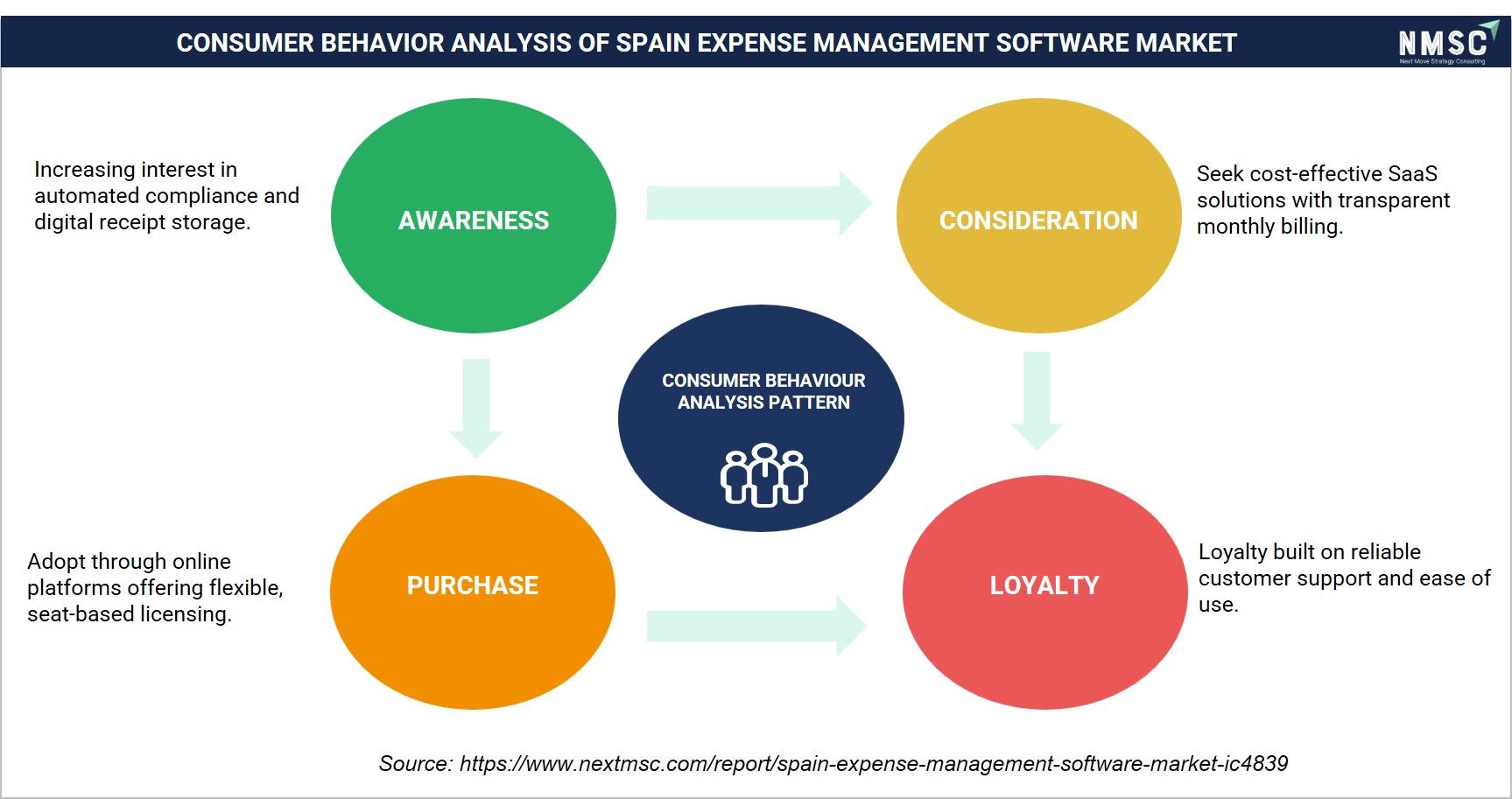
Our assessment indicates that awareness in the Spain expense management software market is increasing due to growing interest in automated compliance management, digital receipt storage, and streamlined financial reporting workflows.
Consideration patterns are strongly influenced by demand for cost-effective SaaS platforms offering transparent monthly pricing and scalable subscription models. Purchase decisions are increasingly driven by online software platforms providing flexible seat-based licensing and simplified deployment capabilities. Furthermore, customer loyalty is being strengthened by reliable technical support, intuitive user interfaces, and consistent operational performance, which continue to support long-term enterprise adoption across the Spain expense management software market.
How is the Spain Expense Management Software segmented in this report, and what are the key insights from the segmentation analysis?
By Product Type Insights
How Is Product-Type Adoption Influencing the Spain Expense Management Software Market?
Based on product type, the Spain expense management software market is segmented into Travel and Expense Management Platforms, Corporate and Virtual Card Platforms, and Finance and ERP Embedded Expense Modules.
In our observation, Travel and Expense Management Platforms are increasingly adopted by Spanish enterprises seeking automated reimbursement processing, simplified receipt management, and stronger policy compliance for hybrid and travel-intensive workforces. Corporate and Virtual Card Platforms are gaining momentum as organizations focus on improving spend visibility, strengthening transaction-level controls, and streamlining reconciliation processes across distributed payment ecosystems. Finance and ERP Embedded Expense Modules continue attracting enterprises that prioritize centralized accounting operations, seamless financial integration, and enhanced audit readiness, particularly within sectors requiring strict operational oversight. Across all product categories, procurement strategies are increasingly shaped by AI-enabled workflow automation, cybersecurity resilience, analytics-driven expense visibility, and the growing need for scalable digital finance ecosystems capable of improving operational efficiency and supporting broader enterprise modernization initiatives across Spain's evolving business environment.
By Deployment Model Insights
How Are Deployment Models Reshaping the Spain Expense Management Software Market?
Based on the deployment model, the Spain expense management software market is segmented into Cloud, On-Premises, and Hybrid.
Based on our market evaluation, we noticed that cloud-based expense management solutions are increasingly preferred by Spanish enterprises due to their scalability, lower infrastructure dependency, remote accessibility, and ability to support real-time financial visibility across distributed operations. On-premises deployments continue to maintain relevance among organizations that prioritize direct control over sensitive financial data, customized compliance frameworks, and stable internal infrastructure management, particularly within regulated industries. Hybrid deployment models are steadily gaining traction as enterprises seek a balanced approach that combines cloud flexibility with selective on-site management of critical financial and operational data. Across all deployment environments, purchasing decisions are increasingly influenced by cybersecurity preparedness, ERP interoperability, workflow automation capabilities, and the growing enterprise emphasis on resilient digital finance ecosystems that support operational continuity and long-term modernization strategies across Spain.
Competitive Landscape
The Spain expense management software industry is evolving within a highly competitive and digitally accelerating environment supported by increasing enterprise automation initiatives, growing cloud software adoption, and rising demand for efficient financial workflow management solutions. The market remains moderately fragmented, with multinational enterprise software providers competing alongside regional fintech and SaaS-based spend management specialists offering localized compliance and reimbursement automation capabilities. Expanding business travel activity, increasing workforce mobility, and a stronger emphasis on real-time expense visibility are encouraging organizations to modernize traditional expense reporting systems. Additionally, the growing integration of embedded payments, AI-enabled policy enforcement, and virtual corporate card ecosystems is transforming expense management platforms into broader spend orchestration and intelligent financial operations solutions.
Strategic Developments:
-
November 2025 – Workday announced the expansion of its “EU Sovereign Cloud” to Spain. By making its AI-driven finance platform available via Google Cloud Marketplace locally, Workday is helping large Spanish corporations scale their expense management while strictly adhering to regional data sovereignty and privacy laws.
Key Players of the Spain Expense Management Software Market
-
Concur Spain S.L.
-
Spendesk SAS
-
Navan Nova Labs SL
-
Captio (Captio Tech, S.L.)
-
Rydoo Spain S.L.
-
Paylocity Holding Corporation
-
Pleo Technologies S.L.
-
Perkbox Limited
-
Sage Spain, S.L.
-
Workday España SL
-
Clara Technologies Spain S.L.
-
Ramp Business Corporation
-
Coupa Software Spain S.L.
Competitive dynamics within the Spain expense management software market are increasingly driven by automation sophistication, ERP interoperability, and employee-centric financial management capabilities. Major participants including Concur Spain S.L., Expensify, Inc., Brex Inc., Spendesk SAS, Navan Nova Labs SL, and Coupa Software Spain S.L. are strengthening market positioning through AI-driven spend analytics, integrated travel-expense management, and unified financial visibility solutions. Meanwhile, Captio (Captio Tech, S.L.), Rydoo Spain S.L., Paylocity Holding Corporation, Pleo Technologies S.L., Perkbox Limited, Sage Spain, S.L., Workday España SL, Clara Technologies Spain S.L., and Ramp Business Corporation are increasingly targeting SME digital transformation, VAT compliance automation, embedded payment functionality, and scalable financial workflow integration. The broader competitive landscape reflects a strategic transition toward predictive spend intelligence, connected finance ecosystems, and end-to-end spend orchestration platforms.
Strategic Framework Analysis of the Spain Expense Management Software Industry
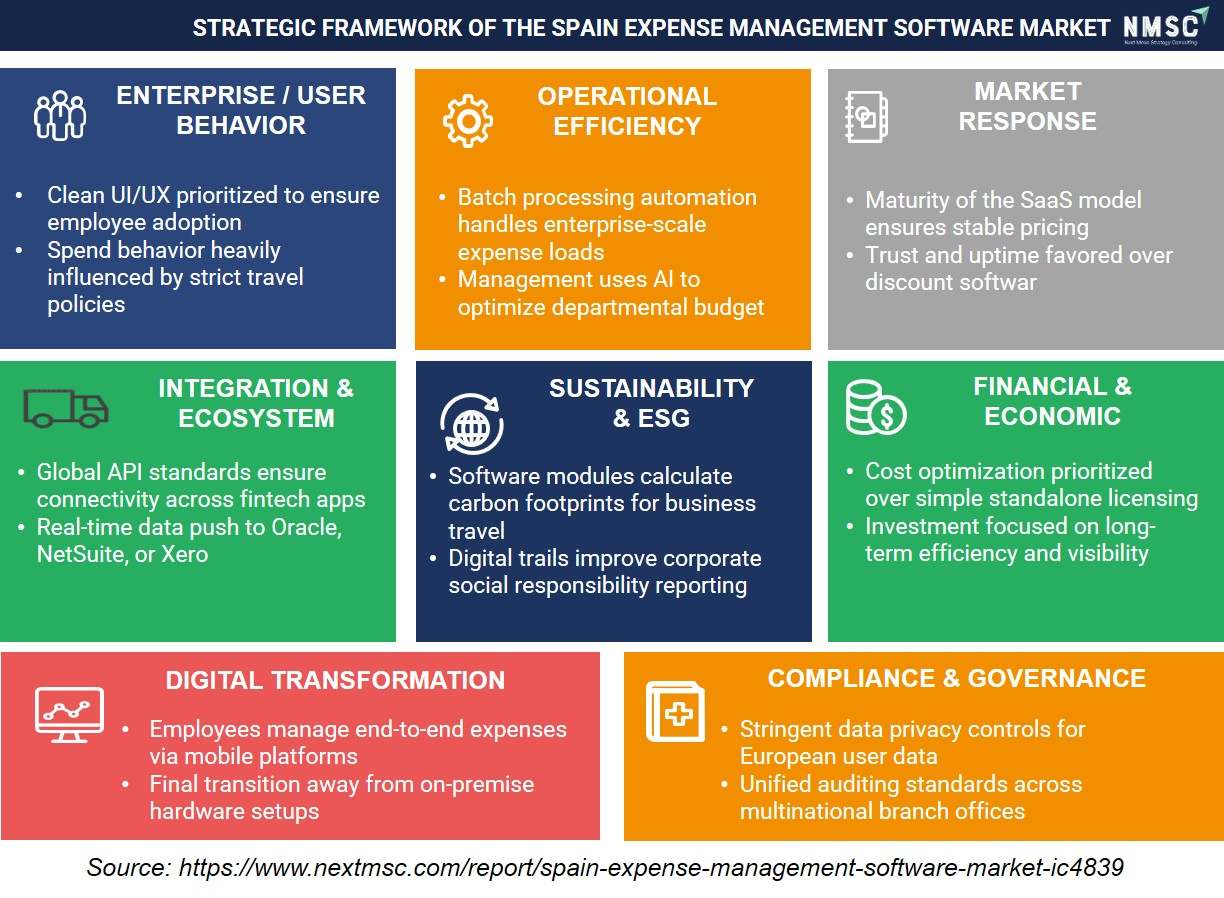
Our findings suggest that the Spain expense management software market is increasingly shaped by enterprise demand for intuitive UI/UX, mobile-first accessibility, and policy-driven spend management practices.
Organizations are prioritizing operational efficiency through AI-enabled budget optimization, automated batch expense processing, and scalable workflow automation. Integration ecosystems and real-time API connectivity with ERP and accounting platforms are becoming essential for enterprise-wide financial visibility. Sustainability and ESG objectives are also encouraging adoption of digital audit trails and carbon footprint tracking functionalities within travel and expense platforms. Furthermore, strong compliance governance, cloud-based digital transformation, and long-term cost optimization strategies are expected to continue driving adoption across the Spain expense management software market.
Spain Expense Management Software Market Key Segments
By Product Type
-
Travel and Expense Management Platform
-
Corporate and Virtual Card Platform
-
Finance and ERP Embedded Expense Modules
By Revenue Stream
-
Software and License Revenue
-
Professional Services Revenue
-
Implementation and Integration
-
Consulting and Training
-
Managed and Support Services
-
Transactional Processing and BPO
-
-
Card and Payment Revenue
-
Interchange and Card Revenue Share
-
Card Processing Commissions and Fees
-
Card Platform Fees
-
By Deployment Model
-
Cloud
-
On-premises
-
Hybrid
By Functional Modules
-
Expense Capture and Receipt OCR
-
Policy Controls and Approval Workflow
-
Reconciliation and Matching
-
Dispute and Exception Management
-
Ordering and Provisioning Inventory
-
Usage Monitoring and Chargeback
-
Analytics, Audit and Fraud Detection
By Pricing Model
-
Per-User
-
Per-Transaction
-
Tiered Organization ARR
-
Per-module
-
Other Monetization Models
By Enterprise Size
-
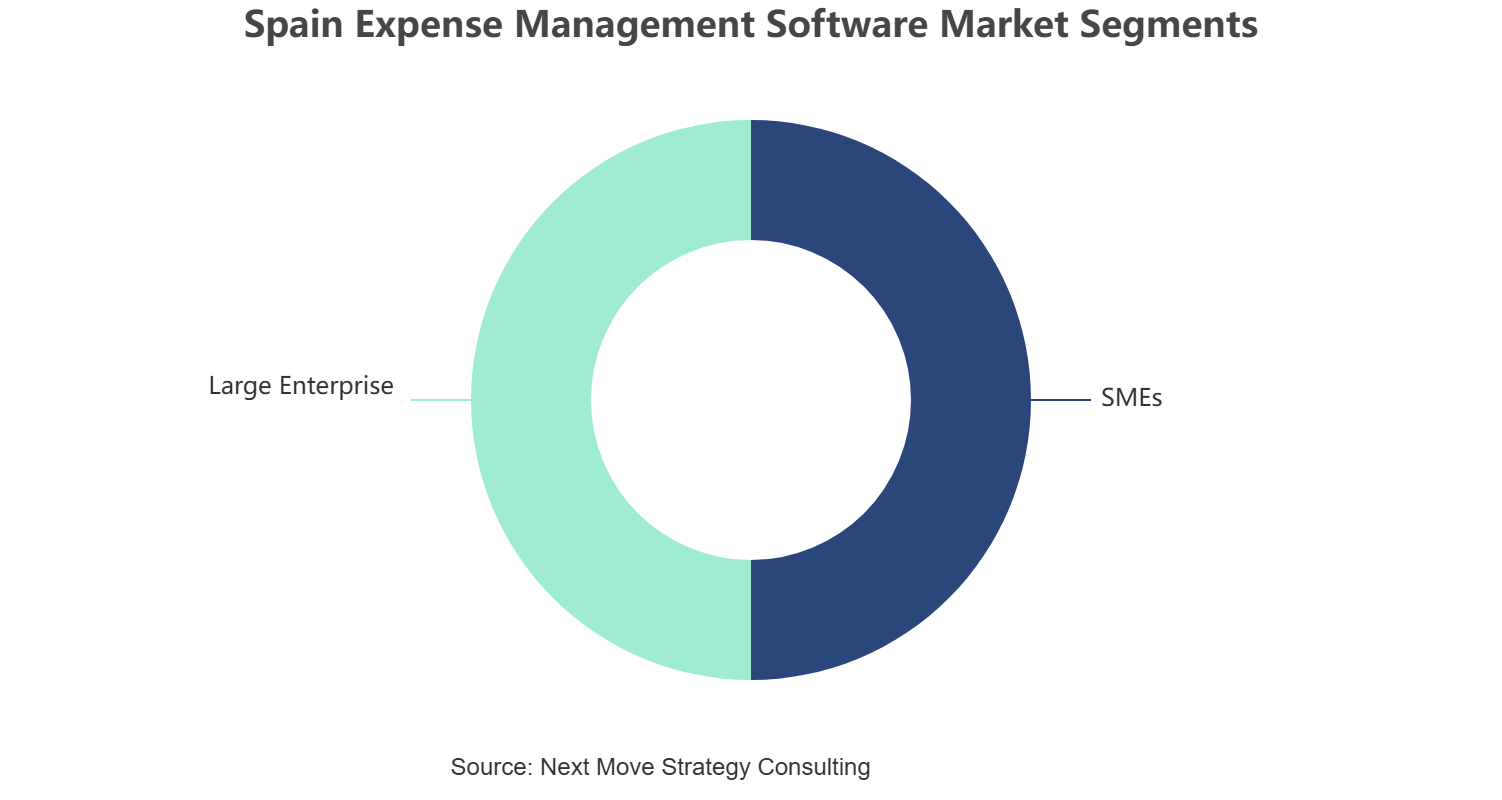
SMEs
-
Large Enterprise
By Industry Vertical
-
BFSI
-
Information Technology and Telecom
-
Manufacturing and Industrials
-
Retail and E-commerce
-
Healthcare and Life Sciences
-
Government and Public Sector
-
Hospitality, Travel and Leisure
-
Energy and Utilities
-
Education and Non-Profit
-
Transportation and Logistics
-
Professional Services and Consulting
-
Other Industries
Key Benefits for Stakeholders:
Next Move Strategy Consulting (NMSC) presents a comprehensive analysis of the Spain expense management software market trends, covering historical developments from 2020 to 2025 and providing forward-looking forecasts through 2035. Our study evaluates the market at national and state levels, delivering quantitative outlooks alongside qualitative insights into key growth drivers, regulatory frameworks, enterprise digitalization trends, cloud adoption, AI-enabled financial automation, and evolving corporate expense governance practices across major end-user industries.
The Spain expense management software market is a fast-evolving digital finance segment driven by growing cloud adoption, operational cost discipline, and rising demand for automated financial workflows across enterprises and SMEs. In our assessment, Spanish organizations, particularly in retail, logistics, tourism, and professional services, are increasingly adopting SaaS-based expense platforms to improve reimbursement efficiency, strengthen compliance documentation, and gain better visibility into distributed spending operations. The market also reflects Spain's expanding digital business ecosystem, where affordability, rapid deployment, and localized support remain critical purchasing priorities. Growing emphasis on mobile-first financial tools, ERP integration, and scalable subscription-based solutions continues to accelerate long-term market adoption across Spain.
|
Parameters |
Details |
|
Customization Scope |
Free customization (equivalent to up to 80 analyst-working hours) after purchase. |
|
Pricing and Purchase Options |
Avail customized purchase options to meet your exact research needs. |
|
Approach |
In-depth primary and secondary research; proprietary databases; rigorous quality control and validation measures. |
|
Analytical Tools |
Porter's Five Forces, SWOT, value chain, and Harvey ball analysis to assess competitive intensity, stakeholder roles, and relative impact of key factors. |
About the Author
 Ridip Gogoi
— Ridip Gogoi is a Research Associate at Next Move Strategy Consulting, where he supports cross-vertical market research and analysis across multiple industry sectors, with four years of experience. His work includes market analysis, data validation, secondary research, and insight development, helping structure evidence into clear findings for business and strategy decisions. He contributes to research quality checks and reporting, with a focus on consistency, source review, and clarity accuracy.
Ridip Gogoi
— Ridip Gogoi is a Research Associate at Next Move Strategy Consulting, where he supports cross-vertical market research and analysis across multiple industry sectors, with four years of experience. His work includes market analysis, data validation, secondary research, and insight development, helping structure evidence into clear findings for business and strategy decisions. He contributes to research quality checks and reporting, with a focus on consistency, source review, and clarity accuracy.
About the Reviewer
 Supradip Baul
— Supradip Baul is an accomplished business consultant and strategist with over a decade of rich experience in market intelligence, strategy, technology, and business transformation. His work has included rigorous qualitative and quantitative analysis across multiple industries, helping clients shape investment decisions and long-term roadmaps. Earlier in his career, he was associated with Gartner, where he contributed to industry-leading reports and market share analyses. He has worked with leading global companies and holds an MBA with a dual specialization in Marketing and Finance.
Supradip Baul
— Supradip Baul is an accomplished business consultant and strategist with over a decade of rich experience in market intelligence, strategy, technology, and business transformation. His work has included rigorous qualitative and quantitative analysis across multiple industries, helping clients shape investment decisions and long-term roadmaps. Earlier in his career, he was associated with Gartner, where he contributed to industry-leading reports and market share analyses. He has worked with leading global companies and holds an MBA with a dual specialization in Marketing and Finance.
At Next Move Strategy Consulting, we understand that insightful market research is the cornerstone of successful business decisions. That's why we employ a robust and multifaceted approach, combining various methodologies to deliver the most accurate and actionable data for our clients.

Research Landscape
We navigate the world of research with two primary approaches:
Qualitative Approach
Our qualitative research methodologies involve immersive techniques such as in-depth interviews, focus groups, and observational studies. By engaging directly with individuals and stakeholders, we uncover valuable insights that quantitative data alone may overlook.

Quantitative Research
In tandem with qualitative methodologies, NMSC leverages the power of Quantitative Research to provide a robust foundation of numerical insights. Through systematic data collection and analysis, we quantify patterns, preferences, and market trends, offering a comprehensive view of the business landscape.
Our quantitative research approach employs diverse tools, including surveys, experiments, and statistical modelling. These methodologies enable us to gather data from a large and representative sample, ensuring the statistical significance of our findings. By employing structured questionnaires and standardized data collection methods, we guarantee the reliability and validity of the information we present to our clients.
Quantitative research is particularly effective in measuring the prevalence of trends, assessing market size, and gauging the impact of various factors on consumer behavior. The numerical precision attained through this approach equips our clients with actionable insights, facilitating data-driven decision-making and strategy formulation.


Our Specialized Toolbox for Industry-Specific Market Research
We deploy a specialized arsenal of techniques tailored to meet your unique requirements. Here's a glimpse into our comprehensive toolbox:

Information Procurement
The stage entails acquiring market data or relevant information through various sources and methodologies.


Market Research Approach
We utilize both top-down and bottom-up approaches in market research analysis to achieve a comprehensive understanding of the market dynamics, leveraging the broad perspective of industry trends and macroeconomic factors alongside detailed insights from specific segments and individual companies.

Porters Five Forces Analysis
We conduct Porter's Five Forces analysis to evaluate the competitive landscape of an industry, providing us with insights into factors that affect profitability and strategic positioning.

SWOT Analysis

Forecasting
We utilize a forecasting model to predict future consumption by considering parameters like population, economics, regulations, market competition, drivers, constraints, technology, and pricing. We also employ statistical techniques such as multilinear regression, exponential smoothing, moving average, ARIMA, and Monte Carlo simulations for accurate predictions. In econometric forecasting, we analyzed short-term and long-term event impacts, attributing values based on regulatory frameworks, economic factors, and market events.





 Speak to Our Analyst