SSD Controller Market Size, Share, Growth & Forecast by Business Model (Merchant Controllers, Captive Controllers), Host Interface (SATA, SAS, PCIe Gen 3, PCIe Gen 4, PCIe Gen 5, PCIe Gen 6), Form Factor (2.5-Inch, M.2, U.2, EDSFF, Add-In Card, BGA), NAND Flash Type (SLC, MLC, TLC, QLC, PLC), Controller Architecture (DRAM Based, DRAMless), End Market Application (Client SSD, Enterprise SSD, Industrial SSD, Automotive SSD), and Sales Channel — Global Analysis 2025–2035
Industry: Semiconductor & Electronics | Publishing Date: July 10, 2026 | Last Updated: September 30, 2026 | No of Pages: N/A | No. of Tables: N/A | No. of Figures: N/A | Format: PDF | Report Code: SE5084
What Is the SSD Controller Market Size?
The global SSD Controller Market was valued at USD 3.8 billion in 2025 and is expected to reach USD 4.2 billion in 2026. Sustained data center build-out, the proliferation of NVMe-based PCIe Gen 4 and PCIe Gen 5 solid-state drives, and rising demand for high-performance storage in AI inference workloads are projected to propel the market to USD 10.6 billion by 2035, advancing at a CAGR of 11.2% from 2026 to 2035. Key growth drivers include the rapid transition from SATA to PCIe interfaces, expanding automotive and industrial SSD deployments, surging enterprise data center SSD adoption, and the ongoing shift toward QLC and PLC NAND architectures requiring increasingly sophisticated controller firmware.
|
Parameters |
Details |
|
Market Size in 2025 |
USD 3.8 Billion |
|
Market Size in 2026 |
USD 4.2 Billion |
|
Revenue Forecast in 2035 |
USD 10.6 Billion |
|
Growth Rate |
CAGR of 11.2% from 2026 to 2035 |
|
Analysis Period |
2025–2035 |
|
Base Year Considered |
2025 |
|
Forecast Period |
2026–2035 |
|
Market Size Estimation |
Billion USD |
|
Companies Profiled |
20 |
|
Countries Covered |
33 |
|
Market Share |
Top 10 |
SSD Controller Market Overview
What Is the SSD Controller Market?
The SSD Controller Market encompasses the global commercial and captive ecosystem for integrated circuits that manage NAND flash memory operations within solid-state drives. An SSD controller orchestrates read and write operations, error correction code (ECC) processing, wear leveling, garbage collection, and host interface communication across SATA, SAS, and PCIe protocols. NMSC's analysis indicates that SSD controllers are the most intelligence-dense component within an SSD, directly determining drive latency, endurance, power efficiency, and compatibility with enterprise, client, automotive, and industrial storage specifications.
How Has the SSD Controller Market Evolved?
The SSD Controller Market has progressed through distinct generational shifts. The initial phase was dominated by SATA-based controllers serving client notebook and desktop replacement drives. The second phase introduced SAS controllers targeting enterprise reliability requirements. Based on research conducted by NMSC, we found that the current and most consequential phase is defined by PCIe Gen 3, Gen 4, and increasingly Gen 5 NVMe controllers that deliver sequential read throughputs exceeding 14 GB/s, enabling AI training, real-time analytics, and hyperscale storage infrastructure that was previously only achievable with DRAM-based systems.
How Do Regulations Influence the SSD Controller Market?
Regulatory and standards frameworks meaningfully shape the SSD Controller Market. The NVMe specification, governed by NVM Express Inc., defines the interface and command set that controller vendors must implement to achieve broad platform compatibility. Export control regulations administered by the U.S. Bureau of Industry and Security (BIS) affect cross-border shipment of advanced semiconductor IP, with specific implications for controller architectures fabricated at leading-edge process nodes. Automotive-grade SSD controllers must comply with AEC-Q100 reliability qualification standards, and industrial deployments are increasingly governed by IEC 62443 cybersecurity standards for embedded storage.
How Is Technology Adoption Expanding Across the SSD Controller Market?
Technology adoption across the SSD Controller Market is accelerating as hyperscalers, OEM server vendors, and consumer electronics manufacturers converge on PCIe Gen 4 as the baseline interface while qualifying Gen 5 platforms for next-generation AI and HPC deployments. Our findings suggest that DRAMless controller architectures are gaining significant traction in cost-sensitive client SSD segments, while DRAM-based and HMB-assisted controllers remain the standard for enterprise and industrial reliability requirements. The emergence of Computational Storage Drive controllers, which embed processing logic to offload host CPU tasks, represents the frontier of controller innovation.
|
Key Takeaways |
|
By Business Model, Merchant Controllers held the largest share of the SSD Controller Market at USD 2.4 billion in 2025. Captive Controllers represent the fastest-growing sub-segment, projected to advance at a CAGR of 13.1% from 2026 to 2035, driven by Samsung, SK hynix, Kioxia, and Micron deepening vertical integration to optimize NAND-controller co-design for AI and data center workloads. |
|
By Host Interface, PCIe Gen 4 commanded the largest revenue share at USD 1.4 billion in 2025, reflecting broad OEM adoption across client and enterprise SSD platforms. PCIe Gen 5 is the fastest-growing interface segment at a CAGR of 32.4% from 2026 to 2035, propelled by hyperscaler AI server platform qualification cycles at major cloud providers. |
|
By Form Factor, M.2 led revenue generation in the SSD Controller Market at USD 1.6 billion in 2025, driven by its universal adoption across notebooks, ultrabooks, and compact workstation platforms. EDSFF is the fastest-growing form factor at a CAGR of 24.8% from 2026 to 2035, as hyperscalers standardize on E1.S and E3.S formats for rack-scale data center density optimization. |
|
By NAND Flash Type, TLC dominated with USD 2.1 billion in 2025, representing the mainstream NAND tier for both client and enterprise SSDs. QLC is the fastest-growing major NAND segment at a CAGR of 17.6% from 2026 to 2035, as read-intensive hyperscale and cold-storage workloads validate QLC endurance at lower cost per terabyte, while PLC is the highest-CAGR NAND segment at 18.2%. |
|
By Controller Architecture, DRAM Based controllers held USD 2.2 billion in 2025. DRAMless is the fastest-growing architecture at a CAGR of 14.3% from 2026 to 2035, as LPDDR4 DRAM cost pressure and HMB (Host Memory Buffer) technology advances narrow the performance gap for mainstream client applications. |
|
By End Market Application, Client SSD held the largest revenue share at USD 1.9 billion in 2025. Enterprise SSD is forecast as the fastest-growing major application segment at a CAGR of 13.8% from 2026 to 2035, as AI server deployments, all-flash storage arrays, and NVMe-oF disaggregated storage architectures drive sustained controller demand growth, while Automotive SSD is the highest-CAGR application segment at 16.8%. |
|
By Sales Channel, Direct OEM led at USD 1.6 billion in 2025. Internal Consumption is the fastest-growing channel at a CAGR of 13.1% from 2026 to 2035, reflecting vertically integrated NAND manufacturers deploying captive controllers across their in-house SSD product lines. |
|
Asia-Pacific held the largest regional share of the SSD Controller Market at USD 1.6 billion in 2025, while North America remained a leading innovation and hyperscaler spending hub at USD 1.1 billion in 2025 and is projected to reach USD 3.1 billion by 2035 at a CAGR of 11.3%, underpinned by hyperscaler AI infrastructure spending and the headquartering of leading SSD OEMs and controller architecture licensors. |
|
Asia-Pacific is the fastest-growing major region in the SSD Controller Market at a CAGR of 12.4% from 2026 to 2035, driven by Taiwan's controller fabless ecosystem, South Korea's integrated NAND-controller manufacturers, and China's domestic SSD controller industry expansion under technology self-sufficiency mandates. |
|
The United States is the single largest country market in the SSD Controller Market, representing over 80% of North American revenue in 2025, anchored by Amazon, Microsoft, Google, and Meta hyperscaler procurement and the design center presence of Marvell, Silicon Motion, and Phison. |
|
Taiwan is the fastest-growing national market in Asia-Pacific within the SSD Controller Market, given that Phison Electronics, Silicon Motion, and InnoGrit are all headquartered on the island, with concentrated design, qualification, and customer engagement activity supporting double-digit growth through 2035. |
Key Emerging Trends in the SSD Controller Market
How Is the PCIe Gen 5 Interface Transition Reshaping the SSD Controller Market?
The industry-wide transition to PCIe Gen 5 interfaces is fundamentally altering the competitive landscape of the SSD Controller Market. Through our market assessment, we observed that PCIe Gen 5 doubles the per-lane bandwidth of Gen 4, enabling sequential read speeds exceeding 14 GB/s and delivering the low-latency, high-throughput storage performance required for AI model serving and large-scale vector database operations. Marvell's Bravera SC5 and Phison's PS5026-E26 controllers represent early commercial implementations qualifying across major hyperscaler AI server platforms, compelling all tier-one controller vendors to accelerate Gen 5 roadmap execution or risk design win displacement.
How Is QLC and PLC NAND Driving Controller Firmware Complexity in the SSD Controller Market?
The industry adoption of QLC (4 bits per cell) and emerging PLC (5 bits per cell) NAND flash is creating a new frontier of controller firmware engineering complexity within the SSD Controller Market. Our findings suggest that higher bit-density NAND technologies require more sophisticated error correction coding, advanced read-retry algorithms, and tighter wear-leveling management to maintain acceptable endurance and latency profiles. Kioxia and Western Digital's joint development of PLC NAND specifically for cold storage applications signals that hyperscale read-intensive workloads will be the proving ground for next-generation controller ECC capabilities.
How Are Computational Storage Drives Creating New Controller Differentiation Opportunities?
Computational Storage Drives (CSDs), which embed processing logic within the SSD controller to execute data-intensive tasks near storage without involving the host CPU, represent a structurally significant emerging trend in the SSD Controller Market. NMSC's analysis indicates that CSD controllers capable of executing database filtering, compression, encryption, and AI inference offload reduce PCIe bus utilization and host CPU overhead by up to 30% in relevant workloads. Samsung's SmartSSD CSD product family, utilizing an FPGA alongside a traditional NVMe controller, demonstrates the commercial feasibility of this architecture for on-premises AI and analytics deployments.
How Is the Automotive Grade SSD Controller Segment Emerging as a High-Growth Market?
The rapid proliferation of software-defined vehicles, advanced driver assistance systems (ADAS), and in-vehicle infotainment platforms is elevating the SSD controller as a safety-critical automotive component. From our research, we found that automotive SSD controllers must meet AEC-Q100 Grade 2 or higher reliability qualifications, operate across extreme temperature ranges, and support functional safety standards including ISO 26262. Hyperstone GmbH's industrial and automotive SSD controller portfolio and Greenliant's embedded NAND storage products demonstrate the specialized qualification discipline required to address this high-growth application segment successfully within the broader SSD Controller Market.
What Are the Key Market Drivers, Breakthroughs, and Investment Opportunities that Will Shape the SSD Controller Market Industry in the Next Decade?
|
Drivers / Trends / Restraints |
(+/-) % Impact on CAGR Forecast |
Geographic Relevance |
Impact Timeline |
|
PCIe Gen 5 Platform Ramp |
+2.4% |
North America, Asia-Pacific |
2025–2028 |
|
AI Server Storage Demand |
+2.1% |
Global (led by NA, APAC) |
2025–2035 |
|
Enterprise NVMe-oF Adoption |
+1.6% |
North America, Europe |
2025–2030 |
|
Automotive SSD Expansion |
+1.3% |
Europe, APAC, North America |
2026–2035 |
|
EDSFF Hyperscale Standardization |
+1.0% |
North America, APAC |
2025–2030 |
|
QLC/PLC NAND Adoption |
+0.9% |
Global |
2026–2035 |
|
NAND Supply Glut Cycles |
-1.0% |
Global |
Cyclical |
|
Captive Controller Displacement of Merchant |
-0.8% |
APAC (Korea, Japan) |
Ongoing |
|
U.S. Export Control on Advanced ICs |
-0.7% |
China, MEA |
Ongoing |
|
Automotive ISO 26262 Qualification Lead Times |
-0.5% |
Europe, North America |
2025–2028 |
What Are the Growth Drivers of the SSD Controller Market?
How Is the Global AI Infrastructure Investment Wave Driving SSD Controller Market Demand?
Artificial intelligence infrastructure investment represents the most powerful near-term demand driver for the SSD Controller Market. AI model training and inference workloads require massive high-speed storage I/O to feed GPU clusters with training datasets, checkpoints, and model weights. Based on our market evaluation, we noticed that the U.S. Department of Energy's National Laboratories have documented storage bandwidth requirements of multiple terabytes per second for frontier AI model training jobs, establishing quantitative demand proof for PCIe Gen 5 NVMe controller deployments in hyperscale environments. Microsoft, Amazon, and Google disclosed combined capital expenditure exceeding USD 230 billion in 2025, a significant portion of which funds AI server storage infrastructure requiring high-performance SSD controllers.
How Does the Enterprise Shift from HDD to NVMe SSD Expand the SSD Controller Market?
The sustained enterprise transition from hard disk drives to NVMe SSDs across all-flash storage arrays, hyperconverged infrastructure, and direct-attached server storage is a structural multi-year growth driver for the SSD Controller Market. Through NMSC's assessment, we found that NVMe SSDs offer latency advantages of 100x over SATA SSDs and 1000x over HDDs in typical enterprise mixed workloads, creating compelling total cost of ownership justifications for storage refresh cycles. The NVM Express Inc. specification body has progressively extended the NVMe command set to support multi-namespace, zoned namespace, and key-value storage, enabling SSD controller vendors to address increasingly diverse enterprise workload requirements.
How Is the Proliferation of Edge Computing and Industrial IoT Driving SSD Controller Market Growth?
The deployment of edge computing nodes, industrial IoT gateway devices, and real-time analytics platforms at manufacturing, energy, and transportation facilities is generating a broad-based demand base for ruggedized industrial SSD controllers. Our assessment indicates that industrial SSD controllers must support extended temperature ranges of negative 40 to 85 degrees Celsius, power-loss protection, vibration resistance, and extended product lifecycle availability of seven or more years. The IEC 62443 industrial cybersecurity standard, adopted by critical infrastructure operators in Europe and North America, is driving demand for SSD controllers with hardware-based encryption, secure boot, and tamper-evident storage capabilities across operational technology environments.
What Are the Growth Inhibitors of the SSD Controller Market?
How Do Cyclical NAND Supply Gluts Constrain SSD Controller Market Revenue?
The SSD Controller Market is structurally exposed to NAND flash supply and pricing cycles that create revenue volatility for merchant controller vendors. When NAND oversupply drives SSD average selling prices lower, OEM customers accelerate their bill-of-materials optimization efforts, increasing pressure on controller vendors to reduce pricing while maintaining technology investments. Based on our market analysis, we observed that the U.S. International Trade Commission monitors NAND flash trade conditions and has historically documented the downstream impact of NAND pricing cycles on SSD component markets, providing regulatory and market-structure evidence of this cyclical risk to controller revenue stability.
How Does the Growing Prevalence of Captive Controllers Displace Merchant SSD Controller Market Share?
Vertically integrated NAND manufacturers, specifically Samsung Electronics, SK hynix, Kioxia, Micron Technology, and Western Digital, invest heavily in proprietary captive SSD controller development to optimize performance, endurance, and cost structures for their specific NAND technologies. From our research, we found that Samsung Electronics' in-house Elpis controller family, deployed across its flagship Pro and PM-series SSDs, is designed to exploit Samsung V-NAND cell characteristics in ways that a merchant controller vendor cannot fully replicate. This vertical integration strategy structurally limits the total addressable market available to independent merchant controller suppliers such as Phison, Silicon Motion, and Marvell.
What Are the Growth Opportunities in the SSD Controller Market?
How Does the Automotive SSD Market Expansion Create a Durable Opportunity for SSD Controller Vendors?
The transition to software-defined vehicles is creating a structurally significant opportunity for automotive-grade SSD controller vendors. Modern electric vehicles and autonomous driving platforms require persistent storage for OTA software update packages, high-resolution mapping data, ADAS sensor logs, and in-vehicle entertainment content. Our analysis shows that the U.S. National Highway Traffic Safety Administration (NHTSA) has mandated event data recorder requirements for new vehicles, creating a regulatory baseline for automotive embedded storage. Greenliant, Hyperstone, and ASolid Technology address this opportunity with AEC-Q100 qualified SSD controllers specifically engineered for automotive operating conditions.
How Does the EDSFF Form Factor Adoption in Hyperscale Data Centers Create Growth Opportunities?
The Open Compute Project (OCP) standardization of Enterprise and Data Center Form Factor (EDSFF) storage, particularly the E1.S and E3.S formats, is creating a concentrated growth opportunity for SSD controller vendors capable of designing to hyperscale density and reliability specifications. NMSC's analysis indicates that EDSFF adoption enables data centers to achieve storage densities of over 100 terabytes per rack unit, compared to under 40 terabytes per rack unit with 2.5-inch drive form factors. OCP member hyperscalers including Meta, Google, and Microsoft have published EDSFF hardware reference designs that specify advanced controller power management and reliability reporting capabilities, guiding controller vendor roadmap investment.
How Does China's Domestic SSD Controller Industry Expansion Present a Market Opportunity?
China's strategic drive for semiconductor self-sufficiency, articulated through national industrial policy frameworks, is accelerating domestic SSD controller development and creating a significant commercial opportunity for Chinese controller vendors in the world's largest SSD production and consumption market. Based on our engagements in APAC markets, we observed that Maxio Technology, InnoGrit, YEESTOR Microelectronics, and Starblaze Technology represent a new generation of domestic Chinese SSD controller companies qualifying products for Chinese SSD OEMs seeking to reduce dependence on Taiwanese and U.S.-origin controller silicon. The Ministry of Industry and Information Technology's (MIIT) semiconductor localization initiatives provide structural policy support for this opportunity.
Ecosystem Analysis of the SSD Controller Market
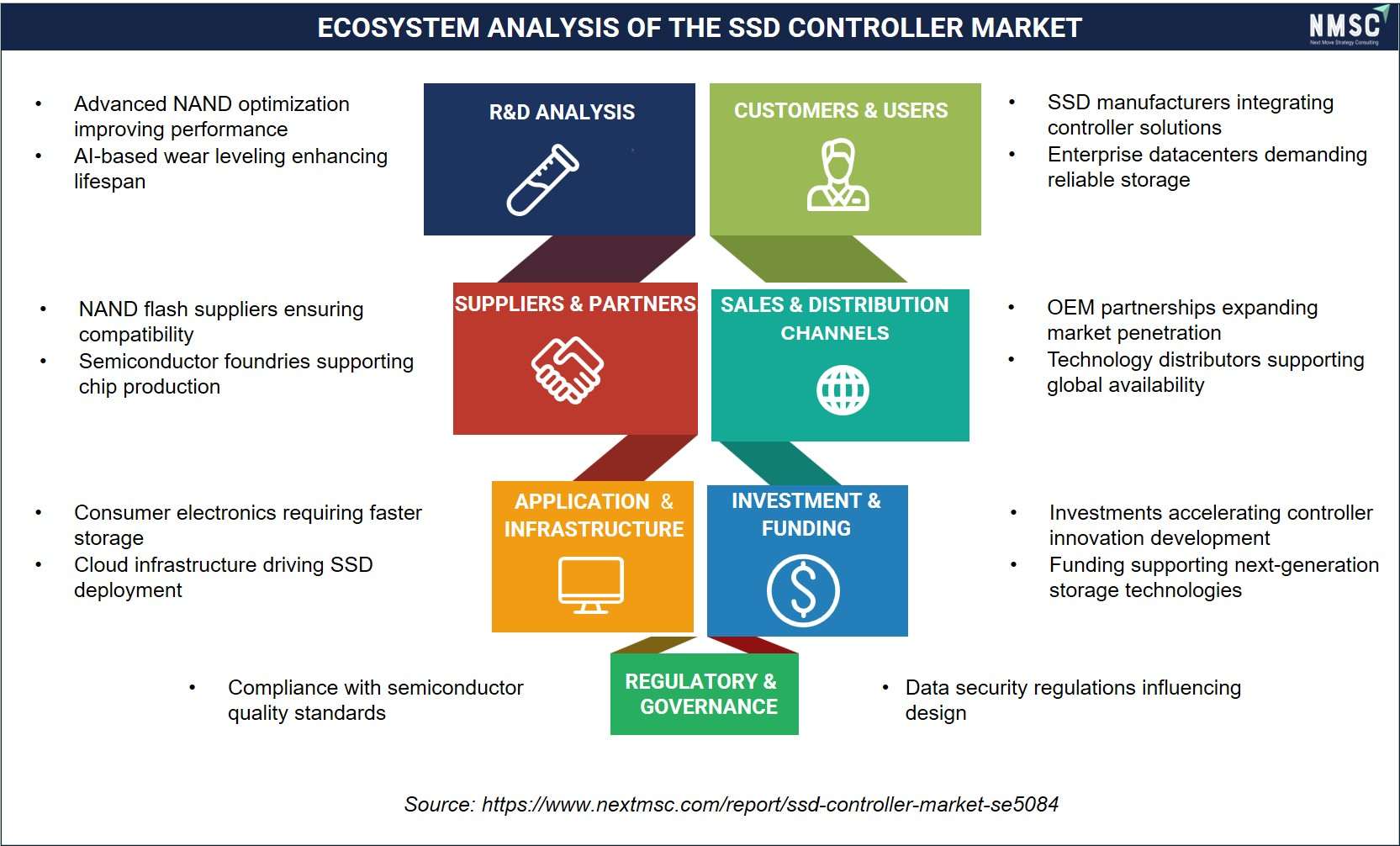
NMSC's analysis indicates that the SSD Controller market is supported by a sophisticated ecosystem involving NAND suppliers, semiconductor foundries, OEM partners, cloud infrastructure providers, and technology investors. Our assessment finds that advancements in controller architectures, AI-enabled optimization, and increasing enterprise storage requirements are accelerating innovation. Furthermore, strategic investments, expanding distribution networks, and evolving data security standards continue to drive market growth.
How Is the SSD Controller Market Segmented in This Report, and What Are the Key Insights from the Segmentation Analysis?
How Does the Business Model Segmentation Define the Competitive Structure of the SSD Controller Market?
|
Business Model Segment |
2025 (USD Bn) |
2035 (USD Bn) |
CAGR (%) |
|
Merchant Controllers |
2.4 |
6.1 |
9.8% |
|
Captive Controllers |
1.4 |
4.5 |
13.1% |
Through our market assessment, we observed that the SSD Controller Market is structured across two primary business model archetypes: Merchant Controllers and Captive Controllers. Merchant controllers, supplied by independent fabless semiconductor companies such as Phison, Silicon Motion, Marvell, and Microchip, represent the majority of the market at USD 2.4 billion in 2025, serving a broad base of SSD OEMs who rely on commercially available controller silicon to build competitive products. Captive controllers, developed internally by vertically integrated NAND manufacturers including Samsung, SK hynix, Kioxia, Micron, and Western Digital, are growing faster at a CAGR of 13.1% as these players deepen co-optimization between controller firmware and proprietary NAND cell technologies.
Which Host Interface Standards Are Driving the Fastest Growth in the SSD Controller Market?
|
Host Interface Segment |
2025 (USD Bn) |
2035 (USD Bn) |
CAGR (%) |
|
SATA |
0.5 |
0.5 |
1.2% |
|
SAS |
0.3 |
0.4 |
2.9% |
|
PCIe Gen 3 |
0.6 |
0.5 |
-1.1% |
|
PCIe Gen 4 |
1.4 |
4.2 |
12.0% |
|
PCIe Gen 5 |
0.6 |
4.2 |
32.4% |
|
PCIe Gen 6 |
0.1 |
0.5 |
21.8% |
|
Other Interfaces |
0.3 |
0.3 |
0.8% |
Based on our analysis of SSD platform qualification cycles across OEM and hyperscaler accounts, we assessed that the SSD Controller Market is segmented by host interface into SATA, SAS, PCIe Gen 3, PCIe Gen 4, PCIe Gen 5, PCIe Gen 6, and Other Interfaces. PCIe Gen 4 is the current revenue leader at USD 1.4 billion in 2025, reflecting broad deployment across client NVMe SSDs and enterprise storage platforms. SATA and PCIe Gen 3 interfaces are in structural decline as platform transitions eliminate legacy port support. PCIe Gen 5 is the fastest-growing segment at a CAGR of 32.4%, driven by AI server platform adoption, while PCIe Gen 6 remains at early qualification stage across leading research programs.
How Does Form Factor Segmentation Reflect Evolving Data Center and Client SSD Deployment Requirements?
|
Form Factor Segment |
2025 (USD Bn) |
2035 (USD Bn) |
CAGR (%) |
|
2.5-Inch |
0.7 |
1.3 |
7.4% |
|
M.2 |
1.6 |
4.0 |
10.0% |
|
U.2 |
0.5 |
1.0 |
8.3% |
|
EDSFF |
0.3 |
2.5 |
24.8% |
|
Add-In Card |
0.3 |
0.7 |
10.4% |
|
BGA |
0.3 |
0.8 |
12.3% |
|
Other |
0.1 |
0.3 |
10.0% |
Our findings suggest that the SSD Controller Market is segmented by form factor into 2.5-Inch, M.2, U.2, EDSFF, Add-In Card, BGA, and Other formats, each serving distinct deployment requirements across client, enterprise, industrial, and automotive applications. M.2 is the dominant form factor at USD 1.6 billion in 2025, driven by near-universal adoption in notebook, desktop, and compact workstation platforms. EDSFF is the fastest-growing form factor at a CAGR of 24.8%, as OCP-aligned hyperscalers standardize on E1.S and E3.S for rack-scale storage density. BGA form factor controllers serve embedded applications in automotive and industrialplatforms where compact footprint and vibration resistance are essential requirements.
How Does NAND Flash Type Segmentation Reveal Controller Complexity and Market Maturity in the SSD Controller Market?
|
NAND Flash Type Segment |
2025 (USD Bn) |
2035 (USD Bn) |
CAGR (%) |
|
SLC |
0.3 |
0.5 |
6.8% |
|
MLC |
0.4 |
0.6 |
5.3% |
|
TLC |
2.1 |
5.4 |
10.1% |
|
QLC |
0.7 |
3.4 |
17.6% |
|
PLC |
0.1 |
0.4 |
18.2% |
|
Other NAND Types |
0.2 |
0.3 |
4.8% |
Based on our evaluation of NAND technology roadmaps from major flash manufacturers and controller vendor disclosures, the SSD Controller Market is segmented by NAND flash type into SLC, MLC, TLC, QLC, PLC, and Other NAND Types. TLC is the dominant segment at USD 2.1 billion in 2025, serving as the mainstream NAND tier across consumer, client, and mainstream enterprise SSDs due to its balance of cost, performance, and endurance. QLC is the fastest-growing major NAND segment at a CAGR of 17.6%, gaining adoption in read-intensive hyperscale and warm-storage workloads, while PLC emerges as the highest-CAGR NAND segment at 18.2%, though from a smaller 2025 base as commercial qualification progresses.
How Does Controller Architecture Segmentation Reflect the Cost-Performance Tradeoffs in the SSD Controller Market?
|
Controller Architecture Segment |
2025 (USD Bn) |
2035 (USD Bn) |
CAGR (%) |
|
DRAM Based |
2.2 |
5.4 |
9.5% |
|
DRAMless |
1.4 |
4.5 |
14.3% |
|
Other |
0.2 |
0.7 |
14.0% |
Our analysis shows that the SSD Controller Market is segmented by controller architecture into DRAM Based, DRAMless, and Other configurations. DRAM Based controllers, which use dedicated DRAM chips to cache the Flash Translation Layer mapping table for fast address resolution, dominate at USD 2.2 billion in 2025 and remain the standard for enterprise-grade SSDs requiring consistent latency performance under heavy write workloads. DRAMless controllers are the fastest-growing architecture at a CAGR of 14.3%, benefiting from Host Memory Buffer technology advances that enable client-grade SSDs to deliver competitive performance without the DRAM component cost, making them highly attractive in cost-sensitive mainstream laptop and desktop platforms.
Which End Market Applications Are Generating the Strongest Demand Across the SSD Controller Market?
|
End Market Application Segment |
2025 (USD Bn) |
2035 (USD Bn) |
CAGR (%) |
|
Client SSD |
1.9 |
4.5 |
9.0% |
|
Enterprise SSD |
1.2 |
3.8 |
13.8% |
|
Industrial SSD |
0.4 |
1.1 |
11.8% |
|
Automotive SSD |
0.2 |
0.8 |
16.8% |
|
Other SSD |
0.1 |
0.4 |
15.0% |
From our assessment of SSD deployment data across verticals, the SSD Controller Market is segmented by end market application into Client SSD, Enterprise SSD, Industrial SSD, Automotive SSD, and Other SSD categories. Client SSD remains the largest application segment at USD 1.9 billion in 2025, driven by global notebook and desktop PC SSD attach rates and the near-complete transition away from HDD-equipped consumer devices. Enterprise SSD is the fastest-growing major application segment at a CAGR of 13.8%, as AI server storage, all-flash arrays, and NVMe-oF storage fabric deployments sustain strong controller demand. Automotive SSD is the highest-CAGR segment at 16.8%, reflecting the storage requirements of software-defined vehicle architectures.
How Do Sales Channel Dynamics Shape Revenue Distribution in the SSD Controller Market?
|
Sales Channel Segment |
2025 (USD Bn) |
2035 (USD Bn) |
CAGR (%) |
|
Direct OEM |
1.6 |
4.0 |
10.0% |
|
Direct ODM |
0.6 |
1.6 |
10.6% |
|
Distributor |
0.5 |
1.3 |
10.2% |
|
Internal Consumption |
0.7 |
2.3 |
13.1% |
|
Retail |
0.3 |
0.8 |
11.1% |
|
Other Sales Channels |
0.1 |
0.6 |
19.8% |
NMSC's analysis indicates that the SSD Controller Market is segmented by sales channel into Direct OEM, Direct ODM, Distributor, Internal Consumption, Retail, and Other Sales Channels. Direct OEM is the dominant channel at USD 1.6 billion in 2025, reflecting deep design-in relationships between merchant controller vendors and Tier 1 SSD OEMs. Internal Consumption is the fastest-growing channel at a CAGR of 13.1%, capturing the revenue value of captive controllers consumed by vertically integrated NAND manufacturers within their own SSD product lines. Retail and distributor channels serve the aftermarket and system integrator segments, providing merchant controller vendors with supplemental volume outside direct OEM accounts.
Regional Outlook
Geographic Performance Snapshot
|
Region |
2025 (USD Bn) |
2035 (USD Bn) |
CAGR (%) |
Key Driver |
|
North America |
1.1 |
3.1 |
11.3% |
Hyperscaler AI capex, NVMe OEM design |
|
Europe |
0.7 |
1.8 |
10.2% |
Automotive SSD, industrial IoT |
|
Asia-Pacific |
1.6 |
4.7 |
12.4% |
NAND-controller integration, China domestic IC |
|
Middle East & Africa |
0.2 |
0.5 |
9.8% |
Data center build-out, Vision 2030 |
|
Latin America |
0.2 |
0.5 |
9.4% |
Cloud adoption, consumer SSD |
North America SSD Controller Market
Asia-Pacific held the largest regional share of the SSD Controller Market at USD 1.6 billion in 2025, while North America remained a leading innovation and hyperscaler spending hub at USD 1.1 billion in 2025 and is forecast to reach USD 3.1 billion by 2035 at a CAGR of 11.3%. The region benefits from the headquarters of the world's leading hyperscalers, the design center presence of Marvell Technology, the largest U.S.-listed merchant controller vendor, and deep enterprise storage OEM ecosystems. AI server storage infrastructure investment from Amazon, Microsoft, Google, and Meta represents the dominant and fastest-accelerating demand driver for PCIe Gen 5 enterprise SSD controllers across North American data center deployments.
U.S. SSD Controller Market
Based on our engagements with SSD OEM and hyperscaler supply chain stakeholders, the United States represents over 80% of North American SSD Controller Market revenue, anchored by the highest global concentration of AI server procurement, enterprise storage array OEM design activity, and NVMe interface standardization engagement. The U.S. Bureau of Industry and Security administers export controls that shape the competitive dynamics of advanced SSD controller shipment to certain geographies. The Department of Energy's Advanced Scientific Computing Research program drives demand for enterprise NVMe SSD controllers capable of sustaining petascale I/O across distributed AI and simulation workloads.
Canada SSD Controller Market
Through our analysis, Canada represents an emerging but meaningful contributor to the North American SSD Controller Market, supported by growing hyperscaler data center investments in Ontario and Quebec, partly incentivized by Canada's Strategic Innovation Fund for digital infrastructure. Canadian federal and provincial government institutions are modernizing their IT storage infrastructure under the Government of Canada Digital Ambition Strategy, generating enterprise SSD controller demand across all-flash storage and server refresh programs. Canadian technology regulation aligned with U.S. export control frameworks ensures interoperability within the North American supply chain for advanced SSD controller products.
Mexico SSD Controller Market
From our assessment, Mexico represents the growth frontier within the North American SSD Controller Market, benefiting from the nearshoring wave that is bringing electronics manufacturing and data center infrastructure investment to the country. Mexico's manufacturing technology parks in Monterrey, Guadalajara, and Juárez are attracting SSD assembly operations that create downstream SSD controller demand. The Mexican government's national digitization programs are expanding cloud and data center deployments, increasing enterprise SSD adoption. However, the primary SSD controller demand remains concentrated in consumer and client device assembly operations serving the North American OEM supply chain.
Europe SSD Controller Market
Europe is the second-largest region in the SSD Controller Market, contributing USD 0.7 billion in 2025 and forecast to reach USD 1.8 billion by 2035 at a CAGR of 10.2%. The region's growth is anchored by two distinct demand pillars: automotive SSD adoption driven by Germany's world-leading automotive OEM base and industrial SSD demand from Germany's and Italy's manufacturing sectors. European data center expansion, supported by EU investment programs including the Important Project of Common European Interest on Microelectronics (IPCEI), is also expanding enterprise SSD controller consumption across hyperscaler co-location and enterprise cloud deployments.
UK SSD Controller Market
Based on our engagements with European technology procurement stakeholders, the United Kingdom is the largest individual European country market for SSD controller-based products, driven by London's dense financial services data center cluster and a deep enterprise storage procurement ecosystem. The UK's National Cyber Security Centre guidelines increasingly specify hardware-level encryption requirements for government and financial sector storage, creating demand for enterprise SSD controllers with certified AES-256 hardware encryption and tamper detection capabilities. Post-Brexit regulatory independence allows the UK to adopt technology procurement policies aligned with both U.S. and EU supply chains.
Germany SSD Controller Market
Through our analysis, Germany represents the most strategically important SSD Controller Market within Europe, due to its position as the world's leading automotive manufacturing nation requiring AEC-Q100 qualified storage and its dense industrial automation ecosystem generating demand for rugged SSD controllers. German automotive OEMs including Volkswagen Group, BMW Group, and Mercedes-Benz are actively deploying SSD storage across ADAS, over-the-air update, and infotainment platforms, creating sustained and growing automotive SSD controller demand. Germany's Federal Office for Information Security (BSI) cloud security guidelines also specify hardware security module requirements relevant to enterprise SSD controller certifications.
France SSD Controller Market
According to our evaluation, France demonstrates solid growth potential within the European SSD Controller Market, underpinned by strong public sector IT modernization programs funded through the France Relance and France 2030 national investment plans, which allocate significant capital to cloud infrastructure and digital sovereignty objectives. French defense and intelligence agencies represent a specialized demand segment for industrial-grade and secure SSD controllers meeting national security specifications. The French regulator CNIL's active enforcement of hardware-level data security obligations is compelling enterprise storage buyers to specify controllers with certified encryption and secure erase capabilities.
Italy SSD Controller Market
From our assessment, Italy is an emerging European growth market for the SSD Controller Market, driven by public administration cloud migration under the Piano Nazionale di Ripresa e Resilienza and industrial automation adoption in the country's precision manufacturing and luxury automotive sectors. Italian enterprise buyers are transitioning legacy storage infrastructure to NVMe-based all-flash platforms, creating direct demand for DRAM-based SSD controllers in tier-one storage array deployments. The Polo Strategico Nazionale sovereign cloud program is generating government SSD procurement requirements that specify security-certified controller hardware with Italian data residency assurance.
Spain SSD Controller Market
Based on our engagements, Spain is experiencing accelerating enterprise and cloud data center expansion within the SSD Controller Market context, supported by hyperscaler investments from Amazon AWS, Microsoft Azure, and Google Cloud establishing local regions in Madrid and Barcelona. The Agenda España Digital 2026 strategy directs national investment toward cloud infrastructure and SME digitalization, expanding enterprise SSD adoption. Spain's financial services and telecommunications sectors are significant enterprise SSD buyers, driving demand for PCIe Gen 4 and Gen 5 controllers that deliver the transaction throughput required for real-time payment processing and network function virtualization.
Sweden SSD Controller Market
Through NMSC's assessment, we found that Sweden is a strategically significant SSD Controller Market within Northern Europe, distinguished by its role as a data center hub of choice for hyperscalers attracted by low electricity costs, political stability, and renewable energy availability. Sweden's Integritetsskyddsmyndigheten (IMY) is among Europe's most technically rigorous GDPR enforcement authorities, compelling enterprise storage deployments to specify SSD controllers with hardware-level data protection capabilities. Swedish manufacturing and defense sectors represent additional specialized demand segments for ruggedized industrial SSD controllers.
Denmark SSD Controller Market
From our analysis, Denmark demonstrates consistent growth in the SSD Controller Market, benefiting from its emerging status as a Northern European data center destination and strong enterprise digital transformation investment. Denmark's government digitalization strategy, administered by the Agency for Digital Government, is accelerating public sector cloud storage adoption with downstream SSD controller demand implications. Danish financial institutions and life sciences companies represent sophisticated enterprise buyers specifying high-reliability enterprise SSD controllers with extended endurance ratings for compliance archival and genomics data storage workloads.
Finland SSD Controller Market
According to our evaluation, Finland occupies a distinct position in the European SSD Controller Market as a data center hub leveraging natural cooling advantages, 100% renewable energy infrastructure, and Nokia's legacy in advanced networking that supports SSD-enabled edge storage deployments. Finland's advanced digital public infrastructure, including the Kanta healthcare data system and MyData personal data services, generates compliance-driven demand for storage solutions with hardware-certified encryption capabilities. Finnish technology companies and hyperscaler data centers are adopting NVMe SSD platforms, creating growing controller procurement across server storage and storage array applications.
Netherlands SSD Controller Market
Based on our market evaluation, the Netherlands holds a structurally important position in the European SSD Controller Market as the location of the Amsterdam Internet Exchange, one of the world's largest internet exchange points, and as a major European hyperscaler data center hub hosting facilities for Microsoft, Google, Amazon, and Equinix. The Autoriteit Persoonsgegevens enforces GDPR with active oversight of enterprise data security practices, driving enterprise storage security certifications. ASML's semiconductor lithography operations, while not an SSD controller manufacturer, contribute to Dutch technology ecosystem sophistication that supports advanced SSD controller adoption.
Rest of Europe SSD Controller Market
Our analysis shows that the Rest of Europe segment within the SSD Controller Market encompasses Eastern European technology manufacturing hubs, including Poland and the Czech Republic, which host significant electronics assembly and data center investment activity. Poland's dynamic IT services sector and growing data center market are driving enterprise NVMe SSD adoption. The Czech Republic hosts Tier 3 data center operations for Central European enterprises. Romania and Hungary are attracting automotive electronics manufacturing, creating incremental demand for AEC-Q100 automotive SSD controllers across regional Tier 1 automotive supplier operations.
Asia-Pacific SSD Controller Market
Asia-Pacific is the fastest-growing major region in the SSD Controller Market at a CAGR of 12.4% from 2026 to 2035, generating USD 1.6 billion in 2025 and forecast to reach USD 4.7 billion by 2035. The region encompasses the world's dominant SSD controller design and manufacturing ecosystem: Phison, Silicon Motion, and InnoGrit are headquartered in Taiwan; Samsung and SK hynix integrate captive controllers from Korea; Kioxia designs controllers in Japan; and China's domestic controller industry is expanding rapidly. APAC's data center infrastructure investment, driven by hyperscaler cloud expansion across China, India, Japan, South Korea, and Southeast Asia, provides a broad and diversified demand base.
China SSD Controller Market
Based on our engagements in the China SSD Controller Market, China represents the most complex and rapidly evolving national market globally, characterized by the dual pressures of accelerating domestic demand for advanced storage and strategic imperative to reduce dependence on foreign SSD controller silicon. Maxio Technology, YEESTOR Microelectronics, InnoGrit, and Starblaze Technology are qualifying PCIe Gen 4 merchant controllers for Chinese SSD OEMs. China's Ministry of Industry and Information Technology supports domestic semiconductor development through its National Integrated Circuit Industry Investment Fund. U.S. export control regulations create competitive asymmetry that domestic controller vendors seek to exploit.
India SSD Controller Market
Through our analysis, India is emerging as a significant growth contributor to the Asia-Pacific SSD Controller Market, driven by hyperscaler data center expansion from Amazon, Microsoft, Google, and domestic players, the proliferation of digital payments infrastructure, and the government's Digital India programme under the Ministry of Electronics and Information Technology (MeitY). India's semiconductor design community, concentrated in Bangalore, Hyderabad, and Pune, is increasingly engaged in SSD controller IP development for international merchant controller vendors. The India Semiconductor Mission represents a structural program to grow domestic chip design and manufacturing capabilities relevant to the storage controller sector.
Japan SSD Controller Market
From our assessment, Japan occupies a unique position in the SSD Controller Market as the headquarters of Kioxia Corporation, a leading global NAND flash manufacturer that deploys captive SSD controllers across its SSD product portfolio. Japan's industrial automation, robotics, and advanced manufacturing sectors represent high-value demand segments for industrial-grade SSD controllers with extended temperature and vibration tolerance. The Personal Information Protection Commission (PPC) enforces Japan's Act on Protection of Personal Information, driving enterprise storage security requirements. Japan's government IT modernization program is also transitioning legacy storage infrastructure to NVMe SSD platforms.
South Korea SSD Controller Market
Based on our market evaluation, South Korea is among the most strategically significant nations in the SSD Controller Market, as the home country of Samsung Electronics and SK hynix, which collectively represent the world's two largest NAND flash producers and deploy captive SSD controllers across their integrated SSD product lines. Samsung's captive Elpis and Amano controller families and SK hynix's Sequoia controller platform are designed for co-optimization with V-NAND and 4D NAND cell technologies respectively. The Korea Communications Commission and Ministry of Science and ICT's cloud infrastructure investment programs expand domestic enterprise SSD procurement.
Taiwan SSD Controller Market
According to our evaluation, Taiwan is the global center of gravity for the merchant SSD Controller Market, as the headquarters of Phison Electronics Corp., Silicon Motion Technology Corp., and InnoGrit Corporation, which collectively supply merchant SSD controllers to the majority of the world's SSD OEMs. Taiwan's Industrial Technology Research Institute and SSD controller design ecosystem reflect decades of accumulated IP in NAND interface design, ECC algorithms, and wear-leveling firmware. Taiwan Semiconductor Manufacturing Company's advanced process nodes, specifically N5 and N3, provide Taiwanese controller vendors with access to cutting-edge silicon that enables competitive PCIe Gen 5 and next-generation controller implementations.
Indonesia SSD Controller Market
Through our analysis, Indonesia is an emerging SSD Controller Market within Southeast Asia, driven by rapid cloud infrastructure build-out from domestic and global hyperscalers, fintech platform expansion, and e-commerce digitalization across the archipelago. Indonesia's Personal Data Protection Law, administered by the Ministry of Communication and Information Technology (Kominfo), is establishing data security requirements that influence enterprise storage procurement. The government's Making Indonesia 4.0 industrial strategy is supporting manufacturing digitalization that creates incremental demand for industrial SSD controller-based storage platforms in factory automation environments.
Vietnam SSD Controller Market
From our assessment, Vietnam is an increasingly relevant SSD Controller Market beneficiary as the country establishes itself as a major electronics manufacturing export hub, with Samsung Electronics operating its largest global smartphone and electronics manufacturing facilities in the country. This manufacturing concentration creates downstream demand for industrial and embedded SSD controllers in device assembly line automation, quality control systems, and production data logging applications. Vietnam's Ministry of Information and Communications is expanding national cloud infrastructure, generating enterprise SSD demand across government and financial sector data center deployments.
Australia SSD Controller Market
Based on our engagements, Australia demonstrates consistent enterprise SSD adoption across the SSD Controller Market, supported by the country's mature financial services sector, government digital transformation under the Digital Economy Strategy, and growing hyperscaler data center investment in Sydney and Melbourne. The Australian Competition and Consumer Commission's Consumer Data Right initiative and the Office of the Australian Information Commissioner's Privacy Act enforcement drive hardware-level data security specification in enterprise storage procurement. Australia's natural resources sector, particularly mining and energy, represents an industrial SSD controller demand segment for ruggedized storage in remote site operations.
Philippines SSD Controller Market
Through our analysis, the Philippines is a developing SSD Controller Market characterized by rapid growth in business process outsourcing data center infrastructure, government e-services digitalization, and consumer electronics adoption. The National Privacy Commission administers the Data Privacy Act, creating compliance-driven enterprise storage security requirements. Philippine hyperscaler co-location investments and offshore financial services operations are accelerating NVMe SSD adoption across enterprise storage platforms, generating incremental merchant controller procurement. The country's young digital population also drives strong consumer device SSD demand.
Malaysia SSD Controller Market
According to our evaluation, Malaysia occupies a strategically significant position in the Asia-Pacific SSD Controller Market as an established electronics manufacturing hub and emerging data center destination. Western Digital operates a major HDD and SSD manufacturing facility in Penang, contributing to regional SSD production capacity. Malaysia's Multimedia Super Corridor and Digital Economy Blueprint are attracting hyperscaler data center investments, with Amazon, Google, and Microsoft all establishing or expanding Malaysian cloud regions. The Personal Data Protection Act (PDPA) governs enterprise storage security requirements in alignment with APAC regional compliance frameworks.
Rest of APAC SSD Controller Market
Our analysis shows that the Rest of APAC segment within the SSD Controller Market includes Singapore, Thailand, Pakistan, and other emerging digital economies. Singapore functions as a regional financial services and hyperscaler hub with the Monetary Authority of Singapore's technology risk management guidelines specifying storage security standards for financial institutions. Thailand's digital economy initiatives under the Ministry of Digital Economy and Society are expanding cloud and enterprise SSD adoption. Across the broader Rest of APAC segment, consumer SSD demand in mobile and compact PC categories drives baseline merchant controller volume.
Middle East & Africa (MEA) SSD Controller Market
The Middle East and Africa region contributes USD 0.2 billion to the SSD Controller Market in 2025, forecast to reach USD 0.5 billion by 2035 at a CAGR of 9.8%. The region's growth is concentrated in the Gulf Cooperation Council countries, particularly Saudi Arabia and the UAE, where Vision 2030 and equivalent national digital transformation programs are driving substantial data center investment. Enterprise SSD controller demand is growing as regional cloud providers and hyperscaler co-location operators upgrade storage infrastructure from HDD to all-flash NVMe platforms to support AI, government digitization, and financial services workloads.
Saudi Arabia SSD Controller Market
Based on our engagements, Saudi Arabia is the largest and most strategically active SSD Controller Market in the Middle East, driven by the Saudi Data and AI Authority's (SDAIA) national data governance frameworks and the Vision 2030 digital transformation program that is funding major data center infrastructure investments. Hyperscalers including Google Cloud and AWS have established Saudi data center regions, creating enterprise SSD controller demand for local cloud infrastructure. Saudi Aramco and SABIC's industrial digitalization programs are also generating demand for industrial SSD controllers in operational technology environments across energy and petrochemical sector deployments.
UAE SSD Controller Market
Through our analysis, the United Arab Emirates represents the most commercially mature SSD Controller Market in the MEA region, supported by Dubai and Abu Dhabi's status as regional technology and financial services hubs. The UAE's National AI Strategy 2031 and Dubai Digital Authority initiatives are driving hyperscaler data center expansion with direct implications for enterprise SSD controller procurement. The UAE Cybersecurity Council's National Cybersecurity Strategy specifies hardware-level storage security requirements relevant to SSD controller certifications. Microsoft, AWS, and Oracle have established UAE sovereign cloud regions that require locally compliant hardware infrastructure.
Egypt SSD Controller Market
From our assessment, Egypt is an emerging contributor to the MEA SSD Controller Market, benefiting from government digitalization investments under Egypt's Digital Egypt national strategy and growing enterprise IT infrastructure spending across Cairo's expanding financial and telecommunications sectors.
Egypt's strategic location as a submarine cable hub connecting Europe, Asia, and Africa supports data center investment. The National Telecommunications Regulatory Authority's cloud computing regulations are establishing a framework for enterprise storage compliance, creating incremental demand for SSD controllers with hardware encryption in regulated industry deployments.
Israel SSD Controller Market
According to our evaluation, Israel demonstrates a distinctive profile within the SSD Controller Market as a high-technology innovation hub with a disproportionate concentration of storage and semiconductor IP development activity relative to its size. StoreDot and other Israeli storage technology startups represent an innovation ecosystem adjacent to the SSD controller market. Global SSD controller vendors including Marvell maintain significant R&D centers in Israel, leveraging local engineering talent for advanced controller architecture development. Israel's cybersecurity sector drives specialized demand for hardware-secured SSD controllers with certified encryption across defense and intelligence applications.
Turkey SSD Controller Market
Based on our engagements, Turkey is an emerging SSD Controller Market within the MEA region, characterized by a dynamic consumer electronics market, growing cloud data center investment, and manufacturing sector digitalization. Turkey's e-commerce expansion and mobile-first consumer technology adoption drive solid demand for client SSD controllers in domestic device assembly. The Personal Data Protection Law (KVKK) administered by the Personal Data Protection Authority establishes enterprise storage security requirements. Turkish government cloud and digital transformation programs are expanding public sector SSD procurement in enterprise storage array deployments.
Nigeria SSD Controller Market
Through our analysis, Nigeria is the largest Sub-Saharan African contributor to the SSD Controller Market, driven by a young digital population, Africa's largest fintech ecosystem centered in Lagos, and growing enterprise cloud adoption. The Nigeria Data Protection Commission's enforcement of the Nigeria Data Protection Act is establishing compliance-driven storage security requirements. Nigerian hyperscaler co-location investments and financial services digitalization programs generate incremental enterprise SSD controller demand, while a large consumer electronics retail market drives client SSD adoption in laptop and gaming device categories.
South Africa SSD Controller Market
From our assessment, South Africa represents the most commercially mature Sub-Saharan SSD Controller Market, supported by Johannesburg's position as the continent's leading financial services and enterprise technology hub. The Information Regulator South Africa enforces the Protection of Personal Information Act (POPIA), which establishes hardware-level data security obligations for enterprise storage. Hyperscaler investments from Amazon AWS, Microsoft Azure, and Google Cloud establishing South African regions are driving enterprise SSD adoption with direct controller procurement implications. South Africa's mining and energy sectors represent industrial SSD controller demand segments for ruggedized embedded storage applications.
Rest of MEA SSD Controller Market
Our analysis shows that the Rest of MEA segment within the SSD Controller Market encompasses Kuwait, Qatar, Bahrain, Oman, Morocco, Kenya, and Ethiopia, where emerging data center investments and government digital transformation programs are generating nascent but growing SSD controller demand. The Gulf states' sovereign wealth fund-backed technology infrastructure investments, including Saudi Arabia's NEOM and Qatar's Smart Nation initiatives, are creating structured enterprise storage procurement requirements. East African nations, particularly Kenya and Ethiopia, represent early-stage growth opportunities as mobile money infrastructure and fintech platforms expand digital data storage requirements.
Latin America SSD Controller Market
Latin America contributes USD 0.2 billion to the SSD Controller Market in 2025, forecast to reach USD 0.5 billion by 2035 at a CAGR of 9.4%. Brazil and Mexico together represent approximately 75% of regional revenue. Latin America's SSD controller demand is primarily driven by consumer device SSD adoption in the large notebook and desktop PC markets, growing enterprise data center investment from hyperscalers establishing local regions, and financial services sector storage upgrades. Regulatory frameworks including Brazil's LGPD and Colombia's data protection legislation are increasing enterprise storage security requirements across the region.
Brazil SSD Controller Market
Based on our engagements, Brazil is the largest SSD Controller Market in Latin America, supported by South America's largest economy, a vibrant fintech ecosystem, and growing hyperscaler data center investment from Amazon, Google, and Oracle establishing São Paulo regions. Brazil's Lei Geral de Proteção de Dados (LGPD), enforced by the Autoridade Nacional de Proteção de Dados, is compelling enterprise storage buyers to specify SSD controllers with hardware-certified encryption. Brazil's large consumer electronics market and competitive smartphone assembly operations in the Zona Franca de Manaus create client SSD controller demand from domestic device manufacturing.
Argentina SSD Controller Market
Through our analysis, Argentina is a developing SSD Controller Market within Latin America, characterized by a sophisticated technology services sector in Buenos Aires and growing data center investment from regional cloud providers. Despite macroeconomic volatility that constrains enterprise capital expenditure cycles, Argentina's technology services export sector and financial services institutions are adopting NVMe SSD platforms for performance-sensitive workloads. Argentina's Agencia de Acceso a la Información Pública enforces the Personal Data Protection Law, establishing compliance requirements for enterprise storage security relevant to SSD controller hardware specification.
Chile SSD Controller Market
From our assessment, Chile demonstrates the strongest governance and digital infrastructure maturity within the Latin American SSD Controller Market, supported by a stable regulatory environment, hyperscaler investments from Google and AWS establishing Santiago regions, and a modern financial services sector requiring high-performance SSD storage. Chile's copper mining sector is digitizing operations through Industrial IoT and real-time analytics platforms, generating incremental industrial SSD controller demand. The Consejo para la Transparencia oversees data privacy compliance that influences enterprise storage hardware certification requirements across regulated sectors.
Colombia SSD Controller Market
According to our evaluation, Colombia is an emerging growth contributor to the Latin American SSD Controller Market, driven by Bogotá's expansion as a regional financial services and technology hub and growing hyperscaler data center investment. Colombia's Ley 1581 data protection framework establishes compliance requirements for enterprise storage systems. The Colombian government's Digital Transformation strategy is expanding public sector cloud adoption, creating enterprise SSD procurement within government data center modernization programs. Colombia's fintech sector growth and e-commerce expansion are also driving enterprise NVMe SSD adoption across transaction processing and analytics storage deployments.
Rest of LATAM SSD Controller Market
Our analysis shows that the Rest of LATAM segment in the SSD Controller Market encompasses Peru, Ecuador, Venezuela, Central America, and the Caribbean, where consumer SSD adoption in notebooks and mobile devices represents the primary demand driver given early-stage enterprise cloud infrastructure. Peru's growing mining technology sector and Ecuador's fintech adoption are generating incremental industrial and enterprise SSD controller demand. Regional cloud provider expansion from AWS, Microsoft, and Google into additional Latin American geographies is progressively extending enterprise reach across currently underserved national markets.
Pain Point Analysis of the SSD Controller Market
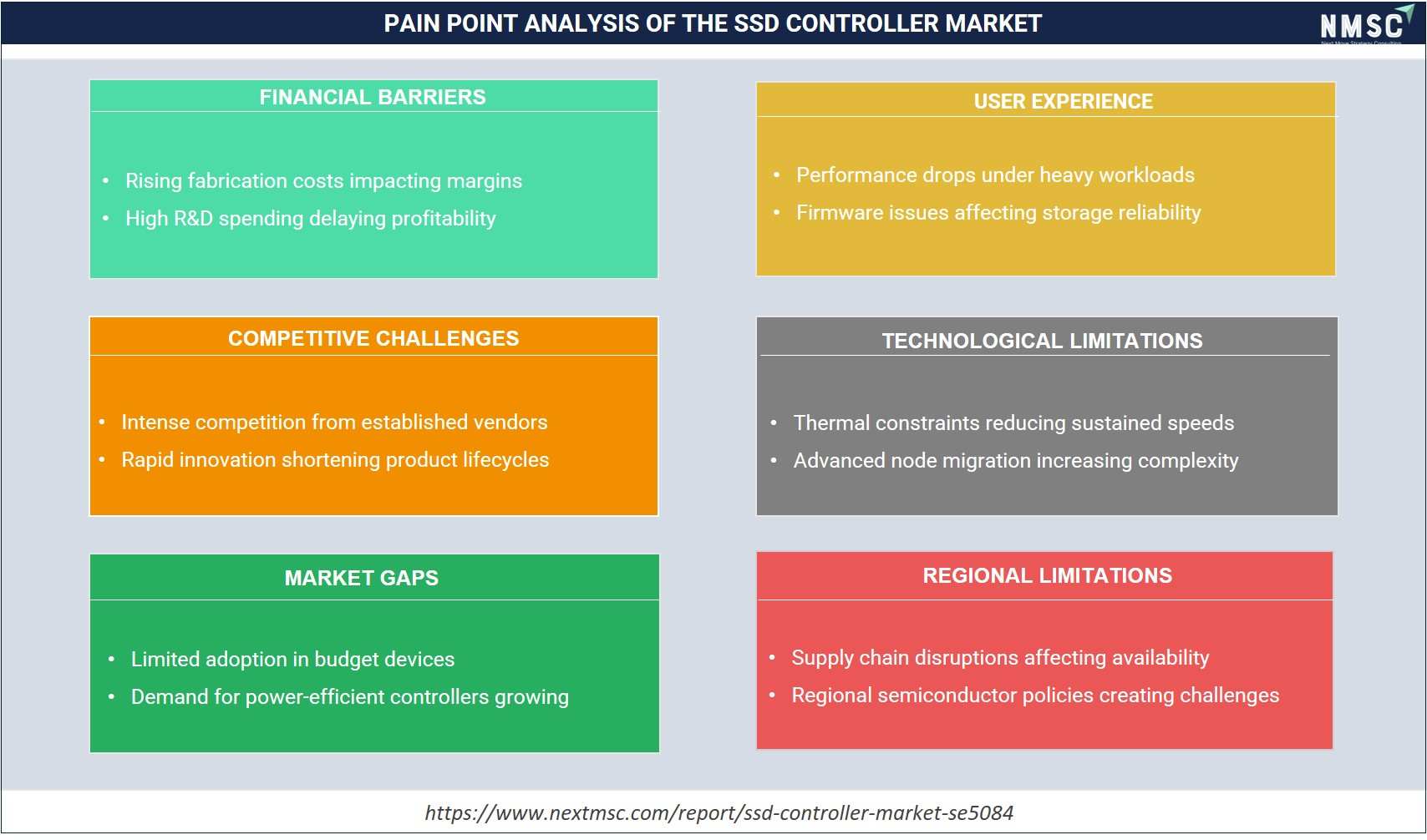
Based on NMSC's evaluation, we found that the SSD Controller market faces challenges related to rising development costs, performance optimization, and increasing technological complexity. Our assessment identifies that thermal constraints, firmware reliability concerns, and rapid innovation cycles are placing pressure on manufacturers. Moreover, supply chain disruptions, regional semiconductor policy uncertainties, and growing demand for power-efficient storage solutions continue to influence competitive market dynamics.
Competitive Landscape
Competitive Dynamics & M&A Landscape
|
Key Takeaways |
Details |
|
Market Structure |
Duopolistic at the captive controller tier (Samsung, SK hynix dominate integrated NAND-controller platforms) with an oligopoly of merchant controller vendors (Phison, Silicon Motion, Marvell, Microchip) serving independent SSD OEMs globally. |
|
Innovation Focus |
PCIe Gen 5 and Gen 6 controller architectures, computational storage drive firmware, AI-optimized NVMe command queuing, DRAMless HMB performance optimization, and automotive AEC-Q100 compliant controller platforms. |
|
M&A Activity |
Marvell's acquisition of Cavium (networking) and Inphi (high-speed interconnects) reflects a strategy of building adjacent silicon platforms. Microchip Technology's Microsemi acquisition reinforced its industrial and aerospace SSD controller capabilities. Consolidation among Chinese domestic controller vendors is ongoing under national IC investment fund directives. |
How Do Companies Compete in the SSD Controller Market?
The SSD Controller Market is characterized by multi-dimensional competition across interface generation leadership, NAND compatibility breadth, firmware sophistication, and customer-specific customization capabilities. NMSC's analysis indicates that PCIe Gen 5 design win execution is the current primary battleground, as OEM and hyperscaler platform qualification cycles select controller silicon for multi-year production programs that define revenue trajectories through 2028. Merchant controller vendors differentiate through reference design support, evaluation kit availability, and firmware customization depth, while captive controller vendors compete on NAND co-optimization, vertical integration economics, and proprietary endurance enhancement algorithms. Pricing strategies reflect dual pressures: technology premium pricing for leading-edge Gen 5 controllers and aggressive margin compression in mature Gen 3 and SATA segments.
Which Kind of Companies Dominate the SSD Controller Market?
The SSD Controller Market is dominated by two distinct company archetypes. Vertically integrated NAND manufacturers, led by Samsung Electronics, SK hynix, Kioxia, Micron Technology, and Western Digital, deploy captive controllers co-designed with their proprietary NAND technologies, achieving system-level optimization advantages that independent vendors cannot replicate. Fabless merchant controller specialists, including Phison Electronics, Silicon Motion Technology, Marvell Technology, and Microchip Technology, serve the broad SSD OEM market with commercially available controller silicon optimized for NAND interoperability, cost efficiency, and broad platform compatibility. A third emerging category consists of domestic Chinese controller developers, specifically Maxio Technology, InnoGrit, YEESTOR Microelectronics, and Starblaze Technology, which are rapidly ascending the technology capability curve under national semiconductor self-sufficiency directives.
AI-Native Differentiation and Open Standards Drive Market Success in the SSD Controller Market
Leading SSD Controller Market vendors are increasingly differentiating through AI workload-optimized firmware capabilities, specifically NVMe command prioritization algorithms for AI training data streaming, zoned namespace (ZNS) support for log-structured AI inference storage, and key-value storage command set extensions for vector database applications. Our findings suggest that alignment with open standards bodies, including NVM Express Inc. for NVMe specifications and the Open Compute Project for EDSFF form factor standardization, is a prerequisite for hyperscaler design win qualification, making standards participation a competitive imperative rather than an optional industry engagement for all tier-one SSD controller vendors.
Market Players to Opt for Merger and Acquisition Strategies to Expand Their Presence in the SSD Controller Market
Strategic M&A activity in the SSD Controller Market is driven by the need to acquire complementary firmware IP, expand NAND compatibility matrices, and achieve geographic market access, particularly in the Asia-Pacific region. Based on our market evaluation, we noticed that Marvell's investment in AI-optimized interconnect IP through the Inphi acquisition has been leveraged in developing high-performance PCIe Gen 5 controller architectures. Future consolidation is most likely to involve Chinese domestic controller vendors acquiring foreign IP licenses, merchant controller vendors acquiring industrial or automotive SSD controller specialists, and NAND manufacturers deepening firmware engineering teams through targeted talent and IP acquisitions to strengthen captive controller competitive positioning.
Who Are the Key Market Players in the SSD Controller Market?
-
Samsung Electronics Co., Ltd.
-
SK hynix Inc.
-
KIOXIA Corporation
-
Western Digital Corporation
-
Micron Technology, Inc.
-
Phison Electronics Corp.
-
Silicon Motion Technology Corporation
-
Marvell Technology, Inc.
-
Microchip Technology Incorporated
-
FADU Inc.
-
Maxio Technology (Hangzhou) Co., Ltd.
-
InnoGrit Corporation
-
YEESTOR Microelectronics Co., Ltd.
-
Seagate Technology Holdings plc
-
Realtek Semiconductor Corp.
-
Greenliant Systems, Ltd.
-
TenaFe, Inc.
-
ASolid Technology Co., Ltd.
-
Starblaze Technology Co., Ltd.
-
Hyperstone GmbH
What Are the Latest Developments in the SSD Controller Market Industry?
|
Date |
Event |
|
May 2026 |
Silicon Motion Technology Corp. launched the SM2524XT, a next-generation PCIe Gen5 DRAMless SSD controller purpose-built for AI inference and KV Cache-intensive workloads. Built on TSMC's advanced 6nm process, the four-core architecture supports NAND interface speeds up to 4800 MT/s, achieving sequential read speeds up to 14 GB/s and industry-leading random performance of up to 2.5 million IOPS. |
|
May 2026 |
KIOXIA Corporation introduced its high-performance XG10 Series solid-state drives engineered for PC OEMs and on-premise AI training. Utilizing a new PCIe 5.0 controller architecture, the drives double the sequential read performance of the previous XG8 generation, reaching up to 14,000 MB/s and delivering random read speeds up to 2,000 KIOPS. |
|
November 2025 |
Phison Electronics Corp. announced that its proprietary E28 controller architecture marketed as the industry's first 6nm AI-computing SSD won the 2026 Taiwan Excellence Gold Award. The controller tightly integrates the SSD with the host GPU to cost-effectively extend memory capacity, overcoming memory bottlenecks during on-premise generative AI model training. |
Expert Insights

“You will not see any PCIe Gen6 [solutions] until 2030. PC OEMs have very little interest in PCIe 6.0 right now — they do not even want to talk about it. AMD and Intel do not want to talk about it.”
— Wallace C. Kuo, CEO, Silicon Motion
Statement made during an interview with Tom's Hardware discussing the commercialization timeline of PCIe 6.0 SSDs, controller development complexity, ecosystem readiness, and future storage technology adoption trends.
Market Interpretation
NMSC's analysis indicates that the SSD controller market is prioritizing performance optimization and cost efficiency within the PCIe 5.0 ecosystem rather than accelerating migration to PCIe 6.0. The statement highlights limited near-term demand from PC OEMs and platform providers, suggesting that PCIe 5.0 controllers will remain the dominant architecture for consumer SSDs over the next several years. As controller complexity, power consumption, validation requirements, and development costs increase with each PCIe generation, SSD controller vendors are focusing on enhancing throughput, NAND management capabilities, and power efficiency within existing platforms. This trend is expected to sustain investment in PCIe 5.0 controller innovation while delaying large-scale commercialization of PCIe 6.0 SSD solutions until ecosystem readiness improves.
What Are the Investment Opportunities in the SSD Controller Market?
Capital Inflows and Venture Activity
The SSD Controller Market continues to attract targeted venture and strategic capital, particularly in Chinese domestic controller development and computational storage startups. FADU Inc., which develops NVMe enterprise SSD controllers with computational storage capabilities, has attracted strategic investment from both U.S. and Asian technology investors. The National Venture Capital Association noted that AI infrastructure semiconductors received disproportionate venture attention in 2024, with SSD controller IP representing a valued component of storage acceleration investment theses. Strategic investments by NAND manufacturers into controller software startups reflect the sector's recognition that firmware differentiation is an increasingly critical competitive dimension.
Infrastructure Investment
Hyperscaler infrastructure capital expenditure is the most direct investment driver for the SSD Controller Market, as each AI server platform refresh and data center expansion program generates new PCIe Gen 5 and EDSFF enterprise SSD controller procurement requirements. Microsoft's disclosed plans to invest USD 80 billion in AI-optimized data centers in fiscal year 2025 and Google's commitment of USD 75 billion in capital expenditure for cloud and AI infrastructure in 2025 create structural multi-year demand visibility for enterprise SSD controller vendors capable of qualifying at hyperscaler-grade reliability and performance specifications. These infrastructure programs represent the clearest demand signal for high-performance SSD controller investment cycles.
ESG Considerations
Environmental considerations are shaping SSD controller design priorities and investment thesis frameworks within the SSD Controller Market. NVMe SSD controllers enable significantly lower data center power consumption per unit of storage throughput compared to HDD-based storage, supporting hyperscaler and enterprise decarbonization commitments. DRAMless controller architectures that reduce the DRAM component's power draw represent an additional ESG dimension in mobile and edge device applications. The U.S. Department of Energy's Better Buildings Alliance data center energy efficiency programs provide policy context supporting investment in energy-efficient storage controller technologies that reduce the environmental footprint of digital storage infrastructure.
Digital Transformation Enablement
SSD controllers are a foundational enabler of enterprise digital transformation programs, as every cloud migration, AI infrastructure build-out, and data center modernization initiative requires NVMe SSD storage as a baseline platform component. From our research, we found that the NIST Digital Transformation Framework explicitly identifies high-performance storage as infrastructure-critical for AI and analytics capability development, providing policy and best-practice endorsement of enterprise NVMe SSD adoption. SSD controller vendors that align product roadmaps with hyperscaler infrastructure cycles, enterprise server platform refreshes, and automotive software-defined vehicle timelines are best positioned to capture the multi-year digital transformation investment waves flowing through each of these end markets.
Private Equity and Strategic M&A Activity
Strategic M&A interest in the SSD Controller Market is driven by the technology scarcity of advanced NVMe Gen 5 and Gen 6 controller IP, automotive-grade SSD controller qualification capabilities, and computational storage drive architectures. Our assessment indicates that mid-market SSD controller vendors with proven hyperscaler design win track records represent attractive acquisition targets for larger semiconductor consolidators seeking to expand their storage silicon portfolio. Chinese domestic controller vendors with growing PCIe Gen 4 production volumes may attract investment from Chinese national semiconductor investment funds seeking to accelerate the country's SSD controller technology independence agenda through targeted IP acquisitions and talent-driven technology programs.
Key Benefits for Stakeholders
For SSD OEM Buyers and Design Engineers
SSD OEM buyers and design engineers gain access to a comprehensive and vendor-neutral assessment of the SSD Controller Market, including quantitative sizing across all business model, interface, form factor, NAND type, architecture, application, and channel segments. Our competitive landscape analysis provides design engineering teams with intelligence on merchant controller vendor roadmap priorities, Gen 5 design win dynamics, and firmware differentiation strategies, enabling informed controller selection for next-generation SSD platform development programs. The regional analysis provides geographic demand prioritization context for supply chain and customer development investment decisions.
For Investors and Financial Analysts
Investors and financial analysts access a structured, data-rich assessment of the SSD Controller Market's growth trajectory, competitive dynamics, and segment-level revenue forecasts through 2035. The CAGR analysis by segment, region, and application enables precise portfolio construction and valuation modeling for listed SSD controller vendors including Phison, Silicon Motion, Marvell, and Microchip Technology. The latest developments tracking section provides an early-signal framework for identifying design win momentum, technology transitions, and emerging competitive threats within the global SSD controller landscape.
For SSD Controller Vendors and Semiconductor Companies
SSD controller vendors gain actionable intelligence on white-space opportunities across emerging application segments, including automotive SSD, EDSFF hyperscale, and computational storage drive categories. Our segmentation analysis reveals the fastest-growing interface generations, form factors, and NAND technology transitions that should anchor controller vendor roadmap prioritization decisions. The regional outlook sections identify geographic expansion priorities with regulatory context, enabling vendors to calibrate their sales organization investment and standards engagement activities across North America, APAC, Europe, MEA, and Latin America markets.
For Government and Regulatory Bodies
Government agencies and technology policy bodies gain a structured analysis of how national semiconductor self-sufficiency programs, export control regulations, and data security standards are influencing the competitive structure of the SSD Controller Market. Country-level insights provide policymakers with evidence-based perspectives on how technology regulation, procurement standards, and industrial policy choices affect domestic SSD controller industry development and data storage security outcomes. The analysis of China's domestic controller industry development and U.S. export control implications provides directly relevant context for semiconductor policy design.
Key Market Segments
By Business Model
-
Merchant Controllers
-
Captive Controllers
By Host Interface
-
SATA
-
SAS
-
PCIe Gen 3
-
PCIe Gen 4
-
PCIe Gen 5
-
PCIe Gen 6
-
Other Interfaces
By Form Factor
-
2.5-Inch
-
M.2
-
U.2
-
EDSFF
-
Add-In Card
-
BGA
-
Other
By NAND Flash Type
-
SLC
-
MLC
-
TLC
-
QLC
-
PLC
-
Other NAND Types
By Controller Architecture
-
DRAM Based
-
DRAMless
-
Other
By End Market Application
-
Client SSD
-
Enterprise SSD
-
Industrial SSD
-
Automotive SSD
-
Other SSD
By Sales Channel
-
Direct OEM
-
Direct ODM
-
Distributor
-
Internal Consumption
-
Retail
-
Other Sales Channels
By Region
-
North America: U.S., Canada, and Mexico.
-
Europe: UK, Germany, France, Italy, Spain, Sweden, Denmark, Finland, the Netherlands, and the rest of Europe.
-
Asia Pacific: China, India, Japan, South Korea, Taiwan, Indonesia, Vietnam, Australia, Philippines, Malaysia and the rest of APAC.
-
Middle East & Africa (MEA): Saudi Arabia, UAE, Egypt, Israel, Turkey, Nigeria, South Africa, and the rest of MEA.
-
Latin America: Brazil, Argentina, Chile, Colombia, and the rest of LATAM.
Conclusion and Recommendations
Long-Term Outlook
The SSD Controller Market is entering a decade of structurally robust growth, driven by the convergence of AI infrastructure investment, automotive software-defined vehicle proliferation, enterprise NVMe adoption acceleration, and the emergence of new hyperscale-native form factors and interface generations. The market is forecast to grow from USD 4.2 billion in 2026 to USD 10.6 billion by 2035 at a CAGR of 11.2%. NMSC's analysis indicates that this growth reflects not only expanding SSD unit volumes but a meaningful increase in average controller silicon content value per drive, as PCIe Gen 5 and Gen 6 architectures and computational storage capabilities command premium pricing relative to SATA and Gen 3 predecessor platforms.
Strategic Positioning Recommendations
SSD controller vendors should prioritize PCIe Gen 5 design win execution as the single most critical near-term competitive initiative, as OEM and hyperscaler platform qualification cycles are currently active and will lock in multi-year production commitments. Automotive SSD controller investment, while requiring long qualification lead times, represents a structural growth opportunity where early mover advantages in AEC-Q100 certification are significant barriers to entry. Vendors without EDSFF form factor reference designs and OCP hardware certification should treat this as a priority gap, given the concentration of enterprise SSD controller procurement value shifting toward hyperscale-optimized storage platforms.
Investment Attractiveness
The SSD Controller Market represents a compelling investment environment underpinned by durable secular demand drivers, structurally increasing silicon content per drive, and a once-in-generation interface transition from PCIe Gen 4 to Gen 5 that creates design win displacement opportunities for technology leaders. Our assessment indicates that the highest-conviction investment themes include PCIe Gen 5 enterprise controller adoption (32.4% segment CAGR), automotive SSD controllers (16.8% CAGR), EDSFF form factor growth (24.8% CAGR), and China domestic controller industry expansion (multiple domestic vendors growing from small base). Listed merchant controller vendors Phison and Silicon Motion offer public market exposure to these themes.
Market Shifts and Key Risks
The most significant market shift underway is the progressive displacement of merchant controller revenue by captive controller expansion at Samsung, SK hynix, Kioxia, Micron, and Western Digital, which structurally limits the total available market for independent suppliers. Key risks for the SSD Controller Market include cyclical NAND supply glut events that compress SSD average selling prices and accelerate controller price erosion, U.S. export control escalation affecting advanced controller IP shipment to China, NAND technology transition delays that reduce the pace of controller generation upgrade cycles, and geopolitical disruption to the Taiwan-centric merchant controller supply chain from which Phison and Silicon Motion operate.
Growth Pathways
Organizations seeking to maximize value from the SSD Controller Market should pursue a three-horizon strategy. In the near term from 2025 to 2027, prioritize PCIe Gen 5 platform qualification execution, EDSFF form factor product readiness, and hyperscaler AI server design win campaigns. In the mid-term from 2027 to 2031, invest in computational storage drive capabilities, automotive SSD controller AEC-Q100 qualification programs, and PCIe Gen 6 architecture development to maintain generational leadership. In the long term from 2031 to 2035, position for AI-native NVMe controller architectures that embed inference acceleration capabilities directly within storage silicon as the frontier of controller innovation and the highest-value competitive differentiation dimension.
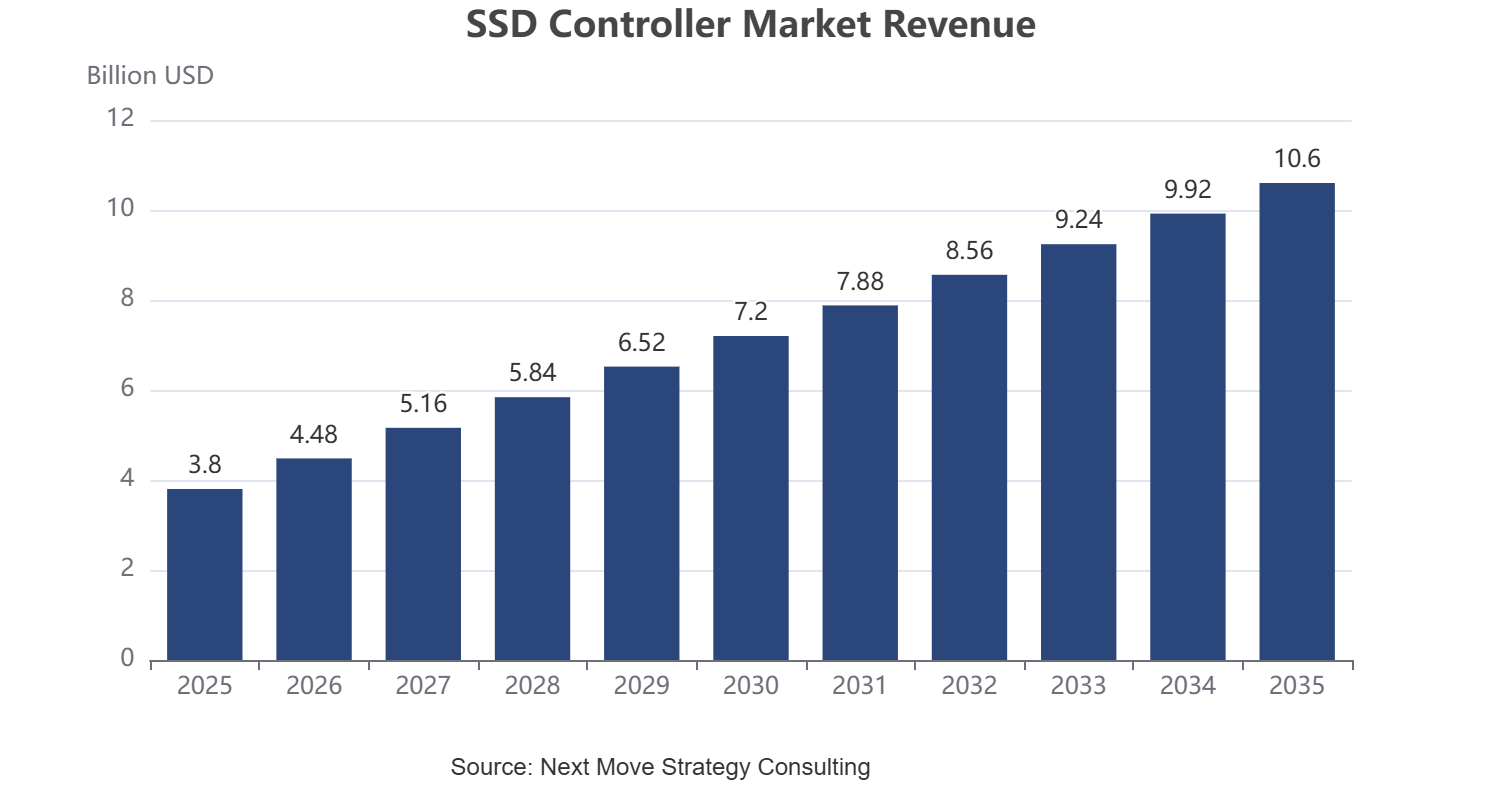
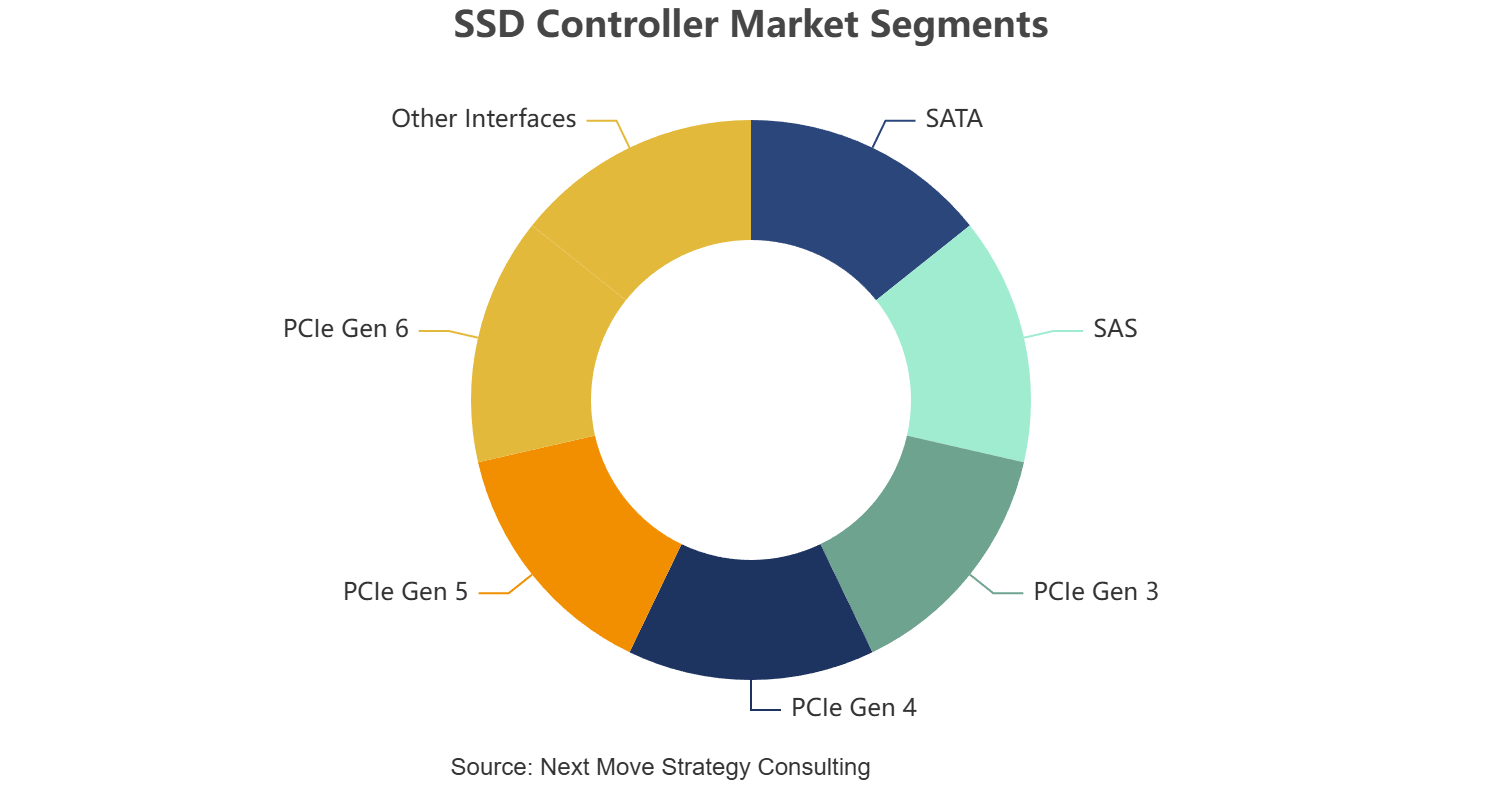
About the Author
 Saista Faiyaz
— Saista Faiyaz is Research Associate at Next Move Strategy Consulting, where she has covered consumer markets and healthcare technologies for 3 years. Her work includes primary interview review, secondary-source validation, market sizing, and structured analysis of company and industry data. She supports research by comparing evidence across sources, organizing findings into market narratives, and documenting assumptions used in analysis. Her scope includes cross-market benchmarking, and reports.
Saista Faiyaz
— Saista Faiyaz is Research Associate at Next Move Strategy Consulting, where she has covered consumer markets and healthcare technologies for 3 years. Her work includes primary interview review, secondary-source validation, market sizing, and structured analysis of company and industry data. She supports research by comparing evidence across sources, organizing findings into market narratives, and documenting assumptions used in analysis. Her scope includes cross-market benchmarking, and reports.
About the Reviewer
 Supradip Baul
— Supradip Baul is an accomplished business consultant and strategist with over a decade of rich experience in market intelligence, strategy, technology, and business transformation. His work has included rigorous qualitative and quantitative analysis across multiple industries, helping clients shape investment decisions and long-term roadmaps. Earlier in his career, he was associated with Gartner, where he contributed to industry-leading reports and market share analyses. He has worked with leading global companies and holds an MBA with a dual specialization in Marketing and Finance.
Supradip Baul
— Supradip Baul is an accomplished business consultant and strategist with over a decade of rich experience in market intelligence, strategy, technology, and business transformation. His work has included rigorous qualitative and quantitative analysis across multiple industries, helping clients shape investment decisions and long-term roadmaps. Earlier in his career, he was associated with Gartner, where he contributed to industry-leading reports and market share analyses. He has worked with leading global companies and holds an MBA with a dual specialization in Marketing and Finance.
At Next Move Strategy Consulting, we understand that insightful market research is the cornerstone of successful business decisions. That's why we employ a robust and multifaceted approach, combining various methodologies to deliver the most accurate and actionable data for our clients.

Research Landscape
We navigate the world of research with two primary approaches:
Qualitative Approach
Our qualitative research methodologies involve immersive techniques such as in-depth interviews, focus groups, and observational studies. By engaging directly with individuals and stakeholders, we uncover valuable insights that quantitative data alone may overlook.

Quantitative Research
In tandem with qualitative methodologies, NMSC leverages the power of Quantitative Research to provide a robust foundation of numerical insights. Through systematic data collection and analysis, we quantify patterns, preferences, and market trends, offering a comprehensive view of the business landscape.
Our quantitative research approach employs diverse tools, including surveys, experiments, and statistical modelling. These methodologies enable us to gather data from a large and representative sample, ensuring the statistical significance of our findings. By employing structured questionnaires and standardized data collection methods, we guarantee the reliability and validity of the information we present to our clients.
Quantitative research is particularly effective in measuring the prevalence of trends, assessing market size, and gauging the impact of various factors on consumer behavior. The numerical precision attained through this approach equips our clients with actionable insights, facilitating data-driven decision-making and strategy formulation.


Our Specialized Toolbox for Industry-Specific Market Research
We deploy a specialized arsenal of techniques tailored to meet your unique requirements. Here's a glimpse into our comprehensive toolbox:

Information Procurement
The stage entails acquiring market data or relevant information through various sources and methodologies.


Market Research Approach
We utilize both top-down and bottom-up approaches in market research analysis to achieve a comprehensive understanding of the market dynamics, leveraging the broad perspective of industry trends and macroeconomic factors alongside detailed insights from specific segments and individual companies.

Porters Five Forces Analysis
We conduct Porter's Five Forces analysis to evaluate the competitive landscape of an industry, providing us with insights into factors that affect profitability and strategic positioning.

SWOT Analysis

Forecasting
We utilize a forecasting model to predict future consumption by considering parameters like population, economics, regulations, market competition, drivers, constraints, technology, and pricing. We also employ statistical techniques such as multilinear regression, exponential smoothing, moving average, ARIMA, and Monte Carlo simulations for accurate predictions. In econometric forecasting, we analyzed short-term and long-term event impacts, attributing values based on regulatory frameworks, economic factors, and market events.





 Speak to Our Analyst