Thailand Customer Relationship Management (CRM) Market By Component (Software, Services), By Enterprise Size (Large Enterprise, SMEs), By Application (Sales Force Automation, Marketing Automation, Customer Service & Support, Lead Generation & Retention, CRM Analytics, Customer Experience Management, Social Media Monitoring), By Industry Vertical (BFSI, Retail & E-commerce, IT & Telecom, Manufacturing, Healthcare & Life Sciences, & Others) – Global Analysis & Forecast, 2025–2035
Industry: ICT & Media | Publishing Date: February 5, 2026 | Last Updated: September 16, 2026 | No of Pages: N/A | No. of Tables: N/A | No. of Figures: N/A | Format: PDF | Report Code: IC4043
Industry Outlook
The Thailand Customer Relationship Management (CRM) Market size was valued at USD 182.72 million in 2025 and is expected to reach USD 204.19 million by 2026. Looking ahead, the industry is projected to expand significantly, reaching USD 554.96 million by 2035, registering a CAGR of 11.75% from 2026 to 2035.
The (CRM) market is witnessing steady expansion as enterprises accelerate digital transformation and customer-centric operating models. Organisations across banking, retail, telecommunications, healthcare, and hospitality are increasing CRM adoption to enhance customer engagement, sales productivity, and service automation. Growing penetration of cloud-based platforms, mobile-first customer interactions, and omnichannel engagement strategies is reshaping procurement preferences, particularly among small and medium enterprises. Advanced analytics, AI-driven customer insights, and workflow automation are expanding AI-powered CRM platforms use cases beyond contact management into predictive sales, personalisation, and customer experience optimisation. At the same time, rising e-commerce activity and competitive intensity are increasing demand for real-time customer visibility and faster response capabilities. As data localisation requirements and cybersecurity standards evolve, vendors offering scalable, compliant, and industry-specific CRM solutions are well positioned to gain market share in Thailand.
What Are the Key Trends in The Thailand Customer Relationship Management (CRM) Market?
How will Thailand’s On-Shore Cloud Infrastructure Accelerate Enterprise CRM Cloud Adoption?
Thailand’s on-shore hyperscale infrastructure materially lowers key barriers to enterprise CRM cloud adoption by addressing latency, data residency, and regulatory compliance concerns. Microsoft’s May 2024 Thailand cloud region announcement signals reduced performance risk and improved confidence for regulated sectors such as BFSI, telecom, and public services that previously delayed cloud migration. Local availability shortens procurement and security approval cycles and lowers the total cost of ownership compared with overseas hosting. The result is accelerated migration from legacy on-premise CRM digital transformation to cloud-native platforms such as Dynamics 365 and Salesforce, alongside faster SaaS expansion among mid-market firms. For vendors and integrators, this favours Thailand-specific deployment blueprints, certified sovereignty controls, and localised managed services.
How Will AI-driven Automation and Embedded Analytics Change CRM Value Propositions in Thailand?
AI-driven automation is shifting CRM value propositions in Thailand from system-of-record tools to productivity and revenue-optimisation platforms. Embedded AI capabilities, predictive lead scoring, automated service routing, churn prediction, and next-best-action recommendations- directly address local enterprise priorities such as reducing contact-centre costs and improving loyalty effectiveness. Global CRM roadmaps released in 2024–2025 show these capabilities moving from optional add-ons to standard modules, accelerating adoption in Thailand. Mid-sized enterprises are likely to adopt pre-configured AI CRM bundles via local partners, while large corporates invest in customised analytics integrated with internal data lakes. Vendors that offer Thai-language models, privacy-compliant automation, and low-friction AI accelerators will gain a competitive advantage.
Why is Omni-Channel Loyalty and Payments Integration Emerging as a Distinct Growth Vector for CRM in Thailand?
Rapid digital commerce expansion is driving demand for the (CRM) market that unifies loyalty, payments, and customer engagement across online and offline channels. Government-led digital-wallet initiatives and rising smartphone-based commerce have accelerated merchant onboarding and POS digitisation, creating fragmented customer data environments. Retailers, F&B chains, and service brands increasingly require CRM systems that integrate loyalty rewards, payment reconciliation, and omnichannel analytics to improve repeat purchase rates and campaign ROI. Local solution providers demonstrate that bundled loyalty-payment-CRM offerings resonate strongly with Thai merchants. Localization Opportunity for global CRM vendors, this creates a clear opportunity to localise through certified connectors to domestic wallets, POS systems, and e-commerce platforms, supported by outcome-linked pricing models.
What Are the Key Market Drivers, Breakthroughs, And Investment Opportunities That Will Shape the Thailand Customer Relationship Management (CRM) Market in The Next Decade?
Thailand customer relationship management (CRM) market growth is driven by structural digitisation across commerce and government, rising e-commerce and payments adoption, and the arrival of on-shore cloud infrastructure that solves key data-residency and latency concerns. The combined effect of public stimulus programs, private digital investments and hyperscaler presence creates a near-term acceleration window for CRM implementations across enterprise and SME segments.
Breakthroughs include embedded AI capabilities and integrated loyalty-payments stacks, while challenges are concentrated in SME digital maturity, data governance expectations and talent shortages for analytics and integration. Opportunities exist in verticalized CRM stacks (retail, BFSI, travel), managed services for SMEs, and recycled-value propositions such as loyalty monetisation and customer-data platforms. Providers that combine platform capability with local regulatory compliance and channelised go-to-market will win.
Growth Drivers:
How are SME Digitalisation Programs and Local CRM Vendors Reshaping Adoption at Scale in Thailand?
Thailand’s SME segment represents the largest untapped CRM opportunity, historically constrained by high software costs and limited digital capabilities. This constraint is easing as local vendors introduce bundled, low-friction CRM offerings tailored to SME realities. Ready Planet’s 2024 disclosures illustrate this shift through subscription-based CRM and digital marketing solutions paired with structured enablement via Ready Planet Academy. By combining software, training, and managed services, adoption barriers are materially reduced. As SMEs increasingly transact across digital sales channels, messaging platforms, and integrated payments, CRM becomes operational infrastructure rather than discretionary spend. International vendors seeking scale must localise SME go-to-market models with simplified bundles, Thai-language interfaces, embedded training, and usage-linked pricing aligned with transaction growth.
How will Government Stimulus and Digital-Economy Policies Expand CRM Addressability for Merchants and Public Services?
Thailand’s 2024 digital-wallet stimulus and broader digital-economy policies are accelerating transaction digitisation across merchants, SMEs, and public-service touchpoints. As subsidies, consumer payments, and loyalty incentives move onto digital rails, customer interaction volumes and data complexity rise sharply. This structurally expands demand for CRM systems that manage customer identification, transaction-linked engagement, targeted promotions, and service workflows. Policy-led digitisation also lowers resistance to enterprise software adoption among smaller merchants by normalising digital compliance requirements. CRM therefore, evolves from a sales enablement tool into a compliance, engagement, and revenue orchestration layer. Vendors that pre-integrate CRM with digital wallets, government-certified payment systems, and merchant onboarding workflows are best positioned to capture stimulus-driven adoption at scale.
Growth Inhibitors:
How do SME Budget Constraints and Digital Skills Gaps Slow CRM Penetration at Scale?
Despite favourable demand drivers, Thailand (CRM) market adoption among Thai SMEs is constrained by limited budgets, a shortage of in-house IT talent, and uneven digital maturity. Many SMEs view full-featured CRM platforms as complex, costly, and difficult to implement relative to near-term business needs. Industry disclosures in 2024 highlight strong interest in CRM outcomes but persistent demand for training, implementation support, and simplified solutions. This gap reduces the addressable market for customised enterprise-grade CRM deployments, and shifts demand toward low-cost SaaS, bundled solutions, and managed-service models. To unlock scale, CRM vendors must lower adoption friction through SME-tier pricing, embedded training programs, and low-code or no-code templates that minimise reliance on specialised technical staff.
Where can Investors Capture Outsized Returns in Thailand’s CRM Ecosystem?
Thailand customer relationship management (CRM) market presents attractive investment opportunities in scalable, localised business models rather than global platform replication. High-potential segments include local SaaS CRM and loyalty platforms optimised for the Thai language and domestic payment systems, managed-service providers that deliver turnkey CRM adoption for SMEs, and customer data platform providers enabling privacy-compliant analytics. Government digitisation initiatives and new cloud infrastructure amplify growth potential for vendors with recurring revenue and established merchant relationships. Investors are best positioned by backing proven local operators that already control customer access points. Minority stakes or joint ventures with these players, combined with hyperscaler partnerships, offer capital-efficient exposure to rapid adoption without assuming full execution risk.
How Thailand Customer Relationship Management (CRM) Market Segmented in This Report, And What Are the Key Insights from The Segmentation Analysis?
By Component Insights
Is Software-Centric CRM Adoption Dominant Over Services in Thailand?
Based on component, the Thailand customer relationship management (CRM) market is segmented into software and services.
Software platforms drive initial Thailand customer relationship management (CRM) market adoption, but services account for a larger share of total project value over the lifecycle. Large enterprises typically license comprehensive platforms such as Salesforce, Microsoft Dynamics, or SAP, then layer significant spending on implementation, integration, customisation, and ongoing optimisation. SMEs, by contrast, favour packaged SaaS CRM bundled tightly with onboarding, training, and digital marketing services from local vendors. Market disclosures from local providers indicate that service revenues scale alongside software adoption because customers require hands-on enablement to realise value. Vendors that bundle fixed-price implementation and subscription-based managed services with software accelerate SME conversion while maximising lifetime value from enterprise accounts.
By Software Deployment Insights
Is Cloud Deployment Dominating CRM Adoption in Thailand in 2025?
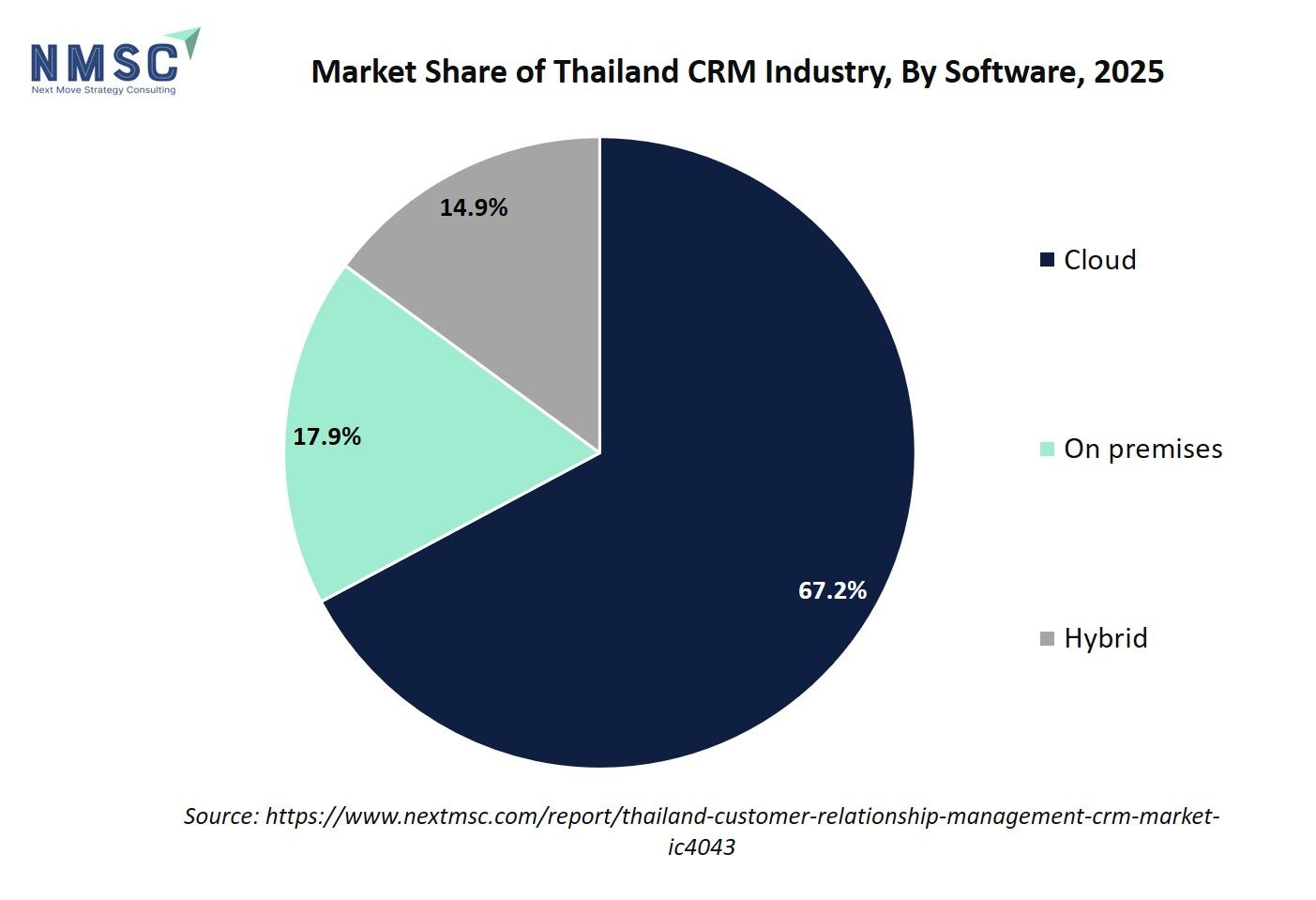
Based on software deployment, the Thailand customer relationship management (CRM) market is segmented into cloud, on premises, and hybrid.
Cloud deployment is the dominant model for new CRM projects in Thailand, driven by hyperscaler investments, faster deployment timelines, and predictable operating costs. Local cloud-region availability has materially reduced concerns around data latency and jurisdiction, encouraging both large enterprises and fast-growing SMEs to adopt cloud-first CRM architectures. While on-premises or hybrid deployments persist in highly regulated agencies and legacy-heavy organisations, they represent a declining share of new demand. Growth momentum is clearly cloud-led, particularly for SaaS CRM integrated with analytics and AI features. Vendors and system integrators that demonstrate robust data-residency controls, security certifications, and local hosting advantages are best positioned to capture the bulk of incremental CRM spend.
By Services Insights
Are Managed Services and Training the Highest-Growth Service Lines?
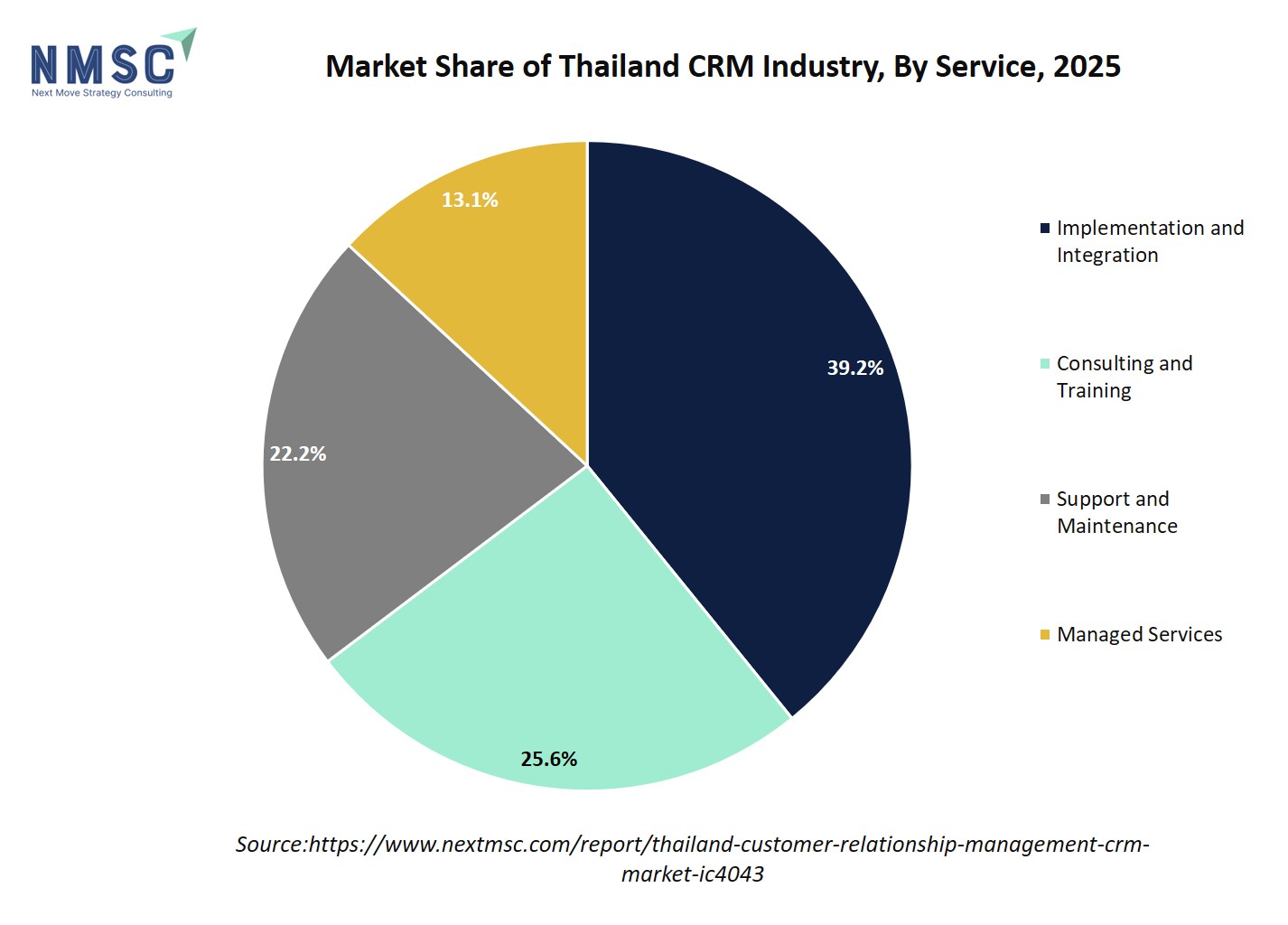
Based on services, the Thailand customer relationship management (CRM) market is segmented into implementation and integration, consulting and training, support and maintenance, and managed services.
Managed services and training are among the fastest-growing CRM service lines in Thailand as organisations seek to overcome skills gaps and accelerate value realisation. Beyond initial implementation and integration, clients increasingly outsource CRM administration, analytics configuration, and automation management to trusted partners. The expansion of structured training academies by local providers signals sustained demand for capability-building alongside software adoption. While one-time project services remain essential at go-live, recurring managed services and support contracts generate predictable revenue, higher retention, and stronger customer lock-in. Service providers that productize managed CRM offerings through tiered service levels, outcome-linked pricing, and bundled training improve customer stickiness and drive long-term annual recurring revenue growth.
By Application Insights
Are Marketing Automation and Customer Service Leading CRM Use Cases in Thailand?
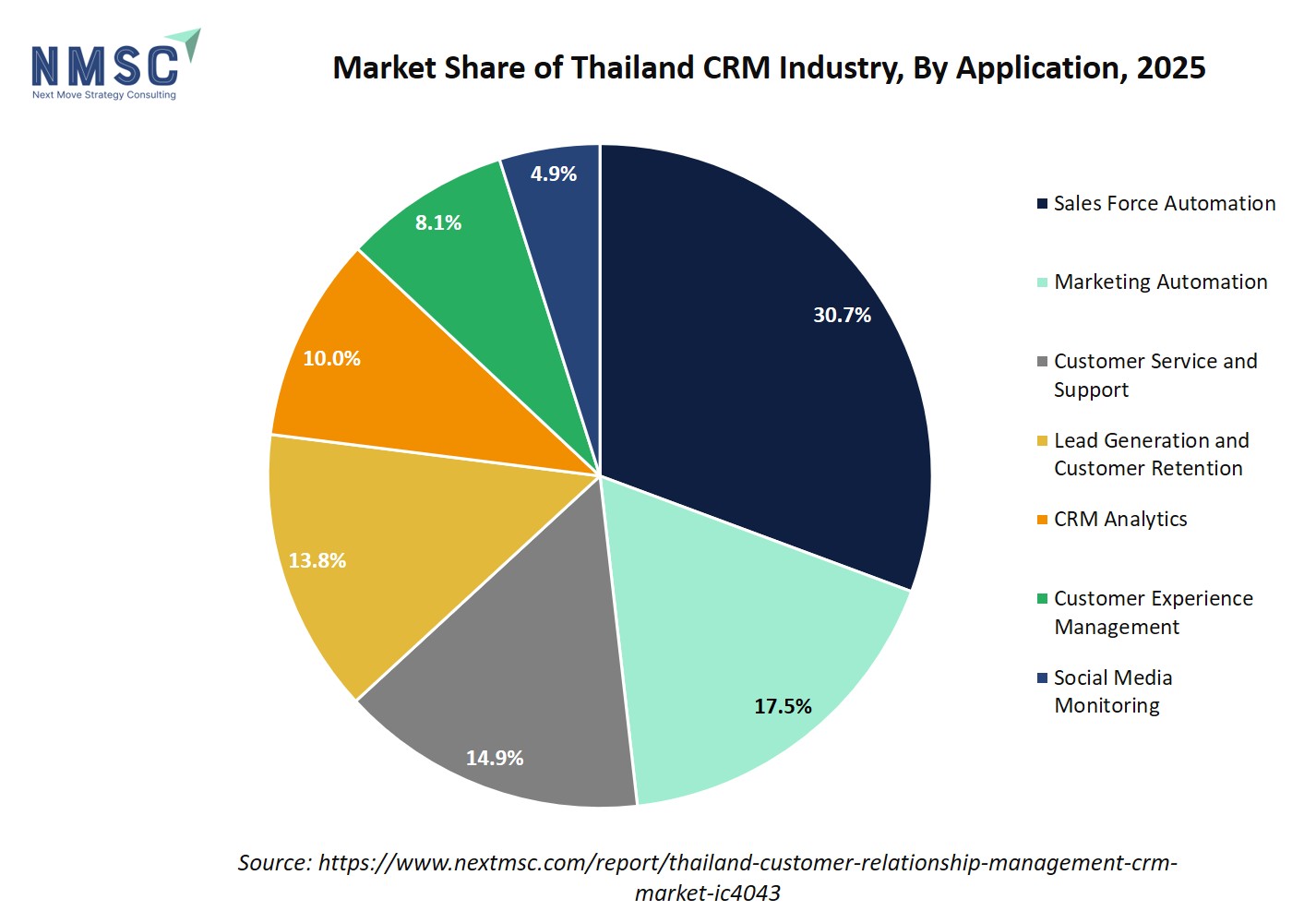
Based on application, the Thailand customer relationship management (CRM) market is segmented into sales force automation, marketing automation, customer service and support, lead generation and customer retention, CRM analytics, customer experience management, and social media monitoring.
Marketing automation and customer service are the leading CRM applications across Thailand, reflecting enterprises’ focus on personalised engagement and operational efficiency. Retailers, F&B chains, and digital-first brands prioritise campaign automation, loyalty management, and omnichannel messaging, while service-oriented sectors emphasize contact-center integration and chatbot-driven support. Analytics and customer experience management are gaining traction as organisations seek to improve retention and lifetime value through data-driven insights. Sales force automation remains important, particularly in B2B industries, but growth is slower than in marketing and service use cases. CRM product roadmaps that emphasise integrated campaign tools, Thai-language natural language processing, and sector-specific analytics dashboards will align best with prevailing demand patterns.
By Industry Vertical Insights
Which Verticals Present the Largest CRM Demand Pools?
Based on industry vertical, the Thailand customer relationship management (CRM) market is segmented into BFSI, retail and e-commerce, IT and telecommunications, manufacturing, healthcare and life sciences, professional services, public administration, transportation and logistics, and others.
BFSI, retail and e-commerce, telecom, and travel and tourism represent the largest CRM demand pools in Thailand due to high transaction volumes and intensive customer engagement requirements. BFSI institutions require robust compliance, KYC workflows, and secure omnichannel servicing. Retail and e-commerce players prioritise CRM systems that integrate loyalty programs, POS data, and digital payments to drive repeat purchases. Telecom operators rely heavily on CRM for churn management and personalised offers, while travel and tourism firms use CRM to manage bookings, loyalty, and service recovery. Government and public administration are emerging adopters as digital-service initiatives expand. Verticalized CRM templates and compliance-ready modules significantly shorten deployment cycles and improve time-to-value.
Competitive Landscape
Which Companies Dominate the Thailand Customer Relationship Management (CRM) Industry and How do they Compete?
The Thailand customer relationship management (CRM) market blends global platform vendors with strong local specialists and system integrators. International players such as Salesforce, Microsoft Dynamics, SAP, Oracle, and Adobe anchor large-enterprise deployments with scalable architectures, security certifications, and advanced AI roadmaps. Alongside them, local vendors including ReadyPlanet, Buzzebees, and Amity Solutions play a critical role by tailoring CRM to Thai-language workflows, local payment and wallet ecosystems, and SME operating realities. Recent disclosures indicate ReadyPlanet’s emphasis on SME-focused CRM bundled with training, while Buzzebees concentrates on loyalty and omnichannel engagement for consumer brands. This coexistence illustrates a complementary structure in which global platforms provide depth and scale, while local specialists drive adoption velocity and localization.
Market Dominated by Thailand Customer Relationship Management (CRM) Giants and Specialists
The Thai Thailand customer relationship management (CRM) market is structurally bifurcated between global giants and specialised local providers. Large enterprises and regulated sectors typically favour tier-one CRM suites due to their integration breadth, compliance assurance, and long-term vendor stability. In contrast, mid-market firms and SMEs increasingly select local SaaS vendors and managed-service providers that deliver faster deployment, lower total cost of ownership, and localised functionality. Competitive intensity is therefore highest in the SME and mid-market tiers, where loyalty integration, payments connectivity, and hands-on support matter more than global brand scale. The prevailing competitive model is partnership-driven, with global vendors collaborating with local system integrators or SaaS players to extend reach and accelerate adoption across diverse customer segments.
Innovation and Adaptability Drive Market Success
Innovation in Thailand customer relationship management (CRM) market centers on practical localization rather than abstract feature breadth. Key differentiators include Thai-language AI and natural language processing, seamless wallet and POS integrations, and preconfigured vertical accelerators for BFSI, retail, and telecommunications. Hyperscaler investments and frequent CRM platform updates are accelerating access to advanced analytics and automation, but competitive advantage accrues to vendors that rapidly operationalise these features for local clients. Adaptability is equally critical; providers must align with evolving compliance requirements and merchant workflows. Vendors and system integrators that combine global CRM capabilities with localised innovation and managed outcomes are consistently outperforming pure software sellers in winning and retaining Thai customers.
Market Players to Opt for Merger & Acquisition Strategies to Expand their Presence
Mergers, acquisitions, and strategic partnerships are expected to intensify as participants seek scale and defensible positioning. Global Thailand customer relationship management (CRM) market vendors are increasingly requiring local partners or acquisitions to deepen SME penetration and embed payment and loyalty capabilities, while local players seek capital and technology alliances to expand beyond niche markets. The loyalty- and payments-integrated CRM segment is a particular consolidation hotspot, as control over merchant networks creates recurring revenue and high switching costs. Market signals include growing emphasis on managed services, training, and ecosystem plays in corporate disclosures. Likely acquisition targets include niche loyalty platforms and system integrators with strong SME footprints, vertical expertise, and established relationships with local merchants and payment providers.
List of Key Thailand Customer Relationship Management (CRM) Companies
-
Salesforce, Inc.
-
Microsoft Corporation
-
Adobe Inc.
-
Buzzebees Co., Ltd.
-
Readyplanet Public Company Limited
-
Amity Solutions Corporation Co., Ltd.
-
Choco Card Enterprise Co., Ltd.
-
EGG Digital Co., Ltd.
-
Mango Consultant Co., Ltd.
-
Prosoft Comtech Co., Ltd.
-
Primo World Co., Ltd.
-
Wisdom Information Systems Co., Ltd.
-
Funcrowd Co., Ltd.
What Are the Latest Key Industry Developments?
-
October 2025- Salesforce Appoints New Country Leader to Accelerate Growth in Thailand.
-
October 2025- Buzzebees unveils its plan to leverage AI and Copilot to assist brands, aiming for revenue of 3.4 billion baht in 2025.
-
April 2024- Salesforce launches Pro Suite, a comprehensive CRM solution, targeting the Thai SME market.
What Are the Key Factors Influencing Both Investment Analysis & Thailand Customer Relationship Management (CRM) Market Opportunity?
Investment decisions in Thailand customer relationship management (CRM) market are anchored in four core considerations. First, visible demand catalysts such as hyperscaler cloud-region availability and government-led digital wallet and SME digitisation programs materially accelerate adoption cycles. Second, defensible vendor–partner moats matter, particularly merchant networks, vertical-specific IP, and deep integrations with payments and e-commerce platforms that raise switching costs. Third, recurring revenue potential from managed services, training subscriptions, and loyalty monetisation models enhances valuation resilience beyond one-time software sales. Fourth, execution risk must be carefully assessed, as SME digital readiness and integration complexity slow scaling. Investors are prioritising local SaaS vendors with proven merchant contracts and recurring ARPU, managed-service providers with repeatable delivery playbooks, and integration IP linking CRM to transaction flows. Due diligence emphasises churn metrics, contract stickiness, and compliance with data-residency and financial-integration requirements.
Key Benefits for Stakeholders:
Next Move Strategy Consulting (NMSC) presents a comprehensive analysis of the Thailand customer relationship management (CRM) market, covering historical trends from 2020 through 2025 and offering detailed forecasts through 2035. Our study examines the market at regional and country levels, providing quantitative projections and insights into key growth drivers, challenges, and investment opportunities across all major Thailand customer relationship management (CRM) segments.
Stakeholders across the ecosystem realise distinct benefits from Thailand customer relationship management (CRM) market expansion. Investors gain exposure to structural digital-transformation tailwinds, supported by subscription-style revenues, high-margin managed services, and scalable loyalty monetisation models. Enterprise customers benefit from higher customer lifetime value, reduced churn, and improved operational efficiency through automation, analytics, and integrated payments. SMEs access affordable CRM bundles combined with training and managed services, enabling them to convert digital-wallet transactions and stimulus-driven traffic into repeat business. Government agencies and regulators gain improved traceability for digital programs and more effective citizen engagement through CRM-enabled service platforms. Vendors and system integrators secure long-term maintenance revenues and upsell opportunities into analytics, AI-driven automation, and advanced customer engagement services.
Report Scope
|
Parameters |
Details |
|
Market Size in 2026 |
USD 204.19 Million |
|
Revenue Forecast in 2035 |
USD 554.96 Million |
|
Growth Rate |
CAGR of 11.75% from 2026 to 2035 |
|
Analysis Period |
2025–2035 |
|
Base Year Considered |
2025 |
|
Forecast Period |
2026–2035 |
|
Market Size Estimation |
Million (USD) |
|
Growth Factors |
|
|
Companies Profiled |
15 |
|
Market Share |
Available for 10 companies |
|
Customization Scope |
Free customization (equivalent to up to 80 analyst-working hours) after purchase. Addition or alteration to country, regional & segment scope. |
|
Pricing and Purchase Options |
Avail customized purchase options to meet your exact research needs. |
|
Approach |
In-depth primary and secondary research; proprietary databases; rigorous quality control and validation measures. |
|
Analytical Tools |
Porter's Five Forces, SWOT, value chain, and Harvey ball analysis to assess competitive intensity, stakeholder roles, and relative impact of key factors. |
Thailand Customer Relationship Management (CRM) Market Key Segments
By Component
-
Software
-
Cloud
-
On premises
-
Hybrid
-
-
Services
-
Implementation and integration
-
Consulting and training
-
Support and maintenance
-
Managed services
-
By Enterprise Size
-
Large enterprises
-
Small and medium enterprises SMEs
By Application
-
Sales force automation
-
Marketing automation
-
Customer service and support
-
Lead generation and customer retention
-
CRM analytics
-
Customer experience management
-
Social media monitoring
By Industry Vertical
-
BFSI
-
Retail and e-commerce
-
IT and telecommunications
-
Manufacturing
-
Healthcare and life sciences
-
Professional services
-
Public administration
-
Transportation and logistics
-
Others
Conclusion & Recommendations
Our report equips stakeholders, industry participants, investors, and consultants with actionable intelligence to capitalise on Thailand's customer relationship management (CRM)’s transformative potential. By combining robust data-driven analysis with strategic frameworks, NMSC’s Thailand customer relationship management (CRM) market report serves as an indispensable resource for navigating the evolving landscape. Thailand customer relationship management (CRM) market sits at an inflexion point driven by hyperscaler infrastructure investment, government stimulus, digitisation, and merchant payment modernisation. Vendors who combine cloud-native platforms with Thai-language UX, wallet/connectors and managed-service offerings for SMEs will capture the most rapid growth. Enterprises are prioritising cloud migration now to leverage improved performance and AI features, while investors are targeting local SaaS/loyalty providers with merchant relationships and recurring ARPU.
For executives and investors, the key to capitalising on these trends lies in identifying high-potential segments, investing in R&D for innovative Thailand customer relationship management (CRM) market, and fostering strategic partnerships to expand market reach. Productizing wallet/POS connectors and vertical accelerators for retail/BFSI. Launching SME onboarding packages, including training and managed services, to accelerate TAM conversion.


About the Author
 Ridip Gogoi
— Ridip Gogoi is a Research Associate at Next Move Strategy Consulting, where he supports cross-vertical market research and analysis across multiple industry sectors, with four years of experience. His work includes market analysis, data validation, secondary research, and insight development, helping structure evidence into clear findings for business and strategy decisions. He contributes to research quality checks and reporting, with a focus on consistency, source review, and clarity accuracy.
Ridip Gogoi
— Ridip Gogoi is a Research Associate at Next Move Strategy Consulting, where he supports cross-vertical market research and analysis across multiple industry sectors, with four years of experience. His work includes market analysis, data validation, secondary research, and insight development, helping structure evidence into clear findings for business and strategy decisions. He contributes to research quality checks and reporting, with a focus on consistency, source review, and clarity accuracy.
About the Reviewer
 Supradip Baul
— Supradip Baul is an accomplished business consultant and strategist with over a decade of rich experience in market intelligence, strategy, technology, and business transformation. His work has included rigorous qualitative and quantitative analysis across multiple industries, helping clients shape investment decisions and long-term roadmaps. Earlier in his career, he was associated with Gartner, where he contributed to industry-leading reports and market share analyses. He has worked with leading global companies and holds an MBA with a dual specialization in Marketing and Finance.
Supradip Baul
— Supradip Baul is an accomplished business consultant and strategist with over a decade of rich experience in market intelligence, strategy, technology, and business transformation. His work has included rigorous qualitative and quantitative analysis across multiple industries, helping clients shape investment decisions and long-term roadmaps. Earlier in his career, he was associated with Gartner, where he contributed to industry-leading reports and market share analyses. He has worked with leading global companies and holds an MBA with a dual specialization in Marketing and Finance.
At Next Move Strategy Consulting, we understand that insightful market research is the cornerstone of successful business decisions. That's why we employ a robust and multifaceted approach, combining various methodologies to deliver the most accurate and actionable data for our clients.

Research Landscape
We navigate the world of research with two primary approaches:
Qualitative Approach
Our qualitative research methodologies involve immersive techniques such as in-depth interviews, focus groups, and observational studies. By engaging directly with individuals and stakeholders, we uncover valuable insights that quantitative data alone may overlook.

Quantitative Research
In tandem with qualitative methodologies, NMSC leverages the power of Quantitative Research to provide a robust foundation of numerical insights. Through systematic data collection and analysis, we quantify patterns, preferences, and market trends, offering a comprehensive view of the business landscape.
Our quantitative research approach employs diverse tools, including surveys, experiments, and statistical modelling. These methodologies enable us to gather data from a large and representative sample, ensuring the statistical significance of our findings. By employing structured questionnaires and standardized data collection methods, we guarantee the reliability and validity of the information we present to our clients.
Quantitative research is particularly effective in measuring the prevalence of trends, assessing market size, and gauging the impact of various factors on consumer behavior. The numerical precision attained through this approach equips our clients with actionable insights, facilitating data-driven decision-making and strategy formulation.


Our Specialized Toolbox for Industry-Specific Market Research
We deploy a specialized arsenal of techniques tailored to meet your unique requirements. Here's a glimpse into our comprehensive toolbox:

Information Procurement
The stage entails acquiring market data or relevant information through various sources and methodologies.


Market Research Approach
We utilize both top-down and bottom-up approaches in market research analysis to achieve a comprehensive understanding of the market dynamics, leveraging the broad perspective of industry trends and macroeconomic factors alongside detailed insights from specific segments and individual companies.

Porters Five Forces Analysis
We conduct Porter's Five Forces analysis to evaluate the competitive landscape of an industry, providing us with insights into factors that affect profitability and strategic positioning.

SWOT Analysis

Forecasting
We utilize a forecasting model to predict future consumption by considering parameters like population, economics, regulations, market competition, drivers, constraints, technology, and pricing. We also employ statistical techniques such as multilinear regression, exponential smoothing, moving average, ARIMA, and Monte Carlo simulations for accurate predictions. In econometric forecasting, we analyzed short-term and long-term event impacts, attributing values based on regulatory frameworks, economic factors, and market events.





 Speak to Our Analyst