UAE Wireless Charging Market By Technology (Inductive, Magnetic Resonance, Radio Frequency, and Other Technologies), By Power Level (Low Power (≤ 15 W), Medium Power (>15 W to 60 W), High Power (>60 W to 500 W), and Ultra High Power (>500 W)), By Application (Consumer Electronics, Automotive, Healthcare, Industrial, Aerospace and Defense, and Other Applications), By Distribution Channel (Online, Offline Retail, OEM Supply, and Direct Enterprise) - Analysis & Forecast, 2025-2035
Industry: Semiconductor & Electronics | Latest Edition: August 13, 2026 | No of Pages: 154 | No. of Tables: 47 | No. of Figures: 43 | Format: PDF | Report Code: SE5692
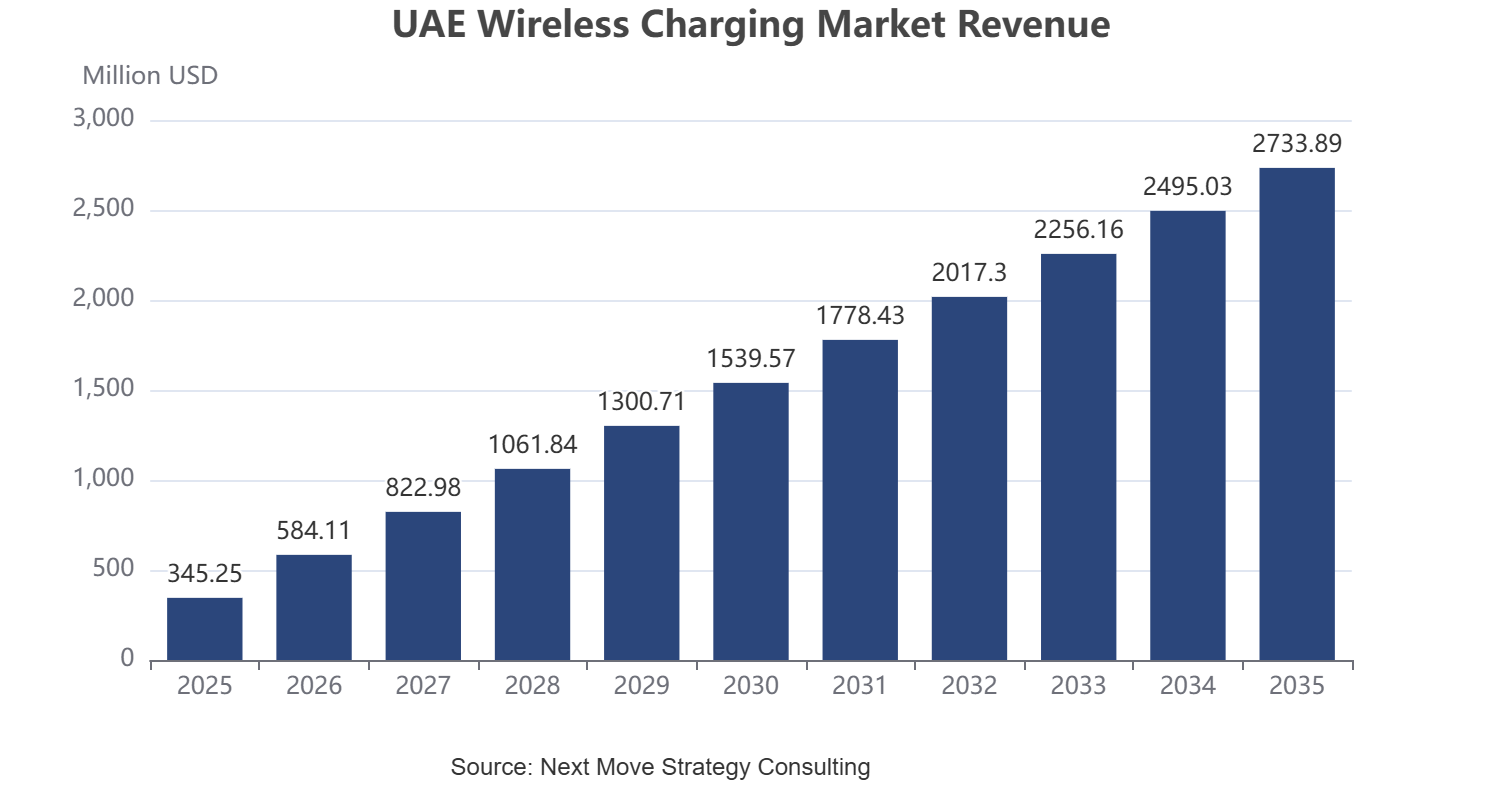
UAE wireless charging Market size and forecast
|
Parameters |
Details |
|
Market size in 2025 |
USD 345.25 Million |
|
Market size in 2026 |
USD 430.60 Million |
|
Revenue forecast in 2035 |
USD 2,733.89 Million |
|
Growth rate |
CAGR of 22.80% from 2026 to 2035 |
|
Analysis period |
2025–2035 |
|
Base year considered |
2025 |
|
Forecast period |
2026–2035 |
|
Market size estimation |
Million (USD) |
|
Companies profiled |
15 |
Industry outlook
The UAE wireless charging market is expanding quickly as premium consumer electronics, connected vehicles, and contactless infrastructure converge in urban environments. The market is valued at USD 345.25 million in 2025, is estimated at USD 430.60 million in 2026, and is projected to reach USD 2,733.89 million by 2035. This trajectory reflects a 22.80% CAGR from 2026 to 2035, supported by smart city investments, luxury ecosystem integration, and rising demand for seamless power delivery.
What are the key drivers, restraints, and opportunities shaping the UAE wireless charging market through 2035?
Growth catalyst and risk assessment matrix
|
Drivers / trends / restraints |
(+/–) % impact on CAGR forecast |
Geographic relevance |
Impact timeline |
|
Smart city investments accelerate adoption of contactless technologies |
+3.1% |
UAE |
Short to medium term (1–4 years) |
|
High concentration of premium smartphone users |
+2.7% |
UAE |
Short to medium term (1–4 years) |
|
Luxury retail, hospitality, and intelligent mobility integration |
+2.4% |
UAE |
Medium to long term (3–7 years) |
|
Small domestic population limits overall volume growth |
-1.4% |
UAE |
Ongoing |
|
Commercial deployment across luxury ecosystems and managed mobility |
+3.0% |
UAE |
Long term (5–10 years) |
The UAE market is shaped by a combination of urban modernization, affluent consumer behavior, and enterprise interest in embedded charging experiences. Wireless charging is moving beyond accessory purchases into furniture, transportation hubs, hospitality venues, and mobility platforms. At the same time, compatibility concerns and a relatively small domestic population moderate the pace of scale-up. These forces create a market that is premium, highly segmented, and increasingly tied to ecosystem-led deployment strategies.
Growth driver:
How do smart city investments accelerate adoption of contactless technologies in the UAE?
Smart city investments are accelerating adoption because they encourage governments, developers, and infrastructure operators to embed contactless technologies into public and commercial spaces. Wireless charging aligns well with these investments because it supports cleaner surfaces, reduced cable clutter, and easier integration into desks, seating, kiosks, and transit environments. As the UAE continues to position itself as a digitally advanced hub, these projects create visible demand and strengthen the case for broader deployment across consumer and enterprise settings.
Why does a high concentration of premium smartphone users support wireless charging demand?
A high concentration of premium smartphone users supports market expansion because these consumers are more willing to pay for convenience, design, and brand-aligned accessories. In the UAE, wireless charging is often perceived as a premium feature that complements flagship devices and high-end lifestyles. That perception lifts average selling prices and encourages accessory refresh cycles. It also creates fertile ground for bundled offerings, magnetic charging ecosystems, and products that emphasize aesthetic quality as well as performance.
How is luxury retail, hospitality, and intelligent mobility widening everyday use cases?
Growing demand from luxury hospitality, commercial real estate, and intelligent mobility creates a third growth driver by normalizing wireless charging as a service feature rather than a standalone product. Hotels, lounges, airports, and premium retail destinations increasingly use charging surfaces to improve customer experience and dwell time. In mobility, embedded charging in vehicles and smart infrastructure enhances convenience. Together, these use cases broaden the market beyond home users and increase opportunities for recurring enterprise deployments.
Growth inhibitor:
Why does the UAE’s small domestic population constrain total volume growth?
The main growth inhibitor is the UAE’s relatively small domestic population, which limits the overall volume of device and infrastructure purchases available in the local market. Even though per-capita spending is high, total unit growth can be constrained when compared with larger regional economies. This makes scale dependent on premium pricing, enterprise adoption, and ecosystem integration rather than mass-market volume alone. Vendors must therefore focus on higher-value applications and repeatable contract-based channels to sustain momentum.
Growth opportunity:
How will integration into luxury retail, hospitality, and intelligent mobility ecosystems create new value?
Integration into luxury retail, hospitality, and intelligent mobility ecosystems represents a major opportunity because these environments reward convenience, premium positioning, and seamless user experiences. Wireless charging can become part of the physical service design in hotels, shopping centers, lounges, and managed transportation platforms. When embedded into these ecosystems, the technology can generate upsell potential, strengthen brand differentiation, and create long-term relationships with property owners and mobility operators that value differentiation as much as functionality.
How Is the UAE Wireless Charging Market Segmented, and What Are the Key Insights from the Segmentation Analysis?
By Technology
How is the technology segmentation shaping revenue distribution in the UAE wireless charging market?
Based on technology, the UAE wireless charging market remains centered on inductive systems, with magnetic resonance, radio frequency, and other technologies serving more specialized needs. Inductive platforms dominate because they are familiar, reliable, and well matched to smartphones, wearables, and accessories. Magnetic resonance is gaining attention in premium mobility and equipment settings, while emerging technologies may support niche designs. The market will reward vendors that improve compatibility, efficiency, and integration across multiple device categories.
By Application
How is the application segmentation driving demand insights in the UAE wireless charging market?
Based on application, consumer electronics continues to anchor demand, but automotive, healthcare, and industrial use cases are strengthening the market’s long-term value profile. Smartphones and wearables drive broad adoption, while in-vehicle chargers and stationary EV charging support premium mobility use cases. Healthcare and industrial environments value hygiene, continuity, and low-maintenance operation. As the UAE deepens smart infrastructure and enterprise automation, application demand will become more diversified and more dependent on specialized performance requirements.
Ecosystem Analysis of the UAE Wireless Charging Market
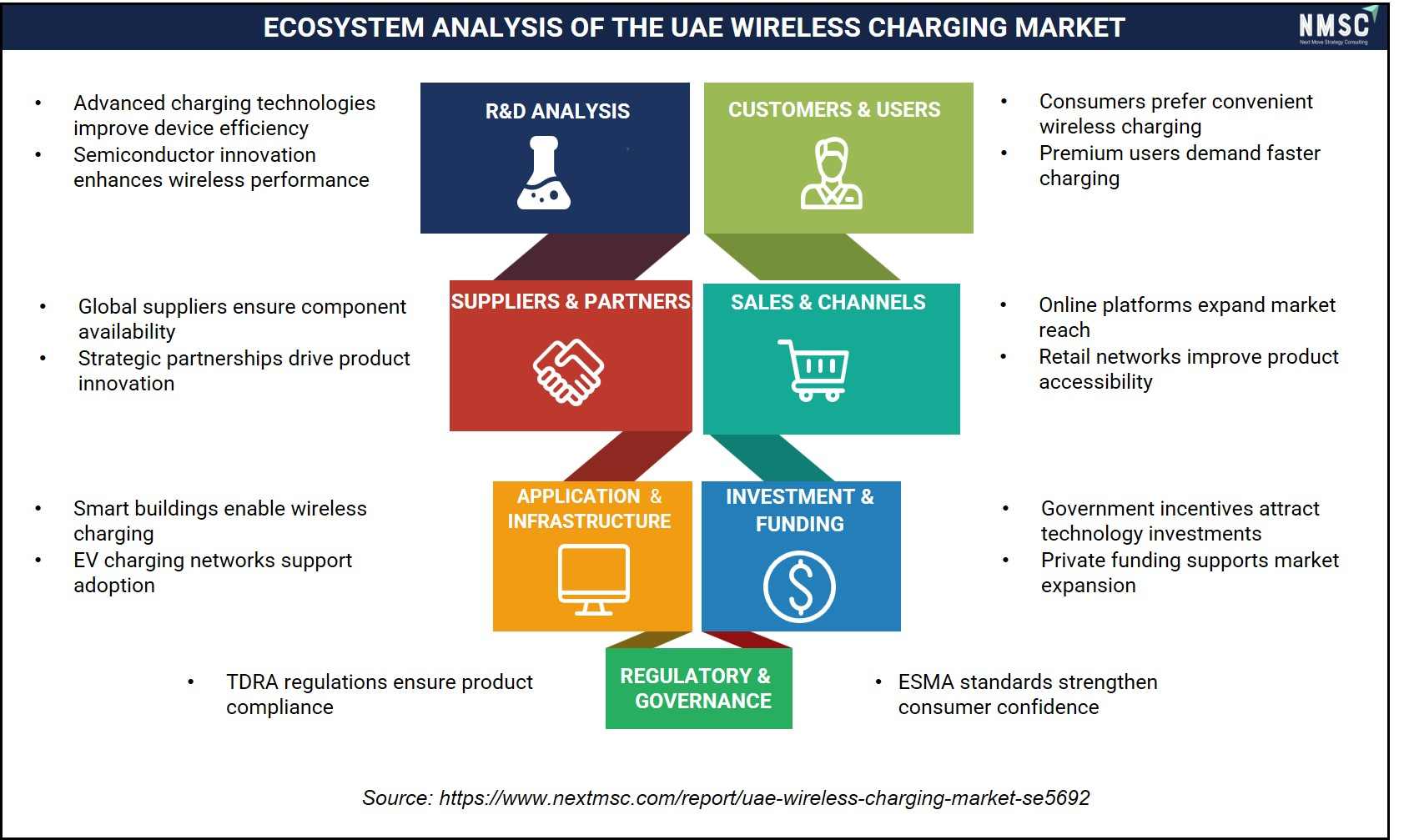
The UAE wireless charging market is supported by a well-connected ecosystem comprising technology developers, device manufacturers, distributors, retailers, investors, and regulatory authorities. Strong consumer demand for premium smart devices, combined with the country’s focus on digital transformation and smart city initiatives, is encouraging innovation and adoption of wireless charging solutions. Strategic partnerships between global technology brands, local distributors, and e-commerce platforms strengthen market accessibility, while ongoing investments in advanced consumer electronics and smart infrastructure create opportunities for ecosystem expansion. Supportive regulatory frameworks and growing interest in connected technologies further contribute to the development of a robust and innovation-driven wireless charging ecosystem in the UAE.
Key segments
By Technology
-
Inductive
-
Magnetic Resonance
-
Radio Frequency
-
Other Technologies
By Power Level
-
Low Power (≤ 15 W)
-
Medium Power (>15 W to 60 W)
-
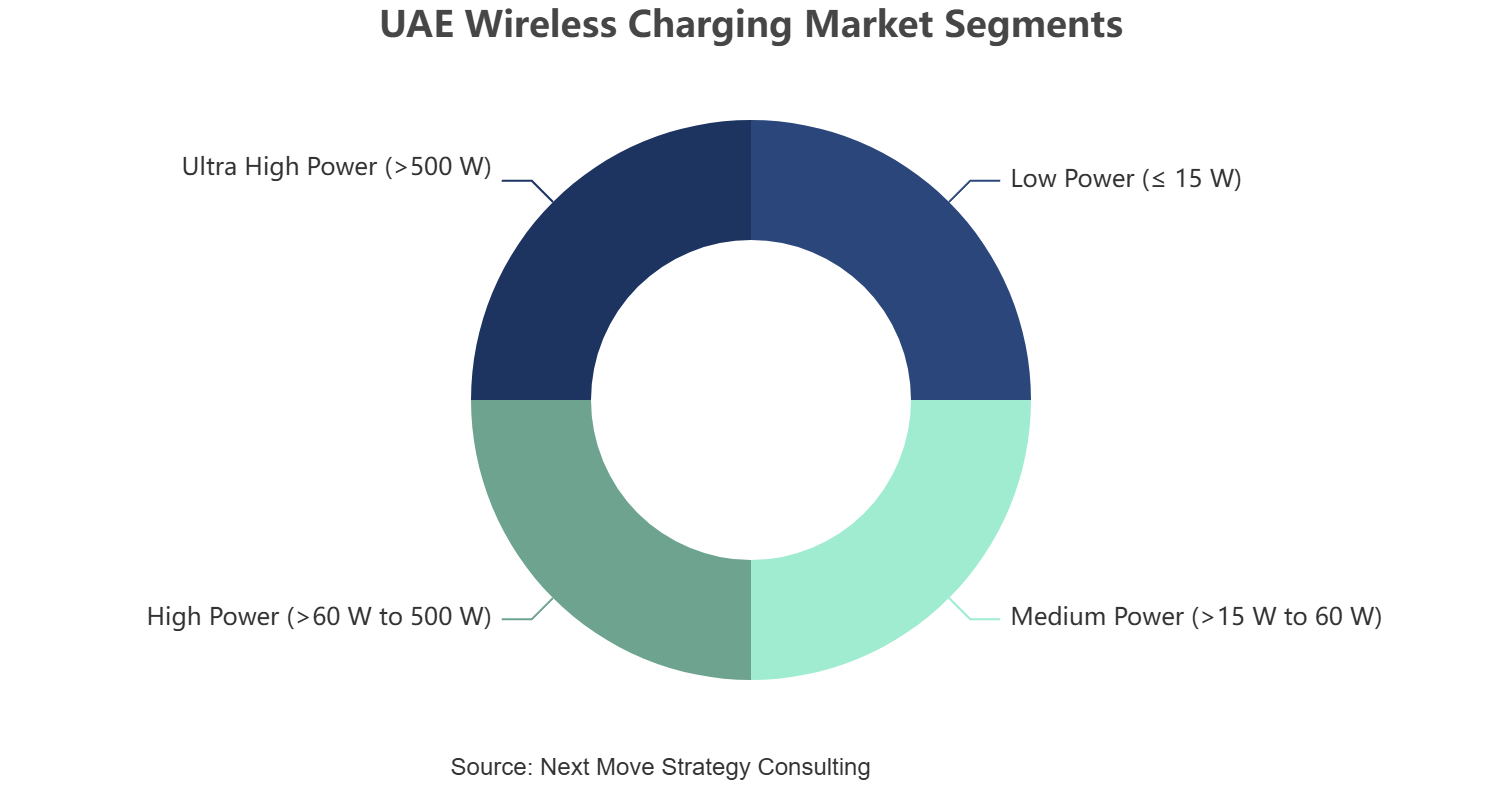
High Power (>60 W to 500 W)
-
Ultra High Power (>500 W)
By Application
-
Consumer Electronics
-
Smartphones and Tablets
-
Wearable
-
Laptops and Notebooks
-
Other Consumer Devices
-
-
Automotive
-
In-Vehicle Chargers
-
Stationary EV Charging
-
Dynamic EV Charging
-
-
Healthcare
-
Implantable Devices
-
Portable Equipment
-
-
Industrial
-
AGVs & AMRs
-
Robots
-
Tools & Machinery
-
Other Industrial Uses
-
-
Aerospace & Defense
-
UAVs
-
Military Equipment
-
-
Other Applications
By Distribution Channel
-
Online
-
Offline Retail
-
OEM Supply
-
Direct Enterprise
Competitive landscape
Competition in the UAE wireless charging market is shaped by premium branding, ecosystem compatibility, and channel reach rather than by price alone. Suppliers compete to embed charging functionality into devices, accessories, furniture, and enterprise environments while keeping pace with evolving consumer expectations. Strategic partnerships with distributors, OEMs, retailers, hospitality operators, and infrastructure developers are increasingly important because they expand visibility, strengthen adoption, and help vendors secure a more durable position across both consumer and commercial use cases.
Strategic Developments:
-
July 2025 - Huawei launched the Pura 80 Series in Dubai, UAE. The flagship smartphones include Huawei’s wireless charging technologies and contribute to the UAE market for wireless charging-enabled devices.
-
February 2025 - Samsung launched the Galaxy S25 Series in the UAE. The S25 family is positioned around Qi2-ready wireless charging compatibility, strengthening demand for wireless charging pads, stands, and magnetic accessories in the region.
Key players
-
Samsung Gulf Electronics FZE
-
Apple M E FZCO Dubai Branch
-
Huawei Technologies UAE L.L.C.
-
Task FZCO
-
OPPO Guangdong Mobile Telecommunications Corp., Ltd.
-
UGREEN Middle East FZE
-
Anker MEA - FZE
-
Motorola Mobility LLC
-
Sandberg A/S
-
GAO Tek Inc.
-
Design Pool Limited
-
Conductix-Wampfler Middle East FZE
-
Bang & Olufsen Middle East FZ-LLC
-
Shenzhen Torras Technology Co., Ltd.
-
Alogic FZCO
The competitive field is defined by a mix of consumer electronics leaders and specialized charging vendors that pursue different but overlapping opportunities. Samsung Gulf Electronics FZE, Apple M E FZCO Dubai Branch, Huawei Technologies UAE L.L.C., Task FZCO, OPPO Guangdong Mobile Telecommunications Corp., Ltd., UGREEN Middle East FZE, Anker MEA - FZE, Motorola Mobility LLC, Sandberg A/S, GAO Tek Inc., Design Pool Limited, Conductix-Wampfler Middle East FZE, Bang & Olufsen Middle East FZ-LLC, Shenzhen Torras Technology Co., Ltd., and Alogic FZCO collectively reinforce innovation, distribution depth, and premium market positioning.
Regulatory Framework Impacting the UAE Wireless Charging Market
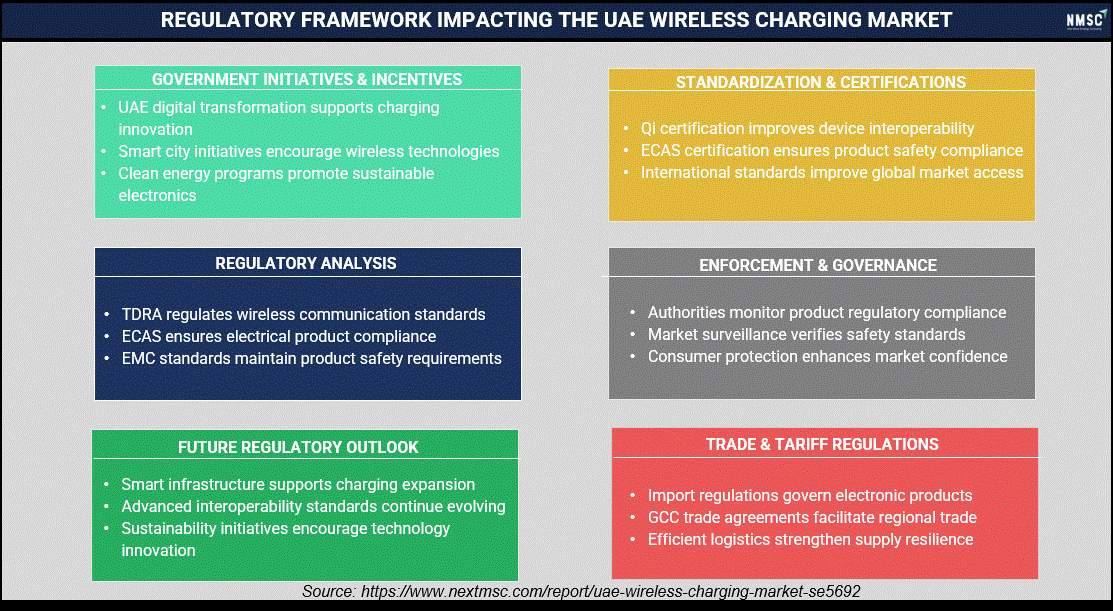
The UAE wireless charging market operates within a supportive regulatory environment that promotes technology innovation, product safety, and sustainable electronics adoption. Government-led smart city initiatives and clean energy programs encourage the deployment of advanced wireless technologies across consumer and commercial applications. Regulatory oversight, including compliance with telecommunications, electromagnetic compatibility, and product safety standards, helps ensure product reliability and consumer confidence. Certification requirements such as ECAS facilitate market access and quality assurance, while GCC trade agreements support the efficient movement of electronic products across the region. As the UAE continues investing in smart infrastructure and digital transformation, evolving interoperability and safety standards are expected to further strengthen the wireless charging ecosystem.
Key benefits for stakeholders
For investors and strategic planners, the UAE wireless charging market provides a clear view of how premium consumer demand, smart infrastructure, and enterprise adoption interact across the value chain. The report helps identify where higher margins, recurring contracts, and differentiated use cases are most likely to emerge. It also supports capital allocation by clarifying which technologies and channels can scale fastest in a market that rewards ecosystem fit, design quality, and deployment convenience rather than pure volume alone.
For manufacturers, distributors, and enterprise buyers, the report clarifies how application priorities and channel preferences influence purchasing decisions in the UAE. Consumer electronics brands can identify accessory and bundling opportunities, while hospitality, retail, and mobility operators can assess how embedded charging improves service design. Industrial and healthcare stakeholders can evaluate reliability and maintenance requirements. The analysis also supports partnership planning, product positioning, and go-to-market decisions across a market that values premium experiences and integrated infrastructure.
|
Parameters |
Details |
|
Customization scope |
Free customization equivalent to up to 80 analyst working hours after purchase. |
|
Pricing and purchase options |
Customized purchase options are available to match specific research requirements. |
|
Approach |
In-depth primary and secondary research, proprietary databases, and rigorous validation measures. |
|
Analytical tools |
Porter’s Five Forces, SWOT, value chain, and Harvey ball analysis. |
Conclusion
The UAE wireless charging market is expected to maintain strong momentum through 2035 as premium consumer demand, smart city investment, and ecosystem integration deepen across retail, hospitality, and mobility settings. While the country’s smaller population limits mass volume growth, the market continues to benefit from high-value applications and strong brand-led competition. Future opportunities will come from embedded charging experiences, enterprise deployments, and intelligent transport use cases that reward convenience, design, and seamless connectivity.
About the Author
 Mihul Sharma
— Mihul Sharma is Research Associate at Next Move Strategy Consulting, where he has covered technology, industrial, and healthcare markets for 3 years. His work applies structured business research, market analysis, and secondary-source review to assess market trends, competitive developments, and growth opportunities. He supports report development by fully synthesizing industry data, company information, and market signals into concise findings for strategy and investment-focused research teams.
Mihul Sharma
— Mihul Sharma is Research Associate at Next Move Strategy Consulting, where he has covered technology, industrial, and healthcare markets for 3 years. His work applies structured business research, market analysis, and secondary-source review to assess market trends, competitive developments, and growth opportunities. He supports report development by fully synthesizing industry data, company information, and market signals into concise findings for strategy and investment-focused research teams.
About the Reviewer
 Supradip Baul
— Supradip Baul is an accomplished business consultant and strategist with over a decade of rich experience in market intelligence, strategy, technology, and business transformation. His work has included rigorous qualitative and quantitative analysis across multiple industries, helping clients shape investment decisions and long-term roadmaps. Earlier in his career, he was associated with Gartner, where he contributed to industry-leading reports and market share analyses. He has worked with leading global companies and holds an MBA with a dual specialization in Marketing and Finance.
Supradip Baul
— Supradip Baul is an accomplished business consultant and strategist with over a decade of rich experience in market intelligence, strategy, technology, and business transformation. His work has included rigorous qualitative and quantitative analysis across multiple industries, helping clients shape investment decisions and long-term roadmaps. Earlier in his career, he was associated with Gartner, where he contributed to industry-leading reports and market share analyses. He has worked with leading global companies and holds an MBA with a dual specialization in Marketing and Finance.
At Next Move Strategy Consulting, we understand that insightful market research is the cornerstone of successful business decisions. That's why we employ a robust and multifaceted approach, combining various methodologies to deliver the most accurate and actionable data for our clients.

Research Landscape
We navigate the world of research with two primary approaches:
Qualitative Approach
Our qualitative research methodologies involve immersive techniques such as in-depth interviews, focus groups, and observational studies. By engaging directly with individuals and stakeholders, we uncover valuable insights that quantitative data alone may overlook.

Quantitative Research
In tandem with qualitative methodologies, NMSC leverages the power of Quantitative Research to provide a robust foundation of numerical insights. Through systematic data collection and analysis, we quantify patterns, preferences, and market trends, offering a comprehensive view of the business landscape.
Our quantitative research approach employs diverse tools, including surveys, experiments, and statistical modelling. These methodologies enable us to gather data from a large and representative sample, ensuring the statistical significance of our findings. By employing structured questionnaires and standardized data collection methods, we guarantee the reliability and validity of the information we present to our clients.
Quantitative research is particularly effective in measuring the prevalence of trends, assessing market size, and gauging the impact of various factors on consumer behavior. The numerical precision attained through this approach equips our clients with actionable insights, facilitating data-driven decision-making and strategy formulation.


Our Specialized Toolbox for Industry-Specific Market Research
We deploy a specialized arsenal of techniques tailored to meet your unique requirements. Here's a glimpse into our comprehensive toolbox:

Information Procurement
The stage entails acquiring market data or relevant information through various sources and methodologies.


Market Research Approach
We utilize both top-down and bottom-up approaches in market research analysis to achieve a comprehensive understanding of the market dynamics, leveraging the broad perspective of industry trends and macroeconomic factors alongside detailed insights from specific segments and individual companies.

Porters Five Forces Analysis
We conduct Porter's Five Forces analysis to evaluate the competitive landscape of an industry, providing us with insights into factors that affect profitability and strategic positioning.

SWOT Analysis

Forecasting
We utilize a forecasting model to predict future consumption by considering parameters like population, economics, regulations, market competition, drivers, constraints, technology, and pricing. We also employ statistical techniques such as multilinear regression, exponential smoothing, moving average, ARIMA, and Monte Carlo simulations for accurate predictions. In econometric forecasting, we analyzed short-term and long-term event impacts, attributing values based on regulatory frameworks, economic factors, and market events.





 Speak to Our Analyst