Vietnam Expense Management Software Market By Product Type (Travel & Expense, Corporate & Virtual Card, and Finance & ERP Embedded Modules), By Revenue Stream (Software, Professional Services, and Card & Payment), By Deployment Model (Cloud, On-premises, and Hybrid), By Functional Modules (Expense Capture & OCR, Policy Controls, Reconciliation, Analytics & Fraud Detection, & Others), By Pricing Model, By Enterprise Size, and By Industry Vertical – Opportunity Analysis & Forecast, 2026-2035
Industry: ICT & Media | Latest Edition: September 7, 2026 | No of Pages: 173 | No. of Tables: 62 | No. of Figures: 55 | Format: PDF | Report Code: IC4848
Vietnam Expense Management Software Market Size & Forecast
|
Parameters |
Details |
|
Market Size in 2026 |
USD 45.89 Million |
|
Revenue Forecast in 2035 |
USD 178.19 Million |
|
Growth Rate |
CAGR of 16.27% from 2026 to 2035 |
|
Analysis Period |
2025–2035 |
|
Base Year Considered |
2025 |
|
Forecast Period |
2026–2035 |
|
Market Size Estimation |
Million (USD) |
|
Companies Profiled |
15 |
|
Market Share |
Available for 10 companies |
Industry Outlook
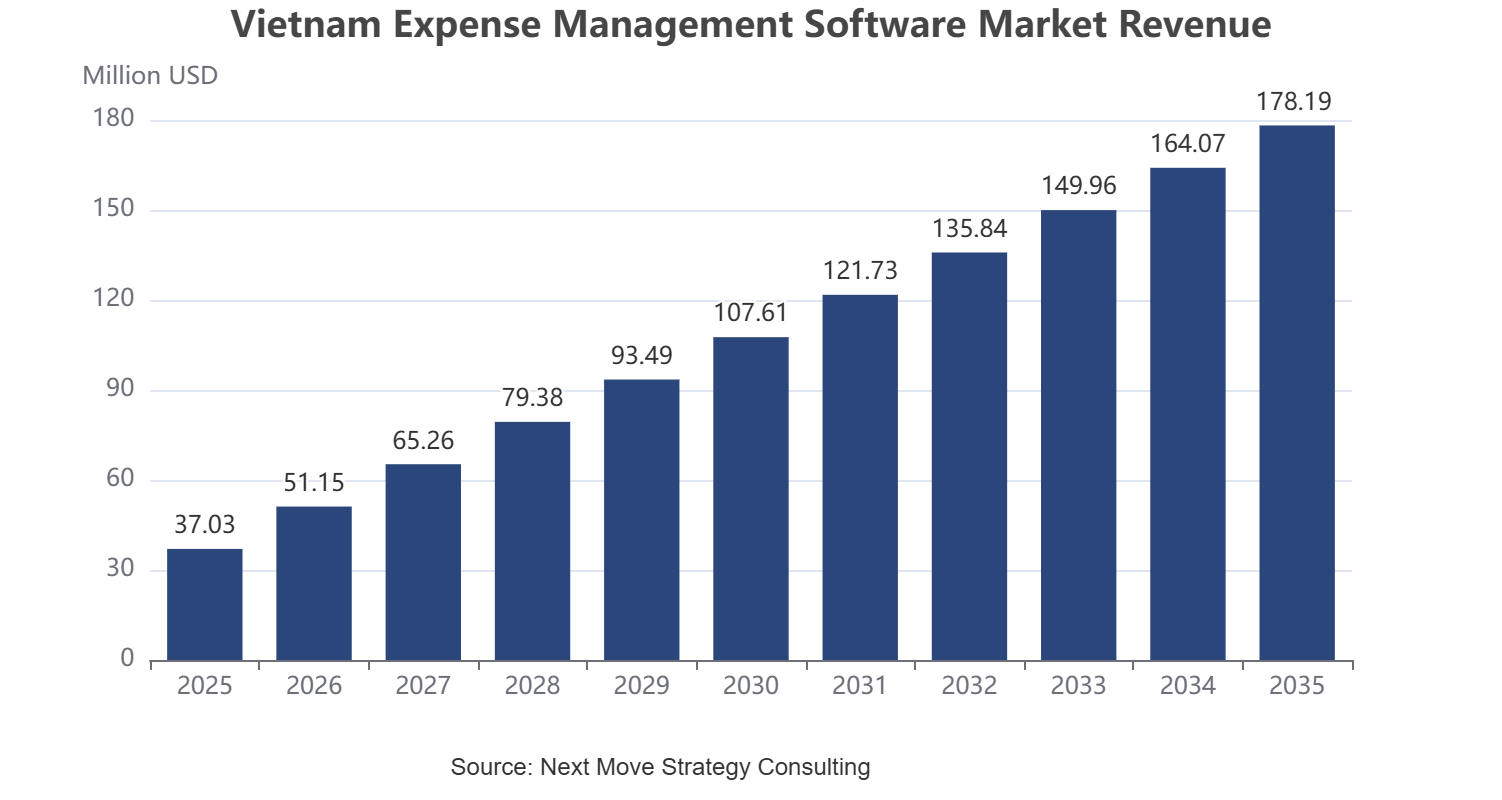
The Vietnam Expense Management Software Market size was valued at USD 37.03 Million in 2025 and is expected to reach USD 45.89 million by 2026. Looking ahead, the industry is projected to expand significantly, reaching USD 178.19 million by 2035, registering a CAGR of 16.27% from 2026 to 2035.
What are the Key Market Drivers, Breakthroughs, and Investment Opportunities that will Shape the Vietnam Expense Management Software Market in the Next Decade?
Growth Catalyst & Risk Assessment Matrix
|
DRIVERS / TRENDS / RESTRAINTS |
(+/-) % IMPACT ON CAGR FORECAST |
GEOGRAPHIC RELEVANCE |
IMPACT TIMELINE |
|
Rapid business expansion and FDI-led modernization accelerate adoption of automated expense management platforms |
+3.88% |
Ho Chi Minh City, Hanoi, Binh Duong, Bac Ninh, major export manufacturing and FDI corridors |
Medium to Long term (3–6 years) |
|
Increasing digital finance adoption among SMEs supports growth of SaaS-based expense management solutions |
+3.36% |
Ho Chi Minh City, Hanoi, Da Nang, Can Tho, expanding SME and startup ecosystems nationwide |
Medium term (2–5 years) |
|
Evolving data governance, cybersecurity compliance, and financial digitization requirements increase demand for localized expense management systems |
+3.52% |
Nationwide with stronger impact in regulated enterprise sectors and major economic zones |
Medium to Long term (3–6 years) |
|
Limited internal expertise and lack of finance workflow automation capabilities slow effective software implementation |
-3.41% |
SME-dominated provinces and developing business regions outside primary metropolitan hubs |
Short to Medium term (1–4 years) |
|
Offer packaged deployment, localized onboarding, and SME-focused training services to accelerate software adoption |
+2.97% |
Tier 1 and Tier 2 business cities including Ho Chi Minh City, Hanoi, Hai Phong, Da Nang |
Medium to Long term (3–6 years) |
The Vietnam expense management software market is evolving steadily as enterprises, SMEs, and foreign-invested businesses accelerate finance modernization and transition toward cloud-based operational ecosystems. Through our market assessment, we observed that rapid business expansion and rising FDI inflows are driving demand for automated expense management platforms that improve spend visibility, policy enforcement, audit readiness, and cross-department financial control, while increasing digital finance adoption among SMEs is strengthening growth for SaaS-based expense solutions offering scalable and cost-efficient deployment. We also identified that evolving cybersecurity regulations, data localization requirements, and financial compliance standards are encouraging organizations to adopt locally compliant and secure expense management systems integrated with accounting and ERP workflows. However, limited internal expertise and insufficient workflow automation capabilities continue to slow implementation across smaller and less digitally mature enterprises. Looking ahead, strong growth opportunities are expected to emerge through packaged deployment models, localized onboarding services, AI-enabled automation, and SME-focused training programs that simplify implementation complexity and support broader finance transformation across Vietnam's expanding digital economy.
Growth Drivers:
How Is Rapid Business Expansion and FDI-Led Modernization Accelerating the Vietnam Expense Management Software Market?
Vietnam's strong economic expansion, rising foreign direct investment (FDI), and rapid industrial modernization are significantly accelerating the Vietnam expense management software market. Multinational corporations entering Vietnam's manufacturing, retail, logistics, and technology sectors are introducing stricter financial governance standards, centralized reporting structures, and automated compliance systems. As regional supply chains expand, businesses are increasingly managing cross-border employee reimbursements, travel spending, procurement expenses, and vendor payments, creating demand for scalable cloud-based expense management platforms. Additionally, foreign-invested enterprises are pushing local subsidiaries and suppliers toward digitized financial workflows to improve operational transparency and audit readiness. Vietnam's broader digital economy ambitions and enterprise modernization initiatives are also encouraging organizations to move away from paper-based accounting and fragmented spreadsheets. This transition supports real-time expense visibility, automated approval workflows, and integration with ERP and accounting ecosystems. As enterprise complexity increases alongside investment inflows, expense management software is becoming a critical operational tool for financial control, compliance monitoring, and scalable business expansion across Vietnam.
How Is Increasing Digital Finance Adoption Among SMEs Supporting SaaS Growth in the Vietnam Expense Management Software Market?
The growing adoption of digital finance solutions among Vietnamese SMEs is creating a strong foundation for SaaS-based Vietnam expense management software market expansion. Small and medium enterprises are increasingly embracing digital banking, e-invoicing, cloud accounting, QR-based payments, and mobile finance applications to improve efficiency and reduce administrative burdens. This shift is encouraging businesses to integrate automated expense tracking and reimbursement tools into broader digital finance ecosystems. SaaS-based expense management platforms are particularly attractive for SMEs because they offer low upfront costs, subscription-based pricing, remote accessibility, and rapid deployment without large IT investments. As Vietnamese SMEs continue digitizing financial operations, demand is rising for platforms that can automate approvals, simplify tax documentation, reduce fraud risk, and provide real-time spend visibility. Additionally, younger digitally oriented business owners are more willing to adopt cloud-native financial systems compared to legacy on-premise infrastructure. The expansion of fintech ecosystems and government-backed digital transformation efforts further strengthens confidence in cloud financial tools, accelerating the transition toward subscription-driven expense management platforms across Vietnam's growing SME sector.
How Are Data Localization and Regulatory Requirements Driving Demand for Localized Expense Management Platforms in Vietnam?
Vietnam's tightening cybersecurity, personal data protection, and localization regulations are becoming a major structural driver shaping the expense management software market. Businesses handling financial records, employee reimbursement data, payment information, and digital transaction histories increasingly require software platforms capable of complying with Vietnam's evolving data governance framework. Regulations under the Cybersecurity Law, Decree 53/2022, and subsequent digital governance measures require certain categories of user and financial data to be stored locally, while imposing stricter controls over cross-border data transfers. These requirements are pushing enterprises to prioritize locally compliant cloud infrastructure, Vietnamese-hosted platforms, and region-specific SaaS deployments. As compliance obligations intensify, organizations are investing in expense management solutions that provide audit trails, secure data storage, policy-based approvals, and localization support aligned with domestic accounting and tax standards. The regulatory environment is also encouraging partnerships between global software providers and local implementation firms to ensure compliance readiness. Consequently, regulatory pressure is not only increasing software adoption but also accelerating the development of localized enterprise finance ecosystems within Vietnam.
Growth Inhibitor:
How Does Limited Internal Expertise Restrict Adoption of Expense Management Software in Vietnam?
Limited internal technical expertise remains a significant barrier to effective expense management software adoption among Vietnamese enterprises, particularly SMEs and traditionally managed businesses. Many organizations still lack experienced finance transformation teams capable of configuring automated approval workflows, integrating accounting systems, designing policy controls, and managing employee onboarding for digital expense platforms. As a result, businesses often face implementation delays, workflow mismatches, compliance gaps, and underutilization of advanced analytics features after deployment. Smaller firms especially struggle with change management, digital process redesign, and staff training, making them hesitant to replace familiar manual reimbursement practices. In some cases, organizations purchase software solutions without fully understanding policy configuration requirements, resulting in inefficient adoption and low return on investment. Additionally, varying levels of digital maturity across sectors create inconsistencies in operational readiness for SaaS-based financial systems. This skills gap increases dependence on external consultants and implementation partners, raising deployment costs and slowing market penetration, particularly outside Vietnam's largest urban business hubs such as Ho Chi Minh City and Hanoi.
Growth Opportunity:
How Can Packaged Deployment and Training-Led Onboarding Create New Growth Opportunities in the Vietnam Expense Management Software Market?
Providing packaged deployment models combined with structured onboarding and training services represents a major growth opportunity for vendors operating in the Vietnam expense management software market. Many SMEs are interested in digitizing finance operations but remain discouraged by implementation complexity, lack of technical expertise, and uncertainty around workflow configuration. Vendors that offer simplified deployment bundles, preconfigured expense policies, localized compliance templates, and guided onboarding can significantly reduce adoption barriers for first-time software users. Training-led service models can also improve long-term customer retention by helping employees understand reimbursement workflows, approval automation, mobile receipt capture, and reporting dashboards. Furthermore, localized Vietnamese-language support and industry-specific onboarding packages for sectors such as manufacturing, retail, logistics, and professional services can create competitive differentiation. As regulatory requirements surrounding financial reporting, cybersecurity, and digital accounting continue evolving, enterprises increasingly value implementation partners that provide both software and operational guidance. This creates strong opportunities for SaaS providers, fintech firms, and system integrators to position training-enabled deployment services as a core value-added offering in Vietnam's expanding digital finance ecosystem.
Strategic Framework Of The Vietnam Expense Management Software Market
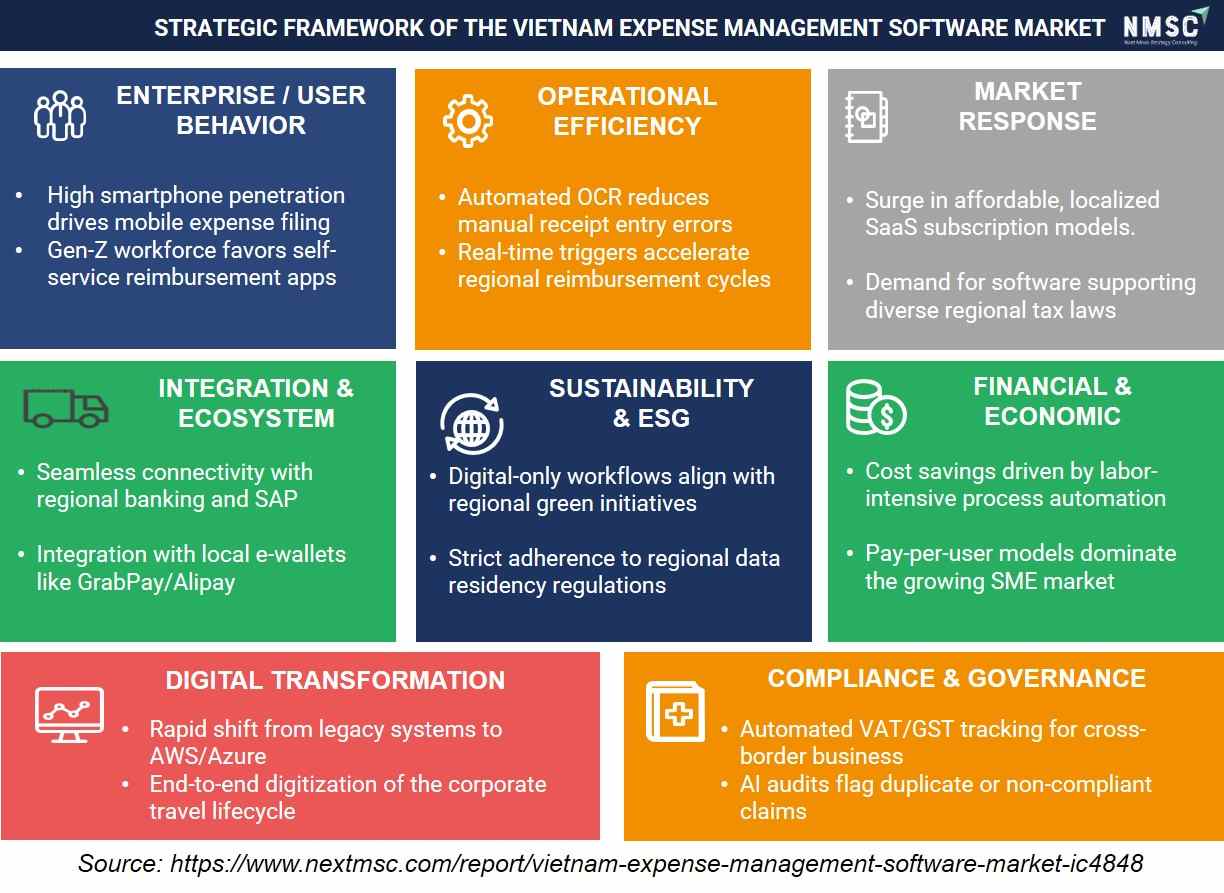
Through our market assessment of the Vietnam expense management software market, we observed that enterprise and user behavior is characterized by high smartphone penetration driving mobile expense filing, alongside a Gen Z workforce that increasingly favors self-service reimbursement apps over traditional paper-based processes. Our analysis shows that operational efficiency is being transformed through automated optical character recognition that reduces manual receipt entry errors, while real-time triggers accelerate regional reimbursement cycles across Vietnam's geographically dispersed business centers. NMSC's findings indicate that market response has featured a surge in affordable, localized software-as-a-service subscription models, coupled with growing demand for software supporting diverse regional tax laws across different provinces. From our assessment, integration and ecosystem developments emphasize seamless connectivity with regional banking and SAP systems, as well as integration with local e-wallets such as MoMo, ZaloPay, VNPay, and Viettel Money to facilitate instant reimbursements. Our analysis further reveals that sustainability and environmental, social, and governance considerations are gaining traction, with digital-only workflows aligning with regional green initiatives and strict adherence to regional data residency regulations becoming a competitive differentiator. On the financial and economic front, we observe cost savings driven by labor-intensive process automation, while pay-per-user models increasingly dominate the growing small and medium enterprise segment. NMSC's assessment of digital transformation confirms a rapid shift from legacy systems to cloud infrastructure providers such as Amazon Web Services and Microsoft Azure, alongside end-to-end digitization of the corporate travel lifecycle from booking to settlement. Finally, our findings on compliance and governance indicate that automated value-added tax and goods-and-services tax tracking for cross-border business operations, combined with artificial intelligence-driven audits that flag duplicate or non-compliant claims, are becoming essential platform capabilities for vendors operating in Vietnam.
How is the Vietnam Expense Management Software Market segmented in this report, and what are the key insights from the segmentation analysis?
By Industry Vertical Insights
How Are Industry Verticals Influencing Demand Patterns in the Vietnam Expense Management Software Market?
Based on industry vertical segmentation, the Vietnam expense management software market is structured into BFSI, Information Technology and Telecom, Manufacturing and Industrials, Retail and E-commerce, Healthcare and Life Sciences, Government and Public Sector, Hospitality, Travel and Leisure, Energy and Utilities, Education and Non-Profit, Transportation and Logistics, Professional Services and Consulting, and Other Industries.
Through our market assessment, it is observed that industry-specific operational complexity and compliance requirements are significantly shaping software adoption patterns across Vietnam. BFSI organizations increasingly prioritize audit-ready expense governance and automated policy enforcement, while Information Technology and Telecom companies are accelerating demand for mobile-first and cloud-based reimbursement platforms supporting distributed workforces. Our analysis shows that Manufacturing and Industrials, along with Transportation and Logistics sectors, are emphasizing integrated expense tracking and procurement visibility to improve cost control across supply chains. NMSC's findings suggest that Retail and E-commerce, Hospitality, Travel and Leisure, and Professional Services sectors are increasingly adopting real-time spend analytics and automated travel reconciliation capabilities to support workforce scalability and operational efficiency. Meanwhile, Healthcare and Life Sciences, Government and Public Sector, Energy and Utilities, Education and Non-Profit, and other industries are strengthening adoption of secure, compliance-focused SaaS platforms that enhance transparency, workflow standardization, and financial accountability across evolving enterprise ecosystems in Vietnam.
By Product Type Insights
How Are Product Categories Reshaping the Vietnam Expense Management Software Market in 2025?
Based on product type segmentation, the Vietnam expense management software market is categorized into Travel and Expense Management Platform, Corporate and Virtual Card Platform, and Finance and ERP Embedded Expense Modules.
Through our market assessment, it is observed that product type dynamics in Vietnam's expense management software market are increasingly influenced by enterprise priorities around automation, financial visibility, and integrated spend governance. Travel and Expense Management Platforms continue to witness strong adoption among enterprises seeking streamlined reimbursement workflows, mobile expense capture, travel policy enforcement, and faster approval cycles across distributed workforces. Our analysis shows that Corporate and Virtual Card Platforms are gaining traction as organizations prioritize transaction traceability, controlled employee spending, and automated reconciliation within expanding digital payment ecosystems. NMSC's findings suggest that Finance and ERP Embedded Expense Modules are increasingly preferred by businesses pursuing centralized finance modernization, as these solutions enable seamless integration with accounting, procurement, payroll, and compliance functions. Additionally, growing demand for unified SaaS-based finance ecosystems is encouraging vendors to offer AI-enabled analytics, localized integration support, and scalable deployment capabilities tailored to Vietnam's evolving enterprise digitalization landscape.
Competitive Landscape
The competitive landscape of the Vietnam expense management software industry is moderately fragmented, with a combination of global enterprise software providers, regional fintech firms, and emerging domestic SaaS platforms competing across enterprise and SME customer segments. Market competition is increasingly shaped by accelerating enterprise digitalisation, rising cross-border business travel, expanding embedded finance and payment integration capabilities, and growing demand for automated compliance management. Through our assessment, we observe that cloud-native deployment models, AI-enabled expense analytics, mobile-first reimbursement systems, and integration with ERP and HRMS ecosystems are becoming key competitive differentiators. Vendors are also strengthening localisation capabilities to address Vietnam's evolving e-invoicing, tax reporting, and data governance requirements.
Strategic Developments:
-
December 2025 – SAP Vietnam partnered with FPT Group to implement SAP S/4HANA Public Cloud for Phu Tai Joint Stock Company. This is the largest ERP cloud project in Vietnam's materials industry, aimed at centralizing financial management and controlling costs across seven member companies.
-
September 2025 – Bizzi promoted its “Bizzi Expense & Travel” solution as a direct response to Vietnam's Resolution 68, which aims to cut administrative procedures and compliance costs for private enterprises by 30%.
Key Players of the Vietnam Expense Management Software Market
-
Paylocity Holding Corporation
-
Airwallex Pty Ltd
-
Oracle Vietnam Company Limited
-
Microsoft Vietnam Company Limited
-
AppotaPay (via Xendit Inc.)
-
Bizzi Vietnam LLC
-
Zoho Corporation Pvt. Ltd.
-
Base Enterprise Joint Stock Company
-
Aspire FT Pte. Ltd.
-
Akrivia Automation Private Limited
-
Yomly Technologies LLC
-
SAP Vietnam Co., Ltd.
Competitive intensity in the Vietnam expense management software market is expected to increase as vendors expand platform interoperability, embedded payments functionality, and AI-driven automation capabilities to strengthen enterprise retention and SME penetration. Through our analysis, multinational technology providers such as Paylocity Holding Corporation, BILL Operations, LLC, Airwallex Pty Ltd, SAP Vietnam Co., Ltd., Oracle Vietnam Company Limited, and Microsoft Vietnam Company Limited continue leveraging broad enterprise ecosystems and cloud infrastructure advantages, while regional and domestic players including AppotaPay, Bizzi Vietnam LLC, Zoho Corporation Pvt. Ltd., Odoo HK Limited, Base Enterprise Joint Stock Company, Aspire FT Pte. Ltd., Akrivia Automation Private Limited, and Yomly Technologies LLC are increasingly focusing on localisation, API-led integrations, and affordable subscription models to strengthen competitiveness among mid-market enterprises and digitally transforming businesses.
Consumer Behavior Analysis of the Vietnam Expense Management Software Market
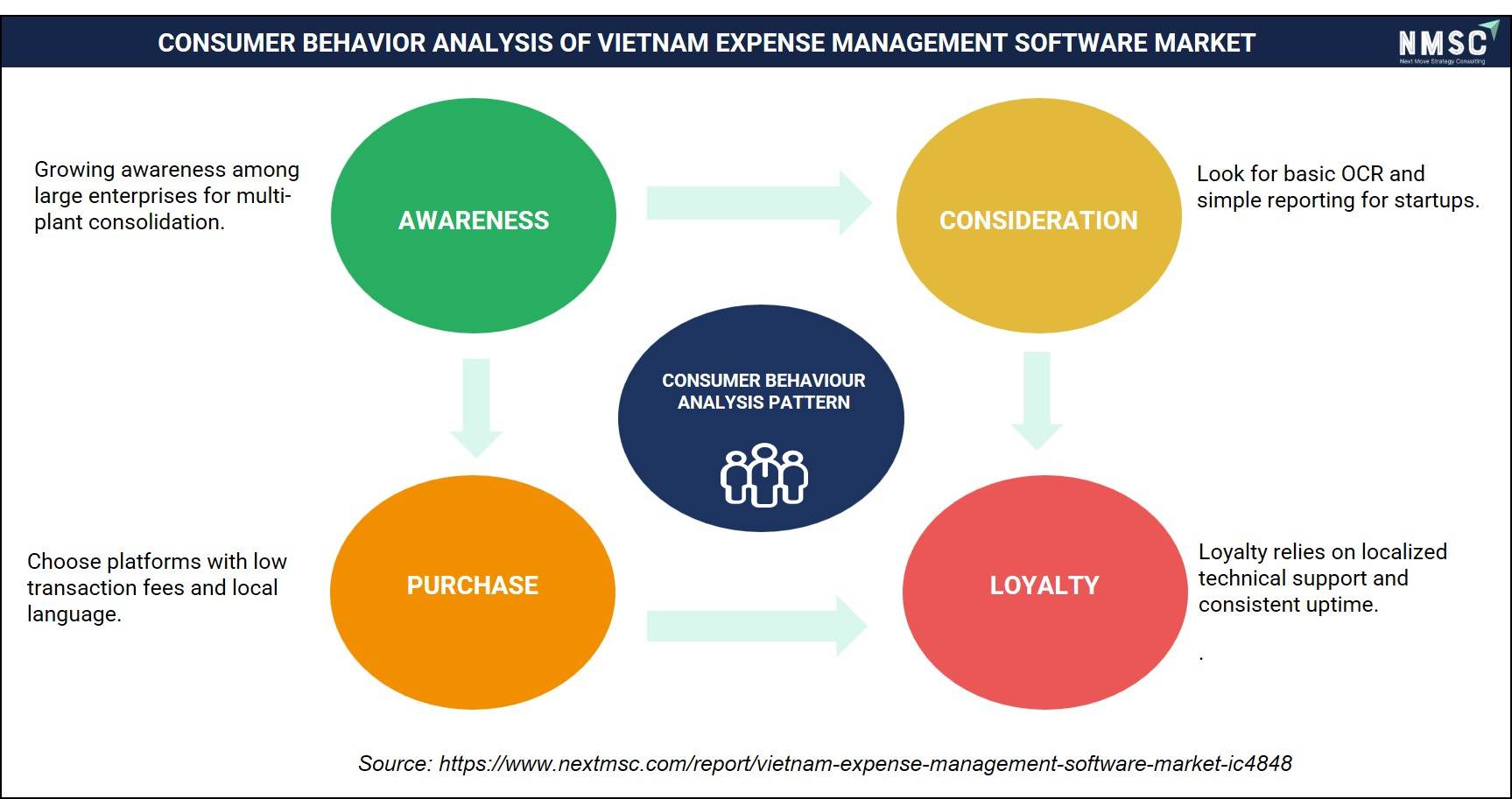
The consumer behavior analysis of the Vietnam expense management software market follows a four-stage journey shaped by distinct enterprise priorities. In the Awareness stage, growing recognition among large enterprises regarding the need for multi-plant consolidation serves as the primary driver for seeking expense management solutions. As buyers move to the Consideration phase, their focus shifts to evaluating platforms based on low transaction fees and the availability of local language support, which become critical decision-making factors. At the Purchase stage, these considerations directly influence the final selection, with cost efficiency and Vietnamese-language usability playing decisive roles. Finally, post-purchase Loyalty is established and sustained through localized technical support and consistent system uptime, ensuring that enterprises remain committed to their chosen platforms over time. This behavioral pattern highlights that while initial awareness stems from operational consolidation needs, long-term customer retention in Vietnam depends heavily on ongoing service quality rather than just product features.
Vietnam Expense Management Software Market Key Segments
By Product Type
-
Travel and Expense Management Platform
-
Corporate and Virtual Card Platform
-
Finance and ERP Embedded Expense Modules
By Revenue Stream
-
Software and License Revenue
-
Professional Services Revenue
-
Implementation and Integration
-
Consulting and Training
-
Managed and Support Services
-
Transactional Processing and BPO
-
-
Card and Payment Revenue
-
Interchange and Card Revenue Share
-
Card Processing Commissions and Fees
-
Card Platform Fees
-
By Deployment Model
-
Cloud
-
On-premises
-
Hybrid
By Functional Modules
-
Expense Capture and Receipt OCR
-
Policy Controls and Approval Workflow
-
Reconciliation and Matching
-
Dispute and Exception Management
-
Ordering and Provisioning Inventory
-
Usage Monitoring and Chargeback
-
Analytics, Audit and Fraud Detection
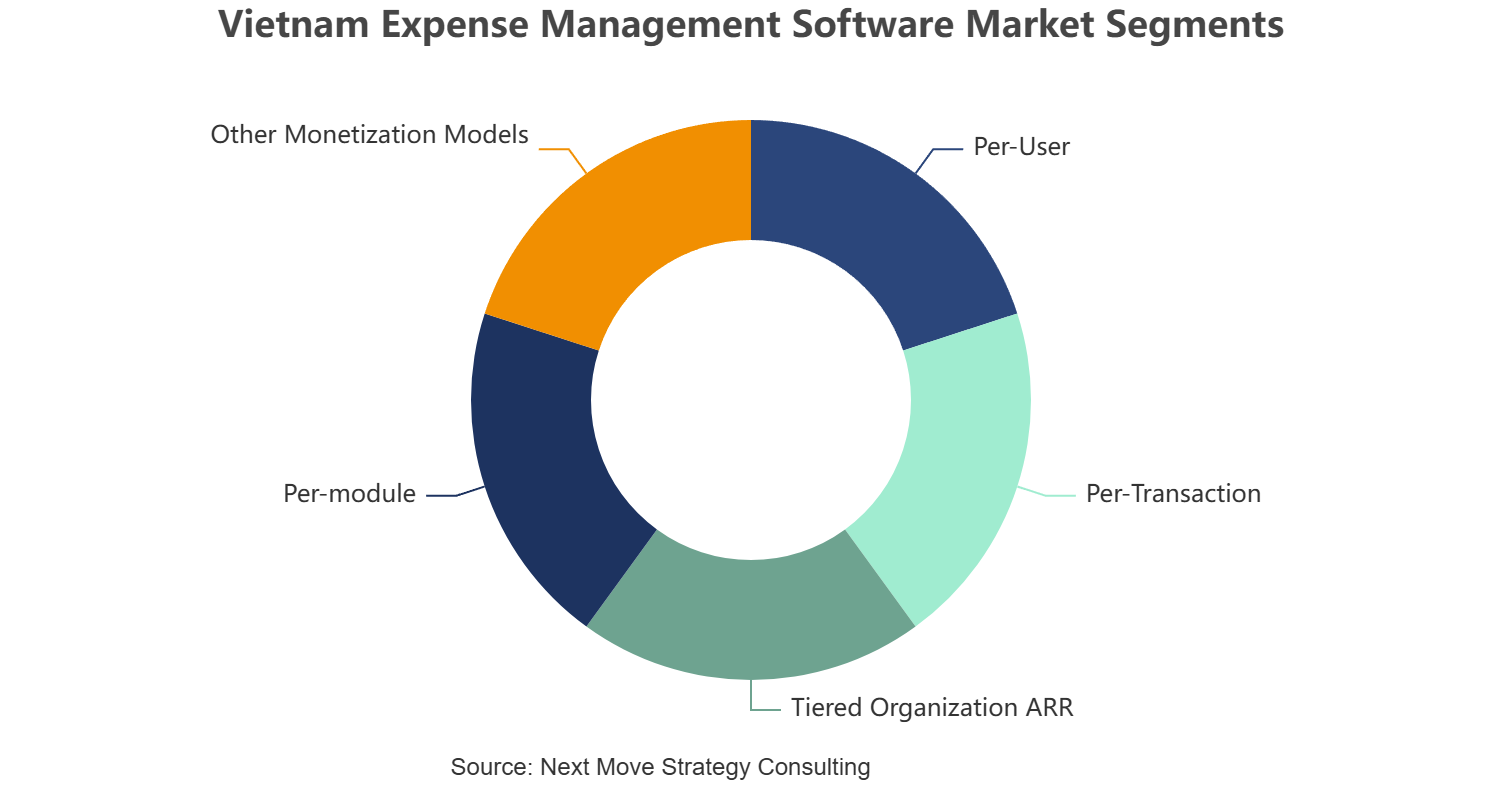
By Pricing Model
-
Per-User
-
Per-Transaction
-
Tiered Organization ARR
-
Per-module
-
Other Monetization Models
By Enterprise Size
-
SMEs
-
Large Enterprise
By Industry Vertical
-
BFSI
-
Information Technology and Telecom
-
Manufacturing and Industrials
-
Retail and E-commerce
-
Healthcare and Life Sciences
-
Government and Public Sector
-
Hospitality, Travel and Leisure
-
Energy and Utilities
-
Education and Non-Profit
-
Transportation and Logistics
-
Professional Services and Consulting
-
Other Industries
Key Benefits for Stakeholders:
Next Move Strategy Consulting (NMSC) presents a comprehensive analysis of the Vietnam expense management software market trends, covering historical developments from 2020 to 2025 and providing forward-looking forecasts through 2035. The study evaluates the market at national and enterprise levels, delivering qualitative insights into cloud adoption, AI-enabled financial automation, regulatory compliance evolution, and enterprise digital transformation shaping expense governance across industries.
Based on our assessment of the Vietnam expense management software market, we observe strong multi-stakeholder value creation driven by enterprise digital transformation and evolving financial governance requirements. Investors benefit from scalable recurring-revenue SaaS models, expanding SME adoption, and rising demand for AI-enabled finance automation solutions that improve long-term revenue visibility. Customers gain operational efficiency through automated reimbursement workflows, stronger spend transparency, improved fraud monitoring, and enhanced employee experience across travel and expense processes. From a policy perspective, regulators and policymakers benefit from digitized audit trails, improved tax compliance support, and greater financial transparency, aligning with Vietnam's broader digital economy and electronic invoicing initiatives.
|
Parameters |
Details |
|
Customization Scope |
Free customization (equivalent to up to 80 analyst-working hours) after purchase. |
|
Pricing and Purchase Options |
Avail customized purchase options to meet your exact research needs. |
|
Approach |
In-depth primary and secondary research; proprietary databases; rigorous quality control and validation measures. |
|
Analytical Tools |
Porter's Five Forces, SWOT, value chain, and Harvey ball analysis to assess competitive intensity, stakeholder roles, and relative impact of key factors. |
About the Author
 Ridip Gogoi
— Ridip Gogoi is a Research Associate at Next Move Strategy Consulting, where he supports cross-vertical market research and analysis across multiple industry sectors, with four years of experience. His work includes market analysis, data validation, secondary research, and insight development, helping structure evidence into clear findings for business and strategy decisions. He contributes to research quality checks and reporting, with a focus on consistency, source review, and clarity accuracy.
Ridip Gogoi
— Ridip Gogoi is a Research Associate at Next Move Strategy Consulting, where he supports cross-vertical market research and analysis across multiple industry sectors, with four years of experience. His work includes market analysis, data validation, secondary research, and insight development, helping structure evidence into clear findings for business and strategy decisions. He contributes to research quality checks and reporting, with a focus on consistency, source review, and clarity accuracy.
About the Reviewer
 Supradip Baul
— Supradip Baul is an accomplished business consultant and strategist with over a decade of rich experience in market intelligence, strategy, technology, and business transformation. His work has included rigorous qualitative and quantitative analysis across multiple industries, helping clients shape investment decisions and long-term roadmaps. Earlier in his career, he was associated with Gartner, where he contributed to industry-leading reports and market share analyses. He has worked with leading global companies and holds an MBA with a dual specialization in Marketing and Finance.
Supradip Baul
— Supradip Baul is an accomplished business consultant and strategist with over a decade of rich experience in market intelligence, strategy, technology, and business transformation. His work has included rigorous qualitative and quantitative analysis across multiple industries, helping clients shape investment decisions and long-term roadmaps. Earlier in his career, he was associated with Gartner, where he contributed to industry-leading reports and market share analyses. He has worked with leading global companies and holds an MBA with a dual specialization in Marketing and Finance.
At Next Move Strategy Consulting, we understand that insightful market research is the cornerstone of successful business decisions. That's why we employ a robust and multifaceted approach, combining various methodologies to deliver the most accurate and actionable data for our clients.

Research Landscape
We navigate the world of research with two primary approaches:
Qualitative Approach
Our qualitative research methodologies involve immersive techniques such as in-depth interviews, focus groups, and observational studies. By engaging directly with individuals and stakeholders, we uncover valuable insights that quantitative data alone may overlook.

Quantitative Research
In tandem with qualitative methodologies, NMSC leverages the power of Quantitative Research to provide a robust foundation of numerical insights. Through systematic data collection and analysis, we quantify patterns, preferences, and market trends, offering a comprehensive view of the business landscape.
Our quantitative research approach employs diverse tools, including surveys, experiments, and statistical modelling. These methodologies enable us to gather data from a large and representative sample, ensuring the statistical significance of our findings. By employing structured questionnaires and standardized data collection methods, we guarantee the reliability and validity of the information we present to our clients.
Quantitative research is particularly effective in measuring the prevalence of trends, assessing market size, and gauging the impact of various factors on consumer behavior. The numerical precision attained through this approach equips our clients with actionable insights, facilitating data-driven decision-making and strategy formulation.


Our Specialized Toolbox for Industry-Specific Market Research
We deploy a specialized arsenal of techniques tailored to meet your unique requirements. Here's a glimpse into our comprehensive toolbox:

Information Procurement
The stage entails acquiring market data or relevant information through various sources and methodologies.


Market Research Approach
We utilize both top-down and bottom-up approaches in market research analysis to achieve a comprehensive understanding of the market dynamics, leveraging the broad perspective of industry trends and macroeconomic factors alongside detailed insights from specific segments and individual companies.

Porters Five Forces Analysis
We conduct Porter's Five Forces analysis to evaluate the competitive landscape of an industry, providing us with insights into factors that affect profitability and strategic positioning.

SWOT Analysis

Forecasting
We utilize a forecasting model to predict future consumption by considering parameters like population, economics, regulations, market competition, drivers, constraints, technology, and pricing. We also employ statistical techniques such as multilinear regression, exponential smoothing, moving average, ARIMA, and Monte Carlo simulations for accurate predictions. In econometric forecasting, we analyzed short-term and long-term event impacts, attributing values based on regulatory frameworks, economic factors, and market events.





 Speak to Our Analyst