Could Waveguide Display Technology Define the Future of AR Glasses in 2026?
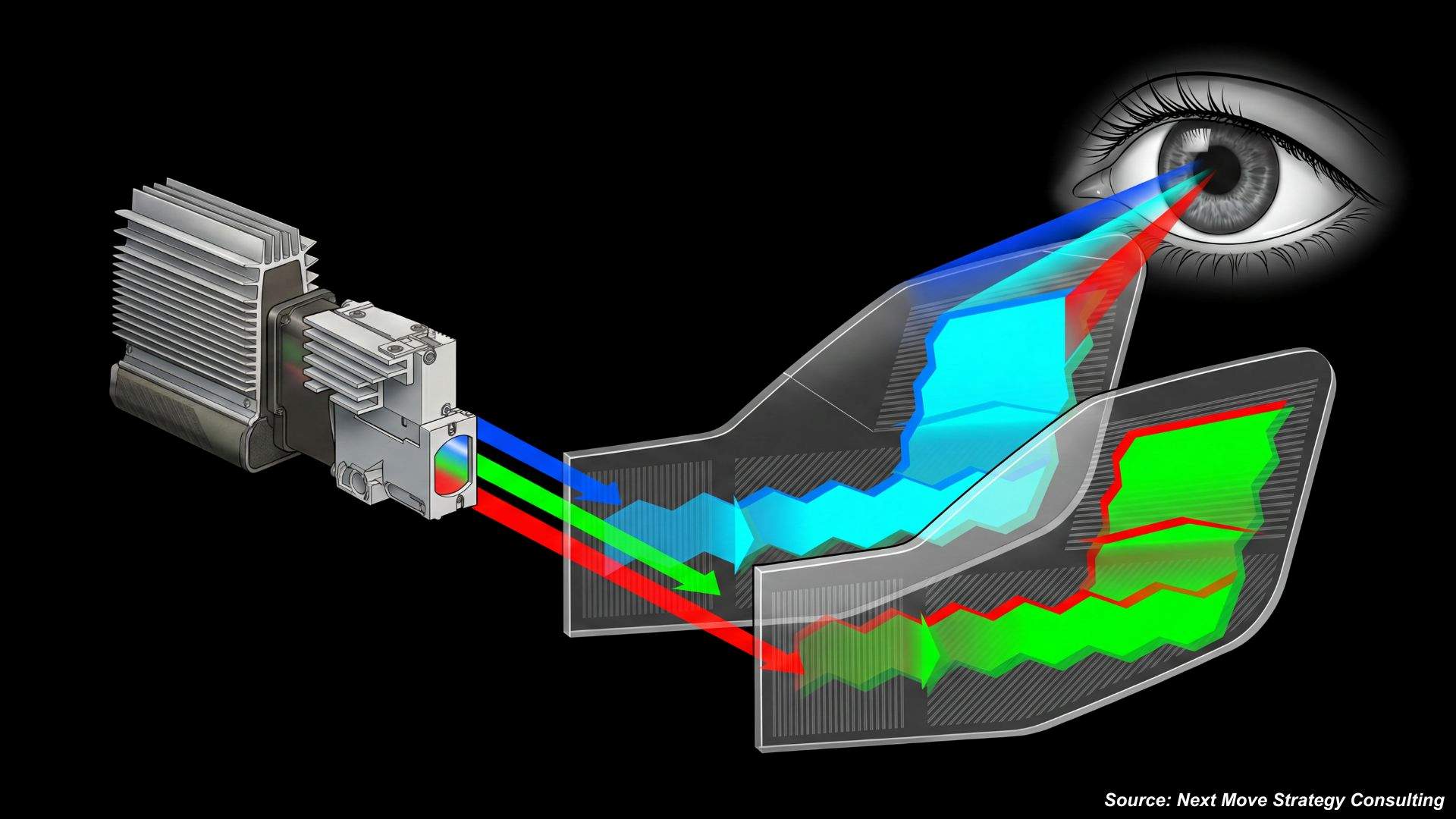
Waveguide Display Market is becoming one of the most critical innovations shaping the augmented reality (AR) industry in 2026. As major technology companies continue investing in smart glasses and wearable computing, waveguide optics are emerging as the foundation enabling lightweight, energy-efficient, and commercially scalable AR devices.
The industry has recently witnessed two major developments that signal a transition from experimental AR hardware toward large-scale commercialization. SCHOTT, working alongside Lumus, is widely recognized as the likely waveguide supplier behind Meta’s Ray-Ban Display glasses. At the same time, AAC Technologies announced the acquisition of Dispelix to accelerate the global commercialization of diffractive waveguide technology.
These developments matter because the AR industry is no longer focused only on innovation labs and prototypes. The conversation has shifted toward manufacturing scalability, optical efficiency, and supply chain readiness. For investors, enterprise buyers, and technology strategists, waveguide displays are increasingly viewed as a core enabling technology for the future of wearable computing.
How Is Waveguide Display Technology Reshaping the AR Industry?
Waveguide displays are transparent optical layers that guide projected digital images into the user’s eyes while maintaining the appearance and comfort of regular glasses. Unlike bulky VR headsets, waveguide-based AR glasses aim to deliver immersive experiences in a compact and wearable format.
The current market is primarily divided between geometric reflective waveguides and diffractive waveguides. SCHOTT and Lumus are advancing geometric reflective optics, while Dispelix specializes in diffractive waveguide solutions.
|
Technology Type |
Major Companies |
Primary Advantage |
Main Limitation |
|
Geometric Reflective |
SCHOTT, Lumus |
Higher light efficiency |
Complex production |
|
Diffractive Waveguides |
Dispelix |
Thin optical structure |
Lower light efficiency |
According to Road to VR, SCHOTT believes geometric reflective waveguides offer superior energy efficiency compared to competing technologies. This advantage is particularly important because AR glasses operate within extremely limited thermal and battery constraints. More efficient optics help reduce power consumption while enabling smaller displays and lighter hardware designs.
However, diffractive waveguides continue to attract attention due to their ability to integrate into thinner optical systems. AAC Technologies’ acquisition of Dispelix reflects growing confidence that diffractive optics still have an important role in next-generation wearable displays.

Major Trends Shaping the Present Waveguide Display Landscape
One of the biggest trends in 2025 is the industry’s movement toward mass-production readiness. SCHOTT announced that it became the first company capable of producing geometric reflective waveguides at consumer-scale manufacturing volumes. This milestone is significant because scalability has long been one of the largest barriers preventing AR glasses from entering mainstream markets.
The company also expanded its optical manufacturing infrastructure with a new factory dedicated to supplying high-quality AR components. This reflects a broader industry trend in which manufacturing capability is becoming just as important as optical innovation itself.
Another major trend is the push toward wider field-of-view (FoV) experiences. Current Ray-Ban Display glasses reportedly operate with a relatively narrow 20° FoV. SCHOTT and Lumus claim their technology can support significantly wider immersive viewing experiences in future devices. Lumus previously demonstrated a 50° field-of-view concept, showing how the industry is aiming to create more immersive wearable displays.
However, wider FoV systems introduce several technical challenges. As displays spread images across larger viewing areas, brightness levels decrease and power demands increase. This creates additional pressure on battery systems, thermal management, and display resolution capabilities.
The industry is also witnessing increasing strategic consolidation. AAC Technologies’ acquisition of Dispelix highlights how companies are attempting to combine optical expertise with large-scale manufacturing infrastructure and OEM relationships. Instead of competing solely on optics, companies are now building vertically integrated ecosystems that include system integration, precision manufacturing, and supply chain management.

How Does Holographic Waveguide Technology Enable AR Visualization?
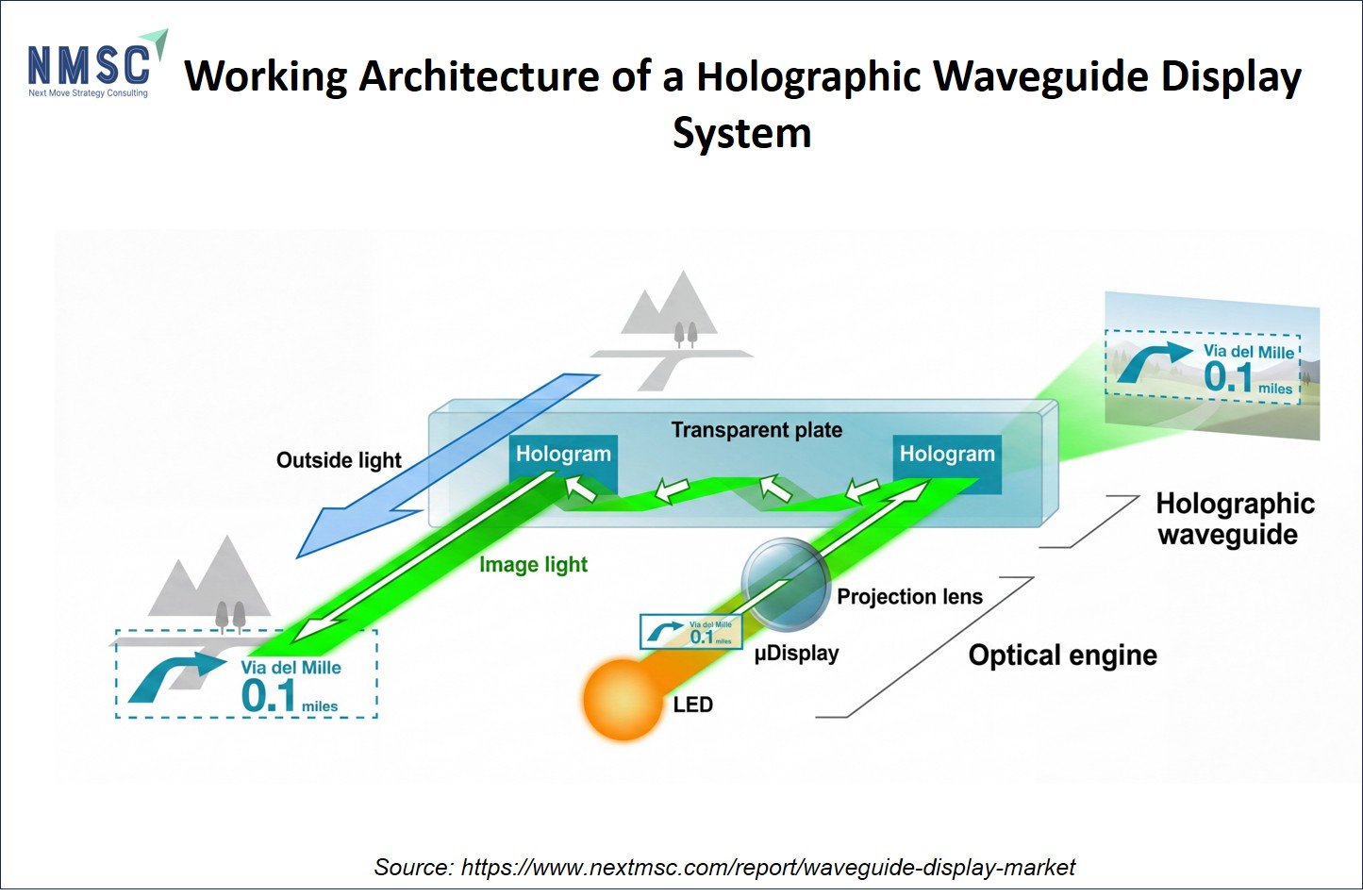
The image illustrates the working mechanism of a holographic waveguide display system used in augmented reality (AR) smart glasses. The process begins with an LED light source that projects digital content through a microdisplay and projection lens, forming the optical engine of the device. This generated image light is then directed into a transparent waveguide plate containing holographic elements.
Inside the transparent plate, the holographic waveguide guides and reflects the digital image across the glass surface while still allowing outside light to pass through. This enables users to simultaneously view real-world surroundings and overlaid digital information, such as navigation directions or notifications.
The diagram also highlights how holograms embedded within the waveguide help control the movement and projection of light efficiently across the display surface. By combining transparency with image projection, waveguide technology enables lightweight and compact AR glasses without blocking the user’s natural field of vision.
Overall, the image demonstrates how holographic waveguide systems integrate optics, projection technology, and transparent displays to create immersive augmented reality experiences in wearable smart glasses.
Optical Efficiency Emerges as the Primary Focus in Waveguide Display Commercialization
The pie chart highlights the major factors shaping the commercialization and adoption of waveguide display technology in 2026. Optical efficiency accounts for the largest share at 30%, reflecting the industry’s strong emphasis on improving brightness performance while reducing energy consumption in AR smart glasses. This has become especially important as manufacturers aim to develop lightweight and wearable devices with longer battery life.
Manufacturing scalability represents 25% of the chart, indicating how critical mass-production capability has become for the industry. Companies are increasingly investing in advanced optical manufacturing infrastructure to support large-scale commercialization of AR devices.
Display innovation contributes 18%, showing the growing need for higher-resolution and wider field-of-view displays capable of delivering more immersive augmented reality experiences. Meanwhile, battery and power management account for 15%, highlighting ongoing challenges related to thermal efficiency and compact wearable hardware.
OEM partnerships make up the remaining 12%, emphasizing the importance of collaborations between optics providers, semiconductor companies, and consumer electronics manufacturers in accelerating market adoption.
Overall, the chart demonstrates that waveguide display commercialization is being driven not only by optical advancements but also by manufacturing readiness, ecosystem partnerships, and power-efficient hardware development.

Leading Companies Driving Innovation in the Waveguide Display Industry
The waveguide display market features several prominent players, including Beneq Oy, Dispelix, Lumus Ltd., Wave Optics Ltd., Sumitomo Electric Industries, Ltd., Quantic Corry, FormFactor, DigiLens Inc., TriLite Technologies GmbH, and VividQ, among others. These companies are actively strengthening their market presence through strategic initiatives such as technology collaborations, product innovations, and commercialization partnerships aimed at advancing next-generation waveguide display solutions.

Industry Impact Analysis
The rapid progress in waveguide display technology is influencing multiple segments of the AR ecosystem. For institutional investors and enterprise stakeholders, the sector now represents a growing intersection between advanced optics, semiconductor innovation, and wearable computing infrastructure.
For device manufacturers, waveguide suppliers are increasingly expected to provide more than optical components alone. OEMs now require manufacturing scalability, thermal optimization support, and integration expertise capable of supporting high-volume consumer deployments.
Supply chain leaders are also paying close attention to the sector because waveguide commercialization will increase demand for precision optical materials, advanced glass manufacturing, compact microdisplays, and efficient semiconductor platforms.
Despite this momentum, several critical limitations remain unresolved. Road to VR noted that Meta’s Orion AR prototype still depended on external hardware for computing and battery support. This demonstrates that optics alone are not enough to enable mainstream standalone AR glasses.
Display technology also continues to present challenges. Current Ray-Ban Display glasses reportedly use a relatively low-resolution 600 × 600 display. As field-of-view expands, both brightness and resolution must improve simultaneously to maintain image quality, which significantly increases engineering complexity.
Future Outlook
The waveguide display industry is moving steadily toward commercial maturity. Companies are increasingly focusing on production scalability, optical performance, and strategic partnerships with major OEMs.
The next stage of competition will likely depend on which companies can successfully balance optical efficiency with manufacturing execution. Wider field-of-view experiences, improved display brightness, and lower power consumption will remain key priorities across the industry.
At the same time, the broader AR ecosystem still requires substantial advances in semiconductor efficiency, battery technology, and microdisplay resolution before fully standalone AR glasses can achieve mass adoption.
Next Steps
Organizations evaluating opportunities in waveguide display technology should closely monitor OEM partnerships, manufacturing investments, and developments in display efficiency. Companies operating in optics, semiconductor packaging, advanced materials, and wearable systems may all benefit from increasing AR commercialization efforts.
Investors and enterprise decision-makers should also evaluate whether suppliers possess scalable production capabilities rather than focusing solely on prototype-level innovation.
-
Analyze supply chain readiness for mass-market AR smart glasses
-
Identify opportunities in advanced optics, precision glass, and XR component ecosystems
-
Review how wider field-of-view technologies are influencing next-generation device design
-
Follow strategic acquisitions and collaborations shaping the AR optics market
Conclusion
Waveguide display technology is rapidly evolving from an experimental AR component into a commercially important platform for next-generation wearable devices. Recent developments involving SCHOTT, Lumus, AAC Technologies, and Dispelix demonstrate that the industry is entering a critical commercialization phase driven by manufacturing readiness and strategic partnerships.
Although challenges involving battery life, processing power, and display efficiency still remain, the industry’s progress suggests that AR smart glasses are moving closer to broader consumer and enterprise adoption. For technology strategists, investors, and supply chain leaders, waveguide displays are becoming an increasingly important area to watch within the future wearable computing landscape.
About the Author
 Sanyukta Deb
— Sanyukta Deb is Digital Marketing Team Lead at Next Move Strategy Consulting, where she has led content strategy and technical SEO for the firm's B2B market research publications for over 2 years. Her editorial process translates NextMSC's primary and secondary research — spanning technology, industrial, and consumer sectors — into commercial narratives, backed by search-intent, keyword, and competitive analysis. She brings 5 years of overall experience in digital marketing and content strategy.
Sanyukta Deb
— Sanyukta Deb is Digital Marketing Team Lead at Next Move Strategy Consulting, where she has led content strategy and technical SEO for the firm's B2B market research publications for over 2 years. Her editorial process translates NextMSC's primary and secondary research — spanning technology, industrial, and consumer sectors — into commercial narratives, backed by search-intent, keyword, and competitive analysis. She brings 5 years of overall experience in digital marketing and content strategy.
About the Reviewer
 Debashree Dey
— Debashree Dey is Assistant Manager at Next Move Strategy Consulting, where she supports cross-vertical market content and communications across diverse industries for 6 years. Her professional background includes senior content writing, communications, and published manuscript authorship, with experience developing audience-focused business narratives and maintaining clear, consistent messaging. Her role supports research-led content development and editorial quality across NextMSC publications.
Debashree Dey
— Debashree Dey is Assistant Manager at Next Move Strategy Consulting, where she supports cross-vertical market content and communications across diverse industries for 6 years. Her professional background includes senior content writing, communications, and published manuscript authorship, with experience developing audience-focused business narratives and maintaining clear, consistent messaging. Her role supports research-led content development and editorial quality across NextMSC publications.

















Add Comment