How Is Enterprise AI Redefining Business Transformation Across Industries in 2026?

Enterprise AI Market is entering a decisive phase in 2026 as organizations move beyond pilot programs and experimental deployments toward enterprise-wide implementation. Large technology alliances, billion-dollar investments, and industry-focused AI initiatives are redefining how enterprises approach operations, productivity, and digital transformation.
Recent announcements from Microsoft, EY, and NTT DATA highlight a growing industry shift toward scalable AI ecosystems that combine cloud infrastructure, data engineering, intelligent automation, and industry-specific consulting. These developments indicate that Enterprise AI is no longer viewed as an isolated innovation strategy. Instead, it is becoming a core business capability influencing finance, supply chain, risk management, healthcare, and industrial operations.
The current transformation is particularly important for investors, procurement leaders, and enterprise strategists because organizations are increasingly demanding measurable business outcomes from AI initiatives. Productivity gains, operational cost reductions, workflow automation, and intelligent decision-making are now central to enterprise AI adoption strategies.
Major Trends Shaping Enterprise AI Adoption
One of the most significant developments in Enterprise AI is the rise of large-scale strategic alliances focused on operational deployment rather than experimentation. Microsoft and EY announced a joint investment exceeding $1 billion over five years to help organizations scale AI transformation across enterprise functions. The initiative combines Microsoft’s engineering capabilities with EY’s consulting expertise to accelerate enterprisewide AI integration.
The collaboration focuses on areas including finance, tax, risk, human resources, and supply chain operations. This reflects a broader market trend in which enterprises are embedding AI directly into critical operational workflows instead of limiting adoption to standalone tools.
Another major trend is the increasing adoption of agentic AI. Agentic AI systems are designed to perform autonomous tasks and coordinate workflows with minimal manual intervention. Both the EY-Microsoft initiative and the NTT DATA-WinWire acquisition emphasize agentic AI as a key driver of scalable enterprise transformation.
NTT DATA’s acquisition of WinWire also highlights the growing importance of cloud-native AI infrastructure. WinWire specializes in AI on Azure, data engineering, and cloud-native development, enabling enterprises to build scalable digital foundations capable of supporting production-ready AI systems.
The growing emphasis on workforce transformation is equally important. EY stated that workforce upskilling and embedded change management are essential for organizations seeking sustainable AI adoption. This indicates that successful Enterprise AI strategies now require operational readiness alongside technical implementation.
How Enterprise AI Technologies Are Transforming Business Operations
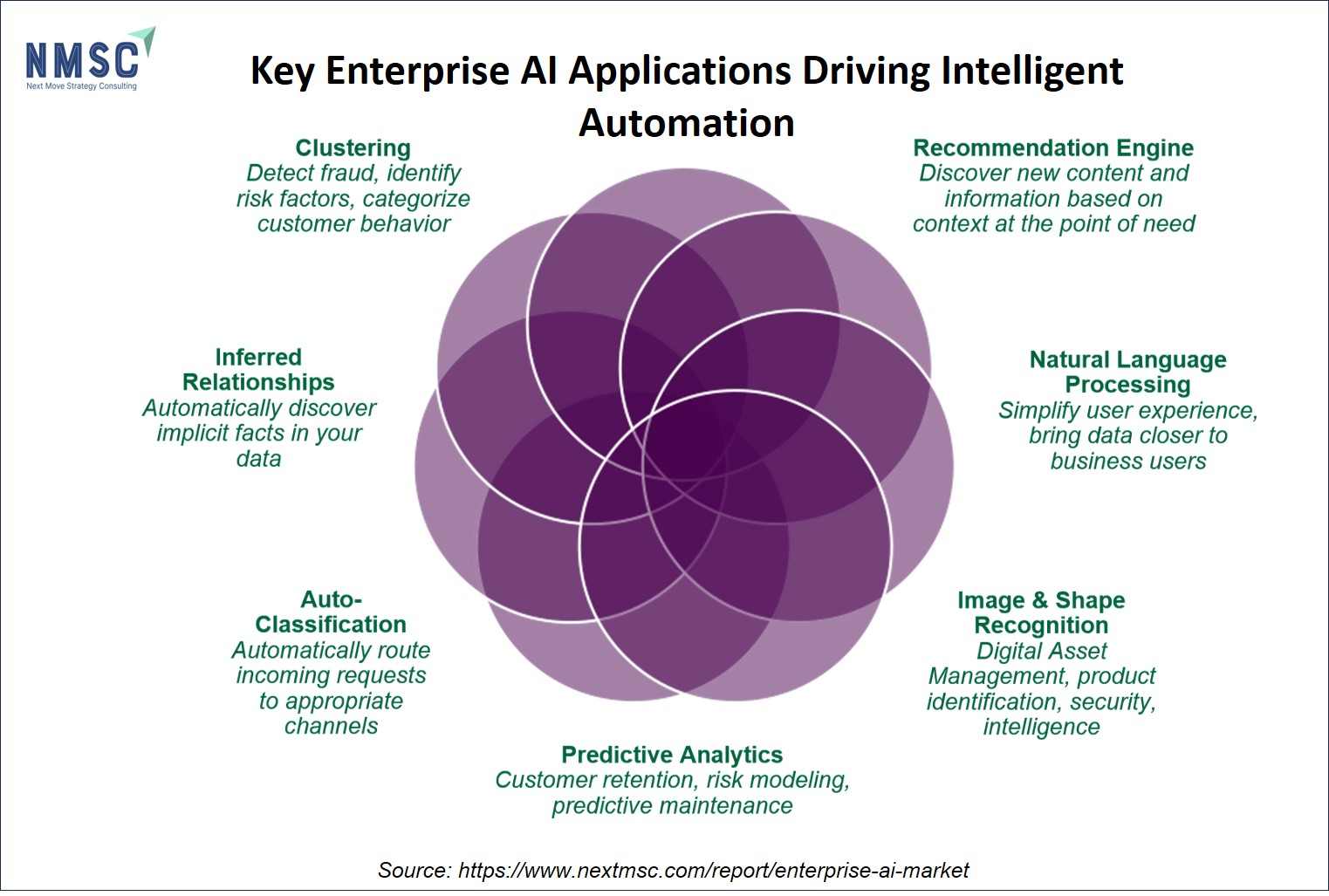
The image highlights the major functional applications of Enterprise AI across modern business environments. At the center, the interconnected circular design represents how multiple AI technologies work together to improve operational efficiency, automation, and intelligent decision-making across enterprises.
The diagram emphasizes six core Enterprise AI capabilities. Clustering helps organizations detect fraud, identify risk factors, and categorize customer behavior patterns using advanced data analysis. Recommendation engines improve customer engagement by delivering personalized content and contextual information in real time. Natural Language Processing (NLP) enhances user interaction by simplifying communication between humans and enterprise systems, making business data more accessible to non-technical users.
The image also showcases predictive analytics, which enables enterprises to forecast customer retention trends, improve risk modeling, and support predictive maintenance strategies. Auto-classification helps businesses automatically route requests and streamline workflows, reducing manual intervention across operational channels. Meanwhile, image and shape recognition technologies support digital asset management, product identification, and security intelligence.
How Are Enterprises Measuring AI Business Impact?
The latest Enterprise AI initiatives demonstrate a stronger focus on measurable business value. Organizations are increasingly evaluating AI projects based on operational efficiency, productivity improvements, and cost optimization.
EY shared several internal deployment outcomes through its “Client Zero” approach. The organization initially deployed Copilot to 150,000 users and reported a 15% productivity increase. According to the company, this productivity gain was reinvested into learning and client delivery operations.
The organization also modernized finance operations using Microsoft Power Platform and intelligent agents integrated through Copilot Studio. This resulted in 95% faster lead times and more than 37% lower operational costs. Additionally, early adoption of Microsoft Azure AI Document Intelligence reduced manual workloads by up to 90% on EY’s Global Tax Platform.
NTT DATA’s acquisition strategy reflects similar priorities. The company aims to strengthen its ability to deliver production-ready AI solutions aligned with industry-specific requirements. By adding more than 1,000 Azure engineers and AI specialists through WinWire, NTT DATA is expanding its capability to operationalize enterprise AI at scale.
These developments suggest that enterprises are increasingly prioritizing execution capabilities over experimental AI adoption. Operational consistency, workflow integration, and scalable deployment models are becoming the primary competitive differentiators.
How Artificial Intelligence Technologies Are Connected Across Enterprise Applications
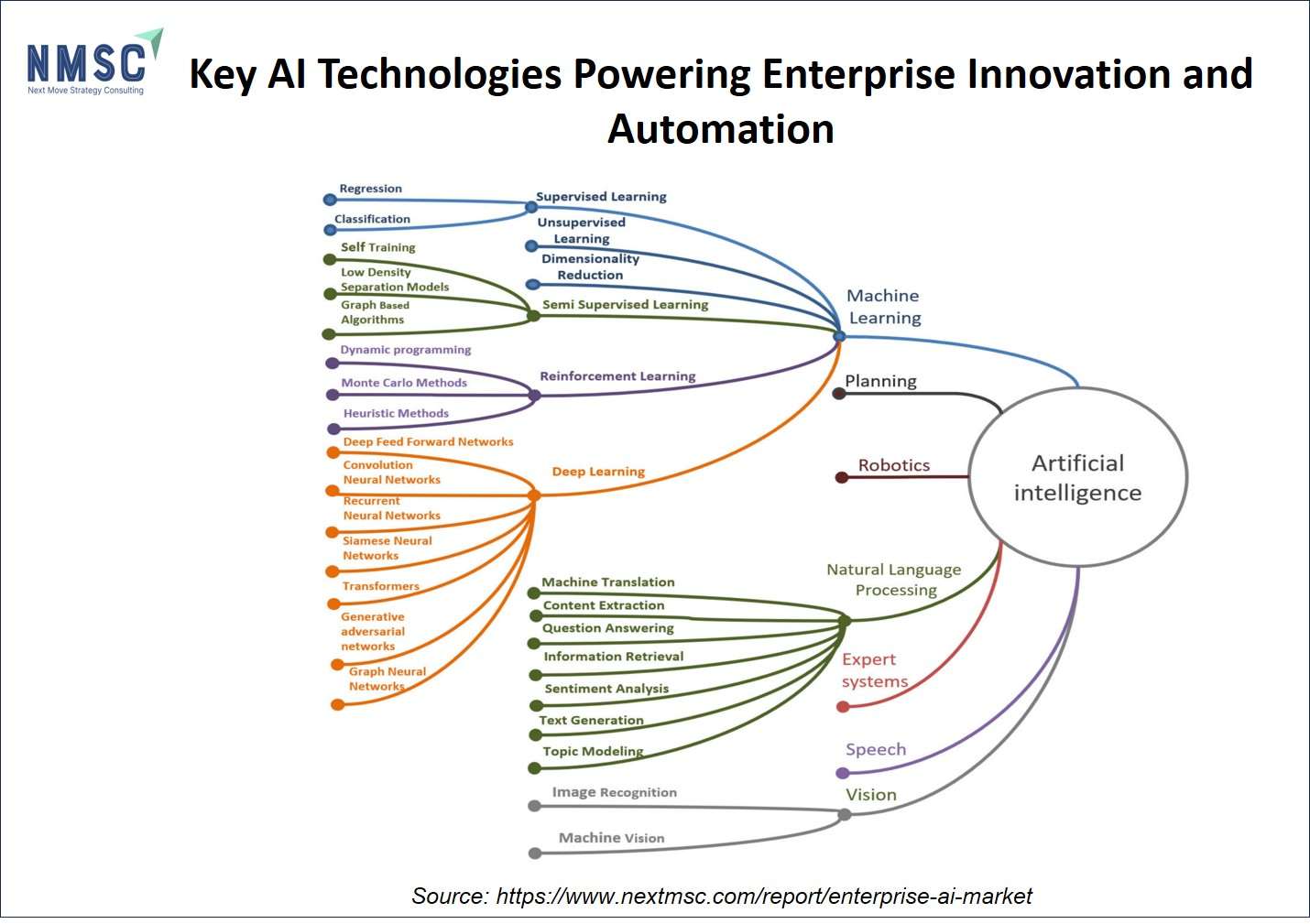
The image presents a structured overview of the major branches of Artificial Intelligence (AI) and their interconnected technologies within enterprise environments. At the center, Artificial Intelligence acts as the core framework connecting machine learning, deep learning, natural language processing, robotics, planning, expert systems, speech, and vision technologies.
A major focus of the diagram is Machine Learning, which is divided into supervised learning, unsupervised learning, semi-supervised learning, and reinforcement learning. These learning models support enterprise capabilities such as regression analysis, classification, dimensionality reduction, graph-based algorithms, and dynamic programming. Together, they help organizations improve forecasting, decision-making, automation, and data analysis.
The diagram also highlights Deep Learning technologies, including convolution neural networks, recurrent neural networks, transformers, graph neural networks, and generative adversarial networks. These advanced neural architectures are increasingly used in enterprise AI applications involving automation, predictive analytics, recommendation systems, and intelligent data processing.
Another important section focuses on Natural Language Processing (NLP), which supports machine translation, content extraction, question answering, sentiment analysis, text generation, and information retrieval. These technologies simplify enterprise communication and improve customer interaction by making business data more accessible and actionable.
Enterprise AI Adoption Trends Across Core Industries
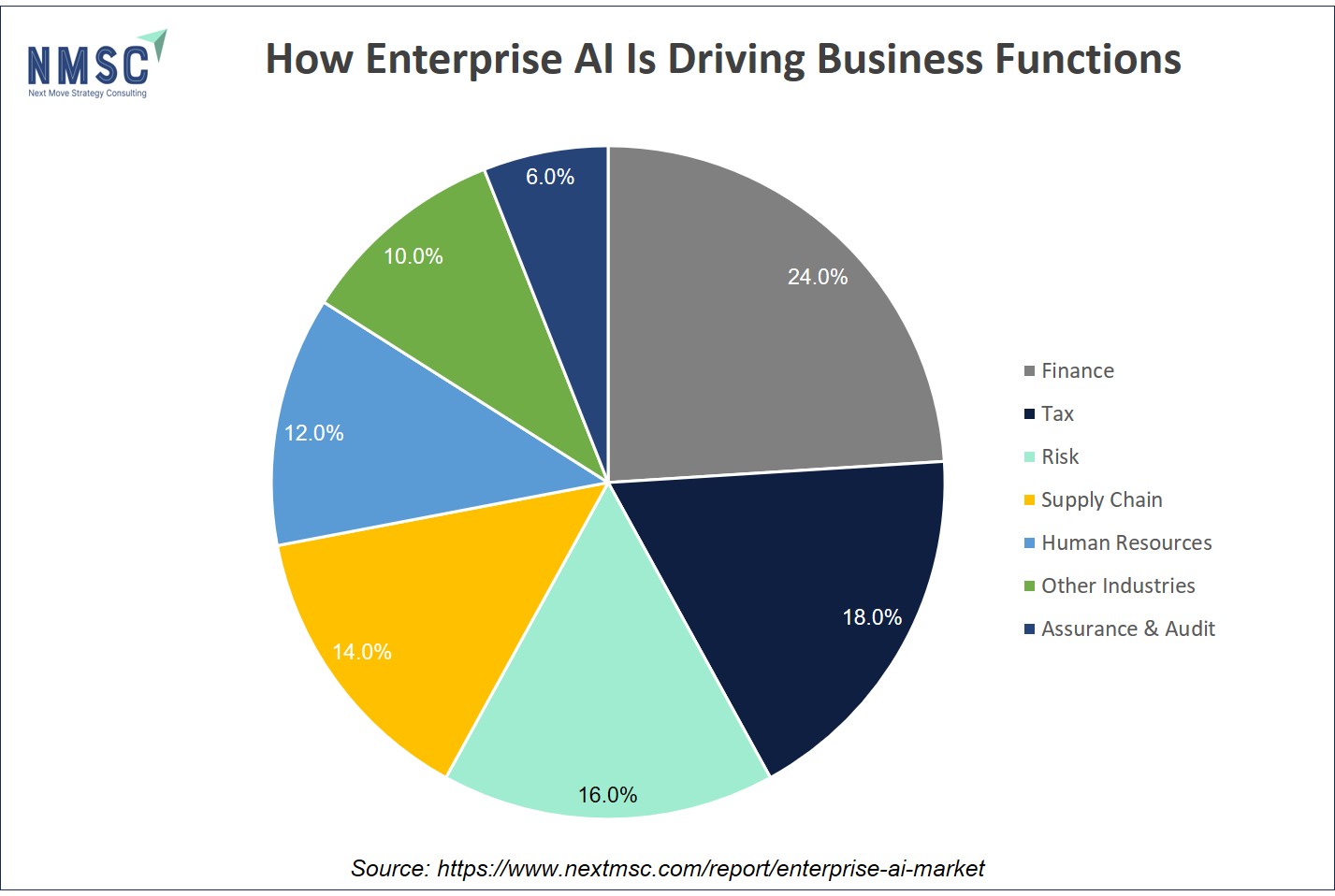
The pie chart illustrates how Enterprise AI initiatives are being distributed across major enterprise functions and industries in 2026. Finance holds the largest share at 24%, highlighting the growing use of AI-driven automation, intelligent agents, and workflow optimization to improve operational efficiency and reduce costs. Tax and Risk functions together account for 34%, reflecting the increasing adoption of AI for document intelligence, compliance management, and data-driven decision-making.
Supply Chain and Human Resources collectively contribute 26%, showing how enterprises are integrating AI into workforce management, planning, forecasting, and operational coordination. Other industries such as healthcare, government, retail, and energy represent 10%, indicating broader enterprise-wide AI transformation beyond traditional corporate functions. Assurance and Audit account for 6%, supported by multiagent AI frameworks that streamline audit workflows and enterprise reporting processes.
Overall, the chart demonstrates that Enterprise AI adoption is shifting from experimentation toward large-scale operational deployment focused on productivity, automation, and measurable business outcomes.
Industry Impact Analysis
Enterprise AI is reshaping multiple industries by improving operational agility and enabling intelligent automation at scale.
|
Industry |
Enterprise AI Impact |
|
Financial Services |
Improved risk management and operational efficiency |
|
Healthcare |
Faster document processing and workflow automation |
|
Retail and Consumer |
Enhanced supply chain visibility and decision-making |
|
Industrials and Energy |
Intelligent operations and infrastructure optimization |
|
Government |
Accelerated digital transformation initiatives |
The technology is also influencing enterprise procurement strategies. Organizations increasingly require AI systems that integrate securely across cloud environments while supporting governance and compliance requirements. This is driving demand for integrated consulting, engineering, and infrastructure partnerships.
At the same time, enterprises continue to face several implementation challenges. Large-scale AI adoption often requires modernization of legacy infrastructure, extensive workforce training, and governance frameworks capable of supporting responsible AI deployment.
Leading Companies Driving Enterprise AI Innovation
The Enterprise AI industry includes major technology providers and AI innovators such as OpenAI, Anthropic PBC, Microsoft, Google, NVIDIA, IBM, Amazon Web Services, Salesforce, Oracle, SAP SE, C3.ai, Palantir Technologies, ServiceNow, Snowflake, Hewlett Packard Enterprise, Persado, Intel, DeepL, Jasper AI, and Domino Data Lab. These companies are increasingly focusing on innovation, strategic collaborations, cloud-based AI expansion, and enterprise-scale deployment capabilities to strengthen their competitive position across global markets.
Future Outlook
Enterprise AI is expected to continue evolving toward integrated, scalable, and industry-specific deployment models. The recent Microsoft-EY and NTT DATA-WinWire developments suggest that future enterprise competition will increasingly depend on execution speed, cloud-native readiness, and operational intelligence.
Organizations are also expected to place greater emphasis on AI governance, workforce readiness, and secure cloud infrastructure. As AI systems become embedded into enterprise workflows, companies will require stronger alignment between technology teams, operational leaders, and business strategists.
The broader market direction indicates that Enterprise AI is becoming a long-term operational strategy rather than a short-term innovation initiative.
Key Takeaways
-
AI deployment models are becoming more industry-focused
-
Operational scalability is replacing experimentation
-
Cloud-native ecosystems will remain essential
Next Steps
Organizations evaluating Enterprise AI initiatives should begin by identifying operational areas with high manual workloads and repetitive processes. Enterprises should also assess cloud readiness, data infrastructure capabilities, and governance requirements before scaling deployment.
Building cross-functional AI teams and workforce training programs will become increasingly important as enterprises move toward broader operational integration.
-
Prioritize workforce upskilling and change management to support long-term AI adoption
-
Partner with experienced cloud and AI providers capable of delivering industry-specific solutions
-
Focus on measurable business outcomes such as productivity improvement, workflow optimization, and operational cost reduction
Conclusion
Enterprise AI is reshaping how organizations approach operational efficiency, workforce productivity, and digital transformation in 2026. Strategic collaborations involving Microsoft, EY, NTT DATA, and WinWire demonstrate that enterprises are moving beyond experimentation toward scalable AI ecosystems capable of delivering measurable business outcomes.
The growing focus on agentic AI, cloud-native infrastructure, and operational intelligence reflects a larger market transformation in which AI becomes embedded across core business functions. For investors, enterprise leaders, and procurement strategists, these developments indicate that scalable AI execution capabilities may become one of the defining competitive advantages of the decade.
About the Author
 Sanyukta Deb
— Sanyukta Deb is Digital Marketing Team Lead at Next Move Strategy Consulting, where she has led content strategy and technical SEO for the firm's B2B market research publications for over 2 years. Her editorial process translates NextMSC's primary and secondary research — spanning technology, industrial, and consumer sectors — into commercial narratives, backed by search-intent, keyword, and competitive analysis. She brings 5 years of overall experience in digital marketing and content strategy.
Sanyukta Deb
— Sanyukta Deb is Digital Marketing Team Lead at Next Move Strategy Consulting, where she has led content strategy and technical SEO for the firm's B2B market research publications for over 2 years. Her editorial process translates NextMSC's primary and secondary research — spanning technology, industrial, and consumer sectors — into commercial narratives, backed by search-intent, keyword, and competitive analysis. She brings 5 years of overall experience in digital marketing and content strategy.
About the Reviewer
 Debashree Dey
— Debashree Dey is Assistant Manager at Next Move Strategy Consulting, where she supports cross-vertical market content and communications across diverse industries for 6 years. Her professional background includes senior content writing, communications, and published manuscript authorship, with experience developing audience-focused business narratives and maintaining clear, consistent messaging. Her role supports research-led content development and editorial quality across NextMSC publications.
Debashree Dey
— Debashree Dey is Assistant Manager at Next Move Strategy Consulting, where she supports cross-vertical market content and communications across diverse industries for 6 years. Her professional background includes senior content writing, communications, and published manuscript authorship, with experience developing audience-focused business narratives and maintaining clear, consistent messaging. Her role supports research-led content development and editorial quality across NextMSC publications.

















Add Comment