How Is Synthetic Data Redefining the Future of Industrial AI in 2026?

Synthetic Data Market is becoming one of the most influential technologies shaping industrial artificial intelligence in 2026. As manufacturers and technology companies face growing pressure to scale automation and train AI systems faster, the demand for high-quality training data has intensified. However, the supply of human-generated data is no longer expanding quickly enough to support the growing complexity of AI models.
This challenge is pushing enterprises toward synthetic data, which refers to artificially generated datasets used to train and refine AI systems. The technology is increasingly being integrated into robotics, digital twins, and industrial simulations to improve operational accuracy and reduce deployment time.
The strategic importance of synthetic data became more visible after ABB announced its collaboration with NVIDIA in 2026. The partnership focuses on integrating NVIDIA Omniverse libraries into ABB Robotics’ RobotStudio platform to create highly realistic industrial simulations capable of training robotics systems with up to 99% accuracy.
At the same time, growing concerns around AI reliability are reshaping industry discussions. A 2025 report published by Business Standard highlighted the hidden risks associated with excessive dependence on synthetic data, particularly the possibility of AI model collapse and declining output quality.
For investors, corporate strategists, and industrial decision-makers, synthetic data is no longer a niche AI topic. It is becoming a strategic capability tied directly to manufacturing efficiency, production scalability, workforce automation, and long-term AI governance.
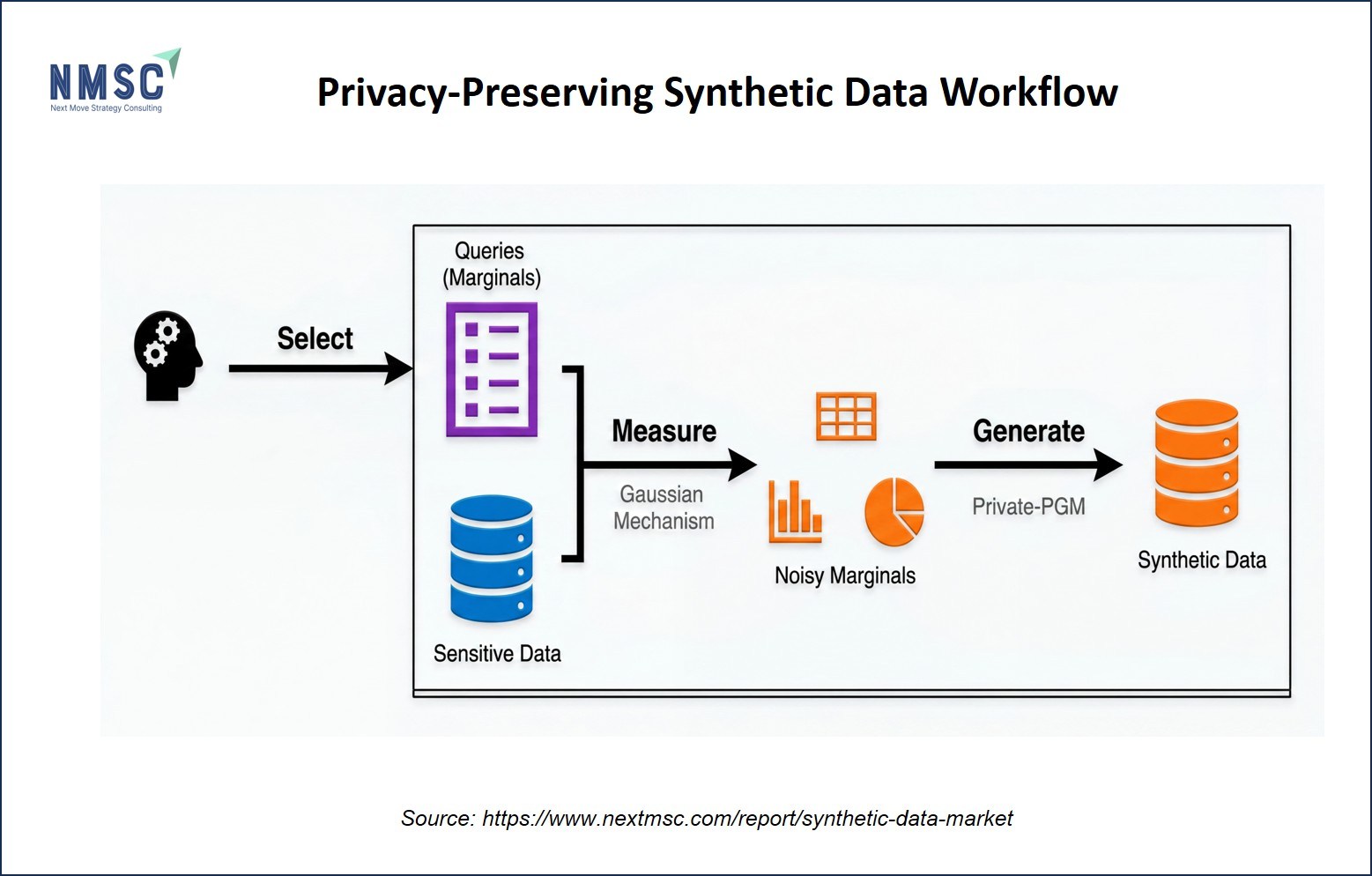
Differentially Private Synthetic Data Generation via Private-PGM Architecture
This diagram illustrates a multi-step privacy-preserving pipeline designed to create secure synthetic alternatives from real-world datasets. The workflow begins when an analytical system or user selects target queries, known as Queries (Marginals), which are evaluated alongside a repository of Sensitive Data. During the Measure phase, a mathematically rigorous privacy technique called the Gaussian Mechanism injects controlled noise into these evaluations to prevent data reconstruction, thereby transforming the measurements into Noisy Marginals. Finally, in the Generate phase, these noisy distributions are processed through a Private-PGM (Private Probabilistic Graphical Model) algorithm, synthesizing a completely new, mathematically anonymous Synthetic Data asset that maintains structural utility without compromising individual user privacy.
How Is Synthetic Data Transforming Industrial AI?
Synthetic data is changing how industrial AI systems are designed, tested, and deployed. Instead of relying entirely on real-world factory data, manufacturers can now create simulated industrial environments where robots learn tasks before entering live production lines.
According to ABB Robotics, integrating NVIDIA Omniverse libraries into RobotStudio helps bridge the long-standing “sim-to-real” gap. This gap refers to the differences between virtual simulations and real-world environments that often reduce the effectiveness of AI-driven robotics after deployment.
The new RobotStudio HyperReality platform is designed to generate highly accurate industrial simulations that replicate factory conditions such as lighting, textures, materials, positioning, and movement patterns. These realistic simulations allow AI models to train in virtual environments before performing tasks in real facilities.
ABB stated that this approach can reduce setup and commissioning time by up to 80%, while lowering operational costs by up to 40% through the reduction of physical testing and prototype requirements. The company also reported that manufacturers could accelerate time-to-market for complex products by up to 50%.
One of the strongest examples comes from Foxconn, which is piloting the technology in consumer electronics assembly. According to the company, robotic systems trained with synthetic data can improve assembly precision while reducing debugging and setup delays.
Nvidia Nemotron Self-Correction Architecture for High-Fidelity Synthetic Datasets
This workflow outlines an automated pipeline for generating high-quality synthetic training data using advanced LLMs. The process begins when a developer submits a Domain Specific Input Query, which is processed by the Nemotron-4-340B Instruct model to generate raw Synthetic Response Data. To ensure quality control, this output is passed to the Nemotron-4-340B Reward model, which evaluates the text and generates Response Scores. Finally, these scores are used to Filter Synthetic Response Data, weeding out low-quality or inaccurate information so that only the highest-scoring data is compiled into the final Synthetic Dataset for AI model training.

What Major Trends Are Shaping Synthetic Data Adoption?
One of the most significant drivers behind synthetic data adoption is the growing shortage of human-generated training data. The Business Standard report noted that AI systems require enormous volumes of text, images, and video content, while human-generated data is not expanding quickly enough to meet industry demand.
This imbalance is forcing technology firms to increasingly rely on AI-generated datasets. Synthetic data offers a faster and more scalable alternative because it can be produced continuously without depending on human content creation.
Another major trend is the rapid rise of digital twin technology in industrial operations. ABB Robotics and NVIDIA are using synthetic data to build highly realistic digital environments where manufacturers can simulate production processes before physical deployment. These virtual simulations are becoming strategic assets because they allow enterprises to optimize production lines, test workflows, and improve operational efficiency without disrupting factory operations.
Labor shortages are also accelerating adoption. WORKR, a robotic workforce company based in California, is using synthetic data and AI-powered robotic systems to help manufacturers address workforce constraints. The company stated that robots trained in simulated environments can learn new tasks within minutes and operate without extensive programming expertise.
At the same time, enterprises are becoming more cautious about the quality of synthetic data. Industry discussions increasingly focus on validation systems, governance frameworks, and oversight mechanisms designed to ensure that AI outputs remain accurate and trustworthy.
Synthetic Data Adoption Trends in Industrial AI
The pie chart highlights the major factors driving synthetic data adoption across industrial AI ecosystems in 2026. AI training and simulation account for the largest share at 30%, reflecting the growing need for scalable datasets to train robotics and automation systems in virtual environments. Manufacturing efficiency follows with 25%, driven by companies using synthetic data to reduce setup time, optimize production lines, and lower operational costs. Digital twin expansion represents 20% of the adoption landscape, showing how enterprises are increasingly relying on realistic virtual factory simulations to improve deployment accuracy. Labor automation contributes 15%, as manufacturers adopt AI-powered robotics to address workforce shortages and repetitive industrial tasks. The remaining 10% focuses on AI governance and validation, highlighting the rising importance of maintaining transparency, accuracy, and trust in synthetic-data-driven AI systems.

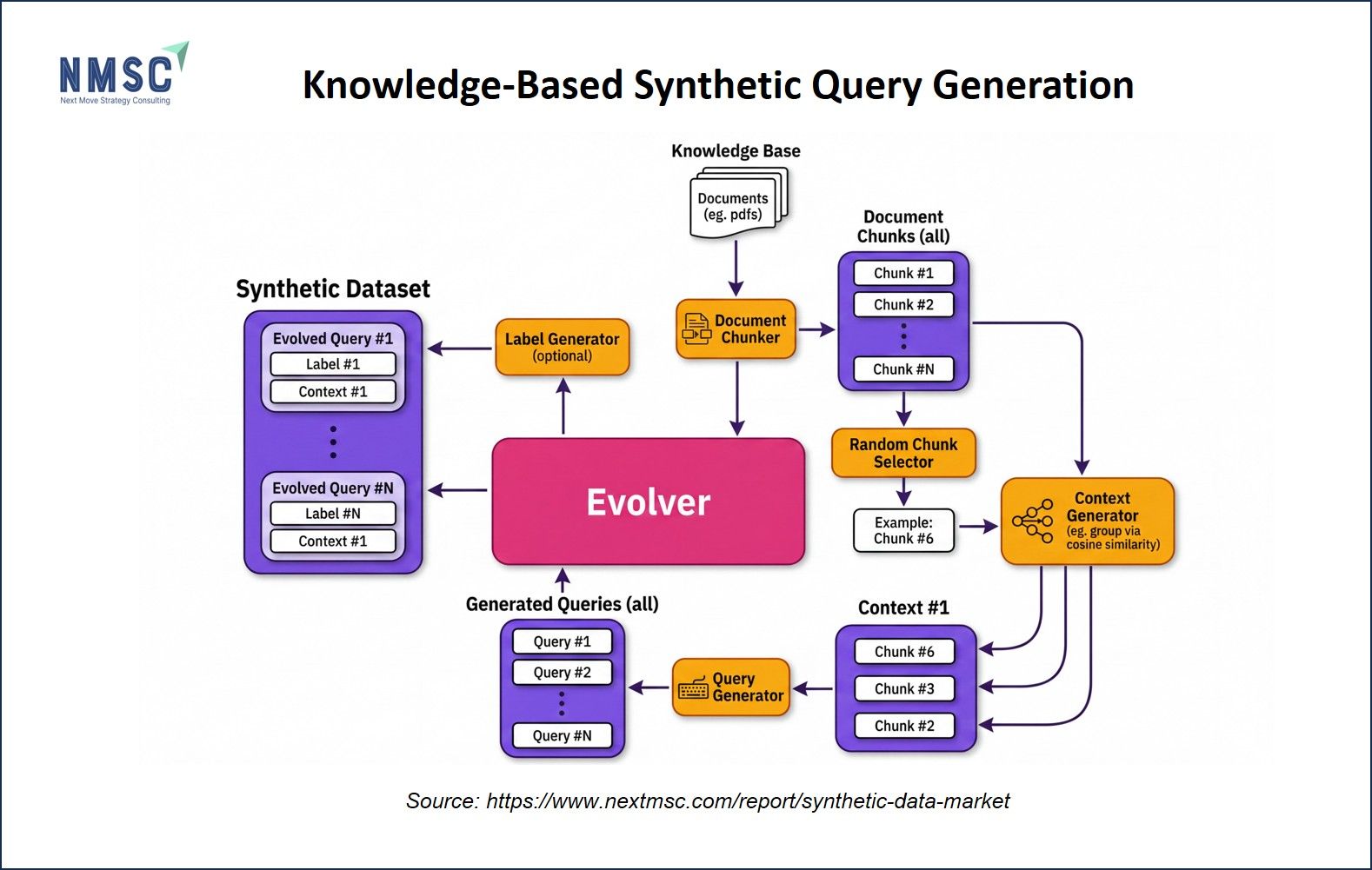
Document-Based Synthetic Evaluation Data Generation Pipeline
This diagram illustrates an automated pipeline, typically used in frameworks like Ragas, for generating synthetic evaluation datasets directly from a custom knowledge base. The process begins with source documents (such as PDFs) in a Knowledge Base that are broken down by a Document Chunker into smaller segments (Document Chunks). A Random Chunk Selector picks an individual slice (e.g., Chunk #6), which a Context Generator expands into a clustered context block (Context #1) alongside closely related text segments using techniques like cosine similarity. This grouped context is passed to a Query Generator to formulate corresponding user-style prompts (Generated Queries). At the heart of the system, a central Evolver refines these initial queries to introduce complexity, while an optional Label Generator creates the ideal target answers, ultimately synthesizing a robust Synthetic Dataset paired with evolution tracks, labels, and grounded context.
Major Companies Driving Innovation in the Synthetic Data Industry
The synthetic data industry comprises several prominent market players, including NVIDIA, Microsoft, IBM, SAS Institute, MOSTLY AI, K2View, Tonic, Syntho, GenRocket, MDClone, Synthesis AI, Parallel Domain, Rendered.ai, Anyverse, and Mindtech Global, among others. These companies are actively pursuing strategies such as acquisitions, partnerships, and collaborations to strengthen their market position and expand their technological capabilities within the evolving synthetic data landscape.

Industry Impact Analysis
The industrial impact of synthetic data extends far beyond AI development. It is reshaping manufacturing operations, supply chain efficiency, and enterprise automation strategies.
For manufacturers, synthetic data significantly improves operational flexibility. Virtual simulations allow production lines to be tested and optimized digitally before physical deployment begins. ABB reported that manufacturers can reduce physical prototype requirements and accelerate production readiness through simulation-driven workflows.
The technology is also influencing supply chain performance. Faster deployment cycles and reduced commissioning delays can improve inventory planning, production scheduling, and product launch timelines. This is particularly valuable for industries such as consumer electronics, where production speed and precision directly affect competitiveness.
However, synthetic data also introduces operational risks. The Business Standard report emphasized that excessive reliance on synthetic datasets may cause AI systems to generate inaccurate or misleading outputs. This issue, commonly referred to as AI hallucination or model collapse, could create serious concerns in industrial environments where precision and reliability are essential.
As a result, enterprises are increasingly focusing on governance systems capable of validating training data, monitoring AI outputs, and maintaining transparency across AI development processes.
Future Outlook
Synthetic data is expected to become increasingly central to industrial AI ecosystems over the next several years. As enterprises pursue more advanced automation strategies, the need for scalable AI training environments will continue to grow.
The collaboration between ABB Robotics and NVIDIA demonstrates how industrial AI is moving toward physically accurate simulation systems capable of training robotics at enterprise scale. This shift could reshape how manufacturers approach product development, factory design, and operational planning.
However, long-term adoption will depend heavily on trust and governance. The Business Standard report emphasized the importance of metadata tracking, validation systems, and international standards capable of ensuring transparency in AI training processes.
Organizations that successfully balance scalability with reliability may gain significant operational advantages as industrial AI adoption accelerates.
Next Steps
Industrial leaders evaluating synthetic data strategies should begin by assessing their digital twin capabilities and AI governance readiness. Enterprises should also focus on monitoring AI accuracy, validating synthetic datasets, and establishing oversight systems capable of identifying errors before deployment.
Manufacturers exploring synthetic data adoption should prioritize operational areas where virtual simulations can improve efficiency without compromising reliability.
-
Implement continuous monitoring systems to detect AI hallucinations or model inaccuracies
-
Prioritize operational transparency and compliance in AI deployment strategies
-
Track cost-saving opportunities linked to virtual simulations and automation
-
Develop long-term strategies for scalable and trustworthy AI adoption
Conclusion
Synthetic data is rapidly transforming industrial AI, robotics, and manufacturing operations. Companies such as ABB Robotics and NVIDIA are demonstrating how simulation-driven AI systems can reduce costs, improve deployment accuracy, and accelerate industrial automation at scale.
At the same time, the technology introduces new challenges related to AI reliability, validation, and governance. The growing dependence on synthetic datasets means enterprises must invest not only in automation infrastructure but also in systems that preserve transparency and trustworthiness.
For investors, supply chain leaders, and corporate strategists, synthetic data is emerging as both an operational opportunity and a governance challenge that will shape the future of industrial AI.
About the Author
 Sanyukta Deb
— Sanyukta Deb is Digital Marketing Team Lead at Next Move Strategy Consulting, where she has led content strategy and technical SEO for the firm's B2B market research publications for over 2 years. Her editorial process translates NextMSC's primary and secondary research — spanning technology, industrial, and consumer sectors — into commercial narratives, backed by search-intent, keyword, and competitive analysis. She brings 5 years of overall experience in digital marketing and content strategy.
Sanyukta Deb
— Sanyukta Deb is Digital Marketing Team Lead at Next Move Strategy Consulting, where she has led content strategy and technical SEO for the firm's B2B market research publications for over 2 years. Her editorial process translates NextMSC's primary and secondary research — spanning technology, industrial, and consumer sectors — into commercial narratives, backed by search-intent, keyword, and competitive analysis. She brings 5 years of overall experience in digital marketing and content strategy.
About the Reviewer
 Debashree Dey
— Debashree Dey is Assistant Manager at Next Move Strategy Consulting, where she supports cross-vertical market content and communications across diverse industries for 6 years. Her professional background includes senior content writing, communications, and published manuscript authorship, with experience developing audience-focused business narratives and maintaining clear, consistent messaging. Her role supports research-led content development and editorial quality across NextMSC publications.
Debashree Dey
— Debashree Dey is Assistant Manager at Next Move Strategy Consulting, where she supports cross-vertical market content and communications across diverse industries for 6 years. Her professional background includes senior content writing, communications, and published manuscript authorship, with experience developing audience-focused business narratives and maintaining clear, consistent messaging. Her role supports research-led content development and editorial quality across NextMSC publications.


















Add Comment