Colombia Warehouse Robotics Market By Type [Automated Guided Vehicles (AGVs) (Laser Guidance, Magnetic Guidance, Optical Tape Guidance, Vision Guidance, and Others), Autonomous Mobile Robots (AMRs) (Tow Vehicle, Tug Vehicle, Unit Load Vehicle), Articulated Robots, Collaborative Robots (Cobots), Scara and Cylindrical Robots, and Others], By Offering (Hardware, Software, and Service), By Payload Capacity, By Application, and By End User – Opportunity Analysis and Industry Forecast, 2025–2035
Industry: ICT & Media | Lastest Edition: July 16, 2026 | No of Pages: N/A | No. of Tables: N/A | No. of Figures: N/A | Format: PDF | Report Code : IC5192
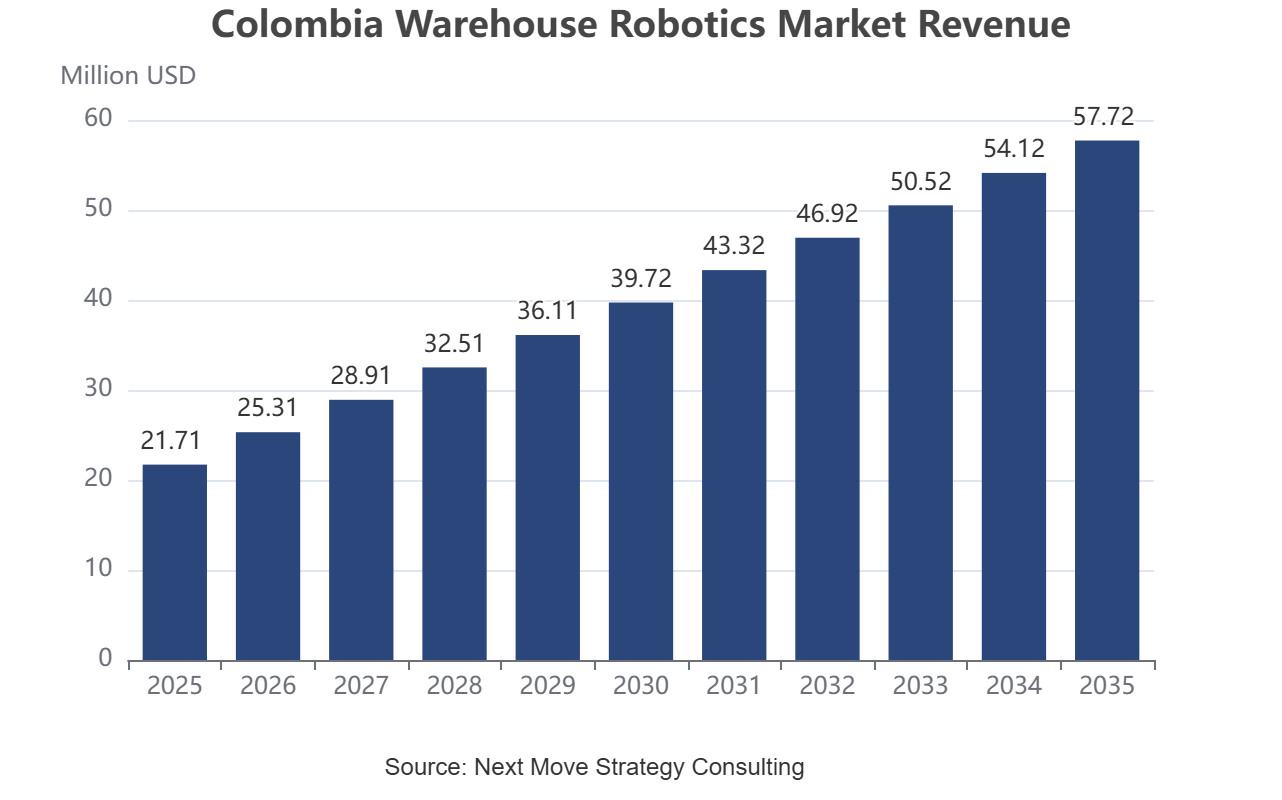
Colombia Warehouse Robotics Market Size & Forecast 2025–2035
|
Parameters |
Details |
|
Market Size in 2025 |
USD 21.71 Million |
|
Market Size in 2026 |
USD 30.58 Million |
|
Revenue Forecast in 2035 |
USD 57.72 Million |
|
Growth Rate |
CAGR of 7.31% from 2026 to 2035 |
|
Market Volume in 2025 |
2 Thousand Units |
|
Market Volume in 2026 |
2 Thousand Units |
|
Volume Forecast in 2035 |
5 Thousand Units |
|
Growth Rate |
CAGR of 8.14% from 2026 to 2035 |
|
Analysis Period |
2025–2035 |
|
Base Year Considered |
2025 |
|
Forecast Period |
2026–2035 |
|
Market Size Estimation |
Million (USD) |
|
Companies Profiled |
12 |
|
Market Share |
Available for 10 Companies |
Industry Outlook
The Colombia Warehouse Robotics Market was valued at USD 21.71 million in 2025 and reached USD 30.58 million in 2026. Looking ahead, the market is projected to experience steady growth, reaching USD 57.72 million by 2035, registering a CAGR of 7.31% from 2026 to 2035. In terms of volume, the market recorded 2 thousand units in both 2025 and 2026, with forecasts indicating growth to 5 thousand units by 2035, reflecting a CAGR of 8.14% over the same period.
What Are the Key Market Drivers, Restraints, and Opportunities Shaping the Colombia Warehouse Robotics Market Through 2035?
|
Drivers / Trends / Restraints / Opportunities |
(+/–) % Impact on CAGR Forecast |
Geographic Relevance |
Impact Timeline |
|
Growing modernization of Colombia's retail and consumer goods supply chains is driving investment in warehouse automation and robotic fulfillment solutions across major urban distribution hubs |
+1.6% |
Bogotá, Medellín, Cali |
Short to medium term (1–5 years) |
|
Expansion of Colombia's pharmaceutical and food and beverage sectors is increasing demand for precise, compliant, and automated warehouse robotics solutions to support production and distribution operations |
+1.4% |
Colombia (nationwide) |
Short to medium term (1–5 years) |
|
Government-led digital economy and logistics competitiveness initiatives are encouraging warehouse operators to modernize infrastructure and adopt automated robotics systems to improve supply chain productivity |
+1.1% |
Colombia (nationwide) |
Medium to long term (3–8 years) |
|
Macroeconomic volatility, currency fluctuation, and limited access to financing for capital-intensive robotics deployments are constraining market adoption, particularly among mid-sized Colombian warehouse operators |
–1.0% |
Colombia |
Short to medium term (1–5 years) |
|
The emergence of nearshoring trends and growing foreign direct investment in Colombia's manufacturing and logistics sectors are creating new opportunities for warehouse automation across strategic industrial corridors |
+0.9% |
Bogotá, Medellín, Barranquilla |
Long term (4–10 years) |
Through our market assessment, we observed that the Colombia Warehouse Robotics Market is advancing steadily, driven by supply chain modernization across retail and consumer goods, growing investment in pharmaceutical and food sector automation, and supportive government digital economy policies. While macroeconomic headwinds and financing constraints pose adoption challenges, the emergence of nearshoring activity and increasing foreign direct investment are creating promising long-term demand catalysts. Together, these dynamics are shaping a stable yet increasingly opportunity-rich environment for warehouse robotics technology deployment throughout Colombia over the forecast period.
Growth Drivers:
How Is the Modernization of Retail and Consumer Goods Supply Chains Driving the Colombia Warehouse Robotics Market?
Through our market assessment, we observed that the rapid modernization of retail distribution networks and consumer goods supply chains across Colombia is a primary catalyst for warehouse robotics adoption. Large-format retailers, supermarket chains, and fast-moving consumer goods distributors are investing in automated storage and retrieval systems, AGVs, and robotic sorting technologies to manage rising SKU complexity and growing order volumes. Major distribution hubs in Bogotá, Medellín, and Cali are increasingly deploying automation to improve throughput, reduce fulfillment errors, and maintain competitiveness in Colombia's evolving retail landscape.
How Are Colombia's Pharmaceutical and Food & Beverage Sectors Accelerating Demand for Warehouse Robotics?
Based on our market evaluation, the sustained growth of Colombia's pharmaceutical manufacturing and food and beverage sectors is significantly increasing demand for precision-driven warehouse robotics. These industries require highly accurate inventory management, strict compliance with temperature and hygiene regulations, and reliable automated handling of sensitive products. Robotic palletizing systems, collaborative robots, and automated guided vehicles are enabling operators to meet these stringent requirements while improving throughput and reducing manual handling risks. As both sectors continue to expand their production and national distribution networks, warehouse automation investment is expected to rise considerably.
How Are Government Digital Economy and Logistics Competitiveness Initiatives Supporting Warehouse Automation Adoption?
Based on research conducted by NMSC, Colombia's national digital economy agenda and government-backed logistics competitiveness programs are encouraging warehouse operators to modernize their infrastructure and invest in robotics-enabled automation. Policy frameworks supporting supply chain digitalization, productivity improvement, and technology adoption are creating institutional incentives for automation investment. Additionally, public sector initiatives to improve Colombia's logistics performance index ranking are prompting operators in strategic freight corridors and industrial zones to adopt warehouse management systems, autonomous mobile robots, and intelligent automation platforms to enhance operational efficiency throughout the forecast period.
Growth Inhibitor:
How Do Macroeconomic Volatility and Financing Constraints Restrain Warehouse Robotics Adoption in Colombia?
Macroeconomic instability, currency depreciation risk, and limited access to affordable long-term financing for capital-intensive robotics projects represent significant growth constraints for the Colombia Warehouse Robotics Market. Through our market analysis, we observed that many Colombian warehouse operators, particularly mid-sized companies, face difficulties justifying high upfront robotics investment amid uncertain economic conditions. Fluctuating import costs for robotic hardware, lengthy return-on-investment timelines, and limited availability of specialized technical support services further complicate adoption decisions, slowing the pace of warehouse automation penetration compared to more mature Latin American markets.
Growth Opportunity:
How Are Nearshoring Trends and Growing FDI Inflows Creating New Warehouse Robotics Opportunities in Colombia?
Through NMSC's assessment, we found that Colombia's growing attractiveness as a nearshoring destination and increasing foreign direct investment in its manufacturing and logistics sectors are creating significant demand opportunities for warehouse robotics providers. As global companies seek to diversify supply chains closer to North American markets, Colombia is emerging as a viable location for production and distribution facilities that require modern, automated warehousing infrastructure. Strategic industrial corridors in Bogotá, Medellín, and Barranquilla are benefiting from this FDI inflow, supporting demand for AMRs, AGVs, and integrated warehouse automation platforms throughout the forecast period.
Supply Chain Structure Of The Colombia Warehouse Robotics Market
The supply chain structure of the Colombia warehouse robotics market encompasses the complete value chain, from raw material suppliers and robotic system integration to logistics, distribution, and after-sales services. Upstream activities focus on automation components, software integration, regulatory compliance, and supporting infrastructure, while downstream operations include equipment deployment, distribution networks, and end-user industries such as retail, e-commerce, manufacturing, and distribution centers. Continuous maintenance, technical support, and system upgrades further ensure reliable and efficient warehouse automation across Colombia
How Is the Colombia Warehouse Robotics Market Segmented in This Report, and What Are the Key Insights from the Segmentation Analysis?
By Offering Insights
Is Offering Segmentation Reflecting the Technology Investment Priorities of Warehouse Operators Across Colombia?
Based on offering, the market is segmented into Hardware, Software, and Services. The Software segment is further categorized into Warehouse Management System (WMS), Warehouse Execution System (WES), and Warehouse Control System (WCS), while the Services segment encompasses integration, maintenance, and support offerings delivered alongside robotics hardware deployments.
Based on our analysis, we observed that offering segmentation in the Colombia Warehouse Robotics Market reflects the varying technology investment priorities and automation maturity levels of warehouse operators across the country. Hardware remains a foundational investment, encompassing AGVs, AMRs, articulated robots, and cobots. However, software solutions, particularly Warehouse Management Systems (WMS), are gaining increasing traction as operators seek to maximize efficiency and achieve full-stack automation visibility. Professional services, including system integration, robotics commissioning, and post-deployment technical support, are also becoming important value-added components of comprehensive warehouse automation solutions in Colombia.
By End User Insights
Is End-User Segmentation Capturing the Breadth of Industrial and Commercial Demand for Warehouse Robotics Across Colombia?
Based on end user, the market is segmented into E-commerce, Automotive, Food and Beverages, Pharmaceutical, Chemical and Materials, Semiconductor and Electronics, and Others. This segmentation reflects the diverse cross-sector demand for warehouse robotics solutions spanning Colombia's industrial and commercial distribution ecosystem.
Based on our evaluation, we identified that warehouse robotics demand across Colombia is increasingly spread across multiple end-user verticals. The food and beverage and pharmaceutical sectors represent prominent adopters, driven by the need for precise, compliant, and hygienic automated handling. The e-commerce segment is growing rapidly as online retail penetration deepens across Bogotá, Medellín, and secondary cities. The chemical and materials sector is also investing in robotic automation for safe and efficient handling of hazardous and high-value materials. Continued industrial diversification across Colombia's economy is expected to sustain multi-sector demand growth throughout the forecast period.
Competitive Landscape
The Colombia Warehouse Robotics Market features a moderately competitive landscape characterized by the presence of established global automation providers alongside regionally active technology companies offering localized solutions. Competitive differentiation is driven by the breadth of automation portfolios, local service and integration capabilities, system interoperability with existing warehouse infrastructure, and the ability to deliver cost-effective robotics solutions tailored to Colombia's evolving industrial and logistics requirements. Market participants are increasingly focused on building after-sales support networks, local technical partnerships, and scalable automation offerings to address the distinct budgetary and operational realities of Colombian warehouse operators.
Key Players of the Colombia Warehouse Robotics Market
-
Jungheinrich Colombia S.A.S.
-
Mecalux Colombia S.A.S.
-
SSI SCHAEFER Sucursal Colombia
-
ABB Colombia Ltda.
-
KNAPP AG
-
Kardex Holding AG
-
Vanderlande Industries Sucursal Colombia
-
Omron Corporation
-
Zebra Technologies Colombia S.A.S.
-
Rockwell Automation Colombia S.A.
NMSC's analysis indicates that competitive dynamics in the Colombia Warehouse Robotics Market are shaped by global automation expertise combined with strong regional presence and local service delivery capabilities. Key companies such as Dematic Colombia S.A.S., Jungheinrich Colombia S.A.S., Mecalux Colombia S.A.S., SSI SCHAEFER Sucursal Colombia, Honeywell Colombia S.A.S., ABB Colombia Ltda., KNAPP AG, Kardex Holding AG, Vanderlande Industries Sucursal Colombia, Omron Corporation, Zebra Technologies Colombia S.A.S., and Rockwell Automation Colombia S.A. are each leveraging their technology portfolios, regional distribution networks, and application expertise to capture growing demand across Colombia's expanding warehouse automation landscape.
Key Segments
By Types
-
Automated Guided Vehicles (AGVs)
-
Laser Guidance
-
Magnetic Guidance
-
Optical Tape Guidance
-
Vision Guidance
-
Others
-
-
Autonomous Mobile Robots (AMRs)
-
Tow Vehicle
-
Tug Vehicle
-
Unit Load Vehicle
-
Pallet Truck
-
Forklift Vehicle
-
Other Type
-
-
Articulated Robots
-
Collaborative Robots (Cobot)
-
Scara Robots and Cylindrical Robot
-
Others
By Offerings
-
Hardware
-
Software
-
Warehouse Management System (WMS)
-
Warehouse Execution System (WES)
-
Warehouse Control System (WCS)
-
-
Services
By Payload Capacity
-
≤ 100 KG
-
101–200 KG
-
201–500 KG
-
501–1000 KG
-
1001–2000 KG
-
2001–5000 KG
-
More than 5000 KG
By Application
-
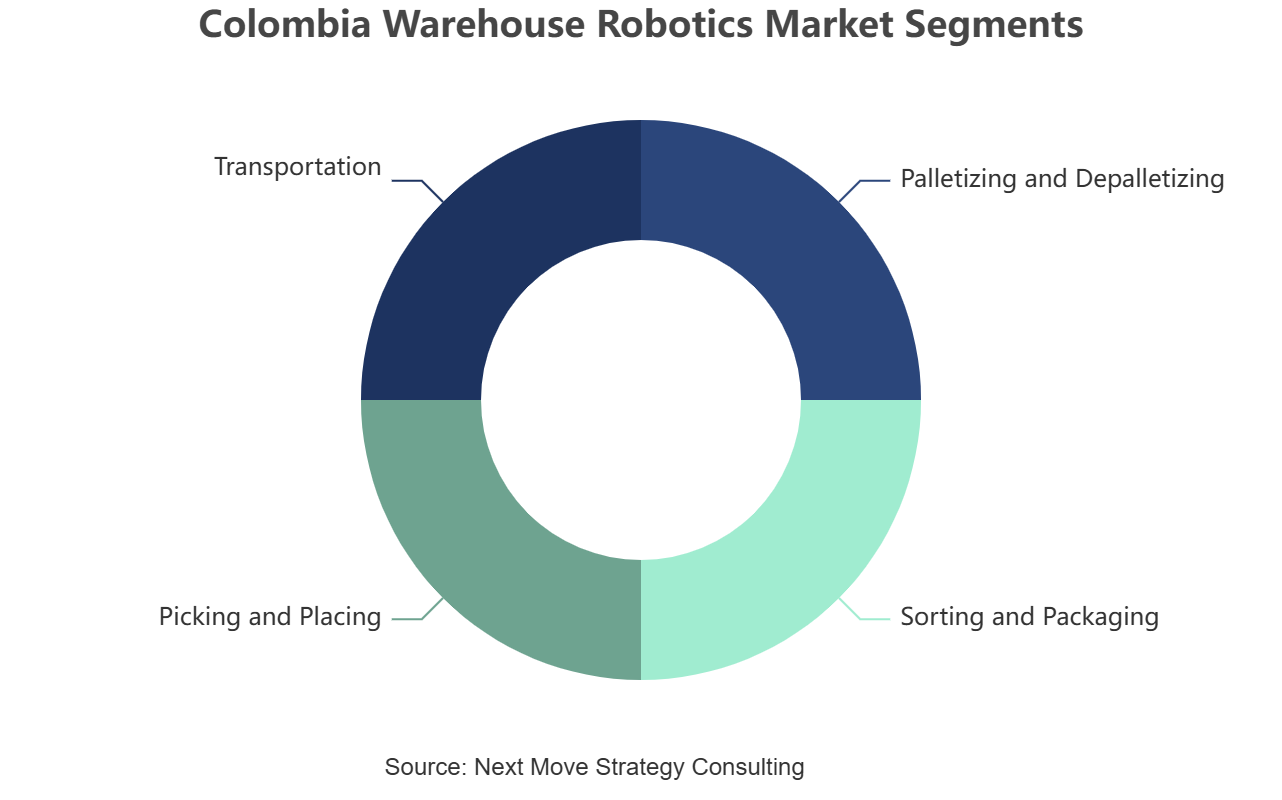
Palletizing and Depalletizing
-
Sorting and Packaging
-
Picking and Placing
-
Transportation
By End User
-
E-commerce
-
Automotive
-
Food & Beverages
-
Pharmaceutical
-
Chemical and Materials
-
Semiconductor and Electronics
-
Others
Consumer Behavior Analysis Of The Colombia Warehouse Robotics Market
The consumer behavior analysis of the Colombia warehouse robotics market illustrates the decision-making journey from awareness to long-term loyalty. Businesses are increasingly recognizing the benefits of warehouse automation for improving operational efficiency and logistics performance. Purchase decisions are influenced by system capabilities, integration flexibility, customization options, financing models, and supplier support. Long-term customer loyalty is driven by reliable system performance, productivity improvements, predictive maintenance, software upgrades, and responsive after-sales technical support.
Key Benefits for Stakeholders
Next Move Strategy Consulting (NMSC) presents a comprehensive analysis of the Colombia Warehouse Robotics Market, covering historical developments from 2020 to 2025 and providing detailed forecasts through 2035. Our study evaluates the market across key robotics types, offerings, payload capacities, applications, and end-user industries, delivering quantitative outlooks alongside qualitative insights into warehouse automation adoption trends, supply chain digitalization, AMR and AGV deployment patterns, pharmaceutical and food sector automation, and warehouse software platform evolution. Investors and technology providers benefit from clarity on high-potential segments and emerging growth corridors across Colombia's logistics ecosystem.
Warehouse robotics manufacturers, automation solution providers, system integrators, logistics operators, e-commerce retailers, pharmaceutical distributors, food and beverage producers, and third-party logistics (3PL) companies benefit from increasing demand for scalable and intelligent warehouse automation across Colombia. This report supports strategic decision-making by providing detailed market sizing, competitive intelligence, segmentation insights, investment opportunity analysis, and technology adoption pattern assessment across a steadily growing Latin American market projected to expand at a CAGR of 7.31% through 2035, enabling stakeholders to make informed decisions in Colombia's evolving warehousing and logistics automation landscape.
|
Parameters |
Details |
|
Customization Scope |
Free customization (equivalent to up to 80 analyst-working hours) after purchase. |
|
Pricing and Purchase Options |
Avail customized purchase options to meet your exact research needs. |
|
Approach |
In-depth primary and secondary research; proprietary databases; rigorous quality control and validation measures. |
|
Analytical Tools |
Porter's Five Forces, SWOT, value chain, and Harvey ball analysis to assess competitive intensity, stakeholder roles, and relative impact of key factors. |
Conclusion
The Colombia Warehouse Robotics Market is on a measured yet consistent growth path, projected to expand from USD 21.71 million in 2025 to USD 57.72 million by 2035 at a CAGR of 7.31%. Growth is underpinned by retail and consumer goods supply chain modernization, pharmaceutical and food sector expansion, and government digital economy initiatives. Nearshoring trends and growing FDI inflows represent compelling long-term opportunities. A competitive landscape of global automation leaders and locally embedded solution providers ensures continued technology advancement and market deepening throughout Colombia's evolving warehouse automation ecosystem.
About the Author
 Liza Phukan is a content and market research professional with a strong focus on analyzing emerging industries, validating market data, and developing insightful business content. She is passionate about transforming complex information into clear, engaging, and well-structured research that supports strategic decision-making. Beyond her professional interests, she enjoys crocheting, gardening, reading, and exploring creative projects while continuously enhancing her research and writing skills.
About the Reviewer
 Supradip Baul is an accomplished business consultant and strategist with over a decade of rich experience in market intelligence, strategy, technology, and business transformation. His work has included rigorous qualitative and quantitative analysis across multiple industries, helping clients shape investment decisions and long-term roadmaps. Earlier in his career, he was associated with Gartner, where he contributed to industry-leading reports and market share analyses. He has worked with leading global companies and holds an MBA with a dual specialization in Marketing and Finance.
At Next Move Strategy Consulting, we understand that insightful market research is the cornerstone of successful business decisions. That's why we employ a robust and multifaceted approach, combining various methodologies to deliver the most accurate and actionable data for our clients.

Research Landscape
We navigate the world of research with two primary approaches:
Qualitative Approach
Our qualitative research methodologies involve immersive techniques such as in-depth interviews, focus groups, and observational studies. By engaging directly with individuals and stakeholders, we uncover valuable insights that quantitative data alone may overlook.

Quantitative Research
In tandem with qualitative methodologies, NMSC leverages the power of Quantitative Research to provide a robust foundation of numerical insights. Through systematic data collection and analysis, we quantify patterns, preferences, and market trends, offering a comprehensive view of the business landscape.
Our quantitative research approach employs diverse tools, including surveys, experiments, and statistical modelling. These methodologies enable us to gather data from a large and representative sample, ensuring the statistical significance of our findings. By employing structured questionnaires and standardized data collection methods, we guarantee the reliability and validity of the information we present to our clients.
Quantitative research is particularly effective in measuring the prevalence of trends, assessing market size, and gauging the impact of various factors on consumer behavior. The numerical precision attained through this approach equips our clients with actionable insights, facilitating data-driven decision-making and strategy formulation.


Our Specialized Toolbox for Industry-Specific Market Research
We deploy a specialized arsenal of techniques tailored to meet your unique requirements. Here's a glimpse into our comprehensive toolbox:

Information Procurement
The stage entails acquiring market data or relevant information through various sources and methodologies.


Market Research Approach
We utilize both top-down and bottom-up approaches in market research analysis to achieve a comprehensive understanding of the market dynamics, leveraging the broad perspective of industry trends and macroeconomic factors alongside detailed insights from specific segments and individual companies.

Porters Five Forces Analysis
We conduct Porter's Five Forces analysis to evaluate the competitive landscape of an industry, providing us with insights into factors that affect profitability and strategic positioning.

SWOT Analysis

Forecasting
We utilize a forecasting model to predict future consumption by considering parameters like population, economics, regulations, market competition, drivers, constraints, technology, and pricing. We also employ statistical techniques such as multilinear regression, exponential smoothing, moving average, ARIMA, and Monte Carlo simulations for accurate predictions. In econometric forecasting, we analyzed short-term and long-term event impacts, attributing values based on regulatory frameworks, economic factors, and market events.





 Speak to Our Analyst