North America Mobile Robot Market By Product Type (Pallet Transport Robots, Forklift Robots, Tow Tractor Robots, Tote & Bin Robots, Shelf & Rack Robots, Case Handling Robots, Piece Picking Robots, and Others), By Technology (Automated Guided Vehicles (AGVs), Autonomous Mobile Robots (AMRs), and Hybrid Mobile Robots), By Payload Capacity, By Operating Environment, By Fleet Size, By Sales Channel, and By End User Industry – Opportunity Analysis and Industry Forecast, 2025–2035
Industry: ICT & Media | Latest Edition: September 30, 2026 | No of Pages: 575 | No. of Tables: 296 | No. of Figures: 280 | Format: PDF | Report Code: IC5183
North America Mobile Robot Market Size & Forecast, 2025-2035
|
Parameters |
Details |
|
Market Size in 2025 |
USD 6.37 Billion |
|
Market Size in 2026 |
USD 7.88 Billion |
|
Revenue Forecast in 2035 |
USD 24.16 Billion |
|
Growth Rate |
CAGR of 13.26% from 2026 to 2035 |
|
Market Volume in 2025 |
111 Thousand Units |
|
Market Volume in 2026 |
146 Thousand Units |
|
Volume Forecast in 2035 |
511 Thousand Units |
|
Growth Rate |
CAGR of 14.96% from 2026 to 2035 |
|
Analysis Period |
2025-2035 |
|
Base Year Considered |
2025 |
|
Forecast Period |
2026-2035 |
|
Market Size Estimation |
Billion (USD) |
|
Companies Profiled |
15 |
|
Market Share |
Available for 10 Companies |
North America Mobile Robot Market Overview
Industry Outlook
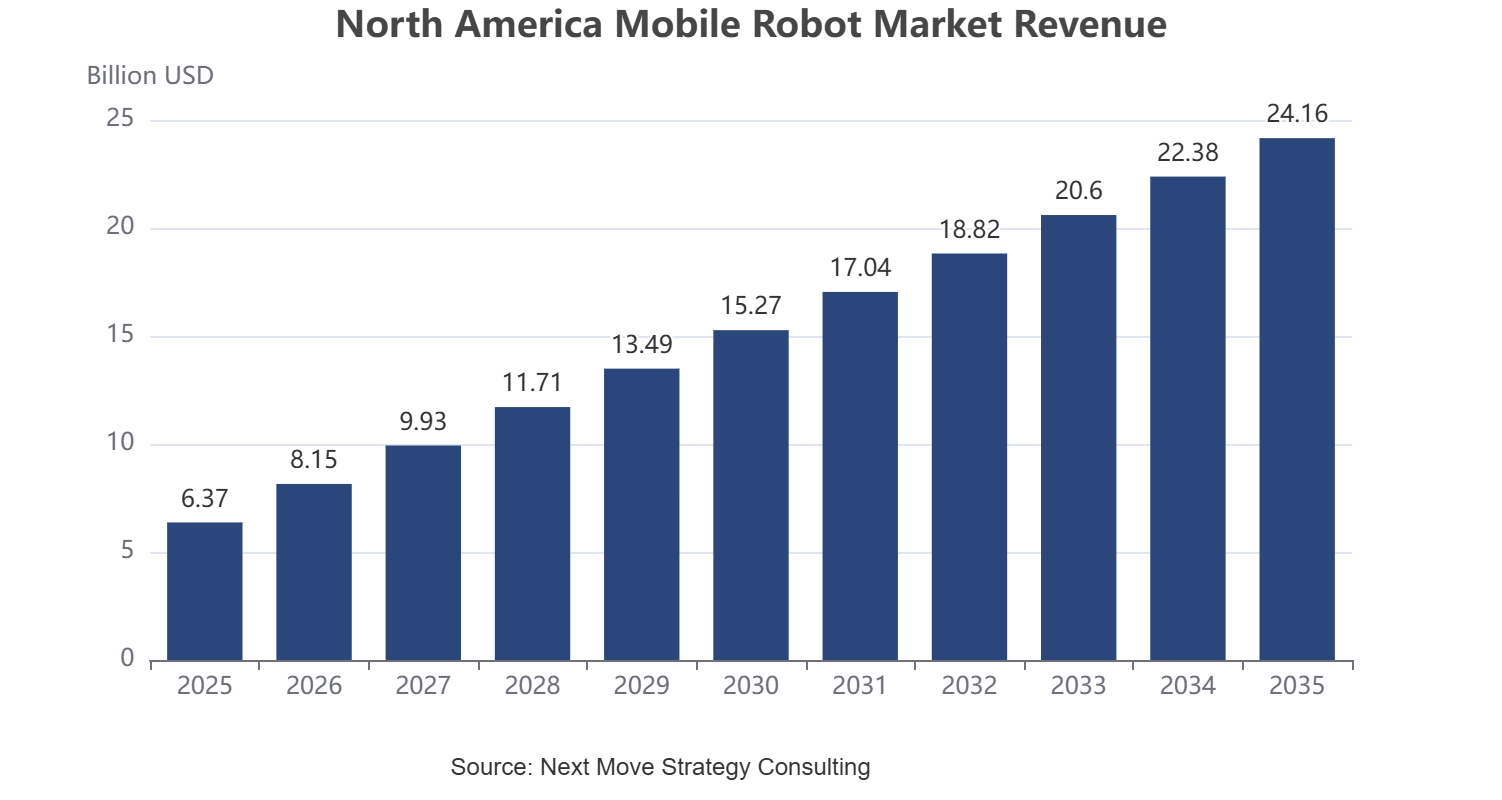
The North America Mobile Robot Market was valued at USD 6.37 billion in 2025 and is estimated to reach USD 7.88 billion in 2026. The market is projected to grow steadily over the forecast period, reaching USD 24.16 billion by 2035, registering a strong CAGR of 13.26% from 2026 to 2035. In terms of volume, the market recorded 111 thousand units in 2025 and is expected to reach 146 thousand units in 2026, further rising to 511 thousand units by 2035, reflecting a CAGR of 14.96% during the same period.
What Are the Key Market Drivers, Restraints, and Opportunities Shaping the North America Mobile Robot Market Through 2035?
Growth Catalyst & Risk Assessment Matrix
|
Drivers / Trends / Restraints |
(+/-) % Impact on CAGR Forecast |
Geographic Relevance |
Impact Timeline |
|
Rapid expansion of e-commerce and warehouse automation is driving fulfillment centers to adopt mobile robots for picking, sorting, and transport |
+2.1% |
United States, Canada |
Short to medium term (1-5 years) |
|
Persistent labor shortages across manufacturing, warehousing, and logistics are accelerating investment in autonomous material handling systems |
+1.8% |
United States, Canada |
Medium term (2-7 years) |
|
Reshoring and nearshoring of manufacturing under the USMCA framework is increasing demand for automated intralogistics and material handling |
+1.6% |
United States, Mexico |
Medium to long term (3-8 years) |
|
High capital investment requirements and integration complexity with legacy systems continue to restrain adoption among smaller enterprises |
-1.2% |
North America |
Short to medium term (1-5 years) |
|
Expansion of mobile robots into healthcare, retail, and last-mile logistics is creating new opportunities beyond traditional manufacturing |
+1.5% |
United States, Canada, Mexico |
Long term (4-10 years) |
Through our market assessment, we observed that the North America Mobile Robot Market is witnessing strong growth driven by rapid e-commerce expansion, persistent labor shortages, and increasing warehouse and manufacturing automation across the United States, Canada, and Mexico. Reshoring and nearshoring trends supported by USMCA are further strengthening industrial automation investment. However, high capital investment requirements and system integration complexity continue to restrain adoption among smaller enterprises. Meanwhile, expanding applications in healthcare, retail, and last-mile logistics are creating substantial long-term growth opportunities across the region.
Growth Drivers
How Is the Growth of E-Commerce Driving the North America Mobile Robot Market?
Our market assessment indicates that the rapid expansion of e-commerce and omnichannel retail across the United States and Canada is a key factor accelerating demand for mobile robots. Fulfillment centers are increasingly deploying autonomous mobile robots and automated guided vehicles to manage rising order volumes, shorten delivery timelines, and improve picking accuracy. Mobile robots enable continuous operations, reduce reliance on manual labor, and optimize intralogistics workflows, supporting the region's transition toward highly automated warehousing and distribution environments.
How Are Labor Shortages Accelerating Mobile Robot Adoption Across North America?
Based on our market evaluation, persistent labor shortages across manufacturing, warehousing, and logistics sectors are driving increased deployment of mobile robots throughout North America. Employers are investing in automation solutions to offset workforce gaps, reduce turnover-related disruptions, and maintain consistent production and fulfillment output. Mobile robots handling material transport, picking, and inventory movement allow companies to sustain operational continuity while improving workplace safety, making automation an increasingly essential strategy for regional employers.
How Is Manufacturing Reshoring Under USMCA Supporting Market Growth?
According to NMSC research, the reshoring and nearshoring of manufacturing operations to the United States and Mexico, supported by the USMCA trade framework, is strengthening the North America Mobile Robot Market. Companies relocating production closer to end markets are investing heavily in automated material handling and intralogistics systems to achieve operational efficiency and cost competitiveness. This manufacturing resurgence is accelerating mobile robot deployment across automotive, electronics, and industrial manufacturing facilities throughout the region.
Growth Inhibitor
What Factors Are Restraining Growth in the North America Mobile Robot Market?
Despite strong growth prospects, high upfront capital investment and the complexity of integrating mobile robots with existing warehouse management and enterprise systems continue to restrain market expansion. Through our market analysis, we observed that smaller manufacturers and logistics providers often face budget constraints and limited technical expertise, delaying automation adoption. Additionally, ensuring interoperability between diverse robotic platforms and legacy infrastructure increases implementation timelines and raises overall project costs across many facilities.
Growth Opportunity
How Is Expansion Beyond Manufacturing Creating New Growth Opportunities?
Through NMSC's assessment, we found that the adoption of mobile robots is expanding rapidly beyond traditional manufacturing and warehousing into healthcare, retail, and last-mile delivery applications. Hospitals, pharmacies, and retail chains are increasingly investing in autonomous mobile robots for material transport, inventory replenishment, and service delivery to improve efficiency and address staffing shortages. As navigation technologies and AI capabilities continue advancing, these emerging applications are expected to generate substantial long-term growth opportunities across North America.
Which Country is Dominating the North America Mobile Robot Market?
Our comprehensive market assessment indicates that the United States holds the dominant share in the North America Mobile Robot Market, accounting for the largest regional market revenue. The country's leadership is driven by its advanced industrial automation ecosystem, widespread adoption of Industry 4.0 technologies, and the strong presence of leading robotics manufacturers and technology providers. Increasing investments in warehouse automation, smart manufacturing, e-commerce fulfillment centers, and AI-powered logistics solutions continue to accelerate market growth. Furthermore, the rapid deployment of Autonomous Mobile Robots (AMRs), Automated Guided Vehicles (AGVs), AI-enabled navigation systems, and intelligent fleet management platforms across manufacturing, retail, healthcare, and logistics sectors reinforces the United States' leading position in the North America Mobile Robot Market.
Which Country is Set to Witness the Fastest Growth?
Based on our assessment of industrial automation investments, digital transformation initiatives, and market growth projections, Mexico is expected to witness the fastest growth in the North America Mobile Robot Market during the forecast period. The country's expanding manufacturing base, increasing adoption of warehouse automation, and rising investments in smart factories and logistics infrastructure are driving demand for mobile robotics solutions. Growing nearshoring activities, expansion of automotive and electronics manufacturing, and increasing deployment of autonomous mobile robots in production facilities and distribution centers are further supporting market expansion. With a projected CAGR of 14.96% during 2026–2035, Mexico is expected to emerge as the fastest-growing market in North America, strengthening its role in the region's industrial automation and intelligent intralogistics ecosystem.
ECOSYSTEM ANALYSIS OF THE NORTH AMERICA MOBILE ROBOT MARKET
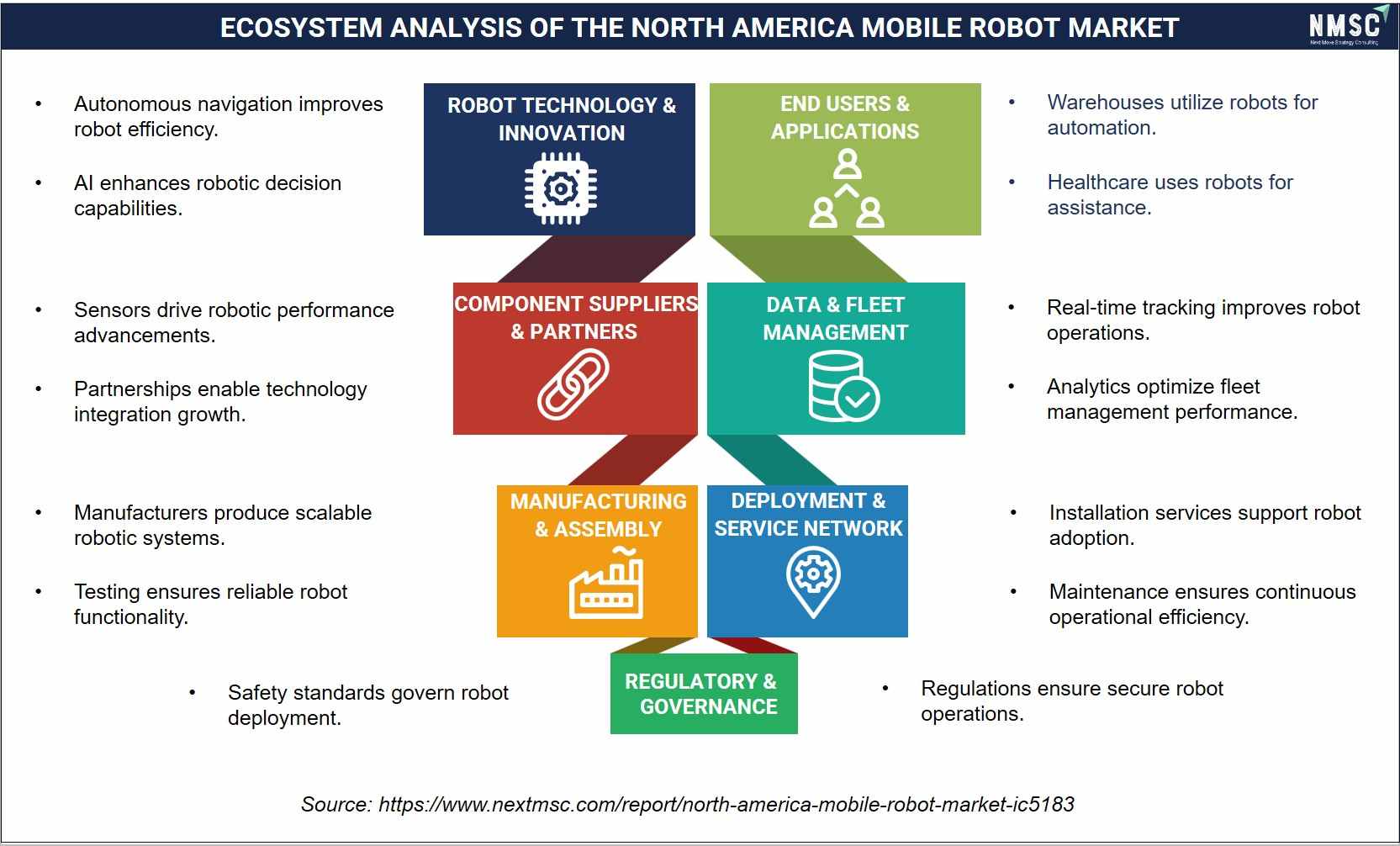
The North America Mobile Robot Market ecosystem comprises technology developers, component suppliers, robot manufacturers, software providers, system integrators, and end users working together to advance industrial automation. Innovations in AI, machine vision, LiDAR, and autonomous navigation are accelerating the adoption of mobile robots across warehousing, manufacturing, healthcare, retail, and logistics. Cloud-based fleet management, expanding deployment networks, and supportive regulatory frameworks further strengthen the ecosystem, enabling improved operational efficiency, scalability, and productivity throughout the region.
How Is the North America Mobile Robot Market Segmented, and What Are the Key Insights from the Segmentation Analysis?
By Technology Insights
Is Technology Segmentation Driving Innovation Across the North America Mobile Robot Market?
Based on technology, the North America Mobile Robot Market is segmented into Automated Guided Vehicles, Autonomous Mobile Robots, and Hybrid Mobile Robots. AGVs are further classified into Magnetic Guidance, Wire Guidance, Optical Guidance, QR Code Guidance, and Laser Guidance, while AMRs are segmented into LiDAR Navigation, Vision Navigation, SLAM Navigation, Natural Feature Navigation, and AI-Based Navigation. Hybrid Mobile Robots are categorized into Mixed Guidance Systems and Switchable Navigation Systems.
Based on our analysis, Autonomous Mobile Robots are witnessing the fastest adoption across North American warehouses and manufacturing facilities owing to their intelligent navigation, flexibility, and ability to operate in dynamic environments alongside human workers. Automated Guided Vehicles remain widely used for repetitive, high-volume material handling due to their reliability and cost efficiency in structured settings. Hybrid Mobile Robots are gaining traction by combining multiple navigation technologies, while continued advancements in AI-based and SLAM navigation are supporting increasingly intelligent robotic deployments across the region.
By Payload Capacity Insights
How Is Payload Capacity Influencing Mobile Robot Adoption Across the North America Mobile Robot Market?
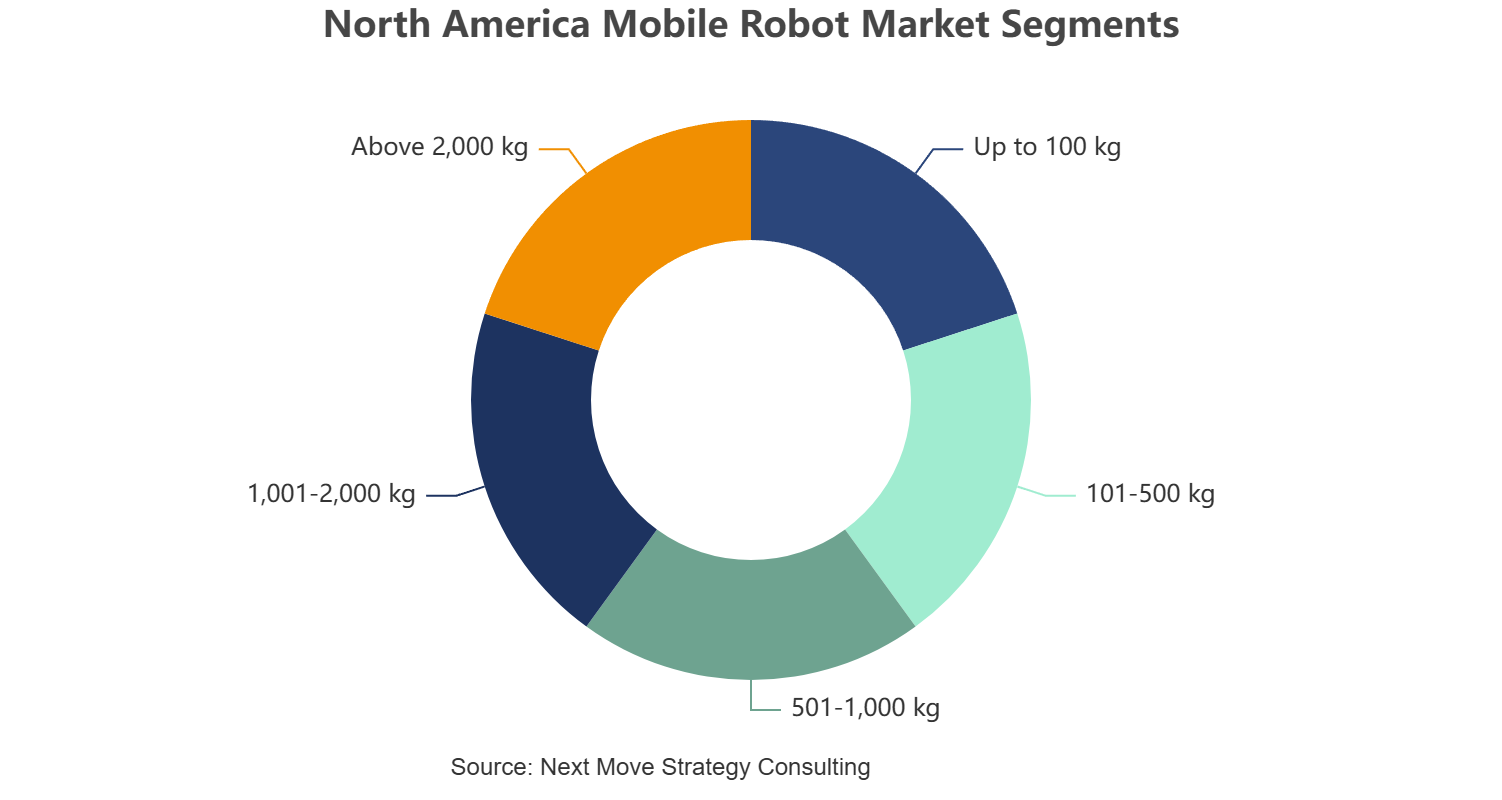
Based on payload capacity, the North America Mobile Robot Market is segmented into Up to 100 kg, 101-500 kg, 501-1,000 kg, 1,001-2,000 kg, and Above 2,000 kg. Each capacity tier corresponds to distinct operational use cases, ranging from light-duty component and tote transport to heavy-duty pallet, forklift, and industrial load handling, allowing manufacturers, warehouses, and distribution centers across the United States, Canada, and Mexico to select mobile robot solutions aligned with their specific throughput and material handling requirements.
Based on our evaluation, payload capacity remains a key factor shaping deployment strategies across end-user industries in North America. Robots with capacities up to 100 kg are widely used for light-duty tasks such as component transport and retail replenishment, while the 101-500 kg and 501-1,000 kg segments dominate warehousing and general manufacturing applications. Robots exceeding 1,001 kg are gaining traction in automotive and heavy manufacturing, where high-load transportation and continuous material handling remain essential to production efficiency.
Competitive Landscape
The North America Mobile Robot Market is characterized by a highly competitive and innovation-driven landscape, supported by the presence of established robotics manufacturers, automation solution providers, and AI software developers. Market growth is driven by rising automation adoption across manufacturing, warehousing, logistics, and retail sectors, alongside expanding e-commerce fulfillment and USMCA-supported nearshoring activity. Continuous advancements in AI-powered navigation, fleet management platforms, and intralogistics automation are strengthening competitive positioning, enhancing operational efficiency, and driving sustained long-term market growth across the region.
Strategic Development
-
February 2026 - KUKA announced its LogiMAT 2026 showcase featuring interoperable Autonomous Mobile Robots integrated with industrial robots. The demonstration highlights scalable AMR solutions for warehouse automation and smart intralogistics, reinforcing KUKA's mobile robotics portfolio used by manufacturers and distribution centers worldwide, including North America.
-
September 2024 - Toyota Industries announced a strategic investment and partnership with Gideon, an AI-based Autonomous Mobile Robot software developer. The partnership strengthens Toyota's warehouse automation and autonomous mobile robot capabilities for logistics and manufacturing operations, including the North American market.
-
March 2024 - ABB launched its next-generation Autonomous Mobile Robot (AMR) platform featuring AI-powered Visual SLAM navigation and the AMR Studio® software suite. The solution enables infrastructure-free navigation for warehouses and manufacturing facilities, directly supporting mobile robot deployments across North America for logistics and material handling.
Key Players of the North America Mobile Robot Market
-
Toyota Industries Corporation
-
KUKA Aktiengesellschaft
-
Teradyne, Inc.
-
Jungheinrich Aktiengesellschaft
-
Toyota Industries Commercial Finance Canada, Inc.
-
Agilox North America Inc.
-
Conductix-Wampfler Ltd.
-
SSI SCHAEFER Sistemas Internacionales de Almacenaje, S. de R.L. de C.V.
-
Stäubli Mexicana, S. de R.L. de C.V.
-
Honeywell International de México, S.A. de C.V.
-
Mobile Industrial Robots Mexico, S. de R.L. de C.V.
NMSC's analysis indicates that competitive dynamics in the North America Mobile Robot Market are increasingly shaped by advancements in autonomous navigation, AI-enabled fleet management, and intralogistics automation. Key companies such as Toyota Industries Corporation, KUKA Aktiengesellschaft, Teradyne, Dematic Corp., ABB Ltd, Jungheinrich Aktiengesellschaft, Agilox North America, Conductix-Wampfler, SSI SCHAEFER, Stäubli Mexicana, Honeywell International de México, and Mobile Industrial Robots Mexico are strengthening their market positions through strategic partnerships, product innovation, and expansion of automation portfolios across manufacturing, warehousing, and logistics applications throughout the region.
Key Segments
By Product Type
-
Pallet Transport Robots
-
Autonomous Pallet Trucks
-
Pallet Stackers
-
Underlift Pallet Movers
-
Pallet Shuttle Robots
-
-
Forklift Robots
-
Counterbalance Forklift Robots
-
Reach Truck Robots
-
VNA Forklift Robots
-
High-Lift Forklift Robots
-
Side Loader Robots
-
-
Tow Tractor Robots
-
Tugger Robots
-
Cart Pulling Robots
-
Milk Run Robots
-
Train Towing Robots
-
-
Tote and Bin Robots
-
Bin Transport Robots
-
Tote Transport Robots
-
Container Transport Robots
-
-
Workstation Delivery Robots
-
Shelf and Rack Robots
-
Shelf-to-Person Robots
-
Rack-to-Person Robots
-
Mobile Shelf Robots
-
Inventory Shelf Robots
-
-
Case Handling Robots
-
Carton Transport Robots
-
Case Transfer Robots
-
Cross Dock Robots
-
-
Piece Picking Robots
-
Mobile Piece Picking Robots
-
Goods-to-Person Picking Robots
-
Picking Assistant Robots
-
-
Other Mobile Robots
By Technology
-
Automated Guided Vehicles
-
Magnetic Guidance
-
Wire Guidance
-
Optical Guidance
-
QR Code Guidance
-
Laser Guidance
-
-
Autonomous Mobile Robots
-
LiDAR Navigation
-
Vision Navigation
-
SLAM Navigation
-
Natural Feature Navigation
-
AI-Based Navigation
-
-
Hybrid Mobile Robots
-
Mixed Guidance Systems
-
Switchable Navigation Systems
-
By Payload Capacity
-
Up to 100 kg
-
101-500 kg
-
501-1,000 kg
-
1,001-2,000 kg
-
Above 2,000 kg
By Operating Environment
-
Indoor
-
Outdoor
-
Hybrid
By Fleet Size
-
Single Robot Deployment
-
Small Fleet
-
Medium Fleet
-
Large Fleet
By Sales Channel
-
Direct Sales
-
System Integrators
-
OEM Partners
-
Value Added Resellers
-
Distributors
By End User Industry
-
Automotive
-
Electronics and Semiconductor
-
General Manufacturing
-
Warehousing
-
Third Party Logistics
-
E-commerce
-
Retail Distribution
-
Food and Beverage
-
Consumer Goods
-
Pharmaceuticals
-
Other Industries
STRATEGIC FRAMEWORK OF THE NORTH AMERICA MOBILE ROBOT MARKET
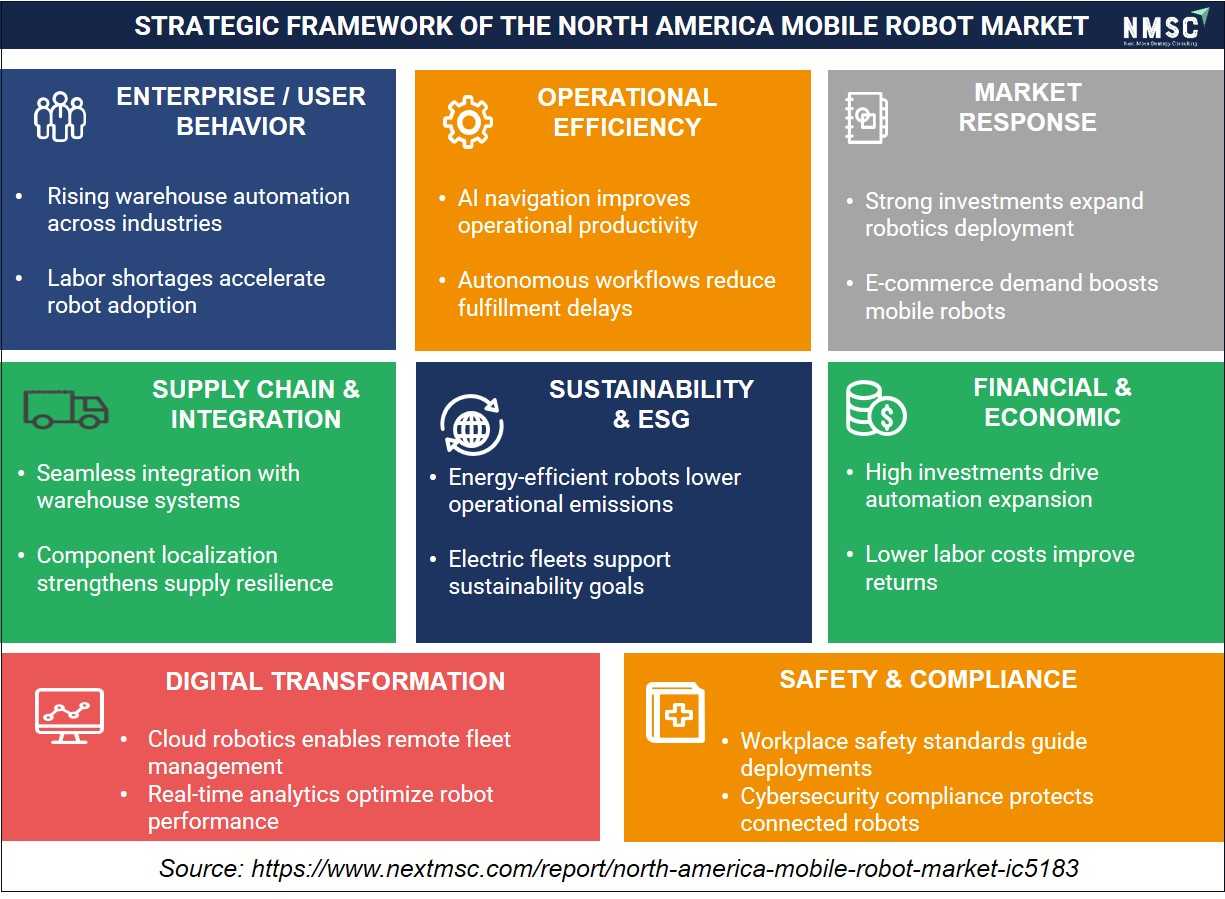
The strategic framework of the North America Mobile Robot Market is driven by rising warehouse automation, AI-powered operational efficiency, and increasing investments in smart manufacturing and logistics. Integration with digital supply chains, cloud-based fleet management, and real-time analytics enhances productivity and scalability. Sustainability initiatives promote energy-efficient robotic systems, while favorable economic returns encourage adoption across industries. Additionally, workplace safety regulations, cybersecurity standards, and compliance requirements support the secure and reliable deployment of mobile robots throughout North America.
Key Benefits for Stakeholders
Next Move Strategy Consulting presents a comprehensive analysis of the North America Mobile Robot Market, covering historical developments from 2020 to 2025 and providing forecasts through 2035. Our study evaluates the market across the United States, Canada, and Mexico, delivering quantitative outlooks alongside qualitative insights into AGV and AMR deployment trends, AI-powered navigation technologies, fleet management systems, and warehouse automation innovation across diverse industrial and commercial applications throughout the region.
Investors benefit from expanding opportunities in intelligent automation and digital manufacturing, while mobile robot manufacturers, automation solution providers, system integrators, logistics providers, warehouse operators, and end-user industries benefit from the growing demand for efficient, flexible, and autonomous material handling solutions. Retailers, healthcare facilities, and third-party logistics providers also gain actionable insights supporting strategic planning, technology investment, and competitive positioning within the rapidly evolving North America Mobile Robot Market landscape.
|
Parameters |
Details |
|
Customization Scope |
Free customization (equivalent to up to 80 analyst-working hours) after purchase. |
|
Pricing and Purchase Options |
Avail customized purchase options to meet your exact research needs. |
|
Approach |
In-depth primary and secondary research; proprietary databases; rigorous quality control and validation measures. |
|
Analytical Tools |
Porter's Five Forces, SWOT, value chain, and Harvey ball analysis to assess competitive intensity, stakeholder roles, and relative impact of key factors. |
Conclusion
The North America Mobile Robot Market is set for sustained growth through 2035, supported by rising e-commerce fulfillment demand, persistent labor shortages, and USMCA-driven manufacturing reshoring across the United States, Canada, and Mexico. Continued advancements in AI-powered navigation and fleet management are expanding opportunities beyond traditional warehousing into healthcare, retail, and last-mile logistics. Despite integration costs and capital investment challenges, a competitive landscape anchored by established automation leaders positions the market for robust, innovation-driven expansion throughout the forecast period.
About the Author
 Liza Phukan
— Liza Phukan is Research Associate at Next Move Strategy Consulting, where she has covered emerging industries and market research across sectors for 3.5 years. Her work includes analyzing industry developments, validating market data, and developing structured business content from research findings. She uses secondary research and data-validation practices to turn complex market information into clear decision-useful market analysis for business audiences and support report development and B2B.
Liza Phukan
— Liza Phukan is Research Associate at Next Move Strategy Consulting, where she has covered emerging industries and market research across sectors for 3.5 years. Her work includes analyzing industry developments, validating market data, and developing structured business content from research findings. She uses secondary research and data-validation practices to turn complex market information into clear decision-useful market analysis for business audiences and support report development and B2B.
About the Reviewer
 Supradip Baul
— Supradip Baul is an accomplished business consultant and strategist with over a decade of rich experience in market intelligence, strategy, technology, and business transformation. His work has included rigorous qualitative and quantitative analysis across multiple industries, helping clients shape investment decisions and long-term roadmaps. Earlier in his career, he was associated with Gartner, where he contributed to industry-leading reports and market share analyses. He has worked with leading global companies and holds an MBA with a dual specialization in Marketing and Finance.
Supradip Baul
— Supradip Baul is an accomplished business consultant and strategist with over a decade of rich experience in market intelligence, strategy, technology, and business transformation. His work has included rigorous qualitative and quantitative analysis across multiple industries, helping clients shape investment decisions and long-term roadmaps. Earlier in his career, he was associated with Gartner, where he contributed to industry-leading reports and market share analyses. He has worked with leading global companies and holds an MBA with a dual specialization in Marketing and Finance.
At Next Move Strategy Consulting, we understand that insightful market research is the cornerstone of successful business decisions. That's why we employ a robust and multifaceted approach, combining various methodologies to deliver the most accurate and actionable data for our clients.

Research Landscape
We navigate the world of research with two primary approaches:
Qualitative Approach
Our qualitative research methodologies involve immersive techniques such as in-depth interviews, focus groups, and observational studies. By engaging directly with individuals and stakeholders, we uncover valuable insights that quantitative data alone may overlook.

Quantitative Research
In tandem with qualitative methodologies, NMSC leverages the power of Quantitative Research to provide a robust foundation of numerical insights. Through systematic data collection and analysis, we quantify patterns, preferences, and market trends, offering a comprehensive view of the business landscape.
Our quantitative research approach employs diverse tools, including surveys, experiments, and statistical modelling. These methodologies enable us to gather data from a large and representative sample, ensuring the statistical significance of our findings. By employing structured questionnaires and standardized data collection methods, we guarantee the reliability and validity of the information we present to our clients.
Quantitative research is particularly effective in measuring the prevalence of trends, assessing market size, and gauging the impact of various factors on consumer behavior. The numerical precision attained through this approach equips our clients with actionable insights, facilitating data-driven decision-making and strategy formulation.


Our Specialized Toolbox for Industry-Specific Market Research
We deploy a specialized arsenal of techniques tailored to meet your unique requirements. Here's a glimpse into our comprehensive toolbox:

Information Procurement
The stage entails acquiring market data or relevant information through various sources and methodologies.


Market Research Approach
We utilize both top-down and bottom-up approaches in market research analysis to achieve a comprehensive understanding of the market dynamics, leveraging the broad perspective of industry trends and macroeconomic factors alongside detailed insights from specific segments and individual companies.

Porters Five Forces Analysis
We conduct Porter's Five Forces analysis to evaluate the competitive landscape of an industry, providing us with insights into factors that affect profitability and strategic positioning.

SWOT Analysis

Forecasting
We utilize a forecasting model to predict future consumption by considering parameters like population, economics, regulations, market competition, drivers, constraints, technology, and pricing. We also employ statistical techniques such as multilinear regression, exponential smoothing, moving average, ARIMA, and Monte Carlo simulations for accurate predictions. In econometric forecasting, we analyzed short-term and long-term event impacts, attributing values based on regulatory frameworks, economic factors, and market events.





 Speak to Our Analyst