AI Budgeting App Market Size, Share, Growth & Forecast by Buyer Type (Individual, Couples and Households, Family, Freelancer and Micro-business, and Other Buyer Type), By Industry Vertical (BFSI, Retail & E-commerce,and Other Industries), By Revenue Model (Subscription, Transaction Fee, Advertising, One-time Purchase, Other), By End Device (Smartphone, Tablet, Desktop/Laptop, Multi-Device), By AI Capability (Rules-Based, ML Categorisation, Other) -- Global Analysis 2025-2035
Industry: BFSI | Publishing Date: July 14, 2026 | Last Updated: September 30, 2026 | No of Pages: N/A | No. of Tables: N/A | No. of Figures: N/A | Format: PDF | Report Code: BF5126
What Is the AI Budgeting App Market Size?
The AI Budgeting App Market comprises software applications that use artificial intelligence to automate expense categorisation, forecast cash flow, and deliver conversational or autonomous budgeting guidance to individuals, households, and businesses across smartphone, tablet, and desktop environments worldwide.
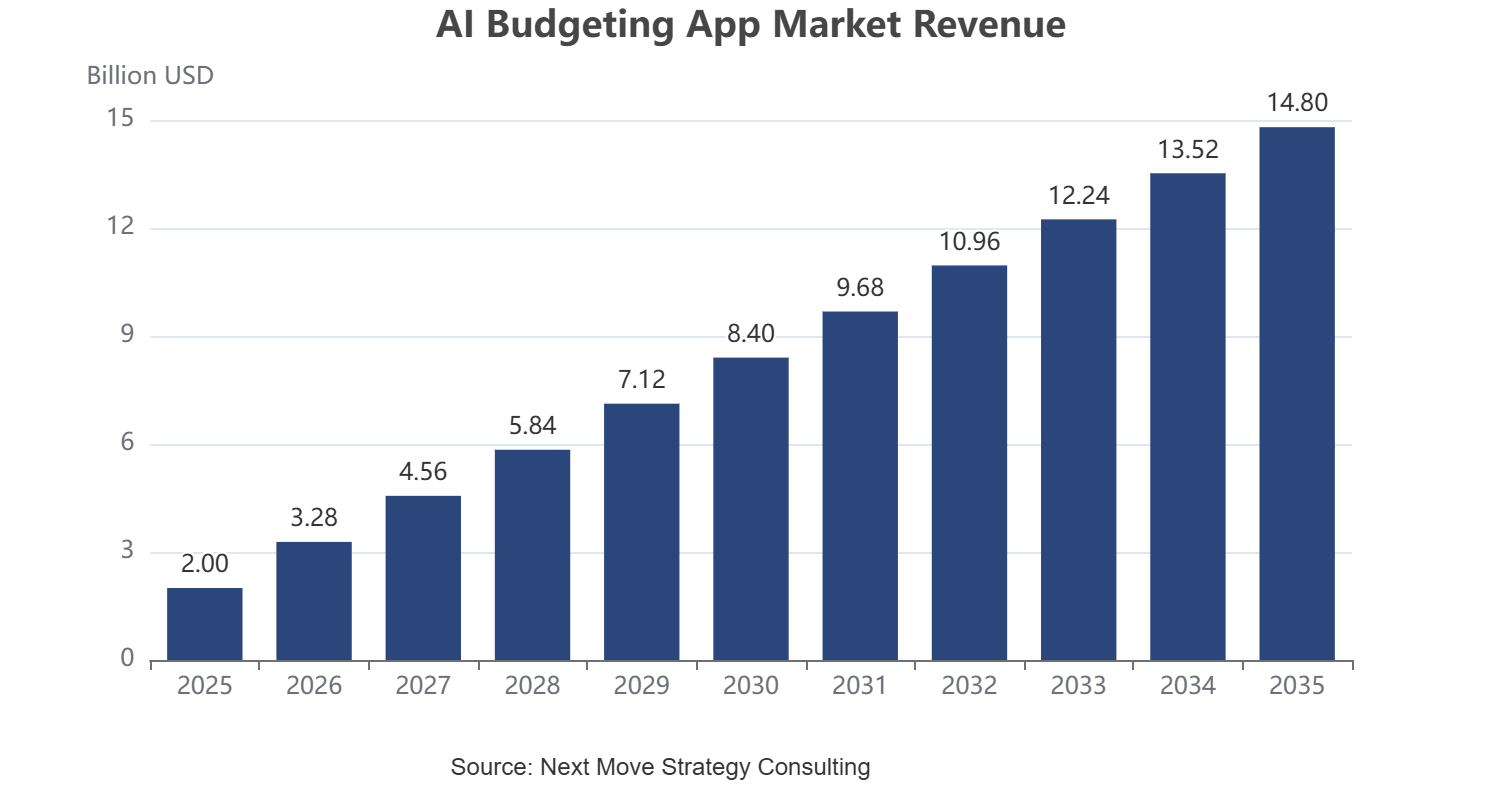
From our research, we found that the AI Budgeting App Market size was valued at USD 2.00 Billion in 2025 and is expected to reach USD 2.30 Billion by the end of 2026, before advancing to USD 14.80 Billion by 2035 at a CAGR of 23.0% between 2026 and 2035. Growth is driven by rising smartphone-first financial management adoption, expanding generative and conversational AI capability in consumer fintech, growing demand for real-time spend categorisation among younger earners, and increasing integration of budgeting tools within banking and neobank ecosystems.
Based on research conducted by NMSC, we found that household financial stress and the proliferation of open banking data rails are accelerating enterprise and individual demand for AI-native budgeting tools. Vendors are shifting from static category-tracking dashboards toward predictive and autonomous-action capable assistants that recommend or execute savings transfers, positioning the category as a durable subset of the broader personal-finance software industry through 2035.
|
Parameters |
Details |
|
Market Size in 2025 |
USD 2.00 Billion |
|
Market Size in 2026 |
USD 2.30 Billion |
|
Revenue Forecast in 2035 |
USD 14.80 Billion |
|
Growth Rate |
CAGR of 23.0% from 2026 to 2035 |
|
Analysis Period |
2025-2035 |
|
Base Year Considered |
2025 |
|
Forecast Period |
2026-2035 |
|
Market Size Estimation |
Revenue (USD Billion) |
|
Companies Profiled |
20 |
|
Countries Covered |
33 |
|
Market Share |
Available for Top 10 Companies |
AI Budgeting App Market Overview
The AI Budgeting App Industry spans standalone applications, embedded modules within banking platforms, and API-only products that apply machine learning and conversational AI to personal and business expense management. Through our market assessment, we observed that the industry is evolving from rules-based categorisation tools toward predictive and autonomous-action assistants capable of executing savings transfers on a user's behalf. Regulatory frameworks such as open banking data-sharing rules, consumer financial protection guidance, and evolving AI-transparency requirements across major economies are shaping vendor design choices toward explainability. Meanwhile, smartphone-first adoption and generative AI maturity are accelerating category expansion across individual, household, and small-business segments.
|
Key Takeaways |
|
By buyer type, Individual held the largest share of the AI Budgeting App Market at USD 0.58 Billion in 2025. The Enterprise segment is the fastest-growing sub-segment, projected to expand from USD 0.18 Billion in 2025 to USD 1.57 Billion by 2035 at a CAGR of 25.0% from 2026 to 2035. |
|
By industry vertical, BFSI held the largest share of the AI Budgeting App Market at USD 0.48 Billion in 2025. The Healthcare segment is the fastest-growing sub-segment, projected to expand from USD 0.30 Billion in 2025 to USD 2.51 Billion by 2035 at a CAGR of 24.9% from 2026 to 2035. |
|
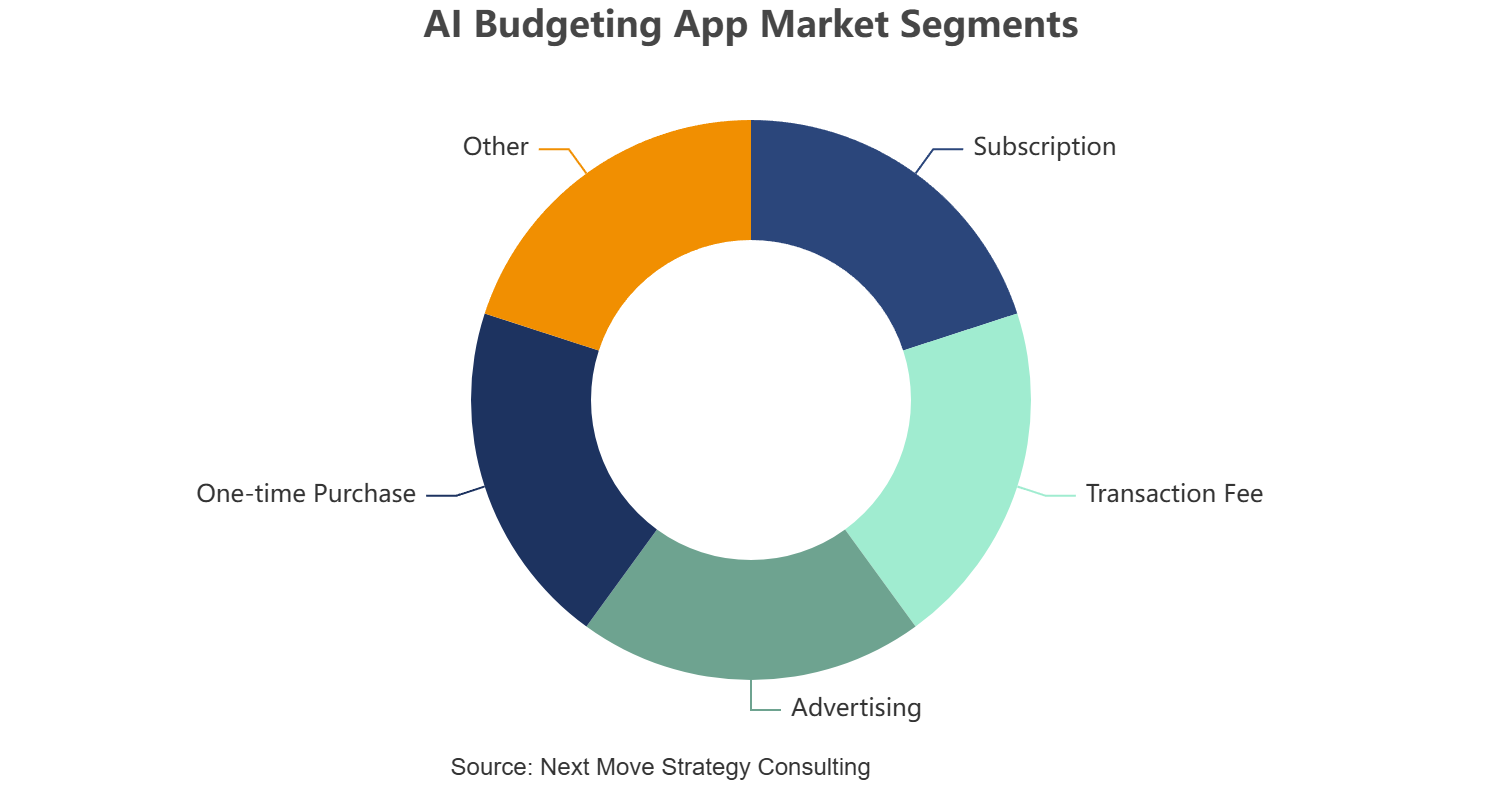
By revenue model, Subscription held the largest share of the AI Budgeting App Market at USD 1.10 Billion in 2025. The Transaction Fee segment is the fastest-growing sub-segment, projected to expand from USD 0.36 Billion in 2025 to USD 3.06 Billion by 2035 at a CAGR of 25.0% from 2026 to 2035. |
|
By end device, Smartphone held the largest share of the AI Budgeting App Market at USD 1.00 Billion in 2025. The Multi-Device segment is the fastest-growing sub-segment, projected to expand from USD 0.26 Billion in 2025 to USD 2.52 Billion by 2035 at a CAGR of 26.7% from 2026 to 2035. |
|
By AI capability, ML Categorisation held the largest share of the AI Budgeting App Market at USD 0.60 Billion in 2025. The Autonomous Action segment is the fastest-growing sub-segment, projected to expand from USD 0.22 Billion in 2025 to USD 2.25 Billion by 2035 at a CAGR of 27.7% from 2026 to 2035. |
|
North America held the largest regional share at USD 0.68 Billion in 2025 and is projected to reach USD 4.29 Billion by 2035 at a CAGR of 20.9%, anchored by leading AI budgeting vendors and mature open banking infrastructure. |
|
Asia-Pacific is the fastest-growing major region in the AI Budgeting App Market at a CAGR of 26.0% from 2026 to 2035, propelled by rapid smartphone penetration and expanding digital banking adoption. |
|
The U.S. is the dominant country in the AI Budgeting App Market at USD 0.53 Billion in 2025, projected to reach USD 3.37 Billion by 2035. |
|
Taiwan is the fastest-growing country in the AI Budgeting App Market at a CAGR of 28.2% from 2026 to 2035, reaching USD 0.28 Billion by 2035. |
Key Emerging Trends in the AI Budgeting App Industry
How Is Conversational AI Transforming the Budgeting Experience?
Conversational AI interfaces are replacing static dashboards with natural-language budgeting assistants that answer spending questions, explain variances, and suggest category adjustments in real time. Through NMSC's assessment, we found that vendors including Cleo AI Ltd have expanded chat-first interaction models that increase daily engagement among younger users. This shift is prompting stakeholders across the industry to reprioritize conversational design over manual entry, directly influencing product roadmaps and retention strategies within the AI Budgeting App Market through 2035.
Why Are Autonomous Action Features Gaining Enterprise Attention?
Autonomous-action capability, where the application executes savings transfers or bill payments without manual approval, is emerging as a premium differentiator among leading vendors. Based on NMSC's research, we found that Albert Corporation has positioned automated savings features as a core retention driver, encouraging comparable investment from competitors. Enterprise and household stakeholders increasingly value this hands-off model, reshaping competitive positioning and pricing structures across the AI Budgeting App Market.
How Is Embedded Finance Reshaping Distribution Channels?
Embedded modules delivered through banking apps and neobank platforms are becoming a meaningful distribution channel alongside standalone application. NMSC's analysis indicates that banks and credit unions are licensing AI budgeting modules to strengthen digital engagement, reducing customer acquisition costs for software vendors. This trend is expanding addressable demand among Couples and Households and Family buyer types, altering go-to-market strategy across the AI Budgeting App Market.
Porter's Five Forces Analysis of the AI Budgeting App Market
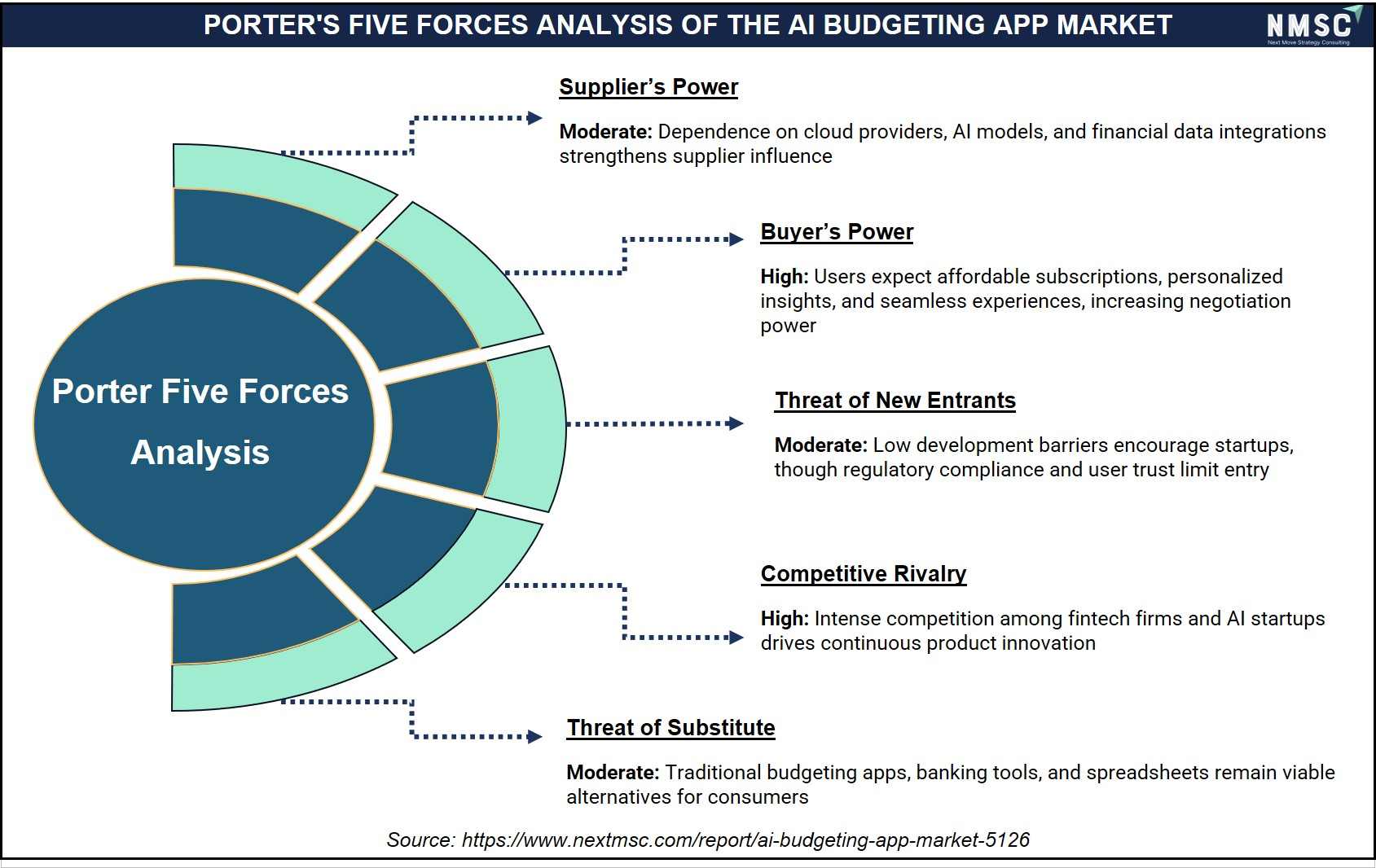
The Porter's Five Forces analysis evaluates the competitive landscape of the AI Budgeting App Market. Our assessment indicates that competitive rivalry remains high due to numerous fintech companies and digital banking platforms. The threat of new entrants is moderate as AI technologies reduce development barriers, while trust and regulatory compliance remain critical. Buyer bargaining power is high because users can easily switch between competing applications. Supplier bargaining power is moderate, and the threat of substitutes remains high from banking apps, traditional budgeting tools, and personal finance software.
What Are the Key Market Drivers, Restraints, and Investment Opportunities that will Shape the AI Budgeting App Industry in the Next Decade?
|
Driver / Trend / Restraint |
(+/-) % Impact on CAGR Forecast |
Geographic Relevance |
Impact Timeline |
|
Rising smartphone-first personal finance adoption |
+3.2% |
Global |
2026-2030 |
|
Expansion of open banking data connectivity |
+2.6% |
North America, Europe |
2026-2032 |
|
Data privacy and consumer protection compliance costs |
-1.4% |
Europe, North America |
2026-2035 |
|
Free native budgeting tools from banks and OS platforms |
-1.1% |
Global |
2026-2029 |
|
Growth of embedded AI budgeting in neobank platforms |
+2.1% |
Global |
2027-2035 |
|
Demand for AI-driven small-business cash-flow forecasting |
+1.8% |
North America, Asia-Pacific |
2027-2035 |
What Are the Growth Drivers of the AI Budgeting App Industry?
What Is Driving Adoption of AI Budgeting Applications Among Individuals?
Rising smartphone penetration and growing financial-literacy engagement are driving individual adoption of AI budgeting applications. Our findings suggest that the U.S. Federal Reserve reports that a majority of adults now manage some portion of their finances through mobile applications, supporting sustained category growth. This adoption pattern is reinforced by app-store distribution efficiency and low-friction onboarding, directly supporting demand across the Individual and Couples and Households buyer segments.
How Does Open Banking Infrastructure Support Market Growth?
Open banking frameworks that standardize secure data-sharing between financial institutions and third-party applications are expanding the addressable base for AI budgeting vendors. Our assessment indicates that the UK's Open Banking Implementation Entity and equivalent frameworks in the European Union have expanded the number of regulated account-information providers, an industry-derived estimate given the absence of a single global tracker. This infrastructure reduces integration costs and accelerates vendor expansion into new regional markets.
What Are the Growth Inhibitors of the AI Budgeting App Industry?
What Restrains Broader Enterprise Adoption of AI Budgeting Tools?
Data privacy compliance obligations under frameworks such as the General Data Protection Regulation restrain adoption pace among enterprise and small-business buyers handling sensitive financial data. Our analysis shows that compliance and security certification requirements lengthen enterprise procurement cycles, an industry-derived estimate given limited public disclosure of average cycle length. This restraint is most pronounced in Europe, where regulatory scrutiny of automated financial-decision tools continues to intensify.
Why Do Free Native Budgeting Tools Constrain Paid App Growth?
Financial institutions and mobile operating-system providers increasingly bundle basic categorisation and spend-tracking features at no cost, constraining willingness to pay for standalone AI budgeting applications. From our research, we found that this dynamic is most visible among Individual buyers with simpler financial profiles who default to bank-provided tools rather than dedicated applications, pressuring subscription-based vendors to differentiate through predictive and autonomous-action capability.
What Are the Growth Opportunities in the AI Budgeting App Industry?
What Opportunities Exist in Small-Business and Freelancer Budgeting?
Freelancer and micro-business buyers represent a substantial opportunity as gig-economy participation expands and irregular-income earners seek AI-driven cash-flow forecasting. Based on research conducted by NMSC, we found that the U.S. Bureau of Labor Statistics data on independent contractor participation supports continued growth in this buyer category, creating opportunity for vendors offering tax-estimation and irregular-income budgeting features tailored to freelance work patterns.
How Does Predictive AI Create Opportunity Across Industry Verticals?
Predictive AI capability that forecasts future cash positions and flags anomalies presents opportunity across BFSI, retail, and professional-services verticals seeking embedded financial-wellness tools for employees and customers. Through our market assessment, we observed that predictive-AI sub-segment growth outpaces the market average, supporting vendor investment in forecasting accuracy and creating opportunity for API-only product deployment models within enterprise software ecosystems.
How Is the AI Budgeting App Industry Segmented in This Report, and What Are the Key Insights from the Segmentation Analysis?
Which Buyer Type Leads the AI Budgeting App Market?
|
Segment |
2025 (USD Billion) |
2035 (USD Billion) |
CAGR% (2026-2035) |
|
Individual |
0.58 |
4.04 |
22.1% |
|
Couples and Households |
0.40 |
2.83 |
22.4% |
|
Family |
0.28 |
2.06 |
23.0% |
|
Freelancer and Micro-business |
0.26 |
2.00 |
23.5% |
|
Small Business |
0.24 |
1.94 |
24.0% |
|
Enterprise |
0.18 |
1.57 |
25.0% |
|
Other Buyer Type |
0.06 |
0.36 |
20.0% |
|
Total |
2.00 |
14.80 |
23.0% |
The By Buyer Type segmentation spans Individual, Couples and Households, Family, Freelancer and Micro-business, Small Business, Enterprise, and Other Buyer Type categories, each available across Standalone App, Embedded Module, API-only Product, and Other Deployment formats. Based on our market evaluation, we noticed that Individual buyers led with USD 0.58 Billion in 2025 owing to widespread smartphone-first adoption, while Enterprise is the fastest-growing category at a CAGR of 25.0%, driven by rising demand for embedded financial-wellness modules within corporate benefits platforms.
Which Industry Vertical Drives Demand for AI Budgeting Applications?
|
Segment |
2025 (USD Billion) |
2035 (USD Billion) |
CAGR% (2026-2035) |
|
BFSI |
0.48 |
3.29 |
22.0% |
|
Retail & E-commerce |
0.38 |
2.83 |
23.0% |
|
Professional Services |
0.34 |
2.40 |
22.4% |
|
Healthcare |
0.30 |
2.51 |
24.9% |
|
Manufacturing |
0.26 |
2.00 |
23.5% |
|
IT & Telecom |
0.16 |
1.27 |
24.2% |
|
Other Industries |
0.08 |
0.50 |
21.0% |
|
Total |
2.00 |
14.80 |
23.0% |
The By Industry Vertical segmentation covers BFSI, Retail & E-commerce, Professional Services, Healthcare, Manufacturing, IT & Telecom, and Other Industries. In our observation, BFSI held the largest share at USD 0.48 Billion in 2025 as banks embed budgeting modules within digital channels, while Healthcare is the fastest-growing vertical at a CAGR of 24.9%, supported by expanding employee financial-wellness benefit programs tied to healthcare cost management.
Which AI Capability Tier Is Reshaping the AI Budgeting App Market?
|
Segment |
2025 (USD Billion) |
2035 (USD Billion) |
CAGR% (2026-2035) |
|
Rules-Based |
0.24 |
0.82 |
12.7% |
|
ML Categorisation |
0.60 |
3.62 |
20.2% |
|
Conversational AI |
0.48 |
4.57 |
26.5% |
|
Predictive AI |
0.36 |
3.05 |
25.0% |
|
Autonomous Action |
0.22 |
2.25 |
27.7% |
|
Other |
0.10 |
0.49 |
18.1% |
|
Total |
2.00 |
14.80 |
23.0% |
The By AI Capability segmentation spans Rules-Based, ML Categorisation, Conversational AI, Predictive AI, Autonomous Action, and Other capability tiers. Through NMSC's assessment, we found that ML Categorisation held the largest share at USD 0.60 Billion in 2025 owing to its established role in automated expense sorting, while Autonomous Action is the fastest-growing tier at a CAGR of 27.7%, reflecting rising demand for hands-off savings execution among Individual and Small Business buyers.
Regional Outlook
Geographic Performance Snapshot
|
Region |
2025 (USD Billion) |
2035 (USD Billion) |
CAGR% (2026-2035) |
Key Driver |
|
North America |
0.68 |
4.29 |
20.9% |
Mature open banking infrastructure |
|
Europe |
0.54 |
3.51 |
21.2% |
PSD2-driven data connectivity |
|
Asia-Pacific |
0.46 |
4.23 |
26.0% |
Rapid smartphone-first adoption |
|
Middle East & Africa |
0.18 |
1.60 |
25.3% |
Digital banking expansion |
|
Latin America |
0.14 |
1.17 |
24.7% |
Rising fintech penetration |
|
Total |
2.00 |
14.80 |
23.0% |
- |
North America AI Budgeting App Market
North America represents a mature AI budgeting application market anchored by well-established open banking connectivity and high consumer smartphone penetration. Based on NMSC's research, we found that regulatory clarity under the Consumer Financial Protection Bureau's data-sharing rules supports vendor expansion, while enterprise adoption of embedded financial-wellness benefits continues to strengthen. The region's strategic outlook favors vendors that combine predictive AI with strong data-security certification to sustain premium subscription retention.
Europe AI Budgeting App Market
Europe's AI budgeting application market is shaped by the revised Payment Services Directive, which mandates standardized open banking data access across member states. NMSC's analysis indicates that this regulatory foundation accelerates account-aggregation capability among vendors, while GDPR compliance obligations raise the bar for data-handling transparency. Technology adoption is strongest in the UK, Germany, and the Nordic markets, where digital banking penetration and consumer trust in fintech applications remain comparatively high.
Asia-Pacific AI Budgeting App Market
Asia-Pacific is the fastest-growing regional market for AI budgeting applications, propelled by smartphone-first financial behavior across China, India, and Southeast Asia. Our findings suggest that rapid digital payment adoption and expanding middle-class income segments are driving demand for automated categorisation tools. Regulatory environments vary considerably across the region, with data-localization requirements in several markets shaping vendor infrastructure and partnership strategies with local financial institutions.
Middle East & Africa AI Budgeting App Market
The Middle East & Africa AI budgeting application market is expanding as digital banking initiatives in the Gulf Cooperation Council states and mobile-money adoption across Sub-Saharan Africa broaden the addressable user base. Our assessment indicates that national digital-transformation strategies in Saudi Arabia and the UAE are accelerating fintech licensing, supporting vendor market entry. Technology adoption remains uneven, with strategic outlook favoring vendors that localize language and currency support.
Latin America AI Budgeting App Market
Latin America's AI budgeting application market benefits from rising smartphone penetration and expanding digital-banking adoption in Brazil and Argentina. Our analysis shows that central bank-led instant-payment infrastructure, including Brazil's Pix system, is lowering integration friction for budgeting vendors that connect to real-time transaction data. Regulatory environments are gradually formalizing open banking frameworks, supporting a positive strategic outlook for regional expansion through 2035.
U.S. AI Budgeting App Market
Based on our engagements, the AI Budgeting App Market in U.S. was valued at approximately USD 0.53 Billion in 2025 and is projected to reach approximately USD 3.37 Billion by 2035, expanding at a CAGR of 20.9% from 2026 to 2035. Demand structure benefits from deep open banking integration and high enterprise financial-wellness benefit adoption, with adoption levels shaped by local regulatory posture toward open finance data-sharing and consumer AI transparency. Competitive intensity is rising as both global and regional vendors localize product offerings, supporting a favorable strategic outlook for continued category expansion.
Canada AI Budgeting App Market
Through our analysis, the AI Budgeting App Market in Canada was valued at approximately USD 0.10 Billion in 2025 and is projected to reach approximately USD 0.62 Billion by 2035, expanding at a CAGR of 21.2% from 2026 to 2035. Demand structure benefits from deep open banking integration and high enterprise financial-wellness benefit adoption, with adoption levels shaped by local regulatory posture toward open finance data-sharing and consumer AI transparency. Competitive intensity is rising as both global and regional vendors localize product offerings, supporting a favorable strategic outlook for continued category expansion.
Mexico AI Budgeting App Market
From our assessment, the AI Budgeting App Market in Mexico was valued at approximately USD 0.05 Billion in 2025 and is projected to reach approximately USD 0.30 Billion by 2035, expanding at a CAGR of 19.6% from 2026 to 2035. Demand structure benefits from deep open banking integration and high enterprise financial-wellness benefit adoption, with adoption levels shaped by local regulatory posture toward open finance data-sharing and consumer AI transparency. Competitive intensity is rising as both global and regional vendors localize product offerings, supporting a favorable strategic outlook for continued category expansion.
UK AI Budgeting App Market
According to evaluation, the AI Budgeting App Market in UK was valued at approximately USD 0.11 Billion in 2025 and is projected to reach approximately USD 0.72 Billion by 2035, expanding at a CAGR of 20.9% from 2026 to 2035. Demand structure reflects PSD2-driven account-aggregation standardization and rising digital-banking penetration, with adoption levels shaped by local regulatory posture toward open finance data-sharing and consumer AI transparency. Competitive intensity is rising as both global and regional vendors localize product offerings, supporting a favorable strategic outlook for continued category expansion.
Germany AI Budgeting App Market
Based on our engagements, the AI Budgeting App Market in Germany was valued at approximately USD 0.09 Billion in 2025 and is projected to reach approximately USD 0.60 Billion by 2035, expanding at a CAGR of 22.0% from 2026 to 2035. Demand structure reflects PSD2-driven account-aggregation standardization and rising digital-banking penetration, with adoption levels shaped by local regulatory posture toward open finance data-sharing and consumer AI transparency. Competitive intensity is rising as both global and regional vendors localize product offerings, supporting a favorable strategic outlook for continued category expansion.
France AI Budgeting App Market
Through our analysis, the AI Budgeting App Market in France was valued at approximately USD 0.07 Billion in 2025 and is projected to reach approximately USD 0.46 Billion by 2035, expanding at a CAGR of 21.5% from 2026 to 2035. Demand structure reflects PSD2-driven account-aggregation standardization and rising digital-banking penetration, with adoption levels shaped by local regulatory posture toward open finance data-sharing and consumer AI transparency. Competitive intensity is rising as both global and regional vendors localize product offerings, supporting a favorable strategic outlook for continued category expansion.
Italy AI Budgeting App Market
From our assessment, the AI Budgeting App Market in Italy was valued at approximately USD 0.05 Billion in 2025 and is projected to reach approximately USD 0.33 Billion by 2035, expanding at a CAGR of 20.9% from 2026 to 2035. Demand structure reflects PSD2-driven account-aggregation standardization and rising digital-banking penetration, with adoption levels shaped by local regulatory posture toward open finance data-sharing and consumer AI transparency. Competitive intensity is rising as both global and regional vendors localize product offerings, supporting a favorable strategic outlook for continued category expansion.
Spain AI Budgeting App Market
According to evaluation, the AI Budgeting App Market in Spain was valued at approximately USD 0.04 Billion in 2025 and is projected to reach approximately USD 0.26 Billion by 2035, expanding at a CAGR of 20.1% from 2026 to 2035. Demand structure reflects PSD2-driven account-aggregation standardization and rising digital-banking penetration, with adoption levels shaped by local regulatory posture toward open finance data-sharing and consumer AI transparency. Competitive intensity is rising as both global and regional vendors localize product offerings, supporting a favorable strategic outlook for continued category expansion.
Sweden AI Budgeting App Market
Based on our engagements, the AI Budgeting App Market in Sweden was valued at approximately USD 0.03 Billion in 2025 and is projected to reach approximately USD 0.19 Billion by 2035, expanding at a CAGR of 22.8% from 2026 to 2035. Demand structure reflects PSD2-driven account-aggregation standardization and rising digital-banking penetration, with adoption levels shaped by local regulatory posture toward open finance data-sharing and consumer AI transparency. Competitive intensity is rising as both global and regional vendors localize product offerings, supporting a favorable strategic outlook for continued category expansion.
Denmark AI Budgeting App Market
Through our analysis, the AI Budgeting App Market in Denmark was valued at approximately USD 0.03 Billion in 2025 and is projected to reach approximately USD 0.19 Billion by 2035, expanding at a CAGR of 22.8% from 2026 to 2035. Demand structure reflects PSD2-driven account-aggregation standardization and rising digital-banking penetration, with adoption levels shaped by local regulatory posture toward open finance data-sharing and consumer AI transparency. Competitive intensity is rising as both global and regional vendors localize product offerings, supporting a favorable strategic outlook for continued category expansion.
Finland AI Budgeting App Market
From our assessment, the AI Budgeting App Market in Finland was valued at approximately USD 0.02 Billion in 2025 and is projected to reach approximately USD 0.13 Billion by 2035, expanding at a CAGR of 23.1% from 2026 to 2035. Demand structure reflects PSD2-driven account-aggregation standardization and rising digital-banking penetration, with adoption levels shaped by local regulatory posture toward open finance data-sharing and consumer AI transparency. Competitive intensity is rising as both global and regional vendors localize product offerings, supporting a favorable strategic outlook for continued category expansion.
Netherlands AI Budgeting App Market
According to evaluation, the AI Budgeting App Market in Netherlands was valued at approximately USD 0.04 Billion in 2025 and is projected to reach approximately USD 0.25 Billion by 2035, expanding at a CAGR of 19.6% from 2026 to 2035. Demand structure reflects PSD2-driven account-aggregation standardization and rising digital-banking penetration, with adoption levels shaped by local regulatory posture toward open finance data-sharing and consumer AI transparency. Competitive intensity is rising as both global and regional vendors localize product offerings, supporting a favorable strategic outlook for continued category expansion.
Rest of Europe AI Budgeting App Market
Based on our engagements, the AI Budgeting App Market in Rest of Europe was valued at approximately USD 0.06 Billion in 2025 and is projected to reach approximately USD 0.38 Billion by 2035, expanding at a CAGR of 20.7% from 2026 to 2035. Demand structure reflects PSD2-driven account-aggregation standardization and rising digital-banking penetration, with adoption levels shaped by local regulatory posture toward open finance data-sharing and consumer AI transparency. Competitive intensity is rising as both global and regional vendors localize product offerings, supporting a favorable strategic outlook for continued category expansion.
China AI Budgeting App Market
Through our analysis, the AI Budgeting App Market in China was valued at approximately USD 0.13 Billion in 2025 and is projected to reach approximately USD 1.20 Billion by 2035, expanding at a CAGR of 26.0% from 2026 to 2035. Demand structure is underpinned by rapid smartphone-first financial behavior and expanding digital payment infrastructure, with adoption levels shaped by local regulatory posture toward open finance data-sharing and consumer AI transparency. Competitive intensity is rising as both global and regional vendors localize product offerings, supporting a favorable strategic outlook for continued category expansion.
India AI Budgeting App Market
From our assessment, the AI Budgeting App Market in India was valued at approximately USD 0.09 Billion in 2025 and is projected to reach approximately USD 0.84 Billion by 2035, expanding at a CAGR of 26.7% from 2026 to 2035. Demand structure is underpinned by rapid smartphone-first financial behavior and expanding digital payment infrastructure, with adoption levels shaped by local regulatory posture toward open finance data-sharing and consumer AI transparency. Competitive intensity is rising as both global and regional vendors localize product offerings, supporting a favorable strategic outlook for continued category expansion.
Japan AI Budgeting App Market
According to evaluation, the AI Budgeting App industry in Japan was valued at approximately USD 0.06 Billion in 2025 and is projected to reach approximately USD 0.55 Billion by 2035, expanding at a CAGR of 25.7% from 2026 to 2035. Demand structure is underpinned by rapid smartphone-first financial behavior and expanding digital payment infrastructure, with adoption levels shaped by local regulatory posture toward open finance data-sharing and consumer AI transparency. Competitive intensity is rising as both global and regional vendors localize product offerings, supporting a favorable strategic outlook for continued category expansion.
South Korea AI Budgeting App Market
Based on our engagements, the AI Budgeting App industry in South Korea was valued at approximately USD 0.04 Billion in 2025 and is projected to reach approximately USD 0.36 Billion by 2035, expanding at a CAGR of 24.5% from 2026 to 2035. Demand structure is underpinned by rapid smartphone-first financial behavior and expanding digital payment infrastructure, with adoption levels shaped by local regulatory posture toward open finance data-sharing and consumer AI transparency. Competitive intensity is rising as both global and regional vendors localize product offerings, supporting a favorable strategic outlook for continued category expansion.
Taiwan AI Budgeting App Market
Through our analysis, the AI Budgeting App industry in Taiwan was valued at approximately USD 0.03 Billion in 2025 and is projected to reach approximately USD 0.28 Billion by 2035, expanding at a CAGR of 28.2% from 2026 to 2035. Demand structure is underpinned by rapid smartphone-first financial behavior and expanding digital payment infrastructure, with adoption levels shaped by local regulatory posture toward open finance data-sharing and consumer AI transparency. Competitive intensity is rising as both global and regional vendors localize product offerings, supporting a favorable strategic outlook for continued category expansion.
Indonesia AI Budgeting App Market
From our assessment, the AI Budgeting App industry in Indonesia was valued at approximately USD 0.03 Billion in 2025 and is projected to reach approximately USD 0.28 Billion by 2035, expanding at a CAGR of 28.2% from 2026 to 2035. Demand structure is underpinned by rapid smartphone-first financial behavior and expanding digital payment infrastructure, with adoption levels shaped by local regulatory posture toward open finance data-sharing and consumer AI transparency. Competitive intensity is rising as both global and regional vendors localize product offerings, supporting a favorable strategic outlook for continued category expansion.
Vietnam AI Budgeting App Market
According to evaluation, the AI Budgeting App industry in Vietnam was valued at approximately USD 0.02 Billion in 2025 and is projected to reach approximately USD 0.18 Billion by 2035, expanding at a CAGR of 27.7% from 2026 to 2035. Demand structure is underpinned by rapid smartphone-first financial behavior and expanding digital payment infrastructure, with adoption levels shaped by local regulatory posture toward open finance data-sharing and consumer AI transparency. Competitive intensity is rising as both global and regional vendors localize product offerings, supporting a favorable strategic outlook for continued category expansion.
Australia AI Budgeting App Market
Based on our engagements, the AI Budgeting App industry in Australia was valued at approximately USD 0.03 Billion in 2025 and is projected to reach approximately USD 0.27 Billion by 2035, expanding at a CAGR of 27.7% from 2026 to 2035. Demand structure is underpinned by rapid smartphone-first financial behavior and expanding digital payment infrastructure, with adoption levels shaped by local regulatory posture toward open finance data-sharing and consumer AI transparency. Competitive intensity is rising as both global and regional vendors localize product offerings, supporting a favorable strategic outlook for continued category expansion.
Philippines AI Budgeting App Market
Through our analysis, the AI Budgeting App Market in Philippines was valued at approximately USD 0.01 Billion in 2025 and is projected to reach approximately USD 0.09 Billion by 2035, expanding at a CAGR of 27.7% from 2026 to 2035. Demand structure is underpinned by rapid smartphone-first financial behavior and expanding digital payment infrastructure, with adoption levels shaped by local regulatory posture toward open finance data-sharing and consumer AI transparency. Competitive intensity is rising as both global and regional vendors localize product offerings, supporting a favorable strategic outlook for continued category expansion.
Malaysia AI Budgeting App Market
From our assessment, the AI Budgeting App industry in Malaysia was valued at approximately USD 0.01 Billion in 2025 and is projected to reach approximately USD 0.09 Billion by 2035, expanding at a CAGR of 27.7% from 2026 to 2035. Demand structure is underpinned by rapid smartphone-first financial behavior and expanding digital payment infrastructure, with adoption levels shaped by local regulatory posture toward open finance data-sharing and consumer AI transparency. Competitive intensity is rising as both global and regional vendors localize product offerings, supporting a favorable strategic outlook for continued category expansion.
Rest of APAC AI Budgeting App Market
According to evaluation, the AI Budgeting App industry in Rest of APAC was valued at approximately USD 0.01 Billion in 2025 and is projected to reach approximately USD 0.09 Billion by 2035, expanding at a CAGR of 27.7% from 2026 to 2035. Demand structure is underpinned by rapid smartphone-first financial behavior and expanding digital payment infrastructure, with adoption levels shaped by local regulatory posture toward open finance data-sharing and consumer AI transparency. Competitive intensity is rising as both global and regional vendors localize product offerings, supporting a favorable strategic outlook for continued category expansion.
Saudi Arabia AI Budgeting App Market
Based on our engagements, the AI Budgeting App industry in Saudi Arabia was valued at approximately USD 0.03 Billion in 2025 and is projected to reach approximately USD 0.26 Billion by 2035, expanding at a CAGR of 27.1% from 2026 to 2035. Demand structure reflects accelerating digital-banking licensing activity and mobile-money expansion, with adoption levels shaped by local regulatory posture toward open finance data-sharing and consumer AI transparency. Competitive intensity is rising as both global and regional vendors localize product offerings, supporting a favorable strategic outlook for continued category expansion.
UAE AI Budgeting App Market
Through our analysis, the AI Budgeting App industry in UAE was valued at approximately USD 0.03 Billion in 2025 and is projected to reach approximately USD 0.27 Billion by 2035, expanding at a CAGR of 27.7% from 2026 to 2035. Demand structure reflects accelerating digital-banking licensing activity and mobile-money expansion, with adoption levels shaped by local regulatory posture toward open finance data-sharing and consumer AI transparency. Competitive intensity is rising as both global and regional vendors localize product offerings, supporting a favorable strategic outlook for continued category expansion.
Egypt AI Budgeting App Market
From our assessment, the AI Budgeting App industry in Egypt was valued at approximately USD 0.02 Billion in 2025 and is projected to reach approximately USD 0.18 Billion by 2035, expanding at a CAGR of 27.7% from 2026 to 2035. Demand structure reflects accelerating digital-banking licensing activity and mobile-money expansion, with adoption levels shaped by local regulatory posture toward open finance data-sharing and consumer AI transparency. Competitive intensity is rising as both global and regional vendors localize product offerings, supporting a favorable strategic outlook for continued category expansion.
Israel AI Budgeting App Market
According to evaluation, the AI Budgeting App industry in Israel was valued at approximately USD 0.03 Billion in 2025 and is projected to reach approximately USD 0.27 Billion by 2035, expanding at a CAGR of 27.7% from 2026 to 2035. Demand structure reflects accelerating digital-banking licensing activity and mobile-money expansion, with adoption levels shaped by local regulatory posture toward open finance data-sharing and consumer AI transparency. Competitive intensity is rising as both global and regional vendors localize product offerings, supporting a favorable strategic outlook for continued category expansion.
Turkey AI Budgeting App Market
Based on our engagements, the AI Budgeting App industry in Turkey was valued at approximately USD 0.02 Billion in 2025 and is projected to reach approximately USD 0.18 Billion by 2035, expanding at a CAGR of 27.7% from 2026 to 2035. Demand structure reflects accelerating digital-banking licensing activity and mobile-money expansion, with adoption levels shaped by local regulatory posture toward open finance data-sharing and consumer AI transparency. Competitive intensity is rising as both global and regional vendors localize product offerings, supporting a favorable strategic outlook for continued category expansion.
Nigeria AI Budgeting App Market
Through our analysis, the AI Budgeting App industry in Nigeria was valued at approximately USD 0.02 Billion in 2025 and is projected to reach approximately USD 0.18 Billion by 2035, expanding at a CAGR of 27.7% from 2026 to 2035. Demand structure reflects accelerating digital-banking licensing activity and mobile-money expansion, with adoption levels remain high from banking apps, traditional budgeting tools, and personal finance software.
South Africa AI Budgeting App Market
From our assessment, the AI Budgeting App industry in South Africa was valued at approximately USD 0.02 Billion in 2025 and is projected to reach approximately USD 0.17 Billion by 2035, expanding at a CAGR of 26.8% from 2026 to 2035. Demand structure reflects accelerating digital-banking licensing activity and mobile-money expansion, with adoption levels shaped by local regulatory posture toward open finance data-sharing and consumer AI transparency. Competitive intensity is rising as both global and regional vendors localize product offerings, supporting a favorable strategic outlook for continued category expansion.
Rest of MEA AI Budgeting App Market
According to evaluation, the AI Budgeting App Market in Rest of MEA was valued at approximately USD 0.01 Billion in 2025 and is projected to reach approximately USD 0.09 Billion by 2035, expanding at a CAGR of 27.7% from 2026 to 2035. Demand structure reflects accelerating digital-banking licensing activity and mobile-money expansion, with adoption levels shaped by local regulatory posture toward open finance data-sharing and consumer AI transparency. Competitive intensity is rising as both global and regional vendors localize product offerings, supporting a favorable strategic outlook for continued category expansion.
Brazil AI Budgeting App Market
Based on our engagements, the AI Budgeting App Market in Brazil was valued at approximately USD 0.05 Billion in 2025 and is projected to reach approximately USD 0.43 Billion by 2035, expanding at a CAGR of 24.5% from 2026 to 2035. Demand structure is supported by expanding instant-payment infrastructure and rising smartphone-based banking adoption, with adoption levels shaped by local regulatory posture toward open finance data-sharing and consumer AI transparency. Competitive intensity is rising as both global and regional vendors localize product offerings, supporting a favorable strategic outlook for continued category expansion.
Argentina AI Budgeting App Market
Through our analysis, the AI Budgeting App Market in Argentina was valued at approximately USD 0.03 Billion in 2025 and is projected to reach approximately USD 0.25 Billion by 2035, expanding at a CAGR of 26.6% from 2026 to 2035. Demand structure is supported by expanding instant-payment infrastructure and rising smartphone-based banking adoption, with adoption levels shaped by local regulatory posture toward open finance data-sharing and consumer AI transparency. Competitive intensity is rising as both global and regional vendors localize product offerings, supporting a favorable strategic outlook for continued category expansion.
Chile AI Budgeting App Market
From our assessment, the AI Budgeting App Market in Chile was valued at approximately USD 0.02 Billion in 2025 and is projected to reach approximately USD 0.17 Billion by 2035, expanding at a CAGR of 26.8% from 2026 to 2035. Demand structure is supported by expanding instant-payment infrastructure and rising smartphone-based banking adoption, with adoption levels shaped by local regulatory posture toward open finance data-sharing and consumer AI transparency. Competitive intensity is rising as both global and regional vendors localize product offerings, supporting a favorable strategic outlook for continued category expansion.
Colombia AI Budgeting App Market
According to evaluation, the AI Budgeting App Market in Colombia was valued at approximately USD 0.02 Billion in 2025 and is projected to reach approximately USD 0.16 Billion by 2035, expanding at a CAGR of 26.0% from 2026 to 2035. Demand structure is supported by expanding instant-payment infrastructure and rising smartphone-based banking adoption, with adoption levels shaped by local regulatory posture toward open finance data-sharing and consumer AI transparency. Competitive intensity is rising as both global and regional vendors localize product offerings, supporting a favorable strategic outlook for continued category expansion.
Rest of LATAM AI Budgeting App Market
Based on our engagements, the AI Budgeting App Market in Rest of LATAM was valued at approximately USD 0.02 Billion in 2025 and is projected to reach approximately USD 0.16 Billion by 2035, expanding at a CAGR of 26.0% from 2026 to 2035. Demand structure is supported by expanding instant-payment infrastructure and rising smartphone-based banking adoption, with adoption levels shaped by local regulatory posture toward open finance data-sharing and consumer AI transparency. Competitive intensity is rising as both global and regional vendors localize product offerings, supporting a favorable strategic outlook for continued category expansion.
Price Point Analysis of the AI Budgeting App Market
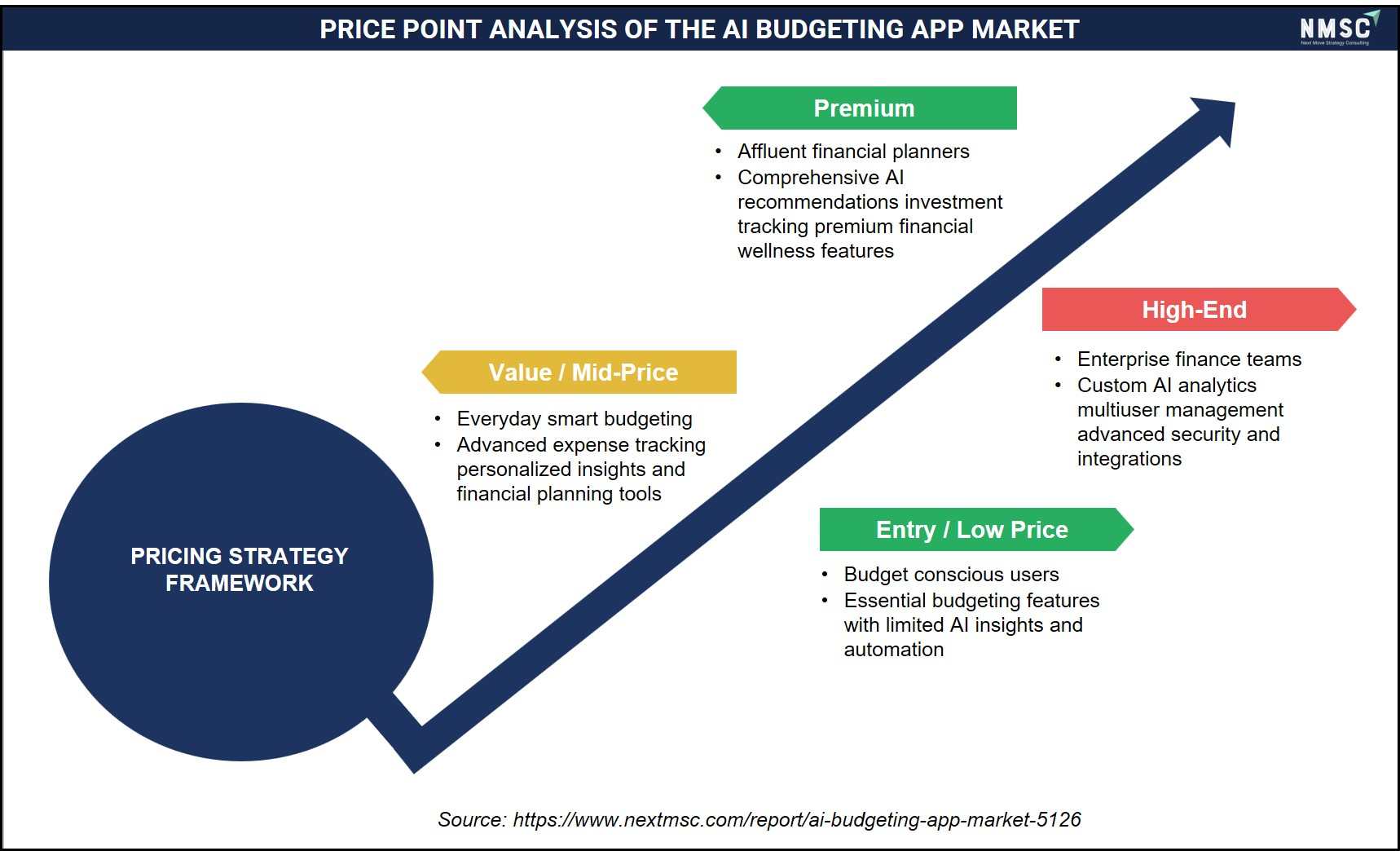
The price point analysis evaluates how AI budgeting app providers position their offerings across diverse customer segments. Our assessment indicates that entry-level solutions attract budget-conscious users with basic budgeting, expense tracking, and limited AI automation through free or low-cost subscriptions. Mid-price applications provide advanced expense categorization, personalized financial insights, and savings management for mainstream users. Premium offerings deliver AI-powered financial planning, investment tracking, and wealth management features, while enterprise-grade platforms support businesses with advanced analytics, multi-user management, enhanced security, and regulatory compliance capabilities.
Competitive Landscape
Competitive Dynamics and M&A Landscape
|
Key Takeaways |
Details |
|
Market Structure |
The AI Budgeting App Market is moderately fragmented, with established personal-finance software vendors competing alongside venture-backed AI-native challengers and embedded-module providers across Standalone App, Embedded Module, and API-only Product formats. |
|
Innovation Focus |
Competitive differentiation is increasingly centered on conversational and predictive AI capabilities, autonomous savings execution, and enhanced open banking data connectivity, enabling vendors to move beyond basic expense categorization and deliver more personalized financial management experiences. |
|
M&A Activity |
Consolidation is accelerating through acquisitions of complementary data aggregation and credit-monitoring capabilities, alongside strategic partnerships between AI budgeting application vendors and traditional financial institutions to expand embedded finance offerings. |
How Do Companies Compete in the AI Budgeting App Market?
Companies compete primarily on categorisation accuracy, breadth of financial-account connectivity, and depth of AI-driven guidance. From our research, we found that vendors such as Monarch Money, Inc. and Copilot Money, Inc. differentiate through premium household-level collaboration features, while others including PocketGuard, Inc. compete on affordability and simplicity. Pricing strategy increasingly bundles budgeting with subscription-cancellation and bill-negotiation services to strengthen retention economics.
Which Competitive Archetypes Dominate the Market?
Three competitive archetypes dominate: automation-first platforms that minimize manual user input, methodology-driven platforms built around structured budgeting discipline, and AI-agent platforms offering conversational financial coaching. Based on research conducted by NMSC, we found that You Need A Budget LLC exemplifies the methodology-driven archetype, while Cleo AI Ltd represents the AI-agent archetype, illustrating how differentiated product philosophy shapes distinct user retention outcomes across the AI Budgeting App Market.
AI-Native Differentiation and Explainability Drive Market Success in the AI Budgeting App Market
Innovation strategy in the AI Budgeting App Market centers on predictive cash-flow forecasting, autonomous savings-transfer execution, and multi-account household collaboration tools. Through our market assessment, we observed that vendors including Albert Corporation and Rocket Money, Inc. have expanded automated-savings and bill-negotiation capability to extend monetization beyond subscription fees, while Quicken Inc. leverages decades of desktop-software brand trust to retain multi-device users spanning Family and Small Business buyer types.
Market Players to Opt for Merger and Acquisition Strategies to Expand Their Presence in the AI Budgeting App Market
M&A and partnership activity in the AI Budgeting App Market has centered on integration with banking-data aggregators and expansion into adjacent credit-monitoring and bill-negotiation services. Based on our market evaluation, we noticed that several vendors have pursued geographic expansion into European and Asia-Pacific markets through localized currency and language support, reflecting competitive pressure to diversify beyond saturating North American subscriber bases.
Key Market Players in the AI Budgeting App Industry
-
Albert Corporation
-
Cleo AI Ltd
-
BudgetBakers s.r.o.
-
Plum Fintech Limited
-
You Need A Budget LLC
-
PocketGuard, Inc.
-
Monarch Money, Inc.
-
Quicken Inc.
-
The Lampo Group, LLC
-
Emma Technologies Ltd
-
Copilot Money, Inc.
-
Dayspring Technologies, Inc. SPC
-
SPENDEE s.r.o.
-
Fintonic Servicios Financieros, S.L.
-
Toshl Inc.
-
Blend Financial Inc. dba Origin Financial
-
Lunchbag Labs, Inc.
-
Rolly Technologies, Inc
What Are the Latest Developments in the AI Budgeting App Industry?
|
Date |
Event |
|
April 2026 |
YNAB (You Need A Budget) enhanced its public API by introducing support for creating and updating categories, category groups, and targets, alongside payee creation, money movement capabilities, expanded account-type support, enhanced OAuth security, and updated developer libraries. These enhancements expand integration capabilities for third-party applications and developer-built financial automation tools, strengthening the platform's extensibility and workflow automation. |
|
May 2025 |
Monarch Money raised USD 75 million in a Series B funding round, co-led by FPV Ventures and Forerunner Ventures, to scale its prescriptive AI-driven financial guidance and expand its B2B2C distribution channels |
What Are the Investment Opportunities in the AI Budgeting App Industry?
Capital inflows into the AI Budgeting App Market are concentrated among vendors advancing predictive and autonomous-action AI capability, with venture funding favoring platforms demonstrating measurable user savings outcomes. NMSC's analysis indicates that infrastructure investment is increasingly directed toward open banking data-connectivity and security certification to support enterprise and cross-border expansion. ESG-oriented investors are showing growing interest in financial-inclusion-oriented budgeting applications that serve underbanked Freelancer and Micro-business segments, reflecting alignment between social-impact objectives and addressable market expansion across emerging economies.
Key Benefits for Stakeholders
This report benefits enterprise technology leaders and CIOs by clarifying deployment-model tradeoffs across Standalone App, Embedded Module, and API-only Product formats when evaluating financial-wellness integrations. Our findings suggest that investors and financial analysts gain access to segmented revenue forecasts, CAGR trajectories, and competitive-positioning analysis supporting capital-allocation decisions. Technology vendors and product teams benefit from segmentation, regional, and AI-capability insights that inform roadmap prioritization, helping each stakeholder group align strategy with the AI Budgeting App Market's projected growth pathways through 2035.
Key Market Segments
By Buyer Type
-
Individual
-
Standalone App
-
Embedded Module
-
API-only Product
-
Other Deployment
-
-
Couples and Households
-
Standalone App
-
Embedded Module
-
API-only Product
-
Other Deployment
-
-
Family
-
Standalone App
-
Embedded Module
-
API-only Product
-
Other Deployment
-
-
Freelancer and Micro-business
-
Standalone App
-
Embedded Module
-
API-only Product
-
Other Deployment
-
-
Small Business
-
Standalone App
-
Embedded Module
-
API-only Product
-
Other Deployment
-
-
Enterprise
-
Standalone App
-
Embedded Module
-
API-only Product
-
Other Deployment
-
-
Other Buyer Type
-
Standalone App
-
Embedded Module
-
API-only Product
-
Other Deployment
-
By Industry Vertical
-
BFSI
-
Retail & E-commerce
-
Professional Services
-
Healthcare
-
Manufacturing
-
IT & Telecom
-
Other Industries
By Revenue Model
-
Subscription
-
Transaction Fee
-
Freemium
-
Other Revenue Model
By End Device
-
Smartphone
-
Tablet
-
Desktop
-
Multi-Device
-
Other End Device
By AI Capability
-
Rules-Based
-
ML Categorisation
-
Conversational AI
-
Predictive AI
-
Autonomous Action
-
Other
By Region
-
North America: U.S., Canada, and Mexico.
-
Europe: UK, Germany, France, Italy, Spain, Sweden, Denmark, Finland, Netherlands, and Rest of Europe.
-
Asia-Pacific: China, India, Japan, South Korea, Taiwan, Indonesia, Vietnam, Australia, Philippines, Malaysia, and Rest of APAC.
-
Middle East & Africa: Saudi Arabia, UAE, Egypt, Israel, Turkey, Nigeria, South Africa, and Rest of MEA.
-
Latin America: Brazil, Argentina, Chile, Colombia, and Rest of LATAM.
Conclusion and Recommendations
Our assessment indicates that the AI Budgeting App Market is positioned for sustained expansion from USD 2.00 Billion in 2025 to USD 14.80 Billion by 2035 at a CAGR of 23.0%, driven by predictive and autonomous-action AI adoption. Vendors should prioritize open banking connectivity, conversational interface investment, and embedded-distribution partnerships to strengthen positioning. Investment attractiveness remains strong given demonstrable user-savings outcomes, though data-privacy regulation and free bank-provided alternatives pose key risks. Growth pathways favor vendors expanding across Freelancer, Small Business, and Asia-Pacific opportunities through 2035.
About the Author
 Saista Faiyaz
— Saista Faiyaz is Research Associate at Next Move Strategy Consulting, where she has covered consumer markets and healthcare technologies for 3 years. Her work includes primary interview review, secondary-source validation, market sizing, and structured analysis of company and industry data. She supports research by comparing evidence across sources, organizing findings into market narratives, and documenting assumptions used in analysis. Her scope includes cross-market benchmarking, and reports.
Saista Faiyaz
— Saista Faiyaz is Research Associate at Next Move Strategy Consulting, where she has covered consumer markets and healthcare technologies for 3 years. Her work includes primary interview review, secondary-source validation, market sizing, and structured analysis of company and industry data. She supports research by comparing evidence across sources, organizing findings into market narratives, and documenting assumptions used in analysis. Her scope includes cross-market benchmarking, and reports.
About the Reviewer
 Supradip Baul
— Supradip Baul is an accomplished business consultant and strategist with over a decade of rich experience in market intelligence, strategy, technology, and business transformation. His work has included rigorous qualitative and quantitative analysis across multiple industries, helping clients shape investment decisions and long-term roadmaps. Earlier in his career, he was associated with Gartner, where he contributed to industry-leading reports and market share analyses. He has worked with leading global companies and holds an MBA with a dual specialization in Marketing and Finance.
Supradip Baul
— Supradip Baul is an accomplished business consultant and strategist with over a decade of rich experience in market intelligence, strategy, technology, and business transformation. His work has included rigorous qualitative and quantitative analysis across multiple industries, helping clients shape investment decisions and long-term roadmaps. Earlier in his career, he was associated with Gartner, where he contributed to industry-leading reports and market share analyses. He has worked with leading global companies and holds an MBA with a dual specialization in Marketing and Finance.
At Next Move Strategy Consulting, we understand that insightful market research is the cornerstone of successful business decisions. That's why we employ a robust and multifaceted approach, combining various methodologies to deliver the most accurate and actionable data for our clients.

Research Landscape
We navigate the world of research with two primary approaches:
Qualitative Approach
Our qualitative research methodologies involve immersive techniques such as in-depth interviews, focus groups, and observational studies. By engaging directly with individuals and stakeholders, we uncover valuable insights that quantitative data alone may overlook.

Quantitative Research
In tandem with qualitative methodologies, NMSC leverages the power of Quantitative Research to provide a robust foundation of numerical insights. Through systematic data collection and analysis, we quantify patterns, preferences, and market trends, offering a comprehensive view of the business landscape.
Our quantitative research approach employs diverse tools, including surveys, experiments, and statistical modelling. These methodologies enable us to gather data from a large and representative sample, ensuring the statistical significance of our findings. By employing structured questionnaires and standardized data collection methods, we guarantee the reliability and validity of the information we present to our clients.
Quantitative research is particularly effective in measuring the prevalence of trends, assessing market size, and gauging the impact of various factors on consumer behavior. The numerical precision attained through this approach equips our clients with actionable insights, facilitating data-driven decision-making and strategy formulation.


Our Specialized Toolbox for Industry-Specific Market Research
We deploy a specialized arsenal of techniques tailored to meet your unique requirements. Here's a glimpse into our comprehensive toolbox:

Information Procurement
The stage entails acquiring market data or relevant information through various sources and methodologies.


Market Research Approach
We utilize both top-down and bottom-up approaches in market research analysis to achieve a comprehensive understanding of the market dynamics, leveraging the broad perspective of industry trends and macroeconomic factors alongside detailed insights from specific segments and individual companies.

Porters Five Forces Analysis
We conduct Porter's Five Forces analysis to evaluate the competitive landscape of an industry, providing us with insights into factors that affect profitability and strategic positioning.

SWOT Analysis

Forecasting
We utilize a forecasting model to predict future consumption by considering parameters like population, economics, regulations, market competition, drivers, constraints, technology, and pricing. We also employ statistical techniques such as multilinear regression, exponential smoothing, moving average, ARIMA, and Monte Carlo simulations for accurate predictions. In econometric forecasting, we analyzed short-term and long-term event impacts, attributing values based on regulatory frameworks, economic factors, and market events.





 Speak to Our Analyst