Global AI in Climate Change Mitigation Market Size, Share, and Growth Forecast by Carbon Management (Carbon Accounting, ESG Reporting, Product Foot Printing), Building Energy Optimization (Buildings, Portfolio Energy Management), Grid and Renewable (Grid Operations, Renewable Forecasting, DER and Storage), Industrial Decarbonization, Transport and Logistics, Agriculture, Forestry and Land Use, Emissions Monitoring and MRV (Methane Detection, Satellite Monitoring) - Global Analysis 2025–2035
Industry: ICT & Media | Publishing Date: July 4, 2026 | Last Updated: September 30, 2026 | No of Pages: N/A | No. of Tables: N/A | No. of Figures: N/A | Format: PDF | Report Code: IC4936
What Is the AI in Climate Change Mitigation Market Size?
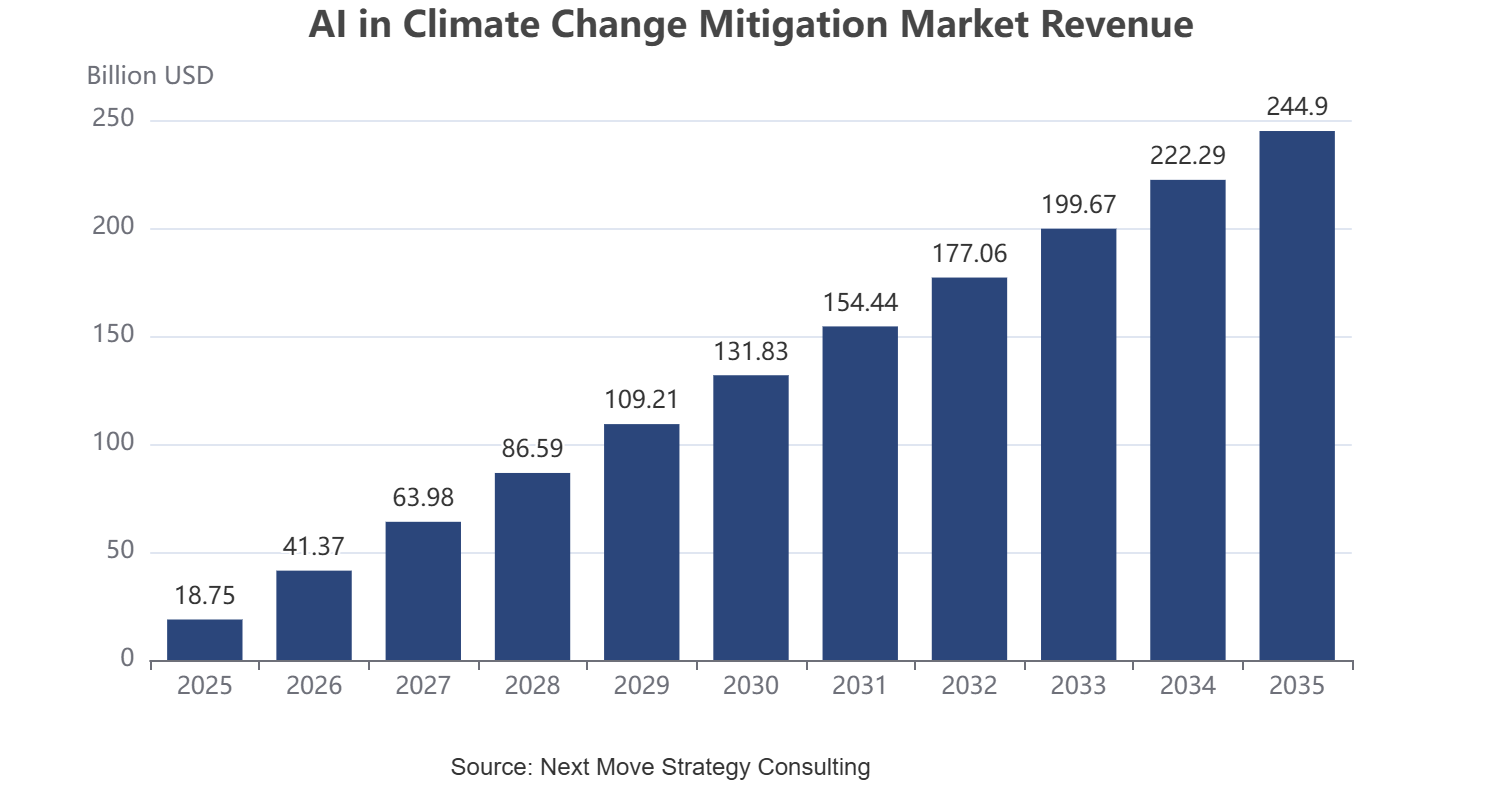
The global AI in Climate Change Mitigation Market was valued at USD 18.75 billion in 2025 and is estimated at USD 24.24 billion in 2026. From 2026 to 2035, the market is projected to expand at a CAGR of 29.3%, reaching USD 244.9 billion by 2035. Growth is driven by the EU Carbon Border Adjustment Mechanism's definitive certificate-purchasing phase that began in January 2026, rapid data center capacity expansion that is intensifying demand for cooling and power optimization software, large-scale renewable capacity additions that require AI-based forecasting and grid dispatch tools, and the continued, if regionally uneven, expansion of national emissions trading schemes from China to Brazil.
|
Parameters |
Details |
|
Market Size in 2025 |
USD 18.75 Billion |
|
Market Size in 2026 |
USD 24.24 Billion |
|
Revenue Forecast in 2035 |
USD 244.9 Billion |
|
Growth Rate |
CAGR of 29.3% from 2026 to 2035 |
|
Analysis Period |
2025–2035 |
|
Base Year Considered |
2025 |
|
Forecast Period |
2026–2035 |
|
Market Size Estimation |
USD Billion |
|
Companies Profiled |
20 |
|
Countries Covered |
33 |
|
Market Share |
Top 10 |
AI in Climate Change Mitigation Market Overview
What Is the AI in Climate Change Mitigation Market?
This market report covers software and AI-enabled tools that measure, forecast, optimize, and verify activity across the carbon and energy value chain, spanning carbon accounting, ESG disclosure, building and data center energy optimization, grid and renewable forecasting, industrial process and asset optimization, transport routing and fuel efficiency, precision agriculture and forestry monitoring, and emissions and methane detection. The scope excludes the underlying physical hardware, such as solar panels, batteries, or capture equipment, focusing instead on the AI-enabled software and services layer used by enterprises, utilities, and governments to plan and verify decarbonization activity.
How Has This Market Evolved Structurally?
The market evolved from disconnected spreadsheet-based carbon accounting tools used by sustainability teams in the early 2010s into an integrated software category spanning compliance, operations, and capital planning by the mid-2020s. Early adoption concentrated in voluntary corporate carbon footprinting; current platforms increasingly sit inside core operating systems, including building management systems, grid control rooms, and industrial process control software. The proliferation of large-scale data centers built to support AI workloads has further accelerated structural change, pulling building and energy optimization software into a central capital planning role for hyperscale technology companies.
How Do Regulations Influence the Market?
Regulatory signals are diverging sharply by jurisdiction, and that divergence is itself a defining structural feature of the market. The European Union's Omnibus I Directive, published February 26, 2026, narrowed CSRD and CSDDD reporting thresholds, while the EU Carbon Border Adjustment Mechanism entered its definitive, certificate-purchasing phase on January 1, 2026, with more than 4,100 authorized declarants registered in the first week alone. In the United States, the SEC proposed in May 2026 to fully rescind its 2024 climate disclosure rule, even as California's SB 253 keeps a binding statewide reporting deadline of August 2026 in place, illustrating a fragmented compliance landscape that vendors must navigate jurisdiction by jurisdiction.
How Is Technology Adoption Expanding Across This Market?
Technology adoption is shifting from descriptive carbon reporting toward predictive and prescriptive optimization embedded directly into operational systems. Renewable forecasting and grid dispatch tools are increasingly bundled into utility control room software rather than purchased as standalone analytics, while satellite and continuous monitoring platforms are expanding methane and facility-level emissions visibility independent of self-reported company data. This shift toward independently verifiable, sensor-based monitoring is reinforced by setbacks such as the loss of the Environmental Defense Fund's MethaneSAT satellite in June 2025, which has increased reliance on commercial satellite operators and ground-based continuous monitoring networks to sustain methane visibility.
Key Takeaways
|
Key Takeaways |
|
By application area, Carbon Management held the largest share of the AI in Climate Change Mitigation Market at USD 4.5 billion in 2025, encompassing carbon accounting, ESG reporting, product footprinting, and carbon project MRV. |
|
Building Energy Optimization is among the fastest-growing major application areas, expanding from USD 3.6 billion in 2025 to USD 58.0 billion by 2035 at a CAGR of 32.0%, driven by data center cooling and power optimization demand. |
|
Grid and Renewable closely follow at a CAGR of 31.5%, advancing from USD 4.0 billion in 2025 to USD 62.0 billion by 2035 as utility-scale renewable capacity additions accelerate globally. |
|
Emissions Monitoring and MRV recorded the highest percentage CAGR among all application areas at 33.2%, though from the smallest 2025 base of USD 1.05 billion, reflecting continued investment in satellite and continuous monitoring infrastructure. |
|
Industrial Decarbonization generated USD 3.2 billion in 2025, with Process Optimization the leading secondary segment given the immediate cost-saving case for yield and resource efficiency improvements in heavy industry. |
|
North America held the largest regional share of the market at USD 7.9 billion in 2025, supported by the concentration of major technology, industrial automation, and enterprise software vendors headquartered in the region. |
|
Asia Pacific is the fastest-growing major region at a CAGR of 31.2%, advancing from USD 4.2 billion in 2025 to USD 63.5 billion by 2035, led by China's expanding national emissions trading scheme and renewable capacity build-out. |
|
Europe generated USD 5.6 billion in 2025, the second-largest regional share, anchored by the EU Carbon Border Adjustment Mechanism's definitive phase and continuing, if narrowed, CSRD reporting obligations. |
|
The United States is the leading individual country market, reflecting the concentration of AI in Climate Change Mitigation Market vendor headquarters and binding state-level requirements such as California's SB 253. |
|
China is the fastest-growing major country market, supported by the expansion of its national emissions trading scheme into steel, cement, and aluminium, and by the world's largest utility-scale renewable capacity pipeline. |
Key Emerging Trends in the AI in Climate Change Mitigation Market
How Is the Data Center Energy Boom Reshaping Building Energy Optimization Demand?
The scale-up of data center capacity to support AI workloads is fundamentally reshaping demand within building energy optimization, shifting the center of gravity from conventional commercial buildings toward hyperscale facilities with extreme power density and cooling requirements. Hyperscale operators are deploying AI-based cooling and power optimization software as a core capital efficiency tool rather than a sustainability add-on, since marginal efficiency gains translate directly into additional usable compute capacity within fixed grid interconnection limits, a transformation that is pulling utilities and data center landlords into the same software procurement decisions.
How Is CBAM's Definitive Phase Transforming Industrial Product Footprinting?
The EU Carbon Border Adjustment Mechanism's transition into its definitive, certificate-purchasing phase on January 1, 2026, has converted product-level embedded emissions calculation from a voluntary disclosure exercise into a financial compliance requirement for steel, cement, aluminium, and fertiliser exporters. Non-EU manufacturers are now under direct commercial pressure from EU importers to supply verified, installation-specific emissions data rather than relying on conservative default values, accelerating adoption of supplier emissions data and procurement analytics tools across global industrial supply chains.
How Is Regulatory Divergence Between the United States and the European Union Reshaping Vendor Strategy?
Vendor strategy is increasingly shaped by a widening gap between US federal deregulation and continued European tightening, with the SEC's May 2026 proposal to rescind its climate disclosure rule contrasting sharply with the EU's CBAM definitive phase and continuing CSRD wave one obligations. Vendors serving multinational clients are responding by emphasizing modular platforms that can serve California's SB 253 and EU CSRD requirements simultaneously while de-emphasizing dependence on any single federal mandate, reducing single-jurisdiction regulatory risk in product roadmaps.
How Is Independent Satellite and Continuous Monitoring Gaining Ground Over Self-Reported Data?
Independent, sensor-based emissions verification is gaining credibility relative to self-reported corporate data, a trend reinforced rather than reversed by the Environmental Defense Fund's MethaneSAT losing contact in June 2025 after little more than a year in orbit. The setback has accelerated enterprise and government interest in commercial satellite operators and ground-based continuous stack and facility monitoring networks as more resilient, diversified sources of independently verifiable emissions data for both regulatory reporting and counterparty risk assessment.
What Are the Key Market Drivers, Breakthroughs, and Investment Opportunities That Will Shape This Industry in the Next Decade?
|
Drivers / Trends / Restraints |
(+/-) % Impact on CAGR Forecast |
Geographic Relevance |
Impact Timeline |
|
EU CBAM definitive phase and certificate purchasing obligations |
+2.8% |
Europe |
2026–2030 |
|
Data center capacity expansion and AI workload growth |
+2.6% |
Global, notably North America and APAC |
2026–2035 |
|
Utility-scale renewable capacity additions requiring forecasting |
+2.2% |
Global |
2026–2035 |
|
Expansion of national emissions trading schemes (China, Brazil) |
+1.6% |
Asia Pacific, Latin America |
2026–2032 |
|
California SB 253 and SB 261 disclosure deadlines |
+0.8% |
North America |
2026–2027 |
|
US federal climate disclosure and methane rule rollback |
-1.1% |
North America |
2025–2027 |
|
EU Omnibus narrowing of CSRD and CSDDD scope |
-0.7% |
Europe |
2025–2026 |
|
Loss of satellite-based methane monitoring capacity |
-0.4% |
Global |
2025–2027 |
|
Vendor consolidation among industrial and enterprise software platforms |
+0.6% |
Global |
2025–2028 |
|
Grid modernization and distributed energy resource growth |
+1.3% |
Global |
2026–2035 |
What Are the Growth Drivers of This Market?
How Does the EU Carbon Border Adjustment Mechanism Drive Demand for Product Footprinting Tools?
CBAM entered its definitive period on January 1, 2026, requiring authorized declarants to purchase certificates covering the embedded emissions of imported steel, cement, aluminium, fertiliser, electricity, and hydrogen, with the first annual surrender due September 30, 2027. More than 4,100 economic operators obtained authorized declarant status in the first week of the definitive period alone, creating direct, financially material demand for verified, installation-specific emissions data tools among non-EU manufacturers.
How Does Data Center Expansion Drive Demand for Building Energy Optimization Software?
Rising data center electricity consumption tied to AI workload growth is increasing pressure on hyperscale operators and grid operators alike to deploy cooling and power optimization software that extracts additional usable compute capacity from fixed interconnection limits. This dynamic has elevated building energy optimization from a sustainability function to a core capital efficiency discipline within data center operators' infrastructure planning.
How Does National Emissions Trading Scheme Expansion Drive Demand for Carbon Accounting Tools?
China's national emissions trading scheme has expanded coverage beyond power generation into steel, cement, and aluminium, while Brazil's Emissions Trading System was established under Law No. 15,042 in December 2024 ahead of the country's hosting of the COP30 summit in November 2025. Each expansion directly enlarges the population of companies required to measure and report verified emissions data.
What Are the Growth Inhibitors of This Market?
How Does United States Federal Deregulation Inhibit Climate Disclosure Software Adoption?
The SEC proposed in May 2026 to fully rescind its 2024 climate-related disclosure rule, while the EPA has separately proposed rescinding the Endangerment Finding and delayed the Subpart W greenhouse gas reporting program for oil and gas facilities until 2034, removing federal compliance urgency that had previously supported enterprise software adoption in the United States (industry-derived estimate of net demand impact, no publicly verifiable workforce or budget dataset available).
How Does the Loss of Independent Satellite Monitoring Capacity Restrain Methane Detection Adoption?
The Environmental Defense Fund's MethaneSAT satellite lost contact on June 20, 2025, and was declared unrecoverable on July 1, 2025, after roughly one year of operation, removing one of the most advanced independent methane monitoring assets from service and temporarily narrowing the pool of high-resolution, publicly available verification data available to regulators, researchers, and counterparties.
What Are the Growth Opportunities in This Market?
What Opportunity Does Regulatory Divergence Create for Multi-Jurisdiction Compliance Platforms?
The widening gap between EU tightening and US federal loosening creates an opportunity for vendors able to serve a single multinational enterprise across California's SB 253, the EU's narrowed but still binding CSRD, and CBAM simultaneously, reducing the customer's exposure to any single jurisdiction's regulatory direction and supporting durable multi-year platform contracts.
What Opportunity Does Brazil's COP30 Presidency Create for Carbon Market Infrastructure Vendors?
Brazil's proposal at COP30 for an Open Coalition for Carbon Market Integration, combined with the ongoing build-out of its own Emissions Trading System, creates a near-term opportunity for carbon project MRV and market analytics vendors to establish early infrastructure relationships in one of the world's largest potential compliance and voluntary carbon markets.
What Opportunity Does Grid Modernization Create for Distributed Energy Resource Optimization Vendors?
Rising penetration of rooftop solar, battery storage, and electric vehicle charging is increasing the operational complexity utilities must manage, creating opportunity for vendors of virtual power plant and microgrid optimization software, particularly in markets such as Australia and California, with among the world's highest per-capita rates of distributed solar adoption.
PESTEL Analysis of the AI in Climate Change Mitigation Industry
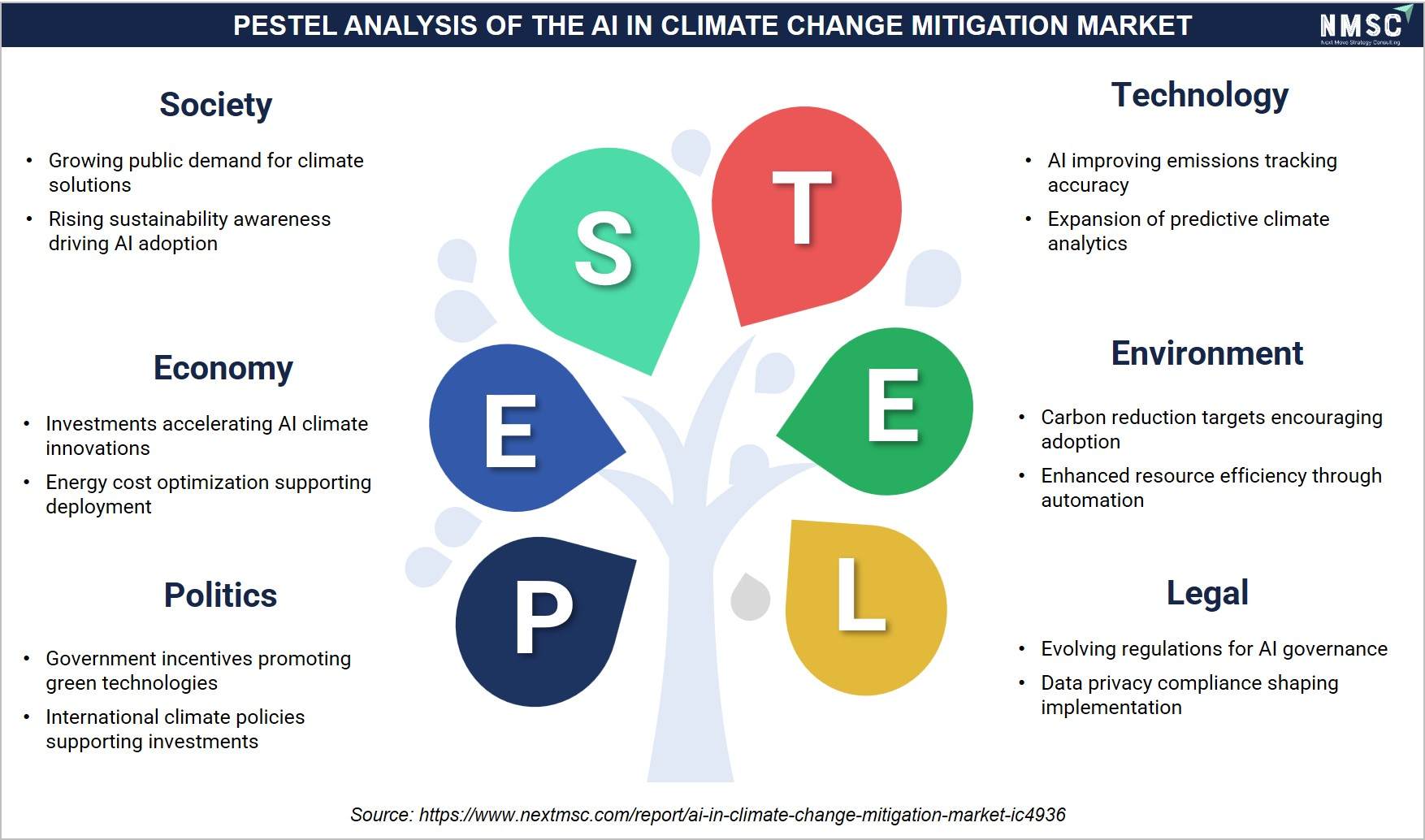
The above infographic presents a PESTEL analysis of the market. Government incentives and carbon reduction targets are encouraging investment and adoption, while energy cost optimization is supporting deployment. At the same time, growing public demand for climate solutions and sustainability awareness are shaping social acceptance, while AI is improving emissions tracking and expanding predictive climate analysis. Environmental efforts are reinforced by enhanced resource efficiency through automation, all within a legal framework of evolving AI governance and data privacy regulations. Looking ahead, we observed that these interconnected factors collectively shape the market's growth across the sector.
How Is This Market Segmented in This Report, and What Are the Key Insights From the Segmentation Analysis?
Which Application Area Leads This Market, and What Are the Key Insights?
|
Segment |
2025 (USD Bn) |
2035 (USD Bn) |
CAGR (%) |
|
Carbon Management |
4.5 |
38.5 |
23.9% |
|
Building Energy Optimization |
3.6 |
58.0 |
32.0% |
|
Grid and Renewable |
4.0 |
62.0 |
31.5% |
|
Industrial Decarbonization |
3.2 |
38.0 |
28.1% |
|
Transport and Logistics |
1.55 |
19.4 |
28.7% |
|
Agriculture Forestry and Land Use |
0.85 |
10.5 |
28.6% |
|
Emissions Monitoring and MRV |
1.05 |
18.5 |
33.2% |
Carbon Management generated USD 4.5 billion in 2025, the largest application area, reflecting the maturity of carbon accounting and ESG reporting software relative to newer categories, though its growth rate of 23.9% lags the market average given the EU's Omnibus narrowing of CSRD scope and the SEC's proposed rescission of US climate disclosure rules. Emissions Monitoring and MRV is growing fastest in percentage terms at 33.2%, albeit from the smallest base, while Building Energy Optimization and Grid and Renewable are the fastest-growing categories at scale, at 32.0% and 31.5% respectively, driven by data center expansion and utility-scale renewable build-out.
Carbon Management
How Are Carbon Accounting, ESG Reporting, Product Footprinting, and Carbon Project MRV Performing Within Carbon Management?
Carbon Management spans Carbon Accounting, ESG Reporting, Product Footprinting, and Carbon Project MRV, each used by a distinct buyer within the enterprise sustainability function. Carbon Accounting and ESG Reporting remain the largest and most mature secondary segments, reflecting years of CSRD and voluntary disclosure-driven adoption, while Product Footprinting is the fastest-growing secondary segment as CBAM's definitive phase pushes manufacturers toward installation-specific emissions data over default values. Carbon Project MRV is a smaller but strategically important segment supporting the verification and issuance infrastructure behind both compliance and voluntary carbon markets.
Building Energy Optimization
How Are Buildings, Data Centers, and Portfolio Energy Management Performing Within Building Energy Optimization?
Building Energy Optimization spans Buildings, Data Centers, and Portfolio Energy Management, with Data Centers now the fastest-growing and most capital-intensive secondary segment given the scale of cooling and power optimization investment tied to AI workload growth at hyperscale operators. Buildings remains the largest installed base by site count, covering HVAC, lighting, and occupancy optimization across commercial real estate, while Portfolio Energy Management is gaining adoption among multi-site operators seeking centralized benchmarking and forecasting across campuses and building portfolios.
Grid and Renewable
How Are Grid Operations, Renewable Forecasting, and DER and Storage Performing Within Grid and Renewable?
Grid and Renewable spans Grid Operations, Renewable Forecasting, and DER and Storage, with Renewable Forecasting the largest secondary segment given the immediate operational necessity of solar and wind output prediction for grid balancing. DER and Storage is the fastest-growing secondary segment as battery storage and virtual power plant deployments scale globally, while Grid Operations, covering load forecasting, dispatch optimization, and outage management, remains the structural backbone of utility AI adoption across both mature and emerging grids.
Industrial Decarbonization
How Are Process Optimization, Asset Performance, Plant Energy Management, and CCUS Optimization Performing Within Industrial Decarbonization?
Industrial Decarbonization spans Process Optimization, Asset Performance, Plant Energy Management, and CCUS Optimization, with Process Optimization the dominant secondary segment given the direct, fast-payback cost case for yield, resource efficiency, and setpoint optimization in heavy industry. Plant Energy Management is a close second given its overlap with existing energy management practice, while CCUS Optimization remains the smallest secondary segment today but is gaining investment, particularly in the Middle East, as capture, transport, and storage infrastructure scales beyond pilot projects.
Transport and Logistics
How Are Road Transport, Maritime, and Aviation Performing Within Transport and Logistics?
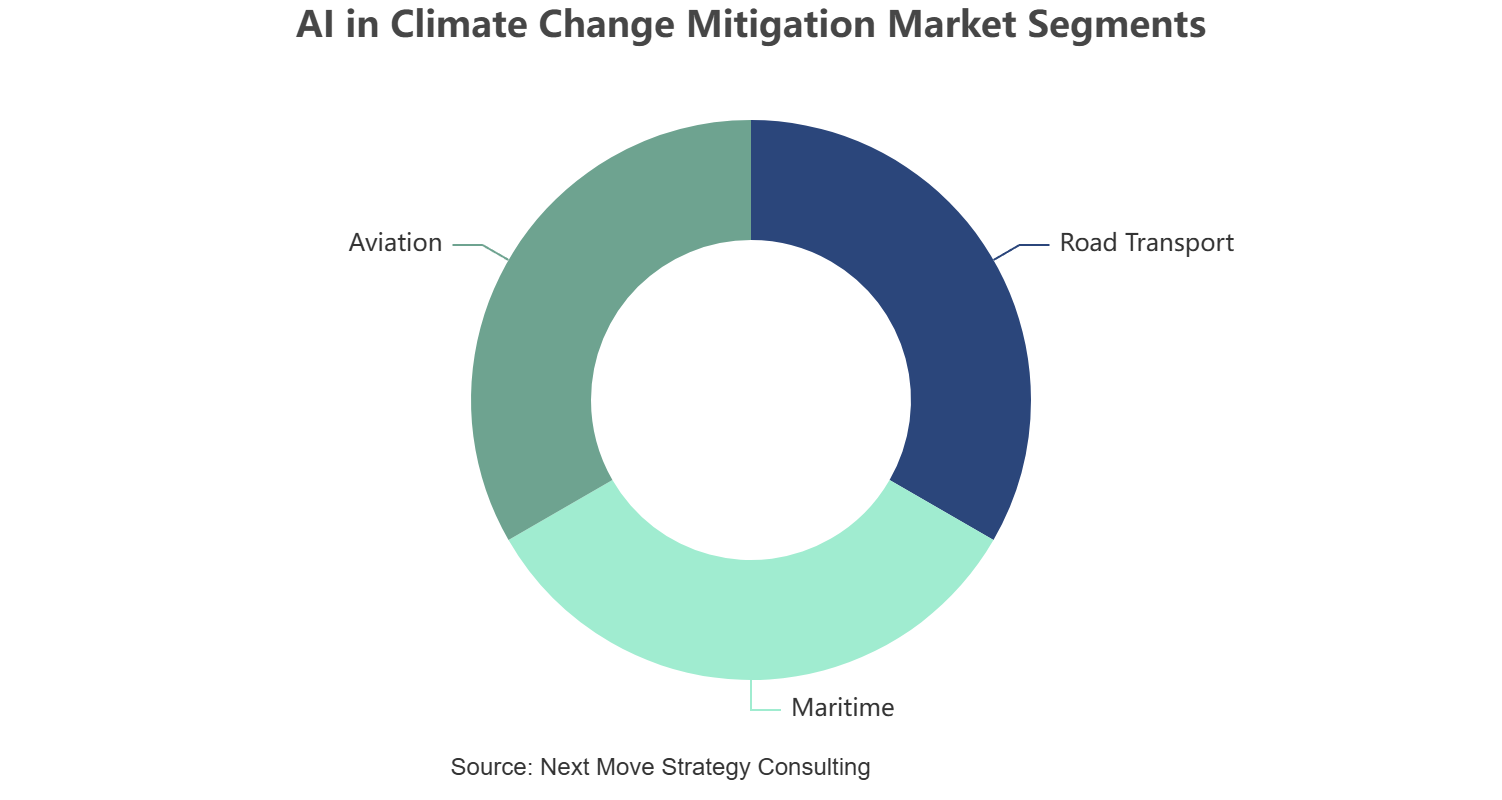
Transport and Logistics spans Road Transport, Maritime, and Aviation, with Road Transport the largest secondary segment given the scale of commercial fleet routing, load planning, and electric vehicle fleet management software already in commercial use. Maritime voyage and fuel optimization is the fastest-growing secondary segment as shipping operators respond to tightening international fuel efficiency requirements, while Aviation flight planning and fuel optimization remains the smallest segment, reflecting the sector's longer technology adoption cycles.
Agriculture Forestry and Land Use
How Are Precision Agriculture, Forestry and Reforestation, and Soil Carbon Performing Within Agriculture Forestry and Land Use?
Agriculture Forestry and Land Use spans Precision Agriculture, Forestry and Reforestation, and Soil Carbon, with Precision Agriculture the largest secondary segment given established commercial adoption of fertiliser and irrigation optimization tools among large-scale growers. Forestry and Reforestation, including deforestation detection and forest carbon monitoring, is the fastest-growing secondary segment, supported by tropical forest nations, including Brazil and Indonesia, expanding satellite-based monitoring, while Soil Carbon analytics remains the smallest and most nascent secondary segment, given ongoing measurement methodology development.
Emissions Monitoring and MRV
How Are Methane Detection, Continuous Monitoring, Satellite Monitoring, and Climate Intelligence and Planning Performing Within Emissions Monitoring and MRV?
Emissions Monitoring and MRV spans Methane Detection, Continuous Monitoring, Satellite Monitoring, and Climate Intelligence and Planning, with Continuous Monitoring the largest secondary segment given established demand for stack and facility-level monitoring among regulated industrial emitters. Climate Intelligence and Planning, covering climate forecasting, scenario planning, and geospatial intelligence, is the fastest-growing secondary segment as financial institutions expand transition risk analysis, while Satellite Monitoring faces near-term capacity constraints following the loss of the MethaneSAT satellite in June 2025.
Regional Outlook
Geographic Performance Snapshot
|
Region |
2025 (USD Bn) |
2035 (USD Bn) |
CAGR (%) |
Key Driver |
|
North America |
7.9 |
98.5 |
28.7% |
Data center capacity expansion and California SB 253 disclosure deadline |
|
Europe |
5.6 |
68.5 |
28.5% |
EU CBAM definitive phase and continuing CSRD wave one obligations |
|
Asia Pacific |
4.2 |
63.5 |
31.2% |
China national ETS expansion and utility-scale renewable build-out |
|
Latin America |
0.6 |
8.4 |
30.2% |
Brazil Emissions Trading System and COP30 carbon market initiatives |
|
Middle East and Africa |
0.45 |
6.0 |
29.6% |
GCC CCUS investment and South Africa grid modernization |
North America Market
North America held the largest regional share of the market at USD 7.9 billion in 2025, projected to reach USD 98.5 billion by 2035 at a CAGR of 28.7%. The region benefits from the concentration of major technology, industrial automation, and enterprise software vendor headquarters and from data center capacity expansion tied to AI workload growth, even as federal climate disclosure and methane reporting requirements have been substantially rolled back since early 2025. California's SB 253 and SB 261 keep a binding state-level compliance timeline in place, partially offsetting the federal regulatory retreat.
United States AI in Climate Change Mitigation Market
Based on our engagements, the United States represents the largest single national contributor to the AI in Climate Change Mitigation Market, though the regulatory signal is mixed: the SEC proposed in May 2026 to fully rescind its 2024 climate disclosure rule, and the EPA has moved through 2025 and 2026 to delay the Subpart W greenhouse gas reporting program to 2034 and to propose rescinding the Endangerment Finding underpinning federal greenhouse gas regulation. California's SB 253 and SB 261 nonetheless keep large companies operating in the state on a binding emissions-disclosure timeline beginning August 2026, and the country's concentration of grid, data center, and industrial software vendors continues to anchor global platform innovation.
Canada AI in Climate Change Mitigation Market
Through our analysis, Canada's AI in Climate Change Mitigation Market reflects a similarly mixed policy backdrop, with the federal consumer carbon levy eliminated in 2025 while industrial carbon pricing under the federal Output-Based Pricing System continues to apply to large emitters in oil, gas, and manufacturing. Provincial utilities and oil sands operators remain active adopters of methane detection and asset performance optimization tools, sustaining steady demand even as consumer-facing carbon policy has retreated.
Mexico AI in Climate Change Mitigation Market
From our assessment, Mexico's market is shaped by the transition of its national emissions trading scheme from a multi-year pilot phase toward a mandatory program covering the power and industrial sectors, alongside rapid, nearshoring-driven growth in manufacturing that is increasing demand for plant energy management and industrial process optimization tools. Renewable forecasting adoption is also expanding as wind and solar capacity grow across the country's northern industrial corridor.
Europe Market
Europe is the second-largest region, contributing USD 5.6 billion in 2025 and forecast to reach USD 68.5 billion by 2035 at a CAGR of 28.5%. Growth is anchored by the EU Carbon Border Adjustment Mechanism's definitive phase, which began January 1, 2026, and by continuing CSRD wave one reporting obligations, even as the EU's Omnibus I Directive has narrowed the population of companies subject to mandatory sustainability reporting going forward.
United Kingdom AI in Climate Change Mitigation Market
According to our evaluation, the United Kingdom's AI in Climate Change Mitigation Market is shaped by the UK Emissions Trading Scheme and mandatory Streamlined Energy and Carbon Reporting requirements for large companies, alongside National Grid ESO's increasing reliance on AI-based load forecasting and dispatch optimization to manage a rapidly decarbonizing power mix. Offshore wind forecasting and grid balancing tools are particularly active areas of enterprise investment as the country's renewable generation share continues to rise.
Germany AI in Climate Change Mitigation Market
Based on our engagements, Germany's AI in Climate Change Mitigation Market benefits from the country's dual exposure to the EU Emissions Trading System and the Carbon Border Adjustment Mechanism, which entered its definitive certificate-purchasing phase in January 2026 and directly affects German steel, cement, and chemical exporters. Grid operators are simultaneously scaling renewable forecasting and storage optimization tools to manage the Energiewende's growing share of variable wind and solar generation.
France AI in Climate Change Mitigation Market
Through our analysis, France's AI in Climate Change Mitigation Market reflects a nuclear-and-renewable generation mix that places relatively less emphasis on renewable forecasting than other large European markets, with demand instead concentrated in industrial decarbonization and carbon accounting as French manufacturers prepare technical documentation for CBAM-covered exports of steel, aluminium, and fertiliser. Wave one CSRD reporters in France continue mandatory sustainability disclosure under the narrowed but still binding Omnibus framework.
Italy AI in Climate Change Mitigation Market
From our assessment, Italy's AI in Climate Change Mitigation Market is concentrated among CBAM-exposed manufacturers in steel, cement, and ceramics, for whom embedded-emissions calculation and product footprinting tools have become a near-term compliance necessity ahead of the first certificate surrender deadline in September 2027. Northern Italian industrial clusters are also early adopters of plant energy management software to offset rising EU ETS allowance costs.
Spain AI in Climate Change Mitigation Market
According to our evaluation, Spain's AI in Climate Change Mitigation Market is anchored by one of Europe's fastest-growing utility-scale solar and wind pipelines, creating sustained demand for renewable and price forecasting tools among grid operators and independent power producers. Spanish industrial exporters in the cement and fertiliser sectors are simultaneously building CBAM-compliant emissions data pipelines ahead of the mechanism's definitive phase obligations.
Sweden AI in Climate Change Mitigation Market
Based on our engagements, Sweden's AI in Climate Change Mitigation Market is supported by one of the world's most established national climate law frameworks and a large district heating sector that has been an early adopter of building and portfolio energy optimization software. Swedish utilities and forestry companies are also active users of forest carbon monitoring tools, reflecting the country's significant managed forest land base.
Denmark AI in Climate Change Mitigation Market
Through our analysis, Denmark's AI in Climate Change Mitigation Market is shaped by the country's global leadership in offshore wind, where operators including the country's major wind developers rely heavily on wind and price forecasting software to optimize output and grid integration. Danish municipalities are also early adopters of portfolio energy benchmarking tools across public building stock.
Finland AI in Climate Change Mitigation Market
From our assessment, Finland's AI in Climate Change Mitigation Market is distinguished by the country's large forestry sector, which has driven early and sustained adoption of forest carbon monitoring and deforestation detection tools relative to the rest of the Nordic region. Finnish district heating utilities are also integrating energy forecasting software to manage seasonal demand swings efficiently.
Netherlands AI in Climate Change Mitigation Market
According to our evaluation, the Netherlands' AI in Climate Change Mitigation Market is shaped by the country's position as a major CBAM-exposed import and processing hub through the Port of Rotterdam, creating concentrated demand for supplier emissions data and procurement analytics tools among trading and logistics companies. Dutch agricultural producers are also adopting precision agriculture and nitrogen-focused input optimization tools in response to long-standing national nutrient reduction policy.
Rest of Europe AI in Climate Change Mitigation Market
Based on our engagements, the Rest of Europe category, spanning Poland, Switzerland, Ireland, Belgium, and Austria, reflects highly differentiated demand drivers, with Poland's coal-dependent power sector facing the steepest EU ETS cost exposure in the region and Ireland's status as a major data center hub creating outsized demand for cooling and power optimization software relative to the country's size. Switzerland, while outside the EU ETS, maintains its own linked carbon pricing system covering large industrial emitters.
Asia Pacific Market
Asia Pacific is the fastest-growing major region, advancing from USD 4.2 billion in 2025 to USD 63.5 billion by 2035 at a CAGR of 31.2%. China's national emissions trading scheme expansion into steel, cement, and aluminium, combined with the world's largest utility-scale renewable capacity pipeline, anchors regional demand, while South Korea's long-running emissions trading scheme and Japan's GX League framework support steady adoption across the region's more mature markets.
China AI in Climate Change Mitigation Market
Through our analysis, China's AI in Climate Change Mitigation Market benefits from the world's largest national emissions trading scheme, which has expanded coverage beyond power generation into steel, cement, and aluminium, creating broad-based demand for carbon accounting and continuous emissions monitoring tools among newly covered industrial emitters. The country's exceptionally large utility-scale renewable build-out is simultaneously the single largest global source of demand for renewable forecasting and grid dispatch optimization software.
India AI in Climate Change Mitigation Market
From our assessment, India's AI in Climate Change Mitigation Market is supported by the national Carbon Credit Trading Scheme administered by the Bureau of Energy Efficiency and by the Reserve Bank of India's continued guidance on green finance disclosure for regulated lenders. Rapid utility-scale solar capacity additions are driving strong demand for solar forecasting tools, while the country's large outsourced technology services sector exports carbon accounting and reporting capability to multinational clients.
Japan AI in Climate Change Mitigation Market
According to our evaluation, Japan's AI in Climate Change Mitigation Market reflects the phased rollout of the country's GX League framework, which is expected to introduce mandatory carbon pricing obligations for large emitters in the coming years alongside the long-running voluntary J-Credit offset scheme. Japanese manufacturers and utilities are increasingly deploying predictive maintenance and energy efficiency tools to prepare for tightening obligations under the GX transformation agenda.
South Korea AI in Climate Change Mitigation Market
Based on our engagements, South Korea's AI in Climate Change Mitigation Market is anchored by the Korea Emissions Trading Scheme, one of the longest continuously operating cap-and-trade systems in Asia, which has normalized corporate demand for carbon accounting and Scope 1 and 2 monitoring tools across covered industrial sectors. Korean battery and electronics manufacturers are also significant adopters of plant energy management software to control energy-intensive production costs.
Taiwan AI in Climate Change Mitigation Market
Through our analysis, Taiwan's AI in Climate Change Mitigation Market is shaped by the introduction of a national carbon fee for large emitters and by the semiconductor industry's exceptionally high energy and water intensity, which has made energy efficiency and process optimization tools a standard part of fabrication plant operations. Renewable forecasting demand is also rising as the island accelerates offshore wind development.
Indonesia AI in Climate Change Mitigation Market
From our assessment, Indonesia's AI in Climate Change Mitigation Market is an early-stage but expanding segment, supported by the national carbon exchange launched to facilitate trading of both compliance and voluntary credits, alongside growing pressure on palm oil and nickel producers to adopt supply chain emissions tracking tools for export markets. Forest and peatland monitoring tools are particularly relevant given the country's large tropical forest cover.
Vietnam AI in Climate Change Mitigation Market
According to our evaluation, Vietnam's AI in Climate Change Mitigation Market growth is tied to the government's plan to pilot a domestic carbon market ahead of full operation later in the decade, alongside rapid solar and wind capacity additions that are creating new demand for renewable forecasting tools. Export manufacturers are also beginning to adopt product footprinting tools to meet the supply chain emissions data requests of multinational customers.
Australia AI in Climate Change Mitigation Market
Based on our engagements, Australia's AI in Climate Change Mitigation Market is shaped by the reformed Safeguard Mechanism, which sets declining emissions baselines for the country's largest industrial facilities and has driven measurable growth in demand for continuous emissions monitoring and process optimization tools among covered mining, processing, and energy facilities. Australian grid operators are simultaneously managing one of the world's highest per-capita rates of rooftop solar integration, sustaining strong demand for distributed energy resource and storage optimization tools.
Philippines AI in Climate Change Mitigation Market
Through our analysis, the Philippines' AI in Climate Change Mitigation Market benefits from the country's renewable portfolio standard and its high exposure to climate-related physical risk, which has driven the adoption of hazard analytics and climate forecasting tools among utilities, insurers, and infrastructure operators. Renewable forecasting demand is also growing as geothermal and solar capacity expand.
Malaysia AI in Climate Change Mitigation Market
From our assessment, Malaysia's AI in Climate Change Mitigation Market is supported by the Bursa Carbon Exchange and the national energy transition roadmap, which together are encouraging palm oil, manufacturing, and energy companies to adopt carbon accounting and emissions monitoring tools ahead of anticipated future compliance obligations. Grid operators are also investing in renewable forecasting tools as solar capacity expands under the national energy transition plan.
Rest of Asia Pacific AI in Climate Change Mitigation Market
According to our evaluation, the Rest of Asia Pacific category, including Singapore, New Zealand, and Thailand, is led by Singapore's carbon tax, one of the first implemented in Asia, which applies to large direct emitters and has driven sustained demand for carbon accounting and emissions monitoring tools among the country's refining and petrochemical sector. New Zealand's long-running emissions trading scheme similarly supports steady regional demand for forestry carbon monitoring tools, given the scheme's significant forestry offset component.
Latin America Market
Latin America is among the fastest-growing regions at a CAGR of 30.2%, advancing from USD 0.6 billion in 2025 to USD 8.4 billion by 2035. Brazil is the dominant national market, supported by the Brazilian Emissions Trading System established in December 2024 and by the country's hosting of the COP30 summit in November 2025, while Chile's green hydrogen strategy and existing carbon tax support a growing secondary market.
Brazil AI in Climate Change Mitigation Market
Based on our engagements, Brazil's AI in Climate Change Mitigation Market growth is closely tied to the Brazilian Emissions Trading System established under Law No. 15,042 in December 2024 and to the country's hosting of the COP30 summit in Belem in November 2025, where it proposed an Open Coalition for Carbon Market Integration. Brazilian agribusiness and forestry companies are significant adopters of forest carbon monitoring and deforestation detection tools, given the country's globally significant tropical forest cover.
Argentina AI in Climate Change Mitigation Market
Through our analysis, Argentina's AI in Climate Change Mitigation Market remains at an early stage, with demand concentrated among large agricultural exporters adopting precision agriculture and fertiliser optimization tools and among lithium and renewable energy project developers seeking grid integration and forecasting capability. National carbon market policy remains less developed than in Brazil or Chile.
Chile AI in Climate Change Mitigation Market
From our assessment, Chile's AI in Climate Change Mitigation Market is supported by the country's existing carbon tax on large thermal generators and by its national green hydrogen strategy, which is driving renewable forecasting and storage optimization investment among project developers. Chilean copper mining companies are also adopting energy and emissions monitoring tools to meet decarbonization commitments tied to international offtake agreements.
Colombia AI in Climate Change Mitigation Market
According to our evaluation, Colombia's AI in Climate Change Mitigation Market growth is supported by the country's existing national carbon tax and by sustained policy focus on reducing Amazon deforestation, which has driven adoption of satellite-based deforestation detection and forest carbon monitoring tools among government agencies and conservation organizations. Bogota's growing fintech and energy sectors are also beginning to adopt carbon accounting tools.
Rest of Latin America AI in Climate Change Mitigation Market
Based on our engagements, the Rest of Latin America category, including Peru, Uruguay, and Costa Rica, is led by Uruguay's exceptionally high share of renewable electricity generation, which has normalized grid forecasting and dispatch optimization tools among the country's utilities, and by Costa Rica's long-standing decarbonization policy commitments, which continue to support voluntary corporate carbon accounting adoption across the region.
Middle East and Africa Market
The Middle East and Africa is the fastest-growing regions in percentage terms at a CAGR of 29.6%, expanding from USD 0.45 billion in 2025 to USD 6.0 billion by 2035 from a comparatively small base. Growth is anchored by Gulf Cooperation Council investment in carbon capture, utilization, and storage infrastructure under Saudi Arabia's circular carbon economy approach, alongside South Africa's grid modernization efforts amid sustained operational strain at the national utility Eskom.
Saudi Arabia AI in Climate Change Mitigation Market
Based on our engagements, Saudi Arabia's AI in Climate Change Mitigation Market growth is anchored by the Saudi Green Initiative and the Kingdom's large-scale investment in carbon capture, utilization, and storage hubs as part of its circular carbon economy approach. State energy and petrochemical companies are the primary commissioners of CCUS optimization and industrial process efficiency tools, supporting the Kingdom's stated emissions reduction targets alongside continued hydrocarbon production.
UAE AI in Climate Change Mitigation Market
Through our analysis, the United Arab Emirates' AI in Climate Change Mitigation Market benefits from the country's net-zero-by-2050 strategy and its legacy as host of the COP28 climate summit, which has accelerated government and state-utility adoption of grid optimization and renewable forecasting tools tied to large-scale solar projects. Free zone industrial companies are also early adopters of carbon accounting tools to support voluntary disclosure commitments.
Egypt AI in Climate Change Mitigation Market
From our assessment, Egypt's AI in Climate Change Mitigation Market remains at an early stage of development, supported by the country's large utility-scale solar capacity at the Benban complex and by growing green hydrogen project activity that requires renewable forecasting and grid integration tools. Egypt's hosting of the COP27 summit continues to inform national climate policy engagement, though binding corporate disclosure obligations remain limited relative to Europe.
Israel AI in Climate Change Mitigation Market
According to our evaluation, Israel's AI in Climate Change Mitigation Market reflects the country's strength in agricultural and water technology, which has translated into export-oriented precision agriculture and irrigation optimization tools used both domestically and by international customers. Methane and emissions monitoring technology development also benefits from the country's broader strength in sensor and remote-sensing innovation.
Turkey AI in Climate Change Mitigation Market
Based on our engagements, Turkey's AI in Climate Change Mitigation Market is shaped by the country's development of a national emissions trading pilot and by its substantial exposure to the EU Carbon Border Adjustment Mechanism as a major steel exporter to European markets. Turkish industrial exporters are increasingly investing in product footprinting and supplier emissions data tools to maintain access to EU customers under the mechanism's definitive phase.
Nigeria AI in Climate Change Mitigation Market
Through our analysis, Nigeria's AI in Climate Change Mitigation Market is shaped primarily by gas flaring reduction commitments in the oil and gas sector, where methane detection and leak detection tools are gaining adoption among international and domestic operators seeking to meet flare-out targets. Renewable mini-grid developers are also early adopters of forecasting and storage optimization tools to serve off-grid communities.
South Africa AI in Climate Change Mitigation Market
From our assessment, South Africa's AI in Climate Change Mitigation Market is supported by an existing carbon tax in place since 2019 and by the severe operational strain on the national utility Eskom, which has driven significant investment in AI-based grid load forecasting and outage management tools. The country's Just Energy Transition Partnership funding commitments are also supporting renewable forecasting and storage optimization adoption as coal capacity is progressively retired.
Rest of Middle East and Africa AI in Climate Change Mitigation Market
According to our evaluation, the Rest of Middle East and Africa category, encompassing Qatar, Kuwait, Bahrain, Oman, and a broader set of African markets, reflects steady but uneven adoption tied to Gulf Cooperation Council sovereign decarbonization investment and to early-stage carbon market and renewable forecasting initiatives across East and West Africa.
Strategic Analysis of the AI in Climate Change Mitigation Market
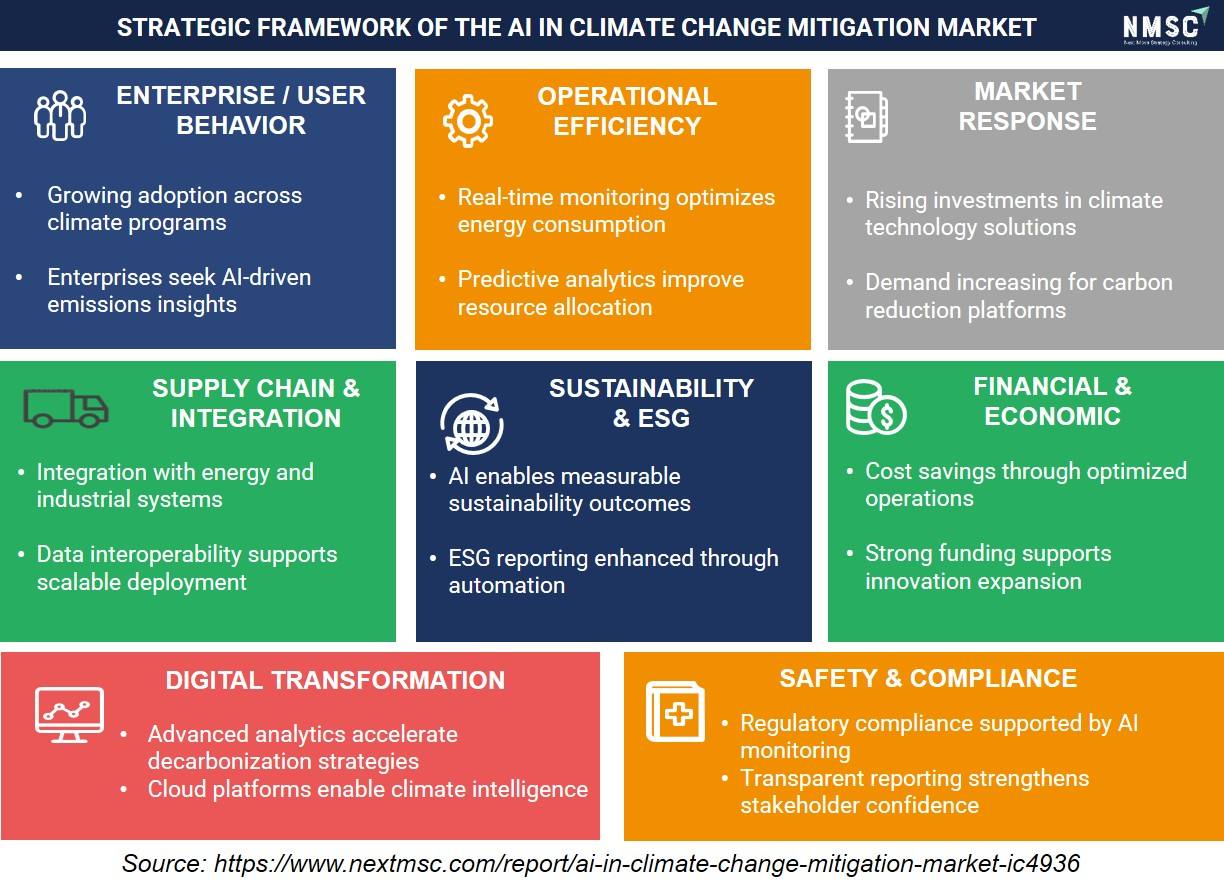
The above infographic presents a strategic framework of the AI in climate change mitigation market. Enterprises are adopting AI-driven emissions insights, supported by integration with energy systems and data interoperability for scalable deployment. Real-time monitoring optimizes energy consumption and predictive analytics improve resource allocation, while AI enables measurable sustainability outcomes and enhances ESG reporting through automation. Rising investments and cost savings are driving market expansion, just as advanced analytics and cloud platforms accelerate decarbonization strategies. Looking ahead, we observed that regulatory compliance and transparent reporting further strengthen stakeholder confidence and market credibility.
Competitive Landscape
Competitive Dynamics and M&A Landscape
|
Key Takeaways |
Details |
|
Market Structure |
Fragmented across industrial automation conglomerates, enterprise software platforms, and specialist climate software vendors, with no single company holding more than a low double-digit share of total market revenue. |
|
Innovation Focus |
Concentrated on embedding AI optimization directly into existing building management, grid control, and industrial process control systems rather than selling standalone climate analytics tools. |
|
M&A Activity |
Steady, with diversified industrial and enterprise software vendors continuing to acquire specialist carbon accounting, ESG reporting, and grid analytics capability to round out broader sustainability and operations platforms. |
How Do Companies Compete in This Industry?
Competition spans diversified industrial automation conglomerates including Siemens, Schneider Electric, Honeywell, ABB, and Emerson, which embed AI optimization into existing building, grid, and plant control systems; enterprise software platforms including Microsoft, SAP, Oracle, IBM, and ServiceNow, which add carbon and ESG modules to broader business software suites; and specialist climate software vendors including Watershed Technology and Persefoni AI, which compete on depth of carbon accounting and disclosure automation capability. Pricing strategies favor subscription software bundled with existing industrial or enterprise contracts over standalone licensing, while geographic expansion is led by vendors building EU CSRD and CBAM-specific capability ahead of European compliance deadlines.
Which Kind of Companies Dominate This Market?
Diversified industrial automation and enterprise software companies with existing operational technology relationships dominate large-scale deployment within this market, leveraging decades of installed base in building management, grid control, and industrial process systems to attach AI optimization modules with comparatively low incremental sales friction. Specialist climate software vendors retain an advantage in depth of carbon accounting and disclosure automation capability, particularly for multinational customers managing EU CSRD and CBAM compliance across complex supply chains.
AI-Native Differentiation and Open Standards Drive Market Success in This Market
Vendors that align closely with recognized international standards, including the GHG Protocol and emerging CBAM default value methodologies, have demonstrated stronger enterprise credibility than those relying on proprietary scoring frameworks. Watershed Technology's decision to make portions of its emissions factor database freely available publicly in 2025 illustrates this trend, positioning open data access as a competitive differentiator that increases switching costs for customers once a vendor's data becomes embedded in internal reporting workflows.
Market Players to Opt for Merger and Acquisition Strategies to Expand Their Presence in This Market
Diversified technology and industrial vendors continue to use acquisition to add specialist climate software capability rather than building it internally, reflecting both the specialized data science required and the urgency created by approaching compliance deadlines such as CBAM's first certificate surrender in September 2027. This pattern is consistent with IBM's acquisition of Envizi to build ESG data management capability and is likely to continue as enterprise software vendors seek to round out sustainability modules ahead of the EU's narrowed but still binding CSRD enforcement timeline.
Who Are the Key Market Players in the AI in Climate Change Mitigation Market?
-
Microsoft Corporation
-
Schneider Electric SE
-
Siemens AG
-
GE Vernova Inc.
-
ABB Ltd.
-
Johnson Controls International plc
-
Oracle Corporation
-
ServiceNow, Inc.
-
Hitachi, Ltd.
-
Emerson Electric Co.
-
Rockwell Automation, Inc.
-
Trane Technologies plc
-
Palantir Technologies Inc.
-
C3.ai, Inc.
-
Itron, Inc.
-
Watershed Technology, Inc.
-
Persefoni AI, Inc.
What Are the Latest Developments in This Industry?
|
Date |
Event |
|
October 2025 |
IBM partnered with the UAE Ministry of Climate Change and Environment (MoCCAE) to develop AI-powered environmental sustainability solutions supporting national climate initiatives, environmental monitoring, and long-term decarbonization strategies. |
Expert Insights
 “We believe that AI has the potential to contribute to tackling some of society’s most pressing challenges and opportunities—among these, climate and sustainability, where we’re researching and innovating to help unlock scientific discoveries and to assist people in making informed choices and communities impacted by climate change.”
— James Manyika, SVP, Research, Technology & Society, Google
Statement made while discussing Google's AI research initiatives focused on addressing climate change and sustainability.
Market Interpretation
The comment highlights the growing role of artificial intelligence as a catalyst for climate change mitigation by accelerating scientific research, improving environmental decision-making, and enabling data-driven sustainability solutions. As governments, research institutions, and enterprises increasingly invest in AI-powered technologies for emissions reduction, climate modeling, resource optimization, and resilience planning, AI is emerging as a foundational technology supporting the expansion of the AI in Climate Change Mitigation Market.
What Are the Investment Opportunities in This Market?
Capital Inflows and Strategic Investment
Capital inflows into this market continue through both direct venture funding and corporate restructuring. Persefoni AI's USD 23 million funding round in March 2025 was directed toward AI-driven carbon accounting and physical risk modeling, while GE's April 2024 spin-off of GE Vernova created a standalone, publicly traded company with direct capital market exposure to grid modernization and renewable forecasting software demand, distinct from GE's aviation and healthcare businesses.
Infrastructure Investment
Infrastructure investment tied to data center build-out and grid modernization is increasingly treated by private equity and strategic investors as a durable, multi-year capital allocation theme rather than a cyclical sustainability budget line. The rapid expansion of AI computing infrastructure and electricity network modernization is driving sustained demand for energy optimization, forecasting, and carbon management software embedded across digital infrastructure.
ESG Considerations
ESG-focused investment continues to support carbon accounting, emissions disclosure, and sustainability reporting platforms, particularly those addressing evolving regulatory requirements such as the EU Corporate Sustainability Reporting Directive (CSRD) and Carbon Border Adjustment Mechanism (CBAM). While investment strategies in the U.S. have shifted toward operational efficiency and grid reliability following the federal climate disclosure rollback, ESG remains a significant driver of capital allocation globally.
Private Equity and Venture Capital Activity
Private equity and venture capital firms continue to invest in software providers specializing in carbon accounting, climate risk analytics, and grid optimization technologies. Investors increasingly favor businesses with recurring software revenue models, regulatory compliance capabilities, and AI-enabled analytics that support enterprise decarbonization and energy efficiency. As digital infrastructure and sustainability initiatives converge, strategic acquisitions and growth investments are expected to remain key avenues for value creation in this market.
Key Benefits for Stakeholders
For Enterprise Sustainability and Compliance Teams
Enterprise sustainability, ESG, and compliance teams gain access to a comprehensive assessment of the AI Climate Technology Market, including detailed analysis of regulatory frameworks, technology adoption trends, and application-specific solutions. The report provides actionable insights into compliance requirements associated with carbon reporting, emissions monitoring, climate risk management, and sustainability disclosure regulations, enabling organizations to prioritize software investments and strengthen enterprise-wide compliance strategies.
For Industrial and Utility Operators
<Industrial enterprises, utilities, and energy infrastructure operators benefit from detailed market intelligence covering AI applications in building energy optimization, renewable energy forecasting, grid management, emissions monitoring, and operational efficiency. The analysis identifies the fastest-growing technology segments and deployment trends, enabling organizations to optimize operational technology investments, improve energy efficiency, and enhance resilience across critical infrastructure.
For Investors and Corporate Development Teams
Investors, private equity firms, venture capital funds, and corporate development teams receive a structured evaluation of the AI Climate Technology Market's growth trajectory, competitive landscape, and investment activity through 2035. Market sizing, segment-level forecasts, and analysis of recent funding, strategic partnerships, spin-offs, acquisitions, and product launches support informed capital allocation, target company evaluation, portfolio construction, and M&A decision-making.
For Policy and Regulatory Affairs Teams
Government policy teams, regulatory affairs professionals, and industry associations gain evidence-based insights into how evolving climate regulations, sustainability disclosure requirements, and environmental policies are shaping enterprise technology adoption worldwide. The study evaluates the impact of changing regulatory frameworks across major markets, enabling stakeholders to develop informed policy strategies, compliance roadmaps, and long-term regulatory planning initiatives.
For Climate Technology Vendors
Climate technology providers gain detailed visibility into emerging market opportunities across application areas, customer segments, and geographic regions. The report identifies high-growth demand for AI-enabled emissions monitoring, measurement, reporting, and verification (MRV), climate analytics, energy optimization, and environmental intelligence solutions, enabling vendors to refine product roadmaps, prioritize innovation investments, optimize go-to-market strategies, and expand into underserved markets through 2035.
Key Market Segments
By Carbon Management
-
Carbon Accounting
-
Scope 1 & 2 Accounting
-
Scope 3 Accounting
-
-
ESG Reporting
-
Disclosure Automation
-
Audit and Controls
-
-
Product Foot printing
-
Supplier Emissions Data
-
Procurement Analytics
-
-
Carbon Project MRV
-
Project Development
-
Verification and Issuance
-
Market Analytics
-
By Building Energy Optimization
-
Buildings
-
HVAC Optimization
-
Lighting Optimization
-
Occupancy Optimization
-
-
Data Centers
-
Cooling Optimization
-
Power Optimization
-
-
Portfolio Energy Management
-
Campus Optimization
-
Multi-site Benchmarking
-
Energy Forecasting
-
By Grid and Renewable
-
Grid Operations
-
Load Forecasting
-
Dispatch Optimization
-
Outage Management
-
-
Renewable Forecasting
-
Solar Forecasting
-
Wind Forecasting
-
Price Forecasting
-
-
DER and Storage
-
Battery Optimization
-
Virtual Power Plants
-
Microgrids
-
By Industrial Decarbonization
-
Process Optimization
-
Yield Optimization
-
Resource Efficiency
-
Setpoint Optimization
-
-
Asset Performance
-
Predictive Maintenance
-
Reliability Optimization
-
Throughput Optimization
-
-
Plant Energy Management
-
Energy Monitoring
-
Energy Reporting
-
Energy Efficiency
-
-
CCUS Optimization
-
Capture
-
Transport
-
Storage
-
By Transport and Logistics
-
Road Transport
-
Fleet Routing
-
Load Planning
-
EV Fleet
-
-
Maritime
-
Voyage Optimization
-
Fuel Optimization
-
-
Aviation
-
Flight Planning
-
Fuel Optimization
-
By Agriculture Forestry & Land Use
-
Precision Agriculture
-
Fertilizer Optimization
-
Irrigation Optimization
-
Crop Input Optimization
-
-
Forestry and Reforestation
-
Deforestation Detection
-
Forest Carbon Monitoring
-
Reforestation Planning
-
-
Soil Carbon
-
Soil Monitoring
-
Carbon Sequestration Analytics
-
By Emissions Monitoring and MRV
-
Methane Detection
-
Leak Detection
-
Source Attribution
-
-
Continuous Monitoring
-
Stack Monitoring
-
Facility Monitoring
-
-
Satellite Monitoring
-
GHG Monitoring
-
Land Use Monitoring
-
-
Climate Intelligence and Planning
-
Climate Forecasting
-
Weather Analytics
-
Hazard Analytics
-
-
Scenario Planning
-
Transition Scenarios
-
Abatement Planning
-
-
Geospatial Intelligence
-
Earth Observation
-
Environmental Screening
-
-
- Other Mitigation Applications
By Region
-
North America: U.S., Canada, and Mexico.
-
Europe: UK, Germany, France, Italy, Spain, Sweden, Denmark, Finland, the Netherlands, and the rest of Europe.
-
Asia Pacific: China, India, Japan, South Korea, Taiwan, Indonesia, Vietnam, Australia, Philippines, Malaysia and the rest of APAC.
-
Middle East & Africa (MEA): Saudi Arabia, UAE, Egypt, Israel, Turkey, Nigeria, South Africa, and the rest of MEA.
-
Latin America: Brazil, Argentina, Chile, Colombia, and the rest of LATAM.
Conclusion and Recommendations
Long-Term Outlook
This market is positioned for sustained growth through 2035, expanding from USD 18.75 billion in 2025 to USD 244.9 billion at a CAGR of 29.3% from 2026 to 2035. Growth is structurally supported by capital-intensive forces, including data center expansion and utility-scale renewable build-out, that are less exposed to single-jurisdiction regulatory reversal than compliance-driven demand alone, giving the long-term forecast resilience even amid the current divergence between US deregulation and European tightening.
Vendors Position
Vendors are best positioned by embedding optimization capability directly into existing building, grid, and industrial control systems rather than selling standalone analytics, and by building a reporting architecture flexible enough to serve California's SB 253, the EU's narrowed CSRD, and CBAM simultaneously. This multi-jurisdiction flexibility reduces customer exposure to regulatory reversal in any single market and is becoming a baseline expectation among multinational enterprise buyers.
Market Investment
Investment attractiveness is reinforced by GE's 2024 spin-off of GE Vernova into a standalone, publicly traded energy software and equipment company and by continued venture funding into specialist vendors such as Persefoni AI, demonstrating that both public market and private capital view climate-adjacent software as a durable, investable category distinct from broader enterprise software.
Market Shifts
Stakeholders should monitor the widening divergence between US federal deregulation and EU regulatory tightening, the reallocation of building energy optimization budgets toward data center infrastructure, and the shift toward independently verifiable satellite and continuous monitoring data following the loss of the MethaneSAT satellite in 2025.
Key Risks
The principal risks are continued US federal regulatory retreat, reducing compliance-driven demand in the country with the largest concentration of vendor headquarters, and the operational fragility of satellite-based emissions monitoring infrastructure, illustrated by MethaneSAT's failure after only a year in orbit, which could slow the broader shift toward independently verified emissions data if not offset by commercial satellite operators and ground-based monitoring networks.
Promising Growth Pathways
The most promising growth pathways lie in data center cooling and power optimization tied to AI infrastructure build-out, CBAM-driven product footprinting tools for industrial exporters, and multi-jurisdiction compliance platforms capable of serving both tightening European and loosening United States regulatory environments from a single product architecture.
About the Author
 Mayurima Roy
— Mayurima Roy is Research Analyst at Next Move Strategy Consulting, where she has spent 4 years working across the firm's full industry coverage rather than a single fixed vertical. Her work centers on structured research, ongoing trend tracking, competitive assessment, and insight-led content development, translating complex market data into clear, decision-ready narratives that support informed client decision-making across diverse global industries, market sectors, and world regions every day.
Mayurima Roy
— Mayurima Roy is Research Analyst at Next Move Strategy Consulting, where she has spent 4 years working across the firm's full industry coverage rather than a single fixed vertical. Her work centers on structured research, ongoing trend tracking, competitive assessment, and insight-led content development, translating complex market data into clear, decision-ready narratives that support informed client decision-making across diverse global industries, market sectors, and world regions every day.
About the Reviewer
 Supradip Baul
— Supradip Baul is an accomplished business consultant and strategist with over a decade of rich experience in market intelligence, strategy, technology, and business transformation. His work has included rigorous qualitative and quantitative analysis across multiple industries, helping clients shape investment decisions and long-term roadmaps. Earlier in his career, he was associated with Gartner, where he contributed to industry-leading reports and market share analyses. He has worked with leading global companies and holds an MBA with a dual specialization in Marketing and Finance.
Supradip Baul
— Supradip Baul is an accomplished business consultant and strategist with over a decade of rich experience in market intelligence, strategy, technology, and business transformation. His work has included rigorous qualitative and quantitative analysis across multiple industries, helping clients shape investment decisions and long-term roadmaps. Earlier in his career, he was associated with Gartner, where he contributed to industry-leading reports and market share analyses. He has worked with leading global companies and holds an MBA with a dual specialization in Marketing and Finance.
At Next Move Strategy Consulting, we understand that insightful market research is the cornerstone of successful business decisions. That's why we employ a robust and multifaceted approach, combining various methodologies to deliver the most accurate and actionable data for our clients.

Research Landscape
We navigate the world of research with two primary approaches:
Qualitative Approach
Our qualitative research methodologies involve immersive techniques such as in-depth interviews, focus groups, and observational studies. By engaging directly with individuals and stakeholders, we uncover valuable insights that quantitative data alone may overlook.

Quantitative Research
In tandem with qualitative methodologies, NMSC leverages the power of Quantitative Research to provide a robust foundation of numerical insights. Through systematic data collection and analysis, we quantify patterns, preferences, and market trends, offering a comprehensive view of the business landscape.
Our quantitative research approach employs diverse tools, including surveys, experiments, and statistical modelling. These methodologies enable us to gather data from a large and representative sample, ensuring the statistical significance of our findings. By employing structured questionnaires and standardized data collection methods, we guarantee the reliability and validity of the information we present to our clients.
Quantitative research is particularly effective in measuring the prevalence of trends, assessing market size, and gauging the impact of various factors on consumer behavior. The numerical precision attained through this approach equips our clients with actionable insights, facilitating data-driven decision-making and strategy formulation.


Our Specialized Toolbox for Industry-Specific Market Research
We deploy a specialized arsenal of techniques tailored to meet your unique requirements. Here's a glimpse into our comprehensive toolbox:

Information Procurement
The stage entails acquiring market data or relevant information through various sources and methodologies.


Market Research Approach
We utilize both top-down and bottom-up approaches in market research analysis to achieve a comprehensive understanding of the market dynamics, leveraging the broad perspective of industry trends and macroeconomic factors alongside detailed insights from specific segments and individual companies.

Porters Five Forces Analysis
We conduct Porter's Five Forces analysis to evaluate the competitive landscape of an industry, providing us with insights into factors that affect profitability and strategic positioning.

SWOT Analysis

Forecasting
We utilize a forecasting model to predict future consumption by considering parameters like population, economics, regulations, market competition, drivers, constraints, technology, and pricing. We also employ statistical techniques such as multilinear regression, exponential smoothing, moving average, ARIMA, and Monte Carlo simulations for accurate predictions. In econometric forecasting, we analyzed short-term and long-term event impacts, attributing values based on regulatory frameworks, economic factors, and market events.





 Speak to Our Analyst