AI Model Security Market

The global AI Model Security Market size was valued at USD 590.00 million in 2025 and is estimated at USD 840.00 million in 2026, forecast to reach USD 8,060.00 million by 2035, expanding at a 28.6% CAGR between 2026 and 2035. North America leads with approximately 41% share, while Runtime Protection and Guardrails account for approximately 34% of market revenue.
Download Free Sample PDF
Base Year (2025)
$590.0 Million
Forecast (2035)
$8,060.0 Million
CAGR (2026-2035)
28.6%
Top Region
North America

What Is the AI Model Security Market Size?
The global AI Model Security Market was USD 590.00 Million in 2025 and is estimated at USD 840.00 Million in 2026, forecast to reach USD 8,060.00 Million by 2035 at a CAGR of 28.6% from 2026 to 2035. North America leads with approximately 41% share in 2025, while Runtime Protection and Guardrails holds approximately 34% of revenue.
Our analysis shows that cloud delivered runtime controls and North American enterprise buyers anchor demand, while agent security and Asia-Pacific supply the fastest growth.

AI Model Security Market Revenue Forecast
Values in USD Million

2025 $590.0 Million
2025
2026 $840.0 Million
2026
2027 $1,080.2 Million
2027
2028 $1,389.2 Million
2028
2029 $1,786.5 Million
2029
2030 $2,297.4 Million
2030
2031 $2,954.5 Million
2031
2032 $3,799.5 Million
2032
2033 $4,886.1 Million
2033
2034 $6,283.6 Million
2034
2035 $8,060.0 Million
2035

Key Takeaways

By Security Function: Runtime Protection and Guardrails held the largest share, expanding from USD 200.60 Million in 2025 to USD 2,418.00 Million by 2035; Agent Security and Access Control is the fastest growing at 36.1% CAGR from 2026–2035.

By Deployment Mode: Cloud Based led with USD 365.80 Million in 2025 and is also the fastest growing, reaching USD 5,319.60 Million by 2035 at 29.2% CAGR from 2026–2035.

By End User Industry: BFSI held the largest share at USD 153.40 Million in 2025, rising to USD 1,773.20 Million by 2035; Healthcare and Life Sciences is the fastest growing at 33.1% CAGR from 2026–2035.

Dominant Region: North America accounted for approximately 41% of 2025 revenue at USD 241.90 Million and is projected to reach USD 2,901.60 Million by 2035.

Fastest Growing Region: Asia-Pacific is growing at 31.7% CAGR from 2026–2035, rising from USD 129.80 Million in 2025 to USD 2,256.80 Million by 2035.

Dominant Country: The U.S. led with approximately USD 215.29 Million in 2025 and is projected to reach USD 2,524.39 Million by 2035.

Fastest Growing Country: India is growing at 39.0% CAGR from 2026–2035, rising from USD 9.09 Million in 2025 to USD 293.38 Million by 2035.

The AI Model Security Market presents an absolute investment opportunity of approximately USD 7,220.00 Million between 2026 and 2035, as enterprise spending moves from pilot controls to platform contracts.

According to NMSC analysis, buyers are shifting budgets from point scanners to platforms that cover discovery, testing and runtime enforcement under one contract, which favors vendors with existing security distribution.

What Does the AI Model Security Market Encompass?

The AI Model Security Market covers software platforms and services that protect machine learning models, large language model applications and AI agents from adversarial attack, data leakage and supply chain compromise across their lifecycle. Core capabilities include model scanning, runtime guardrails, AI red teaming, AI security posture management and agent access control. The NIST adversarial machine learning taxonomy, published as AI 100-2 E2025 in March 2025, gives vendors and buyers a shared vocabulary for evasion, poisoning, privacy and abuse attacks.

Regulation shapes purchasing timelines. EU AI Act obligations for general purpose AI models applied from 2 August 2025, and the Digital Omnibus entered into force on 27 July 2026, extending Annex III high risk rules to 2 December 2027. South Korea's AI Basic Act took effect on 22 January 2026, and the UK published a Code of Practice for the Cyber Security of AI in January 2025. Our findings suggest that responsible AI mandates now set procurement calendars more than breach events alone.

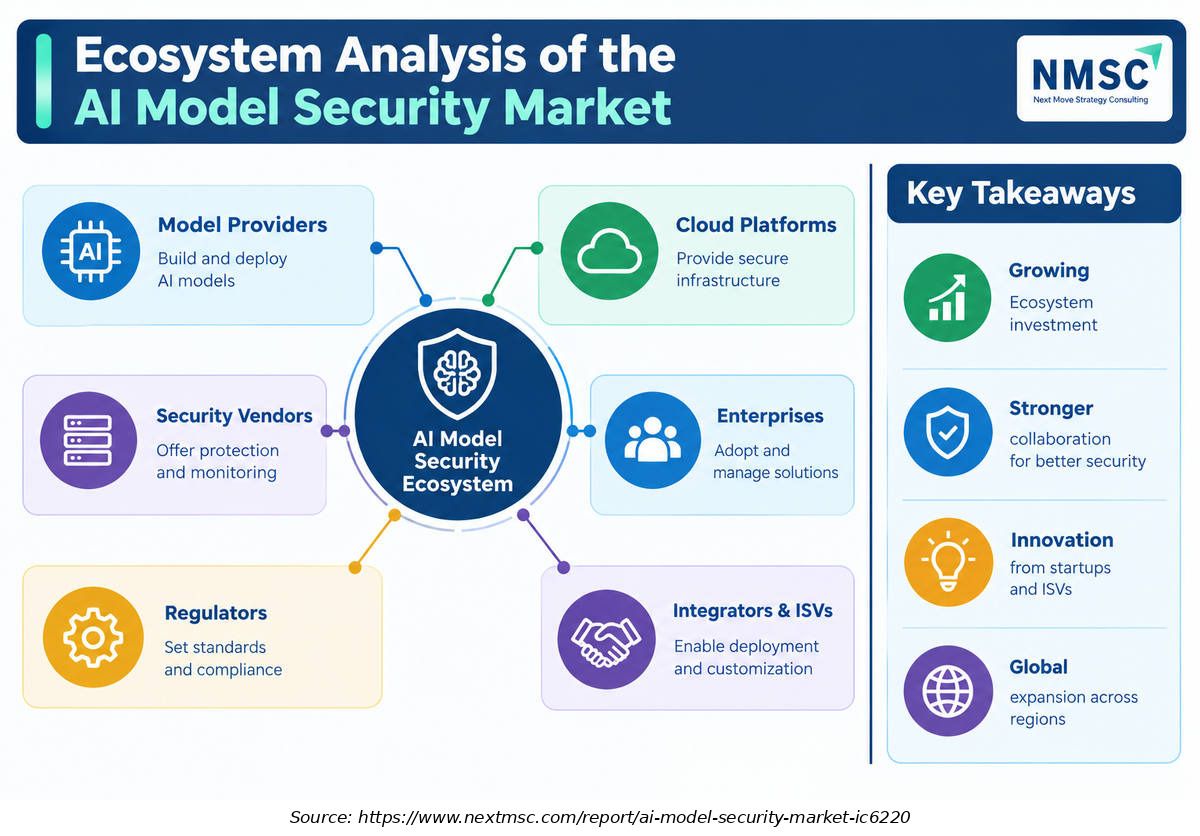
Ecosystem Analysis of the AI Model Security Market

The AI Model Security Market ecosystem comprises model developers, security vendors, cloud platforms, enterprises, system integrators, and regulators. These stakeholders collaborate to protect AI models throughout development, deployment, and operation. Growing investment in AI security, stronger regulatory oversight, and partnerships between technology providers are strengthening ecosystem capabilities, supporting innovation, and expanding adoption across industries.

Market Drivers & Dynamics

Interactive Dataset
Rising enterprise AI deployment into production driver +4.1% Global 2026–2035
Regulation and standards for AI risk management driver +3.3% Europe, Asia-Pacific, North America 2026–2030
Agent adoption widening the attack surface driver +3.6% North America, Asia-Pacific 2026–2035
Breach costs tied to ungoverned AI use driver +2.1% Global 2026–2032
Security skills shortage and unclear budget ownership restraint −2.4% Global 2026–2030
Immature testing standards and noisy detection results restraint −1.8% Global 2026–2029
Deferred EU high risk compliance deadlines restraint −1.1% Europe 2026–2028
Source: Next Move Strategy Consulting

Growth Drivers

What Is the Primary Growth Driver in the AI Model Security Market?

Production AI deployment is the primary structural driver of the AI Model Security Market, because every deployed model creates an asset that needs protection. The US Census Bureau found that 19.8% of US businesses used AI as of 3 May 2026, rising to 37% among firms with 250 or more employees. Eurostat reported 19.95% of EU enterprises using AI in 2025, with 55.03% among large enterprises. These rates show why artificial intelligence budgets now carry a security line item.

How Are Breach Costs and Regulation Driving Market Growth?

IBM's 2025 Cost of a Data Breach Report found that 13% of organizations reported breaches of AI models or applications and that 97% of them lacked proper AI access controls. Shadow AI added about USD 0.67 Million to breach costs against a global average of USD 4.44 Million. Regulation reinforces this evidence, since EU obligations for general purpose AI models applied from 2 August 2025 and South Korea's AI Basic Act took effect on 22 January 2026.

Growth Inhibitors

What Is Restraining the AI Model Security Market?

The main restraint is organizational rather than technical. Security teams lack staff who understand both model behavior and attack techniques, and budget ownership is split between security, data and AI engineering groups. Testing standards are still maturing, and unsafe pickle alerts that proved 96% false positives in JFrog's analysis show how noisy detection can be. The EU decision to defer Annex III obligations to 2 December 2027 also lets some buyers wait, which ties purchasing to governance, risk and compliance programs.

Segmentation Analysis

2025 (USD Million)
2035 (USD Million)
Runtime Protection and Guardrails 2025: $200.6 Million | 2035: $277.2 Million
Runtime Prot
Model Supply Chain Security 2025: $118.0 Million | 2035: $168.0 Million
Model Supply
AI Red Teaming and Testing 2025: $106.2 Million | 2035: $151.2 Million
AI Red Teami
AI Posture Management and Discovery 2025: $118.0 Million | 2035: $168.0 Million
AI Posture M
Agent Security and Access Control 2025: $47.2 Million | 2035: $75.6 Million
Agent Securi
Runtime Protection and Guardrails $200.6 Million $277.2 Million 2,418.00
Model Supply Chain Security $118.0 Million $168.0 Million 1,450.80
AI Red Teaming and Testing $106.2 Million $151.2 Million 1,370.20
AI Posture Management and Discovery $118.0 Million $168.0 Million 1,612.00
Agent Security and Access Control $47.2 Million $75.6 Million 1,209.00

Which Security Function Leads the AI Model Security Market?

Runtime Protection and Guardrails leads with approximately 34% of 2025 revenue at USD 200.60 Million, because guardrails sit in the request path and are the first control buyers deploy for chat and retrieval augmented generation applications. Agent Security and Access Control is the fastest growing function at 36.1% CAGR from 2026 to 2035, rising from USD 75.60 Million in 2026 to USD 1,209.00 Million by 2035 as agents gain tool access.

2025 (USD Million)
2035 (USD Million)
Category A
Category B
Category C
Category D
Segment Item 2025 (USD Million) 2035 (USD Million) CAGR
Category A $10.0 USD Million $40.0 USD Million 25.0%
Category B $17.1 USD Million $51.1 USD Million 11.0%
Category C $24.2 USD Million $62.2 USD Million 25.0%
Category D $31.3 USD Million $73.3 USD Million 11.0%

Segment-wise data is locked

Unlock complete segment-wise numbers for By Deployment Mode.

Unlock Full Data
2025 (USD Million)
2035 (USD Million)
Category A
Category B
Category C
Category D
Segment Item 2025 (USD Million) 2035 (USD Million) CAGR
Category A $10.0 USD Million $40.0 USD Million 27.0%
Category B $17.1 USD Million $51.1 USD Million 9.0%
Category C $24.2 USD Million $62.2 USD Million 19.0%
Category D $31.3 USD Million $73.3 USD Million 17.0%

Segment-wise data is locked

Unlock complete segment-wise numbers for By End User Industry.

Unlock Full Data
2025 (USD Million)
2035 (USD Million)
Category A
Category B
Category C
Category D
Segment Item 2025 (USD Million) 2035 (USD Million) CAGR
Category A $10.0 USD Million $40.0 USD Million 14.0%
Category B $17.1 USD Million $51.1 USD Million 24.0%
Category C $24.2 USD Million $62.2 USD Million 22.0%
Category D $31.3 USD Million $73.3 USD Million 12.0%

Segment-wise data is locked

Unlock complete segment-wise numbers for By Region.

Unlock Full Data

Growth Opportunities

Our findings suggest that three whitespace opportunities will account for most incremental spending through 2035.

Can Nonhuman Identity and Agent Access Control Become a Distinct Budget Line?

Agents authenticate with tokens, keys and service accounts that identity teams rarely inventory. Cisco bought Astrix Security for nonhuman identity, and specialists such as Zenity sell agent governance. Vendors that pair identity inventory with runtime action limits built on zero trust principles can capture a segment growing from USD 75.60 Million in 2026 to USD 1,209.00 Million by 2035, and enterprises with large agent fleets benefit most.

Does Compliance Evidence Open a Premium Services Opportunity for Regulated Industries?

Healthcare, finance and public agencies must prove that models were tested and monitored. Vendors that package red team reports, model inventories and runtime logs into audit ready evidence can attach services to software contracts. IBM links Guardium AI Security with watsonx.governance, and healthcare and life sciences demand grows at 33.1% CAGR from 2026 to 2035, so reporting becomes a revenue layer beyond detection.

Can Mid Sized Enterprises and Asia-Pacific Buyers Be Reached Through Platform Channels?

Asia-Pacific offers the steepest regional trajectory, with revenue climbing from USD 189.00 Million in 2026 to USD 2,256.80 Million by 2035 at 31.7% CAGR. Mid sized enterprises rarely hire AI security staff, so managed shadow AI discovery and attack surface management delivered through resellers and cloud marketplaces can reach them. Cloud native vendors with local language guardrails can win ahead of regional incumbents.

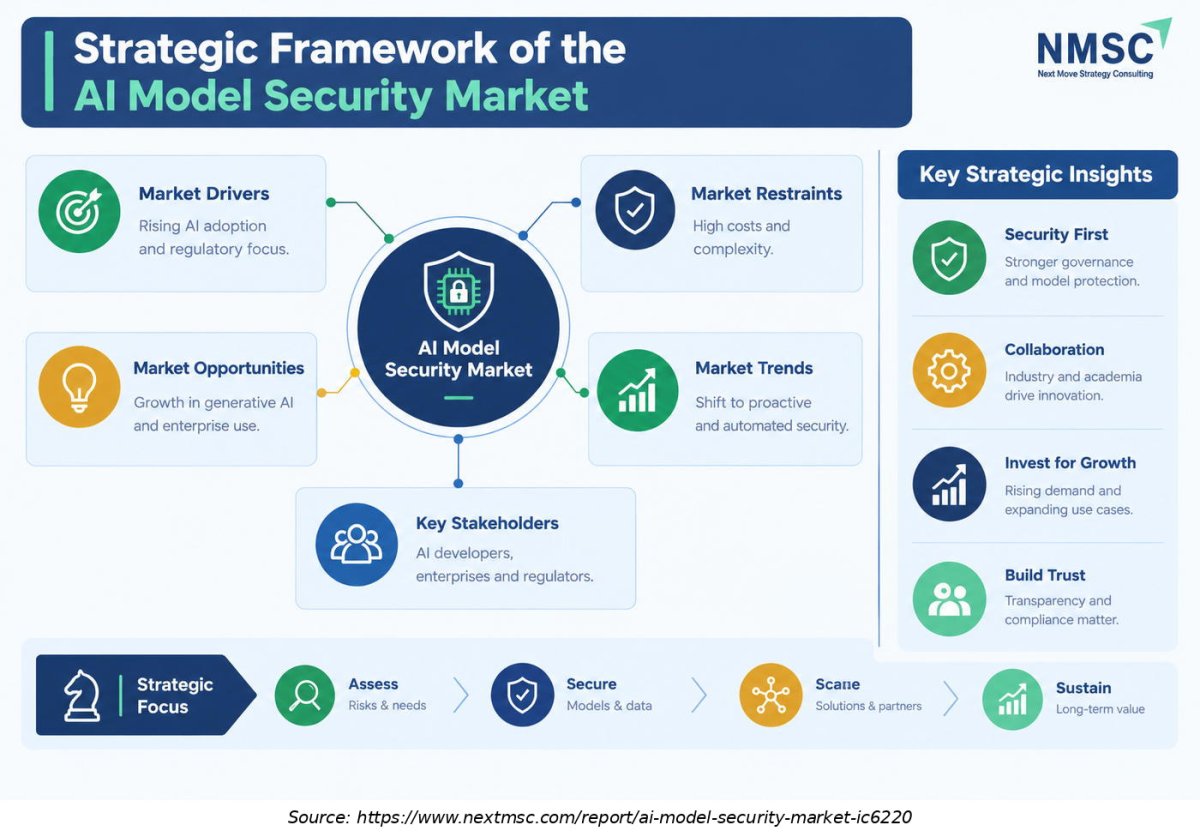
Strategic Framework of the AI Model Security Market

Strategic Framework of the AI Model Security Market

The strategic framework of the AI Model Security Market is shaped by rising AI adoption, evolving threats, regulatory requirements, and demand for proactive protection. Market participants are prioritizing risk assessment, model and data security, automated monitoring, and strategic partnerships. Long-term competitiveness will depend on effective governance, continuous innovation, regulatory compliance, and the ability to deliver scalable security solutions.
Regional Outlook

2025 (USD Million)
2035 (USD Million)
North Americ
Europe
Asia-Pacific
Middle East
Latin Americ
Region 2025 (USD Million) 2035 (USD Million) CAGR (%)
North America $10.0 USD Million $40.0 USD Million 9.0%
Europe $17.1 USD Million $51.1 USD Million 27.0%
Asia-Pacific $24.2 USD Million $62.2 USD Million 25.0%
Middle East & Africa $31.3 USD Million $73.3 USD Million 23.0%
Latin America $38.4 USD Million $84.4 USD Million 12.0%

Regional data is locked

Unlock complete regional numbers for this market.

Unlock Full Data

Competitive Landscape

Our assessment indicates that the AI Model Security Market industry is moderately fragmented, with platform vendors and funded specialists competing for the same budgets.

Dimension Description
Market Structure Moderately fragmented; security platform vendors, cloud providers and funded specialists compete across scanning, runtime protection and red teaming
Innovation Focus Agent security, continuous red teaming, model supply chain scanning and runtime guardrails that work across clouds
M&A Activity Platform vendors acquired or agreed to acquire Protect AI, Lakera, CalypsoAI, Prompt Security, Pangea and SPLX between July 2025 and November 2025, and Cisco completed Astrix in June 2026

How Do Companies Compete in the AI Model Security Market?

Companies compete on coverage across the model lifecycle, detection accuracy, latency in the request path and integration with existing security consoles. Cloud and model providers offer guardrails close to the model, while Palo Alto Networks, Cisco and CrowdStrike sell them inside broader platforms. Pricing follows subscription and consumption models tied to protected applications, tokens or agents, and geographic expansion follows cloud regions and channel partners.

Which Competitive Archetypes Dominate the AI Model Security Market?

Three archetypes dominate. Security platform vendors, led by Palo Alto Networks, Cisco, CrowdStrike and Check Point, win on distribution and bundling. Cloud and model providers, including Microsoft, Google, Amazon Web Services and NVIDIA, win on proximity to the model. Funded specialists such as HiddenLayer, Noma Security, Mindgard and Lasso Security win on depth in red teaming, scanning and agent security, and often become acquisition targets.

What Innovation and Differentiation Strategies Are Companies Pursuing?

We observed that leading vendors invest in agent aware controls, automated red teaming and inventories of shadow AI. Trend Micro added an AI Scanner and guardrails to its Trend Vision One AI Security Package, IBM paired Guardium AI Security with watsonx.governance, and Akamai and Cloudflare extended web application firewalls to inspect prompts. SentinelOne and CrowdStrike also tie AI telemetry to AI based security operations.

What M&A and Partnership Activity Is Shaping the Market?

Our findings suggest that consolidation is a defining pattern in the AI Model Security Market. Palo Alto Networks completed its Protect AI acquisition in July 2025, SentinelOne acquired Prompt Security in 2025, Check Point completed its Lakera acquisition in the fourth quarter of 2025, and F5 completed its CalypsoAI acquisition on 29 September 2025. CrowdStrike acquired Pangea on 26 September 2025, and Zscaler completed its SPLX acquisition on 31 October 2025. Cisco completed its Astrix Security acquisition in June 2026, while Proofpoint acquired Acuvity in February 2026. OpenAI announced an agreement to acquire Promptfoo in March 2026.

Key Market Players

Based on research conducted by NMSC, the following 20 companies represent the validated set of leading vendors, listed in qualitative rank order because most do not disclose AI model security revenue.

Palo Alto Networks, Inc. Cisco Systems, Inc. Microsoft Corporation CrowdStrike Holdings, Inc. Check Point Software Technologies Ltd. Alphabet Inc. International Business Machines Corporation Zscaler, Inc. SentinelOne, Inc. F5, Inc. HiddenLayer, Inc. Noma Security Amazon.com, Inc. Trend Micro Incorporated Cloudflare, Inc. Akamai Technologies, Inc. NVIDIA Corporation Cato Networks Mindgard Lasso Security

Latest Developments

During our market evaluation, we noticed that 2025–2026 activity centered on acquisitions, agent security launches and large funding rounds.

Date Event
Aug 2026 HiddenLayer launched Agent Harness Security, a runtime protection solution for AI coding agents. It extends the company’s Runtime Security module to detect and stop prompt injection, sensitive-data exposure, unsafe commands and related threats during agent execution, while aiming to preserve developer productivity.
Jun 2026 Cisco completed its acquisition of Astrix Security, adding non-human identity security capabilities for discovering and governing service accounts, API keys, tokens and other machine identities used by AI agents. The technology complements Cisco’s security portfolio as organizations deploy agents that access enterprise systems and execute actions autonomously.
Mar 2026 OpenAI announced an agreement to acquire Promptfoo, whose tools help enterprises evaluate and red-team AI systems. OpenAI plans to integrate Promptfoo’s security testing into Frontier so organizations can test agent behavior, identify prompt injections, jailbreaks, data leaks and tool misuse, and document oversight.
Feb 2026 Proofpoint acquired Acuvity, adding AI-native visibility, governance and runtime protection for AI applications, agents and Model Context Protocol servers. The technology is designed to give security teams control over enterprise AI use across endpoints, browsers, connected infrastructure and internal AI deployments.
Nov 2025 Trend Micro announced its Trend Vision One AI Security Package, planned for introduction at AWS re:Invent in December 2025. The package protects AI applications from model development through runtime and includes AI Application Security capabilities, with AI Scanner for vulnerability discovery and AI Guard for runtime defense.

Investment Opportunities

Where Are Capital Inflows Concentrating in the AI Model Security Market?

Capital is concentrating in funded specialists and in acquisitions by platform vendors. HiddenLayer raised USD 100.00 Million in September 2026, Noma Security raised USD 100.00 Million in July 2025, and Mindgard raised USD 30.00 Million in August 2026. SentinelOne reported USD 160.20 Million in fair value for Prompt Security. Investors should also watch vendors that use synthetic data to generate attack simulations and evaluation sets.

How Is Infrastructure Investment Shaping Market Capacity?

Infrastructure investment centers on enforcement in the inference path and on cloud delivery. Google Cloud Model Armor, Amazon Bedrock Guardrails and Microsoft Defender for Cloud screen prompts and responses inside cloud platforms, while NVIDIA NeMo Guardrails offers an open source library for self-hosted models. Cloudflare and Akamai inspect traffic at the network edge. Capacity spending therefore favors low latency enforcement and multicloud coverage over standalone appliances.

What ESG Considerations Are Influencing Market Investment?

Governance is the dominant ESG factor, because boards must show oversight of AI risk. NIST AI 100-2 E2025 and the UK Code of Practice for the Cyber Security of AI give investors a checklist for diligence. Social considerations include privacy and fairness when model outputs affect customers. Environmental impact is minor for security software, although efficient runtime scanning lowers compute overhead for protected workloads.

Key Benefits for Stakeholders

How Does This Report Benefit Industry Leaders and Enterprise Security Teams?

Chief information security officers and AI program leads gain a reconciled sizing of USD 590.00 Million in 2025 and a segment view of where controls are purchased first. The report compares security function, deployment mode and industry growth, which helps leaders sequence budgets across discovery, scanning, runtime protection and red teaming. Regional and country analysis shows where regulation will accelerate procurement.

How Does This Report Benefit Investors and Financial Analysts?

Investors and financial analysts gain a model that moves from USD 840.00 Million in 2026 to USD 8,060.00 Million by 2035 at a 28.6% CAGR. Segment growth spreads from 24.9% for On Premises to 36.1% for Agent Security and Access Control, which helps screen valuations. The competitive review documents the acquisition pattern and funding rounds that signal likely exit routes.

How Does This Report Benefit Technology Vendors and Product Teams?

Product and strategy teams at security vendors gain visibility into which functions and deployment modes are growing fastest, and how competitors position through bundling, acquisition and agent security. The country analysis highlights entry points such as India at 39.0% CAGR and Saudi Arabia at 31.6%, while the player review shows where partnerships can close portfolio gaps.

Key Market Segments Evaluated

By Security Function

  • Runtime Protection and Guardrails
  • Model Supply Chain Security
  • AI Red Teaming and Testing
  • AI Posture Management and Discovery
  • Agent Security and Access Control

By Deployment Mode

  • Cloud Based
  • Hybrid
  • On Premises

By End User Industry

  • BFSI
  • IT and Telecom
  • Healthcare and Life Sciences
  • Government and Defense
  • Retail and Ecommerce
  • Other Industries

By Region

  • North America 
    • U.S.
    • Canada
    • Mexico
  • Europe 
    • UK
    • Germany
    • France
    • Italy
    • Spain
    • Sweden
    • Denmark
    • Finland
    • Netherlands
    • Rest of Europe
  • Asia-Pacific 
    • China
    • India
    • Japan
    • South Korea
    • Taiwan
    • Indonesia
    • Vietnam
    • Australia
    • Philippines
    • Malaysia
    • Rest of APAC
  • Middle East & Africa 
    • Saudi Arabia
    • UAE
    • Egypt
    • Israel
    • Turkey
    • Nigeria
    • South Africa
    • Rest of MEA
  • Latin America 
    • Brazil
    • Argentina
    • Chile
    • Colombia
    • Rest of LATAM

Conclusion & Recommendations

The long term outlook for the AI Model Security Market is strongly positive, with revenue rising from USD 840.00 Million in 2026 to USD 8,060.00 Million by 2035. Deployment of agents and regulated AI use cases will keep security attached to every production model. Cloud Based delivery and platform bundling will define how buyers purchase, and spending will shift from pilots to enterprise agreements.

What Strategic Positioning Recommendations Does NMSC Offer?

Security platform vendors should prioritize agent identity controls, continuous red teaming and cross cloud guardrails, and should buy rather than build where detection research is scarce. Specialists should focus on one defensible function and integrate with the major platforms. Cloud providers should open guardrail interfaces to third party models. All vendors should publish evidence mapped to NIST and EU requirements to shorten sales cycles in BFSI and healthcare.

How Strong Is the Investment Attractiveness of the AI Model Security Market?

Investment attractiveness is high, supported by a USD 7,220.00 Million absolute opportunity between 2026 and 2035 and active acquirers across the platform vendor group. Asia-Pacific and healthcare offer the fastest growth, while North America and BFSI offer the deepest current spending. Valuation risk remains because revenue disclosure is thin, so diligence should test retention and attach rates in addition to funding momentum.

What Are the Market Shifts and Key Risks in the AI Model Security Market?

Key shifts include the move from model scanning to runtime and agent control, and from standalone tools to platform contracts. Risks include deferred EU deadlines, noisy detection results, consolidation that removes independent options, and a shortage of staff who understand both attack techniques and model behavior. Buyers should demand measurable detection accuracy and clear exit terms before committing to a single vendor.

What Are the Primary Growth Pathways Through 2035?

Primary growth pathways include agent security and access control at 36.1% CAGR, healthcare and life sciences at 33.1%, Asia-Pacific at 31.7% and cloud delivered services at 29.2%. Platform bundling through existing security contracts and managed services for mid sized firms add further routes. Together these pathways explain why spending grows about 9.6 times between 2026 and 2035.

FAQs

About the Author

Mihul Sharma

Mihul Sharma

Mihul Sharma is Research Associate at Next Move Strategy Consulting, where he has covered technology, industrial, and healthcare markets for 3 years. His work applies structured business research, market analysis, and secondary-source review to assess market trends, competitive developments, and growth opportunities. He supports report development by fully synthesizing industry data, company information, and market signals into concise findings for strategy and investment-focused research teams.

About the Reviewer

Supradip Baul

Supradip Baul

Supradip Baul is an accomplished business consultant and strategist with over a decade of rich experience in market intelligence, strategy, technology, and business transformation. His work has included rigorous qualitative and quantitative analysis across multiple industries, helping clients shape investment decisions and long-term roadmaps. Earlier in his career, he was associated with Gartner, where he contributed to industry-leading reports and market share analyses. He has worked with leading global companies and holds an MBA with a dual specialization in Marketing and Finance.

Download Free Sample

Mohit Agarwal

MOHIT AGARWAL

Chief Manager

DryChem India Pvt. Ltd.

Next Move Strategy Consulting is an amazing team of consultants. We required a market study report for our investors on top priority and the team went above and beyond our expectations to deliver the same with ample supporting data within a short time span enabling us to secure the investments and keep our project timeline maintained. Their professionalism, attention to detail, and timely delivery of actionable recommendations have left a lasting impression on our organization.

Kevin Coker

KEVIN COKER

Founder, CEO and Board Diector

Proxima Clinical Research

I have been using Next MSC reports for product positioning in a new geography for a long time. They have by far the best reports I have found and the price is reasonable too!

Amos Chang

AMOS CHANG

Strategy Consultant

Kardex Group

I have bought the intralogistics market reports from NMSC two times so far. Joseph and his team are always very helpful and flexible in responding to any customization requirements on the report. Their expertise in market reports really helps us steer the day-to-day business. I will definitely recommend and come back myself whenever there is a need.

Gustaf Hummel Burstrom

GUSTAF HUMMEL BURSTROM

Founder

Revline Tools AB

Joseph and the team at Next Move Strategy Consulting have been excellent to work with, in supplying us with relevant market data and forecasts for our specific category. We had some special requirements and they were able to do a custom package to suit our needs. We would definitely recommend them to any other company needing market data and forecasts

Henri Knyphausen

HENRI KNYPHAUSEN

Partner at Singulier [Ex-BCG]

Singulier

I recently engaged NEXTMSC.com for a commercial due diligence project within the intralogistics sector, and I am pleased to provide a reference based on my experience. In utilizing NEXTMSC.com's services, I found their report to offer valuable insights into market dynamics and key industry players. The initial report provided a solid foundation for our analysis. However, as we were investigating a smaller target in the market, and I had specific customization requests requiring additional research. These requests included detailed information on product portfolios of various players and sub-market sizes, both inclusive and exclusive of certain product categories. NEXTMSC.com demonstrated commendable responsiveness and agility in accommodating these customization requests. Within a timeframe of 1-2 weeks, they delivered a revised report that met our specific needs. Furthermore, they were receptive to my follow-up inquiries, ensuring clarity and understanding of the data provided. The final deliverable significantly contributed to our due diligence efforts. One of NEXTMSC.com's notable strengths lies in their qualitative research capabilities. However, for future engagements, I would recommend the inclusion of a quantified market model in Excel format. Such a model would offer the ability to conduct in-depth analyses and explore various market segments, including country-specific data and subcomponent breakdowns. Based on my positive experience, I would not hesitate to work with NEXTMSC.com again. Their responsiveness, willingness to accommodate customization requests, and commitment to delivering actionable insights make them a reliable partner for commercial research projects.

Custom Market Research Services

We will customize the research for you if the listed report does not fully match your requirements.

Get 30% Free Customization

Select License

This website uses cookies to ensure you get the best experience on our website. Learn more

✖