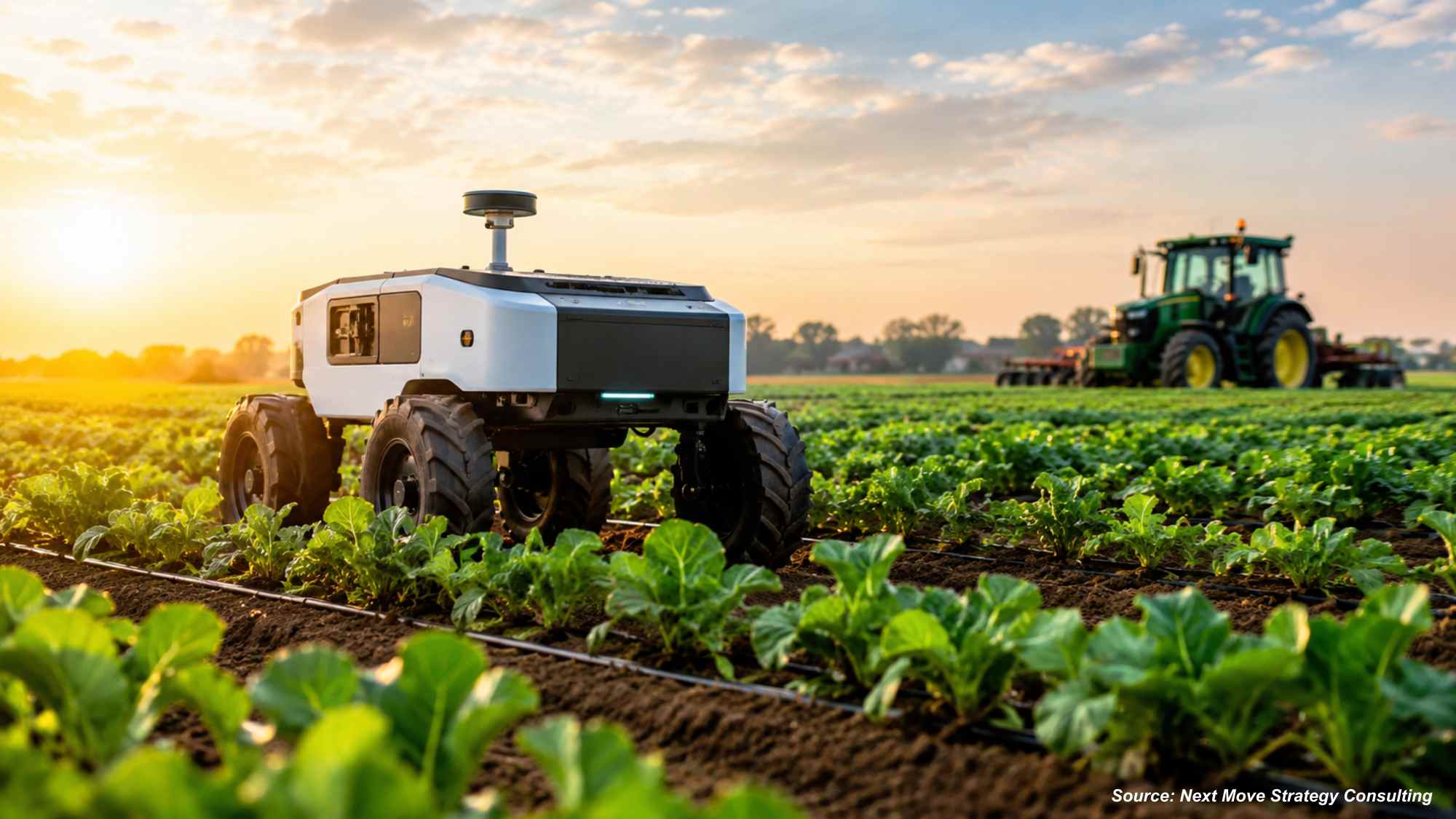
AI Path Planning Market Size, Share, Trends and Growth Analysis, By Function (Motion Planning, Fleet Path Optimization, and Offline Path Generation), By Deployment Platform (Industrial Robots, Mobile Robots, On-Road Autonomous Vehicles, Unmanned Aerial Systems, and Marine Systems), By Delivery Model, By Buyer Type, By Sales Channel, By End User Industry, and Region – Global Industry Report and Forecast, 2026–2035
Industry: ICT & Media | Publishing Date: July 22, 2026 | Last Updated: September 30, 2026 | No of Pages: N/A | No. of Tables: N/A | No. of Figures: N/A | Format: PDF | Report Code: IC5300
What Is the AI Path Planning Market Size?
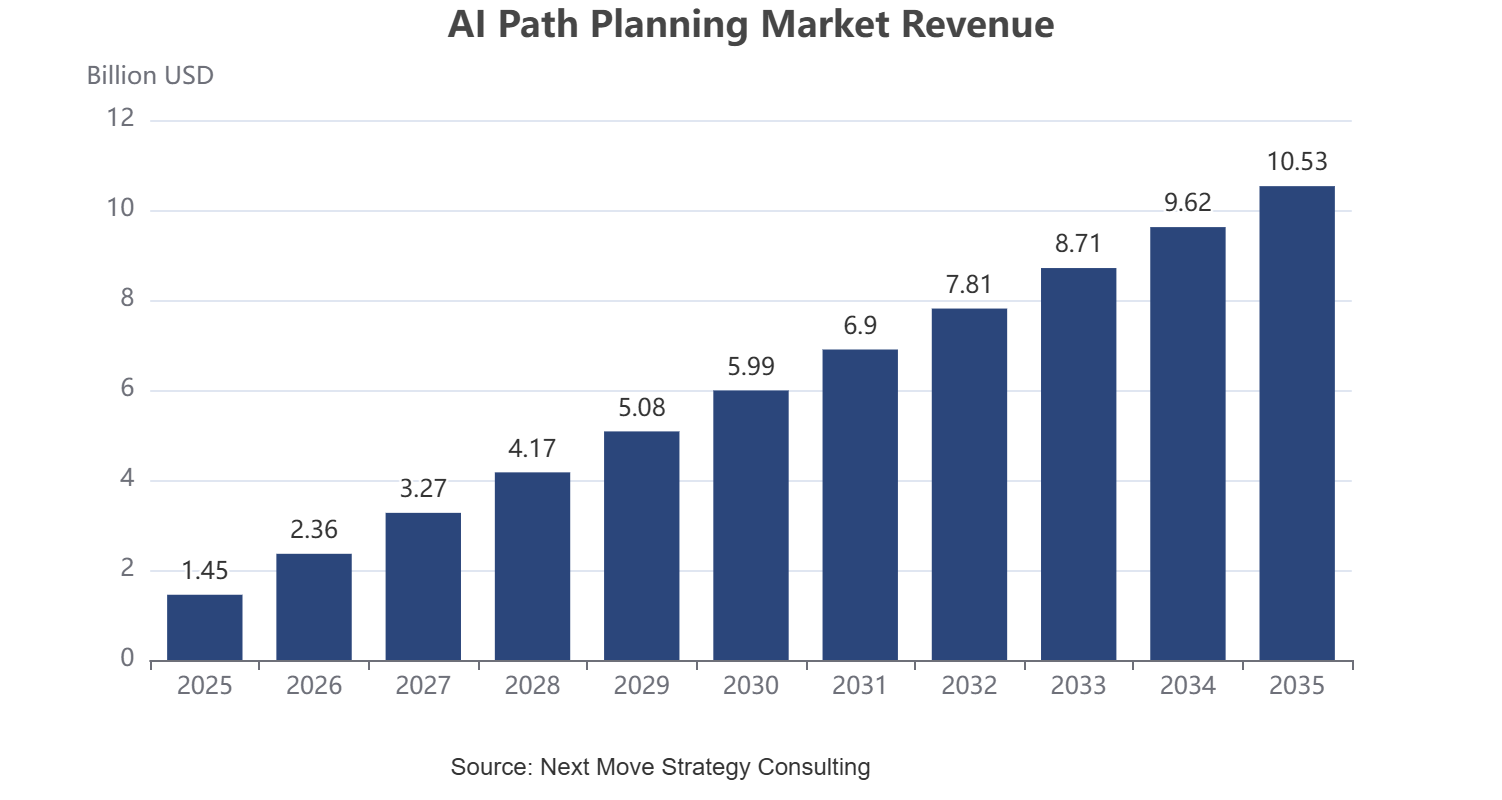
The global AI path planning market size was valued at USD 1.45 billion in 2025 and is estimated at USD 1.80 billion in 2026, forecast to reach USD 10.53 billion by 2035, expanding at a 22.8% CAGR between 2026 and 2035. North America leads with approximately 40% share, while motion planning and trajectory optimization dominates all other functions with approximately 52% share.
We observed that growth is broad-based across every segmentation axis, with warehouse automation scale-up and robotaxi commercialization driving the dominant structural shifts through 2035.
|
Key Takeaways |
|
By Function: Motion Planning and Trajectory Optimization held the largest share of approximately 52% (USD 0.75 billion) in 2025; Fleet Path Optimization and Traffic Management is the fastest-growing sub-segment at 25.2% CAGR from 2026–2035. |
|
By Deployment Platform: Mobile Robots held the largest share of approximately 30% (USD 0.43 billion) in 2025; On-Road Autonomous Vehicles is the fastest-growing sub-segment at 27.4% CAGR from 2026–2035. |
|
By Delivery Model: Software License held the largest share of approximately 68% (USD 0.99 billion) in 2025; Services is the fastest-growing sub-segment at 24.2% CAGR from 2026–2035. |
|
By Buyer Type: Machine Builders and System Integrators held the largest share of approximately 38% (USD 550 million) in 2025; Enterprise End Users is the fastest-growing sub-segment at 25.2% CAGR from 2026–2035. |
|
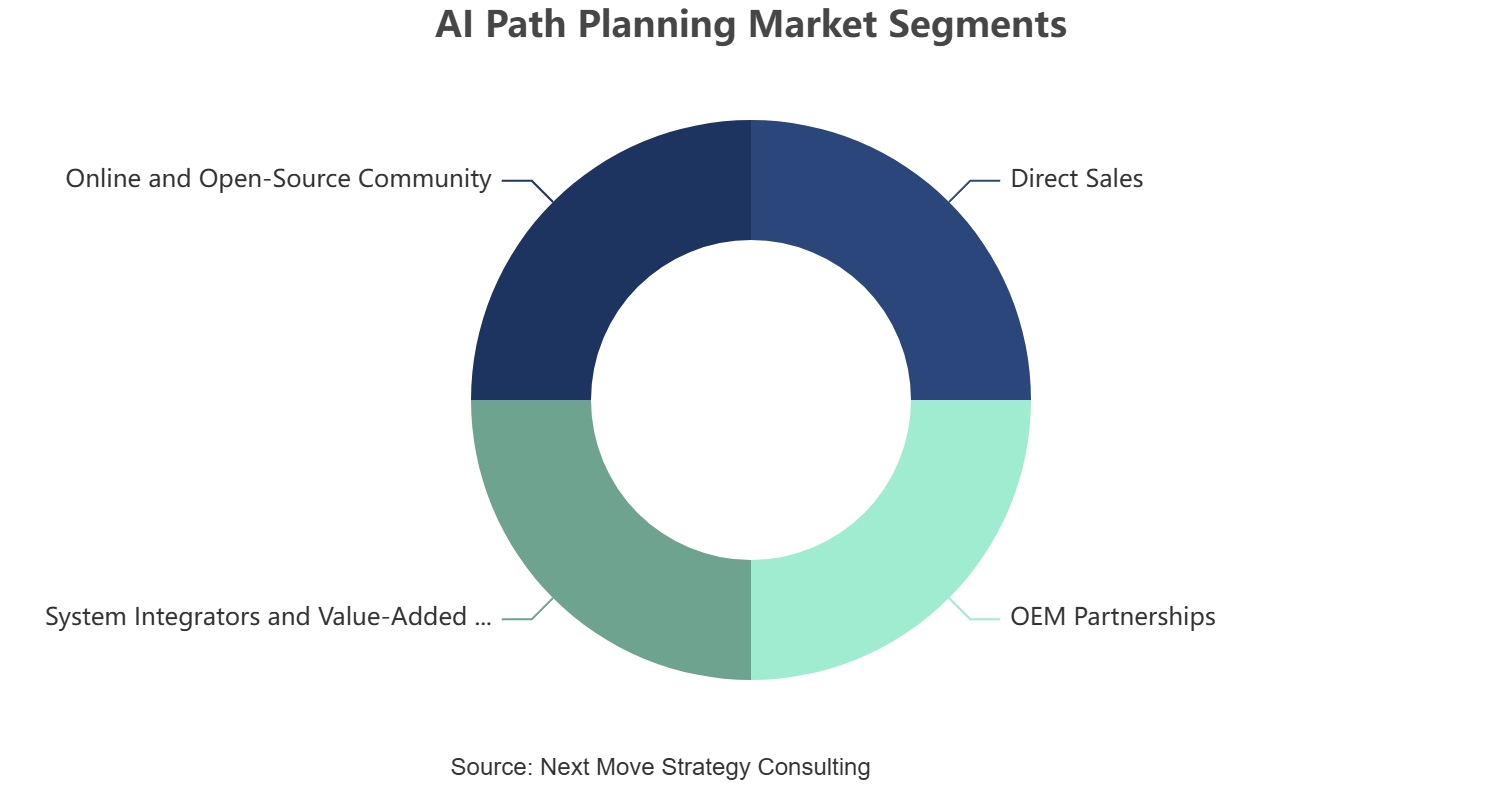
By Sales Channel: Direct Sales held the largest share of approximately 42% (USD 610 million) in 2025; Online and Open-Source Community is the fastest-growing sub-segment at 27.8% CAGR from 2026–2035. |
|
By End User Industry: Manufacturing held the largest share of approximately 30% (USD 430 million) in 2025; Warehousing and Logistics is the fastest-growing sub-segment at 24.1% CAGR from 2026–2035. |
|
Dominant Region: North America dominated with approximately 40% revenue share (USD 0.58 billion) in 2025. |
|
Fastest-Growing Region: Asia-Pacific is expected to register the highest CAGR of 25.9% during 2026–2035. |
|
Dominant Country: The U.S. led with approximately USD 452 million in 2025. |
|
Fastest-Growing Country: India is the fastest-growing country at approximately 32.2% CAGR from 2026–2035. |
Market Opportunity: The AI path planning market is expected to create an absolute dollar opportunity of USD 8.73 billion between 2026 and 2035, presenting significant investment potential across the industrial robotics and autonomous mobile robot value chain.
According to NMSC analysis, machine builders and system integrators are increasingly consolidating path planning software spend with fewer, platform-native vendors to simplify multi-robot fleet coordination, a shift that favors vendors with proven simulation-to-deployment pipelines over point solvers as fleet scale intensifies through 2035.
What Does the AI Path Planning Market Encompass?
The AI path planning market encompasses software and services that apply artificial intelligence to compute collision-free, efficient motion trajectories and fleet-level routing for industrial robots, mobile robots, on-road autonomous vehicles, unmanned aerial systems, and marine systems. Our assessment indicates that the scope spans global path planning, local replanning, multi-agent coordination, fleet dispatching, and offline programming tools deployed by original equipment manufacturers, machine builders and system integrators, enterprise end users, and research institutions worldwide.
Technology adoption is shifting toward simulation-trained, AI-native motion planning stacks that replace hand-tuned classical solvers, exemplified by GPU-accelerated libraries entering industrial deployment. We observed that this shift is reinforced by growing open-source robotics software adoption and expanding warehouse automation programs addressing persistent labor constraints. NMSC's analysis indicates that this structural change, combined with rapid robotaxi commercialization, is redefining vendor selection criteria across the AI path planning market.
|
Parameter |
Details |
|
Market Size in 2025 |
USD 1.45 Billion |
|
Market Size in 2026 |
USD 1.80 Billion |
|
Revenue Forecast in 2035 |
USD 10.53 Billion |
|
Growth Rate |
CAGR of 22.8% from 2026 to 2035 |
|
Analysis Period |
2025–2035 |
|
Base Year Considered |
2025 |
|
Forecast Period |
2026–2035 |
|
Market Size Estimation |
USD Billion |
|
Companies Profiled |
20 |
|
Countries Covered |
38 |
|
Market Share |
Available for Top 10 Companies |
Key Emerging Trends
Based on research conducted by NMSC, we found that four structural trends are reshaping product development, fleet deployment, and stakeholder engagement across the industry.
How Is GPU-Accelerated Motion Planning Transforming Industrial Robotics?
GPU-accelerated motion planning libraries are replacing traditional CPU-bound trajectory solvers to enable real-time, multi-robot coordination at industrial scale. We observed that NVIDIA's cuMotion library, integrated with partners including ABB Robotics, FANUC, KUKA, and Yaskawa Electric Corporation at GTC 2026, runs multiple trajectory optimizations simultaneously to return optimal collision-free paths. Manufacturers are adopting these architectures to shorten integration cycles while improving throughput across dense, multi-robot manufacturing cells.
Why Is Fully Autonomous Warehouse Fulfillment Gaining Enterprise Priority?
Fully autonomous, multi-task fulfillment robots are gaining priority as warehouse operators face persistent labor constraints and rising cost pressure. Our findings suggest that Locus Robotics' Locus Array, launched in April 2026, combines mobile robotics, integrated picking arms, and AI-powered perception to execute end-to-end fulfillment workflows without manual intervention. Enterprises increasingly require coordinated, fleet-level path planning that dynamically assigns tasks across heterogeneous robot types operating in shared aisles.
How Is Robotaxi Commercialization Reshaping On-Road Path Planning Requirements?
Robotaxi commercialization is accelerating demand for production-grade, safety-certified path planning stacks capable of handling dense urban traffic scenarios. We observed that Mobileye announced plans in June 2026 to establish a vertically integrated robotaxi business, targeting a phased U.S. launch scaling toward approximately 17,000 vehicles over five years. This trend is elevating demand for real-time collision avoidance and multi-agent coordination software validated across millions of simulated and real-world driving miles.
What Role Does Vehicle Intelligence Simulation Play in Path Planning Innovation?
Simulation-first vehicle intelligence platforms are emerging as the primary validation pathway for autonomy stacks before physical deployment. Our analysis shows that Applied Intuition, which closed a USD 600 million Series F round at a USD 15 billion valuation in 2025, delivers simulation and validation infrastructure spanning automotive, trucking, construction, mining, agriculture, and defense domains. This direction is exemplified by vendors combining synthetic scenario generation with real-world log data to validate path planning behavior at scale.
Growth Drivers and Restraints
Growth Catalyst and Risk Assessment Matrix
|
Factors |
Type |
(+/-) % Impact on CAGR |
Geographic Relevance |
Impact Timeline |
|
Accelerating warehouse and e-commerce fulfillment automation |
Driver |
+2.8% |
Global |
2026-2035 |
|
Robotaxi and autonomous trucking commercial scaling |
Driver |
+2.4% |
North America, Asia-Pacific |
2026-2035 |
|
Manufacturing labor shortages driving industrial robot deployment |
Driver |
+2.0% |
Global |
2026-2035 |
|
Advances in AI-based motion planning reducing integration time and cost |
Driver |
+1.8% |
Global |
2026-2035 |
|
Expanding defense and unmanned systems investment |
Driver |
+1.5% |
North America, Europe |
2026-2035 |
|
Open-source robotics software lowering development barriers |
Driver |
+1.2% |
Global |
2026-2032 |
|
Safety certification and regulatory approval complexity for autonomous systems |
Restraint |
-1.5% |
Global |
2026-2035 |
|
High integration and customization costs for multi-robot fleet deployments |
Restraint |
-1.0% |
Global |
2026-2032 |
|
Public and regulatory skepticism toward autonomous vehicle safety |
Restraint |
-0.7% |
North America, Europe |
2026-2032 |
What Is the Primary Growth Driver of the AI Path Planning Market?
Accelerating warehouse and e-commerce fulfillment automation is the primary driver of the market. Government labor statistics agencies across major economies continue to document persistent warehousing and logistics labor shortages that sustain enterprise demand for autonomous mobile robot fleets. We observed that this structural labor constraint, reinforced by rising e-commerce order volumes, continues to anchor baseline consumption of fleet path optimization and multi-agent coordination software across developed and emerging logistics markets alike.
How Is Robotaxi Commercialization Driving the Market Growth?
Robotaxi and autonomous trucking commercialization is accelerating enterprise investment in production-grade motion planning and collision avoidance software. NMSC's analysis indicates that this commercialization pressure, combined with Mobileye's June 2026 announcement of a vertically integrated robotaxi business targeting approximately 17,000 vehicles over five years, is compressing development timelines for real-time path planning stacks across North American and Asia-Pacific autonomous vehicle programs.
What Is Restraining AI Path Planning Market Expansion?
Safety certification and regulatory approval complexity for autonomous systems restrains deployment speed across the industry, particularly for on-road autonomous vehicles and unmanned aerial systems operating in shared public spaces. We found that smaller robotics vendors face particular exposure, as limited certification budgets reduce their ability to validate path planning software against the safety standards increasingly required by regulators and enterprise procurement teams.
Strategic Analysis of the AI Path Planning Industry
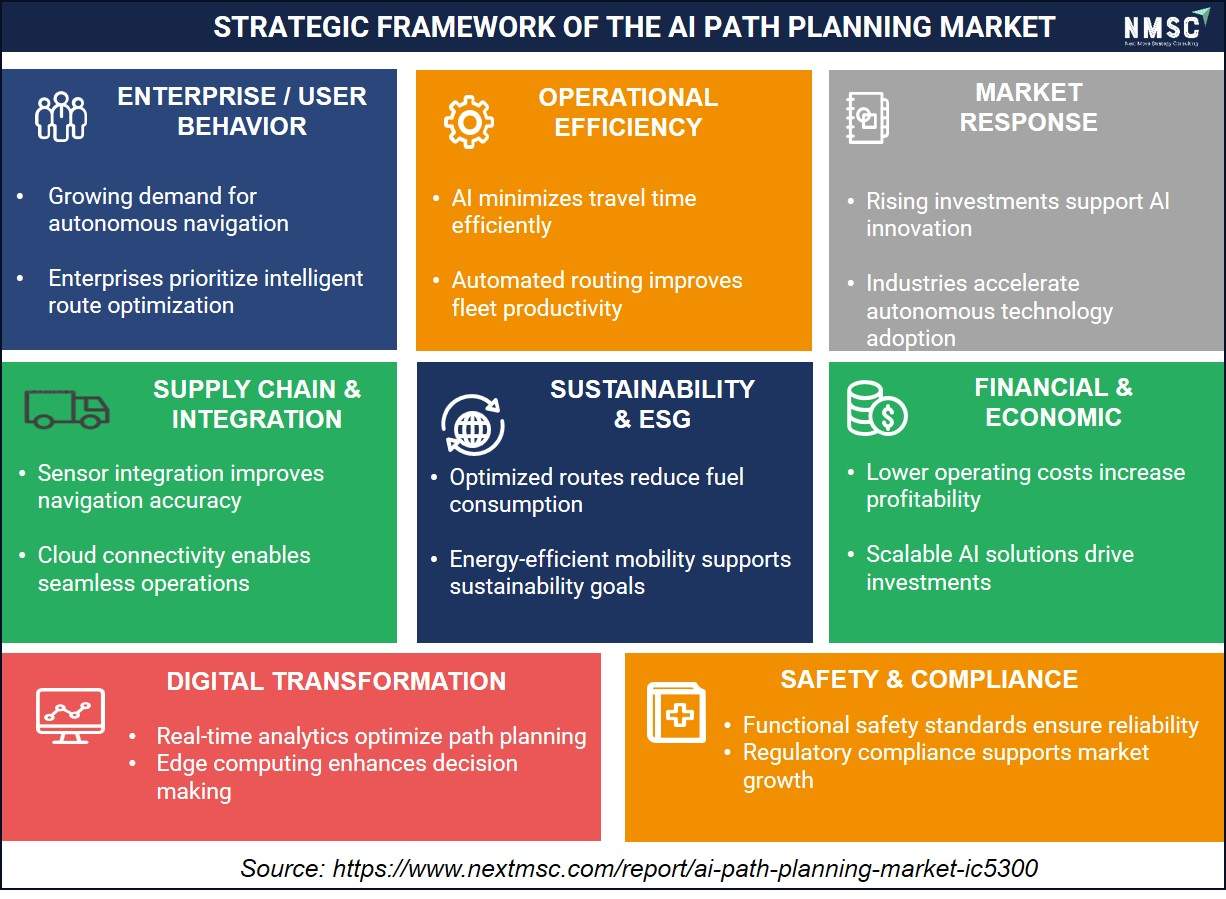
The above infographic presents a strategic framework of the AI path planning market, where growing demand for autonomous navigation and intelligent route optimization is driving adoption. Sensor integration and cloud connectivity improve accuracy and enable seamless operations, while AI minimizes travel time and enhances fleet productivity. Optimized routes and energy-efficient mobility support sustainability goals, and lower operating costs are increasing profitability. Real-time analytics and edge computing enhance decision-making, while safety standards and regulatory compliance ensure reliability and market growth. Looking ahead, we observed that these interconnected elements collectively shape the market's evolution across the sector.
Segmentation Analysis
Segment Sizing: By Deployment Platform
|
Segment |
2025 (USD) |
2035 (USD) |
CAGR% (2026–2035) |
|
Mobile Robots |
USD 0.43 Billion |
USD 2.99 Billion |
20.9% |
|
Industrial Robots |
USD 0.38 Billion |
USD 2.02 Billion |
17.6% |
|
On-Road Autonomous Vehicles |
USD 0.32 Billion |
USD 3.54 Billion |
27.4% |
|
Unmanned Aerial Systems |
USD 0.17 Billion |
USD 1.13 Billion |
20.6% |
|
Marine and Subsea Systems |
USD 0.09 Billion |
USD 0.53 Billion |
19.1% |
|
Other Autonomous Systems |
USD 0.06 Billion |
USD 0.32 Billion |
18.4% |
|
Total |
USD 1.45 Billion |
USD 10.53 Billion |
22.8% |
Which Deployment Platform Dominates the AI Path Planning Market?
Mobile Robots led the market with USD 430 million in 2025, supported by widespread autonomous mobile robot and automated guided vehicle deployment across warehousing and manufacturing facilities. We observed that On-Road Autonomous Vehicles are the fastest-growing deployment platform, expanding at a 27.4% CAGR from 2026 to 2035, as robotaxi and autonomous trucking programs scale from pilot fleets toward commercial-scale operations across major metropolitan markets.
Segment Sizing: By Buyer Type
|
Segment |
2025 (USD) |
2035 (USD) |
CAGR% (2026–2035) |
|
Machine Builders and System Integrators |
USD 0.55 Billion |
USD 3.68 Billion |
20.6% |
|
Original Equipment Manufacturers |
USD 0.46 Billion |
USD 2.98 Billion |
19.9% |
|
Enterprise End Users |
USD 0.32 Billion |
USD 3.02 Billion |
25.2% |
|
Developers and Research Institutions |
USD 0.12 Billion |
USD 0.85 Billion |
22.2% |
|
Total |
USD 1.45 Billion |
USD 10.53 Billion |
22.8% |
Which Buyer Type Leads the AI Path Planning Market Demand?
Machine Builders and System Integrators remained the leading buyer type within the market, valued at USD 550 million in 2025, due to their central role in specifying and embedding path planning software into delivered robot systems. Our findings suggest that Enterprise End Users are the fastest-growing buyer type, registering a 25.2% CAGR from 2026 to 2035, as large logistics and manufacturing enterprises increasingly deploy and manage autonomous fleets directly rather than solely through integrators.
Segment Sizing: By End User Industry
|
Segment |
2025 (USD) |
2035 (USD) |
CAGR% (2026–2035) |
|
Manufacturing |
USD 0.43 Billion |
USD 2.67 Billion |
19.4% |
|
Warehousing and Logistics |
USD 0.38 Billion |
USD 3.28 Billion |
24.1% |
|
Automotive and Transportation |
USD 0.23 Billion |
USD 1.70 Billion |
21.7% |
|
Retail and E-commerce |
USD 0.13 Billion |
USD 1.01 Billion |
22.7% |
|
Aerospace and Defence |
USD 0.12 Billion |
USD 0.76 Billion |
20.7% |
|
Agriculture and Mining |
USD 0.07 Billion |
USD 0.51 Billion |
21.3% |
|
Healthcare and Life Sciences |
USD 0.06 Billion |
USD 0.42 Billion |
22.0% |
|
Other Industries |
USD 0.03 Billion |
USD 0.18 Billion |
18.2% |
|
Total |
USD 1.45 Billion |
USD 10.53 Billion |
22.8% |
Which End User Industry Is Most Widely Adopting AI Path Planning Tools?
Manufacturing remained the dominant end-user industry, reaching USD 430 million in 2025 due to its long-standing base of industrial robot installations requiring precise trajectory optimization. Based on research conducted by NMSC, we found that Warehousing and Logistics is the fastest-growing end-user industry at a 24.1% CAGR from 2026 to 2035, reflecting accelerating autonomous fulfillment deployment among third-party logistics providers and e-commerce operators.
Growth Opportunities
Our analysis shows that three forward-looking opportunities stand out for stakeholders positioning within the AI path planning market over the 2026-2035 forecast period.
How Can Open-Source Path Planning Frameworks Unlock Value for Developers?
Open-source motion planning frameworks present a whitespace opportunity for developers and research institutions seeking lower-cost entry points into robot programming. Vendors that commercialize managed support and enterprise hardening around open-source stacks stand to capture recurring services revenue as smaller robotics builders adopt community frameworks before graduating to fully licensed platforms.
Where Do Heterogeneous Fleet Coordination Tools Create New Demand?
Warehouses operating mixed fleets of AMRs, AGVs, and robotic arms represent an underpenetrated opportunity for unified, cross-platform fleet coordination software. Vendors that develop vendor-agnostic task allocation and deadlock resolution tools can secure new contracts with enterprise end users, benefiting from expansion revenue as facilities scale beyond single-vendor robot deployments.
How Can Simulation-Validated Stacks Benefit On-Road Autonomous Vehicle Programs?
Autonomous vehicle programs facing safety certification pressure create an opportunity for vendors offering simulation-validated path planning stacks with documented test-mile coverage. Early movers that combine synthetic scenario generation with real-world validation data can differentiate with OEMs and robotaxi operators pursuing regulatory approval across multiple jurisdictions simultaneously.
Regional Outlook
|
Region |
2025 (USD) |
2035 (USD) |
CAGR% (2026–2035) |
Key Driver |
|
North America |
USD 0.58 Billion |
USD 3.37 Billion |
18.7% |
Robotaxi commercialization and warehouse automation labor shortages |
|
Europe |
USD 0.35 Billion |
USD 2.21 Billion |
19.9% |
Industrial robot modernization and automotive manufacturing digitization |
|
Asia-Pacific |
USD 0.40 Billion |
USD 4.05 Billion |
25.9% |
Large-scale manufacturing robot deployment and government robotics investment |
|
Middle East & Africa |
USD 0.06 Billion |
USD 0.48 Billion |
23.9% |
Gulf logistics infrastructure investment and defense modernization programs |
|
Latin America |
USD 0.06 Billion |
USD 0.42 Billion |
22.0% |
Growing e-commerce fulfillment automation and agricultural robotics adoption |
|
Total |
USD 1.45 Billion |
USD 10.53 Billion |
22.8% |
— |
North America
North America leads the AI path planning market with a dense concentration of autonomous vehicle developers and warehouse automation vendors driving continuous platform innovation. We observed that robotaxi commercialization, exemplified by Mobileye's planned vertically integrated robotaxi business, sustains demand for production-grade motion planning software. Technology adoption remains advanced, with enterprise end users increasingly deploying autonomous mobile robot fleets directly across the region's large logistics sector.
Europe
Europe's market reflects a mature but modernization-focused landscape shaped by a strong domestic industrial robot manufacturing base. Our findings suggest that automotive manufacturers across Germany, France, and the UK are accelerating the adoption of AI-driven trajectory optimization to improve production line flexibility. Technology adoption favors integration with established industrial robot platforms among the region's machine builders and system integrators.
Asia-Pacific
Asia-Pacific is the fastest-growing region, propelled by large-scale manufacturing robot deployment in China and expanding government robotics investment across the region. We found that regulatory frameworks remain less harmonized than in Europe, giving vendors flexibility to scale mobile robot and industrial robot offerings rapidly. Technology adoption is accelerating as regional manufacturers, including several China-based robot producers, expand AI-driven path planning pilots.
Middle East & Africa
The AI path planning market in the Middle East & Africa is expanding as Gulf Cooperation Council economies invest in logistics infrastructure and defense modernization programs. Our analysis shows that Saudi Arabia and the UAE are attracting robotics software investment linked to flagship port and warehouse automation projects. Regulatory influence remains developing, while technology adoption is gradually shifting toward mobile robots and unmanned aerial system platforms.
Latin America
Latin America's market is supported by growing e-commerce fulfillment automation in Brazil and Argentina and expanding agricultural robotics adoption. We observed that regulatory frameworks are less stringent than in North America or Europe, though multinational logistics operators are introducing autonomous mobile robot fleets locally. Technology adoption remains centered on mobile robots, with competitive intensity increasing as global vendors partner with regional distributors.
U.S.
Based on our estimates, the U.S. market was valued at approximately USD 452 million in 2025 and is projected to reach USD 2.46 billion by 2035, growing at a 17.8% CAGR. Demand is anchored by robotaxi commercialization programs and a dense concentration of warehouse automation vendors. Technology penetration favors AI-native motion planning stacks, and competitive intensity remains high among established robotics and autonomous vehicle software providers serving large enterprises.
Canada
The market in Canada reached roughly USD 87 million in 2025 and is forecast to hit USD 525 million by 2035 at a 19.2% CAGR. Demand structure mirrors U.S. warehouse automation and logistics adoption patterns, while federal robotics research funding shapes early-stage technology development. Technology penetration is rising as national logistics operators request autonomous fleet coordination platforms, with competitive intensity moderate given reliance on cross-border vendor partnerships.
UK
As per our estimate, the UK market stood at about USD 70 million in 2025, advancing toward USD 418 million by 2035 at a 19.2% CAGR. Demand is driven by automotive and logistics sector modernization, navigating post-Brexit manufacturing competitiveness pressures. Regulatory influence is significant, technology penetration favors mobile robot adoption, and competitive intensity remains steady among domestic and European vendors serving UK enterprises.
Germany
According to our analysis, Germany's market was valued near USD 91 million in 2025 and is set to reach USD 569 million by 2035, expanding at a 19.8% CAGR. Demand structure benefits from a strong domestic industrial robot manufacturing base led by established automation companies. Germany's advanced manufacturing strategy drives regulatory influence, while technology penetration favors AI-driven trajectory optimization among leading automotive producers.
France
Based on our estimates, France's market reached approximately USD 52 million in 2025, projected to climb to USD 340 million by 2035 at a 20.2% CAGR. Demand is supported by France's aerospace and automotive manufacturing sectors pursuing production automation upgrades. Regulatory influence from French industrial policy is notable, and competitive intensity remains high given the concentration of aerospace system integrators headquartered domestically.
China
The market in China stood at roughly USD 120 million in 2025 and is forecast to reach USD 1.39 billion by 2035, registering a 27.8% CAGR. Demand is fueled by the world's largest industrial robot installation base and rapidly expanding mobile robot manufacturing capacity. Regulatory influence is increasing gradually, technology penetration is accelerating through large manufacturer pilots, and competitive intensity remains elevated among domestic and international vendors.
India
As per our estimate, India's market was valued at about USD 56 million in 2025, projected to reach USD 876 million by 2035 at a 32.2% CAGR, the fastest among covered countries. Demand structure reflects rapidly expanding manufacturing and warehousing automation investment. Regulatory influence remains developing, while technology penetration is rising quickly as multinational vendors localize path planning software offerings to serve India's growing industrial base.
Japan
According to our analysis, Japan's market reached close to USD 64 million in 2025 and is expected to hit USD 560 million by 2035, growing at a 23.8% CAGR. Demand is supported by Japan's long-established industrial robot manufacturing leadership and precision automation heritage. Regulatory influence is well established, technology penetration is advanced, and competitive intensity remains high among long-standing domestic robot suppliers.
South Korea
Based on our estimates, South Korea's market stood at approximately USD 40 million in 2025, forecast to reach USD 402 million by 2035 at a 25.8% CAGR. Demand structure benefits from the country's advanced electronics and automotive manufacturing sectors. Technology penetration is high, with domestic conglomerates adopting AI-driven path planning platforms, and competitive intensity remains pronounced amid rapid innovation cycles.
Australia
The AI path planning market in Australia reached about USD 20 million in 2025 and is projected to reach USD 183 million by 2035, expanding at a 24.2% CAGR. Demand is supported by growing mining automation and logistics sector investment. Regulatory influence stems from national robotics and automation strategy guidance, while technology penetration favors mobile robot platforms amid moderate competitive intensity.
UAE
As per our estimate, the UAE market was valued near USD 15 million in 2025, projected to reach USD 127 million by 2035 at a 24.2% CAGR. Demand structure is shaped by the UAE's role as a regional logistics and trade hub. Regulatory influence remains moderate, technology penetration is improving through flagship port automation projects, and competitive intensity is rising as vendors expand Gulf portfolios.
Saudi Arabia
According to our analysis, Saudi Arabia's market reached roughly USD 17 million in 2025 and is expected to hit USD 154 million by 2035, growing at a 25.5% CAGR. Demand is driven by Vision 2030-linked logistics and defense modernization programs. Regulatory influence is developing under national industrial guidelines, and technology penetration is advancing as large state-linked enterprises scale automation adoption.
South Africa
Based on our estimates, South Africa's market stood at about USD 7 million in 2025, forecast to reach USD 49 million by 2035 at a 22.3% CAGR. Demand structure reflects a developing mining and logistics automation sector serving regional Southern African markets. Regulatory influence remains moderate, technology penetration is gradually improving, and competitive intensity is limited given reliance on imported robotics platforms.
Brazil
The market in Brazil reached approximately USD 28 million in 2025 and is projected to reach USD 199 million by 2035, registering a 22.5% CAGR. Demand is underpinned by Brazil's large agricultural and manufacturing sectors facing rising automation and export competitiveness requirements. Regulatory influence stems from national industrial policy, technology penetration favors mobile robot platforms, and competitive intensity remains moderate among regional distributors.
Argentina
As per our estimate, Argentina's market was valued near USD 10 million in 2025, projected to reach USD 63 million by 2035 at a 21.4% CAGR. Demand structure is supported by steady agricultural and logistics automation adoption despite macroeconomic volatility. Regulatory influence remains limited, technology penetration is modest, and competitive intensity is centered on a small number of regional distributors serving domestic enterprises.
Competitive Landscape
We observed that the AI path planning market features a moderately fragmented competitive landscape, with large industrial automation and autonomous vehicle technology incumbents competing alongside specialized robotics software vendors on simulation depth, fleet coordination capability, and integration breadth.
|
Key Takeaways |
Details |
|
Market Structure |
Moderately fragmented, large industrial robot manufacturers and autonomous vehicle technology suppliers compete alongside specialized mobile robot and simulation software vendors serving distinct deployment platforms. |
|
Innovation Focus |
GPU-accelerated motion planning, fully autonomous multi-task fulfillment robots, and simulation-validated autonomous vehicle stacks dominate current innovation pipelines across leading suppliers. |
|
M&A Activity |
Active investment and ecosystem expansion are exemplified by Applied Intuition's USD 600 million Series F raise and NVIDIA's expanding robotics ecosystem partnerships with major industrial robot manufacturers. |
|
Source: www.nextmsc.com |
|
How Do Companies Compete in the AI Path Planning Market?
Companies compete primarily on simulation-to-deployment pipeline maturity, fleet coordination depth, and platform integration breadth across the industry. Large industrial automation vendors such as FANUC Corporation and ABB Ltd leverage established robot installation bases to embed path planning natively, while specialized vendors such as Locus Robotics Corporation and Applied Intuition, Inc. compete on AI-native coordination and simulation validation capabilities supplied directly to enterprise end users and OEM programs.
Which Competitive Archetypes Dominate the AI Path Planning Market?
Two archetypes dominate the market: established industrial robot and automation manufacturers offering embedded path planning across broader hardware platforms, and specialized software vendors focused on AI-native motion planning and fleet coordination. FANUC Corporation and Yaskawa Electric Corporation exemplify the hardware-integrated archetype, while Applied Intuition, Inc. and Realtime Robotics, Inc. exemplify the specialized software archetype through dedicated simulation and motion planning platforms.
How Are Companies Differentiating Through Innovation in AI Path Planning?
Innovation and differentiation strategy increasingly center on GPU-accelerated computation and fully autonomous multi-task execution. NVIDIA's cuMotion library and Locus Robotics' Locus Array both apply AI to reduce integration complexity while improving throughput. Our analysis shows that vendors unable to demonstrate credible real-time, multi-robot coordination risk exclusion from enterprise request-for-proposal shortlists as procurement teams tighten evidentiary requirements for fleet-scale deployments.
What M&A and Expansion Activity Is Shaping the AI Path Planning Industry?
Investment and ecosystem partnership activity continue to shape competitive dynamics within the industry. Applied Intuition's USD 600 million Series F round at a USD 15 billion valuation illustrates sustained investor confidence in vehicle intelligence platforms, while NVIDIA's expanding robotics partnerships with ABB Robotics, FANUC, KUKA, and Yaskawa demonstrate how ecosystem-based expansion is reshaping competitive positioning across industrial and mobile robotics.
Key Market Players
Our assessment indicates that the following companies are actively shaping product innovation, fleet deployment strategy, and platform ecosystem expansion within the global AI path planning market.
-
Mobileye Global Inc.
-
FANUC Corporation
-
Siemens AG
-
Yaskawa Electric Corporation
-
KUKA AG
-
OMRON Corporation
-
Geekplus Technology Co., Ltd.
-
Brain Corporation
-
Locus Robotics Corporation
-
GreyOrange Inc.
-
Seegrid Corporation
-
Mobile Industrial Robots A/S
-
BlueBotics SA
-
Clearpath Robotics Inc.
-
Applied Intuition, Inc.
-
Realtime Robotics, Inc.
-
Outrider Technologies, Inc.
-
PickNik Robotics, Inc.
Latest Developments
We found that recent funding rounds, ecosystem partnerships, and product launches within the AI path planning market are concentrated on GPU-accelerated motion planning and autonomous fleet commercialization.
|
Date |
Event |
|
June 2026 |
Mobileye announced plans to establish a vertically integrated robotaxi business, combining its autonomous-driving technology with fleet operations and mobility services. The initiative builds on Mobileye's AI-driven autonomy stack, which has evolved beyond goal-driven navigation toward context- and intent-aware reasoning for autonomous systems operating in complex real-world environments. |
|
January 2026 |
Mobileye announced its agreement to acquire Mentee Robotics, combining Mobileye's AI technology with Mentee's AI-first humanoid robotics platform. Mobileye specifically highlighted the evolution of its autonomy stack beyond goal-driven navigation toward holistic, context-aware, and intent-aware reasoning, creating a foundation for robots that can operate autonomously in real-world environments. |
SWOT Analysis of the AI Path Planning Industry
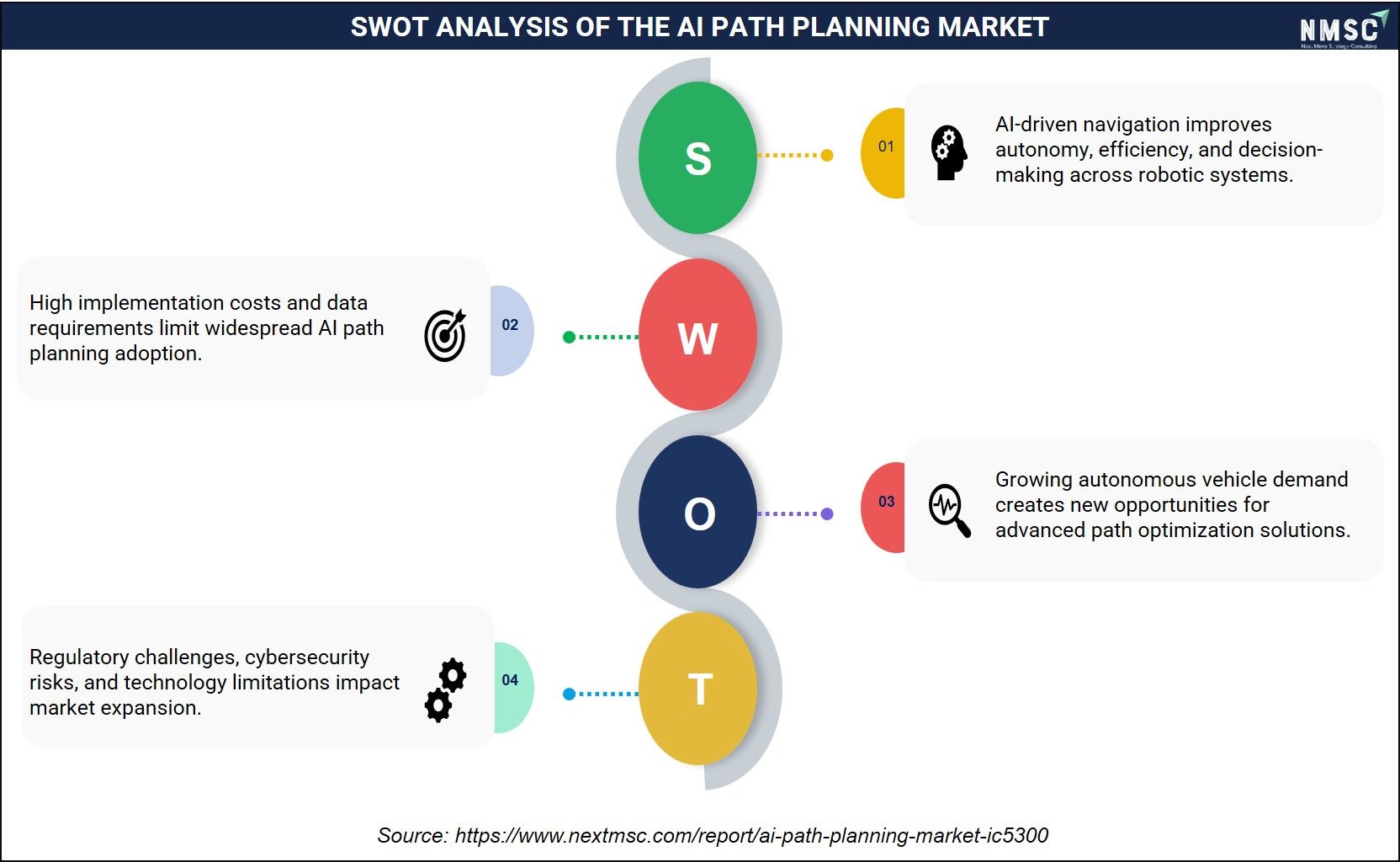
The above infographic presents a SWOT analysis of the AI path planning market, where AI-driven navigation improves autonomy, efficiency, and decision-making across robotic systems as key strengths. However, high implementation costs and data requirements limit widespread adoption, posing notable weaknesses. Looking ahead, we observed that growing autonomous vehicle demand creates new opportunities for advanced path optimization solutions. That said, regulatory challenges, cybersecurity risks, and technology limitations continue to impact overall market expansion and long-term growth.
Investment Opportunities
What Capital Inflows Are Targeting the AI Path Planning Market?
Capital inflows into the AI path planning market are increasingly directed toward simulation infrastructure and autonomous fleet commercialization. Investors continue to fund vehicle intelligence and robotics platforms, as seen in Applied Intuition's USD 600 million Series F round at a USD 15 billion valuation. We observed that investors favor companies demonstrating production-scale deployment evidence, viewing simulation-to-deployment maturity as a proxy for long-term enterprise and OEM contract retention.
How Is Infrastructure Investment Supporting AI Path Planning Deployment?
Infrastructure investment is expanding GPU computing and simulation capacity across vendors to support real-time, multi-robot trajectory optimization at scale. Our findings suggest that vendors are investing in digital twin and synthetic scenario generation infrastructure to improve the validation depth required for safety-critical deployments, supporting the precision demanded by on-road autonomous vehicle and unmanned aerial system programs.
What ESG Considerations Are Shaping AI Path Planning Investment Decisions?
Environmental, social, and governance considerations are increasingly relevant to investment decisions across the industry, with workplace safety and energy-efficient fleet routing as emerging criteria. Government labor safety agencies continue to inform enterprise procurement standards for collaborative robot and autonomous mobile robot safety compliance. We found that investors increasingly favor vendors with transparent safety validation practices, treating it as a governance indicator alongside data security compliance.
Key Benefits for Stakeholders
How Does This Report Benefit Enterprise and Industry Leaders?
Enterprise and industry leaders gain access to validated segmentation, competitive benchmarking, and regional demand forecasts that support procurement and product-portfolio decisions across the AI path planning industry. Our analysis shows that detailed deployment platform, buyer type, and end-user industry breakdowns help operations and engineering teams align vendor specifications with fleet coordination and safety requirements while identifying underserved industry segments for portfolio expansion.
How Does This Report Benefit Investors and Financial Analysts?
Investors and financial analysts benefit from consistent, single-point market size and CAGR estimates that support valuation and capital-allocation decisions across the AI path planning market supply chain. We observed that the report's regional and segment-level growth differentials help identify which vendors and deployment platforms are best positioned to capture above-market growth in On-Road Autonomous Vehicles and Enterprise End Users categories through 2035.
How Does This Report Benefit Technology Vendors and Product Teams?
Technology vendors and product teams gain insight into emerging design requirements, including GPU-accelerated computation, fleet-level task allocation, and simulation-validated safety certification, that are reshaping the industry. Our findings suggest that this analysis helps research and development teams prioritize roadmaps around multi-robot coordination and regulatory alignment increasingly required by enterprise and OEM request-for-proposal processes.
Key Market Segments
By Function
-
Motion Planning and Trajectory Optimization
-
Global Path Planning
-
Local Replanning
-
Collision Avoidance
-
Multi-Agent Coordination
-
-
Fleet Path Optimization and Traffic Management
-
Task Allocation
-
Dispatching
-
Traffic Control
-
Deadlock Resolution
-
-
Offline Path Generation and Programming
-
Path Generation
-
Cycle Time Optimization
-
Robot Programming
-
By Deployment Platform
-
Industrial Robots
-
Articulated Robots
-
Collaborative Robots
-
SCARA Robots
-
Delta Robots
-
Gantry Robots
-
Cartesian Robots
-
-
Mobile Robots
-
Autonomous Mobile Robots
-
Automated Guided Vehicles
-
Autonomous Forklifts
-
Tuggers
-
Last-Mile Delivery Robots
-
-
On-Road Autonomous Vehicles
-
Passenger Vehicles including Robotaxis
-
Commercial Trucks
-
Buses and Shuttles
-
Delivery Vans
-
-
Unmanned Aerial Systems
-
Commercial Drones
-
Defence Drones
-
Other Unmanned Aerial Systems
-
-
Marine and Subsea Systems
-
Surface Vessels
-
Subsea Vehicles
-
Other Marine Systems
-
-
Other Autonomous Systems
-
Defence Ground Vehicles
-
Space Systems
-
Research Platforms
-
By Delivery Model
-
Software License
-
Perpetual License
-
Subscription and SaaS
-
Embedded License
-
-
Services
-
Implementation
-
Customization
-
Tuning
-
Maintenance and Support
-
By Buyer Type
-
Original Equipment Manufacturers
-
Machine Builders and System Integrators
-
Enterprise End Users
-
Developers and Research Institutions
By Sales Channel
-
Direct Sales
-
OEM Partnerships
-
System Integrators and Value-Added Resellers
-
Online and Open-Source Community
By End User Industry
-
Manufacturing
-
Warehousing and Logistics
-
Automotive and Transportation
-
Retail and E-commerce
-
Aerospace and Defence
-
Agriculture and Mining
-
Healthcare and Life Sciences
-
Other Industries
By Region
-
North America: U.S., Canada, Mexico
-
Europe: UK, Germany, France, Italy, Spain, Sweden, Denmark, Finland, Netherlands, Rest of Europe
-
Asia-Pacific: China, India, Japan, South Korea, Taiwan, Indonesia, Vietnam, Australia,Philippines, Malaysia, Rest of APAC
-
Middle East & Africa: Saudi Arabia, UAE, Egypt, Israel, Turkey, Nigeria, South Africa, Rest of MEA
-
Latin America: Brazil, Argentina, Chile, Colombia, Rest of LATAM
Conclusion and Recommendations
What Is the Long-Term Outlook for the AI Path Planning Market?
The long-term outlook for the market remains strongly positive, with global revenue projected to expand more than sevenfold from USD 1.45 billion in 2025 to USD 10.53 billion by 2035 at a 22.8% CAGR. We observed that sustained warehouse automation investment, robotaxi commercialization, and expanding industrial robot deployment will continue underpinning demand across manufacturers, logistics operators, and autonomous vehicle programs through the forecast period.
What Strategic Positioning Should AI Path Planning Vendors Pursue?
Vendors should prioritize GPU-accelerated computation and multi-robot fleet coordination capability while pursuing simulation-validated safety certification to secure long-term enterprise and OEM contracts. NMSC's assessment indicates that companies investing early in heterogeneous fleet coordination and open-source ecosystem support will be best positioned to capture premium positioning within the AI path planning market.
How Attractive Is the AI Path Planning Market for New Investment?
The AI path planning industry presents a highly attractive investment case, supported by a USD 8.73 billion absolute dollar opportunity between 2026 and 2035 and above-average growth in Asia-Pacific and On-Road Autonomous Vehicles categories. We found that investment attractiveness is highest for vendors combining simulation-to-deployment maturity with scalable fleet coordination software, positioning them to serve both industrial and mobile robotics segments simultaneously.
What Market Shifts and Key Risks Should Stakeholders Monitor?
Stakeholders should monitor safety certification complexity, public skepticism toward autonomous vehicle safety, and high integration costs for multi-robot fleets as key risks to the AI path planning market. Our analysis shows that vendors unable to demonstrate credible, simulation-validated safety performance risk losing procurement consideration to competitors with proven deployment track records, particularly within North America's increasingly scrutinized autonomous vehicle environment.
What Are the Key Growth Pathways for the AI Path Planning Market?
Key growth pathways include expanding GPU-accelerated motion planning adoption, scaling fully autonomous warehouse fulfillment systems, and deepening penetration into robotaxi and autonomous trucking programs. NMSC's analysis indicates that vendors pursuing these pathways while maintaining rigorous safety validation discipline will be best positioned to capture the AI path planning market's projected growth through 2035.
About the Author
 Mayurima Roy
— Mayurima Roy is Research Analyst at Next Move Strategy Consulting, where she has spent 4 years working across the firm's full industry coverage rather than a single fixed vertical. Her work centers on structured research, ongoing trend tracking, competitive assessment, and insight-led content development, translating complex market data into clear, decision-ready narratives that support informed client decision-making across diverse global industries, market sectors, and world regions every day.
Mayurima Roy
— Mayurima Roy is Research Analyst at Next Move Strategy Consulting, where she has spent 4 years working across the firm's full industry coverage rather than a single fixed vertical. Her work centers on structured research, ongoing trend tracking, competitive assessment, and insight-led content development, translating complex market data into clear, decision-ready narratives that support informed client decision-making across diverse global industries, market sectors, and world regions every day.
About the Reviewer
 Supradip Baul
— Supradip Baul is an accomplished business consultant and strategist with over a decade of rich experience in market intelligence, strategy, technology, and business transformation. His work has included rigorous qualitative and quantitative analysis across multiple industries, helping clients shape investment decisions and long-term roadmaps. Earlier in his career, he was associated with Gartner, where he contributed to industry-leading reports and market share analyses. He has worked with leading global companies and holds an MBA with a dual specialization in Marketing and Finance.
Supradip Baul
— Supradip Baul is an accomplished business consultant and strategist with over a decade of rich experience in market intelligence, strategy, technology, and business transformation. His work has included rigorous qualitative and quantitative analysis across multiple industries, helping clients shape investment decisions and long-term roadmaps. Earlier in his career, he was associated with Gartner, where he contributed to industry-leading reports and market share analyses. He has worked with leading global companies and holds an MBA with a dual specialization in Marketing and Finance.
At Next Move Strategy Consulting, we understand that insightful market research is the cornerstone of successful business decisions. That's why we employ a robust and multifaceted approach, combining various methodologies to deliver the most accurate and actionable data for our clients.

Research Landscape
We navigate the world of research with two primary approaches:
Qualitative Approach
Our qualitative research methodologies involve immersive techniques such as in-depth interviews, focus groups, and observational studies. By engaging directly with individuals and stakeholders, we uncover valuable insights that quantitative data alone may overlook.

Quantitative Research
In tandem with qualitative methodologies, NMSC leverages the power of Quantitative Research to provide a robust foundation of numerical insights. Through systematic data collection and analysis, we quantify patterns, preferences, and market trends, offering a comprehensive view of the business landscape.
Our quantitative research approach employs diverse tools, including surveys, experiments, and statistical modelling. These methodologies enable us to gather data from a large and representative sample, ensuring the statistical significance of our findings. By employing structured questionnaires and standardized data collection methods, we guarantee the reliability and validity of the information we present to our clients.
Quantitative research is particularly effective in measuring the prevalence of trends, assessing market size, and gauging the impact of various factors on consumer behavior. The numerical precision attained through this approach equips our clients with actionable insights, facilitating data-driven decision-making and strategy formulation.


Our Specialized Toolbox for Industry-Specific Market Research
We deploy a specialized arsenal of techniques tailored to meet your unique requirements. Here's a glimpse into our comprehensive toolbox:

Information Procurement
The stage entails acquiring market data or relevant information through various sources and methodologies.


Market Research Approach
We utilize both top-down and bottom-up approaches in market research analysis to achieve a comprehensive understanding of the market dynamics, leveraging the broad perspective of industry trends and macroeconomic factors alongside detailed insights from specific segments and individual companies.

Porters Five Forces Analysis
We conduct Porter's Five Forces analysis to evaluate the competitive landscape of an industry, providing us with insights into factors that affect profitability and strategic positioning.

SWOT Analysis

Forecasting
We utilize a forecasting model to predict future consumption by considering parameters like population, economics, regulations, market competition, drivers, constraints, technology, and pricing. We also employ statistical techniques such as multilinear regression, exponential smoothing, moving average, ARIMA, and Monte Carlo simulations for accurate predictions. In econometric forecasting, we analyzed short-term and long-term event impacts, attributing values based on regulatory frameworks, economic factors, and market events.





 Speak to Our Analyst