
AI Road Inspection Platforms Market Size, Share, Trends and Growth Analysis, By Offering (Platform Software, Platform Services, and Data Access), By Deployment Mode (Cloud, On-Premises, and Hybrid), By Inspection Application (Pavement Inspection, Road Asset Inspection, Road Safety Inspection, Maintenance Planning, and Network Condition Monitoring), By Data Acquisition Source, By AI Technology, By Road Type, By Organization Size, By End User— Global Industry Report and Forecast, 2026–2035
Industry: Automotive & Transportation | Publishing Date: July 15, 2026 | Last Updated: September 30, 2026 | No of Pages: N/A | No. of Tables: N/A | No. of Figures: N/A | Format: PDF | Report Code: AT5147
What Is the AI Road Inspection Platforms Market Size?
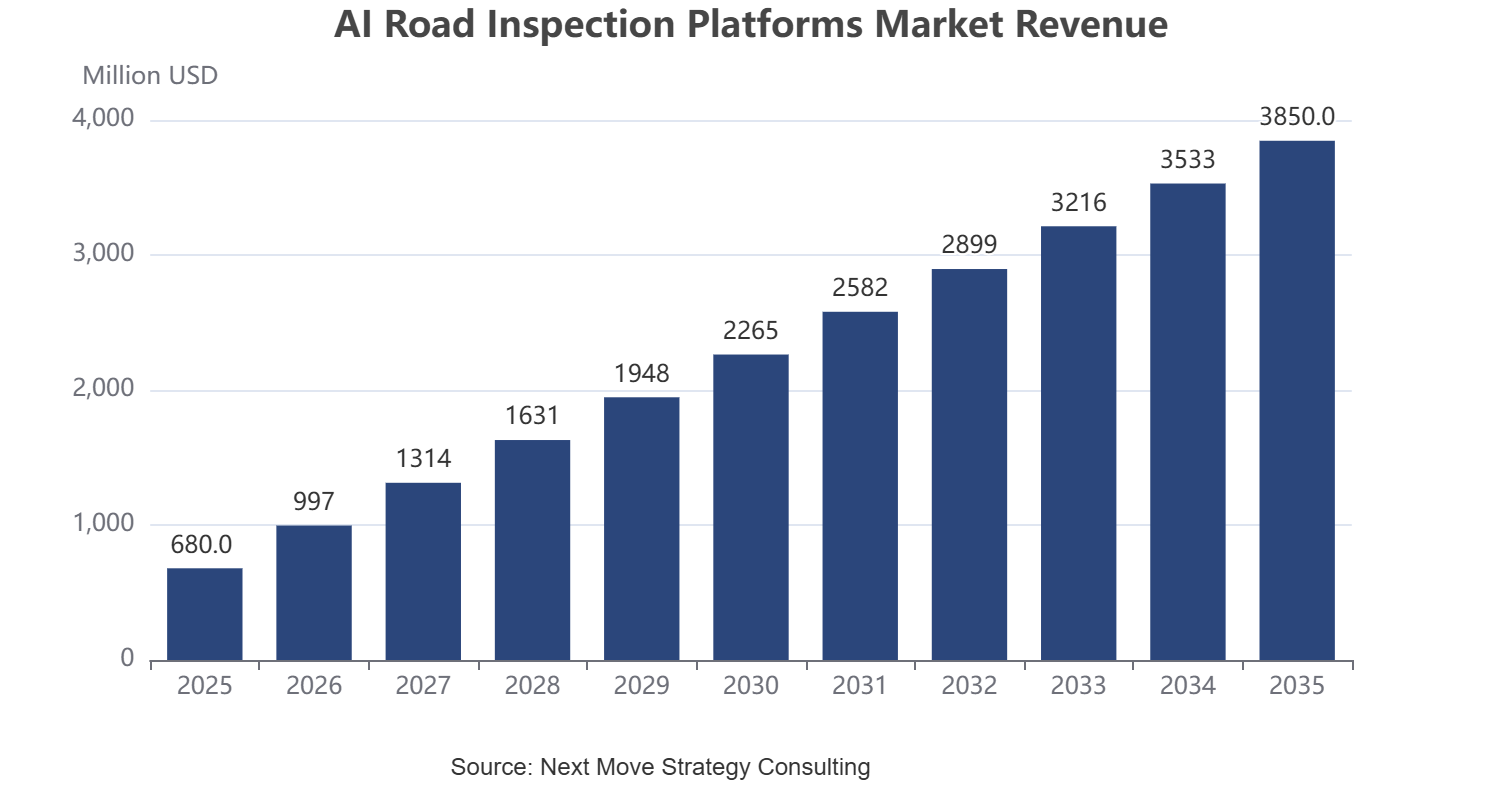
The global AI road inspection platforms market size was valued at USD 680.0 million in 2025 and is estimated at USD 810.0 million in 2026, forecast to reach USD 3850.0 million by 2035, expanding at an 18.9% CAGR between 2026 and 2035. North America leads with approximately 36% share, while pavement inspection dominates all other inspection applications with approximately 40% share.
We observed that growth is broad-based across every segmentation axis, with computer vision-led pavement analytics and municipal digitization programs driving the dominant structural shifts through 2035.
|
Key Takeaways |
|
By Offering: Platform Software held the largest share of approximately 62% (USD 420.0 million) in 2025; Data Access is the fastest-growing sub-segment at 21.3% CAGR from 2026–2035. |
|
By Deployment Mode: Cloud held the largest share of approximately 68% (USD 460.0 million) in 2025; Hybrid is the fastest-growing sub-segment at 21.0% CAGR from 2026–2035. |
|
By Inspection Application: Pavement Inspection held the largest share of approximately 40% (USD 270.0 million) in 2025; Maintenance Planning is the fastest-growing sub-segment at 22.4% CAGR from 2026–2035. |
|
By Data Acquisition Source: Vehicle-Mounted Cameras held the largest share of approximately 44% (USD 300.0 million) in 2025; Drone Imagery is the fastest-growing sub-segment at 23.5% CAGR from 2026–2035. |
|
By AI Technology: Computer Vision held the largest share of approximately 46% (USD 310.0 million) in 2025; Generative AI is the fastest-growing sub-segment at 23.1% CAGR from 2026–2035. |
|
By Road Type: Urban Roads held the largest share of approximately 35% (USD 240.0 million) in 2025; Airport Pavements is the fastest-growing sub-segment at 20.5% CAGR from 2026–2035. |
|
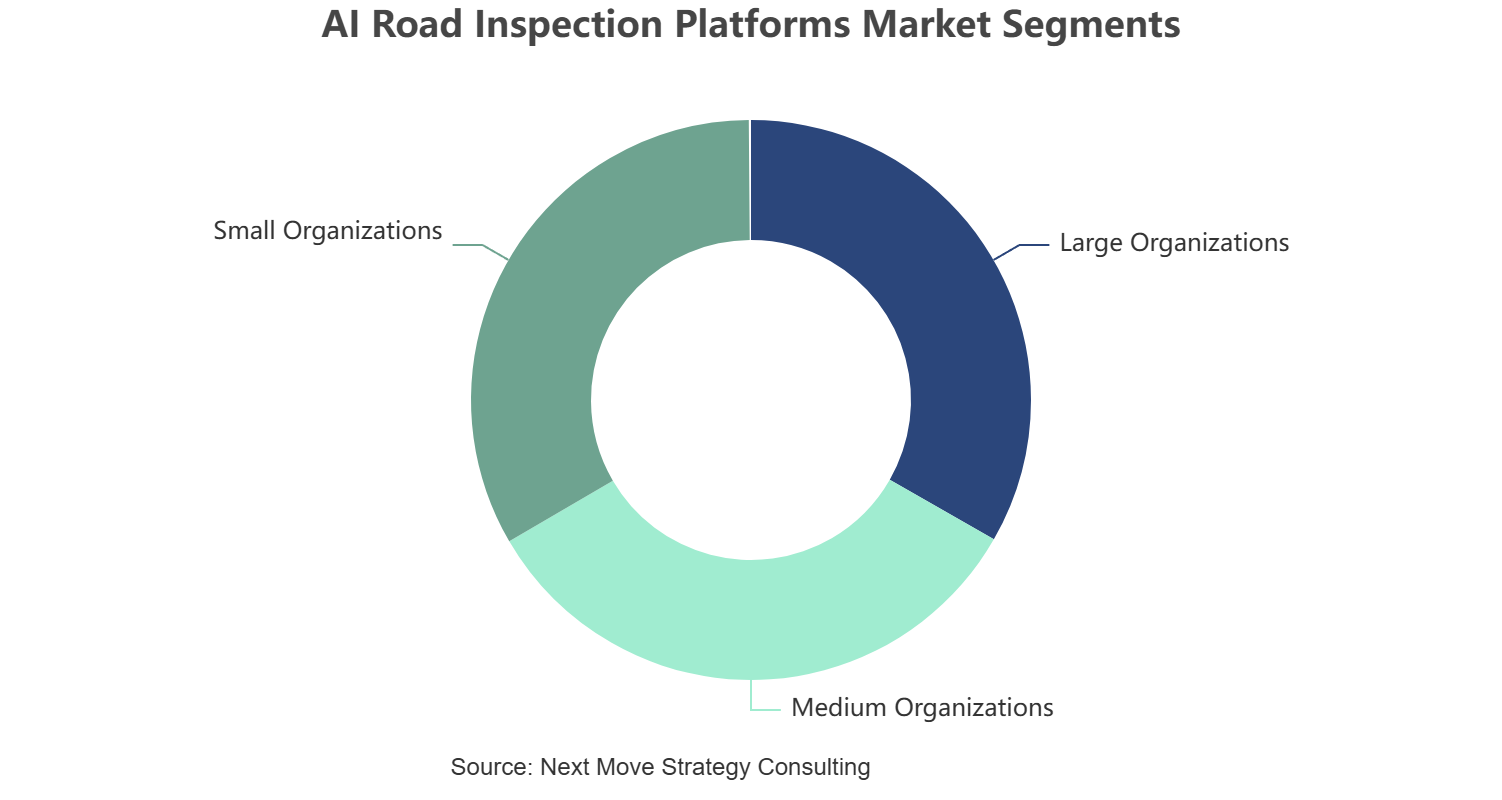
By Organization Size: Large Organizations held the largest share of approximately 54% (USD 370.0 million) in 2025; Small Organizations is the fastest-growing sub-segment at 21.8% CAGR from 2026–2035. |
|
By End User: State Agencies held the largest share of approximately 24% (USD 160.0 million) in 2025; Smart City Authorities is the fastest-growing sub-segment at 24.0% CAGR from 2026–2035. |
|
Dominant Region: North America dominated with approximately 36% revenue share (USD 245.0 million) in 2025. |
|
Fastest-Growing Region: Asia-Pacific is expected to register the highest CAGR of 22.6% during 2026–2035. |
|
Dominant Country: U.S. led with approximately USD 190.0 million in 2025. |
|
Fastest-Growing Country: India is the fastest-growing country at approximately 26.7% CAGR from 2026–2035. |
Market Opportunity: The AI Road inspection platforms market is expected to create an absolute dollar opportunity of USD 3040.0 million between 2026 and 2035, presenting significant investment potential across the municipal and highway-authority digital infrastructure value chain.
According to Next Move Strategy Consulting analysis, transportation agencies are increasingly bundling platform software with analytics modules and managed services into multi-year subscriptions, a shift that favors vendors offering integrated computer vision and predictive-maintenance stacks over single-point detection tools as procurement cycles mature through 2035.
What Does the AI Road Inspection Platforms Market Encompass?
The AI Road inspection platforms market encompasses software, services, and data-access offerings that apply computer vision, deep learning, and predictive analytics to automate detection and assessment of pavement distress, road assets, and safety hazards. Our assessment indicates that scope spans SaaS and licensed platform software, implementation and AI model customization services, and API-based data access supplied to national, state, and municipal transportation agencies alongside highway authorities, engineering firms, and commercial fleet operators. The category has evolved from manual windshield surveys into automated, camera- and LiDAR-fed inspection pipelines that materially reduce inspection cycle time and cost.
Regulatory frameworks such as the U.S. Federal Highway Administration's pavement management guidance and the European Union's Trans-European Transport Network requirements shape data standardization and asset-management reporting obligations, while national infrastructure funding programs increasingly condition disbursement on digital condition-monitoring evidence. We observed that technology adoption is shifting from single-purpose crack-detection tools toward integrated network condition monitoring platforms combining computer vision, sensor fusion, and predictive maintenance analytics. Next Move Strategy Consulting's analysis indicates that this structural shift, combined with smart-city digitization mandates, is redefining procurement criteria across the market.
|
Parameter |
Details |
|
Market Size in 2025 |
USD 680.0 Million |
|
Market Size in 2026 |
USD 810.0 Million |
|
Revenue Forecast in 2035 |
USD 3850.0 Million |
|
Growth Rate |
CAGR of 18.9% from 2026 to 2035 |
|
Analysis Period |
2025–2035 |
|
Base Year Considered |
2025 |
|
Forecast Period |
2026–2035 |
|
Market Size Estimation |
Revenue (USD Million) |
|
Companies Profiled |
20 |
|
Countries Covered |
33 |
|
Market Share |
Available for Top 10 Companies |
Key Emerging Trends
Based on research conducted by Next Move Strategy Consulting, we found that four structural trends are reshaping platform architecture, data sourcing, and stakeholder engagement across the industry.
How Is Computer Vision Transforming Automated Pothole and Crack Detection?
Computer vision models are replacing manual pavement condition surveys with automated crack, pothole, and rutting detection pipelines. We observed that RoadBotics' AI-based road assessment platform, used by numerous U.S. municipalities, converts smartphone-captured video into standardized pavement condition scores within days rather than weeks. Highway authorities are adopting these pipelines to prioritize maintenance budgets objectively, while engineering firms retool inspection workflows to accommodate continuous, camera-fed condition scoring across large road networks.
Why Are Mobile Mapping and LiDAR-Based Platforms Gaining Municipal Adoption?
Mobile mapping systems combining multi-camera arrays with LiDAR are gaining traction as agencies seek asset-level precision beyond pavement surface distress. Our findings suggest that municipal governments increasingly specify survey-vehicle-mounted LiDAR to capture guardrail, signage, and drainage-asset inventories in a single pass. Vendors such as Pavemetrics Systems and XenomatiX are expanding LiDAR-integrated offerings, positioning network condition monitoring as a premium, higher-margin category within the broader market structure.
How Is Predictive Maintenance Analytics Reshaping Budget Prioritization?
Predictive maintenance analytics is shifting agencies from reactive repair toward condition-forecasting budget allocation. We found that state departments of transportation increasingly deploy AI-based deterioration models to forecast pavement condition three to five years ahead, informing capital planning cycles. This trend is elevating demand for predictive planning and benchmarking analytics modules among state and provincial agencies, while software vendors integrate deterioration forecasting directly into procurement-ready dashboards.
What Role Does Sensor Fusion Play in Multi-Modal Road Safety Inspection?
Sensor fusion combining vehicle-mounted cameras, LiDAR, and third-party imagery is emerging as the technical backbone of comprehensive road safety inspection. Our analysis shows that infrastructure operators piloting multi-sensor platforms can simultaneously assess pavement distress, signage visibility, and work-zone hazards in a unified data pipeline. Blyncsy's integration of connected-vehicle imagery with proprietary detection models exemplifies this direction, enabling continuous, near-real-time network condition awareness for highway authorities.
SWOT Analysis of the AI Road Inspection Platforms Market
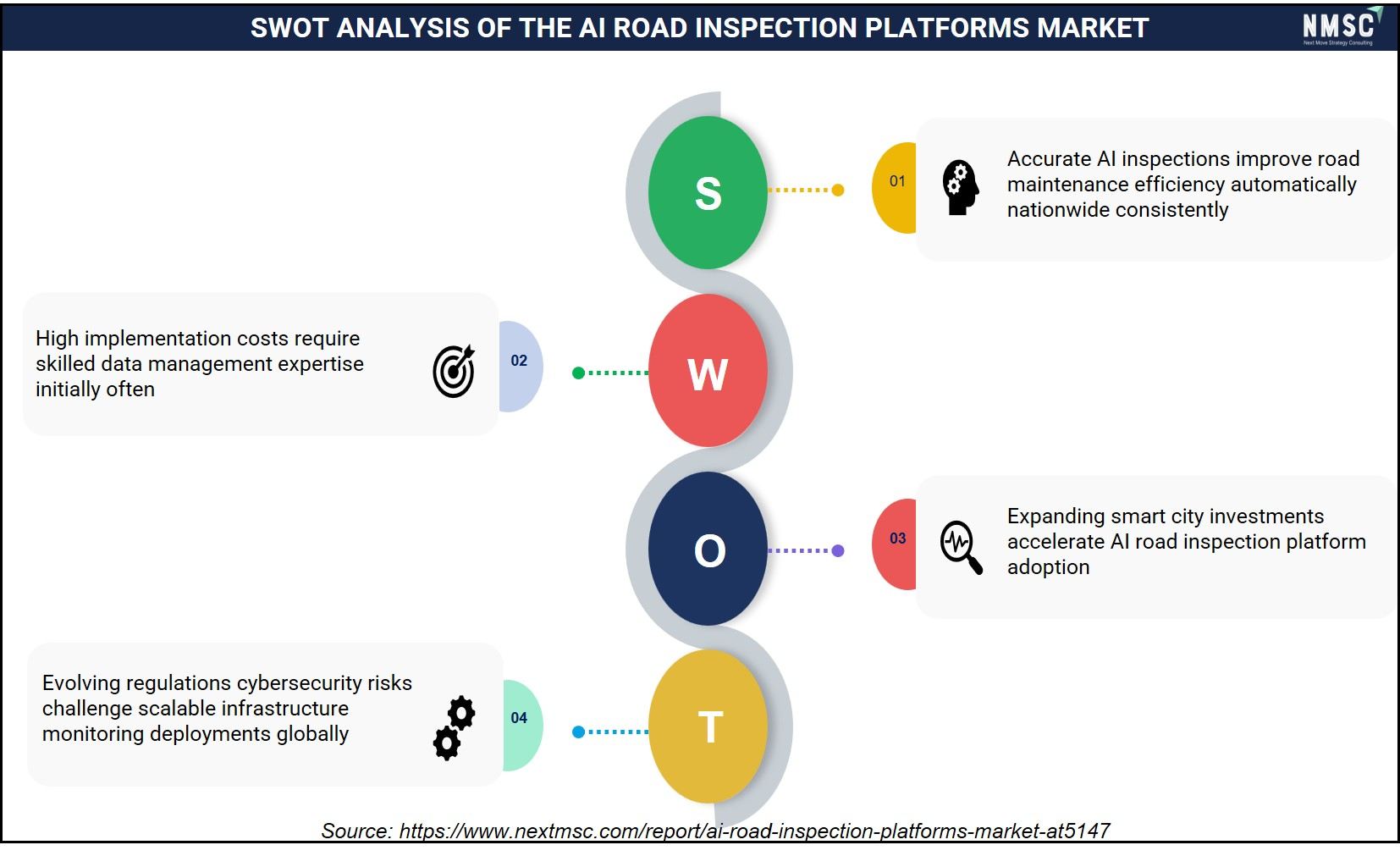
Based on our SWOT assessment, we observed that accurate AI-powered inspections and automation capabilities strengthen operational efficiency, whereas high implementation costs and the need for specialized technical expertise remain key adoption challenges. Moreover, our industry analysis indicates that expanding smart city investments and digital infrastructure modernization create significant growth opportunities, while evolving regulations, cybersecurity risks, and increasing competitive pressure continue to influence long-term market expansion.
Growth Drivers and Restraints
Growth Catalyst and Risk Assessment Matrix
|
Factors |
Type |
(+/−) % Impact on CAGR |
Geographic Relevance |
Impact Timeline |
|
Rising infrastructure funding tied to digital asset management |
Driver |
+3.2% |
North America, Europe |
2026-2035 |
|
Government mandates for automated pavement condition reporting |
Driver |
+2.6% |
North America, Europe, Asia-Pacific |
2026-2035 |
|
Falling cost of computer vision and edge-AI hardware |
Driver |
+2.1% |
Global |
2026-2035 |
|
Expansion of smart city programs in Asia-Pacific and MEA |
Driver |
+2.4% |
Asia-Pacific, Middle East & Africa |
2026-2033 |
|
Growing adoption of mobile mapping and LiDAR survey vehicles |
Driver |
+1.7% |
Global |
2026-2035 |
|
Rising fleet-operator demand for predictive maintenance analytics |
Driver |
+1.3% |
North America, Europe |
2026-2032 |
|
Limited digital infrastructure and budget in developing regions |
Restraint |
-1.6% |
Latin America, Middle East & Africa |
2026-2035 |
|
Data privacy and public-sector procurement complexity |
Restraint |
-1.1% |
North America, Europe |
2026-2032 |
|
Shortage of skilled personnel for AI model customization |
Restraint |
-0.9% |
Global |
2026-2030 |
What Is the Primary Growth Driver of the AI Road Inspection Platforms Market?
Rising infrastructure funding tied to digital asset management is the primary driver of the market. The U.S. Federal Highway Administration continues to condition portions of surface transportation funding on data-driven pavement and bridge management practices, sustaining agency demand for automated inspection platforms. We observed that this funding linkage, reinforced by aging road-network conditions across developed economies, continues to anchor baseline procurement of pavement inspection and road asset inspection applications.
How Is Government Regulation Driving AI Road Inspection Platforms Market Growth?
Government mandates requiring standardized, data-backed pavement condition reporting are accelerating platform adoption. The U.S. Moving Ahead for Progress in the 21st Century Act framework and subsequent transportation legislation require state departments of transportation to maintain risk-based asset management plans. Our assessment indicates that this regulatory pressure, combined with European Union Trans-European Transport Network monitoring requirements, is compressing adoption timelines for automated network condition monitoring platforms across North America and Europe.
What Is Restraining AI Road Inspection Platforms Market Expansion?
Limited digital infrastructure and constrained public-sector budgets restrain platform adoption across developing regions. The World Bank's infrastructure financing data indicates persistent funding gaps for road-network digitization in lower-income economies, delaying survey-vehicle and mobile-mapping procurement. We found that smaller municipal governments face particular exposure, as limited in-house technical capacity reduces their ability to deploy and maintain AI model customization compared with larger, well-resourced national transportation agencies.
Segmentation Analysis
Segment Sizing: By Offering
|
Segment |
2025 (USD) |
2035 (USD) |
CAGR% (2026–2035) |
|
Platform Software |
USD 420.0 Million |
USD 2250.0 Million |
18.3% |
|
Platform Services |
USD 180.0 Million |
USD 1050.0 Million |
19.3% |
|
Data Access |
USD 80.0 Million |
USD 550.0 Million |
21.3% |
|
Total |
USD 680.0 Million |
USD 3850.0 Million |
18.9% |
Which Offering Segment Dominates the AI Road Inspection Platforms Market?
Platform Software, encompassing SaaS, perpetual licenses, and analytics modules, led the market with USD 420.0 million in 2025, supported by agencies' preference for subscription-based deployment over one-time hardware purchases. We observed that Data Access is the fastest-growing offering, expanding at a 21.3% CAGR from 2026 to 2035, as engineering firms and infrastructure operators increasingly license API-based condition data rather than operating in-house survey programs.
Segment Sizing: By Inspection Application
|
Segment |
2025 (USD) |
2035 (USD) |
CAGR% (2026–2035) |
|
Pavement Inspection |
USD 270.0 Million |
USD 1350.0 Million |
17.5% |
|
Road Asset Inspection |
USD 150.0 Million |
USD 850.0 Million |
18.9% |
|
Road Safety Inspection |
USD 110.0 Million |
USD 620.0 Million |
18.9% |
|
Maintenance Planning |
USD 90.0 Million |
USD 680.0 Million |
22.4% |
|
Network Condition Monitoring |
USD 60.0 Million |
USD 350.0 Million |
19.3% |
|
Total |
USD 680.0 Million |
USD 3850.0 Million |
18.9% |
Which Inspection Application Leads AI Road Inspection Platforms Market Demand?
Pavement Inspection remained the leading application, valued at USD 270.0 million in 2025 on sustained crack, pothole, and rutting-detection deployment across highway networks. Our findings suggest that Maintenance Planning is the fastest-growing application, registering a 22.4% CAGR from 2026 to 2035, as agencies increasingly adopt predictive and preventive planning modules to convert condition data into budget-prioritization decisions.
Segment Sizing: By AI Technology
|
Segment |
2025 (USD) |
2035 (USD) |
CAGR% (2026–2035) |
|
Computer Vision |
USD 310.0 Million |
USD 1550.0 Million |
17.5% |
|
Deep Learning |
USD 180.0 Million |
USD 1000.0 Million |
18.7% |
|
Predictive Analytics |
USD 100.0 Million |
USD 650.0 Million |
20.6% |
|
Generative AI |
USD 50.0 Million |
USD 400.0 Million |
23.1% |
|
Sensor Fusion |
USD 40.0 Million |
USD 250.0 Million |
20.1% |
|
Total |
USD 680.0 Million |
USD 3850.0 Million |
18.9% |
Which AI Technology Is Most Widely Used in Road Inspection Platforms?
Computer Vision remained the dominant technology, reaching USD 310.0 million in 2025 due to its maturity, cost efficiency, and proven accuracy for crack and pothole classification tasks. Based on research conducted by Next Move Strategy Consulting, we found that Generative AI represents the fastest-growing technology category at a 23.1% CAGR from 2026 to 2035, reflecting early adoption of synthetic training-data generation and automated report drafting across leading platforms.
Growth Opportunities
Our analysis shows that three forward-looking opportunities stand out for stakeholders positioning within the AI road inspection platforms market over the 2026-2035 forecast period.
How Can Predictive Maintenance Modules Unlock Value for State Agencies?
Predictive maintenance analytics presents a whitespace opportunity for vendors serving state and provincial agencies seeking to shift from reactive repair to forecast-driven budget allocation. Suppliers that commercialize deterioration-forecasting modules stand to capture recurring analytics-subscription revenue as agencies formalize risk-based asset management plans across large highway networks.
Where Do Drone-Based Survey Platforms Create New Demand?
Drone imagery represents an underpenetrated data-acquisition opportunity for inspecting guardrails, drainage assets, and hard-to-access rural and industrial roads. Vendors that develop validated drone-to-platform data pipelines can secure contracts with infrastructure operators and rural highway authorities, benefiting from lower survey-vehicle costs and faster network-wide coverage cycles.
How Can Smart City Integration Benefit Municipal Governments?
Smart city authorities seeking unified urban-infrastructure dashboards create an opportunity for vendors offering API-based integration between road inspection platforms and broader municipal data systems. Early movers that secure interoperability partnerships can differentiate with municipal governments pursuing consolidated infrastructure-management platforms across their smart city technology portfolios.
Regional Outlook
Geographic Performance Snapshot
|
Region |
2025 (USD) |
2035 (USD) |
CAGR% (2026–2035) |
Key Driver |
|
North America |
USD 245.0 Million |
USD 1100.0 Million |
16.2% |
Federal infrastructure funding tied to data-driven asset management |
|
Europe |
USD 160.0 Million |
USD 700.0 Million |
15.9% |
EU Trans-European Transport Network monitoring requirements |
|
Asia-Pacific |
USD 150.0 Million |
USD 1150.0 Million |
22.6% |
Rapid smart city expansion and highway network growth |
|
Middle East & Africa |
USD 70.0 Million |
USD 480.0 Million |
21.2% |
Vision 2030-linked infrastructure digitization programs |
|
Latin America |
USD 55.0 Million |
USD 420.0 Million |
22.5% |
Expanding highway concession and toll-road modernization |
|
Total |
USD 680.0 Million |
USD 3850.0 Million |
18.9% |
– |
North America AI Road Inspection Platforms Market Outlook
North America leads the market with mature federal and state infrastructure funding programs and established highway authority procurement processes. We observed that Federal Highway Administration asset-management guidance sustains demand for pavement and road asset inspection platforms, while agencies increasingly specify AI-based predictive maintenance analytics to justify capital budgets. Technology adoption remains advanced, with cloud deployment and computer vision detection dominating procurement across the region's state departments of transportation.
Europe AI Road Inspection Platforms Market Outlook
Europe's market reflects a mature but regulation-intensive landscape shaped by the European Union's Trans-European Transport Network monitoring obligations. Our findings suggest that national highway authorities across Germany, France, and the UK are accelerating adoption of network condition monitoring platforms to satisfy cross-border reporting requirements. Technology adoption favors integrated sensor fusion platforms, supported by regional engineering firms investing in LiDAR-equipped survey vehicles.
Asia-Pacific AI Road Inspection Platforms Market Outlook
Asia-Pacific is the fastest-growing regional market, propelled by expanding highway networks in China and India and rapid smart city program rollouts. We found that regulatory frameworks remain less harmonized than in Europe, giving vendors flexibility to scale cloud-based platform software rapidly. Technology adoption is accelerating as regional developers, including several China-based providers, expand deployment to serve national transportation agencies and municipal governments.
Middle East & Africa AI Road Inspection Platforms Market Outlook
The market in Middle East & Africa is expanding as Gulf Cooperation Council economies diversify into smart infrastructure investment under national digitization visions. Our analysis shows that Saudi Arabia and the UAE are attracting platform investment tied to highway modernization programs. Regulatory influence remains moderate, while technology adoption is gradually shifting toward cloud-deployed platforms as regional highway authorities align with global smart-city expectations.
Latin America AI Road Inspection Platforms Market Outlook
Latin America's market is supported by expanding toll-road concessions and modernizing highway authority infrastructure in Brazil and Argentina. We observed that regulatory frameworks are less stringent than in North America or Europe, though multinational engineering firms operating locally are introducing computer vision inspection specifications. Technology adoption remains centered on vehicle-mounted camera platforms, with competitive intensity increasing as regional distributors partner with global platform vendors.
U.S. AI Road Inspection Platforms Market
Based on our estimates, the market in U.S. was valued at approximately USD 190.0 million in 2025 and is projected to reach USD 830.0 million by 2035, growing at a 15.9% CAGR. Demand is anchored by mature federal and state infrastructure funding, high e-commerce-grade cloud adoption, and Federal Highway Administration asset-management requirements. Technology penetration favors integrated computer vision and predictive maintenance platforms, and competitive intensity remains high among established national vendors serving state departments of transportation.
Canada AI Road Inspection Platforms Market
The market in Canada was valued at approximately USD 45.0 million in 2025 and is projected to reach USD 210.0 million by 2035, growing at a 16.7% CAGR. Demand is anchored by provincial highway authority modernization and municipal digitization programs. Technology penetration is rising as provincial agencies request cloud-based network condition monitoring, with competitive intensity moderate given reliance on cross-border platform vendors.
UK AI Road Inspection Platforms Market
As per our estimate, the market in UK was valued at approximately USD 38.0 million in 2025 and is projected to reach USD 155.0 million by 2035, growing at a 15.1% CAGR. Demand is anchored by National Highways' asset-management digitization program and local authority pothole-reporting mandates. Regulatory influence is significant, technology penetration favors cloud deployment, and competitive intensity remains steady among domestic and European platform vendors.
Germany AI Road Inspection Platforms Market
According to our analysis, the market in Germany was valued at approximately USD 42.0 million in 2025 and is projected to reach USD 185.0 million by 2035, growing at a 16.0% CAGR. Demand is anchored by Federal Ministry of Transport digital infrastructure initiatives and strong domestic engineering-firm base. Regulatory influence stems from EU Trans-European Transport Network requirements, while technology penetration favors sensor-fusion platforms among leading engineering firms.
France AI Road Inspection Platforms Market
Based on our estimates, the market in France was valued at approximately USD 30.0 million in 2025 and is projected to reach USD 125.0 million by 2035, growing at a 15.3% CAGR. Demand is anchored by national highway network modernization and municipal smart-city pilots. Regulatory influence from French infrastructure digitization policy is notable, and competitive intensity remains moderate given a concentrated base of domestic engineering firms.
China AI Road Inspection Platforms Market
The market in China was valued at approximately USD 48.0 million in 2025 and is projected to reach USD 440.0 million by 2035, growing at a 24.8% CAGR. Demand is anchored by expanding national expressway network and government-led smart transportation initiatives. Regulatory influence is increasing gradually, technology penetration is accelerating through domestic platform development, and competitive intensity remains elevated among numerous regional vendors.
India AI Road Inspection Platforms Market
As per our estimate, the market in India was valued at approximately USD 22.0 million in 2025 and is projected to reach USD 235.0 million by 2035, growing at a 26.7% CAGR. Demand is anchored by rapid national highway expansion under government infrastructure programs and rising municipal digitization. Regulatory influence remains developing, while technology penetration is rising quickly as state agencies localize platform sourcing to serve India's expanding road network.
Japan AI Road Inspection Platforms Market
According to our analysis, the market in Japan was valued at approximately USD 20.0 million in 2025 and is projected to reach USD 135.0 million by 2035, growing at a 21.0% CAGR. Demand is anchored by aging highway infrastructure requiring systematic condition monitoring and strong domestic engineering standards. Regulatory influence is well established, technology penetration is advanced, and competitive intensity remains high among long-standing domestic infrastructure technology providers.
South Korea AI Road Inspection Platforms Market
Based on our estimates, the market in South Korea was valued at approximately USD 14.0 million in 2025 and is projected to reach USD 95.0 million by 2035, growing at a 21.0% CAGR. Demand is anchored by government-led smart city expansion and highway authority digitization mandates. Technology penetration is high, with domestic developers supplying integrated platforms, and competitive intensity remains pronounced amid rapid product innovation cycles.
Australia AI Road Inspection Platforms Market
The market in Australia was valued at approximately USD 12.0 million in 2025 and is projected to reach USD 75.0 million by 2035, growing at a 20.1% CAGR. Demand is anchored by state road authority modernization and rural highway network monitoring needs. Regulatory influence stems from state transport agency asset-management policy, while technology penetration favors cloud-deployed platforms amid moderate competitive intensity.
UAE AI Road Inspection Platforms Market
As per our estimate, the market in UAE was valued at approximately USD 14.0 million in 2025 and is projected to reach USD 95.0 million by 2035, growing at a 21.0% CAGR. Demand is anchored by the UAE's role as a regional smart infrastructure and highway technology hub. Regulatory influence remains moderate, technology penetration is improving through imported platform software, and competitive intensity is rising as distributors expand offerings across Gulf markets.
Saudi Arabia AI Road Inspection Platforms Market
According to our analysis, the market in Saudi Arabia was valued at approximately USD 18.0 million in 2025 and is projected to reach USD 125.0 million by 2035, growing at a 21.4% CAGR. Demand is anchored by Vision 2030-linked infrastructure digitization and highway modernization investment. Regulatory influence is developing under national transport authority guidelines, and technology penetration is advancing as platform vendors scale regional deployment.
South Africa AI Road Inspection Platforms Market
Based on our estimates, the market in South Africa was valued at approximately USD 8.0 million in 2025 and is projected to reach USD 48.0 million by 2035, growing at a 19.6% CAGR. Demand is anchored by a developing highway authority digitization base serving regional Southern African markets. Regulatory influence remains moderate, technology penetration is gradually improving, and competitive intensity is limited given reliance on imported platform software from Europe and Asia.
Brazil AI Road Inspection Platforms Market
The market in Brazil was valued at approximately USD 24.0 million in 2025 and is projected to reach USD 190.0 million by 2035, growing at a 22.9% CAGR. Demand is anchored by Brazil's large toll-road concession network and expanding highway modernization investment. Regulatory influence stems from national transport infrastructure policy, technology penetration favors cloud-based platforms, and competitive intensity remains moderate among regional vendors.
Argentina AI Road Inspection Platforms Market
As per our estimate, the market in Argentina was valued at approximately USD 10.0 million in 2025 and is projected to reach USD 68.0 million by 2035, growing at a 21.2% CAGR. Demand is anchored by steady highway authority modernization despite macroeconomic volatility. Regulatory influence remains limited, technology penetration is modest, and competitive intensity is centered on a small number of regional distributors serving domestic agencies.
Supply Chain Structure of the AI Road Inspection Platforms Market
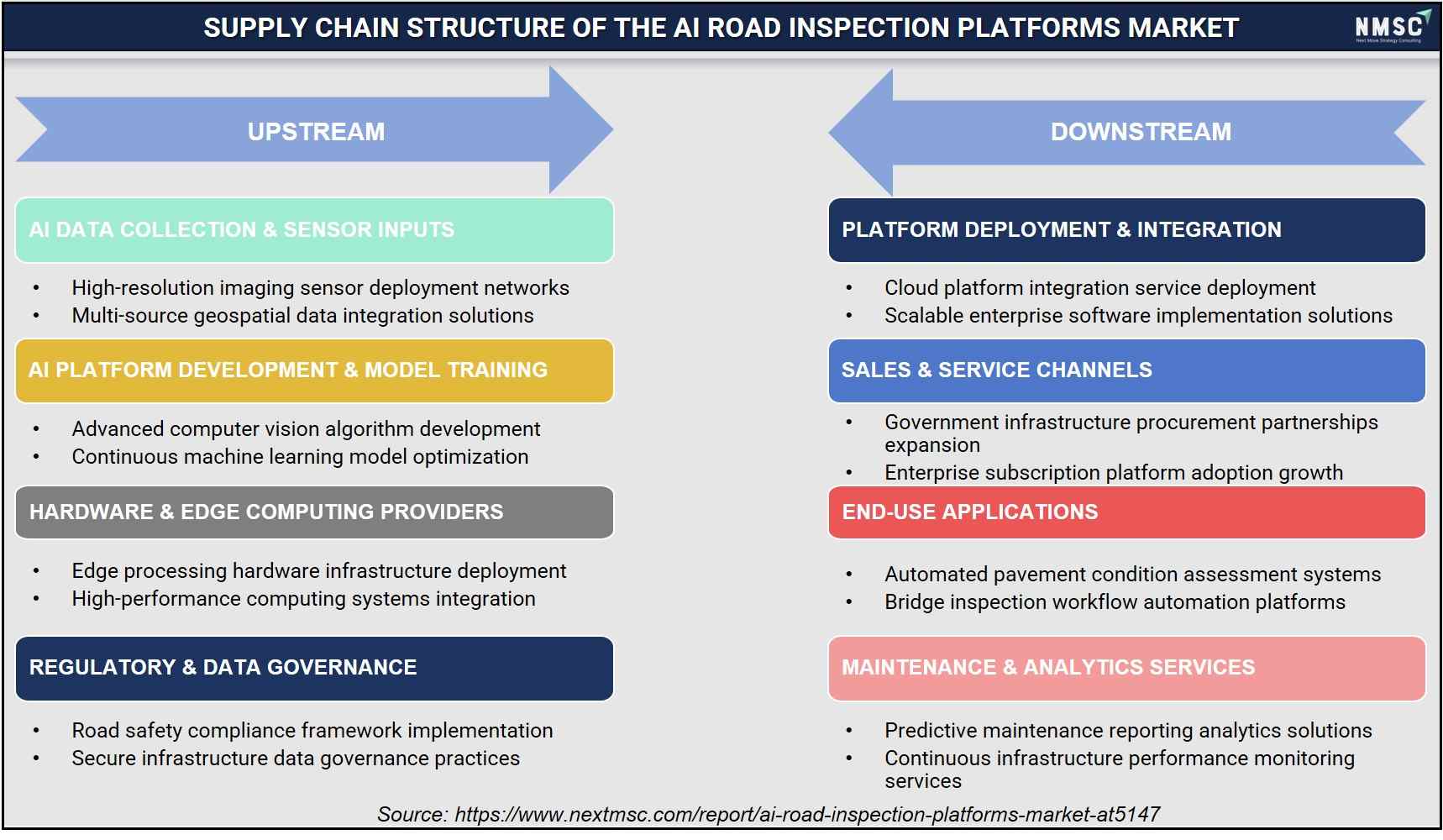
Based on our supply chain assessment, we identified that the AI road inspection platforms market begins with sensor manufacturers, geospatial data providers, AI platform developers, hardware vendors, and regulatory bodies that enable data acquisition, model development, computing infrastructure, and compliance. Furthermore, our industry analysis indicates that downstream activities involving platform deployment, enterprise integration, government procurement, infrastructure inspection applications, and predictive analytics services transform AI insights into efficient road maintenance, asset management, and long-term infrastructure performance optimization.
Competitive Landscape
We observed that the AI road inspection platforms market features a fragmented, innovation-driven competitive landscape, with specialized computer vision startups competing alongside broader mobility-analytics and asset-management technology providers.
Key Takeaways
|
Dimension |
Description |
|
Market Structure |
Fragmented; numerous specialized computer vision and mobile mapping startups serve national, state, and municipal agencies, with no single vendor holding a dominant global revenue share. |
|
Innovation Focus |
Predictive maintenance analytics, sensor fusion, and generative AI-based report automation dominate current innovation pipelines across leading platform vendors. |
|
M&A Activity |
Selective consolidation through platform acquisitions, exemplified by Previan's (formerly Eddyfi/NDT) acquisition of Pavemetrics Systems and Michelin's acquisition of RoadBotics, both broadening diversified industrial groups' automated infrastructure-inspection portfolios. |
How Do Companies Compete in the AI Road Inspection Platforms Market?
Companies compete primarily on detection accuracy, data-acquisition flexibility, and integration with existing agency asset-management systems. Vendors such as vialytics and RoadBotics leverage smartphone- and dashcam-based data capture to serve cost-sensitive municipal governments, while providers like Pavemetrics Systems and XenomatiX compete on precision LiDAR-based survey-vehicle hardware for national transportation agencies requiring network-grade accuracy.
Which Competitive Archetypes Dominate the AI Road Inspection Platforms Market?
Two archetypes dominate the market: low-cost, crowdsourced-data platforms optimized for municipal budgets, and precision survey-grade platforms serving national and state agencies. vialytics and Roadly exemplify the accessible municipal archetype through smartphone-based data capture, while Pavemetrics Systems and Vaisala exemplify the precision-instrumentation archetype through specialized sensor hardware integrated with proprietary analytics software.
How Are Companies Differentiating Through Innovation in Road Inspection Platforms?
Innovation and differentiation strategy increasingly center on predictive analytics and generative AI-based reporting automation. Blyncsy's connected-vehicle data integration and Cyvl's AI-based asset inventory platforms both extend detection capability beyond basic crack and pothole identification. Our analysis shows that vendors unable to demonstrate predictive maintenance and benchmarking capability risk exclusion from state department of transportation procurement shortlists.
What M&A and Expansion Activity Is Shaping the AI Road Inspection Platforms Market?
Mergers, acquisitions, and geographic expansion continue to consolidate detection and analytics capabilities within the industry. Previan's acquisition of Pavemetrics Systems and Michelin's acquisition of RoadBotics illustrate how diversified industrial and mobility groups are absorbing specialized computer vision capability, while vendors such as vialytics pursue partnership-led expansion, exemplified by its collaborations with BETA Group and Colliers Engineering & Design, to broaden geographic and municipal-agency reach.
Key Market Players
Our assessment indicates that the following 20 companies are actively shaping product innovation, capacity expansion, and geographic strategy within the global AI road inspection platforms market.
-
vialytics GmbH
-
RoadBotics, Inc.
-
Blyncsy, Inc.
-
Vaisala Oyj
-
Roadly, Inc.
-
ROADVISION AI PRIVATE LIMITED
-
Cyvl, Inc.
-
Advanced Services in Mobility S.L.
-
Maintain-AI
-
Visual Defence Inc.
-
XenomatiX N.V.
-
Pavemetrics Systems Inc.
-
Dareesoft Inc.
-
EyeVi Technologies OÜ
-
GoodRoads Inc.
-
IRIS R&D Group Inc.
-
Definitics Software Solutions Private Limited
-
Route Reports Limited
-
Scanwai Oy
-
BrainCreators B.V.
Latest Developments
We found that recent product and partnership announcements within the market are concentrated on predictive analytics and expanded municipal deployment, reflecting the industry's broader shift toward proactive asset management.
|
Date |
Event |
|
May 2026 |
Bentley Systems announced a landmark implementation of its Blyncsy AI technology for the Western Cape Government in South Africa. The project monitors 5,000 kilometers of roadway, using automated computer vision to identify hazards like damaged guardrails, missing signage, and vegetation encroachment. This marks a significant scaling of "infrastructure-as-a-service" AI in emerging markets. |
|
September 2025 |
The City of Buffalo announced a major infrastructure partnership with CYVL to inform its 2026 paving cycle. By using vehicle-mounted LiDAR and AI-based assessment, the city updated its ADA transition plan and prioritized street repairs across the entire municipal network, replacing manual inspections that had been static for over a decade. |
Expert Insights

“The Cognitive Artificial Intelligence and other technologies are enablers of the automation of the supervision of the visibility of road signage, as well as the irregularities of the highway and other crucial safety parameters.”
— Ibon Arechalde, CEO, ASIMOB
Statement made during an interview with FineEngineering, discussing the role of cognitive artificial intelligence in automating road infrastructure inspections, including road signage visibility assessment, pavement irregularity detection, and highway safety monitoring.
Market Interpretation
The statement underscores the growing role of cognitive artificial intelligence in transforming road inspection from labor-intensive manual surveys to automated, data-driven infrastructure monitoring. AI-powered road inspection platforms are increasingly leveraging computer vision and intelligent analytics to assess pavement conditions, detect road surface irregularities, monitor signage visibility, and identify safety risks with greater accuracy and efficiency. As transportation agencies prioritize predictive maintenance and smart infrastructure initiatives, the adoption of AI-enabled inspection solutions is expected to improve operational efficiency, enhance road safety, and support more proactive infrastructure asset management.
Investment Opportunities
What Capital Inflows Are Targeting the AI Road Inspection Platforms Market?
Capital inflows into the market are increasingly directed toward predictive analytics and sensor-fusion platform development. Venture and strategic investors continue to fund specialized computer vision startups serving municipal and state agency customers. We observed that investors favor vendors demonstrating validated deployment across multiple agency contracts, viewing recurring subscription revenue as a proxy for long-term platform viability.
How Is Infrastructure Investment Supporting AI Road Inspection Platform Deployment?
Infrastructure investment is expanding survey-vehicle fleets and cloud-computing capacity to support growing network condition monitoring demand. Our findings suggest that national transportation agencies are investing in dedicated data-acquisition hardware to improve inspection frequency, supporting the precision required for pavement, road asset, and road safety inspection applications across expanding highway networks.
What ESG Considerations Are Shaping AI Road Inspection Platforms Investment Decisions?
Environmental, social, and governance considerations are increasingly relevant to investment decisions, with road-safety outcomes and public-infrastructure resilience as key criteria. Government infrastructure resilience programs continue to inform agency sustainability disclosures. We found that investors increasingly favor platform vendors demonstrating measurable safety-outcome improvements, treating it as a governance indicator alongside data-security compliance.
Key Benefits for Stakeholders
How Does This Report Benefit Enterprise and Industry Leaders?
Enterprise and industry leaders gain access to validated segmentation, competitive benchmarking, and regional demand forecasts that support sourcing and product-portfolio decisions across the AI road inspection platforms industry. Our analysis shows that detailed offering, deployment, and technology breakdowns help procurement teams align specifications with agency requirements while identifying underserved application segments for portfolio expansion.
How Does This Report Benefit Investors and Financial Analysts?
Investors and financial analysts benefit from consistent, single-point market size and CAGR estimates that support valuation and capital-allocation decisions across the market's technology and services supply chain. We observed that the report's regional and segment-level growth differentials help identify which platform vendors are best positioned to capture above-market growth in predictive analytics and generative AI categories through 2035.
How Does This Report Benefit Technology Vendors and Product Teams?
Technology vendors and product teams gain insight into emerging platform requirements, including sensor fusion, predictive maintenance, and generative AI-based reporting, that are reshaping the industry. Our findings suggest that this analysis helps R&D teams prioritize development roadmaps around integration and interoperability capabilities increasingly required by agency request-for-proposal processes.
Key Market Segments
By Offering
-
Platform Software
-
SaaS
-
Enterprise SaaS
-
Municipal SaaS
-
Network SaaS
-
-
Perpetual Licenses
-
On-Premises Licenses
-
Private Cloud Licenses
-
-
Analytics Modules
-
Pavement Analytics
-
Road Asset Analytics
-
Road Safety Analytics
-
Predictive Maintenance Analytics
-
Benchmarking
-
-
Support
-
Standard Support
-
Premium Support
-
-
-
Platform Services
-
Implementation
-
Data Migration
-
AI Model Customization
-
Training
-
Managed Services
-
-
Data Access
-
API Subscriptions
-
Data Licensing
-
Integration Access
-
By Deployment Mode
-
Cloud
-
Public Cloud
-
Private Cloud
-
Multi-Cloud
-
-
On-Premises
-
Hybrid
By Inspection Application
-
Pavement Inspection
-
Crack Detection
-
Longitudinal Crack Detection
-
Transverse Crack Detection
-
Alligator Crack Detection
-
-
Pothole Detection
-
Rutting Detection
-
Surface Wear Detection
-
Edge Deterioration Detection
-
-
Road Asset Inspection
-
Traffic Sign Inspection
-
Pavement Marking Inspection
-
Guardrail Inspection
-
Street Lighting Inspection
-
Drainage Asset Inspection
-
-
Road Safety Inspection
-
Hazard Detection
-
Work Zone Monitoring
-
Visibility Assessment
-
Safety Compliance Assessment
-
-
Maintenance Planning
-
Preventive Planning
-
Predictive Planning
-
Budget Prioritization
-
-
Network Condition Monitoring
-
Condition Monitoring
-
Change Detection
-
Risk Assessment
-
By Data Acquisition Source
-
Vehicle-Mounted Cameras
-
Passenger Vehicles
-
Fleet Vehicles
-
Survey Vehicles
-
-
Mobile Devices
-
Smartphones
-
Tablets
-
-
Mobile Mapping Systems
-
Multi-Camera Systems
-
LiDAR Systems
-
-
Drone Imagery
-
Fixed Roadside Cameras
-
Third-Party Imagery
By AI Technology
-
Computer Vision
-
Image Classification
-
Object Detection
-
Semantic Segmentation
-
-
Deep Learning
-
Supervised Learning
-
Self-Supervised Learning
-
-
Predictive Analytics
-
Generative AI
-
Sensor Fusion
By Road Type
-
Highways
-
Urban Roads
-
Rural Roads
-
Toll Roads
-
Industrial Roads
-
Airport Pavements
By Organization Size
-
Large Organizations
-
Medium Organizations
-
Small Organizations
By End User
-
National Transportation Agencies
-
State Agencies
-
Provincial Agencies
-
Municipal Governments
-
Highway Authorities
-
Engineering Firms
-
Infrastructure Operators
-
Commercial Fleet Operators
-
Smart City Authorities
By Region
-
North America: U.S., Canada, Mexico
-
Europe: UK, Germany, France, Italy, Spain, Sweden, Denmark, Finland, Netherlands, Rest of Europe
-
Asia-Pacific: China, India, Japan, South Korea, Taiwan, Indonesia, Vietnam Australia, Philippines, Malaysia, Rest of APAC.
-
Middle East & Africa: Saudi Arabia, UAE, Egypt, Israel, Turkey, Nigeria, South Africa, Rest of MEA.
-
Latin America: Brazil, Argentina, Chile, Colombia, Rest of LATAM.
Conclusion and Recommendations
What Is the Long-Term Outlook for the AI Road Inspection Platforms Market?
The long-term outlook for the market remains strongly positive, with global revenue projected to grow more than fivefold from USD 680.0 million in 2025 to USD 3850.0 million by 2035 at an 18.9% CAGR. We observed that sustained infrastructure funding, regulatory-driven digitization mandates, and predictive analytics expansion will continue underpinning demand across national, state, and municipal transportation agency segments through the forecast period.
What Strategic Positioning Should AI Road Inspection Platform Vendors Pursue?
Vendors should prioritize predictive maintenance and sensor-fusion platform capability while pursuing multi-agency deployment references to secure long-term public-sector contracts. Our assessment indicates that providers investing early in generative AI-based reporting and cross-platform data-integration capability will be best positioned to capture premium pricing within the AI road inspection platforms market.
How Attractive Is the AI Road Inspection Platforms Market for New Investment?
The industry presents an attractive investment case, supported by a USD 3040.0 million absolute dollar opportunity between 2026 and 2035 and above-average growth in Asia-Pacific and Generative AI-enabled product categories. We found that investment attractiveness is highest for vendors combining validated detection accuracy with scaled multi-agency deployment, positioning them to serve both municipal and national procurement segments simultaneously.
What Market Shifts and Key Risks Should Stakeholders Monitor?
Stakeholders should monitor limited digital infrastructure budgets, data-privacy procurement complexity, and skilled-personnel shortages as key risks to the market. Our analysis shows that vendors unable to adapt to evolving agency data-security requirements risk losing procurement standing to competitors with stronger compliance and integration credentials, particularly within Europe's increasingly regulated public-sector environment.
What Are the Key Growth Pathways for the AI Road Inspection Platforms Market?
Key growth pathways include expanding predictive maintenance and generative AI-enabled analytics portfolios, scaling drone- and LiDAR-based data acquisition, and deepening penetration into municipal and smart city end-user channels. Next Move Strategy Consulting's analysis indicates that vendors pursuing these pathways while maintaining cost competitiveness in core pavement inspection categories will be best positioned to capture the market's projected growth through 2035.
About the Author
 Saista Faiyaz
— Saista Faiyaz is Research Associate at Next Move Strategy Consulting, where she has covered consumer markets and healthcare technologies for 3 years. Her work includes primary interview review, secondary-source validation, market sizing, and structured analysis of company and industry data. She supports research by comparing evidence across sources, organizing findings into market narratives, and documenting assumptions used in analysis. Her scope includes cross-market benchmarking, and reports.
Saista Faiyaz
— Saista Faiyaz is Research Associate at Next Move Strategy Consulting, where she has covered consumer markets and healthcare technologies for 3 years. Her work includes primary interview review, secondary-source validation, market sizing, and structured analysis of company and industry data. She supports research by comparing evidence across sources, organizing findings into market narratives, and documenting assumptions used in analysis. Her scope includes cross-market benchmarking, and reports.
About the Reviewer
 Supradip Baul
— Supradip Baul is an accomplished business consultant and strategist with over a decade of rich experience in market intelligence, strategy, technology, and business transformation. His work has included rigorous qualitative and quantitative analysis across multiple industries, helping clients shape investment decisions and long-term roadmaps. Earlier in his career, he was associated with Gartner, where he contributed to industry-leading reports and market share analyses. He has worked with leading global companies and holds an MBA with a dual specialization in Marketing and Finance.
Supradip Baul
— Supradip Baul is an accomplished business consultant and strategist with over a decade of rich experience in market intelligence, strategy, technology, and business transformation. His work has included rigorous qualitative and quantitative analysis across multiple industries, helping clients shape investment decisions and long-term roadmaps. Earlier in his career, he was associated with Gartner, where he contributed to industry-leading reports and market share analyses. He has worked with leading global companies and holds an MBA with a dual specialization in Marketing and Finance.
At Next Move Strategy Consulting, we understand that insightful market research is the cornerstone of successful business decisions. That's why we employ a robust and multifaceted approach, combining various methodologies to deliver the most accurate and actionable data for our clients.

Research Landscape
We navigate the world of research with two primary approaches:
Qualitative Approach
Our qualitative research methodologies involve immersive techniques such as in-depth interviews, focus groups, and observational studies. By engaging directly with individuals and stakeholders, we uncover valuable insights that quantitative data alone may overlook.

Quantitative Research
In tandem with qualitative methodologies, NMSC leverages the power of Quantitative Research to provide a robust foundation of numerical insights. Through systematic data collection and analysis, we quantify patterns, preferences, and market trends, offering a comprehensive view of the business landscape.
Our quantitative research approach employs diverse tools, including surveys, experiments, and statistical modelling. These methodologies enable us to gather data from a large and representative sample, ensuring the statistical significance of our findings. By employing structured questionnaires and standardized data collection methods, we guarantee the reliability and validity of the information we present to our clients.
Quantitative research is particularly effective in measuring the prevalence of trends, assessing market size, and gauging the impact of various factors on consumer behavior. The numerical precision attained through this approach equips our clients with actionable insights, facilitating data-driven decision-making and strategy formulation.


Our Specialized Toolbox for Industry-Specific Market Research
We deploy a specialized arsenal of techniques tailored to meet your unique requirements. Here's a glimpse into our comprehensive toolbox:

Information Procurement
The stage entails acquiring market data or relevant information through various sources and methodologies.


Market Research Approach
We utilize both top-down and bottom-up approaches in market research analysis to achieve a comprehensive understanding of the market dynamics, leveraging the broad perspective of industry trends and macroeconomic factors alongside detailed insights from specific segments and individual companies.

Porters Five Forces Analysis
We conduct Porter's Five Forces analysis to evaluate the competitive landscape of an industry, providing us with insights into factors that affect profitability and strategic positioning.

SWOT Analysis

Forecasting
We utilize a forecasting model to predict future consumption by considering parameters like population, economics, regulations, market competition, drivers, constraints, technology, and pricing. We also employ statistical techniques such as multilinear regression, exponential smoothing, moving average, ARIMA, and Monte Carlo simulations for accurate predictions. In econometric forecasting, we analyzed short-term and long-term event impacts, attributing values based on regulatory frameworks, economic factors, and market events.





 Speak to Our Analyst