Asia-Pacific Drone Market By Component (Hardware, Software, and Services), By Platform Type (Multi-Rotor, Fixed-Wing, Hybrid VTOL, and Others), By Autonomy Level (Remotely Piloted, Assisted, Advanced, and Fully Autonomous), By Maximum Take-off Weight {Nano (<250 g), Micro (250 g–2 kg), Small (>2 kg–25 kg), and Others}, By End-User (Consumer Drone, Commercial & Industrial Drone, Government & Public Safety Drone, and Military Drone) – Analysis & Forecast, 2025–2035
Industry: Aerospace & Defense | Latest Edition: October 16, 2026 | No of Pages: 802 | No. of Tables: 384 | No. of Figures: 370 | Format: PDF | Report Code: AD4011
Asia-Pacific Drone Market Size & Forecast
|
Parameters |
Details |
|
Market Size in 2025 |
USD 23.84 billion |
|
Market Size in 2026 |
USD 27.98 billion |
|
Revenue Forecast in 2035 |
USD 69.73 billion |
|
Market Size Growth Rate |
CAGR of 10.68% from 2026 to 2035 |
|
Market Volume in 2025 |
1,087 thousand units |
|
Market Volume in 2026 |
1,333 thousand units |
|
Volume Forecast in 2035 |
4,518 thousand units |
|
Market Volume Growth Rate |
CAGR of 14.52% from 2026 to 2035 |
|
Analysis Period |
2025–2035 |
|
Base Year Considered |
2025 |
|
Forecast Period |
2026–2035 |
|
Market Size Estimation |
Billion (USD) |
|
Companies Profiled |
20 |
|
Market Share |
Available for 10 companies |
Industry Outlook
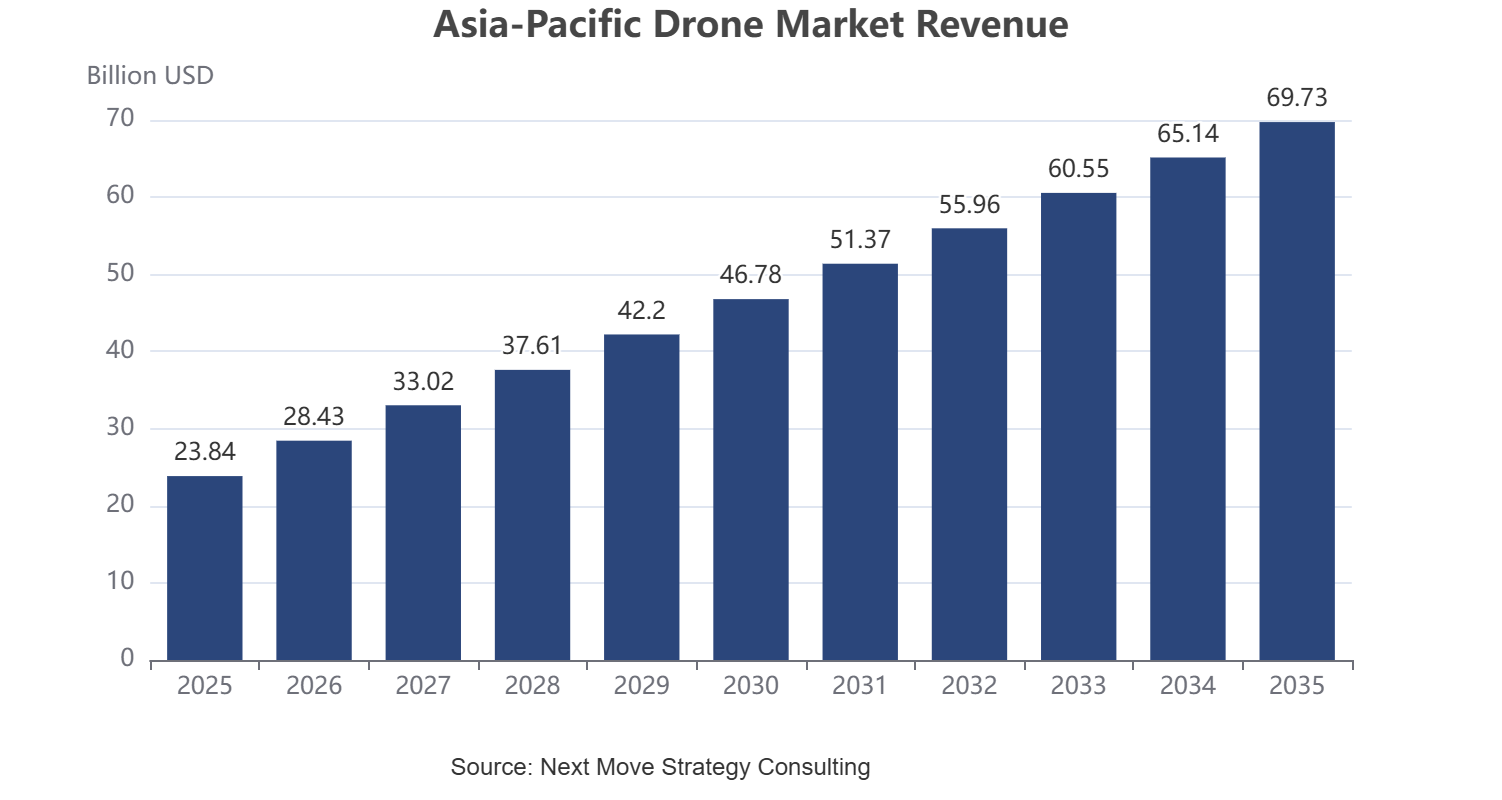
The Asia-Pacific Drone Market was valued at USD 23.84 billion in 2025, with a market volume of 1,087 thousand units, making it the largest regional drone market globally by volume. The market is estimated to reach USD 27.98 billion and 1,333 thousand units in 2026, driven by China’s manufacturing scale, rapid agricultural drone adoption, and expanding defense procurement. Revenue is projected to reach USD 69.73 billion by 2035 at a CAGR of 10.68%, with volume forecast at 4,518 thousand units at a CAGR of 14.52%, reflecting sustained momentum across commercial, defense, and consumer segments throughout the forecast period.
What Are the Key Market Drivers, Restraints, and Strategic Opportunities Defining the Asia-Pacific Drone Market Through 2035?
Growth Catalyst & Risk Assessment Matrix
|
DRIVERS / TRENDS / RESTRAINTS |
(+/–) % IMPACT ON CAGR FORECAST |
GEOGRAPHIC RELEVANCE |
IMPACT TIMELINE |
|
China’s vertically integrated drone manufacturing ecosystem providing global-scale component supply chains and competitive cost structures across all platform categories |
+3.5% |
China – Pearl River Delta manufacturing hub; regional export markets |
Long term (4–7 years) |
|
Agricultural drone adoption for precision spraying, crop monitoring, and field mapping driven by government subsidy programs and labor cost pressures across major farming economies |
+3.0% |
China, India, Japan – major rice, wheat, and vegetable cultivation regions |
Medium to Long term (3–6 years) |
|
Military drone procurement expansion driven by territorial defense priorities and armed forces modernization programs across China, India, Japan, South Korea, and Australia |
+2.5% |
China, India, Japan, South Korea, Australia – defense ministry budgets |
Long term (4–7 years) |
|
Regulatory fragmentation across Asia-Pacific’s diverse jurisdictions creating compliance complexity and constraining cross-border commercial drone deployment at scale |
–1.4% |
Multi-market commercial operators; DaaS providers with regional expansion strategies |
Short to Medium term (1–4 years) |
|
India’s PLI drone manufacturing scheme and Drone Rules 2021 framework creating emerging domestic manufacturing ecosystem and large-scale government procurement opportunities |
+1.8% |
India – agricultural, defense, and public safety procurement programs |
Medium to Long term (3–7 years) |
The Asia-Pacific Drone Market is shaped by a distinctive combination of manufacturing scale concentration, agricultural modernization imperatives, intensifying territorial defense dynamics, and heterogeneous regulatory environments across the region’s diverse economies. Our analysis indicates that China’s vertically integrated drone ecosystem, anchored by global-scale hardware manufacturing and rapidly advancing autonomy software, provides a structural competitive foundation that influences pricing, supply chains, and market dynamics across the broader region. Agricultural drone adoption, defense procurement expansion, and India’s emerging industrial policy framework further define Asia-Pacific’s near- and long-term drone market growth trajectory.
Growth Drivers:
How is China’s Manufacturing Scale and Vertically Integrated Drone Ecosystem Driving Asia-Pacific Market Growth?
China’s unparalleled concentration of drone hardware manufacturing capacity, component supply chain depth, and software development capability positions the country as the dominant structural driver of Asia-Pacific drone market volume and competitive pricing dynamics. China-headquartered manufacturers control significant shares of global airframe, avionics, payload, and propulsion component production, enabling highly competitive cost structures across consumer, prosumer, enterprise, and agricultural drone segments. Our assessment indicates that China’s manufacturing ecosystem not only generates substantial domestic demand but also defines component cost benchmarks influencing competitive positioning for drone manufacturers across the broader Asia-Pacific region.
How is Agricultural Drone Adoption Across China, India, and Japan Accelerating Commercial Market Expansion in Asia-Pacific?
Agricultural drone deployment for crop spraying, precision monitoring, and field mapping is one of the most structurally significant commercial growth drivers in the Asia-Pacific Drone Market. China’s expansive agricultural drone adoption, supported by government subsidy programs and established operator networks, has demonstrated economic viability of drone-based precision agriculture at scale. India’s agricultural drone ecosystem is expanding under the Drone-as-a-Service kisan scheme, while Japan’s aging farming population is accelerating autonomous spraying drone uptake. Agricultural applications generate substantial unit volume demand across small and medium MTOW platform categories across the region.
How is Military Drone Procurement and Territorial Defense Investment Driving High-Value Revenue Growth Across Asia-Pacific?
Escalating territorial tensions, expanding defense budgets, and national military modernization programs across China, India, Japan, South Korea, and Australia are generating sustained high-value procurement demand for military-grade drone platforms in the Asia-Pacific Drone Market. ISR systems, loitering munitions, MALE-class platforms, and counter-UAS capabilities are receiving priority investment as regional defense establishments recognize unmanned systems as core components of modern force structure. Our assessment indicates that military drone procurement generates disproportionate revenue contribution relative to unit volume given premium pricing of defense-grade platforms, particularly across MALE/HALE and UCAV categories throughout the forecast period.
Growth Inhibitor:
How Does Regulatory Fragmentation Across Asia-Pacific’s Diverse Jurisdictions Constrain Commercial Drone Market Expansion?
The Asia-Pacific region encompasses some of the world’s most diverse regulatory environments, ranging from China’s centralized Civil Aviation Administration framework to India’s evolving Directorate General of Civil Aviation drone rules and Japan’s progressive level-four urban drone operation approvals. This jurisdictional heterogeneity creates significant compliance complexity for commercial operators and drone service providers seeking multi-market deployment strategies. Our assessment indicates that regulatory inconsistency constrains cross-border DaaS business model scalability, increases market entry costs for foreign drone developers, and limits operational efficiency gains available from regional fleet standardization across Asia-Pacific commercial segments.
Growth Opportunity:
How is India’s Production-Linked Incentive (PLI) Scheme and Domestic Drone Manufacturing Policy Creating Regional Market Opportunities?
India’s Production-Linked Incentive (PLI) scheme for drones and drone components, combined with progressive regulatory reform under the Drone Rules 2021 framework, is catalyzing the emergence of a domestic drone manufacturing ecosystem with significant regional market implications. Government mandates favoring domestically manufactured drone procurement for agricultural, defense, and public safety applications are creating structural demand for India-based platform developers. Our analysis indicates that India represents one of the most compelling emerging opportunities within Asia-Pacific for drone manufacturers, software providers, and service operators given its large agricultural base, expanding defense budget, and rapidly maturing regulatory framework.
Supply Chain Structure of the Asia-Pacific Drone Market:
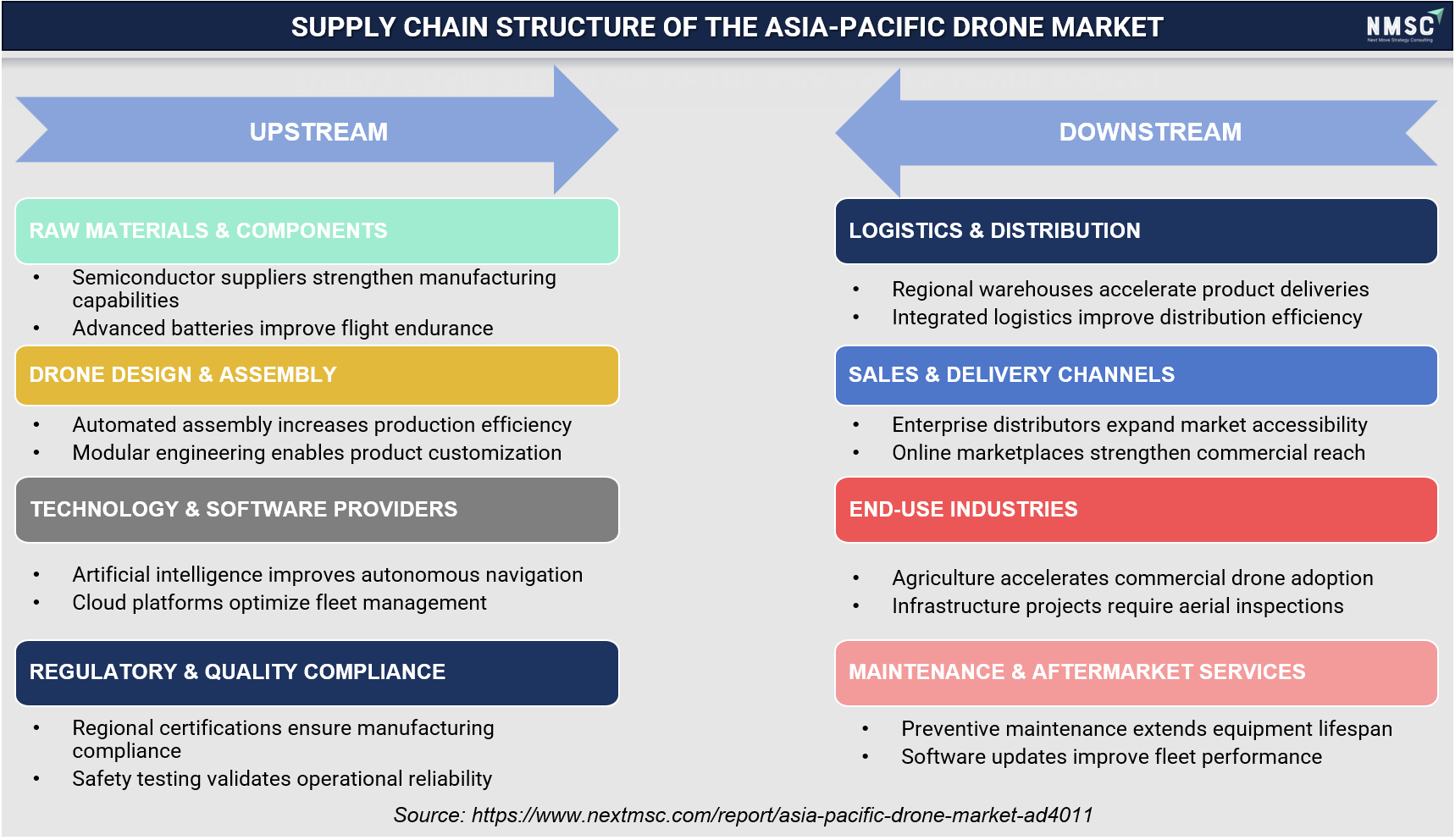
The above supply chain analysis maps the key operational stages, such as upstream and downstream, shaping the Asia-Pacific drone market. From our analysis, we observed that upstream activities include semiconductor suppliers, advanced batteries, automated assembly, modular engineering, artificial intelligence, cloud platforms, and regional certifications, while downstream activities encompass regional warehouses, enterprise distributors, online marketplaces, agriculture and infrastructure end-users, and preventive maintenance, reflecting a well-integrated supply chain across the market.
How Is the Asia-Pacific Drone Market Segmented in This Report, and What Are the Key Insights from the Segmentation Analysis?
By Maximum Take-off Insights
How Does Maximum Take-off Weight (MTOW) Segmentation Reflect Operational Diversity?
Based on maximum take-off weight (MTOW), the Asia-Pacific Drone Market is segmented into nano (<250 g), micro (250 g–2 kg), small (>2 kg–25 kg), medium (>25 kg–150 kg), large (>150 kg–600 kg), and very large/tactical (>600 kg) platforms.
The market comprises a wide range of drone weight categories designed to support diverse requirements across consumer, commercial, government, and defense applications. According to our analysis, we found that nano and micro platforms enable lightweight imaging, recreational, and short-range inspection activities, while small and medium platforms support agriculture, surveying, mapping, and industrial operations requiring greater payload capacity. Large and very large/tactical platforms address complex missions such as long-range surveillance, logistics, maritime operations, and defense applications where extended endurance and advanced capabilities are essential.
By Price/Performance Grade Insights
How Does Price/Performance Grade Segmentation Reveal Consumer and Enterprise Demand Dynamics?
Based on price/performance grade, the Asia-Pacific Drone Market is segmented into consumer grade (<$1,000), prosumer grade ($1,000–$10,000), enterprise grade ($10,000–$100,000), and military grade (>$100,000) platforms.
The market encompasses diverse drone solutions designed to address varying performance expectations, operational requirements, and investment capabilities across consumer, commercial, government, and defense applications. According to our analysis, we found that consumer and prosumer-grade platforms support recreational, imaging, and entry-level professional activities, while enterprise-grade systems enable advanced surveying, agriculture, inspection, and logistics operations through enhanced payload capabilities and reliability. Military-grade platforms serve specialized defense requirements with advanced endurance, autonomy, and mission-specific technologies, reflecting the varied adoption patterns across the region.
Which Country is Dominating the Asia-Pacific Drone Market?
Through NMSC’s market evaluation, we noticed that China dominates the Asia-Pacific drone market due to its extensive manufacturing capabilities, strong domestic demand, and leadership in UAV technology development. The country benefits from a well-established drone supply chain, cost-efficient production, and the presence of major manufacturers serving commercial and defense applications. Rapid advancements in AI, autonomous flight systems, and expanding adoption across agriculture, logistics, and infrastructure further reinforce China’s regional market leadership.
Which Country is Set to Witness the Fastest Growth?
Our assessment suggests that Vietnam is set to witness the fastest growth in the Asia-Pacific drone market through 2035, driven by increasing UAV adoption across agriculture, logistics, infrastructure inspection, and disaster management. The country’s expanding manufacturing sector, growing technology investments, and rising focus on digital transformation are creating favorable conditions for drone deployment. Furthermore, increasing demand for precision agriculture and cost-effective aerial monitoring solutions is expected to accelerate adoption and support sustained market expansion.
PESTEL Analysis of the Asia-Pacific Drone Market:
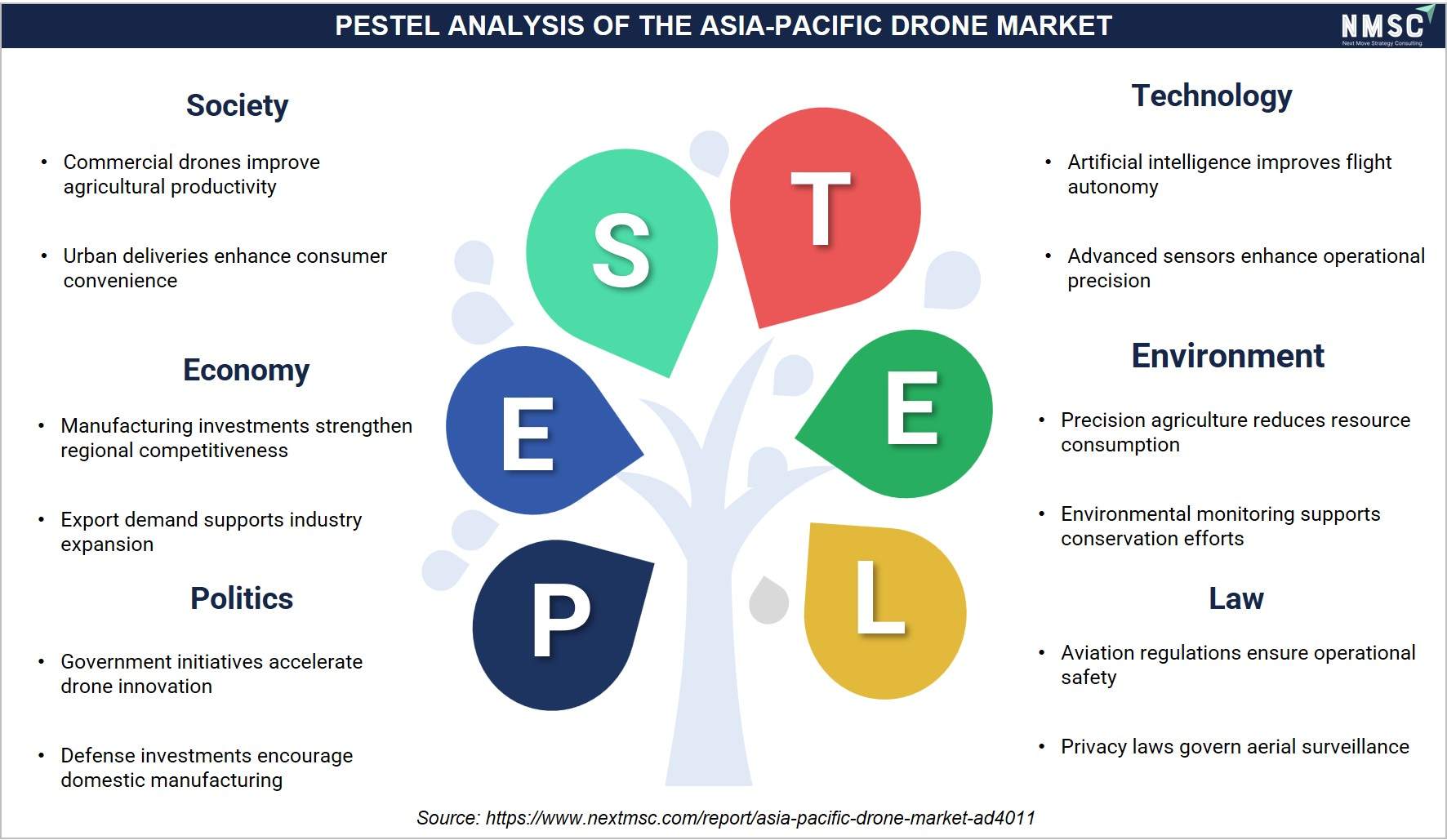
The above PESTEL analysis maps the key macro-environmental factors, such as political, economic, social, technological, environmental, and legal, shaping the Asia-Pacific drone market. From our analysis, we observed that political stability and government initiatives support drone adoption, while economic growth and increasing investments drive market expansion. Social acceptance and rapid technological advancements fuel innovation, whereas environmental regulations promote sustainable operations. Legal frameworks, including aviation laws and data privacy regulations, ensure compliance and safety, reflecting a comprehensive PESTEL landscape across the Asia-Pacific drone industry.
Key Segments
By Component
-
Hardware
-
Airframe
-
Avionics & Core Systems
-
Payloads & Sensors (Cameras, LiDAR, Multispectral, etc.)
-
Communication Systems (C2 Links)
-
-
Software
-
Flight Control & Autonomy
-
Data Processing & Analytics
-
Fleet Management
-
-
Services
-
Drone-as-a-Service (DaaS)
-
Training & Certification
-
Maintenance, Repair & Overhaul (MRO)
-
Data Processing Services
-
By Platform Type
-
Multi-Rotor
-
Fixed-Wing
-
Hybrid VTOL (Vertical Take-Off and Landing)
-
Single-Rotor (Helicopter)
-
Tethered UAV
-
Loitering Munition
-
MALE/HALE/UCAV
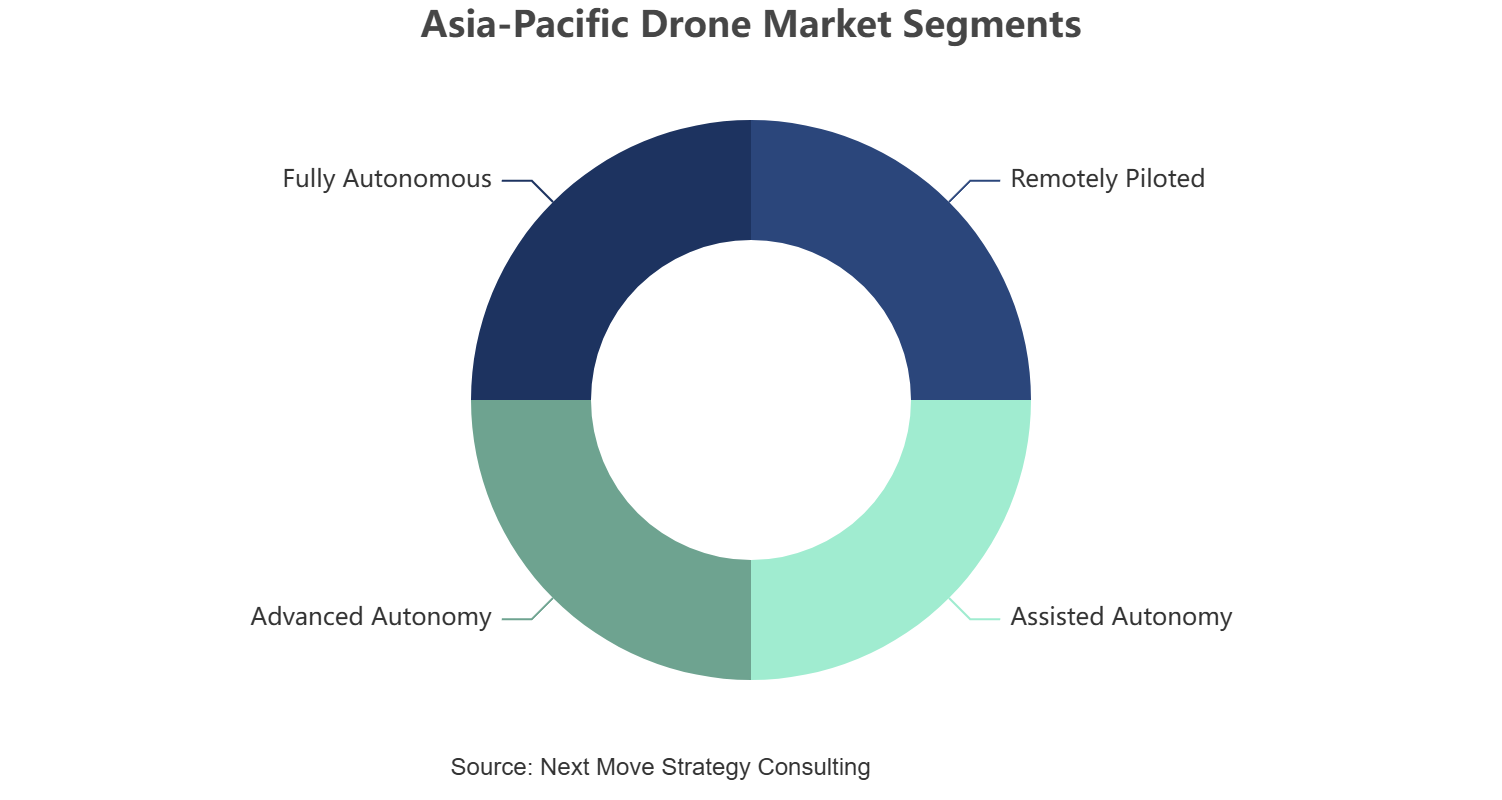
By Autonomy Level
-
Remotely Piloted
-
Assisted Autonomy
-
Advanced Autonomy
-
Fully Autonomous
By Maximum Takeoff Weight (MTOW)
-
Nano: < 250 g
-
Micro: 250 g – 2 kg
-
Small: > 2 kg – 25 kg
-
Medium: > 25 kg – 150 kg
-
Large: > 150 kg – 600 kg
-
Very Large/Tactical: > 600 kg
By Price/Performance Grade
-
Consumer Grade (< $1,000)
-
Prosumer Grade ($1,000 – $10,000)
-
Enterprise Grade ($10,000 – $100,000)
-
Military Grade (> $100,000)
By End-User
-
Consumer Drone
-
Commercial & Industrial Drone
-
Aerial Imaging & Cinematography
-
Surveying & Mapping (Geomatics)
-
Agricultural Applications (Spraying, Crop Monitoring)
-
Infrastructure Inspection (Energy, Utilities, Transport)
-
Logistics & Delivery (Package Transport)
-
Environmental & Scientific Monitoring
-
-
Government & Public Safety Drone
-
Emergency Response & Disaster Management
-
Law Enforcement & Security
-
Firefighting & Public Safety
-
Smart City Management
-
-
Military Drone
-
Intelligence, Surveillance & Reconnaissance (ISR)
-
Combat Operations
-
Electronic Warfare (EW)
-
Target Acquisition & Designation
-
Logistics & Resupply
-
Decoy & Countermeasure Systems
-
By Region
-
China
-
Japan
-
India
-
South Korea
-
Vietnam
-
Philippines
-
Malaysia
-
Australia
-
Indonesia
-
Taiwan
Competitive Landscape
The competitive landscape of the Asia-Pacific Drone Market is defined by a structural dynamic in which China-headquartered manufacturers command significant global manufacturing scale and cost advantages, while specialized regional players from Japan, India, South Korea, and Australia compete across niche commercial, agricultural, and defense application segments. Competitive differentiation is driven by manufacturing cost efficiency, agricultural platform specialization, defense procurement relationships, and software autonomy capability. The region’s competitive intensity is increasing as India’s emerging manufacturers gain domestic procurement support through PLI incentives and government industrial policy frameworks favoring domestic supply.
Strategic Developments:
-
August 2025 – EHang Holdings Limited signed an investment agreement with the Hefei government to establish a VT35 series pilotless eVTOL product hub in China. The facility will integrate R&D, testing, manufacturing, certification, and operations, strengthening EHang’s commercial drone production capabilities and supporting large-scale deployment of next-generation autonomous aerial vehicles.
-
June 2025 – EHang Holdings Limited partnered with Changchun Jingyue High-Tech Zone to deploy 41 EH216-S pilotless eVTOL aircraft for aerial tourism, emergency response, and urban mobility. The collaboration accelerates commercial drone deployment, expands low-altitude applications, and strengthens China’s autonomous aerial mobility ecosystem.
Key Players of the Asia-Pacific Drone Market:
-
SZ DJI Technology Co. Ltd.
-
Guangzhou XAG Co. Ltd.
-
EHang Holdings Limited
-
Autel Robotics Co. Ltd.
-
Chengdu JOUAV Automation Tech Co. Ltd.
-
Terra Drone Corporation
-
ideaForge Technology Limited
-
ACSL Ltd.
-
Garuda Aerospace Private Limited
-
Doosan Mobility Innovation Inc.
-
SkyDrive Inc.
-
Shenzhen Hubsan Technology Co. Ltd.
-
Skydio Inc.
-
Quantum-Systems GmbH
-
Flyability SA
-
Wingtra AG
-
Percepto Robotics Ltd.
-
Parrot Drone SAS
-
Thunder Tiger Corporation
-
DronesVision Inc.
Leading players shaping the Asia-Pacific Drone Market include SZ DJI Technology, Guangzhou XAG, EHang Holdings, Autel Robotics, Chengdu JOUAV Automation Tech, Terra Drone Corporation, ideaForge Technology, ACSL, and others competing through manufacturing scale, agricultural platform specialization, defense contract positioning, and autonomy software development to capture Asia-Pacific’s diverse and rapidly expanding drone market across commercial, government, and military end-user segments.
Key Benefits for Stakeholders
Next Move Strategy Consulting (NMSC) presents a comprehensive analysis of the Asia-Pacific Drone Market, spanning historical trends from 2020 through 2025 with detailed forecasts through 2035. The study delivers quantitative revenue and volume projections alongside qualitative insights across drone components, platform types, autonomy levels, MTOW classifications, price grades, and end-user segments. Manufacturers, defense contractors, agricultural operators, investors, and policymakers gain actionable intelligence to navigate Asia-Pacific’s complex and high-growth unmanned systems landscape.
Our market assessment equips investors with visibility into growth dynamics driven by China’s manufacturing scale, India’s policy-driven ecosystem expansion, and defense modernization across the region’s major economies. Agricultural drone operators and commercial service providers gain demand forecasting across MTOW categories, DaaS models, and precision agriculture applications. Defense contractors and government agencies benefit from end-user analysis enabling informed procurement and deployment planning across Asia-Pacific’s diverse and rapidly evolving drone application landscape.
|
Parameters |
Details |
|
Customization Scope |
Free customization (equivalent to up to 80 analyst-working hours) after purchase. |
|
Pricing and Purchase Options |
Avail customized purchase options to meet your exact research needs. |
|
Approach |
In-depth primary and secondary research; proprietary databases; rigorous quality control and validation measures. |
|
Analytical Tools |
Porter’s Five Forces, SWOT, value chain, and Harvey ball analysis to assess competitive intensity, stakeholder roles, and relative impact of key factors. |
Conclusion
The Asia-Pacific Drone Market represents the largest regional drone market globally by unit volume, with revenue projected to grow from USD 23.84 billion in 2025 to USD 69.73 billion by 2035 at a CAGR of 10.68%, and volume forecast to reach 4,518 thousand units at a CAGR of 14.52%. China’s manufacturing ecosystem, agricultural drone adoption, military modernization, and India’s emerging industrial policy framework are the primary growth catalysts. Regulatory fragmentation presents a near-term constraint, while Asia-Pacific’s competitive landscape intensifies as domestic manufacturers challenge global players across commercial and defense drone segments throughout the forecast period.
About the Author
 Mayurima Roy
— Mayurima Roy is Research Analyst at Next Move Strategy Consulting, where she has spent 4 years working across the firm's full industry coverage rather than a single fixed vertical. Her work centers on structured research, ongoing trend tracking, competitive assessment, and insight-led content development, translating complex market data into clear, decision-ready narratives that support informed client decision-making across diverse global industries, market sectors, and world regions every day.
Mayurima Roy
— Mayurima Roy is Research Analyst at Next Move Strategy Consulting, where she has spent 4 years working across the firm's full industry coverage rather than a single fixed vertical. Her work centers on structured research, ongoing trend tracking, competitive assessment, and insight-led content development, translating complex market data into clear, decision-ready narratives that support informed client decision-making across diverse global industries, market sectors, and world regions every day.
About the Reviewer
 Supradip Baul
— Supradip Baul is an accomplished business consultant and strategist with over a decade of rich experience in market intelligence, strategy, technology, and business transformation. His work has included rigorous qualitative and quantitative analysis across multiple industries, helping clients shape investment decisions and long-term roadmaps. Earlier in his career, he was associated with Gartner, where he contributed to industry-leading reports and market share analyses. He has worked with leading global companies and holds an MBA with a dual specialization in Marketing and Finance.
Supradip Baul
— Supradip Baul is an accomplished business consultant and strategist with over a decade of rich experience in market intelligence, strategy, technology, and business transformation. His work has included rigorous qualitative and quantitative analysis across multiple industries, helping clients shape investment decisions and long-term roadmaps. Earlier in his career, he was associated with Gartner, where he contributed to industry-leading reports and market share analyses. He has worked with leading global companies and holds an MBA with a dual specialization in Marketing and Finance.
At Next Move Strategy Consulting, we understand that insightful market research is the cornerstone of successful business decisions. That's why we employ a robust and multifaceted approach, combining various methodologies to deliver the most accurate and actionable data for our clients.

Research Landscape
We navigate the world of research with two primary approaches:
Qualitative Approach
Our qualitative research methodologies involve immersive techniques such as in-depth interviews, focus groups, and observational studies. By engaging directly with individuals and stakeholders, we uncover valuable insights that quantitative data alone may overlook.

Quantitative Research
In tandem with qualitative methodologies, NMSC leverages the power of Quantitative Research to provide a robust foundation of numerical insights. Through systematic data collection and analysis, we quantify patterns, preferences, and market trends, offering a comprehensive view of the business landscape.
Our quantitative research approach employs diverse tools, including surveys, experiments, and statistical modelling. These methodologies enable us to gather data from a large and representative sample, ensuring the statistical significance of our findings. By employing structured questionnaires and standardized data collection methods, we guarantee the reliability and validity of the information we present to our clients.
Quantitative research is particularly effective in measuring the prevalence of trends, assessing market size, and gauging the impact of various factors on consumer behavior. The numerical precision attained through this approach equips our clients with actionable insights, facilitating data-driven decision-making and strategy formulation.


Our Specialized Toolbox for Industry-Specific Market Research
We deploy a specialized arsenal of techniques tailored to meet your unique requirements. Here's a glimpse into our comprehensive toolbox:

Information Procurement
The stage entails acquiring market data or relevant information through various sources and methodologies.


Market Research Approach
We utilize both top-down and bottom-up approaches in market research analysis to achieve a comprehensive understanding of the market dynamics, leveraging the broad perspective of industry trends and macroeconomic factors alongside detailed insights from specific segments and individual companies.

Porters Five Forces Analysis
We conduct Porter's Five Forces analysis to evaluate the competitive landscape of an industry, providing us with insights into factors that affect profitability and strategic positioning.

SWOT Analysis

Forecasting
We utilize a forecasting model to predict future consumption by considering parameters like population, economics, regulations, market competition, drivers, constraints, technology, and pricing. We also employ statistical techniques such as multilinear regression, exponential smoothing, moving average, ARIMA, and Monte Carlo simulations for accurate predictions. In econometric forecasting, we analyzed short-term and long-term event impacts, attributing values based on regulatory frameworks, economic factors, and market events.





 Speak to Our Analyst