Asia-Pacific Expense Management Software Market By Product Type (Travel & Expense, Corporate & Virtual Card, and Finance & ERP Embedded Modules), By Revenue Stream (Software, Professional Services, and Card & Payment), By Deployment Model (Cloud, On-premises, and Hybrid), By Functional Modules (Expense Capture & OCR, Policy Controls, Reconciliation, Analytics & Fraud Detection, & Others), By Pricing Model, By Enterprise Size, and By Industry Vertical – Opportunity Analysis & Forecast, 2026-2035
Industry: ICT & Media | Latest Edition: September 10, 2026 | No of Pages: 416 | No. of Tables: 165 | No. of Figures: 157 | Format: PDF | Report Code: IC4861
Asia-Pacific Expense Management Software Market Size & Forecast
|
Parameters |
Details |
|
Market Size in 2026 |
USD 2.11 Billion |
|
Revenue Forecast in 2035 |
USD 5.57 Billion |
|
Growth Rate |
CAGR of 11.37% from 2026 to 2035 |
|
Analysis Period |
2025–2035 |
|
Base Year Considered |
2025 |
|
Forecast Period |
2026–2035 |
|
Market Size Estimation |
Billion (USD) |
|
Companies Profiled |
15 |
|
Market Share |
Available for 10 companies |
Industry Outlook
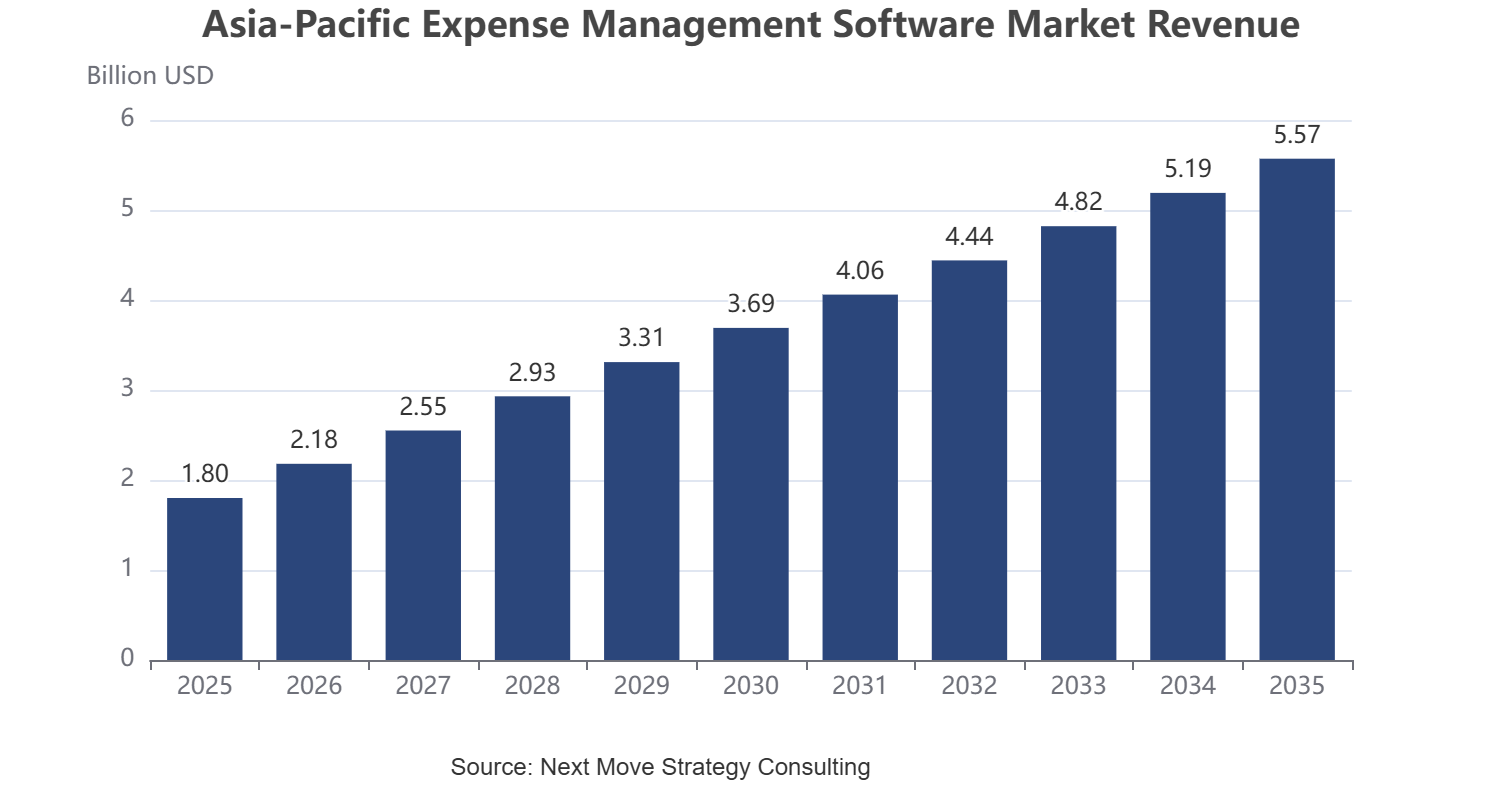
The Asia-Pacific Expense Management Software Market size was valued at USD 1.80 billion in 2025 and is expected to reach USD 2.11 billion by 2026. Looking ahead, the industry is projected to expand significantly, reaching USD 5.57 billion by 2035, registering a CAGR of 11.37% from 2026 to 2035.
What are the Key Market Drivers, Breakthroughs, and Investment Opportunities that will Shape the Asia-Pacific Expense Management Software Market in the Next Decade?
Growth Catalyst & Risk Assessment Matrix
|
DRIVERS / TRENDS / RESTRAINTS |
(+/-) % IMPACT ON CAGR FORECAST |
GEOGRAPHIC RELEVANCE |
IMPACT TIMELINE |
|
Rapid enterprise digitization and cloud migration are accelerating adoption of automated expense management platforms across enterprises of Asia-Pacific expense management software market |
+3.88% |
Singapore, Tokyo, Sydney, Seoul, Bengaluru, Jakarta, Shanghai, and major enterprise technology corridors across Asia-Pacific |
Medium to Long term (3–6 years) |
|
Expanding SME ecosystems are increasing demand for affordable, scalable, and cloud-native SaaS expense management solutions |
+3.46% |
Emerging SME and startup hubs across India, Indonesia, Vietnam, Thailand, Malaysia, and the Philippines |
Medium term (2–5 years) |
|
Data localization requirements and evolving regulatory compliance frameworks are increasing demand for secure and audit-ready expense management systems |
+3.63% |
Nationwide across Asia-Pacific with stronger impact in regulated and enterprise-intensive markets such as China, India, Singapore, Japan, and Australia |
Medium to Long term (3–6 years) |
|
Diverse regulatory structures and uneven digital maturity levels complicate regional standardization and enterprise-wide deployment strategies |
-3.34% |
Region-wide, with stronger impact across developing economies and fragmented compliance environments |
Short to Medium term (1–4 years) |
|
Offer localized, mobile-first expense management platforms tailored to multilingual and emerging Asia-Pacific workforce environments |
+3.02% |
Southeast Asia, South Asia, and digitally emerging enterprise regions across Asia-Pacific |
Medium to Long term (3–6 years) |
The Asia-Pacific expense management software market is undergoing significant transformation as enterprises accelerate digital finance modernization and migrate toward integrated cloud-based operational ecosystems. Through our market assessment, we observed that organizations across the region are moving beyond conventional reimbursement digitization toward intelligent expense management platforms that support policy enforcement, real-time approvals, audit readiness, and centralized spend visibility. Businesses are increasingly adopting these solutions to streamline travel expense management, employee reimbursements, tax documentation, corporate card reconciliation, and multi-department financial workflows across geographically distributed operations. The market is further supported by rapid enterprise digitization, expanding SME adoption of scalable SaaS platforms, and increasing demand for secure, compliance-ready financial systems aligned with evolving regional regulatory frameworks. Looking ahead, growth opportunities are expected to strengthen through localized mobile-first platforms, AI-enabled automation capabilities, and flexible deployment models tailored to the diverse operational, linguistic, and compliance requirements of emerging and mature Asia-Pacific economies.
Growth Drivers:
How Is Rapid Enterprise Digitization and Cloud Migration Accelerating the Asia-Pacific Expense Management Software Market?
Rapid enterprise digitization and expanding cloud migration initiatives are significantly accelerating the Asia-Pacific expense management software market as organizations modernize financial operations and transition toward integrated digital workflow ecosystems. Through our market assessment, we observed that enterprises across Asia-Pacific are increasingly replacing manual reimbursement processes and fragmented accounting systems with cloud-based expense automation platforms capable of supporting real-time approvals, centralized spend visibility, and policy-driven financial governance. Businesses are prioritizing scalable SaaS environments that improve operational agility while reducing infrastructure dependency and administrative inefficiencies. Our analysis shows that the expansion of hybrid work models, cross-border business activity, and digital finance transformation strategies is further increasing demand for mobile-first expense management capabilities integrated with ERP, HRMS, and payment ecosystems. Additionally, enterprises are leveraging AI-enabled analytics and automated reconciliation tools to strengthen audit readiness and improve decision-making transparency. This ongoing digital transformation momentum continues to position expense management software as a strategic component of enterprise finance modernization across the Asia-Pacific region.
How Is the Expanding SME Ecosystem Driving Demand for Expense Management Software Across Asia-Pacific?
The rapid expansion of SMEs across Asia-Pacific is creating substantial demand for affordable and scalable expense management software solutions capable of supporting financial efficiency and operational transparency. Based on our market evaluation, SMEs throughout the region are increasingly seeking cloud-native platforms that simplify reimbursement processing, automate expense approvals, and reduce reliance on manual bookkeeping practices. Businesses are prioritizing subscription-based SaaS models that offer lower implementation complexity, flexible pricing structures, and mobile accessibility suitable for evolving operational requirements. Our analysis indicates that digitally emerging enterprises in sectors such as retail, logistics, technology services, and professional consulting are adopting expense management tools to improve spend control and strengthen financial accountability across distributed teams. NMSC’s findings suggest that growing awareness surrounding compliance management, tax documentation, and digital audit readiness is further encouraging SMEs to integrate expense automation into broader business transformation strategies. This expanding SME digitization landscape remains a critical long-term growth catalyst for the Asia-Pacific expense management software market.
How Are Data Localization and Regulatory Restrictions Influencing the Asia-Pacific Expense Management Software Market?
Data localization mandates and evolving regulatory compliance frameworks are increasingly shaping adoption dynamics and vendor strategies across the Asia-Pacific expense management software market. Through our analysis, we observe that enterprises are placing stronger emphasis on secure financial data management, localized hosting infrastructure, and compliance-ready software architectures capable of aligning with country-specific governance requirements. Organizations operating across multiple Asia-Pacific jurisdictions are prioritizing expense management platforms that support regional tax documentation standards, electronic invoicing regulations, cybersecurity protections, and digital audit transparency. At the same time, vendors are strengthening partnerships with local cloud providers, system integrators, and regional technology ecosystems to improve compliance alignment and operational adaptability. Our assessment further indicates that regulatory complexity is encouraging demand for configurable expense management environments capable of supporting multi-country policy enforcement and localized financial reporting workflows. These evolving compliance expectations are transforming regulatory readiness into a critical competitive differentiator throughout the Asia-Pacific enterprise finance technology landscape.
Growth Inhibitor:
How Do Diverse Regulatory and Digital Maturity Levels Restrain the Asia-Pacific Expense Management Software Market Growth?
Diverse regulatory structures and uneven digital maturity levels across Asia-Pacific remain significant restraints limiting seamless standardization within the expense management software market. Based on our assessment, enterprises operating across multiple countries frequently encounter challenges related to fragmented tax frameworks, varying electronic invoicing requirements, inconsistent cybersecurity regulations, and differing cloud adoption readiness levels. These complexities increase implementation timelines and create operational difficulties for vendors attempting to deliver unified regional solutions. Our analysis shows that businesses in digitally mature markets often demand advanced AI-enabled automation and integrated analytics capabilities, while organizations in developing economies may still rely on legacy accounting systems and manual reimbursement workflows. Additionally, language diversity, localized financial processes, and uneven IT infrastructure readiness complicate large-scale deployment and platform integration strategies across the region. These factors collectively slow enterprise-wide standardization efforts and require software providers to adopt highly localized operational models to effectively address varying market conditions throughout Asia-Pacific.
Growth Opportunity:
How Can Localized Mobile-First Platforms Unlock New Opportunities in the Asia-Pacific Expense Management Software Market?
The growing demand for localized, mobile-first expense management platforms presents a major growth opportunity across emerging Asia-Pacific markets as enterprises increasingly prioritize workforce mobility and digital financial accessibility. Through our market assessment, we observed that businesses operating in rapidly digitizing economies are seeking intuitive cloud-based platforms capable of supporting multilingual interfaces, localized compliance workflows, and region-specific payment integrations. Mobile-first expense management solutions are becoming particularly important for organizations managing field employees, distributed sales teams, and hybrid workforces requiring real-time reimbursement processing and remote approval functionality. Our analysis further indicates that enterprises are favoring platforms offering simplified onboarding, AI-enabled receipt capture, and scalable SaaS deployment models tailored to local operational requirements. NMSC’s findings suggest that vendors capable of balancing affordability, compliance readiness, and seamless mobile usability will be well-positioned to strengthen market penetration across emerging Asia-Pacific economies, where digital finance modernization and smartphone-centric workforce behavior continue accelerating enterprise software adoption.
Ecosystem Analysis of the Asia-Pacific Expense Management Software Market
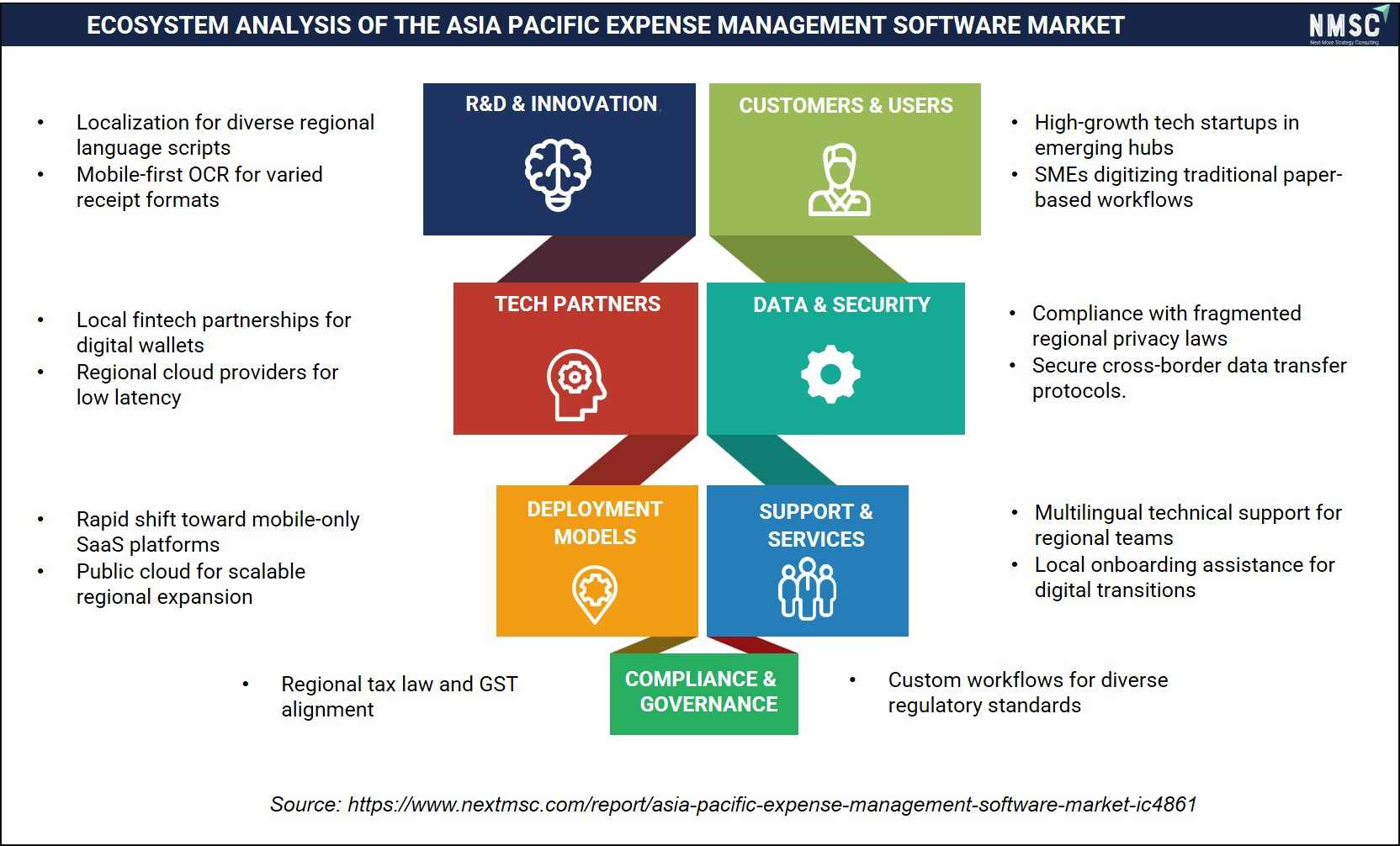
This ecosystem analysis is structured around seven interconnected components that collectively define the Asia-Pacific expense management software market landscape. R&D & Innovation drives product advancement through AI, automation, and continuous feature development. Customers & Users represent enterprises, SMEs, and individual employees whose adoption behaviors shape market demand. Tech Partners include ERP providers, cloud platforms, and integration specialists enabling seamless connectivity. Data & Security encompasses encryption standards, privacy compliance, and protection against cyber threats. Deployment Models range from cloud-native and hybrid to on-premise solutions tailored to organizational needs. Support & Services covers technical assistance, managed services, user training, and system uptime maintenance. Compliance & Governance ensures adherence to regional tax laws, data protection regulations, and government auditing standards across diverse Asia-Pacific jurisdictions.
Which Country Is Dominating the Asia-Pacific Expense Management Software Market?
Through our market assessment, we observed that China holds the dominant position in the Asia-Pacific expense management software market due to its large enterprise ecosystem, rapid digital transformation across finance operations, and widespread adoption of cloud-based business management platforms. The country benefits from strong demand for automated expense reporting, AI-enabled reimbursement systems, and integrated financial workflow solutions, particularly among large enterprises and expanding multinational organizations managing complex employee spending structures.
Furthermore, this dominance is supported by China’s accelerating enterprise digitization initiatives, increasing use of mobile-first financial applications, and the growing integration of expense management platforms with ERP, tax compliance, and e-invoicing systems. In addition, businesses across sectors are increasingly prioritizing real-time expense visibility, policy-based approval automation, and centralized financial governance to improve operational efficiency and compliance management, further reinforcing China’s leading share in the Asia-Pacific expense management software market.
Which Country Is Set to Witness the Fastest Growth?
Indonesia is emerging as the fastest-growing country in the Asia-Pacific expense management software market, supported by rapid digitalization across enterprises and increasing adoption of automated financial management solutions. Indonesian organizations are steadily transitioning from paper-based and manual expense tracking processes toward cloud-enabled platforms that improve reimbursement efficiency, strengthen policy compliance, and enhance real-time visibility into employee spending.
In our observation, Indonesia’s growth is also being driven by the expanding adoption of mobile-first business applications, rising cloud infrastructure investments, and the growing integration of expense management tools with accounting, payroll, and ERP systems. Small and medium-sized enterprises, in particular, are demonstrating increasing demand for scalable and subscription-based expense management solutions that provide operational flexibility, simplified financial reporting, and improved control over business expenditures, positioning Indonesia as a high-growth market within the Asia-Pacific region.
How is the Asia-Pacific Expense Management Software Market segmented in this report, and what are the key insights from the segmentation analysis?
By Revenue Stream Insights
How Do Revenue Streams Shape the Asia-Pacific Expense Management Software Market in 2025?
Based on revenue stream segmentation, the Asia-Pacific expense management software market is structured into Software and License Revenue, Professional Services Revenue, and Card and Payment Revenue.
Through our market assessment, it is observed that Software and License Revenue remains foundational, driven by enterprise demand for scalable cloud-based subscription models that reduce upfront capital expenditure. Our analysis shows that Professional Services Revenue is expanding steadily, as organizations increasingly require implementation support, system integration, and user training to maximize platform value. NMSC’s findings suggest that Card and Payment Revenue is emerging as a transformative stream, with integrated corporate card solutions enabling real-time spend tracking, automated reconciliation, and improved working capital management across the region. Together, these three revenue streams reflect a maturing market where software access, service enablement, and transaction-based offerings converge to create comprehensive financial ecosystems for Asia-Pacific enterprises.
By Deployment Models Insights
How Do Deployment Models Influence the Asia-Pacific Expense Management Software Market in 2025?
Based on deployment model segmentation, the Asia-Pacific expense management software market is structured into Cloud, On-premises, and Hybrid.
Through our market assessment, it is observed that Cloud deployment continues to gain accelerated adoption across the region, driven by demand for real-time accessibility, automatic updates, and reduced IT infrastructure burden. Our analysis shows that On-premises deployment remains relevant for regulated industries and large enterprises with strict data sovereignty requirements, particularly in markets where government policies mandate domestic data storage. NMSC’s findings suggest that Hybrid deployment is emerging as the preferred middle ground, combining cloud scalability with on-premises security controls, allowing organizations to maintain sensitive financial data locally while leveraging cloud-based analytics and reporting capabilities. This three-tier deployment landscape reflects the diverse regulatory, operational, and security priorities shaping enterprise technology decisions across developed and emerging Asia-Pacific economies.
Competitive Landscape
The Asia-Pacific expense management software industry exhibits a fragmented yet rapidly consolidating structure, characterized by a mix of global enterprise software giants, regional incumbents, and agile local fintech disruptors. Through our market assessment, we observed that intensifying digitalisation of corporate finance functions, the growing integration of embedded insurance into spend management platforms, and a sustained rebound in regional business travel demand are collectively reshaping competitive priorities. NMSC’s findings suggest that vendors are increasingly evaluated not merely on core automation capabilities but on their ability to deliver unified ecosystems that span expense tracking, policy enforcement, real-time reconciliation, and ancillary financial services, thereby accelerating differentiation across the competitive matrix.
Strategic Developments:
-
May 2026 – Workday announced sustained workforce expansion in India, with headcount more than doubling to 1,300 employees over 12–14 months. The company serves over 1,800 customers in India and is deepening AI investments across expense management workflows.
-
January 2026 – Airwallex acquired South Korean payments firm Paynuri to deepen its Asia expansion. The acquisition provided critical payment gateway and foreign-exchange licenses, enabling direct regional operations. Strategically, the deal enhanced Airwallex’s ability to scale integrated spend-management and cross-border financial services throughout Asia-Pacific markets.
-
December 2025 – Zoho Corporation unveiled Zoho Spend and Zoho Billing Enterprise, bringing AI-driven unified spend management and enterprise billing capabilities to large firms across Asia-Pacific.
-
October 2025 – Concur Technologies (Australia) Pty Limited expanded its strategic alliance with American Express Global Business Travel through the launch of “Complete by SAP Concur and Amex GBT.” The integrated solution combines booking, payments, servicing, and expensing into a unified AI-enabled platform for corporate travel management modernization in Australia.
-
April 2025 – Money Forward, Inc. announced its “Money Forward AI Vision 2025” strategy, introducing AI Agent and AI Agent Platform capabilities for expense, accounting, and workflow automation. The initiative strengthens AI-led back-office transformation and enhances automated reimbursement and approval processing across Japanese enterprises.
Key Players of the Asia-Pacific Expense Management Software Market
-
Coupa Software India Private Limited
-
Paylocity Holding Corporation
-
Sage Software Solutions Private Limited
-
Workday India Private Limited
-
Zoho Corporation Private Limited
-
BILL Operations, LLC
-
Rydoo NV
-
Airwallex Shanghai Network Technology Co., Ltd.
-
Concur Technologies Australia Pty Limited
-
freee K.K.
-
Sansan, Inc.
-
Zaggle Prepaid Ocean Services Limited
-
PT Mid Solusi Nusantara Mekari
The competitive trajectory of the Asia-Pacific expense management software market is increasingly defined by strategic bifurcation between global scale players and deeply localized specialists. Our analysis shows that Coupa Software India Private Limited continues to leverage its unified business spend management platform to capture large enterprise accounts, while Workday India Private Limited integrates expense management within broader financial and human capital ecosystems to drive cross-sell efficiencies. Sage Software Solutions Private Limited and Zoho Corporation Private Limited maintain strong SME footholds through affordable, modular solutions tailored to diverse regional tax regimes. Simultaneously, Paylocity Holding Corporation and BILL Operations, LLC are expanding their APAC footprints by emphasizing payroll-expense integration and AP automation, respectively. Rydoo NV and Concur Technologies Australia Pty Limited are doubling down on travel-expense convergence, while Airwallex Shanghai Network Technology Co., Ltd. differentiates through embedded cross-border payment and card infrastructure. In mature markets, Money Forward, Inc., freee K.K., and Sansan, Inc. dominate Japan’s localized compliance landscape, whereas Zaggle Prepaid Ocean Services Limited and PT Mid Solusi Nusantara Mekari lead in India and Indonesia through prepaid card-linked expense tools. Expensify Australia Pty Ltd and others are pivoting toward AI-driven audit and real-time policy controls. NMSC’s findings suggest that sustained competitive advantage will accrue to players that successfully balance global integration standards with hyper-local regulatory agility and embedded financial service innovation.
Strategic Framework of the Asia-Pacific Expense Management Software Market
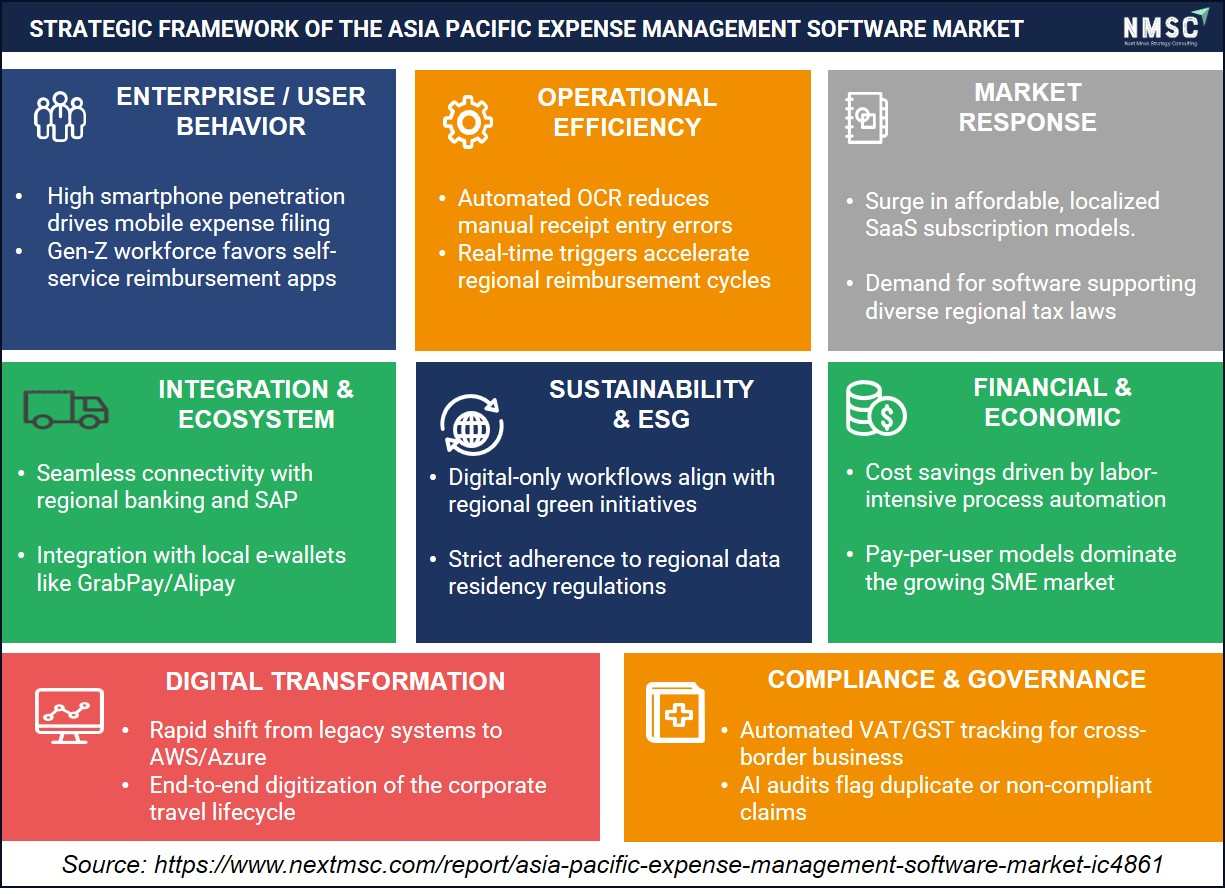
The strategic framework of the Asia-Pacific expense management software market is built on eight interconnected pillars. Enterprise and user behavior is shaped by high smartphone penetration driving mobile expense filing, while the Gen-Z workforce favors self-service reimbursement apps. Operational efficiency is achieved through automated OCR reducing manual receipt entry errors, and real-time triggers accelerate regional reimbursement cycles. Market response features a surge in affordable, localized SaaS subscription models, alongside demand for software supporting diverse regional tax laws. Integration and ecosystem enables seamless connectivity with regional banking and SAP, as well as integration with local e-wallets like GrabPay and Alipay. Sustainability and ESG is supported by digital-only workflows aligning with regional green initiatives, coupled with strict adherence to regional data residency regulations. Financial and economic drivers include cost savings from labor-intensive process automation, while pay-per-user models dominate the growing SME market. Digital transformation reflects a rapid shift from legacy systems to AWS and Azure, enabling end-to-end digitization of the corporate travel lifecycle. Compliance and governance incorporates automated VAT/GST tracking for cross-border business, with AI audits flagging duplicate or non-compliant claims.
Asia-Pacific Expense Management Software Market Key Segments
By Product Type
-
Travel and Expense Management Platform
-
Corporate and Virtual Card Platform
-
Finance and ERP Embedded Expense Modules
By Revenue Stream
-
Software and License Revenue
-
Professional Services Revenue
-
Implementation and Integration
-
Consulting and Training
-
Managed and Support Services
-
Transactional Processing and BPO
-
-
Card and Payment Revenue
-
Interchange and Card Revenue Share
-
Card Processing Commissions and Fees
-
Card Platform Fees
-
By Deployment Model
-
Cloud
-
On-premises
-
Hybrid
By Functional Modules
-
Expense Capture and Receipt OCR
-
Policy Controls and Approval Workflow
-
Reconciliation and Matching
-
Dispute and Exception Management
-
Ordering and Provisioning Inventory
-
Usage Monitoring and Chargeback
-
Analytics, Audit and Fraud Detection
By Pricing Model
-
Per-User
-
Per-Transaction
-
Tiered Organization ARR
-
Per-module
-
Other Monetization Models
By Enterprise Size
-
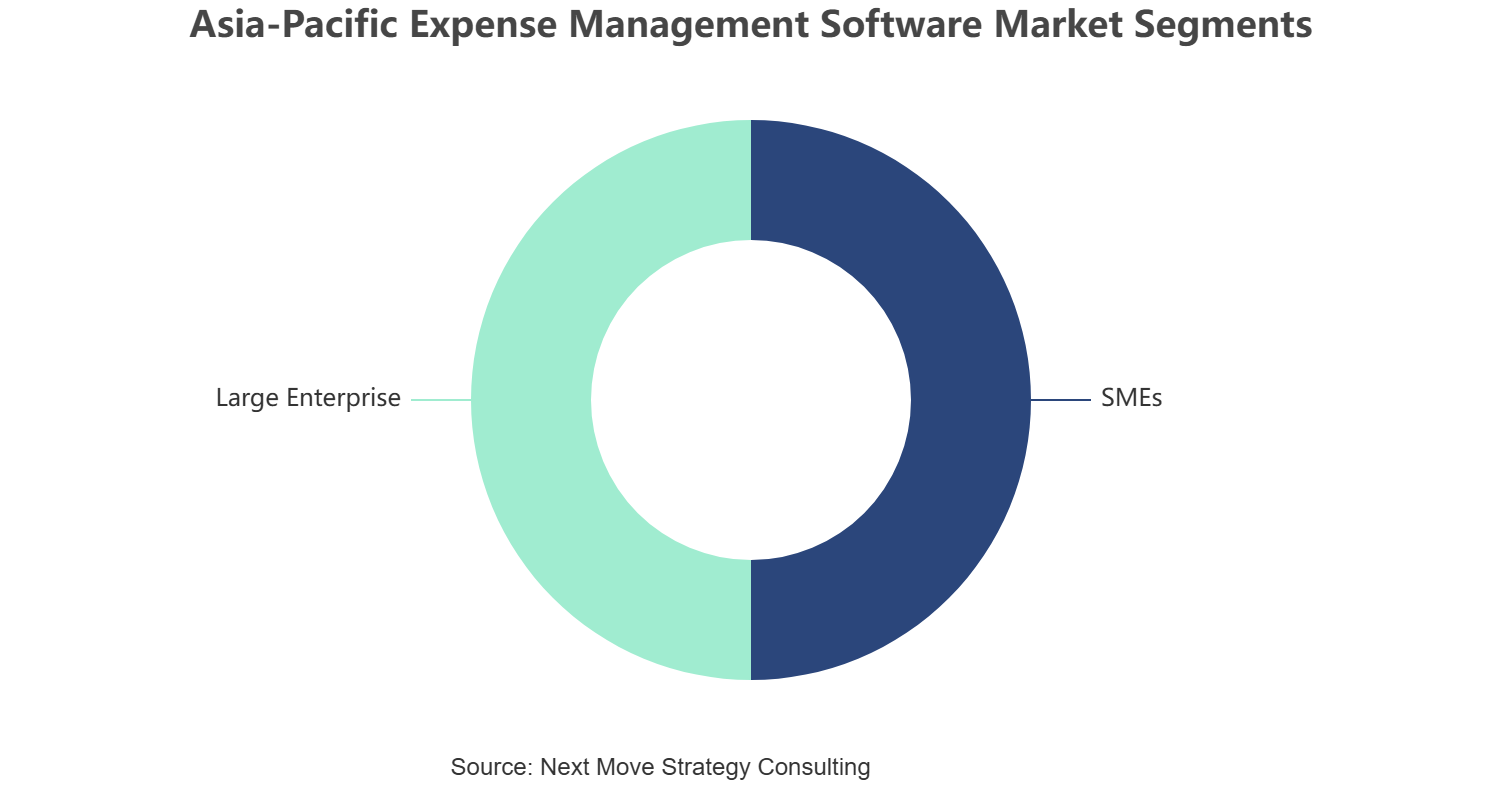
SMEs
-
Large Enterprise
By Industry Vertical
-
BFSI
-
Information Technology and Telecom
-
Manufacturing and Industrials
-
Retail and E-commerce
-
Healthcare and Life Sciences
-
Government and Public Sector
-
Hospitality, Travel and Leisure
-
Energy and Utilities
-
Education and Non-Profit
-
Transportation and Logistics
-
Professional Services and Consulting
-
Other Industries
Key Benefits for Stakeholders:
Next Move Strategy Consulting (NMSC) presents a comprehensive analysis of the Asia-Pacific expense management software market trends, covering historical developments from 2020 to 2025 and providing forward-looking forecasts through 2035. The study evaluates the market at national and enterprise levels, delivering qualitative insights into cloud adoption, AI-enabled financial automation, regulatory compliance evolution, and enterprise digital transformation shaping expense governance across industries.
Based on our assessment of the Asia-Pacific expense management software market, we observe substantial value creation across investors, enterprises, and policymakers as organizations accelerate digital finance transformation and cloud-based workflow modernization. Investors benefit from scalable SaaS revenue models, expanding enterprise digitization across emerging economies, and stronger long-term revenue visibility supported by recurring subscription structures. Customers gain operational efficiency through automated reimbursements, centralized spend governance, improved fraud monitoring, and enhanced financial transparency across distributed workforces and cross-border operations. From a policy perspective, regulators benefit from stronger digital audit trails, improved compliance management, and enhanced financial reporting transparency aligned with evolving regional data governance, e-invoicing, and enterprise modernization initiatives across Asia-Pacific economies.
|
Parameters |
Details |
|
Customization Scope |
Free customization (equivalent to up to 80 analyst-working hours) after purchase. |
|
Pricing and Purchase Options |
Avail customized purchase options to meet your exact research needs. |
|
Approach |
In-depth primary and secondary research; proprietary databases; rigorous quality control and validation measures. |
|
Analytical Tools |
Porter's Five Forces, SWOT, value chain, and Harvey ball analysis to assess competitive intensity, stakeholder roles, and relative impact of key factors. |
About the Author
 Ridip Gogoi
— Ridip Gogoi is a Research Associate at Next Move Strategy Consulting, where he supports cross-vertical market research and analysis across multiple industry sectors, with four years of experience. His work includes market analysis, data validation, secondary research, and insight development, helping structure evidence into clear findings for business and strategy decisions. He contributes to research quality checks and reporting, with a focus on consistency, source review, and clarity accuracy.
Ridip Gogoi
— Ridip Gogoi is a Research Associate at Next Move Strategy Consulting, where he supports cross-vertical market research and analysis across multiple industry sectors, with four years of experience. His work includes market analysis, data validation, secondary research, and insight development, helping structure evidence into clear findings for business and strategy decisions. He contributes to research quality checks and reporting, with a focus on consistency, source review, and clarity accuracy.
About the Reviewer
 Supradip Baul
— Supradip Baul is an accomplished business consultant and strategist with over a decade of rich experience in market intelligence, strategy, technology, and business transformation. His work has included rigorous qualitative and quantitative analysis across multiple industries, helping clients shape investment decisions and long-term roadmaps. Earlier in his career, he was associated with Gartner, where he contributed to industry-leading reports and market share analyses. He has worked with leading global companies and holds an MBA with a dual specialization in Marketing and Finance.
Supradip Baul
— Supradip Baul is an accomplished business consultant and strategist with over a decade of rich experience in market intelligence, strategy, technology, and business transformation. His work has included rigorous qualitative and quantitative analysis across multiple industries, helping clients shape investment decisions and long-term roadmaps. Earlier in his career, he was associated with Gartner, where he contributed to industry-leading reports and market share analyses. He has worked with leading global companies and holds an MBA with a dual specialization in Marketing and Finance.
At Next Move Strategy Consulting, we understand that insightful market research is the cornerstone of successful business decisions. That's why we employ a robust and multifaceted approach, combining various methodologies to deliver the most accurate and actionable data for our clients.

Research Landscape
We navigate the world of research with two primary approaches:
Qualitative Approach
Our qualitative research methodologies involve immersive techniques such as in-depth interviews, focus groups, and observational studies. By engaging directly with individuals and stakeholders, we uncover valuable insights that quantitative data alone may overlook.

Quantitative Research
In tandem with qualitative methodologies, NMSC leverages the power of Quantitative Research to provide a robust foundation of numerical insights. Through systematic data collection and analysis, we quantify patterns, preferences, and market trends, offering a comprehensive view of the business landscape.
Our quantitative research approach employs diverse tools, including surveys, experiments, and statistical modelling. These methodologies enable us to gather data from a large and representative sample, ensuring the statistical significance of our findings. By employing structured questionnaires and standardized data collection methods, we guarantee the reliability and validity of the information we present to our clients.
Quantitative research is particularly effective in measuring the prevalence of trends, assessing market size, and gauging the impact of various factors on consumer behavior. The numerical precision attained through this approach equips our clients with actionable insights, facilitating data-driven decision-making and strategy formulation.


Our Specialized Toolbox for Industry-Specific Market Research
We deploy a specialized arsenal of techniques tailored to meet your unique requirements. Here's a glimpse into our comprehensive toolbox:

Information Procurement
The stage entails acquiring market data or relevant information through various sources and methodologies.


Market Research Approach
We utilize both top-down and bottom-up approaches in market research analysis to achieve a comprehensive understanding of the market dynamics, leveraging the broad perspective of industry trends and macroeconomic factors alongside detailed insights from specific segments and individual companies.

Porters Five Forces Analysis
We conduct Porter's Five Forces analysis to evaluate the competitive landscape of an industry, providing us with insights into factors that affect profitability and strategic positioning.

SWOT Analysis

Forecasting
We utilize a forecasting model to predict future consumption by considering parameters like population, economics, regulations, market competition, drivers, constraints, technology, and pricing. We also employ statistical techniques such as multilinear regression, exponential smoothing, moving average, ARIMA, and Monte Carlo simulations for accurate predictions. In econometric forecasting, we analyzed short-term and long-term event impacts, attributing values based on regulatory frameworks, economic factors, and market events.





 Speak to Our Analyst