Asia-Pacific Food Robotics Market By Robot Kinematic Structure (Articulated Robots, Cartesian Robots, SCARA Robots and Others), By Mobility (Fixed Robots, Autonomous Mobile Robots and Hybrid-Fixed Mobile Systems), By Technology Stack (Perception Layer, Intelligence Layer and Control & Integration Layer), By Payload Capacity (Ultra-Low, Low, and Others), By End-User (Primary Food Production, Food Processing & Manufacturing, and Others) – Opportunity Analysis & Forecast, 2025–2035
Industry: Retail and Consumer | Latest Edition: June 24, 2026 | No of Pages: 948 | No. of Tables: 478 | No. of Figures: 458 | Format: PDF | Report Code: RC4761
Asia-Pacific Food Robotics Market Size & Forecast
|
Parameters |
Details |
|
Market Size in 2026 |
USD 1.93 Billion |
|
Revenue Forecast in 2035 |
USD 8.28 Billion |
|
Growth Rate |
CAGR of 17.57% from 2026 to 2035 |
|
Market Volume in 2026 |
66 Thousand Units |
|
Volume Forecast in 2035 |
340 Thousand Units |
|
Volume Growth Rate |
CAGR of 19.93% from 2026 to 2035 |
|
Analysis Period |
2025–2035 |
|
Base Year Considered |
2025 |
|
Forecast Period |
2026–2035 |
|
Market Size Estimation |
Billion (USD) |
|
Countries Covered |
10 |
|
Companies Profiled |
15 |
|
Market Share |
Available for 10 companies |
Industry Outlook
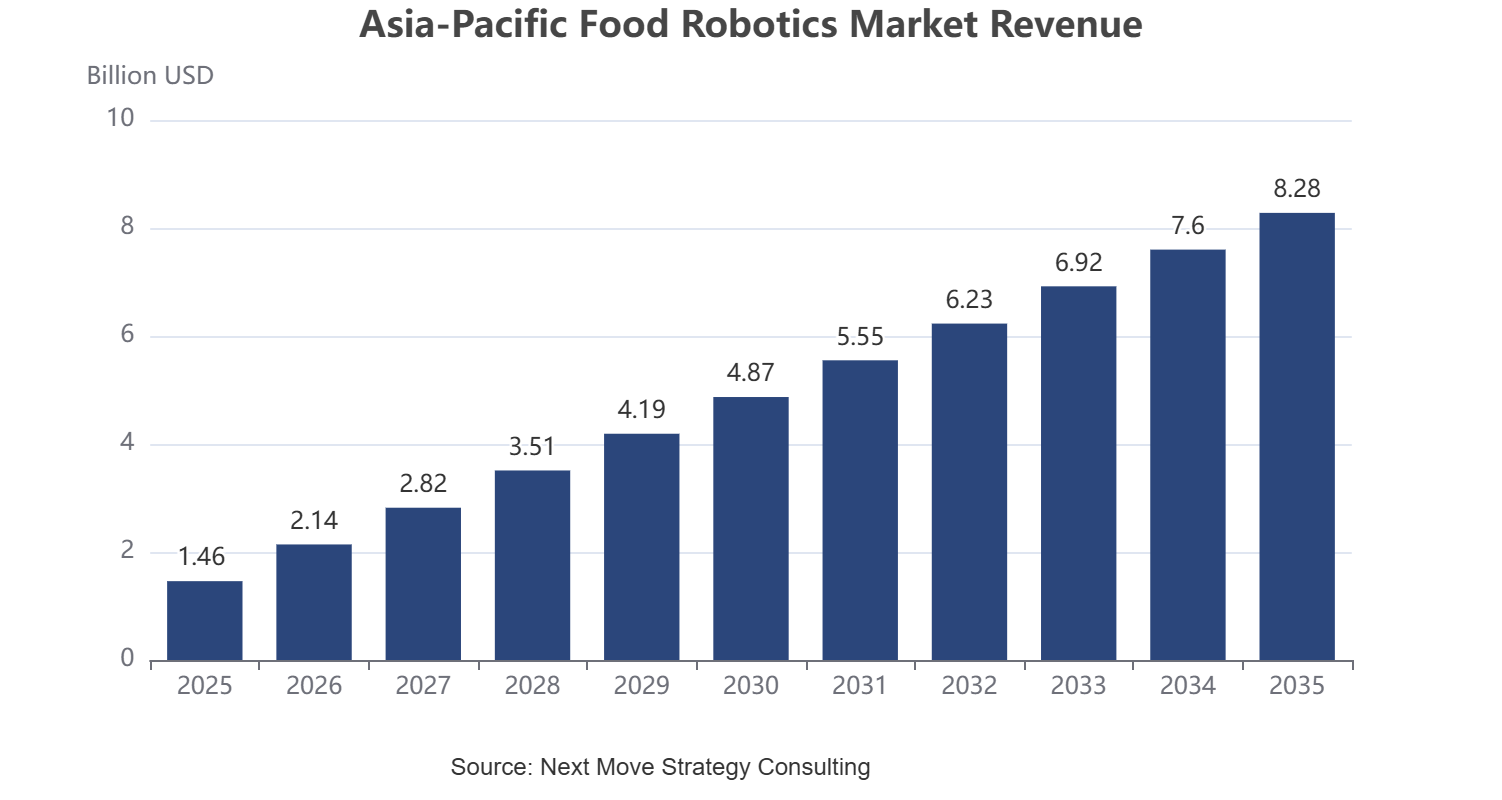
The Asia-Pacific Food Robotics Market size was valued at USD 1.46 Billion in 2025 and is expected to reach USD 1.93 Billion by 2026. Looking ahead, the industry is projected to expand significantly, reaching USD 8.28 Billion by 2035, registering a CAGR of 17.57% from 2026 to 2035. In terms of volume, the market recorded 49 thousand units in 2025, with forecasts indicating growth to 66 thousand units by 2026 and further to 340 thousand units by 2035, reflecting a CAGR of 19.93% over the same period.
What are the Key Market Drivers, Breakthroughs, and Investment Opportunities that will Shape the Food Robotics Industry in the Next Decade?
Growth Catalyst & Risk Assessment Matrix
|
DRIVERS / TRENDS / RESTRAINTS |
(+/–) % IMPACT ON CAGR FORECAST |
GEOGRAPHIC RELEVANCE |
IMPACT TIMELINE |
|
Acute labour shortages in major Asia-Pacific food processing hubs driving adoption of collaborative robots and articulated systems to stabilise throughput and reduce dependency on manual labour |
+1.3% |
Major food processing clusters and industrial hubs across Asia-Pacific |
Short to medium term (1–3 years) |
|
Rising regulatory pressure and stringent food safety mandates accelerating adoption of machine vision–enabled robotics to enhance hygiene, traceability, and compliance |
+1.2% |
Export-oriented agribusiness hubs and key meat, dairy, and processed food segments across APAC |
Short to medium term (1–3 years) |
|
Increasing focus on consistent product quality, defect detection, and waste reduction driving adoption of advanced sensing and sorting robotics |
+1.1% |
High-volume and export-oriented food processing facilities across Asia-Pacific |
Short to medium term (1–3 years) |
|
Technological advancements in collaborative robots, AI-enabled vision, and modular automation enabling improved operational flexibility and faster adaptation to production changes |
+1.0% |
Advanced manufacturing and food processing facilities across Asia-Pacific |
Medium to long term (2–5 years) |
|
High upfront capital investment and integration complexity, particularly in facilities with legacy equipment and non-standard interfaces, limiting adoption |
–0.9% |
Small and mid-sized processors and fragmented production environments across Asia-Pacific |
Short to medium term (1–3 years) |
The Asia-Pacific food robotics market is witnessing strong growth, driven by rapid industrial automation, rising food processing demand, and increasing pressure to improve operational efficiency across large-scale manufacturing environments. Based on our evaluation of regional food manufacturing trends, we observed that labour shortages, rising wage pressures, and tightening food safety regulations are accelerating robotics adoption across key processing hubs including China, Japan, South Korea, India, and Southeast Asia. Moreover, manufacturers are increasingly integrating robotics with AI-enabled vision systems, automated inspection technologies, and smart manufacturing platforms to improve throughput, ensure product consistency, and strengthen traceability. In addition, export-oriented food processors are prioritizing automation to comply with stringent international quality and hygiene standards. However, high capital investment requirements and integration complexity continue to restrain adoption among smaller processors. Nevertheless, ongoing advancements in modular robotics, collaborative systems, and intelligent automation technologies are creating strong long-term growth opportunities across the market.
Growth Drivers:
How Is Labour Scarcity Driving the Asia-Pacific Food Robotics Market Growth?
Based on our analysis of the food robotics market in Asia-Pacific, we observed that acute labour shortages across major food processing hubs, largely driven by urban migration and tightening workforce availability, are significantly accelerating robotics adoption. In particular, insights from plant operations and automation strategies indicate that collaborative robots and articulated arms are increasingly deployed to stabilise throughput, reduce reliance on manual labour, and sustain high-volume packaging and handling efficiency. Moreover, these labour constraints are making robotics a critical tool for ensuring production continuity and operational resilience in highly competitive manufacturing clusters. At the same time, facilities facing seasonal or cyclical demand fluctuations are relying on automation to maintain output without overextending temporary labour. Consequently, robotics is becoming essential for managing workforce gaps while ensuring consistent and reliable production performance.
How Are Compliance and Food Safety Standards Boosting the Asia-Pacific Food Robotics Market Demand?
Rising compliance requirements and stringent food safety standards across the Asia-Pacific region are significantly driving automation investments. Notably, machine vision–enabled robotic systems are being adopted to enhance contamination control, improve traceability, and ensure audit readiness, particularly in export-oriented processing facilities. Furthermore, our industry evaluation highlights that robotics reduces manual errors, strengthens hygiene compliance, and minimises operational risks associated with human handling. In addition, automated systems help standardise sanitisation processes and limit human contact, which is critical for preventing cross-contamination. As regulatory scrutiny continues to intensify, automation is increasingly viewed not just as an efficiency tool but as a necessary solution for maintaining consistent compliance and safeguarding food quality across diverse APAC markets.
How Is Quality Consistency Driving the Asia-Pacific Food Robotics Market Expansion?
NMSC's assessment confirms that Asia-Pacific food manufacturers are placing strong emphasis on maintaining consistent product quality, reducing waste, and protecting brand reputation, which is driving increased adoption of robotics. Specifically, robotics integrated with advanced sensing, vision, and sorting technologies enable precise defect detection and uniform product grading across production lines. Furthermore, real-time monitoring capabilities allow manufacturers to make immediate adjustments, thereby reducing batch rejections and minimising spoilage. In addition, automation supports consistent packaging and labelling, which enhances brand integrity and strengthens consumer trust. As competition intensifies across both domestic and export markets, manufacturers are increasingly investing in robotics to ensure operational precision and product uniformity, ultimately reinforcing their competitiveness and long-term market positioning.
Growth Inhibitor:
How Do Capital Costs and Integration Hurdles Restrain the Asia-Pacific Food Robotics Market Demand?
Our analysis indicates that despite growing interest in automation, high upfront capital expenditure continues to act as a major constraint on the Asia-Pacific food robotics market. In particular, stakeholders highlight that the total cost of ownership including robotic systems, vision technologies, safety infrastructure, and control software places significant financial pressure on manufacturers, especially SMEs. As a result, many firms choose to delay or gradually phase automation investments due to budget limitations. Furthermore, integration complexity presents an additional challenge, particularly for facilities operating legacy equipment with non-standard interfaces, which leads to extended deployment timelines and technical difficulties. In the absence of widely available modular and plug-and-play solutions, smaller processors remain dependent on specialised integrators, thereby increasing both costs and implementation risks, ultimately slowing the pace of adoption across the region.
Growth Opportunity:
How Are AI-Enabled Vision Systems and Modular Automation Unlocking New Growth Opportunities for the Asia-Pacific Food Robotics Market?
Through our analysis of emerging industry trends, we identified that advancements in collaborative robotics, AI-enabled vision systems, and autonomous handling technologies are creating significant growth opportunities in the Asia-Pacific food robotics market. In particular, flexible and modular robotic solutions are enabling manufacturers to improve operational efficiency, enhance throughput, and reduce dependency on manual labour. Moreover, these technologies support rapid adaptation to changing production requirements, allowing processors to respond effectively to demand fluctuations and product variability. In addition, improved integration capabilities and declining technology costs are making robotics more accessible across a wider range of food processing companies. As adoption barriers continue to decrease, manufacturers are increasingly leveraging automation to strengthen traceability, ensure regulatory compliance, and meet evolving consumer expectations, thereby positioning robotics as a key driver of scalable and sustainable industry growth.
Ecosystem Analysis of the Asia-Pacific Food Robotics Industry
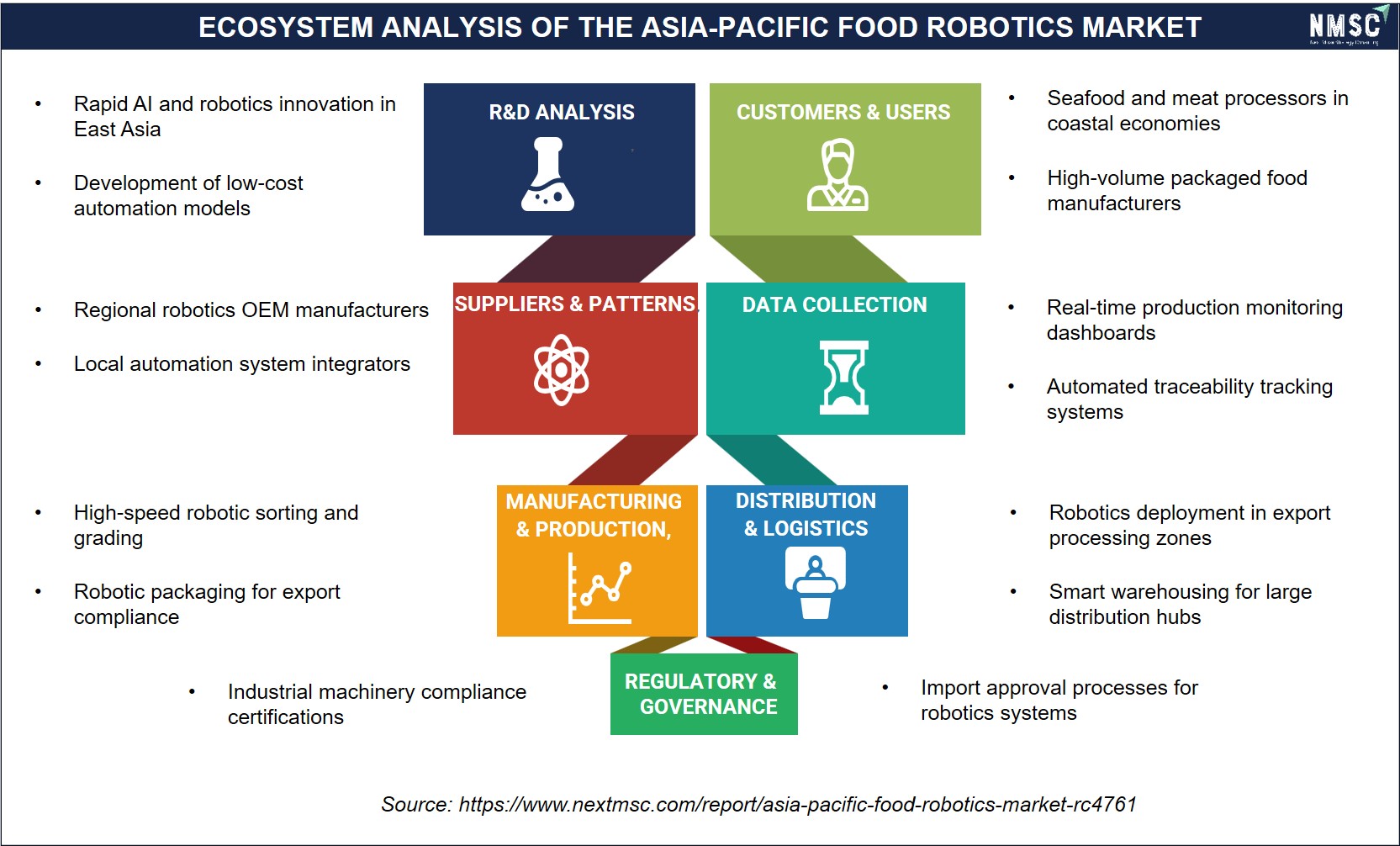
Based on our assessment, we observed that the Asia-Pacific food robotics ecosystem operates as a highly interconnected network spanning R&D, end-users, suppliers, manufacturing, logistics, data analytics, and regulatory systems. Research activities in Japan, South Korea, and China focus on AI-driven vision, precision handling, and hygienic automation, supported by policy initiatives. Meanwhile, food processors, QSRs, cloud kitchens, and packaged food players drive demand for efficiency and compliance. Suppliers and integrators ensure system compatibility, while manufacturing hubs in China and Vietnam manage production and customization. At the same time, regional logistics and regulatory frameworks support scalable, efficient, and compliant deployment.
Which Country Is Dominating the Asia-Pacific Food Robotics Market?
China holds the dominant position in the Asia-Pacific food robotics market, supported by its large food processing industry, advanced manufacturing ecosystem, and early adoption of automation technologies. The country hosts numerous domestic and global robotics manufacturers, enabling cost-efficient production of collaborative robots, automated packaging systems, and high-speed food handling solutions. In addition, integrated supply chains and strong local component availability enable faster innovation and shorter time-to-market, strengthening its regional advantage. Our analysis indicates that China's leadership is reinforced by strong R&D capabilities, deep technical expertise, and the presence of experienced system integrators.
Furthermore, increasing standardization of robotic systems across production lines improves consistency, traceability, and regulatory compliance. In addition, government support for automation and smart manufacturing creates a favorable environment for adoption. Consequently, rising demand for efficiency, labor optimization, and consistent quality drives market growth, while continuous advancements in intelligent robotics further accelerate adoption. Therefore, China remains the primary hub for food robotics innovation, manufacturing, and consumption in the Asia-Pacific region.
Which Country Is Set to Witness the Fastest Growth?
Japan is demonstrating substantial growth in the market, supported by advanced manufacturing capabilities, a rapidly ageing workforce, and strong emphasis on automation across the food processing sector. The increasing need to address labor shortages and improve operational efficiency is accelerating the adoption of industrial robotics, collaborative robots, and AI-enabled automation systems in food production and packaging processes. In addition, Japan's well-established robotics ecosystem and technological leadership are enabling faster integration of precision-driven solutions that enhance productivity, consistency, and food safety standards.
Furthermore, high digital maturity, robust infrastructure, and widespread adoption of smart manufacturing technologies are facilitating seamless deployment of robotics across both large-scale manufacturers and mid-sized food processors. Government initiatives promoting Industry 4.0, along with investments in automation and innovation, continue to strengthen market expansion. Rising demand for high-quality, standardized food products, combined with increasing pressure to optimize costs and maintain efficiency, is further driving adoption. Our assessment indicates that as robotics technologies become more advanced, scalable, and cost-efficient, Japan is well positioned to lead technological advancement and drive sustained growth in the Asia-Pacific food robotics market.
How is the Asia-Pacific Food Robotics Market Segmented in this Report, and What are the Key Insights from the Segmentation Analysis?
By Level of Autonomy Insights
How Are Different Levels of Autonomy Shaping Asia-Pacific Food Robotics?
Based on level of autonomy, we found that the market is segmented into manual/teleoperated, assisted automation, task-autonomous, process-autonomous, fully autonomous, and adaptive autonomy systems.
Our assessment indicates that task-autonomous and process-autonomous systems support repetitive food processing operations through programmed workflow execution and reduced manual intervention. Furthermore, fully autonomous and adaptive autonomy systems integrate AI-driven decision-making, machine vision, and real-time sensor technologies to support coordinated production activities and dynamic operational adjustments. In addition, these systems operate alongside conveyors, robotic handling units, and inspection technologies to maintain workflow continuity and strengthen operational coordination across processing facilities. As a result, different levels of autonomy contribute to improved process consistency, production efficiency, and quality assurance across the Asia-Pacific food robotics market.
By Application (Robotics-Only) Insights
How Are Robotics Applications Structured in Asia-Pacific Food Processing?
Based on application, we found that the market is segmented into material handling, food processing, and inspection/quality control.
Robotics applications across material handling, food processing, and inspection/quality control support operational modernization throughout the Asia-Pacific food robotics market. Pick & place, packaging, and palletizing robots improve workflow coordination while reducing manual handling errors across production environments. In addition, cutting, slicing, and mixing robots enhance processing precision, reduce material waste, and maintain batch consistency during food manufacturing activities. Our evaluation indicates that inspection and quality control systems equipped with AI-enabled vision, hyperspectral imaging, and force/tactile sensing technologies support real-time defect detection and product grading across multiple production stages. Consequently, these robotics applications strengthen traceability, operational reliability, and quality monitoring throughout APAC food processing facilities.
Competitive Landscape
Based on our assessment of the Asia-Pacific food robotics industry, we found that the competitive landscape is characterized by a blend of global automation leaders and specialized regional solution providers, reflecting a moderately consolidated yet rapidly evolving structure. Leading international companies such as FANUC Corporation, ABB, KUKA AG, Krones AG, Yaskawa Electric Corporation, OMRON Corporation, and GEA Group provide advanced robotics solutions, including articulated robots, automated packaging systems, and precision machine vision technologies. Specialized providers like Kawasaki Heavy Industries Ltd., Mayekawa Manufacturing Co., Ltd., and Festo OY focus on niche process automation, energy-efficient systems, and customized integration services, while versatile players such as Techman Robot Inc., DENSO Corporation, JBT Corporation, and Epson Robots deliver flexible, modular, and application-specific solutions. From our industry insights, we found that these companies prioritize scalable, adaptable, and high-precision robotics offerings designed to enhance food processing, packaging, and quality control operations, leveraging their global expertise alongside localized deployment strategies to meet Asia-Pacific's diverse operational requirements and regulatory frameworks.
Strategic Developments:
-
July 2025 – ABB expanded its robot portfolio in China, introducing Lite+, PoWa, and IRB1200 robots targeting mid-sized industries including food and beverage. The systems support pick-and-place, packaging, and basic inspection tasks with AI-enabled ease of use and rapid deployment, strengthening automation accessibility and reinforcing the role of robotics in improving efficiency and addressing labor shortages across Asia-Pacific food manufacturing.
SWOT Analysis of the Asia-Pacific Food Robotics Industry
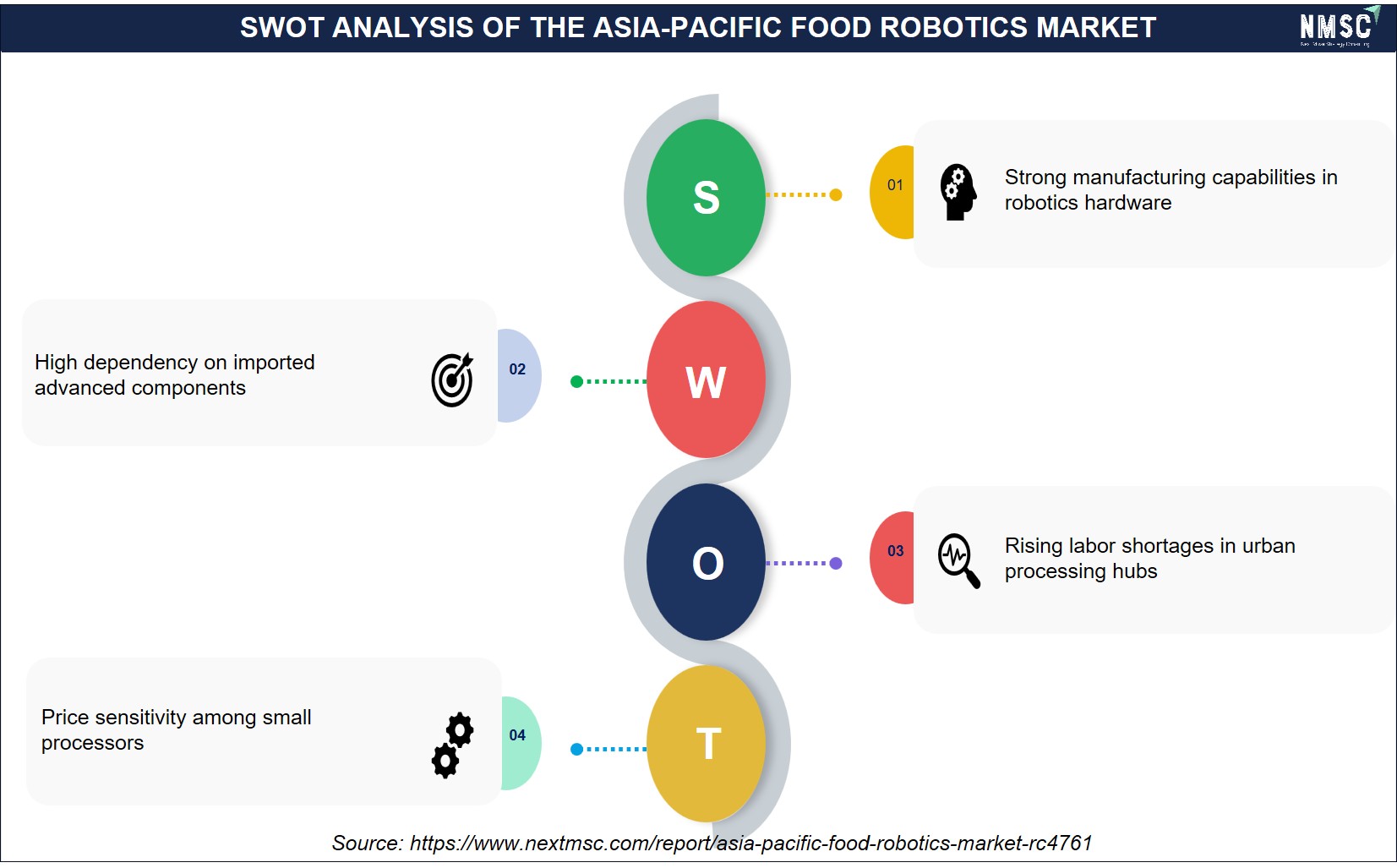
Based on our assessment, we observed that strong robotics manufacturing capabilities across China, Japan, and South Korea drive the Asia-Pacific food robotics market, supported by mature industrial ecosystems, skilled labor, and stable component supply networks. This foundation enables scalable production and cost-efficient deployment, further strengthened by policy support and established robotics firms. However, reliance on imported advanced components, including AI processors and precision sensors, creates supply chain risks in emerging markets such as India and Vietnam. Meanwhile, growing labor shortages accelerate automation demand, whereas price sensitivity and financing limitations among small and mid-sized processors continue to restrain broader adoption.
Key Players of the Asia-Pacific Food Robotics Market
-
ABB
-
KUKA AG
-
Krones AG
-
OMRON Corporation
-
Stäubli International AG
-
Yaskawa Electric Corporation
-
Kawasaki Heavy Industries Ltd.
-
Techman Robot Inc.
-
Mayekawa Manufacturing Co., Ltd.
-
DENSO Corporation
-
JBT Corporation
-
Epson Robots
-
Festo OY
Our analysis indicates that competitive dynamics in the Asia-Pacific food robotics market are increasingly shaped by technological differentiation, system reliability, and application-specific expertise rather than hardware performance alone. Leading suppliers actively integrate AI-enabled vision systems, advanced motion control, IoT connectivity, and collaborative robot platforms to address the growing demand for flexible and intelligent automation solutions. In addition, we observed that the rising deployment of collaborative robots and autonomous mobile robots reflects manufacturers' preference for scalable systems with lower integration complexity and higher operational adaptability.
We further observed that market leaders strengthen their positions through localized manufacturing, expanded service and support networks, and deeper partnerships with system integrators. These strategies enable broader penetration across key end-use industries, including food processing, packaging, and logistics operations. Moreover, sustained investment in advanced technologies, software capabilities, and customer support infrastructure remains a key determinant of competitive positioning in the Asia-Pacific food robotics market.
Asia-Pacific Food Robotics Market Key Segments
By Robot Kinematic Structure
-
Articulated Robots
-
Cartesian Robots
-
SCARA Robots
-
Parallel (Delta) Robots
-
Cylindrical Robots
-
Soft Robots
-
Hybrid Robots
By Mobility
-
Fixed Robots
-
Autonomous Mobile Robots
-
Hybrid-Fixed Mobile Systems
By Human-Robot Interaction
-
Traditional Industrial Robots (Not Fixed)
-
Collaborative Robots
-
Supervised Human-in-the-Loop Robots
By Technology Stack
-
Perception Layer
-
2D Vision
-
3D Vision
-
LiDAR / Depth
-
Hyperspectral / Color Imaging
-
Force / Tactile Sensors
-
-
Intelligence Layer
-
AI / ML (Vision AI, Path Planning, Optimisation)
-
Rule-Based Automation
-
-
Control & Integration Layer
-
Real-Time Control & Execution
-
System Orchestration & Coordination
-
Connectivity & Data Exchange
-
Enterprise & Production Integration
-
Virtualization & Digital Representation
-
By Level of Autonomy
-
Manual / Teleoperated
-
Assisted Automation
-
Task-Autonomous
-
Process-Autonomous
-
Fully Autonomous
-
Adaptive Autonomy
By Application (Robotics-Only)
-
Material Handling
-
Pick & Place
-
Packaging
-
Palletizing
-
Conveyor Handling
-
-
Food Processing
-
Cutting / Slicing
-
Sorting / Grading
-
Mixing / Forming
-
Cooking Assistance
-
-
Inspection & Quality Control
By Payload Capacity
-
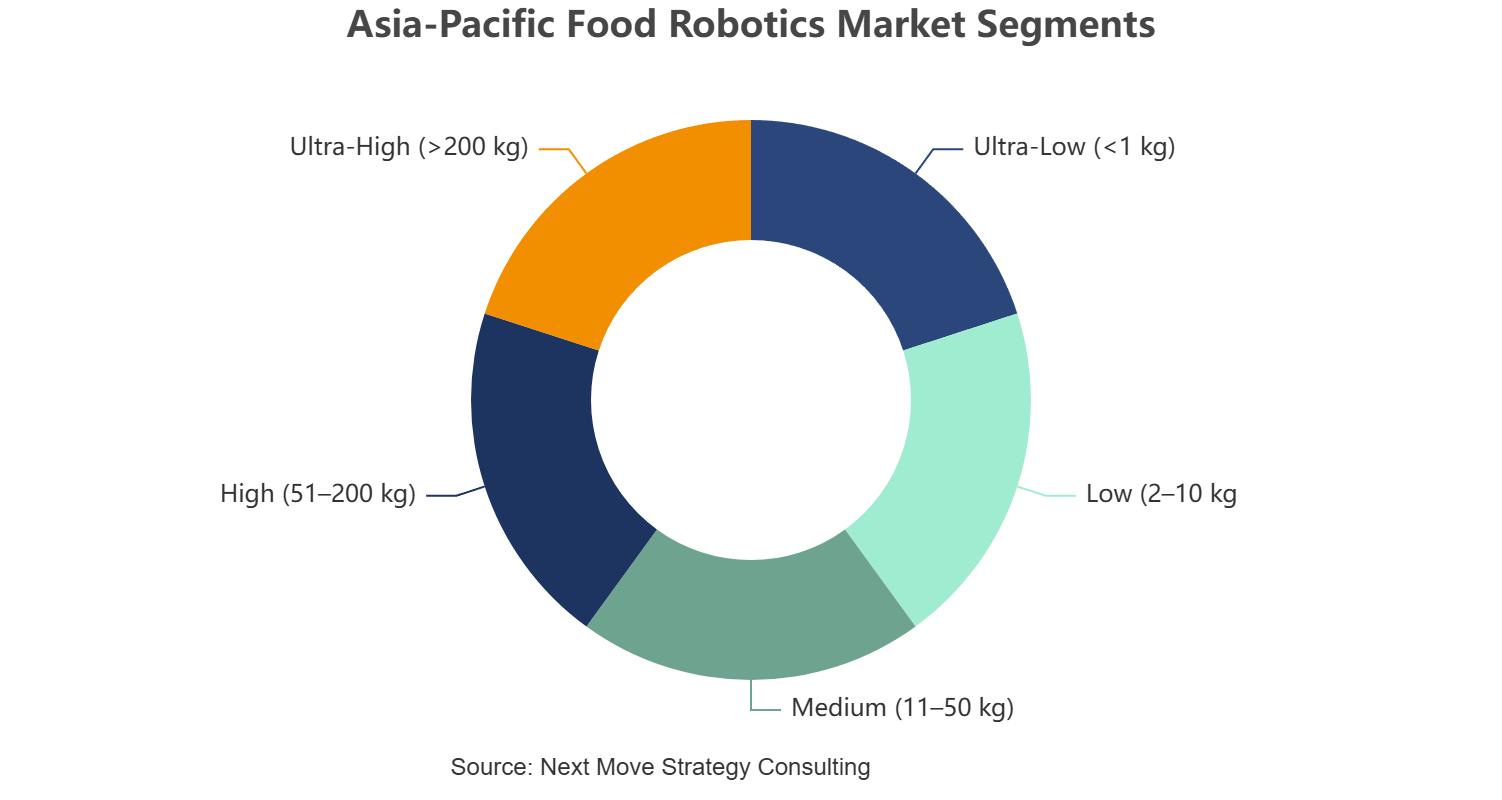
Ultra-Low (<1 kg)
-
Low (2–10 kg)
-
Medium (11–50 kg)
-
High (51–200 kg)
-
Ultra-High (>200 kg)
By Business Model
-
CapEx (One-Time Purchase)
-
Robot-as-a-Service (RaaS)
-
Subscription / Pay-Per-Use
-
Leasing / Rental
By End User
-
Primary Food Production
-
Food Processing & Manufacturing
-
Contract Packaging & Co-Packing
-
Food Distribution & Logistics
-
Retail & Wholesale Food Operations
-
Foodservice & Commercial Kitchens
-
Ingredient & Intermediate Product Suppliers
-
Testing, Inspection & Quality Assurance Providers
Key Benefits for Stakeholders:
Next Move Strategy Consulting (NMSC) presents a comprehensive analysis of the Asia-Pacific Food Robotics Market trends, covering historical developments from 2020 to 2025 and providing forward-looking forecasts through 2035. The study assesses the Asia-Pacific food robotics market at the regional level, combining quantitative market sizing with qualitative insights into key growth drivers, adoption challenges, technology evolution, and investment trends across major industrial robot segments.
From our assessment, we found that the market delivers strong value across the manufacturing ecosystem. Manufacturers benefit from higher productivity, improved quality consistency, and reduced labor dependency through automation. At the same time, investors gain exposure to long-term growth supported by smart manufacturing initiatives and ongoing factory modernization. In addition, system integrators and technology providers benefit from recurring revenue streams through software upgrades, maintenance services, and long-term service contracts. Overall, the Asia-Pacific food robotics market supports industrial efficiency and scalability, while reinforcing its strategic importance in the region's broader manufacturing transformation.
|
Parameters |
Details |
|
Customization Scope |
Free customization (equivalent to up to 80 analyst-working hours) after purchase. |
|
Pricing and Purchase Options |
Avail customized purchase options to meet your exact research needs. |
|
Approach |
In-depth primary and secondary research; proprietary databases; rigorous quality control and validation measures. |
|
Analytical Tools |
Porter's Five Forces, SWOT, value chain, and Harvey ball analysis to assess competitive intensity, stakeholder roles, and relative impact of key factors. |
About the Author
 Saista Faiyaz
— Saista Faiyaz is Research Associate at Next Move Strategy Consulting, where she has covered consumer markets and healthcare technologies for 3 years. Her work includes primary interview review, secondary-source validation, market sizing, and structured analysis of company and industry data. She supports research by comparing evidence across sources, organizing findings into market narratives, and documenting assumptions used in analysis. Her scope includes cross-market benchmarking, and reports.
Saista Faiyaz
— Saista Faiyaz is Research Associate at Next Move Strategy Consulting, where she has covered consumer markets and healthcare technologies for 3 years. Her work includes primary interview review, secondary-source validation, market sizing, and structured analysis of company and industry data. She supports research by comparing evidence across sources, organizing findings into market narratives, and documenting assumptions used in analysis. Her scope includes cross-market benchmarking, and reports.
About the Reviewer
 Supradip Baul
— Supradip Baul is an accomplished business consultant and strategist with over a decade of rich experience in market intelligence, strategy, technology, and business transformation. His work has included rigorous qualitative and quantitative analysis across multiple industries, helping clients shape investment decisions and long-term roadmaps. Earlier in his career, he was associated with Gartner, where he contributed to industry-leading reports and market share analyses. He has worked with leading global companies and holds an MBA with a dual specialization in Marketing and Finance.
Supradip Baul
— Supradip Baul is an accomplished business consultant and strategist with over a decade of rich experience in market intelligence, strategy, technology, and business transformation. His work has included rigorous qualitative and quantitative analysis across multiple industries, helping clients shape investment decisions and long-term roadmaps. Earlier in his career, he was associated with Gartner, where he contributed to industry-leading reports and market share analyses. He has worked with leading global companies and holds an MBA with a dual specialization in Marketing and Finance.
At Next Move Strategy Consulting, we understand that insightful market research is the cornerstone of successful business decisions. That's why we employ a robust and multifaceted approach, combining various methodologies to deliver the most accurate and actionable data for our clients.

Research Landscape
We navigate the world of research with two primary approaches:
Qualitative Approach
Our qualitative research methodologies involve immersive techniques such as in-depth interviews, focus groups, and observational studies. By engaging directly with individuals and stakeholders, we uncover valuable insights that quantitative data alone may overlook.

Quantitative Research
In tandem with qualitative methodologies, NMSC leverages the power of Quantitative Research to provide a robust foundation of numerical insights. Through systematic data collection and analysis, we quantify patterns, preferences, and market trends, offering a comprehensive view of the business landscape.
Our quantitative research approach employs diverse tools, including surveys, experiments, and statistical modelling. These methodologies enable us to gather data from a large and representative sample, ensuring the statistical significance of our findings. By employing structured questionnaires and standardized data collection methods, we guarantee the reliability and validity of the information we present to our clients.
Quantitative research is particularly effective in measuring the prevalence of trends, assessing market size, and gauging the impact of various factors on consumer behavior. The numerical precision attained through this approach equips our clients with actionable insights, facilitating data-driven decision-making and strategy formulation.


Our Specialized Toolbox for Industry-Specific Market Research
We deploy a specialized arsenal of techniques tailored to meet your unique requirements. Here's a glimpse into our comprehensive toolbox:

Information Procurement
The stage entails acquiring market data or relevant information through various sources and methodologies.


Market Research Approach
We utilize both top-down and bottom-up approaches in market research analysis to achieve a comprehensive understanding of the market dynamics, leveraging the broad perspective of industry trends and macroeconomic factors alongside detailed insights from specific segments and individual companies.

Porters Five Forces Analysis
We conduct Porter's Five Forces analysis to evaluate the competitive landscape of an industry, providing us with insights into factors that affect profitability and strategic positioning.

SWOT Analysis

Forecasting
We utilize a forecasting model to predict future consumption by considering parameters like population, economics, regulations, market competition, drivers, constraints, technology, and pricing. We also employ statistical techniques such as multilinear regression, exponential smoothing, moving average, ARIMA, and Monte Carlo simulations for accurate predictions. In econometric forecasting, we analyzed short-term and long-term event impacts, attributing values based on regulatory frameworks, economic factors, and market events.





 Speak to Our Analyst