Asia-Pacific In-Vitro Diagnostics Market by Type (Reagents, Instruments, and Software & Services), by Technique (Immunodiagnostics, Hematology, Molecular Diagnostics, Tissue Diagnostics, Clinical Chemistry, and Other IVD Techniques), by Application (Infectious Diseases, Cancer, Cardiac Diseases, Immune System Disorders, Nephrological Diseases, Gastrointestinal Diseases, and Others) – Opportunity Analysis and Industry Forecast, 2024–2030
Industry: Healthcare | Latest Edition: June 1, 2026 | No of Pages: 225 | No. of Tables: 145 | No. of Figures: 110 | Format: PDF | Report Code: HC2345
Asia-Pacific In-Vitro Diagnostics Market Overview
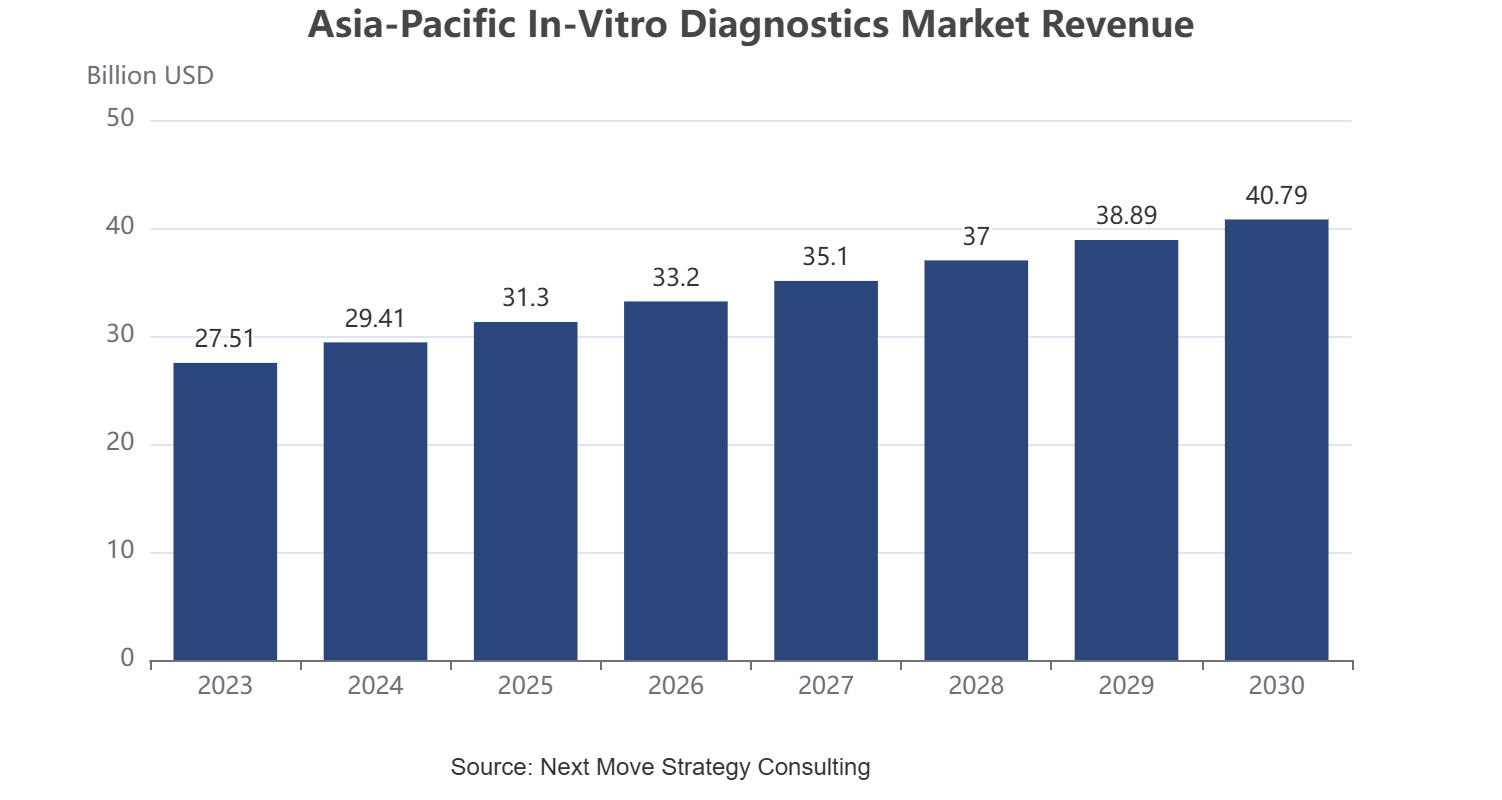
The Asia-Pacific In-Vitro Diagnostics Market size was valued at USD 27.51 billion in 2023, and is predicted to reach USD 40.79 billion by 2030, at a CAGR of 5.4% from 2024 to 2030. In-vitro diagnostics (IVD) refers to a wide range of medical tests conducted on samples of bodily fluids, tissues, or cells outside of the body to diagnose diseases, monitor therapy, and assess overall health conditions. IVD tests are performed in laboratory settings using various techniques and technologies, including immunoassays, molecular diagnostics, clinical chemistry, hematology, and microbiology.
These tests enable early detection of diseases, allowing for timely intervention and treatment initiation. By providing rapid and accurate results, IVD tests facilitate personalized medicine, guiding tailored treatment approaches based on individual patient characteristics. Also, immunoassay experiments provide valuable insights into biological systems, enabling scientists and researchers to make significant contributions to fields such as medicine, biotechnology, and pharmacology. They serve as essential tools for understanding fundamental biological processes and developing innovative solutions to address health challenges.
Increasing Chronic Disease Prevalence in Asia-Pacific Drives Significant Market Growth
The high prevalence of chronic diseases, particularly cardiovascular diseases and cancer, highlights the crucial need for immunodiagnostic tests that enable early detection and continuous monitoring. This growing demand is further amplified by substantial healthcare spending in the region, which strengthens healthcare infrastructure and increases access to diagnostic services.
Enhanced financial resources allow for the adoption of advanced diagnostic technologies, improving the ability to diagnose and manage these chronic conditions effectively. Consequently, the combination of rising chronic disease rates and increased healthcare expenditure is driving significant growth in the in-vitro diagnostic market in the Asia-Pacific region.
Technological Advancements Drive the Growth of Market in Asia-Pacific
Technological innovations by market players are significantly enhancing diagnostic capabilities, leading to the expanding Asia-Pacific in-vitro diagnostics market demand. These advancements enable more accurate, efficient, and faster diagnostic tests, which are essential for early detection and effective management of diseases.
Coupled with evolving healthcare needs and substantial investments in healthcare infrastructure, the region is witnessing a surge in demand for advanced diagnostic solutions. This creates significant growth opportunities for the in-vitro diagnostics market, as healthcare providers adopt these cutting-edge technologies to improve patient outcomes and meet the rising demand for high-quality clinical diagnostic services.
High Research, Development, and Regulatory Approval Costs Hinder the Market Growth
High costs associated with research, development, and regulatory approval are significant factors restraining the Asia-Pacific IVD market expansion. Operating within this sector necessitates significant financial investment for companies to navigate the complex landscape of research and development.
This investment often encompasses extensive clinical trials, laboratory testing, and product refinement to guarantee accuracy and reliability. Additionally, obtaining regulatory approvals from agencies such as the FDA requires strict adherence to stringent standards, further compounding the financial burden. This financial constraint can discourage potential adopters from market expansion.
Introduction of Point-of-Care Testing Solutions in IVD Creates Opportunity
Point-of-care testing (POCT) is poised to significantly drive the Asia-Pacific in-vitro diagnostics market demand in the forthcoming years. POCT serves as a valuable complement to laboratory testing, especially in situations where immediate results are crucial, such as emergency departments, ambulances, and remote healthcare settings.
With POCT technologies offering rapid tests for infectious diseases, cardiac markers, glucose monitoring, pregnancy testing, and more, healthcare providers can quickly assess patients' conditions and make timely treatment decisions.
By integrating POCT with traditional IVD, healthcare providers can enhance their diagnostic capabilities, delivering more efficient and patient-centered care. This integration streamlines workflows, allowing for faster diagnosis and treatment initiation, ultimately leading to improved patient outcomes.
China Dominates the Asia-Pacific In-Vitro Diagnostics Market Share
The prevalence of chronic diseases significantly drives the growth of the in-vitro diagnostics market in China. According to National Institutes of Health, in China, there are higher rates of cardiovascular disease, cancer, chronic respiratory disease, and diabetes compared to regions with similar social development levels. These non-communicable diseases are responsible for 88.5% of all deaths and contribute to 84.9% of the disease burden, as measured by disability-adjusted life years (DALYs).
As these conditions continue to rise, there is an increasing demand for accurate and efficient diagnostic solutions to effectively manage and monitor patient health. IVD tests play a crucial role in this landscape by enabling early disease detection, personalized treatment strategies, and ongoing disease monitoring.
Singapore to Witness Substantial Growth in the Market
Increased healthcare expenditure in Singapore serves as a significant factor for the growth of the in-vitro diagnostics market. According to World Trade Administration, the Singapore National Health Expenditure is projected to reach around USD 44 billion by 2030 to address both short and long-term infrastructure needs and to provide support for healthcare provisions and subsidies for low-income individuals. This investment creates opportunities for the adoption of advanced in-vitro diagnostics technologies, leading to improved disease detection, monitoring, and personalized treatment options.
Competitive Landscape
The promising players operating in the Asia-Pacific in-vitro diagnostics industry include Roche Holding AG, Abbott Laboratories, Thermo Fisher Scientific Inc, Danaher Corporation, Becton, Dickinson and Company, Siemens Healthineers AG, bioMérieux SA, Sysmex Corporation, QIAGEN N.V., and Bio-Rad Laboratories, Inc., and others.
Asia-Pacific In-Vitro Diagnostics Market Key Segments
By Product & Service
-
Reagents & Consumables
-
Clinical Chemistry Reagents
-
Immunoassay Reagents (ELISA/CLIA)
-
Molecular Master Mixes
-
Hematology Controls
-
-
Instruments & Devices
-
Chemistry Analyzers
-
Immunoassay Systems
-
Molecular Thermocyclers/Sequencers
-
Hematology Analyzers
-
POC Devices
-
-
Software & Services
-
LIS, Data Analytics
-
CRO/Testing Services
-
By Technique
-
Clinical Chemistry
-
Metabolites
-
Electrolytes
-
Enzymes
-
-
Immunoassays
-
ELISA / CLIA / CMIA
-
Lateral-flow Rapid Tests
-
Immunofluorescence
-
-
Molecular Diagnostics
-
PCR
-
Isothermal NAAT
-
NGS
-
In-situ Hybridization
-
-
Hematology & Coagulation
-
CBC Analyzers
-
Coagulation Panels
-
-
Microbiology
-
Culture & Sensitivity
-
MALDI-TOF
-
Molecular ID
-
-
Urinalysis & Body Fluids
-
Other Techniques
By Testing Site / Channel
-
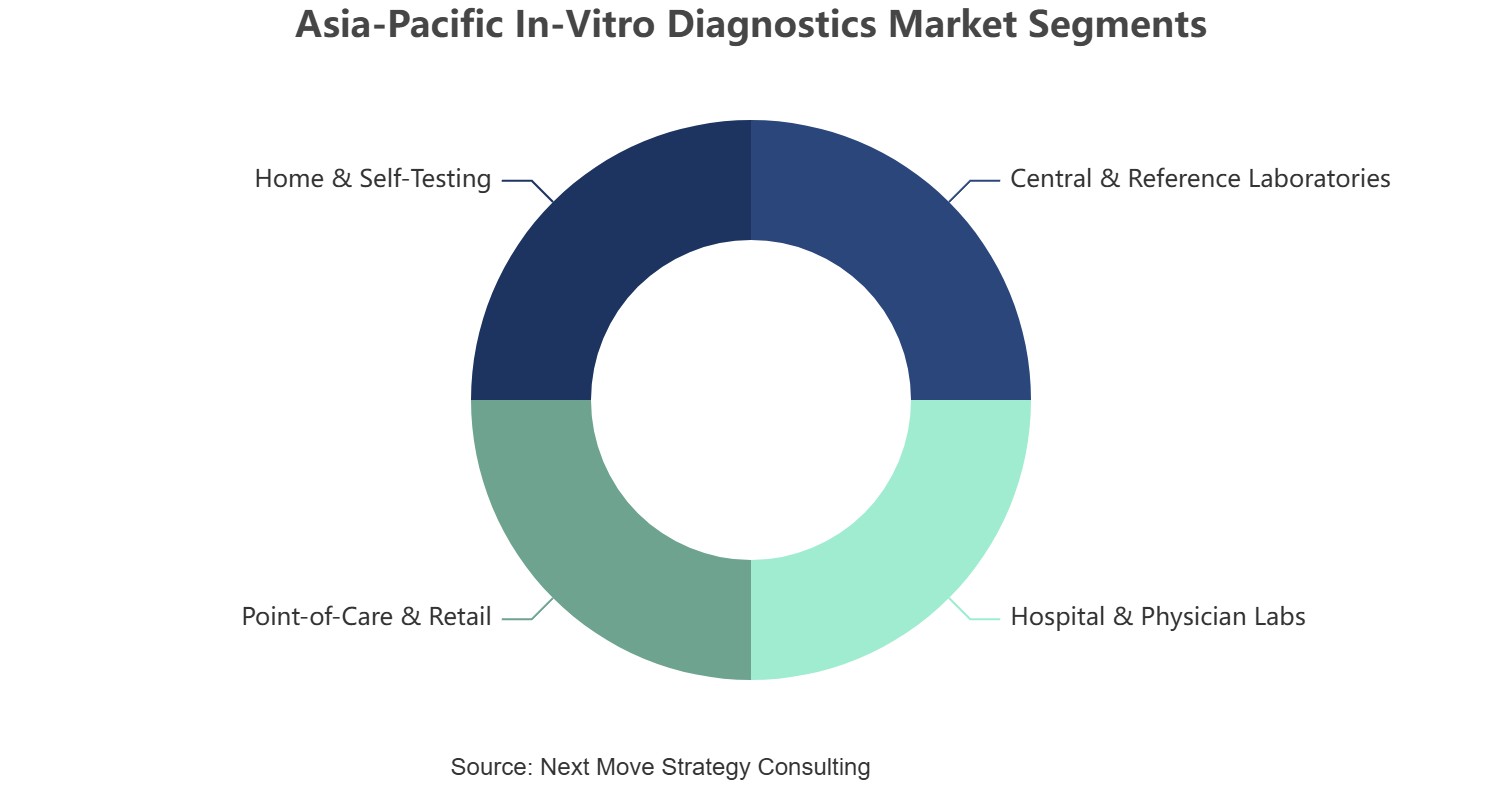
Central & Reference Laboratories
-
Hospital & Physician Labs
-
Point-of-Care & Retail
-
Home & Self-Testing
By Application
-
Infectious Diseases
-
Oncology
-
Cardiovascular Health
-
Endocrinology & Diabetes
-
Nephrology
-
Genetic & Prenatal Testing
-
Autoimmune Disorders
-
Drug Monitoring & Toxicology
-
Blood Screening & Typing
-
Other Indications
By Country
-
China
-
India
-
South Korea
-
Australia
-
Indonesia
-
Singapore
-
Taiwan
-
Thailand
-
Rest of Asia-Pacific
Key Players
-
Roche Holding AG
-
Abbott Laboratories
-
Thermo Fisher Scientific Inc.
-
Danaher Corporation
-
Becton, Dickinson and Company
-
Siemens Healthineers AG
-
bioMérieux SA
-
Sysmex Corporation
-
QIAGEN N.V.
-
Bio-Rad Laboratories, Inc.
Report Scope and Segmentation
|
Parameters |
Details |
|
Market Size Value in 2023 |
USD 27.51 billion |
|
Revenue Forecast in 2030 |
USD 40.79 billion |
|
Value Growth Rate |
CAGR of 5.4% from 2024 to 2030 |
|
Analysis Period |
2023–2030 |
|
Base Year Considered |
2023 |
|
Forecast Period |
2024–2030 |
|
Market Size Estimation |
Billion (USD) |
|
Growth Factors |
|
|
Companies Profiled |
10 |
|
Countries Covered |
8 |
|
Customization Scope |
Free customization (equivalent up to 80 working hours of analysts) after purchase. Addition or alteration to country, regional, and segment scope. |
|
Pricing and Purchase Options |
Avail customized purchase options to meet your exact research needs. |
About the Author
 Sikha Haritwal
— Sikha Haritwal is an assistant manager with strong expertise in market research, data analysis, and cross-functional coordination. She plays a key role in leading complex research initiatives, strengthening analytical rigor, and enabling data-driven decision-making across teams. Known for her leadership mindset and structured problem-solving approach, she supports process improvement, enhances operational efficiency, and contributes to building scalable frameworks that drive long-term strategic outcomes and organizational effectiveness.
Sikha Haritwal
— Sikha Haritwal is an assistant manager with strong expertise in market research, data analysis, and cross-functional coordination. She plays a key role in leading complex research initiatives, strengthening analytical rigor, and enabling data-driven decision-making across teams. Known for her leadership mindset and structured problem-solving approach, she supports process improvement, enhances operational efficiency, and contributes to building scalable frameworks that drive long-term strategic outcomes and organizational effectiveness.
About the Reviewer
 Supradip Baul
— Supradip Baul is an accomplished business consultant and strategist with over a decade of rich experience in market intelligence, strategy, technology, and business transformation. His work has included rigorous qualitative and quantitative analysis across multiple industries, helping clients shape investment decisions and long-term roadmaps. Earlier in his career, he was associated with Gartner, where he contributed to industry-leading reports and market share analyses. He has worked with leading global companies and holds an MBA with a dual specialization in Marketing and Finance.
Supradip Baul
— Supradip Baul is an accomplished business consultant and strategist with over a decade of rich experience in market intelligence, strategy, technology, and business transformation. His work has included rigorous qualitative and quantitative analysis across multiple industries, helping clients shape investment decisions and long-term roadmaps. Earlier in his career, he was associated with Gartner, where he contributed to industry-leading reports and market share analyses. He has worked with leading global companies and holds an MBA with a dual specialization in Marketing and Finance.
At Next Move Strategy Consulting, we understand that insightful market research is the cornerstone of successful business decisions. That's why we employ a robust and multifaceted approach, combining various methodologies to deliver the most accurate and actionable data for our clients.

Research Landscape
We navigate the world of research with two primary approaches:
Qualitative Approach
Our qualitative research methodologies involve immersive techniques such as in-depth interviews, focus groups, and observational studies. By engaging directly with individuals and stakeholders, we uncover valuable insights that quantitative data alone may overlook.

Quantitative Research
In tandem with qualitative methodologies, NMSC leverages the power of Quantitative Research to provide a robust foundation of numerical insights. Through systematic data collection and analysis, we quantify patterns, preferences, and market trends, offering a comprehensive view of the business landscape.
Our quantitative research approach employs diverse tools, including surveys, experiments, and statistical modelling. These methodologies enable us to gather data from a large and representative sample, ensuring the statistical significance of our findings. By employing structured questionnaires and standardized data collection methods, we guarantee the reliability and validity of the information we present to our clients.
Quantitative research is particularly effective in measuring the prevalence of trends, assessing market size, and gauging the impact of various factors on consumer behavior. The numerical precision attained through this approach equips our clients with actionable insights, facilitating data-driven decision-making and strategy formulation.


Our Specialized Toolbox for Industry-Specific Market Research
We deploy a specialized arsenal of techniques tailored to meet your unique requirements. Here's a glimpse into our comprehensive toolbox:

Information Procurement
The stage entails acquiring market data or relevant information through various sources and methodologies.


Market Research Approach
We utilize both top-down and bottom-up approaches in market research analysis to achieve a comprehensive understanding of the market dynamics, leveraging the broad perspective of industry trends and macroeconomic factors alongside detailed insights from specific segments and individual companies.

Porters Five Forces Analysis
We conduct Porter's Five Forces analysis to evaluate the competitive landscape of an industry, providing us with insights into factors that affect profitability and strategic positioning.

SWOT Analysis

Forecasting
We utilize a forecasting model to predict future consumption by considering parameters like population, economics, regulations, market competition, drivers, constraints, technology, and pricing. We also employ statistical techniques such as multilinear regression, exponential smoothing, moving average, ARIMA, and Monte Carlo simulations for accurate predictions. In econometric forecasting, we analyzed short-term and long-term event impacts, attributing values based on regulatory frameworks, economic factors, and market events.





 Speak to Our Analyst