Biodefense Vaccines and Detection Systems Market Size, Share, Trends and Growth Analysis, By Vaccines (Countermeasure Vaccines [Anthrax, Smallpox and Mpox, Ebola, and Other Countermeasure Vaccines], and Response Vaccines [Chikungunya, Cholera and Typhoid, and Other Response Vaccines]), By Detection Systems (Instruments, Consumables and Assays, Software and Informatics, and Services), By Buyer Type, By Sales Channel, By Revenue Type, and Region — Global Industry Report and Forecast, 2026–2035
Industry: Healthcare | Publishing Date: July 29, 2026 | Last Updated: September 30, 2026 | No of Pages: N/A | No. of Tables: N/A | No. of Figures: N/A | Format: PDF | Report Code: HC5455
What Are the Biodefense Vaccines and Detection Systems Market Size?
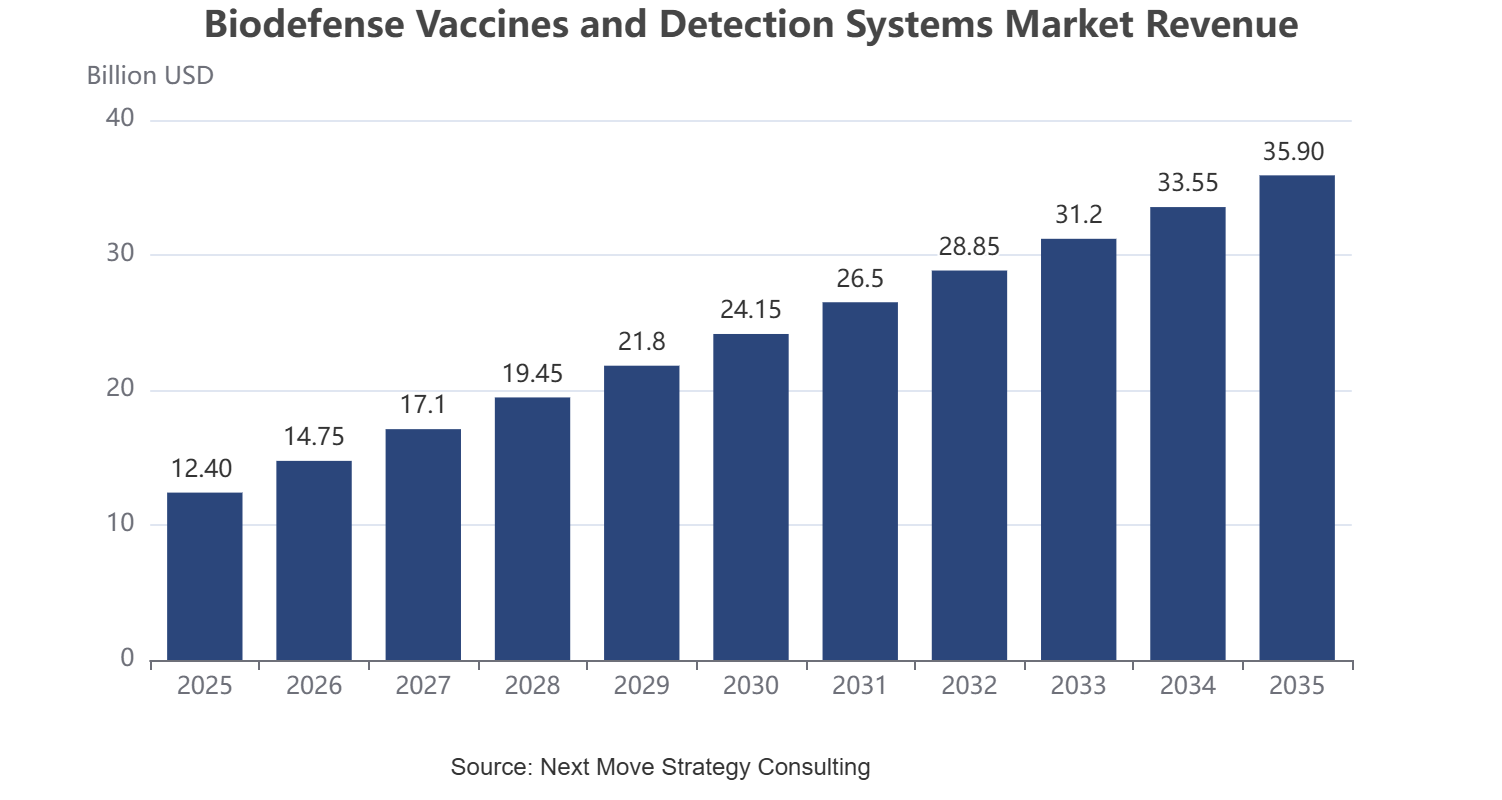
The global Biodefense Vaccines and Detection Systems Market size was valued at USD 12.40 billion in 2025 and is estimated at USD 13.79 billion in 2026, forecast to reach USD 35.90 billion by 2035, expanding at an 11.2% CAGR between 2026 and 2035. North America leads with approximately 38% share, while detection systems dominate the offering mix with approximately 58% share.
We observed that growth is broad-based across every segmentation axis, with molecular detection instrumentation and mpox-driven countermeasure procurement jointly reinforcing the structural expansion of the biodefense vaccines and detection systems market through 2035.
Key Takeaways
|
Key Takeaways |
|
By Vaccines: Countermeasure Vaccines held the largest share of approximately 68% (USD 3.55 Billion) in 2025; Response Vaccines is the fastest-growing sub-segment at 12.5% CAGR from 2026–2035. |
|
By Detection Systems: Instruments held the largest share of approximately 41% (USD 2.95 Billion) in 2025; Consumables and Assays is the fastest-growing sub-segment at 13.3% CAGR from 2026–2035. |
|
By Buyer Type: Defence and Military held the largest share of approximately 27% (USD 3.35 Billion) in 2025; Food, Water and Environment is the fastest-growing sub-segment at 14.6% CAGR from 2026–2035. |
|
By Sales Channel: Direct Tender held the largest share of approximately 42% (USD 5.15 Billion) in 2025; Online is the fastest-growing sub-segment at 17.1% CAGR from 2026–2035. |
|
By Revenue Type: Product Sale held the largest share of approximately 47% (USD 5.85 Billion) in 2025; Software License is the fastest-growing sub-segment at 18.1% CAGR from 2026–2035. |
|
Dominant Region: North America dominated with approximately 38% revenue share (USD 4.70 Billion) in 2025. |
|
Fastest-Growing Region: Asia-Pacific is expected to register the highest CAGR of 16.0% during 2026–2035. |
|
Dominant Country: U.S. led with approximately USD 3.85 Billion in 2025. |
|
Fastest-Growing Country: India is the fastest-growing country at approximately 19.8% CAGR from 2026–2035. |
Market Opportunity: The biodefense vaccines and detection systems market is expected to create an absolute dollar opportunity of USD 22.11 billion between 2026 and 2035, presenting significant investment potential across the government biopreparedness, clinical diagnostics, and molecular detection instrumentation value chain.
According to Next Move Strategy Consulting analysis, government biopreparedness agencies are increasingly bundling vaccine stockpiling contracts with point-of-care detection procurement to shorten outbreak-response timelines, a shift that favors diversified suppliers capable of servicing both countermeasure and diagnostic mandates simultaneously through 2035.
What Does the Biodefense Vaccines and Detection Systems Market Encompass?
The biodefense vaccines and detection systems market encompasses medical countermeasures and diagnostic technologies developed to prepare for, detect, and respond to biological threats, including naturally occurring outbreaks, laboratory accidents, and deliberate bioterrorism events. Our assessment indicates that the scope spans countermeasure and response vaccines alongside instruments, consumables, software, and services used for pathogen detection, supplied to defence, civil government, clinical, and research end users across the biopreparedness value chain.
Regulatory frameworks such as the U.S. Project BioShield Act and the Biomedical Advanced Research and Development Authority procurement mandates shape countermeasure stockpiling requirements, while the World Health Organization's International Health Regulations increasingly influence cross-border biosurveillance coordination. We observed that technology adoption is shifting toward sample-to-answer molecular platforms that compress detection turnaround from days to hours. Next Move Strategy Consulting's analysis indicates that this structural shift, combined with growing government interest in the Infectious Disease Diagnostics Market, is redefining procurement criteria across the biodefense vaccines and detection systems market.
|
Parameter |
Details |
|
Market Size in 2025 |
USD 12.40 Billion |
|
Market Size in 2026 |
USD 13.79 Billion |
|
Revenue Forecast in 2035 |
USD 35.90 Billion |
|
Growth Rate |
CAGR of 11.2% from 2026 to 2035 |
|
Analysis Period |
2025–2035 |
|
Base Year Considered |
2025 |
|
Forecast Period |
2026–2035 |
|
Market Size Estimation |
Revenue (USD Billion) |
|
Companies Profiled |
20 |
|
Countries Covered |
33 |
|
Market Share |
Available for Top 10 Companies |
Key Emerging Trends
Based on research conducted by Next Move Strategy Consulting, we found that four structural trends are reshaping product development, procurement, and stakeholder engagement across the industry.
How Is Mpox Resurgence Reshaping Countermeasure Vaccine Procurement?
Recurring mpox outbreaks are accelerating government procurement of non-replicating smallpox and mpox vaccines beyond routine stockpile replenishment. We observed that Bavarian Nordic A/S secured a USD 22.5 million order from Canada's Public Health Agency in February 2026 under an existing ten-year framework, alongside an expanded European Commission HERA agreement covering up to eight million doses across twenty member states. Health agencies are treating mpox as a sustained rather than episodic threat, extending demand visibility for manufacturers well into the next procurement cycle.
Why Are Sample-to-Answer Molecular Platforms Gaining Government Adoption?
Sample-to-answer molecular detection platforms are displacing multi-step laboratory workflows as civil government and defence buyers prioritize speed of pathogen identification. Our findings suggest that integrated next-generation sequencing systems capable of specimen-to-report turnaround within a single day are increasingly specified in biosurveillance tenders. Thermo Fisher Scientific Inc.'s continued expansion of its Ion Torrent Genexus sequencing portfolio illustrates how instrument vendors are compressing detection timelines for field and reference laboratory deployment alike.
How Is Pediatric Label Expansion Broadening the Vaccine Addressable Population?
Vaccine developers are pursuing pediatric and expanded-age label extensions to widen the addressable population for outbreak-response formulations. We observed that Bavarian Nordic reported positive topline data in October 2025 from a pediatric MVA-BN mpox and smallpox vaccine study conducted with children aged two to eleven, supporting a planned 2026 European Medicines Agency filing. This trend is elevating demand for response vaccines suited to outbreak-affected regions with younger at-risk populations.
What Role Is Multiplexed Mass Spectrometry Playing in Biothreat Detection?
Multiplexed mass spectrometry and high-throughput proteomic platforms are gaining traction for biothreat characterization beyond traditional PCR-based identification. Our analysis shows that instrument vendors are launching tribrid mass spectrometry systems offering substantially faster sequence coverage for complex biological samples. This trend is broadening the analytical toolkit available to reference and research laboratories tasked with characterizing novel or engineered biological agents.
Regulatory Framework Impacting the Biodefense Vaccines and Detection Systems Market
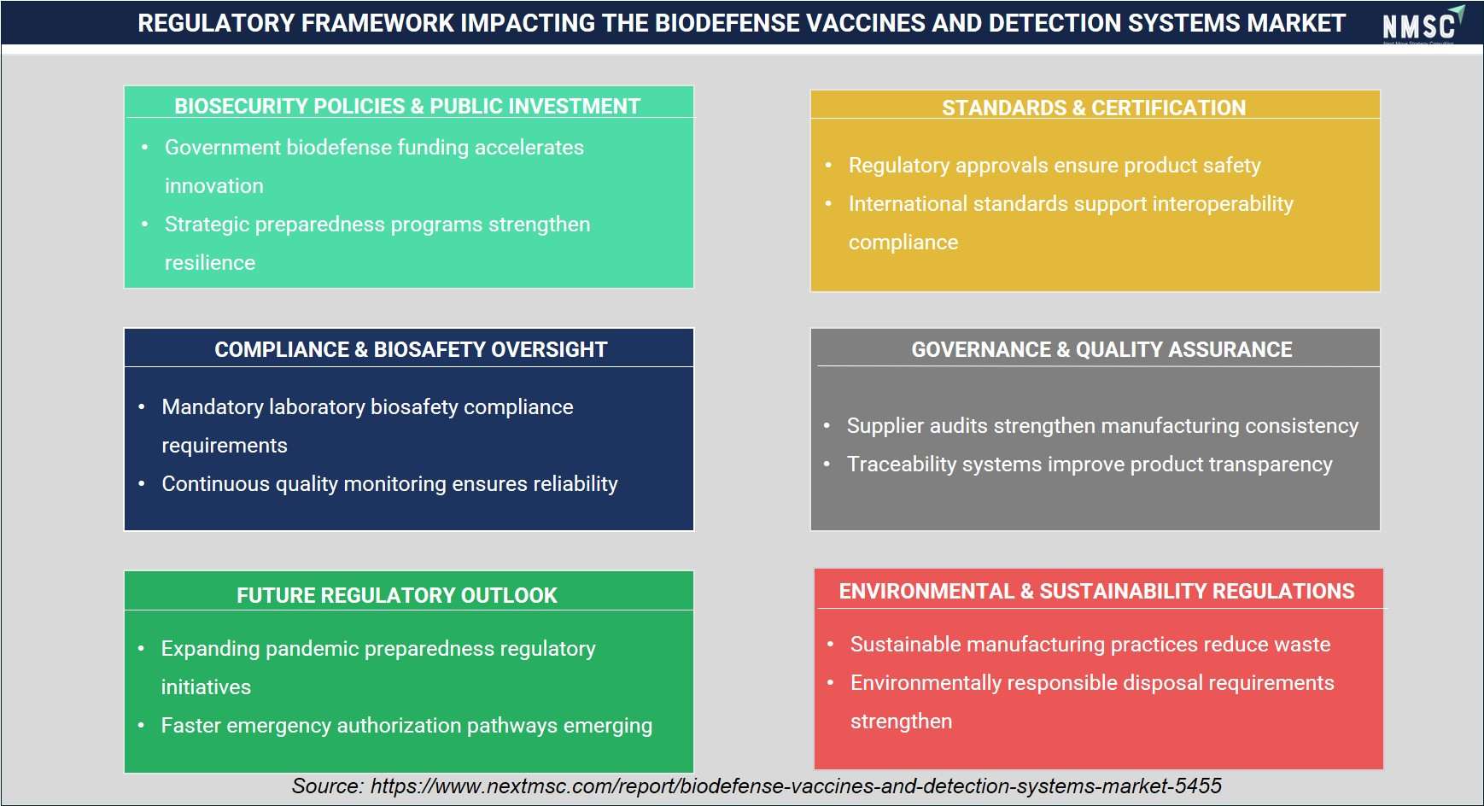
Based on our regulatory assessment, we observed that biosecurity policies, product certification standards, biosafety compliance, governance frameworks, environmental regulations, and emergency preparedness initiatives collectively influence the biodefense vaccines and detection systems market. Furthermore, our market analysis indicates that government funding, rigorous regulatory approvals, laboratory biosafety protocols, quality assurance systems, sustainable manufacturing practices, and accelerated emergency authorization pathways strengthen product reliability, enhance public health preparedness, encourage innovation, and support long-term market growth.
Growth Drivers and Restraints
Growth Catalyst and Risk Assessment Matrix
|
Factors |
Type |
(+/−) % Impact on CAGR |
Geographic Relevance |
Impact Timeline |
|
Sustained BARDA and government biopreparedness funding |
Driver |
+2.4% |
North America |
2026–2035 |
|
Recurring mpox and emerging pathogen outbreaks |
Driver |
+2.0% |
Global |
2026–2035 |
|
Expansion of sample-to-answer molecular diagnostics |
Driver |
+1.7% |
Global |
2026–2035 |
|
EU HERA joint procurement and stockpiling mandates |
Driver |
+1.3% |
Europe |
2026–2035 |
|
Rising defence modernization and CBRN readiness spending |
Driver |
+1.2% |
North America, Asia-Pacific |
2026–2035 |
|
Growth in point-of-care and field-deployable detection |
Driver |
+1.0% |
Global |
2026–2032 |
|
Lengthy regulatory approval cycles for novel countermeasures |
Restraint |
-1.1% |
Global |
2026–2035 |
|
High cost of advanced detection instrumentation |
Restraint |
-0.9% |
Middle East & Africa, Latin America |
2026–2032 |
|
Budgetary uncertainty tied to shifting public health priorities |
Restraint |
-0.7% |
North America, Europe |
2028–2035 |
What Is the Primary Growth Driver of the Biodefense Vaccines and Detection Systems Market?
Sustained government biopreparedness funding is the primary driver of the market. The U.S. Administration for Strategic Preparedness and Response continues to award contract modifications through BARDA for anthrax and mpox countermeasures, including a USD 30 million CYFENDUS contract modification to Emergent BioSolutions Inc. in September 2025. We observed that this durable procurement pattern, reinforced by Project BioShield authorities, continues to anchor baseline demand for countermeasure vaccines across developed biodefense markets.
How Is Outbreak Recurrence Driving Biodefense Vaccines and Detection Systems Market Growth?
Recurring biological threats, particularly mpox, are accelerating market growth toward expanded stockpiling and faster detection deployment. The World Health Organization continues to monitor mpox as an outbreak of international concern, sustaining demand for both response vaccines and rapid diagnostic instrumentation. Our assessment indicates that this outbreak persistence, combined with expanding HERA and BARDA procurement frameworks, is compressing adoption timelines for integrated vaccine-and-detection biopreparedness programs across Europe and North America.
What Is Restraining Biodefense Vaccines and Detection Systems Market Expansion?
Lengthy regulatory approval cycles for novel medical countermeasures restrain the pace of new product introduction across the industry. The U.S. Food and Drug Administration's supplemental biologics license pathway, while structured, typically requires multi-year clinical and manufacturing data packages before approval, as seen in the freeze-dried JYNNEOS review process. We found that smaller detection technology developers face particular exposure, as extended validation timelines delay revenue recognition compared with larger, diversified biodefense suppliers.
Segmentation Analysis
Segment Sizing: By Vaccines
The vaccines category and the detection systems category together constitute the total biodefense vaccines and detection systems market, with each table below reconciling to its own product family total.
|
Segment |
2025 (USD) |
2035 (USD) |
CAGR% (2026–2035) |
|
Countermeasure Vaccines |
USD 3.55 Billion |
USD 7.50 Billion |
8.7% |
|
Response Vaccines |
USD 1.66 Billion |
USD 5.40 Billion |
12.5% |
|
Total (Vaccines) |
USD 5.21 Billion |
USD 12.90 Billion |
9.9% |
Which Vaccines Segment Dominates the Biodefense Market?
Countermeasure Vaccines, encompassing anthrax, smallpox and mpox, and Ebola formulations, led the vaccines category with USD 3.55 billion in 2025, supported by durable BARDA and HERA stockpiling contracts. We observed that Response Vaccines are the fastest-growing vaccines sub-segment, expanding at a 12.5% CAGR from 2026 to 2035, as chikungunya and cholera outbreak-response procurement scales in emerging economies with limited existing stockpile coverage.
Segment Sizing: By Detection Systems
|
Segment |
2025 (USD) |
2035 (USD) |
CAGR% (2026–2035) |
|
Instruments |
USD 2.95 Billion |
USD 8.50 Billion |
12.1% |
|
Consumables and Assays |
USD 2.55 Billion |
USD 8.85 Billion |
13.3% |
|
Software and Informatics |
USD 0.95 Billion |
USD 3.35 Billion |
13.6% |
|
Services |
USD 0.74 Billion |
USD 2.30 Billion |
12.7% |
|
Total (Detection Systems) |
USD 7.19 Billion |
USD 23.00 Billion |
12.6% |
Which Detection Systems Segment Leads Market Demand?
Instruments remained the leading detection systems category, valued at USD 2.95 billion in 2025 on sustained sample-to-answer and real-time PCR platform procurement, a pattern also visible in the broader Next Generation Sequencing Market. Our findings suggest that Consumables and Assays is the fastest-growing detection sub-segment, registering a 13.3% CAGR from 2026 to 2035, as expanding installed instrument bases drive recurring cartridge and immunoassay replenishment across public health laboratories.
Segment Sizing: By Buyer Type
|
Segment |
2025 (USD) |
2035 (USD) |
CAGR% (2026–2035) |
|
Defence and Military |
USD 3.35 Billion |
USD 8.90 Billion |
11.5% |
|
Civil Government and Public Health |
USD 3.10 Billion |
USD 8.60 Billion |
12.1% |
|
Clinical and Hospital |
USD 2.55 Billion |
USD 6.80 Billion |
11.5% |
|
First Responders and Security |
USD 1.35 Billion |
USD 4.35 Billion |
13.9% |
|
Reference and Research |
USD 0.95 Billion |
USD 3.40 Billion |
15.2% |
|
Food, Water and Environment |
USD 0.55 Billion |
USD 2.15 Billion |
14.6% |
|
Animal Health |
USD 0.35 Billion |
USD 1.05 Billion |
13.0% |
|
Law Enforcement and Forensics |
USD 0.20 Billion |
USD 0.65 Billion |
14.0% |
|
Total |
USD 12.40 Billion |
USD 35.90 Billion |
11.2% |
Which Buyer Type Drives the Largest Share of Market Revenue?
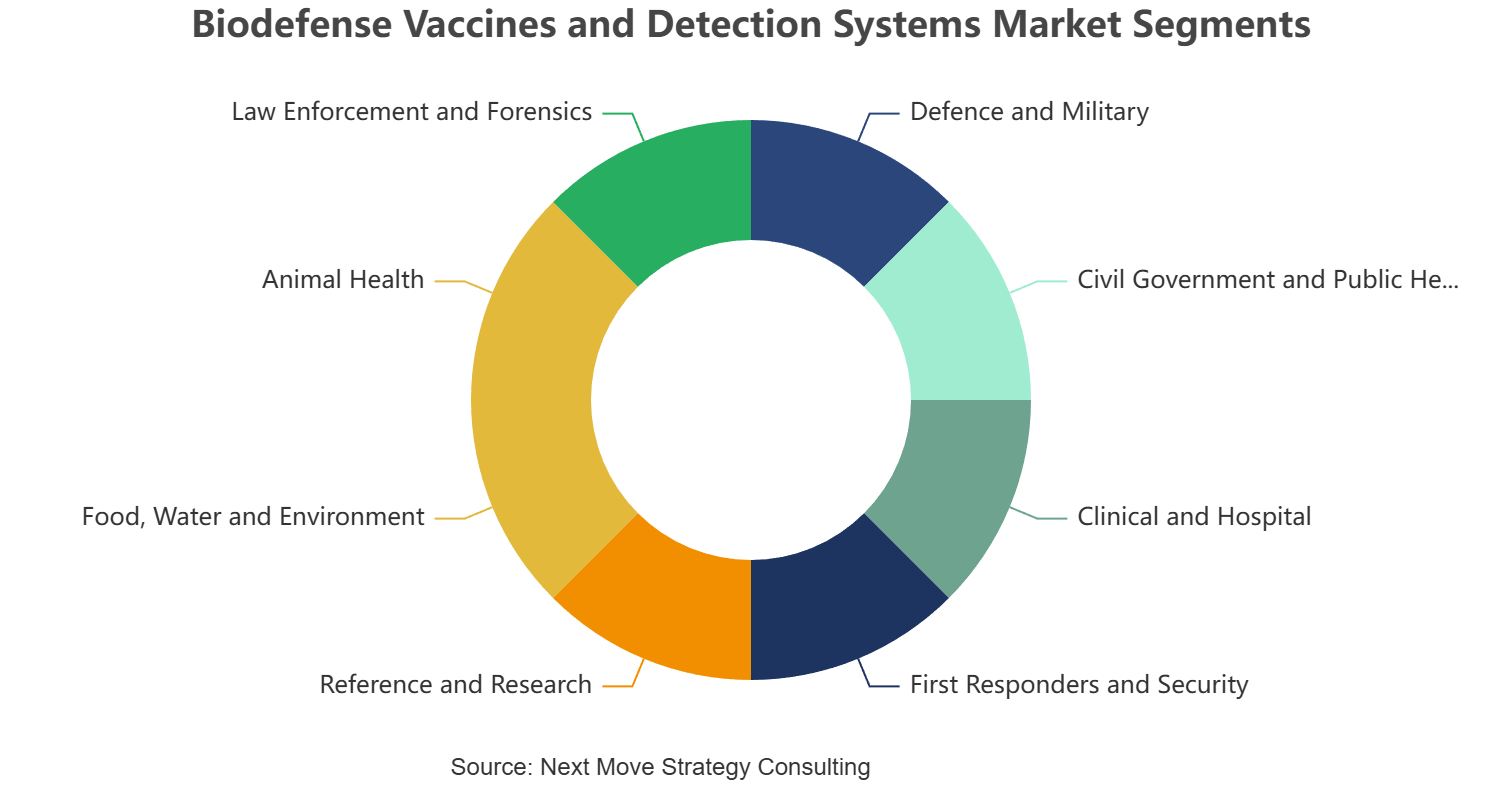
Defence and Military buyers led the market with USD 3.35 billion in 2025, reflecting sustained CBRN readiness and biopreparedness stockpiling budgets across NATO and allied procurement programs. Based on research conducted by Next Move Strategy Consulting, we found that Food, Water and Environment is the fastest-growing buyer type, expanding at a 14.6% CAGR from 2026 to 2035, as agricultural and environmental agencies scale biosurveillance testing to protect food and water supply chains.
Growth Opportunities
Our analysis shows that three forward-looking opportunities stand out for stakeholders positioning within the biodefense vaccines and detection systems market over the 2026–2035 forecast period.
How Can Multiplex Field-Deployable Detection Unlock Value for First Responders?
Multiplex, ruggedized detection instruments capable of identifying multiple biological agents in a single field test present a whitespace opportunity for suppliers serving first responder and security buyers. Vendors that commercialize portable, battery-operated biosensor and PCR platforms stand to capture recurring cartridge and calibration-service revenue as emergency response agencies replace single-agent legacy detectors.
Where Do Emerging-Market Response Vaccine Programs Create New Demand?
Emerging economies facing recurring chikungunya, cholera, and rabies outbreaks represent an underpenetrated opportunity for response vaccine manufacturers. Serum Institute of India Pvt. Ltd. and Bharat Biotech International Limited are positioned to expand regional manufacturing partnerships, benefiting from Gavi-aligned procurement programs and growing outbreak-response funding across Asia-Pacific and Africa.
How Can Biosurveillance Software Platforms Benefit Public Health Agencies?
Civil government and public health agencies seeking integrated outbreak monitoring create an opportunity for software and informatics vendors offering interoperable surveillance and analysis platforms. Early movers that secure interoperability with national health information systems can differentiate with reference laboratories and public health agencies pursuing real-time biosurveillance dashboards across their public health infrastructure investments.
Regional Outlook
Geographic Performance Snapshot
|
Region |
2025 (USD) |
2035 (USD) |
CAGR% (2026–2035) |
Key Driver |
|
North America |
USD 4.70 Billion |
USD 12.50 Billion |
11.5% |
BARDA and Project BioShield stockpiling programs |
|
Europe |
USD 3.35 Billion |
USD 8.60 Billion |
11.0% |
EU HERA joint procurement and REACH-aligned biosecurity rules |
|
Asia-Pacific |
USD 2.85 Billion |
USD 10.80 Billion |
16.0% |
Expanding domestic vaccine manufacturing and public health investment |
|
Middle East & Africa |
USD 1.05 Billion |
USD 2.70 Billion |
11.1% |
Gulf biosecurity diversification and outbreak-response funding |
|
Latin America |
USD 0.45 Billion |
USD 1.30 Billion |
12.5% |
Growing public health laboratory modernization |
|
Total |
USD 12.40 Billion |
USD 35.90 Billion |
11.2% |
-- |
North America Biodefense Vaccines and Detection Systems Market Outlook
North America leads the biodefense vaccines and detection systems market with an established government procurement infrastructure and mature countermeasure stockpiling programs. We observed that BARDA contract modifications for CYFENDUS and JYNNEOS sustain demand for both countermeasure vaccines and companion detection instrumentation, while defence agencies increasingly specify integrated biosurveillance platforms. Technology adoption remains advanced, with sample-to-answer molecular systems driving demand across the region's public health laboratory network.
Europe Biodefense Vaccines and Detection Systems Market Outlook
Europe's biodefense vaccines and detection systems market reflects a coordinated but regulation-intensive landscape shaped by the European Commission's HERA framework and national public health preparedness mandates. Our findings suggest that member states across Germany, France, and the UK are accelerating joint procurement of mpox and smallpox vaccines alongside detection instrumentation to satisfy cross-border biosecurity obligations. Technology adoption favors interoperable surveillance software, supported by regional laboratories investing in EMA-aligned validation pipelines.
Asia-Pacific Biodefense Vaccines and Detection Systems Market Outlook
Asia-Pacific is the fastest-growing biodefense vaccines and detection systems market region, propelled by expanding domestic vaccine manufacturing in India and China and rising public health infrastructure investment. We found that regulatory frameworks remain less harmonized than in Europe, giving manufacturers flexibility to scale response vaccine and detection instrument production rapidly. Technology adoption is accelerating as regional developers, including several India-based vaccine manufacturers, expand export capacity to serve global outbreak-response demand.
Middle East & Africa Biodefense Vaccines and Detection Systems Market Outlook
The biodefense vaccines and detection systems market in Middle East & Africa is expanding as Gulf Cooperation Council economies diversify into domestic biosecurity manufacturing and outbreak-response readiness rises. Our analysis shows that Saudi Arabia and the UAE are attracting investment tied to regional biopreparedness stockpiling. Regulatory influence remains moderate, while technology adoption is gradually shifting toward imported detection instrumentation as regional health authorities align with global surveillance standards.
Latin America Biodefense Vaccines and Detection Systems Market Outlook
Latin America's biodefense vaccines and detection systems market is supported by growing public health laboratory modernization in Brazil and Argentina and expanding regional disease-surveillance infrastructure. We observed that regulatory frameworks are less stringent than in North America or Europe, though national health ministries operating locally are introducing expanded response vaccine procurement. Technology adoption remains centered on core PCR-based detection, with competitive intensity increasing as regional distributors partner with global diagnostics suppliers to expand product breadth.
U.S. Biodefense Vaccines and Detection Systems Market
Based on our estimates, the U.S. market was valued at approximately USD 3.85 billion in 2025 and is projected to reach USD 9.85 billion by 2035, growing at an 11.0% CAGR. Demand is anchored by mature BARDA and Project BioShield stockpiling programs and high defence biopreparedness spending. Technology penetration favors sample-to-answer molecular detection, and competitive intensity remains high among established countermeasure suppliers serving federal procurement channels.
Canada Biodefense Vaccines and Detection Systems Market
The market in Canada reached roughly USD 550 million in 2025 and is forecast to hit USD 1.55 billion by 2035 at a 12.2% CAGR. Demand structure mirrors U.S. federal biopreparedness procurement patterns, while the Public Health Agency of Canada's ten-year vaccine supply framework shapes countermeasure specifications. Technology penetration is rising as national laboratories request integrated detection platforms, with competitive intensity moderate given reliance on established international vaccine suppliers.
UK Biodefense Vaccines and Detection Systems Market
As per our estimate, the UK market stood at about USD 680 million in 2025, advancing toward USD 1.65 billion by 2035 at a 10.4% CAGR. Demand is driven by national biosecurity strategy investment and participation in HERA-coordinated procurement despite being outside the EU. Regulatory influence is significant, technology penetration favors advanced sequencing-based detection, and competitive intensity remains steady among domestic and European suppliers serving UK health authorities.
Germany Biodefense Vaccines and Detection Systems Market
According to our analysis, Germany's market was valued near USD 820 million in 2025 and is set to reach USD 2.05 billion by 2035, expanding at a 10.7% CAGR. Demand structure benefits from a strong domestic public health laboratory network and robust federal biopreparedness budgets. Germany's participation in EU HERA joint procurement drives regulatory influence, while technology penetration favors advanced molecular detection among leading national reference laboratories.
France Biodefense Vaccines and Detection Systems Market
Based on our estimates, France's market reached approximately USD 580 million in 2025, projected to climb to USD 1.42 billion by 2035 at a 10.5% CAGR. Demand is supported by France's prominent national public health institute network, which shapes vaccine stockpiling and detection instrumentation adoption. Regulatory influence from national biosecurity legislation is notable, and competitive intensity remains high given the concentration of European diagnostics suppliers serving French laboratories.
China Biodefense Vaccines and Detection Systems Market
The market in China stood at roughly USD 950 million in 2025 and is forecast to reach USD 4.35 billion by 2035, registering an 18.4% CAGR. Demand is fueled by expanding domestic public health infrastructure investment and a growing base of regional vaccine and detection instrument manufacturers. Regulatory influence is increasing gradually, technology penetration is accelerating through domestic production upgrades, and competitive intensity remains elevated among numerous China-based suppliers.
India Biodefense Vaccines and Detection Systems Market
As per our estimate, India's market was valued at about USD 420 million in 2025, projected to reach USD 2.15 billion by 2035 at a 19.8% CAGR, the fastest among covered countries. Demand structure reflects expanding domestic vaccine manufacturing capacity and rising public health surveillance investment. Regulatory influence remains developing, while technology penetration is rising quickly as domestic manufacturers such as Serum Institute of India scale response vaccine production to serve regional outbreak-response needs.
Japan Biodefense Vaccines and Detection Systems Market
According to our analysis, Japan's market reached close to USD 550 million in 2025 and is expected to hit USD 1.55 billion by 2035, growing at a 12.2% CAGR. Demand is supported by Japan's advanced public health laboratory network and precision diagnostics manufacturing heritage. Regulatory influence is well established, technology penetration is advanced, and competitive intensity remains high among long-standing domestic instrumentation manufacturers.
South Korea Biodefense Vaccines and Detection Systems Market
Based on our estimates, South Korea's market stood at approximately USD 350 million in 2025, forecast to reach USD 1.05 billion by 2035 at a 13.0% CAGR. Demand structure benefits from the country's globally influential molecular diagnostics industry and strong export momentum. Technology penetration is high, with domestic developers supplying advanced detection platforms, and competitive intensity remains pronounced amid rapid product innovation cycles.
Australia Biodefense Vaccines and Detection Systems Market
The biodefense vaccines and detection systems market in Australia reached about USD 280 million in 2025 and is projected to reach USD 780 million by 2035, expanding at a 12.1% CAGR. Demand is supported by a well-established public health laboratory sector and growing biosecurity investment tied to agricultural and border protection priorities. Regulatory influence stems from national biosecurity legislation, while technology penetration favors imported detection systems amid moderate competitive intensity.
UAE Biodefense Vaccines and Detection Systems Market
As per our estimate, the UAE market was valued near USD 220 million in 2025, projected to reach USD 620 million by 2035 at a 12.3% CAGR. Demand structure is shaped by the UAE's role as a regional health security and diagnostics distribution hub. Regulatory influence remains moderate, technology penetration is improving through imported instrumentation, and competitive intensity is rising as distributors expand product portfolios to serve Gulf markets.
Saudi Arabia Biodefense Vaccines and Detection Systems Market
According to our analysis, Saudi Arabia's market reached roughly USD 280 million in 2025 and is expected to hit USD 800 million by 2035, growing at a 12.4% CAGR. Demand is driven by Vision 2030-linked biosecurity diversification and rising national public health laboratory investment. Regulatory influence is developing under national health authority guidelines, and technology penetration is advancing as domestic laboratories scale detection capacity.
South Africa Biodefense Vaccines and Detection Systems Market
Based on our estimates, South Africa's market stood at about USD 120 million in 2025, forecast to reach USD 300 million by 2035 at a 10.7% CAGR. Demand structure reflects a developing public health laboratory base serving regional Southern African biosurveillance needs. Regulatory influence remains moderate, technology penetration is gradually improving, and competitive intensity is limited given reliance on imported detection components from Europe and Asia.
Brazil Biodefense Vaccines and Detection Systems Market
The market in Brazil reached approximately USD 240 million in 2025 and is projected to reach USD 680 million by 2035, registering a 12.3% CAGR. Demand is underpinned by Brazil's large domestic public health system and expanding national laboratory network. Regulatory influence stems from national health surveillance policy, technology penetration favors standard PCR-based detection, and competitive intensity remains moderate among regional diagnostics suppliers.
Argentina Biodefense Vaccines and Detection Systems Market
As per our estimate, Argentina's market was valued near USD 90 million in 2025, projected to reach USD 240 million by 2035 at an 11.5% CAGR. Demand structure is supported by steady public health laboratory investment despite macroeconomic volatility. Regulatory influence remains limited, technology penetration is modest, and competitive intensity is centered on a small number of regional distributors serving national health ministries.
Strategic Framework of the Biodefense Vaccines and Detection Systems Market
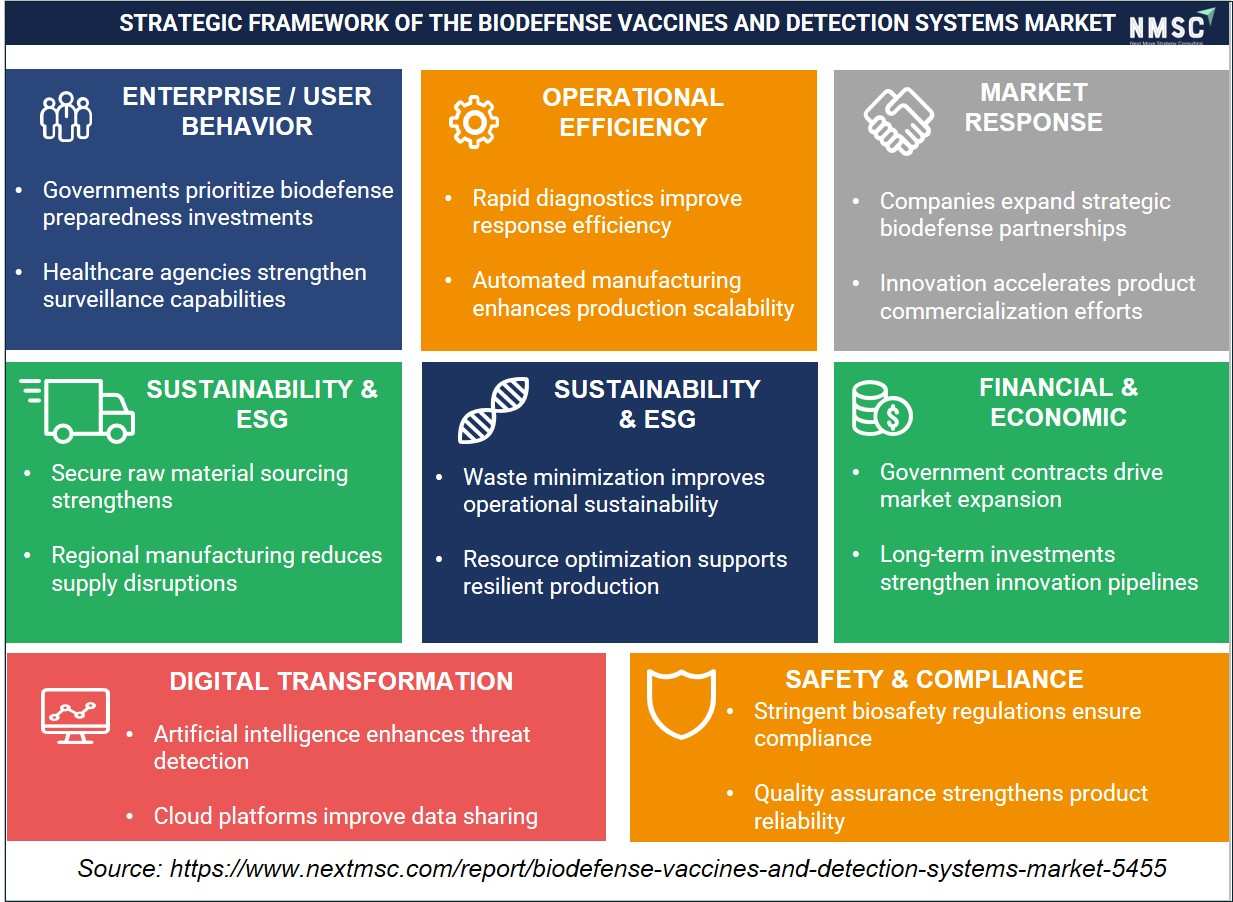
Based on our strategic assessment, we identified that end-user priorities, operational efficiency, market response, supply chain resilience, sustainability initiatives, financial investments, digital transformation, and regulatory compliance collectively shape the biodefense vaccines and detection systems market. Moreover, our industry evaluation highlights that government preparedness programs, rapid diagnostics, strategic partnerships, resilient manufacturing, AI-enabled threat detection, long-term public investments, and stringent biosafety standards improve response capabilities, strengthen operational resilience, accelerate commercialization, and drive sustainable market expansion.
Competitive Landscape
We observed that the biodefense vaccines and detection systems market features a moderately consolidated competitive landscape, with global diagnostics and vaccine specialists competing alongside diversified defence and life science conglomerates on procurement scale, regulatory track record, and platform breadth.
|
Key Takeaways |
|
Market Structure: Moderately consolidated; the top companies profiled in this report collectively account for a majority of global biodefense vaccines and detection systems market revenue, while specialized regional vaccine developers serve outbreak-response demand in emerging economies. |
|
Innovation Focus: Sample-to-answer molecular detection, multiplexed biosensor platforms, and pediatric label expansion for countermeasure vaccines dominate current innovation pipelines across leading suppliers. |
|
M&A Activity: Selective consolidation through platform and portfolio acquisitions, exemplified by diversified life science groups expanding molecular diagnostics and biosurveillance capabilities via bolt-on technology acquisitions. |
How Do Companies Compete in the Biodefense Vaccines and Detection Systems Market?
Companies compete primarily on government contract track record, regulatory approval breadth, and manufacturing scale across the industry. Global players such as Thermo Fisher Scientific Inc. and Danaher Corporation leverage broad instrument and consumables portfolios to serve multinational public health buyers, while specialized vaccine developers such as Bavarian Nordic A/S and Emergent BioSolutions Inc. compete on BARDA and HERA contract retention for niche countermeasure indications.
Which Competitive Archetypes Dominate the Biodefense Vaccines and Detection Systems Market?
Two archetypes dominate the market: diversified life science and diagnostics conglomerates offering full-service instrument, consumables, and software portfolios, and specialized biodefense vaccine developers focused on government stockpiling contracts. Danaher Corporation and Becton, Dickinson and Company exemplify the diversified archetype through integrated detection ecosystems, while Bavarian Nordic A/S and Valneva SE exemplify the specialized vaccine-developer archetype serving niche countermeasure and response indications.
How Are Companies Differentiating Through Innovation in Biodefense?
Innovation and differentiation strategy increasingly center on rapid molecular detection and expanded vaccine label indications. Thermo Fisher Scientific's tribrid mass spectrometry platform and Bavarian Nordic's pediatric MVA-BN label extension both aim to widen addressable procurement scope. Our analysis shows that suppliers unable to demonstrate validated regulatory pathways risk exclusion from government tender shortlists across North America and Europe.
What M&A and Expansion Activity Is Shaping the Market?
Mergers, acquisitions, and geographic expansion continue to consolidate biodefense capabilities within the industry. Diversified life science groups have pursued bolt-on acquisitions to broaden molecular diagnostics and biosurveillance software capabilities, while vaccine developers such as Bharat Biotech International Limited and Serum Institute of India Pvt. Ltd. pursue regional manufacturing partnerships to expand geographic reach and pricing leverage across defence, public health, and clinical end markets.
Key Market Players
Our assessment indicates that the following 20 companies are actively shaping product innovation, contract retention, and geographic expansion strategy within the global biodefense vaccines and detection systems market.
-
Bavarian Nordic A/S
-
Emergent BioSolutions Inc.
-
bioMérieux SA
-
Danaher Corporation
-
Roche Holding AG
-
QIAGEN N.V.
-
Smiths Group plc
-
Becton, Dickinson and Company
-
Abbott Laboratories
-
QuidelOrtho Corporation
-
Revvity, Inc.
-
Teledyne Technologies Incorporated
-
Chemring Group plc
-
BAE Systems plc
-
Merck & Co., Inc.
-
Valneva SE
-
Serum Institute of India Pvt. Ltd.
-
Bharat Biotech International Limited
Latest Developments
We found that recent developments within the biodefense vaccines and detection systems market are concentrated on countermeasure contract renewals and next-generation detection instrument launches, reflecting the industry's sustained government procurement momentum.
|
Date |
Event |
|
July 2026 |
Smiths Detection officially completed its transition and multi-billion-dollar corporate carve-out from Smiths Group plc to CVC Capital Partners, unlocking independent capital investment for advanced threat-detection, biological screening, and security infrastructure technologies. |
|
March 2026 |
Bruker Corporation showcased its latest high-performance analytical mass spectrometry and detection systems at Analytica 2026, delivering enhanced specificity and automated workflows for environmental pathogen screening and biological threat identification. |
Expert Insights

“Security and equity are at the heart of the 100 Days Mission—a strategy for the world to develop new vaccines against any emerging epidemic threat, regardless of whether it arises naturally, accidentally or due to deliberate misuse, and to do that quickly enough to prevent or mitigate deadly pandemics.”
— Jane Halton, Chair, Coalition for Epidemic Preparedness Innovations (CEPI)
Statement made during the launch of CEPI's Biosecurity Strategy (2024), highlighting the importance of accelerating vaccine development against both naturally occurring and deliberate biological threats.
Market Interpretation
The statement underscores the increasing global emphasis on strengthening biodefense preparedness through rapid vaccine development capabilities. As concerns over emerging infectious diseases and potential biological threats continue to grow, governments and public health organizations are prioritizing investments in next-generation vaccine platforms, accelerated R&D, and resilient manufacturing infrastructure. This strategic focus is expected to drive innovation and sustained growth in the biodefense vaccines and detection systems market by enhancing preparedness, surveillance, and rapid response capabilities.
Investment Opportunities
What Capital Inflows Are Targeting the Biodefense Vaccines and Detection Systems Market?
Capital inflows into the market are increasingly directed toward molecular detection platform development and expanded vaccine manufacturing capacity. Government biopreparedness agencies, including BARDA and the European Commission's HERA, continue to fund countermeasure stockpiling and technology development through structured contract awards. We observed that investors favor suppliers demonstrating validated regulatory pathways, viewing government contract retention as a proxy for long-term revenue stability.
How Is Infrastructure Investment Supporting Biodefense Manufacturing?
Infrastructure investment is expanding vaccine fill-finish and molecular instrument assembly capacity across North America, Europe, and Asia-Pacific to serve rising government demand. Our findings suggest that regional manufacturers, including Serum Institute of India, are investing in scaled production lines to support both domestic public health programs and international outbreak-response commitments, supporting the precision required for high-volume countermeasure vaccine batches.
What ESG Considerations Are Shaping Biodefense Investment Decisions?
Environmental, social, and governance considerations are increasingly central to investment decisions across the industry, with equitable global vaccine access and laboratory biosafety compliance as key criteria. The World Health Organization's International Health Regulations continue to inform biosurveillance governance disclosures. We found that investors increasingly favor manufacturers with transparent biosafety and quality certification, treating it as a governance indicator alongside labor and regulatory compliance.
Key Benefits for Stakeholders
How Does This Report Benefit Enterprise and Industry Leaders?
Enterprise and industry leaders gain access to validated segmentation, competitive benchmarking, and regional demand forecasts that support procurement and product-portfolio decisions across the biodefense vaccines and detection systems industry. Our analysis shows that detailed buyer-type, sales-channel, and revenue-type breakdowns help business development teams align specifications with government tender requirements while identifying underserved buyer segments for portfolio expansion.
How Does This Report Benefit Investors and Financial Analysts?
Investors and financial analysts benefit from consistent, single-point market size and CAGR estimates that support valuation and capital-allocation decisions across the biodefense supply chain. We observed that the report's regional and segment-level growth differentials help identify which vaccine developers and detection instrument suppliers are best positioned to capture above-market growth in response vaccines and consumables categories through 2035.
How Does This Report Benefit Technology Vendors and Product Teams?
Technology vendors and product teams gain insight into emerging design requirements, including sample-to-answer molecular platforms, multiplexed biosensors, and pediatric label expansion, that are reshaping the industry. Our findings suggest that this analysis helps R&D teams prioritize development roadmaps around regulatory validation and field-deployable detection formats that are increasingly required by government tender processes.
Key Market Segments
By Vaccines
-
Countermeasure Vaccines
-
Anthrax
-
Smallpox and Mpox
-
Ebola
-
Other Countermeasure Vaccines
-
-
Response Vaccines
-
Chikungunya
-
Cholera and Typhoid
-
Rabies
-
Other Response Vaccines
-
By Detection Systems
-
Instruments
-
Sample-to-Answer Systems
-
Real-Time PCR Systems
-
Biosensors
-
Mass Spectrometers
-
Sequencers
-
Other Instruments
-
-
Consumables and Assays
-
Cartridges
-
Immunoassays
-
Sample Prep Kits
-
Other Assays
-
-
Software and Informatics
-
Surveillance Software
-
Analysis and Reporting
-
Middleware
-
-
Services
-
Installation and Validation
-
Maintenance and Support
-
Training
-
Managed Testing
-
By Buyer Type
-
Defence and Military
-
Civil Government and Public Health
-
Clinical and Hospital
-
First Responders and Security
-
Reference and Research
-
Food, Water and Environment
-
Animal Health
-
Law Enforcement and Forensics
By Sales Channel
-
Direct Tender
-
Contract Vehicle
-
Distributor
-
OEM
-
Service Contract
-
Online
By Revenue Type
-
Product Sale
-
Consumables Sale
-
Software License
-
Service Contract
-
Development Funding
By Region
-
North America: U.S., Canada, Mexico
-
Europe: UK, Germany, France, Italy, Spain, Sweden, Denmark, Finland, Netherlands, Rest of Europe
-
Asia-Pacific: China, India, Japan, South Korea, Taiwan, Indonesia, Vietnam, Australia, Philippines, Malaysia, Rest of APAC
-
Middle East & Africa: Saudi Arabia, UAE, Egypt, Israel, Turkey, Nigeria, South Africa, Rest of MEA
-
Latin America: Brazil, Argentina, Chile, Colombia, Rest of LATAM
Conclusion and Recommendations
What Is the Long-Term Outlook for the Biodefense Vaccines and Detection Systems Market?
The long-term outlook for the market remains positive, with global revenue projected to nearly triple from USD 12.40 billion in 2025 to USD 35.90 billion by 2035 at an 11.2% CAGR. We observed that sustained government biopreparedness funding, recurring outbreak activity, and expanding molecular detection adoption collectively support durable double-digit growth across both the vaccines and detection systems product families through the forecast period.
What Strategic Positioning Should Suppliers Pursue?
Suppliers should pursue strategic positioning that bundles countermeasure vaccine supply with companion detection instrumentation to strengthen government contract retention. Our assessment indicates that vendors offering integrated stockpiling-and-surveillance solutions are better positioned to win multi-year BARDA and HERA framework agreements than single-product specialists, particularly as procurement agencies consolidate vendor relationships to simplify biopreparedness logistics.
How Attractive Is the Market for New Investment?
Investment attractiveness remains strong given durable government funding cycles and the market's insulation from typical consumer demand volatility. We found that detection systems, particularly consumables and assays, offer especially attractive recurring-revenue characteristics as installed instrument bases expand across public health and defence laboratories, supporting predictable long-term capital returns for suppliers and investors alike.
What Market Shifts and Key Risks Should Stakeholders Monitor?
Stakeholders should monitor shifting public health budget priorities and lengthy regulatory approval cycles as key risks to near-term growth. Our analysis shows that geopolitical shifts affecting defence and biosecurity spending allocations, alongside potential delays in novel countermeasure approvals, represent the principal sources of forecast variability across the biodefense vaccines and detection systems market through 2035.
What Are the Key Growth Pathways Through 2035?
Key growth pathways include expanding pediatric and broadened-population vaccine labels, scaling field-deployable multiplex detection instruments, and deepening public-private manufacturing partnerships in emerging economies. We observed that suppliers pursuing these pathways, combined with sustained BARDA, HERA, and allied government procurement commitments, are best positioned to capture above-market growth across the forecast period.
About the Author
 Saista Faiyaz
— Saista Faiyaz is Research Associate at Next Move Strategy Consulting, where she has covered consumer markets and healthcare technologies for 3 years. Her work includes primary interview review, secondary-source validation, market sizing, and structured analysis of company and industry data. She supports research by comparing evidence across sources, organizing findings into market narratives, and documenting assumptions used in analysis. Her scope includes cross-market benchmarking, and reports.
Saista Faiyaz
— Saista Faiyaz is Research Associate at Next Move Strategy Consulting, where she has covered consumer markets and healthcare technologies for 3 years. Her work includes primary interview review, secondary-source validation, market sizing, and structured analysis of company and industry data. She supports research by comparing evidence across sources, organizing findings into market narratives, and documenting assumptions used in analysis. Her scope includes cross-market benchmarking, and reports.
About the Reviewer
 Supradip Baul
— Supradip Baul is an accomplished business consultant and strategist with over a decade of rich experience in market intelligence, strategy, technology, and business transformation. His work has included rigorous qualitative and quantitative analysis across multiple industries, helping clients shape investment decisions and long-term roadmaps. Earlier in his career, he was associated with Gartner, where he contributed to industry-leading reports and market share analyses. He has worked with leading global companies and holds an MBA with a dual specialization in Marketing and Finance.
Supradip Baul
— Supradip Baul is an accomplished business consultant and strategist with over a decade of rich experience in market intelligence, strategy, technology, and business transformation. His work has included rigorous qualitative and quantitative analysis across multiple industries, helping clients shape investment decisions and long-term roadmaps. Earlier in his career, he was associated with Gartner, where he contributed to industry-leading reports and market share analyses. He has worked with leading global companies and holds an MBA with a dual specialization in Marketing and Finance.
At Next Move Strategy Consulting, we understand that insightful market research is the cornerstone of successful business decisions. That's why we employ a robust and multifaceted approach, combining various methodologies to deliver the most accurate and actionable data for our clients.

Research Landscape
We navigate the world of research with two primary approaches:
Qualitative Approach
Our qualitative research methodologies involve immersive techniques such as in-depth interviews, focus groups, and observational studies. By engaging directly with individuals and stakeholders, we uncover valuable insights that quantitative data alone may overlook.

Quantitative Research
In tandem with qualitative methodologies, NMSC leverages the power of Quantitative Research to provide a robust foundation of numerical insights. Through systematic data collection and analysis, we quantify patterns, preferences, and market trends, offering a comprehensive view of the business landscape.
Our quantitative research approach employs diverse tools, including surveys, experiments, and statistical modelling. These methodologies enable us to gather data from a large and representative sample, ensuring the statistical significance of our findings. By employing structured questionnaires and standardized data collection methods, we guarantee the reliability and validity of the information we present to our clients.
Quantitative research is particularly effective in measuring the prevalence of trends, assessing market size, and gauging the impact of various factors on consumer behavior. The numerical precision attained through this approach equips our clients with actionable insights, facilitating data-driven decision-making and strategy formulation.


Our Specialized Toolbox for Industry-Specific Market Research
We deploy a specialized arsenal of techniques tailored to meet your unique requirements. Here's a glimpse into our comprehensive toolbox:

Information Procurement
The stage entails acquiring market data or relevant information through various sources and methodologies.


Market Research Approach
We utilize both top-down and bottom-up approaches in market research analysis to achieve a comprehensive understanding of the market dynamics, leveraging the broad perspective of industry trends and macroeconomic factors alongside detailed insights from specific segments and individual companies.

Porters Five Forces Analysis
We conduct Porter's Five Forces analysis to evaluate the competitive landscape of an industry, providing us with insights into factors that affect profitability and strategic positioning.

SWOT Analysis

Forecasting
We utilize a forecasting model to predict future consumption by considering parameters like population, economics, regulations, market competition, drivers, constraints, technology, and pricing. We also employ statistical techniques such as multilinear regression, exponential smoothing, moving average, ARIMA, and Monte Carlo simulations for accurate predictions. In econometric forecasting, we analyzed short-term and long-term event impacts, attributing values based on regulatory frameworks, economic factors, and market events.





 Speak to Our Analyst